Air handling systems can be specialists or generalists; some are designed to do one thing very well while others are more adaptable but not as precise. Fan type plays a big role in determining a sprayer’s abilities. Their native characteristics make them better suited to certain scenarios.
This may seem contradictory, but we are not saying that the fan alone defines or limits the entire sprayer. Fans operate within a larger, engineered air handling system. Also, the operator has control over how that sprayer is configured and used. This means it is equally important to consider how the air exits the sprayer – not just the fan type that generated it.
Fan types
Radial fans: Radial fans produce high volumes of moderately turbulent air, and relatively low static pressures. They are often associated with fixed vanes and straighteners inside the fan housing to reduce initial turbulence.
Turbines: Turbines may look like radial fans but they’re designed to spin faster and they have blades designed to compress air. They are used in sprayers that have ducts, towers, cannons, or other more complex volutes.
Straight-through axial fans: These fans produce high volumes of the most turbulent air. With their comparatively short throw and wide air wash, they should be positioned close to the target.
Tangential (aka Cross-flow) fans: Tangentials produce the most laminar air, forming a very high volume, low velocity jet sometimes called a “curtain” or “knife”. They have a comparatively long throw and rely on the canopy to induce turbulence.
Centrifugal (aka Squirrel cage) fans: Centrifugal fans have a side-discharge arrangement that turns air 90 degrees. They can produce high pressures and are nearly always paired with an air-shaping volute.
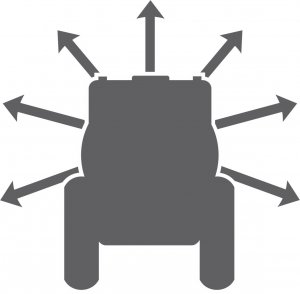
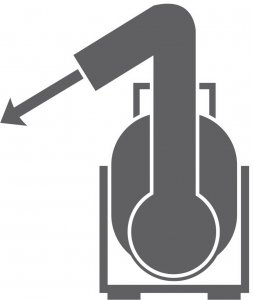
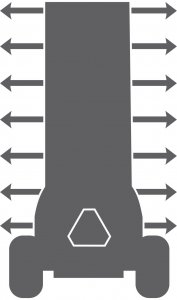
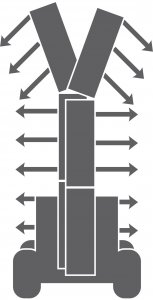
We are proposing defining air-assist sprayers for perennial crops according to their air handling systems. Ultimately, the defining characteristic of each design is the net vector of the air they generate. We have provided silhouettes for clarity, but these generic designs are not intended to imply a manufacturer.
Low profile radial
The oldest and perhaps most recognizable air handling design, the Low Profile Radial (LPR) sprayer generates air in a radial pattern from one or more axial fans or a volute connected to some other fan style. This is the classic airblast sprayer.
Defining characteristics
Wide range of adjustable air energies from virtually zero to high.
Minor adjustability of air vectors via deflectors and moveable outlets.
Net air movement is lateral and upward.
Cannon
The Cannon (CN) sprayer generates and channels air through a single volute and delivers the spray as a compact, point-source jet.
Defining characteristics
High air energy characterized by high velocity and low volume.
Extensive adjustability of air vector via a vertical duct with positional outlet and deflector(s).
Usually a single-sided sprayer used to spray over and through multiple rows.
Fixed tower
The Fixed Tower (FT) sprayer generates air from one or more axial fans, multiple straight-through radial or tangential fans. It may employ flexible tubes, tapered bags or solid ducts to redirect air laterally from a fixed central tower. It may feature additional flexible ducts or adjustable deflectors at the top of the tower to spray over and beyond the adjacent rows.
Defining characteristics
Wide range of adjustable air energies from virtually zero to high.
Minor adjustability of air vectors via deflectors and moveable outlets.
Net air movement is lateral compared to LPR sprayers.
Targeting tower
Similar to the FT, the Targeting Tower (TT) sprayer can focus air vectors with a wider range of adjustability, shaping the lateral air output more precisely to the canopy. TT generates air from one or more radial fans or multiple tangential or straight-through axial fans. It may employ flexible tubes or solid ducts to redirect air generally laterally.
Defining characteristics
Medium to high air energy.
Moderate to high adjustability of air vectors. Airflow can be subdivided into individually-adjustable sections.
When the tower exceeds canopy height, net air movement is lateral to slightly downward.
Wrap-around
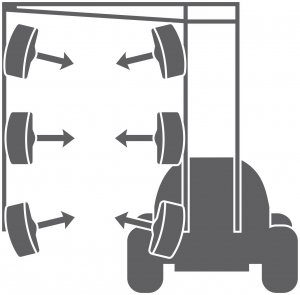
The Wrap-Around (WA) sprayer surrounds the target rows with air sources. This creates multiple converging and/or opposing airflows within the row.
Defining characteristics
Straight-through axial fan systems are either electric or hydraulic with a wide range of air energies.
Low to high adjustability of air vector via deflectors, moveable air outlets, or fan position adjustments. May also have an adjustable frame.
Net air movement is ideally neutral to slightly downward.
Summary
In adopting this system of classification, we believe the process of optimizing sprayer configuration and calibration can be made less complicated. A universal language facilitates clear communication between growers, industry and consultants/specialists.
We acknowledge that there may be rare sprayers that don’t fit these categories. There are commercial examples of air-assist sprayers that combine features from these air-handling designs (e.g. hybrids of LPR and FT designs)… but let’s keep things simple.
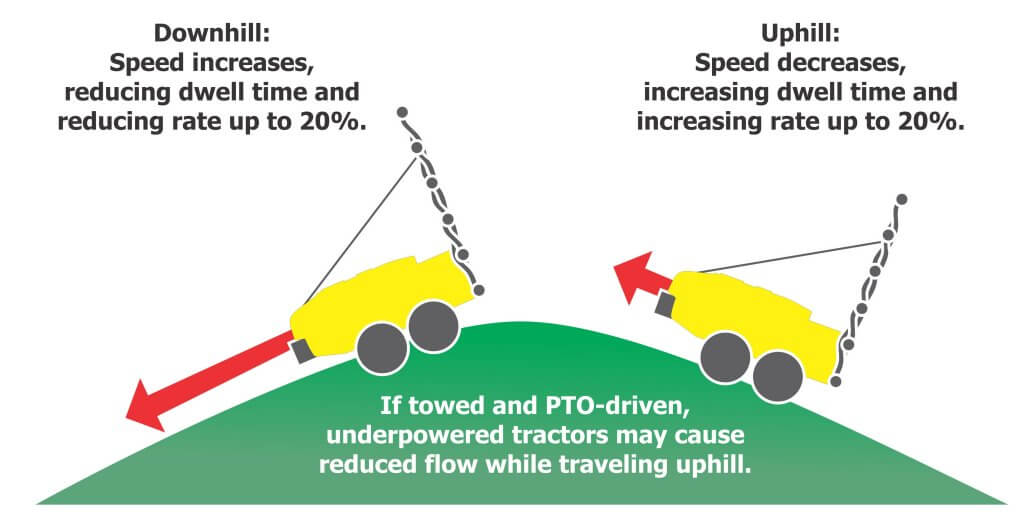
There are many advantages to using rate controllers, but their primary role is to maintain a constant application rate. All sprayers change speed on hills, at row-ends, or in response to surface conditions. Since flow from an uncontrolled sprayer is constant, the application rate varies significantly (up to 40% in hilly conditions). Rate controllers compensate for changing speed by adjusting flow.
Hilly operations create highly variable application rates. Changes in travel speed can translate to 40% variability in rate applied. Rate controllers adjust flow to compensate.
Pesticide is not saved directly (since increased uphill rates already cancel out reduced downhill rates), but consider the pesticide label. Labels that list a range of rates are contingent on pest pressure and crop size, but also compensate for poor coverage from low-performing equipment. When coverage uniformity is improved, experience has shown that operators can safely spray at minimal rates.
Experience has also demonstrated that when coverage uniformity is improved, pack-out benefits follow. Even a modest improvement represents a quick return on investment. Equally important, a more consistent application reduces the risk of higher residue levels on the uphill and improves crop protection on the downhill.
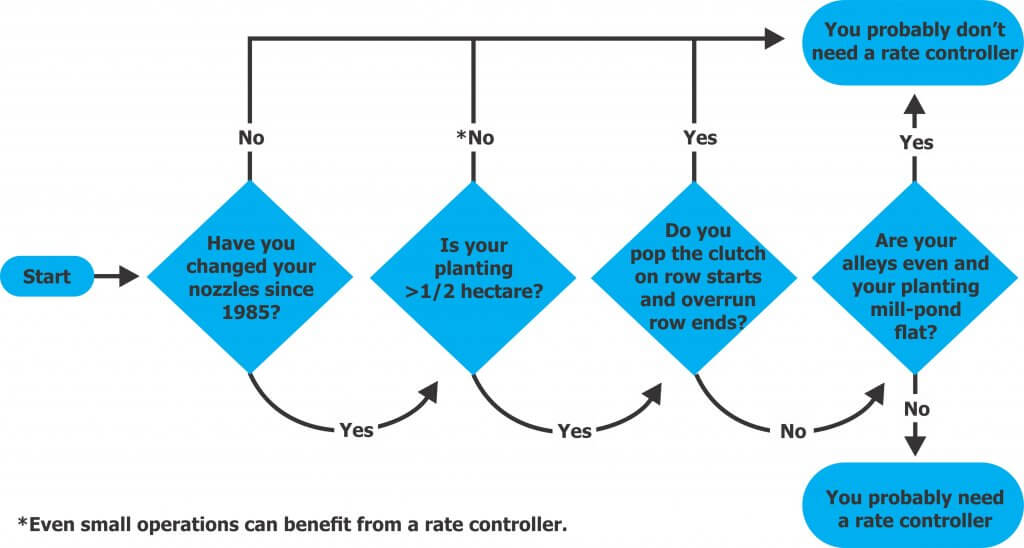
Now, if you are wondering if a rate controller is right for your operation, or if you should just stop reading now, consult this handy decision support matrix:
This decision support matrix will help you decide if a rate controller is right for your operation. Spoiler alert: It probably is.
Rate controller categories
The following table categorizes controllers based on how they control flow. The categories are successively more expensive and complicated, but there’s commensurate value. For example, while not specified here, high-end rate controllers offer value-added features such as as-applied mapping (a powerful management tool).
Description
Pros
Cons
Good: Monitors and adjusts pressure. Uses math to assume flow.
System monitors pressure, but does not register flow. For example, if nozzle flow is restricted, back pressure increases. The controller will compensate to correct pressure, implicitly reducing flow, but the operator is not alerted to the actual problem.
Better: Monitors and adjusts flow, not pressure.
Alerts operator to changes in flow. Operator usually sets the percent error threshold a little high to ignore transient changes.
System will not register pressure deviations. At threshold speed, pressure may drop too low. This can cause inconsistent check valve operation and spray pattern collapse. With tall booms, the top nozzles may close completely.
Best: Monitors flow and pressure and adjusts flow.
-Best likelihood of a consistent application. -Alarms or automatic compensation of flow and pressure (user sets hard stops). -Provides a low tank level warning. -Stores preset calibrations to quickly switch between blocks.
-Highest cost. -Steepest learning curve. -More “wire-wiggling”. -Operators often choose to over-apply at low speeds as a tradeoff for uniform output and consistent atomizer performance.
Rate controller adoption and components
As we write this, less than 10% of air-assist sprayers have rate controllers. In the dark old days of the 1980’s, air-assist operators were ill-advised to install high flow, low pressure field sprayer controllers. That history of mismatched components and subsequent bad experiences continues to hinder widespread adoption.
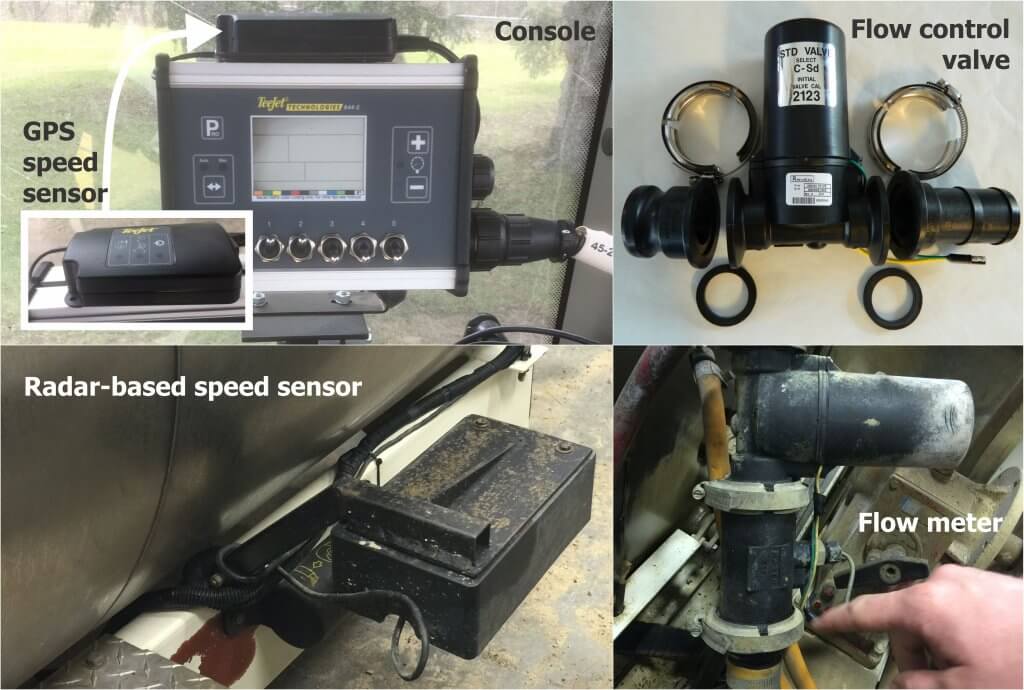
Today’s components, however, are specific to air-assist sprayers and have made installations easier and more successful. Do your homework and speak with the manufacturer (not necessarily the local dealer) to ensure the controller, and all its components, meet your needs. Let’s describe the components so you’re prepared to have the conversation:
Console
Flow meter(s)
Flow control valve (including electric boom shut-offs)
Speed sensor
Wire harness
Examples of rate controller components.
Console
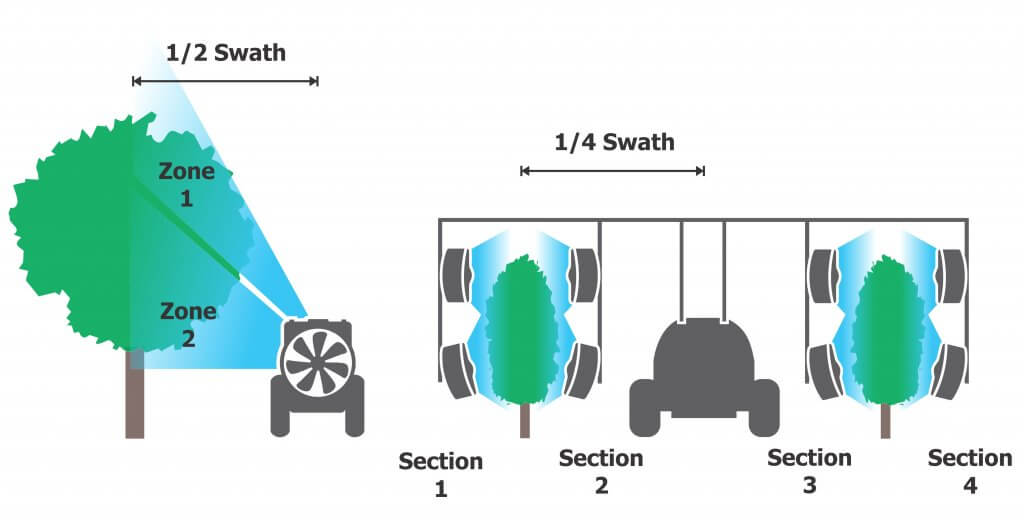
The console is the interface. The user enters criteria about the sprayer, the planting, and calibration data and receives information about sprayer performance. Select a console designed for air-assist sprayers and not field sprayers. Controllers intended for horizontal booms perceive swath in two dimensions, but air-assist controllers account for multiple vertical booms or boom sections in the swath (see the following figure).
Field sprayer rate controllers used in vertical crops must be “tricked” when programming swath. Leading air-assist rate controllers can assign flow to zones on a single vertical section (left) and adjust swath (sometimes called width) for multiple booms (right).
Flow meter
With rate controllers, flow is detected by one or more flow meters positioned pre-manifold. The relief valve becomes more of a safety device, defining the high pressure limit and bypassing flow if required. Most rate controllers use a flowmeter with no ability to monitor pressure. While still effective, adding a pressure sensor ensures nozzles are operating in the desired pressure range.
Turbine or paddle meters are inexpensive and acceptably accurate. They require periodic cleaning because some chemistry can accumulate and interfere with their moving parts. Filtration helps to minimize this issue. Magnetic or ultrasonic meters have no moving parts, higher resolution, wider metering ranges and aren’t affected by the viscosity of the spraying solution or entrained foam. However, they are considerably more expensive than mechanical meters.
Flow control valve
Unlike boom control valves that are open or closed, flow control valves are capable of a range of adjustments. Valve actuation is controlled by 12 volt servomotors. The level of precision depends on the style of valve.
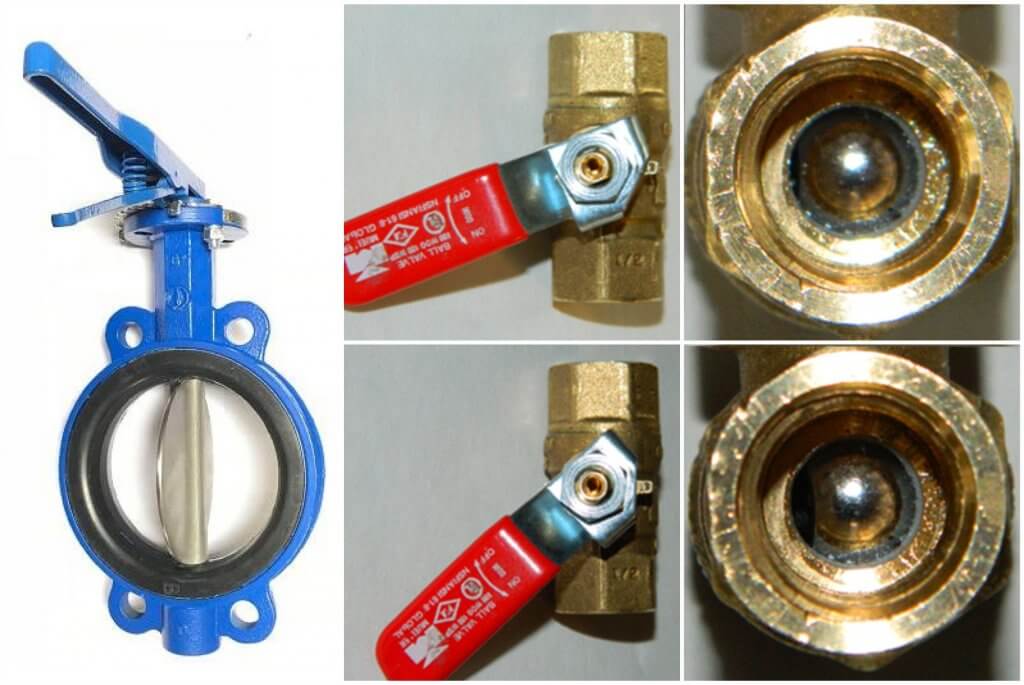
Butterfly valves: Simple, inexpensive, and typically for pressures <10bar (150psi). Some have minor leak-by when closed. Control is less precise as the valve opens because the orifice gets geometrically larger. This gives a narrow metering range.
Calibrated ball valves: Versions available for all pressures. May be simple flow through balls with similar metering limits to a butterfly. A better ball design is also available that offers a linear flow rate through the entire adjustment range, offering more stable rate control over the entire flow range. Several manufacturers offer these. All ball valves offer zero flow when closed.
Left- A butterfly valve. Right- A ball valve. Notice how a small change in the opening angle translates into a large change in the orifice size; this is difficult to control manually. Servomotors not pictured.
Compared to field sprayers, air-assist sprayers travel slower and use lower flow rates. It is a mistake to employ valves intended for high-flow, high-speed sprayers.
Speed: Valves are rated by connection size (½”, ¾”, etc.) and opening time (e.g. 1-14 seconds are common). Many rate controllers can be programmed to optimize adjustments for the speed and size of the valve.
Precision: As control valves open over their 90° range, the ability to control flow is less precise. Slower valves give less precision, but greater stability.
Size: Valve size should accommodate maximum flow and no more. If the valve is too large, it can only meter flow over the first few degrees of opening. For example, let’s say a valve capable of 200 L/min (50 gpm) and rated 1 second is used. Your sprayer meters 0-20 L/min (0-5 gpm). This means the whole metering range happens in the first tenth of a second. Even lightning-fast consoles will give unstable readings (aka hunting) as the computer overshoots the target in an effort to comply.
Control valves are “service parts”. Seals, moving parts and abrasive liquids mean they will require regular care and eventual replacement. It’s a wise precaution to make them accessible and easily removable. We suggest installing them with quick-connects (see top-right of the previous collage of rate controller components above) to make field-maintenance fast and easy.
Speed sensor
Speed can be based on GPS, engine tachometer readings, radar, or wheel rotations. Newer rate controllers may even take the speed directly from the tractor’s data feed. Price, reliability and crop conditions are all factors you should consider in the choice.
GPS: Easiest to deploy, very accurate (especially RTK-GPS) and reasonably priced. However, overhead canopy can block satellite signals. Some controllers compensate for the GPS losses with sophisticated internal kinematic devices that measure the inertia of the sprayer and calculate speed when the GPS is not reliable.
Wheel rotation speed sensors: An entry-level sensor, it’s typically a reed switch or Hall effect sensor that detects either the lug nuts or magnets installed on the rotating wheel. More magnets improve accuracy. Its exposure makes it prone to physical damage, and readings change with tire radius (which changes as the tank empties, on soft ground and with temperature). This is why wheel sensors are calibrated in the alley, with the tank half full and both tires at the same pressure.
Radar speed sensors: Employing the Doppler effect to measure speed, radar is the most accurate sensor. They are unaffected by terrain, slope or tank volume. They can be mounted anywhere in sight of the ground. They are, however, the most expensive and are typically not repairable if they fail.
Tachometer speed sensors: Largely obsolete, they measure the tractor’s tachometer speed and convert it to travel speed. Difficult to install and prone to the same inaccuracy as wheel sensors.
Interface sensors: Relatively new, some rate controllers interface with tractor electronics to receive speed data. ISOBUS, the standard interface language that agricultural electronics are increasingly adopting, makes this data exchange more common.
Wire harness
It may seem we’re drilling deep to mention wires, but standards are changing. Many controllers employ traditional analog wiring, but they are being made obsolete by the newer ISOBUS option.
Traditional Analog: Simple wires with automotive or custom plugs designed to match components. Relatively inexpensive and sometimes field repairable, analog wiring carries signal voltage (and power) to and from the controller to drive valves and receive analog sensor data. Communication is one-way: Sensor to controller, controller to valves.
Modern ISOBUS: Bus systems are more like a computer network, where digital signals travel back and forth between the controller and each component. Components that require power are wired directly to a battery. This results in a greatly simplified harness. The controller’s single ISOBUS wire “daisy chains” all components to relay commands and receive status, which makes system monitoring and diagnosis easier and more effective.
Conclusion
Rate controllers are a worthy consideration for your existing or future air-assist sprayer. Assess your needs and work with a knowledgeable dealer or manufacturer that can assemble and install a system appropriate for your operation.