Author: Jason Deveau

  • Airblast Agitation and Solubags

    Airblast Agitation and Solubags

    Agricultural products are formulated to be as emulsifiable as possible, but many do not mix well in water. They contain elements that do not dissolve (e.g. wettable powders), or they may be petroleum distillates (e.g. emulsifiable concentrates). Other products are heavier than water and form precipitates (e.g. fertilizers and powdered metals like copper). Consequently, good agitation is very important.

    Effective agitation requires water to “sweep” the bottom of the tank so that any precipitated material is picked up and re-mixed. Turbulence is often not enough. If there is too little agitation, the pesticide will be applied unevenly and not always at the required rate. If there is too much agitation, the pesticide may foam (which can be controlled using anti-foamers) or cause an invert emulsion (a gel). There are two types of airblast sprayer agitation: Mechanical and Hydraulic (learn about pros and cons here).

    Mechanical Agitation

    Mechanical Agitation is produced by paddles that are attached to a shaft mounted near the bottom of the spray tank. While effective, this system cannot always sweep the very bottom of the tank, so there is always some material that precipitates out of reach. Are your nozzles and screens plugging frequently, and is there “sludge” left at the bottom of the tank after spraying? You may have an agitation issue.

    Note the two paddles set at 90° to one another on the mechanical agitation shaft in this very cool “cutaway” Turbomist sprayer.
    Note the two paddles set at 90° to one another on the mechanical agitation shaft in this very cool “cutaway” Turbomist sprayer.

    Hydraulic Agitation

    Hydraulic Agitation is accomplished by returning a portion of the pump output to the tank. Cylindrical and oval tanks are the ideal configuration for the sparging (i.e. rinsing) type of hydraulic return agitation system. This system consists of a tube located longitudinally along the wall of the tank, with volume booster nozzles aimed at the centreline so they sweep across the bottom. Volume booster nozzles take a small amount of water pumped into their venturi chamber and create a vacuum that draws three to four times that volume from the surrounding water and expels it out the end.

    For hydraulic agitation to the effective, the agitator nozzle(s) should be fed by a dedicated line from the pressure side of the pump (not the pressure regulator). They should have a valve to throttle the flow or completely shut it off to prevent foaming.

    A mixing nozzle in the basket of a Hol sprayer.
    A mixing nozzle in the basket of a Hol sprayer.
    With enough pump capacity, a hydraulic return in the tank basket is a great way to agitate as you mix. A return in an old FMC.
    With enough pump capacity, a hydraulic return in the tank basket is a great way to agitate as you mix. A return in an older FMC.

    Adding Water Soluble Pouches

    Adding pesticide to the sprayer may not always be straight-forward. Many airblast operators, for example, place dissolvable pouches in the basket so they can be broken up by the hydraulic return, or the fill water. But fill water often splatters out of the basket, and the bags can burst open, releasing product into the air. This creates unnecessary contamination and both inhalation and dermal exposure concerns.

    Photo credit: Mario Lanthier.
    Photo credit: Mario Lanthier.

    Some elect to temporarily remove the basket and add the pouches to a half-full tank with the agitator on. However, the pump can suck in the partially dissolved bag which then coats the intake screen. This is exacerbated when the fill water is cold. I know of one operator that had to rebuild the pump because the Viton seals burned out. This operator now adds pouches to the basket while standing upwind and away from potential splatter. Or, they mix a pre-slurry.

    Mixing a pre-slurry requires the operator cut the bag into a five or 10 gallon bucket filled with water and to incorporate using a paint mixer. However, mixing a pre-slurry increases the chances of dermal exposure, inhalation and point-source contamination. Dissolvable bags were intended as a form of closed transfer, which is a good idea. Mixing a pre-slurry defeats that intent.

    And so, for all these reason, I don’t feel dissolvable pouches are a good formulation choice. If possible, select product formulations that do not cause possible filling issues and better match the capabilities of your agitation system. Always choose the safest and most effective filling method for your sprayer design.

  • Re-imagining of the Axial Airblast Fan

    Re-imagining of the Axial Airblast Fan

    On a trip to Mildura, Victoria I met Matthew McWilliams, Director at Interlink Sprayers. His passion for innovation was exciting. He described Interlink’s history of near-annual design improvements, each of which made the last generation of sprayers look a bit passé. Continual improvement means spending a lot of time educating and upgrading customer’s sprayers, but that level of support is worth it. Their strategy of drawing from leading international designs and improving on them has led to a unique axial fan assembly that boasts impressive benefits for those spraying large canopies.

    A man and his fan housing.

    Matt explained a problem common to any axial fan: they hate back-pressure. When an axial fan blows air against a volute, which redirects the air laterally, the back-pressure acts like an air break. It pushes back against the fan, flexing the blades, reducing output volume and reducing efficiency.

    In an effort to relieve some of this pressure, Interlink cut a hole in the volute (called an “Unloader”). Venting reduced the pressure and increased efficiency significantly. It did something else, too, but we’ll get to that later.

    This success led them to reconsider fan blade design. Classic, rectilinear fan blades are inefficient. They only produce air over the last 1/3 of their length. Using computational fluid dynamics, they modelled an efficient sickle-shape that creates pressure over the entire length. This means it can produce as much volume as a rectilinear blade, but with fewer revolutions.

    The difference between rectilinear and sickle-shaped fan blades.

    When the new blades were combined with the Unloader, they were able to move the fan closer to the volute and make the cowl longer. A less-exposed fan is not only safer, but its proximity to the volute increased efficiency.

    The result was a 2.5x increase in pressure and a concomitant 30% savings in horsepower. In other words, while similarly-sized sprayers were using 25 L (6.5 US gal.) of fuel per hour, they created the same air volume and speed using 17 L (4.5 US gal.) fuel per hour.

    But why stop there?

    Nut orchards in Australia and the US can grow up to 21 meters (~70 feet). A low-profile axial sprayer must produce a great deal of air volume to both penetrate the canopy and reach the top. Increasing fan diameter can help, but perhaps two fans are better? Air-O-Fan has their twin-fan system, where two shaft-driven fans with reversed blade pitches produce high-volume turbulent air. Interlock decided to try it.

    Hydraulics permit the twin-fan head to be raised off the ground.

    When two hydraulically driven fans were placed back-to-back (spinning counter to one another) the Unloaders did something Unexpected. Normally, an axial fan blowing against a volute creates deflection, causing higher speeds on the downward side of the fan. Most sprayers use vanes to correct this, but they cause back-pressure. Serendipitously, when placed back-to-back, the pressure vented through the Unloaders was reclaimed on the upward side of each fan, equalizing airspeed across the outlet.

    The air vented through the Uploader evened-out the airspeed.
    Computational fluid dynamics demonstrate even air-speed and volume on both sides of the sprayer.

    And there’s still more. Since this counter-rotation twin fan design is hydraulically driven, it is not restricted by a shaft. This allows the head to be lifted off the ground. Quite often in large orchards, air and nozzles are aimed too low, wasting spray below the canopy. Lifting the fan and nozzle banks brings everything closer to the top of the canopy; a notoriously difficult target to reach. It also reduces the level of dust and detritus stirred up from the canopy floor. Operators reported that the elevated fan head helped keep fan intakes and radiators (required on Australian airblast sprayers) clear of debris.

    This low-profile axial airblast fan is a refreshing new approach to a design that has seen only marginal improvement over the last 20 years. Given the pace of innovation in Matt’s factory, I’m sure the next set of improvements will be in place by the time this article is published.

  • Pesticide Drift and Communication

    Pesticide Drift and Communication

    When it comes to information about mitigating pesticide drift, it’s plentiful and easily accessed. I have an archive of >30 articles written by Ontario Ministry of Agriculture staff spanning 1999 to present day. Many are on this website. In fact, there’s so much good information out there (see BeDriftAware) it feels like there’s nothing left to say. As a connoisseur (and author) of such materials, I’ve noticed they can be grouped into four common themes – see if you recognize any:

    • The Carrot: These articles describe the benefits of reduced drift, like solid neighbourly relations, reduced environmental impact, saving money in wasted pesticide and improved spray coverage.
    • The Stick: These articles feature insurance adjusters or regulators providing statistics from case studies on the financial, legal, and insurance impacts of drift. Not to mention the time it takes to deal with these issues.
    • The Heart: Many articles describe the frustration and emotional impact from the driftee’s perspective. Others chronicle the conflict, irritation and personal insult that come from being accused of drifting.
    • The Facts: Here we have technical specialists laying out math, such as weather models describing spray behaviour, buffer zones and drift reduction technologies like nozzles, shrouds and sprayer calibration.

    Beyond the written word there are also videos, PowerPoint presentations, workshops or demonstrations, government fact sheets, marketing brochures, social media content and smartphone apps. And yet, every May-July, the drift complaints seem to roll in regardless. For those that ask “why?” here are a few possible reasons:

    Why drift happens

    • Maybe the sprayer operator is pressed for time and chooses to ignore best practices in an effort to catch up. Haste can lead to mistakes.
    • Perhaps the sprayer operator is new and inexperienced, or falls into that small demographic without ready access to educational resources like ag meetings or the internet.
    • Maybe the operator is a veteran lulled into false security having successfully sprayed so many acres, for so many hours, for so many years. Why be so diligent when nothing bad ever seems to happen? Bad logic, but not uncommon.
    • Maybe the problem stemmed from poor communication. Perhaps the land is rented by one person, to a farmer that isn’t there, who has their fields sprayed by custom applicators, who don’t know what’s around the field.
    • Or, perhaps, even the best-intentioned sprayer operator can have bad luck.

    Where can drift take place?

    Agricultural spray (i.e. field crop or horticulture) has the potential to move between operations, or onto residential areas, or sensitive environmental areas. A single operation can even drift an incompatible chemistry onto itself. There are also residential applications (e.g. lawn care) that can negatively affect neighbours. Industrial applications such as roadside sprays can drift to agricultural or residential. Even organic operations spray products that can move outside the treatment area if conditions allow.

    It is important to recognize that every single spray application has the potential for off-target movement. That’s why it’s so important to know what and who is around the treated area.

    Communication helps

    Communication between neighbours can make a big difference, both in preventing drift damage and resolving matters should an incident occur. Here are two perspectives on the same chemical trespass incident. In the first, the parties do not know, and do not care to know, one another. In the second, the parties have communicated previously. Which scenario will be easier to resolve?

    1. A “field cropper that drives 20 miles per hour in high winds” is contacted by a MECP officer on behalf of a “vegetable grower that’s always complaining about spraying”. Accusations and defensiveness between the two parties escalate until they prevent them from speaking directly. Specialists, adjusters, and the officer find themselves acting as mediators. The process is slow and likely headed for court.
    2. Sarah knocks on Kevin’s door and says there might be something wrong with her crop – can he come have a look? She has (rightfully) contacted the MECP to collect samples just in case, and Kevin has all his spray records so they can figure it out. They call in a crop consultant and she contacts a university specialist to solve the problem and prevent it happening again. They follow the crop to yield to determine the impact and agree on a settlement between them.

    Regarding Scenario 1, it’s not my intention to slander field croppers or horticulturalists; I have actually heard parties involved in highly emotional drift disputes describe one another this way. My intent is to point out that you cannot label an entire industry based on the actions of an individual. When parties see each other in this fashion they are unlikely to work together to resolve the problem. No one will be satisfied with the outcome.

    Regarding Scenario 2, I have observed that once each party has a face and a name, it’s so much easier to find solutions. It doesn’t mean someone wasn’t at fault or that compensation isn’t required, but the dialogue facilitates a faster, easier and less emotional outcome. Obviously, in the case of repeated or large-scale incidents, communication may not yield satisfactory results. I’m hopeful, but not naive.

    Opening a dialogue

    Communication can be initiated from either direction: An applicator can inform a residential neighbour or fellow farmer with sensitive crops when and what they intend to spray. Likewise, the neighbour or sensitive crop grower can reach out to the applicator to let them know they are there and that they are concerned.

    There’s no need to wait until there’s a problem. Both parties benefit from keeping one another informed about when sprays go on and the state of any sensitive crops. And, if there is an issue, both parties should begin documenting conditions and suspected damage as soon as possible and over time during the resolution.

    Penn State produced a great article about speaking about pesticides with neighbours.

    Final thoughts

    So, the core of this article isn’t how to prevent drift, or what to do if you suspect it. That’s all been said and I’ve listed a few resources for reference at the end. This article is about being aware of drift potential and about opening lines of communication between those that share borders.

    So follow the links below to learn more about what you can do to mitigate drift. Then, go introduce yourself to your neighbours. Bring a pie. Everyone loves pie.

    Resources

    • Article – This link includes four videos and a factsheet about what drift is, how to prevent it and what to do if you suspect it.
    • Article – This link includes a video and a factsheet about surface inversions and drift.
    • Article – Spraying in the wind.
    • Video – The time of day can affect drift potential.
    • Video – Spray quality (i.e. droplet size) and how it relates to drift.
    • Two articles (one and two) on reducing travel speed and employing other means of improving productivity.
    • Article – Drift-reducing nozzles.
    • Website – This is a link to BeDriftAware, a collection of resources and tools to encourage the use of best application practices by farmers and sprayer operators to reduce the possibility of spray drift.
  • Airblast Nozzles – Nozzle Bodies

    Airblast Nozzles – Nozzle Bodies

    Excepting air shear and centrifugal style nozzles, most airblast sprayers employ nozzle bodies designed to except hydraulic nozzles distributed evenly along the booms. Nozzle caps compress the nozzle against the body to force the spray mix through the nozzle orifice. Nozzle bodies are not all created equal.

    Double Outlet Roll-Over Nozzle Bodies

    Double outlet roll-over bodies (pictured below) allow the operator to quickly switch between two nozzles mounted in each position. This is convenient when alternating from dilute to concentrated applications, or changing the spray distribution from block to block.

    A typical brass roll-over style dual nozzle body with Cap and optional check valve.
    A typical brass roll-over style nozzle body with cap and check valve.

    The roll-over feature can act as a shut-off and facilitate fine-tuning the orientation +/- 15° from centre. When roll-overs are new there is an audible ‘click’ when they reach 15° to alert the operator that turning them any further will interfere with flow. This feature fails as bodies wear.

    Single Nozzle Bodies

    Some sprayers employ single nozzle bodies featuring screw or lever-style quarter-turn shut-offs. Some sprayers, like the Turbomist featured below, double the density of the bodies along the boom, arranged in an alternating A-B pattern. The operator shuts off each alternate nozzle, perhaps using the A’s for dilute and the B’s for concentrate applications. The density gives the operator the ability to “double up” in positions along the boom if more spray is required.

    Some sprayers do not use roll-over nozzle bodies. Instead, they double the density of the bodies on the boom for use in an alternating A-B pattern.
    Some sprayers do not use double outlet roll-over nozzle bodies. Instead, they double the density of single bodies along the booms for use in an alternating A-B pattern.

    Still others may affix the nozzle bodies to the deflectors (like the Air-O-Fan below), permitting the operator to orient the air and nozzles at the same time.

    The Air-O-Fan offers double-density by affixing two single nozzle bodies to each air deflector. The operator aims air and nozzles simultaneously and can select flow combinations using quarter-turn shut-offs.

    Check Valves

    In my opinion, it should be mandatory for nozzle bodies (or at least booms) to have diaphragm check valves. When pressure drops below ~15 psi the valves shut to prevent the boom from draining (see image below).

    Old FMC with nozzles bodies that do not have check valves. Once the pressure is off, the booms begin to drain through the lowest nozzle. This is a waste of pesticide and unnecessary environmental contamination.
    An older FMC with nozzles bodies that do not have check valves. Once the pressure is off, the booms drain through the lowest nozzle. This is a waste of pesticide and unnecessary environmental contamination.

    Booms don’t just drain in the yard. Operators shut off the outside boom when turning at the end of a row. Without check-valves, the boom drains through the bottom nozzle, wasting pesticide and causing repeated and unnecessary point-source contamination. Further, it takes a moment for the boom to refill, meaning the top nozzles may not be spraying at the beginning of each row.

    You may be tempted to purchase mesh nozzle strainers with built-in ball valves. They can work as an alternative to integrated nozzle body check valves, but they plug and fail with irritating regularity. The image below shows a creative method for installing check-valves on single nozzle bodies. The nozzles protrude and the check valve seems too close to the shut-off, but reputedly this works.

    An example of retrofitting diaphragm check valves on single nozzle bodies.

    Thread Types

    In North America, you will encounter four inlet thread types: NPT, BSPT, NPS and BSPP.

    National, Pipe Tapered (NPT) single-sided, brass roll-over nozzle body with check valve. Note the shallow cap pictured here.
    National, Pipe Tapered (NPT) single-sided, brass roll-over nozzle body with check valve. Note the shallow cap pictured here.
    British Standard, Pipe Tapered (BSPT) single-sided, brass roll-over nozzle body with a check valve.
    British Standard, Pipe Tapered (BSPT) single-sided, brass roll-over nozzle body with a check valve.
    National, Pipe Straight (NPS) single-sided, brass roll-over nozzle body with check valve. Note the deep cap pictured here.
    National, Pipe Straight (NPS) single-sided, brass roll-over nozzle body with check valve. Note the deep cap pictured here.
    British Standard, Pipe Parallel (BSPP) single-sided, brass roll-over nozzle body with a check valve.
    British Standard, Pipe Parallel (BSPP) single-sided, brass roll-over nozzle body with a check valve.

    The inlet thread sizes available are 1/4” female, 1/4” male and 3/8” male. 1/4” female is not available on the NPS or BSPP inlet thread types. If you are considering installing new roll-over bodies, know your boom’s thread type. The retrofitted Turbomist below, for example, required bodies with female fittings.

    A retrofitted Turbomist with check valves and female double outlet roll-over bodies.

    Molded Nozzles

    Another reason for installing new bodies is to convert from disc & core combination nozzles to single-piece, molded nozzles. They may not fit existing nozzle bodies. Check the diameter of the body outlet (where the nozzle rests) and the outlet cap (which compresses the nozzle against the body outlet). Your sprayer may currently use an unusual-diameter nozzle, like older FMC disc & whirls or European large-diameter pink ceramic disc & cores. Today’s ISO molded nozzles won’t fit in those bodies, so you’ll need to replace them.

    Old FMC roll-over bodies removed in favour of moulded-nozzle-compatible roll-overs with check valves.
    Old roll-over bodies without check-valves. These were removed to make way for better bodies.
    Older nozzle bodies can seize in the boom, requiring novel approaches to removing them. In this case, the mechanic is heating the fittings before unscrewing them. I took this picture with a zoom lens so avoid getting too close! If you plan to do this, please be very careful to do so in an open space, using PPE like gloves and a respirator. Years of residue build-up should be anticipated and respected.
    Older nozzle bodies can seize in the boom, requiring novel approaches to removing them. In this case, the mechanic is heating the fittings using “the blue wrench” to loosen them. If you do this, do not do what this mechanic did. Operate in an open space using gloves and a respirator. Years of residue build-up should be anticipated and respected.

    Be aware: that unlike disc and core, molded nozzles protrude and may hit the edge of the sprayer duct when rolled over, preventing them from turning freely

    Nozzle Body Caps

    Nozzle bodies DO NOT come with the nozzle caps; they are specific to the nozzle type and must be ordered separately. This was an unpleasant surprise the first time I ordered a set of bodies.

    The standard caps are threaded brass hex nut-style but there are also nylon wing-style caps that don’t require a wrench. Beware converting to quarter-turn systems for airblast sprayers. It can work, but nozzles may require additional gaskets and O-rings… and even then are known to leak if the cap diameter is too large (see below):

    Airblast pressure often exceeds 100 psi and can force the O-ring off the molded nozzle and cause leaks.

    Be aware: North American nozzle caps might not fit imported European bodies, and European nozzles might not fit North American cap diameters. The LipCo sprayer is one such example.

    Regarding the cap depths, sprayer operators must consider the how much “stuff” is between the nozzle body and cap. Gaskets, spacers, O-rings and strainers take up room that may warrant a deeper cap. Perhaps most critical is the nozzle itself. For example, brass disc-core are quite thin, but ceramic are much thicker. They require different cap depths.

    TeeJet’s molded cone nozzles come with an ‘A’ (Thinner) or ‘B’ (Thicker) shoulder. The shoulder is the lip around the nozzle base that is compressed against the nozzle body outlet. The B-shoulder is the ISO standard, and is preferred (see below). Shallow caps may not thread onto a nozzle body using a nozzle with a B-shoulder. Deep caps may bottom-out before compressing a nozzle with an A-shoulder, creating leaks. Be sure to note in the nozzle catalog which caps are recommended for the nozzle.

    Moulded hollow cone nozzles come in the thin shoulder (A-style) or thick shoulder (B-style) varieties. The B-style is the ISO standard and is preferred.
    Molded cone nozzles come in the thin shoulder (A-style) or thick shoulder (B-style) varieties. The B-style is the ISO standard and is preferred.

    Nozzle Strainers (aka Filters)

    Before we wrap up, here’s one more look-out. As mentioned, the nozzle strainer shoulder takes up some room between nozzle body and cap. It turns out there can be another concern.

    A hop grower contacted me. He had installed new nozzle bodies on his sprayer. He’d taken into account the shoulder depth and the cap depth. So why were his nozzles plugged? And why when he loosened the cap to finger-tight did they spray, but leak?

    We tried gaskets, O-rings, different cap depths and new nozzles – but no change. That’s when we noticed one side of the roll-over body had a plastic slotted strainer and the other had newer mesh strainer. The mesh strainers were longer and terminated in a disk of solid plastic. When we swapped the two strainers, we had flow! We realized the longer mesh strainers were being compressed against the orifice in the nozzle body, acting like a cork in a wine bottle.

    I prefer slotted over mesh because they are a bit more forgiving with dry formulations and hard water residue, but perhaps more critical is that they aren’t long enough to block the flow.

    Be aware that some strainers may be long enough to block flow in the nozzle body.

    Take Home Tips

    If you are considering installing new nozzle bodies:

    • Confirm the male or female fitting and thread type of your boom
    • Ensure bodies have check valves
    • Ensure roll-overs and check valves clear any obstructions with nozzles in place
    • Know the nozzle type you intend to use, and ensure cap diameter is appropriate
    • Know whether you will use gaskets, o-rings, spacers and strainers, and confirm the cap depth will accommodate everything.
    • Be certain the strainer you choose isn’t so long that it interferes with flow.
    • Consider buying a single nozzle body to install as a trial before buying an entire set of replacements.
  • Continuous rinsing for airblast sprayers

    Continuous rinsing for airblast sprayers

    Why Rinse?

    Airblast sprayers are not rinsed as frequently or as diligently as field sprayers. This is primarily because they are not used to spray herbicides, so residue carry-over doesn’t incur an immediately obvious penalty. The typical operator rinses prior to long-term storage or when cross contamination might cause some form of antagonism (e.g. dormant oil followed by Captan or sulfur).

    Learn more about the difference between rinsing and cleaning in this article.

    Aftermarket Rinsing Systems

    Airblast sprayers can be outfitted with rinsing systems that permit operators to rinse quickly, easily, and dispose of dilute rinsate in rotating locations.

    A Serial Rinse (SR) system, common on field sprayers, re-purposes the pump to transfer clean water from a saddle tank to the product tank via tank rinse nozzles. The operator introduces a volume of clean water to the remaining volume in the tank, circulates it through the system, and then sprays the rinsate in the crop. Repeating this process three times (i.e. the Triple Rinse) serially dilutes the remainder, resulting in a higher dilution factor than a single high-volume rinse.

    A Continuous Rinse (CR) system requires the addition of a dedicated rinse pump. In this case the operator introduces clean water to the tank via tank rinse nozzles while simultaneously spraying. While there is circulation from the bypass (and/or agitation) circuit, the remaining volume is diluted and essentially displaced by clean water.

    Objective

    Using a fluorescent dye tracer as an analog for pesticide, we wanted to explore the effectiveness and efficiency of both systems. We describe the fluorimetry method in this article. We installed a CR system in a 2,000 L H.S.S. tower sprayer, which unlike most North American airblast sprayers, already features a SR system (150 L clean water tank and two tank rinse nozzles).

    Installing a Continuous Rinse System

    Installing a CR option required us to address the same three criteria we have already discussed in previous articles on field sprayer installs:

    • Identifying a CR pump with sufficient flow to operate the tank rinse nozzles
    • Satisfying the electrical or hydraulic requirements of the CR pump
    • Matching the supply flow from the CR pump to the demand flow at the booms
    The Hol sprayer with an 18-nozzle ducted tower, 150 L clean water tank and two tank rinse nozzles. Inset: Rhodamine WT dye used as a pesticide analog for comparing residue levels.

    We mounted two electric Shurflo pumps in parallel to provide flow sufficient to match the typical demand at the booms without excessive electrical load.

    Parallel electric Shurflo pumps drew low amperage and provided sufficient flow to the boom.

    We found that while the CR flow spun the tank rinse nozzles weakly, the spray didn’t reach all interior surfaces. This was remedied by adding a deflector plate to the bottom of the nozzles to redirect flow.

    A brass disc mounted on the tank rinse nozzle deflected spray to all interior surfaces.

    We encountered a complication installing CR on an airblast sprayer compared to a field sprayer. Most field sprayers have rate controllers that permit the operator to adjust travel speed or ‘dial in’ a rate to match boom demand to CR pump supply. Unless the airblast sprayer already has this feature, the operator has to calculate in advance how best to match the flows.

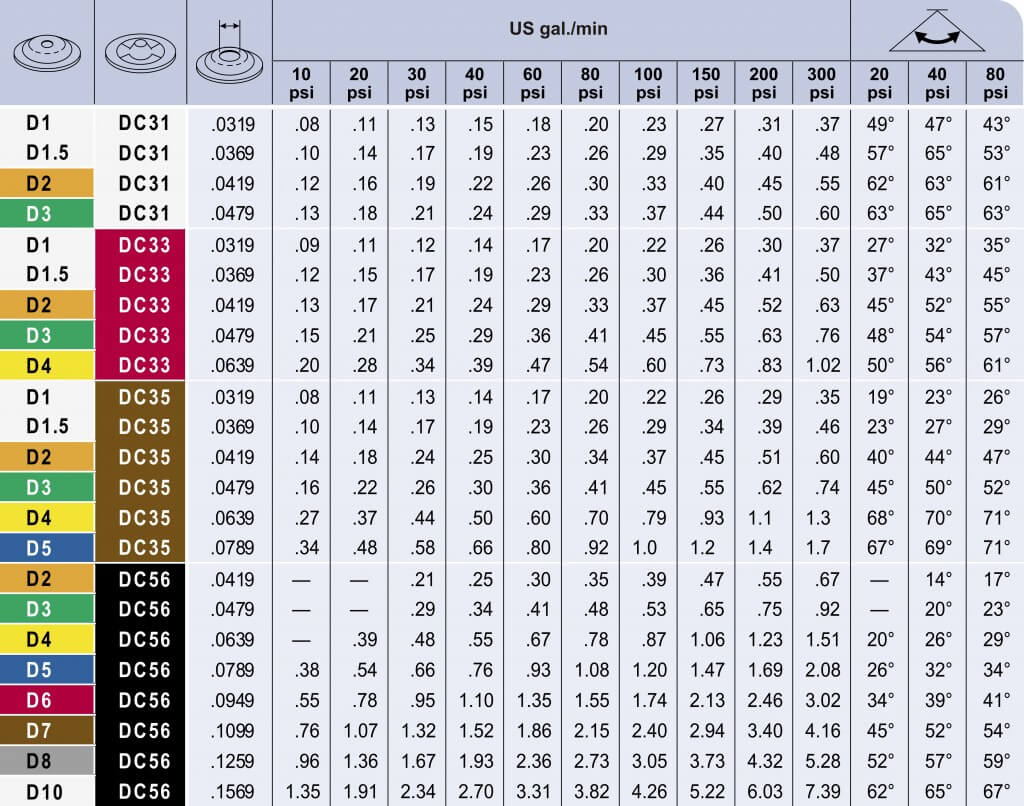
    The calculation has to be performed for each unique output (e.g. dilute or concentrate nozzle arrangements). The flow from the CR pump is a known constant. The nozzle output is variable according to operating pressure, calculated using a nozzle guide. The operator can adjust pressure (bypass or pressure regulator), PTO-speed (on positive displacement pumps), or even alternate between booms or boom-sections to match the flows.

    Matching flow demand to supply using a nozzle catalogue.

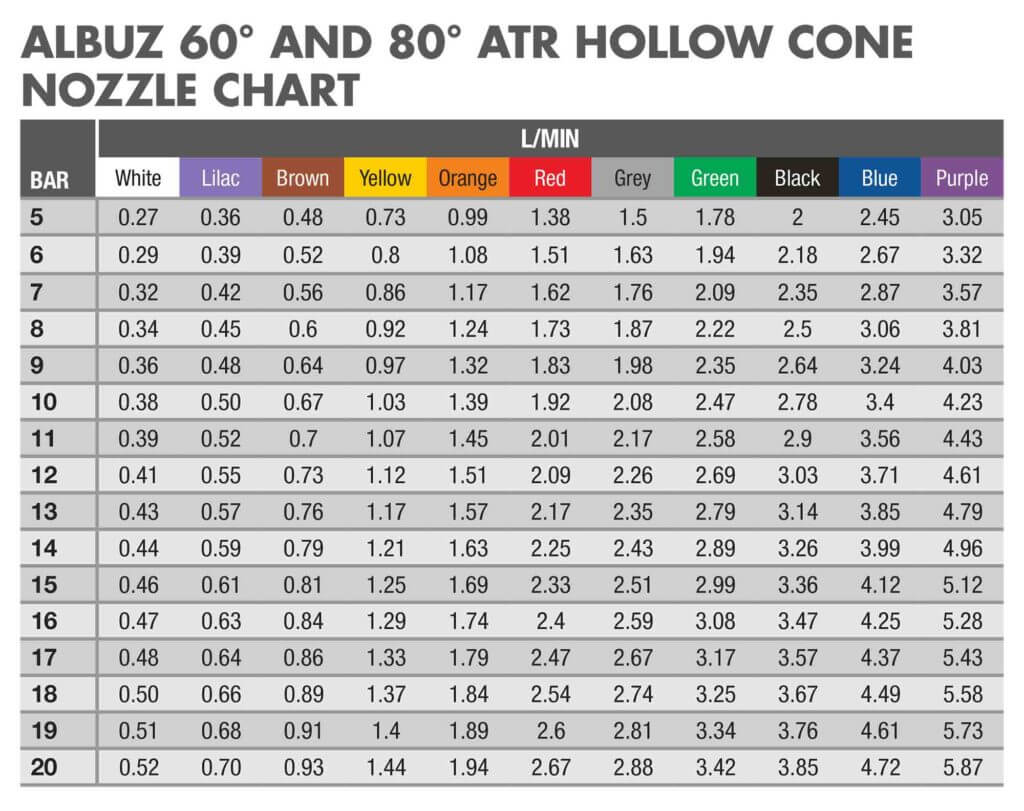
    In our case, the operator was using 12 blue Albuz hollow cones in their orchard. We knew the CR pump output was 24.25 L/min. So, by setting the pressure to 6.1 bar prior to rinsing, we were spraying about 24.5 L/min. We parked the sprayer and watched to ensure the sump did not fill or drain during CR. Note in the following video how well the two flow rates were balanced (the camera was accidentally turned when we showed the vertical boom).

    During trials we noticed that as the sprayer climbed uphill the water level in the tank shifted and the pump drew a little air, causing the nozzles to briefly sputter. This was a welcome sight given reports that introducing a few air bubbles during continuous rinsing can be beneficial.

    Field Testing

    During testing, we filled the 2,000 L Hol sprayer with 500 L of water and a final concentration of 0.25 ppm rhodamine (0.5 mL dye per 500 L water). The clean water tank was filled to 150 L. We allowed the mix to circulate for two minutes before priming the booms by spraying for a minute. A 50 mL sample was then drawn from the manifold (see below) and later used to represent the starting concentration during the analysis. The sprayer then drove through the orchard, spraying until empty.

    Samples were drawn after the tank, before the manifold. Note the telltale Mancozeb coating the sprayer. PPE was worn.

    Serial Rinse testing: When the sprayer was empty, the operator left the cab to introduce 75 L of clean water to the main tank via the tank wash nozzles. The rinsate was circulated for one minute before the operator returned to the cab and sprayed the orchard until empty. A 50 mL sample was drawn from the manifold to represent the concentration half-way through the rinse. The process was repeated for the remaining 75 L of clean water and a second 50 ml sample was drawn to represent the final concentration. We did this twice. It took about 12 minutes to rinse the sprayer and the operator had to leave the tractor cab twice.

    Continuous Rinse testing: When the sprayer was empty, the operator stopped spraying and engaged the continuous rinse pump. After a few seconds, he continued driving and spraying rinsate. When 75 L had passed through the system, we paused to draw a 50 mL sample from the manifold to represent the concentration half-way through the rinse. The operator continued until the remaining 75 L was sprayed and a second 50 ml sample was drawn to represent the final concentration. We did this twice. It took about 5 minutes, 45 seconds to rinse the sprayer and the operator did not leave the tractor cab.

    Sample Analysis: A Turner TD 700 fluorometer was calibrated using samples from the tank. Samples were diluted when necessary to ensure they fell in range of the calibration curve (where there is a linear relationship between the concentration of Rhodamine WT and Raw Fluorescence Units (FSU)). This range spanned a maximum of 0.1 ppm and a detection limit of 0.01 ppm active ingredient. Having previously tested recovery accuracy of 95%, data was adjusted accordingly.

    Results of rinsate analysis. n=2.

    Observations

    While both methods diluted the residue significantly, the remainder following both Serial and Continuous Rinse was much higher than anticipated. This may be an artifact given that both concentrations are potentially below our detection limit, per the following:

    Assuming 10 L of residual spray volume left in the system once “empty”, 75 L added would give a dilution factor of 9 (according to the ). While the first 75 L of Continuous Rinse seems to remove more residue than a single addition of 75 L, both are higher than anticipated. A subsequent addition of 75 L should result in a dilution factor of 72. In this case, the remainder would be below our fluorometer’s detection limit, and could explain the results.

    Nevertheless, there were positive observations:

    • Continuous Rinse resulted in a more dilute rinsate with less water than Serial Rinse.
    • Continuous Rinse took less time than Serial Rinse.
    • The operator did not leave the tractor cab during Continuous Rinse.
    • Potentially, any remaining water from the Continuous Rinse system could be used to operate a spray wand to rinse the sprayer exterior before leaving the crop.
    • Both systems encourage improved airblast sprayer sanitation and reduce environmental impact from point source contamination.

    Thanks to ProvideAgro for performing the installation, Wilmot Orchards in Ontario for supplying the sprayer and running the trials, and OMAFRA summer student Aidan Morgan for assistance with the data analysis.