Tag: RPAS

  • Canada Gazette Part II – Recent and upcoming changes to Canadian rules for operating RPAS

    Canada Gazette Part II – Recent and upcoming changes to Canadian rules for operating RPAS

    Editor’s Note: This article was posted in June 2025, and as of November 4th all rules have now come into effect.

    Summary

    The Government of Canada introduced the first set of Remote Piloted Aerial Systems (RPAS) rules in 2019, which addressed safety concerns and created a flexible and predictable environment for small RPAS flown within visual line-of-sight (VLOS). On March 6, 2025, amendments were made to the Canadian Aviation Regulations (RPAS – Beyond Visual Line-of-Sight and Other Operations): SOR/2025-70 Canada Gazette, Part II, Volume 159, Number 7. According to the Impact Analysis Statement in the document, the changes:

    • permit RPAS <150 kg to be flown within visual line-of-sight;
    • introduce rules for routine beyond visual line-of-sight (BVLOS) operations for RPAS <150 kg
      • over sparsely populated areas,
      • at low altitudes, and
      • in uncontrolled airspace;
    • remove the requirement for a Special Flight Operations Certificate (SFOC) for these operations;
    • include requirements for
      • new pilot certification,
      • new technical standards for the aircraft and supporting systems,
      • new operational procedures, such as increased distances from airports, heliports, and people, as well as
      • new requirements for individuals and organizations to operate BVLOS.

    In addition, the Regulations will update existing service fees and introduce fees for existing services that are currently provided for free and the new services that will be provided to the RPAS sector.

    These regulatory changes are driven by agriculture, but also increasing utility in package delivery, use in emergency response (e.g. fire assessment), environmental impact assessment and infrastructure inspection.

    The original document is lengthy, so only those changes that relate to the use of spray drones are reproduced here. For more details, refer to the Regulations Amending the Canadian Aviation Regulations (RPAS – Beyond Visual Line-of-Sight and Other Operations) Canada Gazette, Part II, Volume 159, Number 7. Transport Canada has a summary of the changes here.

    At the time of writing, there are no agricultural, terrestrial pesticides registered for application by RPAS in Canada. Health Canada’s Pesticide Compliance Program (PCP) is responsible for promoting, monitoring and enforcing the Pest Control Products Act (PCPA). Their factsheet can be downloaded here.

    Objectives

    There are three objectives to the new regulations:

    • Regulatory predictability, economic growth, and innovation
    • Safety risk mitigation
    • Fee modernization

    The regulations build upon Part IX of the CARs and introduce new requirements to reflect the increased risks of the two new categories of operation:

    • Medium drones that weigh above 25 kg up to and including 150 kg flying within VLOS near and over people, in both controlled and uncontrolled airspace; and
    • Drones that weigh 250 g up to and including 150 kg flying BVLOS in unpopulated and sparsely populated areas, below 400 feet above ground level, and in uncontrolled airspace.

    Grouping the new regulations – The 3 P’s

    The new regulations can be grouped into:

    • Pilot (pilot training and certification)
    • Product (aircraft and supporting systems)
    • Procedures (operational rules)

    In addition, there are new requirements for individuals and organizations operating BVLOS, such as appointing an accountable executive, and requirements to establish training programs and risk management processes, which are discussed in more detail below. These new requirements will allow for clearer organizational oversight with larger-scale operations, covering larger geographic areas, as well as an increase in the number and types of drones being operated.

    The Pilot

    Advanced Pilot Certificate

    TC has determined that the following operations may be added to the types of operations conducted by Advanced Pilot Certificate holders, without the requirement to obtain a new pilot certificate:

    • VLOS operations with a medium-sized drone (above 25 kg up to and including 150 kg).
    • Extended VLOS operations (EVLOS), using a visual observer to scan the airspace.
    • Sheltered operations, which allow the drone to be flown around a building or structure without the use of a visual observer.

    Advanced Pilot Certificate operators will be required to pay fees associated with the obtaining the certificate:

    • $10 exam fee, paid to the Government of Canada (GoF).
    • $25 certificate issuance fee, paid to the GoC.
    • $257 flight review fee, paid to the flight reviewer.

    Pilot Certificate for Level 1 Complex Operations (Lower-risk BVLOS)

    The Regulations will introduce a new pilot certification process for lower-risk BVLOS called Level 1 Complex Operations. A pilot must be at least 18 years old and have their Advanced operations certification.

    • Pilot must attend RPAS training (“ground school”).
    • Pilot will need to pass a new online multiple-choice exam delivered through TC’s DMP.
    • Pilot will need to visit a flight reviewer to do an in-person flight review.

    Every two years, pilots will need to do at least one training renewal activity recognized by TC (e.g. flight review, training activities, or retaking one of the pilot exams in the DMP.)

    CARs 901.19, Fitness of Crew Members, and the requirements of the RPAS Operator Certificate (RPOC) provide sufficient mitigations to maintain safety within the level of risk for BVLOS operations. However, a medical standard for operations outside the lower-risk category may be considered in future regulatory work.

    Commercial RPAS operators will need to hold a Level 1 Complex Certificate to conduct lower-risk BVLOS operations. To receive their Level 1 Complex Certificate, operators will need to pay a certificate fee of $125 to TC.

    Advertised Events

    Part IX of the CARs requires operators of RPAS of at least 250 g to obtain an SFOC to operate at an advertised event, which is defined as “an outdoor event that is advertised to the general public, including a concert, festival, market or sporting event.” The Regulations will expand this requirement to all RPAS, including microdrones weighing less than 250 g.

    The Product

    Drone registration is expanded to all drones 250 g and above.

    Declaration

    A drone won’t be permitted to fly in an operating environment unless the manufacturer supplies a Declaration (online form, Standard 992) or a Pre-Validated Declaration (PVD) for that respective operating environment. Operating environments include medium-sized drone in controlled, or uncontrolled airspace, or away from people, or BVLOS operation away from populated areas below 400 ft and in uncontrolled airspace.

    The PVD is a two-step process where the plan for the aircraft design is submitted in the context of Standard 922, and when approved, then they complete the Declaration. Operating environments include VLOS with medium-sized drones near and over people, and certain BVLOS operations over sparsely populated areas, below 400 ft and in uncontrolled airspace.

    Maintaining a PVD requires annual reports of the estimated number of flight hours, a description of any safety-related issues, and any relevant design changes.

    The Procedures

    Advanced Pilot Certificate holders can perform Extended VLOS (EVLOS) operations and sheltered operations if:

    • The drone is within a certain distance from the pilot, while a second person with a Basic Pilot Certificate scans the airspace and notifies the pilot of any other airspace users or hazards.
    • Performing a sheltered operation, the pilot may fly their drone around a structure without keeping the drone in direct line-of-sight, if they keep the drone within a certain distance to the structure (intended for building inspections).
    • The Regulations increase the minimum distance from people not involved in the operation and require additional planning considerations such as weather conditions that could affect the pilot’s ability to maintain line-of-sight.

    Lower-risk BVLOS

    Pilots will need to remain in uncontrolled airspace away from aerodromes, below 400 feet, and over unpopulated or sparsely populated areas (i.e. <25 people/km2 per Stats Canada and the Drone Site Selection Tool.

    RPAS Operator Certificate (RPOC)

    The new RPOC focuses on risk management and addresses the trend of larger fleets, longer flight times and BVLOS operations. The RPOC is an assurance there are policies and procedures in place that reflect the size and complexity of the operations. It is a Declaration to TC that the pilot or organization meets requirements in CARs (via the DMP) and there is no requirement for renewal.

    Fees for services

    Basically, the RPAS Operator Certificate fee is $125 CDN with the goal to lower the cumulative cost of BVLOS. The SFOC structure, which originally proposed two steps (Low-Complexity and High-Complexity) now has two new categories: Very-Low and Medium Complexity. Fees were revised to reflect the different levels of complexity and the related levels of effort that would be required by TC. These fees will be adjusted for inflation.

    Fines (Administrative Monetary Penalties)

    Under the Aeronautics Act, the Minister of Transport has the authority to issue administrative monetary penalties (AMPs) to anyone who violates designated provisions of the Act and the CARs. Most of the provisions in Part IX of the CARs are enforced through the assessment of AMPs imposed in accordance with sections 7.6 to 8.2 of the Act, which carry a maximum fine of $5,000 for individuals and $25,000 for corporations and include the potential suspension or cancellation of a person’s Canadian Aviation Document.

    When do the new regulations come into force?

    New regulations will be introduced in stages to give stakeholders the opportunity to become certified and to familiarize themselves with the new requirements before the 2026 season. Some regulations will come into force on April 1, 2025, but others will activate when they are published in the Canada Gazette, Part II, including:

    • the ability to register drones
    • submit declarations and take new pilot exams

    The remaining provisions will come into force on November 4, 2025, such as:

    • provisions relating operating medium-sized drones in beyond visual line-of-sight (BVLOS) in lower-risk environments.

    For more information, see the Regulations Amending the Canadian Aviation Regulations (RPAS – Beyond Visual Line-of-Sight and Other Operations) Canada Gazette, Part II, Volume 159, Number 7.

    Also see this short-and-sweet summary from RealAgriculture.

  • Exploring the Accuracy of Drone-Applied Herbicide Treatments

    Exploring the Accuracy of Drone-Applied Herbicide Treatments

    Author’s note: Minor edits were made to this article on December 12, 2025. While the results remain unchanged, aspects of the interpretation have been adjusted upon reflection.

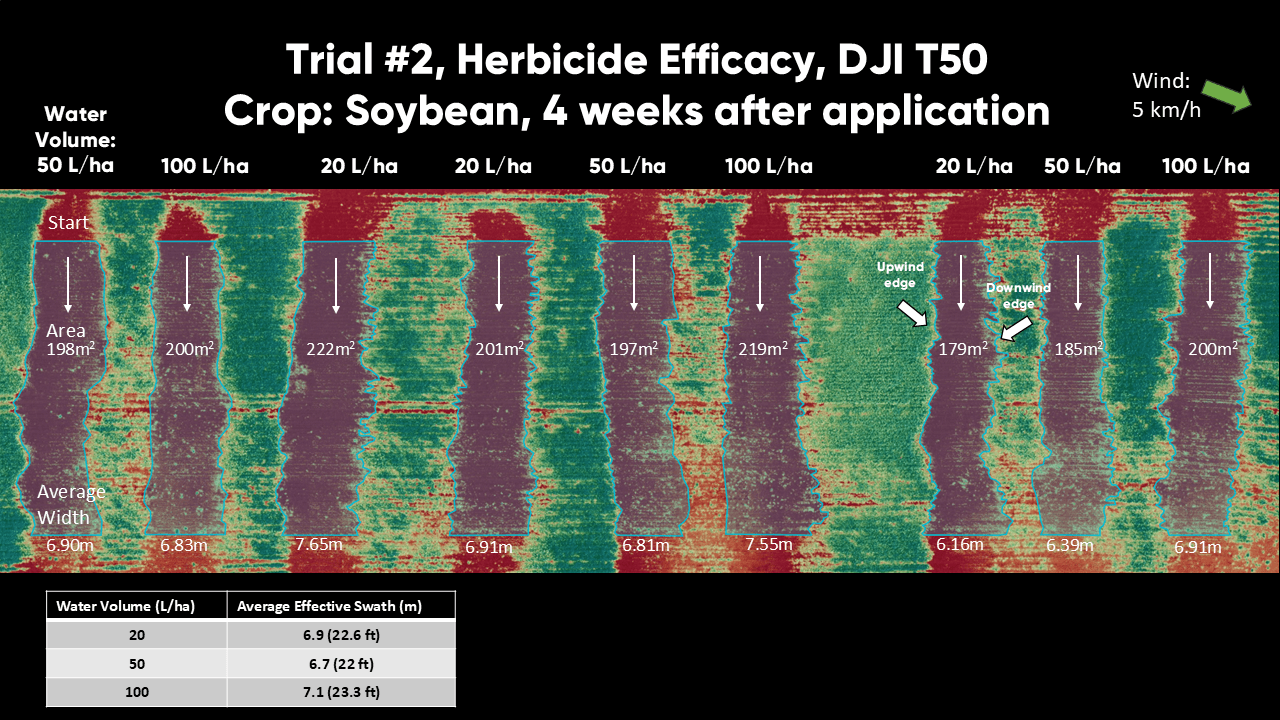
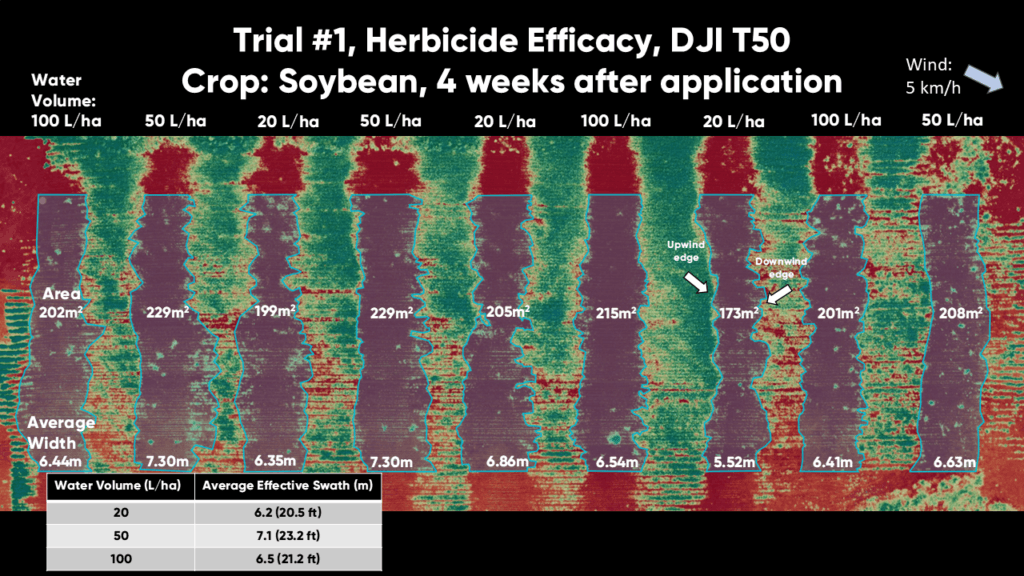
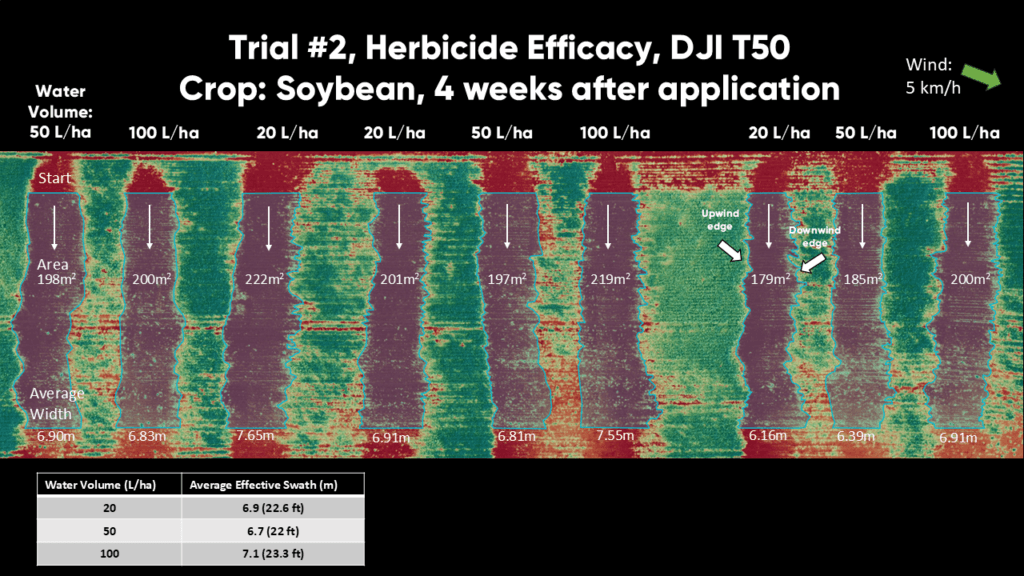
    In 2024, Corteva conducted a study entitled “Drone-Delivered Herbicides: Comparing LontrelTM XC (Clopyralid) Efficacy Across Application Techniques and Water Volumes”. Go read all about it here. Their objective was to compare the relative efficacy of hand booms and drones, and to determine if drone efficacy was affected by low water rates. The researchers evaluated the area treated and the effective swath width by manually tracing the burned areas from an aerial NDVI image.

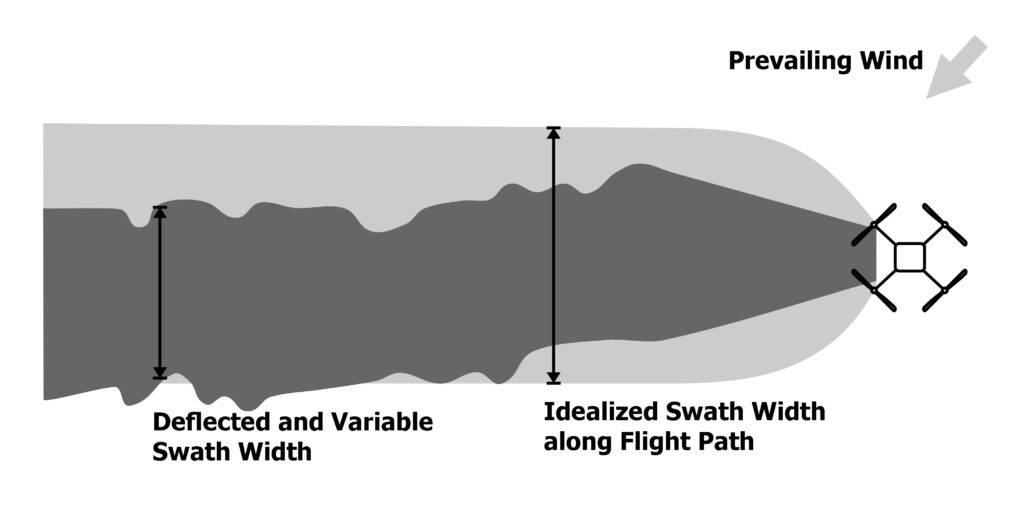
    Interestingly, the study found that water volume had an insignificant impact on herbicide efficacy. But what really caught our attention was the inconsistent and variable shape of the treated area along each flight path (Figure 1).

    Figure 1 – Image from work performed by Kevin Falk, Rory Degenhardt, Angela Fawcett and Neil Spomer, as presented at the 2025 Canadian Weed Science Society annual meeting in Vancouver, BC.

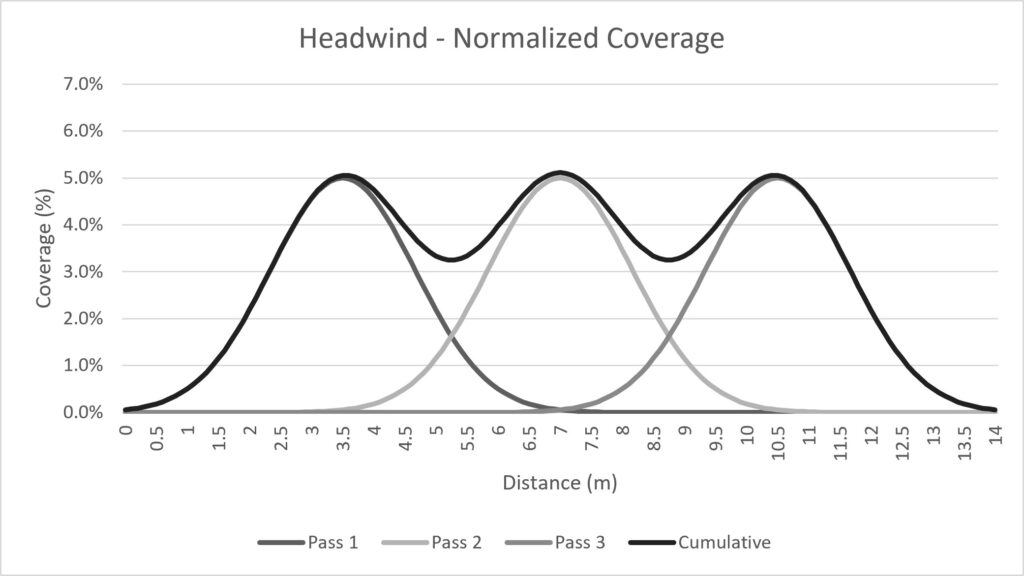
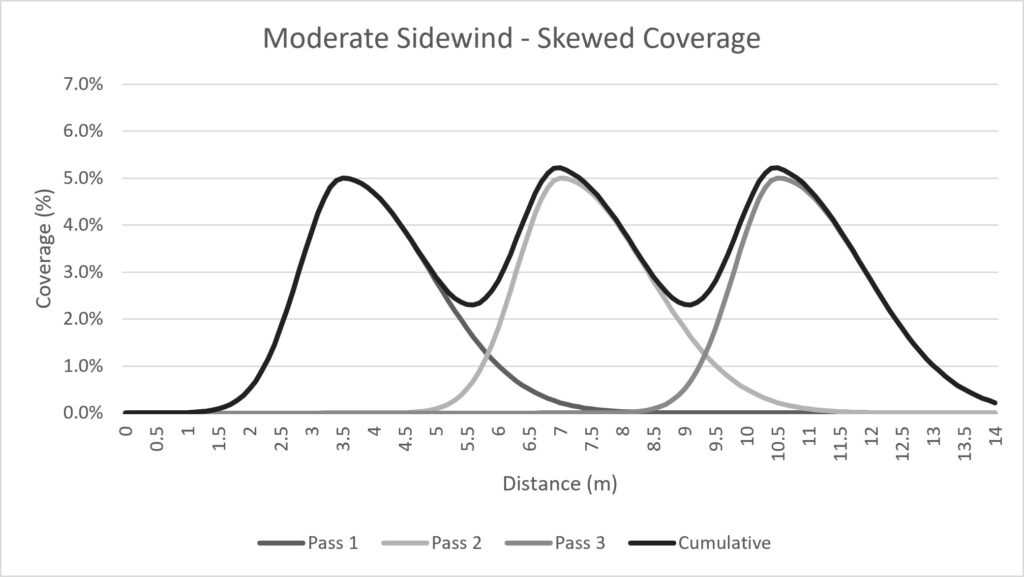
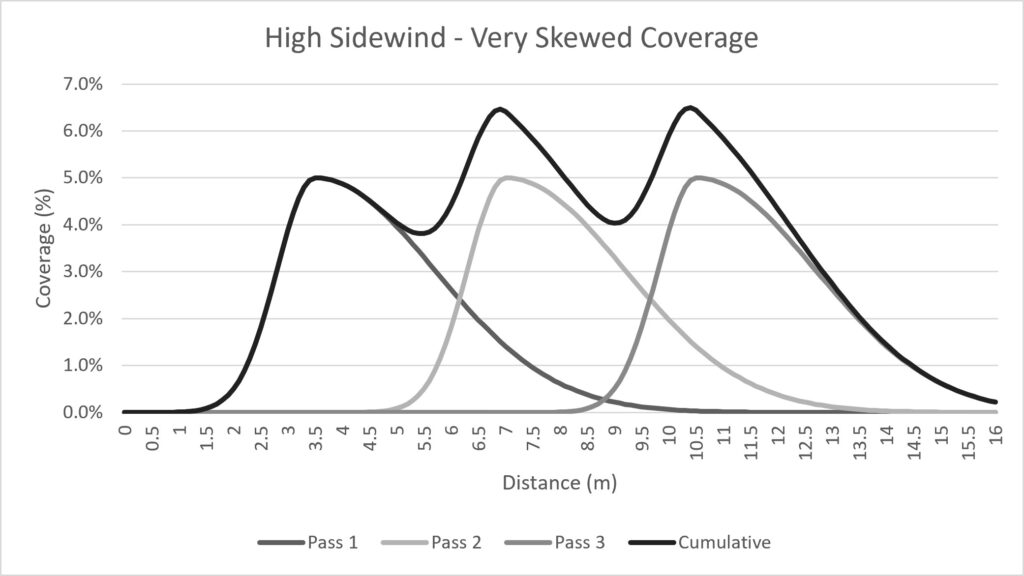
    If the swath width fluctuates and vacillates along the flight path, then there is great potential for overlaps and misses throughout a treated area. Common practice is to rely on displacement (and drift) from upwind passes to deposit a sufficient cumulative dose of herbicide to mask areas of low coverage. This would be facilitated by consistent wind direction, higher altitudes, and a surface with little or no canopy to interfere with secondary deposition.

    On the other hand, if the programmed swath width (i.e. route spacing) is too wide, and/or the the droplet size too large to permit sufficient displacement, then gaps in coverage would appear. And there is always the consideration of restricting the deposit to field boundaries and margins, particularly on the downwind side of the treatment area.

    We explored these considerations by conducting a study that emulated aspects of Corteva’s work. We applied Roundup Transorb HC (a non-selective herbicide) instead of Lontrel (a selective herbicide specifically for broadleaf weeds). We used the DJI Agras T50 and the new T100 with two atomizers and a DJI RTK-2 base station, employing an array of operational settings. And, we flew multiple passes rather than a single pass for each treatment.

    Part one of the study examined three programmed swath widths from both drones to compare their performances directly. Part two of the study evaluated the T100’s performance over a series of flight speeds and spray qualities. Burndown was evaluated using post-application orthomosaic images taken at 200 feet using a DJI M3M drone. Images were analyzed using Pix4D software.

    Materials and Methods

    Field Conditions

    Applications took place in a 160-acre field of wheat stubble in Central Elgin, Ontario (42°45’29.3″N 81°05’58.9″W) on September 13, 2025.

    Treatments

    Each flight was centred on the right boundary of the treatment block, as indicated by a pin flag. Four passes were flown per treatment (i.e. two out-and-backs). There were no repetitions for treatments, so there was no need to randomize them.

    Part One

    The intent of this part of the study was to make a direct comparison of the swaths produced by the T50 and the T100. The T100 is heavier, has a larger volumetric capacity (100 L vs. 40 L) and is capable of faster flight (20 m/s or 64 km/h vs, 10 m/s or 23 km/h). We wrote about our first impressions of the T100, here.

    Drone operational settings were selected to replicate those used in previous corn and wheat fungicide experiments with the T50. These settings are admittedly more restrictive (from the perspective of productivity) than those commonly used for herbicide applications. For example, and anecdotally, we have been told the T100 can spray a full section (~260 hectares or 640 acres) at 2.8 gpa and 20 m/s on one tank and one battery charge. However, we have no information about subsequent coverage, efficacy or off-target deposition.

    Maintaining these operational settings allowed us to make a more direct comparison of herbicide vs. fungicide placement and efficacy. All applications were performed using a 250 µm spray quality (Table 1).

    Treatment CodeRPASProgrammed Swath (m)Speed
    (m/s, km/h)
    Altitude (m)Volume (gpa)
    AUnsprayed
    BT5066, 21.635
    CT5086, 21.635
    DT50106, 21.635
    ET50610, 3635
    FT50810, 3635
    GT50108, 28.8*35
    HT10066, 21.635
    IT10086, 21.635
    JT100106, 21.635
    KT100610, 3635
    LT100810, 3635
    MT1001010, 36*35
    Table 1 – Part one: Drone settings. (*10 m/s was intended, but the T50’s pumps could not produce a 10 m swath at 5 gpa at that speed.)

    Each treatment block was 150 m long, 50 m wide and a 20 m buffer was maintained between treatments (Figure 2). Two, 1 m scale indicators were placed in Treatment B to confirm scale during image analysis.

    Figure 2 – Part one treatment layout.

    Part Two

    The intent of this part of the study was to explore the new drone design and its capabilities. Particularly, the impact of high-speed flight on effective swath width, displacement and drift. The DJI controller advises an altitude of 5 m or higher (likely a safety consideration). We felt this was too high for consistent coverage, and compromised by flying at 4 m (Table 2).

    Treatment CodeRPASSpray Quality (µm)Speed
    (m/s, km/h)
    Altitude (m)Volume (gpa)
    NT10050018.3, 65.843
    OT10025018.3, 65.843
    PT10080*12.5, 45*43
    QT10025018.3, 65.843
    RT10025015, 5443
    ST10025010, 7243
    Table 2 – Part two: Drone settings (20 m/s was intended, but the drone only reached a maximum of 18.3 m/s before slowing as it approached the end of the treatment. *50 µm and 20 m/s was intended, but the T100 controller would not permit those settings, so a compromise was made.)

    Given the greater potential for displacement and drift in this part of the study, we established wider and longer treatments blocks, and wider buffers between treatments. Each treatment was 250 m long, 70 m wide and a 40 m buffer was maintained between treatments (Figure 3).

    Figure 3 – Part two treatment layout.

    Chemistry

    The spray solution (PMRA research authorization 0054-RA-25) was premixed in a single batch. For part one, 80 L Roundup Transorb HC in 1,000 L water plus 0.05% Halt (defoamer). For part two, 700 L of the solution remained, so we added an additional 20 L of Roundup to approximately maintain the dose when dropping from 5 gpa to 3 gpa. This is a high dose of Roundup (~1.5 L/ac), selected to ensure that every drop that landed would create an obvious burn for easier analysis. It does, however, also mean that any reduced dose (i.e. striping) between passes would likely be masked. Drones were refilled after each treatment (to 40 L for T50 and to 65 L for T100) to negate any weight effect on the magnitude of the downwash.

    Weather

    Weather data was collected using a Kestrel 3550AG weather meter (Kestrel Instruments) in a vane mount positioned 2.5 m above ground (Table 3). For part one, conditions were ideal: humid with a light wind in a consistent direction. For part two, afternoon wind speed increased, but predominant direction remained consistent (Figure 4A).

    TimeExperiment PartTreatmentWeather
    10:05 – 10:581B – G18.6 ̊C, 78% RH, 0.0 km/h wind.
    10:58 – 12:401H – M19.8 ̊C, 72% RH, 2.0 km/h wind.
    12:40 – 1:502N – S22 ̊C, 61.2% RH, 7.0 km/h wind.
    Table 3 – Treatment times and weather conditions
    Figure 4 – Left (a): Prevailing wind direction overlaid on orthoscopic image. Right (b): Polygons representing manual traces of the perimeter of the burned treatment areas. Areas are noted for each treatment.

    Estimating Effective Swath Width

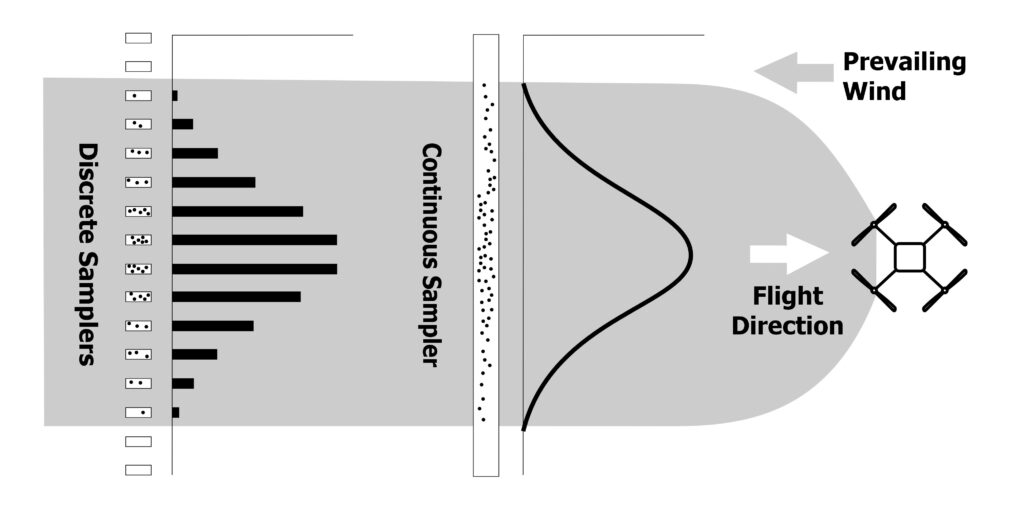
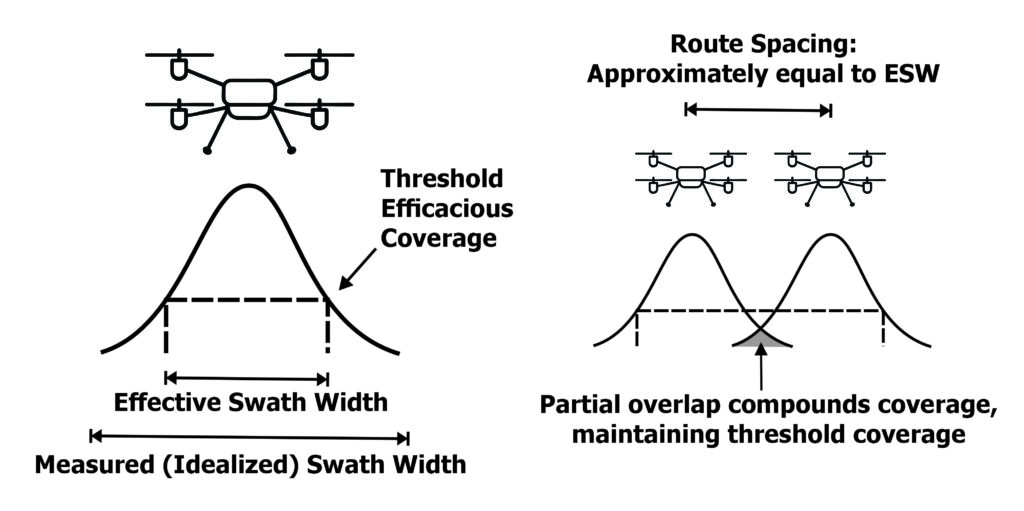
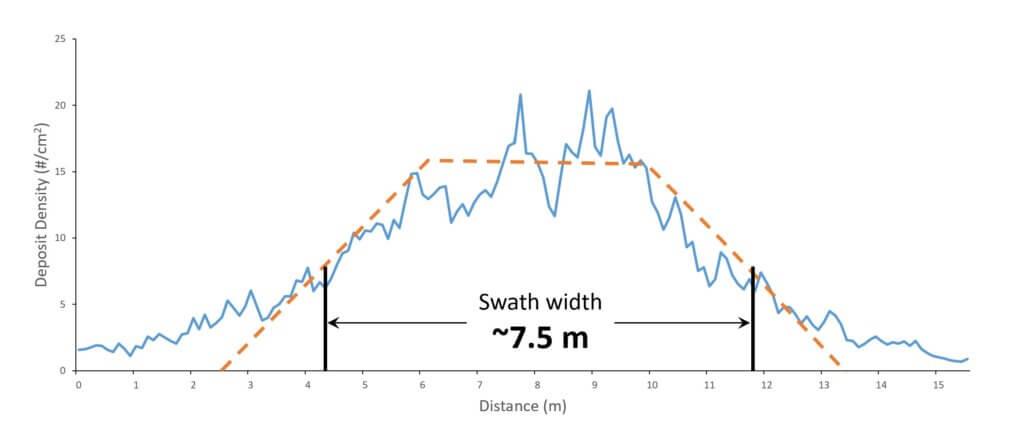
    The burned area indicates that the spray deposited met or exceeded an efficacious dose. This agronomic consideration of real-world efficacy sets the Effective Swath Width (ESW) apart from a swath width measured during calibration. Methods for calculating swath width utilize a sampling system aligned perpendicular to the flight path. Whether continuous or discreet samplers, this approach produces a coefficient of variation and some measure of over- and under-dose based on an assumed target threshold (dose or coverage). By measuring the biological effect (i.e. the burned area), we need not assume a target threshold – it’s indicated by the burn. Work with fungicides has demonstrated that the ESW can be a fraction of the measured swath width.

    ESW was estimated using two methods, and while both approaches have inherent flaws, they still provide valuable information. A more realistic representation of ESW likely falls between the two.

    In the first method, the perimeter of the area burned was traced to create a polygon (above, in Figure 4B). Then, the average width of that area was established from measured spans along the block. Finally, that average was divided by the four passes. Hereafter referred to as the “treatment width ÷ passes” method. This method produces an underestimate of ESW because each upwind drone pass can overlap and hide any displacement (and drift) from the previous. It divides the drift over however many passes are made.

    The second method overlays the flight path onto the area burned. The upwind side of the swath was determined from an average of at least five measurements along the upwind flight path. The downwind side of the swath was calculated the same way (Figure 5). Both the average upwind and downwind distances were added to arrive at the ESW. Hereafter referred to as the “port + starboard extent” method. This approach captures a clear representation of the upwind side of a single pass, but overestimates ESW by including any cumulative increase in drift from multiple passes on the downwind side.

    Figure 5 – Example of port and starboard measurements along the downwind and upwind-most flight paths. The averages were calculated and added to estimate effective swath width.

    Results – Part One

    Planned versus Measured Treatment Area

    The “programmed swath width” is something of a misnomer. More accurately, it is the route spacing and it describes the distance between passes over a target area. However, most drone manufacturers refer to this variable as programmed swath width, so that’s what we’ll do.

    Planned treatment areas were calculated from distance flown × programmed swath width × number of passes. Measured treatment areas were calculated by tracing a polygon along the perimeter of the area burned. In all cases, actual was larger than planned by an average 36.1%. The T50 treated 32% more area than planned and the T100 treated 40% more area than planned, or 8% more than the T50 (Figure 6).

    Figure 6 – Planned and Measured Swath Widths for T50 and T100.

    Programmed and Effective Swath Widths

    In all cases, the “treatment width ÷ passes” method produced an estimated ESW that was greater than, and positively correlated with, programmed swath width (Figure 7). For the T50, it was an average 26.8% wider. For the T100, it was an average 38.3% wider. The ESW calculated by the “port + starboard extent” method was larger still, but was not positively correlated with programmed swath width. For the T50, it was an average 52.8% wider. For the T100, it was an average 62.5% wider.

    No matter the method used to estimate ESW, the T100 exceeded the planned swath width by more than the T50. Using the “port + starboard extent” method, the average T100 ESW was 21.3 m, which is an average 15.4% wider than the average 17 m ESW produced by the T50.

    Figure 7 – Average measured swath width (two methods) compared to planned swath width for the T50 and T100 flown at 5 gpa, 3 m altitude, 250 µm spray quality and multiple speeds.

    T50 ESW by Travel Speed

    When travel speed becomes the independent variable for the T50, the “treatment width ÷ passes” method produces an average ESW that positively correlates with flight speed. At 21.5 km/h, the average ESW was 10 m, increasing to 11.9 at 30-36 km/h (Figure 8). This is typical and expected as higher speeds have been shown to produce wider swaths with the T10 and T50.

    However, the relationship between speed and ESW is less clear when estimated using the “port + starboard extent” method. At 21.5 km/h the average swath was 18.2 m, but reduced to 15.8 km/h at 30-36 km/h (Figure 8).

    Figure 8 – Average measured swath width by speed for the T50.

    T100 ESW by Travel Speed

    When travel speed becomes the independent variable for the T100, neither method for estimating ESW show an effect from flight speed. The “treatment width ÷ passes” method produced an average ESW of 13 m at 21.5 km/h and 12.9 at 30-36 km/h (Figure 9). The “port + starboard extent” method produced an average ESW of 21.7 m at 21.5 km/h and 21 at 30-36 km/h.

    Figure 9 – Average measured swath width by speed for the T100.

    Results – Part Two

    T100 ESW by Travel Speed

    The effect of flight speed on treated area and ESW was examined. In each case, the treated area was significantly larger than the programmed area (Figure 10).

    Figure 10 – Actual treatment areas compared to expected for the T100; three speeds.

    Similar to Part one, travel speed did not appear to influence ESW in any consistent or significant way (Figure 11).

    Figure 11 – Average swath width for T100 calculated using two methods at three speeds.

    T100 ESW by Spray Quality

    The effect of spray quality on treated area and ESW was examined. Once again, in each case, the treated area was significantly larger than the programmed area (Figure 12).

    Figure 12 – Actual treatment areas compared to expected for the T100 using three spray qualities.

    Effective swath widths estimated from both methods were negatively correlated with spray quality (Figure 13). Coarser droplets have greater mass, making them are less prone to displacement by wind than finer droplets. The “treatment width ÷ passes” saw an 80 µm spray quality produce an ESW 46.8% larger than a 500 µm spray quality. The “port + starboard extent” method saw an 80 µm spray quality produce an ESW 22.6% larger than a 500 µm spray quality.

    Figure 13 – Average swath width for T100 calculated using two methods for three spray qualities.

    Discussion

    In all cases, the area treated (i.e. burned) exceeded the area planned. The T50 covered 32% more area while the T100 (with the same operational use case) covered 40% more. This implies that the T100 created wider swaths and/or drifted more than the T50.

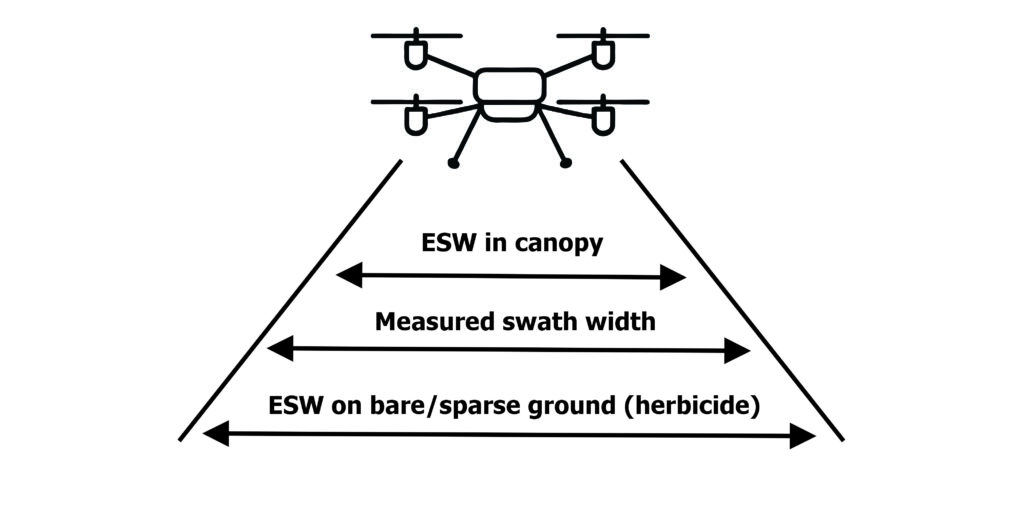
    The ESW estimated from herbicide efficacy appears to be considerably larger than those observed in fungicide efficacy / coverage studies. This is likely the result of the agronomic use case. Consider that herbicides have a relatively lower threshold dose than fungicides. Further, herbicide application on bare earth or into sparse canopies permits the lateral spread of droplets, where spraying fungicides into a dense canopy limits penetration in all directions. Even the sparsest coverage from a systemic herbicide produces a visual effect, and this binary result (i.e. hit or miss) extends the effective swath width. This should raise awareness of the importance of field boundaries and margins, particularly with herbicides.

    When estimating ESW, the method used affected the results. The “port + starboard extent” method resulted in large and low-resolution estimations of ESW, whereas the “treatment width ÷ passes” method seemed to respond in a more predictable way, even if it underestimates the ESW. Ultimately, both methods produce rough estimates; they are not intended to replace traditional, quantifiable assessment methods. The “truth” is likely somewhere in between.

    With that caveat reaffirmed, we assessed ESW using the “treatment width ÷ passes”. It was positively correlated with flight speed for the T50, as observed in previous work. However, this was not the case with the T100. Given that both drones were operated using the same settings, it is unclear why the T100 would produce such erratic results. Future work will evaluate T100 ESW using conventional methods.

    When the T100 was flown using a span of three droplet sizes, there was a strong negative correlation between average droplet size and ESW. Once again, this aligned with previous experience. While rotary atomizers on drones tend to create smaller droplet sizes than reported by the flight controller, coarser droplets have greater mass, making them less prone to displacement by wind.

    However, when the T100 was flown at at three speeds, the relationship with ESW was once again unclear. When flown at 36 km/h (~10 m/s) the T100 was flying at the top speed of the T50. It also flew at 54 km/h and at 66 km/h, which was the highest speed we could achieve at 5 gpa. The ESW (as estimated using the “treatment width ÷ passes” method) was essentially unchanged. While it is possible (and likely) that any increase in effective swath width due to travel speed was obscured by drift, pervious work has shown that drift increases concomitantly with speed. That does not appear to have happened here.

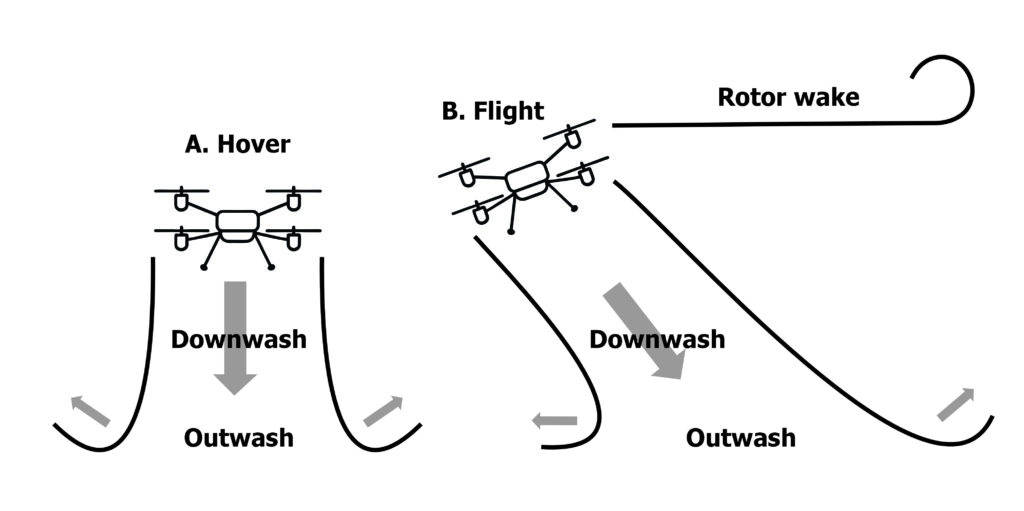
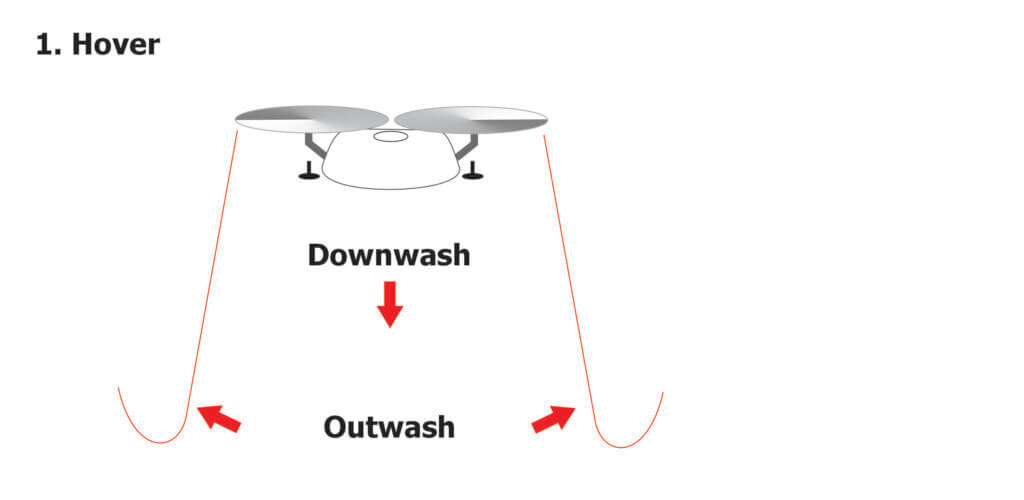
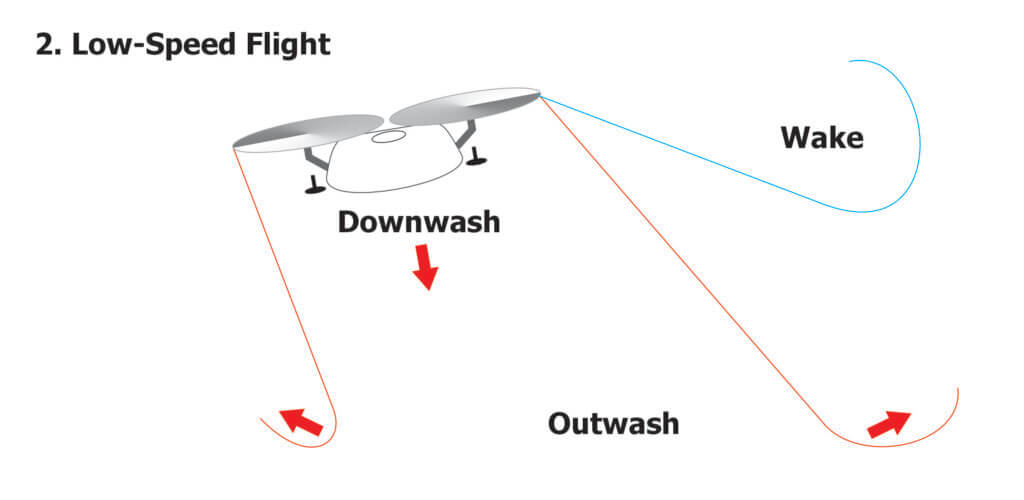
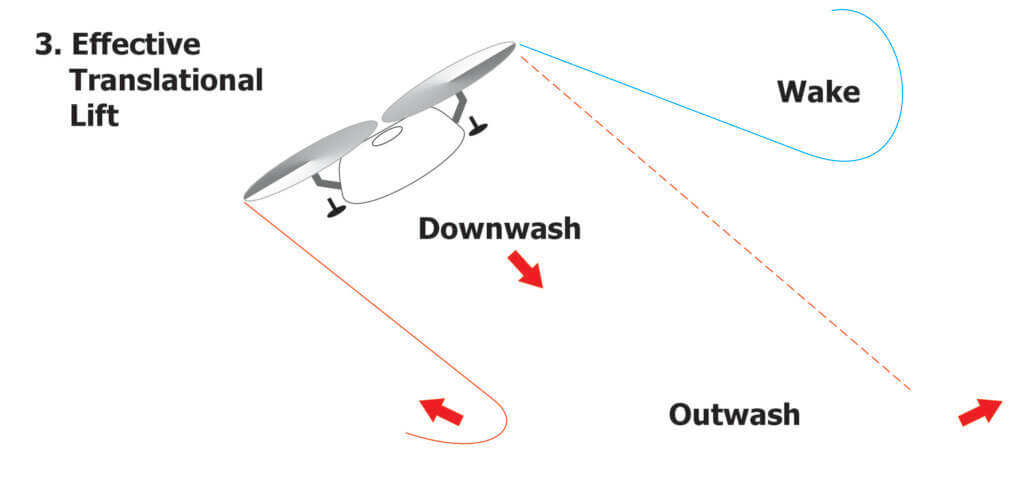
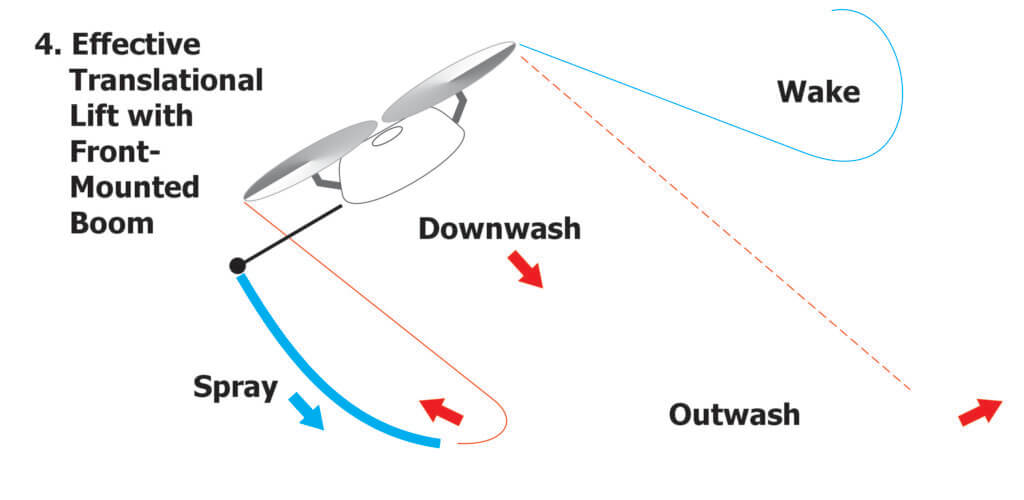
    Perhaps this is a function of a greatly reduced dwell time diminishing the effect of the downwash. Or, perhaps, the T100’s capacity for higher speeds has allowed it to pass beyond translational lift into true forward flight, similar to a helicopter. Translational lift occurs any time there is relative airflow over the rotor disk. As headwind and/or forward speed increase, translational lift increases, resulting in less power required to hover. According to Transport Canada, it is present with any horizontal flow of air across the rotor but most noticeable when the airspeed reaches 16 to 24 knots flight (8.25 to 12.8 m/s or 30 km/h to 46 km/h). This would greatly reduce the effect of the downwash on droplet movement. In our first impressions of the T100, we found that flying slower overheated the battery. This did not occur at higher speeds, and this efficiency supports the premise that it moved past translational lift, perhaps achieving true forward flight.

    If this theory is correct, it’s a new development for rotary drones, which were not previously capable of reaching these speeds. Downwash was an unavoidable side effect of the flight, but may now be a tool for the operator to use as the situation warrants – battery temperature notwithstanding. Perhaps it warrants a return to horizontal booms positioned beyond the downwash in order to improve coverage uniformity. On the other hand, we saw that it took the T100 roughly 100 m to reach the target 66 km/h, meaning it moved from hover to translational flight and beyond over that distance. This raises questions about how they spray would respond throughout that transition.

    More work is required.

    Acknowledgements

    Adrian Rivard and Stuart Hunter (Drone Spray Canada), Adam Pfeffer (Bayer Canada) and Mike Cowbrough (Ontario Ministry of Agriculture, Food and Agribusiness) are gratefully acknowledged for their participation, and both in kind and financial support of this study. Thanks also to Mark Ledebuhr and Tom Wolf for discussions surrounding the interpretation of these results.

  • DJI Agras T100 – First Impressions

    DJI Agras T100 – First Impressions

    On July 15, 2025, DJI Agriculture announced the global launch of the DJI Agras T100. Compared to its predecessor, the T50, it features a larger payload for spraying and spreading and can fly at approximately twice the speed. The rotary atomizer-style nozzles (which DJI refers to as sprinklers) produce comparatively increased flow with an option to increase from two to four for orchard operations. Designed for large-scale commercial growers, it also features a new single-side spraying function to assist with sharper field boundaries and infield obstacles.

    On September 13 we performed some preliminary trials comparing it to the T50. We applied Roundup Transorb HC (PMRA research authorization 0054-RA-25) in plots over a 160-acre field of wheat stubble. While the results of this study will appear in a later article, we wanted to capture our initial observations.

    160 ac wheat stubble field 7 DAA. Wind was a light 2-6 km/h with consistent direction throughout the study.

    Weight and Dimensions

    In Canada, Remote Piloted Aircraft (RPA) are regulated under the Canadian Aviation Regulations (CARs). Part IX of the CARs deals with RPA by operating weight and complexity of the operation to be conducted. Prior to recent amendments (which come into force in November 2025), Part IX covered up to and including 25 kg (55 lb) flown in visual line of sight (VLOS). Other operations like above 25 kg and Beyond VLOS operations required a Special Flight Operations Certificate.

    The 2025 amendments to Part IX added operations of medium RPA that weigh more than 25 kg (55 lb) up to and including 150 kg (331 lb) and introduced rules for beyond visual line-of-sight (BVLOS), sheltered, and extended VLOS operations.

    Left: DJI Agras T100. Right: DJI Agras T50.
    T50T100
    Empty weight52 kg75 kg (2 nozzles
    77 kg (4 nozzles)
    Max. takeoff weight (full liquid tank)92 kg175 kg (2 nozzles)
    177 kg (4 nozzles)
    Dimensions (arms & rotors unfolded)2,800 × 3,085 × 820 mm3,220 × 3,224 × 975 mm

    If flown full, the T100 will be 25 kg beyond the medium RPA category. Therefore, Canadian pilots will have to apply for a Special Flight Operations Certificate (SFOC). Similarly, DJI notes that when using the T100 in Australia, pilots are to follow local regulations and keep the maximum takeoff weight at 149.9 kg.

    The additional size and weight may make handling and transportation more challenging (e.g. lifting the RPAS out of a vehicle). Regarding spray performance, it remains to be seen if the greater weight of the T100 will appreciably increase the magnitude of the downwash, or perhaps this will be negated by the potential for greater travel speed (see Dwell time).

    Tank and nozzles

    Both the T50 and T100 have HPDE tanks (neither with agitation). The rotary atomizer nozzle (aka sprinkler) design has changed. According to DJI’s promotional video, the atomizers are “water cooled”. Our assumption is that the spray mix itself serves as a heat-exchanging coolant. This will come up later in this article.

    T50T100
    Liquid tank capacity40 L100 L
    Atomizer model2 or 4 LX8060SZ standard sprinklers2 LX07550SX, standard sprinklers
    2 LX09550SX, optional mist nozzles for orchard spraying
    Atomizer flow rate16 L/min (2 sprinklers)
    24 L/min (4 sprinklers)
    30 L/min (2 sprinklers)
    40 L/min (2 sprinklers plus 2 misters)
    Droplet size50 – 500 μm50 – 500 μm
    Span between nozzles1,570 mm (between rear nozzles)1,834 mm (between rear nozzles)
    Effective swath width4 – 11 at 3 m altitude5 – 13 m (no altitude specified)

    DJI states that droplet size was “measured by a laser particle size analyzer, with a 50-micron diameter using the Dv50 standard”. It is notable that they do not refer to ASABE S572.3 or ISO 25358:2018, which are standards that define nozzle spray quality. Canadian pesticide labels will require compliance with these standards when the application of agricultural pesticides is eventually permitted.

    T100’s LX07550SX rotary atomizer.

    It would be interesting to confirm if the new atomizers can actually produce the median droplet size indicated on the controller. Historically, and to differing degrees, RPAS rotary atomizers suffer from a “flooding” issue. This is a condition where flow to the nozzle overwhelms its ability to atomize the fluid, degrading the spray pattern and creating coarser, heterogenous spray.

    DJI states that the effective spray width depends on the “actual working scene [sic]”. Compared to the T50, the T100 atomizers are not directly below the rotor hubs, are angled slightly outward and are set further apart. This may explain claims of a larger swath width than the T50.

    However, our studies with the T50 have determined that when flight settings are optimized for low drift and consistent coverage, the ESW for in-canopy fungicide application is no greater than 7 m. This is likely wider for herbicide applications in stubble or on bare ground, but the risk of downwind drift (i.e. not displacement) makes claims of 11 or 13 m for the T100 unlikely. Swathing runs were performed using the Speed Track and Swath Gobbler methods (results will be reported when the burndown study is analyzed).

    Observations during spray trial

    According to DJI, both the T50 and the T100 can manage a maximum 30 L/ha (~3 gpa) at their respective maximum speeds. For the T50, this is 10 m/s (36 km/h) and for the T100 this is 20 m/s (62 km/h). This has obvious implications for greater efficiency, but we wondered what effect higher speeds might have on spray coverage and drift potential.

    Succinctly, faster speeds leave droplets aloft for longer periods, subjecting them to wind, wake and vortices while reducing the influence of the downward-rearward downwash that might normally entrain and direct them to the ground. As a result, they tend to spread laterally in the direction of the prevailing wind. This is drift. To see if this was happening, our treatments included combinations of travel speed, altitude, programmed swath width and droplet size. Here’s what we saw.

    Altitude

    We generally fly the T50 between 3 and 3.5 m above the ground or crop canopy. Any higher creates unacceptable drift and any lower tends to leave a bimodal and inconsistent coverage pattern. However, the T100 controller advises an altitude of >5 m during “high speed operations”. Perhaps this relates to orchard operations, or it’s strictly a matter of safety for such a large drone operating at high speed. In any case, it seemed far too high for field applications.

    Screenshot of altitude recommendations at ~20 m/s.

    To compare the T50 directly to the T100, we chose to fly three treatments at 3 m altitude, 6 m/s and 50 L/ha (5 gpa). There appeared to be a gap in the T100 swath between the nozzles that might indicate bimodal (non uniform) deposition. This gap disappeared when we later flew at 4 m and increased the speed of the drone. Despite what we observed during the application, a preliminary inspection of the aerial images taken of the treatment plots hasn’t revealed any obvious gaps in the burndown. We hope to learn more when we have higher resolution images and when the swath gobbler data is analyzed.

    At 3 m altitude and slower speed (~10 m/s) there was a visual gap in the spray. This was not obvious at 4 m altitude and higher flight speed. It did not appear to leave a corresponding gap in weed control, likely due to secondary coverage from from subsequent passes.

    Battery heat and endurance management

    According to DJI, the T50’s DB1560 battery takes 9-12 minutes to fully charge and the T100’s DB2160 Intelligent Flight battery takes 8-9 to get to 95%. We did not have access to the recommended 3-phase generator and instead used an adaptor cable (pictured right in the following image) that allowed the use of a smaller generator at a cost of slower charging. We alternated between two batteries and did not use a battery cooling station (pictured left in the following image).

    Left: Cooling station (from DJI website). Right: DB2160 battery being charged using a smaller generator and adaptor cable.

    When spraying our 150 m long treatments, the drone flew four passes (two out-and-backs). During the 10 m/s, 50 L/ha (5 gpa) trials, the battery threw an “overheat” warning. We were only able to do a single out-and-back before replacing the overheated battery with a fresh one. The overheated battery was placed in an air-conditioned truck cab until it was cool enough to recharge.

    This taught us that to manage battery heat, three batteries should be swapped, and the cooling station is likely not optional. Also, we gave further thought to the purpose of the water-cooled nozzles: We did not have an overheat issue during faster flights (15-18.5 m/s) and that may have been because the nozzle flow rate was considerably higher and kept the system cooler. In subsequent flights (and days), the drone sprayed at higher flight speeds and the overheat warning did not reappear.

    Addendum

    A few months after writing this article we were able to analyze the burndown data (here). There’s another possibility to explain the battery overheat phenomenon. Any operator can confirm that rotary drones expend a lot of power to remain in the air when they are full and when they are hovering. Flying at slow speed is a little more battery-efficient, but flying faster is better still. However, because rotary drones cannot achieve transitional lift, they are still not flying in a traditional sense. Rather, think of them as pushing hard off the ground, which is why they produce an extensive downwash. The faster they fly, the less the dwell time, which is the time the downwash is focused on one spot.

    But this new generation of larger, faster rotary drones challenges those limitations. The T100 (and a few other brands such as the EAVision J150) are capable of far greater speeds than previous designs. There is a threshold (yet to be determined) where the drone surpasses translational lift and achieves proper flight. When that happens, the downwash is reduced or even eliminated, just as with a helicopter. This could explain why the overheat issue disappeared during faster flights. It might also explain why, beyond a certain speed, additional speed did not appear to affect swath width (see the burndown study).

    This changes certain expectations about droplet movement beneath and behind the drone, as well as canopy penetration, drift potential and certainly, productivity. As drone design continues to evolve, the “rules” surrounding optimal operational settings must be reassessed. These observations are already changing research plans for 2026.

    Flight speed and flow

    Two of our treatments explored the effect of flight speed on swathing. The first set of three treatments set the T100 at max speed (20 m/s) spraying 30 L/ha (3 gpa) at 4 m altitude on an 8 m swath using 50, 250 and 500 µm droplets. Then, the next set of three treatments held droplet size at 250 µm and the dependent variable became speed at 10, 15 or 20 m/s.

    We found the controller set limits on certain combinations of settings. For example, at 20 m/s we could not select any lower than a 200 µm droplet. In fact, the lowest combination of settings was 80 µm and 12.5 m/s. We thought this might be a drift mitigating measure, but it’s more likely a pump or nozzle flow limitation. We also found that we were unable to exceed 16.7 m/s when applying 30 L/ha (3 gpa) using 250 um droplets on a 10 m swath.

    Once we started flying the treatments, we found the drone was not able to exceed 18.3 m/s over the 250 m treatment distance. It took roughly 200 m to get up to 18.3 m/s before the drone began to slow in anticipation of the end of the treatment block. This is not to suggest the drone was under- or over-applying up to that point, because it’s assumed the flow rate compensated for a changing travel speed. It does reflect observations with other rotary RPAS that they take some time (and distance) to achieve a consistent spray state.

    Conclusion

    The T100 shows promise for spraying larger fields more efficiently. Early indications suggest a higher travel speed and altitude will be required for battery management and to maintain consistent coverage over potentially wider swaths. However, research is required to determine how this will affect the balance between coverage, drift and productivity. The results of the burndown study can be found here.

    Acknowledgements

    Adrian Rivard and Stuart Hunter (Drone Spray Canada), Adam Pfeffer (Bayer Canada) and Mike Cowbrough (Ontario Ministry of Agriculture, Food and Agribusiness) are gratefully acknowledged for their participation, and both in kind and financial support of this study.

  • Characterizing RPAS Coverage at Four Cardinal Points on a Vertical Plane: Practical implications for spraying wheat at T3

    Characterizing RPAS Coverage at Four Cardinal Points on a Vertical Plane: Practical implications for spraying wheat at T3

    Global research into Remotely Piloted Aerial Systems (RPAS) is producing pesticide residue, drift and efficacy data that is helping to inform federal regulatory policy. It is reasonable to assume that Canada will ultimately sanction the use of RPAS for agricultural spraying. The first registered products will likely be fungicides intended for broad acre crops such as soybean, corn, and wheat.

    Those considering RPAS for agricultural spraying have expressed interest ranging from general curiosity to high demand. Successful adoption will be contingent on expectation management, which in turn requires education on the functional differences between RPAS and conventional application technologies.

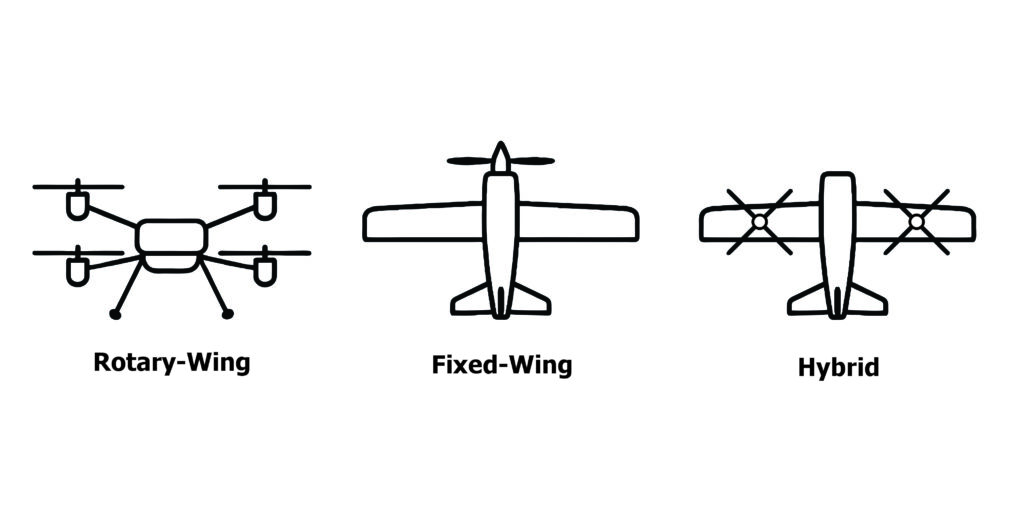
    Quadrotor RPAS design dominates the current commercial landscape, with typical models featuring four rotary atomizers and 40 L tanks. There have been improvements in recent years, but these designs continue to suffer from a low rate of productivity (by North American standards for broad acre crops). This is due, in part, to low volumetric capacity and limitations with rotary atomizer design, which result in a debatably short effective swath width. Broadly, “swath width” refers to the minimal span consistently sprayed by a single pass, while “effective” indicates a spray coverage (i.e. deposition pattern and threshold dose) sufficient to achieve the desired result.

    Our research efforts have focused on identifying and evaluating variables that influence effective swath width. These include operational settings such as altitude, travel speed, volume applied and nozzle settings. They also include environmental factors such as meteorological conditions, crop morphology, and planting architecture. Establishing a combination of settings that account for these factors will inform operator practices and optimize the balance between RPAS effectiveness and efficiency.

    Study Objective

    Fusarium head blight is a significant economic threat in wheat. Fungicide application takes place at the T3 stage of development, with the intention of providing panoramic coverage of the wheat head. RPAS is being considered to apply these fungicides.

    The pursuit of productivity tempts operators to push operational settings to the point that spray coverage is compromised. This study will use operational settings based on the results of previous work and assign flight speed as the independent variable.

    Coverage will be assessed using water sensitive paper (WSP) positioned at the top of the canopy and oriented vertically in four cardinal directions to emulate the circumference of the wheat head. Isolating the resultant coverage in each cardinal direction may provide insight into droplet behaviour within the RPAS spray cloud and perhaps better assess effective swath width.

    Coverage from a conventional field sprayer will also be characterized. This represents the current standard and it will provide a basis for comparison.

    Materials and Methods

    Site

    The experiment was conducted at 45939 John Wise Line, St Thomas, Ontario (42.7320746, -81.0879887) on June 1, 2025. Common seed wheat was planted on October 6th, 2024, at 1.8 million seeds/ac on a 19 cm (7.5 in) row spacing. At the time of spraying, wheat was at the T3 stage of development, approximately 0.7 m (2.5 ft) high.

    Holder Design

    3D-printed holders were designed in Autodesk Fusion. They feature tabs that create a pressure fit (for quick WSP loading and unloading) and a back support (to prevent WSP movement in a downwash) to vertically position 1×3” WSP facing out on four cardinal points (figure 1). 21 poles were positioned on a 1 m spacing, leaving the tops coplanar with the wheat heads for in situ swathing. The square cross-section of the poles corresponded to a square depression in the WSP holder, ensuring the samplers were correctly aligned (figure 2). The gcode file to 3D print your own holders can be downloaded here. We used PLA filament with 3 walls and a 15% rectilinear infill to print 16 holders at a time on a Bambu P1S.

    Figure 1. 3D-printed WSP holder slotted onto a pole in the wheat field.
    Figure 2. Four WSP positioned vertically, facing four cardinal points, at wheat-head depth.

    Wind direction is indicated by the direction the wind is coming from, not the direction it’s blowing to. Therefore, a wind blowing in a northern direction is referred to as a southern wind. The WSP holders were aligned east to west, perpendicular to the prevailing southern wind. We established a trampled path ~0.75 m on the downwind side. This left the wheat canopy surrounding the samplers intact while still permitting access to the WSP holders (figure 3).

    Figure 3. 21 WSP holders on 1 m spacing with access ~0.75 away.

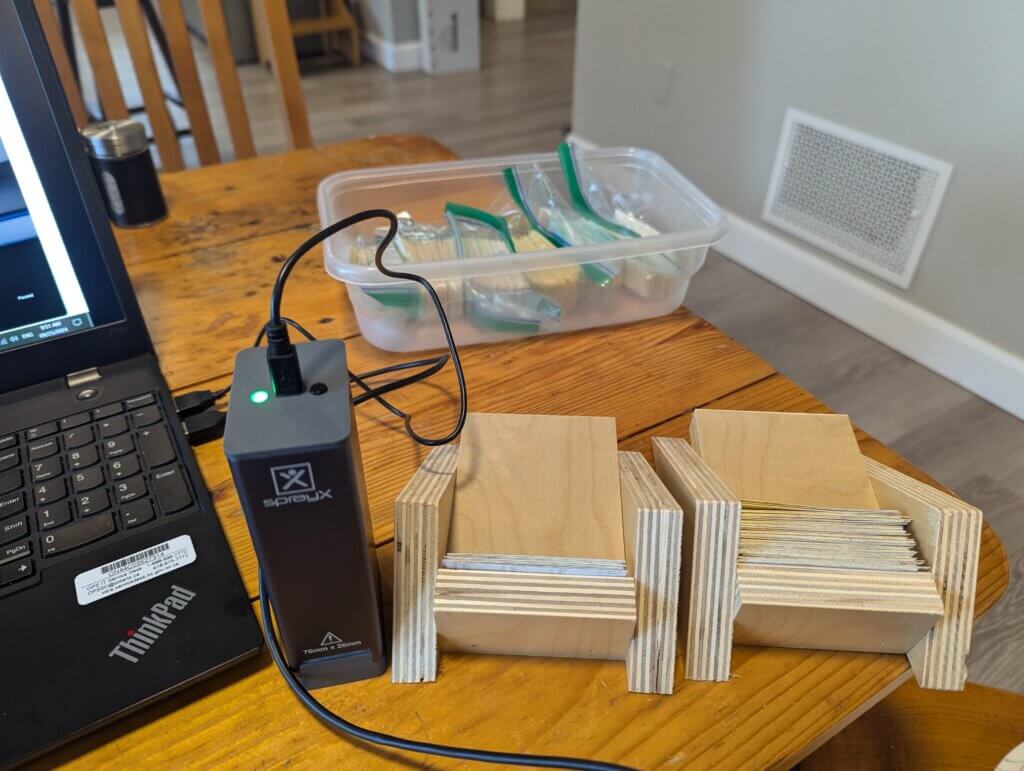
    WSP were given unique serial numbers to identify their position, and pre-loaded into the holders. 170 loaded holders were stored on raised grids inside four shallow plastic bins, arranged in the order they would be used (figure 4). This greatly expedited placement and retrieval, allowing for more repetitions to take place while optimal weather conditions held.

    Figure 4. WSP holders arranged in sequence in a storage bin. This allowed the pre-loading of serial numbered WSP prior to the day of the experiment.

    Application Method

    A DJI Agras T50 RPAS maintained and calibrated by the cooperator was fitted with four rotary atomizers. Previous work has demonstrated that higher rates of flow can have a detrimental effect on the spray quality from rotary atomizers, so distributing the flow over four nozzles was intended to prevent this. The atomizers applied a 250 µm spray over a 7 m swath width (corresponding with route spacing), as selected on the flight controller. Altitude was 3 m above the wheat heads, and flight speed was either 6 or 10 m/s (three repetitions each). Application volume was 50 L/ha, anticipating this to be a future label requirement.

    The RPAS flew a racetrack pattern over the samplers (figure 5). It flew with a prevailing tailwind between samplers 14 and 15, and then back with a prevailing headwind between samplers 7 and 8. We employed a DJI RTK-1 base station, which claims 1 cm horizontal accuracy.

    Figure 5. Racetrack flight path relative to WSP holders and prevailing wind direction.

    The RPAS was given sufficient distance (~40 m before and after the samplers) to reach the target speed, which was confirmed with a screenshot from the flight controller. The RPAS tank (capacity 40 L) contained municipal water with 0.125% v/v of NIS (Ag-Surf II). The level of liquid in the RPAS tank was maintained at 40 L throughout the trial to eliminate the effect of a changing payload.

    The field sprayer, maintained and calibrated by the cooperator, was a New Holland SP 275s. It extended the left boom over the samplers from position 1 through to 12 and made a single pass with a prevailing tailwind (three repetitions). It traveled at 4.5 m/s (16 km/h or 10 mph) spraying 187 L/ha (20 gpa) and rough terrain caused the boom height to fluctuate between ~25 cm and ~50 cm above the wheat heads. The nozzles were Greenleaf Technologies TADF 06 (greys) on a 50 cm spacing operated at 50 psi to produce a Coarse spray quality. The tank contained municipal water with 0.125% v/v of NIS (Ag-Surf II).

    Trial Procedure

    WSP holders were placed just prior to spraying while the RPAS or field sprayer was positioned ~40 m beyond the samplers. When wind conditions were deemed appropriate, a signal was given to initiate spraying. On pass completion, one minute elapsed before initiating collection to permit complete deposition of the spray and drying of the droplets.

    Weather Data

    Weather data was collected using a Kestrel 3550AG weather meter (Kestrel Instruments) in a vane mount positioned roughly 1 m below RPAS altitude. Data was logged as the RPAS or field sprayer boom passed the samplers (table 1). In the case of the RPAS, there was very little difference between the two passes per repetition, so values were averaged.

    TimeRep and TreatmentTemperature (°C)Wind Speed (km/h)Wind Direction
    10:21:511. RPAS 6 m/s16.43.1S
    10:33:562. RPAS 6 m/s17.76.2S x SW
    10:45:503. RPAS 6 m/s18.84.0S x SW
    10:55:401. RPAS 10 m/s18.62.1SW
    11:06:242. RPAS 10 m/s20.00.5S
    11:16:003. RPAS 10 m/s19.25.8S x SW
    11:29:541. Field Sprayer21.10.0S
    11:41:122. Field Sprayer19.91.7S x SW
    11:48:313. Field Sprayer20.23.9S
    Table 1. Time and weather conditions for each repetition. Data was captured as the nozzles passed over the holders. Wind direction is indicated by the direction it is coming from.

    Digitization

    WSP (Spot-On) were scanned using a DropScopeTM (SprayX). The software reported droplet density and percent area coverage, but only deposit density is considered in this report.

    Results

    Comprehensive Observations

    When the average deposit density from each of the four WSP per holder is added, we have a measure of total panoramic coverage. The mean total panoramic coverage from three repetitions of each treatment is shown in figure 6. For the RPAS treatments, distinct coverage peaks typical of RPAS applications correspond to the flight passes through poles 14-15 and 7-8. There is a slight spray displacement due to an occasional shift to a west wind (i.e. overall coverage shifted towards pole 1). However, the entire spray swath appears to have fallen within the range of the samplers. The back-and-forth flight pattern produced higher coverage at the interface between passes (pole 10) compared the extremes (beyond poles 19 and 3) suggesting some overlap. Deposit density was higher for the slower RPAS flight speed, and RPAS produced a higher deposit density than the field sprayer. Field sprayer coverage data is included for perspective but is generally not referred to unless it has some bearing on the evaluation of the RPAS coverage.

    Figure 6. Mean sum deposit in count/cm2 for each treatment. RPAS 6 m/s deposited an average 700 drops/cm2. RPAS 10 m/s deposited an average 400 drops/cm2. The field sprayer deposited an average 280 drops/cm2. r=3. S.E. bars shown. Arrows indicate RPAS flight path and direction.

    Swath Width

    If the coverage at pole 10 represents the edge of each swath, then a swath width of ~6.0 m can be estimated based on similar coverage at poles 16-17 and 3-4. This is less than the programed value of 7.0 m.

    This inference is supported when these averaged values were entered in an Excel-based model that calculates swath width. The model sums deposits from adjacent swaths assuming a racetrack pattern. Threshold coverage is subjective but adhering to the objective of establishing a balance between over- and under-dosing with the lowest possible C.V., we calculated swaths between 5.0 and 6.5 m (table 2).

    TreatmentPole PositionThreshold Coverage (count/cm2)Under-dose (%)Over-dose (%)C.V. (%)Swath (m)
    RPAS 6 m/s21-1012010.45.018.05.5
    RPAS 6 m/s10-11205.714.126.05.0
    RPAS 10 m/s21-10809.111.425.46.0
    RPAS 10 m/s10-13517.214.143.46.5
    Table 2. Swath widths calculated from the average cumulative deposit density for each WSP holder.

    It was expected that the field sprayer would produce a somewhat trapezoidal coverage pattern, tapering up at pole 12 (boom extreme) and level to pole 1 (sprayer chassis). Instead, note the gradual increase in coverage from pole 12 to 1. This is likely the result of boom yaw, where the boom end rose higher than the point closest to the sprayer. If this degree of coverage represents the industry standard, it is notable that the average boom coverage is either on par with, or considerably less, than that of the RPAS.

    Deposit Density

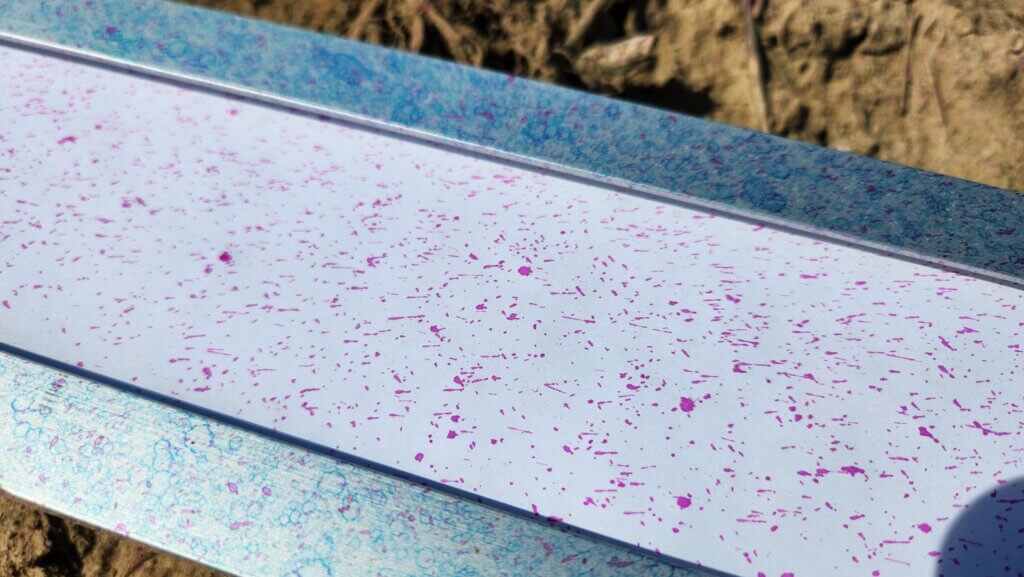
    The RPAS was programmed to produce a 250 µm droplet size, while the field sprayer produced Coarse (~218-349 µm) droplets. Smaller stains were produced by the RPAS than the field sprayer (figures 7 and 8), and their circular/oval shape suggest both a smaller droplet volume and a somewhat perpendicular flight path. Droplets produced by the field sprayer left long streaks, which suggest higher droplet volumes and a more parallel flight path.

    Figure 7. Typical deposition pattern from a single WSP holder in the centre of the RPAS flight pattern. Considered from the perspective of the RPAS, WSP starting at the top and rotating clockwise are left side, retreat side, right side, and advance side.
    Figure 8. Typical deposition pattern from a single WSP holder nearer the field sprayer chassis. Considered from the perspective of the field sprayer, WSP starting at the top and rotating clockwise are left side, retreat side, right side, and advance side.

    When the overall average coverage is calculated the RPAS at 6 m/s deposited an average 700 drops/cm2 and an average 400 drops/cm2 at 10 m/s. The field sprayer deposited an average 280 drops/cm2. When volume remains constant, smaller droplet diameters produce a greater number of droplets than with larger droplet diameters, so more droplets would be expected from the RPAS. However, the RPAS applied only 50 L/ha while the field sprayer applied 182 L/ha. Therefore, the RPAS distributed a greater density of potentially higher-concentration droplets on each WSP holder compared to the field sprayer. Further, a slower flight speed deposited a higher density of stains than a faster flight speed.

    Effect of Travel Speed

    The 6 m/s treatment resulted in slightly smaller swath widths (1 m or 15% less) than the 10 m/s treatment. The positive relationship between swath width and flight speed has already been established. The positive relationship between flight speed and off target drift has also been established, which may account for the significantly fewer deposits (almost 50% fewer) in the swath at 10 m/s versus 6 m/s. When a higher deposit density is valued, such as in the case of contact fungicide application, the loss of productivity from a slightly smaller swath width is a reasonable compromise for the superior coverage within that swath.

    Coverage by Cardinal Point

    North Facing WSP

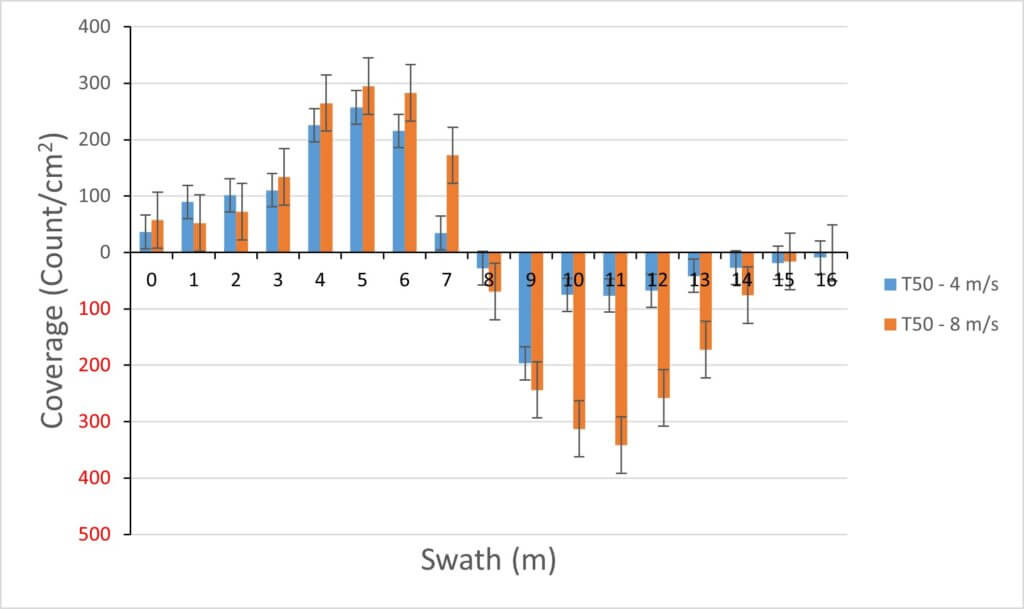
    This side of the WSP holder faced north, away from the prevailing south wind. The RPAS deposited far more on this face when traveling with the wind between poles 14-15, making this side face the RPAS retreat (figure 9). It suggests the RPAS blows down and back, even against a tail wind. This is supported when RPAS returned between poles 7-8 and deposited comparatively less on this face.

    Figure 9. Mean sum deposit in count/cm2 for each treatment on north facing WSP. r=3. S.E. bars shown. Arrows indicate RPAS flight path and direction.

    RPAS speed may have had an effect. With airblast sprayers, slower travel speeds produce greater dwell times, which increases the distance a droplet travels on a given trajectory. Logically, when flying away from the retreat face, higher speeds would impart a greater forward momentum on a droplet, cancelling out some of the backward momentum (watch a video here). If this were the case, there would be comparatively improved deposit density on the 14-15 pass for slower speeds and reduced coverage between poles 7-8 as it blew past the target. Figure 9 supports this hypothesis.

    South Facing WSP

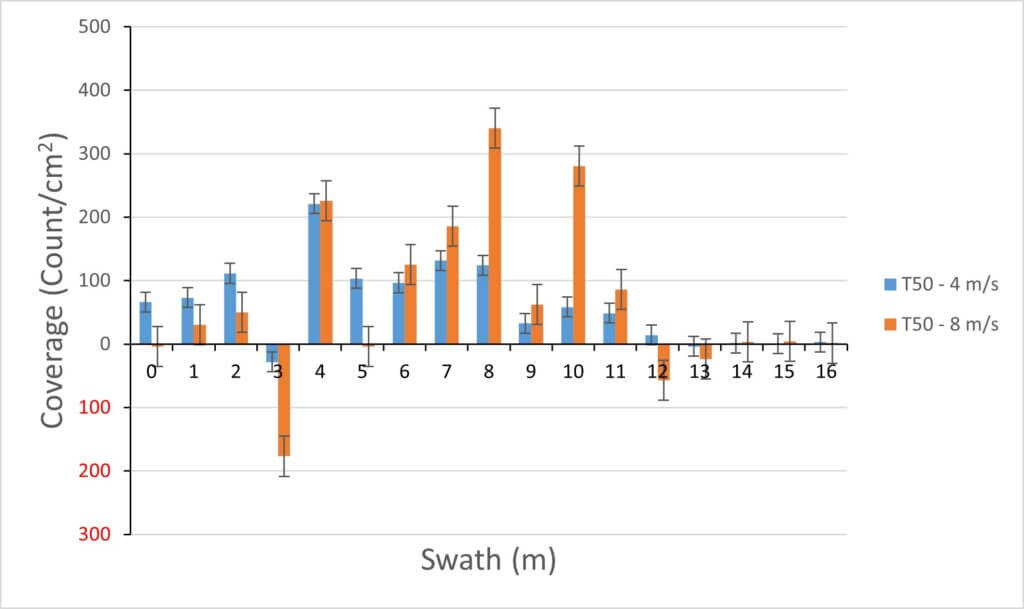
    This side of the WSP holder faced south, into the prevailing south wind. Considering the 6 m/s treatment, we see more coverage on the 7-8 pass than the 14-15, because it represents the retreat side of the sprayer (figure 10). The differential is far less on this plane than the north facing (figure 9) because the prevailing wind likely blew spray into the WSP on the 14-15 pass. Nevertheless there is significantly more on 7-8.

    Figure 10. Mean sum deposit in count/cm2 for each treatment on south facing WSP. r=3. S.E. bars shown. Arrows indicate RPAS flight path and direction.

    This relationship is less clear for the faster 10 m/s treatment. There does tend to be higher deposit on the 14-15 pass as spray was blown into the collectors. However far more was expected on this face for the 7-8 pass as it represents both the retreat face and has the added benefit of wind. Further, there was far less coverage overall when compared to the slower flight speed. We have no explanation for the lack of coverage on the 7-8 pass and can only conclude that higher speeds left droplets airborne and were not conducive to coverage.

    West Facing WSP

    This side of the WSP holder faced west, into the slight west wind. We see coverage is almost exclusively on those WSP facing the drone (figure 11). In other words, as the RPAS passed between 14-15 and 7-8, coverage was positively skewed from this point. The skewed coverage was evident at both flight speeds, but overall coverage was higher for the slower speed. Once again, we cannot explain why there was significantly reduced coverage on the 10 m/s pass between poles 7-8 except to suggest the spray may have remained airborne.

    Figure 11. Mean sum deposit in count/cm2 for each treatment on west facing WSP. r=3. S.E. bars shown. Arrows indicate RPAS flight path and direction.

    East Facing WSP

    This side of the WSP holder faced east, away from a slight west wind. We see that coverage is almost exclusively on those WSP facing the drone in the upwind direction (figure 12). Overall coverage was slightly higher for the slower speed, but far less overall coverage compared to the west facing samplers (figure 11). This is likely because the light west wind caused spray to displace from pole 21 to pole 1, washing past the back (insensitive) sides of the WSP.

    Figure 12. Mean sum deposit in count/cm2 for each treatment on east facing WSP. r=3. S.E. bars shown. Arrows indicate RPAS flight path and direction.

    Summary

    RPAS can provide par or better panoramic wheat head coverage compared to a conventional ground rig when they are flown using reasonable operational settings in optimal environmental conditions. A moderate flight speed (~6-8 m/s), appropriate altitude (~3 m above wheat heads), and four rotary atomizers producing a Medium-Coarse (~250 um) droplet size can produce an in situ 6 m swath width at 50 L/ha. Higher flight speeds produce a marginally wider swath at the cost of reduced droplet density and increased drift potential.

    Assessing coverage using vertical WSP facing four cardinal points has provided further insight into the behaviour of spray from an RPAS. Droplets from any application technology tend to deposit with wind and gravity, but rotor downwash represents an additional variable unique to RPAS. That force, combined with a forward cant of the drone during flight, lead droplets to deposit on vertical surfaces that face the rear (retreat) of the sprayer as well as surfaces that face and intercept spray that radiates laterally from the flight path.

    Drone Spray Canada, Bayer Canada, volunteers Kurtis Pilkington and Natalie, and grower-cooperator Adam Pfeffer are gratefully acknowledged for their contributions to this study.

  • Drone Spraying in Canadian Agriculture (up to 2024)

    Drone Spraying in Canadian Agriculture (up to 2024)

    Note: There have been updates to Canadian regulations governing drones since this article was written. For updates, please refer to this article.
    Introduction

    In Canada, the use of drones for pesticide application, otherwise known as RPAS, is regulated by two Federal Departments: Transport Canada establishes regulations for safe operation and Health Canada for the registration and conditions of use of pest control products.

    Drones are already used in Canadian agriculture for crop surveillance and livestock management, and they’re being used to apply granular fertilizers, for pollination, for frost protection and greenhouse shade management. The use of drones for general spraying was cleared by Transport Canada in July 2017. In 2018, Health Canada stipulated that the use of RPAS for pesticide application is not allowed under the Pest Control Products Act (PCPA) without sufficient data to characterize the hazards or risks associated with this use. You can read the updated (as of June, 2023) Pest Management Regulatory Agency Information note on the subject of pesticides applied by drone, here.
    At this time this article was written, only three pest control products were registered for application by RPAS in Canada. These were restricted-use microbials (two granular and one liquid) intended for larval mosquito control. Their labels were expanded to include RPAS in the fall of 2022 but as of 2023 no province or territory has yet permitted their application. International RPAS working groups (e.g. the OECD working party on pesticides and drones) comprised of academics, the agrichemical industry, government regulatory agencies, and both drone manufacturers and operators, are working collaboratively to assemble the evidence-based information we need to inform the expansion of other pesticide labels. These studies include:

    • comparative evaluations of efficacy
    • operator and bystander exposure studies
    • drift studies
    • residue studies, and
    • technical evaluations of how environmental, topographical, and operational parameters affect the above

    In parallel, several groups are working to develop pesticide safety certification and training materials. Pesticide training and certification programs across Canada are based on the Standard for Pesticide Education, Training and Certification in Canada. Canadian provinces/territories are responsible for the training and certification of pesticide vendors and applicators based on these standards. A national core manual for RPAS operator is anticipated.

    A candid moment from one of the many Health Canada-authorized RPAS research programs happening in Canada.

    Registration and Certification

    Anticipating future pesticide label expansions, perhaps you’re planning to buy and fly a RPAS. Pilots must register their drone (online for a $5 fee) and display that number on the drone. For more information, the Canadian Aviations Regulations (CARs) covers drones here. It’s a massive document, so jump to the end to find the relevant information under Section IX.

    Transport Canada requires all pilots with RPAS over 250 g to obtain a Pilot Certificate, either for Basic Operations or for Advanced Operations. In some cases, pilots may also have to apply for Special Flight Operations Certification (SFOC), which must be approved before the mission can take place. See below for details.

    Basic Operations Pilot Certificate

    The Basic Operations certificate allows pilots to operate any drone from 250 g up to and including 25 kg. This allows the pilot to fly:

    • Outside controlled airspace
    • No closer than 100 ft laterally from bystanders
    • In VLOS (or in contact with someone in VLOS)
    • Over 1.8 km from heliports
    • Over 5.6 km from airports

    If you’d like to explore the requirements, Transport Canada has an online document called TP15263 which describes required knowledge for Basic Operation pilots of small RPAS. Personally, I took a $100 online course (from a Canada-based drone flight school) to help me prepare for my exam. A good course will supply you with what you need to know about the laws, the environment, the aircraft, and your responsibilities as a pilot.

    The $5 exam has 35 multiple choice questions. You have 90 minutes to complete it and you need a 65% to pass. It was a surprisingly challenging exam, so don’t be discouraged if you don’t pass on your first try. You can take another swing at it after 24 hours, and you’ll encounter new questions randomly drawn from their database.

    Advanced Operations Pilot Certificate

    The Advanced Operations certificate allows pilots to operate any approved RPAS over 25 kg in VLOS. This allows the pilot to fly:

    • Inside controlled airspace
    • No closer than 16.4 ft laterally from bystanders
    • Under 16.4 ft above bystanders (essentially directly overhead)
    • In VLOS (or in contact with someone in VLOS)
    • Within 1.8 km from heliports
    • Within 5.6 km from airports

    There are two parts to this certification. The $10 exam requires an 80% to pass, covers more topics than the Basic Operations exam, and has the same 24h wait to retry. You must also undergo a Flight Review with a certified trainer, who changes about $200 for the service. Once the exam and flight review are successfully completed, there’s a $25 issuing cost. Be aware that flying a drone over 25 kg will also require an SFOC.

    Special Flight Operations Certificate

    In some cases pilots will have to apply for a Special Flight Operations Certificate (SFOC). Based on the CARs part IX regulatory structure, examples include operating a drone over 25 kg, flying at an advertised event, operating with foreign credentials (i.e. not a Canadian pilot) or operating outside the rules for Basic or Advanced operations, such as Beyond Visual Line-Of-Sight (BVLOS). Note, the requirements surrounding SFOC’s are under review as Transport Canada reassesses weight classes and streamlines the process, which can take weeks or months to complete. The new requirements are anticipated in late 2023 or early 2024 in Canada Gazette 2 (the 2019 update to Gazette 1 can be found here).

    Recency

    Once you have your Certificate(s) you must carry a copy with you while flying. Technically, Pilot Certification doesn’t expire, but you still have to maintain it. According to CARs 901.56, pilots cannot operate a drone unless they have successfully completed the following within 24 months preceding the flight:

    • Testing / Issue of their pilot certificate (Basic or Advanced).
    • A Flight Review
    • Any of the recurrent training activities set out in section 921.04 of Standard 921. This is an online questionnaire that has the answers posted right after each question. Don’t ask… just comply. Be sure to print it out after you complete it because it doesn’t save the answers.

    Just like the Certificate, the pilot must have Proof of Recency with them at all times. Unlike certification, it’s free.

    Learning from one another at a 2022 RPAS workshop in Southern Ontario.

    Records

    Every owner of a remotely piloted aircraft has to keep certain records. They need to be with you while flying for a certain period of time and all records must be transferred with the system if you sell or give it to a new owner.

    • The name of the pilot(s) and crew involved with each flight, noting time and date (keep with you while flying for 12 months).
    • Any maintenance, modification or repair of the RPAS, including precisely who did what and when. This should detail the instructions used to complete the work (keep with you while flying for 24 months).

    Fines and Enforcement

    Fines for contravening regulations range from a maximum of $3,000 for an individual to a maximum of $25,000 for a corporation. The RCMP and local police are part of the enforcement team.

    Crop Protection Products Registered in Canada

    This list is subject to change. To date, there are no pest control products registered for use in agriculture in Canada. There is no distinction between personal (i.e. home farm) and custom application. It is currently illegal to spray a registered agricultural product by drone. There are, however, two liquid formulation pesticides registered for non-agricultural use:

    • VectoBac 1200L – A biological larvicide intended for black flies and mosquitoes that must be applied over water sites. Label expanded in 2023.
    • Garlon XRT – A herbicide registered for industrial applications (e.g. controlling woody plants and vegetation in non-crop settings, such as around power lines and other utilities). Label expanded in 2024.

    Final Thoughts

    Get certified before you buy your RPAS, and do your research before you commit to a system. Rotor-based RPAS design is changing rapidly as manufacturers adapt to the demands of North American and European applicators. We once thought a swarm of lightweight, nozzled drones would be the path to success, and now the industry is leaning towards larger solitary drones with payloads over 40L and rotary atomizers instead of conventional nozzles.

    Be sure you understand what they can and what they cannot do. Only buy from a reputable dealer with practical spraying experience, and not someone with slick advertising that over-promises RPAS work rate, swath width, reduced drift or improved coverage potential. Ask to see data and remember, at the time this article was written: In Canada, it is currently illegal to spray pesticides in agriculture from a drone, whether it is on your property or not.