We’ve often heard the adage “Coverage is King” but what does that mean, exactly? It means that in order for your spray application to yield acceptable results, a threshold amount of the active ingredient in your tank must end up on the target. But at what point have we achieved sufficient spray coverage without wastefully over-applying to the target? What does good coverage look like?
Let’s manage expectations right here at the beginning of the article: There is no single, definitive answer because it depends on the nature of the application. In other words, you have to understand which factors are relevant to your specific situation before you can understand what success looks like.
Let’s highlight some of those factors:
Transfer Efficiency, Catch Efficiency and Retention
This relates to the spray’s ability to span the distance from nozzle to target (transfer efficiency) get intercepted by that target (catch efficiency) and then deposit a biologically-active residue on the target surface (retention).
First, the spray must reach the the target location. This may be the soil, or it might be the underside of a leaf deep in a plant canopy. The degree of success will depend on the droplet size(s), distance to the target and the environmental conditions.
Then the droplets have to be retained by the target surface and not bounce or slide off. Difficult-to-wet surfaces such as fruit, stems and waxy vertical leaves may be more easily covered with finer droplets and/or formulations that include activator adjuvants (e.g. surfactants).
Then the deposit must stay wet long enough to be absorbed by the tissue, or leave a hardy residue on the surface that can withstand weathering (e.g. precipitation, sun, and even bacteria) long enough to encounter the pest. More on this below.
Mode of Action
This relates to where spray must deposit (or relocate to) in order for it accomplish it’s objective. Here are a few examples of how products might work. Read your pesticide label to determine your situation.
Some products require contact. Insects must touch them, either via a droplet landing on them or as they move through a deposit. Similarly, certain fungicides must contact fungal hyphae on the plant surface. A few products are designed to drench the target, as is the case with oil-based miticides.
Some insecticides must be ingested. That may be in the form of a surface deposit or in plant material that has absorbed the chemistry. Similarly, some fungicides are absorbed by plant tissue.
Many herbicides are mobile (i.e. systemic). They may be drawn up through the roots, or enter the cytoplasm via leaves and travel to the growing points on the plants, or move through the xylem. Others are contact, staying relatively close to the original deposit.
The sprayer operator should consider these factors when planning the application and when evaluating the resulting coverage. So how do we visualize coverage? Some operators look for the shine on leaves, or a cloudy residue once the spray has dried. That’s better than nothing, but we recommend water sensitive paper (WSP), which is still the most versatile and economical way to visualize coverage.
WSP can be purchased from most retailers that carry spray equipment. It is available in three sizes, of which the 1” x 3” size is the most common. It can be folded and clipped to a plant surface, or placed on the ground. We’ve written several articles on how to use it (such as here and here and in pretty much a third of the articles on Sprayers101).
There are two metrics that must be evaluated when assessing coverage on water sensitive paper:
the area of the target that has spray on it, and
the distribution of the droplets over that area.
Let’s use a metaphor to explain:
The Battleship® / Coverage Metaphor
Imagine the boats in this Battleship® game are the insect pests, and the board they’re on is a leaf. The white pegs represent the spray deposits. In this first image, we see 100% coverage and a very high deposit density. Sure, we got every boat, but this is literal and figurative overkill. There’s no need to completely drench the target in order to control most pests. When you spray a target past the point of run-off, you are not adding more pesticide to the target – you are displacing what was already there. The surface will not exceed the concentration of product you sprayed (with the possible exception of mixes that include certain adjuvants). While additional volume can improve coverage to a point, there is a diminishing return.
Unless the label specifically asks for a drench, this is too much coverage.
In this second image, we’ve covered about 15% of the target area, which is reasonable. However, note the lack of distribution. You can see that we’ve missed quite a bit of the leaf. If our pretend pests are sedentary and if this was a contact product, then we’ve missed. If this was WSP we would advise the sprayer operator to note how much space there is between the deposits. Could a pest such as an insect or small weed easily fit between the deposits?
15% coverage is good, but the distribution is bad.
In this third image, we are still covering about 15% of the target, but now the spray is distributed more evenly. Some of you are likely noticing that we missed a pest. That observation reminds me of one of my favourite exchanges from the movie “Christmas Vacation” where Clark finally got his house illuminated, but his father-in-law only sees the problems: “The little lights aren’t twinkling.” “I see that and thanks for noticing, Ed.”
15% coverage, distributed evenly. Deposits may have some pest activity beyond the edge of the residue (light red circles).
Yes, we still missed a pest, but spraying is playing a game of odds. You want enough spray to increase the odds of controlling a pest, but not so much to waste spray (and money and time). This image represents an ideal coverage situation. If this pest moves, or this pesticide redistributes even a little, it will affect the pest.
Plus, we should not discount the threshold of influence that lies around pesticide residue. Imagine a small circle around each droplet (illustrated here as light red haloes) where active ingredient may redistribute beyond the initial deposit to affect an adjacent pest. Perhaps even more importantly, deposits do not spread on WSP the way they do on actual plant tissue, so WSP always gives an underestimate of the potential coverage.
In this last image, we see that red deposits have been introduced. This represents a disease control program where an earlier (white) application retains some residual activity when next application (red) is applied. The second spray application almost never lands on top of the first, giving much more protection on the target. For those keeners out there, note that we got that last pest!
In the case of many disease management programs, subsequent sprays tend to fill in gaps left by previous sprays. If timing is prompt, residual activity will see you through.
If you Absolutely Need a Number…
So, what if you’ve read all this but still insist on a firm number to define adequate coverage? We’ll reiterate that there’s no universally-accepted threshold of deposit density or area covered. It would be nice if pesticide labels included this information, but they don’t.
We’ll stick out necks out and say that in general practice we see excellent results when we achieve 85 discrete deposits per cm2 as well as 10-15% surface coverage on at least 80% of the water sensitive papers in a spray application. If you can manage this, it should give satisfactory results in most situations.
Ontario Agriculture Conference – 2022
For a really in-depth conversation on the topic of coverage, check out our presentation from the 2022 Ontario Ag Conference. We tried to deliver a fun and memorable demo at the end of this presentation to show how different droplet sizes might contribute to coverage. Enjoy.
North American built boom sprayers have nozzle spacings of 20” (50 cm in the rest of the world), but other spacings such as 15” (37 cm) and 10” (25 cm) also exist. What are the reasons for these alternative spacings and do they offer any inherent advantages?
Why spacing matters
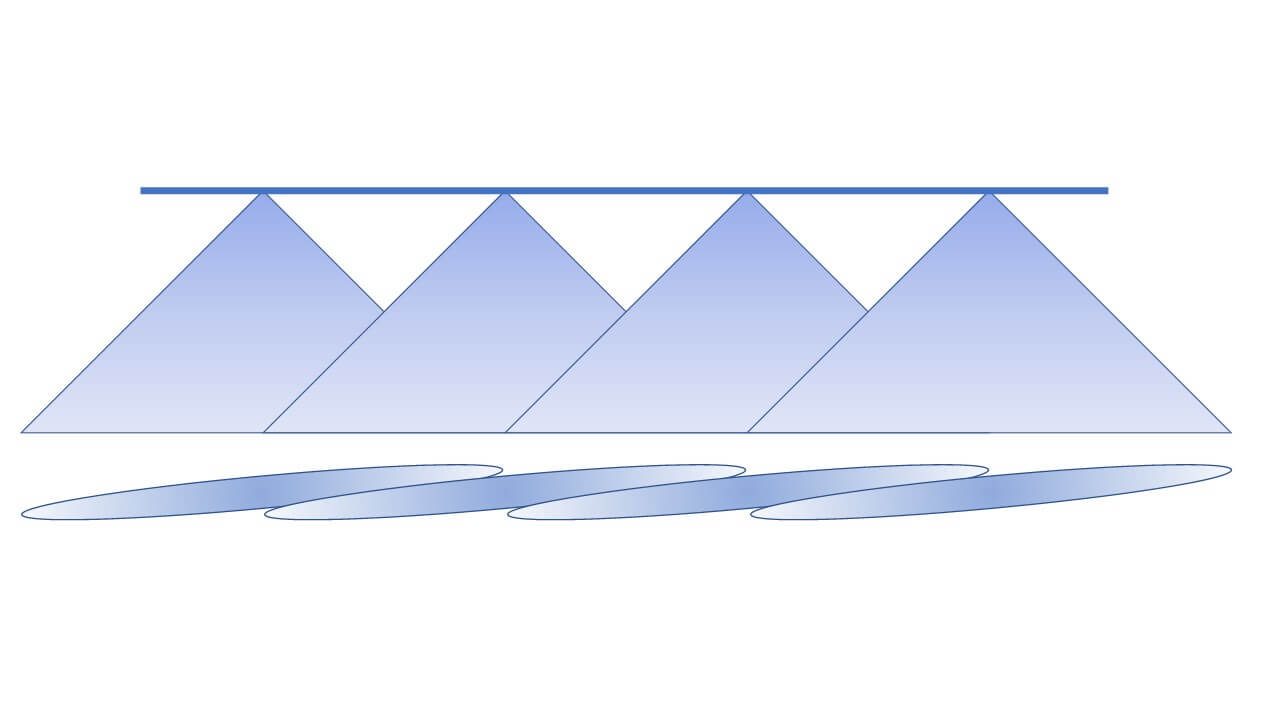
Nozzles are spaced along a boom to allow their fans (patterns) to overlap sufficiently at the target. In broadcast spraying, a uniform distribution of spray volume gives us the best chance for consistent coverage along the boom. Since flat fan nozzles produce a tapered pattern (i.e. the volume is highest in the centre and diminishes towards the edges), approximately 100% overlap (i.e. 50% from each neighbour) will produce a uniform swath.
Figure 1: Tapered flat fans that require some overlap are the default pattern type for agricultural boom nozzles. This is true of conventional and low-drift styles. Note that the flat fans are turned 15° to prevent the spray patterns from interfering with one another.
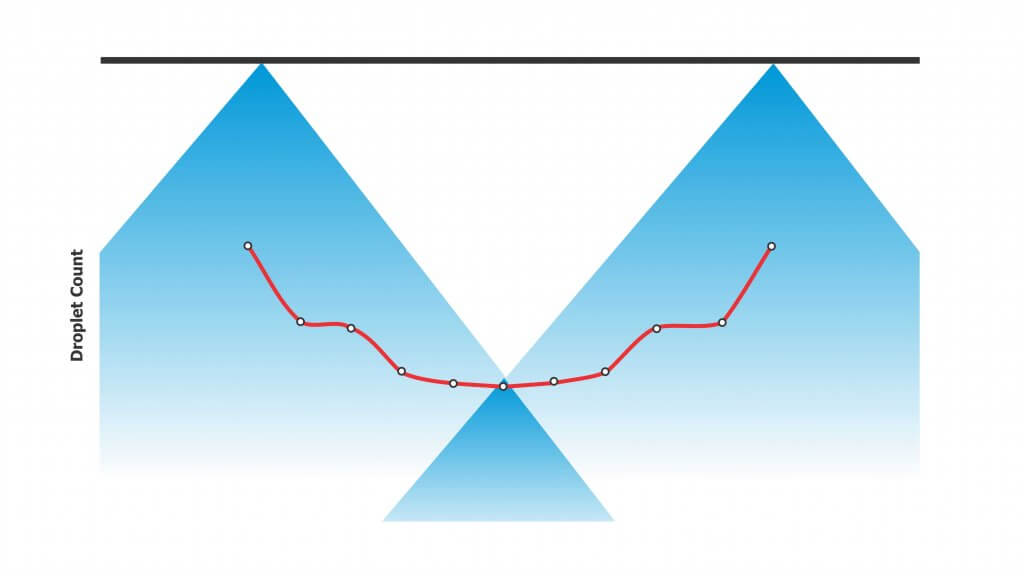
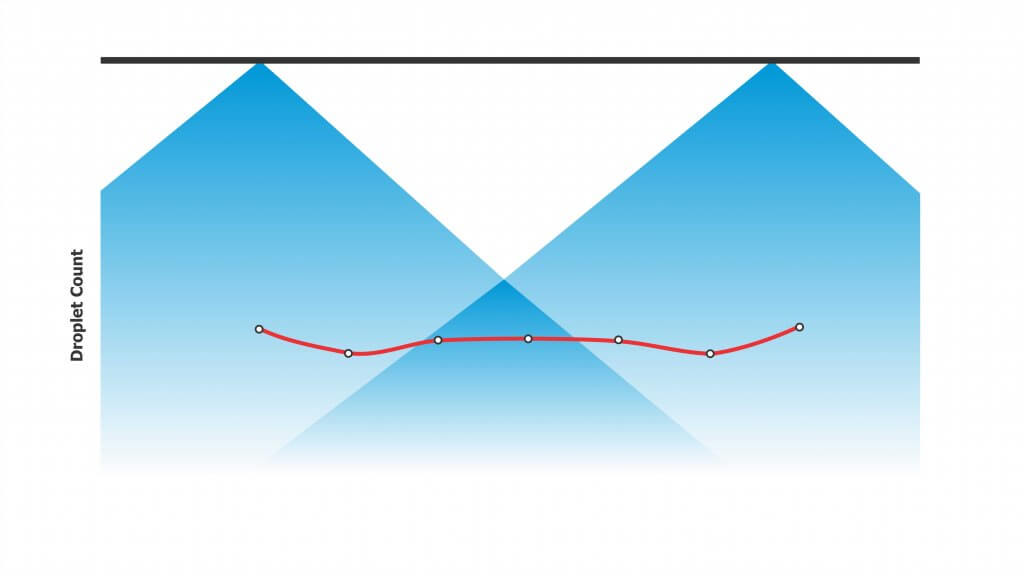
The 100% overlap isn’t just for volumetric distribution. Flat fan spray patterns tend to have more and finer droplets in the centre and fewer and coarser droplets at the edges. All droplet sizes contribute to coverage in different ways, so the overlap ensures both number and sizes are evenly distributed along the entire boom.
Figure 2: 30% overlap may achieve volumetric uniformity. But because the centre of the pattern contains the majority of the smaller droplets, low overlap may result in low coverage in the overlap regions, resulting in striping.Figure 3: Consistent droplet number distribution along the boom requires at minimum 100% overlap (50% from each neighbouring nozzle). This blends those regions of the patterns with high and low droplet densities.
The generic 20” spacing arose from long-held conventions about boom height, fan angle, and travel speed. Specifically, this spacing required a boom height of 20” to obtain good overlap of the once-dominant 80° fan angle. Combined with 0.15 to 0.3 US gallon per minute (gpm) nozzles and travel speeds of 6 to 8 mph, operators were able to apply 5 to 15 US gallons per acre (gpa) volumes. Using nozzles with smaller flow rates would generally result in nozzle blockages.
But what if we want to change any of those variables? How does this affect nozzle spacing? Figuring out the pros and cons of an alternate spacing requires a little math and some contingency management.
Boom Height Math
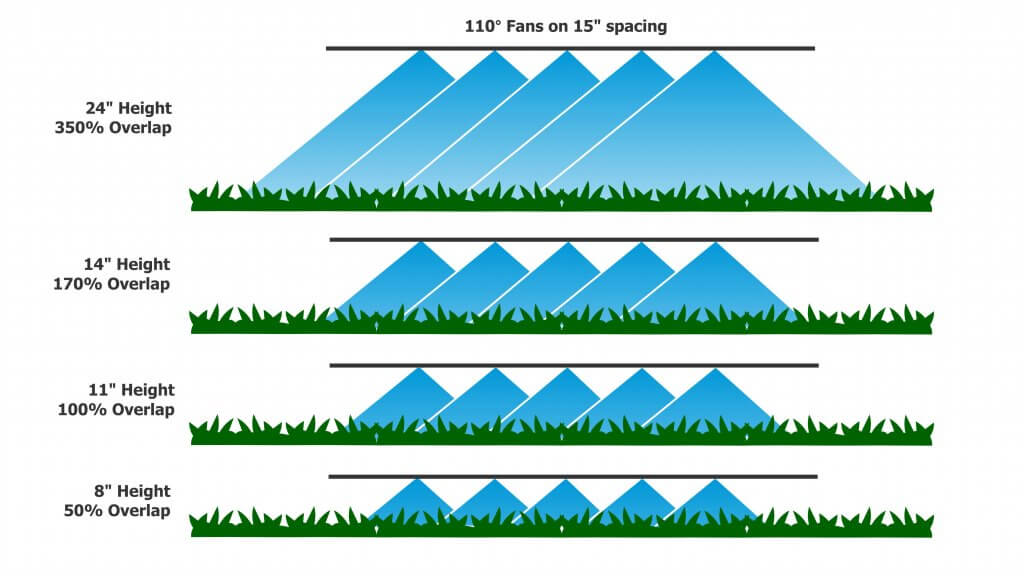
First the math. If the boom has 20” nozzle spacing and we need 100% overlap, the width of the spray pattern at target height must be two times the nozzle spacing, which is 40″. You must calculate the required fan angle and boom height to achieve this. Most nozzle catalogues have tables to help with this, or you can download a handy spreadsheet to calculate your own scenarios here.
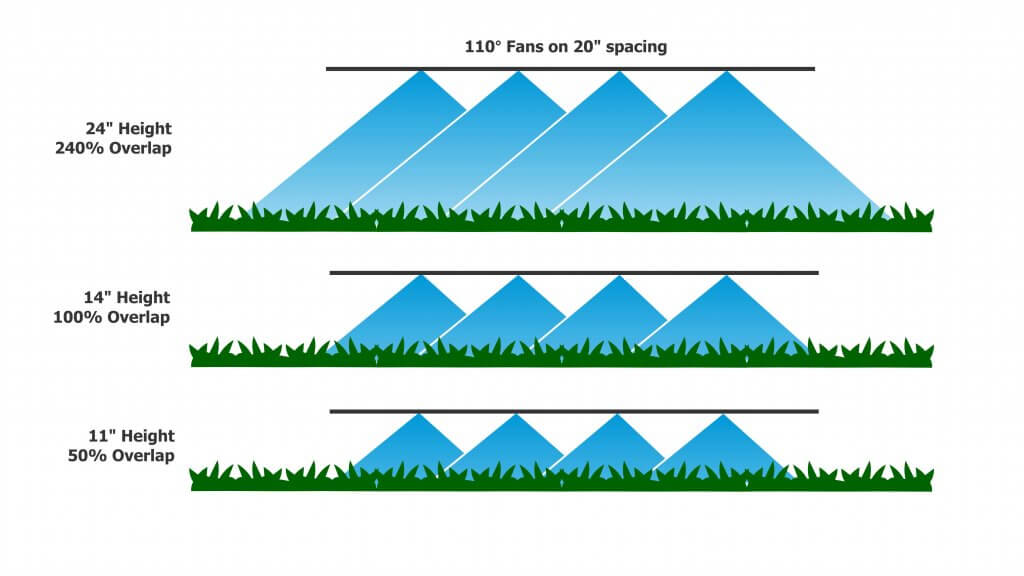
For today’s standard 110° fans, a minimum boom height of 14” is needed to achieve 100% overlap. For 15” spacing, the height is reduced to 11”. For 10” spacing, we drop to a mere 7”. However, consider that most modern suspended booms are not operated at heights less than 24” to allow for sway. At that height, there’s plenty of overlap to go around for 20″ nozzle spacing. For those booms that are able to operate at a consistent height, narrower spacings permit lower heights that will reduce drift potential significantly. Every time we halve boom height, we also halve drift potential.
Figure 4: Using 110° tips with 20″ spacing, the theoretical height at which we achieve 50% overlap is 11″ above target.
By tilting the nozzles forward or backward from the vertical, we can reduce the boom height somewhat further and still get the same overlap. For example, for 20 and 15” spacings, angling nozzles forward or backwards by 30° allows us to drop the boom another 2” closer to the target.
Contingencies
A suspended boom hardly ever stays at a uniform height; It sways up and down with field conditions, topography, etc. This is why many operators set their booms above the minimum height – to prevent striping when the boom sways low. The penalty is that this increases the distance droplets need to travel, increasing drift potential and any turbulent displacement problems arising from the moving boom.
Assuming a 110° flat fan at 24” boom height, each nozzle achieves a theoretical pattern width of about 70”, which is an overlap of 70÷20=3.4-fold or 240% on 20” nozzle spacing. Given a minimally-acceptable overlap of 50% (25% from each neighbouring nozzle), the boom could be as low as 11”. For 15” spacing, the minimum height for 50% overlap is 8”, and for 10” spacing it’s 5”. This means the narrower spray patterns gain 3” to 6” in allowed downward boom movement.
Figure 5: Using 110° tips on 15″ spacing, the height for 50% overlap is 8″ above target.
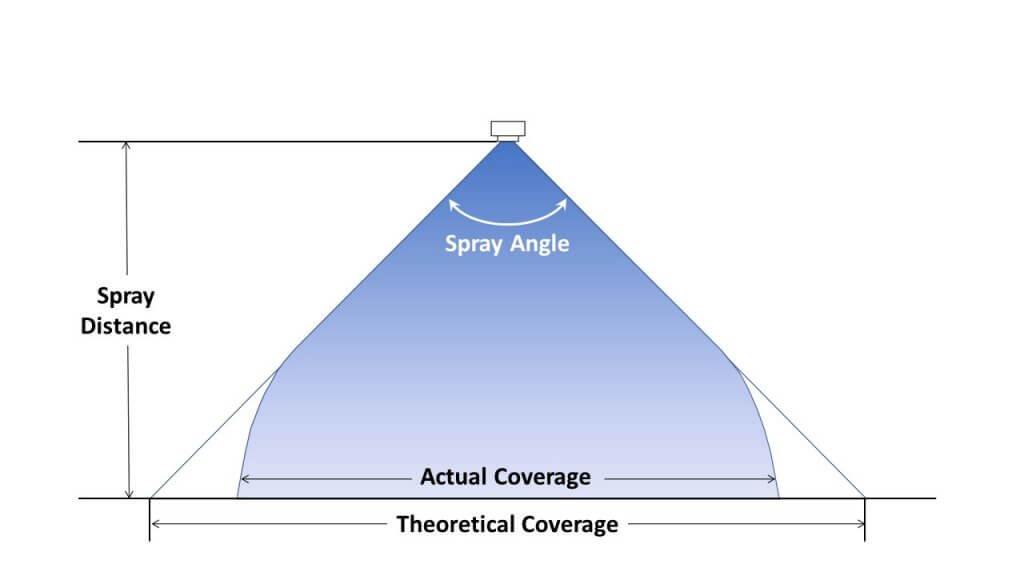
A second contingency is that spray patterns are rarely the exact value that the nozzle catalogues specify. A so-called 110° nozzle may operate at only 90°, or up to 150°, depending on the nozzle model, the spray pressure, and the tank mix. Learn more here and here. Patterns also don’t continue to grow at their rated fan angle, as droplets slow due to air-resistance and fall more vertically due to gravity. For that reason, a visual check is recommended to ensure the expected overlap is achieved.
Figure 6: Fan angles indicate initial trajectories of droplets at the edge. With distance, gravity pulls these droplets downward, narrowing the pattern width from that achieved theoretically (figure adapted from image in TeeJet catalogue).
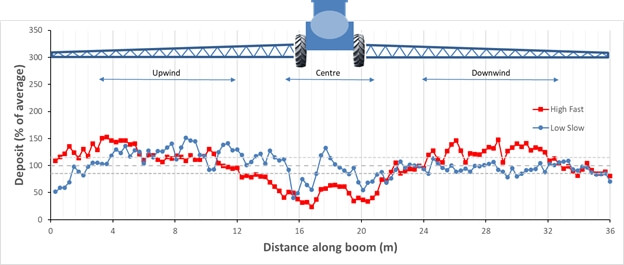
A third issue to consider is less related to boom height but nonetheless affects spray distribution. Small droplets move with air currents, and the turbulence created by large, fast sprayers creates enough turbulence to move these droplets significantly. A perfect pattern under static conditions can look quite different at a fast travel speed with a modest side wind. Low booms may help prevent some of this displacement because droplets spend less time in flight, and their average velocity is faster.
Figure 7: Spray deposition onto a 2 mm string to measure deposit uniformity for a fast travel speed and high boom and a slow speed, low boom configuration.
Flow Rate Math
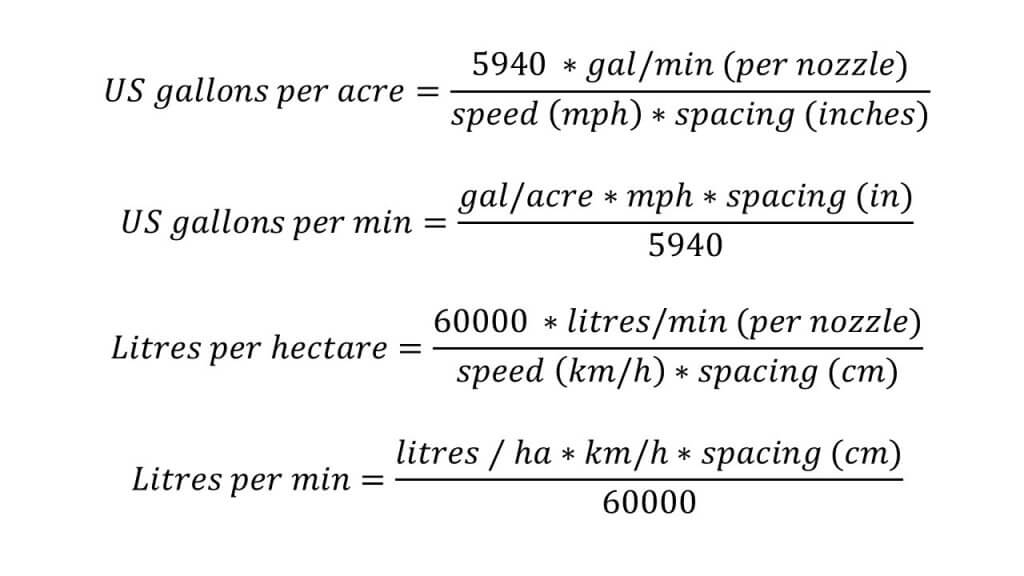
Flow rate requirements per nozzle change whenever we equip a boom at an alternate spacing. The basic formulae are shown below.
Moving from a 20″ to a 15″ spacing would require a nozzle with 0.75 of the flow rate, approximately from a 02 to 015 size, or 03 to a 025 size, or 04 to 03 size, etc.
Pulse Width Modulation
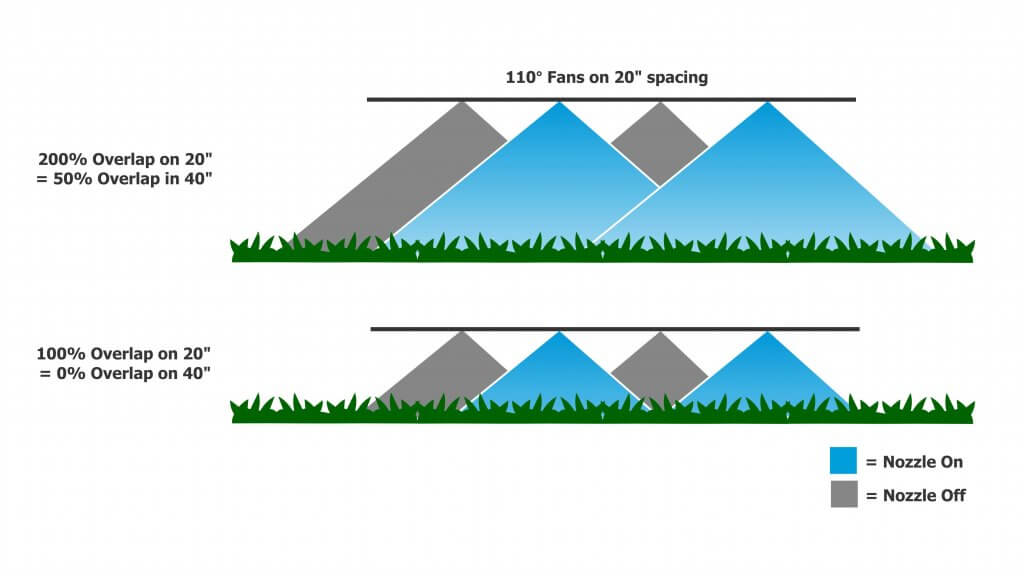
The use of Pulse Width Modulation (PWM) has increased the overlap requirement. With PWM, alternate nozzles are on a 180° timing offset from their neighbours. This means that when running >50% duty cycle, when one nozzle is temporarily off, its neighbours are on. These neighbours’ patterns must now span the gap, and 100% overlap is the absolute minimum to achieve this. PWM users therefore select the wider pattern angles and some opt for >100% overlap.
Figure 8: Pulse Width Modulated booms require 200% overlap so that the entire boom receives proper coverage when the alternate set of nozzles is off. For 110° fans at 20″ spacing, the minimum boom height would be 21″
PWM Considerations
High flows (greater than 1 US gpm at the nozzle) that are common for fertilizer top-dressing may require higher-flow PWM valves.
Narrow spacings reduce the individual nozzle flow rates and can therefore support higher application rates before triggering a larger valve requirement.
PWM valves aren’t cheap and for example 15″ spacing compared to 20″ spacing adds 24 valves on a 120′ boom.
Banding
We noted that 20” nozzle spacing is a standard because it corresponds to what has traditionally been achievable with available boom heights and spray pattern angles. But things can change.
Narrower spacings such as 15” originate with row crops and planter row spacings of 15” or 30”. These spacings exist so the spray pattern can be placed either over the top of a crop row, or in between the rows for banding. Using narrower fan angles and/or lower boom heights, together with “even” (as opposed to “tapered”) fans, banding sprays can be applied over the top of, or between crop rows. Or drop hoses can reach between the rows for top-dressing or directed sprays into the canopy.
Canopy Penetration
With narrower spacing, it can be argued that a greater proportion of the boom length has spray directed directly downward (corresponding to the centre of the pattern). Whether or not this translates into better penetration of a canopy is a fair question. In laboratory trials, use of 10” or 20” spacing did not improve penetration into a broadleaf canopy. But if the lower boom height afforded by the narrower spacing was utilized, some improvements in the deposit of angled sprays onto vertical targets was observed.
Adjusting to Narrower Spacings
As we showed earlier, use of 15” or 10” spacing booms for broadcast sprays requires a smaller nozzle size to achieve the same spray volumes as the 20” spacing. If boom height remains constant, narrower spacings result in greater pattern overlap which provides more latitude for sway. Alternately, lower boom heights can be used.
Using smaller nozzles on narrower spacing presents some challenges. Generally, smaller nozzle size means finer spray quality. If an operator wants to retain the spray quality they had on a 20″ spacing, they may opt to use lower pressure (not advisable for non-PWM systems) or swap to different nozzle design that can produce the desired spray quality at the lower flow rate.
Smaller nozzles are more prone to plugging, so that needs to be managed with filtration, filling practices and water sourcing. Be aware of the the product formulations and their requirements for filter mesh size. Most dry products specify a 50 mesh filter (or coarser). Also, check size options for nozzles. The smallest size for most nozzle models is 015, but certain PWM-specific nozzles are only available in 03 or larger.
The marriage of narrow spacings with individual nozzle shutoff can result in a versatile system capable of producing high resolution banded sprays in narrow seeded crops. For example, consider a boom with a 10” nozzle spacing spacing that matches the seeder row spacing. The operator can shift from 10” to 20” or 30” from the cab if the valve control software allows it. With accurate guidance and good boom levelling, topdressing foliar products (e.g. nutrients, fungicides) can follow the crop row precisely.
Spot Sprays
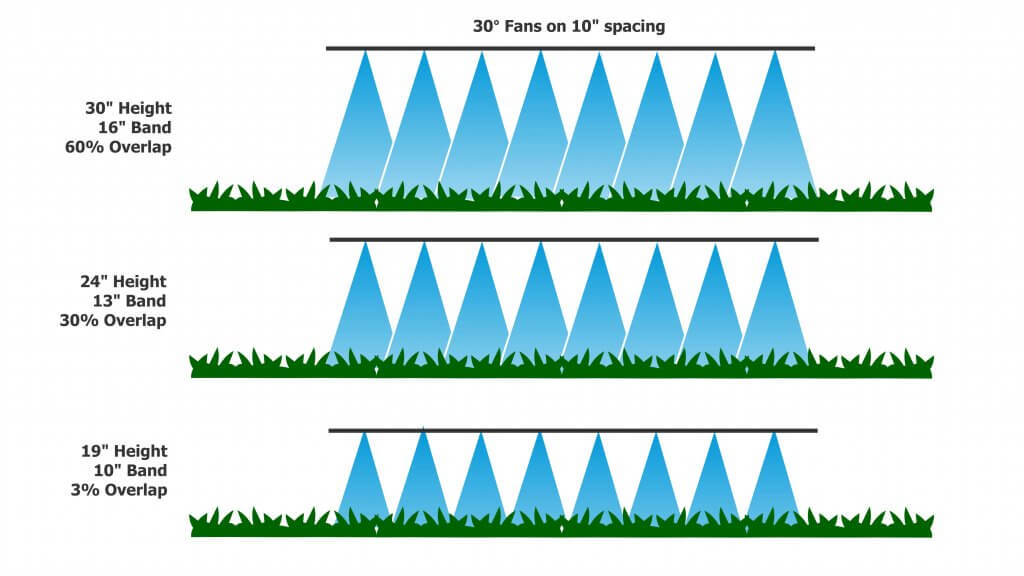
Spot sprays present a situation where compromises are needed. Some, such as WEEDit, utilize narrower nozzle spacings to allow better treatment resolution and increase product savings. Any one nozzle or sets of adjacent nozzles may be triggered by the sensor. For single nozzle activation, to preserve the value of the better resolution a uniform, narrow band of spray needs to be created. This means a 30° or 40° fan angle from a banding nozzle will be necessary. For example, a 24” boom height will result in a 13” band with a 30° fan, and an 18” band with a 40° fan. In the latter case, the dose would be diluted by 80%, wasting much of the potential savings.
Figure 10: Boom height is critical for banded sprays and for spot sprays. Too wide a pattern on a single nozzle reduces dose, too narrow creates misses.
Frequently, a patch of weeds will trigger several adjacent nozzles. Now these individual bands need to work together to create a uniform swath. This will inevitably require some overlap to avoid gaps, but too much overlap will result in bands where twice the dose will be applied. A tapered fan may suit this situation better. As a result of these varying needs, tolerances for spot spray boom height are even more strict than for broadcast spraying. More thoughts on spot spray nozzle selection are here.
Conclusions
Narrower nozzle spacings on a broadcast boom allow somewhat lower boom heights and these can in turn reduce drift and improve deposition of sprays. Lower flow nozzles will be needed with narrower spacings, requiring management of plugging and potentially a more drift-prone spray quality. The value of narrower spacings depends on the availability of booms that control sway, allowing them to operate at uniform, low heights.
There’s been a lot of talk about rate control in spraying, and one key technology is pulse-width modulated spray systems (PWM). Although PWM has been commercially available for a number of years, we are seeing new products enter the market. This article explains what PWM is and how to make it work in a spray operation.
Rate Control Primer
Modern sprayers, be they self-propelled, or tractor- or truck-drawn, experience fluctuations in travel speed. Operators speed up or slow down as conditions demand. In order to maintain a constant application volume per acre, the spray liquid flow must change in direct proportion to travel speed. The sprayer achieves this with a rate controller, a device standard on most sprayers.
The rate controller uses four pieces of information to ensure a constant application rate.
The user enters the width of the boom and the desired water application rate.
The sprayer provides travel speed information (collected from a GPS signal or a radar- or wheel-based speedometer) and liquid flow rate (collected from a flow meter on the main sprayer liquid flow line).
Using a simple mathematical formula, the rate controller calculates what the required liquid flow needs to be for any given travel speed. A typical controller changes the flow by adjusting the pump pressure. The sprayer operator keeps an eye on the spray pressure to ensure it doesn’t exceed the capabilities of either the nozzle, the plumbing, or the pump or that it does not produce an undesirable droplet size or spray pattern.
Rate Control Options
There are currently about five options for rate control on the market, and all but one rely to a degree on spray pressure to manage flow rate.
Pressure-based rate control. The most common system, it changes spray pressure as required by the travel speed. It is limited by the flow rate capacity – both high and low – of the spray nozzles installed on the sprayer and the pressure limitations of the sprayer system.
Variable rate spray nozzles. Commercial systems such as the VariTarget nozzle use a plunger in a nozzle assembly that pushes down on, and deforms a flexible nozzle cap, with spray pressure. Higher pressures result in the cap’s orifice becoming larger, facilitating more flow. This system is capable of a wider range of flows than a conventional nozzle system over the same pressure range.
Dual boom systems. The rate controller still functions as described above, but a second boom fitted with different flow nozzles is activated when the flow rate requirements can no longer be met with a single set of nozzles. For example, if the second boom contains larger nozzles, once the boom with larger flow nozzles is activated, the spray pressure drops significantly and additional speed capacity can be realized.
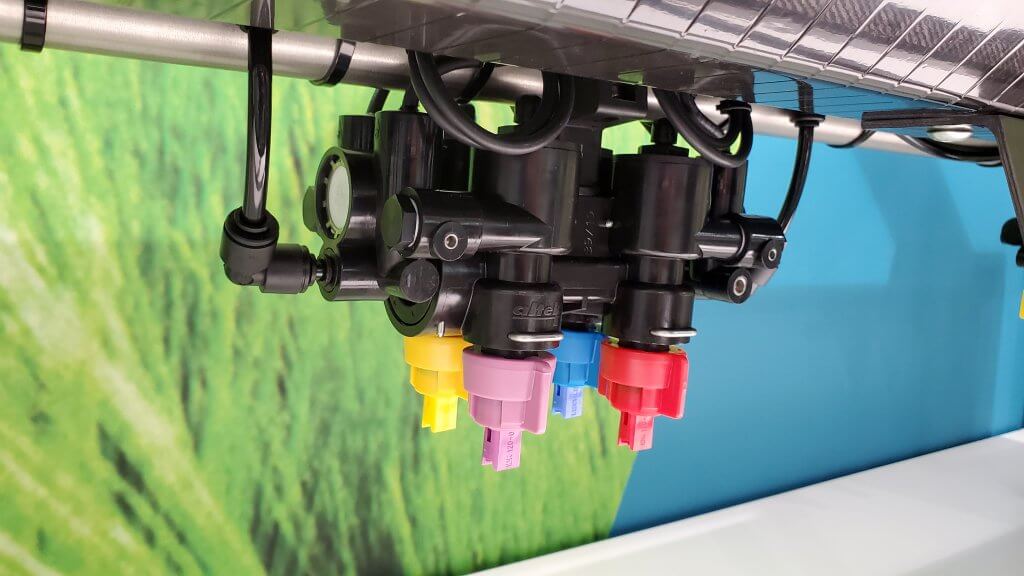
Dual or Quadruple nozzle bodies. A similar approach to the dual boom is available from Arag (Seletron), Hypro (Duo React), and a host of European manufacturers. These systems utilize a single boom (no duplicate boom is required) and direct the flow through one of any two or four (Arag Seletron only) nozzles, or two nozzles simultaneously. Individual nozzle section control is also possible with this approach. Similar pressure fluctuations as with a dual boom would be experienced, requiring careful selection of nozzle flow rates to avoid large pressure jumps. The same system can also be used to manually change from one nozzle to another as conditions require.
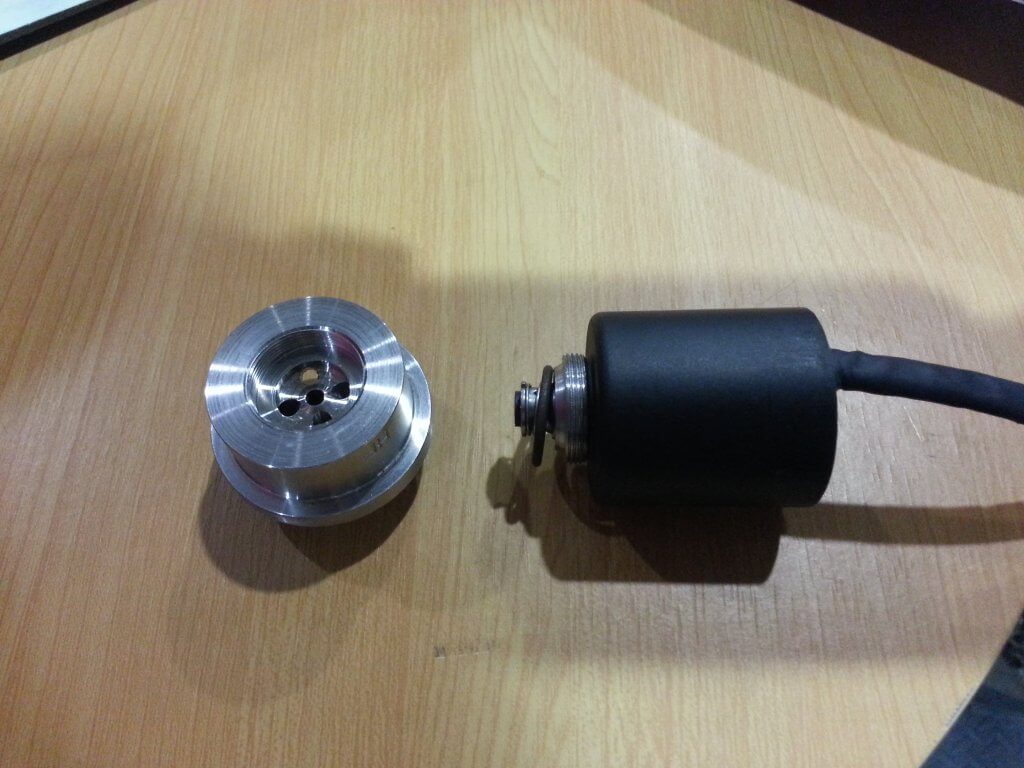
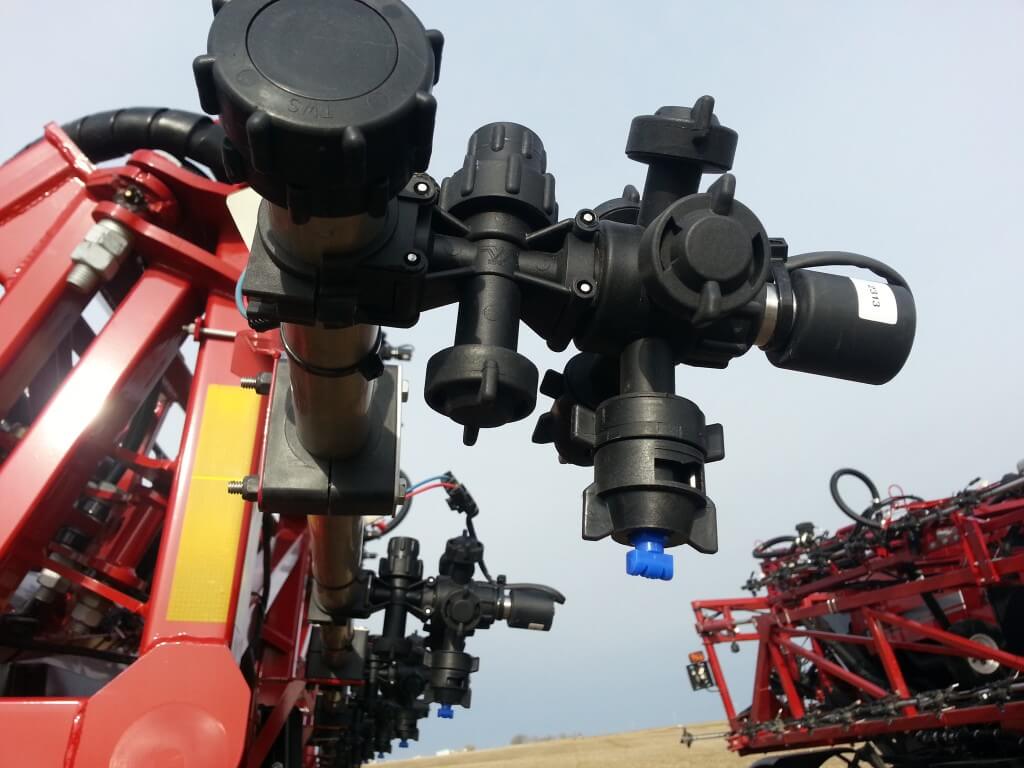
Pulse Width Modulation. PWM utilizes conventional plumbing: a single boom line and a single nozzle at each location. Liquid flow rate through each nozzle is managed via an intermittent, brief shutoff of the nozzle flow activated by an electric solenoid that replaces the spring-loaded check valve. Typical systems pulse at 10 or 15 Hz (the solenoid shuts off the nozzle 10 or 15 times per second), but some pulse at 50 and even 100 Hz. The duration of the nozzle in the “on” position is called the duty cycle (DC) or pulse width. 100% DC means the nozzle is fully on, and 20% DC means the solenoid is open only 20% of the time, resulting in the nozzle flowing at approximately 20% of its capacity. The ability to control the duty cycle is referred to as pulse width modulation.
Pros and Cons
There are two chief features of a pressure-based approach that affect the spray operation.
Pressure affects spray quality and spray patterns. Higher pressures (the result of faster travel speeds) result in finer, more drift-prone sprays, and lower pressures may, in addition to producing a coarser spray, reduce the spray’s fan angle. The resulting narrow patterns can result in less overlap and poor pattern uniformity. When the travel speed drops below a defined point, the spray flow rate is held constant to maintain the pattern; this can result in over application.
Pressure is not a very effective way of changing flow rates. Increasing the travel speed by a factor of 2 requires a pressure change of four-fold, as predicted by the square-root relationship between flow rate and pressure. As a result, a system capable of pressures ranging from a low of 30 psi to a high of 90 psi (a three-fold change in pressure) results in only a 1.73-fold change in flow rate (and travel speed). 1.73 is the square root of 3.
In comparison, PWM systems do not rely on pressure changes to effect new flow rates. Instead, the duty cycle of the system affects nozzle throughput. Boom spray pressure stays constant throughout the duty cycle range, and as a result, so does spray quality and spray fan pattern angle. In practice, the lowest duty cycles increase droplet size, and reduce fan angle, somewhat. These effects are minor and do not impact overall performance, particularly because the time spent at low duty cycles tends to be low. The operator also has the option of adjusting the spray pressure to get a desired droplet size, even “on the fly” and the PWM system will maintain the desired application rate.
A PWM system can therefore change travel speeds by about a factor of five (from 20 to 100% DC). Duty cycles less than 20%, although possible, are not recommended.
Note that the actual measured change in flow rate achieved by a PWM system is not directly related to duty cycle. The actual nozzle flow rate is greater than that predicted by a duty cycle calculation, especially for smaller nozzles and also for higher pulse frequencies.
Commercial PWM Systems
The original inventor of PWM for spraying, Dr. Ken Giles of the University of California at Davis, worked with Capstan Ag Systems to produce the Capstan Synchro, the first PWM system on the market. The Capstan product was later licensed to Case IH sprayers and named AIM Command. It was a factory option on Case sprayers from 1998 to 2016, manufactured by Capstan. The system featured a separate monitor, permitted PWM to range from 100 down to 15%, and featured an alternating pulse in which the every second nozzle pulses identically, and alternating nozzles work in a 180 degree offset. In other words, in a system operating at 50% DC, when any given nozzle is on, adjacent nozzles are off. This results in a “blended pulse” that minimizes the likelihood of skips.
In recent years, Capstan has entered the retrofit market place and the technology has been installed on many brands of sprayers at the dealer level. The hardware is identical to Case products, with some minor differences in how the software interacts with the rate controller.
Since 2012, Case has offered an enhanced version called AIM Command Pro (Capstan calls their version Pinpoint). This system offers individual nozzle sectional control as well as turn compensation. In addition, the enhanced system offers individual nozzle diagnostics that provides operational details to the sprayer operator.
In 2014, Raven introduced a system called the Hawkeye. Initially targeted at the retrofit market, the system uses an ISOBUS approach that works with the Viper 4 monitor. The electric solenoids are similar to those on the Capstan systems. The basic system (Hawkeye) features turn-compensation, but not individual nozzle sectional control. Section resolution is determined by the limits of the monitor, for example, 16 virtual sections on the Raven Viper 4. Hawkeye 2.0 HD, announced December, 2015, allows for individual nozzle on-off control. Hawkeye is available as a factory option on New Holland (called IntelliSpray), Apache, Rogator, Horsch Leeb, and Case (AIM Command HD) sprayers.
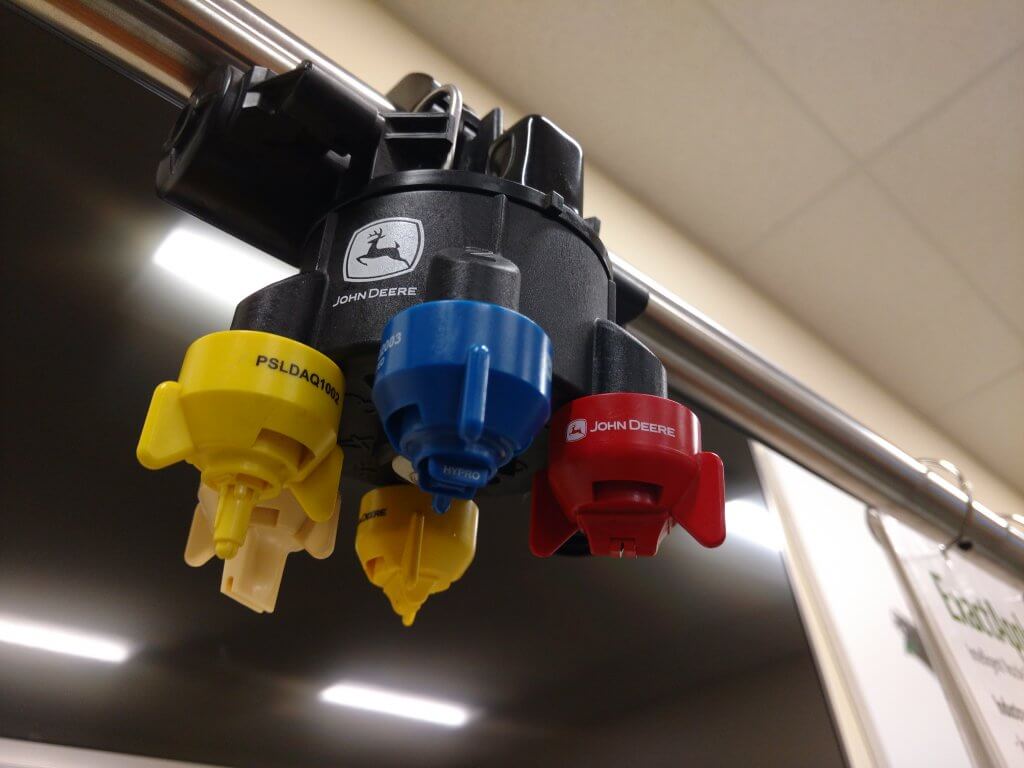
John Deere announced their PWM version in 2016. Called ExactApply, the system splits the liquid flow into two streams, one through each of two solenoids. The solenoids serve to shut off the flow, and also to control liquid flow rate, each running at 15 Hz. The body contains six nozzles on numbered feed housings, and they operate in opposite pairs.
The body is rotated manually to the preferred nozzle pair. With the longer housing in front (#4, 5, and 6) it allows for very high flows from a single nozzle only. When the shorter housing is rotated to the front, the unit will allow just the front, just the back, or both nozzle to operate.
It has three main modes.
High flow (e.g. fertilizer) capacity with the long housing in front. This nozzle can be pulsed at 30 Hz by using both solenoids.
A/B Mode. Cab-switchable nozzles in front, back, or both for rate variation, spray quality variation or other specialty uses. When pulsing is turned off, AB AutoSelect mode is available which automatically switches nozzles based on flow needs. The idea is for a smaller nozzle to be in the front (A) and to respond to travel speed changes with pressure changes (i.e., conventional pressure-based rate control). When increased speed exceeds the pressure limit of the nozzle (set by user), the unit switches to the back nozzle (B), which is slightly larger. Pressure drops immediately and faster speeds are possible. Once the the pressure reaches the user-defined maximum, both nozzles switch on, making additional speed possible.
Pulsing Mode. The front, or back, or both nozzles can be pulsed. The user can switch between these nozzles from the cab. When only one nozzle is pulsed from position #1, 2, or 3, the frequency is 15 Hz. When two are pulsed, the effective frequency would be quasi 30 Hz (15 Hz each at a 180 degree offset).
The system also features individual nozzle shutoff, turn compensation, programmable rates by nozzle, nozzle plug detection, and LED lighting. It offers higher maximum flow rates through its solenoid (up to 50 US gpa at 15 mph).
We’ve provided an in-depth overview of ExactApply here.
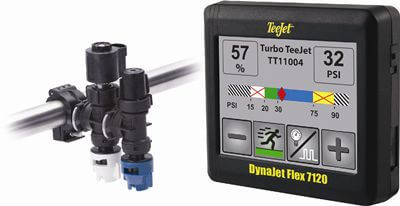
TeeJet has a system called the DynaJet Flex 7120 that uses either a monitor or Android tablet to display pressure, duty cycle, and droplet size. DynaJet is available to OEMs and to the aftermarket. The unique aspect of the TeeJet system is the ability to dynamically select different droplet sizes, and the system will maintain that droplet size across a wide range of speeds or application rates. The TeeJet system is compatible with any flow-based rate control system, and does not require a TeeJet spray control. The product is available from TeeJet dealers.
PWM systems are also available on Agrifac (StrictSprayPlus), WEEDit Quadro, and BBLeap. These systems operate at higher frequencies, up to 50 Hz for WEEDit and up to 100 Hz for Agrifac and BBLeap, as conditions require.
System Capabilities
Spray Quality: Since PWM systems can alter flow rate without affecting spray pressure, the user can select a spray pressure that meets their spray quality goals and expect this spray quality to remain constant throughout the field, regardless of travel speed.
Spray Drift Control: Although PWM does not by itself have any unique capabilities to reduce spray drift, it does make spray drift management easier. For example, the most accessible tool for reducing spray drift is to increase droplet size by reducing spray pressure. In a conventional system, the reduction of spray pressure can only be achieved with a reduction in travel speed because the lower spray pressure also reduces the overall flow rate. With PWM, the loss of flow with a reduction in spray pressure can be compensated by an increase in DC. As a result, lower pressures do not require a reduction in travel speed provided there is sufficient DC capacity in the system. Also, PWM systems use larger orifice nozzles, which naturally produce larger droplets.
Rate Control: A PWM system can be used for variable rate application. The spray volume, as determined by duty cycle, can vary as desired within its operational envelope without a change in travel speed.
Turn Compensation: AIM Command Pro, Capstan Pinpoint, Raven Hawkeye, John Deere ExactApply, Agrifac StrictSprayPlus, TeeJet DynaFlex, and WEEDit Quadro feature turn compensation capabilities. During a turn, the outside boom moves faster than the inside boom, resulting in under- and over-application. A turn-compensated system can deliver additional flow to the outside, reducing the flow towards the boom end on the inside of the turn. In practice, there are limits to this feature. For example, the system’s average DC needs to be about 60 to 70% to offer the maximum flexibility. Second, the diameter of the object being turned around should not be much smaller than the width of the boom, or else the inside boom moves too slowly in relation to the outside boom. The system’s lag must also be minimal to avoid a counteracting effect during turn initiation and completion.
Sectional Control: In a PWM system, sectional configuration is determined by wiring and software, not plumbing. All section valves remain open during operation, and sectional shutoff is effected directly at the nozzle solenoid. Individual nozzle sectional control is offered by most PWM manufacturers. This feature may provide product savings when field margins are not straight, or fields feature obstacles resulting in significant overlaps.
Shutoff response: The traditional nozzle check valve is designed to prevent nozzle dripping on boom shutoff. However, due to the presence of air pockets in most booms as well as the elastic nature of rubber hoses leading to the boom, the shutoff is delayed until the boom pressure reaches about 10 psi or nearly 1 bar. This can take up to 10 seconds, resulting in unintended overspray and other safety concerns. In a PWM system, the solenoid shuts off the flow to the nozzle instantly, and conversely, turn it on instantly as well. The boom remains fully pressurized while the nozzles are shut off, allowing the spray patterns to be fully developed upon flow resumption.
Nozzle Options
A pulsing solenoid creates short durations of low pressure inside the nozzle body, and this can result in poor performance of some air-induced tips. As a result, the PWM manufacturers have recommended that air-induced nozzles be avoided, and pre-orifice nozzles be used instead.
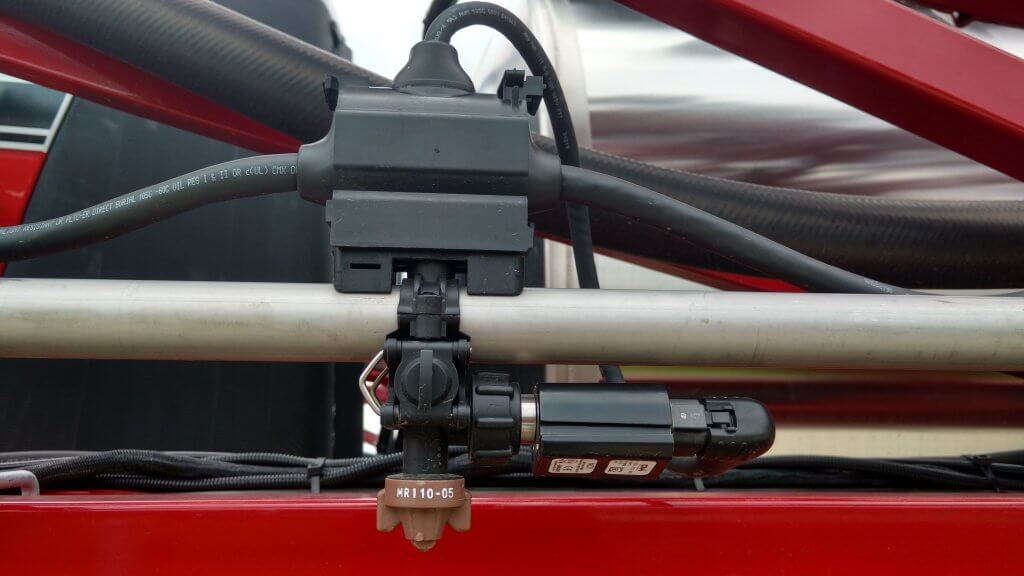
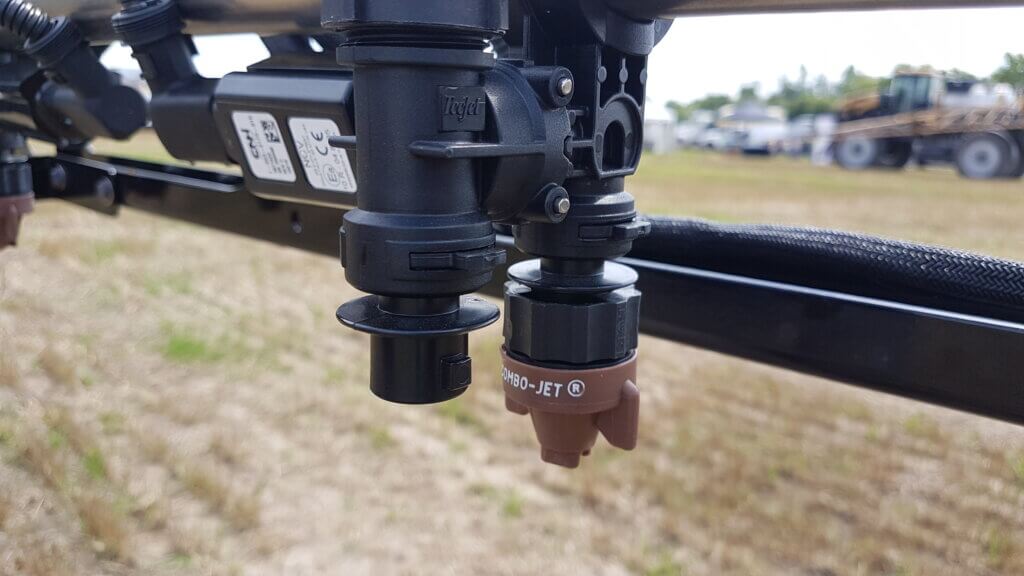
Case sprayers are equipped with a nozzle body manufactured by Wilger Industries that fits the ComboJet nozzle caps. This company offers five nozzles for PWM. In order, from finest to coarsest:
ComboJet ER
ComboJet SR
ComboJet MR
ComboJet DR
ComboJet UR
In practice, the ER and DR are rarely used in PWM systems. The MR is typically suited for lower water volume rates (3 US gpa to 6 US gpa achieved with the MR11003 or MR11004), whereas higher volumes (6 US gpa to 15 US gpa) are typically delivered using the SR tip (SR11005, SR11006, or SR11008, depending on average travel speed). In some cases, the ER nozzle is use when flow rates require 11010 or 110125 sizes. Spray pressures are typically 40 psi at the nozzle. The UR is a dicamba-specific nozzle to meet US label requirements for drift protection.
Wilger’s nozzle body can be purchased as retro fits for other sprayers. The company also offers adaptors that allow Wilger nozzles to be used on TeeJet-style bodies and vice versa, as seen below.
PWM systems operating on TeeJet style bodies are well served by TeeJet Technologies’ Turbo TeeJet nozzles. These wide-angled tips are available in sizes up to 11012 and generate suitable spray qualities at pressures ranging from 15 to 60 psi. Many operators use the Turbo TwinJet, another good option, which is available in a large selection of flow rates to 11010. Recently, TeeJet has tested and approved several air-induced nozzles for PWM, among these are the AITTJ60, the TTI, and the TTI TwinJet.
Hypro’s Guardian and 3D nozzles are well suited for PWM, but are somewhat finer than current air-induced standards. The new ULDM nozzle is Ultra Coarse, and approved for PWM despite being air-induced. Hypro also manufacture the LDM nozzle exclusively for John Deere for ExactApply, producing a spray quality similar to the well-established ULD. Most other manufacturers, including Lechler, Hardi, and others, have traditional pre-orifice flat fan nozzles that may also work. It is important to always select 110 degree fans to ensure that 100% overlap is achieved to maintain the concept of blended pulse. Limitations are in the maximum flow rates available in a specific model, many nozzles are not available in sizes larger than 05 or 06.
Agrotop (Greenleaf in the US) offer two unique PWM nozzles. The BPDF is an asymmetric twin configuration featuring two modified AirMix tips which have eliminated air-induction. The much coarser SoftDrop nozzle is intended for the dicamba market.
Arag has introduced PWM nozzles that produce Coarse or Very Coarse spray qualities, called CFLD-C or CFLD-VC nozzles. These are the a good spray quality for general use. These models are not yet offered in flow rates above 06, however.
Target a duty cycle of 70% ± 10% on average during operation. This permits the best travel speed flexibility. Say you want to apply 10 US gpa at 15 mph. In a conventional system, the 05 nozzle size could meet this flow at 40 psi. For PWM, the 06 size would operate at about 83% duty cycle (0.5/0.6 = 0.83). Assuming a minimum DC of 20%, a minimum travel speed of about 3.6 mph is possible. The 08 size would operate at 63% DC (0.5/0.8=0.63), allowing a minimum speed at 20% DC of 4.8 mph. Either option can work as long as the operator recognizes the travel speed limitations of both. Remember that the actual flow rate change is not directly related to duty cycle. Expect to see higher flows than calculated, especially for the smaller flow rate nozzles.
Calculate the travel speed range. The travel speed range of any nozzle selection and water volume can easily be calculated. The maximum travel speed is limited by the capacity of the selected nozzle and pressure at 100% DC. The minimum travel speed can be assumed to be 20% of that value, at which the system would be operating at 20% DC. Assuming a user selected the 08 nozzle size at 40 psi in the above example, the maximum travel speed can be read from a traditional calibration chart, 24 mph. The minimum would be one fifth of that, 4.8 mph. Capstan has charts that show the theoretical travel speed range (assuming a direct relationship between DC and flow). For Raven and TeeJet, the charts were developed using actual flow measurements. These reveal that actual flows are greater than predicted, especially for smaller nozzles.
Consider the pressure drop across the solenoid. The pressure drop depends on the total flow through the solenoid, it varies from 3 to 5 psi for 04 flow rates to 5 to 13 psi for 08 flow rates for the Case, Capstan, and Raven products. If targeting 40 psi spray pressure, set the pressure to 40 psi plus these values. Traditional spray charts do not account for pressure drop across the PWM solenoids. When using a Capstan Ag system, always refer to the tip charts from Capstan Ag Systems, Inc. at capstanag.com, (or here) and when using a TeeJet system, refer to the charts at www.teejet.com. Both show the pressure drop at various flow rates. Raven’s tip chart is in their operator’s manual.
Common Questions
Will the pulsing of the spray create skips in control? This is very rarely the case, usually only when a mistake in nozzle selection has been made. Skips are more likely with a combination of low duty cycles, fast travel speeds, low booms, narrow fan angles, and extremely coarse sprays. At normal field speeds, the system is usually operating at a high duty cycle unless a nozzle size which is far too large has been selected. At boom heights above 20 inches and Medium to Very Coarse sprays, there is enough blending of the spray cloud from the nozzle to the target to remove any skips in coverage. We can see skips on the outer edge of a boom during a sharp turn, when duty cycle is taken from the tractor unit speed (slow during a turn) and the outer edge of the boom is travelling at two to three times that speed. A conventional system would see similar under-application under these conditions.
Does the droplet size really stay constant throughout the Duty Cycle range? At low duty cycles, we have seen a slight increase in the droplet size, and also a slight decrease in the fan angle. This could be because the longer off-phase reduces the internal pressure in the nozzle body, resulting in an effectively lower pressure. These changes are not significant in their magnitude. It remains important to avoid the lowest duty cycles (travel speeds) for prolonged periods.
Can I do all my spraying with one nozzle? A PWM system offers the advantage of maintaining consistent pressure over a wide range of travel speeds for any given water volume. When moving to a new water volume that is more than 25 to 30% different, a different flow nozzle is recommended. Keeping the same nozzle for two volumes can technically work, but at the cost of limiting the travel speed range for one or both volumes. A typical PWM user has three nozzles, one each for low, intermediate, and high water volume needs assuming similar travel speed ranges. Some choose to use the same nozzle for intermediate and high water volumes, on the assumption that the high volumes is in maturing canopies and travel speeds will be reduced as a result.
Does PWM reduce drift? PWM does not reduce drift in any special way. Drift is related to droplet size, which is controlled by nozzle choice and operating pressure. A conventional system will use low-drift nozzles that maintain reasonably low drift sprays over their pressure range. But at high speeds, high pressures will be used and that can increase drift potential. In a PWM system, high speed does not increase pressure, offering a more consistent amount of drift. However, even at the same pressure, higher speeds increase drift potential because more drift-prone droplets are pulled from the spray plume. Some users of PWM may drive faster than they should simply because they avoid the pressure spike. Fast travel speeds remain a poor practice from a drift perspective.
Is the system prone to breakdowns? PWM has been on the market for about 15 years with Case and Capstan and has proven to be robust. The solenoids themselves have a good wear life, but do require replacement from time to time. Inside the solenoids, a poppet seal can wear over time, requiring fairly inexpensive and easy replacement. As with all electronics, regular inspection of the wiring harness to ensure no abrasion or pinching is required.
Additional Help
One of the more useful websites for PWM users is the Tip Wizard by Wilger (www.wilger.net). It is geared towards selecting the right nozzle for Case AIM Command, which uses the proprietary Wilger nozzle bodies and caps. The website helps users to select nozzles that match their volume, speed, and droplet size requirements.
Once a user understands the basic principles of the system, any conventional calibration chart can be used to identify the needed size nozzle. A user simply needs to choose a nozzle that is about 30 to 40% larger in flow rate, to allow the system to run at approximately 70% DC on average.
Wilger also produces a smartphone app, Tip Wizard, that offers much of the same features as their website for selecting tips.
Capstan (www.capstanag.com) produces a useful calibration table that identifies the pressure drop for various nozzles and pressures, as well as travel speed ranges for these nozzles when applying a range of water volumes.
Raven Industries offers information on the Hawkeye on their website (ravenprecision.com). The company offers useful videos on their youtube channel that illustrate installation procedures.
TeeJet Technologies has DynaJet information on their website (www.teejet.com). The site contains have product information, installation and operator manuals, application rate charts, and drop size information.
Troubleshooting and Maintenance
The main hazard for the PWM solenoids is contaminants. Granules can become lodged on the poppet seal surface, reducing the metering accuracy. Regular inspection of screens, and occasional removal and disassembly of the solenoids to expose the poppet is recommended.
Harvest is mostly done and growers want to hear what we’ve learned and what’s coming next. Lecture season is upon us once again.
In 2021 we’re still finding our way through virtual conferences and hybrid models, but I like to think we’re slowly returning to the in-person format. Just last week I gave my first in-person talk in 20 months. It felt wonderful after having spoken into a dead-eyed camera for so long. Half-way through my lecture I remembered a lesson I learned a few years back and spontaneously decided to go off-script.
Let me explain.
In 2016 I was invited to present at the 40th annual Tomato Days conference in Southern Ontario. I knew what I wanted to say, but didn’t have a decent slide deck for that particular topic. I’d have to pull one together.
I work hard on my presentations. I employ lots of imagery (I create all my own illustrations). I get persnickety about fonts, white space and slide transitions. I try to tell a story that educates and hopefully, entertains. Prideful? Perhaps. But if you’re willing to sit on a hard chair for an hour, I’m going to do my best to make it worth your while.
I finished the slide deck, drove three hours to the conference, handed my USB data key to the organizers and sat down to wait my turn. It was a clear, bright winter morning and I saw that the pavilion we were in was more-or-less windows and a roof. It was so bright, in fact, that none of the 150 attendees could see the projector screen!
I watched sympathetically as the first speaker spent 30 minutes trying (and failing) to verbally describe his graphs. I cringed as the second speaker pantomimed her illustrations in some kind of brave, interpretive dance. Then it was my turn.
I decided I wasn’t going down that road.
When the moderator brought up my talk, I turned the useless projector off. I asked the squirming and disinterested audience:
Q. “What’s the most terrifying thing you can do to an academician?” A. “Take their Power Point away.”
For the next 30 minutes we had a discussion about spray coverage. No props. No slides. The audience slowly warmed up to the new format. They shared experiences. They debated. They asked questions. I became more facilitator than speaker.
When our time was up I think everyone was pleased. Sure, I missed a lot of my key points and never really addressed the subjects I thought I would, but who cares? Everyone learned something.
For me, I learned that speakers should abandon the script every now and again. It’s not always ideal since we’re there to teach and structured visuals are often required. But, the next time you’re asked to speak, consider the possibility of using your time to engage your audience and establish a dialogue… not just talk at them until the moderator gives you the 5-minute warning.
I have a colleague who does this masterfully. Whenever he is the last speaker on the agenda, and the previous speakers have discourteously gone over-time and whittled his time in half, he jumps straight to his take-home slide. He leads a quick discussion with the audience and becomes a hero. The moderators are now back on schedule and no one is late for lunch.
Since “Tomato Days”, I now try to do this once a year. I never know when the mood will take me, but when it does I give the audience a choice: They can hear my canned presentation or I can shut it down and we can have a conversation. To date, given the option, every audience has opted to go off script. It’s scary, it’s fun and like I said earlier, everyone learns something.
I challenge you to try it the next time you’re lucky enough to be in front of an audience in person.
Theodor Leeb started building self-propelled sprayers in Bavaria, Germany in 2001 and formed a partnership with Horsch LLC in 2011 (Horsch has been selling tillage and seeding equipment in North America since 2001 and has 17 dealers in the prairie provinces). The resulting company, Horsch Leeb Application Systems GmbH, is headquartered in Landau a.d. Isar, about 120 km NE of Munich. There they build pull-type and self-propelled sprayers, employ 350 staff, and had sales of approximately $80 M USD in 2019.
This is no Johnny come lately to the sprayer scene.
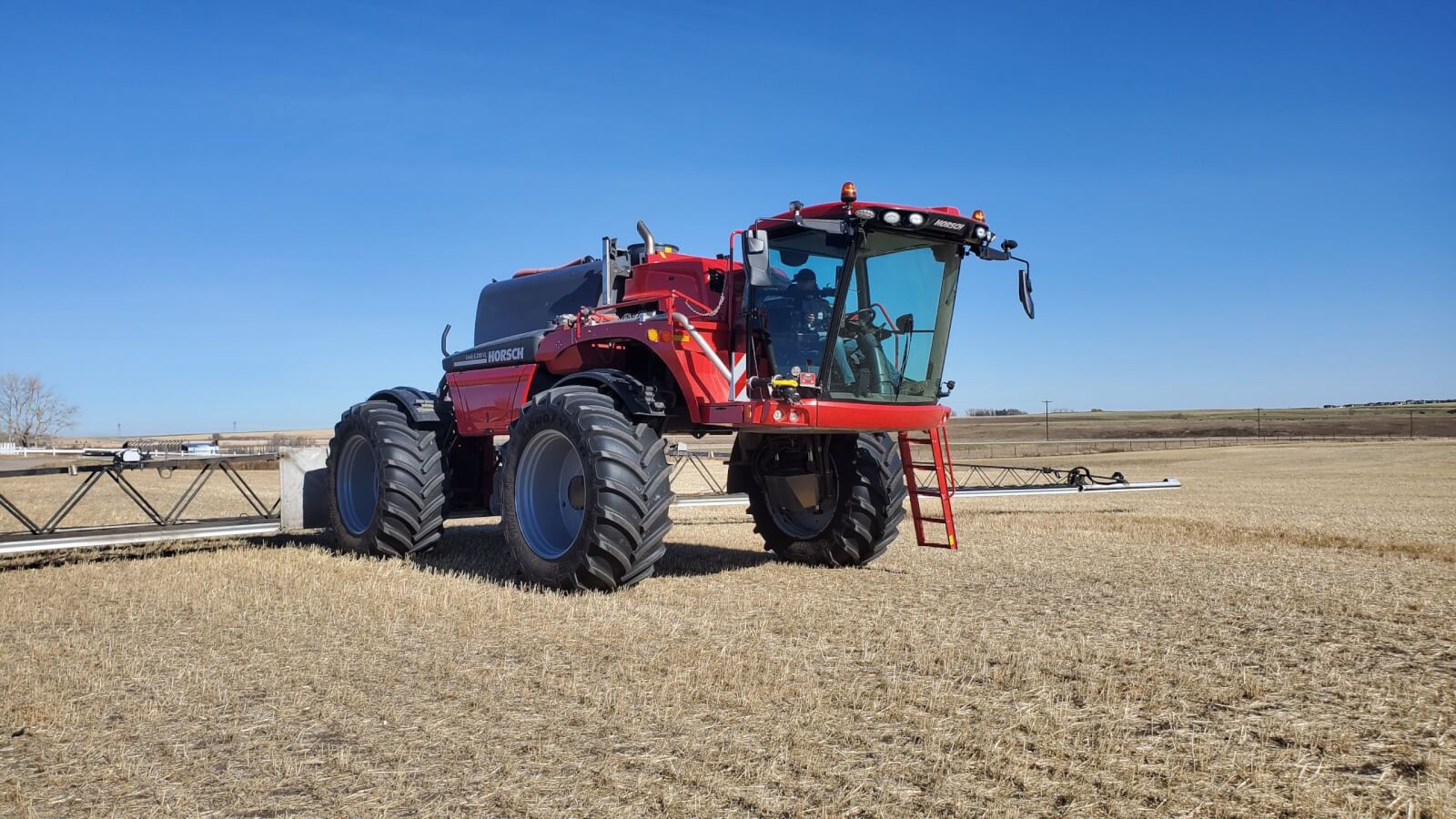
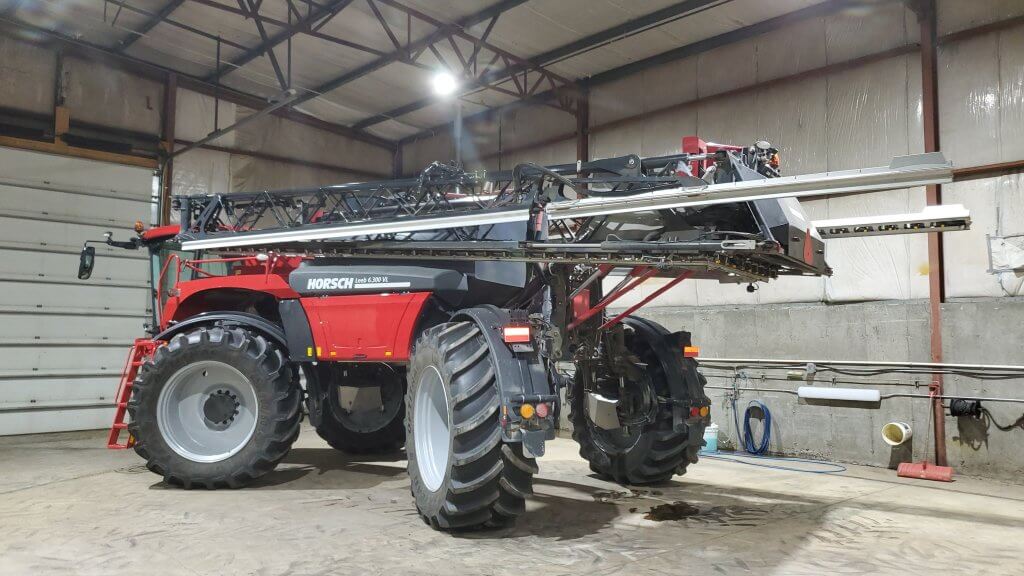
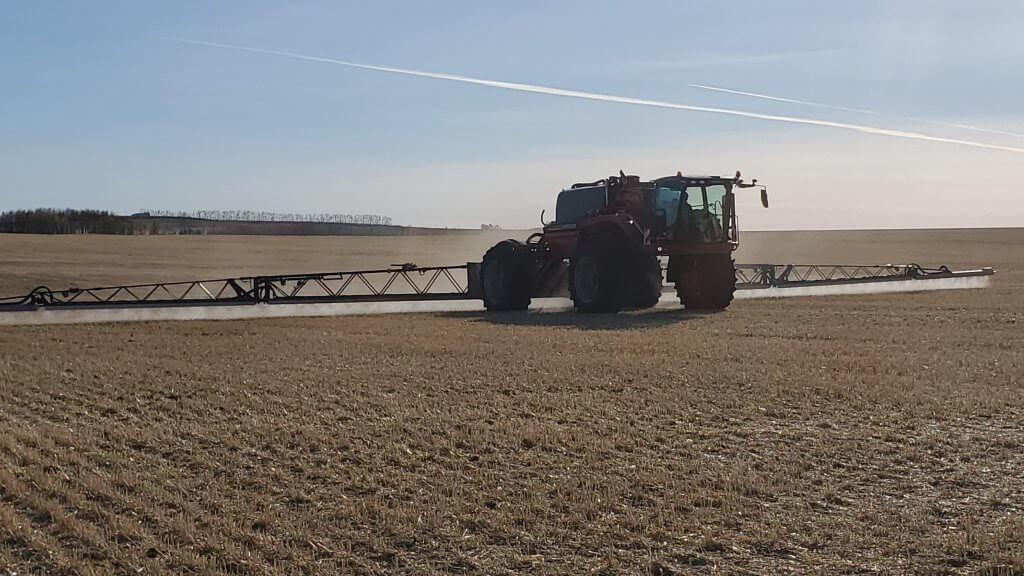
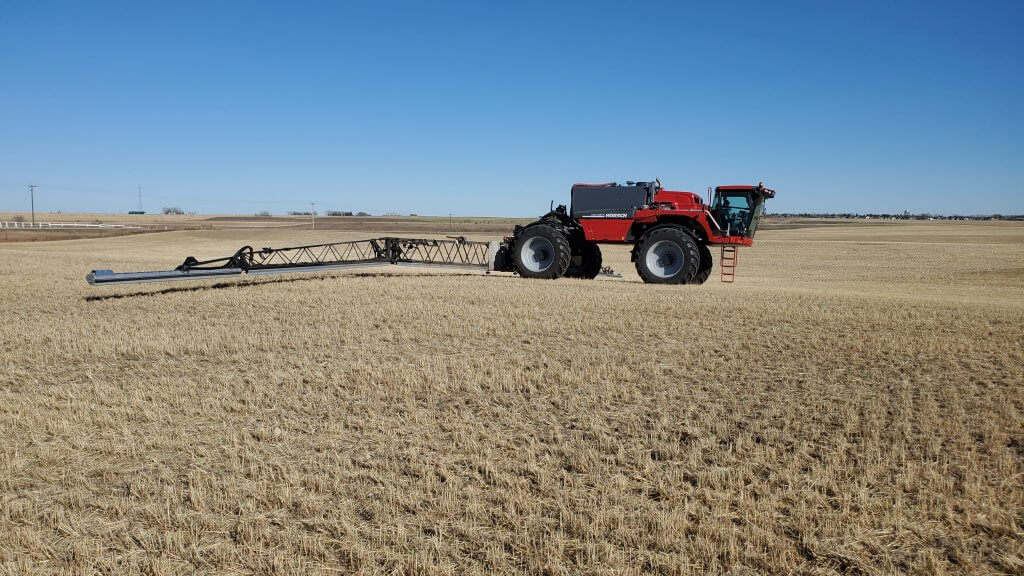
Their current flagship sprayer in North America is the Horsch Leeb 6.300 VL. I spent a day with Mike Wasylyniuk, Product Marketing Manager for Horsch, in Crossfield, Alberta to look it over.
The Numbers
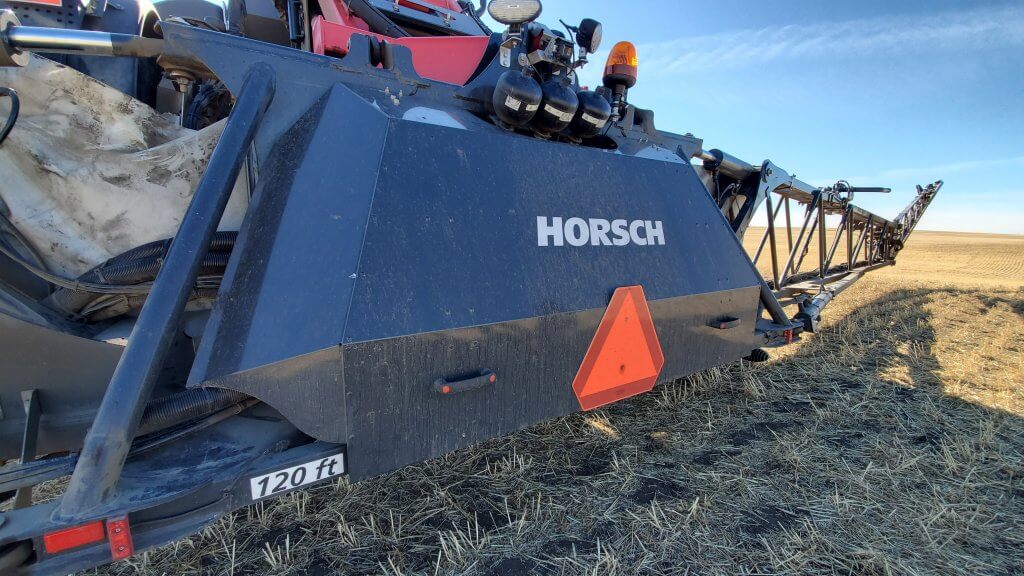
The sprayer chassis holds a 1700 US gallon stainless steel tank and two 100 gallon clean water tanks for a total liquid capacity of 1900 gallons. A stainless steel Pentair Hypro centrifugal pump provides the flow to the boom, and a second pump is dedicated to the clean water tanks. The sprayer is powered by a familiar FPT 6.7 L producing 310 hp. The boom is 120’ wide in 5 articulated sections with 10’ nozzle spacing fitted with Raven Hawkeye Pulse Width Modulation (PWM). Top spraying speed is 20 mph, top transport is 30 mph. Horsch claims a dry weight of 32,000 lbs when fitted with Goodyear LSW 900 50R46.
The Horsch Leeb 6.300 VL near Crossfield, AB October 2021.
A central tubular frame creates room for four-wheel steer that has an interior turning radius of 3 m. Wheels are suspended via hydropneumatics linked to the frame with double wishbones. Track width adjusts from 120″ to 160″, independently, allowing different track widths front and rear without pinning an axle in place. Standing beside the front wheel, one has with easy access to fuel and oil filters, the radiator is on top of the machine facing up with an air-chuck outlet for cleaning.
Four wheel steer improves maneuverability but more importantly, reduces front wheel plowing and allows use of common wheel track in headland turns.
Plumbing
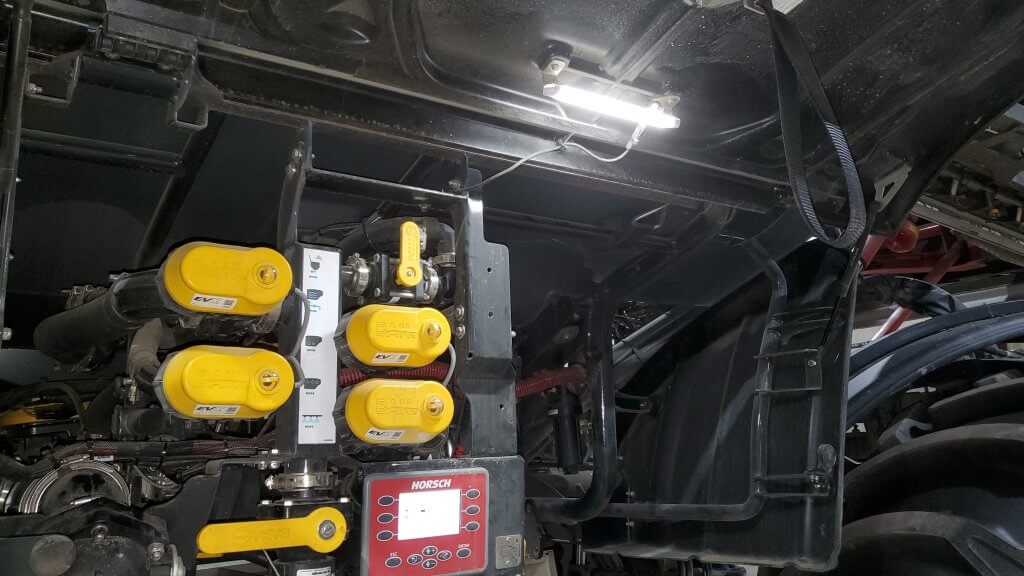
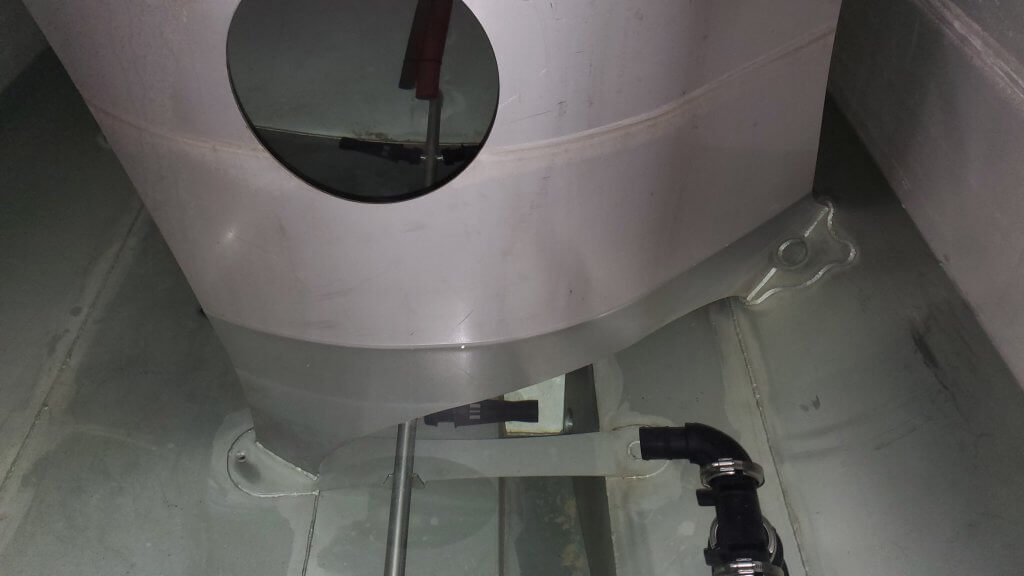
Any loyal reader of Sprayers101 knows that we believe the biggest room for improvement in spraying is in the plumbing. Horsch Leeb seems aware of this. First, it does away with sight tubes on the tank and relies on a more accurate digital float that reads down to an empty tank. Tank slope position is considered using a gyro mounted at the rear of the sprayer. The tank can be filled with the solution pump or from the tender truck using 3” side or front fill locations. It has auto shutoff when a target amount is reached. As is common, the majority of valves are motor operated to allow automation.
Fill station on right side of sprayer contains a 3″ fill connection as well as a 2″ drain
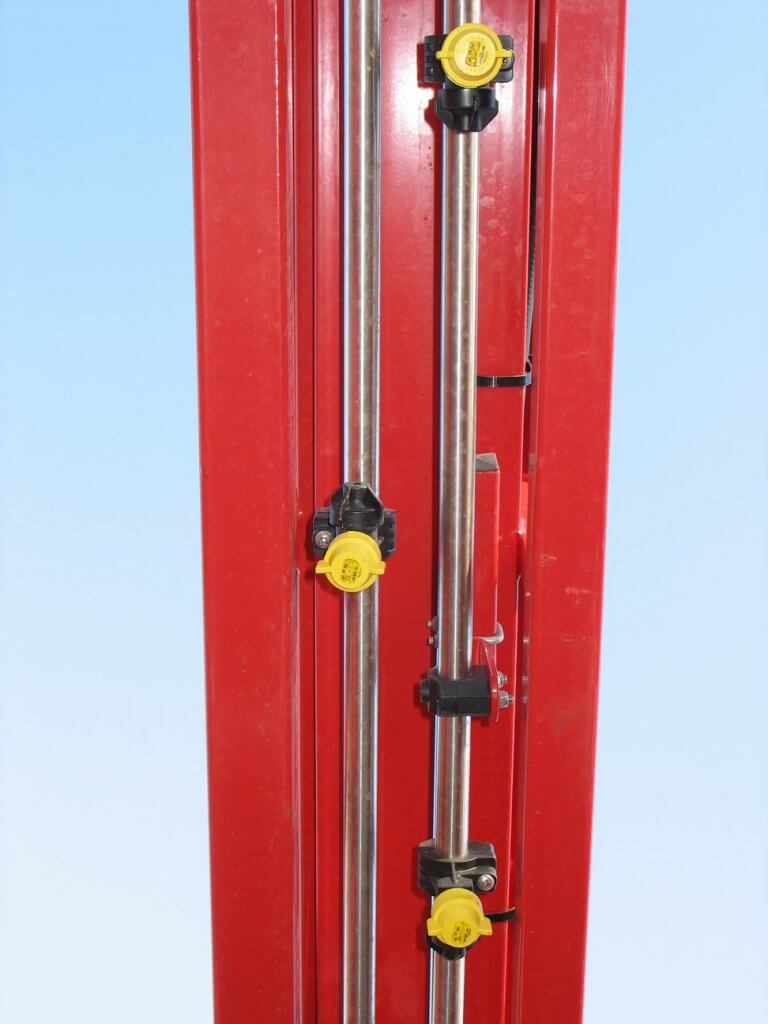
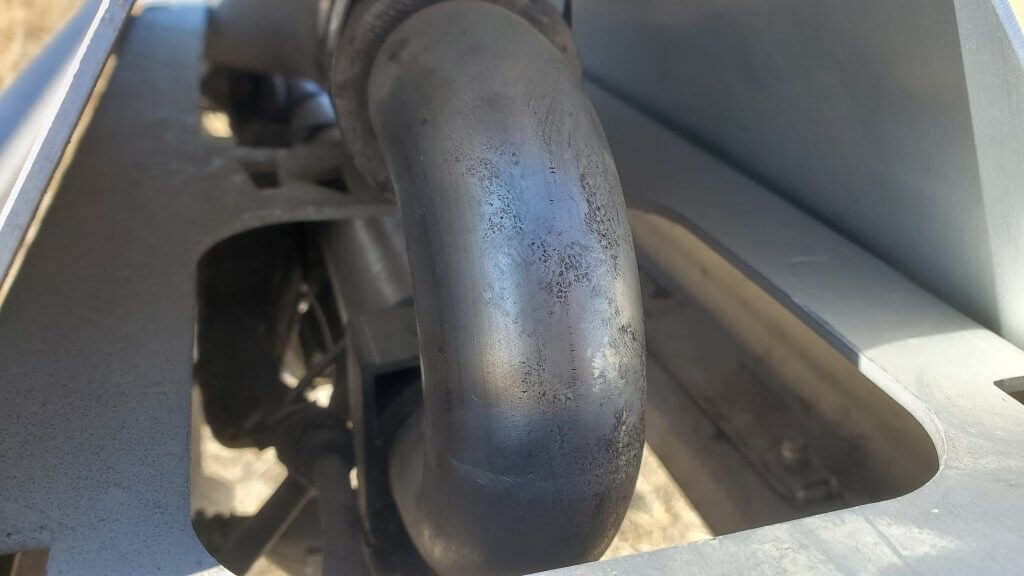
The recirculating boom plumbing is standard North American 1” OD stainless steel to suit any off the shelf nozzle body clamp. It pressurizes from both ends when spraying and returns to tank from the outside of the boom when nozzles shut off or when priming or flushing. The recirculation can run during transport, allowing boom priming en-route to the field, or continuous flushing with a cleaning solution in the main tank on the way home.
Recirculating boom feed and return lines are standard 1″ OD stainless steel.
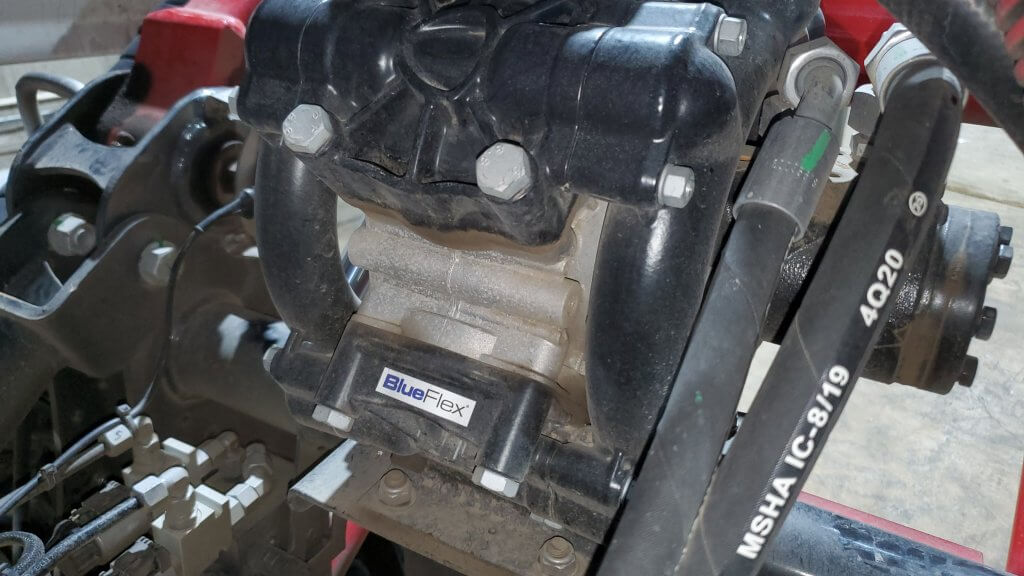
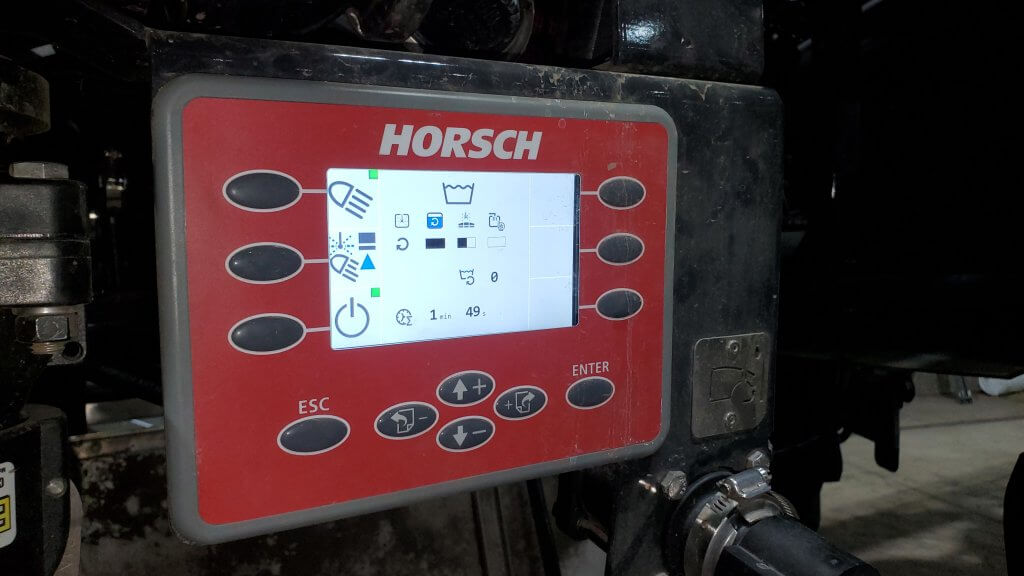
The second pump, an Italian Annovi Reverberi 185 BP diaphragm, powers the continuous cleaning function. It draws from the clean water tank and can push this water to the boom for overnight storage when the tank has solution left, or to the tank’s wash-down nozzles for a continuous clean at the end of a job. In continuous clean mode, the solution pump continues to supply the boom while the cleaning water washes the walls and dilutes the remainder. The tank and boom can be washed with a minimum of liquid, and the process is automated using cab or side monitor controls.
Dedicated to the clean water tanks, this diaphragm pump can push water to the boom, to the wash-downStainless tank with baffle
The system even has a winterizing button that controls all the necessary valves to distribute antifreeze from the clean water tanks throughout the plumbing system in minutes. Remaining antifreeze in the tank can be returned to the drum at the fill station with a convenient camlock drain.
Readout of tank levels and pump pressure via the external monitor. Priming, cleaning and winterizing routines are available.
Some may gloss over plumbing paragraphs in haste, but let’s not underestimate the magnitude of these features. We are talking about a plumbing system that can prime the boom without spraying, spray the field, then spray out any remainder while rinsing the tank, air purge the boom, then rinse the boom without leaving the cab or wasting material unnecessarily. Even the system strainers have flush capability that returns any residue to a removable fine mesh filter before the liquid dumps back to the tank. Such a design saves time and money and pays in acres per hour.
Boom
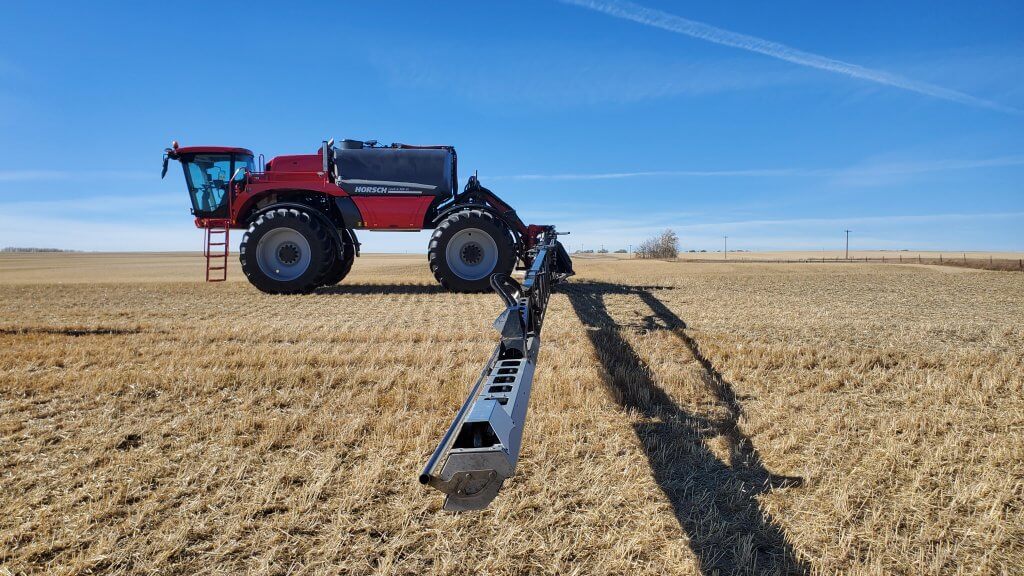
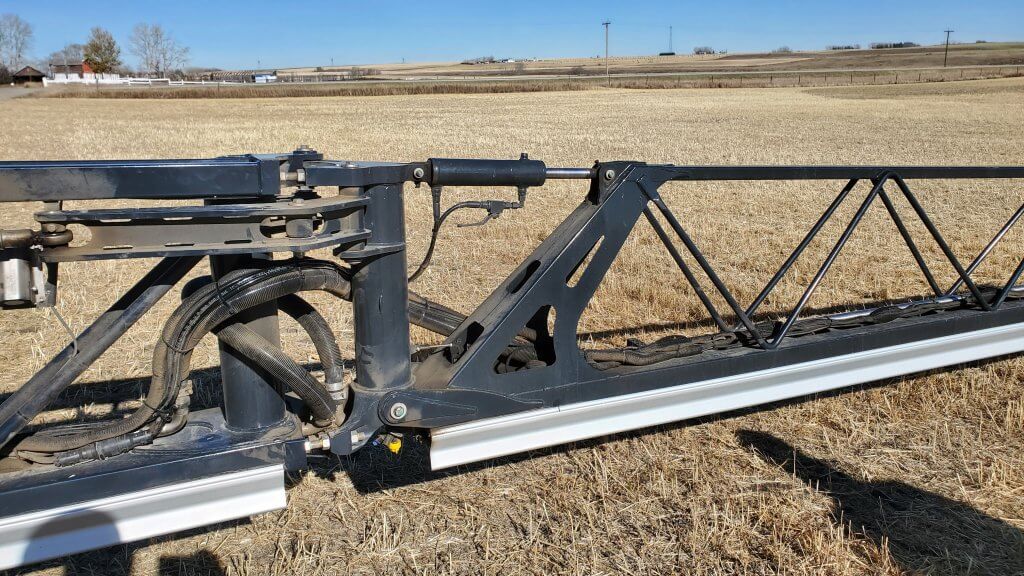
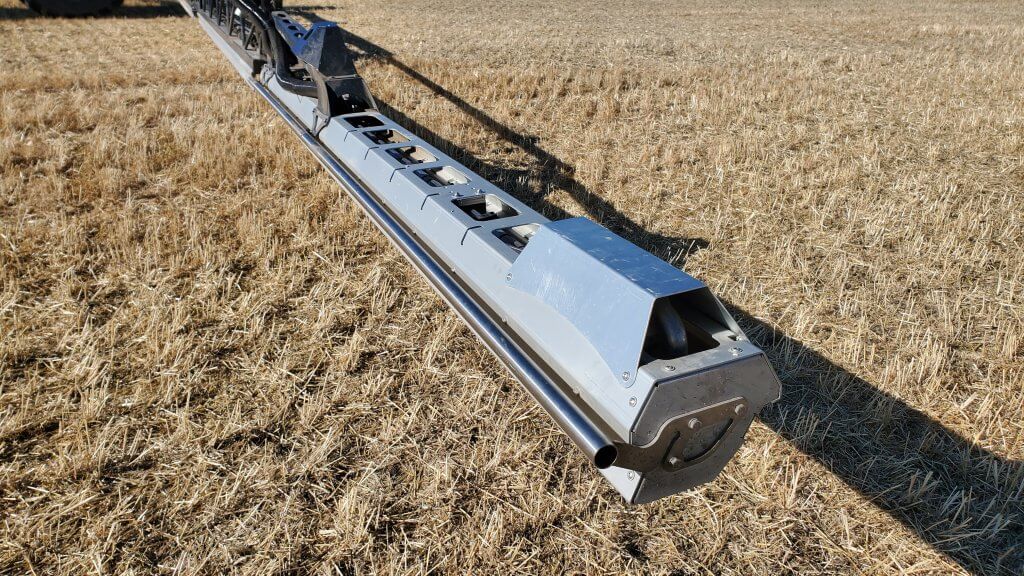
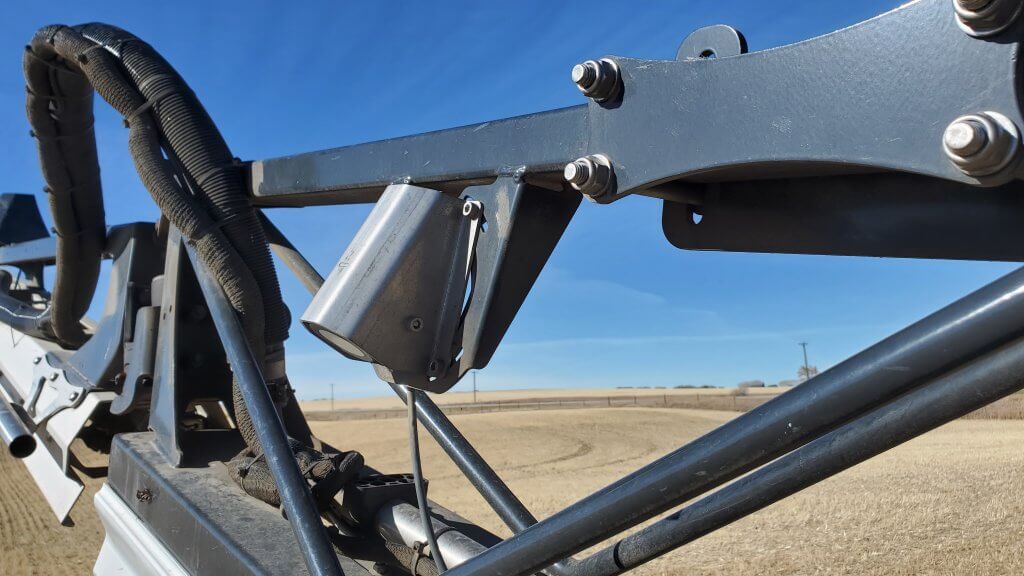
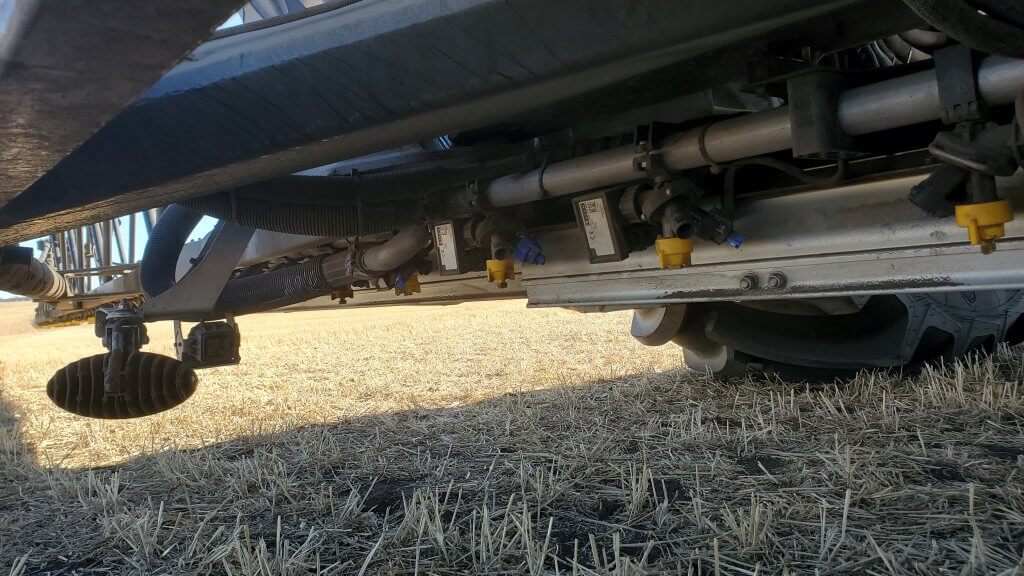
The 120’ boom is well built and has channels for wiring harnesses that are neatly zip-tied in place. An aluminum shield covers the nozzle bodies at the front to protect them from any ground contact. Access is relatively convenient through ports on the other side. The fitted triple nozzle bodies should be enough to suit most needs. The swing-away has a sturdy steel tube on the leading edge to absorb and deflect any sudden impact. There is no exposed plastic. The recirculating boom plumbing is stainless steel throughout except at hinges, where the rubber hose loop is protected from chafing by an additional sleeve.
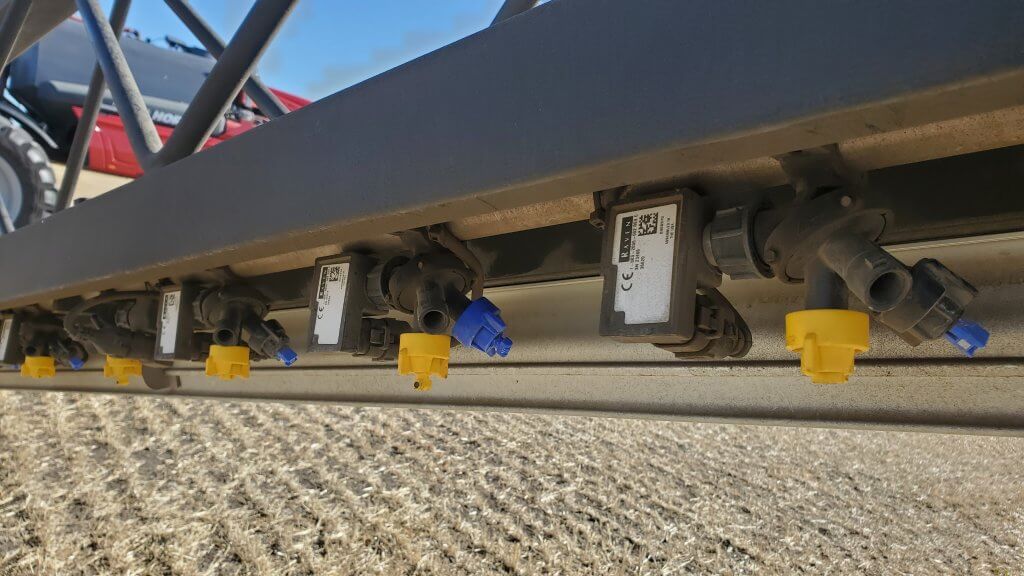
The sturdy boom is shielded where the nozzles are mounted to protect them from impact. Note the vertical hinge that permits improved contour-following.The break-away section has additional protection via a stainless steel pipe that absorbs and deflects impact.Access to the 10″ spaced nozzles and PWM solenoids is via the rear of the boom.
The Leeb philosophy is to design sprayers that control drift at the source without reliance on extremely coarse sprays that can hamper efficiency. They’ve chosen boom height as the key variable and built the boom to make this possible. First, they needed to design a system that can reliably hold the boom low and level.
Low, uniform boom height for drift reduction is the stated goal of the Horsch Leeb sprayer
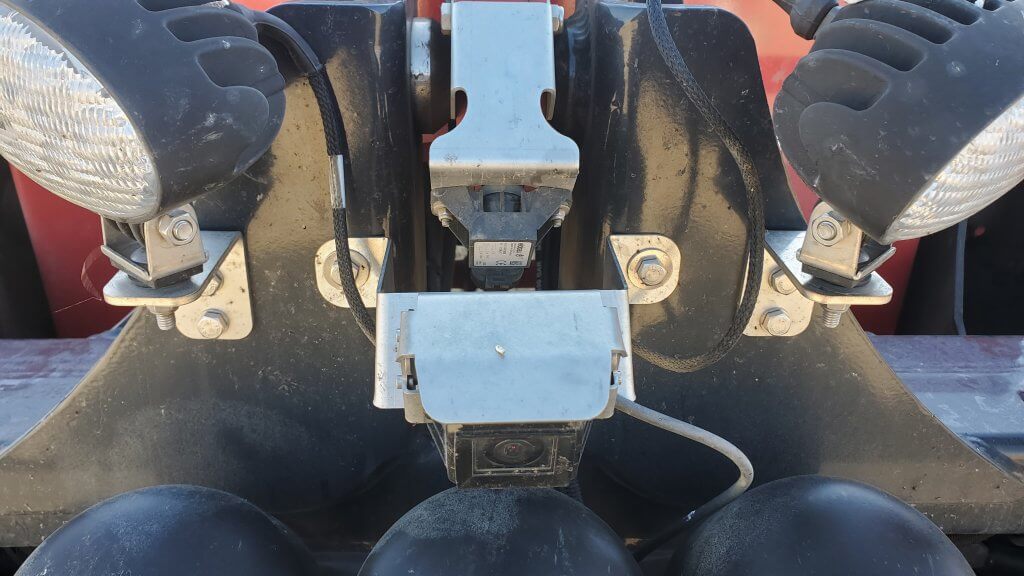
To that end, three pivot points are used to provide independence of the tractor unit and the boom. The first is at the centre rack from which the boom hangs but can pivot thanks to the same gyro that helps read the tank level. A sudden tractor movement due to ruts, for example, can then be compensated. The wings are the second pivot point (as it is for all sprayers), and a third point is halfway out the wings, where a hinge allows for up or down adjustments to better suit the land contour.
A giro, visible just above the backup camera, monitors the tractor aspect relative to the boom.The vertical boom pivot can help prevent unnecessarily high boom ends or ground strikes.
The height sensors have a modest look ahead slant, and the company claims that 8” boom height at 10 mph is possible. We certainly tried that in the field, and after multiple runs up and down a local field with modest knolls we did not strike ground, although the boom ends did rise significantly on occasion. The claim of such low booms will be a point of considerable testing and debate.
Eight sensors provide boom height feedback.
To take advantage of the low heights, narrower 10″ nozzle spacings are needed. The boom therefore has 144 nozzles instead of the usual 72, each half the flow rate. This is new territory for PWM, where the smaller tips are not as widely available. For example, a traditional 5 gpa tip at 20” and 12 mph is 03 in size, with 10” spacing this is now 015. Smaller sizes require more attention to filtering, and they have inherently greater drift potential. This would only be a problem at the lower application rates.
Because PWM allows for individual nozzle control, the operator can select 20” spacing, based on either of the 10” positions. This means one can spray with 20” spacing and then switch to a different nozzle simply by selecting the alternate.
The lower boom height can offer unique advantages. The first of these is drift control. Droplets emerge from the tip at about 70 km/h, and this initial speed prevents even the small ones from drifting. The higher the boom, the more they slow down before targetting, creating drift potential. Wind speeds also tend to be lower nearer to the ground.
Second, the beneficial effects of twin fans or angled single tips are greater with low booms. Readers will know that one of the fundamental prerequisites for successful angled sprays in Fusarium head blight (FHB), for example, are low booms. We may be in for some positive outcomes.
The User Experience
The Class cab has the usual creature comforts with a buddy seat, four cup holders, bluetooth radio and a phone mount. It can be fitted with any ISOBUS monitor, the one we had was equipped with the Raven Viper 4. The climb up the ladder is not as stair-like as the North American sprayers, but the treads are large and there are plenty of handholds so you can climb one-handed and bring your lunch or toddler along for the day.
There is one native Horsch monitor that controls the chassis, wheel spacing, engine specs, speed, etc. It’s controlled using a rotary button selector like the one in many cars, a wheel that highlights items by turning, then selects them with a push. The second, an ISOBUS monitor, handles the rate control and thus creates easy compatibility with a variety of aftermarket monitors.
The joystick is backlit and buttons can be customized. Like the Fendt stick, a push forward sets the speed and it can return to the neutral position without changing that speed. A pull back is required to slow down. It takes a bit of getting used to. Motion can also be foot operated with a speed pedal and foot brake. Cruise control has two preset speeds, and boom height can be raised to preset values when the master switch is shut off to facilitate a headland turn. The top two thumb buttons are Master on/off and autosteer resume.
There is no throttle control. The sprayer decides how much throttle is needed to maintain speed, saving noise and fuel when it can. Throttling up was noticeable as we climbed hills during our test drive, returning to lower rpm as we descended while maintaining our cruise control speed.
Some touches
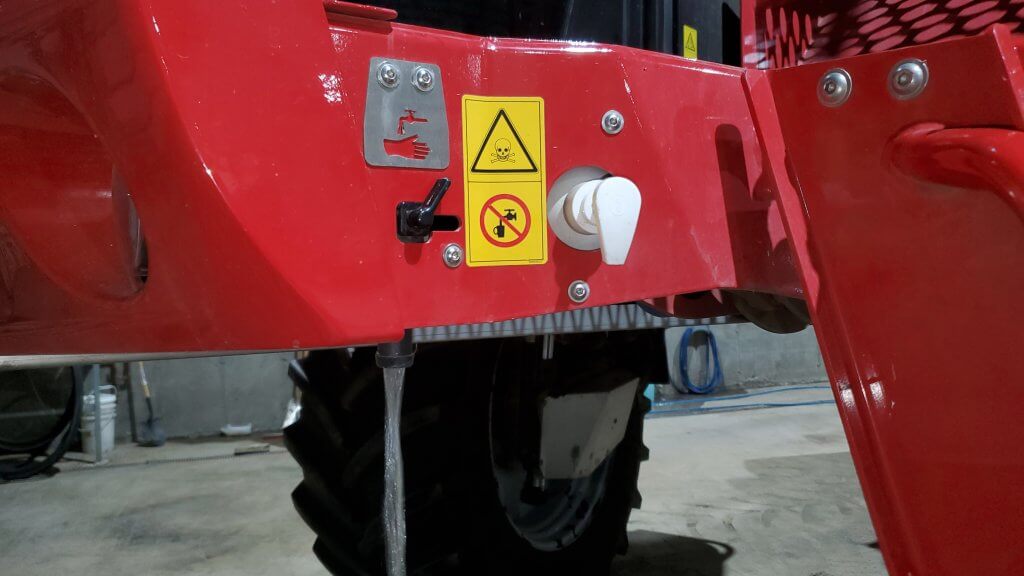
a hand wash station at the ladder to prevent contaminating the hand-holds or cab
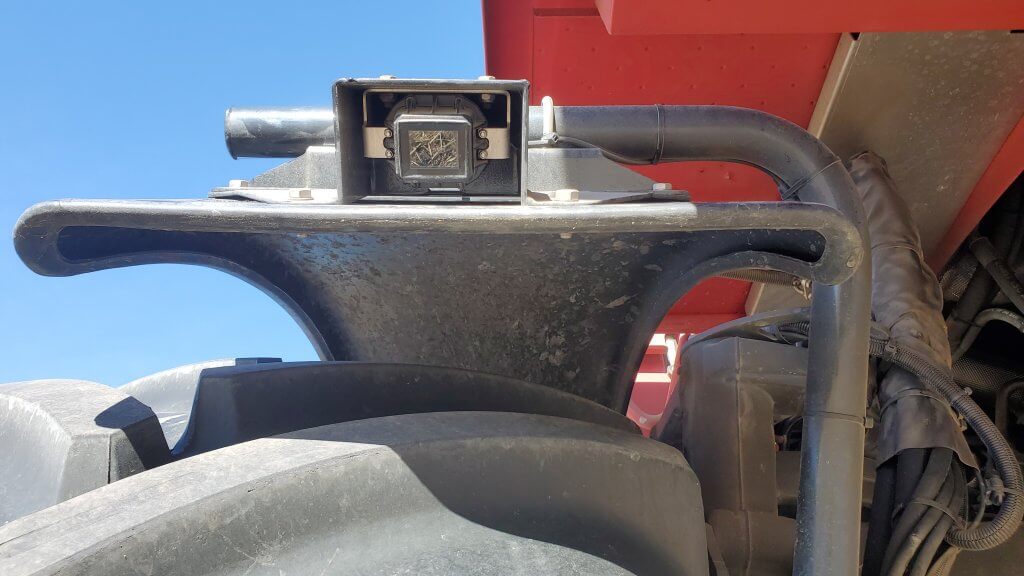
a camera focused on the centre rack nozzles that are invisible from the cab
cameras showing front wheel position
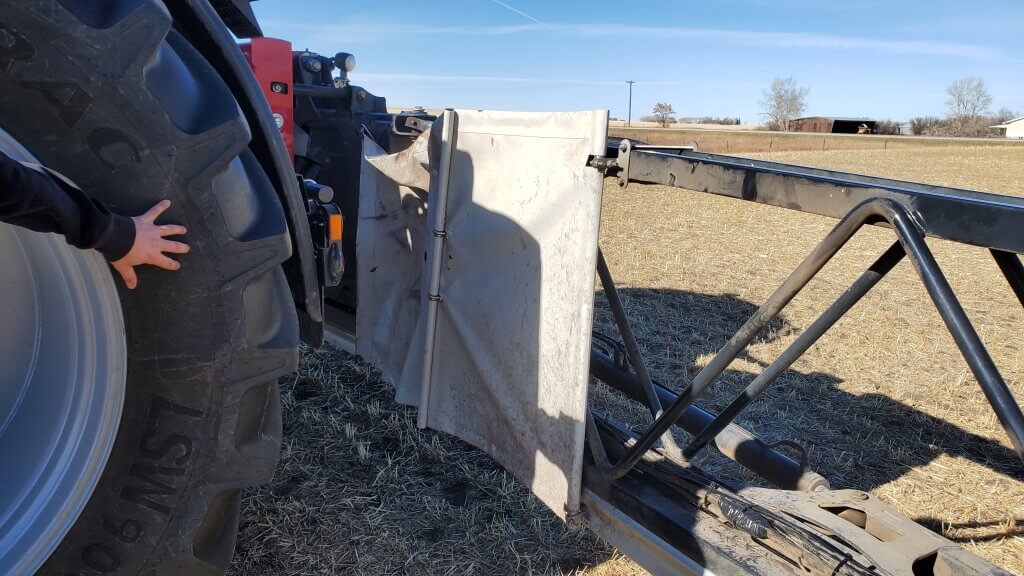
mud guards behind rear wheels to protect boom
Rain cover over electronics mounted on centre rack
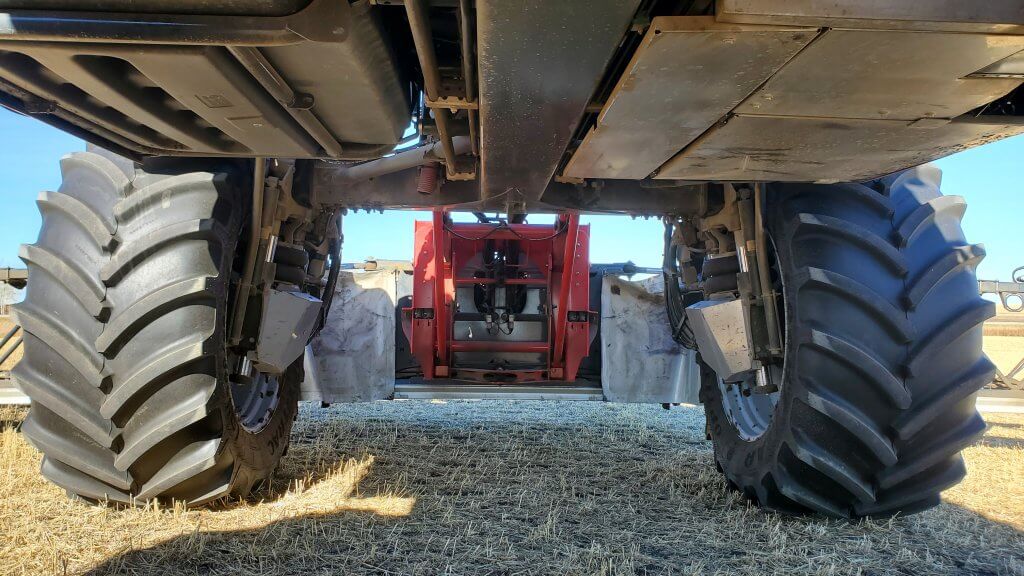
A clean underbelly with good clearance and tow hooks front and back
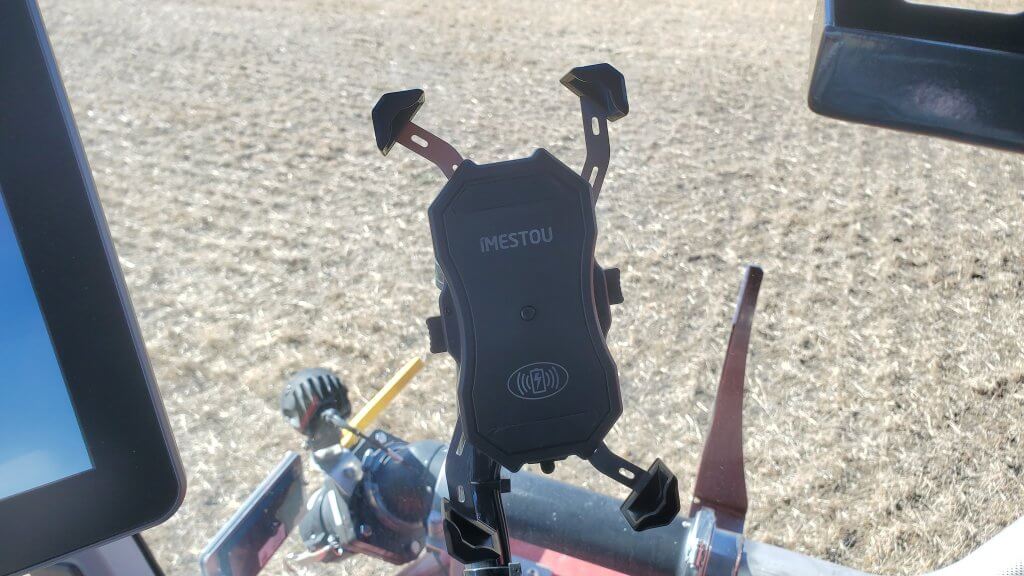
Inductive (wireless) phone charging mount
Overall Impression
It’s clear that Horsch Leeb wants to succeed in North America. I’ve hardly ever seen a company so bent on delivering what the market wants (for familiarity and compatibility) while delivering what it knows they need (like plumbing and drift control). Spending the day with Mike I learned how quickly the engineers and fabricators implemented his suggestions at the factory. That is perhaps the most promising aspect of all, a company that listens to its customers and continually evolves its product as a result.