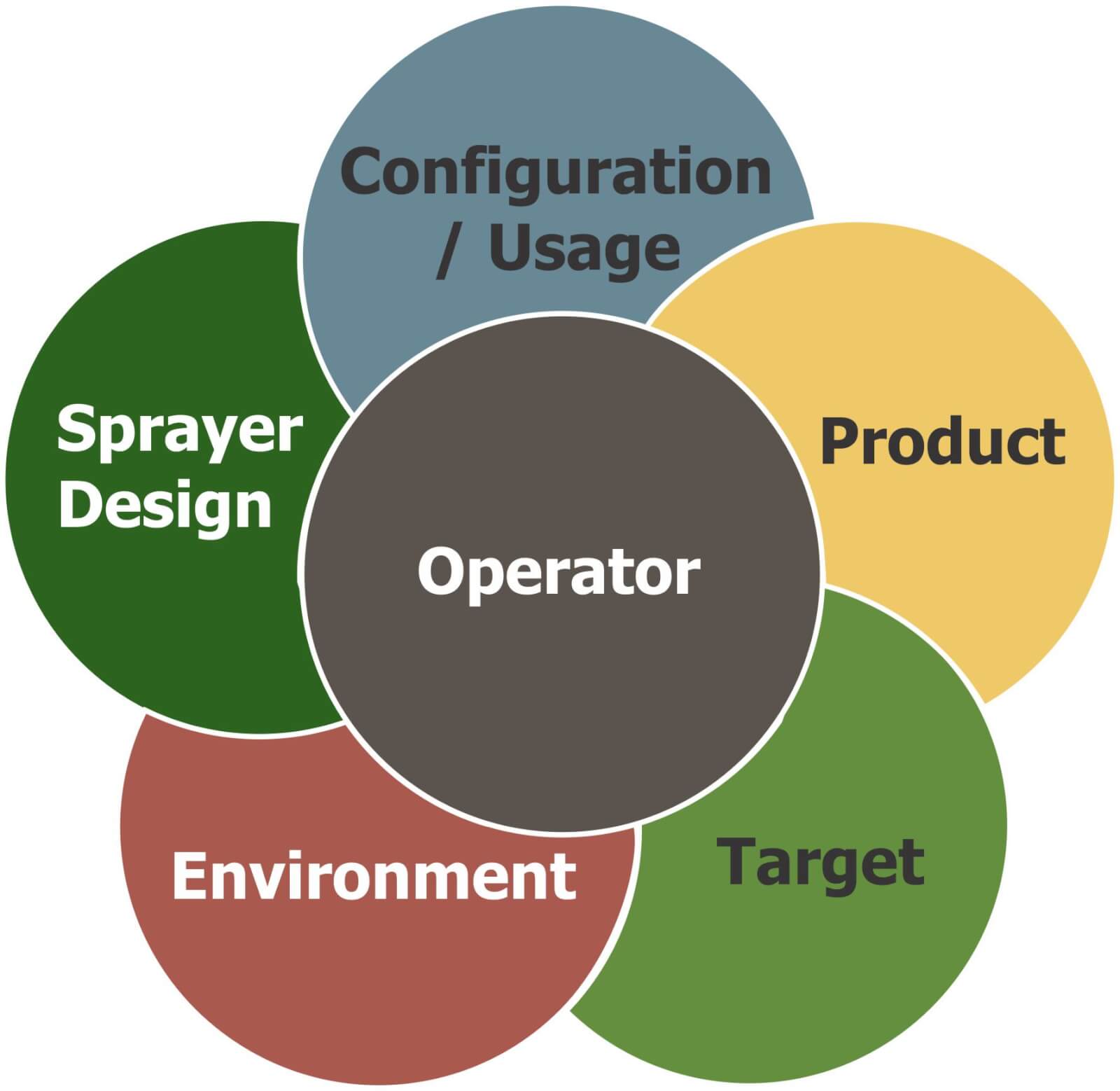
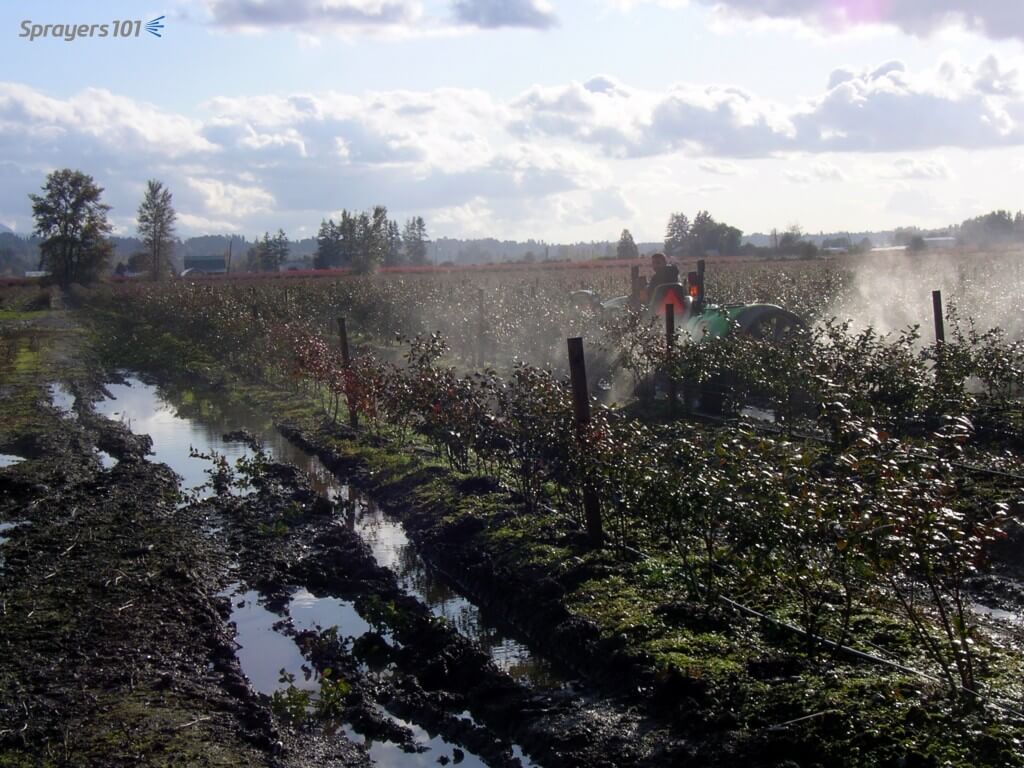
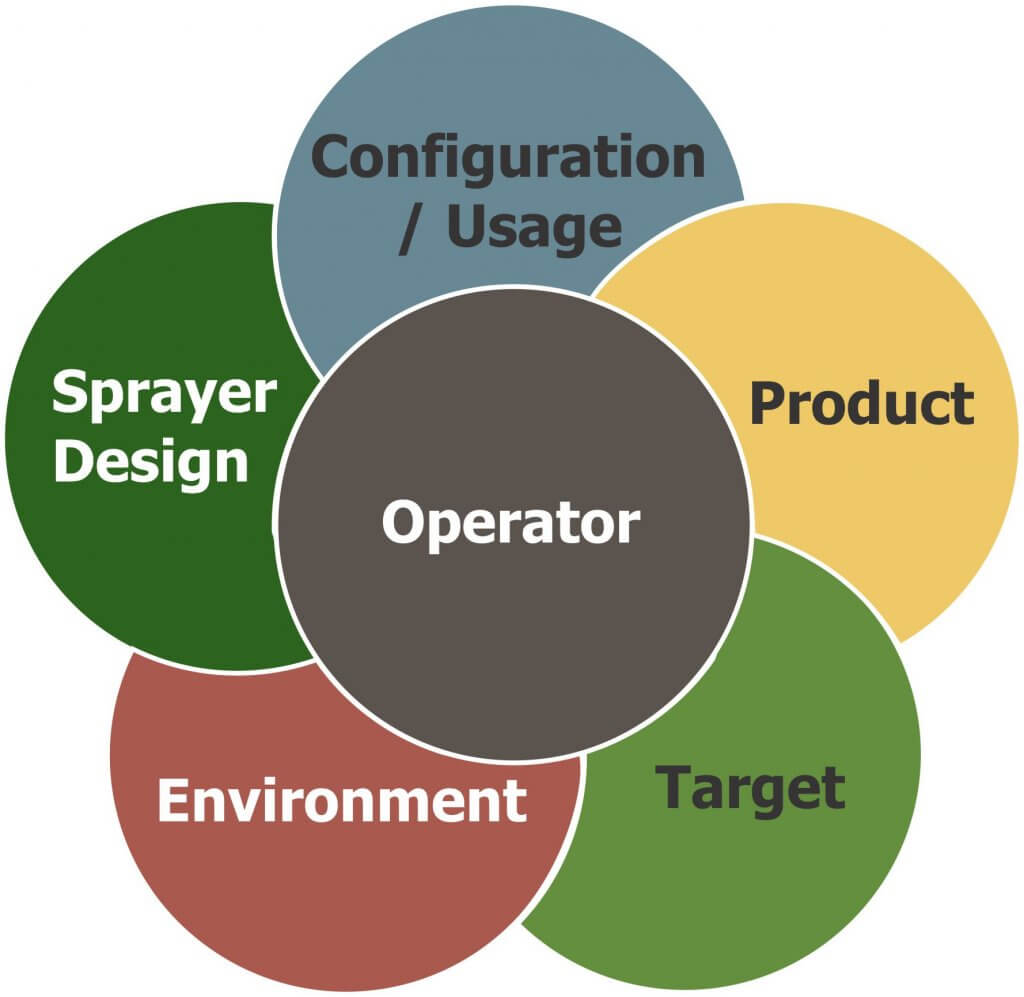
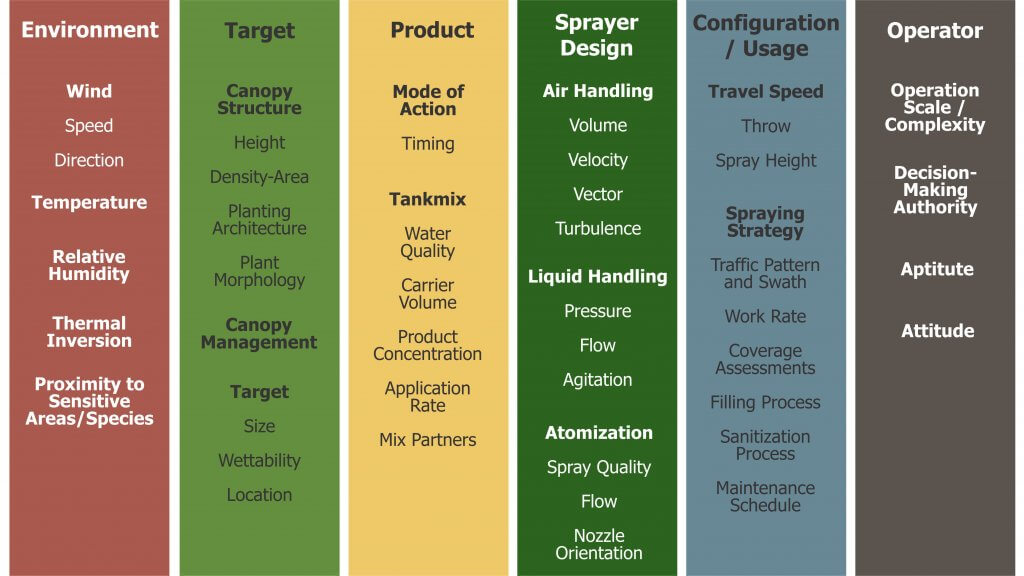
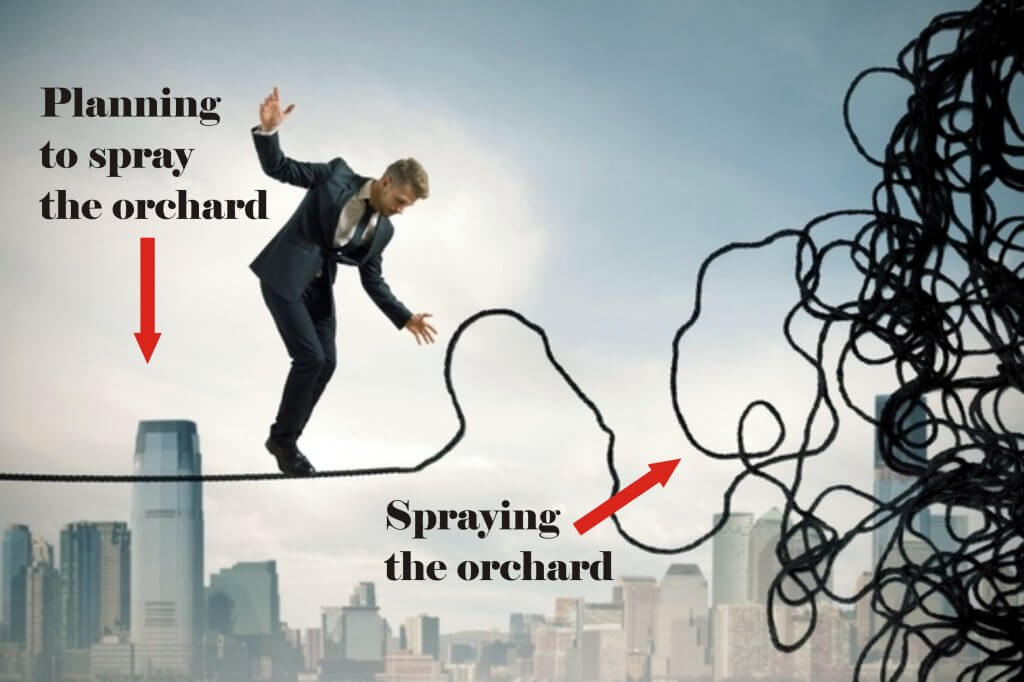
Sprayer operators recognize the importance of matching their sprayer settings to the crop to optimize efficacy. For example, spraying a protective fungicide in field tomato should require a different approach from spraying a locally systemic insecticide in staked peppers. Knowing this, many operators make ad hoc changes and then wait to “see if it worked”. A process is required that empowers the operator to make systematic changes to their program and assess coverage immediately.
Such a process would require some fundamental understanding of how droplets behave, the location of the target, and the physical structure of the crop. This would be tempered by broader concerns such as weather (e.g. wind, rain and inversions as they affect coverage and spray drift), pest staging, and sprayer capacity (i.e. the sprayer’s ability to cover the crop in the window of time available). Finally, there has to be a mechanism for the operator to make a single change, then assess the impact in a quick, convenient, and yet quantitative manner.
There are always exceptions to a rule, but an operator looking to assess spray coverage might consider the following process:
Understand how the pesticide works. Not only do certain tank mixes and weather conditions affect pesticide efficacy, but the mode of action plays a big role. A contact product must hit the target, while a locally systemic offers more latitude and can withstand less coverage.
Use IPM to determine where the pest is, whether it’s at a stage of development where it is susceptible to the spray, and where the spray needs to be to affect it. For example, if the pest is deep in the canopy, or under a leaf, or in the flower, this is where spray coverage should be targeted and assessed.
Understand droplet behaviour.
Coarser droplets move in straight lines and are prone to runoff (especially on waxy and vertical targets). They rarely provide acceptable canopy penetration in dense, broadleaf canopies and do not give under-leaf or panoramic stem coverage. The Coarser the droplet, the fewer the sprayer produces, reducing droplet density. However, they are not prone to drift and can tolerate higher winds.
Finer droplets slow quickly and tend to move in random directions without some form of entrainment (e.g. air-assist). While they are not prone to runoff, they can get caught up on trichomes (leaf hairs) and may not reach the leaf surface. They provide improved canopy penetration and some under-leaf and panoramic stem coverage, but their lack of momentum leads some operators to use higher pressures to “fog them in”. Higher pressures are generally not advisable because they increase the potential for drift and often result in less spray available to the crop.
Consider the droplets’ point of view. Look along the droplets potential path from nozzle to target. If there’s something in the way, consider re-orienting the nozzle using drop-arms, or a nozzle body that can be adjusted to change the spray direction.
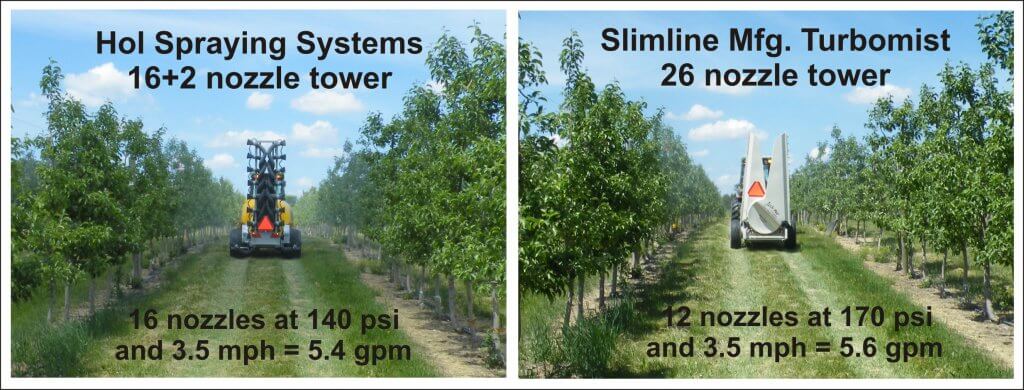
Understand the impact of water volume and travel speed. Higher volumes improve spray coverage by increasing the number of droplets. Slower speeds give more opportunity for spray to penetrate the canopy and reduce the potential for drift, leaving more spray available to cover the crop.
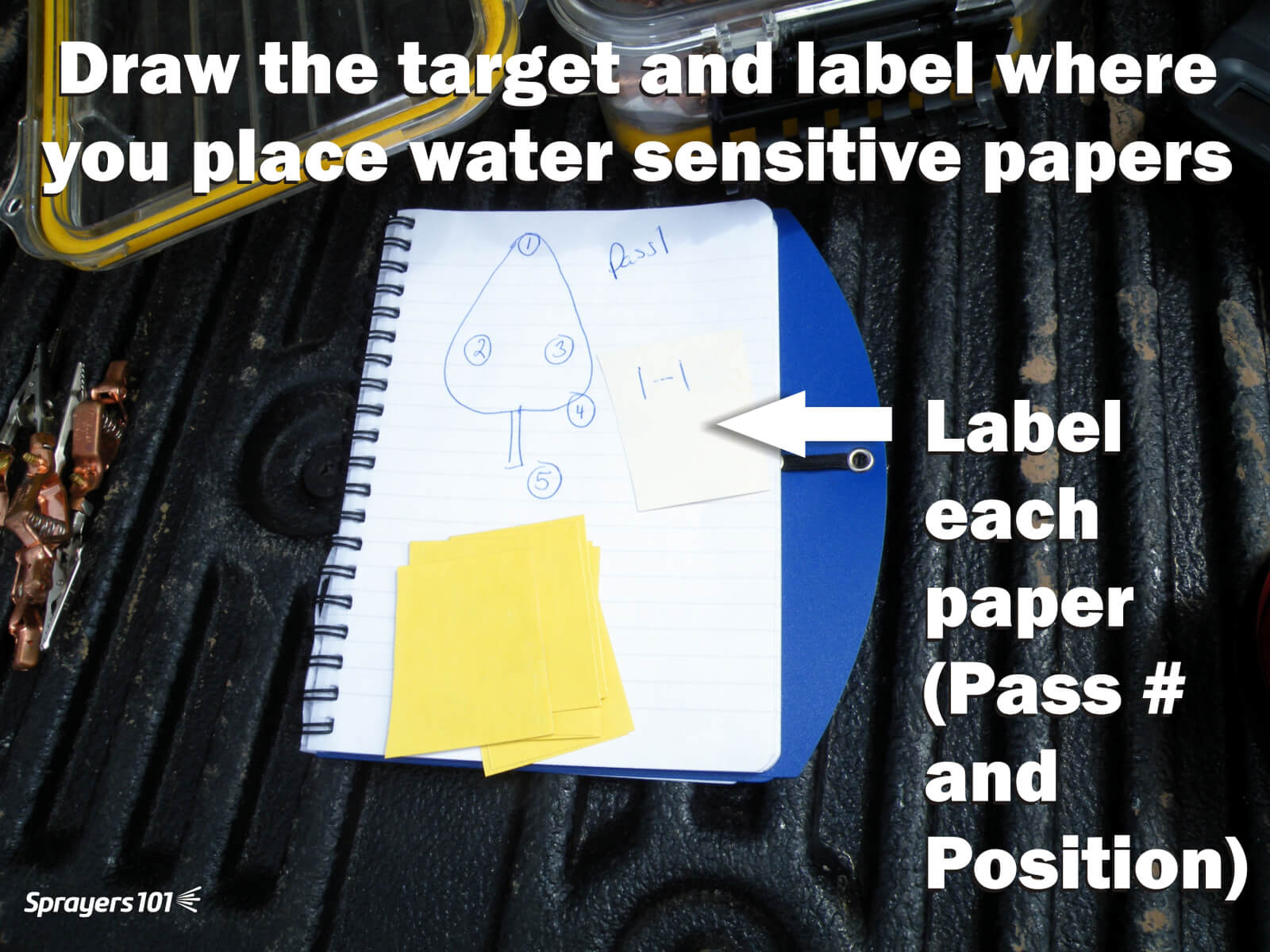
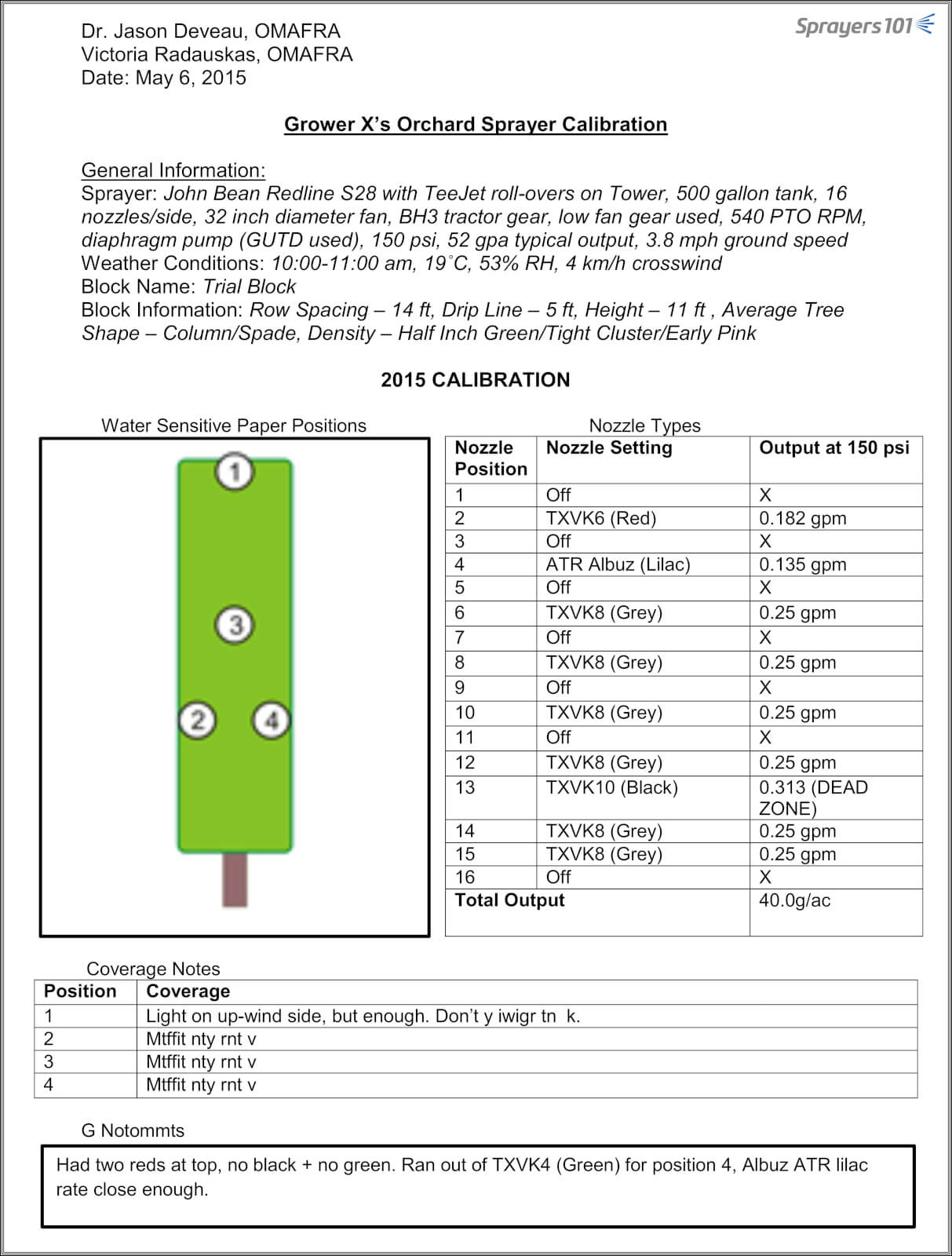
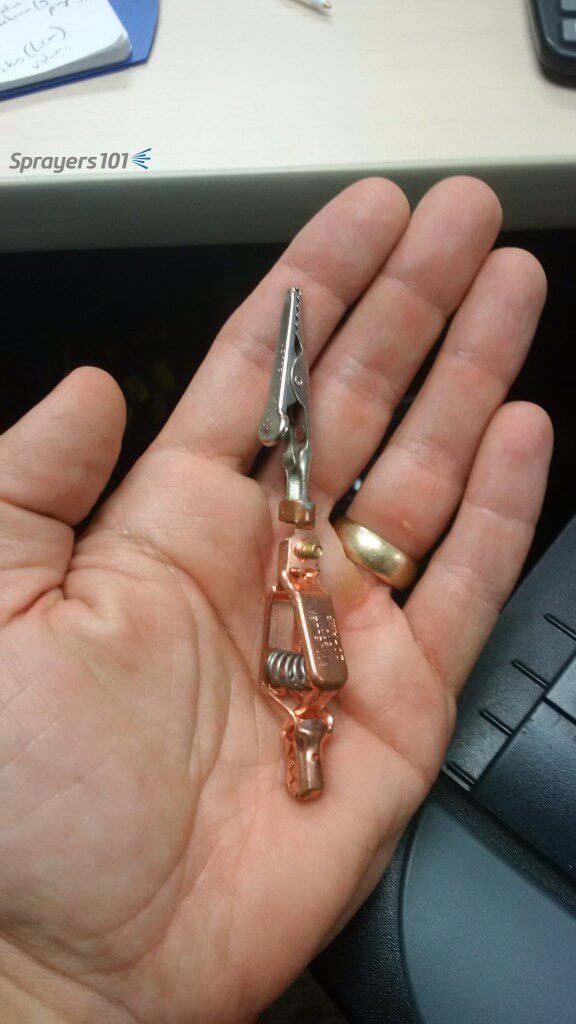
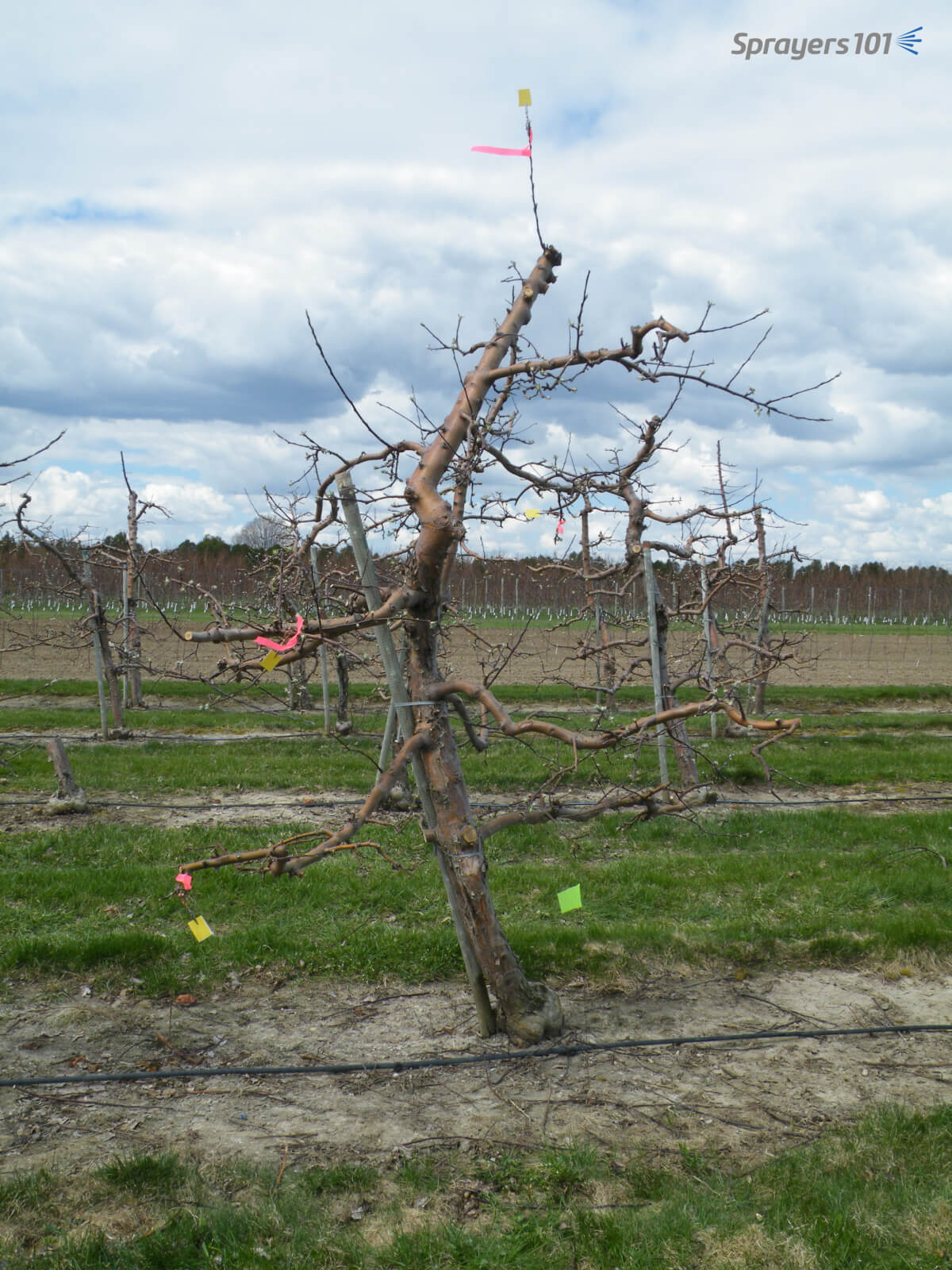
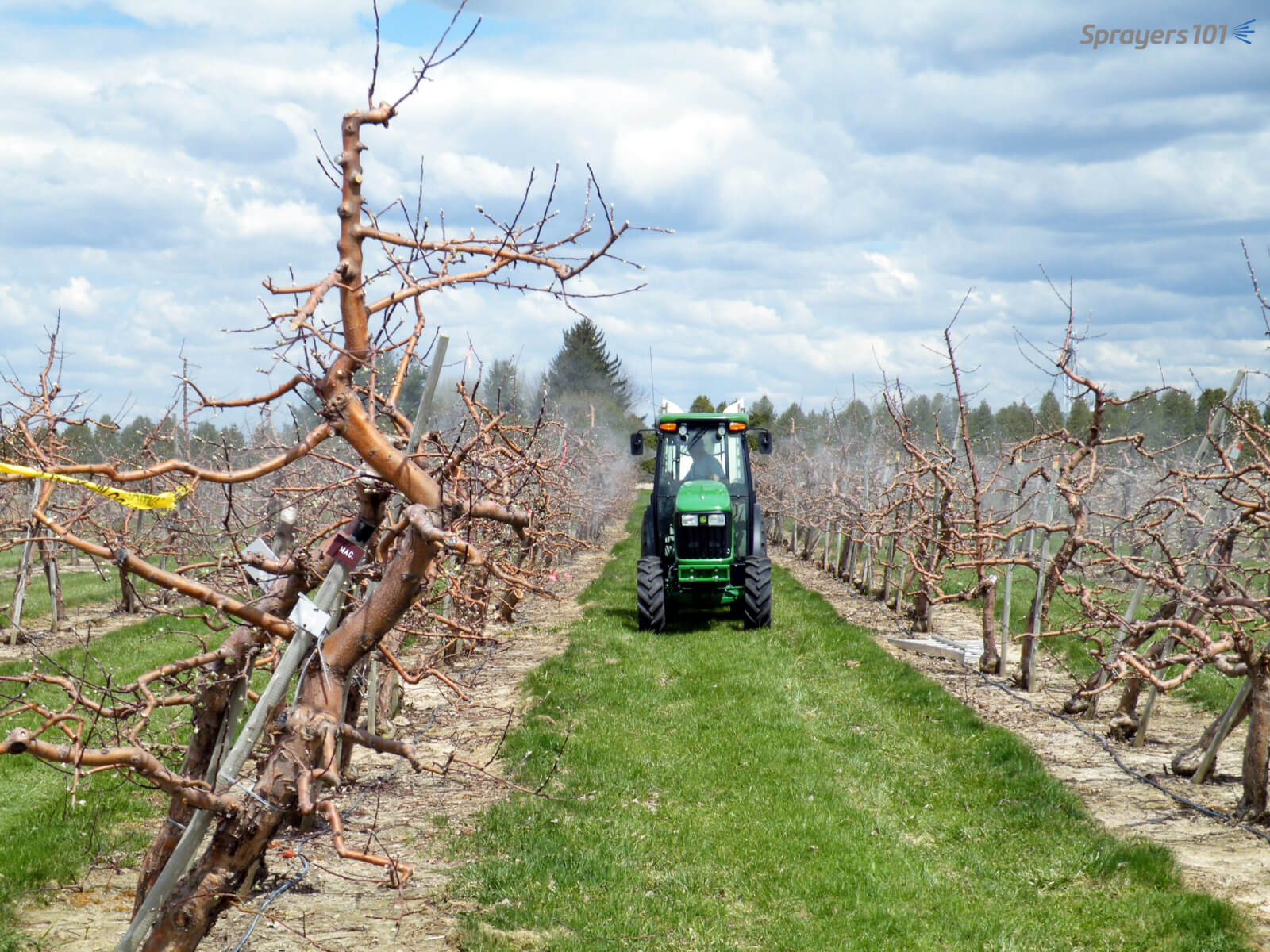
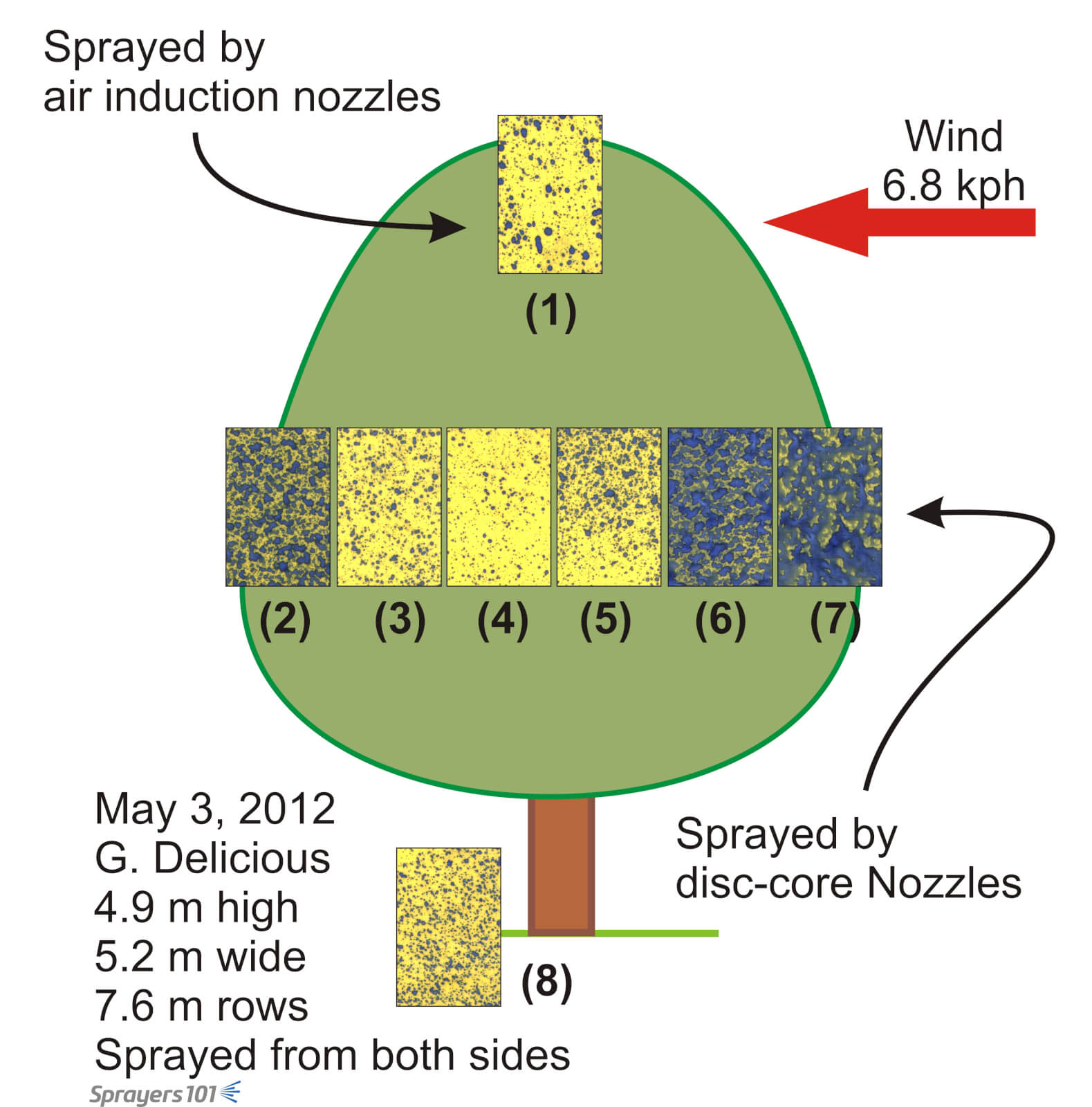
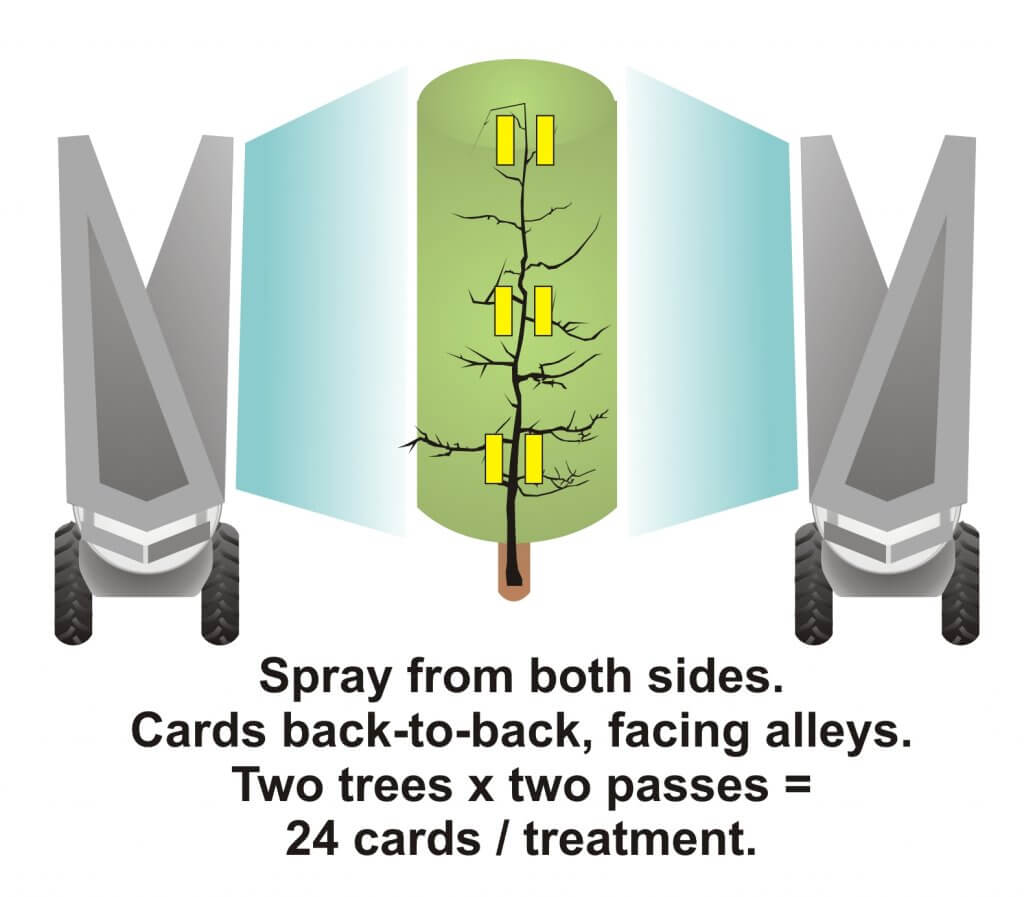
Use water-and-oil sensitive paper to assess spray coverage. The operator should pin or clip papers in the crop, in locations and orientations representing the desired target. Wire flags and flagging tape mark their locations:
Spray using water to establish baseline coverage.
Retrieve the papers and replace them with a new set in the same locations and orientation.
Make one change to the sprayer set-up and determine whether or not coverage was improved.
Continue to tweak the sprayer until coverage is improved. Sometimes, improving spray efficiency means maintaining coverage while using less spray.
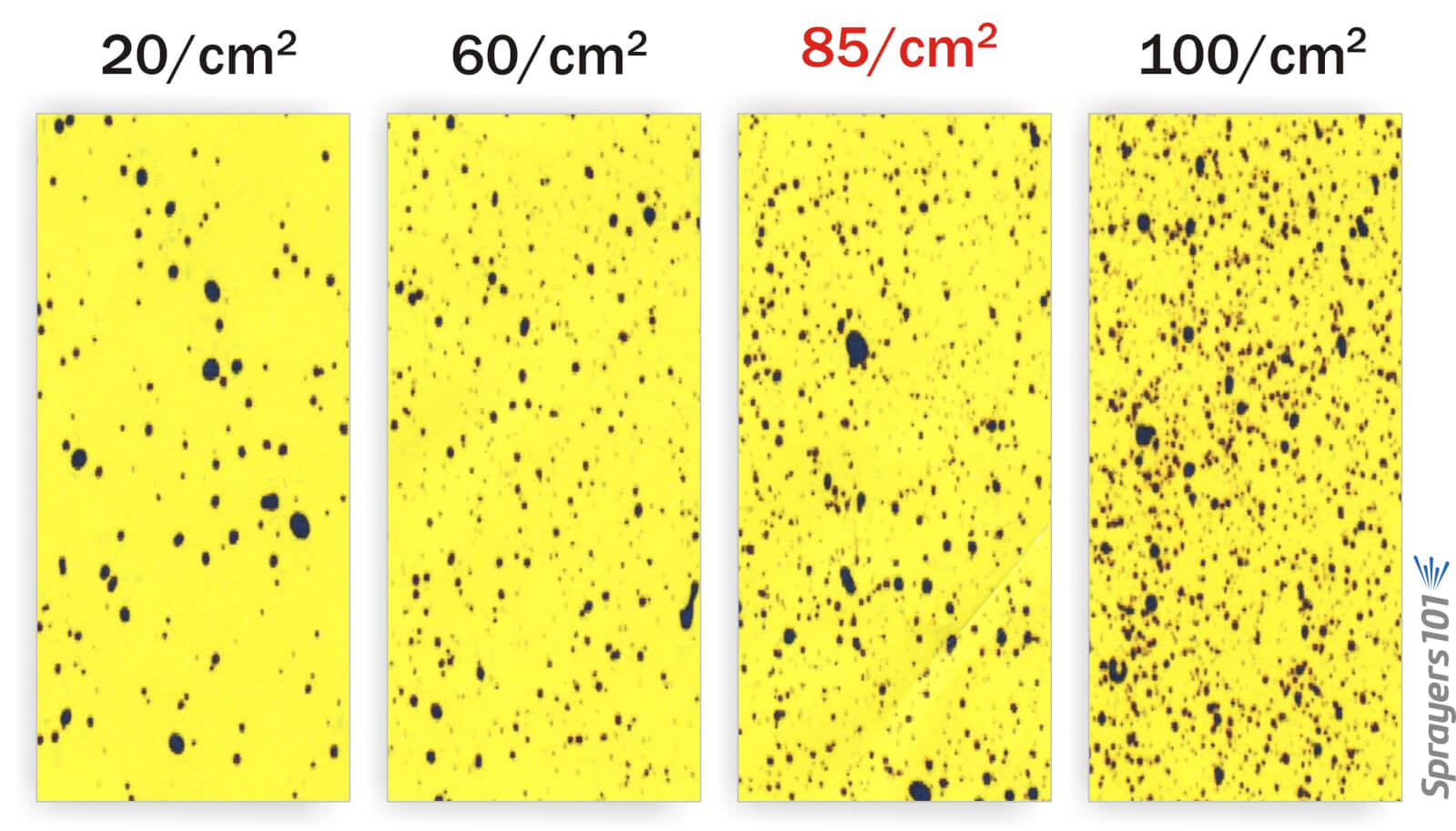
Understand how much is enough. Knowing whether to drench the target, or be satisfied with a low droplet density depends on how the pesticide works and whether or not the pest is mobile. As a general rule for foliar insecticides and fungicides, 85 drops per square centimeter and 10-15% surface coverage on 80% of all targets should be sufficient.
Now, a few caveats: Know that under-leaf coverage is VERY difficult to achieve and that improved coverage does not necessarily mean improve efficacy. Further, know that a systematic approach requires time and effort, and should only be performed in weather conditions the operator would spray in.
Read about how a similar process was used to assess coverage in field tomato and in staked pepper. It may take time out of an already busy schedule, but performing this assessment is always worth it.
Before we dive into the details, let’s start with a quick video summary filmed by RealAgriculture at Canada’s Outdoor Farm Show in September, 2016.
When the pressure drops and the nozzles begin to sputter, the sprayer is considered empty. However, it can still retain a lot of spray solution. Repeated rinses or tank dumps in the same location can lead to accumulation and cause point source contamination.
In response to unacceptably high levels of environmental pesticide contamination, the European Union published an amendment to their directive regarding machinery for pesticide application (2009/127/EC). Their intention was to raise the standard of equipment design to reduce the standing volume of spray solution, and to improve cleaning practices. In order to comply, sprayer technology and operator practices would have to change. But the the amendment didn’t specify how, or to what level.
France (2006) and Denmark (2009) legislated that a rinsed sprayer must not have more than 1% or 2%, respectively, of the original tank mix concentration, as sampled at the nozzle. In response, P G Anderson et al. suggested that residual concentrations should be sampled from at least three places on the sprayer. They conducted research (download here) that showed that both field and airblast sprayers can retain 10-15% of the original concentration in the empty/fill valves, boom ends and filters, while rinsate measured 1-2% at the nozzle. They also stated that in order for sprayer designers, operators and authorities to comply with these new rules, someone had to develop a simple but robust method for cleaning sprayers.
Continuous cleaning
In a later paper, the author and his team proposed a method called “Continuous cleaning” (download here), which employs a dedicated clean water pump to push spray solution from the tank and out the boom in the field. For comparison, the traditional triple rinse method employs the main pump to dilute the remaining spray solution with clean water in a series of rinses and sprays. You can learn more about point source contamination and rinsing methods in this clear and informative presentation by P. Balsari and P. Marucco (download here) given in 2015 at the University of Turin in Italy.
The continuous cleaning method isn’t new. In the 1970s some farmers cleaned their sprayers by plumbing a water supply hose into the suction line while spraying out the rinsate. They were on to something, because formal testing in the late 1990s showed that continuous cleaning was more efficient than triple rinsing. Then, from 2005 onward, research by groups such as betterspraying aps, TOPPS, the Julius Kuhn-Institut and AAMS further refined the process for both field and airblast sprayers.
Anderson et al. made compelling claims about the continuous cleaning method. They stated that a 4,000 L sprayer with a 400 L clean water reservoir would require only 100 L to clean the plumbing as effectively as triple rinsing, which would require the entire 400 L. The remaining 300 L could be used to rinse the exterior and the entire process could take place in the field, in rotating locations. Perhaps most intriguing of all was that it would only take five minutes.
But, it is important to note that their rinsate samples came from the nozzles, as required by France and Denmark. The issue of higher concentrations in dead-end plumbing is not addressed.
European adoption
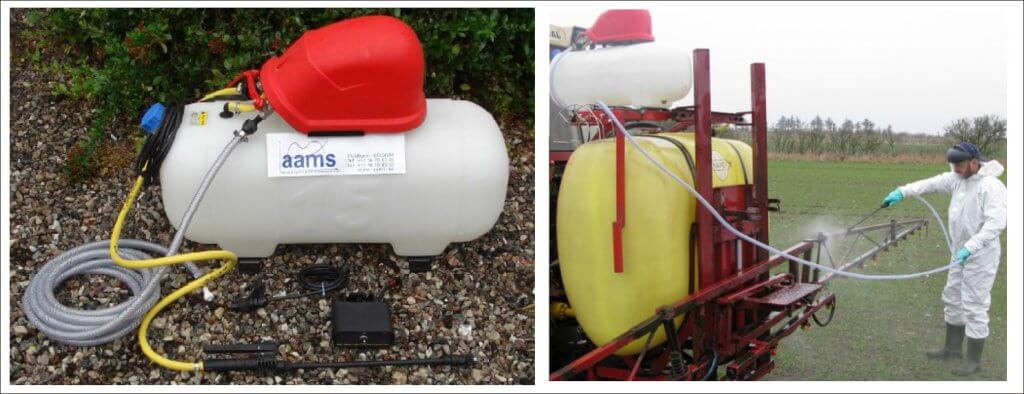
In anticipation of the regulations, some manufacturers were already developing continuous cleaning kits to upgrade sprayers of all makes, models and ages. In Denmark (and to a lesser extent in France and Germany) these kits were used at workshops to upgrade sprayers. But, the installation process was not always straight-forward.
Some kits performed better than others and expertise was needed to match the flow rate, tank rinse nozzles and the pump’s power requirements to the sprayers. Depending on the sprayer’s design, it sometimes required trial and error to establish a process of opening and closing valves during rinsing. Independent testing showed that many sprayers were greatly improved,(download here) but others proved incompatible due to the volume or inaccessibility of residual spray mix remaining in the plumbing. Specific cases include dead-ends on boom sections, or exceptionally long return lines on circulating booms
Defining a fit for North America
In early 2016, we wrote a preliminary article describing what we knew of the method and it created a lot of interest. We decided to test it our for ourselves in a demo at the Canadian Outdoor Farm Show. But before we describe what we did, let’s clarify a few terms. You may have noted that in Europe the process is called “Continuous cleaning” but moving forward we will refer to the method as “Continuous rinsing”. This is because we feel cleaning a sprayer and rinsing a sprayer are different processes with different objectives.
“Cleaning” a sprayer is a total decontamination that should be performed when changing chemicals and at the end of every spray day. It requires the use of a detergent and any label-required additive (such as ammonia following the new dicamba products). Perhaps most importantly, it requires the operator to address the dead-end plumbing areas. There is no universally-accepted process, but we describe fairly common protocols for field sprayers here and for airblast sprayers here.
“Rinsing” is a less intensive process intended to reduce the amount of residue that can build up on, or soak into, sprayer surfaces. Water is brought into contact with most of the plumbing to dilute any solution left in the sprayer, and is then sprayed out in the field. This process should be performed every few loads, or when moving an empty sprayer between fields, or if the operator has (perhaps unwisely) decided not to clean the sprayer at the end of the day because they are spraying the same chemical tomorrow. Often, this is accomplished using the triple rinse process, which we describe here:
Triple Rinse Process
The pressure drops and nozzles sputter (i.e. spray tank is empty).
If the sprayer has an inductor bowl or loading bypass, and if the operator doesn’t already rinse these systems following filling, the operator will exit the cab, open the valve to clean water reservoir, and use a portion of the clean water to clean these circuits. In some cases, the rinse process can be performed without the operator having to leave the cab.
Sprayers with dead end plumbing on boom section ends warrant special consideration. Spray mix can be harboured in the dead ends and is a significant source of contamination, no matter how much rinsing is performed (see video). Therefore, the first rinse (step 5) should be interrupted before it is complete to allow boom ends to be opened, flushed and closed.
The operator then introduces 1/3 of the clean water reservoir to the spray tank through the rinsing nozzle(s) and circulates for 5 minutes (including the agitation line).
The operator returns to cab, and drives to spray the volume out in the field until the nozzles sputter.
Operator exits the cab and introduces 1/3 of the clean water reservoir to the spray tank through the rinsing nozzle(s) and circulates for 5 minutes (including the agitation line).
The operator returns to cab, and drives to spray the volume out in the field until the nozzles sputter.
Operator exits the cab and introduces 1/3 of the clean water reservoir to the spray tank through the rinsing nozzle(s) and circulates for 5 minutes (including the agitation line).
The operator returns to cab, and drives to spray the volume out in the field until the nozzles sputter.
The process, illustrated in this field sprayer plumbing animation, takes about 40 minutes and may require the operator to leave the cab multiple times.
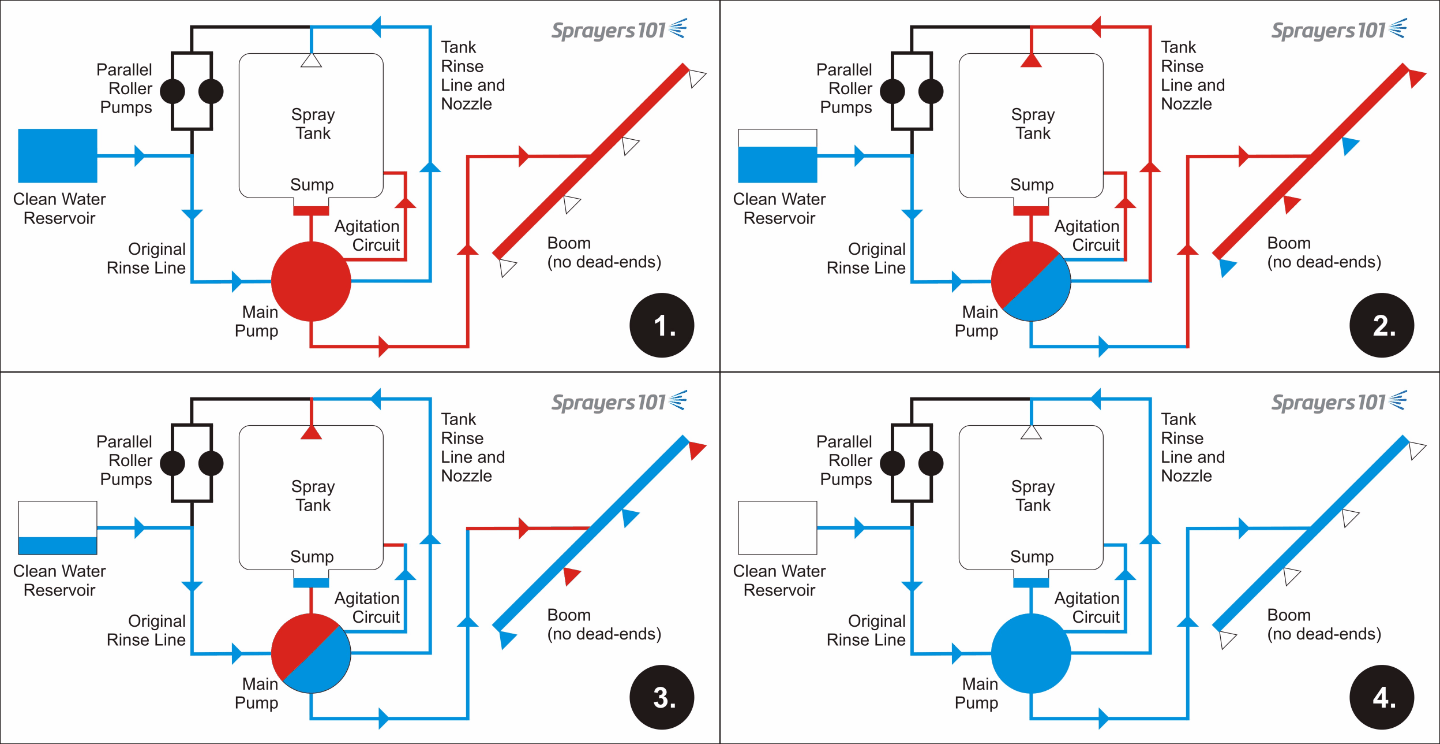
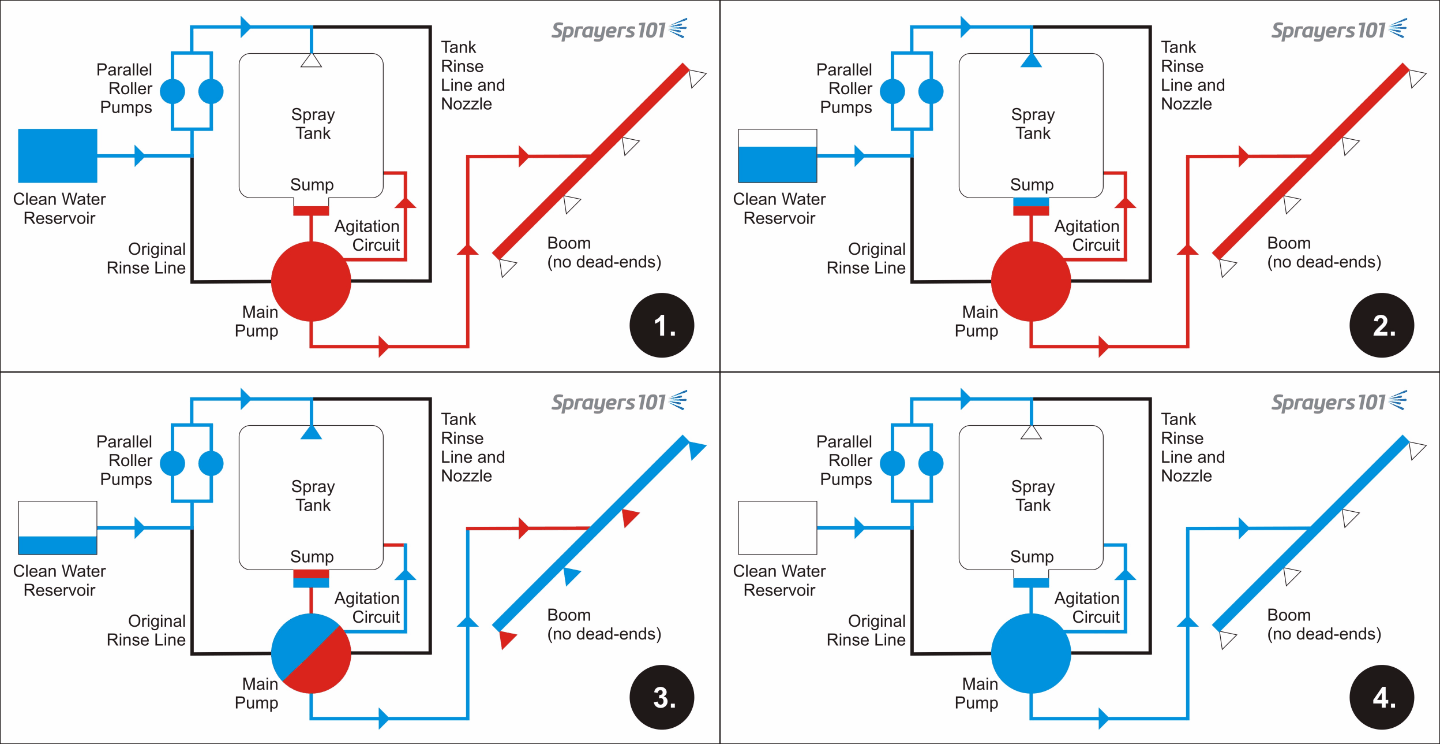
Continuous rinsing requires a second pump to be installed in the system. Rather than performing a serial dilution in three batches, this rinsing essentially pushes spray solution out of the sprayer using clean water. The agitation line creates some dilution since it loops back to the tank, but that small volume is quickly diluted by the process, as below:
Continuous Rinse Process
Pressure drops and nozzles sputter (i.e. spray tank is empty).
If the sprayer has an inductor bowl or loading bypass, and if the operator doesn’t already rinse these systems following filling, the operator will exit the cab, open the valve to clean water reservoir, and use a portion of the clean water to clean these circuits.
There can be no dead-end plumbing at the end of boom sections for this process to work (e.g. sections terminate with air-aspirating end caps).
The operator returns to cab (if they left), and begins introducing clean water to the tank through the rinsing nozzle(s).
When a small volume has been introduced, the operator engages the agitation line with reduced flow to tank and begins driving and spraying at a rate slightly higher than the clean water pump’s flow rate.
Operator continues to spray until the nozzles sputter.
The process, illustrated in this field sprayer plumbing animation, takes about 10 minutes and requires the operator to leave the cab once at most.
Building a demo system and model
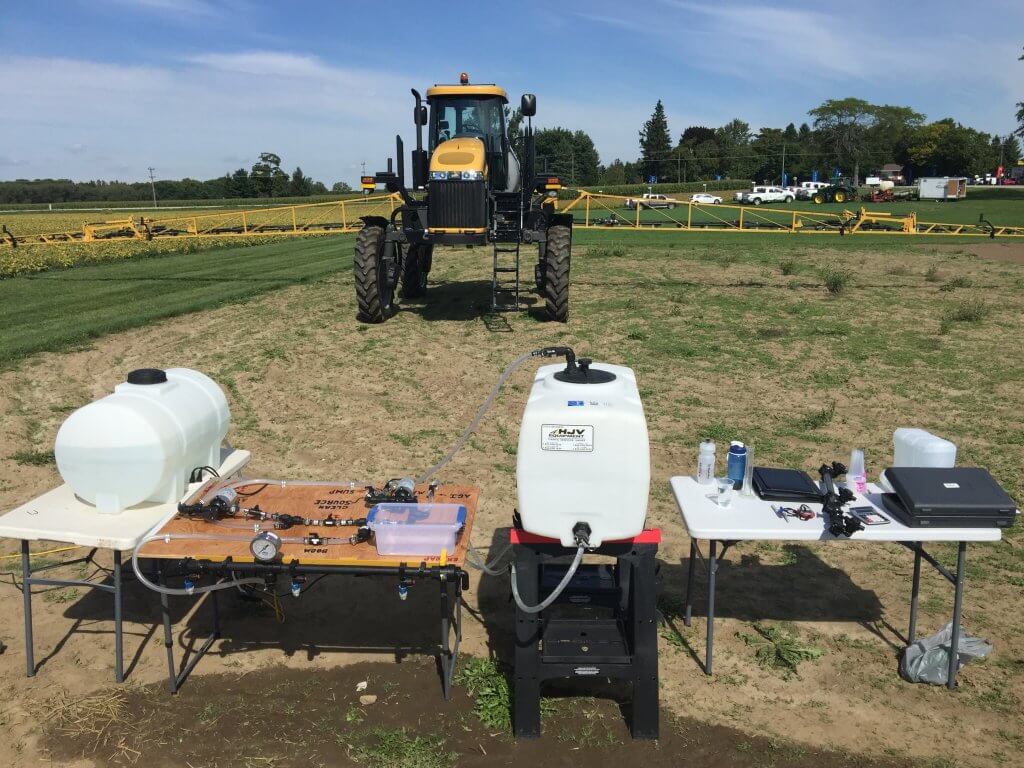
We worked with HJV Equipment in Alliston, Ontario to build a bench-top model representing a simple, scaled-down sprayer rinse system. Using the model, we planned to compare the effectiveness and the efficiency of triple rinsing to continuous rinsing – and we would do so in front of an audience. HJV felt that to make an appropriate model, we should base it on an installed system. So, they plumbed a working system into a RoGator 700.
They used two Hypro electric roller pumps (model 4101 N-H) in parallel, plumbed into the clean water reservoir. Anti-backflow valves led the water to the tank rinse nozzles. The system could be engaged from the cab and could be isolated from the existing rinse system, leaving the sprayer’s original system intact and available for when full cleanings were required. The designer/mechanic points out key features in the following video.
The RoGator 700 has a 700 US gallon tank and a 50 US gallon clean water reservoir. By tapping into an existing compressor, HJV created a means for blowing out the boom with air, greatly reducing the amount of spray solution left in the empty sprayer. Still, the “empty” sprayer would retain about 15 US gallons in the pump, sump and remaining lines. Based on those parameters, we designed and constructed our scaled model. We used 10 L in the main tank and 4.5 L in the clean water reservoir. The lines and sump held about 1.25 L so we felt breaking the 4.5 L of clean water into three 1.5 L volumes was fair.
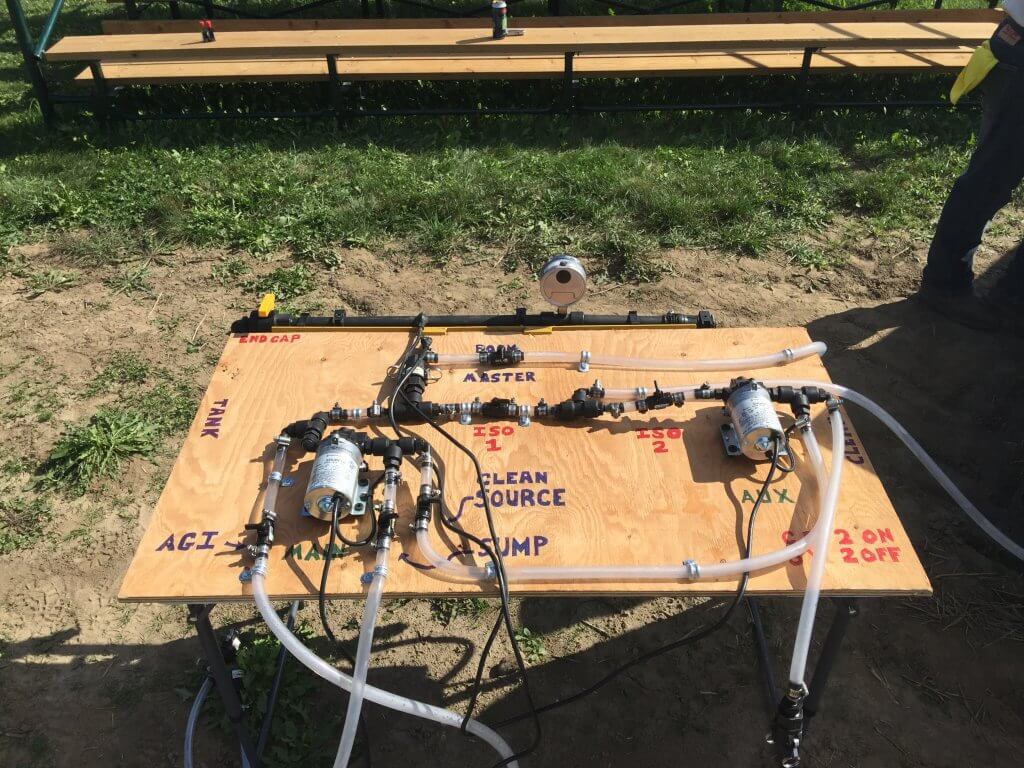
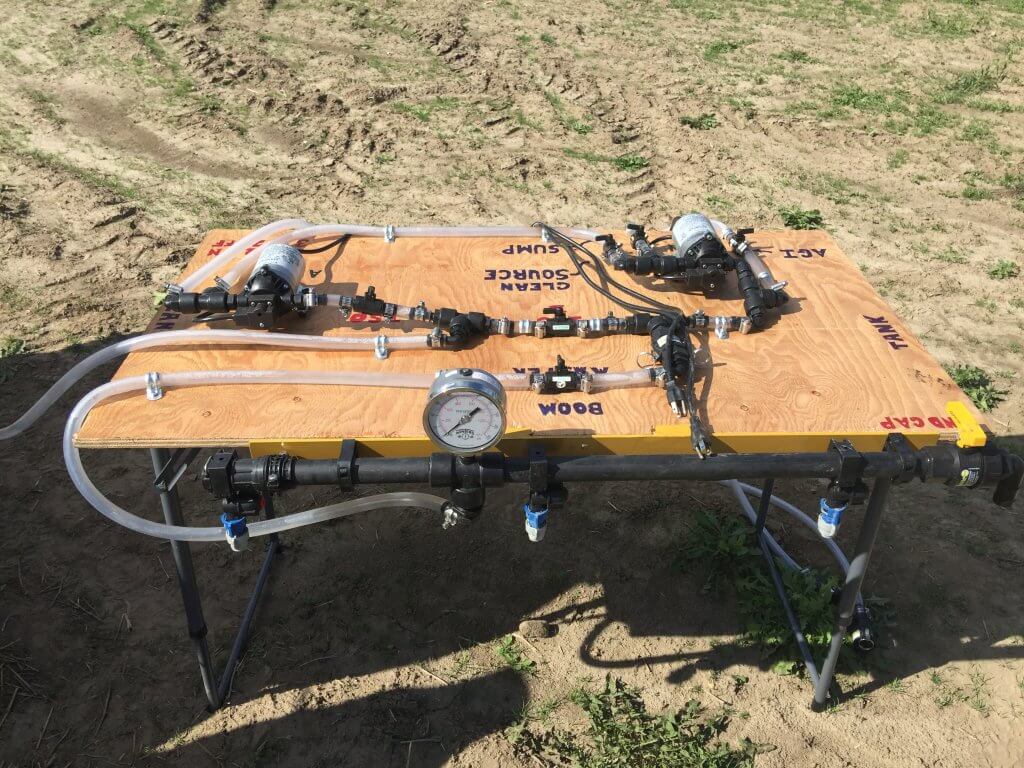
In the images that follow you can see the components. Basically we have a spray tank, clean water reservoir, main pump, dedicated clean water pump, the sprayer boom, and some clever anti-backflow and valves to switch the “sprayer” from one method of rinsing to the next.
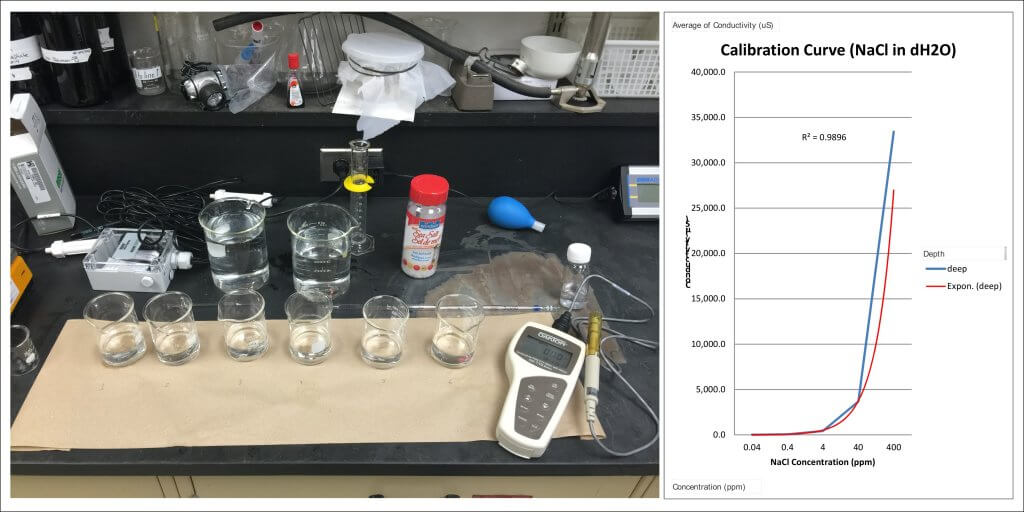
But, we still had to devise a means to measure the effectiveness of the two rinsing systems. UV dye would be difficult to use with a live audience in real time, and food colouring would be too subjective. We decided to use a conductivity meter, which quickly measures the electrical conductivity of a liquid. Using NaCl (table salt) as a readily-dissolved conductor, we calibrated the unit and found we could reliably register table salt in parts per million.
The demo process
We ran the demo six times over three days and recorded how long each rinse took and how effective each rinse was in reducing the original concentration. Here’s how we did it:
Triple Rinse (~4.5 minutes)
Fill the main tank to 10 L.
Introduce 10 cc of salt (and coloured with green food dye) to create our spray mix.
Circulate the solution through the main pump and agitation line to ensure it was completely homogeneous.
Start the system spraying out of the boom.
Draw a sample of the spray mix to serve as our baseline concentration.
When the nozzles began to sputter, the tank was “empty” (duration: 150 seconds).
We drained the boom via valve on the boom-end to simulate “blowing out” the boom. (duration: 5 seconds)
We introduced 1.5 L of clean water through the tank rinse nozzle (duration: 15 seconds).
We circulated the solution through the agitation line. (duration: 30 seconds).
We sprayed the solution out of the boom, drawing a sample of rinsate before the nozzles sputtered (duration: 30 seconds)
Repeat steps 8-10 two more times to represent the other two rinses.
Continuous Rinse (~1.5 minutes)
Fill the main tank to 10 L.
Introduce 10 cc of salt (and coloured with green food dye) to create our spray mix.
Circulate the solution through the main pump and agitation line to ensure it was completely homogeneous.
Start the system spraying out of the boom.
Draw a sample of the spray mix to serve as our baseline concentration.
When the nozzles began to sputter , the tank was “empty” (duration: 150 seconds).
We drained the boom via valve on the boom-end to simulate “blowing out” the boom. (duration: 5 seconds)
We reduced the agitation flow to a low rate and introduced 1.5 L of clean water through the rinse nozzle using our dedicated pump (duration: 5 seconds)
At the 5 second mark, we started spraying while still introducing clean water.
Samples of rinsate were drawn at regular intervals, with particular attention to collect the last volume fraction as the nozzles were sputtering (duration: 100 seconds)
Results
Triple Rinse
The average starting conductivity for the triple rinse demo was 2,520 µS (n=6). The final sample of rinsate registered a conductivity of 490 µS (n=6) representing a final concentration that was 19.4% of the original. Average time: 4.5 minutes.
Continuous Rinse
The average starting conductivity for the continuous rinse demo was 2,145 µS (n=6). The final sample of rinsate registered a conductivity of 342 µS (n=6) representing a final concentration that was 16% of the original. Average time 1.5 minutes.
We were surprised the model could not reduce the concentration of salt to an acceptable 1-2% level. The Agrimetrix Dilution Calculator App suggests it should have been much better. We suspect the standing volume of the system is higher than we predicted, and we weren’t using enough clean water to dilute it. We may have had better results if we’d used a lower concentration of salt to begin with, and/or a higher volume of clean water. We will continue to tweak the demo model and will update this article as we collect more information. The more stringent research in Europe showed that continuous rinsing is a effective as triple rinsing.
The most interesting result is that continuous rinsing took 1/3 of the time triple rinsing required (1.5 minutes versus 4.5 minutes). Research in Europe suggested 1/4 of the time as triple rinsing. The difference is likely accounted for by the time the operator used leaving and entering the cab.
You can see the effectiveness of the process in this AAMS demonstration video. Sure, their demo unit is nicer than the one we built, but our rustic version has charm 🙂 Note the sequence of opening and closing valves to ensure all circuits are rinsed clear of dye.
Conclusion
If continuous rinsing is as effective as triple rinsing and can be performed in a fraction of the time with less operator exposure, then we should be modifying our sprayers to support the method. Airblast sprayers and small field sprayers are relatively easy to modify, and can be even be equipped with a spray wand so excess clean can be employed to rinse down the exterior.
Larger field sprayers, however, may be more challenging as they do not all lend themselves to the conversion:
The clean water pump (hydraulic or electric) must have sufficient power.
Matching the pump capacity to the sprayer can be problematic; The clean water pump flow rate must be 30-50% of the boom flow rate.
Sprayers with dead-end boom sections or circulating-flow return lines may not be compatible, and those with pneumatic systems to clear the boom of solution are preferred.
More sophisticated electronic rate controller systems (e.g. on the larger self-propelled sprayers) may not be compatible.
And, of course, we must remember that neither triple or continuous rinsing should be seen as a replacement for the sprayer cleaning process. Any drain-able part of the sprayer will still harbour high concentrations of residues (e.g. filters, valves, inductors, bypass lines – any dead-end plumbing). With new stacked chemistries being introduced in North America (some still active when residues register as little as a few parts per million), diligent sprayer sanitation is more important than ever.
Thanks to Jan Langenakens of aams for his help researching and informing this article.
In August, 2016, we were contacted by a cut-flower grower specializing in Dahlias. There are photos in this article, but they don’t do justice to this beautiful perennial flower. Imagine a chrysanthemum crossed with a zinnia: lots of tight petals in the bloom. Unfortunately, they’re a perfect place for insects to hide.
Those that buy cut flowers may be some of the most discerning clients in horticulture. A scar on an apple may or may not cause the buyer to reject the fruit, but imagine leaning in to smell a beautiful white bloom only to see a black bug crawl out of it! For many, the revulsion is the equivalent of finding a hair in their food.
The challenge
According to the grower, the 2016 season has been very bad for Thrips, which could easily exceed five per bloom even after spraying. The grower had the insect identified as “Western Flower Thrips” which, in Ontario’s greenhouses, are demonstrating resistance to chemical control. With such high insect density comes natural predators, such as Orius (the Minute Pirate Bug). While it does an admirable job hunting thrips, it must also be controlled because to the buyer it is just another undesirable black bug. Getting the contact spray in between all those petals is exceedingly difficult. The grower wanted to know how he could improve spray coverage deep in the bloom itself. So, we had a discussion.
The ideas
Adjuvants
Our first thought was an adjuvant. Wetting agents have been helpful for controlling thrips in other crops, such as those located deep in green onions in Ontario. We consulted the grower’s insecticide labels looking for possible incompatibilities. We found they had the potential to damage tender foliage if applied in periods of high humidity or high heat (i.e. > 25 °C). They also noted that the use of an adjuvant may increase the potential for damage. The grower confessed that he had already experimented with a non-ionic spreader and saw damage to the blooms. So, a water-conditioning option to improve spread was off the table.
Volume and travel speed
Our next idea was to increase the volume being applied per hectare. This strategy is a safe bet for improving coverage because it increases the number of droplets available for contact. There are a few ways to achieve higher volumes, but we elected to drive slower, which has the added advantage of reducing drift.
Spray angle
We also talked about spray angle. Dahlia blooms face horizontally in all directions, not vertically (i.e. side-ways, not straight up). Consider the spray from the nozzle’s point of view: The spray from the grower’s flat fans would fall predominantly downward. Theoretically, most of it would settle on the upper edges of the flower. We wondered if we could use an angled spray to hit the blooms face-on and improve penetration into the bloom.
We felt twin fans and asymmetrical fans weren’t an aggressive enough angle, and they didn’t address the fact that the flowers faced in all directions. So, in order to get panoramic coverage on a near-horizontal plane, we decided to try alternating (one back, one forward) TeeJet Turbo FloodJets. They have been used to great effect by the University of Guelph’s Dr. David Hooker to provide panoramic coverage to wheat heads, so perhaps they would help here.
To prove the principle, we decided to run a short qualitative trial to see if there was a difference.
Nozzles
In the video below you can see how we nozzled the sprayer. We kept the left wing of the boom in the grower’s configuration: conventional 8004 flat fans (red) operated at 40 psi on 20” centres. That was a Medium spray quality and 0.4 US gallons per minute. On the other wing (right) we used TF04’s (white) operated at 40 psi on 20” centres. That was an Extremely Coarse spray quality and 0.8 US gallons per minute.
Coverage and Efficacy
We cut water-sensitive paper into strips and slotted them into the blooms. By orienting them in multiple directions we hoped get a visual indication of bloom coverage. Plus, when they were extracted after spraying we could see how deeply the spray penetrated the bloom.
We ran a pass using water at the grower’s typical speed of 3.5 mph, but when we didn’t see a big difference on the papers, we slowed to 2.5 mph. That’s 47.5 US gallons per acre (~500 L/ha) from the flat fans (left) and 95 US gallons per acre (~100, L/ha) on the right. A few typical results are shown below.
We weren’t sure if we were seeing an appreciable difference in bloom coverage, but it looked promising. In retrospect, they may have been more effective indicators if we’d oriented a few flat against the bloom face. We decided to use the nozzle arrangement for a few insecticide applications and see if there was a difference in efficacy.
The grower sprayed in the evening and returned the next morning to perform counts in 20 random blooms from each treatment. Normally, a scout looking for thrips would tap the bloom over a piece of white paper to do counts, but the grower’s method was to blow into the bloom. He said Thrips and orius climb out to the edges of the petals immediately and can be counted. We sprayed in the white Dahlia to make the counts easier. We did this twice. The counts were less than spectacular and we were disappointed:
1st application: Turbo FloodJets: 16 orius and 31 thrips in 20 blooms Conventional flat fans: 10 orius and 21 thrips in 20 blooms
2nd application: Turbo FloodJets: 2 Orius and 1 thrip in 20 blooms Conventional flat fans: 2 Orius and 3 thrip in 20 blooms
Conclusion and next steps
The grower reported that even though we raised the volumes by slowing down, the efficacy from his flat fans had not improved compared to what he was doing previously. Adding insult to injury, the Turbo FloodJets (which were spraying twice the volume as the flat fans) did not seem to improve matters. Before we could try another approach, the insect pressure fell and the season drew to a close. You might wonder why we’d publish an article that didn’t pan out. It’s because you can learn as much from what doesn’t work as what does
So why didn’t we see improvement? Perhaps the boom was too high and the spray from FloodJets fell vertically. Perhaps the spray quality from the FloodJets was too coarse. Perhaps the grower’s method for counting insects was biased or inaccurate. It’s all speculation. As we pointed out earlier in this article, this hardly constitutes a formal experiment. We were hoping to see some indication of improvement before designing a more intense study. We didn’t see one.
We hoped to try again between June and August, when thrips and orius counts are highest. Our plan was to use drop-hoses to suspend nozzles at bloom-height and to use a double nozzle body to mount two back-to-back full-cone nozzles in each position. They would alternate 180° along the boom aiming in front-to-back and left-to-right orientations to provide panoramic coverage using a Medium spray quality. And, finally, we would have engaged a scout in a blind study to eliminate bias and increase our sample size.
Unfortunately the study didn’t take place – any takers?
Thanks to the grower co-operator, and TeeJet Technologies for providing the water-sensitive paper and nozzles for the study.
Back in 2011 we toured a few vegetable greenhouses in Southern Ontario. I wanted to learn more about how greenhouses used hydraulic sprayers (i.e. not misting or fogging systems) to apply pesticides to tomatoes, cucumbers and peppers. It was an eye-opening experience for me, because like every commodity group I’ve encountered, they had their own unique way of doing things.
Manually-towed sprayers
The first operation employed a system that I’ve come to learn is fairly common in greenhouses. There is a centralized tank and pump, located outside the growing area. Products are mixed and pumped from there.
Mixing area
The pressure is set at the source so the spray mix is pumped to the rest of the greenhouse where the sprayer can be quick-connected to one of a number of outlets along a central line. I’ve been surprised in the past to see airblast sprayers set as high as 300 psi, so it really surprised me to see the pressure set to 500 psi! I was told this was necessary to counter the pressure-drop experienced at the far reaches of the greenhouse (see below).
Pressure regulator on a clearly-labeled tank.
The sprayer itself was a manually-towed vertical boom and a coil of hose. The operator would wear appropriate personal-protective equipment and tow the sprayer between the rows at a constant speed. They may or may not have the ability to control the pressure with a regulator on the boom – the nozzle selection and travel speed dictate the rate.
Manually-towed vertical boom.Demonstrating how an operator spays greenhouse tomatoes with a towed vertical boom. This was just water, so no PPE required.
In this demo, the operator was using yellow TeeJet VisiFlo hollow cones (TX-VK3) which, despite the pressure-drop, were still operating at >300 psi and therefore beyond what the manufacturer lists in their rate charts. The resultant spray quality was Very Fine. We’ve said before that increasing the pressure does not increase the speed of tiny droplets appreciably, but that’s when we’re talking about going from, say, 60 to 90 psi. At pressures as high as 300 psi the droplets are moving fast enough to generate some air movement (i.e. making their own light wind) and there was a visible distortion of the outer potion of the crop canopy. The resultant coverage, even on the underside of a leaf (see below), was hard to fault.
Under-leaf coverage
However, as one would expect with Very Fine spray, a lot of the mist didn’t go anywhere. So while the coverage was very good, it was not terribly efficient. I was left thinking there might be an opportunity to find a savings in spray mix and reduce the potential for operator exposure by lowering the pressure. Unfortunately the regulator would not allow us to reduce the source pressure appreciably, so we weren’t able to experiment.
Automated sprayers
The next greenhouse we toured used a far more sophisticated method for applying pesticides. While they still used a centralized tank and pump, the sprayers were not hand-pulled trolleys; They were robots! Well, they were automated vertical booms that rode along the hot water pipes in the alleys between the crops. The operator would stand in the corridor and send one sprayer hurdling down the left-hand alley. The sprayer sprayed from only one side of the boom as it went. When it reached the end of the alley, the boom would rotate 180°. Just as it began the return trip, spraying the other side of the alley, the operator would send a second sprayer down the right-hand alley. As the second sprayer reached the end of it’s run, the operator would retrieve the first sprayer, and set it rocketing down the next left-hand alley. In that fashion, alternating back and forth, the greenhouse got sprayed.
Automated vertical boom sprayer
The automated sprayer was set to operate at ~350 psi, traveling at a rate of 75 meters per minute, spraying from a vertical boom equipped with five flat fan nozzles oriented vertically. Water sensitive paper (which has one face that goes from yellow to blue when water contacts it) was placed in three locations in the tomato canopy.
One was placed directly behind the fruit with the sensitive face square to the sprayer.
One was placed with the sensitive face facing the ground (this upside-down orientation exposed only the edge of the card to the sprayer).
The last was oriented with the sensitive face aimed into the direction of the sprayer’s travel, again only exposing the thin edge of the card to the sprayer.
Water-sensitive paper shielded by a fruit. Sprayed with flat fan nozzles.
Flat fan nozzles
The sprayer was released to spray the 125 metre row using the flat fans. To the observer, it produced a cloud of spray that appeared to completely envelop the target row. Very little was seen to escape through the tomato canopy into the next row. When the cards were retrieved, however, the coverage was disappointing. See the right-hand column of papers entitled “Flat fan” in the image below. This goes to show that a spray cloud can fool you – always use water-sensitive paper to confirm spray coverage.
Coverage from three sets of nozzles. Papers oriented in three different ways in a tomato vine.
Hollow cone nozzles
Now, don’t look at the centre column of papers just yet (you just did, didn’t you?).
We chose to switch from the vertically-aligned flat fans to hollow cones. The concept was that the spray would be emitted from so many new angles that it would penetrate the canopy more effectively and hopefully cover more of the targets. I’ll note that we had to use extra gaskets to hold the nozzles firmly in place. The sprayer was re-nozzled, the paper targets replaced, and the sprayer sent back down the alley. Once again, the spray swath looked good to us, but when we retrieved the papers, there was almost no coverage; It was far worse than the flat fans.
Multiple gaskets were required to hold hollow cone nozzle tightly in place.
Finer droplets have very little inertia, so perhaps the high pressure made the droplets too fine for them to move very far. To test this, we reduced the pressure to 100 psi and re-sprayed the same cards, which were simply left in place. The resultant coverage was not improved.
We left the papers in place for a third pass. This time we thought perhaps the spray was still too fine because of the nozzle itself. We replaced the hollow cones with a different set of hollow cones that produced coarser droplets and the same cards were re-sprayed. Still no practicable improvement.
We were getting desperate, now. Cards were left for a fourth pass. It has been demonstrated that a slower travel speed can improve canopy penetration in orchards, berry crops and and grapes, so perhaps the sprayer was moving too quickly? The sprayer was slowed to 50 metres per minute and the cards sprayed for a fourth time. Now look at the centre column entitled “Hollow Cone (x4)” in the figure below. This coverage is the result of four passes with hollow cones. It was disappointing.
Note: a greenhouse is a very hot and humid place. Water-sensitive paper begins to discolour quickly, so don’t leave them out for longer than you have to. That’s why the top paper is cloudy-looking.
Coverage from three sets of nozzles. Papers oriented in three different ways in a tomato vine.
Twin-fan nozzles
Finally, and only because I had them with me, we decided to try dual flat fans (in this case, TeeJet DG TwinJets). Symmetrical and asymmetrical dual fans are often used to spray vertical targets in field crops (e.g. to control fusarium in wheat heads). We oriented the nozzles so they alternated 45° left, then 45° right. We also turned off every second nozzle. The idea was to prevent the fans from physically intersecting, but still create an overlapping swath. The paper targets were replaced and the sprayer was returned to its original settings (i.e. 350 psi and 75 m/sec). We managed to twist them into that orientation by using a cap with a circular opening and additional gaskets to hold the nozzle snugly. Plus, at 350 psi, we had to get the nozzles extra tight to prevent leaks.
Nozzling a vertical boom.
The result was spectacular. Here are the results once more (below). See the left-hand column entitled “Dual Flat Fan”. The cards received so much coverage that two became drenched and curled. Even the card with the worst coverage received more than enough. I will point out that this was achieved with about 2/3 the spray volume the operator typically used to spray with flat fans.
Coverage from three sets of nozzles. Papers oriented in three different ways in a tomato vine.
And, this is where the tour and our trials ended. The operator was happy with the improved coverage and so was I. I was sure to tell them that now that more spray was hitting the target, they should explore reducing the spray volume (either via reduced pressure or lower-rate nozzles) until all the papers looked more like the one in the bottom-left. I suggested a goal of about 85 drops per square centimetre (a benchmark for good coverage) rather than the drench/run-off we were currently getting. The spray mix would continue to be the same ratio of formulated product-to-carrier, but a judicious reduction in overall volume would result in reduced pesticide costs and reduced wastage as long as coverage was never compromised.
And now, a warning…
Unfortunately, as I heard two years later from a miffed agrichemical dealer, the operator did not follow through with the volume reduction. I was told the tomatoes began to exhibit symptoms that looked like blossom end-rot but he suspected it might be chemical burn. His hypothesis was that so much spray was getting to the tomatoes that it was accumulating at the bottom of the fruit during run-off, concentrating as the spray dried, and damaging the area. We may never know what really happened.
And so, it’s important to remember that whenever you adjust or calibrate your sprayer to improve spray coverage, you should reconsider how much spray you need to accomplish your goals. If you were getting poor control before the adjustment, improved coverage might help. If your level of control was already satisfactory, and your adjustments were intended to reduce wastage, consider reducing how much spray volume you use. This is called crop-adapted spraying.
Note: If you are concerned that changes to your spray practices might cause unwanted side effects, always perform trials on small test-plots and monitor the crop closely to ensure there are no negative impacts.
Take home
Greenhouse vegetable producers should consider using water-sensitive paper to test nozzle arrangement on their high volume sprayers. From our preliminary work here, dual flat fans at alternating angles might be worth exploring in hanging tomatoes. And, because it cannot be overstated, consider making changes in small test plots first and monitor the results closely.
In the spring of 2016, the Ontario Berry Growers Association (OBGA) conducted a survey of its membership to poll how fungicides were being applied. The results were very interesting.
Fungicide basics
Generally, fungicides registered for berry crops are contact products, so coverage and timing are very important. The fungicide has to be distributed evenly on the target before disease has a chance to infect the crop. That means the sprayer operator must be aware of the susceptibility of the crop to the level of disease pressure to ensure timing is appropriate. While kickback and post-application distribution of pesticide residue is sometimes possible, sprayer operators should not rely on it. The following table outlines application recommendations for a fungicide commonly used in Ontario. It combines labelled information and provincial recommendations and is representative of most fungicides.
Summer-fruiting and Fall-bearing Raspberry / Blackberry
Highbush Blueberry
Day-neutral and June-bearing Strawberry
Labelled rate
2.5 kg/ha
2.25 kg in 1,000 L/ha
2.75-4.25 kg in 1,000 L/ha
Diseases (Labelled and Ontario provincial recommendations)
Anthracnose fruit rot, Spur blight, Leaf spot, Botrytis grey mould
Flower bud, First bloom, 7-10 days after bloom, Pre-harvest, Through to fall
As of 2016
The spray target
The applicator reading the recommendations should be considering the best way to get the fungicide to the target. But, what is the target, and what is the best way to apply it? It seems the recommendations raise as many questions as they answer:
With the possible exception of blueberry, this fungicide can be applied through much of the growing season (especially when it’s been a wet season). That means the crop staging is highly variable.
The primary target is blossoms, but depending on the disease, leaves and stems are also important.
The label states a volume of carrier (i.e. 1,000 L/ha) for strawberry and blueberry, but not the cane fruit. It does not specify highbush blueberry versus the sessile, ground cover variety.
So, this means is the sprayer operator has to spray crops with highly variable physiology (e.g. bush, cane or sessile row crops), onto very different targets (e.g. leaves, canes, stems, flowers) throughout much of the season as the crop canopies grow and fill. This is a very challenging spray application. It would be wrong to suggest a single spray quality, water volume or sprayer set-up to efficiently accomplish all these goals (more on that later). The first consideration is the application equipment itself.
The application equipment
Berry growers employ a variety of sprayers to protect berries. Without considering models or optional features, there are three fundamentally different styles: Airblast, backpack and boom. According to the survey, the following table shows which sprayers are used in which berry crop in Ontario. Approximately 60 growers responded, and many grow more than one variety of berry and use more than one style of sprayer.
Jacto airblast in raspberry
Airblast Sprayer
Backpack or Wand Sprayer
Vert. or Hor. Boom Sprayer
Total
Highbush blueberry
8
1
0
9
Day-neutral Strawberry
3
0
21
24
June-bearing Strawberry
5
0
32
37
Raspberries & Blackberries
21
1
7
29
Total
37
2
60
So, generally, cane and bush berries are sprayed using airblast sprayers and strawberries using horizontal booms. The survey didn’t specify features such as air-assist on booms, or whether or not those booms are trailed or self-propelled. The type of, and features on, any given sprayer dictate the limits of what an operator can adjust to improve coverage.
Water volume
Respondents also reported on how much carrier (i.e. water) they used to spray fungicide on their crops. Given Canada’s propensity to report volumes in many different forms, I have converted all values into the most common units: L/ha, US g/ac and the dreaded L/ac:
n
L/ha ± std (max./min.)
US g/ac ± std (max./min.)
L/ac ± std (max./min.)
Highbush Blueberries
7
534.2 ± 340.1 (1,000/150)
57.1 ± 36.4 (106.9/16)
216.2 ± 138 (404.7/60.7)
Day-neutral Strawberries
22
418.5 ± 192.2 (1,000/224.5)
44.7 ± 20.6 (106.9/24)
169.4 ± 77.8 (404.7/90.8)
June-bearing Strawberries
33
403.1 ± 235.1 (1,000/50)
43.1 ± 25.1 (106.9/5.3)
163.1 ± 95.1 (404.7/20.2)
Raspberries & Blackberries
27
450.1 ± 279.4 (1,200/50)
48.1 ± 29.9 (128.3/5.3)
182.1 ± 113.1 (485.6/20.2)
Trailed horizontal boom in strawberry
There appears to be a lot of variability in the volumes applied, but on the whole, very few are using the 1,000 l/ha indicated in the fungicide recommendations. The ~430 l/ha overall average is no surprise; labelled volumes are quite often higher than what sprayer operators use. In some cases, high label volumes are warranted because the product requires a “drench” application to totally saturate the target, or to penetrate very dense canopies. Conversely, a high label volume might reflect outdated practices if that label hasn’t kept up with current cropping methods or application technology. Sometimes label volumes are suspiciously large, round numbers that suggest they are intended to encompass a worst-case scenario (e.g. a large, unmanaged crop with high disease pressure and a less-than-accurate spray application). In the particular case of crops sprayed with an airblast sprayer, it is very difficult for a label to accurately predict an appropriate volume due to the variability in crop size, density and plant spacing. This has led to methods to interpret labels, such as crop-adapted spraying.
The disparity between label language and grower practices is not entirely the fault of the label. Most sprayer operators don’t want to carry a lot of water because more refills prolong the spray day. In situations where the crop has reached a critical disease threshold, or bad weather has compressed the spray window, sprayer operators sometimes reduce the volumes in the belief that “getting something on” trumps “good coverage”. Perhaps that’s true, but insufficient volumes greatly reduce coverage. This can be further exacerbated when operators do not account for the increase in crop size and density over the season, or the impact of hot dry weather on droplet evaporation.
Improving coverage
So, is there an ideal sprayer set up and volume? As previously alluded, the variability in crop staging, crop morphology, target location and spray equipment make a single recommendation impossible. But that doesn’t mean there aren’t diagnostic tools and a few simple rules to help a sprayer operator determine a volume to suit their particular needs. Much can be accomplished with these three things:
Water-sensitive paper
A modest selection of nozzles and a nozzle catalogue
An open-minded sprayer operator willing to spend a little time and reconsider traditional practices
Rule-of-thumb fungicide coverage on water-sensitive paper.
Water-sensitive paper is placed in the canopy, oriented to represent the target (e.g. leaf, bloom, etc.). It is important to put multiple papers in at least three plants to ensure the coverage reflects a typical application. The paper changes colour when it’s sprayed and this provides valuable and immediate feedback. Did the spray go where it was supposed to go and did it distribute throughout the target? If so, then the operator now knows that they can safely focus on timing rather than targeting. If not, a little diagnosis is required:
1. Were targets completely drenched? If so, there is too much coverage. Operators can drive faster (if possible, and as long as it doesn’t create drift), reduce operating pressure (if possible, and as long as the nozzle is still operating in the middle of its registered range), or change nozzles to lower rates (as long as spray quality is constant).
2 .Were targets only partially covered, as if a leaf obstructed part of the target and created a shadow? This mutual-shading is the bane of spraying dense canopies. One possible solution lies in understanding droplet behaviour: Coarser sprays generally mean fewer droplets and they move in straight lines. Therefore, when they hit a target, they might splatter or run-off, but typically their journey is over. If the spray is too Coarse, a slightly Finer spray quality increases droplet counts and may help droplets navigate around obstacles and adhere to more surfaces. Sprays that are too Fine will not penetrate dense canopies without some form of air assist. They slow very quickly and tend to drift and evaporate before they get deep enough into a canopy to do any good. A Medium droplet size is a good compromise because it produces some Fines and some Coarser drops – the best of both worlds.
Increasing volumes and reconsidering spray quality often helps, but there might be other options. If using air assist, there are tests that can confirm the air volume and direction are appropriate. Another solution might lie in canopy management (where pruning bushes and canes can help spray penetration immensely). Still another might lie in the use of adjuvants to improve droplet spread on the target.
3. Were targets missed entirely, or coverage is consistent but sparse? The operator is likely not using enough water, and/or the spray quality is too fine. It has been demonstrated time and again that higher volumes improve coverage, but operators can try any of the options listed previously for partially-obstructed coverage. All the reasoning is the same.
Conclusion
Spraying fungicides effectively requires an attentive sprayer operator. Timing and product choice are very important, but when it is time to spray the sprayer operator should diagnose coverage with water-sensitive paper, and be willing to make changes to the sprayer set-up to reflect changing conditions. Thanks to the OBGA for sharing the survey data.