Category: Speciality Sprayers

Main category for all sprayers that are not horizontal booms

  • The Pressure Gauge Shows More Than Pressure

    The Pressure Gauge Shows More Than Pressure

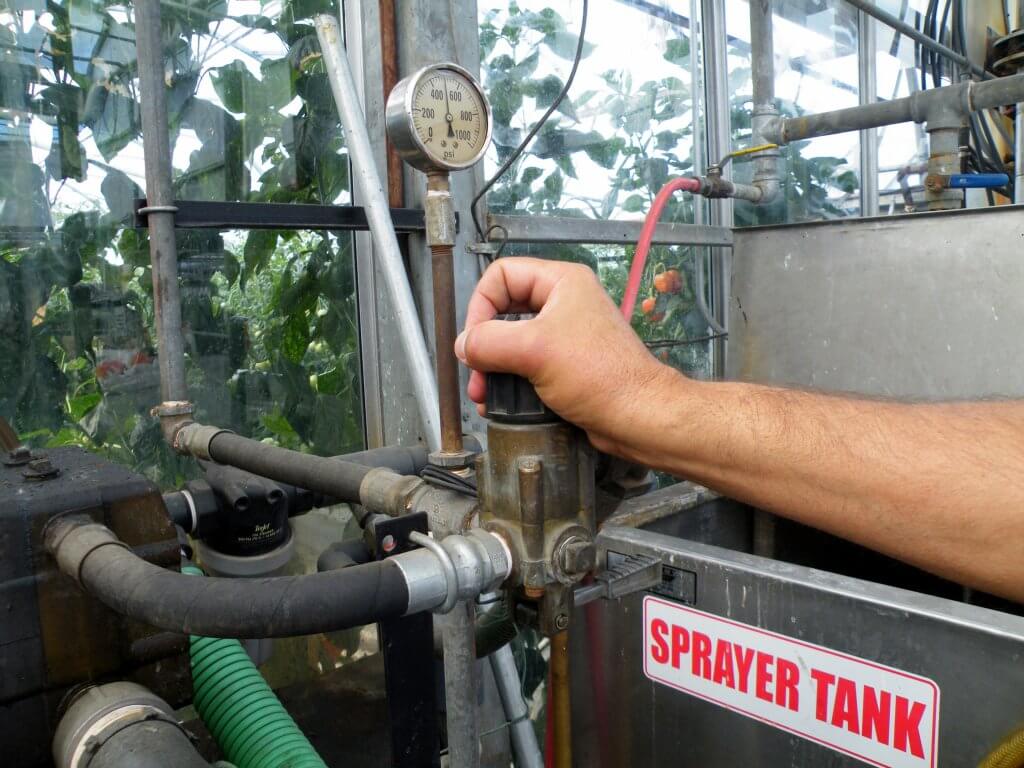
    Kim Blagborne (formally with Slimline Manufacturing) has long said that the pressure gauge on an airblast sprayer indicates more than just pressure. It can be used to diagnose a number of pump and plumbing issues… if you know what to look for. Here’s Kim’s troubleshooting guide to reading into what your gauge is REALLY telling you:

    Scenario One

    “As the tank empties, the pressure drops”

    First, try adjusting the pressure regulator (assuming a positive displacement pump). If you can maintain the pressure up until the tank empties, your intake line may be loose and it’s sucking the bottom of the tank. Check the fitting between the suction filter and the pump. Apply a light coating of grease to the O-rings on the elbows and filter to ensure a complete seal.

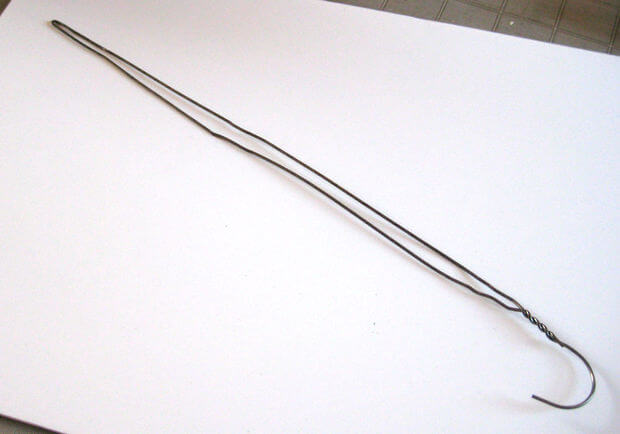
    Second, try stopping mid-tank (that is, turn off the tractor PTO and let the sprayer sit for a few minutes). Does the pressure gauge return to the original set pressure? If so, then the intake line inside sprayer has likely come loose entirely. Open the lid, and using a straightened-out coat hanger, hook the intake line and give a few gentle tugs – it should not be able to move. If it does, you’ll have to re-fasten the intake line so it’s not sucking the bottom of the tank.

    The humble coat hanger. It opens our cars and now fixes our sprayers. Remarkable!
    The humble coat hanger. It opens our cars and now fixes our sprayers. Remarkable!

    Scenario Two

    “When I first start the sprayer, the pressure drops or fails to maintain constant pressure as the tank empties”

    This might indicate improper mixing practices because the filter is probably plugging with product. Alternately, your PTO speed may be too slow to drive sufficient mechanical agitation. Check the suction filter as soon as the problem occurs (don’t finish spraying). If you wait to check when the tank is empty, the evidence of a plugged filter could be washed away before you can confirm it. This problem often happens when spraying nutrients, or when products aren’t compatible.

    If that’s not it, it could be a collapsed suction valve. The pump will sound like it’s “missing” (like an misfiring engine). The suction valve might need to be replaced.

    Or, perhaps you notice that you can compensate for the pressure drop by adjusting the regulator on the first tank. But it has to be dropped back down again for the second tank. In this case, the regulator might be sticking or jamming. Disassemble it and look for grit in the barrel of the regulator, then lubricate the parts.

    Scenario Three

    “I lose pressure when I turn my boom(s) on or off”

    In this scenario, the pressure is fine as you approach the end of the row. You turn off the outside boom (or both) and finish the turn. But, when you re-engage both booms, the pressure drops. Even when you adjust the pressure regulator to compensate (assuming a positive displacement pump), the unit only gains the lost pressure slowly. In this case, the regulator might be sticking or jamming. Disassemble it and look for grit in the barrel of the regulator, then lubricate the parts.

    Scenario Four

    “The pressure gauge spikes when I turn off the boom(s)”

    If you run a Turbomist, it could be the bypass balance. To solve this issue, head over to this article and pan down to see the step-by-step. If it isn’t the balance, then it’s likely the regulator. The issue of a spiking gauge and how to correct for it is covered thoroughly in this article by Ag mechanic extraordinaire Murray Thiessen.

    Scenario Five (a positive displacement pump issue)

    “My gauge pulses”

    Is it more than a 20 psi range? Have you noticed that the deviation gets less as the PTO speed increases? Well, the pump pressure check-valve may have collapsed. Check the pressure check valves in the pump for broken springs on the suction valve plate.

    Does the needle move rapidly through a 5 to 10 psi range? The accumulator pressure might be low. Try adjusting system pressure via the regulator and if that changes how the needle is responding, then set an air compressor to 90 psi (or manufacturer’s recommended pressure) and charge the accumulator.

    Perhaps the needle movement is not affected by system pressure changes or the PTO speed. In this case the accumulator may have failed entirely and the diaphragm will need replacement.

    Scenario Six

    “My calibration is going farther than expected”

    Sure, that sounds pretty good at first, but it may be that the gauge is stuck. With the PTO off and the spray boom on, the gauge must read “ZERO”. If it doesn’t, pony up the $50.00 and get a new one.

  • The Case for Low-Drift Sprays

    The Case for Low-Drift Sprays

    This article was written by Tom Wolf for “PEI Potato News Magazine”, a publication of the Prince Edward Island Potato Board (http://peipotato.org/). It is reprinted with permission.

    PEI Potato News Magazine

    “Should I be using low-drift nozzles?” It seems like a simple question with an obvious answer. We all want to reduce spray drift, and this easy-to-use technology is the fastest way to get there.

    And yet, the question is more complicated than it first appears. Yes, all applicators want to reduce drift, but many worry about the coarse sprays produced by low-drift nozzles. As a spray volume is divided into coarser (i.e. larger) droplets, there are fewer of them, and that can reduce coverage. It’s a legitimate concern.

    Let’s start with our shared value first – the desire to reduce spray drift.

    Given the economic, environmental and health impacts of spray drift, the importance is hard to over-state.  That’s why spray drift management is a primary concern of our federal regulators whose job is to protect the public interest. It’s also a concern for the neighbours who have a right to keep unwanted products off their property, whether it’s residential or agricultural.

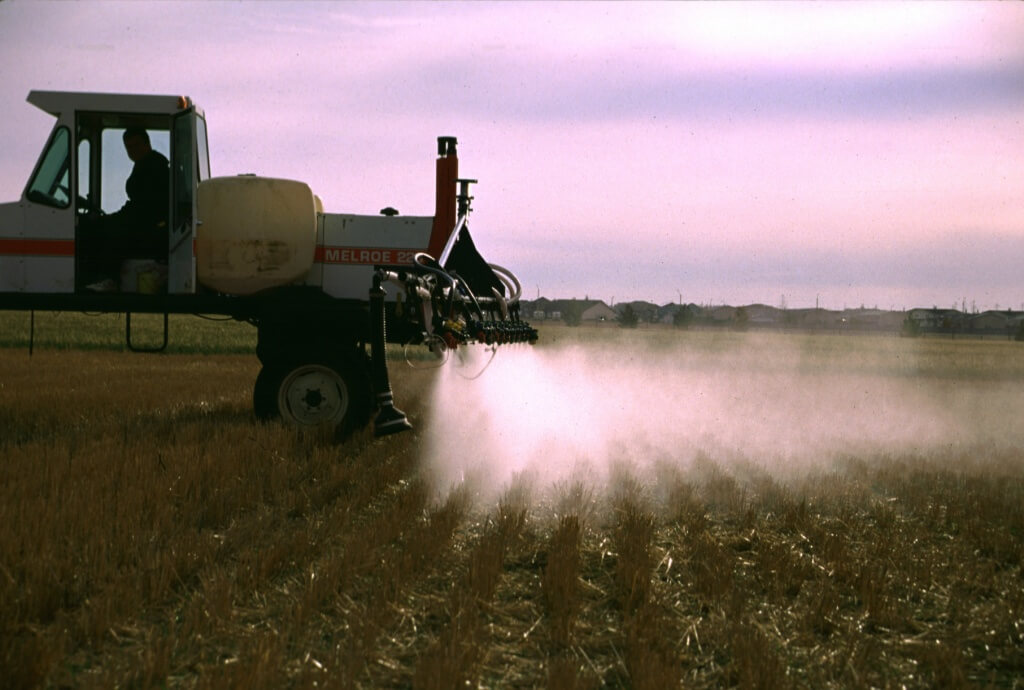
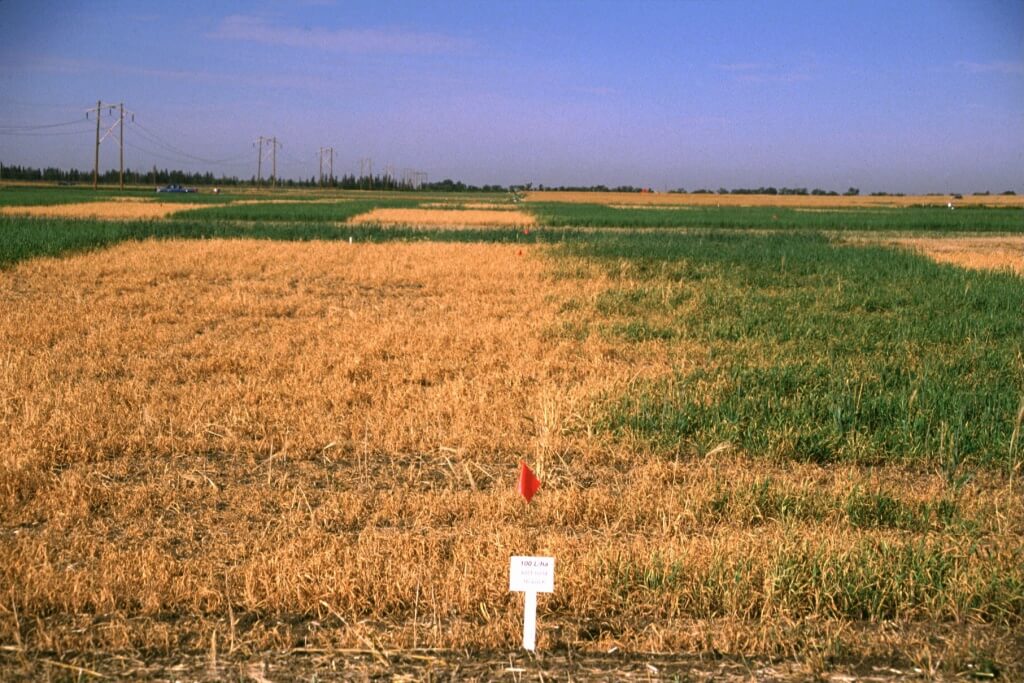
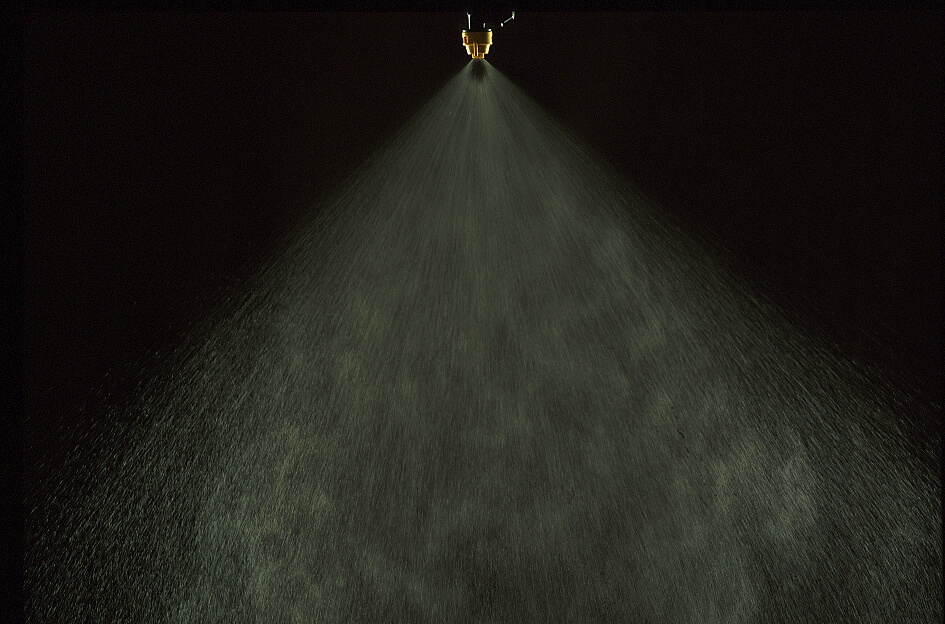
    Fig 1 (XR8004 40 psi)

    Conventional flat fan nozzles (XR8004) operating at 40 psi

    Fig 3 (XR8004 40 psi drift)

    Glyphosate drift with 20 km/h side wind, XR8004 40 psi

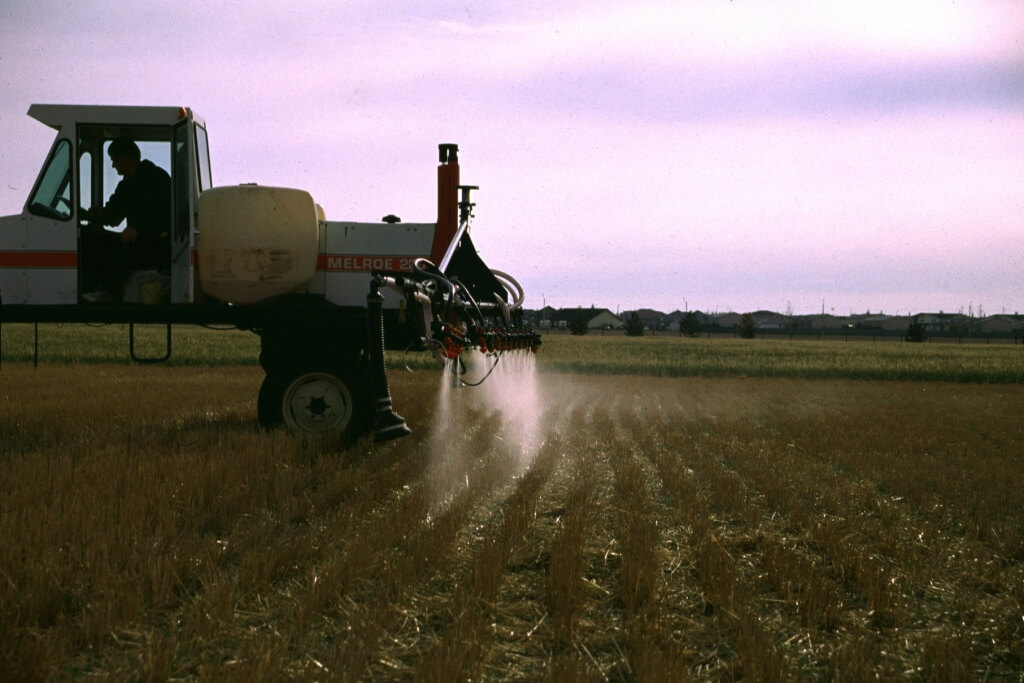
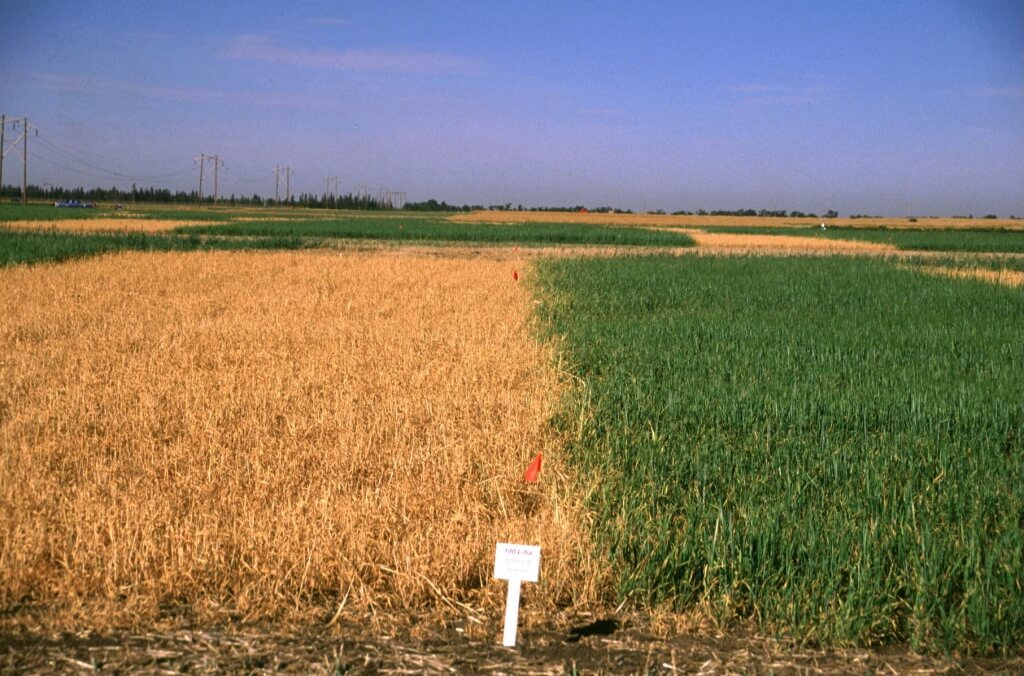
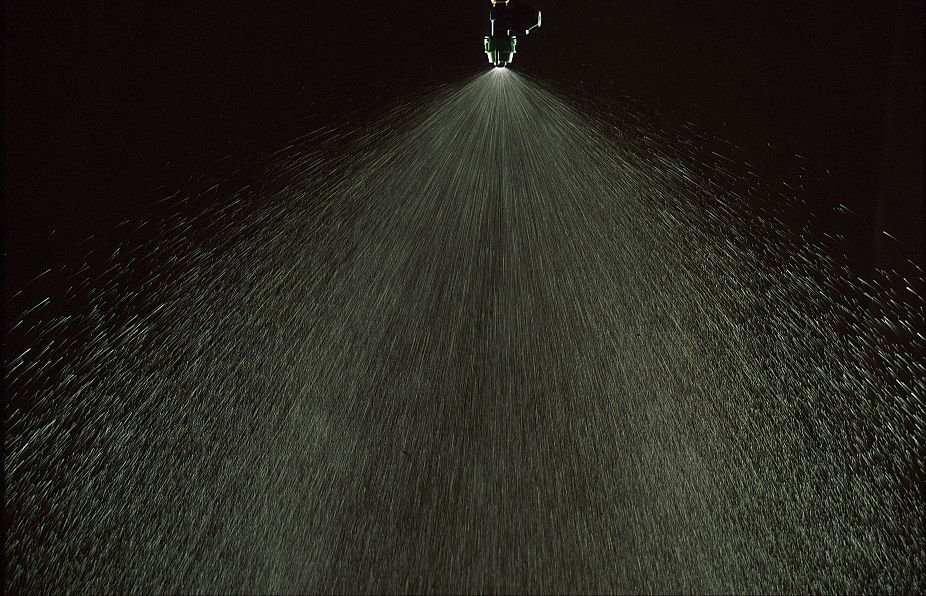
    Fig 2 (TD11004 60 psi)

    Low-drift nozzles (TD11004) operating at 60 psi

    Fig 4 (TD11004 60 psi)

    Glyphosate drift with 20 km/h side wind, TD11004 60 psi

    For these reason, managing drift should be a foremost concern for applicators. The technology is vital to the crop production industry, and if we don’t take care of the issue, someone else will take care of it for us. That’s not the best path.

    Much has been written about how to reduce drift. The key points are:

    • choosing days with better weather,
    • lowering booms and travel speeds,
    • watching spray pressure,
    • protecting the spray with shields,
    • using coarser spray qualities on the whole.

    Of these, the most economical and practical is using coarser sprays via low-drift nozzles. Engineered to emit fewer fine droplets, they are proven to reduce drift by anywhere from 50 to 95% compared to a standard flat fan of the same size.  When it comes to reducing drift, they work.

    When these tips first hit the mainstream as “pre-orifice” nozzles in the late 1980s, and later as “venturi” nozzles in the mid 1990s, we were impressed with their ability to reduce drift. And the obvious question was, what about product efficacy? Can fewer, larger droplets do the job? The answer, to our initial surprise, was yes.

    In the late 1990s, the crop protection industry (including governments, universities, and the private sector), participated in studies throughout Europe, Australasia, and North America looking at low-drift spray performance. In Canada alone, we conducted over 100 studies and concluded that pesticide efficacy was not harmed when a properly adjusted low-drift nozzle was used.  A surprising result showed that fungicides did not seem to need finer sprays, contrary to popular opinion, as long as water volumes were sufficient to provide adequate coverage.

    As we did more and more studies, it became apparent which points were critical:

    • When using venturi nozzles, spray pressure had to be increased from the industry standard of 40 psi to about 70 psi. This is because of a venturi nozzle’s two-stage design. The high pressure compensated for an internal pressure drop inside the nozzle. Sprays remained low-drift, but patterns and overall efficacy were better at this higher pressure.
    Fig 5 (XR8002 40 psi)

    Spray pattern of conventional spray (XR8002, 40 psi)

    Fig 6 (ULD 60 psi)

    Spray pattern of low-drift spray (ULD12002, 60 psi)

    Fig 7 (XR8002 40 psi)

    Spray deposit of conventional spray (XR8002, 40 psi. ~10 gpa)

    Fig 8 (ULD 60 psi)

    Spray deposit of low-drift spray (ULD12002, 60 psi, ~10 gpa)

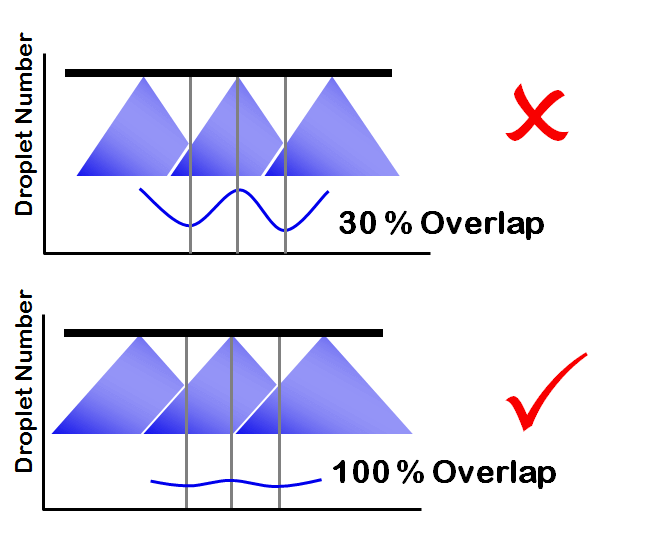
    • Spray pattern overlap needed to be greater with low-drift sprays – a full 100%. In other words, the edge of one nozzle’s spray pattern should reach the middle of the adjacent nozzles’ patterns. The pattern width at target height was now twice the nozzle spacing and this ensured good distribution of not only the spray volume, but droplet numbers, along the boom.
    Pattern Overlap
    • We needed to pay attention to the target plant architecture and leaf surface properties. Plants such as grasses (with vertical surfaces and difficult-to-wet leaves) often had less spray retention with coarser sprays. Low-drift nozzles worked, but we couldn’t go as coarse in these cases. Careful selection of low-drift nozzles as well as more attention paid to operating pressure solved these issues.
    • Our minimum water volumes had to increase slightly to compensate for the fewer drops produced by low-drift sprays. This was especially true for contact modes of action where too few droplets-per-area reduced performance. Using an Extremely Coarse spray at a very low water volume was asking for trouble.

    Much of my efforts in recent years have been to advise applicators just how coarse they can safely go without harming product performance. This involves things we’ve touched on in this article, like water volumes, modes of action in the tank mix, target plant or canopy architecture, growing conditions, and the like. We’ve arrived at a few rules of thumb, like those above, but as always, it’s dangerous to oversimplify and there are always new situations to grapple with.

    While we were learning how to tweak low drift nozzles to get them to perform, we also learned there were significant advantages to using coarser spray qualities.

    1. Foremost, there was an immediate reduction in drift. One applicator told me years ago that switching to a low-drift spray removed a huge burden of worry from him, and that alone was worth it.
    2. Low-drift sprays made it easier to spray on-time, even if weather conditions were marginal for conventional sprays. The result: the timely removal of weeds, or the correct staging of fungicides and insecticides. This has paid large dividends in terms of protected yield.
    3. Coarser sprays can protect product performance from some adverse conditions, such as days with high evaporation rates. On such days, fine sprays evaporate to dryness so quickly that uptake can be limited. Larger drops stay liquid longer, with more uptake the result.
    4. Directed sprays, be they banded sprays or twin fan nozzles for fungicides, make more sense from coarser nozzles. The reason is that these coarser sprays go where they’re pointed, whereas fine sprays lose their path in wind or through travel-induced deflection, very quickly.
    5. We also learned about the air-entrainment that coarser sprays can produce. Large droplets dragged air with them, and smaller droplets could hitch a ride in their wake. This provided a form of air-assistance that reduced drift and carried small droplets into the canopy. Finer sprays had a harder time producing this type of drag, and sustaining it in the canopy.

    When we analyzed the droplet size spectrum of coarse and fine sprays, we confirmed that the total number of droplets produced by any given volume of water had been reduced. Not a surprise. But two things struck us.

    First, even though the average size of droplets in coarse sprays were very large, they still contained a population of small droplets.  In fact, if you counted every single droplet in the spray, the vast majority were small and they were still taking care of coverage.

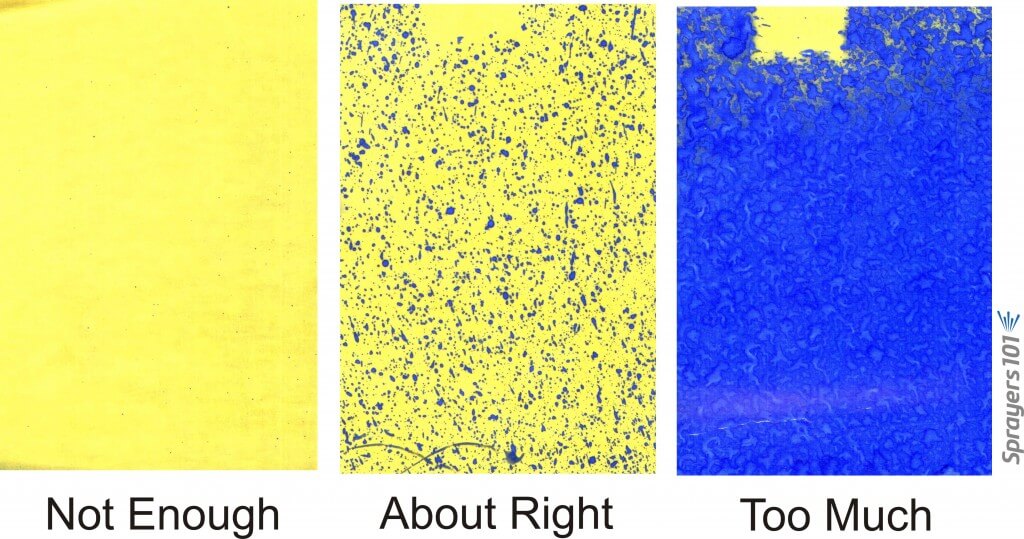
    Second, the critical amount of coverage (measured as the percent of the surface area covered by spray deposits) that was necessary for a given product to work was lower than what we’d been aiming for. In other words, we didn’t need as much coverage as we thought we did, and any excess didn’t actually add to product performance in most cases.

    We later analyzed the relationship between spray coverage and herbicide performance and found that the uniformity of the deposits was actually more important than the amount of coverage per se. So, if we focussed on proper overlap and spray pressure there was greater benefit than increased coverage alone. Deposit uniformity has become our research focus of late.

    So, should you be using low-drift nozzles? By adopting the changes in pressure, overlap, and water volume outlined above, and paying more attention to the plant architecture and pesticide mode of action, we’ve been very successful in implementing low-drift sprays in all field crops. In my view, we can safely retire Fine sprays for all field crop pesticides. This means conventional flat fan nozzles, hollow cone nozzles, and the like. Get rid of them.  All they do is add drift potential.

    It’s safe to adopt low-drift sprays. Research and experience from the field prove that they work. Low-drift sprays should be viewed as an agronomic tool that improves application timing and accuracy.  And with less drift, we show that agricultural practice can be both efficient and environmentally responsible. That’s going to be a very important story to tell, now and in the future.

  • Exploding Sprayer Myths (ep.6): Sprayer Cleanout

    Exploding Sprayer Myths (ep.6): Sprayer Cleanout

    It’s been quite a ride. Here’s episode six of “Exploding Spray Myths”. Real Agriculture helps us share an important message about why sprayer clean out involves so much more than just the tank. If you think you know what we’re covered with, we’re accepting guesses.

    And please, don’t blow into nozzles, even if they don’t touch your lips. Blowback is a real thing…

  • Boomless Nozzle Performance

    Boomless Nozzle Performance

    NOTE: This article has proved very popular, and subsequently we received emails with additional information. The article has now been expanded to include work performed by Dr. Bob Wolf et al.

    Part 1:

    Boomless nozzles are used for vegetative management activities where it’s not practical, or sometimes even impossible, to use a horizontal boom. Consider highway easements and ditches, railways, and infrastructure like buildings, powerline poles or fence posts. In these cases, the booms would hit uneven ground, trees and other obstacles. Enter the boomless nozzle.

    Unlike a typical flat fan nozzle, these nozzles direct spray laterally in one or two directions, creating a very wide spray pattern. Some field sprayers use a smaller version such as an off-centre or uneven fan to either extend the booms’ coverage (e.g. to get around fence posts) or give the pattern a discrete edge and not spray beyond the booms length.

    There are many varieties of boomless nozzle available, but they don’t give the same performance.

    Using a spray pattern table, Helmut Spieser and I compared coverage patterns from three popular tips:

    • The Boom X Tender
    • The Boom Buster
    • XP BoomJet

    The Boom X Tender

    With seven rates to choose from, this nozzle claims up to 13′ throw from tip to the edge of the swath. When we ran the tip at 40 psi we noticed a lot of inconsistency in the pattern, where it clearly had variation in flow along the swath. Note the red arrows in the image.

    2

    These inconsistencies made themselves known when we observed the pattern produced on the spray table. We achieved a 7.5′ swath at 40 psi, 16″ above the table with the XT024 (yellow) tip. The coverage wasn’t very even.

    3

    The Boom Buster

    There are fourteen nozzles to choose from, each delivering different flows and according to the manufacturer, spanning up to 31′ from the tip to the edge of the swath. An interesting feature when we ran this nozzle was that the fan extended back ~15°, which might eliminate the need for a centre nozzle if two were operated at the same time with sufficient overlap.

    4

    We achieved a 7′ swath at 40 psi, 16″ above the table and the coverage described a fairly consistent curve. It did taper at the far end, but did a respectable job. It was obvious some overlap at the 15° end would help level out the response, and when paired with a second tip facing the opposite direction, this would work well.

    5

    The XP BoomJet

    The BoomJet mounts 90º to the swath, and with five rates to choose from claims a swath up to 18.5′ from tip to edge.

    6

    We mounted the (B) 1/4XP20L (You have to specify left or right) 16″ above the table and at 40 psi we achieved a 6′ swath. There was an odd dip in the coverage pattern not far from the tip. We suspected it might be an artifact, but after multiple attempts it persisted. Other than that dip, the pattern was quite consistent. Had we adjusted the angle to reach a 7′ swath, it may have tapered as much as the Boom Buster.

    7

    Observations

    Given the range of possible rates and swath distances, the overall consistency of the swath, the conventional nozzle mount, and the 15º overlap, Helmut and I chose the Boom Buster. The BoomJet was a close second, with a consistent pattern save the odd dip, but the 90º mount while making it possible to elongate or shorten the swath was a bit finicky and could pose a snagging risk. The Boom X Tender ranked third because of the inconsistent coverage.

    Part 2:

    Nozzle mounted on the front bumper of a County Highway Spray Truck used to spray ditches in Kansas.

    Boomless nozzles are often used on all-terrain vehicles (ATV’s) equipped with small-capacity spray tanks and they’re popular for for eliminating weeds in pastures and rangelands as well as along roadsides. In 2009, Kansas State University published a factsheet evaluating the efficacy of boomless spray nozzles and describing how they can best be used. What follows is a summary of the findings from their field trials.

    Considerations for using boomless nozzles

    1. Pick a nozzle that best fits the mode of action of the herbicide being used.
    2. Select spray width to achieve uniform distribution.
    3. Both the height of the vegetation, and the prevailing wind, will interfere with the width of the spray swath.
    4. As with any hydraulic nozzle, pressure should be optimized to achieve the desired droplet size and swath width while reducing drift potential.

    Field Trials

    Applications were tested on small (growth stage prior to jointing and 4-5 inches tall) and large (growth stage after jointing and 24-30 inches tall) wheat crops planted in 20 foot wide strips. The nozzles tested were the BoomJet (XP) , Boom X Tender (XT) , Boom Buster (BB) and the Combo-Jet (WCJ). Glyphosate and paraquat were applied a typical ATV-mounted set-up. The treatments were replicated three times and water sensitive paper was used to analyze droplet size.

    The Combo-Jet nozzle group.

    Results

    The mode of action, coverage and droplet size affected the results in both short and tall wheat. As expected, glyphosate served as the 100% control and paraquat efficacy ranged depending on the nozzle (see Graph 1). The XT gave the best performance with paraquat.

    Graph 1 - Percent Control in Large Wheat
    Graph 1 – Percent Control in Large Wheat

    Spray (control) uniformity was about equal with glyphosate, but with paraquat, on a scale of 1-10 with 10 being the highest level of control, the XT and BB tied for best (Graph 2).

    Graph 2 - Spray Uniformity in Large Wheat
    Graph 2 – Spray Uniformity in Large Wheat

    Swath width was considerably less than manufacturers claimed in the tall wheat (Graph 3). Based on width of control, the WCJ had the widest swath.

    Graph 3 - Swath Width in Large Wheat
    Graph 3 – Swath Width in Large Wheat

    Swath width was somewhat less than manufacturers claimed in the short wheat (Graph 4). Based on width of control, the XT had the widest swath.

    Graph 4 - Swath Width in Small Wheat
    Graph 4 – Swath Width in Small Wheat

    Median droplet size ranged from 684 to 799 microns (Graph 5). If we assume the preferred range for coverage/weed control is 300-500 microns, all nozzles were on the high end. It should be noted that this does reduce drift potential.

    Graph 5 - Droplet Size as VMD (microns)
    Graph 5 – Droplet Size as VMD (microns)

    Percent coverage ranged from 37.5 to 27.0 for paraquat and 28 to 21.3 for glyphostate (Graph 6).

    Graph 6 - Percent Coverage
    Graph 6 – Percent Coverage

    Observations

    The wind direction and height of the spray stream likely affected the results. To achieve the manufacturer-rated swath width, nozzles would have to be mounted higher on the ATV than is practical, and this would lead to increased drift potential. It was noted that the large orifices common to boomless nozzles made it difficult to pressurize with pumps typically used on ATV’s and a more powerful pump (e.g. a roller pump) might provide better swath width.

    While there are many parameters to consider, and counter to the lab trials performed in Part 1, the results from Part 2 suggest the Boom X Tender and Boom Buster gave better overall performance.

    Checking the Boom Buster spray pattern.

    Overall Conclusions from Part 1 and Part 2

    It can be frustrating testing nozzles. What works wonderfully one day might not be worth the materials they’re made of the next. Obviously there was no clear “winner” at the end of this article, but that’s just as well, because perhaps that’s the wrong take home message.

    Instead, remember that any nozzle can be used incorrectly. Mind the pressure, swath width and environmental conditions to get the most out of whichever nozzle you choose to use. Take time to confirm that everything is working optimally, and go back to ground-proof the results so you know what worked and what didn’t.

  • Strategies to Spray the Top of a Perennial Canopy

    Strategies to Spray the Top of a Perennial Canopy

    Orchardists, nurserymen and hop growers share something in common – they want to get spray to the top of a tall plant canopy with as little waste as possible. The tops of trees, for example, are a primary site of infection as they filter spores from the air, so fungicide coverage is critical. Spraying the tops of high canopies (e.g. too high for over-the-row style sprayers) can be a difficult proposition.

    Here are a few considerations:

    • Wind moving through a planting, as a general rule, is twice as fast at the top of a canopy as it is at the ground. Wind carries spray off target.
    • The further the distance a droplet travels, the smaller it gets as it evaporates and the less momentum it has. The likelihood of it hitting the target is greatly reduced.
    • The top of a canopy typically has far less plant material than the rest of the canopy. Relatively speaking, there’s not much there to hit.

    In order to overcome these challenges, the traditional axial orchard sprayer is nozzled with a larger proportion of spray distributed at the top of the boom. The idea is to increase the odds of some spray making it to the top of the canopy. Often, full-cone nozzles are used to accomplish this. Of course, if an estimated 10% of the spray actually impinges on the top of the canopy, the rest goes… well, somewhere else. This shotgun approach is hardly an efficient use of chemical.

    Another strategy is to crank the PTO rpm’s up to 540, throw the fan in high gear and blow the spray as high as possible. The problem is, by increasing air speed and volume to carry spray to the top, the rest of the canopy (far closer to the sprayer) gets overblown and spray shoots right through. Some overspray might hit the next row, but most ends up on the alley floor. If you doubt it, consider how white your pant-legs get when you walk an orchard after spraying kaolin clay.

    Others, mistakenly, might elect to raise the operating pressure to >150 psi in the hope that pressure will drive the droplets in a straight line at higher speeds. Most airblast sprayers using hollow cone patterns create very fine spray quality, even at 100 psi. Raising pressure means the droplets get even smaller, and tiny droplets have very little momentum. Increasing pressure just makes the problem worse.

    Here’s what we propose.

    Deflectors

    If using an axial sprayer, employ air deflectors at the top of the air outlet to channel air (and spray) more effectively. The commercially-available deflectors are often just flat sheets, and air hits the surface and spills over all edges. Image pouring water onto a dinner plate – it just splashes over any which way. Better to replace those deflectors with a set that feature side-walls to channel the air. Anyone with access to a break and some sheet metal can make their own, but ensure they do not stick out beyond the wheel of the sprayer or they could snag plants and trellises. Always aim to overshoot the canopy top by a small factor to compensate for unexpected gusts of wind – better to overshoot a bit than to miss.

    Commercial deflectors may or may not have channeling side walls. Inset: Homemade deflectors can do a great job.Commercial deflectors may or may not have channeling side walls. Inset: Homemade deflectors can do a great job.
    Commercial deflectors may or may not have channeling side walls. Inset: Homemade deflectors can do a great job.
    The original Munckhof deflectors were reversed, and a larger set of extensions were fabricated and attached.
    The original Munckhof deflectors were reversed, and a larger set of extensions were fabricated and attached.

    Towers

    Better than deflectors, some sprayers move the air and nozzles closer to the target via ducted tower assemblies. They work very well, but they must be as tall as the target you intend to spray. Even then, an uneven alley can cause them to rock and you might still miss some upper targets. Operators using adjustable towers or ducts might angle them back to aim the air (and spray) on a slight upward angle rather than parallel to the ground, and that can compensate for a slight height difference, but it begins to defeat the purpose.

    Nozzle body on upper tower deflectors. Still some air assist and a good idea, but use air induction nozzles.
    Nozzle body on upper tower deflectors. Still some air assist and a good idea, but use air induction nozzles.

    Extra Nozzle Bodies

    Some creative operators have attached additional nozzle bodies to the tower’s top deflector plate to aim it up in the top of the canopy. Still others have extended the wet boom itself higher than the tower. Unfortunately, although the nozzle is closer to the target (good) the benefit of air assist has been greatly reduced (bad). Air induction nozzles might help on boom extensions, per below.

    Wet booms can be extended to reach high canopies, but may no longer benefit from air assist. Consider using air induction nozzles in these positions.
    Wet booms can be extended to reach high canopies, but may no longer benefit from air assist. Consider using air induction nozzles in these positions.

    Air Induction Nozzles

    Consider using air induction nozzles in the top two positions of each boom (totaling four per sprayer), with or without towers. There are three advantages:

    1. Coarser droplets have more mass. They move in straight lines and are less likely to be deflected by wind before they reach the target.
    2. Coarser droplets can be propelled by pressure, so unlike finer droplets they rely less on being carried by sprayer air.
    3. Coarser droplets that miss the target do not continue upwards; they fall back out of the air into the orchard, reducing off-target drift potential.

    No matter which strategy, or combination of strategies, you use to hit the top of the canopy, always confirm coverage using water-sensitive paper. Further, recognize that it’s very difficult to compete with high winds, so know when to wait it out.

    Controlling your spray at the top of the canopy means better coverage and less waste. Plus, people won’t see this (wait until the ~50 second mark).