Author: Jason Deveau

  • Experimental Hops Sprayer

    Experimental Hops Sprayer

    First, a warning…

    In 2013, when this sprayer was constructed, Ontario’s hops acreage was expanding for the first time in many years. While there were a few large operations, most were small acreage hobbyists and part-time hops growers that did not have any experience spraying the crop. The latter operations recognized a need to spray, but couldn’t justify investing in an expensive (and complicated) airblast sprayer.

    In response, we set out to design a budget-conscious, low-capacity, tower-style sprayer that small-acreage growers could build for their own operations. Our hope was that hydraulic pressure would give droplets sufficient momentum to cover all foliar surfaces, thereby eliminating the expense of an air-assist fan. Additionally, the telescoping tower would allow the operator to match the height of the crop canopy as the season progressed, reducing the amount of wasted spray mix.

    Unfortunately, the results of our spray coverage trials indicated that while the upper-face of leaves received excellent coverage, the under-side received only sparse coverage. We were unable to move the trials beyond spray coverage and into the efficacy stage, and because of this, we do not know if the under-leaf coverage would be sufficient to control sucking insects or diseases with contact products.

    So why publish this article? The principles behind the design, construction, and testing of this sprayer are still valuable. It led, in part, to growers attempting to modify older and inefficient airblast sprayers to duct air through homemade towers (see here). But, be advised that without efficacy data, we must recommend that budget-conscious and/or small acreage hop growers explore the use of gently used, conventional airblast sprayers.

    Introduction

    Hop bines are trained around twine lines and grown an average 5.5m (~18ft) high. Each line supports two or more bines and, when mature, the line becomes a dense column of foliage as much as 0.5m (~2ft) in diameter. Hopyards, both organic and conventional, use radial airblast sprayers to apply products to the foliage. However, the profile of the radial airblast boom does not match the profile of the target crop. The nozzles at the top of the sprayer have to spray a target 5.5m (~18ft) away, while those at the side spray a target 0.5m (~2ft) away. Additionally, the air from the fan must be calibrated to carry the spray to the highest point on the hop bine, which means it is excessive for the length of bine directly adjacent. With this in mind, it was theorized that a more efficient sprayer design would feature a vertical boom to position each nozzle as close to the target as possible.

    We would build “the Hopsprayer”.

    Rears airblast sprayer tackling 16-20 foot bines. Photo credit - D. Groenendale, Washington
    Rears airblast sprayer tackling 16-20 foot bines. Photo credit – D. Groenendale, Washington

    Beyond the obvious requirements of operator safety and being mechanically sound, the design and construction of the Hopsprayer was guided by four principles:

    1. The Hopsprayer should be less expensive than a conventional 3-point hitch airblast sprayer or small trailed airblast sprayer, making it cost-effective for Ontario’s small-acreage operations (~$4,000.00 CAD).
    2. The Hopsprayer should be constructed of over-the-counter parts that require minimal modification and no special machining or tools to assemble.
    3. The Hopsprayer should have the capacity to operate in the same conditions as an airblast sprayer (i.e. moderately uneven terrain, reasonable ground speeds, and through any configuration of hopyard trellising).
    4. The Hopsprayer should achieve comparable or better spray coverage along the entire length of the hop bine, both on the upper and lower surfaces of the leaves.

    Key Structural Components

    In order to make construction as simple as possible, it was decided to build the sprayer from a commercially-available three-point hitch horizontal boom sprayer. After removing the horizontal boom, several concepts were examined for mounting nozzles on a dynamic vertical boom. The key requirement was that the vertical boom could be raised incrementally, and nozzles activated sequentially, to match the height of the hop bine as it grew taller over the growing season.

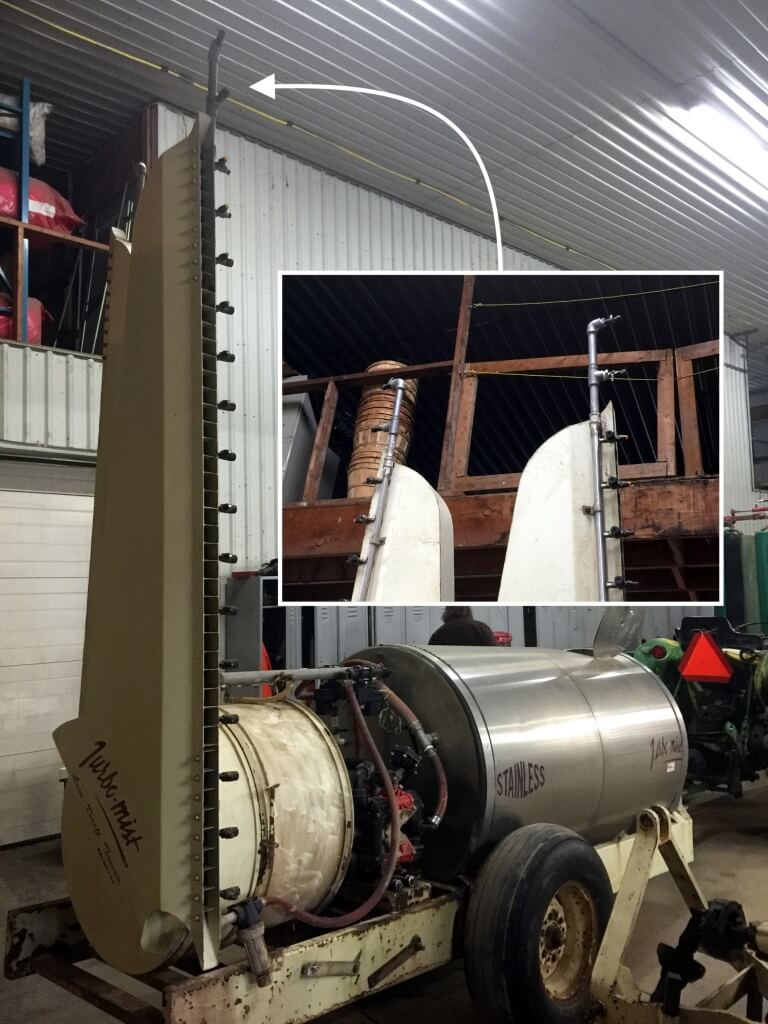
    The boom itself went through several redesigns, each dismissed for reasons of excessive weight, lack of structural stability, or concerns about operator safety when raising and lowering (or even folding and unfolding) the boom. Finally, it was decided to use a commercially-available 6m (~20ft) sliding aluminium ladder. This had the advantage of being strong, light, easy to mount, and the hollow rungs were ideal for running spray lines from one side of the boom to the other. Plus, with the addition of a marine hand winch, the ladder could easily be extended to any height.

    Regarding the nozzles, several nozzle bodies and tips were considered, but the Arag Microjet had several advantages over conventional nozzle-body-and-tip configurations. The Microjet has a mixing valve built into the nozzle body which allows the operator to turn individual nozzles off, as well make minor changes to the spray quality emitted from each unit. Further, the brass nozzle body bends 90° before terminating in a threaded male connection, ideal for fixing to the ladder and attaching spray lines.

    From this point, it was a matter of positioning the key components and finding appropriate mounting hardware.

    Construction

    1 – Removing horizontal boom from three-point hitch sprayer

    (~$2,000.00 CAD for new sprayer)

    Costs vary depending on the sprayer, but the sprayer should feature a pump capable of 200 psi, a minimum capacity of 100 US gallons and a chassis that wraps around the tank to provide a sound surface in the rear for mounting he ladder. Removing the existing boom is a simple matter of disconnecting the feed line and using a set of wrenches to unbolt the boom itself.

    Horizontal boom sprayer
    Horizontal boom sprayer

    2 – Fitting the vertical boom (ladder)

    (~$200.00 CAD for ladder, pipe and fasteners)

    A 6m (20ft) ladder will not actually extend 6m because an overlap is required between the two lengths for stability. However, when mounted to the sprayer it will achieve a final height of 5.5m (~18ft) off the ground. Cut two lengths of black pipe with a diameter that just fits in the hollow rung (~½”) to a length that spans the chassis at the rear of the sprayer. Centre the ladder, punch, pilot and drill holes through the pipe and the sprayer chassis (take care not to hit the poly tank) to mount the ladder using bolts, lock washers and nuts.

    Dry-fit the vertical boom
    Dry-fit the vertical boom

    3 – Preparing to mount the nozzles

    (~$1,000.00 CAD for 12 Arag Microjet nozzle assemblies)

    Remove the ladder and separate the two lengths. Remove the two latches that lock the ladder when it slides. We mounted nozzles every 45cm (at each rung) but that was too many. Consider mounting nozzles every second rung (~90cm). We mounted the nozzles with 9/32” U-bolts but hose-hangers only require one hole and can be swiveled to position the nozzle. This is how the bottom four nozzles were attached to the chassis (see inset), not the ladder. The ladders must be able to slide past one another and the valve handle must be unobstructed.

    Dry-mount a nozzle (hose-hanger in inset)
    Dry-mount a nozzle (hose-hanger in inset)

    4 – Grinding and mounting the nozzles

    (~$100.00 CAD for mounting hardware and grinder disc)

    Remove the dry-fitted nozzle. Centre-punch and drill all the holes for the U-bolts (or preferably, the hose hangers). Remove the threaded swivel from each Microjet. Use a hand drill set to low with a Robertson bit, and an angle grinder to carefully remove the thread and taper the tip to accommodate a ½” hose. Be aware: eye protection is imperative and the brass will get hot. Replace the cool swivels and mount all the nozzles on the ladder. Use washers and set them so the hex-nut on the nozzle body is flush against the aluminium ladder.

    Removing thread from brass swivel
    Removing thread from brass swivel

    5 – Plumbing the sprayer

    (~$75.00 for hose, $20.00 CAD for Tee’s, $75.00 CAD for hose clamps)

    The plumbing on the sprayer is not complicated, but takes thought. It will require 11 ½” TeeJet T-junctions and roughly 60ft of ½” braided, clear spray line rated to 200 psi. You will also need 8 hose clamps for each set of nozzles for a total of ~50 (get extras). Using hose cutters, cut appropriate lengths for a single set of nozzles and use them as a template for the rest. Pass the line through the rungs and do not make loops too tight. Use a drill with a ratcheting chuck to ensure each hose clamp is tight.

    Plumbing the nozzles
    Plumbing the nozzles

    6 – Mounting the winch

    (~$125.00 CAD for winch, cable, clamp, angle iron and plate)

    This step is sprayer-specific. Find a spot on the chassis that you can mount a length (or two lengths) of angle iron to house the winch. On the prototype we included a sheet of plate iron to make the mount as stable as possible. Be aware that the handle (and user’s knuckles) must not hit any part of the sprayer when turning. Never let go of the handle without setting the lock, or the boom will drop and the handle will spin out of control.

    Mount the winch
    Mount the winch

    7 – Raising and securing the boom

    This will take two people. Slide the two lengths back together and raise the boom into position. Bolt the boom into place (see Step 1). Take a ½”, 8ft length of galvanized conduit and crush 2” of one end in a vice. Punch a divot and drill a hole in the crushed end. Repeat with a ¾” length of conduit. Attach the ½” inch length to the chassis and the ¾” length to the top of the bottom boom, telescoping the two lengths together. Now you have a support that is the right length, you can screw the two lengths together and repeat on the other side. Remember not to tighten one side completely before the other is in place.

    Strut attached to boom and chassis
    Strut + boom & chassis

    8 – Tie in plumbing and winch cable

    Attach the cable to the winch, pass it through the pulley on the top boom and clamp it to the lowest rung. Pass the cable between the booms. This is also how the two lengths of boom are plumbed together: A long length of hose hangs from the bottom-most nozzle on the top boom, tied to the top-most nozzle on the lower boom. All the excess hose (needed when the ladder is fully extended) hangs between the two ladders. Trust me – this makes more sense once you do it.

    Nozzles suspended on drop arms
    Nozzles on drop arms

    9 – Test the plumbing

    (~$150.00 CAD for PTO shaft)

    Finally, the sprayer must be attached to a tractor via the 3-pt hitch and PTO shaft. Ensure the sprayer is plumb and level or the boom will bounce and sway excessively as you drive. Raise and lower the boom via the winch to ensure it moves smoothly. Bring up the rpms on the tractor and engage the boom at 100 psi. Look for any leaks. Bring it up to 200 psi and drive the sprayer around with boom fully extended. Repair any blown lines. You are now ready to calibrate your new sprayer.

    Test the sprayer plumbing and stability
    Test the sprayer plumbing and stability

    Calibration

    Classic Arag Microjets will emit approximately 1 US gallon per minute at 200 psi. However, the position of the mixing valve will affect both the spray quality and rate of the nozzle. As such, a timed output test should be performed on each nozzle. Bring down the boom, fill the sprayer with water, bring it up to operating pressure and begin spraying. Adjust one nozzle until you achieve the desired pattern. Then, using a telescoping paint roller handle to reach the highest nozzles, place all valves in similar positions. Using a collection vessel, determine how much volume is emitted at a given pressure and valve position in one minute – this is a timed output test. You can find rates and valve settings for these nozzles in this ginseng article.

    Evaluating Spray Coverage

    There are two ways to evaluate spray coverage:

    1. The amount of the surface area covered (e.g. 25%)
    2. The droplet density (i.e.. the number of drops per square centimetre)

    They are not the same thing. For example, one massive droplet covering ½ the target would leave a lot of space uncovered, and therefore lots of room for an insect to walk past and never touch it. However, an even smattering of small droplets, still covering ½ the target are better because they are distributed evenly and odds are, will hit a pest.

    The Hopsprayer was trialed at Clear Valley Farms, Nottawa, Ontario. Water sensitive paper (which turns from yellow to blue when contacted by spray) was clipped every three feet up to 18 feet on the upper and under sides of leaves. The grower cooperators used their own airblast sprayer operated at their standard 2,340 L/ha and 2.75 km/hr. The Hopsprayer was tested at 1,220 L/ha and 7.5 km/hr – half the volume and three times as fast, even while fully-extended to its 18 foot height. The four histrograms show the coverage on top of the leaves and on the underside of the leaves.

    Total percent surface covered on upper side of leaves (n=3)
    Total % coverage on upper side of leaves (n=3)
    Total percent surface covered on underside of leaves (n=3)
    Total percent surface covered on underside of leaves (n=3)
    Droplet density on underside of leaves (n=3)
    Droplet density on underside of leaves (n=3)
    Droplet density on underside of leaves (n=3)
    Droplet density on underside of leaves (n=3)

    Conclusion

    The airblast achieved minimally-acceptable coverage on all leaf surfaces at all heights. The prototype did not cover as much of the under leaf surface (not surprising as the sprayer did not utilize air assist to lift the leaves), but it did deposit almost three times as many droplets.

    The airblast did well on the tops and undersides, both for total % coverage and for droplet density. The Hopsprayer didn’t cover as much under leaf surface, but did have a higher droplet density. That means there were more drops, but they were very small.

    The big question is: Did higher droplet density, but smaller droplet size, contain enough active ingredient to control insects and disease? That can only be verified through efficacy testing where the Hopsprayer is actually used for a season to evaluate its performance. For now, we just don’t know, and cannot recommend the sprayer design.

    Acknowledgements

    Thanks to TeeJet technologies for providing water sensitive paper and nozzles, McPhee Enterprises of Oakville, Ontario, for providing the Microjets at cost, Mr. Evan Elford (OMAFRA), Mr. Paul Splinter (University of Guelph), Ms. Megan Leedham (OMAFRA summer student), Mr. Herman Kunkel (Allparts Ltd., Simcoe, Ontario) and Clear Valley Farms for hosting the trials. This project was made possible through funding by OMAFRA and the University of Guelph.

  • Spraywise – Broadacre Application Handbook

    Spraywise – Broadacre Application Handbook

    I haven’t written a book-report since high school, but I was recently sent a copy of Dr. Jorg Kitt’s “Spraywise – Broadacre Application Handbook” and I was compelled to share. It’s published by Nufarm and is based out of Australia. What a fantastic, easy-to-read book full of excellent spraying know-how.

    Am I overselling this?
    I am not.

    Spraywise - Broadacre Application Handbook by Dr. Jorg Kitt (published by Nufarm, Australia)
    Spraywise – Broadacre Application Handbook by Dr. Jorg Kitt (published by Nufarm, Australia)

    The chapters include:

    • Droplet Size
    • Chemical Target Interaction
    • Nozzle Types
    • Nozzle Selection
    • Nozzle Spacing & Boom Height
    • Drift
    • Weather
    • Adjuvants
    • Formulation & Mixing Order
    • Cleaning Procedure
    • Calibration
    • Record Keeping

    At risk of copyright infringement, let me share a little of Dr. Kitt’s advice on chemical and target interaction.

    “Many chemicals used in agriculture show only limited movement in or on the plant. For surface active fungicides such as mancozeb coverage is critical because the active does not move – it settles where the droplet dries with only limited redistribution properties.”

    This is why we suggest coverage is king when applying products that don’t translocate. You can slow down, raise water volume, or as a last resort reduce spray quality (minding the drift and evaporation issues that arise from this choice). But he goes on:

    “Many cereal fungicides such as DMIs move only in the xylem (water transport bundles) and therefore can only travel in one direction – upwards towards the tip of the leaf (acropetal).”

    So, I admit that as I continue to transition from horticultural spray applications to broadacre work, I have a lot to learn. Something that bothered me when I started looking at fungicide applications in corn was the appalling coverage on water sensitive paper. If any of my vegetable or orchard applicators had such poor coverage, their crops would be riddled with disease… so why was such poor coverage working so well in field crops?

    According to this new-to-me information, perhaps the >Coarse droplets were penetrating the canopy, reaching down to impinge on the base of the plant (or splatter up from the soil) where they could re-distribute by moving up through the xylem. It certainly makes more sense to me why such coarse droplets and relatively low volumes can still be efficacious for certain fungicides in field crops. I’ll reiterate – this may be old hat to some readers, but I still have a lot to learn on this topic.

    Dr. Kitt shares many digestible, easily-implemented little factoids that make this handbook a must-have for your spray library. Applied herbicide advice, for example:

    “…if 50% of the ground is covered with stubble only half the spray volume will hit the soil directly; the other half will strike stubble. To optimise applications in this situation it is important to produce droplets with sufficient velocity to increase bounce and splatter. The applicator should use higher water volumes (70-100 L/ha) and a coarse to very coarse spray quality. In a clean bed spray quality and water volume have little effect. A coarse spray quality and water volumes above 50 L should be sufficient to achieve efficacy.

    These volumes are low for North America (Australia uses nerve-rackingly low volumes) but otherwise this is solid gold.

    I was fortunate to have someone send me a copy of this handbook. I’ve poked around on-line to try to find a Nufarm-based website where anyone could order a copy, but I was unsuccessful. However, if you Google “Spraywise Broadacre Application Handbook 2nd ed.” you will find a number of dealers that will happily sell and mail you a copy. I won’t share those links here to avoid a bias, but they’re easily found.

    So, to summarize, I wanted to make the sprayers101 readership aware of this Handbook. Given the affiliation with an agrichemical company, it’s a bit adjuvant-rich, but it’s chock full of great information and well worth the cost and effort to have a copy mailed to you.

    Now I’m going to go back to reading mine.

  • A.I. Pressure – Parody

    A.I. Pressure – Parody

    Sung to the tune of “Under Pressure” by Queen

    Pressure!
    Pushing down on spray
    Heading down the boom
    (movin’ so far)

    Under pressure
    It brings the droplets down
    Splits a canopy in two
    Puts product on leaves

    More P S I
    More P S I
    Or bar works
    Or bar works
    That’s okay!

    It’s a terror not knowing
    what pressure’s about
    Watchin’ the product
    come dribblin’ out

    Rate controllers:
    set them higher
    Pressure-up nozzles,
    it’s what A.I needs

    Set A.I. high
    >fifty P S I
    OK!

    Drivin’ around
    got my pedal to the floor
    But when I slow
    it doesn’t spray, but it pours

    Pressure makes spray
    from Air Induction OK!

  • OMAFA Spray Drift Videos

    OMAFA Spray Drift Videos

    CropLife Canada and the Ontario Ministry of Agriculture, Food and Rural Affairs partnered in 2012 to develop two educational videos on pesticide application best management practices in an effort to educate, and hopefully to reduce the incidents of spray drift.

    The first video, ‘What is Spray Drift?’, highlights the various causes of spray drift. The second video, ‘Equipment and Methods to Reduce Spray Drift’, focuses on how applicators can modify equipment to reduce spray drift. We have them in English and en Français.

    Watch drift happening during night spraying under high powered lights, see air induction nozzles prevent drift on a boom sprayer and learn about how spray particles behave from unique computer-animated segments. Also, enjoy the “rock-and-roll” soundtrack. You can’t image how difficult it was to get permission to use rock music in a gov’t-produced video!

  • Spray Coverage in Potato

    Spray Coverage in Potato

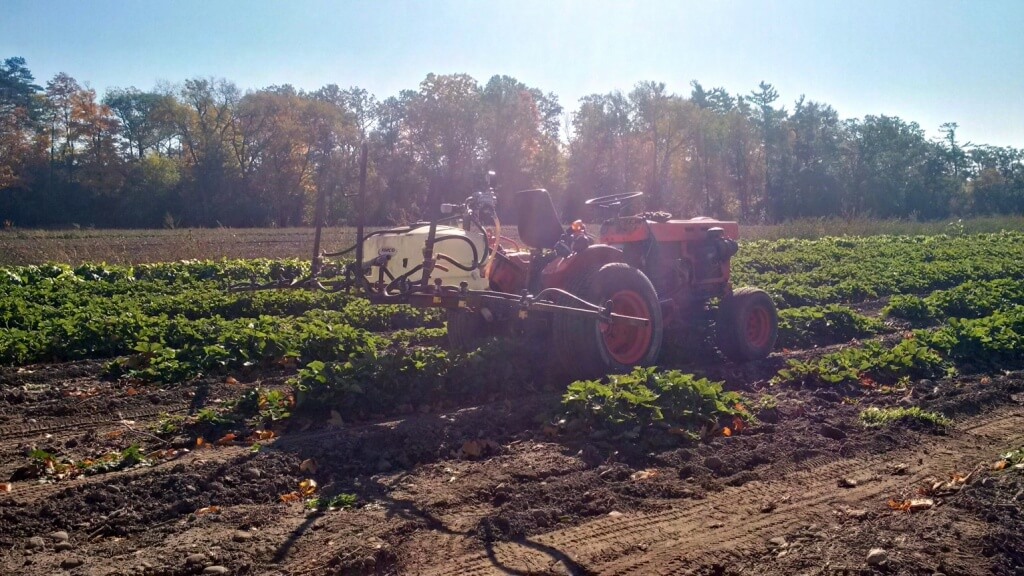
    In June, 2014, 30 growers attended a spray coverage demonstration in a potato field in Alliston, Ontario. Our goal was to explore three questions:

    1. What is the effect of droplet size on coverage?
    2. What is the effect of volume on coverage?
    3. What is the effect of spray angle on coverage?

    This certainly wasn’t a scientific experiment. Spray demos are a great foil for discussing droplet behaviour and teaching operators how to diagnose spray coverage. Take the “results” with a grain of salt.

    Discussing spray coverage in Alliston, Ontario (2014).
    Discussing spray coverage in Alliston, Ontario (2014).

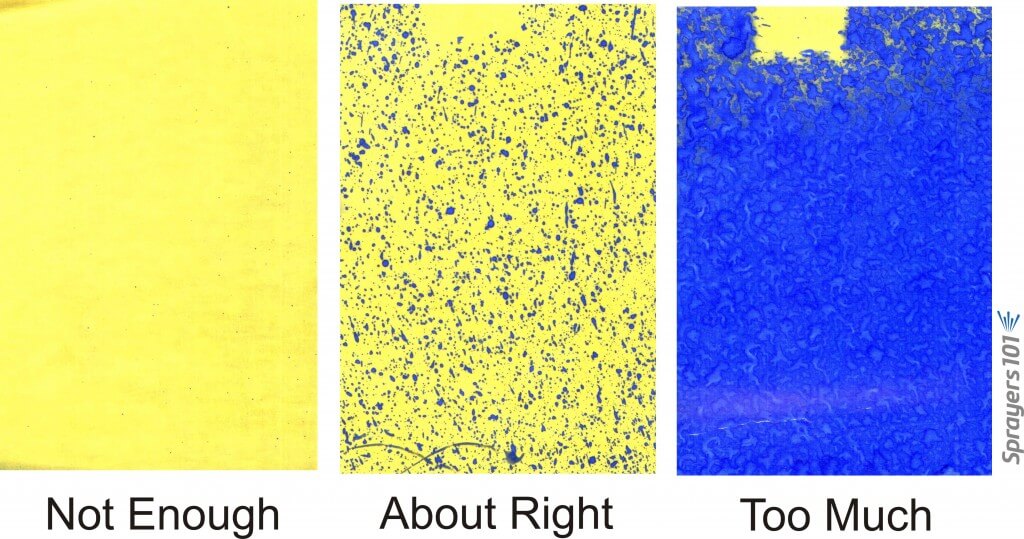
    In order to see spray coverage, we placed water sensitive paper in the potato canopy (see below). Water sensitive paper turns from yellow to blue when it is contacted by water. Normally, we use a digital scanner to quantify spray coverage. However, it was a very humid day and this made it difficult for the scanner to discern spray from background. We decided to assign a qualitative value to the papers based on coverage. Low (or no) coverage got a score of zero. Moderate coverage (enough to offer good control) received a score of one. Papers with excessive coverage (anything more than moderate) received a score of two. Did I mention this wasn’t a scientific experiment?

    The location of water-sensitive papers in the potato plant canopy. Two plants were papered for each nozzle.
    The location of water-sensitive papers in the potato plant canopy. Two plants were papered for each nozzle.

    Droplet Size

    To answer the first question, we compared coverage from two hollow cone nozzles. The TeeJet TXR80028, which creates a fine/medium droplet size, and the TeeJet AITX8002VK, which is air-induced and creates a Coarse/Very Coarse droplet size. In both cases the boom was approximately 50 cm (20 in) above the top of the crop, travelling at 10 km/h (6.2 mph) and spraying about 110 L/ha (~11.5 gpa).

    Generally, Coarse droplets tend to move in a straight line, and are not as easily deflected by moderate wind or travel speed. Conversely, Fine droplets slow very quickly and move erratically depending on the forces acting on them.

    Droplet size comparison. Cumulative spray coverage achieved in four positions, on two plants per nozzle. Low-to-no coverage = 0. Moderate coverage = 1. High-to-excessive coverage = 2.
    Graph 1 – Droplet size comparison. Cumulative spray coverage achieved in four positions, on two plants per nozzle. Low-to-no coverage = 0. Moderate coverage = 1. High-to-excessive coverage = 2.

    Graph 1 shows the coverage results in each position. We see that finer droplets appear to penetrate the canopy more than the coarser droplets. We also see that under-leaf coverage was difficult to achieve overall. It’s possible the small amount of coverage achieved on the under-side of the top scaffold of leaves is the result of Coarse droplets bouncing… but if that’s the case, why wasn’t there any coverage on the upward-facing leaves inside the canopy? Write me – I’m open to ideas. In any case, redistribution is erratic and should not be relied on.

    This graph may appear to favour smaller droplets, but be aware that Fine droplets are prone to drift and evaporation and should not be used without making every effort to prevent off-target movement. Shrouds, low ambient wind, and slower ground speed can help. To my mind, the best drift-mitigating option that still allows the use of finer droplets is an air-assist option on the boom, which would also improve under-leaf coverage. I’ve seen it in field tomato, soybean and even field corn. It’s disappointing that there aren’t more self-propelled sprayers in Ontario that offer this feature.

    Volume

    To answer this question, we compared coverage from Syngenta’s potato nozzles. They aren’t generally available in North America, but we got a few for the sake of the demo. The VP04 (gold) was operated at 1.5 bar (22 psi) and sprayed 135 L/ha (~14.4 gpa). The VP05 (Orange) sprayed 180 L/ha (~19.2 gpa) at the same pressure. The boom travelled at 10 km/h (6.2 mph) at approximately 50 cm (20 in) above the top of the crop.

    Generally, raising the volume-per-hectare translates to improves coverage, but at some point there is a diminishing return. Imagine comparing coverage between 1 L/ha and 100 L/ha – there would be a big difference. Now imagine comparing 500 L/ha to 1,000 L/ha – probably not much difference, because drenched is drenched.

    Spray volume comparison. Cumulative spray coverage achieved in four positions, on two plants per nozzle. Low-to-no coverage = 0. Moderate coverage = 1. High-to-excessive coverage = 2.
    Graph 2 – Spray volume comparison. Cumulative spray coverage achieved in four positions, on two plants per nozzle. Low-to-no coverage = 0. Moderate coverage = 1. High-to-excessive coverage = 2.

    According to Graph 2, the higher volume did not improve coverage. In fact, the lower volume appears to have superior coverage, but it’s likely not significant. Remember, there are no error bars here because there’s no statistical analysis – it’s not a scientific study. It’s possible that at this stage of growth, our 150 L/ha was close to the threshold of diminishing return.

    Once again, note the absence of under-leaf coverage. Truly, the more I spray vegetable and row crops with conventional nozzles on a horizontal boom, the more I think under-leaf coverage can only be achieved by Bigfoot riding the Loch Ness Monster while wielding Harry’s wand. Without directed sprays from drops (aka pendant nozzles, drop hoses, etc.) or some means of redistribution (e.g. air assist or even maybe electrostatics) droplets will not reliably change direction.

    Spray Angle

    To answer this question, we used Hypro’s Guardian Air nozzle (GA11003), which is a 110° wedge-shaped flat fan that we alternated between 15° forward and 15° backward on the boom. We compared it to Greenleaf’s TADF nozzle (a blue and yellow 02), which is an asymmetrical, 110° twin-fan tip, where one fan is at 50° and has a higher flow compared to the second fan at 10°. We also alternated these nozzles on the boom to take advantage of what became four different angles of attack. Both tips sprayed 100 L/ha (10.9 g/ac) from a boom travelling 10 km/h (6.2 mph) and about 35 cm (~14 in) from the top of the canopy.

    Spray angle comparison. Cumulative spray coverage achieved in four positions on two plants per nozzle. Low-to-no coverage = 0. Moderate coverage = 1. High-to-excessive coverage = 2.
    Graph 3 – Spray angle comparison. Cumulative spray coverage achieved in four positions on two plants per nozzle. Low-to-no coverage = 0. Moderate coverage = 1. High-to-excessive coverage = 2.

    Graph 3 shows a lot of spray impacting on the surface of the canopy, with moderate penetration to the upward-facing leaves in the inner canopy. The angled spray may have helped a little, but no more than the finer droplets from hollow cones. While others like it, my personal experience in soybean, field tomato and ginseng has shown that the spray angle does not have much bearing on crop penetration in a broadleaf canopy. Perhaps if the canopy is sparse… but not in dense canopies. This shouldn’t be a surprise because angled sprays are best suited to vertical targets, such as wheat heads. Graph 3 seems to bear this out.

    Now, since I ran this last demo, I’ve learned that I really didn’t use the twin fan nozzles optimally. In order to keep the outputs comparable, the rate controller operated the TADF’s at about 30 psi. That pressure is fine for something like glyphosate, but for contact products 60 psi to 120 psi is preferable to put the droplets in the medium range and keep them moving at the right angle.

    A lot of people like the asymmetrical nozzles in broad leaf crops, so if they’re working for you that’s great. Carry on! As for me, I’m hoping to run a more stringent experiment in the future to satisfy myself.

    Take Home

    So, as I’ve pointed out a few times, this comparison of nozzles and spray variables isn’t definitive. It was only a subjective demonstration. Further, coverage doesn’t necessarily imply efficacy: Just because you have more coverage doesn’t mean you didn’t already have enough to do the job.

    Caveats aside, however, there are a few points to be made:

    • Smaller droplets penetrate dense canopies better than larger droplets, as long as they survive to arrive.
    • Under-leaf coverage is difficult to achieve without some form of mechanical assistance – e.g. directed application from drops, air-assist, electrostatics, etc.
    • Higher volumes result in improved coverage, but only to a certain point. Volume should reflect the stage of growth.
    • At the moment, I’m unconvinced that spray angles impact (dense) broad leaf canopy penetration. There are, of course, many other learned and experienced opinions for spraying vegetables.