Spray adjuvants are tank mix additives that either physically or chemically influence the efficacy, consistency or safety of pesticides. For example, adjuvants can improve the handling characteristics of a spray solution (e.g. water conditioners, de-foamers, emulsifiers). They can improve uptake into a target plant and/or improve the amount of contact between spray droplet and target surface (e.g. non-ionic spreaders). They can also modify droplets to reduce the potential for wastage from drift or run-off (e.g. anti-drift additives, stickers).
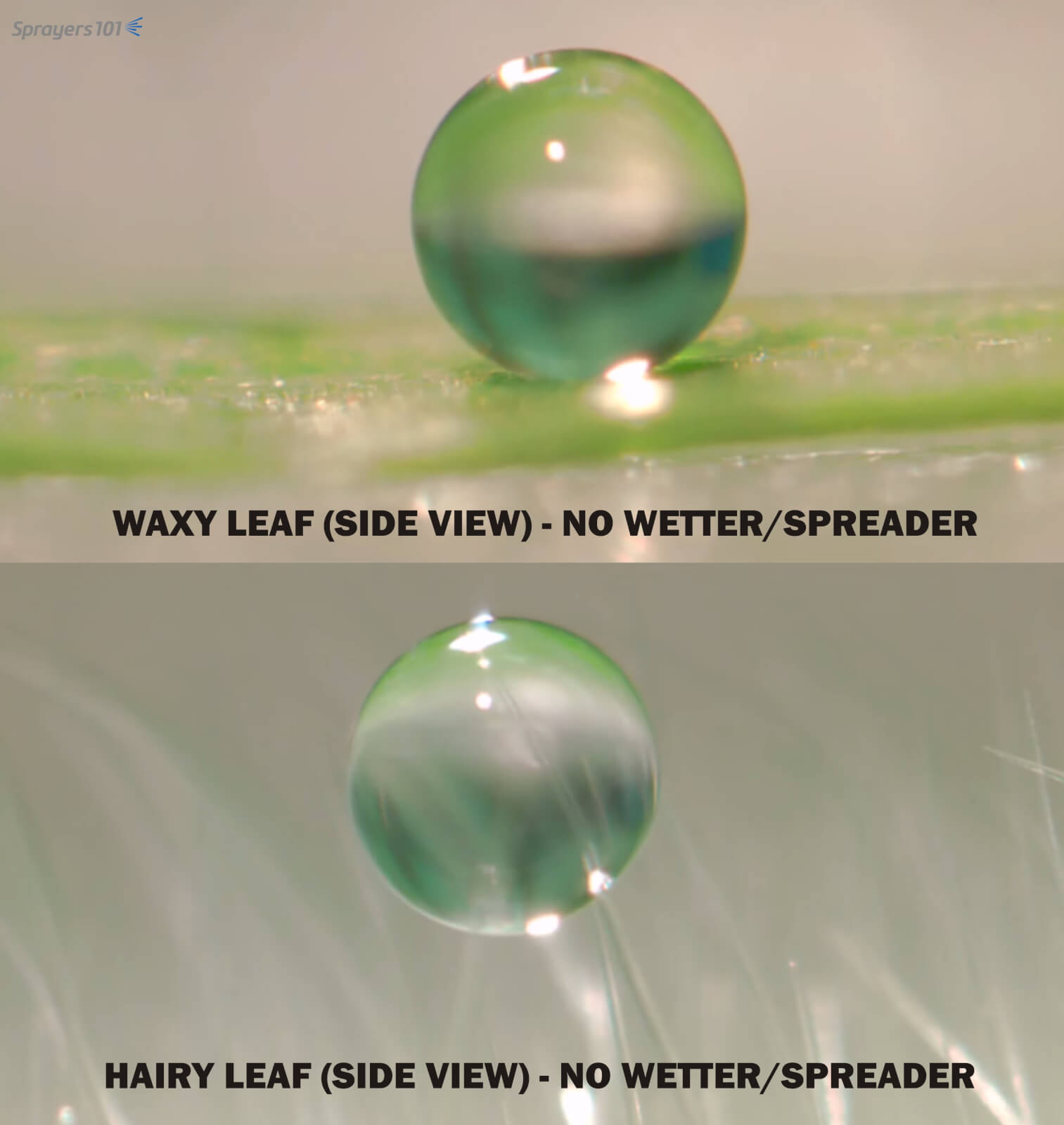
Note how little of the droplet contacts a waxy leaf (above). This hydrophobic reaction between water and wax can be overcome using a non-ionic spreader. Similarly, note how the droplet gets hung up on the trichomes (hairs) on a leaf before it reaches the leaf surface (below). Again, a non-ionic spreader would reduce droplet surface tension allowing it to splash onto the leaf. Photo Credit – Dr. H. Zhu, Ohio.
Some pesticide labels require the use of adjuvants in the tank mix for the pesticide to work correctly. They are not formulated with the product because of expense, bulk, or product stability, and must be added during loading. In order for a pesticide to work as advertised, it is important to include any adjuvants required by the label. In some cases, we are encouraged to use adjuvants to improve an application, even though they are not on the label.
There are potential benefits to introducing some unlabelled adjuvants, but there are also potential problems. The difficulty is that unless someone tests a specific tank mix combination for a specific crop, the results cannot easily be predicted. For example, when a tank mix is incompatible, an adjuvant could cause phytotoxicity, create more drift when used with the wrong nozzle, deactivate or enhance a tank partner, and/or potentially reduce spray coverage.
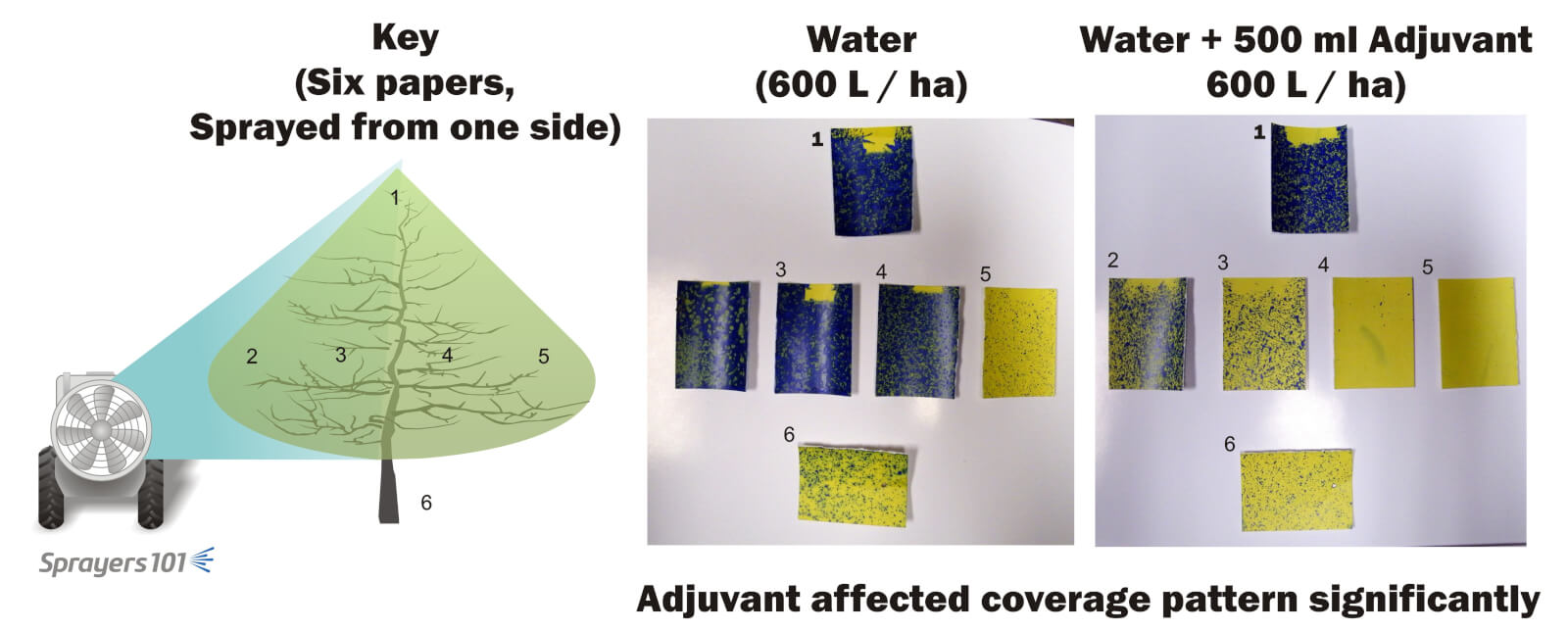
We once conducted a trial to test a deposition utility modifier intended to reduce run-off and drift. Water-sensitive papers were placed in the canopies of a 40 year old McIntosh orchard, which was then sprayed from one side in late May. The papers in the left panel (dilute control) were sprayed with 600L/ha (~60 g/ac.) of water. Those in the right panel (adjuvant) were also sprayed with 600L/ha but included the label rate of 500 ml of adjuvant. The water-plus-adjuvant reduced drift and runoff, as advertised, but did not penetrate as deeply into the canopy or spread on the papers, which is a concern if the operator was performing alternate-row middle spraying or needed better coverage (e.g. for mites). It was an unexpected side effect.
For better or worse, even small amounts of adjuvants can have a significant effect on spray coverage. Always test spray coverage when using a new adjuvant in a tank mix.
We also investigated the use of an anti-drift adjuvant in airblast sprayers, which you can read about here.
There is no simple answer regarding unlabelled adjuvants; there are too many possible product/adjuvant/plant combinations. If you intend to experiment with an adjuvant, perform a jar test to test for physical incompatibility. Then spray a small volume of the tank mix on a few trial plants to ensure there are no unexpected chemical issues (e.g. phytotoxicity or inactivating tank mix partners) or coverage issues.
It is highly recommended that every sprayer operator have a copy of Purdue Extensions’ 2015 “Adjuvants and the Power of the Spray Droplet – PPP-107”. This comprehensive handbook describes of how water quality and adjuvants affect the performance of pesticide applications. I consult it regularly.
Here are two videos from Dr. H. Zhu, USDA-ARS Ohio, showing how adjuvants that affect surface tension can help improve the level of contact between spray droplet and target surface.
Assuming there are no mechanical or maintenance problems, water-sensitive paper can be used to diagnose sprayer performance. Go here to read more about water-sensitive paper. Interpreting the results and knowing what changes to make is the critical part of the process. Observing no coverage, or a sodden paper, make for obvious conclusions… but what about everything in between? Here are the ground rules:
First: Only ever test coverage in environmental conditions you would normally spray in. Temperature, humidity and wind speed can make or break an airblast calibration.
Second: When altering sprayer settings, only make one change at a time for each test pass so you can isolate what’s wrong.
Third: Each pass requires a new set of papers located in the same place, oriented the same way, distributed throughout the canopy. Mark their locations with bright flagging tape and write the pass number and canopy position on the back of paper prior to placement. This helps you to compare the passes later on. Don’t collect papers until they’ve had an opportunity to dry a little, or they will smear and stick together.
Fourth: Pass down one alley first. Have a look at the papers without removing them. Then, spray the target canopy from the other side. Now the papers can be removed for analysis. This order is important because it reveals the impact of wind direction and the cumulative effect of spraying from both sides. In some cases, the sprayer operator may wish to travel an additional upwind alley to reflect the cumulative coverage on a typical spray day. Alternate row applications are not recommended.
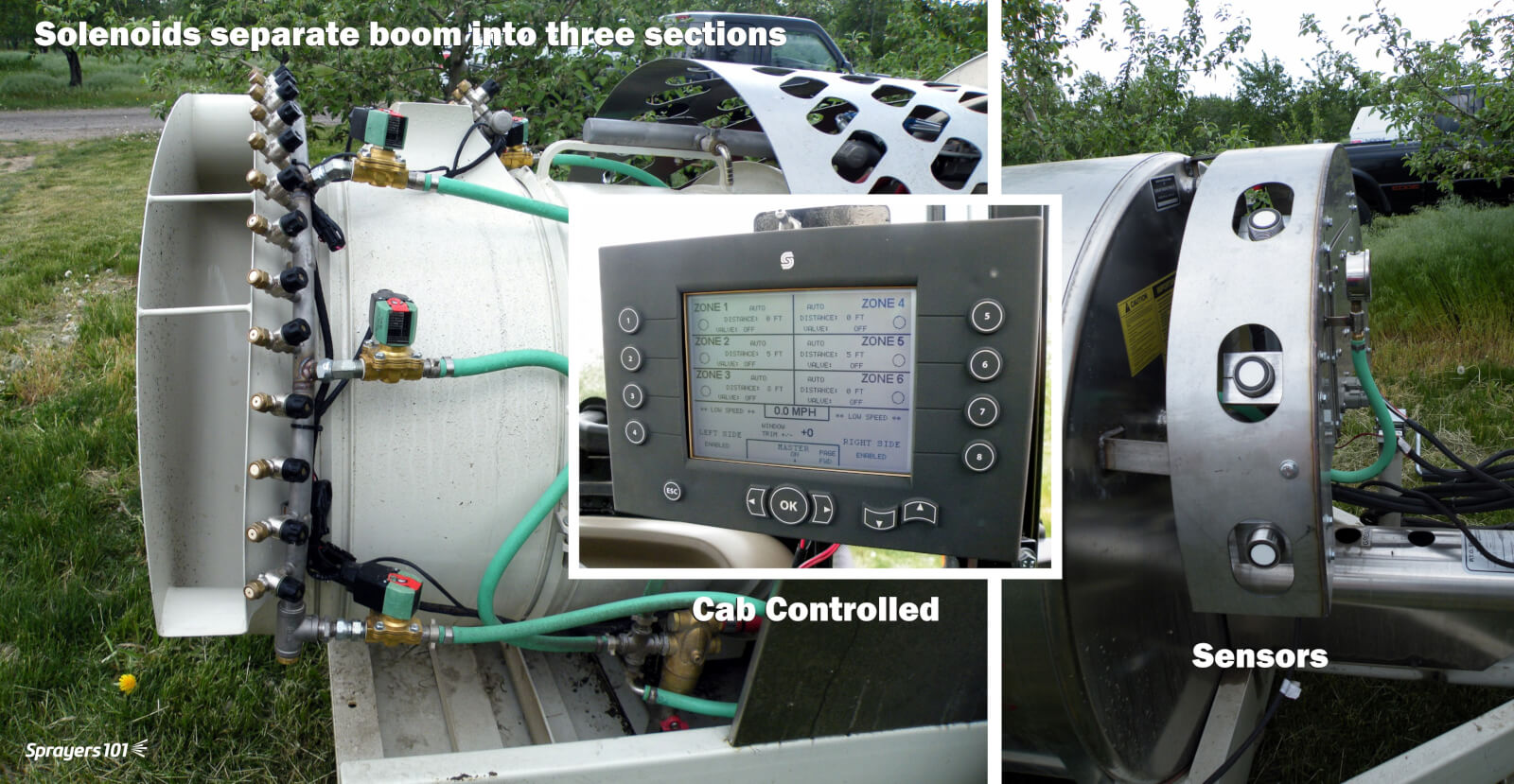
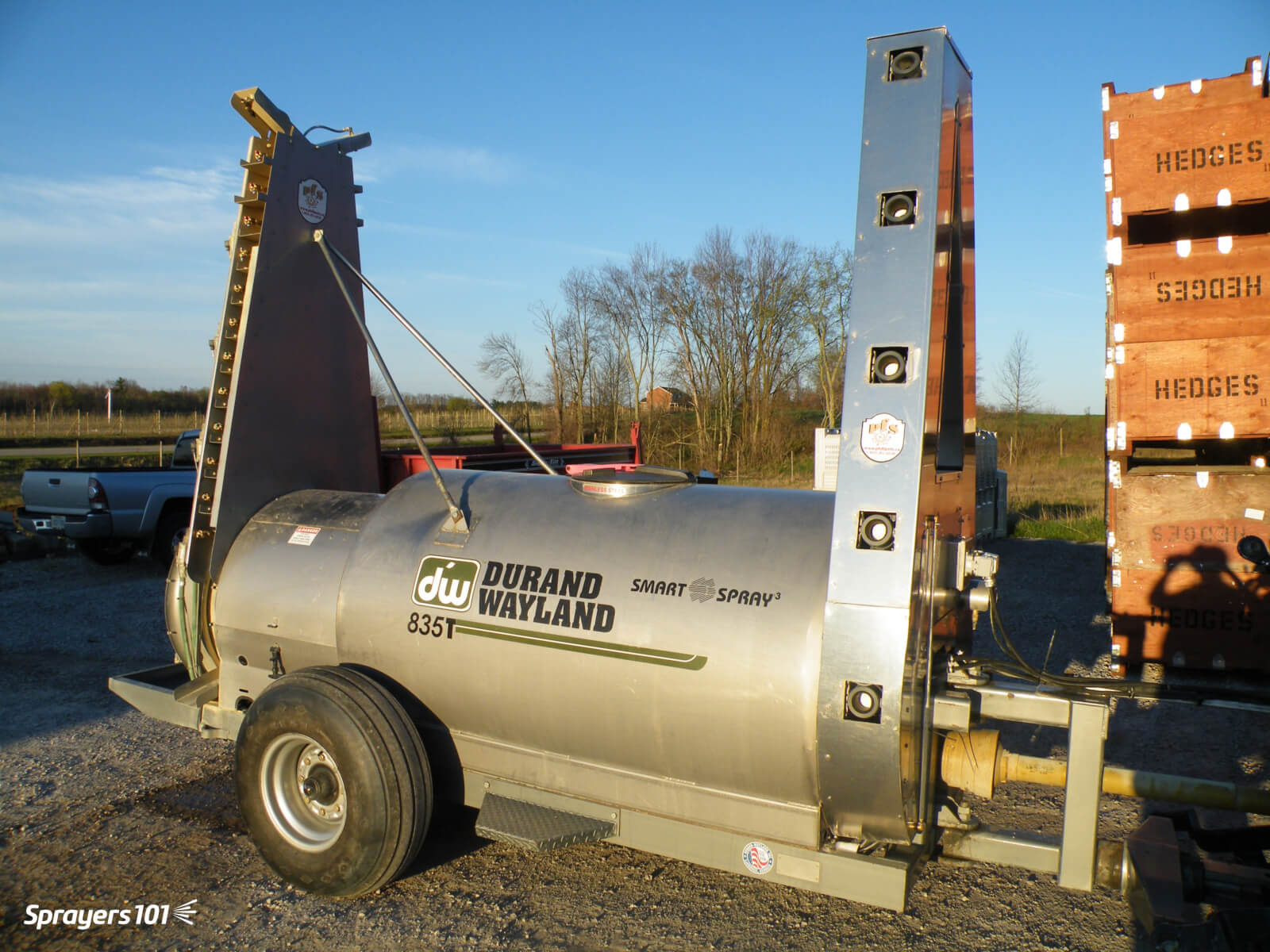
This Turbomist has been outfitted with Gillison’s Sonic Spray sensors that detect the presence of a canopy. Each eye corresponds to a boom section, turning the section on and off as required and improving efficiency. If it’s not there, why spray it?
Once the papers are retrieved, it’s time to diagnose the coverage. The following situations are typical in calibrations, and possible fixes are suggested. Remember, this is a process that takes time. Several passes may be required before satisfactory coverage is obtained. Once the correct settings are determined for the block, continue to use them until there is a significant change in the crop staging or weather. At that point, repeat the process.
Seven Situations
Situation One:
<15% coverage and <85 Fine/Medium droplets/cm2 at top of target (e.g. tall targets such as hops or trees). Suggested Fixes:
Wind might be stealing fine droplets. Try Coarser droplets (e.g. using air induction nozzles). Be aware that you may have to increase volume to compensate for reduced droplet counts and that they may fall out of the airstream before reaching distant targets.
Deflectors may not be channelling air and spray correctly – extrapolate air direction using ribbons on deflectors.
Fan may have to be set to higher gear, or if using GUTD, return to 540 rpm to increase fan speed. If still insufficient, you may need a sprayer with higher air capacity.
Situation Two:
<15% coverage and <85 Fine/Medium droplets/cm2 deep in canopy – sometimes papers on outside of canopy are visibly wet. Suggested Fixes:
Ground speed may be too high. Use flagging tape indicator on far side of target and see if air is getting through.
Canopy maintenance may be required (e.g. pruning, hedging, leaf stripping, etc.). No sprayer can consistently penetrate really dense canopies.
Fan may have to be set to higher gear, or if using GUTD, return to 540 rpm to increase fan speed. If still insufficient, you may need a sprayer with higher air capacity.
Increase carrier volume.
Situation Three:
Papers are drenched, dripping or show channels of running liquid. Suggested Fixes:
Reduce spray volume, either overall or in key locations on the boom corresponding to the drenched papers.
Ground speed may be too low. Use flagging tape indicator on far side of target and see if too much air is getting through. If so, increase ground speed.
Slow the fan speed by shifting to low gear, or using GUTD method
Ground speed may be increased as long as coverage is not compromised. Use flagging tape indicator on far side of target and see if air is getting through.
Situation Five:
Ground under target row is drenched. Suggested Fixes:
Rotate lower nozzles slightly upward, but do not shut them off. If ground remains drenched, turn them off entirely. Each hollow cone produces up to an 80º spray angle, so the next higher nozzle often compensates by spraying lower than expected.
Deflectors may not be channelling air and spray correctly – extrapolate air direction using ribbons on deflectors.
Situation Six:
<15% coverage and <85 Fine/Medium droplets/cm2. Remember that this coverage threshold is only a point of reference, not a hard fact. It does not apply when using Coarser droplets. Suggested Fixes:
Increase spray volume, either overall or in key locations on the boom corresponding to the under-sprayed papers.
Wind might be stealing fine droplets. Try coarser droplets (e.g. using air induction nozzles). Be aware that you may have to increase volume to compensate for reduced droplet counts.
Ground speed may be too high. Use flagging tape indicator on far side of target and see if enough air is getting through. If not, decrease ground speed.
Canopy maintenance may be required (e.g. pruning, hedging, leaf stripping, etc.). No sprayer can consistently penetrate really dense canopies.
Situation Seven:
Inconsistent coverage on outer edge of canopy (e.g. one spot never seems to get spray.) Suggested Fixes:
Nozzle spray angle may be too acute (e.g. full cones), and spray is not overlapping before reaching target. Try wider spray angles.
Some tower sprayers have ‘dead spots’ in their air. Check for limp or flagging ribbons tied to nozzle bodies and/or deflectors. Deflectors may need to be adjusted, or adjacent nozzle body angles repositioned to compensate. Try an air induction nozzle in the dead zone.
Canopy may be brushing against nozzles as the sprayer passes, temporarily blocking them. Canopy management required.
Some sprayers, such as Rears, Turbomist, FMC or this Durand Wayland have an option for electronic ‘eyes’ that detect spray targets. The boom will shut off completely if there is a gap in the planting. This can save a great deal of wasted spray. It is less applicable in trellised plantings where it has been known to be “fooled” by wires and posts.
If you still are unable to achieve satisfactory coverage, you may have to consider more extreme solutions. You may have an under- or over-powered sprayer. You may have to perform significant canopy management. Or, you may be trying to spray in poor weather conditions.
Droplet size influences droplet behaviour. The following table lists the pros and cons to changing droplet size when overall spray volume (e.g. L/ha) remains constant.
Relative Spray Quality
Pros
Cons
Coarser Droplets
Lower drift potential because they resist deflection by wind and evaporation from heat and low humidity.
Lower droplet count may reduce coverage.
Greater mass means they move ballistically, propelled at higher speeds by pressure for greater distance.
May fall out of the spray before reaching the top or centre of the canopy.
Coarser droplets do not penetrate dense canopies as easily as finer droplets.
Redistribution due to bounce, shatter or run-off may either improve or compromise coverage.
Redistribution due to bounce, shatter or run-off may either improve or compromise coverage.
Finer Droplets
Higher droplet count may improve coverage (if they arrive at the target).
Higher drift potential from wind, and evaporation from heat and low humidity.
Finer droplets penetrate denser canopies better than coarser.
Finer droplets move unpredictably and require optimal air settings to direct them to the target. Sprayer design and air settings will determine if it is optimal for nearby or distant targets, but it is rarely if ever both.
Finer droplets move unpredictably and require optimal air settings to direct them to the target. Sprayer design and air settings will determine if it is optimal for nearby or distant targets, but it is rarely if ever both.
It is preferred to use nozzles that create coarser droplets at higher rates (to compensate for fewer droplets) in the higher boom positions. They are more likely to stay on course to the tops of the trees, and when they miss, many fall out of the air rather than contribute to drift.
Learn more about strategies to reach the top of a canopy here.
Finer droplets have very little mass and therefore very little kinetic energy. This means they slow quickly (imagine throwing a feather) and require entraining air to carry them to the target. Finer droplets also evaporate quickly, particularly on hot and dry days (i.e. unsuitable Delta T conditions). If employed, they should be distributed in the lower-middle portion of the boom where they have the least distance to travel and are most likely to be intercepted by canopy.
Boom distribution
Unlike a broad acre boom sprayer, where each nozzle emits the same rate, an airblast boom can distribute spray unevenly. For a curved (axial) boom, the rule of thumb is to produce 2/3 of the overall volume from the top 1/3 of the boom. This compensates for the distance and greater proportion of canopy it is intended to cover.
A vertical (tower) boom positions each nozzle roughly the same distance from the target, and if that target is a hedged canopy, the spray can be distributed equally over the boom. Research has demonstrated that there is no appreciable advantage to one spray shape over another (e.g. flat fan, hollow cone, full cone) other than the spray quality they produce.
In extreme cases, operators might elect to “fire hose” spray to the tops of canopies using high pressures. This is achieved by using streaming nozzles or removing the swirl/whirl/disc plate in a disc-core combination nozzle in the top few nozzle positions. Given the heavy demand on the pump and the inaccuracy of the method, this should only be considered when air fails to reach the tops of trees.
Learn more about nozzling an airblast sprayer here.
Spray coverage and diagnostics
It’s well understood that spray coverage has a negative correlation with tree height. The irony is that in large nut trees the upper portion of the canopy produces much of the harvest. Taken collectively, this may explain why pest activity is also highest in the upper canopy. When choosing a spray volume and boom distribution, the metric is threshold coverage in the top 1/3 of the canopy. This requires us to define threshold coverage.
If ribbons and leaf movement represent the feedback mechanism for air settings, then water sensitive paper (WSP) is the choice for spray coverage. Placement in tall trees can be tricky, given that we are most concerned with coverage at the top, but this can be overcome by mounting the WSP on telescoping poles. Papers can be oriented horizontally to represent a leaf, or curled around the pole to give panoramic coverage and emulate a nut. Beware over-blowing in the lower canopy, which creates a shingling effect where leaves cover one another (or the WSP) and block coverage.
Fluorescent dyes and kaolin clay show spray coverage in situ, but there are drawbacks. Few growers will spray dye and come back at night with a black light to examine targets. Further, a target sprayed with dye or clay cannot be sprayed a second time, which means the grower can’t adjust the sprayer and try again in the same canopy. And finally, it’s very difficult to determine if there is more or less coverage with clay or fluorescent dye.
Learn more about how to use water sensitive paper here.
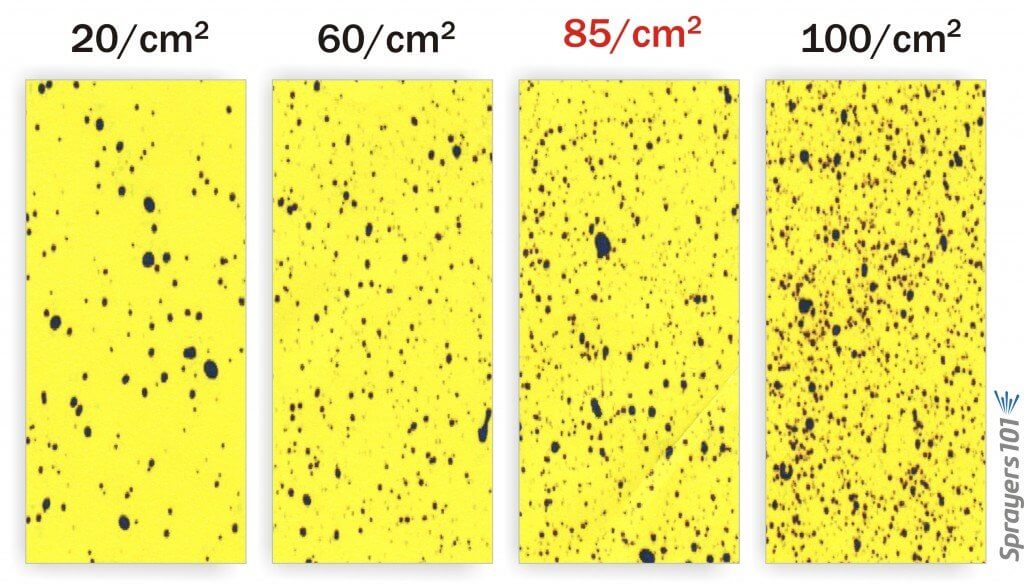
WSP is fast, cheap and effective. With the exception of drench applications, the most demanding spray application (e.g. contact fungicide) should produce a spray coverage pattern of 85 drops per cm2 and 10-15% total coverage on 80% of the targets. This threshold comes from collective research and experience in many horticultural crops, and should true hold for tree nut.
Be prepared to make changes to your sprayer calibration to compensate for tree height, canopy density, and weather conditions throughout the season. The feedback from water sensitive paper is far more accurate than shoulder-checks and leaf residue. It takes some time and effort, but it’s well worth it. Coverage is King.
What others have done
Researchers like Brad Higbee (Paramount Farming Co.) and Ken Giles (UC Davis) have explored spray coverage and efficacy from different sprayer configurations to combat Naval Orange Worm in almond. What follows is a summary of their observations. This information comes from their presentations and conversations with Brad.
Ten years of trials spanned travel speeds of 3-6.5 km/h, volumes of 1,400-2,150 L/ha, and sprayer-generated airspeeds (measured at source) of 80-290 km/h. They looked at efficacy, residue levels and WSP coverage both in leaves and on the nuts themselves. When comparing sprayer configurations, the target almond tree was divided into four levels:
Level 1 = 1.8 m to 2.5 m (Lower canopy)
Level 2 = 3.0 m to 3.7 m
Level 3 = 4.2 m to 4.9 m
Level 4 = >5.5 m (Upper canopy)
Many configurations were tested, but the following figure shows the top four. Of those not shown, most notable are the Bell 206 helicopter (280 L/ha at 50 km/h) and the Curtec AC 1000 Cross-Flow tower.
A. Air-O-Fan low profile axial D-240 (Also used Air-O-Fan 232). B. Progressive Ag two-head 2650 electrostatic air-shear with 4 m tower (Also used 4.9 m three-head and 5.5 m four-head). C. Blueline Accutech 10-head air-shear tower. D. Low-profile axial airblast with two Sardi-style fans on mast. Upper fans set to 70% overall fan speed and spray volume. Axial fan and nozzles set to 30%
Here is a summary of their observations:
Spray coverage and residue deposition was weakest in upper half (Levels 3 and 4) of canopy. Tower sprayers tended to provide more uniform coverage across vertical levels. For low-profile axial sprayers, most of the residues were deposited in the lower half of the tree.
The Air-O-Fan low-profile axial had the highest overall residues. But, above 3.7 m there was severe drop off in coverage. PTO-driven sprayers seemed as effective as engine driven. Incremental improvements were observed on this sprayer when using multiple banks of booms, full cone and hollow cone nozzles.
The Progressive Ag tower provided the highest residue deposition above 3.7 m and modest deposition in the lower canopy. While tower sprayers tended to provide more uniform coverage, the Progressive Ag was not significantly better than the Air-O-Fan overall.
Aerial application (280 L/ha) combined with the Air-O-Fan low-profile axial sprayer (1,870 L/ha) did increase residues in the upper canopy, but did not result in greater damage reduction relative to the Air-O-Fan alone.
Slowing the Air-O-Fan low-profile axial sprayer from 4 to 3.2 km/h resulted in 30% more coverage and 47% higher residue deposition overall.
Electrostatic treatments did not perform well on WSP (small droplet size was suspected), but they were among the best in residue deposition at full volume and “delivered surprising residues at high speeds/low volumes”.
Brad has done remarkable work studying the impact of several sprayer configurations. While many were tested, there are still more that might be considered.
Canopy management
When all else fails, we are left with only one alternative: canopy management. Hedging and pruning the trees to create sprayer clearance opens canopies to spray (and light and air) and is a critical part of crop protection.
Learn more about the benefits of canopy management here.
Topping trees to bring them to a manageable height to improve coverage and reduce drift may be the only viable option for protecting the crop. I acknowledge that a great deal of nut production takes place in the upper third of the canopy, and it is beyond the scope of this article to discuss production and yield economics. However, when the crop is left unprotected, the yield quality is negatively impacted and it has been shown that a reduction in harvest weight is offset by the improvement in overall quality.
Where plants are very old and overgrown (such as macadamia), it is highly recommended that the orchardist engage a local crop expert and discuss a strategy for canopy management. There are many benefits, including:
Improved harvest quality
Fewer refills (saving time and water)
Less time to spray means more timely applications
Potential chemistry savings
Savings in gas, noise and equipment wear and tear
Potential for reduced off target spray drift
Summary
Spraying large nut trees is a challenging proposition. A number of inter-connected factors are involved and an operator must address all of them make spraying as efficient and as effective as possible.
Adjust sprayer air settings first, using canopy penetration as your guide to travel speed.
Distribute the 2/3 of the volume and coarser spray quality to the top 1/3 of the boom.
Consider an air-assisted vertical boom configuration to improve coverage uniformity and reduce drift.
Use water sensitive paper for critical coverage feedback and make changes based on that feedback.
Develop a canopy management strategy to improve spray coverage and yield quality.
I’ve studied spray applications in a diversity of crops, both broad acre and specialty, but perhaps nothing is as challenging large tree nut canopies. Australia’s macadamia orchards can form >10 metre high, >4 metre deep canopy walls! So in writing this article I face the opposite situation I normally encounter when advising on airblast sprayer settings.
In my region, fruit orchard, cane, bush and vine crops are typically sprayed with airblast sprayers. Over the years, through breeding and crop management, these operations have densified. The idea is that smaller, uniform crops can be managed, protected and harvested more efficiently. The ratio of quality fruit to planted area goes up, and input costs go down.
However, our aging fleet of sprayers are overpowered relative to the target. This means much of what I do involves demonstrating to sprayer operators what sufficient coverage looks like, and then teaching how to restrain sprayer parameters to achieve this ideal coverage as efficiently as possible.
So, are there any commonalities?
Yes! The need to understand what “good coverage” looks like, and the parameters that affect it, is universal to any airblast operation. Assuming the operator already has product choice and pest staging well in hand, there are three major factors that influence the quality of the spray application: The sprayer settings, the geometry of the target and the environmental conditions.
In theory we can discuss each of these factors individually, but in practice they interact with one another. It is wrong to adjust one factor without considering the other two. This is also why you should be wary of anyone that tries to sell you a sprayer by demonstrating it in an empty lot on a calm day! Always calibrate a sprayer in the planting, in weather conditions you would normally spray in.
Air volume and direction
Air adjustments are perhaps the most impactful changes you can make to your operation. The air stream created by the sprayer not only conveys the spray solution to the target, but opens the canopy and exposes leaf surfaces to the spray. In order to achieve adequate coverage, the volume (and speed) of sprayer-generated air must be sufficient to span the distance from sprayer to target, and then displace the volume of air in the canopy while depositing the spray.
I admit to a bias when it comes to air shear systems. These sprayers utilize sprayer-generated air to atomize the spray liquid as well as convey it. As such, you cannot easily adjust the air without affecting spray quality (aka average droplet size or VMD). My preference is an arrangement where nozzle selection allows you to control spray quality independent of air settings. In any case, adjusting air settings requires the operator to “see” air.
In my region, I advise tying 25 cm lengths of flagging tape at the top, middle and bottom of the far side of the upwind tree. Then, drive past with the air on and the spray booms off. If the ribbons stand straight out, the sprayer is over-blowing and the operator can drop to a lower fan gear, reduce the tractor RPM’s (if using a positive displacement-style pump) or drive faster. If the ribbons don’t move, the opposite steps can be taken. If the ribbons still won’t move, the sprayer is under-powered, it’s too windy to spray, or the canopy is too large.
Let’s explore that last point. In the case of a canopy as large as macadamia, it is unlikely a low-profile axial sprayer can produce sufficient air volume to displace all the air in the canopy – particularly at the top of the tree. In this case a more humble goal would be to move the leaves at the trunk, indicating that the sprayer is managing to drive the air to the centre. To monitor this, an observer wearing safety goggles would have to stand at the far side of the upwind trunk and (while being very careful of flying debris) watch for leaf movement.
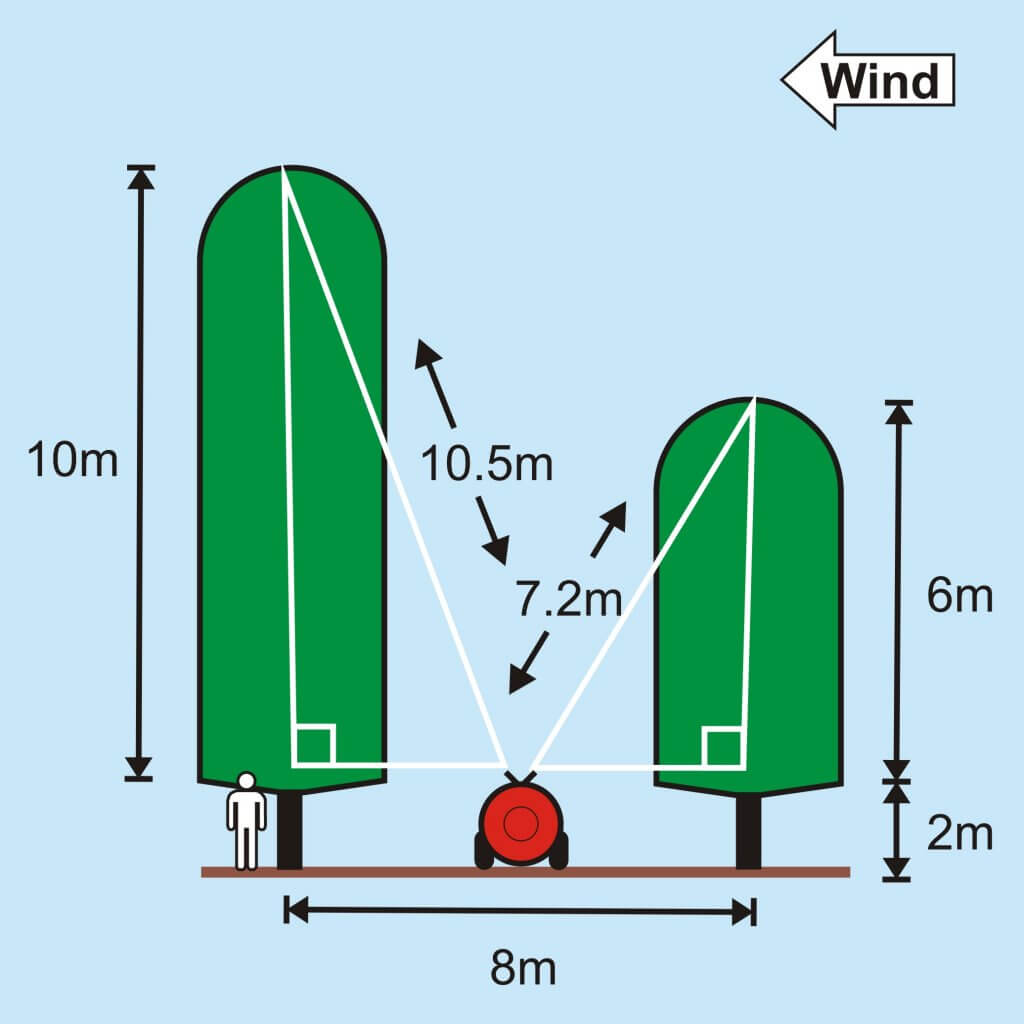
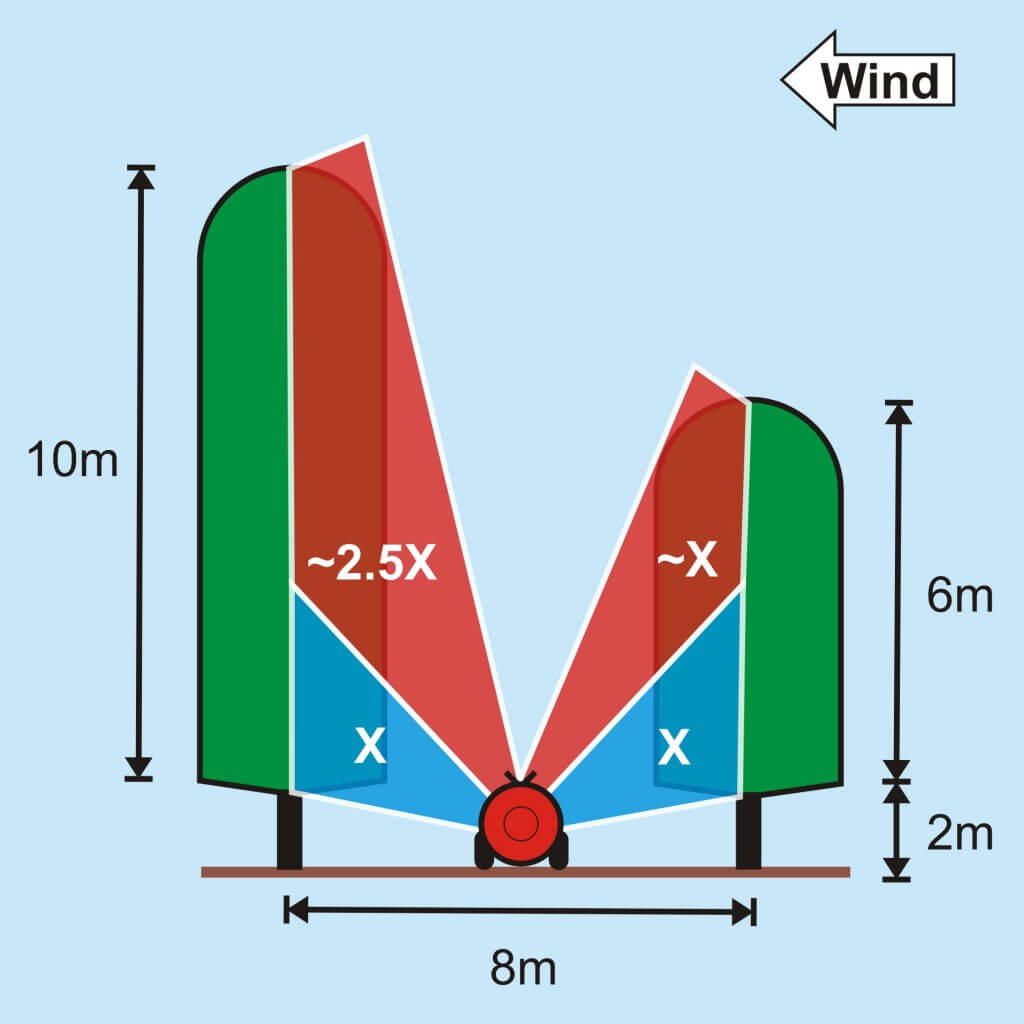
This becomes increasingly difficult to monitor as the target gets fuller, higher, and farther away from the sprayer. Consider the macadamia trees in the following figure:
The observer will have difficulty seeing leaf movement at the top of either the taller or shorter tree, but we can safely assume there will be less movement as a function of height. Since our goal is uniform penetration throughout the canopy, we must somehow compensate for this differential. Consider the following figure which extrapolates the path between the sprayer air outlet and the tree:
In this figure we have divided each side of a low-profile axial sprayer into halves. The bottom half of the air outlet must produce enough air volume to displace area X. I realize I’m mixing area and volume, but bear with me. For the taller tree, the upper half of the outlet must produce enough air to displace 2.5 times the area versus the bottom half. Given that it is a single air outlet, this means inconsistent coverage.
Comparatively, the shorter tree requires a more uniform air distribution. While this improves matters, there are further challenges. Sprayer-generated air slows and disperses proportional to distance, requiring more air to compensate. Also, orchard wind speed increases with elevation, increasing the potential for interference and dispersion. So, the taller the tree, the harder it is to achieve uniform canopy penetration.
Spraying shorter nut trees with a low-profile axial sprayer is possible. The sprayer would require a large fan (≥1 m diameter), an aggressive fan blade pitch and a high fan speed. Air deflectors and air separation vanes would also be needed to segregate and focus the air. And travel speed would play a significant role.
Travel Speed
Travel speed should be considered as function of air penetration. A slower travel speed (~2 km/h) facilitates the displacement of stagnant canopy air with sprayer-generated air. Further, a slower travel speed reduces the wake effect that can suck finer droplets from the swath.
It may seem counter-intuitive, but slower speeds can result in greater productivity. There is no need to increase the volume sprayed per hectare, so additional refills are not an issue. Further, improving spray coverage at slower speeds may prevent the need for an additional “clean-up” application later on, saving time and reducing environmental impact. Time lost to slower travel speed can also be reclaimed with more efficient loading practices.
Learn more about travel speed here and productivity here.
Directed Sprays and Off-Target Deposition
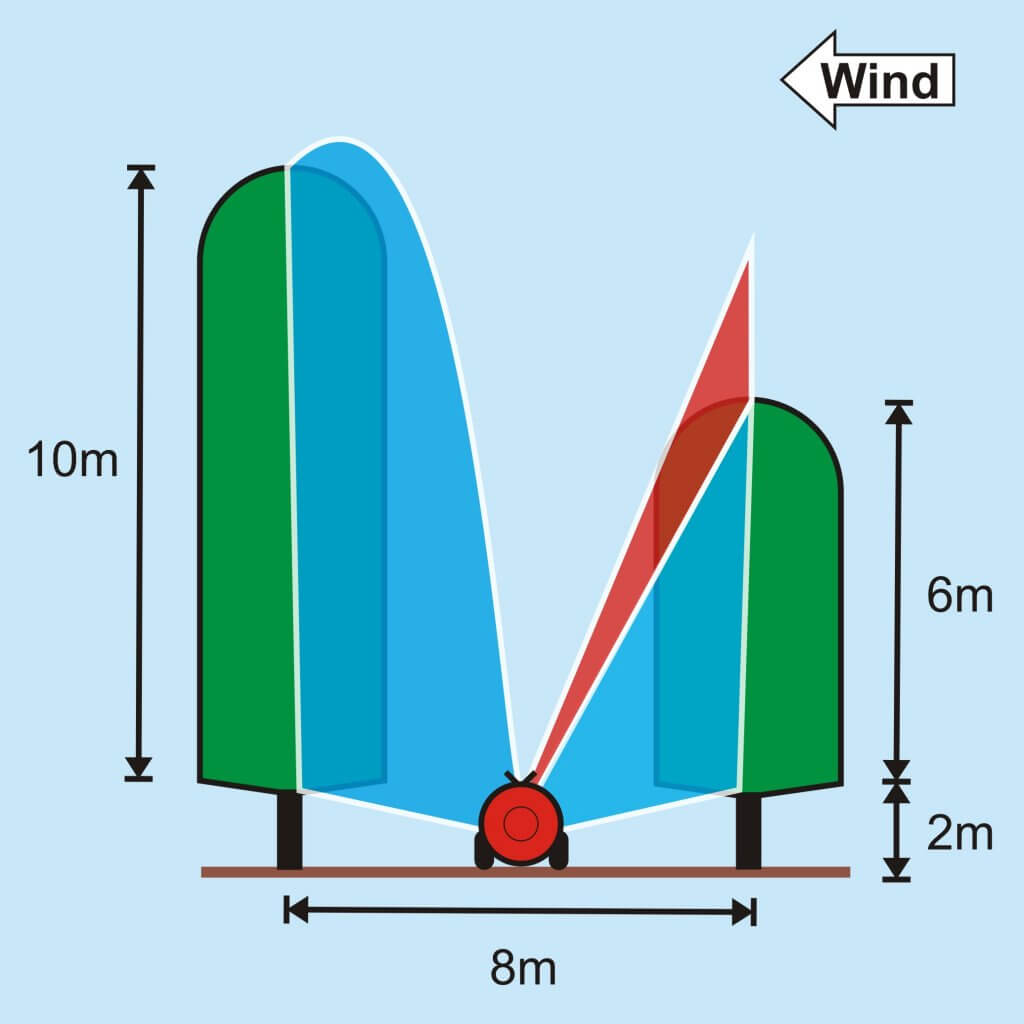
When the height of the target tree exceeds alley width, or when branches overgrow alleys, many low-profile axial sprayers suffer from line-of-sight issues. Lower branches/leaves block the upper canopy and too many nozzles target the lower canopy. See the figure below.
One option is to direct spray vertically to ensure the swath reaches the top of the canopy. In this case it is hoped that droplets remain Coarse enough to fall from the swath and penetrate the canopy, or blow laterally with prevailing wind (left side of figure). This unadvisable strategy is unlikely to achieve consistent results and greatly increases the potential for drift.
Alternately, the top of the swath can be vectored directly at the top of the tree, but it must pass through canopy to reach it (right side of figure). This strategy increases the potential for drift, risks missing a portion of the upper canopy and is also unlikely to yield consistent results.
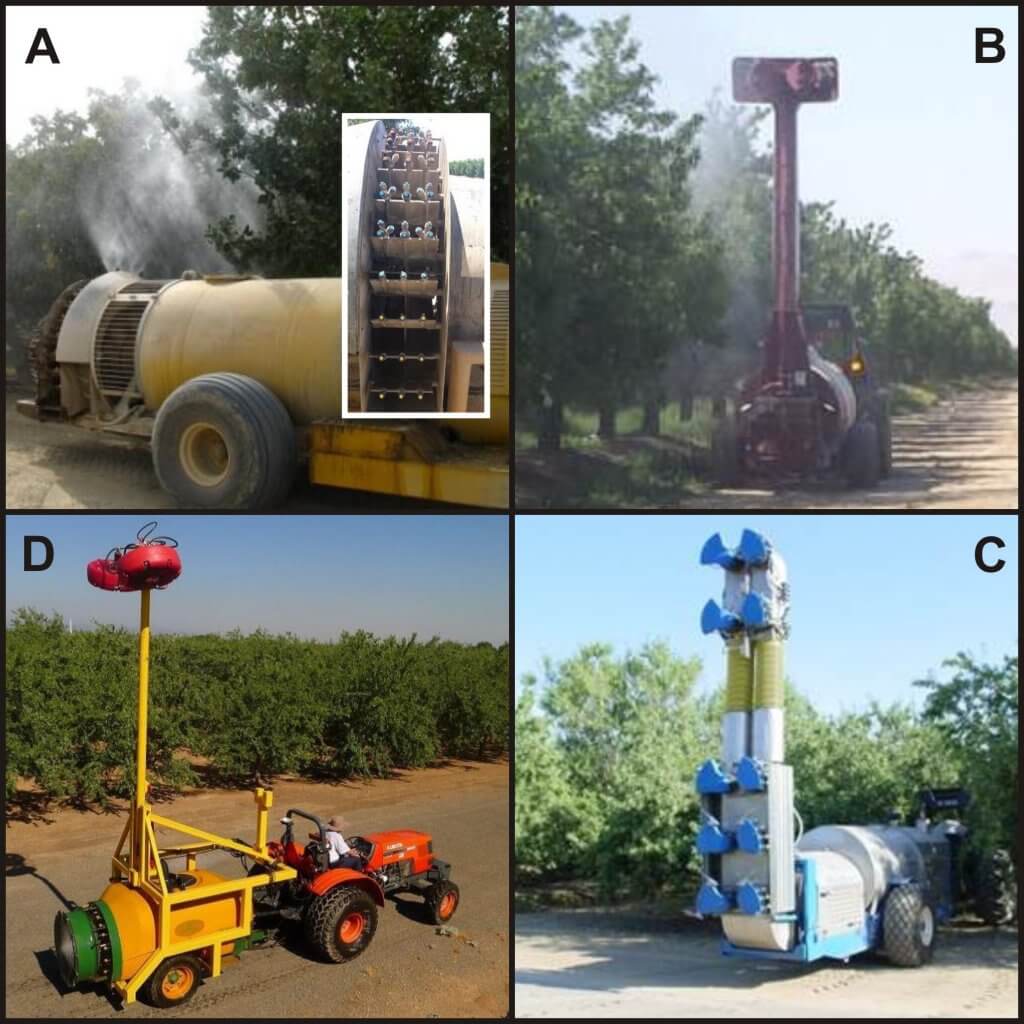
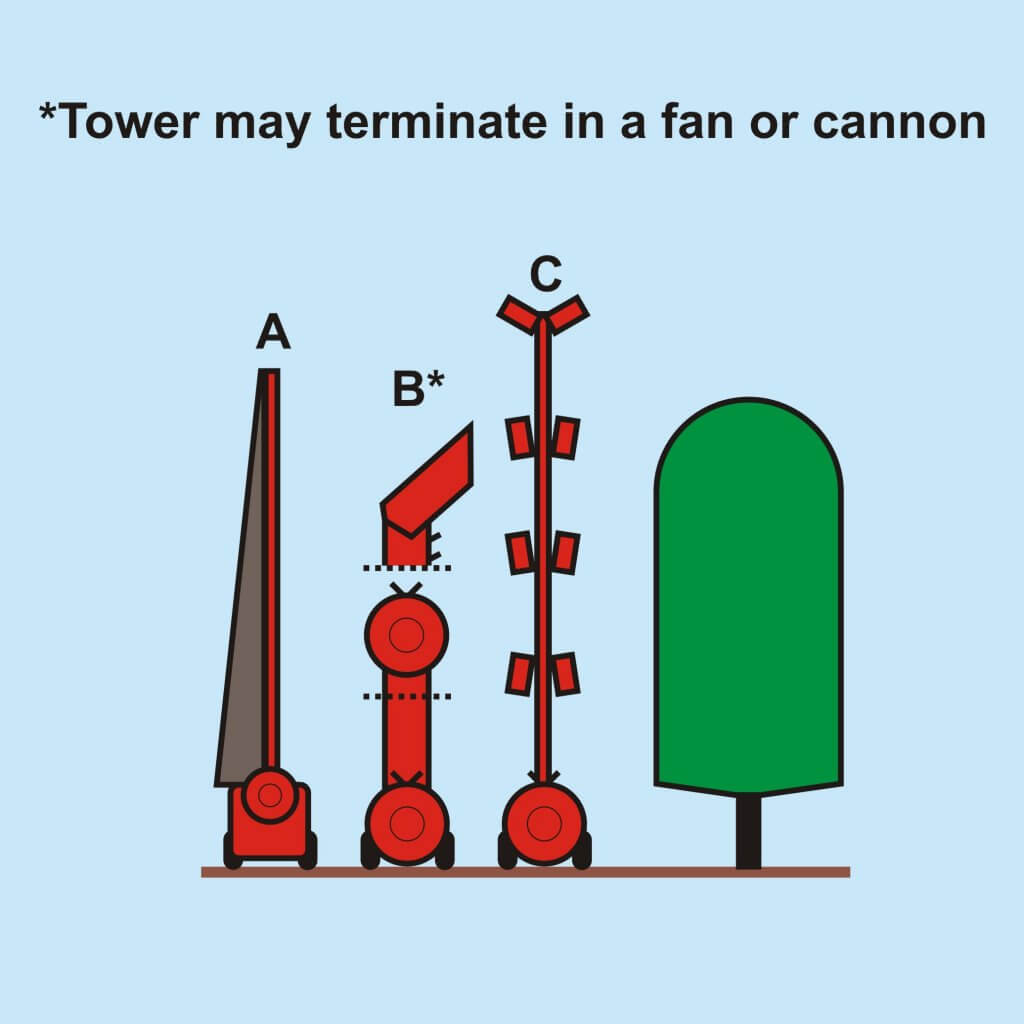
Ideally, we would use a sprayer design that brings the air (and nozzles) closer to the target. Hypothetically, there are several possible configurations, but in practice their success will be hampered by boom sway and roll (from sloped plantings or uneven alleys) and pressure drop restrictions (from boom height). Here are a few possibilities:
A. A vertical boom with a tapered inflatable bag to convey and redirect the air laterally (typically one-sided). B. An axial sprayer topped with a ducted tower with vertical booms, terminating in either a second axial fan or one-sided cannon. C. An axial sprayer with a vertical mast with a series of Sardi-style nozzle/fan assemblies distributed along the height.
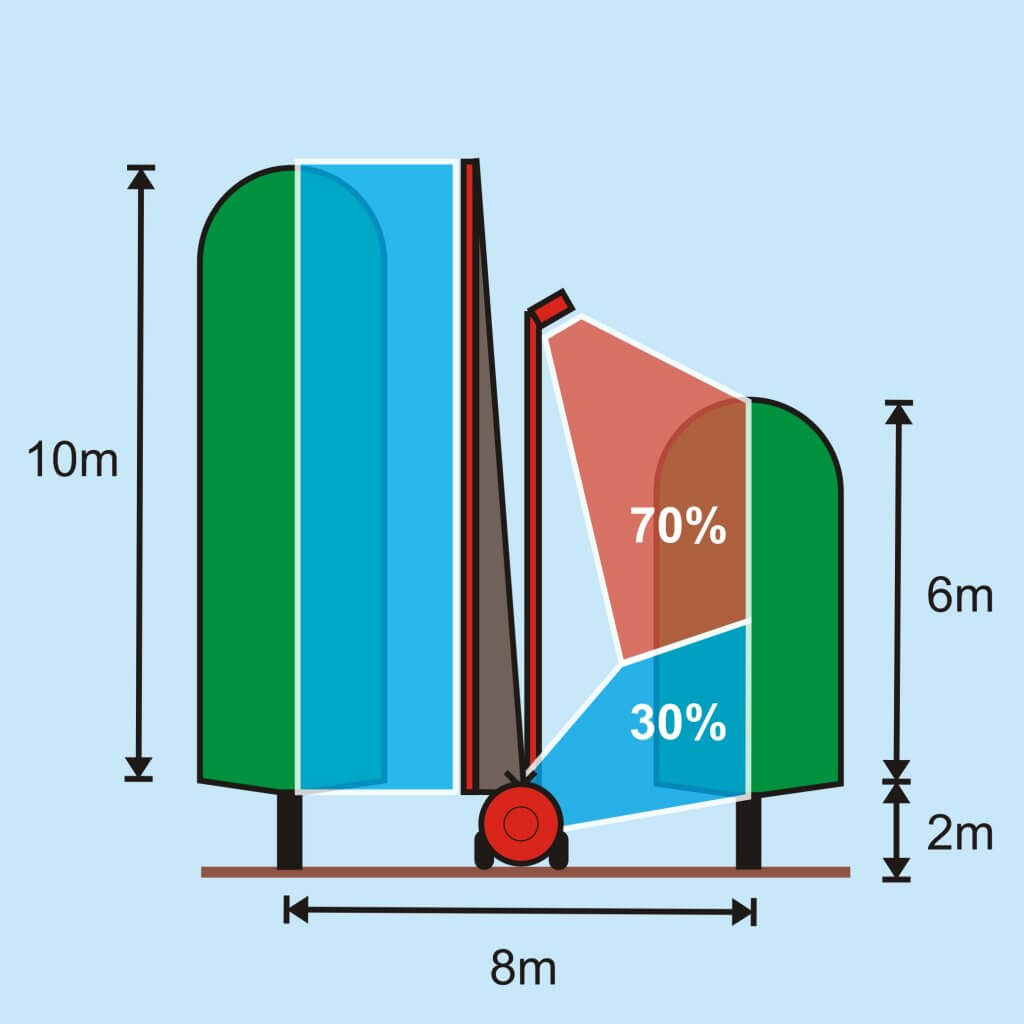
In the following figure we see how two possible arrangements might work. On the left is a vertical boom with a tapered air assist system. This provides the shortest distance-to-target for each nozzle and in moving laterally, the air will more easily penetrate horizontal limbs. It also reduces the potential for drift.
On the right is a novel arrangement proposed by Dr. Ken Giles (UC Davis, California). A Sardi-style fan and nozzle assembly is elevated above the canopy from an axial sprayer. His intention was to create air and fluid interaction to generate turbulence that could improve uniformity and decrease drift. He proportioned 70% of the overall spray to the top fan, and the remaining 30% from the ground. Working in almond, he saw more even coverage distribution compared to a low-profile axial sprayer and noted it reduced off target drift. For a target as tall as macadamia, additional fans would likely be required.
In Part 2 we discuss Droplet size, Boom distribution, Spray coverage and diagnostics, California research and Canopy management.
Are you considering shelling out for a tower extension for your airblast sprayer? Spray towers are an excellent investment, but they warrant special consideration. Towers move the air and nozzles closer to the target compared to the curved booms on a conventional airblast sprayer. When the distance-to-target is reduced, the odds of droplets reaching the target are improved. That means less pesticide drift and more deposit in the plant canopy.
Be Aware: Nozzles need a minimal distance from the target to create an optimal spray pattern, so do not get too close.
Many growers report savings when switching from conventional airblast to towers. The towers are more efficient at depositing the spray, so they have to reduce their typical sprayer volumes to prevent run-off. We worked with one apple grower that switched from a conventional sprayer to one with a tower. His lake-side orchard was plagued by wind, and his conventional sprayer had a relatively small fan diameter (~2 feet) that couldn’t compete. Traditionally, the grower used higher spray volumes to compensate. His new tower sprayer had a larger fan (~3 foot diameter) but perhaps equally import was that the tower reduced the distance-to-target. As a result, he was able to reduce his spray output by more than 200 L/ha while improving his overall coverage! That represented considerable cost savings and reduced environmental impact.
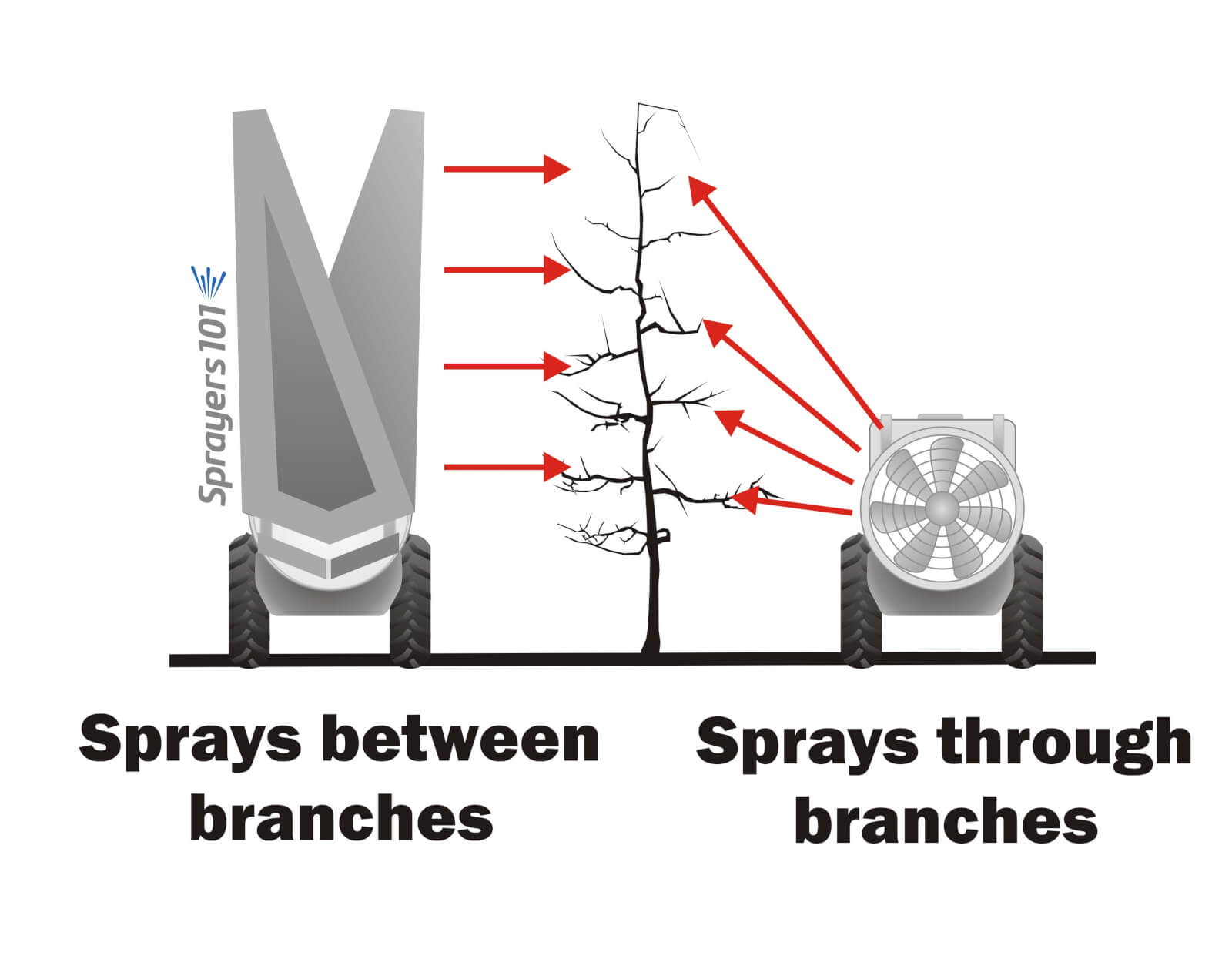
Towers may provide better coverage than conventional sprayers in orchards with horizontal scaffolding. The tower sprays between branches, penetrating more easily, while the conventional sprayer has to spray through them. Concept from K. Blagborne, British Columbia.
While there are many benefits associated with towers, they are not suitable for all situations:
Towers must be taller than the highest target (e.g. treetop)
Towers should be used on level ground. Towers will roll on the vertical axis (i.e. tip left and right) on uneven ground, potentially missing or over-shooting targets
Towers must be able to clear netting, trellises, or an overhanging canopy.
The perils of towers on uneven ground. For towers to be effective, the tower must be at least as tall as the target. When the target is only slightly higher than the tower, some sprayer operators install an additional nozzle body on the top deflector plate to extend the reach.A home-grown airblast sprayer with tower. PVC ducts, sheets of plastic, a squirrel cage blower and grower ingenuity. While it looks suspect, and difficult to clean, it reputedly works very well in highbush blueberries.
Occasionally, we have discovered areas along tower outlets where there is reduced air flow. You can usually feel these “dead zones” with your hand (beware flying debris), but it’s better to observe short ribbons attached to the nozzle bodies as described in our articles about adjusting air direction and speed/volume. In low fan gear, watch to see if any ribbons flag or appear slack from a lack of air, you can “borrow” air by re-positioning neighbouring deflectors. If that’s not possible, try replacing the conventional nozzles in the dead zone with air induction nozzles; coverage should improve in that zone because pressure propels coarser droplets further than finer droplets. We’ve seen significant improvements using this technique in high density orchards.
In the end, if a tower will fit in our operation, we suggest it’s a worthwhile investment that will make coverage more consistent, reduce off-target drift and possibly reduce the volume of spray needed per hectare.
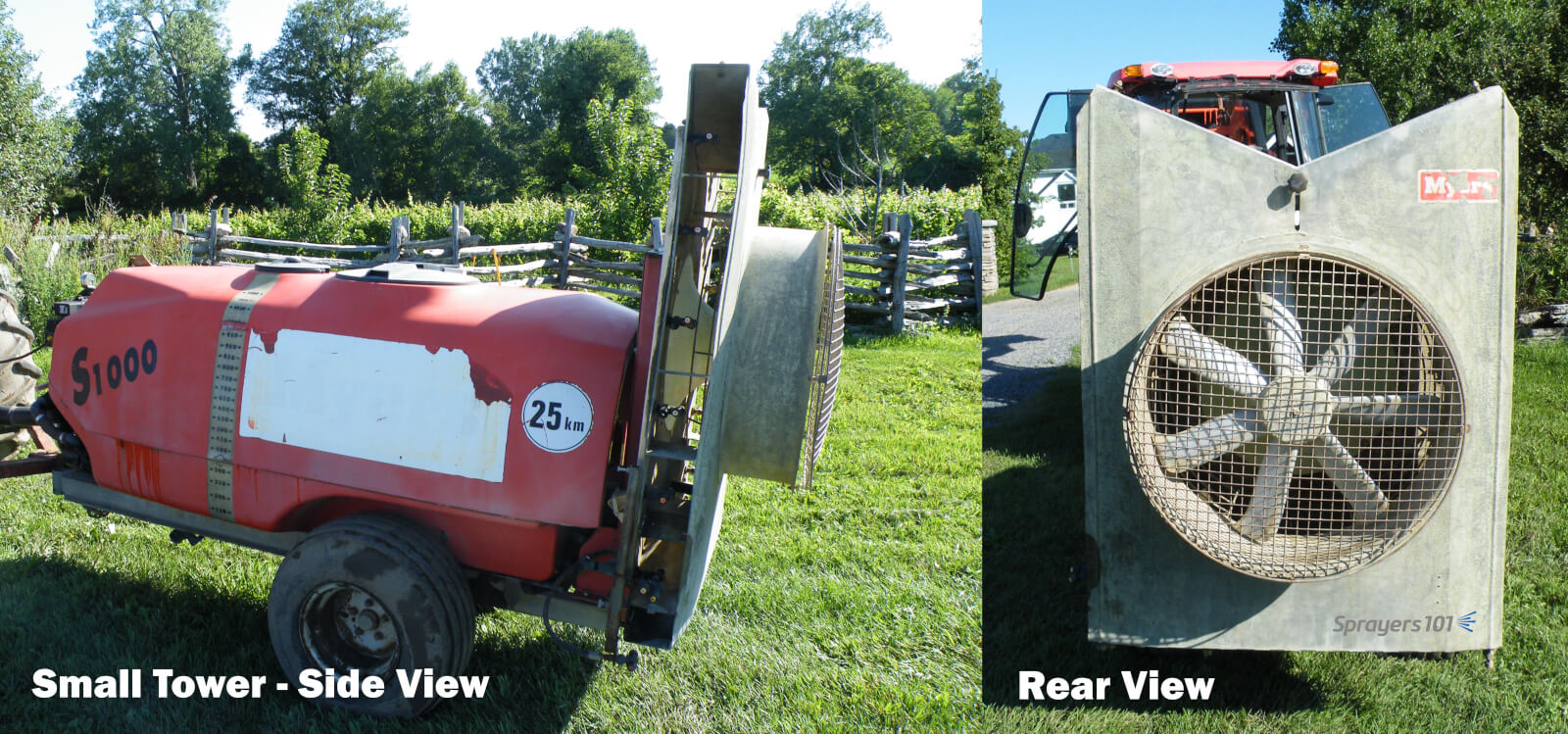
Towers come in many shapes and sizes. Orchards aren’t the only good fit for towers; grapes, bushes and canes can also benefit from small towers.