Tag: airblast

  • How to evaluate airblast coverage

    How to evaluate airblast coverage

    Note: While there’s nothing wrong with this article, a more recent article on this subject can be found here.

    It’s nearing the end of a long morning of spraying and you just want to get it done. As the tank empties and you watch the last of the spray cloud waft through the row, you’re thinking about rinsing out and moving on… but did the spray land where you wanted?

    How do you really know if you hit the target?

    Maybe you’re content with the occasional “shoulder checks” you made from the cab while spraying. Perhaps you stop at the end of the row and get out of the tractor to look for wet foliage during.
    Maybe you plan to return once the product is dry and look for white residue.

    Taken with the sprayer operator’s smart phone, here’s the over-the-shoulder view of an early-morning spray application from the cab. You can’t see coverage, but gaps in the spray will show if nozzles are plugged. You can also check to see if you are overshooting or blowing through the target. Photo Credit – C. Hedges, ON.
    This early morning “shoulder check” was photographed by the operator using his smartphone.  You can’t see coverage, but gaps in the spray will show if nozzles are plugged. You can also check to see if you are overshooting or blowing through the target. Photo Credit – C. Hedges, ON.

    These are all good feedback practices, but a more accurate method is the use of water-sensitive paper, which turns from yellow to blue wherever spray touches it. You can easily see the distribution of the spray and the overall area covered, and it can be quantified so you can compare one sprayer set-up to another, or see the impact of weather, or even the effects of nozzle choice, pressure and  water volume.
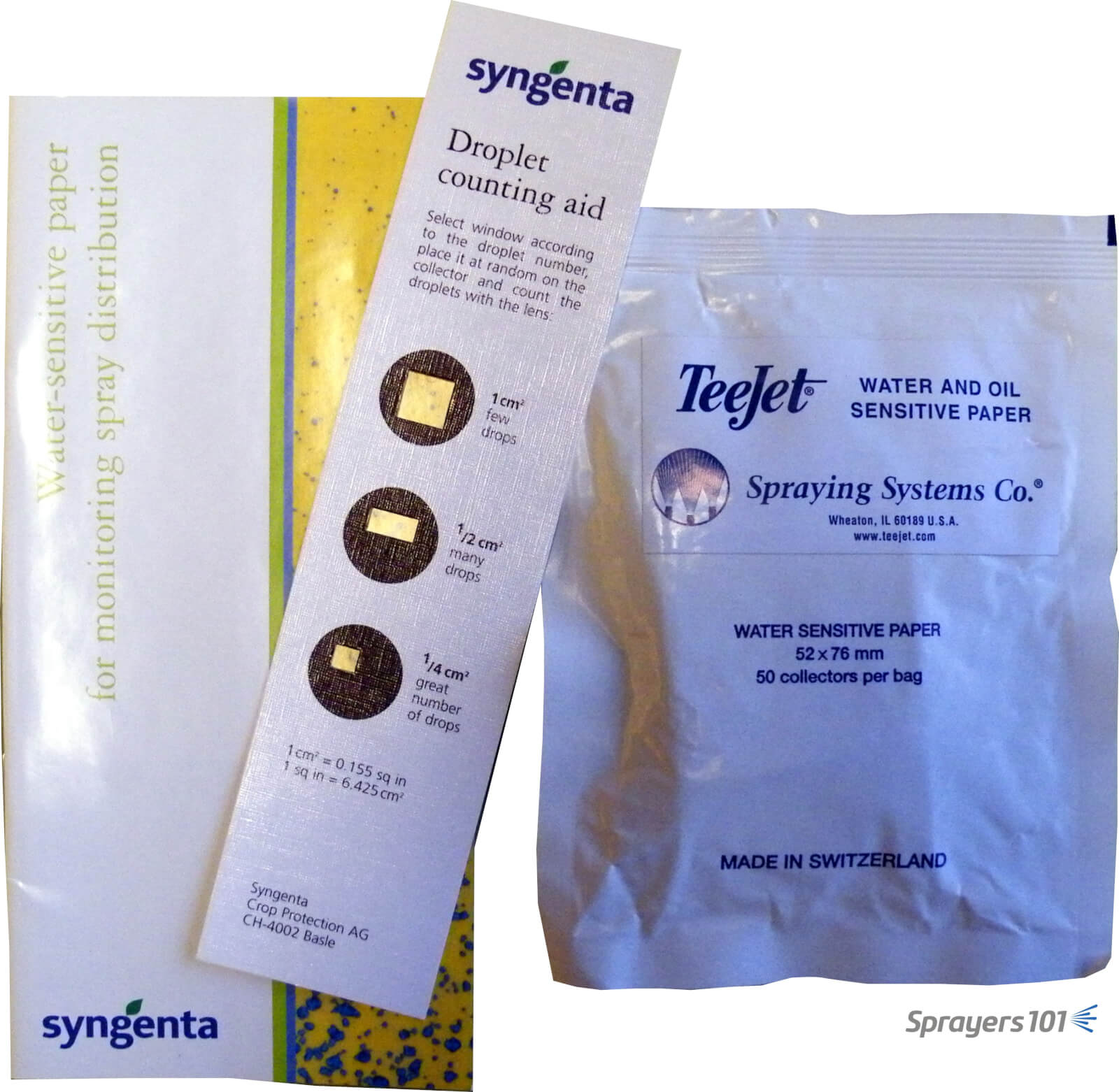
    Water- (and oil-) sensitive paper: Cheap, simple and available on-line or in person from your favourite sprayer equipment store.
    Water- (and oil-) sensitive paper: Cheap, simple and available on-line or in person from your favourite sprayer equipment store.

    Draw a map

    Begin by creating a simple drawing of the tree, cane, bush,vine, etc. you wish to spray. Label the drawing with unique numbers that correspond to where you are going to place the papers. Write the numbers on the back of each paper so you can see where they came from after they are collected. You should also note the pass number, so you can differentiate between each sprayer setup and corresponding pass. You might make a change and want to see how it affects coverage, and it’s very easy to mix up the papers if you haven’t record everything clearly. Plan to do this for at least two plants upwind from the sprayer to ensure you will get an accurate representation of average coverage. Be sure to wear disposable gloves and avoid dew so the papers don’t react prematurely.
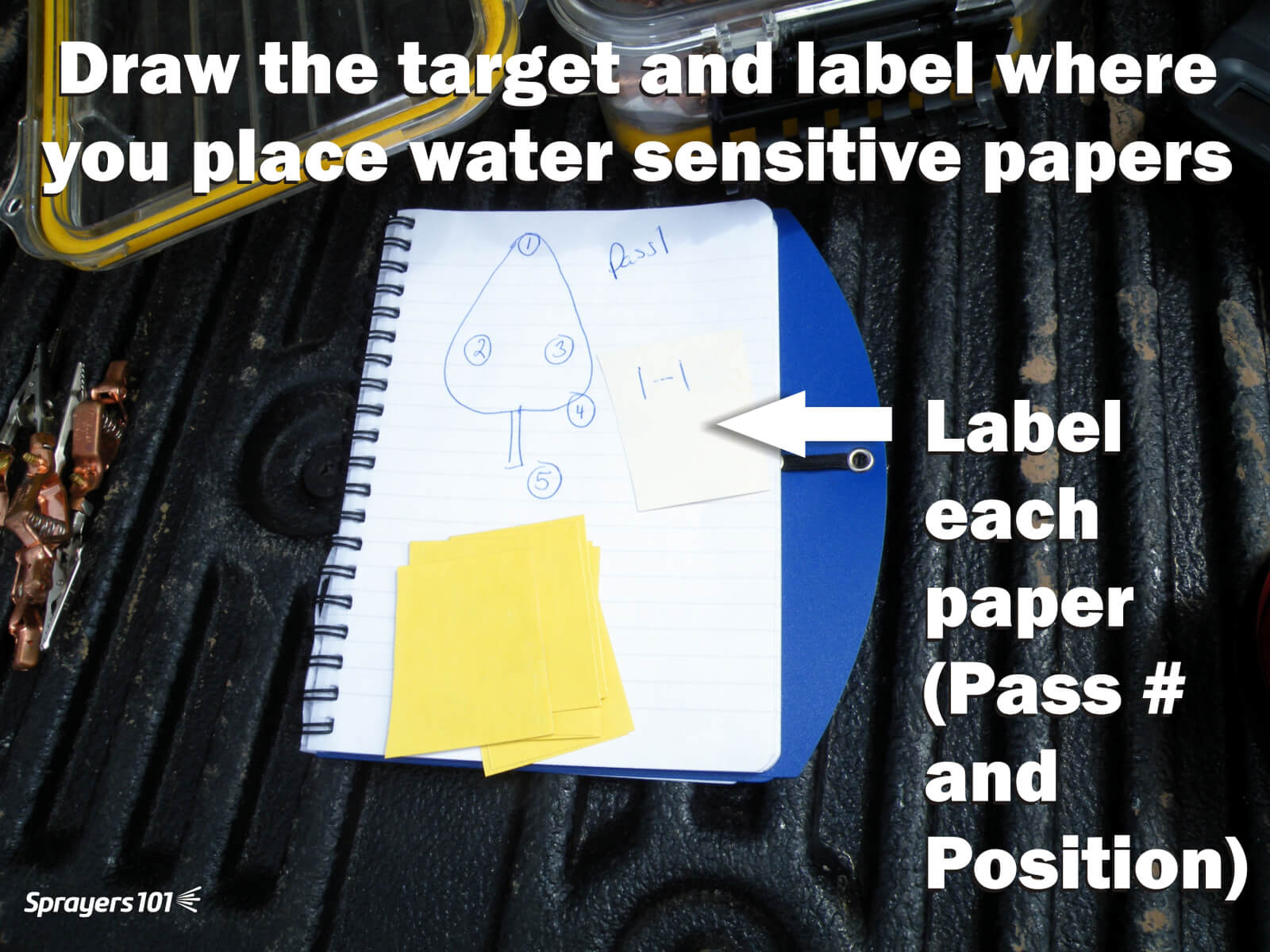
    Create a simple drawing of the target. Number positions on the drawing that correspond to where you plan to place the papers.
    Create a simple drawing of the target. Number positions on the drawing that correspond to where you plan to place the papers.

    Distribute the papers

    It is critical to distribute the papers evenly throughout each target canopy. They should be placed in key locations where pest damage has been an issue in the past (e.g. scab at the top of a tree, or spotted-wing drosophila at the bottom-centre of highbush blueberry), or anywhere coverage is notoriously difficult. Our preference is to place them at the top, centre and bottom of a tree canopy as well as laterally from the outer edge of the canopy beside the sprayer moving in towards the trunk.
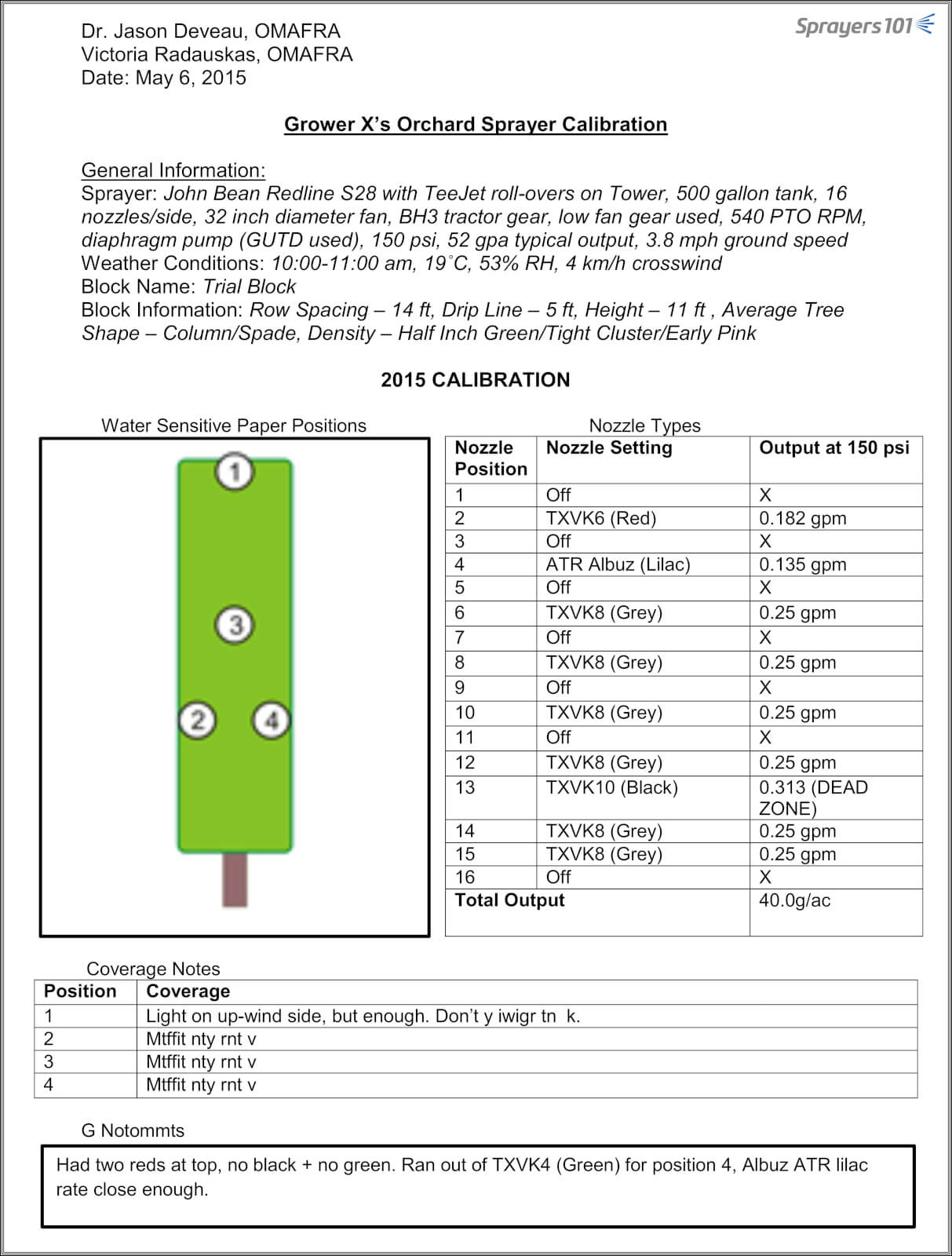
    Number positions on the drawing that correspond to where you plan to place the papers. Label the papers as well so you know where they came from. Consider writing the pass number and the position (e.g. 1-1 would be Pass 1, Position 1) so you can evaluate the changes to the sprayer settings from pass to pass. (Figure 60) Later, all the information from the calibration can be entered into your spray records, like in this example.
    Number positions on the drawing that correspond to where you plan to place the papers. Label the papers as well so you know where they came from. Consider writing the pass number and the position (e.g. 1-1 would be Pass 1, Position 1) so you can evaluate the changes to the sprayer settings from pass to pass. Later, all the information from the calibration can be entered into your spray records, like in this mock-up.

    We use spring-back paper clips attached to alligator clips at 90 degrees to attach the papers to small branches. You can also staple them to the upper or lower face of the leaves (as long as they don’t cause leaf to droop). You can wrap them around stems for panoramic coverage or to monitor drenches. They can be stapled the trunk to show if spray is aimed into the canopy or being wasted. You can even skewer to the ground using wire flags to to illustrate poor lower-nozzle positioning and/or canopy run-off. Put them wherever you want to know about spray coverage!
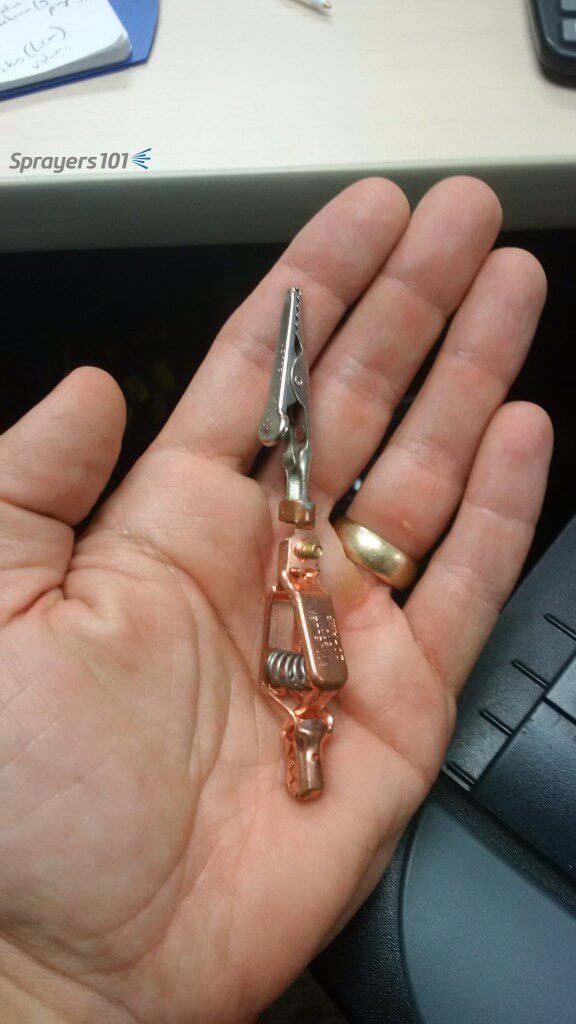
    This home-made double-ended alligator clip holds papers at right angles. One end for the paper, the other end to a twig or wire flag.
    This home-made double-ended alligator clip holds papers at right angles. One end for the paper, the other end to a twig or wire flag.

    We typically orient them facing the alleys so their sensitive faces are square to the sprayer as it passes. We often use two in each location, oriented back-to-back facing each alley so you can resolve coverage from both sides. The important part is to ensure you are consistent. Mark the location in the canopy with some colourful flagging tape so you can find the papers after you spray, and if you wish to replace them with fresh papers to evaluate another pass, orient them the same way to make the comparison fair.
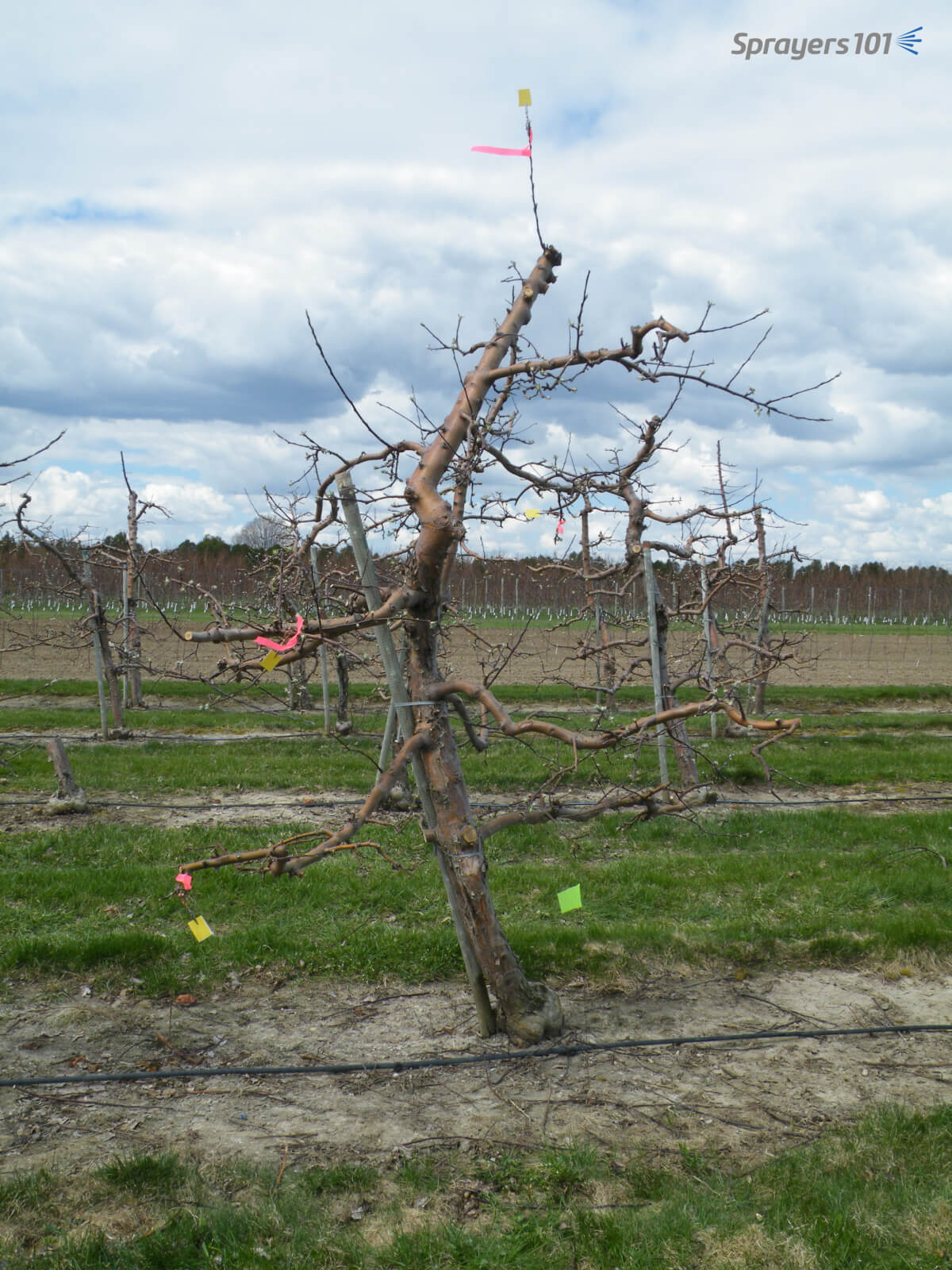
    Water-sensitive papers located in five positions in an Empire apple tree. Two papers were pinned back-to-back in each position, distributed evenly throughout the canopy, facing the alleys. One paper was located at the lowest branch to determine if the lowest nozzle position needed to be on. Another paper was pinned to the ground face-up under the tree to show any excessive waste. Be creative, but be consistent from pass to pass.
    Water-sensitive papers located in five positions in an Empire apple tree. Two papers were pinned back-to-back in each position, distributed evenly throughout the canopy, facing the alleys. One paper was located at the lowest branch to determine if the lowest nozzle position needed to be on. Another paper was pinned to the ground face-up under the tree to show any excessive waste. Be consistent from pass to pass.

    Spray, check and spray again

    Once the papers are in place, pass by on one side with both booms open (as you would normally spray). Be sure to start spraying well before passing the target, and keep spraying afterwards to ensure the resultant coverage represents an actual application. It is very informative to get out of the cab and examine the papers before passing by on the other side. You can learn a lot about how the wind is affecting the spay.
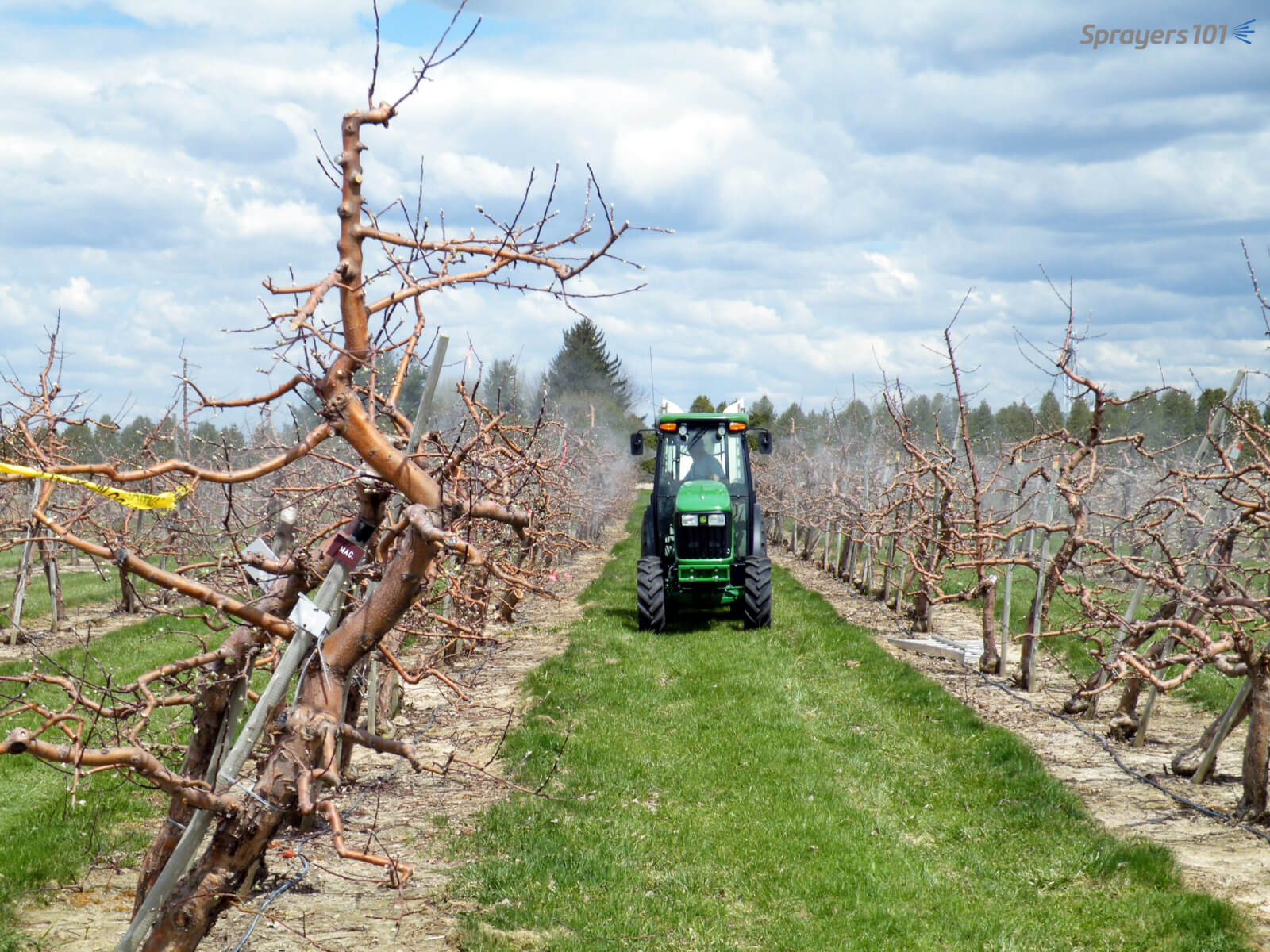
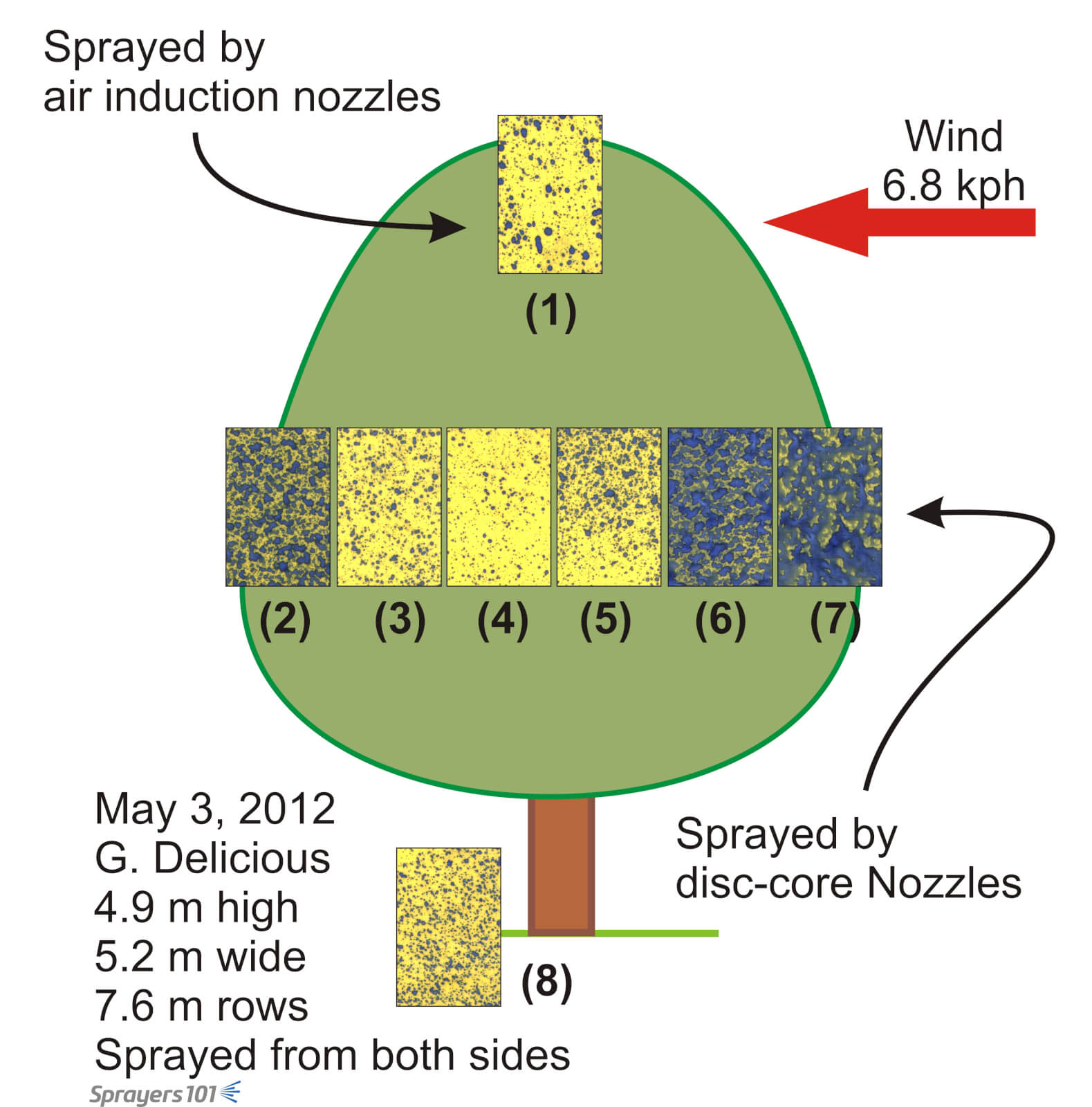
    Once papers are in place, pass by spraying with both booms open to emulate a typical spray day. Be sure to start spraying well before passing the target, and keep spraying afterwards to ensure the resultant coverage represents an actual application. It can be very informative to examine coverage at this point to see how wind is affecting the spray. Then, pass by on the other side to complete the application.
    Once papers are in place, pass by spraying with both booms open to emulate a typical spray day. Be sure to start spraying well before passing the target, and keep spraying afterwards to ensure the resultant coverage represents an actual application. It can be very informative to examine coverage at this point to see how wind is affecting the spray. Then, pass by on the other side to complete the application.
    An example of the coverage obtained on water-sensitive papers placed throughout an apple tree canopy, and on the ground beneath it.
    An example of the coverage obtained on water-sensitive papers placed throughout an apple tree canopy, and on the ground beneath it.

    Interpret the patterns

    You might notice the outer portions of larger canopies receive more spray than the inside. This is hardly surprising given that spray must pass through the outside to get to the inside. As a result, inner papers often receive proportionally less spray and should be the basis for determining if you have sufficient spray coverage. This is also why the label recommendation of “spraying to the point of runoff” is unhelpful: the outer portion of wide, dense canopies often begin to drip before the inner portion receives sufficient coverage. Further, how do you spray to the point of runoff? How do you know when to stop before it’s too late? Label language can be frustrating…

    When water-sensitive paper is sprayed to the point of run-off, the blue dye will drip. This is fine for a drench (dilute) application, but excessive for a typical concentrated application like foliar fungicides and insecticides.
    When water-sensitive paper is sprayed to the point of run-off, the blue dye will drip. This is fine for a drench (dilute) application, but excessive for a typical concentrated application like foliar fungicides and insecticides.

    When assessing coverage, don’t follow the droplet counts in the small guide that comes with the paper sensitive paper kit – they haven’t been updated for a very long time and are more appropriate for field crop applications – not airblast applications. Research and experience suggest that 85 discrete fine/medium-sized droplets per square centimetre and a total coverage of 10-15% should be sufficient for most foliar insecticides and fungicides. Remember, this is only a suggested threshold and in the case of coarser sprays, focus more on even distribution and the 10-15% coverage.
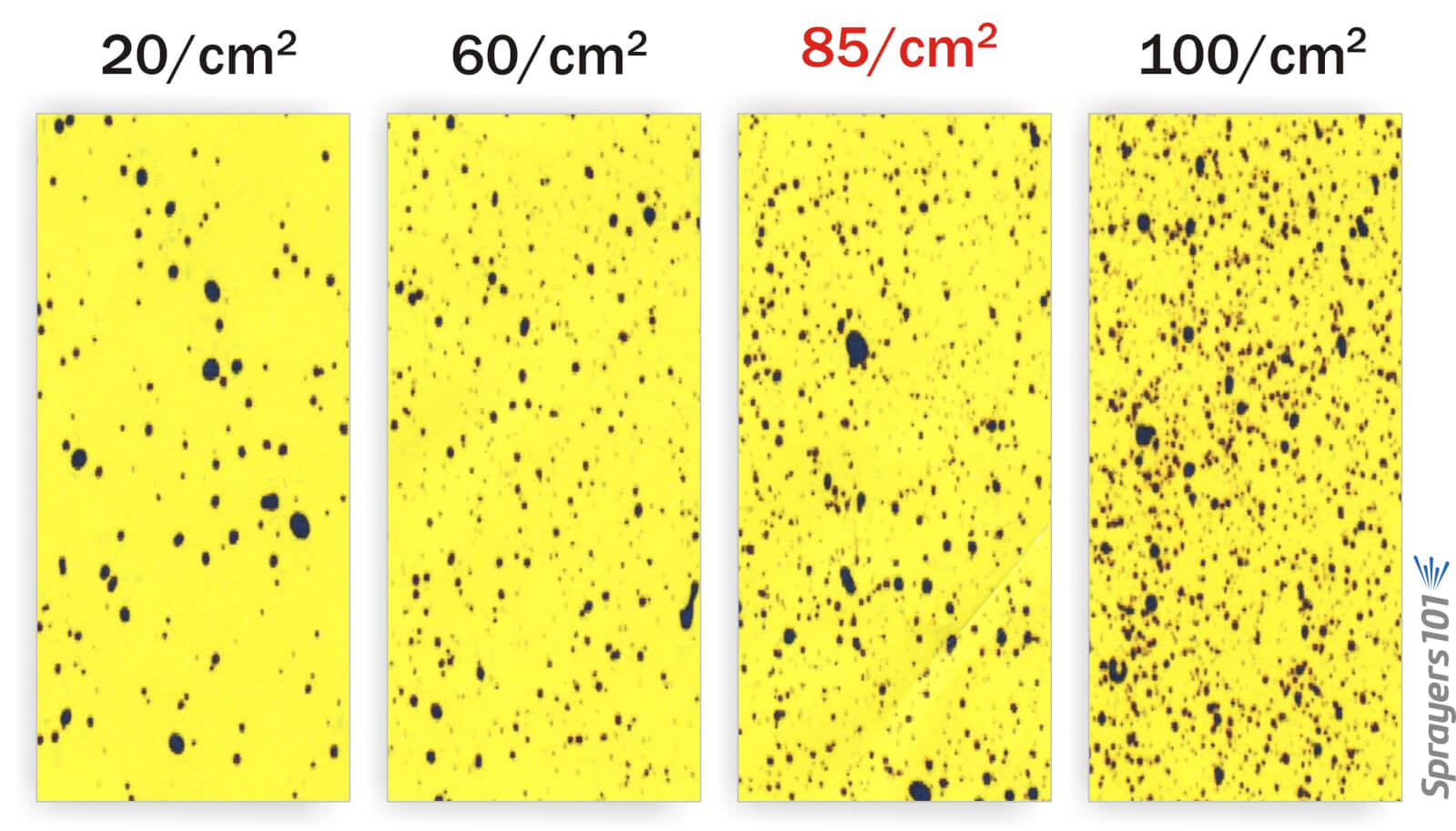
    It’s debatable, but 85 fine/medium-sized drops per square centimetre and about 10-15% total surface covered represents adequate airblast spray coverage for most foliar applications. It is less applicable for applications made with very coarse droplets, because there are fewer of them and they generally cover more area. In this case, focus more on the even distribution of spray and the 10-15% coverage. The extreme example of this is a drench (dilute) application of oil where total saturation is the goal.
    It’s debatable, but 85 Fine/Medium-sized drops per square centimetre and about 15% total surface covered on a minimum 80% of all papers represents adequate airblast spray coverage for most foliar applications. It is less applicable for applications made with Coarse/Very Coarse droplets, because there are fewer of them and they generally cover more area. In this case, focus more on the even distribution of spray and the 15% coverage. An extreme example of this is a drench (dilute) application of oil where total saturation is the goal. Conversely, ultra-low volume applications employ Very Fine droplets and a better metric is uniform, high droplet density rather than area covered.

    Make a change and try again

    There’s no easy way to define a threshold between sufficient and insufficient spray coverage. When you retrieve and examine the papers, think about how the product is intended to work: “Is it a contact, trans-laminar or locally systemic pesticide? What are the odds that an insect or spore will come in contact with residue? Will I be spraying again soon (e.g. fungicide) and will the spray already on the leaves have residual activity?” Regarding that last thought, protectant fungicide applications are often layered, so what one spray misses, the next will catch. Quite often, “sufficient coverage” is less than most sprayer operators think.

    If you are content with the coverage, record your sprayer settings to use them again in that block (in similar weather, and assuming the crop canopy doesn’t change significantly before the next spray day). If you are not content, make a change to the sprayer to improve matters, reset the papers, and go again. It can take time and some effort to get it right, but improved coverage and reduced waste are ample financial reward for your efforts.

    Other methods of evaluating coverage

    It should be noted that while water-sensitive paper is versatile, cheap and easy to use, it has its shortcomings. Placement and orientation of the paper is very important; it’s easy to hit papers on the outside of the canopy with the sensitive-side facing the sprayer. It’s considerably harder when they are at the very centre of the canopy, or hiding behind fruit. When the thin edge of the paper is oriented to the spray (i.e. oriented facing the ground), it presents very little surface and can be difficult to hit.

    Use enough air to only just ruffle the leaves. This exposes all surfaces, however briefly, to the spray. Too much air will align leaves with the spray, exposing only their thin edge and making coverage difficult. Too much air may also cause leaves to shingle (overlap), and create shadows like on the grape leaves shown here.
    Use enough air to only just ruffle the leaves. This exposes all surfaces, however briefly, to the spray. Too much air will align leaves with the spray, exposing only their thin edge and making coverage difficult. Too much air may also cause leaves to shingle (overlap), and create shadows like on the grape leaves shown here.

    Further, the papers won’t show the finest droplets (<50 µm), so there may be spray even though you can’t see it. Taken collectively with the product’s mode of action (i.e. contact or locally systemic), and any possible re-distribution by rain or dew, spray coverage becomes a good indicator for protection, but it isn’t definitive. While coverage is a good indicator, improved coverage does not always mean improved efficacy.

    Some sprayer operators use other methods to confirm their coverage. Kaolin clay is an inert compound that leaves white residue when dry. Red, yellow or green water-soluble, food-grade dyes will also indicate coverage. Even fluorescent dyes such as phosphorus can be sprayed at night and illuminated under black lights.
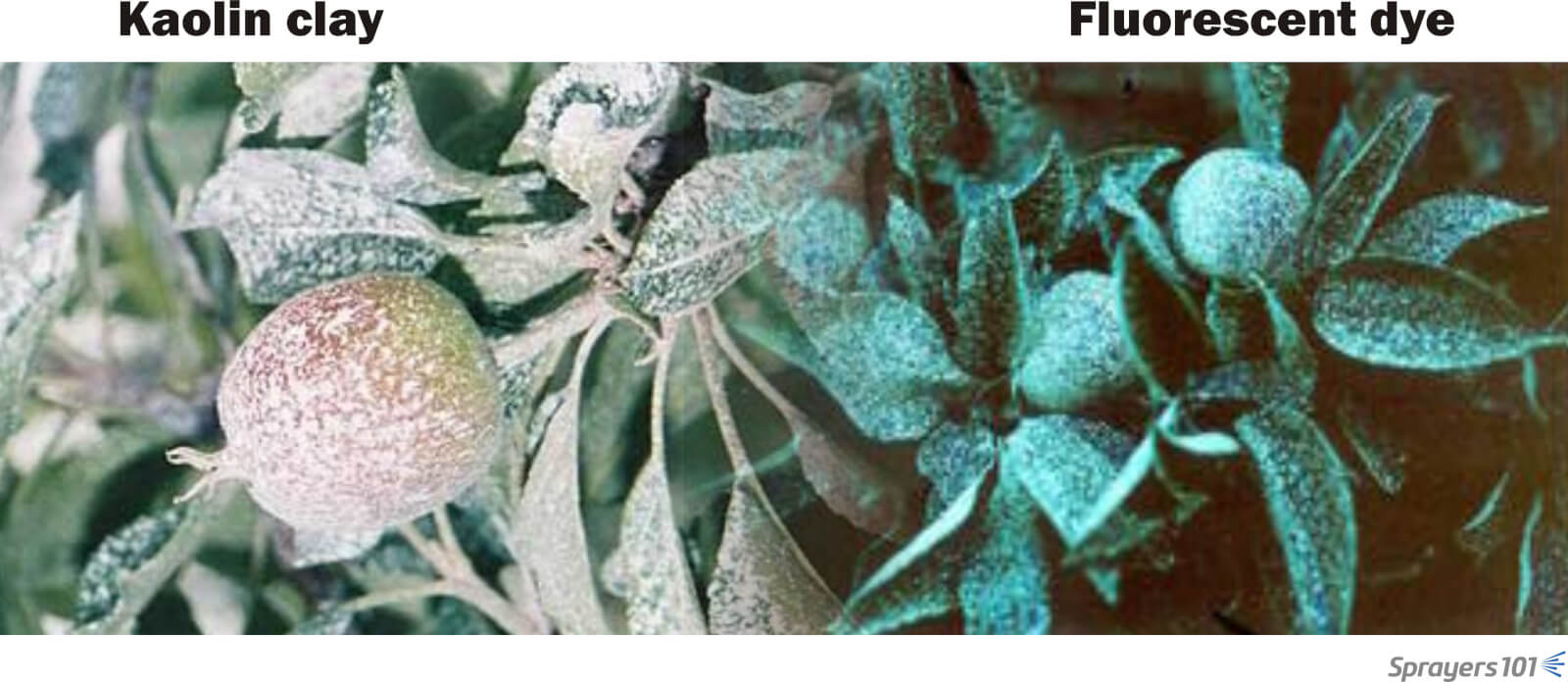
    Kaolin clay and fluorescent dies sprayed into fruit canopies give a lot of information about sprayer coverage, but are relatively inconvenient compared to water-sensitive paper.
    Kaolin clay and fluorescent dies sprayed into fruit canopies give a lot of information about sprayer coverage, but are relatively inconvenient compared to water-sensitive paper.
    Red food-grade dye sprayed from a horizontal boom to demonstrate downwind drift onto a white target. This was a messy experiment and my hands, and the sprayer, were pink for a long time afterwards. Photo Credit – J. McDougall, Ontario.
    Red food-grade dye sprayed from a horizontal boom to demonstrate downwind drift onto a white target. This was a messy experiment and my hands, and the sprayer, were pink for a long time afterwards. Photo Credit – J. McDougall, Ontario.

    Take home

    These methods give the sprayer operator a lot of information because they land on the actual target, not a piece of paper hung in the canopy. But, they require a lot of time and effort and are typically out of reach for most operators. Further, they do not allow multiple applications on the same canopy to compare the effect of sprayer settings on coverage – once the target is sprayed, it’s sprayed.

    No matter which method you choose to use, understanding how changes to you sprayer, or the impact of weather, affect coverage is a critical piece of information. Operators should make an effort to evaluate spray coverage. Here are a few videos describing the process:

    Using water-sensitive paper for airblast coverage diagnostics – thanks to Penn State, Univ. New Hampshire and Chazzbo Media (2014).

    Checking water-sensitive paper in an orchard. Tower is spraying only water during a calibration run (2013).
  • The Sprayer Operator – The Most Important Factor in Spraying

    The Sprayer Operator – The Most Important Factor in Spraying

    Spray application is one of the most important activities regularly done in any crop operation. It can also be one of the most expensive and time-consuming. Integrated Pest Management (IPM) is a multi-step process that helps sprayer operators make informed choices about when and what to spray. But, the decision to spray is not the end of the process.

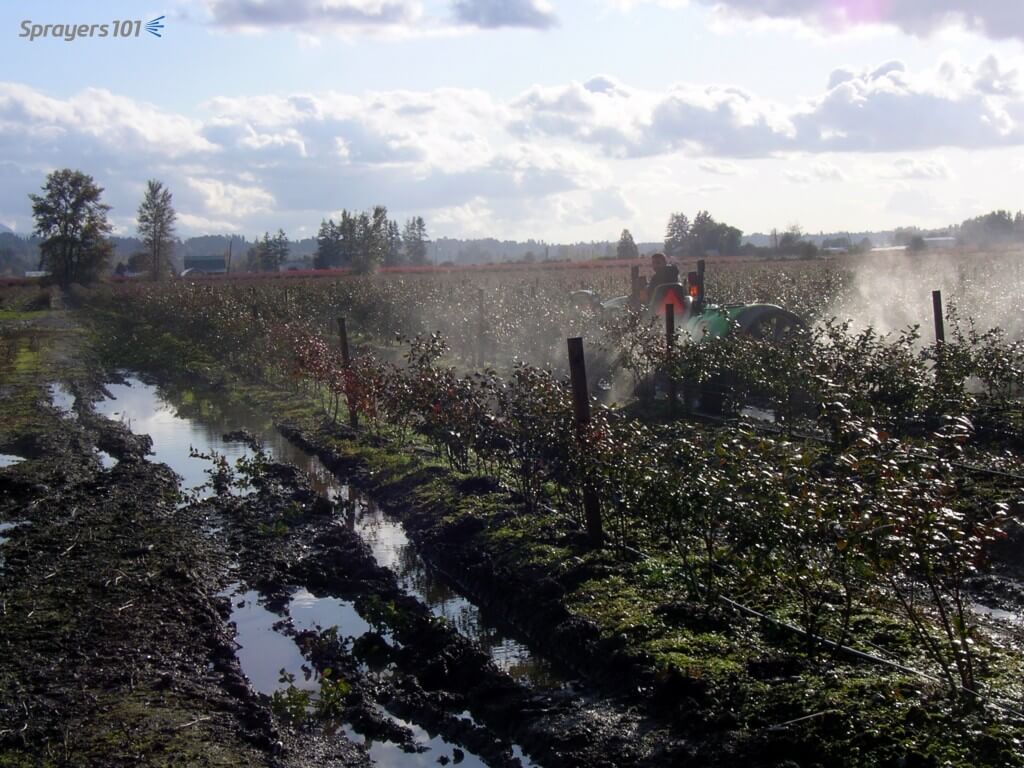
    Spraying highbush blueberry in British Columbia just after a rain. Not ideal, but sometimes the window for application is very small. It’s not the ideal situation, but one strategy for spraying a protectant fungicide on wet leaves is to concentrate the tank mix and use less spray per hectare. The fewer, and more concentrated, spray droplets will dilute in the water already on the leaves and the possibility of run-off is reduced. This is a stop-gap measure, only. The spray will not dry or distribute as it was intended and this strategy will require an additional full-rate application as soon as the weather improves, as long as the label permits. It is often said there is no such thing as a wasted fungicide application.
    Spraying highbush blueberry in British Columbia just after a rain. Not ideal, but sometimes the window for application is very small. It’s not the ideal situation, but one strategy for spraying a protectant fungicide on wet leaves is to concentrate the tank mix and use less spray per hectare. The fewer, and more concentrated, spray droplets will dilute in the water already on the leaves and the possibility of run-off is reduced. This is a stop-gap measure, only. The spray will not dry or distribute as it was intended and this strategy will require an additional full-rate application as soon as the weather improves, as long as the label permits. It is often said there is no such thing as a wasted fungicide application.

    The sprayer operator now faces a lot of decisions about sprayer set-up and application method. These decisions determine if the application will be effective, and they also determine if it will be efficient. Efficient spraying saves money and reduces environmental impact. The goal is to be both effective and efficient.

    So what should the operator be aware of?

    A quick Google search reveals a seemingly endless number of sprayer articles by government, industry and academia (and many on this website!). There are differences in definitions, opinions on priorities vary, and classic sprayer wisdom is sometimes supported and sometimes debunked by current research. But, if you read enough of them you will find more similarities than differences, and common themes will emerge.

    Most agree that the objective of spraying is the safe and timely delivery of an effective, uniform dose of product to a target area. Any product not deposited on the target (e.g. spray drift, sprayer leaks, run-off, etc.) reduces efficiency and is called wastage. The literature points to six broad elements that affect spray efficiency and effectiveness. Sprayer operators should actively consider all six elements before, and during, each spray application.

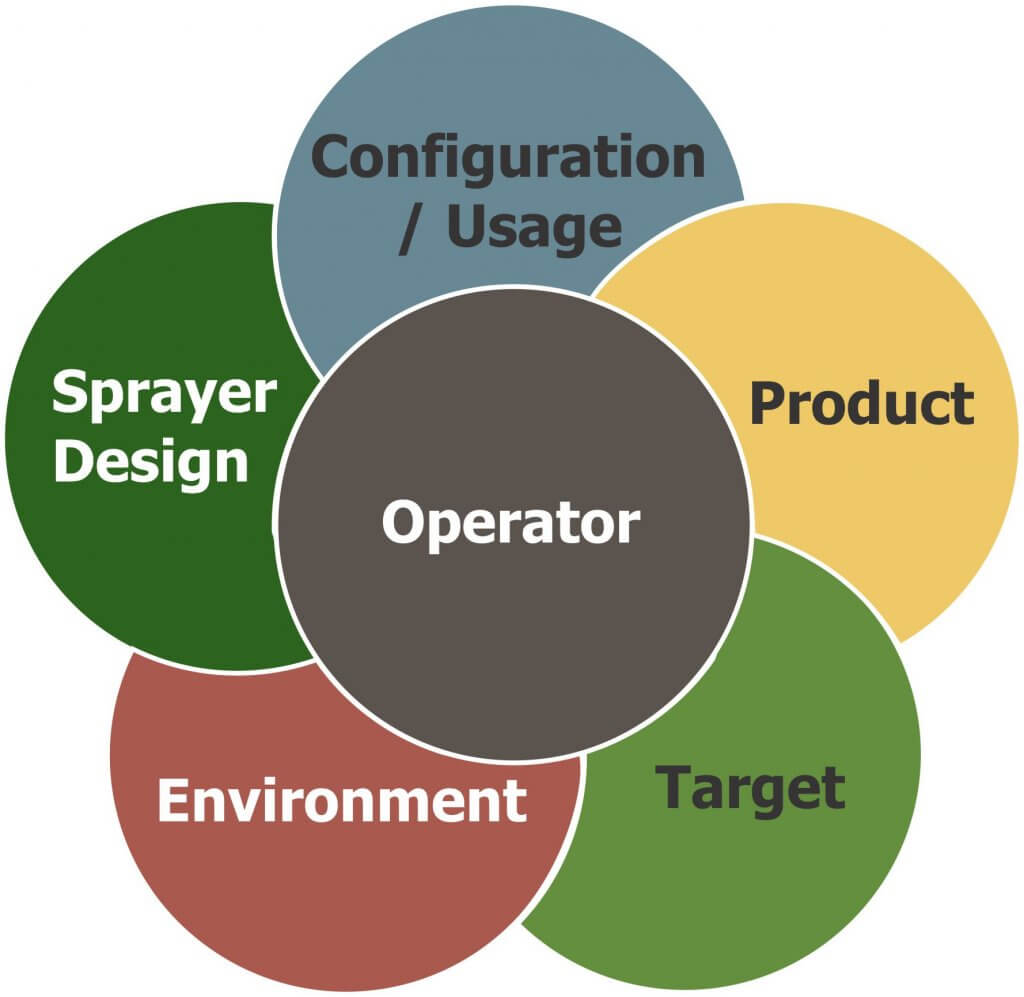
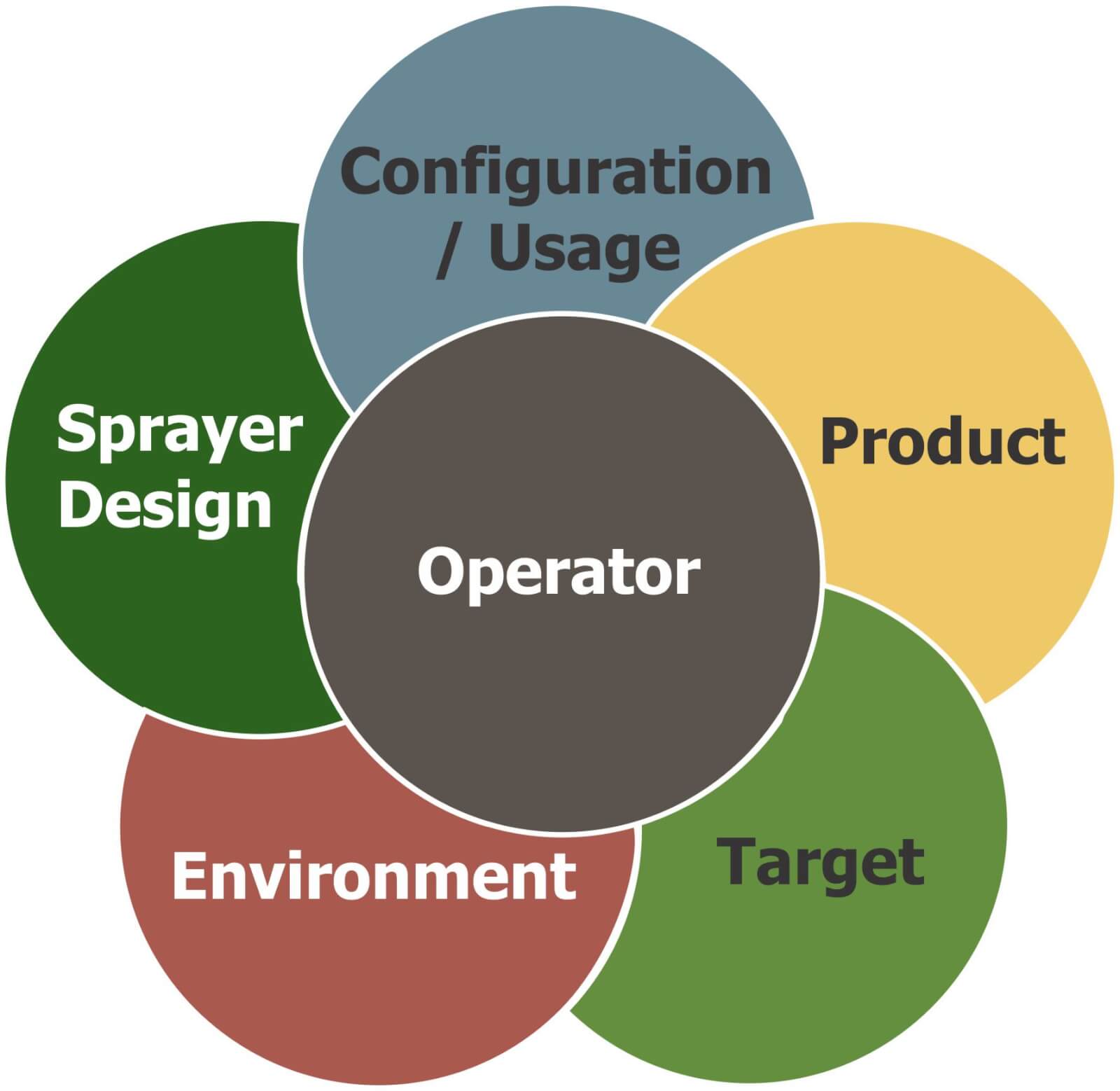
    The six elements in the illustration overlap because changing one of the elements often means reconsidering others. For example, increasing droplet size to reduce drift potential also reduces the number of droplets sprayed. This may warrant higher spray volumes, which means you might require a more dilute tank-mix to maintain the rate-per-area. Only the sprayer operator’s decisions affect all the elements, which is why it’s pictured in the centre. Technology or technique can not compensate for an inattentive operator; an operator’s skill and willingness to do a good job impacts the overall efficiency and effectiveness of every spray application. Understanding how droplets behave (or misbehave) is essential.

    The six elements of effective and efficient spray application.

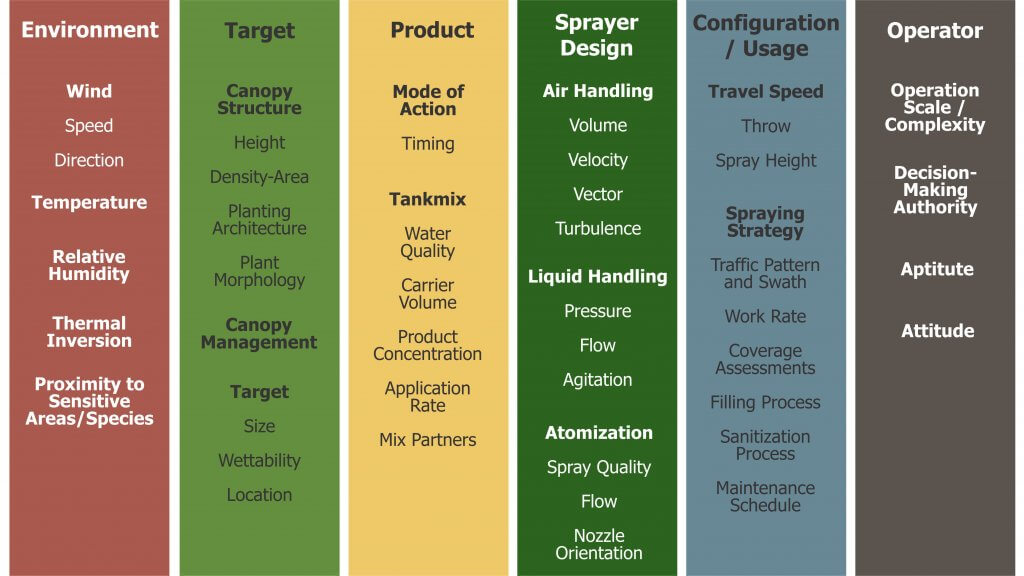
    Each element is comprised of many contributing factors. Some of these factors might fit under multiple elements and certainly we’ve reorganized this list many times over the years. No matter how they are presented, all of these factors (and more) contribute to the success of spray applications and they should figure into the operator’s considerations.

    The expanded six elements of effective and efficient spray application.

    So, as sprayer operators, we should all be aware of how the factors that affect an application. Take an active role! Don’t be afraid to get out of the tractor and make changes to your pressure or your nozzle choice. Check your coverage as you spray, and make adjustments as the weather changes. Finally, recognize when it’s a waste of time and spray, and know when to pack it in. The days of “set it and forget it” are no more!

  • Strategies to Spray the Top of a Perennial Canopy

    Strategies to Spray the Top of a Perennial Canopy

    Orchardists, nurserymen and hop growers share something in common – they want to get spray to the top of a tall plant canopy with as little waste as possible. The tops of trees, for example, are a primary site of infection as they filter spores from the air, so fungicide coverage is critical. Spraying the tops of high canopies (e.g. too high for over-the-row style sprayers) can be a difficult proposition.

    Here are a few considerations:

    • Wind moving through a planting, as a general rule, is twice as fast at the top of a canopy as it is at the ground. Wind carries spray off target.
    • The further the distance a droplet travels, the smaller it gets as it evaporates and the less momentum it has. The likelihood of it hitting the target is greatly reduced.
    • The top of a canopy typically has far less plant material than the rest of the canopy. Relatively speaking, there’s not much there to hit.

    In order to overcome these challenges, the traditional axial orchard sprayer is nozzled with a larger proportion of spray distributed at the top of the boom. The idea is to increase the odds of some spray making it to the top of the canopy. Often, full-cone nozzles are used to accomplish this. Of course, if an estimated 10% of the spray actually impinges on the top of the canopy, the rest goes… well, somewhere else. This shotgun approach is hardly an efficient use of chemical.

    Another strategy is to crank the PTO rpm’s up to 540, throw the fan in high gear and blow the spray as high as possible. The problem is, by increasing air speed and volume to carry spray to the top, the rest of the canopy (far closer to the sprayer) gets overblown and spray shoots right through. Some overspray might hit the next row, but most ends up on the alley floor. If you doubt it, consider how white your pant-legs get when you walk an orchard after spraying kaolin clay.

    Others, mistakenly, might elect to raise the operating pressure to >150 psi in the hope that pressure will drive the droplets in a straight line at higher speeds. Most airblast sprayers using hollow cone patterns create very fine spray quality, even at 100 psi. Raising pressure means the droplets get even smaller, and tiny droplets have very little momentum. Increasing pressure just makes the problem worse.

    Here’s what we propose.

    Deflectors

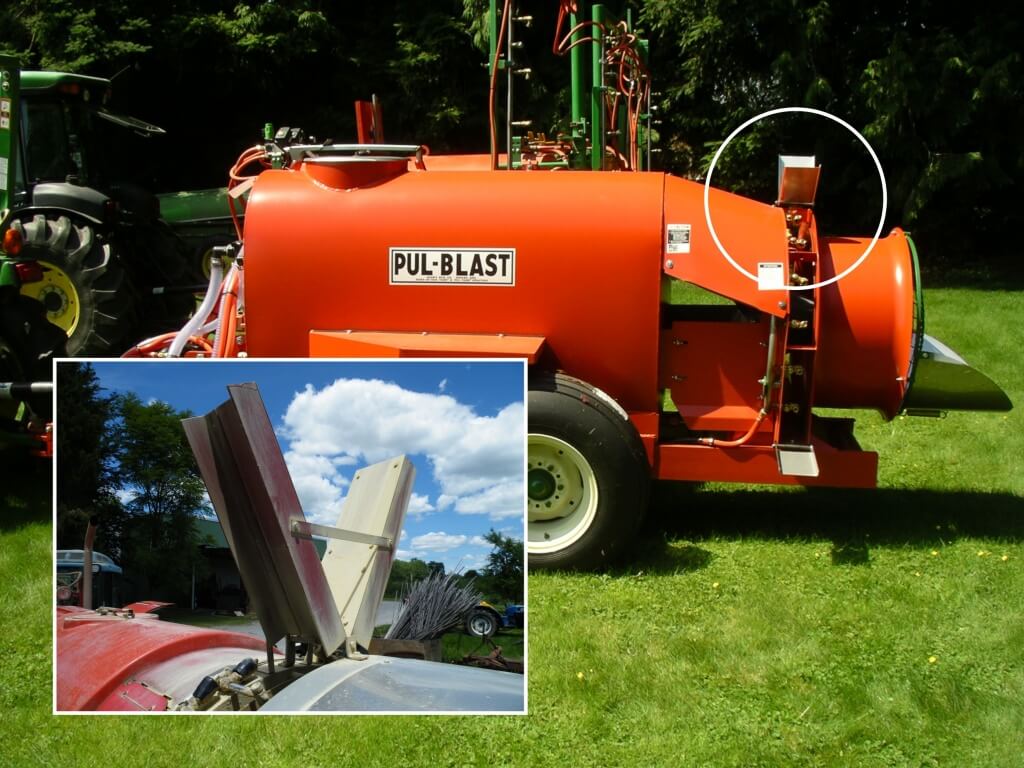
    If using an axial sprayer, employ air deflectors at the top of the air outlet to channel air (and spray) more effectively. The commercially-available deflectors are often just flat sheets, and air hits the surface and spills over all edges. Image pouring water onto a dinner plate – it just splashes over any which way. Better to replace those deflectors with a set that feature side-walls to channel the air. Anyone with access to a break and some sheet metal can make their own, but ensure they do not stick out beyond the wheel of the sprayer or they could snag plants and trellises. Always aim to overshoot the canopy top by a small factor to compensate for unexpected gusts of wind – better to overshoot a bit than to miss.

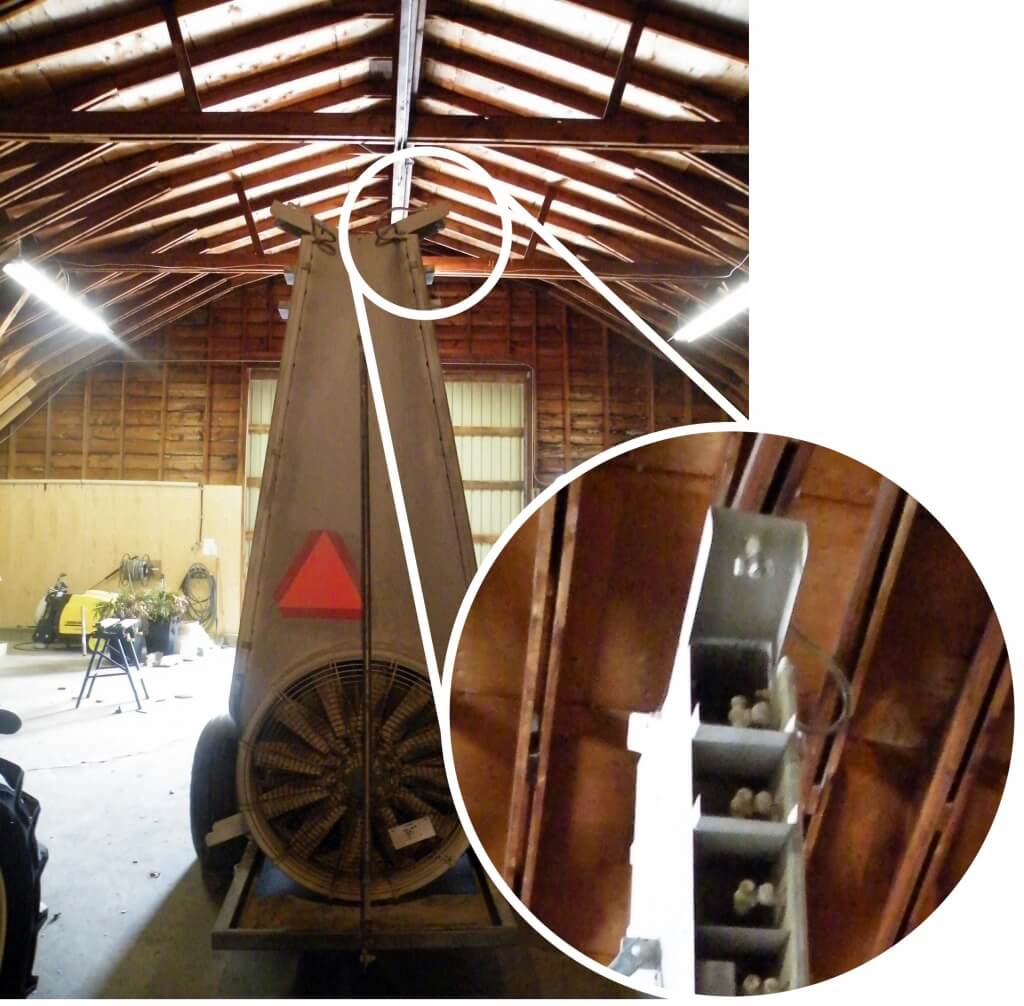
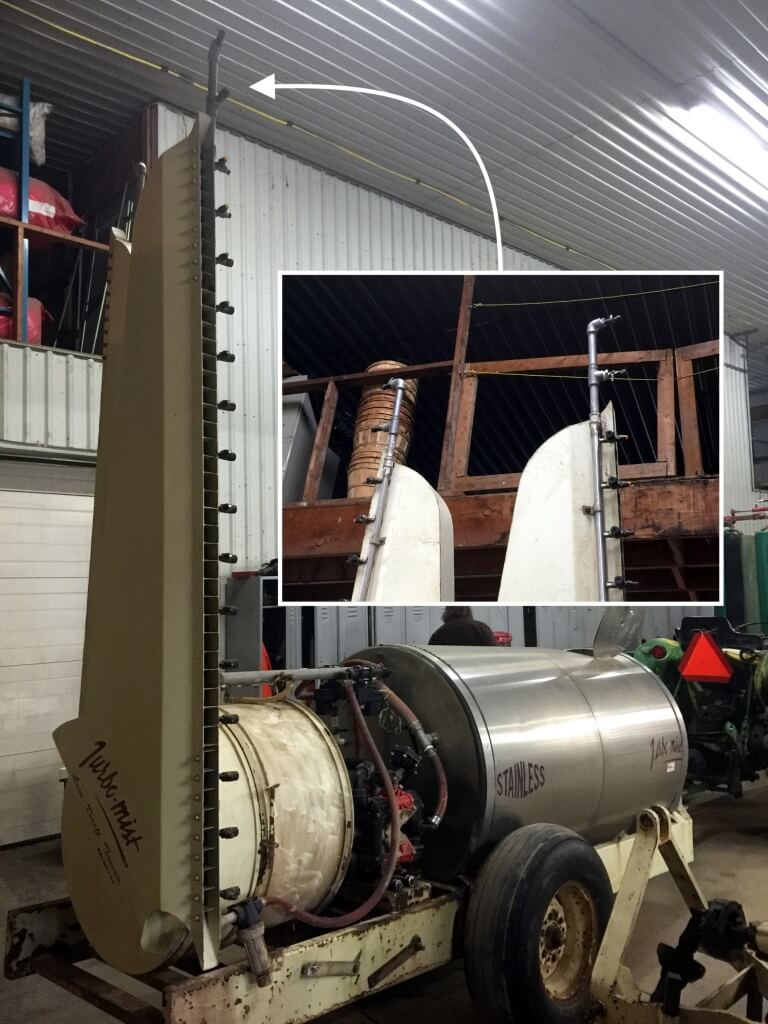
    Commercial deflectors may or may not have channeling side walls. Inset: Homemade deflectors can do a great job.Commercial deflectors may or may not have channeling side walls. Inset: Homemade deflectors can do a great job.
    Commercial deflectors may or may not have channeling side walls. Inset: Homemade deflectors can do a great job.
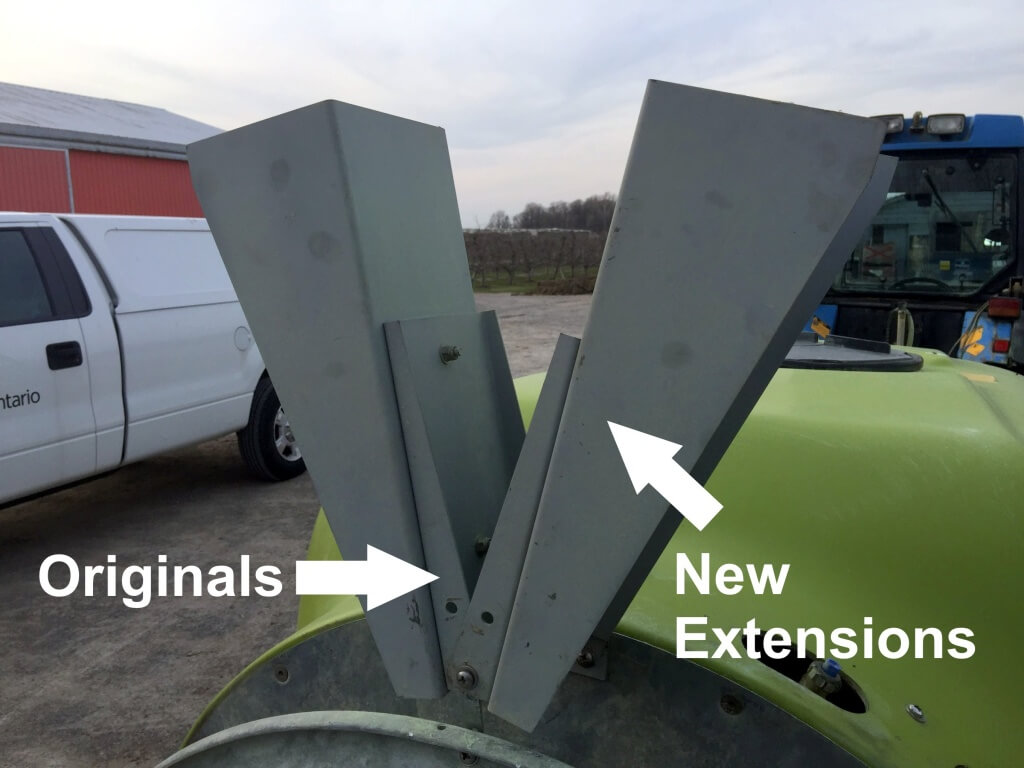
    The original Munckhof deflectors were reversed, and a larger set of extensions were fabricated and attached.
    The original Munckhof deflectors were reversed, and a larger set of extensions were fabricated and attached.

    Towers

    Better than deflectors, some sprayers move the air and nozzles closer to the target via ducted tower assemblies. They work very well, but they must be as tall as the target you intend to spray. Even then, an uneven alley can cause them to rock and you might still miss some upper targets. Operators using adjustable towers or ducts might angle them back to aim the air (and spray) on a slight upward angle rather than parallel to the ground, and that can compensate for a slight height difference, but it begins to defeat the purpose.

    Nozzle body on upper tower deflectors. Still some air assist and a good idea, but use air induction nozzles.
    Nozzle body on upper tower deflectors. Still some air assist and a good idea, but use air induction nozzles.

    Extra Nozzle Bodies

    Some creative operators have attached additional nozzle bodies to the tower’s top deflector plate to aim it up in the top of the canopy. Still others have extended the wet boom itself higher than the tower. Unfortunately, although the nozzle is closer to the target (good) the benefit of air assist has been greatly reduced (bad). Air induction nozzles might help on boom extensions, per below.

    Wet booms can be extended to reach high canopies, but may no longer benefit from air assist. Consider using air induction nozzles in these positions.
    Wet booms can be extended to reach high canopies, but may no longer benefit from air assist. Consider using air induction nozzles in these positions.

    Air Induction Nozzles

    Consider using air induction nozzles in the top two positions of each boom (totaling four per sprayer), with or without towers. There are three advantages:

    1. Coarser droplets have more mass. They move in straight lines and are less likely to be deflected by wind before they reach the target.
    2. Coarser droplets can be propelled by pressure, so unlike finer droplets they rely less on being carried by sprayer air.
    3. Coarser droplets that miss the target do not continue upwards; they fall back out of the air into the orchard, reducing off-target drift potential.

    No matter which strategy, or combination of strategies, you use to hit the top of the canopy, always confirm coverage using water-sensitive paper. Further, recognize that it’s very difficult to compete with high winds, so know when to wait it out.

    Controlling your spray at the top of the canopy means better coverage and less waste. Plus, people won’t see this (wait until the ~50 second mark).

  • Hol Spraying Systems – Canadian airblast gets an upgrade

    Hol Spraying Systems – Canadian airblast gets an upgrade

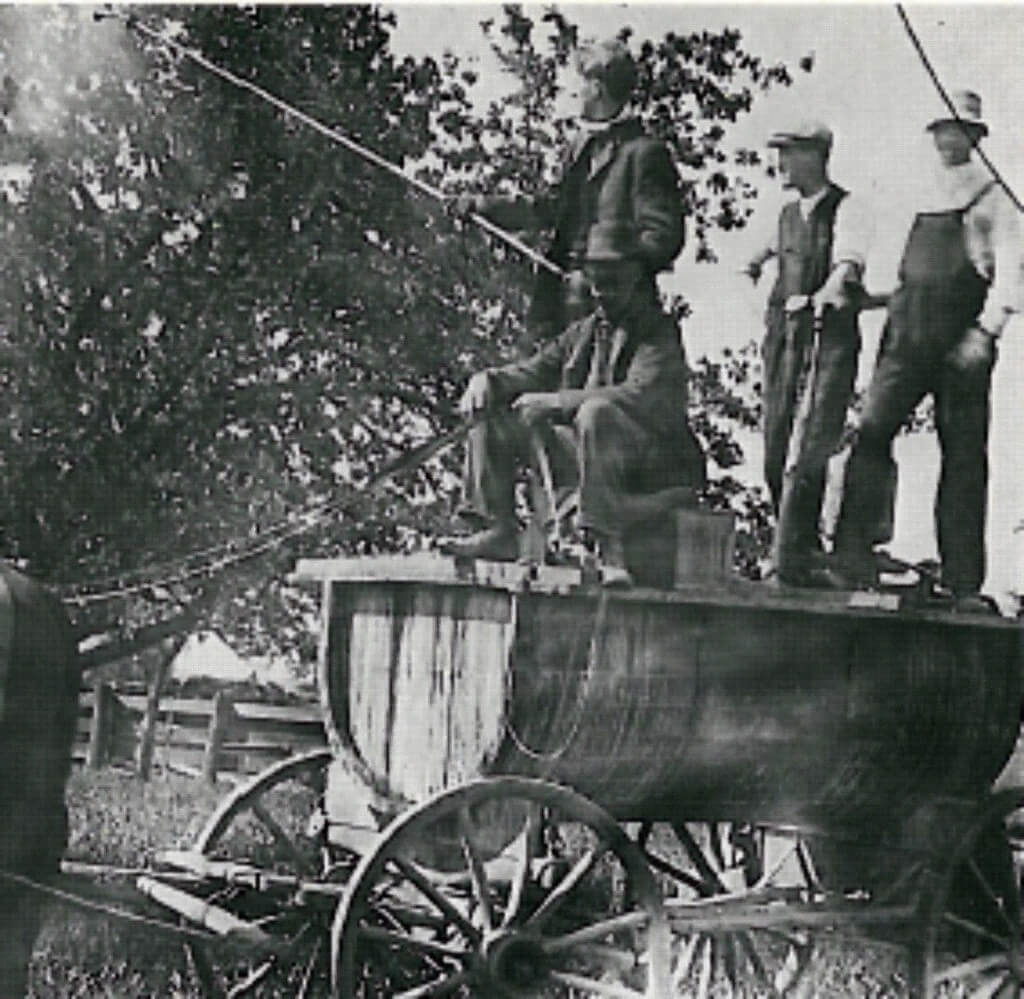
    The first modern airblast sprayer was developed in the mid 1900’s, but competed with existing equipment before it was adopted by the majority. As you can see below, we’ve come a long way. As application technology continues to evolve and grow, so does the array of choices facing growers.

    An Ontario orchard spray crew c.1910. Pump pressure was maintained by the two operators at the right. The spraying rate by the above method could cover 1.2 to 1.6 hectares (3 to 4 acres) per hour. Image from www.farms.com
    An Ontario orchard spray crew c.1910. Pump pressure was maintained by the two operators at the right. The spraying rate by the above method could cover 1.2 to 1.6 hectares (3 to 4 acres) per hour. Image from www.farms.com

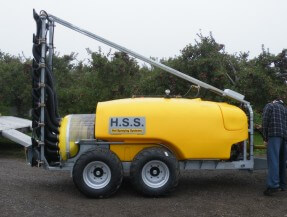
    Provide Agro (a subsidiary of N. M. Bartlett Inc.) had been considering introducing a new airblast sprayer to Canada for more than ten years. After deciding not to get into the manufacturing game, they explored importing sprayers from Europe and Australia. In late 2014 they recently invited me to see their choice: the H.S.S. CF airblast sprayer built by Holland-based “Hol Spraying Systems”.

    It’s not often I get to see a “new” airblast sprayer design. To be fair, H.S.S. has been building similar sprayers in Holland for more than 20 years, so technically it was new-to-me.

    We met at a local apple orchard in Simcoe, where we ran the sprayer through a series of light duties. The first thing we did was explore the sprayer’s features, both optional and standard. As the ambassador to Canada, this particular model had all the bells and whistles. Here is a list of features and observations I feel are worth relating. It’s important to note that this list is in no way an endorsement, nor are any omissions intended to be a condemnation.

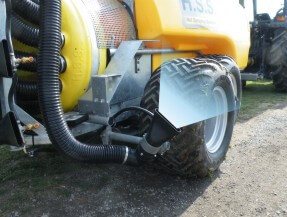
    The H.S.S. CF sprayer. Outwardly this PTO-driven sprayer appears very different from Ontario’s typical fleet of airblast sprayers. Notably the flexible ducts and gantry comprising the tower, and the double axle. However, it operates using the same principles as our more familiar sprayers and following a brief inspection of welds and fastens (and given its more than 20 year history in Europe) it appears to be very durable.

    Each duct is paired to a nozzle body, and that means each air outlet can be adjusted individually. The tower structure can be customized to match everything from vines to high-density orchards and even has an optional woolly aphid attachment for directing air and spray up-and-into the canopy. For taller crops like hops and semi-dwarf trees, a second fan can extend the tower to 5.5 m.

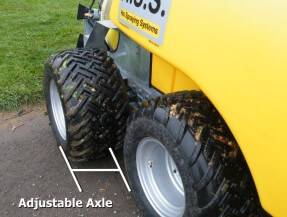
    Anyone that’s been stuck in wet weather can appreciate the value in this adjustable double axle. Weight is distributed to reduce compaction and hopefully, the creation of ruts. This feature is standard, but you have the option to upgrade to hydraulic adjustment. I’m not sure how often an operator would want to adjust the axle length, but there it is.

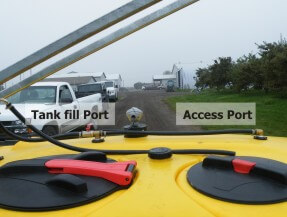
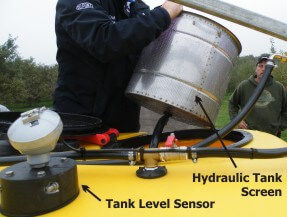
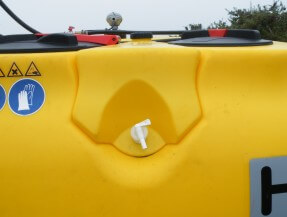
    The H.S.S. CF has a lot of features that promote operator safety by reducing the potential for exposure. One convenient feature is the access port separate from the tank fill port. No need to remove the basket to examine/clean the interior, and no need to remove the basket and come in contact with (potentially) concentrated pesticide residue.

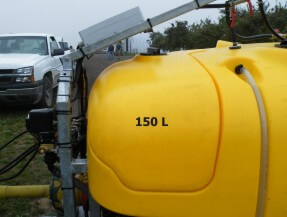
    Many large field sprayers feature tank rinse nozzles to facilitate sprayer cleanout following an application. Finally, airblast can boast this feature as well. The 150 L clean water tank supplies enough water to the tank rinse nozzles for a triple, low-volume rinse in the field with no need for a pressure washer or a nurse tank. This prevents residue buildup and reduces operator exposure – and it’s standard!

    An optional feature is the tank level sensor, which can be tied to the agitation. If you are using a foamy tank mix, agitation won’t turn on until a preset tank level. I’m not certain about this option because proper tank suspension requires agitation from the beginning – just use a defoamer. Note the tank basket has a hose attached to the bottom… read on.

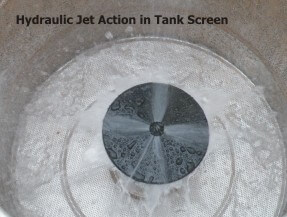
    There’s a standard hydraulic jet at the bottom of the tank basket to assist in proper mixing. I don’t know if it precludes mixing a slurry, or if it will improve pesticide bag dissolution, but I have to assume it helps. I trust there’s a safety feature to prevent this nozzle from operating while the hatch is open, but I’m not certain.

    This final standard feature may seem small, but it further reduces the potential for operator exposure. The onboard clean water source is separate from the spray tank and the tank-rinse supply and provides a convenient hand-wash station.

    Other features include solenoid shut-offs for boom sections, a rate controller and a small-radius draw bar.

    An important function of any airblast sprayer is air handling. Too often, tower sprayers have inconsistent air speeds (and presumably air volumes) over the length of the air outlet. Sometimes this can be compensated for using the small deflectors in the tower, or in extreme cases, replacing conventional hollow cone nozzles in “dead spots” with air induction hollow cones that produce coarser droplets and tend to fly farther under pressure. Using a Pitot meter, we examined the airspeed from each air outlet. The PTO was set to 400 rpm and the fan gear was in low.

    Nozzle:Ground234567Top
    Left70 mph85 mph90 mph85 mph80 mph85 mph80 mph85 mph
    Right75 mph90 mph90 mph90 mph80 mph90 mph85 mph85 mph

    There were no obvious dead spots, and the left and right sides of the tower seemed about equal. The bottom two positions were notably slower than the rest, but given the distance to the target in that position, and the fact that ambient wind is slower at the ground, it’s interesting, but not necessarily a concern.

    We arranged a set of water-sensitive targets in the canopies of semi dwarf apple trees to get a sense of the sprayer coverage. Admittedly, it was very humid and there was little wind that day, so coverage is much easier to achieve because so little spray evaporated or was blown off course before reaching the target. We ran different combinations of PTO speed and fan gear. These images are from 540 rpm and low fan gear using red Albuz nozzles (1.5 L/nozzle/minute @ 6 bar) spraying about 400 L/ha at about 5 kph. On a drier and windier day, higher volumes would be needed.

    There were no obvious misses, even when papers were oriented parallel with the ground (exposing their narrow edge to the sprayer, such as in the paper on the right). This isn’t conclusive, but it does show that the sprayer had no trouble penetrating the canopy, and with further tweaking should be able to provide suitable coverage throughout the canopy. Personally, given the upward orientation, I would use the woolly aphid nozzle for all applications, particularly for drenches. More on that later.

    One notable quality was the “quiet” operation of the sprayer. Applicators are familiar with the loud whine created by most airblast sprayers; at lower rpm’s and in low fan gear, the tractor seemed as loud (or even louder) than the sprayer operation. You can watch a video of one of the spray passes at the bottom of this article.

    So the big question: “How much?”. You’ll have to contact the dealers to find out more, but I will say that stripped down to standard features, it’s comparable to some of the more expensive sprayers in Ontario. Don’t be dissuaded because I believe the expense is warranted given the features, with particular note of the on-board tank rinse system and adjustable air ducts.

    So is this the sprayer for you? Well, if you’re in the market for a new sprayer, always start by prioritizing your goals. Perhaps work-rate is a priority, so look to sprayer capacity to reduce the number of refills and consider over-the-row technology (where possible) to reduce the number of passes. Perhaps the crop is adjacent to sensitive areas or residential homes and drift control is a priority; consider adjustable air direction and adjustable air speed.

    When compiling a prioritized list, reflect on the positives and negatives of your current sprayer and talk to fellow growers about their experiences. It may come down to personal preference, but consider the following points. These points are in no particular order; they come from many articles I’ve read on the subject of considering new equipment purchases and from talking to dealers, mechanics and sprayer owners:

    • Necessity – Is a new sprayer really needed? Manufacturers have a number of retrofit kits available to upgrade and improve sprayers. If poor pesticide performance has led to the decision to purchase a new sprayer, be sure it’s related to the technology, and not to an operating error.
    • Crop Type and Acreage – Consider the size of the operation and the size, shape and density of the crop(s). Can the sprayer adapt to provide adequate coverage throughout the growing season and in the long-term? How flexible is the sprayer when spraying different products onto different targets?
      • Sprayer Capacity and Filling – Fewer refills means a higher work rate, but increased capacity also means more weight, so consider the effects on navigation, turning radius and soil compaction. Is the tank easy to fill?
    • Cleaning, Calibrating and Maintenance – Moving between crops sometimes requires complete cleaning and decontamination of the tank, lines, nozzles and any shrouds or ducts. Clean water reservoirs, tank-rinsing nozzles and overall accessibility should be considered. Review the steps required to winterize and to calibrate the sprayer. Is it easy to access parts? Is operator exposure minimized
    • Horsepower – This is an important consideration for airblast sprayers because fans move a lot of air and liquid. Tank agitators require power, too. Consider selecting from the higher range of manufacturer-recommended horsepower to improve longevity. Remember, however, that fans typically don’t have to operate at the maximum rated rpm’s, particularly early in the season.
    • Nozzle Technology and Operating Pressure – Consider the range of nozzle-types intended for use and ensure the sprayer can provide sufficient pressure. While more expensive, diaphragm and piston pumps have fewer moving parts in contact with the spray solution, reducing cleaning time and operator exposure.
    • Spraying Conditions – A sprayer has to be reliable, even in adverse conditions, so consider the operating environment. Night spraying, uneven terrain, high winds, dry conditions – many environmental factors can impact sprayer performance and may warrant special consideration. Investigate deflectors, shrouds and the structural framework and durability of the sprayer.

    Since its introduction in late 2014, growers have been slowly adopting this sprayer in Ontario and the northern US. Some high-density operations have purchased the optional over-the-row boom system that allows them to spray multiple rows at once. Here at at the Simcoe Resource Station, we’re hoping to run the HOL sprayer in apples for the 2016 season to see if the optional woolly apple aphid (WAA) nozzle has any impact on scale, mites and of course, WAA control. Moreover, we plan to run that nozzle all season long to see if its upward angle improves underleaf coverage and canopy penetration.