Sprayers101 recently received a couple of seemingly unrelated questions about airblast sprayers:
What are the advantages and disadvantages of mechanical versus hydraulic agitation? Why would someone want a stainless tank versus the cheaper poly or fiberglass options?
Recognizing that each manufacturer has their own reasons for the features and materials used in their sprayers, we posed these questions to Mr. Kim Blagborne (formerly of Slimline Manufacturing). The following article was written from Kim’s response, and it turns out these two questions are very much related. Kim writes:
This is a great debate among customers and manufacturers, and it’s difficult to stay neutral. Let’s consider the following:
Hydraulic Agitation
The flow required for hydraulic agitation requires about 30% of the pumps total capacity. This is very important because many sprayers cannot achieve, or maintain, this minimum requirement whilst spraying. This may be why it’s rare for a sales person to demonstrate agitation while the sprayer is spraying; quite often, the agitation slows or even stops. And, of course, because everyone gets wet.
Let’s say an airblast sprayer has a pump with a manufacturer-listed capacity of 26 gallons per minute (gpm) (Click to download the spec sheet for the pump). The figure in that output chart is determined on a bench at 540 rpm and at 50 psi. However, when an operator uses that pump in the field, they run it at ~150 psi, and that brings the pump capacity down a bit to 25.5 gpm.
Now we build in the line pressure drop associated with the sprayer’s plumbing. Effectively, another 8-10% of the pump’s output is lost to plumbing (a figure easily measured by collecting the total output capacity of the pump). Let’s say we are now down to a practical capacity of 23 gpm.
If the operator’s crops are on 14 foot rows, it would be reasonable to spray 200 gpa at a travel speed of 3 mph at 150 psi. With both booms spraying that’s a required flow of 16.8 gpm.
Remember, our hypothetical 26 gpm pump can only provide 23 gpm in the field. When we subtract the 16.8 gpm required for spraying, we’re left with 6.3 gpm excess capacity for agitation. But, we said we needed 30% of the pump’s 26 gpm capacity, and that comes out to 7.8 gpm. We’re short by 1.5 gpm, or stated differently, we’re about 20% short of what we need.
Why don’t we see that deficit? Because the flow to the booms is prioritized, and therefore the sprayer output matches the calibration, so everything seems OK. But no one sees the reduced return flow through the regulator, and certainly no one peeks into the tank while spraying to see that the hydraulic agitation is greatly reduced.
And so, while everything looked great during loading, the spray mix (especially SC and WDG formulations) may not stay suspended correctly during spraying. In extreme cases, that could lead to burning a crop (high concentration) at the start of a spray job, and reduced efficacy (low concentration) at the end. We’re quick to blame the chemical, but no one ever thinks to question hydraulic agitation.
Let’s consider it from another angle: TeeJet suggests a model number 62905c-5 jet agitator for a sprayer with a 250 US gallon tank. To correctly agitate the contents of this tank, we will need 30 psi and 7.6 gpm (see the chart below).
Unfortunately, there is no simple way for an operator to measure the agitation pressure or the flow, so it goes unchecked. The only way to determine if the flow demand is satisfied is to apply the generic rule of 30% of pump capacity and make an estimate. That’s pretty loose math since we’ve already established that the listed capacity may not reflect reality.
Still another angle: Many operators now employ the Gear Up, Throttle Down (GUTD) approach to match their sprayer air settings to the crop canopy. However, when we reduce PTO input speed we also reduce pump capacity. Remember our piston diaphragm pump with the 26 gpm capacity at 540 rpm? We still need 16.8 gpm to spray, but reducing the rpm’s by 100, per GUTD, drops our pump output to only 23.16 gpm.
23.16 minus 16.8 equals 6.36, and we needed 7.8 gpm to maintain sufficient hydraulic agitation. Oops.
Mechanical Agitation and Tank Material
There are definite advantages to mechanical agitation. It is not affected by the PTO speed because it is already excessive at 540 rpm. This means there is no pump capacity issue and it allows the operator to take advantage of GUTD.
There are also a few disadvantages. Unlike a hydraulic system, mechanical agitation requires maintenance, such as regular (daily?) greasing. The packing where the the system inserts into the spray tank also requires occasional inspection and adjustment to prevent leaks.
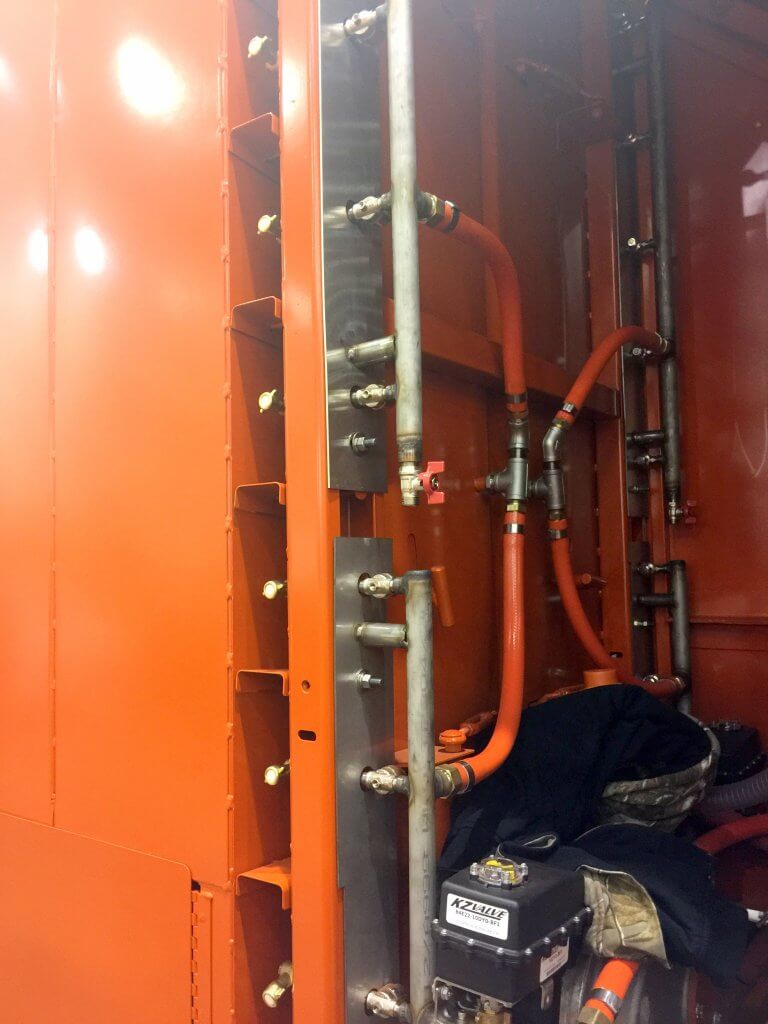
And of course there’s sticker shock. Many European manufacturers offer hydraulic agitation because it is ~$500.00 CAD less expensive. Further, mechanical agitation creates vibrational stress on tanks walls, which fiberglass or plastic tanks can’t handle for long. The solution is stainless tanks, which is a more expensive material. Further, stainless cannot be moulded around pumps and rotating parts, so more steel is required, adding to expense and weight.
In my opinion, there is sufficient benefit to stainless to easily recover the investment. Beyond permitting mechanical agitation, there’s durability. We have stainless tanks built in 1948 that are still operating today, and we’ve never found a plastic or fiberglass tank that can claim that. There’s also sprayer sanitation. It has long been know that stainless cleans more easily and more reliably that plastic or fiberglass, especially as the tanks begin to age.
Closing
The decision to buy a sprayer with hydraulic agitation or mechanical agitation lies, ultimately, with the consumer. But be sure to look past the price tag, and under the hood. Ensure that you have sufficient agitation to properly suspend your tank mix, and give you the flexibility to Gear Up and Throttle Down to improve your spray coverage and efficacy.
In Part One of this article, we showed that approximately 40% of minor use label expansions and registrant submissions rely on data from hand booms and guns. We also showed that a hydraulic backpack or knapsack will not give the same coverage as an airblast sprayer, and we concluded by suggesting that small plot researchers use spray equipment that reflects grower practices.
Unfortunately, practical logistics prevent most researchers from using a full-size airblast sprayer. They may not have access to such a sprayer, and if they do, it takes considerable time to mix and clean between treatments. Further, treatments are often only a single row, or even a single plant. It takes too much pesticide, too much time, and too much plot space to justify using a full-sized airblast sprayer, even if the relevance of the results are questionable.
Would another method of application better emulate an airblast application but retain the convenience of a hand boom or gun?
The motorized backpack mistblower
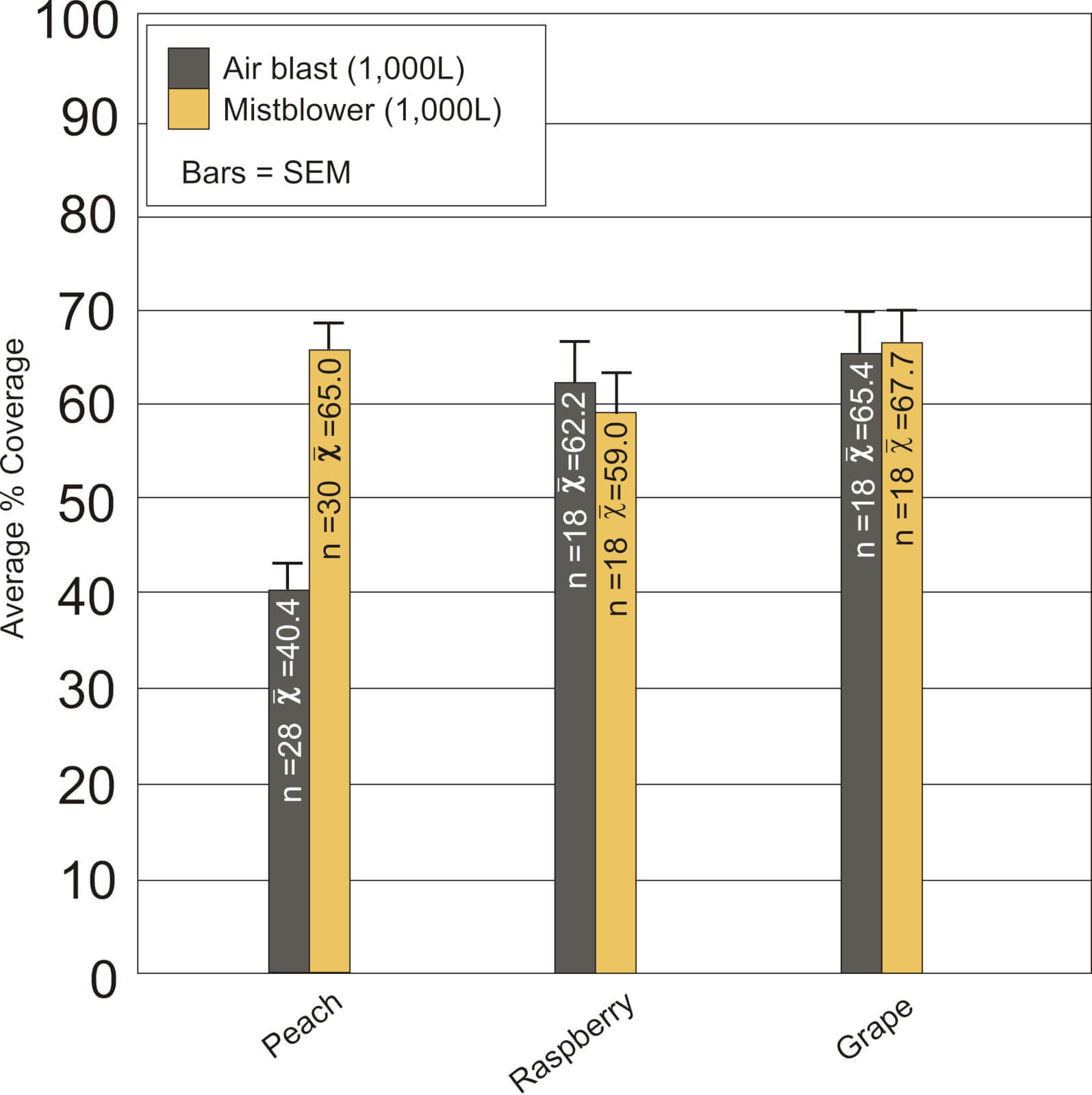
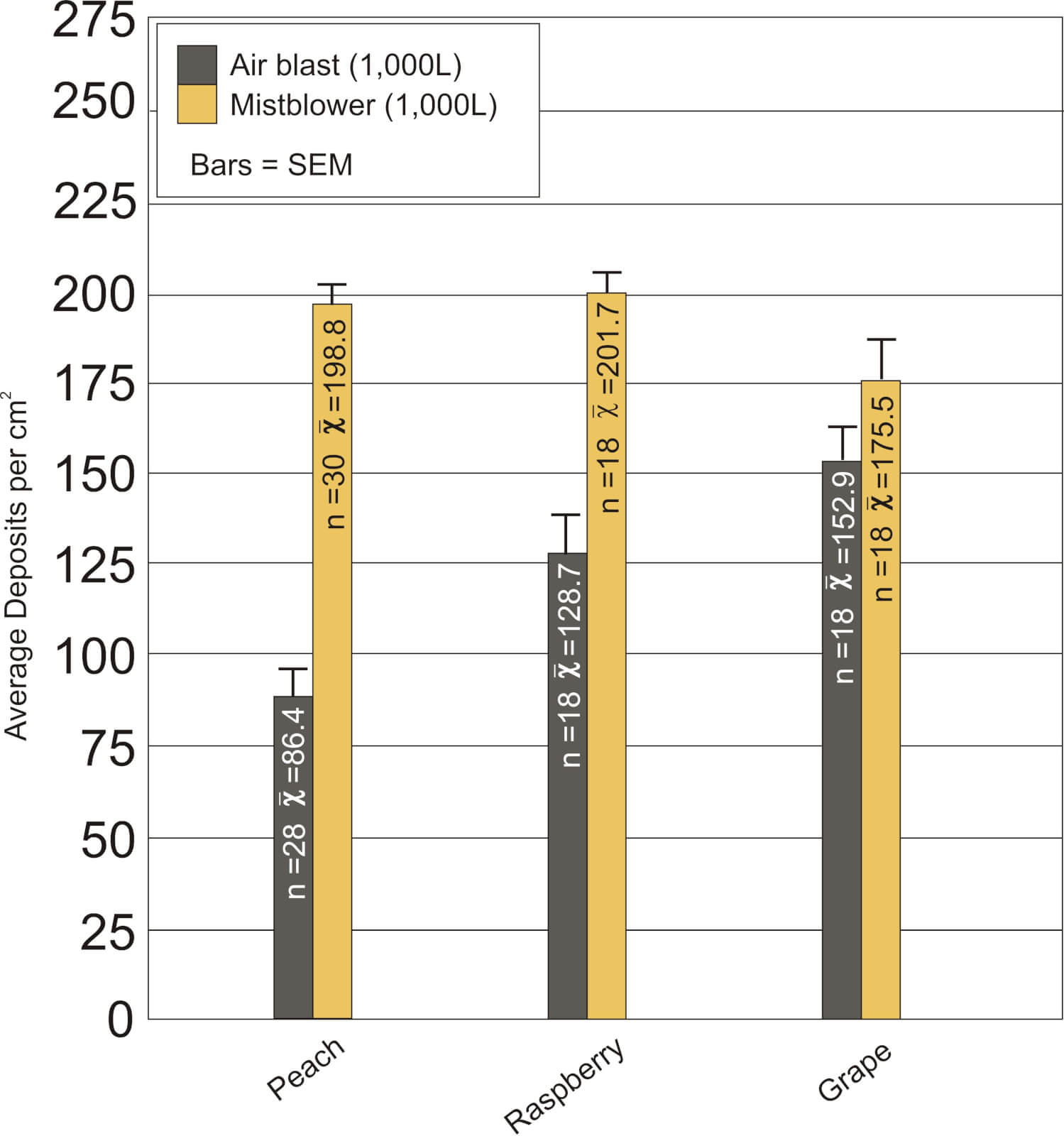
Using the same methods used to compare airblast to hand boom spray coverage in the previous article, we compared airblast sprayer coverage to that of a motorized backpack mistblower in grape, raspberry and peach (July, 2013). Once again, coverage was analyzed as overall percent coverage (see first graph) and droplet density (average droplets per square centimeter – see second graph).
Comparison of average % coverage in peach, raspberry and grape using a mistblower and air blast sprayer emitting he same volumeComparison of droplets per square centimetre in peach, raspberry and grape using a mistblower and air blast sprayer emitting the same volume
Results and Observations
The mistblower met, or in the case of droplet density, exceeded the coverage obtained using an air blast sprayer in most crops. The results led to a few observations:
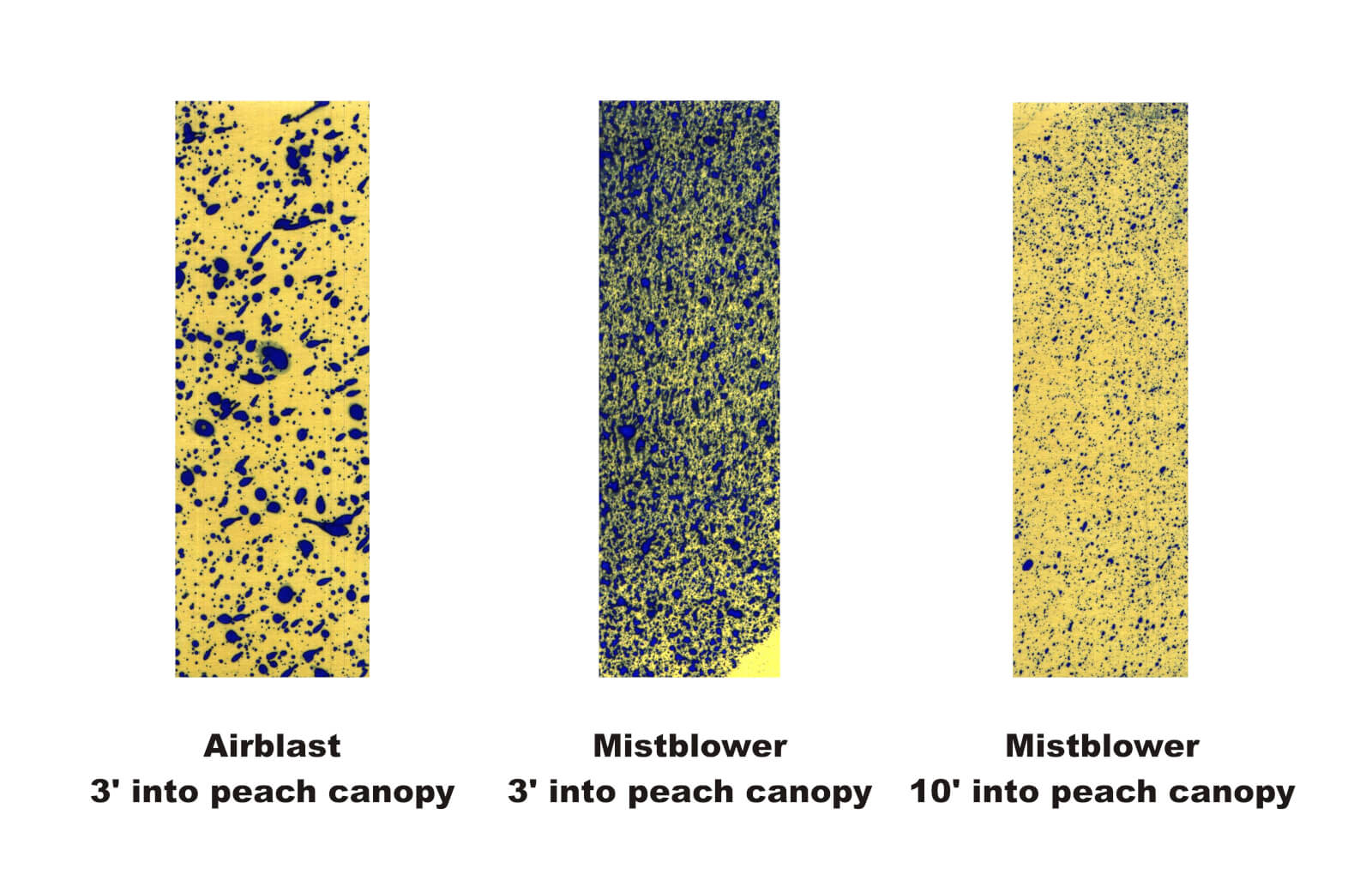
The significantly-higher droplet density is a function of the Finer spray quality produced by the mistblower (see water sensitive papers below). This may still represent a confound between small plot work and large scale airblast applications.
Drift between proximal treatments may be an issue given how far the mist was blown. This should be considered when planning plots.
While not shown here, spray coverage was more consistent throughout each canopy, of each crop, when using the mistblower. This is likely because the operator was able to aim the output as they swept the spray over the canopy, thereby ensuring all surfaces were hit from multiple angles.
While we always try to be brand-neutral, it should be noted that we’ve used multiple Solo mistblowers over the years, and all of them required significant maintenance (no matter how they were cleaned and stored). It was very difficult to find brand parts and repair expertise in Ontario. The Stihl brand currently has far more dealers, and more accessible parts, and has not caused us any difficulties (yet).
Always use the highest grade gasoline in two-stroke engines to avoid ethanol gumming up the carburetors!
Always calibrate mistblowers by volume because raising and lowering the boom will affect the flow rate.
Conclusion
Hand booms, and likely hand guns, are not appropriate for testing agrichemical products intended for use with an airblast sprayer. Data derived from these methods should be questioned. An airblast sprayer is the best choice for any such research, but a mistblower is a viable alternative. Transparent, standardized operating protocols for testing products intended for use in airblast sprayers should be required.
Thanks to Vaughan Agricultural Research Services Ltd. for their assistance in the research performed for this article.
Peer-reviewed journal publications claim there is a significant difference in spray coverage and deposition patterns when an agrichemical product is applied using an airblast sprayer versus a hydraulic hand boom. An airblast sprayer creates Fine droplets that shear in entraining air and are carried into a plant canopy. Properly calibrated, the air opens the canopy to expose all target surfaces to the spray. By comparison, a hand boom relies on pressure to propel fine droplets into a canopy, and while there is some air-entrainment surrounding the spray, it cannot travel as far or displace as much canopy. As a result, most of it impacts on the outer surfaces of the canopy.
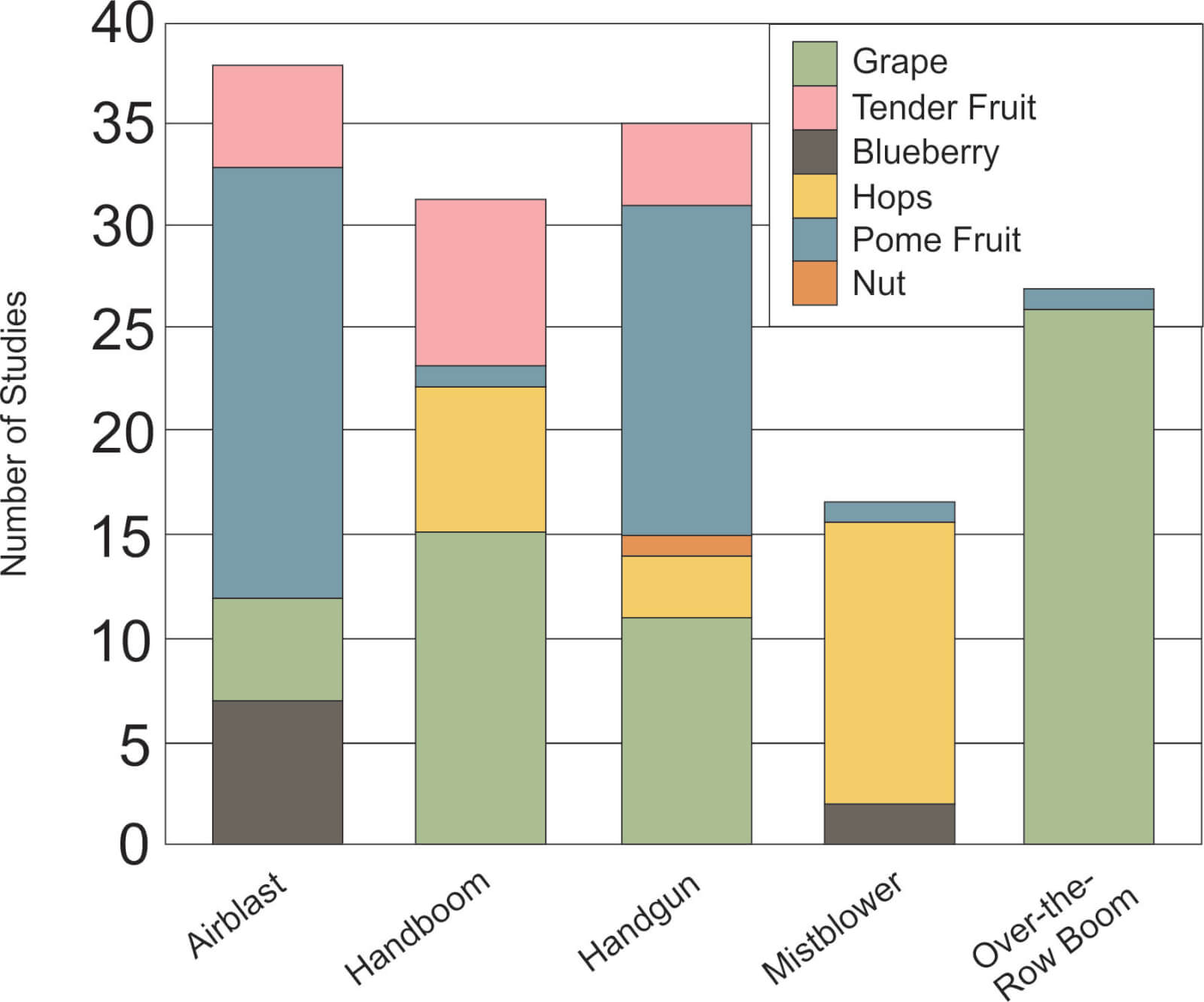
Knowing this, it is surprising that so many products intended for use with airblast sprayers are applied by researchers and consultants using hand booms or the high-pressure arborist-style handgun (see ‘Survey of Submissions’).
Survey of Submissions This graph represents a random selection of 150 minor use label expansion studies and registrant submissions from Canada and the USA spanning 1990 to 2011. It shows the application method by crop.
In 2012, we performed some research with the following goals:
To demonstrate the difference between spray deposition and coverage when using a hand boom versus an airblast sprayer.
To create a sound basis for questioning and potentially improving how agrichemical products for orchard, bush, and vine are tested in Canada.
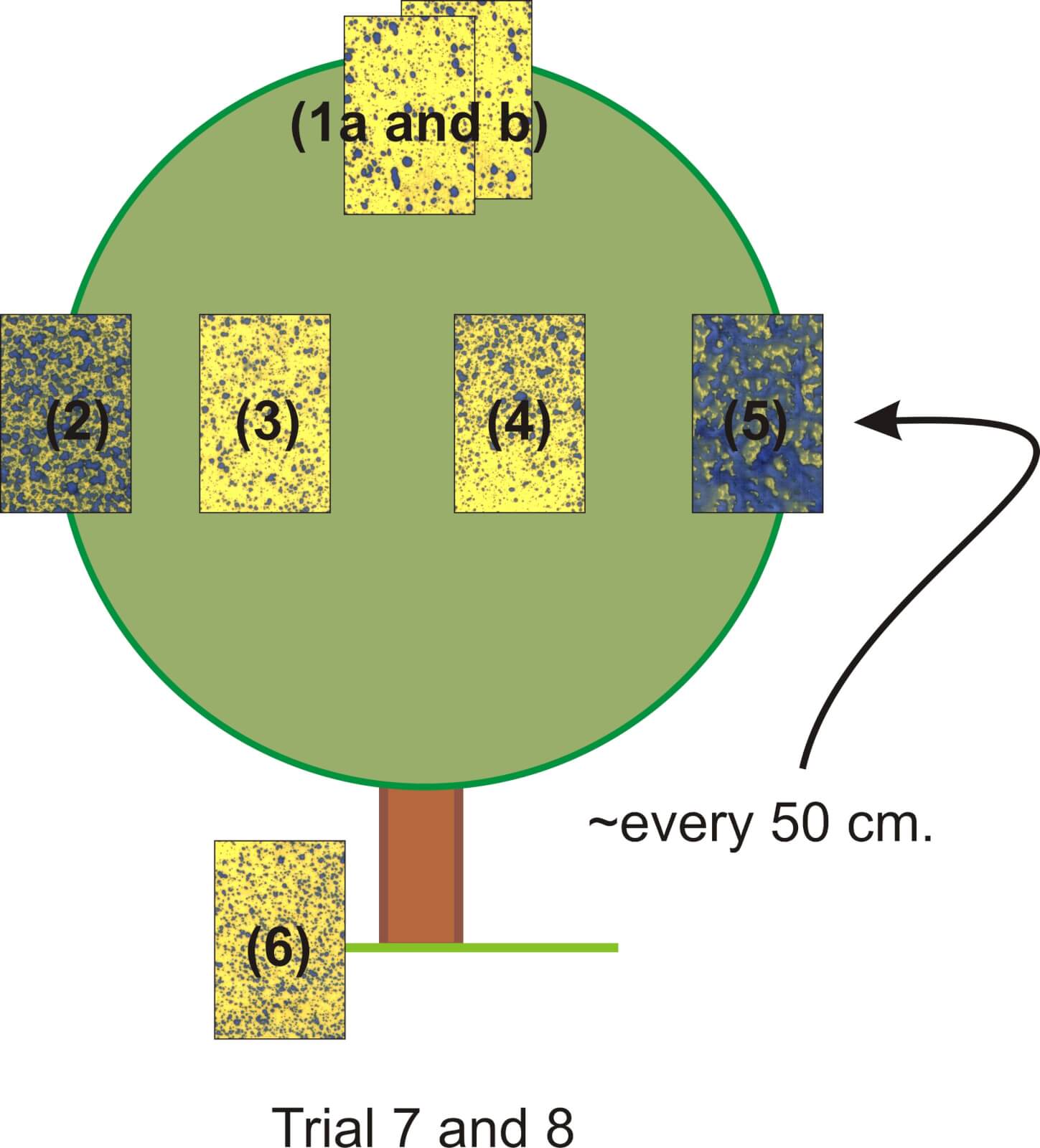
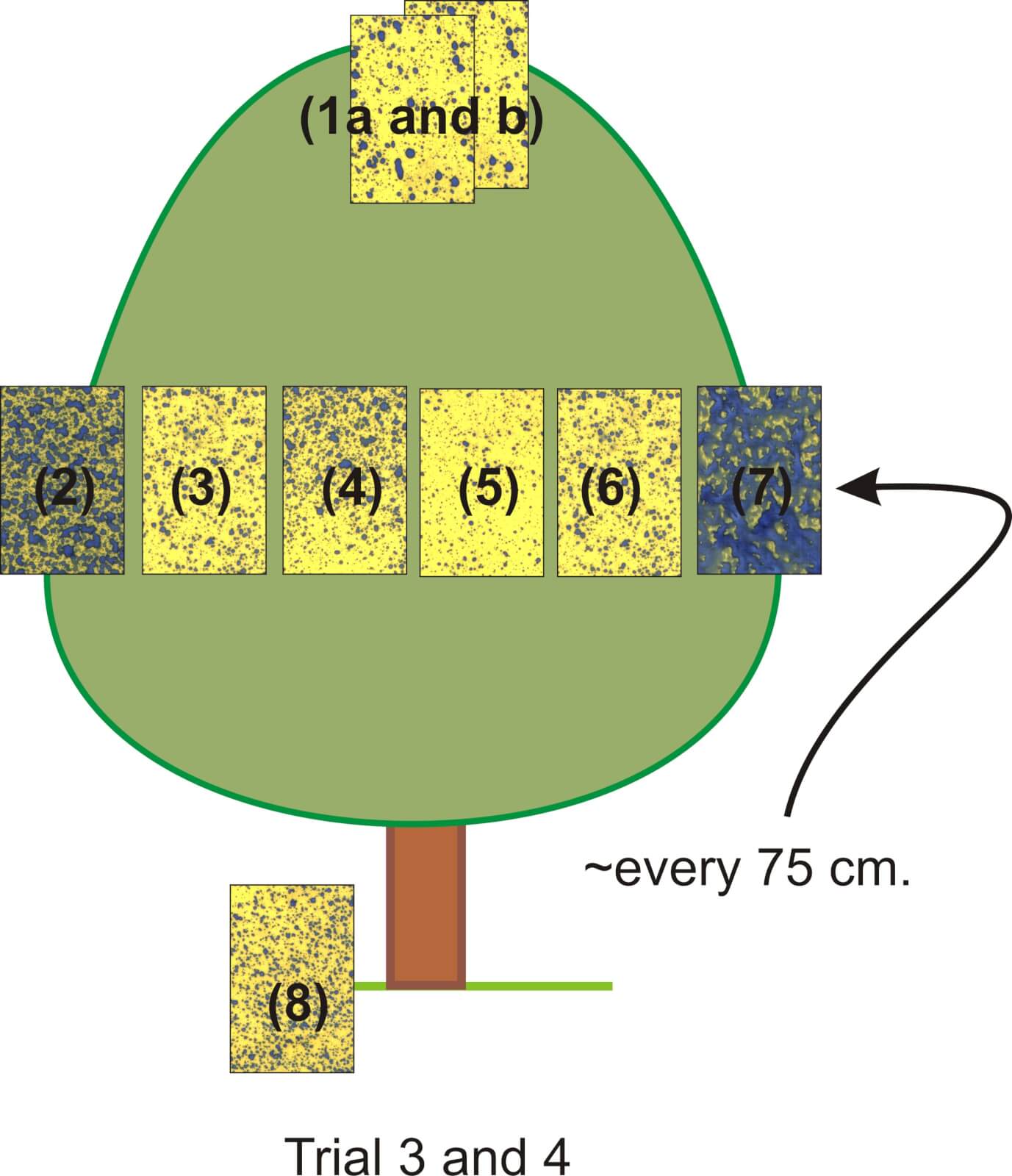
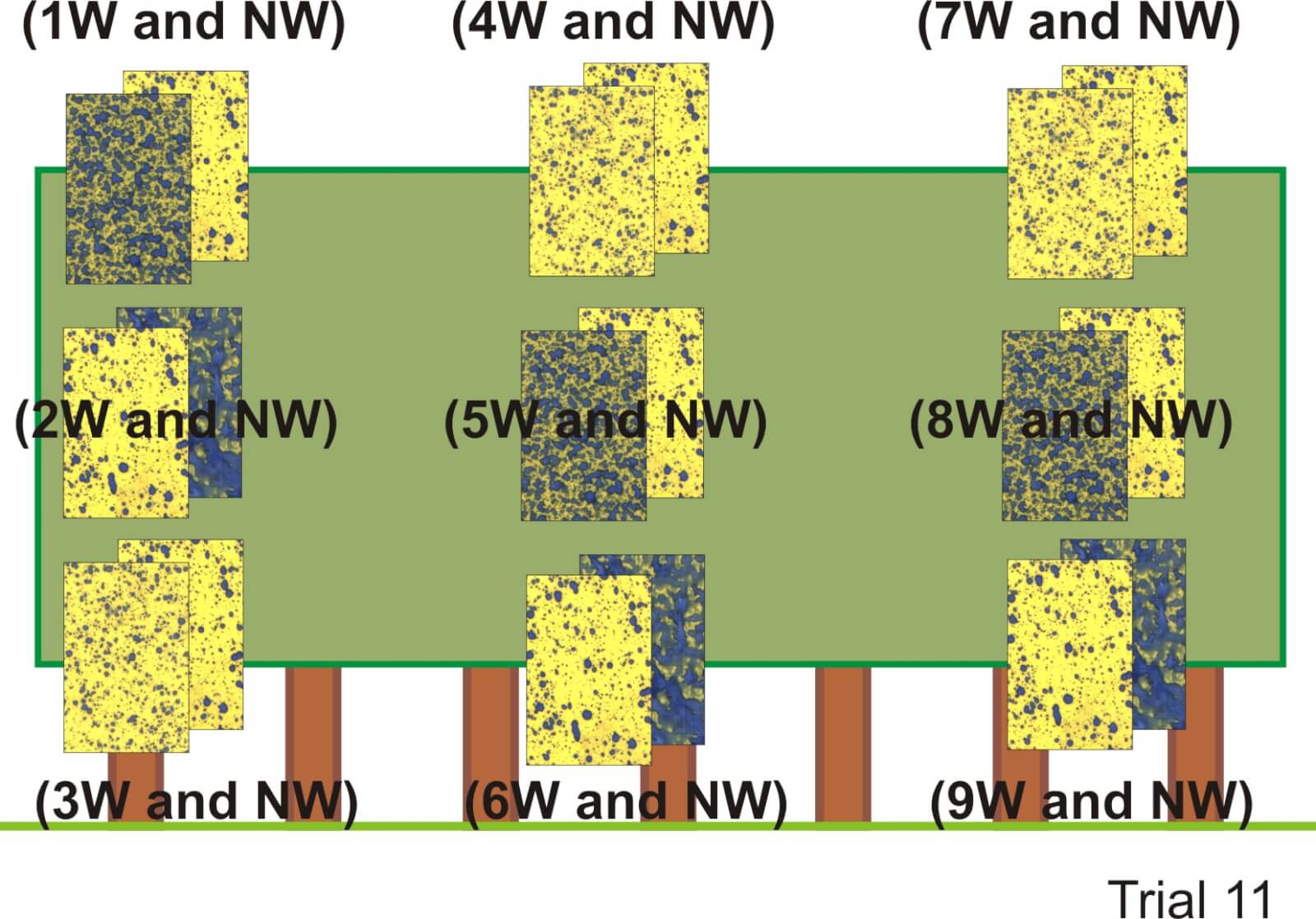
Using water-sensitive paper to diagnose spray coverage, airblast sprayer application was compared to hand boom application in highbush blueberry, apple and grape.
Target locations in highbush blueberry.Target locations in apple.Target locations in grape panel.
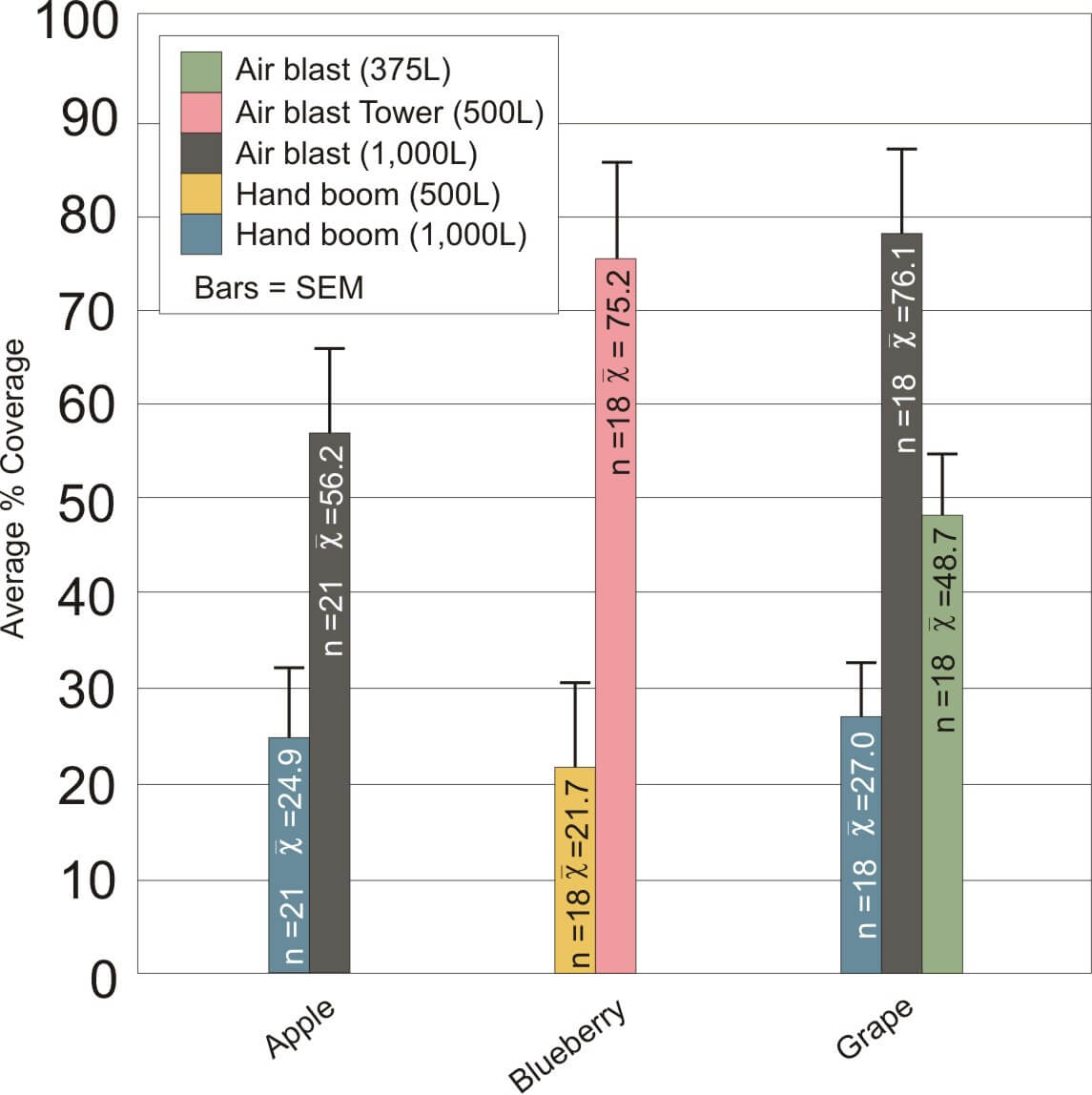
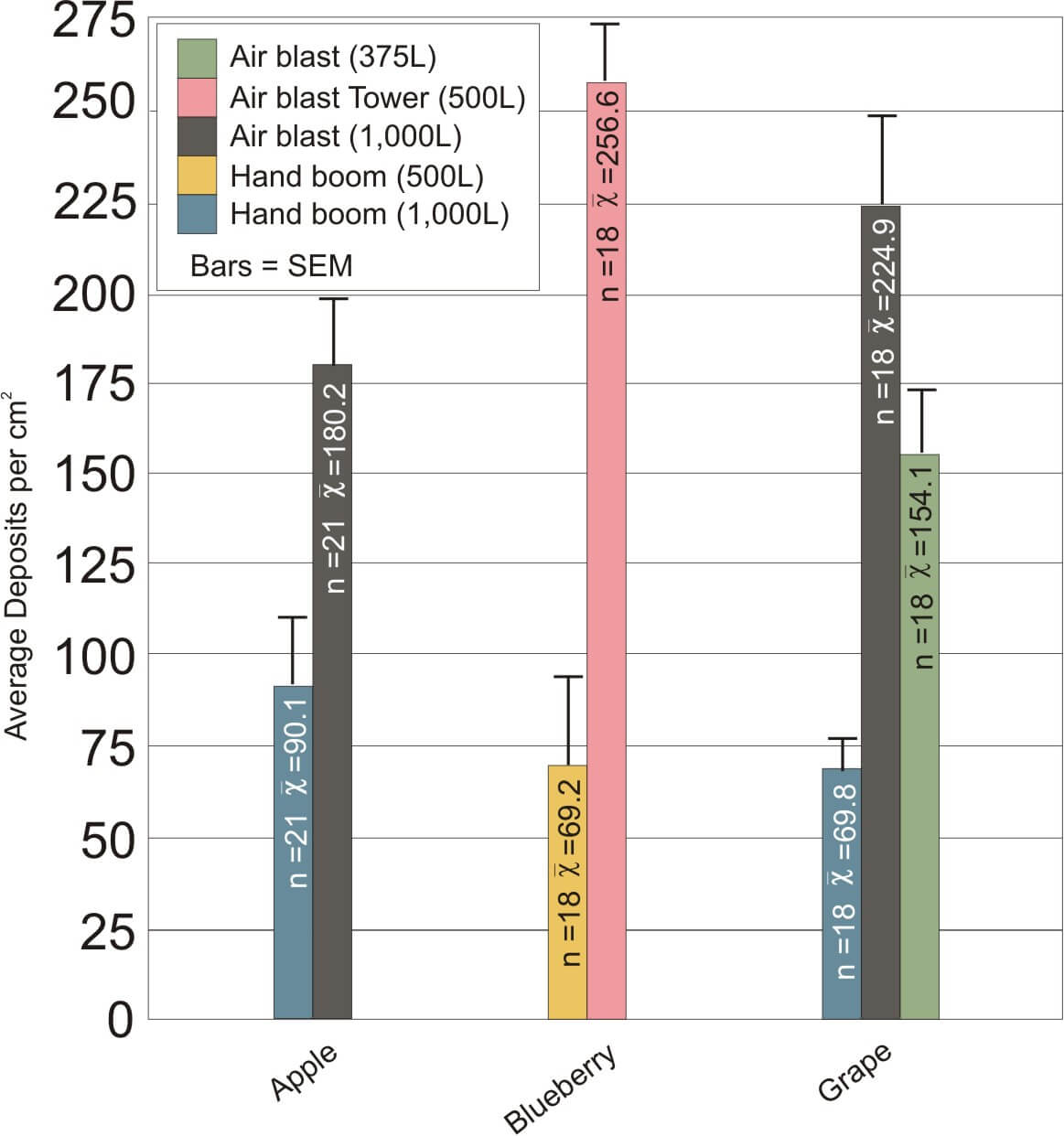
Sprayers were calibrated to emit the same volume per planted area via hollow-cone nozzles. Volumes selected were based on typical application volumes for Pristine or Captan (commonly sprayed in Canada). While there is no standardized protocol (and there should be) we followed typical practices of 500L/ha for grapes, blueberry and apples until plant growth warrants higher carrier volumes. At that point, many researchers go up to 1,000 L/ha. Coverage was quantified by collecting and digitally scanning water-sensitive papers to calculate overall percent coverage (see graph) and droplet density (average droplets per square centimeter – see graph).
Overall percent coverageDroplet density
Conclusion
In all cases, airblast applications deposit > %50 more spray than a hand boom. In the case of grape, you’ll note there are three bars. This is because spraying 1,000 L/ha with the airblast sprayer drenched the targets (it was late in the season and the canopy was sparse), making it impossible to discern droplet density. When we reduced the output to 375 L/ha, we were able to register droplet density, which was still significantly higher than that produced by the hand boom at 1,000 L/ha. This raises significant questions about the validity of efficacy and residue studies performed with hand booms when growers apply the same products using airblast sprayers.
When this data was shared at extension conferences, it was sometimes noted that many researchers choose to spray the target until it is drenched, ensuring the dose administered to the crop reflects what was intended. This does not, however, invalidate the fact that a growers spray equipment and practices are significantly different, and the dose and spray distribution they achieve will not reflect the original research.
The recommendation is that researchers use the same equipment to test products as the growers use to apply them. But, recognizing the difficulties associated with performing small plot experiments with full-sized airblast sprayers, an alternative is needed. That topic will be addressed in part two of this article.
Horticultural Crops Ontario, the grower co-operators and former OMAFRA summer student Carly Decker are gratefully acknowledged for making this research possible.
Managing the canopy of any perennial crop (e.g. pruning, hedging, leaf stripping, etc.) is an important consideration. The benefits are manifold: It affects the health of the plant, the quantity and the quality of the yield. It allows light and air to circulate and it keeps the crop manageable. From the perspective of an airblast sprayer operator, the reason for canopy management is quite simple:
If you can’t see it, odds are you can’t spray it.
Picture this: It’s late April, and an apple grower and I are calibrating his sprayer. We achieve excellent spray coverage in the target block, shake hands and part ways. In late May I get a phone call from the grower. I assume it’s time to adjust his settings to match the growing canopy, but no… he had called to say he suspected apple scab in one of his blocks. Since I was the last person to adjust his sprayer, the unspoken implication was that I’d better come fix matters.
As I drove back out to his orchard, I considered what the problem might be:
Bad product choice?
Poor application timing?
Spraying in inclement weather?
Cutting rates?
Resistance? (a long shot)
Maybe it was ego, but I couldn’t believe it would be the calibration. We left ample volume to provide sufficient coverage to get the grower to petal fall. We ensured the spray swath was higher than top of the tallest tree, accounting for wind and an uneven alley. We did everything right to match the sprayer to the canopy and leave enough buffer to get to petal fall.
When I arrived, he took me to a block I hadn’t seen before. We didn’t calibrate the sprayer to match this particular group of trees, but he figured since they were about the same height, the sprayer would do its job. It was immediately obvious to me what the problem was, but I knew if I simply told him outright, the lesson might not stick. And so, with respect to that old proverb, I taught him to fish rather than give him one. We spent the next few hours trying to fix our alleged calibration problem by exploring:
Slower ground speed
Higher fan gear
Higher rpms to increase fan speed
Changes to deflector settings
Air induction nozzles in top positions
Higher sprayer output
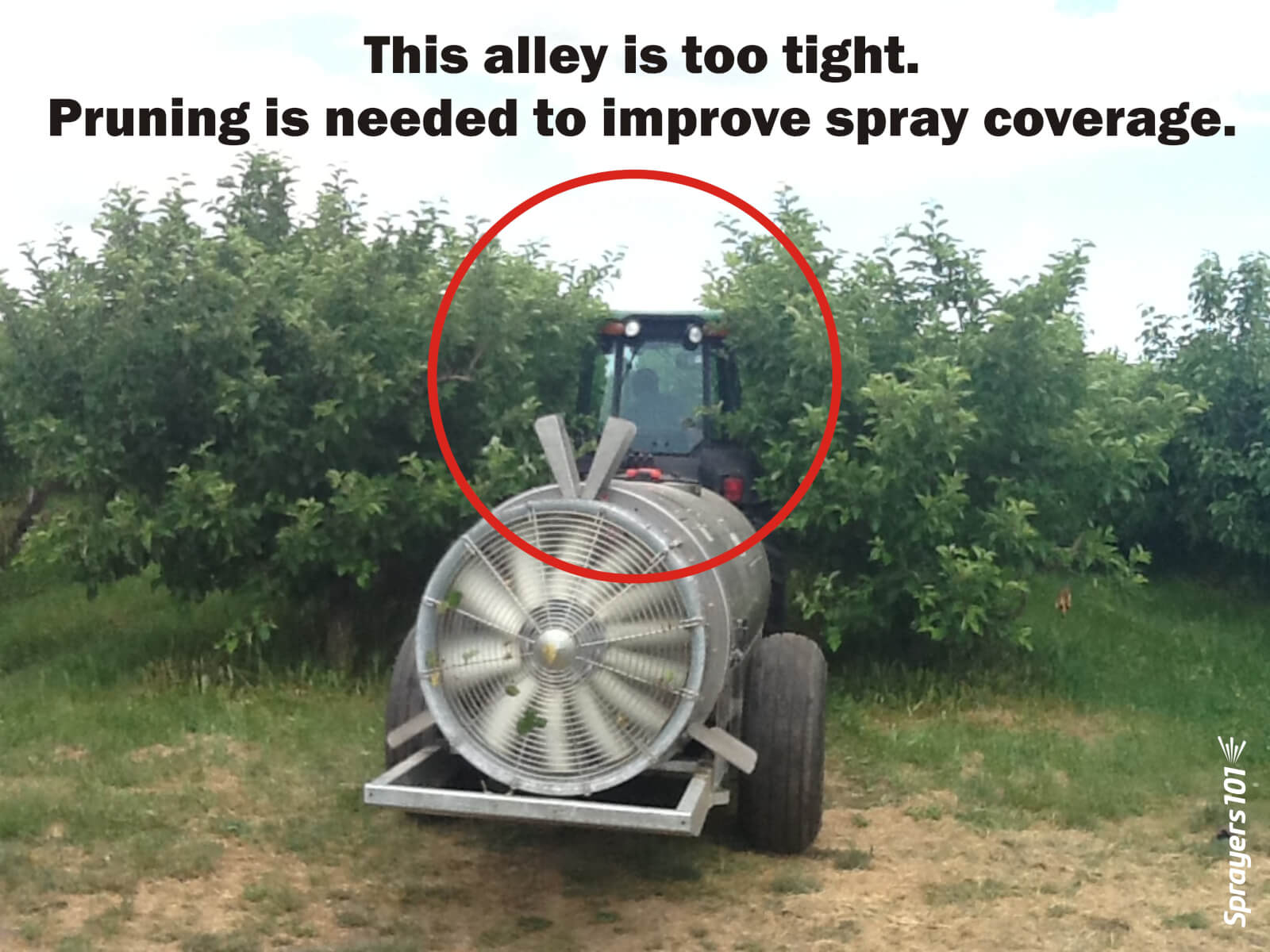
Of course, none of these adjustments had any great impact on coverage because the problem was that the alley had grown so tight that branches were brushing the cab of the tractor (see picture).
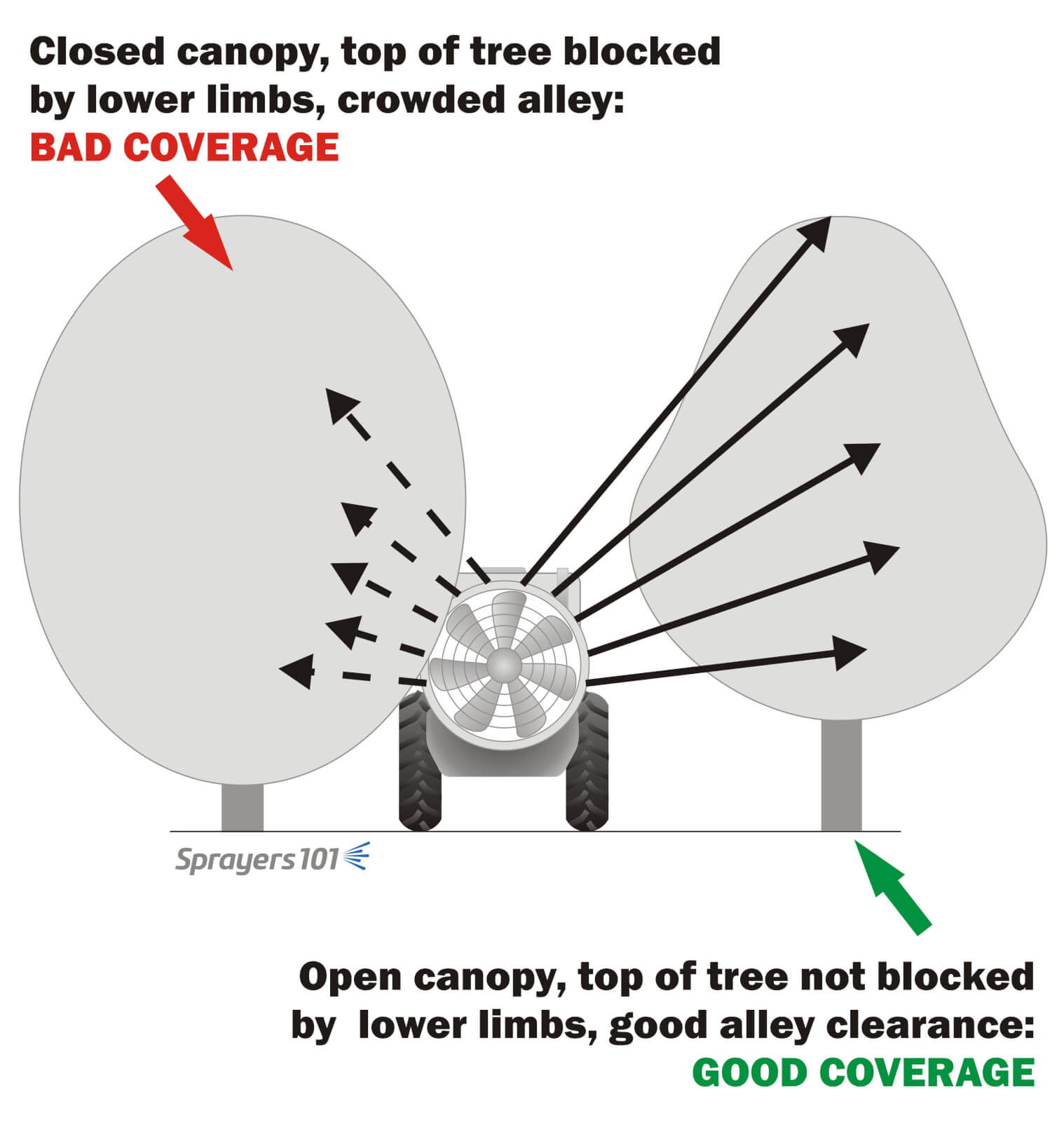
If the canopy is brushing against the tractor, it may intercept spray before it expands fully. Essentially, it temporarily blocks nozzles.Closed canopies and tight alleys will almost always compromise spray coverage.
The canopy was so dense you couldn’t see the trunk! I asked the grower to move the sprayer down the row to a tree I saw that was far less dense that the others. We returned the sprayer to our original calibration settings and achieved excellent coverage once again. The only solution was to prune the trees, and once his workers did this, coverage improved considerably. An airblast sprayer can only do so much. Sometimes it comes down to canopy management.
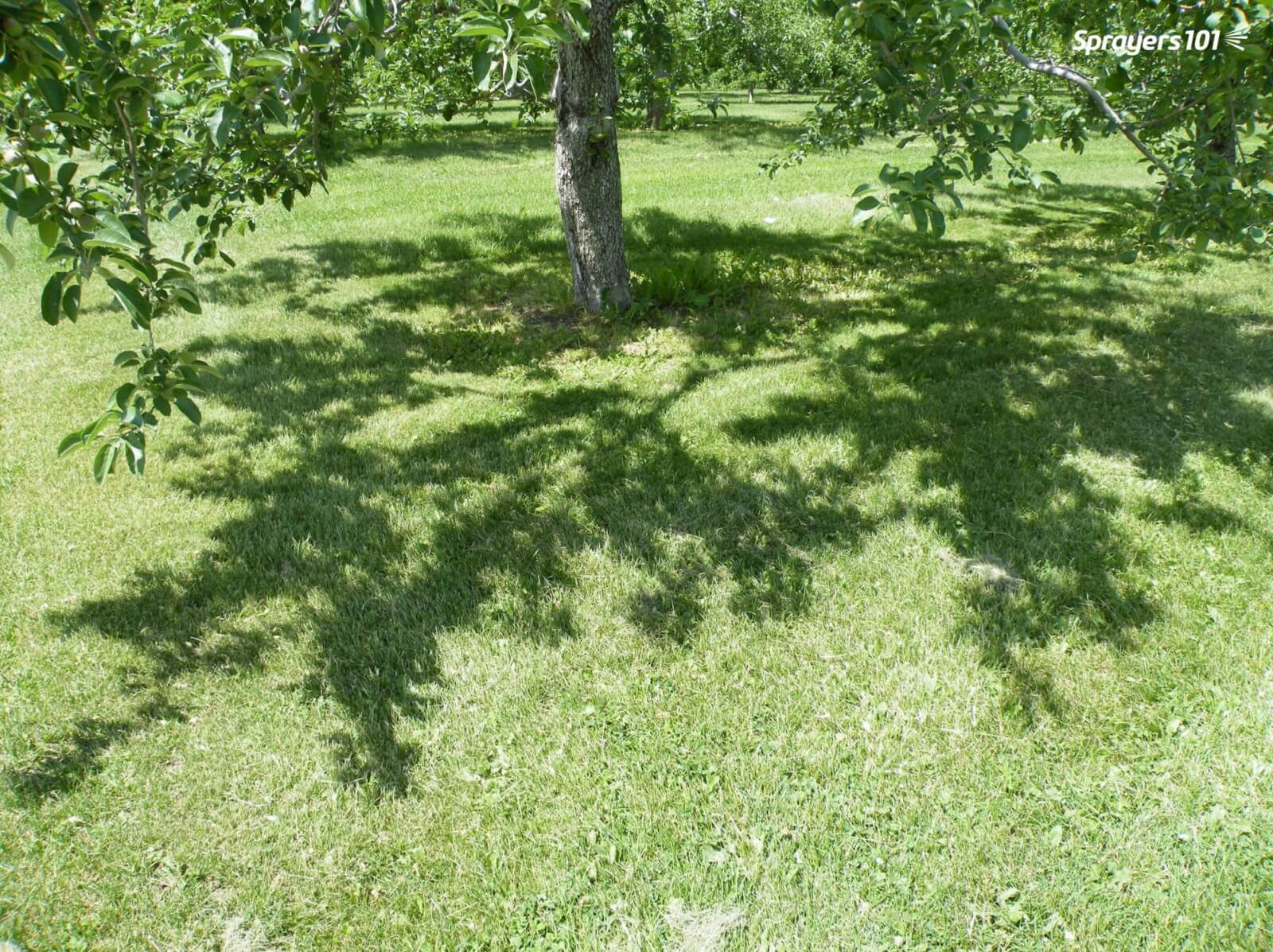
An orchardist taught me this trick: If you want to know if spray will penetrate a canopy, you should be able to see the trunk.An orchardist taught me this trick: If you want to know if spray will penetrate a canopy, you should be able to see sunlight through the shadow at high noon.
Row Spacing in Specialty Crops
Canopy management isn’t just an orchard issue. For high bush blueberry crops, coverage problems may stem from insufficient pruning. How can spray reach the lower, inner portion of a mature bush to control spotted-wing drosophila if the canopy is too thick?
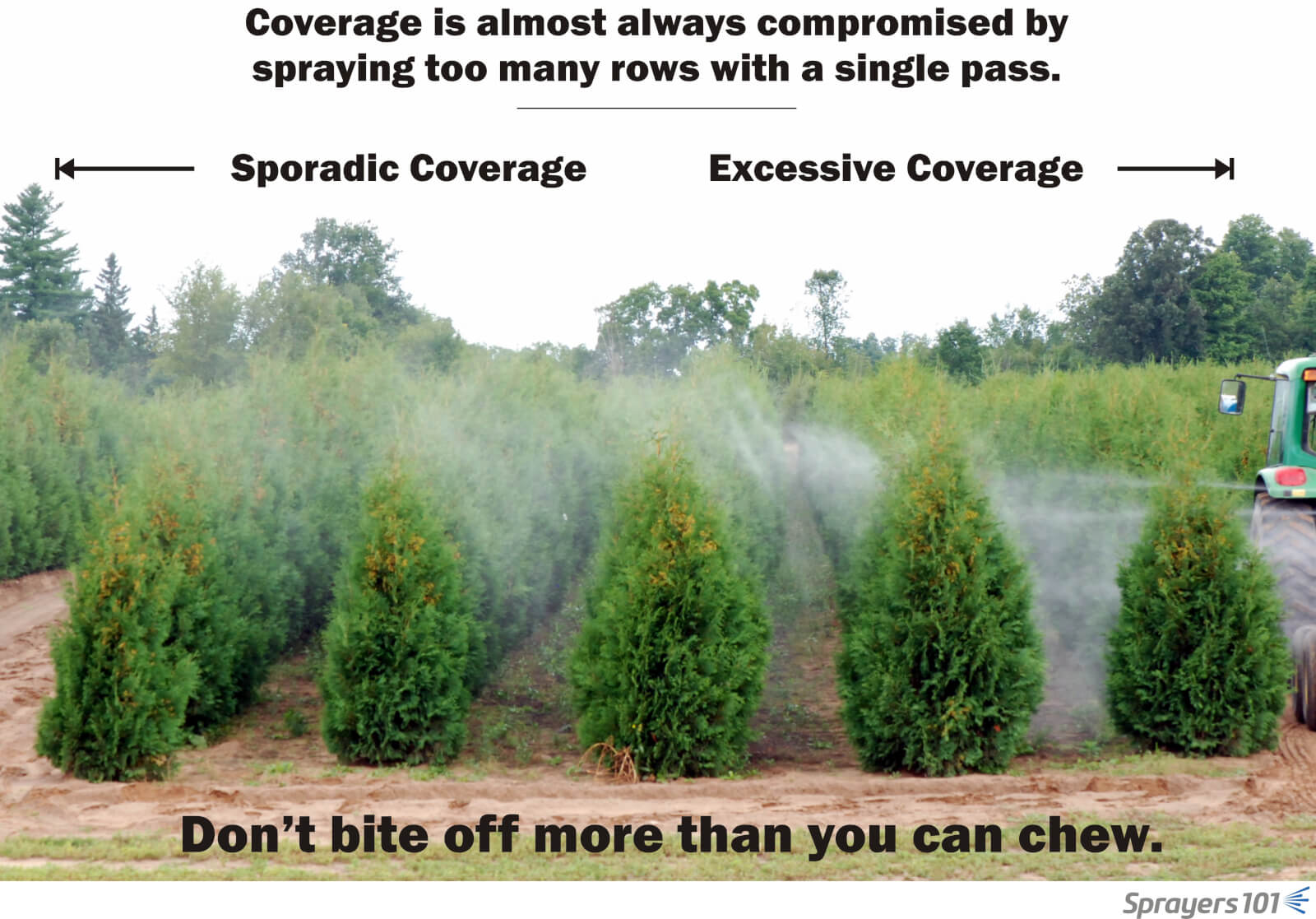
Sometimes it’s not the canopy, but the plant and/or row spacing. Many nurseries arrange container crops, shrubs, whips and cedars as tightly as possible. This may optimize how many plants will fit on a given area, but it compromises sprayer access (due to the reduced number of alleys) and may cause plants to block one another from the spray. Nursery sprayer operators often use cannon sprayers to throw spray over and through all those rows of plants, but cannon sprayers produce excessive coverage at the beginning of the swath and increasingly erratic coverage as a function of distance.
A cannon sprayer attempting five rows of cedars. This sprayer will eventually spray in from the other side, but experience has shown that coverage will be compromised in the centre rows and excessive in the outer rows. Spraying multiple rows may save time, but coverage is almost always erratic.Calibrating a cannon sprayer can greatly improve coverage consistency. Before calibration (above) the sprayer was equipped with full cone nozzles in the upper boom positions and excessive air was employed in an attempt to force spray through the canopy. Although the sprayer would eventually pass down the far side of the five rows, only the water-sensitive papers in the tops of the trees indicated suitable coverage, and a great deal of spray simply blew away. After calibration (below) considerably less air and spray was used, and coverage on water-sensitive papers placed lower in the trees and facing the sprayer was more consistent. Remember, the sprayer would eventually pass down the far side, resulting in similar coverage on the remaining papers. Don’t bite off more than your cannon sprayer can chew – the further spray travels from the sprayer, the harder it is to achieve consistent coverage.
Coverage can be improved by reducing the distance the spray has to travel (i.e. leaving more alleys and reducing the density of planted rows).
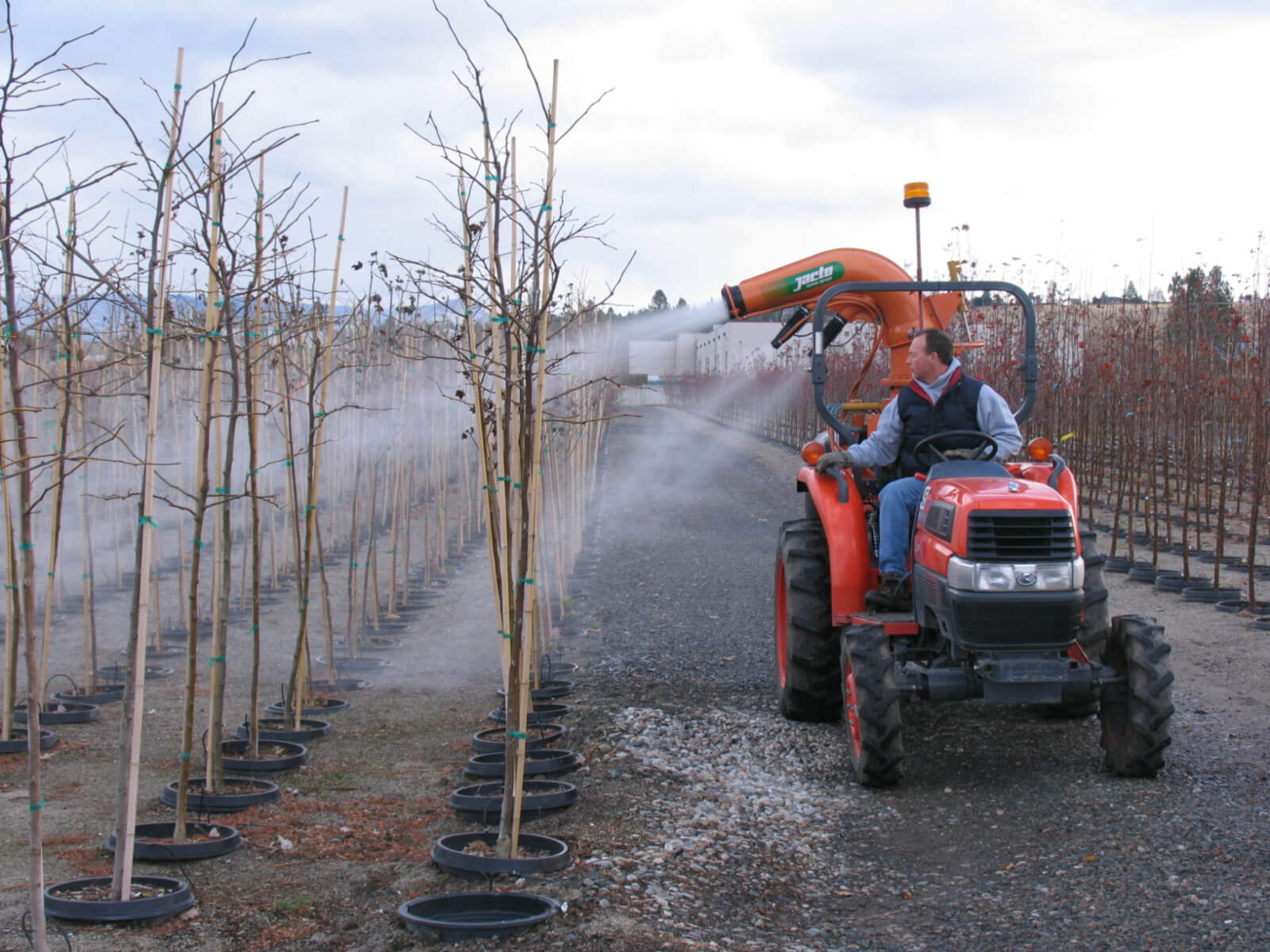
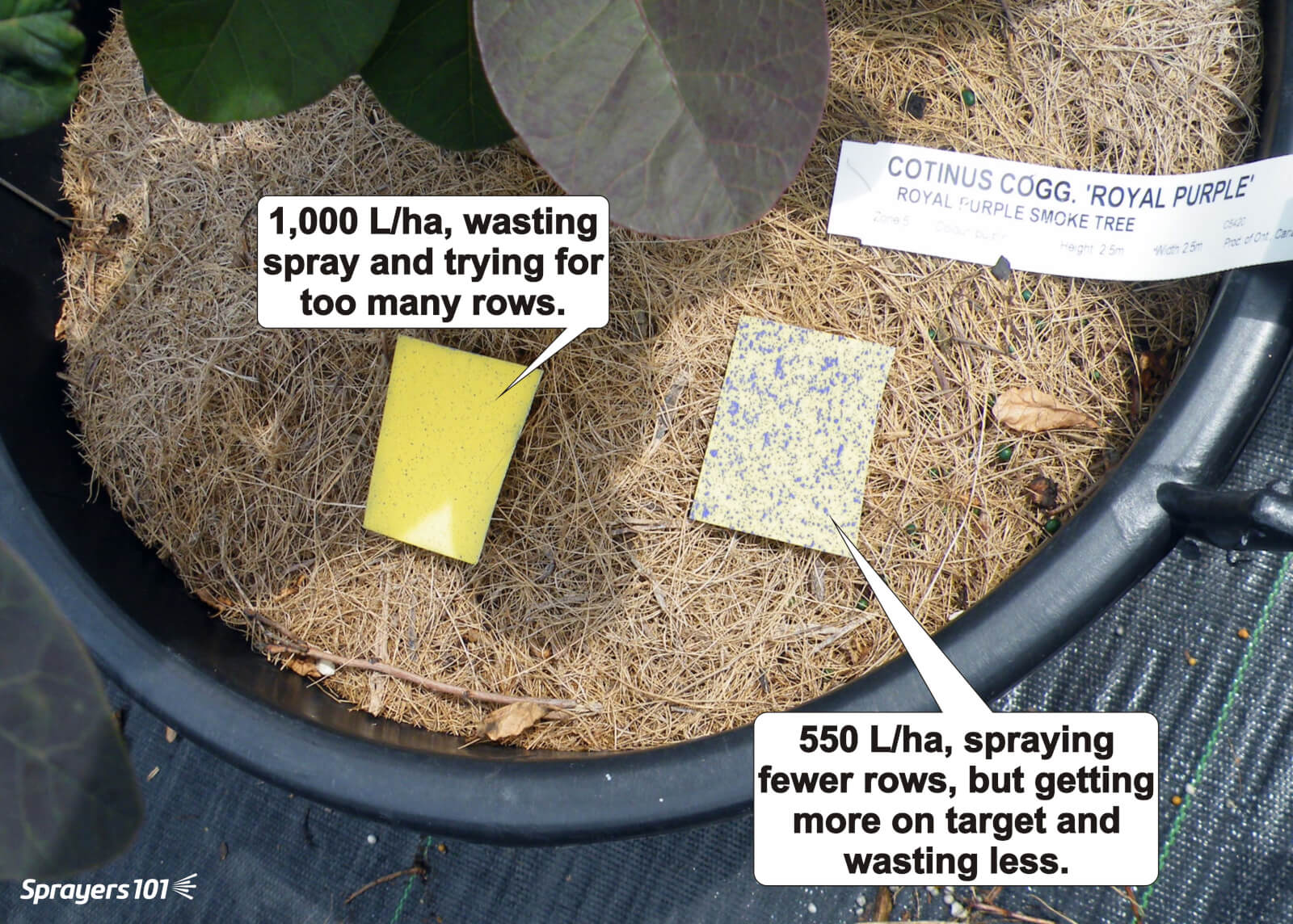
A Jacto cannon sprayer in a nursery. Many nursery and berry operations elect to spray multiple rows in one pass, but be aware that spray coverage suffers the farther away from the sprayer it goes. Independent research has shown that coverage is not reliable at half the distance typically claimed by many cannon sprayer manufacturers. This is a function of canopy density and weather. Always confirm coverage with water-sensitive paper. Photo Credit – M. Lanthier, British Columbia.The results of a cannon sprayer calibration in a container crop nursery. The cannon sprayed 1,000 L/ha and tried to cover too many rows in a pass. The water-sensitive paper showed insufficient and inconsistent coverage. When it was recalibrated to spray 550 L/ha, but drive more rows, the water-sensitive paper showed considerable improvement.
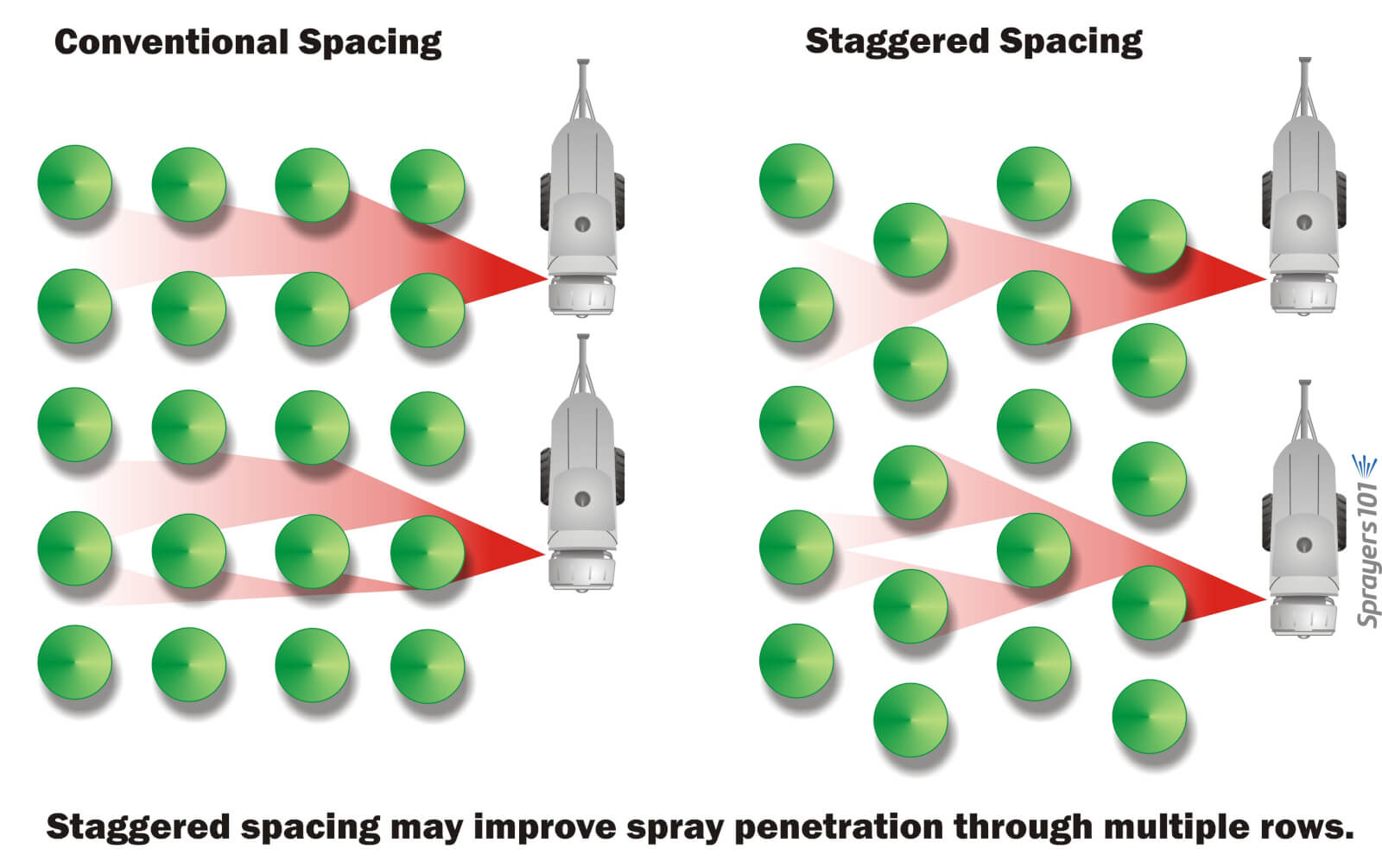
I also suspect that staggering plant spacing from row to row to reduce mutual shading might allow spray to penetrate more easily. As I write this, we’re planning to explore this concept in cedars.
This is speculative, but the when nursery shrubs, trees and container crops are planted in perfect grids, mutual shading probably prevents spray from penetrating deeply into the planting. By staggering the spacing, spray may be able to penetrate more easily between rows. This can be accomplished without reducing the number of plants per hectare significantly.
In the end, try to see the spray target from the droplet’s point of view. If you can easily see where you want the spray to go, you’ll do well. If you can’t see the target, it’s far more challenging.
Michigan’s Great Lakes EXPO is a massive horticultural convention that draws international speakers and more than 4,000 attendees to Grand Rapids every December. Like any large agricultural conference, it can be challenging to run back and forth between lecture rooms to hear key presentations. And, of course, there is always disappointment when you have to choose between two talks in concurrent sessions. When your head is full and your posterior is numb, you move onto the trade show floor.
I think the trade show might be my favourite part; Who doesn’t like filling a bag with swag? Candies, foam vegetables, pens, DVD’s, colourful brochures and all manner of gimmicks designed to get your attention in a sea of vendors that vie for “just a minute of your time”. But for me, I only have eyes for the sprayers. And wow, were there a lot of sprayers at GLEXPO.
This article is a photo journal of those sprayers (or features) that caught my eye. For some readers, these features might be old news, but for me they were insight into a different way of spraying. For example, Europe’s tolerance for spray drift is practically nil, and sprayer manufacturers have had to develop equipment that comply with that reality. Many such sprayers were present, so I had a chance to see, and ask questions, about their claims of less than 5% drift. At the other end of the spectrum, there were sprayers that proudly boasted being able to cover multiple rows in a single pass by boiling the spray over great distances… which while appealing to producers looking to save time, still makes me wince. But then, I’ve never tried to spray almonds in California, or citrus in Florida. Then there were sprayers claiming to cover multitple rows and reduce drift, which would be quite a trick. I reserve the right to be a skeptic.
So, I’m not promoting or condoning any of the equipment or claims described here. I’m just sharing what I found interesting and I’m giving the reader a peek onto a trade show floor they might not otherwise have seen.
Shrouded Herbicide Application
There are lots of approaches to making in-row or under-row herbicide applications. The concept is simple enough: You want to get the product on the ground either under or between rows without hitting the crop itself. If you don’t care about hitting a mature orchard trunk, the boomless nozzle is a good choice with it’s massive droplets and variable swath. But if you want to avoid off-target movement as much as possible, you need shrouds.
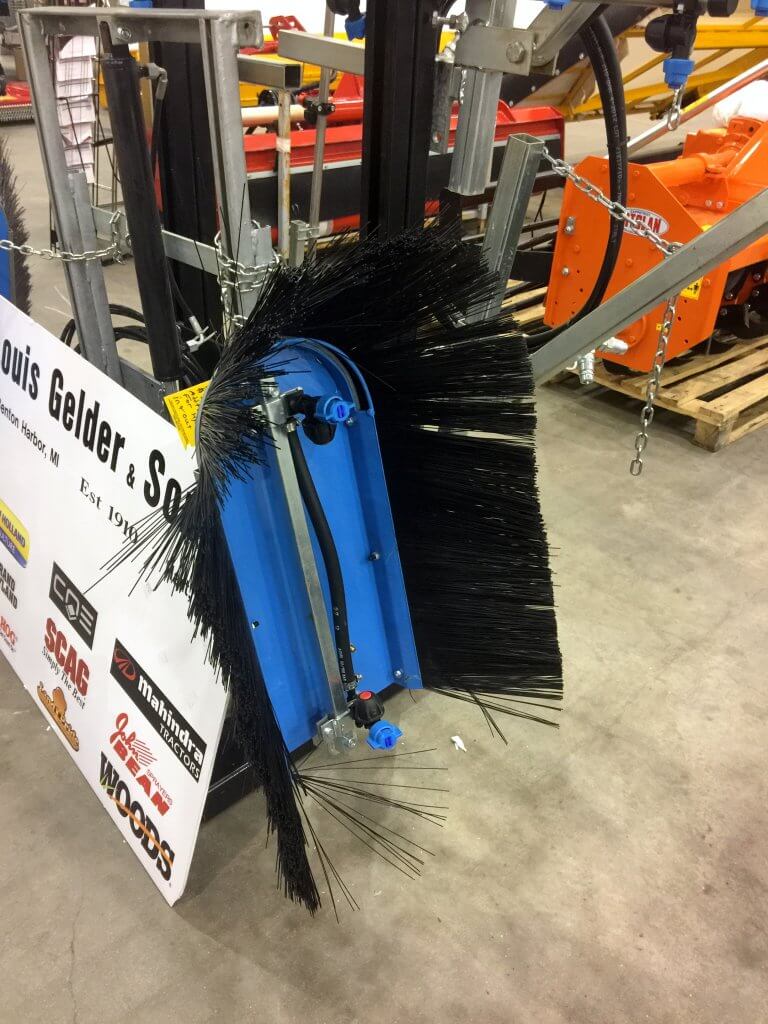
I’ve seen brushes used to great effect in asparagus because they match the contour of moderately uneven ground by dragging over it. Gaps may open in the shroud as the bristles part, but that issue may be offset by the possible advantage of physical redistribution of herbicide as it rubs over the target weeds like a weed-wicker.
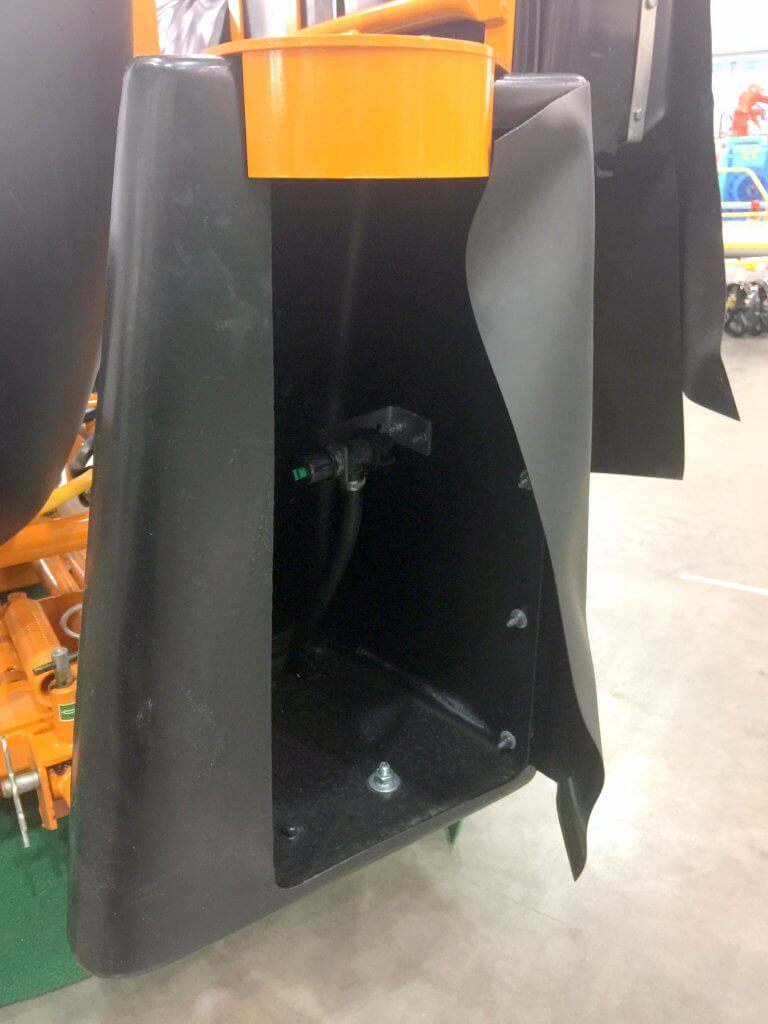
Then there’s the classic flexible curtain. Similar to the brushes, it’s intended to “just” touch the ground and should maintain a reasonable seal even if said ground is moderately uneven. I often wonder how difficult it is to clean all the surfaces on these systems, but since they are only ever used with herbicide, I won’t speculate how often operators actually decontaminate (or even rinse) them.
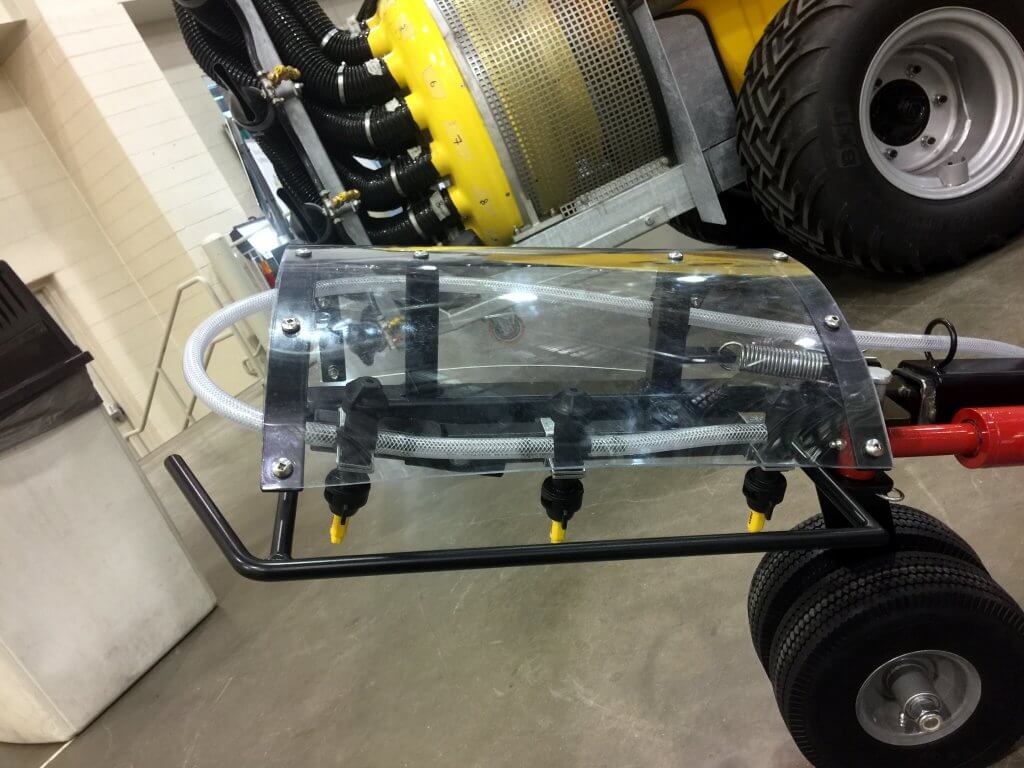
Other variations include a hard carapace with no contouring lip. They should only be used with Coarse spray qualities or larger. Note the hefty spring on the boom for those inattentive moments where the operator might whack a trunk or fence post. The wing flexes away from the impact and snaps back into position, giving the operator time to put down the cell phone and tweak the steering wheel. The adjustable nozzle body on the far end is a nice feature for adjusting the swath without changing nozzle spacing, but beware to maintain proper overlap.
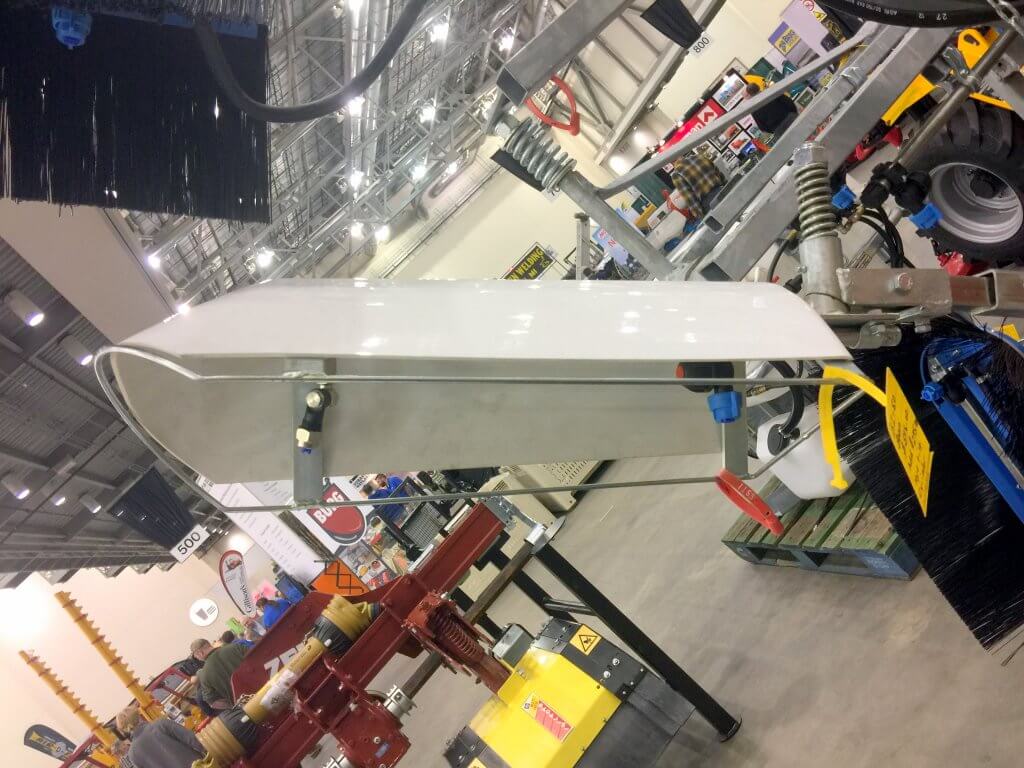
And, if you want the heartiness of a solid carapace, wouldn’t it be nice to be able to see through it so you can spot a plugged nozzle before it becomes a problem? This variation with its heavy impact bar, tight nozzle spacing (to reduce the potential for misses) and guide wheel (to maintain correct boom height) looks ready to handle anything.
Airblast – Multi-Row, Ducted Systems
In the never-ending quest to do more in less time, multi-row airblast systems are very appealing. Delivering air to the vertical booms in each row can be challenging. I’ve seen suspended axial fans (e.g. Gregoire, not pictured) but they’ve always struck me as overkill because of the volume and speed of the air they deliver, and because they need fairly wide rows to be accommodated. Their weight is also a concern, requiring scaffolding that must be strong and still somewhat flexible to handle the inevitable pitch and yaw translated from uneven ground to the boom.
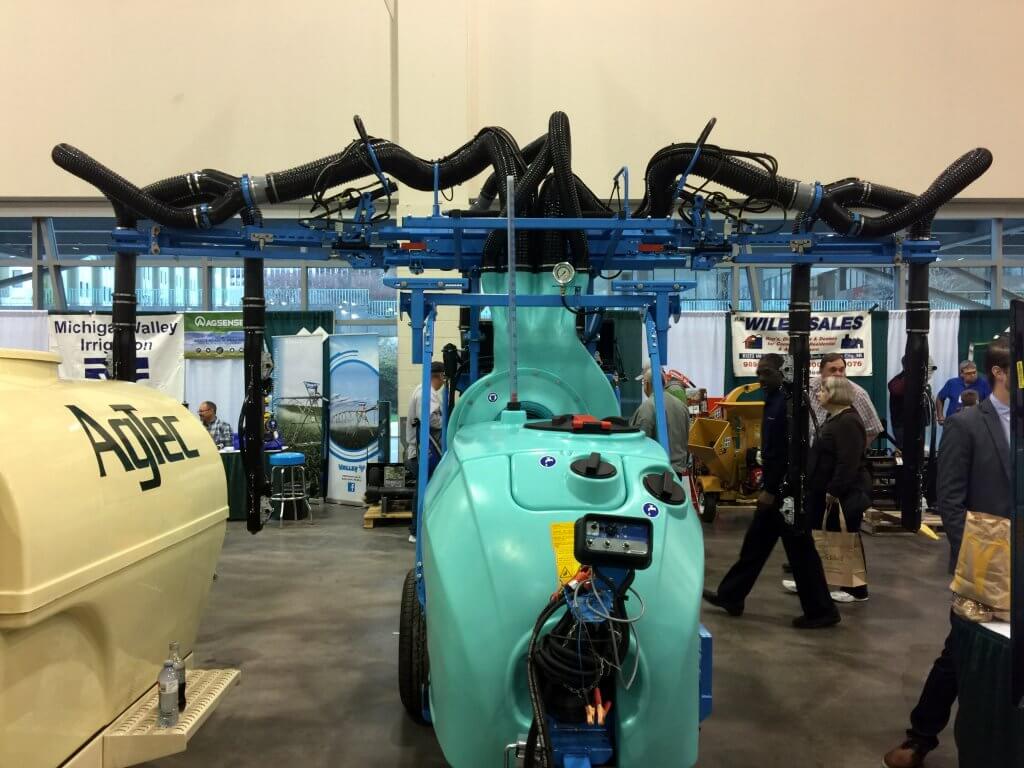
Lightweight conduits that channel air through ducts (like the Berthoud sprayer below) are a popular solution. They can be suspended to any length and telescope to any row width. Head pressure, and friction from sharp bends in the ducts can influence the air delivered, so the shorter the ducts and the less bends, the better. It was a surprise to discover the ducts in this sprayer are corrugated inside as well as out, but apparently it’s not enough to disrupt air flow significantly.
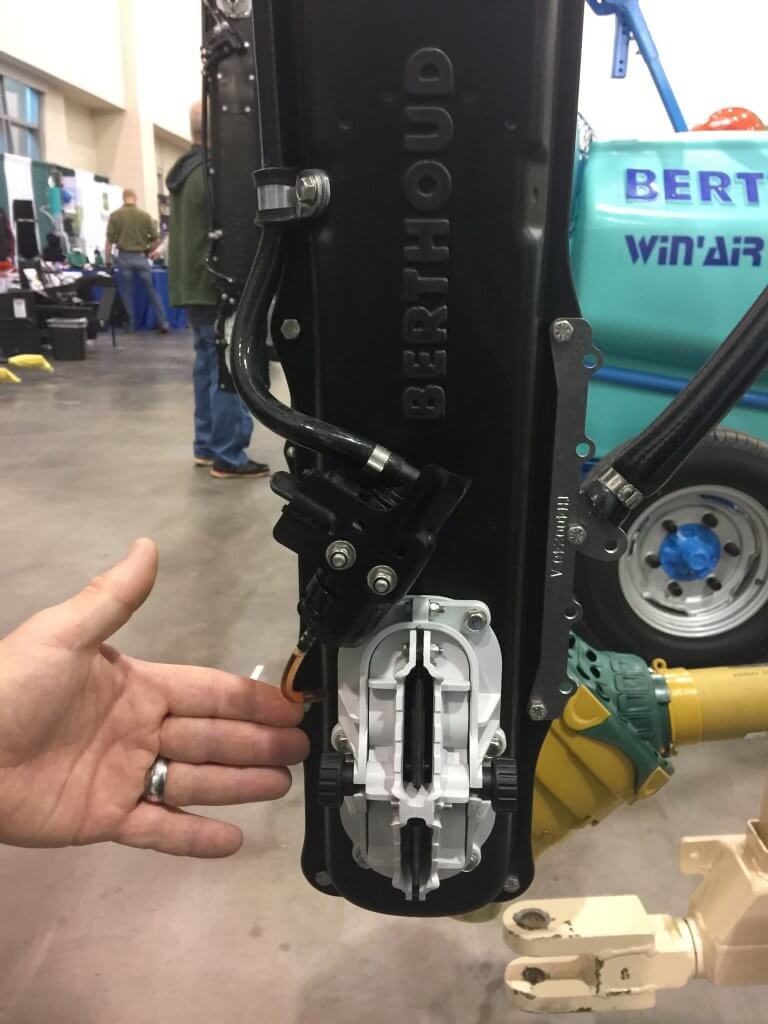
This Berthoud sprayer offers many of the optional features I’ve seen on the Hol sprayer (not pictured) such as tandem axles, a hand wash tank, low residual volume tank, and built-in boom and tank rinse systems. What’s interesting is the light weight “Drop Legs” (i.e. the vertical booms) with dual-angled “airmist diffusers” (i.e. the air shear nozzles) for multi-row vineyard applications. The close-up below uses my hand for reference. There are options for two to four diffusers on each drop leg, and they can be single or double sided, giving a lot of flexibility to match the crop.
How do you control flow? With a digital flow regulator. What if you want a different rate at each diffuser? Well, if I understand this correctly, instead of using a typical flow-metering disk placed in-line to restrict flow, you slot a conventional moulded hollowcone inline and use the nozzle manufacturer’s flow tables. And what if you are concerned about using a misting air-shear style nozzle? It appears they also offer an option to swap out the diffusers for air assisted swirl nozzles where the air flow is behind the nozzle to entrain the spray and limit dispersion. They look similar to the diffusers, except they have a nozzle cap between the slotted air outlets (not pictured).
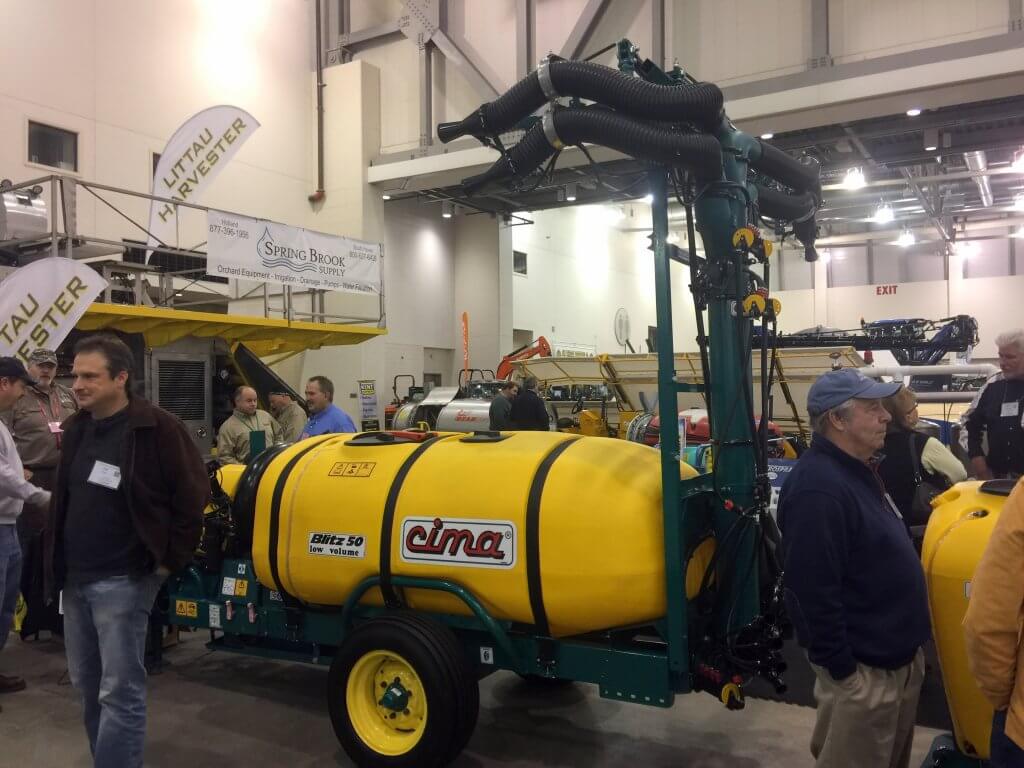
Ducted air handling comes in many shapes and sizes. Rather than terminating in a blade-shaped diffuser, Cima has hourglass shaped distribution heads that use the venturi principle to deliver airspeeds up to 180 mph at the nozzle. That’s fast, and while it would help entrain spray as it travels longer distances, I wonder what it does to crops close-up?
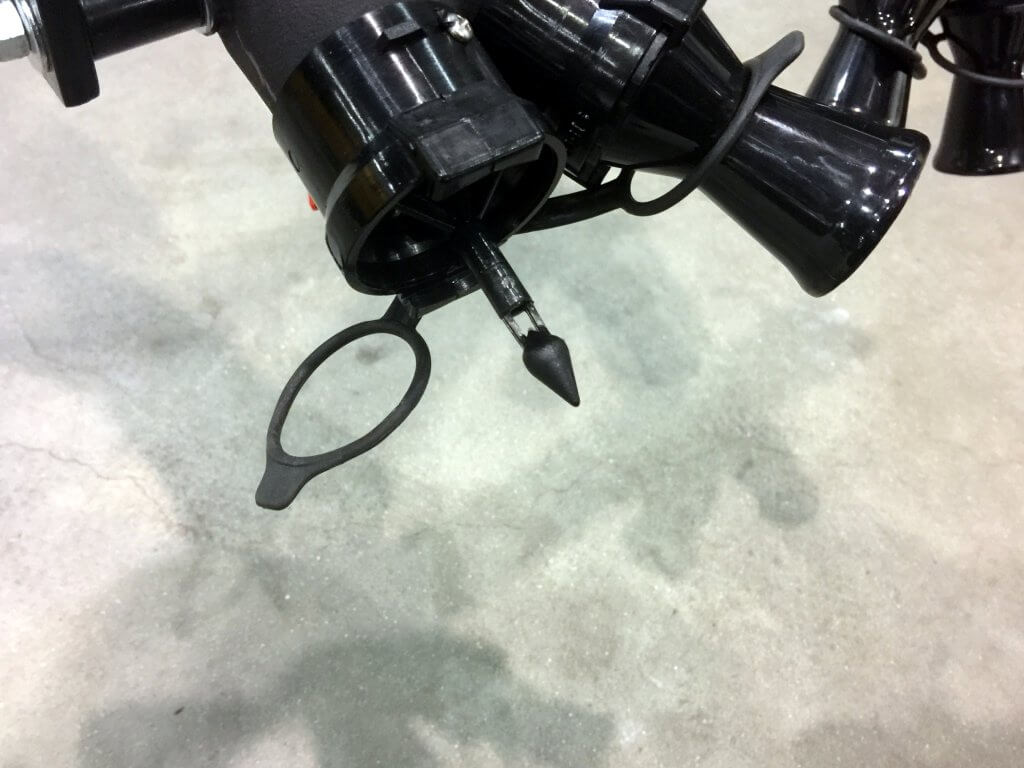
In the centre of each head is the teardrop-shaped atomizer-style nozzle that produces a Very Fine spray quality between 100 and 150 µm in diameter. It was explained that the teardrop employs Bernoulli’s principle… and for the lay reader (like me), think of the teardrop the way you think of an airplane wing. Air moves over the contour at different rates, making a low pressure area at the tip. The upshot is that it creates lots of very small droplets that (according to the manufacturer) permit you to use much lower volumes that you would with an airblast sprayer using conventional hydraulic nozzles. As always, I suggest you let coverage be your guide to spray volume.
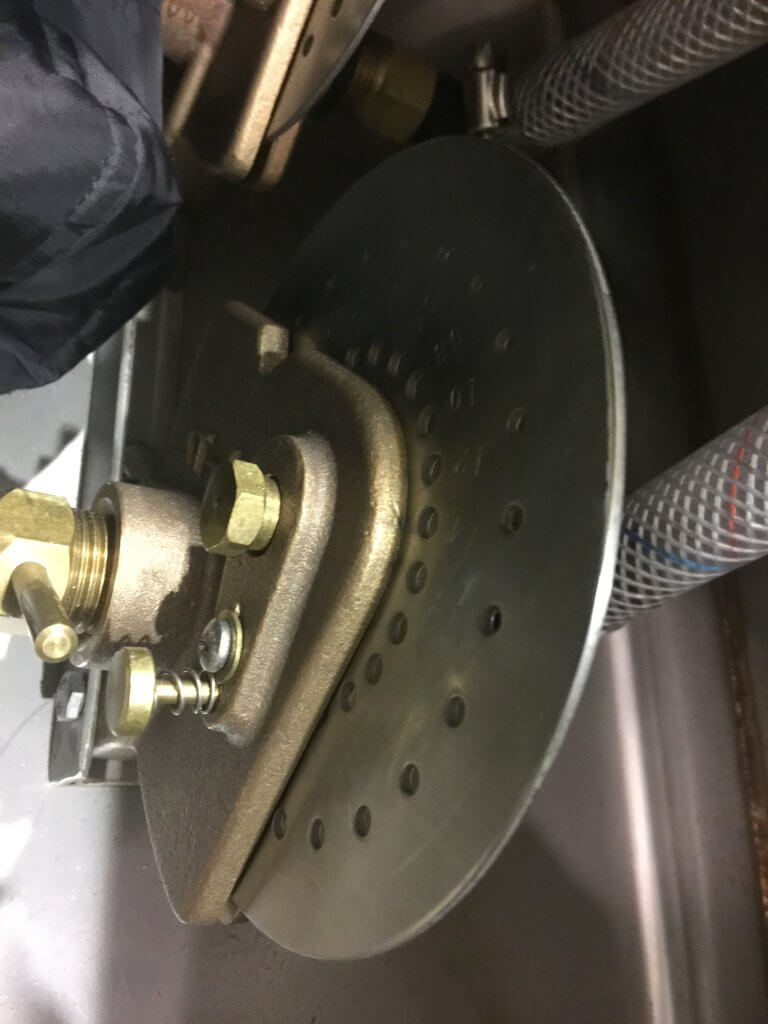
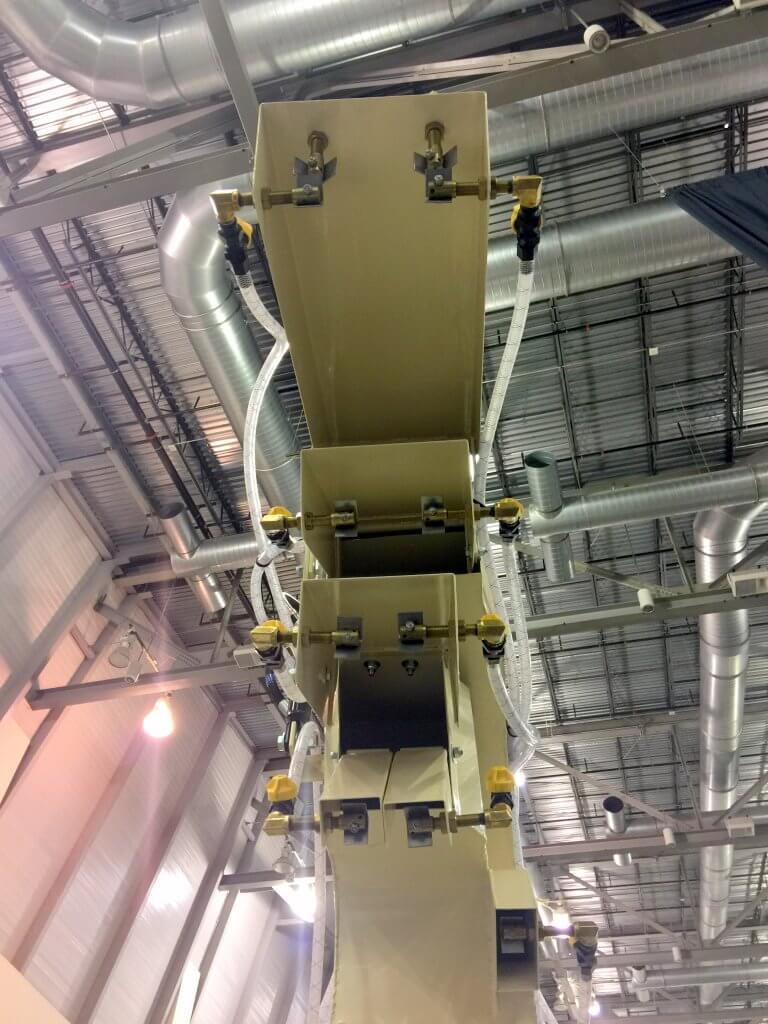
Flow is controlled by an inline disc that allow the user to select from a series of flow-restricting orifices. Look back two photos and you’ll see them as yellow circles on the tower. The photo below is a stainless steel version from an AgTec.
Air-Assist Horizontal Booms
A ducted, vertical airblast sprayer is an air-assisted horizontal boom sprayer just waiting to happen. For vegetable and berry growers, air assisted spraying is an appealing prospect. Many still use axial airblast or cannon sprayers to spray row crops, but I don’t like that. It’s my opinion that while it may be effective, it’s not efficient because it’s not possible to consistently control drift or coverage. I prefer getting the air and nozzle closer to the crop, but sprayers that can do this are few and far between.
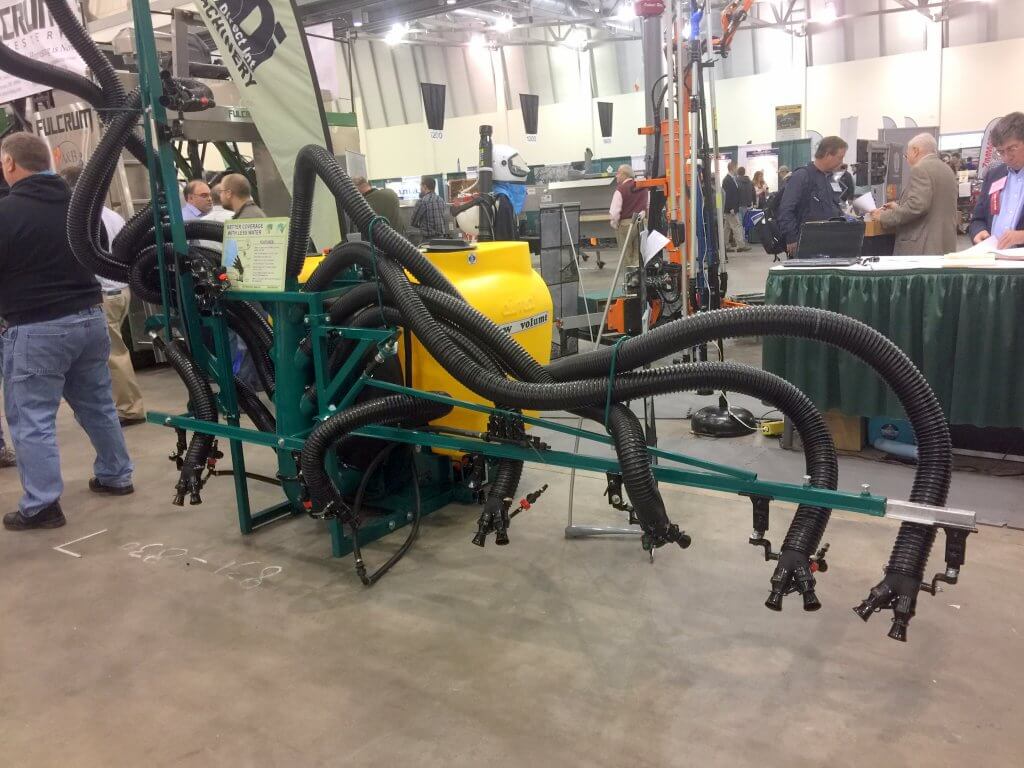
There have been no after-market options I’m aware of for converting a horizontal boom to an air-assisted boom. That leaves only a few manufacturers of trailed boom sprayers to fill the need (e.g. the trailed Hardi Commander with Twinforce air or their new self-propelled Alpha evo). But this tradeshow opened other possibilities, as demonstrated by the Cima below. It uses all the same principles described above… it just aims down.
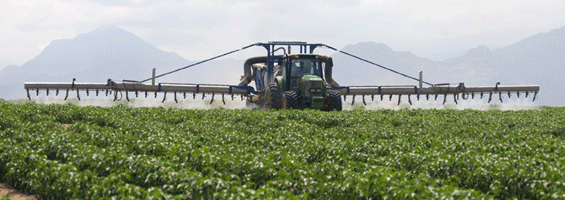
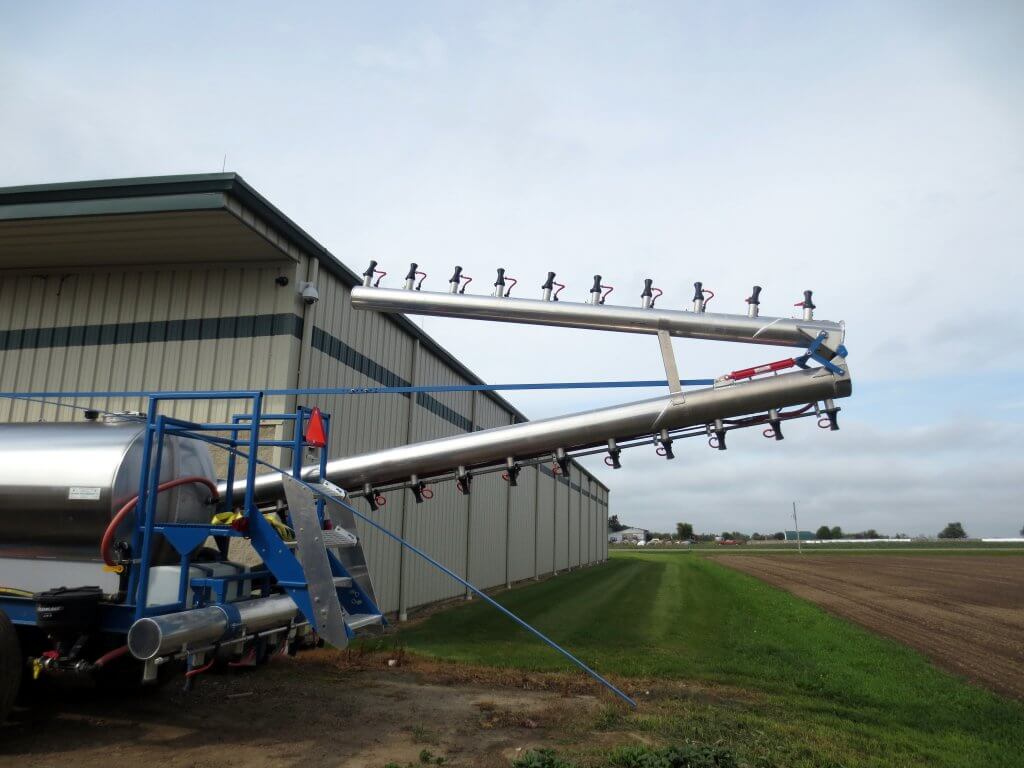
Not interested in ducted air delivery on a three-point hitch system from France or Italy? No problem. How about a Florida company called Airtec that offers trailed air-assist booms up to 120 ft. I wasn’t able to photograph the sprayer at the show, so here’s a picture of one in the field (from their website), as well as several I took at a spinach operation in Ontario.
Airtec offers a single axle, or a walking beam tandem axle reminiscent of the Argifac Condor. Note that the boom itself is the air conduit, which should open crop canopies, expose underleaf surfaces, entrain smaller droplets to reduce drift, and extend the spray window by allowing the operator to work in slightly windier conditions. I can’t speak to the manufacturer’s claims of reducing spray volumes (and by extension, chemicals), but you can read it on their glossy brochure.
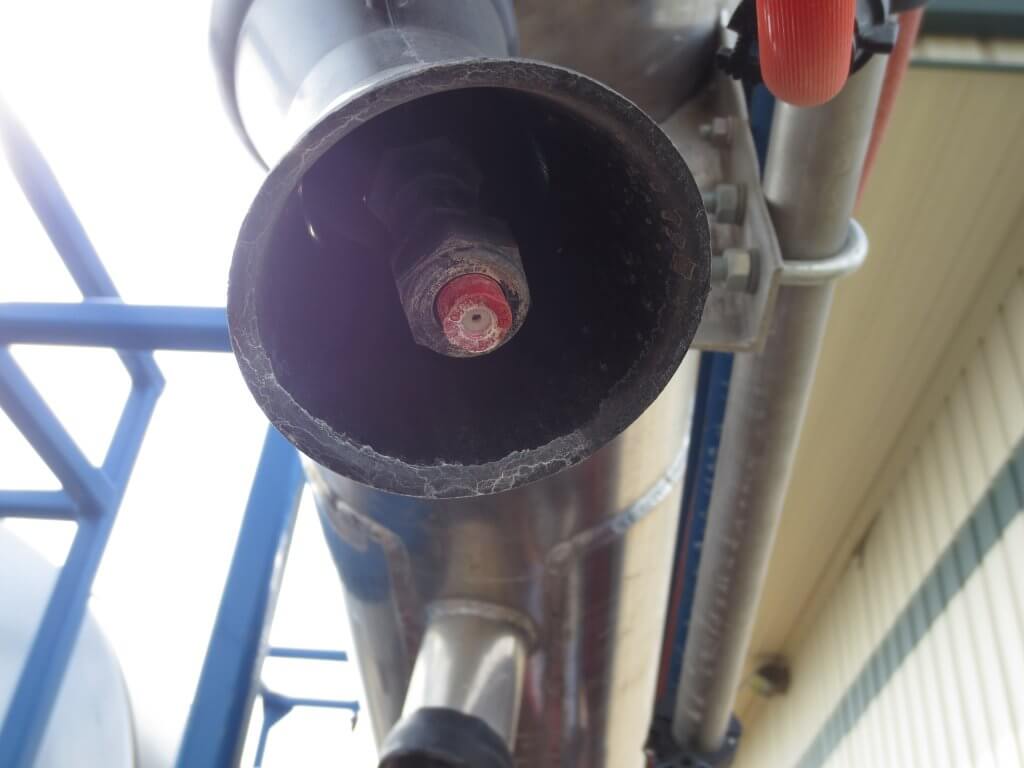
Each air outlet terminates in an hourglass-shaped duct, similar to the Cima and ostensibly creating the same advantage, as they also claim 180 mph windspeed at the nozzle. Again, I wonder if that can be dialed back, or adjusted to match the density of the crop canopy? Unlike the Cima teardrop shear nozzle, conventional hollowcone nozzles are used (see below). They can also be suspended to match the contour of the row (look back at the first photo) improving coverage in a manner similar to using drop arms or row kits.
Airblast – Unconventional Fans
Have you seen this man? Mark Ledebuhr is the co-author of the 2nd edition of Airblast101. He looks happy here… little did he know I’d one day lasso him into writing the new edition with me.
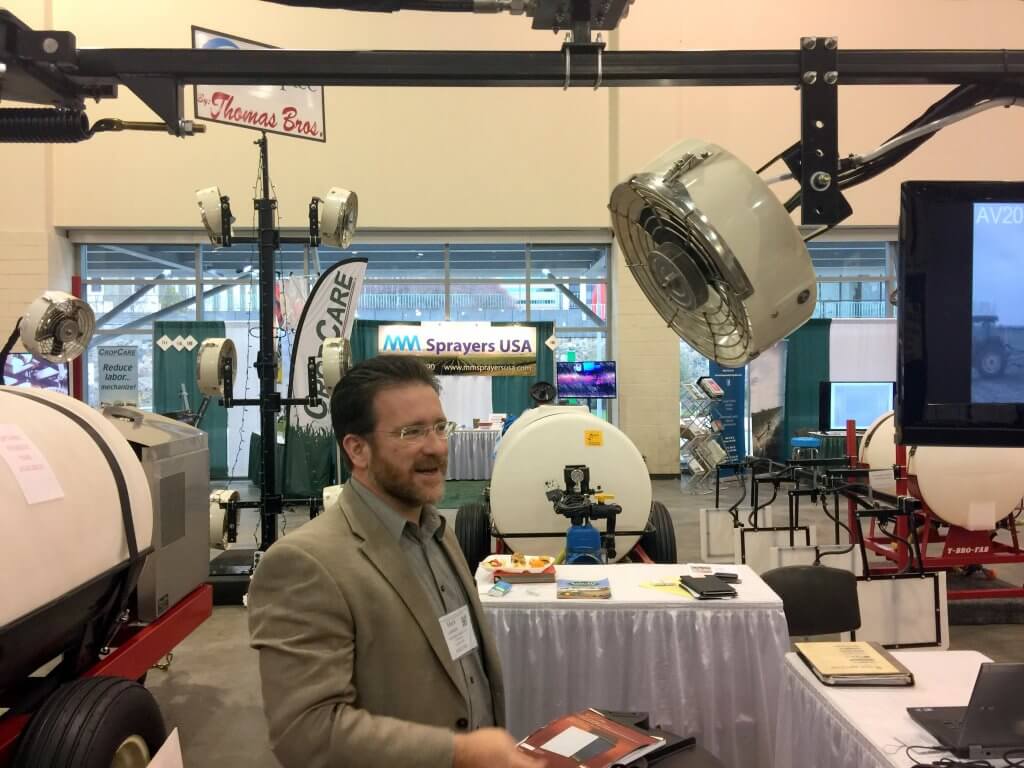
Let’s get back to airblast sprayers. The majority do not use ducts to convey air to the target – they point and blow. Pictured below is the generous Mark Ledebuhr with a Proptec rotary atomizer. I call him generous because for several hours Mark led me through the tradeshow and introduced me to many of the vendors. Perhaps more importantly, he helped me interpret what they were explaining after we left each display. Developed with his father, the Proptec system suspends individual fans with rotary atomizers so each can be aimed and operated independently, offering a lot of targeting flexibility. The fans can be electrically or hydraulically driven. Some might be reminded of a Sardi fan (not pictured) but unlike that system which uses several conventional nozzles around the circumference of the fan, Proptec employs a rotary atomizer in the centre. Rotary atomizers can produce very, very small droplets and until GLEXPO I was only familiar with their use in aerial applications.
I admit to a bias when it comes to airblast sprayers. In my mind, the further away the source of air and spray are from the target, the more opportunity there is to drift. Particularly when such small droplets are involved. I couldn’t find the Proptec video I saw looping at the tradeshow, but what I saw looked like tight columns of cycling spray, reminiscent of a tornado, firing into each row of a vineyard. I was told it was during a 15 mph wind, yet I didn’t see a lot of off target movement. A notable advantage to spraying down into the ground rather than sideways or up into the air. Here’s a good video I found of one operating in highbush blueberry (below). It seems I have a lot more to learn about this system.
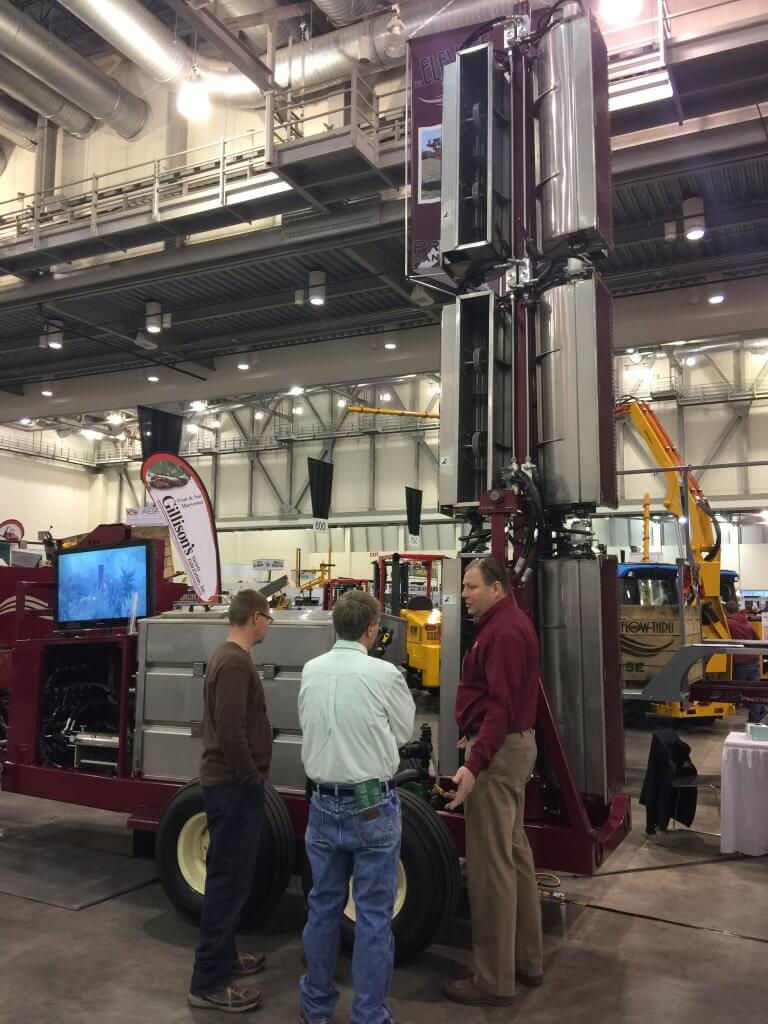
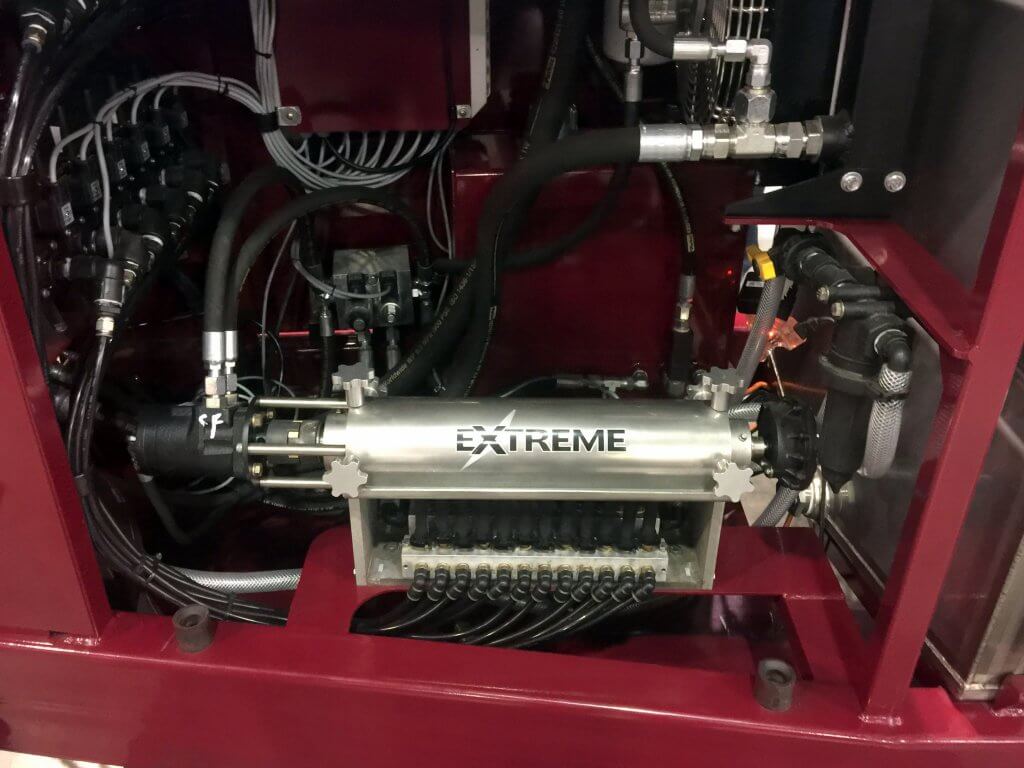
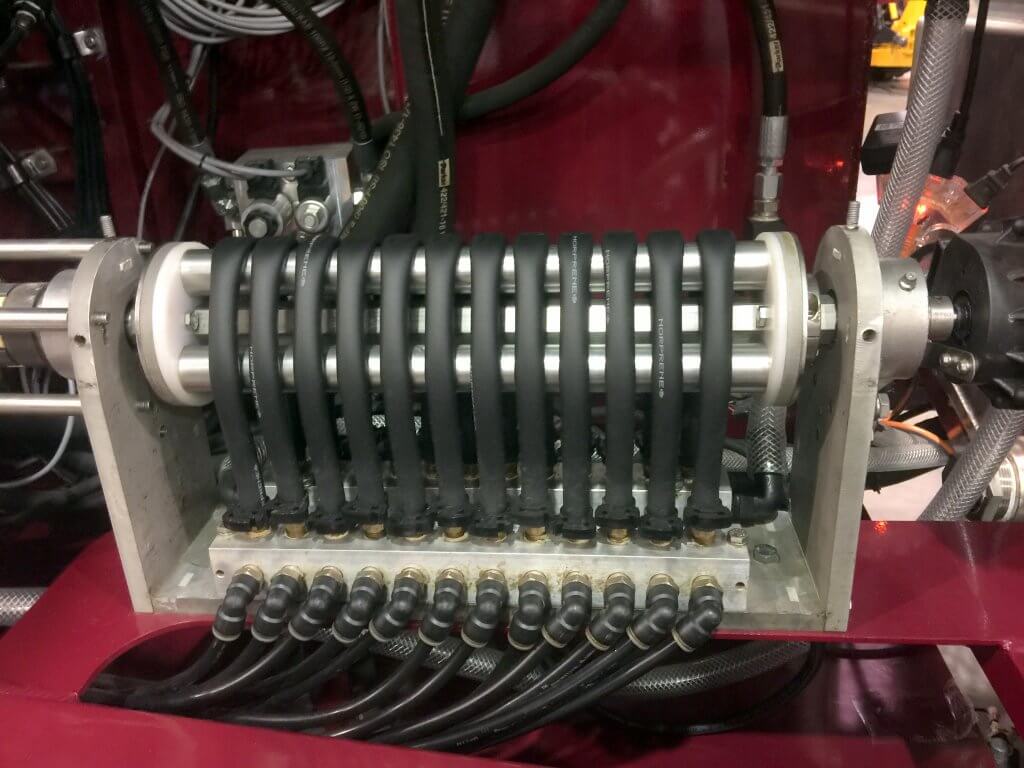
Then Mark and I went over to see Michigan-based Precise Manufacturing’s EX III cross-flow rotary atomizing tower system. I was reminded of the Curtec tangential fan towers that, like this sprayer, employ rotary atomizers and a peristaltic pump. For Curtec, it’s the AccuStaltic pump. For Precise, it’s the Extreme pump. More on that shortly.
Here’s a video of the EX III operating (sourced from the Precise Mfg. website). Obviously, we’re not talking grapes, berries or high-density orchards, here. This is for big, dense targets like standard cherry, nut trees and citrus. The rotary atomizers throw spray in a circle, but the air from the tangential fans capture it and blow it all out towards the target in very laminar (i.e. not turbulent) air that carries it over long distances to the target.
Back to the peristaltic pump. It can run dry, is self-priming, is anti-backflow, low maintenance and can handle pretty much any manner of spray mix (i.e. viscosity and corrosion are non-issues). Each atomizer has its own flow channel, and by changing the diameter of each tube you change the relative flow rate to each atomizer. Certainly not something you’d do every day, but it does allow you to match flow to the canopy density.
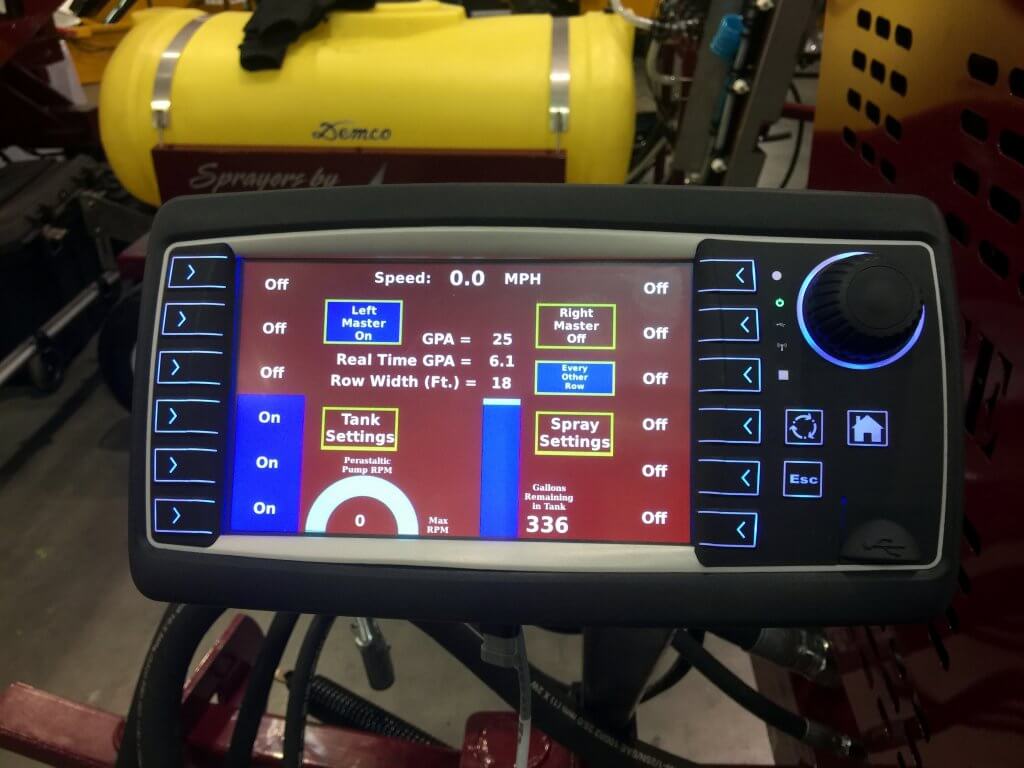
The Precise Touch Screen Controller is very intuitive and I liked how much control the operator has. Fan speed can be adjusted quite easily (although it would require a very knowledgeable operator to ensure the correct speed is selected). It tracks GPS position and logs where the sprayer empties and the rates used per acre. It also calculates a kind of tree-row volume by determining savings when the operator turns off nozzles that would otherwise blow over the tops of targets, or when overall flow is reduced by slowing the rpms of the pump.
Airblast – Cannons
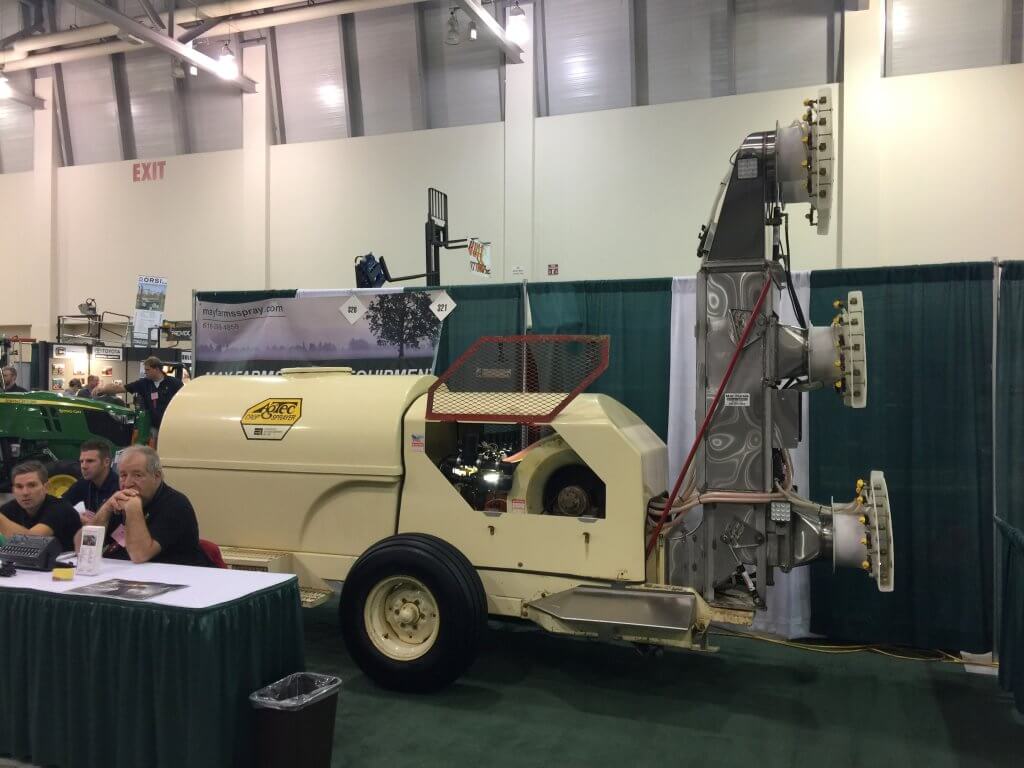
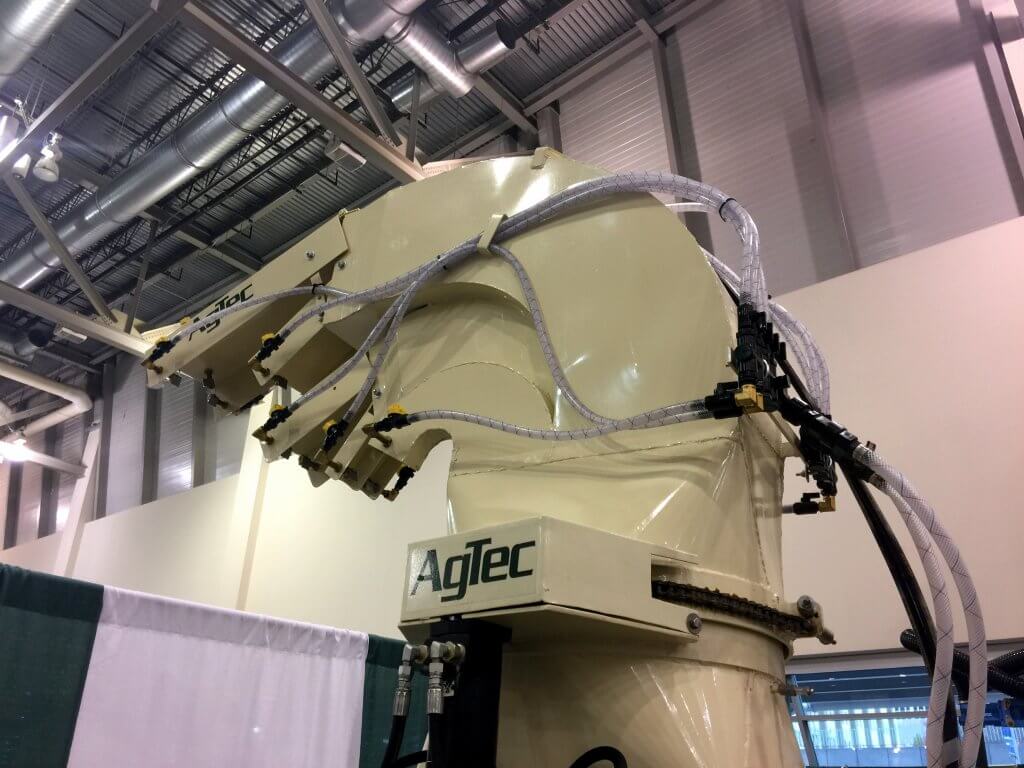
Well, there were lots of cannon sprayers. Most airblast manufacturers have one in their lineup. Squirrel-cage style fans feed air into a tower that allows spray to come out laterally, and on a downward angle from the top of the sprayer. AgTec, pictured below, has long sold such a sprayer.
The nozzles are air-shear style, relying on fast-moving air to shear the spray into finer droplets.
They usually only have nozzles on one side and the cannon can be turned via a chain-driven gear, and aimed up or down from the cab. They are intended to spray larger areas to save the grower traveling every row, and to prevent physical damage to the crop as the sprayer passes (I’m thinking about knocking berries off, mostly).
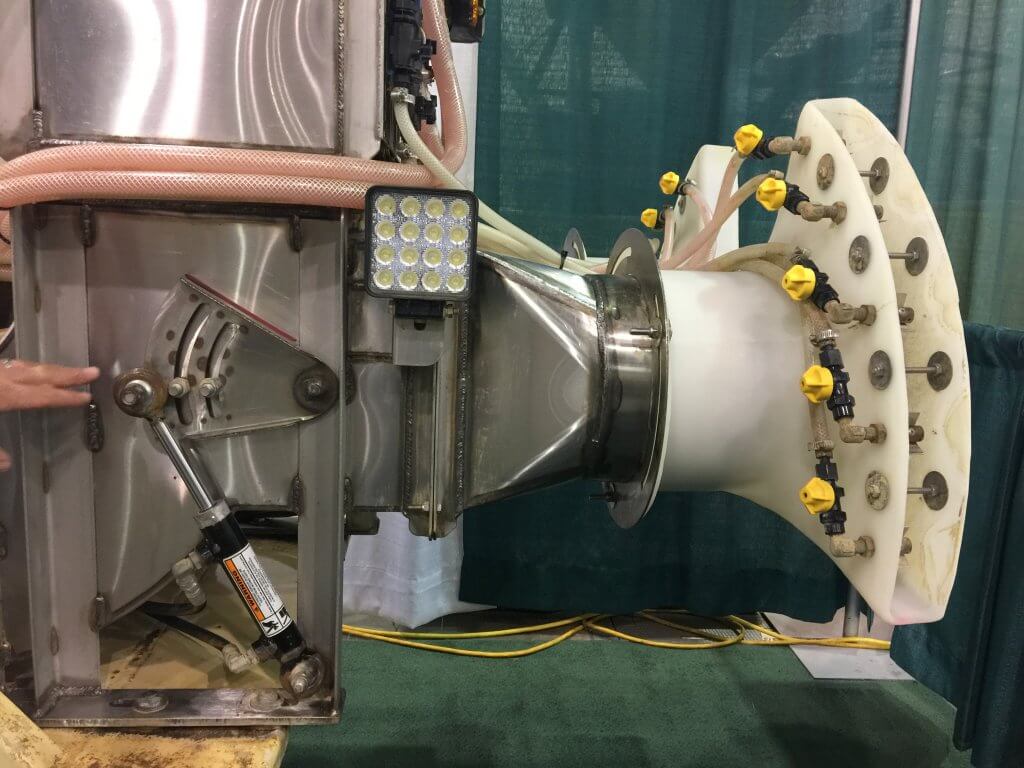
Nurseries use cannon sprayers quite often because they spray whips (i.e. young trees), shrubs, container crops, and all manner of crops in dense plantings and they try to spray them all with a single sprayer. Generally, there’s a lot of drift potential and erratic coverage from cannon sprayers – especially when operators try to cover too much ground in a single pass. I’m always skeptical when I can’t adjust air settings without impacting spray quality, and considering the bad practice of trying to apply too wide a swath, I have a hard time with cannon sprayers. I will note that the AgTec now has baffles that allow the operator to distribute air over the height of the tower (see the hand near the hydraulic piston in the image below). However, I don’t know what that does to spray quality in each section of the tower.
Airblast – Classic Axial Fans
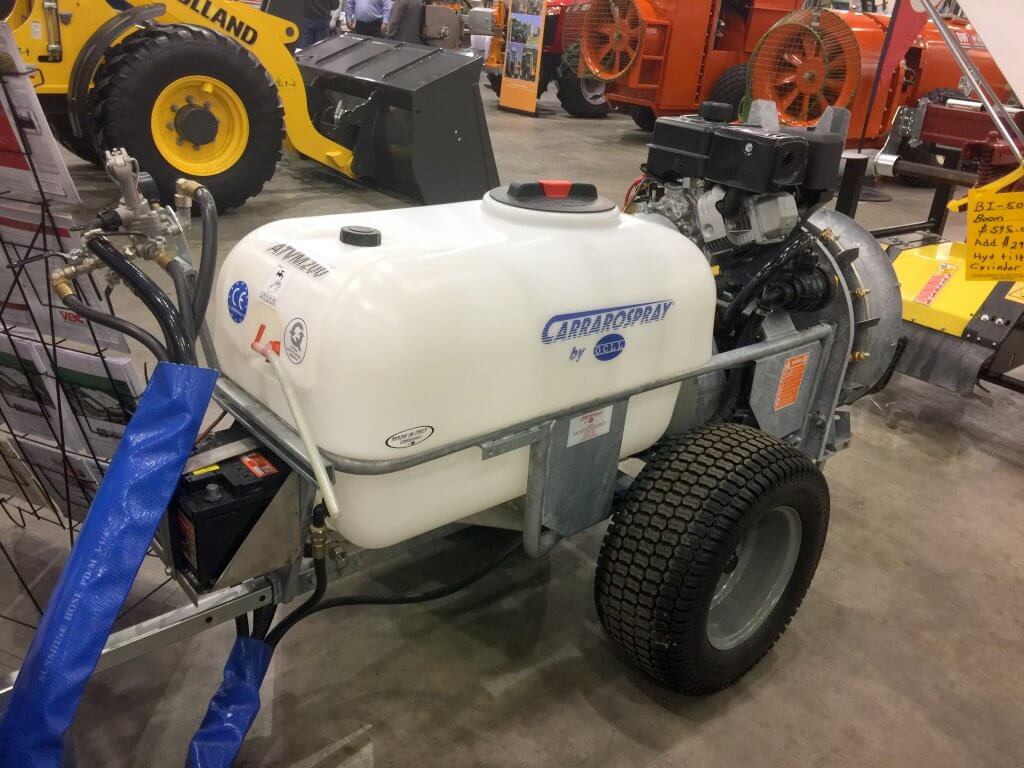
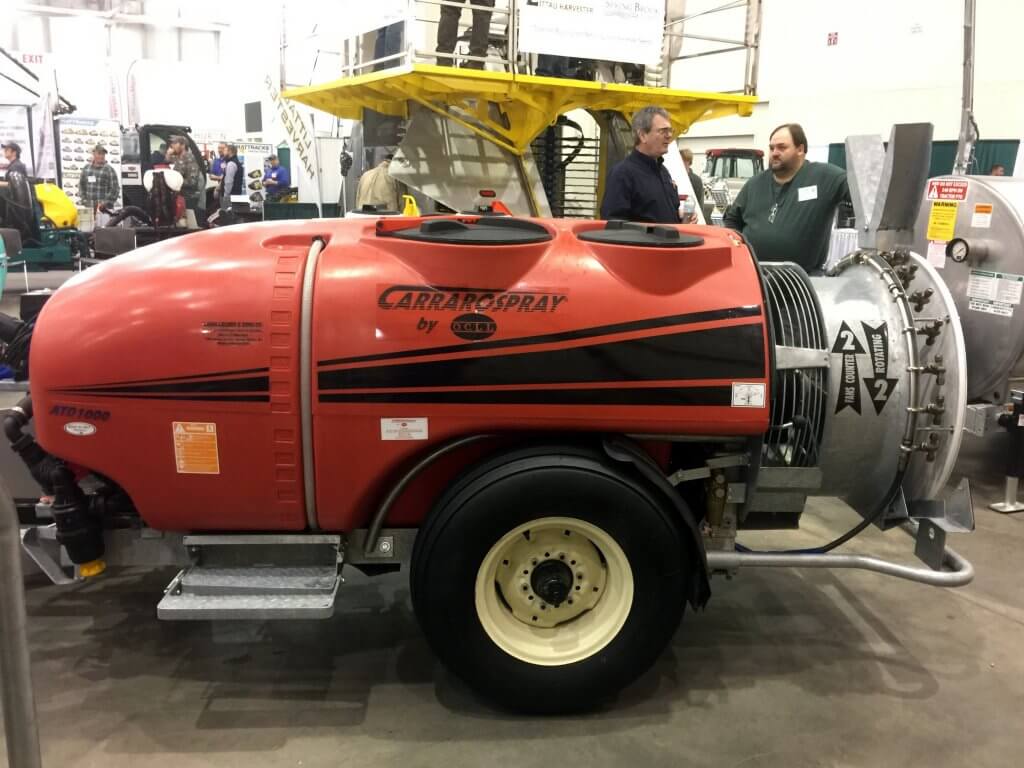
And, of course, there were many classic axial airblast sprayers. Even then, however, there were features to set them apart from one another. British Columbia’s Slimline TurboMist was there, featuring their turbine fans and adjustable air outlets (not pictured). Italy’s Carrarospray was there, and I’ve written about them in the past because they make a tiny sprayer that I like in cane fruit and highbush blueberry. You can hitch it to a mower and mow while you blow.
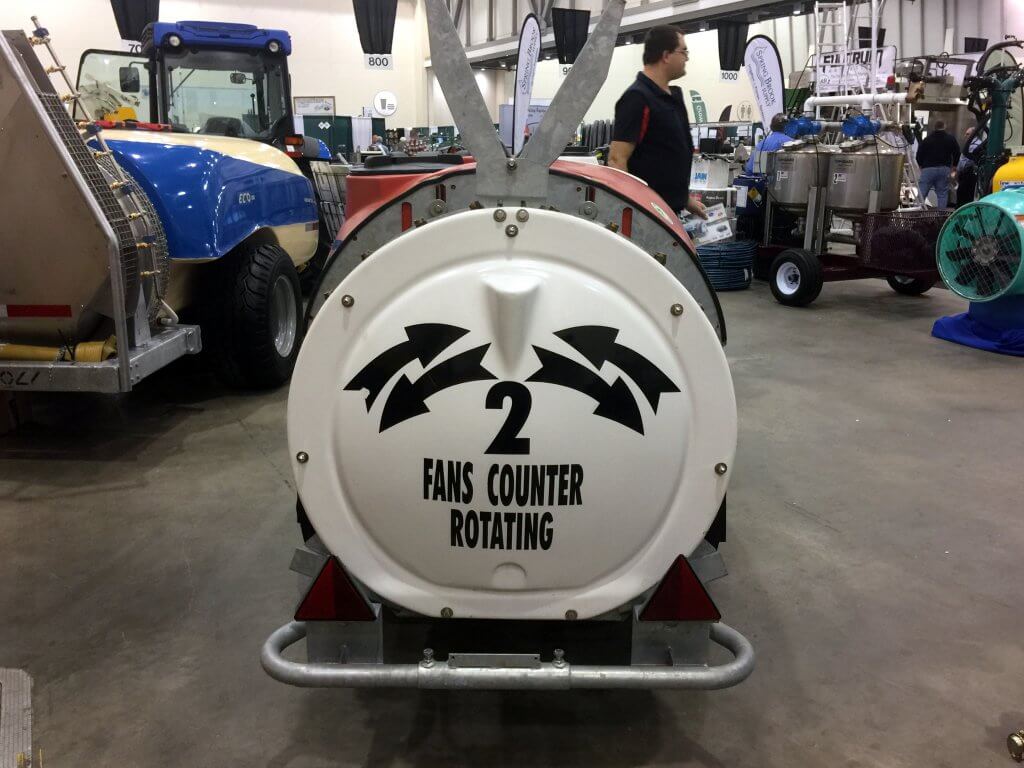
More interesting to me was their sprayer boasting two axial fans that run counter to one another. Carrarospray claims this counter-rotation creates more uniform air than a single fan… but I have no idea how.
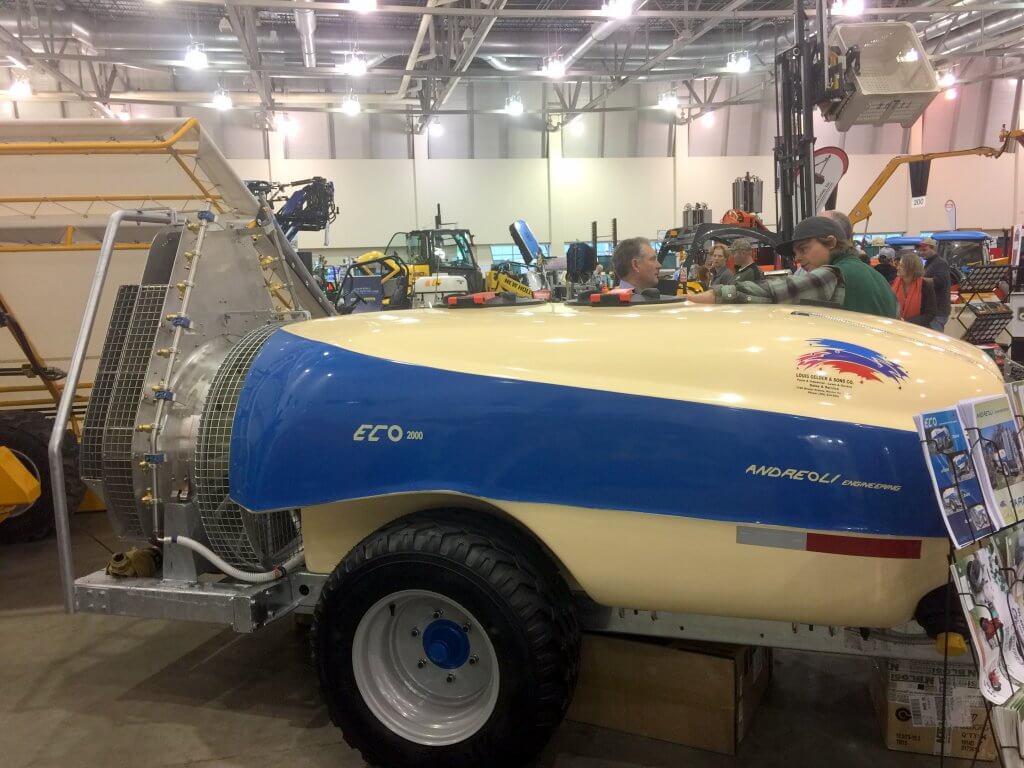
Then there was the Andreoli Eco with it’s stainless steel high-efficiency vane system. Reminding me of the Turbomist, the suction is in the front, so the sprayer is a little less likely to draw spray into the fan when one side is shut down for border spraying and when turning at the end of a row. Louvers covering the outlets would be better, but still, this is an improvement. They also claim to have a symmetrical airflow pattern, unlike older axial fans that move air up on one side and down on the other.
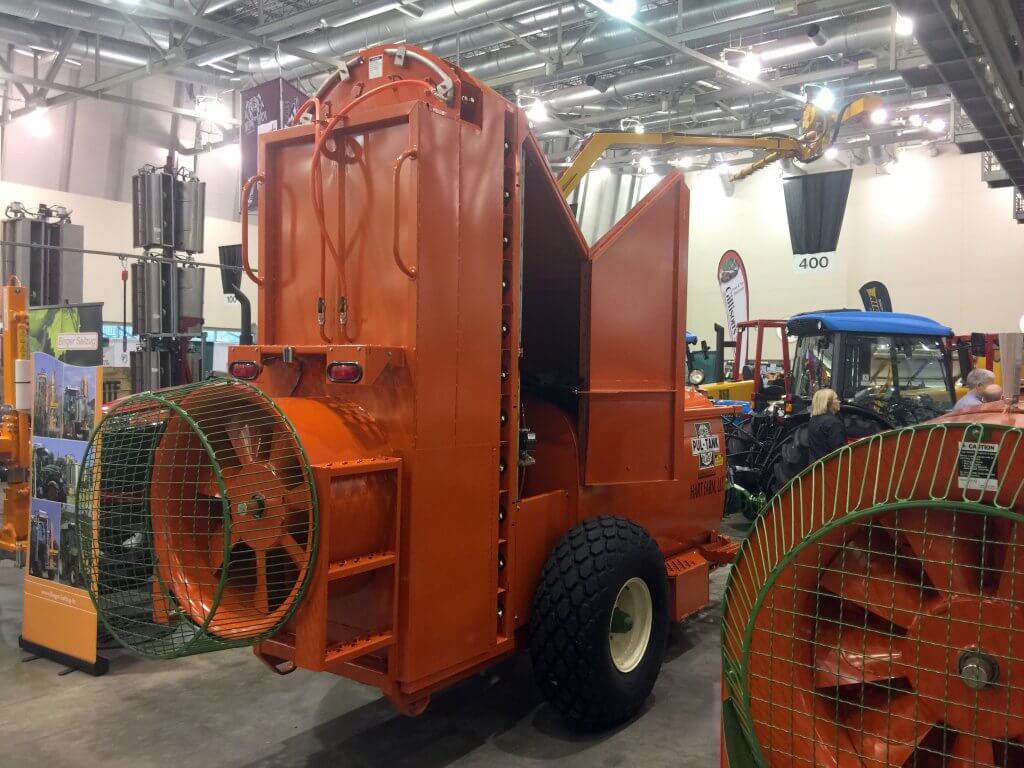
The Rears Pul-Tank reminded me of just that – a tank! Heavy-duty, stainless construction and intended (with care) to last a long, long time. No special features to boast of. It would seem this sprayer adheres to old-school ideas about airblast spraying. Certainly, simple and strong are two appealing features to those operators that don’t want to be bothered with complications.
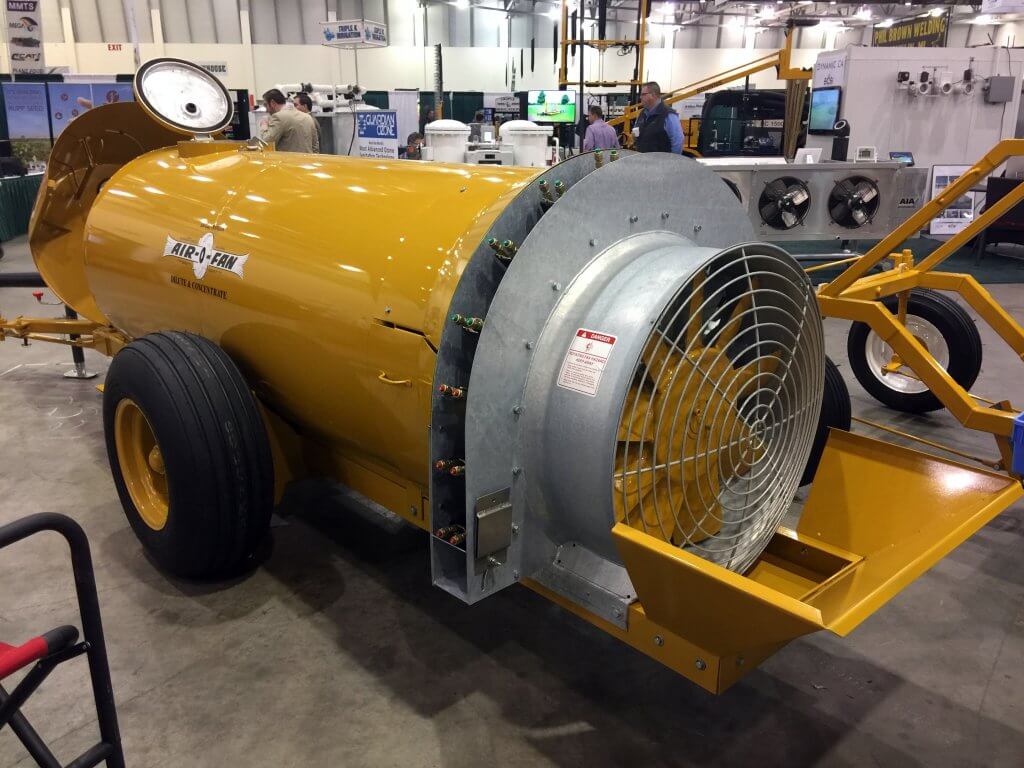
And, lastly (not leastly), was the Air-O-Fan sprayer. Another solidly-built sprayer with a few interesting features. Not shown is the reverse-style propeller which like the Andreoli Eco, claims to draw from clean air, and not spray-laden air. This is undoubtedly the biggest trash guard I’ve ever seen to protect the fan blades from drawing in dirt and leaves (see below). Looks like a CAT steam shovel.
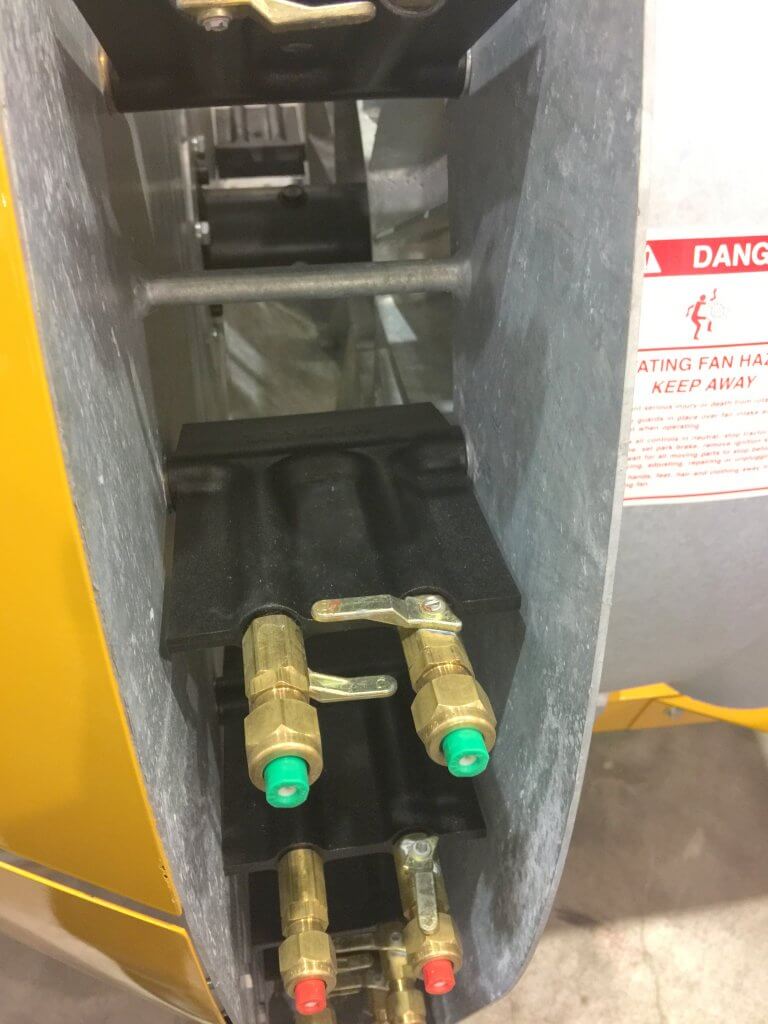
Something that struck me was the air deflector blades inside the fan housing. In my experience, the nozzle bodies and blades are two separate components. But not here, and it makes so much sense! I’ve always taught operators to adjust the air speed/volume and direction first, then adjust nozzle direction and rates second. With this system, you aim the nozzles right along with the air. Expanded systems (e.g. for tree nut, citrus) can have as many as three nozzles per deflector blade.
There was one other very exciting feature coming to this sprayer that I promised I wouldn’t reveal until they were ready, but I’ll just write “HVES” so you will remember you heard it here, first!
Closing
So, this was a massive, sprawling article. Congratulations for getting to the end and I hope it opens your mind to the possibilities for horticultural spray application. The GLEXPO tradeshow was a great experience and I’ll try to get back there in the future. Until then, I look forward to bringing some of this equipment to Ontario to try it out in our horticulture operations. There’s always more to learn.