OK, fine. We confess to the shameful use of click-bait in our title. Nevertheless, it’s absolutely true: Drift can be good. The reason this statement is unsettling is because of the lack of context, which is really what this article is about.
The majority of sprayer-related information available to ag stakeholders relates to horizontal boom sprayers. Most of it is relevant to broadacre field crops and often pertains to herbicide applications. If you’re unsurprised, or still struggling to grasp our point, it’s likely because you’re part of that world. But consider everyone else.
Agricultural spraying is diverse and many usage patterns are grossly underrepresented. As a result, those operators struggle to find relevant information. And what information is most readily available? Yes – broadacre herbicide spraying. Even the experts (i.e. agronomists, salespeople and consultants) often make the error of responding to specialty crop questions with field crop answers. Or relatedly, they assume their entire audience is comprised of field croppers and fail to use a disclaimer before making sweeping statements. The problem (and it is a problem) is so pervasive that we often hear about specialty crop operators taking training courses intended for field crop applicators… because that’s all that’s available.
So how different can spraying be for a given crop? Surely a droplet is a droplet and the laws of physics don’t care what you grow? This is true, but droplet size, spray volume, distance-to-target, environmental conditions, sprayer type and product formulation combine in complicated ways. The result is that the best advice for one operation can be disastrously wrong for another.
Case in point: Drift is good. If we were persnickety (and we are) we would suggest that moderate drift is the lateral movement of spray with the prevailing wind, and that this helps ground and/or disperse spray in a predictable direction. It’s not a bad thing. But we know that drift quickly becomes bad in high winds and especially when there are sensitive downwind areas. We won’t even talk about dead calm.
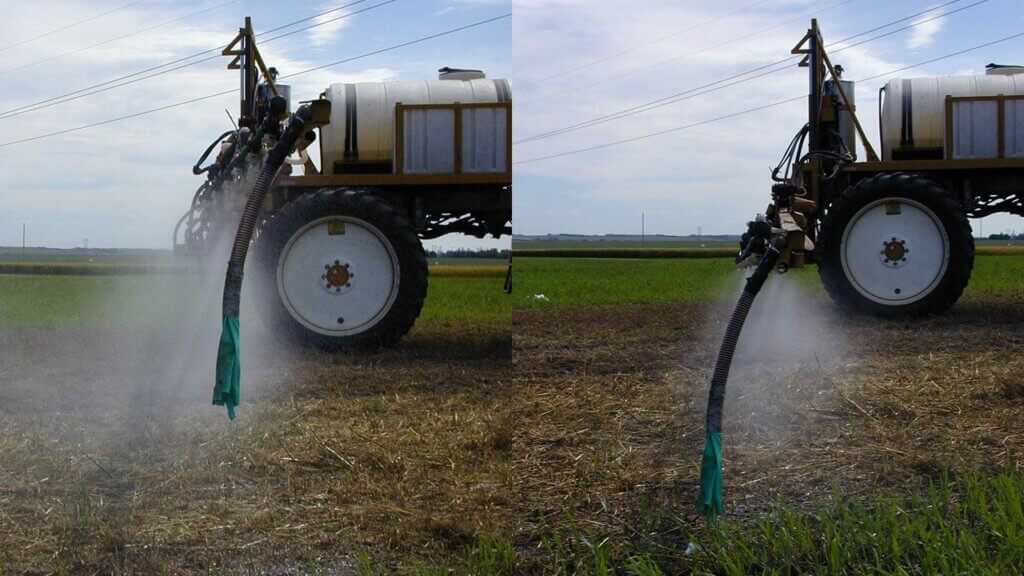
However, in controlled environment applications (e.g. greenhouses) operators use very small droplets in high numbers and absolutely rely on air circulation to expose all crop surfaces to the spray. Without drift, most stationary foggers would only have a limited and localized effect. And in airblast operations, a wind that would never deter a field sprayer operator would derail an airblast operator. Wind is much faster with elevation and airblast sprayers use very small droplets that span considerable distances to the tops of tall targets. In their world, droplet size is not the primary means for drift mitigation – it’s air alignment.
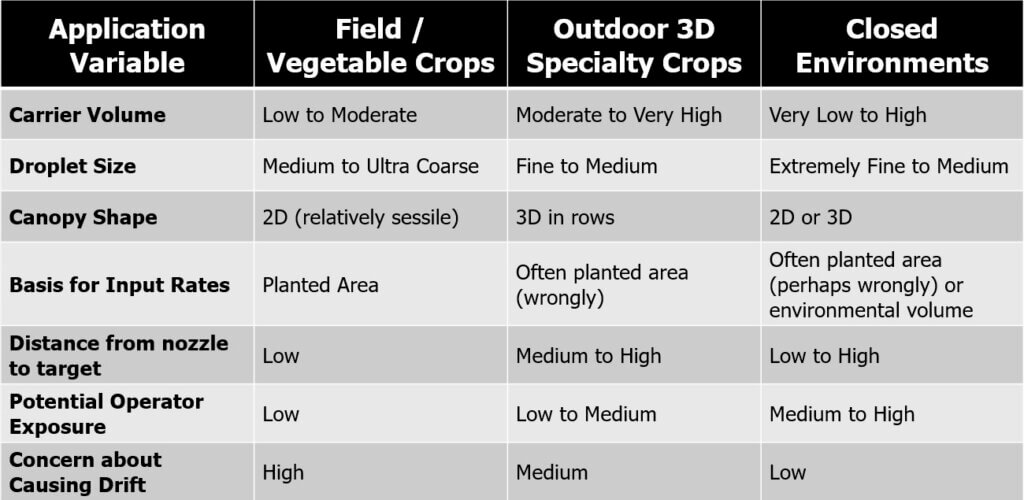
The following table is a relative comparison of key factors in spraying. Note how different they are depending on the usage pattern. And if this isn’t diverse enough, recognize that we didn’t include a column for vegetative management (e.g. roadsides, industrial and forestry) or aerial application (which might even be split into piloted and remotely-piloted).
And so where does this leave us? We have two pieces of advice:
If you are looking for information on spraying, take the time to find out who your source is and understand the context of the information. More often than not it will have relevance, but in some cases it could be completely wrong for you.
If you are providing information on spraying, be clear who the information is intended for. While we don’t propose caveats amending every statement, context is always appreciated. A sentence in an article, or a brief interjection during a presentation, might help someone that doesn’t know what they don’t know.
This presentation was delivered virtually for the 2021 OMAFRA Controlled Environment Webinar Series. If you’d like to learn more about strategies for spraying in closed environments, settle in and give a watch. It’s 45 minutes plus questions.
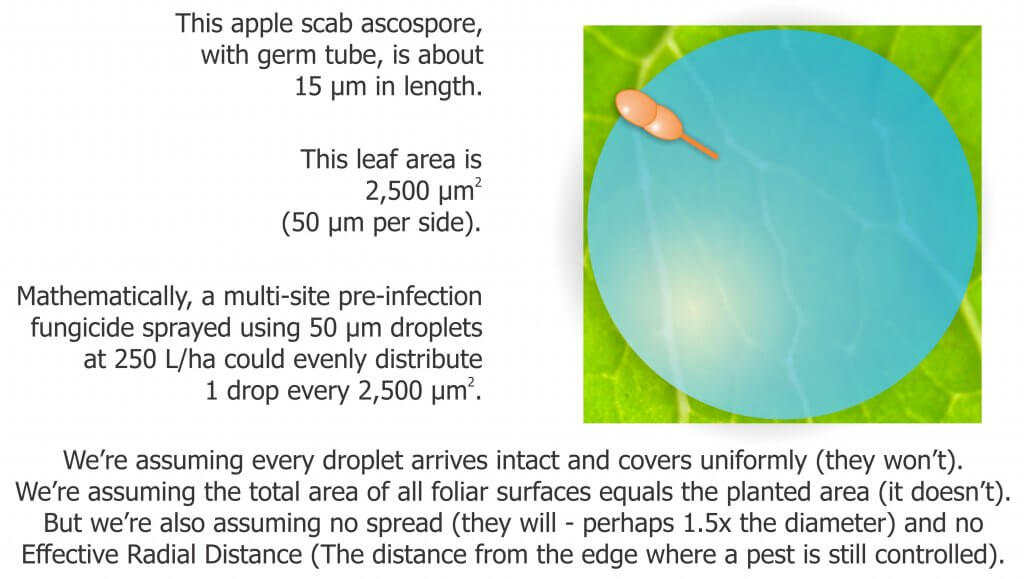
So, a minor error in the presentation. The image of the ascospore was not quite right. This new version (below) is correct. Perspective can get tricky at the micron-scale of resolution.
Choosing the right time to spray can be tricky. Our gut tells us that spraying when it’s windy is wrong. The experts tell us that spraying when it’s calm is wrong. So when can you actually spray?
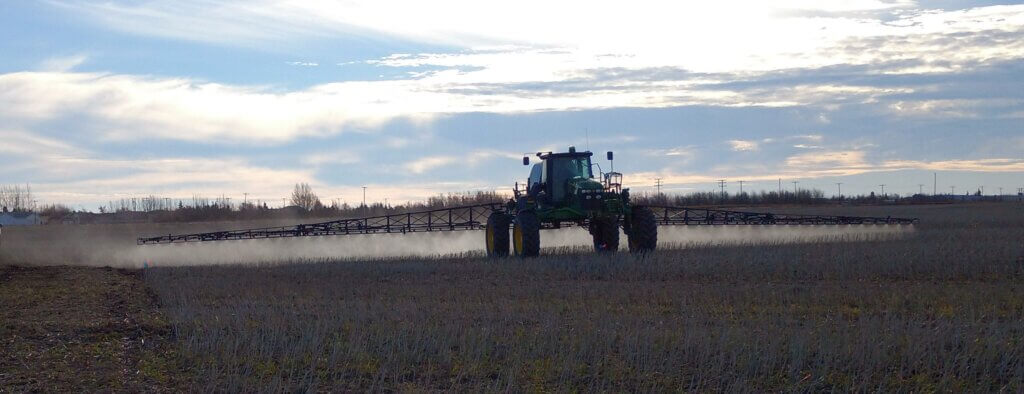
I’ve always advised my clients to spray in some wind, because it has a few advantages. The main one is that wind helps disperse the spray upward and downward, diluting the spray cloud fairly rapidly. Another advantage is that winds tend to be reasonably steady in their direction and velocity (or at least that can be forecast), so downwind areas can be identified and potential impacts are known or predictable. It helps if it’s sunny, because that improves the dispersion of the cloud even more.
First, let’s define “windy”. The classic wind scale is the Beaufort Scale, intended for the sea, but also used on land. The upper limit for spraying is probably Force 3 or Force 4, with upper limits of 20 – 25 km/h or so. The Beaufort Scale calls these “Gentle or Moderate Breezes” (they had to save the alarming words for hurricanes), and the scale provides good visual clues such as what wind does to flags, leaves, or dust.
Spraying under breezy conditions can be done fairly safely if you follow specific steps. The idea is to understand what the risks are and to manage them.
The cornerstone is to use a low-drift spray and match it to a pesticide that will work well with larger droplets. But there are other important aspects to consider. Below are the top ten to think about:
Choose a herbicide that can handle large droplets. Glyphosate products are well suited to coarse droplets. But glyphosate commonly has contact actives in the mix, members of Group 6, 14, and 15, and these are less likely to perform well with big droplets than those that contain Group 2 and 4 mixes. Actives with soil activity also have more tolerance for larger droplets.
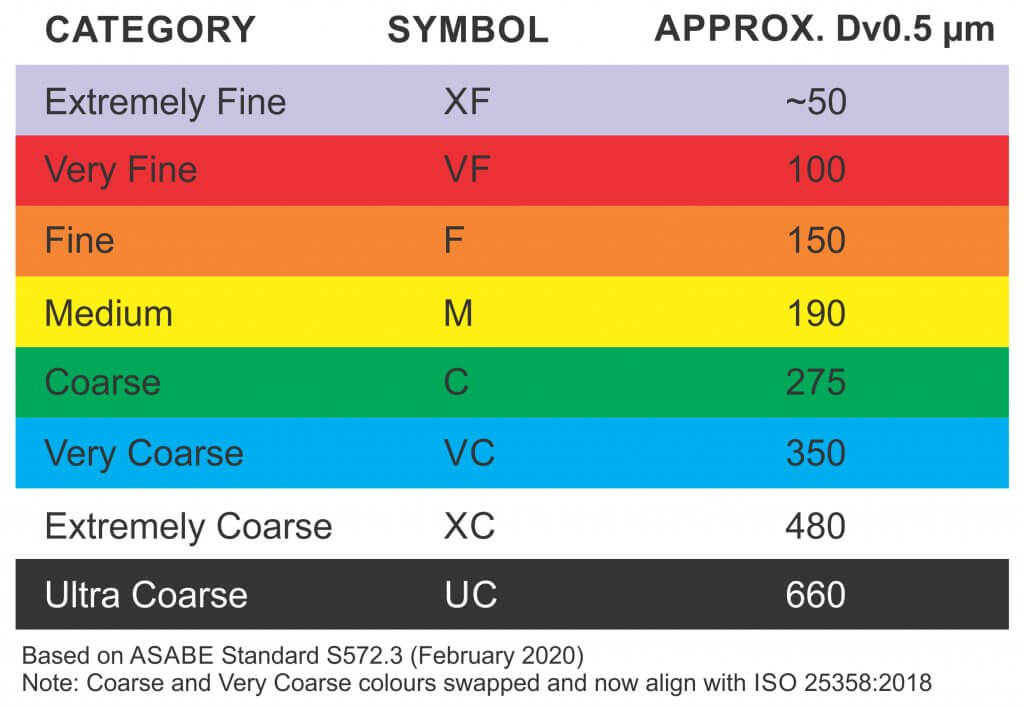
Use a low-drift nozzle and operate it so it produces a Coarse (C) to Very Coarse (VC) spray quality, as described by the manufacturer. Dicamba labels call for Extremely Coarse (XC) to Ultra-Coarse (UC) sprays, and Enlist requires at least Coarse. To achieve these you may need to purchase new nozzles. Low-pressure air-induced nozzles operated at about 50 – 60 psi will generally be very low-drift, but lower drift models are available. If you need a finer spray, produce it either by increasing the pressure or moving to a finer tip. Do this when the weather improves, for contact modes of action.
The name, symbol and range of droplet sizes used to describe the median droplet diameter produced by nozzles according to ASABE S572.3
Keep your boom low. Lowering the boom ranks as the second-most effective way to reduce drift, after coarser sprays. But there’s a limit. For low-drift sprays, you need at least 100% overlap (more for PWM), which is for the edge of one nozzle pattern to spray into the centre of the adjacent pattern. In other words, the spray pattern should be twice as wide as your nozzle spacing at target height. For most nozzles, a boom height of close to 20 inches is enough to achieve this overlap. That’s pretty low by current standards from suspended booms on self-propelled sprayers, so being too low for a good pattern will only happen due to boom sway.
Maintain reasonably slow travel speeds. These reduce the amount of fine droplets that hang behind the spray boom, reduce turbulence from sprayer wheels, and they also make low booms more practical. An added bonus is less dust generation.
Know what’s downwind and what harms it. Survey the fields on all sides of the parcel you’re treating. When you have a choice, avoid spraying fields that have sensitive areas downwind such as water, shelterbelts, pastures, people, etc. If you can’t avoid being upwind of these areas, make sure you check and obey the buffer zone restrictions on the label. These will also give you an idea if the product can cause harm in water or on land, or both.
Let the weather help you.
Take the wind from the side if you can. Going straight into the wind creates a lot of extra drift.
Consider a dicamba tip for special situations, even if you don’t use dicamba. If you’re in a situation where quitting and waiting is a poor option, these tips allow you to finish the job with minimal drift risk and with only slight reductions in product performance due to poor coverage.
Use a low-drift adjuvant. Specific products such as Interlock or Valid have been shown to reduce driftable fines (<150 microns) by between 40 – 60%, without adding significant volume in coarser droplets. The response will depend on the nozzle and the tank mix, but can be very noticeable.
Study drift and how it forms and moves. It’s about more than wind speed and droplet size. Knowledge in this area can help you work out the best strategies.
Invest in productivity. You may not need it every day, but on occasions when you have a small window to avoid bad weather, it pays dividends.
If you feel that drift is unavoidable and someone might be impacted by it, talk to those people first. It’s one of the most important things you can do.
Keeping pesticide sprays on target continues to be one of our top responsibilities.
The year 1989 marked my first spray drift trial under the watchful eye of Dr. Raj Grover and John Maybank. We evaluated the performance of several spray shrouds, Flexi-Coil, AgShield, Brandt, and Rogers, and wanted to measure just how effective they were. But in my heart I wasn’t interested in drift. I wanted to study herbicide efficacy. Anyway, I thought, we’ll do this trial and I’m pretty sure we won’t have to revisit the topic.
It’s now thirty-two years later and spray drift has interwoven itself into all my projects, remains one of the most powerful drivers of regulatory activity, is likely the most visible consequence of poor stewardship, and will stay as one of the dominant creators of public opinion around modern agricultural practice.
Drift has not gone away. And yet our understanding of it is far from complete.
Spray drift is defined as the wind-induced movement of the spray cloud away from the treated swath. Droplet drift can occur for all sprays, and it happens within minutes of the spray pass. Its cousin, vapour drift, is limited to active ingredients that are volatile, that is, they can evaporate from dry deposits after application. Vapour drift happens also starts at application but can persist for days after the spray application is complete.
Droplet Drift
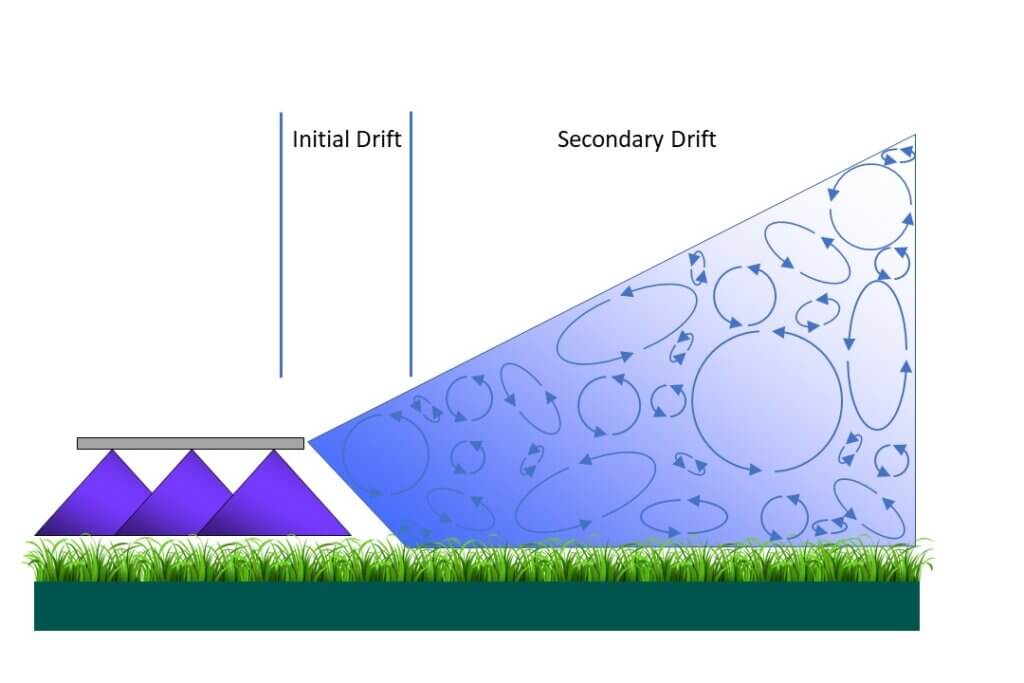
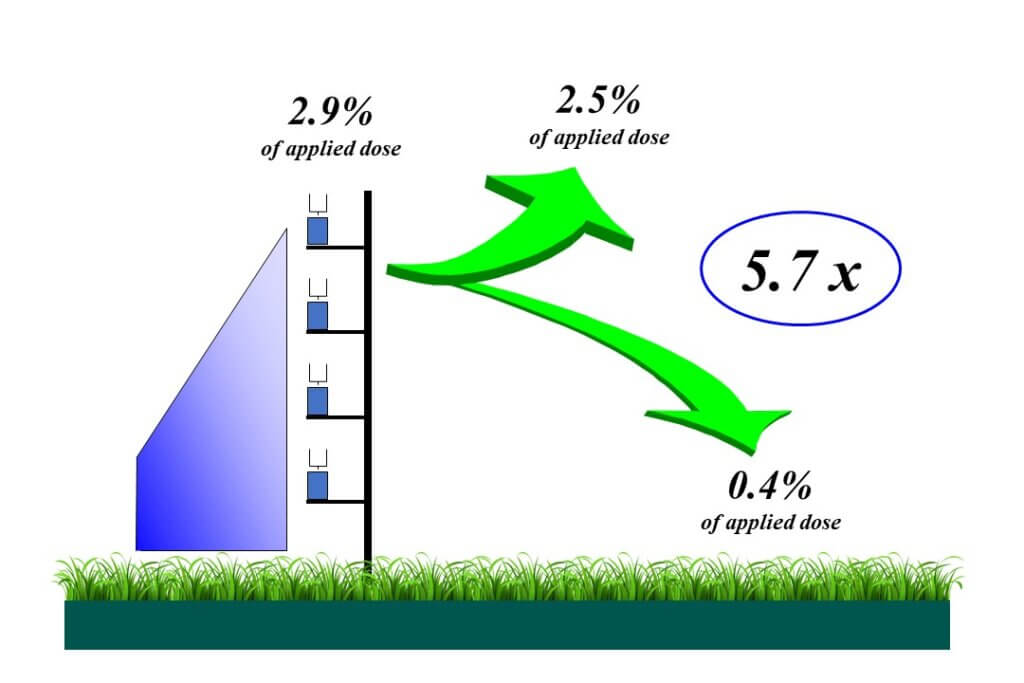
Droplet drift can be divided into two phases that are separated by about 1 second and that are measured differently. “Initial drift” happens first and refers to the product that leaves the treated area immediately after atomization. It is airborne, is caused by air movement strong enough to displace droplets from their intended trajectory, and can be measured by placing air-samplers (any device that can capture droplets in air) close to the downwind edge of the spray swath.
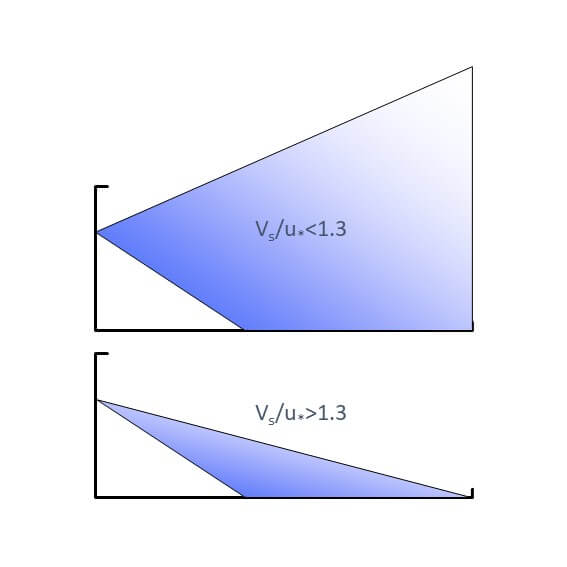
Figure 1: Initial vs Secondary drift. Once the drift cloud leaves the treated swath, the relative strengths of turbulence and sedimentation determine the amount that remains airborne and the amount that lands downwind.
Secondary drift describes the airborne spray cloud that continues to move downwind from the swath edge, where it either remains aloft or deposits on the surface below it. It is typically measured using samplers placed on the ground that capture sedimenting spray droplets. The difference in method is important because it goes to the heart of the problem of understanding spray drift.
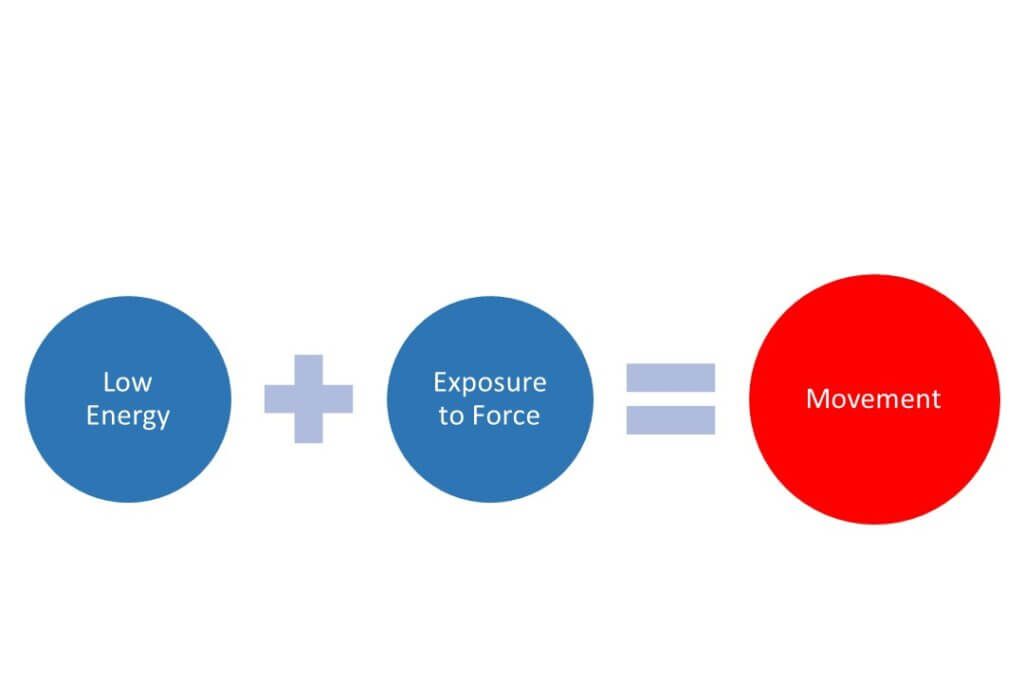
Figure 2: Droplet drift occurs when displacement energy exceeds droplet energy. The droplet’s combination of mass and velocity cannot withstand the energy presented by moving air.
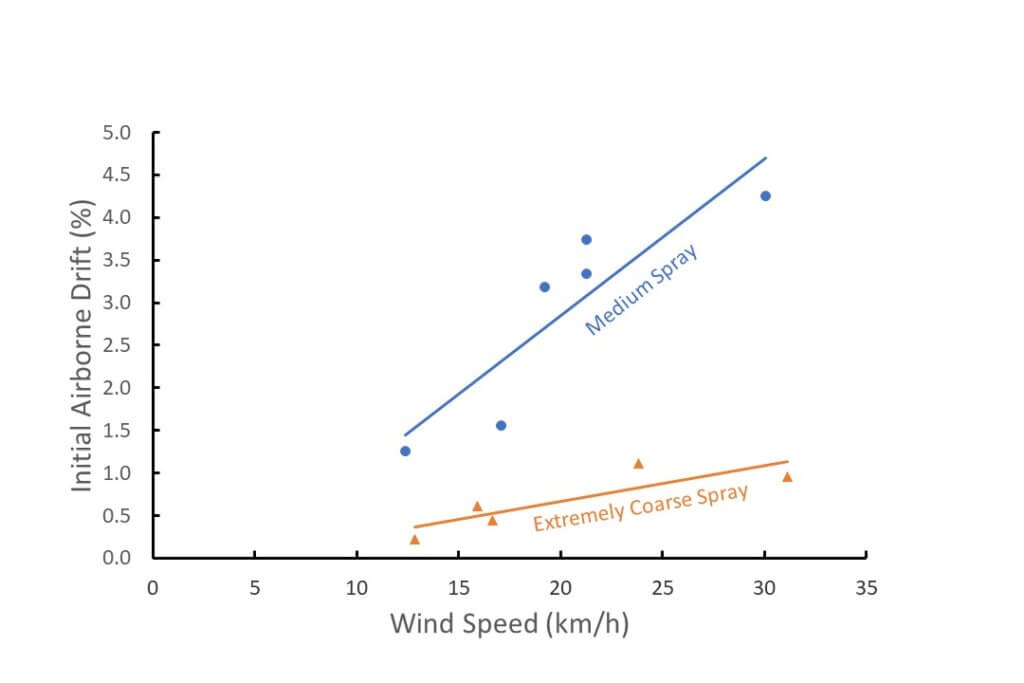
Initial drift is actually quite easy to understand because its creation is intuitive. The displacement of droplets from the spray plume is a function of balancing two types of energy. The first, droplet energy, is the product of droplet diameter and velocity. The more energy in the droplets, the more difficult they are to displace, and that’s why larger, heavier droplets or fast-moving air assist are useful drift reducing tools. The second, displacement energy, comes from relative air movement, either from forward travel speed or wind and the associated turbulence. More wind or turbulence means more power to displace.
Figure 3: Initial drift follows an expected response to greater wind speeds and coarser sprays. Data from a pull-type sprayer travelling 13 km/h with 60 cm boom height.
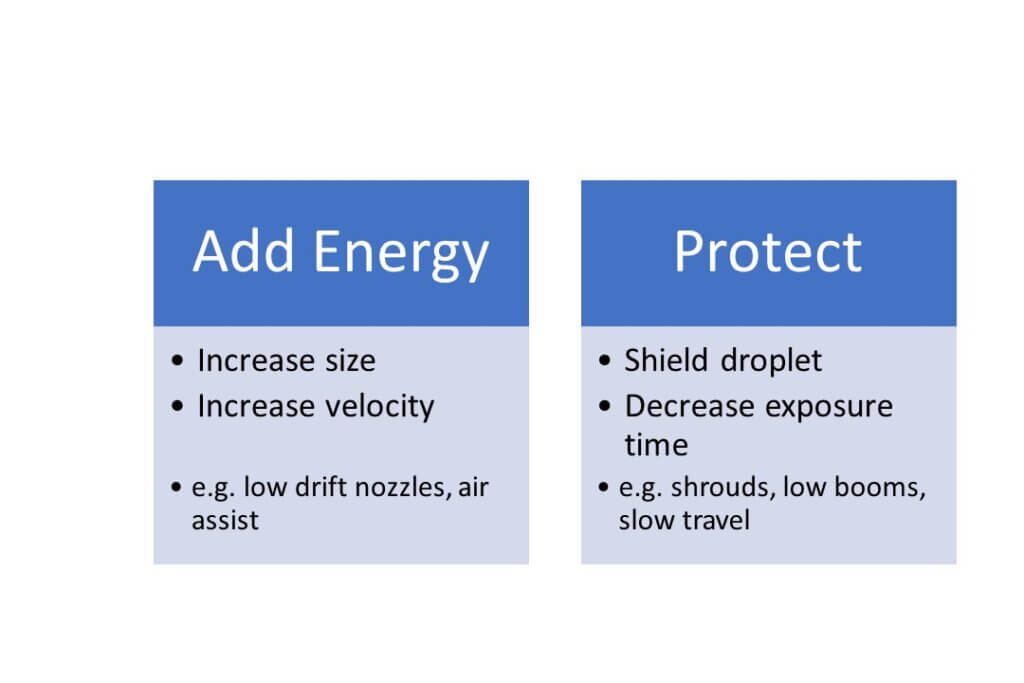
Because initial drift is easier to understand, our most common advice for reducing drift is based on maximizing droplet energy and minimizing displacement energy. Lower booms, larger droplets, slower travel speeds, shrouds, or properly implemented air assist all help reduce initial drift. It makes sense that creating less initial drift will also reduce downwind deposition arising from secondary drift.
Figure 4: Management of initial drift is intuitive. We reduce drift by adding energy to the droplet and by protecting the droplet from exposure to moving air.
Downwind Deposition
After leaving the spray swath, the moving secondary drift cloud has two main options. It can deposit or it can remain airborne. Basic physics suggest that all objects eventually fall to the ground, and since smaller objects need more time, they drift further. But when atmospheric turbulence and topography are considered, it’s not quite that simple. These two complicating factors control what proportion of the drift cloud remains airborne, and what proportion deposits.
Drift trials show that about 20% of the initial drift amount returns to the surface within the first 100 m or so of the sprayer. The rest remains and rises in the atmosphere where it evaporates and gets mixed further.
Figure 5: The majority of secondary drift remains airborne. Data are for Medium spray quality from a pull-type sprayer with 60 cm boom height and 13 km/h travel speed
It happens quickly. Just 5 m downwind of the spray swath, the cloud is already 4 m tall. At 100 m downwind, we’ve measured its height to be 30 m.
The proportion of the spray that remains airborne depends on the spray quality and the nature of the atmosphere. If it’s windy and sunny, or if the spray is finer, turbulence sends more into the air. If it’s cloudy and the wind is low, we have little atmospheric mixing. As a result, a smaller proportion will remain airborne and more will sediment, and overall, we may actually have more potential to damage downwind areas.
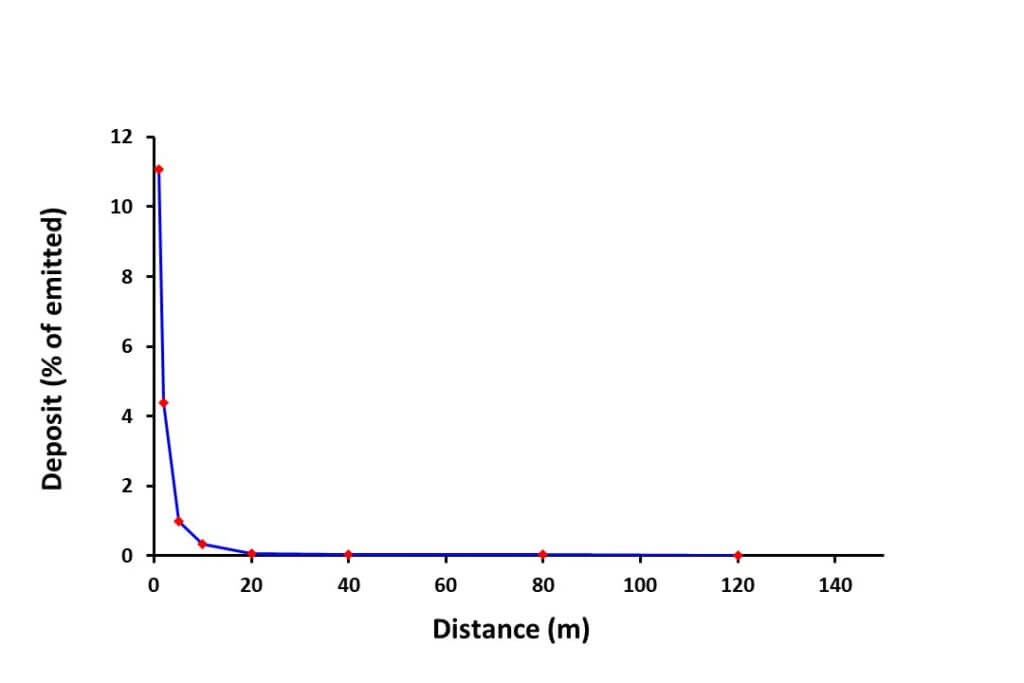
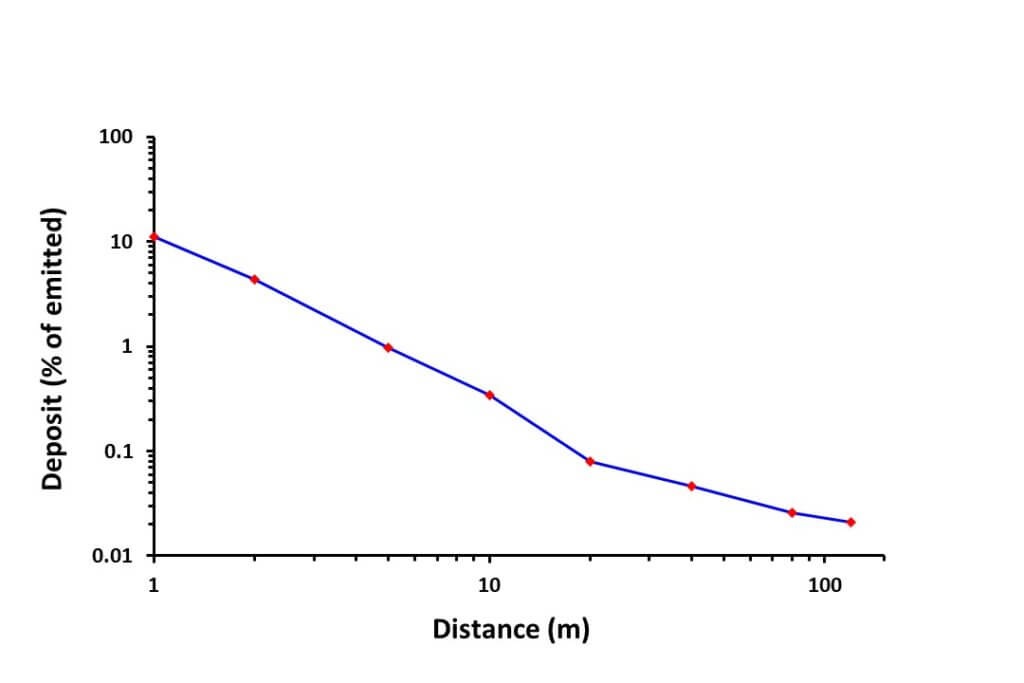
When we graph spray drift deposit data from a windy day, the deposit amount decreases exponentially with downwind distance. Usually, drift damage follows the same pattern. The larger droplets that contain the majority of the dose deposit first. The smaller droplets go further and are more likely to mix in the atmosphere and rise with thermals.
Figure 6: Deposited drift decreases logarithmically with distance. Top, linear axes. Bottom, log axes.
Under temperature inversion conditions that are common on calm summer evenings, overnight, and early mornings, the damage from the drift cloud does not decrease the same way. The cloud containing the buoyant mist lingers over a large area. Without atmospheric mixing and its resulting dilution with time and distance, large areas can be damaged.
The Effect of Turbulence on Deposition
We’ve established that the more atmospheric mixing we have, the less spray will deposit on the ground, at least in the short term. How does this affect our thinking on the role of wind?
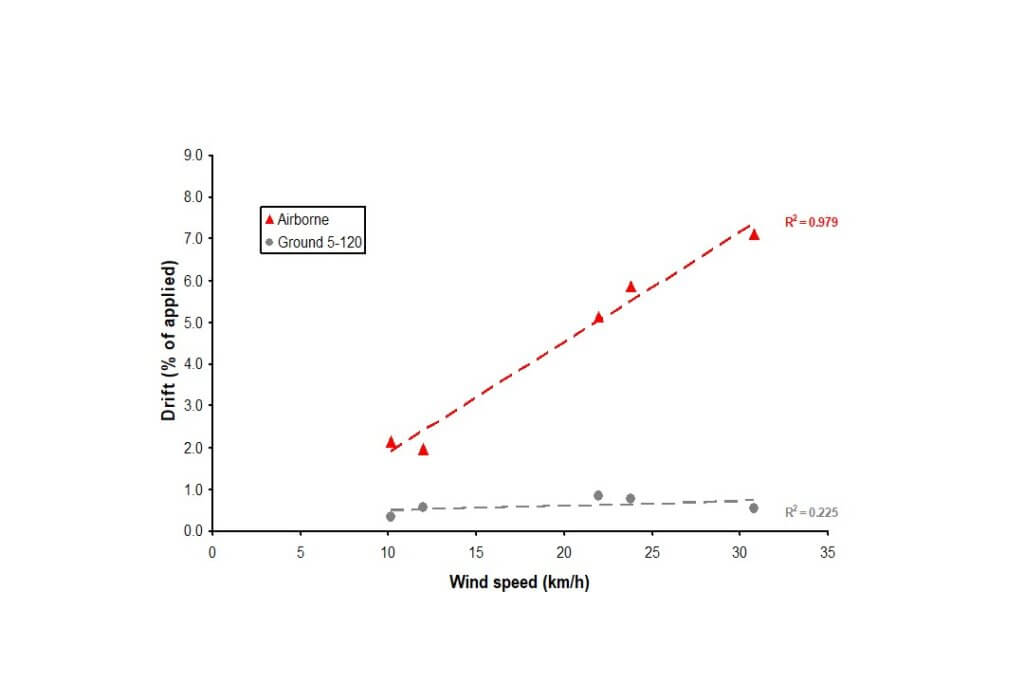
When we evaluated drift data from a number of trials, we always saw more initial drift with higher wind speeds, as expected. However, the downwind deposit did not usually increase significantly. We attributed this observation to turbulence generated by wind which lifted more of the initial drift higher into the atmosphere. To be clear, deposited drift did not go down with higher wind. It just didn’t rise as fast as initial drift.
Figure 7: The effect of wind speed on airborne drift (top line) vs deposited drift (bottom line) from a high clearance sprayer travelling 23 km/h and emitting a Very Coarse spray.
The effect of turbulence can be viewed as a good thing because it protects downwind objects. Rapid dilution reduces immediate drift damage. We can use turbulence to protect objects on the ground. It’s certainly better than the alternative, emitting sprays when the atmosphere can’t dilute them, such as in an inversion. In that case, downwind areas remain at risk for a long distance, and for a long time.
But we have to also consider what happens to airborne spray droplets. Some pesticides degrade in sunlight and stop being a problem. But others are more stable and may persist in the atmosphere for days or longer. During that time, they may move significant distances, ultimately returning to the earth’s surface in precipitation or in dust. Even though the atmosphere has diluted them, these deposits are measurable, and will show up in environmental monitoring of air, soil, and water. We may not be able to find out where they originate, but the public knows who to blame. Agriculture.
Vapour Drift
Vapour drift is another issue altogether. It can persist for hours or days after application, as long as the volatile product remains on a surface and conditions that allow formation of vapours persist. Vapour pressure is related to surface temperature, and losses increase with warmer surfaces. Some products enter the vapour phase when in contact with water, and release vapour after a rainfall.
In situations where vapour is released for several days after application, it becomes impossible to control its subsequent movement. For droplet drift, if we know the wind direction at the time of spraying, we know where the impact is likely to be. But vapour movement depends on conditions that may occur between now and three days from now, and these could include high temperatures, various wind directions, and even inversions in which vapours accumulate. Ultimately, the best way to avoid off-target vapour movement is to avoid using volatile products.
The Public Good
Spray drift is one of agriculture’s most important stewardship challenges, and our industry needs to continue to improve its track record. Sprayers have a difficult task of converting a relatively small volume of liquid into a spray that offers good target coverage yet doesn’t move off the treated area. Favourable weather combined with droplet size management are at the heart of making this system work, but there isn’t a lot of wiggle room. Once again, an emphasis on sprayer productivity is one of the most fruitful areas to invest in, as this makes the best of the sometimes rare conditions in which spraying conditions are optimal.
Bridgette Readel (@BMReadel) is back! This time singing that holiday classic “Larry the Low-Drift Nozzle”! Read the lyrics and then head to the bottom of the article to enjoy Bridgette’s rendition.
You know Flat Fan and Flood Jet and Pulse Width and Wilger, Hypro and Greenleaf and TeeJet and Lechler. But do you recall The most famous nozzle of all?
Larry the low-drift nozzle
Had a very “big-drop” spray
And if you ever saw it
You’d never see it drift away.
All of the other nozzles
Used to laugh and call him names
They never let poor Larry
Join them on their spray boom frames.
Then one windy summer’s eve
Farmer came to say
“Larry with your spray so coarse
Won’t you fight this gusty force?”
Then how the neighbours loved him As they shouted out with glee “Larry the low-drift nozzle Stewardship for chemistry!”
Waste (noun): an act or instance of using or expending something to no purpose.
In agriculture, environment and economy are intertwined. Producers strive to obtain the maximum return on their inputs. They study incremental returns and avoid applying more inputs than necessary, especially if conditions don’t warrant it. The financial incentive is powerful, and waste is a four-letter word. This applies to seed, fertilizer, and pesticide. Pesticide labels identify the rate needed to obtain the desired result, and there is no incentive to over-apply. In fact, it’s illegal.
But there are plenty of other places where applications incur waste. As with time efficiency, it’s a good idea to identify where this waste occurs, and the only tool needed is a sharp pencil.
When might we incur waste in the spray application process?
Mixing more than we need because we don’t trust the flow meter or the tank gauge entirely, or don’t know the exact field size.
Priming the boom before the first swath.
Overlapping due to curvy terrain and coarse sectional control.
Spray drift away from the intended swath.
How big are the losses?
Let’s say we have a clean sprayer and need to spray 160 acres before moving to a new crop and product. We plan to apply 10 gallons per acre and have a 1,200 gallon tank with a 120 foot boom. That means we need 1,600 gallons of spray mix in total.
Once we’re at the field we prime the boom. Each sprayer is different, but depending on operator experience, 30 to 50 gallons are usually needed to push product from the tank to the last nozzle. Only part of that is lost to the ground, as boom sections can be shut off as soon as product has reached every nozzle of that section. We’re assuming 0.2 gallons per foot of boom is lost.
Spraying itself is relatively straightforward. Swath and sectional control handle the overlaps, but in less ideal terrain, double application is known to account for 4 to 5% of the area to reach non-square parts of the field. This is even more likely when the outer section is 10’ or more. Early turn-on of the boom prior to leaving the headland, to allow boom to reach operating pressure, adds to this.
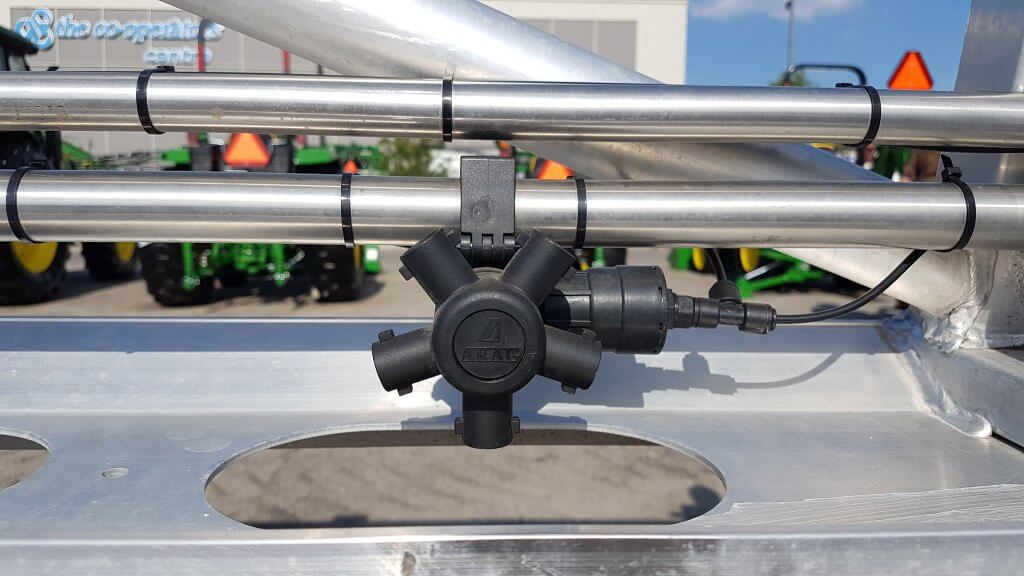
Air-activated shutoff for individual nozzles reduces section size at a reasonable cost.
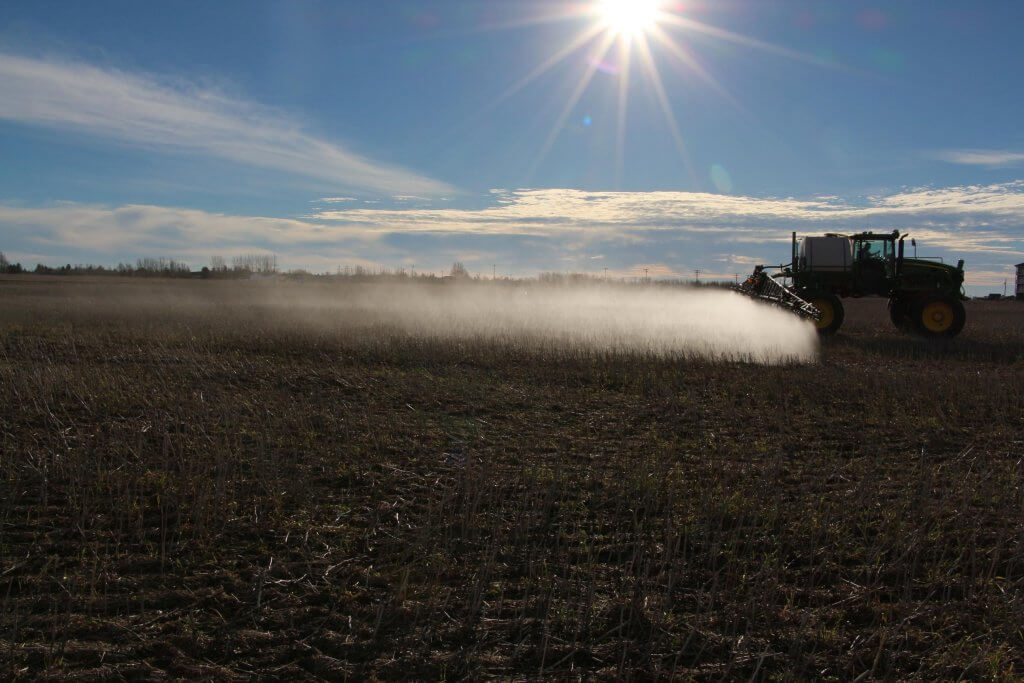
With an average nozzle, we can expect about 2% of the product to airborne drift. Most airborne won’t return to the ground within the field borders, so it’s a complete loss.
Most of the spray that travels more than 5 m after leaving boom stays airborne and should be considered a total loss from the field.
As we finish, the pump will draw air before the tank is empty due to sloshing or foaming, and a 50 to 60 gallon remainder may not be unusual. This simulation has assumed 5% of tank volume remains.
We also need to purge spray from the boom at cleanout, consuming approximately 0.4 gallons per foot of boom. This occurs after the field is completely sprayed and is therefore considered waste.
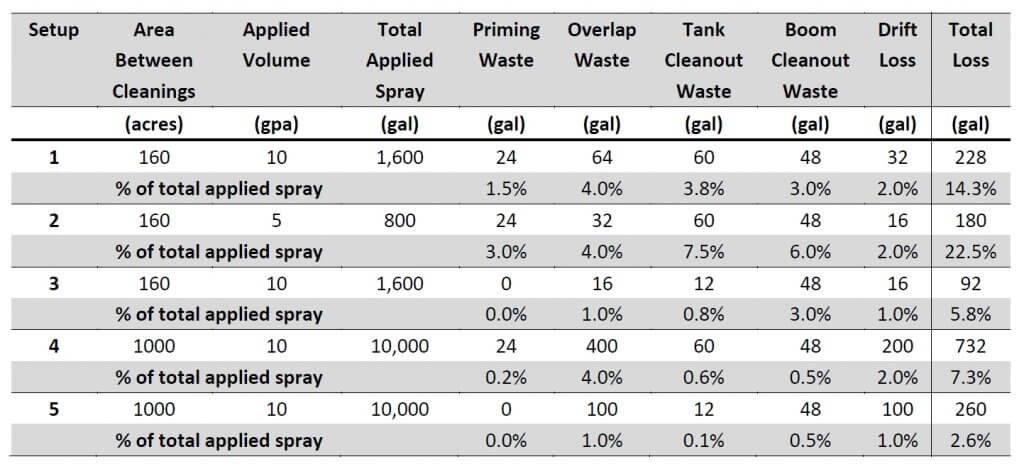
So how does this add up? The following table shows the approximate losses associated with five setups.
Table 1: Spray mix losses during a sprayer operation. Setup 1 = baseline, Setup 2 = low application volume, Setup 3 = baseline with recirculating boom, tank level monitor, and low-drift nozzles, Setup 4 = large area between cleaning, Setup 5 = large area with recirculating boom, tank level monitor, and low-drift nozzles.
In the first scenario, we spray just 160 acres at 10 gallons per acre. Priming the boom with 0.4 gallons per foot (allowing for all associated feed lines) consumes 48 gallons, but only wastes half of that, or 1.5% of the total volume needed for the field.
Four percent overlap consumes another 64 gallons.
If we have 5% of the tank volume left over, that’s 60 gallons. That amount is so small it doesn’t even register on the sight gauge but nonetheless it represents another 4% of the total sprayed amount.
Upon cleaning the boom, we need to push the spray mix out of all the plumbing after the pump, as it has nowhere else to go. At an assumed 0.4 gallons per foot, that’s another 48 gallons or 3%.
If we add to that a conservative 2% drift loss, it sums to a surprising 14% of the total spray volume. For those that use lower water volumes (the second scenario), the volumetric losses are slightly less, but their proportion is higher, now accounting for 23% (!) of the total spray mix.
In the third scenario, let’s assume we use a recirculating boom that returns the initial prime volume to the tank, eliminating any waste. We’ll also upgrade to individual nozzle sectional control, reducing overlap to 1%. And, since we want to know exactly what’s left in the tank, let’s invest in an AccuVolume system to precisely monitor tank volume. This allows us to make small rate adjustments up or down to be sure as much of the mixed product goes onto the sprayed swath as possible.
Recirculating booms allows the spray mix to pass through entire length of boom without being sprayed, saving waste during priming and allowing waste-free boom rinses.
When the sump begins to empty, we can introduce some water from the clean water tank to push the last of the mix to the boom (a continuous rinse system makes this easy).
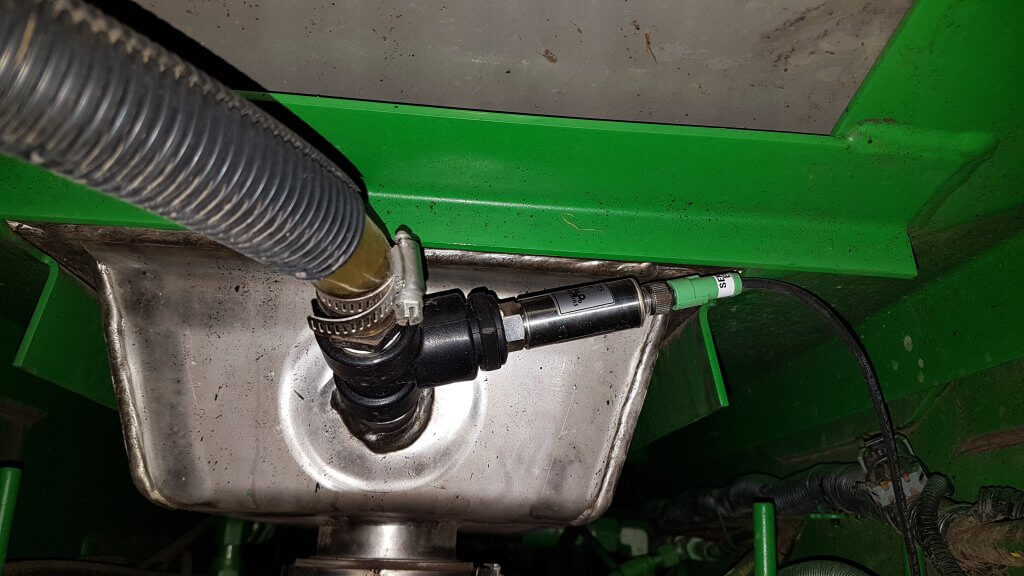
An AccuVolume sensor shows the exact volume left in the tank at any slope position and with 1 gallon resolution, allowing greater accuracy when filling and emptying.
We’ll assume our sump waste is now reduced to 12 gallons. We still need to dispose of the content of the boom somehow, so the recirculating boom offers no saving there. But let’s also add better low-drift nozzles to reduce drift by 50% (now 1% total volume). Total loss is now just 6%.
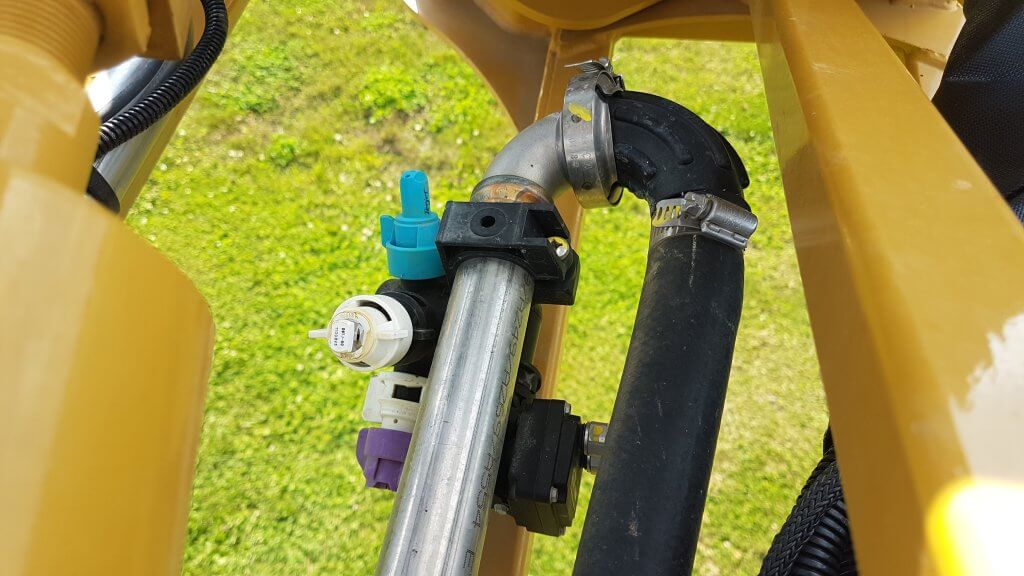
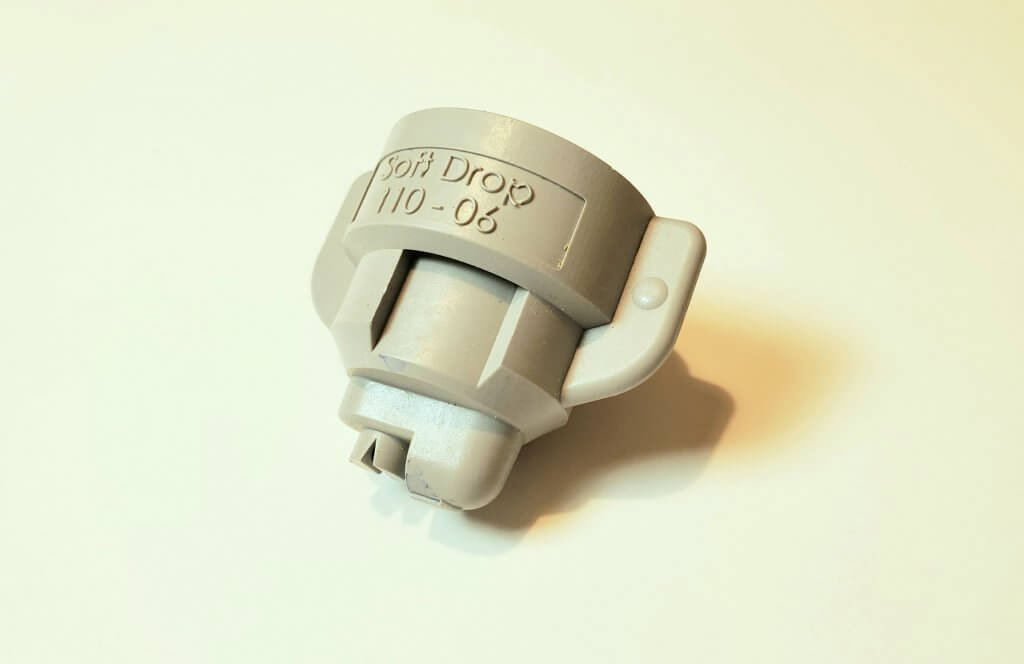
Low-drift nozzles such as this AirMix (Agrotop) SoftDrop reduce airborne drift by 50 to 90%.
The last two rows in the table repeat the first and third scenarios for a larger sprayed area (1000 acres) before a tank cleaning is needed. This doesn’t change the magnitude of the volumetric loss, but reduces its proportion. Percent loss is down by a factor of two from the 160 acre interval, to 3 to 7%.
Experienced operators might cheat the system a bit by mixing the required pesticide with some extra water to make up for the plumbing waste. Doing so prevents extra pesticide from being consumed, but it doesn’t reduce the inherent inefficiency.
Lessons
This exercise suggests that waste from spraying is probably higher than we assumed. If we average the scenarios, there is 10 to 15% waste. At, say, $200,000 spent on pesticide for a single spraying season, that’s $20 – $30,000 worth of product and water hauled that ends up where it doesn’t belong. Beyond the time and money, there can also be environmental consequences depending on how that waste is treated.
Improve monitoring of tank content to allow lower remainders.
Consider individual nozzle shutoff to improve sectional control. These are part of Pulse Width Modulation (PWM) systems, but can also be achieved with less expensive valves.
Plan spray operations to minimize the amount of product changeovers.
Consider direct injection.
The return on investment for plumbing improvements can be high and result in considerable future savings over the life of the sprayer. It’s worth thinking about.