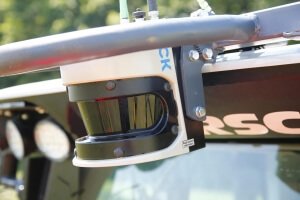
An interesting technology recently came to our attention. The Horsch BoomSight detects potential obstacles and as the sprayer passes it raises the boom to avoid the impact. We figured it was worthy of a tweet, which read:
The Horsch BoomSight
@Spray_Guy: Ever accidentally hit something with your boom? <35 km/h, perhaps the Horsch BoomSight can help: http://bit.ly/2j6ShBx
Now, when you tweet something, you hope it has some impact. That’s usually a few “likes”, maybe a few “retweets” and if you’re lucky someone may take the time to write a response. We received the following response:
@WcropW: Yes, often bumping into kangaroos as they hop out of my crop. Got to be quick to lift boom above them!
@Spray_Guy: Still can’t decide if that’s a joke or not, but it certainly made me laugh.
@WcropW: Was looking for picture – definitely true! Has happened 3 or 4 times!
@spraydriftgirl: Definitely true! Plague numbers in crops down here #strayamat.
@ryan_milgate: Yep I’ve hit plenty of kangaroos, esp in canola.
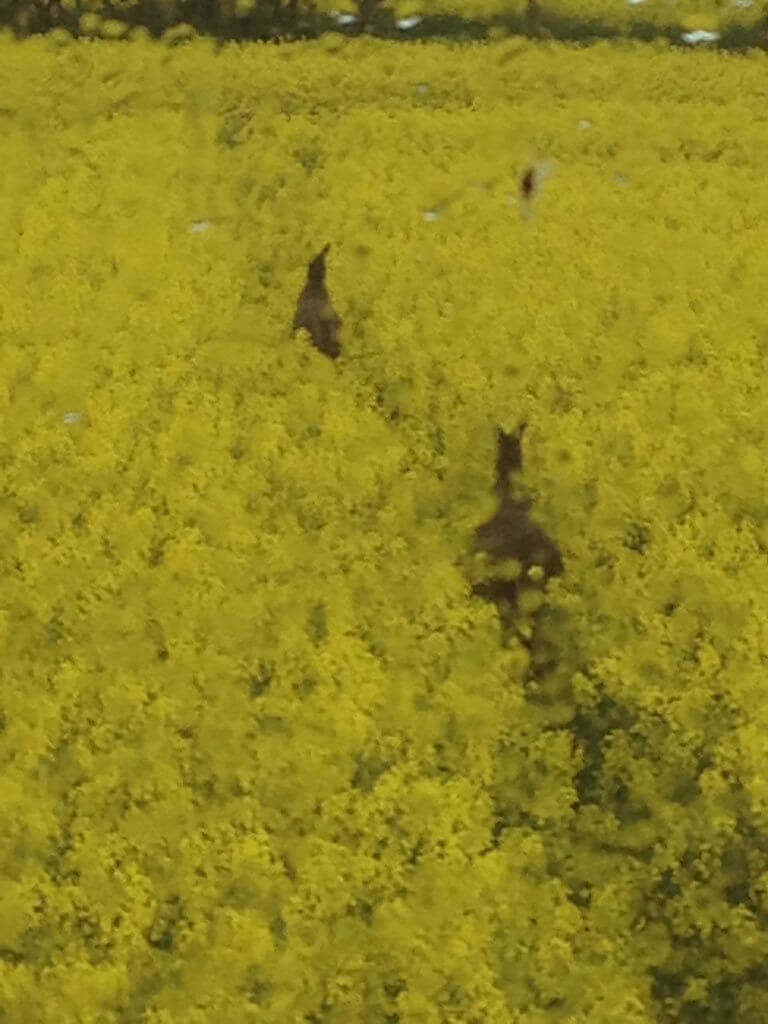
@Wilkshag: Kangaroo- out side window of sprayer. They get stuck jumping through canola.
@Spray_Guy: Wow! What a photo! Is there any product registered for kangaroo in canola in Canada?
Photo Credit: Randall Wilksch
—
And so, it got us thinking… What other strange and unexpected things do sprayer operators hit, or nearly hit, during all those hours of spraying? So we asked:
@Spray_Guy: Hey Twitterverse! What’s the strangest thing you’ve hit with spray boom? “Kangaroo” currently in lead.
In less than 48 hours, that tweet earned more than 10,000 impressions as the Twitterverse shared all. What follows is a slightly edited transcript of that thread: snarky responses, pictures, videos and all. We don’t know if there’s any educational value, but it’s certainly fun and surprising. No one wrote “fencepost” or “tree”. They covered everything else, though.
—
@SteveTwynstra: Wild Turkey!
@Spray_Guy: Is that what you hit, or WHY you hit?
@SteveTwynstra: Jumped right up outta the standing wheat 50 odd feet to my right. Next day, grazed a fawn 2 fields over…
@Spray_Guy: Putting the “Bam” in Bambi.
@SteveTwynstra: The doe did give me a dirty look…..
—
@MarkDavis0129: I snagged a boat, dragged it 150 yds. The fisherman had quite the look on their faces once I stopped.
@Spray_Guy: A BOAT!? Nope… I’m pretty imaginative, but this escapes me. How was that possible?
@MarkDavis0129: It’s true, have land right to shoreline in few spots. Turning on head land and snagged it.
@Spray_Guy: Priceless. I’m still laughing picturing that.
@MarkDavis0129: Was last fall, 18′ alum flat bottom, they were nosed up to shore, snagged boweye on boom tip.
—
@Paulvdb2016: I have hit an abandoned small liquid manure spreader in a fast turn. Boom hit at 30+ mph!
@Spray_Guy: The $hit hit the flatfan…
—
@AgronomoOz: @Pontaragrain has hit his own drone and put it on Youtube. #honesty
@Spray_Guy: Ouch. UAV’s aren’t cheap. Got the link, Andrew?
@CrystalSeedSeer: Let’s hope crop inspector isn’t in there! LOL!
@Spray_Guy: From this thread, it seems like he’d be at risk of being hit, too!
Turn up the volume on this video. Great soundtrack! Shared with permission from Michael Pfitzner (@farmingfitz)
And believe it or not, it’s happened to more than one person. Bad time for battery to run low. Shared with permission from Warwick Holding (@Pontaragrain)
—
@MattTolton2: I’d only run a sprayer a few months but once slapped a duck out of mid air.
@Spray_Guy: A solid example of booms set too high… or ducks too low. Tell me you shouted “DUCK”!
@JoannaMWallace: This thread is winning Twitter for me today.
—
@vg_tim: Knocked over a wild turkey and porcupine at same time. Years ago, but can still remember.
@Spray_Guy: Yikes… what were they doing when you hit them? #Darwinwouldntapprove
@vg_tim: it seemed suspicious, they were just standing in a bean field looking at each other…
—
@DavidKucher: I may have hit an oilwell or two.
—
@MaizingPete: Almost hit a hippy sleeping off a punk party in the fence line.
@Spray_Guy: LOL! You may have de-throned ‘kangaroo’ with ‘hippy’! We still have hippies? We have hipsters… we should hit more of them.
@MaizingPete: For sure Hippy… That poor b@stard thought he was still in Woodstock.
—
@BlackPearl152: I gave two coyotes a good spank with the boom once.
—
@cropperandy2: Have hit deer, a coyote, in ON and a moose in AB.
—
@jamesschiltz85: 1982 International cab cover.
—
@GregOldhaver: Had a flock of partridge lift up and get smacked out of the air with boom.
—
@cjrnumber6: An endangered Lesser Prairie Chicken.
@Spray_Guy: Somewhat more endangered now, it would seem…
—
@DarLinFarms: Travel trailer. Guy drove into boom unfolding infield. He watching as unfold. Crash into me.
—
@Joe_Widdup: Had a near miss with a guy who stopped to take photos. Scared the hell out of me.
—
@Luckycangus: Deer and sharp tail grouse.
—
@RowcropAust: Emus at night go crazy in the lights. I have hit a couple over the years.
@Spray_Guy: I’ve heard of people jacking deer (headlights and hunting) but never emu. Educational!
—
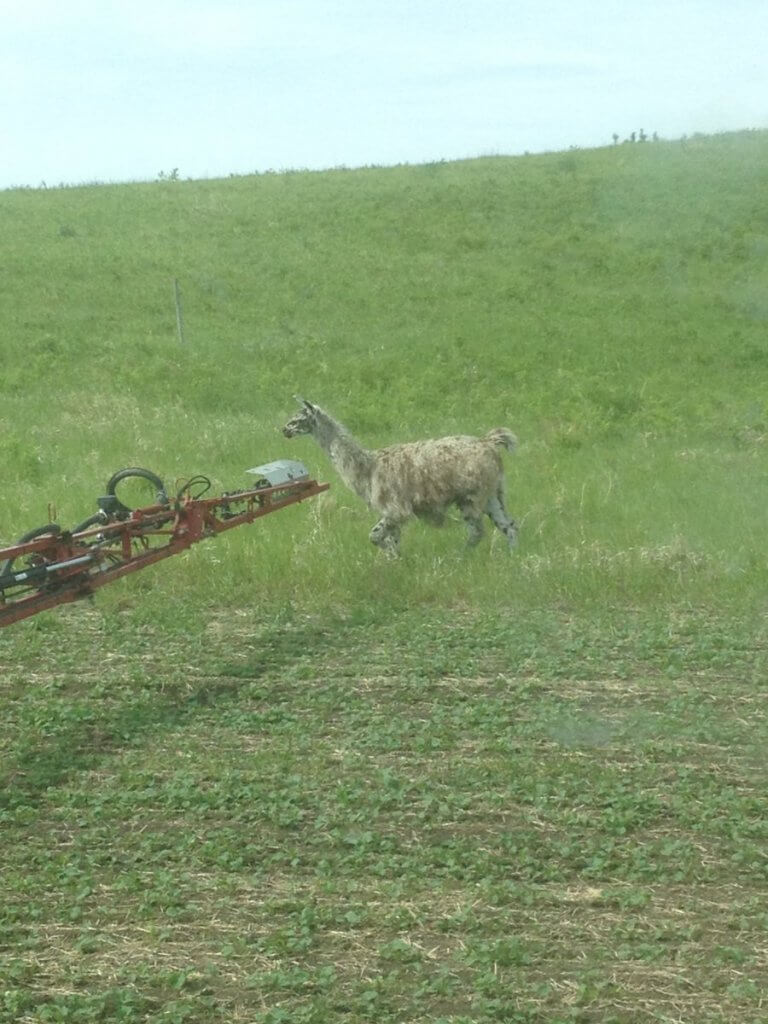
@kerriRaeMillar: Llama in the hills of south-central Manitoba.
(Photo credit Lucas Millar)
—
@Jeremycnobel: Hit a gopher in head with a foam cup as he came out of his hole. Ended with Blue dye foam ?
@Spray_Guy: That’s one way to mark your A-B line. Trying to think of a #caddyshack joke…
—
And that’s the thread. So look up from your smart phones occasionally while you’re spraying. It seems there are all kinds of unexpected obstacles in the field.
A very common question we hear at sprayer demonstrations is:
“I want to drive the spray deeper into the canopy – does higher pressure help?”
Well, here’s the classic government answer:
“…yes and no.”
It depends on two things. First, the size of the droplet and second, your tolerance for drift (ours is almost zero, BTW). The following video explains how Fine droplets behave very differently than Coarse droplets. It’s always nice to get outside and toss a few balls around:
Well, that last statement in the video isn’t strictly correct…
It’s true that changes in pressure have greater impact on the momentum of coarser droplets, but there is some impact on finer droplets, too. Sufficiently high pressure makes for a finer spray quality and finer sprays have been shown to penetrate dense canopies more effectively. We have seen improved canopy penetration in ginseng, field peppers and matted-row strawberry using finer spray under higher pressure. If pressure is high enough, it will create air-inclusion and impart additional momentum to even Fine spray droplets over a short distance, but it’s a case of diminishing return. That is, it takes a lot of pressure to do it and relatively speaking they only got a bit faster/further. In our work, we used pressures between 90 and 300 psi. Excepting hollow cones, that’s generally on the upper end, or beyond a nozzles rated pressure range and it may even be outside the pumps capacity.
The reason we downplay pressure as a tool for improving canopy penetration is because finer spray under high pressure causes unbelievable drift. A fraction of the spray does get deeper into canopies when you “fog it in”, but the plume of spray blowing beyond the sprayer is entirely unacceptable. Slowing down the travel speed, spraying on cool, humid, low-wind days and lowering boom height can help, but in every trial where we’ve used high pressure and Fine spray quality, we see the image below… or far worse:
Staged drift in peppers using water and high pressure combined with Fine spray quality
The compromise in canopy penetration is to use a Medium spray quality and higher water volume. Stay within the pressure range the nozzle requires to achieve that Medium spray quality. If canopy penetration is still insufficient, consider canopy management (like planting density and pruning) and explore drop-arms to direct the spray, or booms that offer an air-assist or air-deflection option (a few shown here) to entrain and carry spray into the canopy.
Don’t use higher pressure to increase canopy penetration.
This article is reproduced, with permission, from Ohio State University Extension’s factsheet FABE-528.
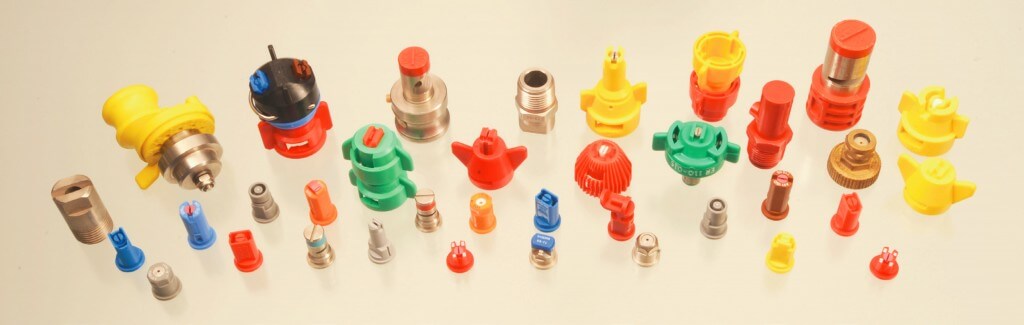
Although nozzles are some of the least expensive components of a sprayer, they hold a high value in their ability to influence sprayer performance.
Nozzles meter the amount of liquid sprayed per unit area, controlling application rate, as well as variability of spray over the width of the sprayer boom. Nozzles also influence droplet size, affecting both target coverage and spray drift risk.
Nozzles come in a wide variety of types and sizes. The best nozzle for a given application will maximize efficacy, minimize spray drift, and allow compliance with label requirements such as application rate (gallons per acre) and spray droplet size. Selecting the best nozzle requires careful consideration of all the factors listed below:
Mode of action of chemical (spray coverage requirement)
Systemic
Contact
Application type (broadcast, band, directed, air assisted)
Target crop (field crops, vegetables, vineyard, shrubs and trees, etc.)
Spray drift risk
Nozzle Size
Each nozzle type is designed for a specific type of target and application. For example, a nozzle designed for broadcast spraying is not good for spraying pesticides over a narrow band. Luckily, most nozzle manufacturers’ catalogues have charts showing which nozzle type will be best for a specific job. Check the websites of nozzle manufacturers to reach their catalogues. For more information, contact your county Extension office.
Nozzle manufacturers’ catalogs provide tables and charts showing application rates (gallons per acre or gpa), given a nozzle’s flow rate (gallons per minute or gpm) delivered at various pressures (psi) and travel speeds (mph). These tables are useful tools for selecting the appropriate nozzles, pressure and speed to spray chemicals at application rates prescribed by product labels. However, the charts are only for a limited number of travel speed and nozzle spacing situations. There may be situations where the charts will not provide information associated with your sprayer setup (nozzle spacing) and operating conditions (travel speed and spray pressure). The Apps developed by most of the major nozzle manufacturers can provide you the exact nozzle flow rate required for any given set of application parameters, and identify a specific set of nozzle recommendations for the given application parameters.
To find these Apps, simply visit the App Store in your smart phone or tablet and do a search under “Spray Nozzle Calculator”, or some other key words related to nozzle size selection. You may also want to do a search under the name of the nozzle company from which you are interested in buying the nozzles. However, some Apps are not user friendly and sometimes they do not take into account the droplet size requirements when recommending nozzles. Although the Apps and tables in catalogues may expedite the nozzle size selection process, it is best to understand the procedure and the maths nozzle manufacturers use to generate the values listed in tables and to recommend nozzles in their Apps. The procedure used by the nozzle manufacturers to generate numbers in tables and in their Apps is explained below. By following the steps mentioned below, you should be able to determine the exact nozzle flow rate (gpm) required for your spray application parameters.
Once the exact nozzle flow rate is determined, you can then look at the catalogue to select the nozzle that will provide you the flow rate at a practical pressure setting.
Steps to select the proper nozzle size:
The following steps must be taken to determine the nozzle flow rate (gpm):
Select the application rate in gallons per acre (gpa). This is a management decision you will have to make based on pesticide label recommendations, field conditions and water supply.
Select a practical and safe ground speed in miles per hour (mph).
Determine the spray width per nozzle (W). For broadcast applications, W = nozzle spacing (distance between two nozzles on the boom) in inches. For band spraying, W = band width in inches. For directed spraying, W = row spacing in inches (or band width) divided by the number of nozzles per row (or band).
Determine the flow rate (gpm) required from each nozzle by using the following equation: gpm = (gpa x mph x W) / 5,940(5,940 is a constant to convert gpa, mph and inches to gpm).
Select a nozzle size from the manufacturer’s catalogue that will give the flow rate (gpm) determined in Step 4 when the nozzle is operated within the recommended pressure range. If a nozzle of this size is not available, change the travel speed in the equation above and determine the new flow rate required.
An Example
For example: You want to spray a pre-emergence herbicide at 15 gpa, at a speed of 8 mph. The distance between the nozzles on the boom is 20 inches. The herbicide label requires a spray quality of “Medium.” What should be the flow rate of the nozzle you will choose?
gpm = (gpa × mph × W) ÷ 5,940
Since this is a broadcast application (pre-emergence), W is the distance between nozzles (W = 20″). Filling in the variables yields the following calculation:
gpm = (15 gpa × 8 mph × 20 in) ÷ 5,940 = 0.4 gpm
This means, to apply 15 gpa at a speed of 8 mph with this sprayer setup, we need to select a nozzle with a flow rate of 0.4 gpm.
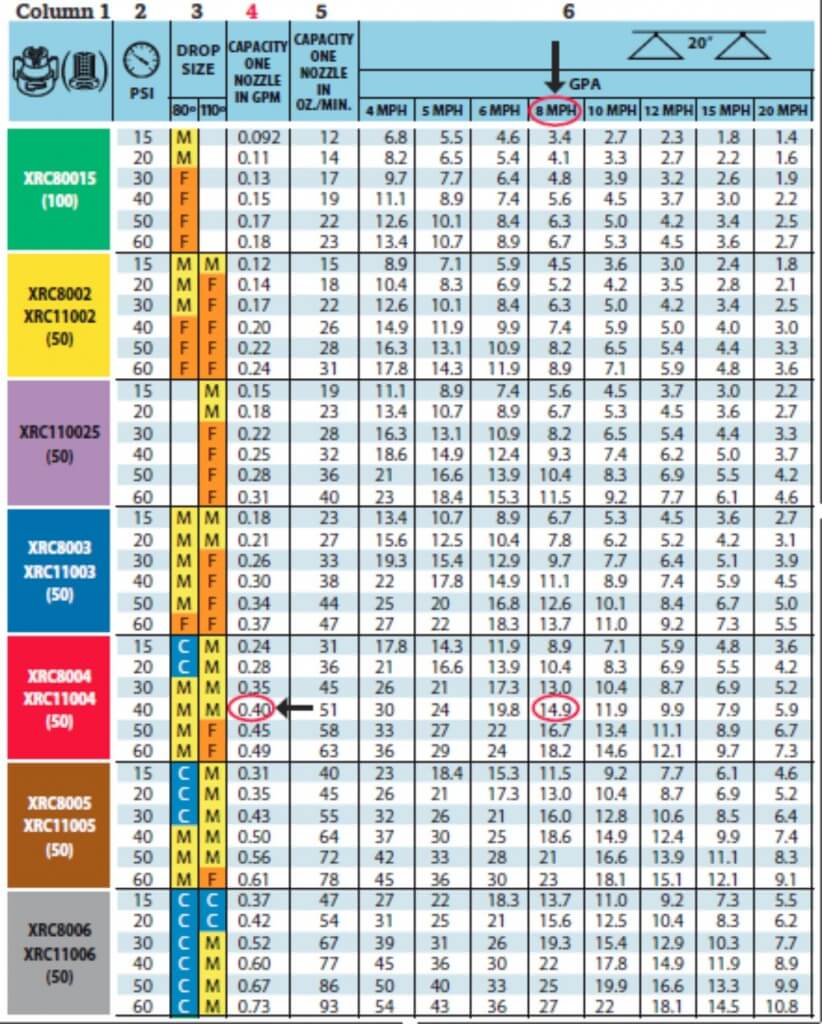
Now, we go to the nozzle catalogue, and find a nozzle that will give us a flow rate of 0.4 gpm, while operating the sprayer at an applicable pressure and travelling at 8 mph. Catalogues have charts for each nozzle, similar to the one shown on the next page. The first column gives the color code of the nozzle (which indicates flow rate), nozzle ID number, and the appropriate filter type for the nozzle. Column 2 gives the pressure range at which the nozzle should be operated. Column 3 gives the spray quality, a measure of spray droplet size (fine, medium, coarse, etc.) produced at different pressure settings. Columns 4 and 5 give the flow rate of nozzles in gallons per minute and ounces per minute, respectively, at different pressure settings. Column 6 gives gallons per acre application rate at different travel speed settings.
First, we need to find the best type of nozzle for our application. In their catalog, the nozzle manufacturer recommends a flat-fan pattern type nozzle for broadcast application of pre-emergence herbicides. Then we find a chart associated with the nozzle type recommended.
The chart shown happens to be for that type of a nozzle. Now we proceed with the process to determine the appropriate size of the nozzle.
Example of a typical nozzle rate table.
In our example above, the equation in Step 4 resulted with a flow rate of 0.4 gpm. Now, we look at Column 4 (gpm per nozzle) to determine the nozzle that provides us 0.4 gpm. Using the chart, we see that the nozzles XRC8004 or XRC11004 (shown in red) provide 0.4 gpm flow rate at 40 psi operating pressure. This nozzle also happens to provide Medium (designated with “M”) spray quality as recommended on the herbicide label. Under these operating conditions, this sprayer should apply 15 gpa at 8 mph as we expected. The validation of this is also evident on the chart. If you look at Column 6, choose 8 mph ground speed, the nozzle we selected will spray approximately 15 gallons per acre (14.9 gpa shown on the chart) at 8 mph travel speed and 40 psi spray pressure.
There may be multiple numbers of nozzles that can satisfy the 0.4 gpm flow rate requirements. However, they may not satisfy the desired spray quality and/or desired travel speed. It may be necessary to adjust pressure and/or travel speed according to nozzle selection. For example, the Brown XRC8005 nozzle is capable of producing 0.4 gpm, and achieving 15 gpa at 8 mph, if the spray pressure is reduced to about 25 psi. Similar calculations can be made using the equation below to come up with other GPM (flow rate) and PSI (pressure) combinations to satisfy the required 15 gpa application rate:
(GPM₁ ÷ GPM₂) = (√PSI₁ ÷ √PSI₂)
In this example, reducing the pressure to 25 psi alters the spray quality to “Coarse,” violating the label recommendation. When changing pressure is not an appropriate choice, the only other practical option is to change the travel speed. There is an inverse linear relationship between the travel speed (mph) and the application rate (gpa). The relationship is expressed by the equation:
Using the relationship above, we can determine that increasing the travel speed to 9.9 mph and keeping the sprayer operating at 40 psi will yield 15 gpa, as described below. The chart shown earlier indicates when using XRC11005, GPA₁ = 18.6 at 8 mph (MPH₁) at 40 psi. We want to find out what the new travel speed (MPH₂) should be to achieve 15 gpa (GPA₂). Using the equation above:
However, increasing travel speed to 9.9 mph may not be practical or safe. When changes to pressure or travel speed as dictated by the equations above are neither practical nor safe, it may be necessary to select a different nozzle.
In this example, it looks like the best nozzles to use for our application situation are XRC8004 or XRC11004, both providing 0.4 gpm at 40 psi. The only difference between these two nozzles is in the angle of spray pattern: one produces an 80 degree fan pattern (XRC8004), while the other one (XRC11004) produces a 110 degree fan pattern. Due to the difference in the angle of the spray pattern, each of these nozzles require different boom heights to obtain proper overlap between two adjacent nozzles.
Calibrate the sprayer
Selecting the right type and size of a nozzle is not sufficient to end up with accurate, effective and efficient application of chemicals sprayed. Changes in ground conditions (tilled, un-tilled, grass, wet, dry), and the topography of the field sprayed (flat, sloped) will affect the ground speed which is one of the variables used in determining the correct nozzle size. Nozzle orifices wear out with time causing larger flow rates and distorted spray patterns than when they were new. The gpm flow rate values given in catalogues or in Apps are based on spraying water only. Spraying solutions with higher densities than water (most spray solutions are) will affect the flow rates of nozzles at the same spray pressure. For the reasons mentioned above, sprayers should be calibrated frequently, especially when the field conditions change, to determine the actual application rate.
Calibration is easy, and there are many ways to do it. regardless of the method chose, three measurements will be taken:
actual ground speed,
the distance between nozzles, and
nozzle flow rate for a given length of time.
One easy method is explained in an OSU Extension Publication (AEX 520) listed in the references at the end of this article.
Keep several types of nozzles on the boom
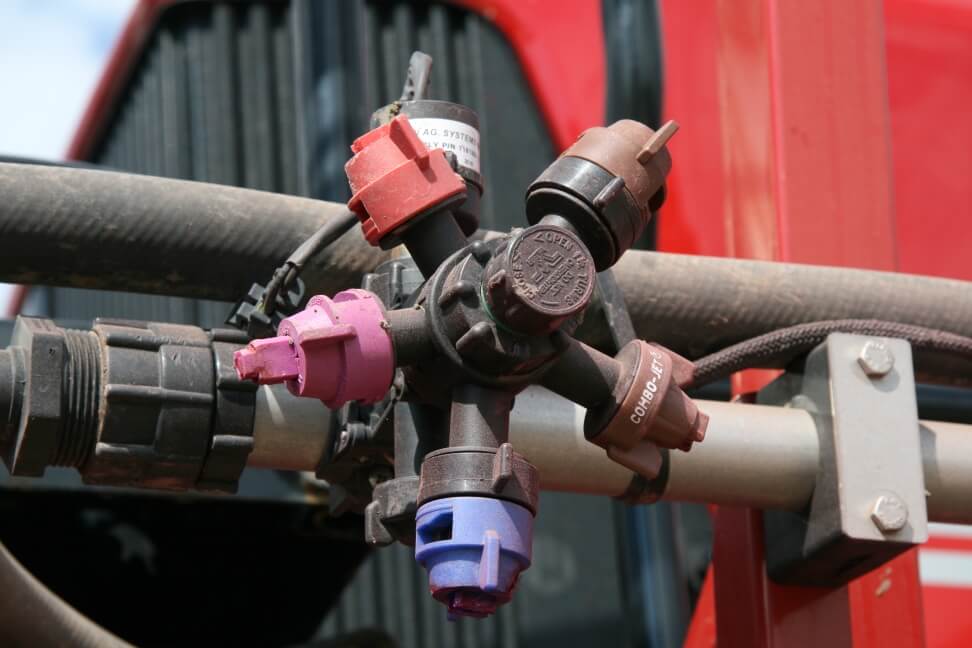
Remember that one specific type of nozzle will not be best for all applications. For this reason, it is best to have several types and sizes of nozzles on the boom so that you can switch to the “best” nozzle choice for a given spraying job. As shown in the pictures below, there are various types of sprayer components and setups you can buy to configure your boom so the new set up allows you to easily switch from one nozzle to another instantly.
Keep spray drift in mind when selecting nozzles
One of the major problems challenging pesticide applicators is spray drift, which is defined as movement of pesticides by wind from the application site to an off target site. Drift is influenced by many factors which are discussed in detail in two OSU Extension publications (Bulletin 816 and AEX-525) listed in the references at the end of this article. Equipment, especially the nozzles, used to spray pesticides play a significant role in generating as well as reducing spray drift. In nozzle catalogues, you can see a number of different nozzles of the same type, in terms of spray pattern. For example, one can find nozzles within the same “flat-fan” category classified as “low-drift.” Research conducted at Ohio State and elsewhere clearly indicate that nozzles labelled as “low-drift” significantly reduce spray drift as discussed in OSU Extension publication AEX-523 (listed in the references below). If drift is, or becomes a concern, it may be best to switch from a conventional flat-fan nozzle to a “low-drift” flat-fan nozzle with the same flow rate. Therefore, it is best to have more than one type of a “flat-fan” pattern nozzle on the boom.
Summary and conclusions
Nozzles are typically the least costly items on a sprayer, but they play a key role in the final outcome from a spraying job: achieving maximum efficacy from the pesticide applied while reducing the off-target (drift) movement of pesticides to minimum. Pesticides work well if the rates on labels are achieved during application. This can be achieved only if the right nozzle type and the proper size of the nozzles are on the sprayer, and the sprayer is operated properly.
Although the Apps and tables in catalogs may expedite the nozzle size selection process, it is best to understand the process and the math nozzle manufacturers use to generate the values listed in tables, and to generate nozzle recommendations in their Apps. This procedure, explained in this publication, hopefully will help you to determine the exact nozzle flow rate (gpm) required for your spray application parameters, while highlighting some other important parameters such as spray pressure, droplet size, spray coverage on the target, and drift, all of which should be given serious consideration when selecting the best nozzle for a spraying job.
Acknowledgments
The author thanks Mary Griffith, Agriculture and Natural Resources Extension Educator, OSU Extension; Dr. Larry C. Brown, Professor and Extension Specialist, Department of Food, Agricultural and Biological Engineering, The Ohio State University; and Dr. Robert “Bobby” Grisso, Professor and Associate Director, Virginia Cooperative Extension, Virginia Tech University, Department of Biological Systems Engineering; for reviewing this publication and for their editorial contributions.
References
Ozkan, E. Calibrating boom sprayers. Ohio State University Extension publication AEX-520, Columbus, Ohio.
Ozkan, E. New nozzles for spray drift reduction. Ohio State University Extension publication AEX-523, Columbus, Ohio.
Ozkan, E. and R.C. Derksen. Effectiveness of Turbodrop® and Turbo Teejet® nozzles in drift reduction. Ohio State University Extension publication AEX-524, Columbus, Ohio.
Ozkan, E. and H. Zhu. Effect of Major Variables on Drift Distances of Spray Droplets. Ohio State University Extension publication AEX-525, Columbus, Ohio.
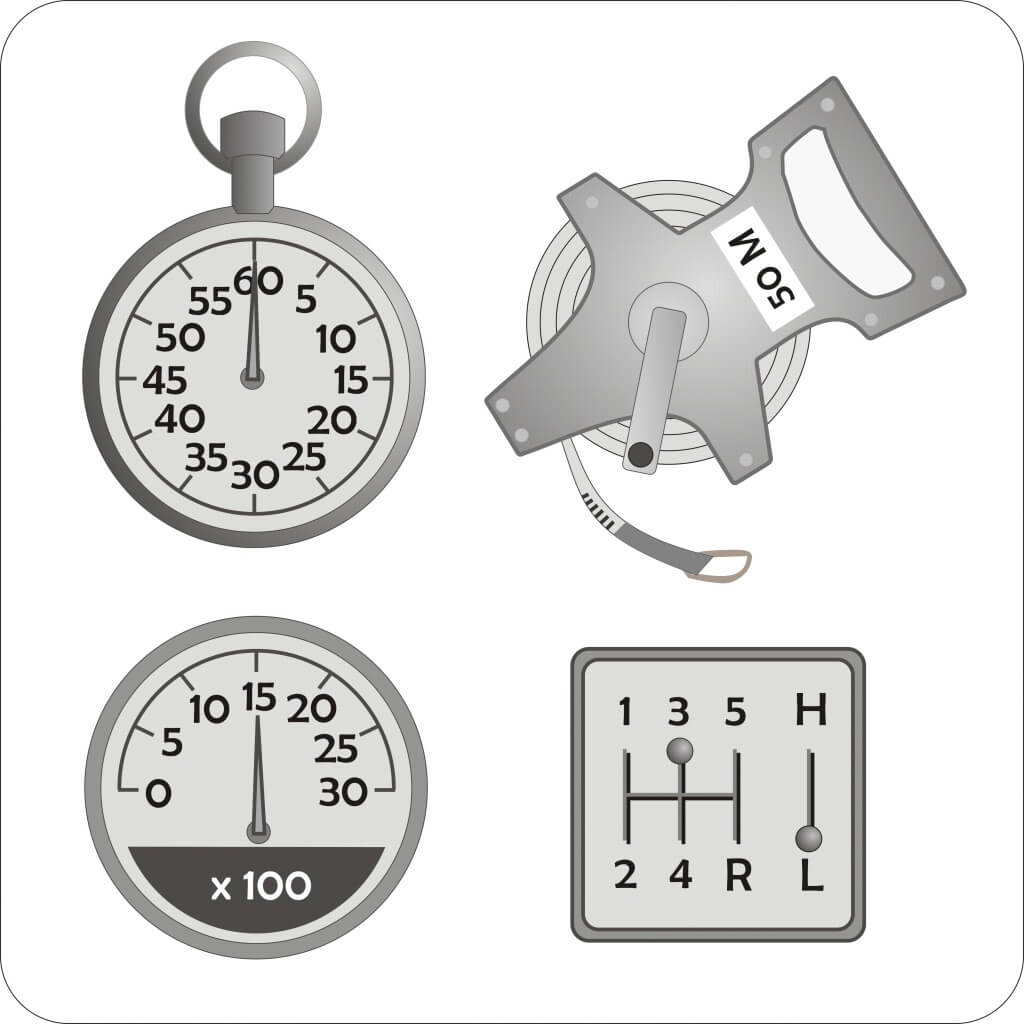
Calibrating a boom sprayer is not as difficult as it sounds. There are several ways to calibrate a sprayer. Regardless of which method you choose, it usually doesn’t take more than 30 minutes, and only three things are needed:
a timer (or watch or smart phones) showing seconds,
a measuring tape, and
a jar graduated in ounces.
Here, I will describe perhaps the easiest of all the methods to calibrate a field sprayer.
Now is the time to get the field sprayer out of the shed and get it ready for the season. Check all the components of the sprayer to make sure they are in working order. Next step in preparations for the season is to calibrate the sprayer. The only way you can achieve maximum accuracy from a sprayer is by calibrating it once before the spraying season starts, and re-calibrating it frequently throughout the spraying season. While applying too little pesticide may result in ineffective pest control, too much pesticide wastes money, may damage the crop and increases the potential risk of contaminating ground water and environment. The primary goal with calibration is to determine the actual rate of application in gallons per acre, then to make adjustments if the difference between the actual rate and the intended rate is greater or less than 5% of the intended rate. This is a recommended guideline by USEPA and USDA.
Before starting calibration, make sure you have a good set of nozzles on the sprayer. Nozzles wear through extended use causing over application, or some nozzles may be plugged. Clean and check the output of all the nozzles for a given length of time at a given spray pressure (usually 1 minute and 40 psi). Compare output from each nozzle’s output with the expected output shown in the nozzle catalog for that nozzle at the same pressure. Replace the nozzles showing an output error of more than 10% of the output of the new nozzle. Once you do this, now you are ready to calibrate your sprayer.
Fill the sprayer tank (at least half full) with water.
Run the sprayer, inspect it for leaks, and make sure all vital parts function properly.
Measure the distance in inches between the nozzles.
Measure an appropriate travel distance in the field based on this nozzle spacing. The appropriate distances for different nozzle spacing is as follows: 408 ft for a 10-inch spacing, 272 ft for a 15-inch spacing, 204 ft for 20-inch spacing, 136 feet for a 30-inch spacing, and 102 feet for a 40-inch spacing.
Drive through the measured distance in the field at your normal spraying speed, and record the travel time in seconds. Repeat this procedure and average the two measurements.
With the sprayer parked, run the sprayer at the same pressure level and catch the output from each nozzle in a measuring jar for the travel time required in step 5 above.
Calculate the average nozzle output by adding the individual outputs and then dividing by the number of nozzles tested. The final average nozzle output in ounces you get is equal to the application rate in gallons per acre. For example, if you catch 15 ounces from a set of nozzles, the actual application rate of the sprayer is equal to 15 gallons per acre.
Compare the actual application rate with the recommended or intended rate. If the actual rate is more than 5 percent higher or lower than the recommended or intended rate, you must make adjustments in either the spray pressure or the travel speed or in both. For example, to increase the flow rate you will need to either slow down, or increase the spray pressure. The opposite is true when you need to reduce application rate. As you make these changes stay within proper and safe operating condition of the sprayer. Remember increased pressure will result in increasing the number of small, drift-prone droplets.
Repeat steps 5-8 above until the recommended application error of +5% or less is achieved.
Note: While there’s nothing wrong with this article, a more recent article on this subject can be found here.
It’s nearing the end of a long morning of spraying and you just want to get it done. As the tank empties and you watch the last of the spray cloud waft through the row, you’re thinking about rinsing out and moving on… but did the spray land where you wanted?
How do you really know if you hit the target?
Maybe you’re content with the occasional “shoulder checks” you made from the cab while spraying. Perhaps you stop at the end of the row and get out of the tractor to look for wet foliage during. Maybe you plan to return once the product is dry and look for white residue.
This early morning “shoulder check” was photographed by the operator using his smartphone. You can’t see coverage, but gaps in the spray will show if nozzles are plugged. You can also check to see if you are overshooting or blowing through the target. Photo Credit – C. Hedges, ON.
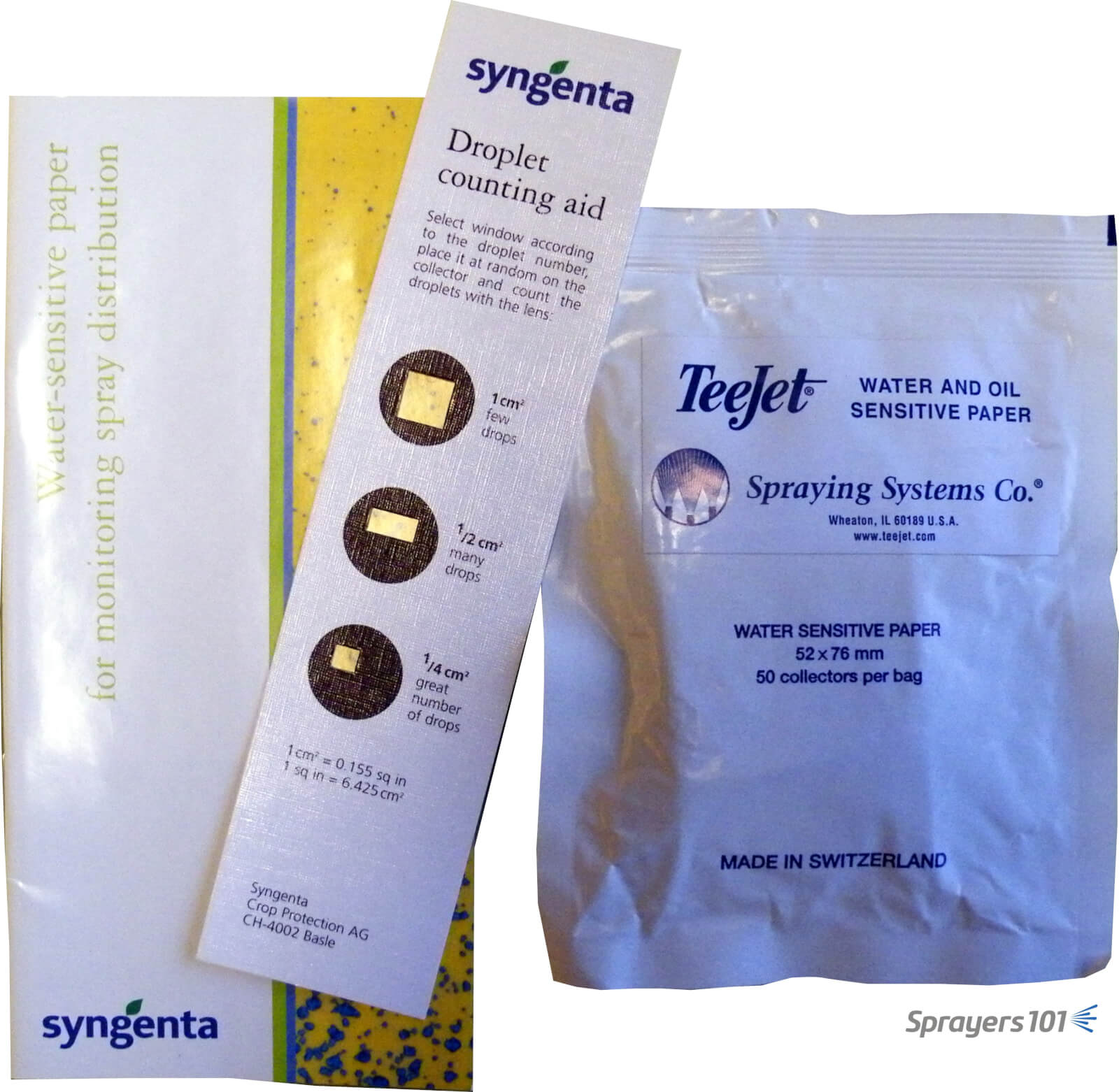
These are all good feedback practices, but a more accurate method is the use of water-sensitive paper, which turns from yellow to blue wherever spray touches it. You can easily see the distribution of the spray and the overall area covered, and it can be quantified so you can compare one sprayer set-up to another, or see the impact of weather, or even the effects of nozzle choice, pressure and water volume.
Water- (and oil-) sensitive paper: Cheap, simple and available on-line or in person from your favourite sprayer equipment store.
Draw a map
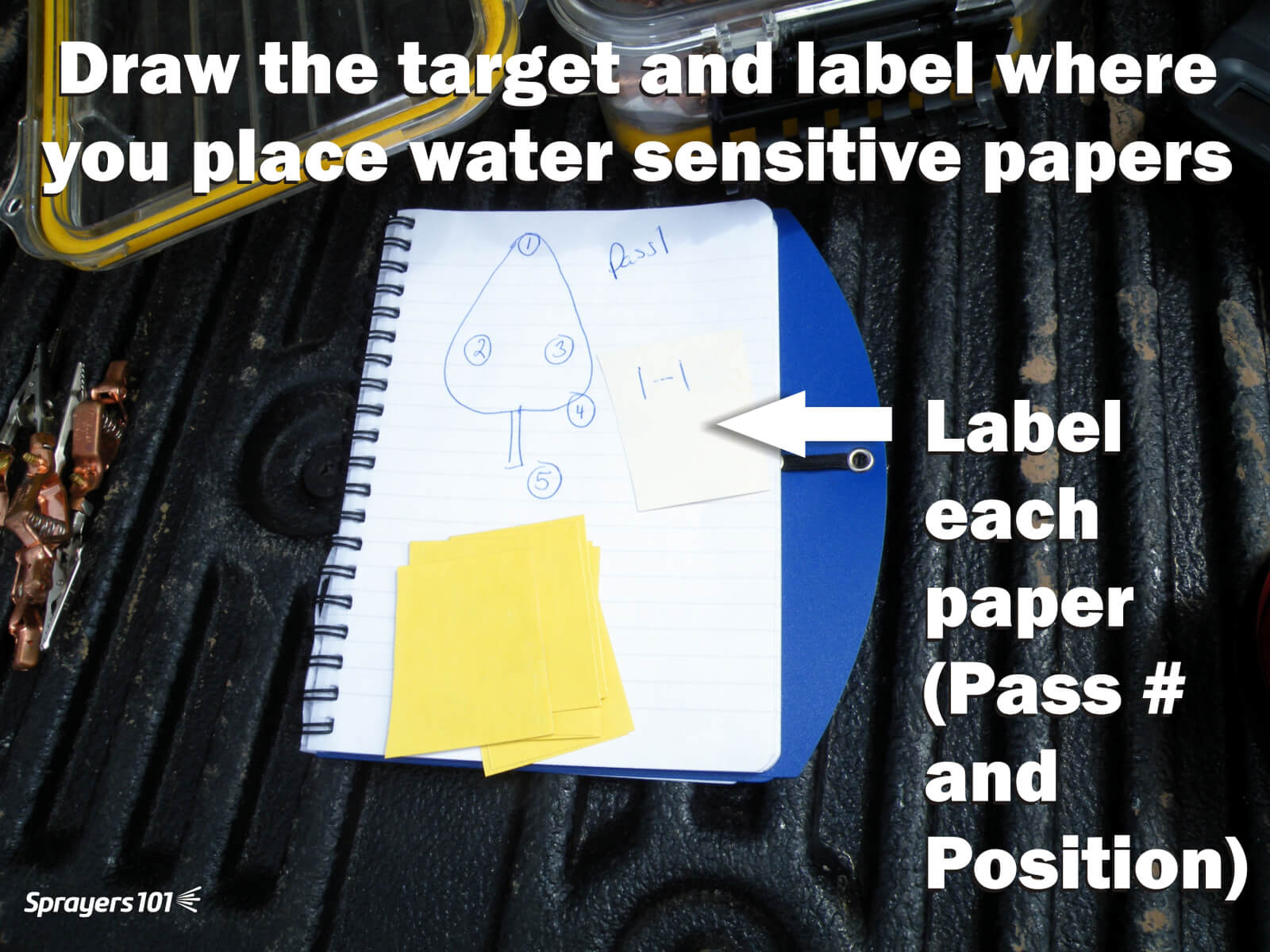
Begin by creating a simple drawing of the tree, cane, bush,vine, etc. you wish to spray. Label the drawing with unique numbers that correspond to where you are going to place the papers. Write the numbers on the back of each paper so you can see where they came from after they are collected. You should also note the pass number, so you can differentiate between each sprayer setup and corresponding pass. You might make a change and want to see how it affects coverage, and it’s very easy to mix up the papers if you haven’t record everything clearly. Plan to do this for at least two plants upwind from the sprayer to ensure you will get an accurate representation of average coverage. Be sure to wear disposable gloves and avoid dew so the papers don’t react prematurely.
Create a simple drawing of the target. Number positions on the drawing that correspond to where you plan to place the papers.
Distribute the papers
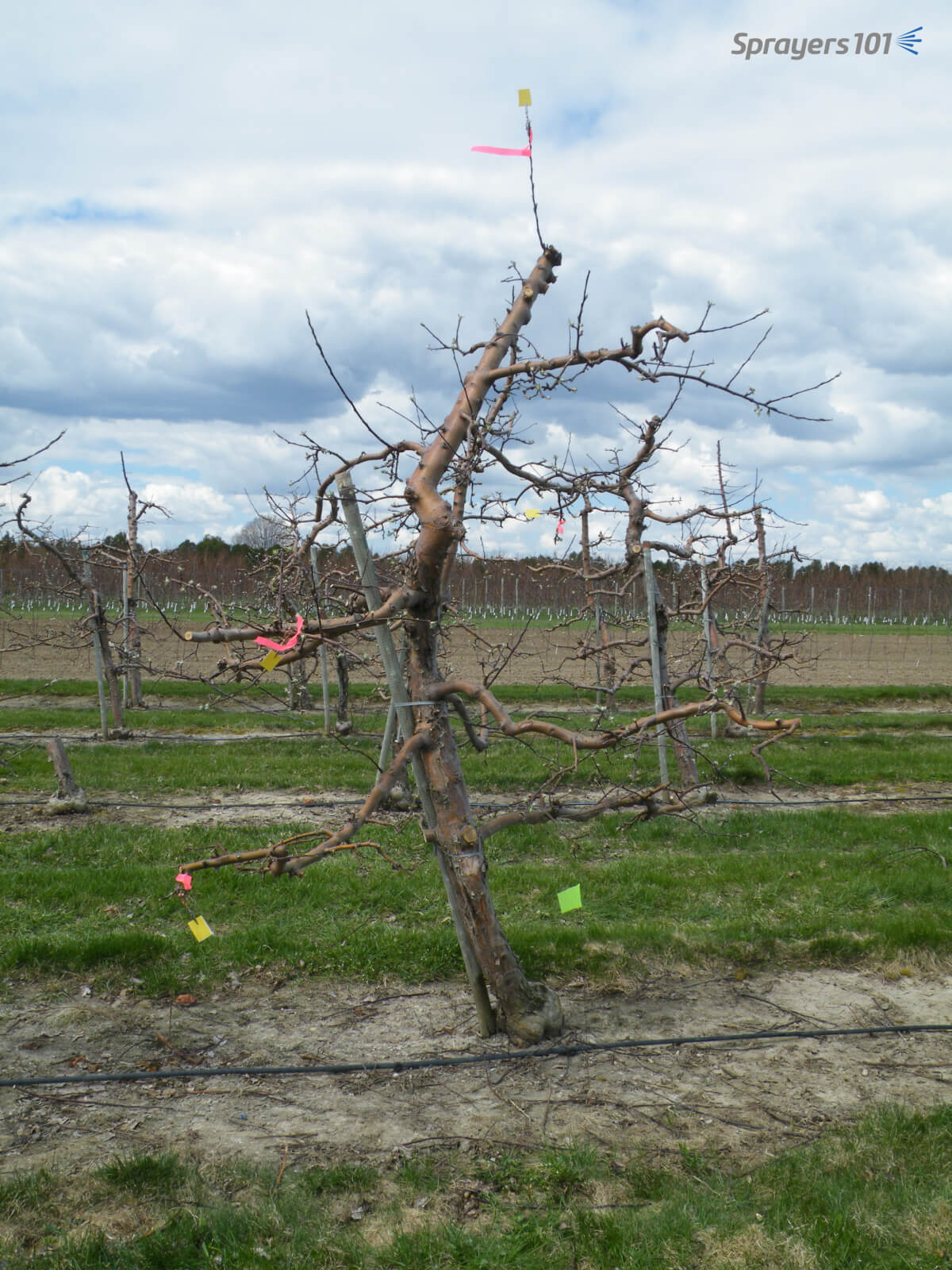
It is critical to distribute the papers evenly throughout each target canopy. They should be placed in key locations where pest damage has been an issue in the past (e.g. scab at the top of a tree, or spotted-wing drosophila at the bottom-centre of highbush blueberry), or anywhere coverage is notoriously difficult. Our preference is to place them at the top, centre and bottom of a tree canopy as well as laterally from the outer edge of the canopy beside the sprayer moving in towards the trunk.
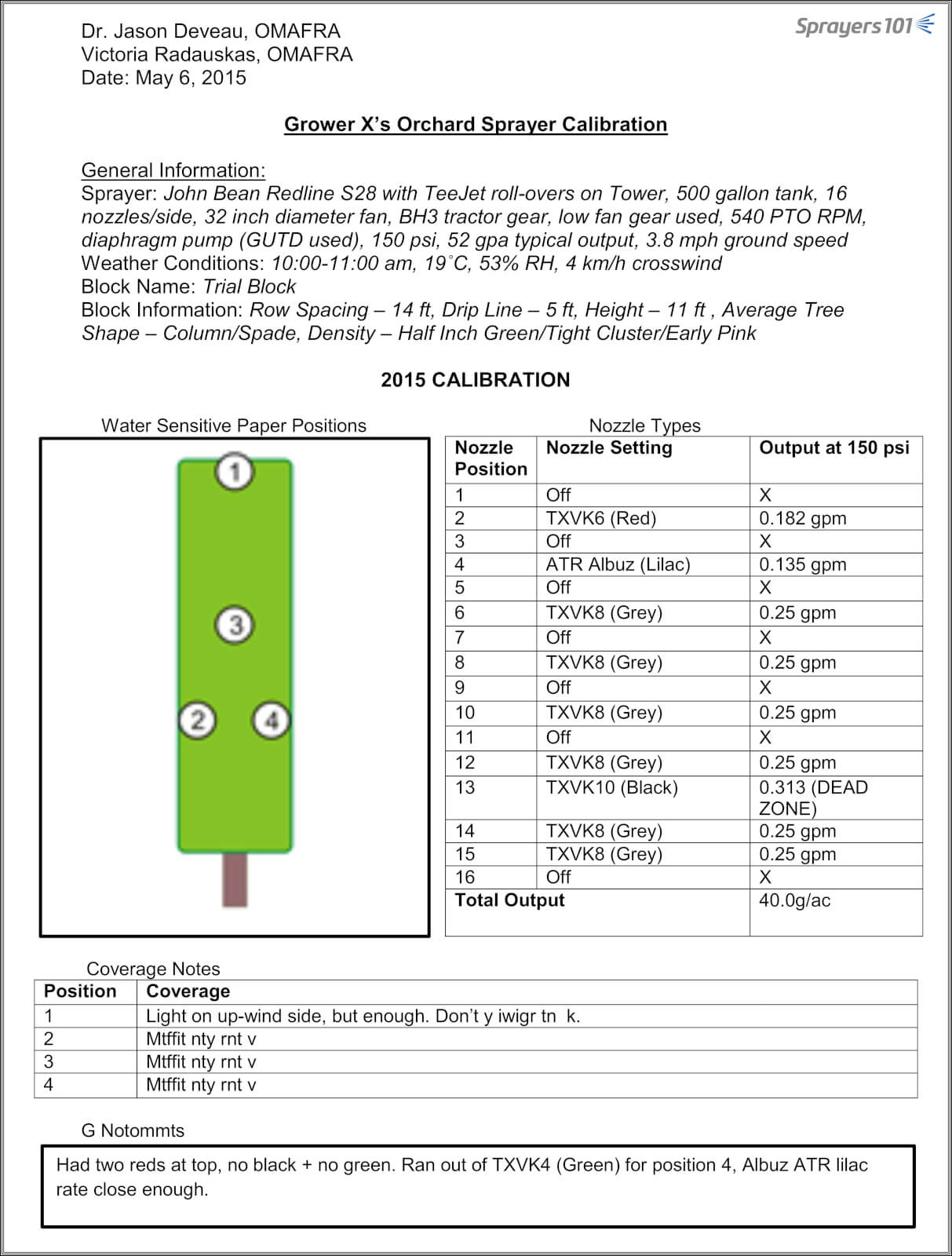
Number positions on the drawing that correspond to where you plan to place the papers. Label the papers as well so you know where they came from. Consider writing the pass number and the position (e.g. 1-1 would be Pass 1, Position 1) so you can evaluate the changes to the sprayer settings from pass to pass. Later, all the information from the calibration can be entered into your spray records, like in this mock-up.
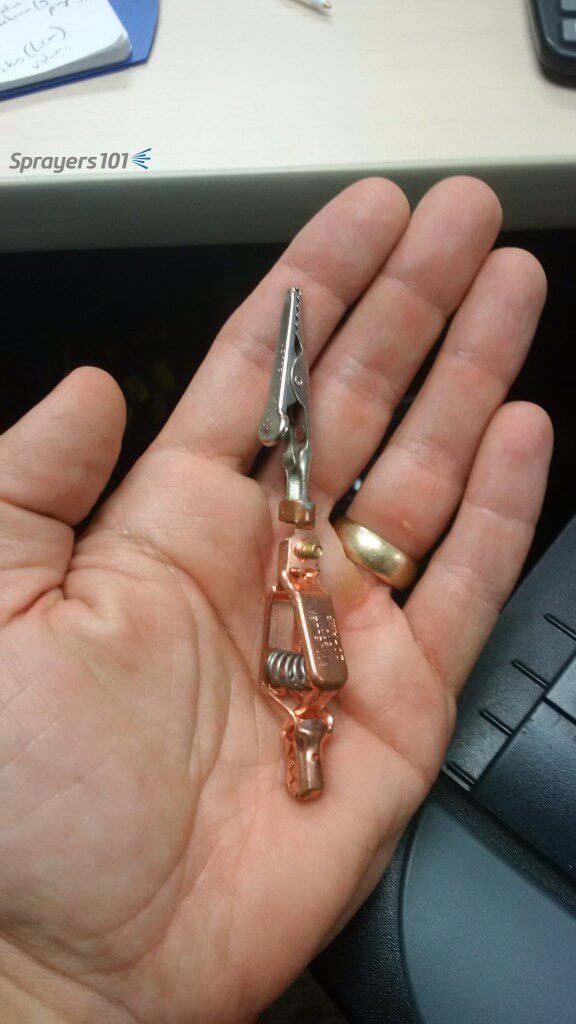
We use spring-back paper clips attached to alligator clips at 90 degrees to attach the papers to small branches. You can also staple them to the upper or lower face of the leaves (as long as they don’t cause leaf to droop). You can wrap them around stems for panoramic coverage or to monitor drenches. They can be stapled the trunk to show if spray is aimed into the canopy or being wasted. You can even skewer to the ground using wire flags to to illustrate poor lower-nozzle positioning and/or canopy run-off. Put them wherever you want to know about spray coverage!
This home-made double-ended alligator clip holds papers at right angles. One end for the paper, the other end to a twig or wire flag.
We typically orient them facing the alleys so their sensitive faces are square to the sprayer as it passes. We often use two in each location, oriented back-to-back facing each alley so you can resolve coverage from both sides. The important part is to ensure you are consistent. Mark the location in the canopy with some colourful flagging tape so you can find the papers after you spray, and if you wish to replace them with fresh papers to evaluate another pass, orient them the same way to make the comparison fair.
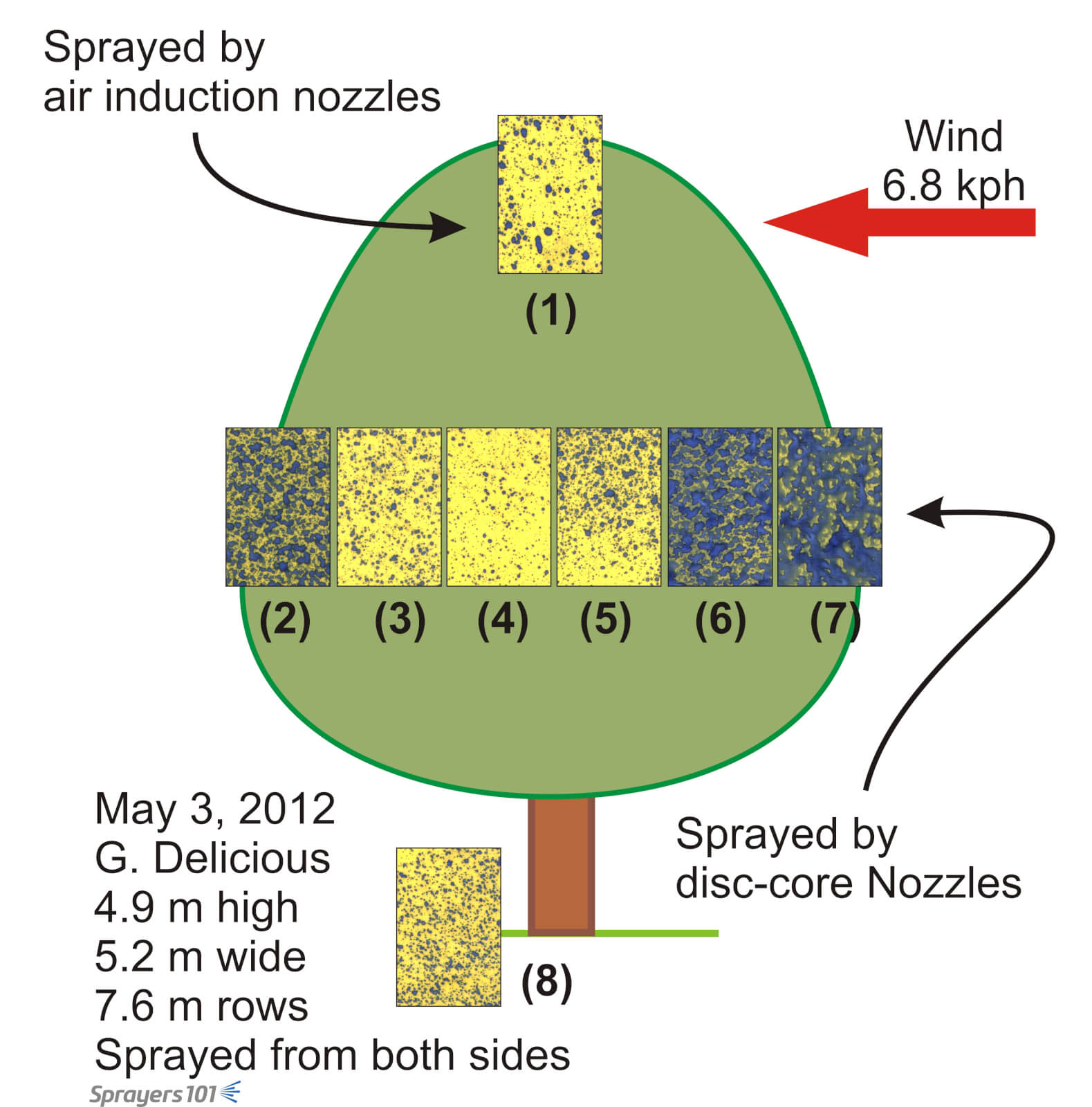
Water-sensitive papers located in five positions in an Empire apple tree. Two papers were pinned back-to-back in each position, distributed evenly throughout the canopy, facing the alleys. One paper was located at the lowest branch to determine if the lowest nozzle position needed to be on. Another paper was pinned to the ground face-up under the tree to show any excessive waste. Be consistent from pass to pass.
Spray, check and spray again
Once the papers are in place, pass by on one side with both booms open (as you would normally spray). Be sure to start spraying well before passing the target, and keep spraying afterwards to ensure the resultant coverage represents an actual application. It is very informative to get out of the cab and examine the papers before passing by on the other side. You can learn a lot about how the wind is affecting the spay.
Once papers are in place, pass by spraying with both booms open to emulate a typical spray day. Be sure to start spraying well before passing the target, and keep spraying afterwards to ensure the resultant coverage represents an actual application. It can be very informative to examine coverage at this point to see how wind is affecting the spray. Then, pass by on the other side to complete the application.An example of the coverage obtained on water-sensitive papers placed throughout an apple tree canopy, and on the ground beneath it.
Interpret the patterns
You might notice the outer portions of larger canopies receive more spray than the inside. This is hardly surprising given that spray must pass through the outside to get to the inside. As a result, inner papers often receive proportionally less spray and should be the basis for determining if you have sufficient spray coverage. This is also why the label recommendation of “spraying to the point of runoff” is unhelpful: the outer portion of wide, dense canopies often begin to drip before the inner portion receives sufficient coverage. Further, how do you spray to the point of runoff? How do you know when to stop before it’s too late? Label language can be frustrating…
When water-sensitive paper is sprayed to the point of run-off, the blue dye will drip. This is fine for a drench (dilute) application, but excessive for a typical concentrated application like foliar fungicides and insecticides.
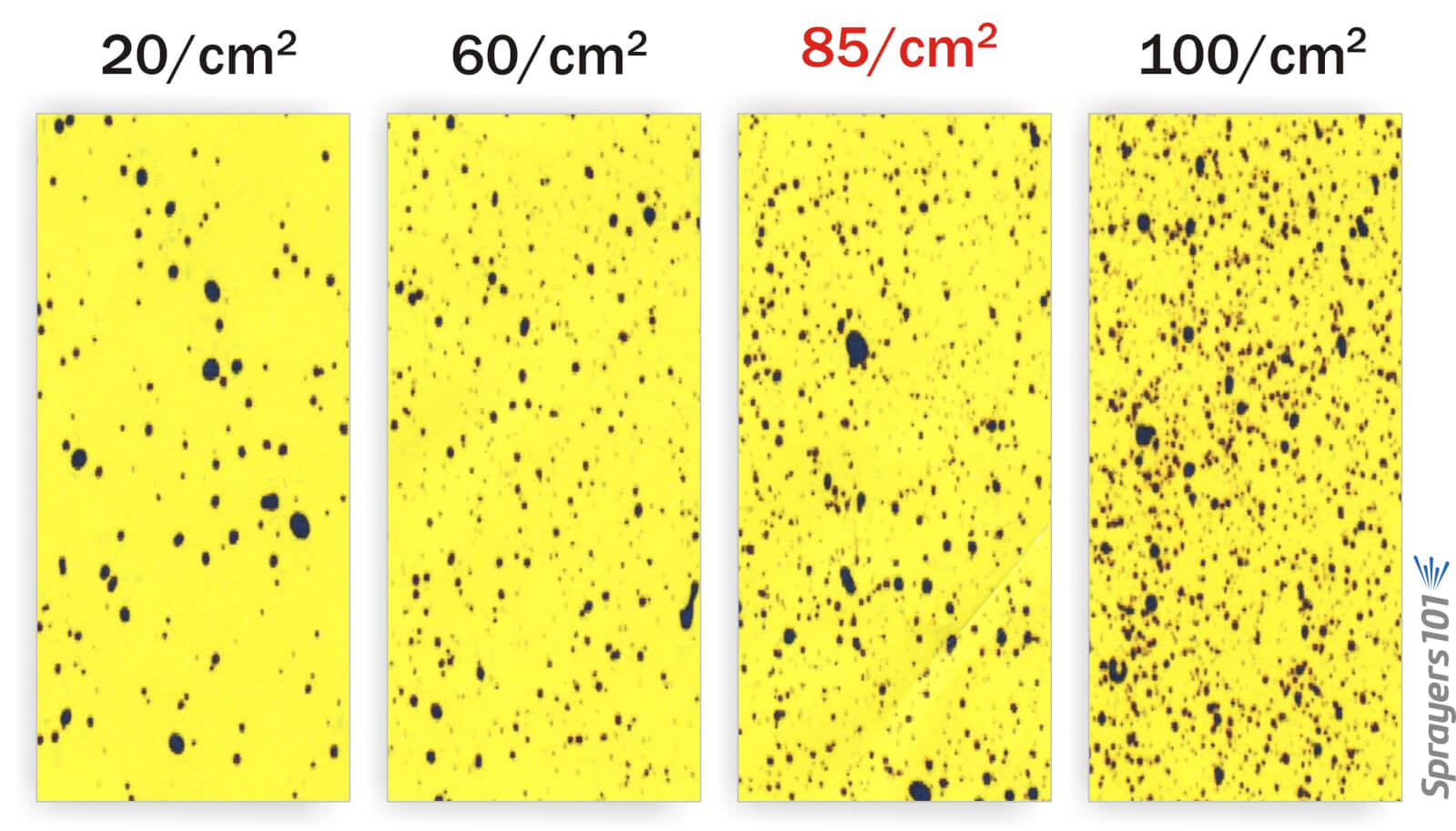
When assessing coverage, don’t follow the droplet counts in the small guide that comes with the paper sensitive paper kit – they haven’t been updated for a very long time and are more appropriate for field crop applications – not airblast applications. Research and experience suggest that 85 discrete fine/medium-sized droplets per square centimetre and a total coverage of 10-15% should be sufficient for most foliar insecticides and fungicides. Remember, this is only a suggested threshold and in the case of coarser sprays, focus more on even distribution and the 10-15% coverage.
It’s debatable, but 85 Fine/Medium-sized drops per square centimetre and about 15% total surface covered on a minimum 80% of all papers represents adequate airblast spray coverage for most foliar applications. It is less applicable for applications made with Coarse/Very Coarse droplets, because there are fewer of them and they generally cover more area. In this case, focus more on the even distribution of spray and the 15% coverage. An extreme example of this is a drench (dilute) application of oil where total saturation is the goal. Conversely, ultra-low volume applications employ Very Fine droplets and a better metric is uniform, high droplet density rather than area covered.
Make a change and try again
There’s no easy way to define a threshold between sufficient and insufficient spray coverage. When you retrieve and examine the papers, think about how the product is intended to work: “Is it a contact, trans-laminar or locally systemic pesticide? What are the odds that an insect or spore will come in contact with residue? Will I be spraying again soon (e.g. fungicide) and will the spray already on the leaves have residual activity?” Regarding that last thought, protectant fungicide applications are often layered, so what one spray misses, the next will catch. Quite often, “sufficient coverage” is less than most sprayer operators think.
If you are content with the coverage, record your sprayer settings to use them again in that block (in similar weather, and assuming the crop canopy doesn’t change significantly before the next spray day). If you are not content, make a change to the sprayer to improve matters, reset the papers, and go again. It can take time and some effort to get it right, but improved coverage and reduced waste are ample financial reward for your efforts.
Other methods of evaluating coverage
It should be noted that while water-sensitive paper is versatile, cheap and easy to use, it has its shortcomings. Placement and orientation of the paper is very important; it’s easy to hit papers on the outside of the canopy with the sensitive-side facing the sprayer. It’s considerably harder when they are at the very centre of the canopy, or hiding behind fruit. When the thin edge of the paper is oriented to the spray (i.e. oriented facing the ground), it presents very little surface and can be difficult to hit.
Use enough air to only just ruffle the leaves. This exposes all surfaces, however briefly, to the spray. Too much air will align leaves with the spray, exposing only their thin edge and making coverage difficult. Too much air may also cause leaves to shingle (overlap), and create shadows like on the grape leaves shown here.
Further, the papers won’t show the finest droplets (<50 µm), so there may be spray even though you can’t see it. Taken collectively with the product’s mode of action (i.e. contact or locally systemic), and any possible re-distribution by rain or dew, spray coverage becomes a good indicator for protection, but it isn’t definitive. While coverage is a good indicator, improved coverage does not always mean improved efficacy.
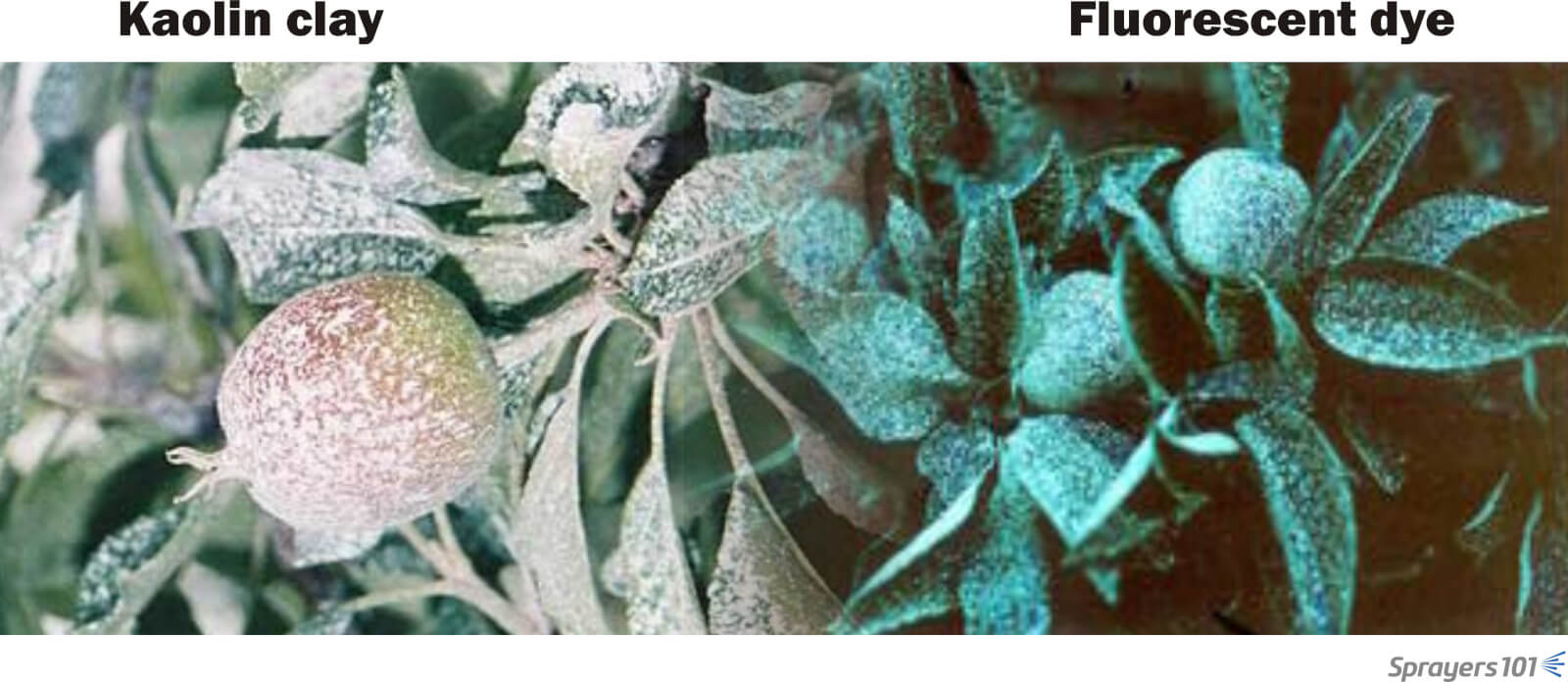
Some sprayer operators use other methods to confirm their coverage. Kaolin clay is an inert compound that leaves white residue when dry. Red, yellow or green water-soluble, food-grade dyes will also indicate coverage. Even fluorescent dyes such as phosphorus can be sprayed at night and illuminated under black lights.
Kaolin clay and fluorescent dies sprayed into fruit canopies give a lot of information about sprayer coverage, but are relatively inconvenient compared to water-sensitive paper.Red food-grade dye sprayed from a horizontal boom to demonstrate downwind drift onto a white target. This was a messy experiment and my hands, and the sprayer, were pink for a long time afterwards. Photo Credit – J. McDougall, Ontario.
Take home
These methods give the sprayer operator a lot of information because they land on the actual target, not a piece of paper hung in the canopy. But, they require a lot of time and effort and are typically out of reach for most operators. Further, they do not allow multiple applications on the same canopy to compare the effect of sprayer settings on coverage – once the target is sprayed, it’s sprayed.
No matter which method you choose to use, understanding how changes to you sprayer, or the impact of weather, affect coverage is a critical piece of information. Operators should make an effort to evaluate spray coverage. Here are a few videos describing the process:
Using water-sensitive paper for airblast coverage diagnostics – thanks to Penn State, Univ. New Hampshire and Chazzbo Media (2014).
Checking water-sensitive paper in an orchard. Tower is spraying only water during a calibration run (2013).