Category: General Operation

All general hort articles on sprayer operation.

  • Spraying Large Nut Trees – Part 1

    Spraying Large Nut Trees – Part 1

    Introduction

    I’ve studied spray applications in a diversity of crops, both broad acre and specialty, but perhaps nothing is as challenging large tree nut canopies. Australia’s macadamia orchards can form >10 metre high, >4 metre deep canopy walls! So in writing this article I face the opposite situation I normally encounter when advising on airblast sprayer settings.

    In my region, fruit orchard, cane, bush and vine crops are typically sprayed with airblast sprayers. Over the years, through breeding and crop management, these operations have densified. The idea is that smaller, uniform crops can be managed, protected and harvested more efficiently. The ratio of quality fruit to planted area goes up, and input costs go down.

    However, our aging fleet of sprayers are overpowered relative to the target. This means much of what I do involves demonstrating to sprayer operators what sufficient coverage looks like, and then teaching how to restrain sprayer parameters to achieve this ideal coverage as efficiently as possible.

    So, are there any commonalities?

    Yes! The need to understand what “good coverage” looks like, and the parameters that affect it, is universal to any airblast operation. Assuming the operator already has product choice and pest staging well in hand, there are three major factors that influence the quality of the spray application: The sprayer settings, the geometry of the target and the environmental conditions.

    In theory we can discuss each of these factors individually, but in practice they interact with one another. It is wrong to adjust one factor without considering the other two. This is also why you should be wary of anyone that tries to sell you a sprayer by demonstrating it in an empty lot on a calm day! Always calibrate a sprayer in the planting, in weather conditions you would normally spray in.

    Air volume and direction

    Air adjustments are perhaps the most impactful changes you can make to your operation. The air stream created by the sprayer not only conveys the spray solution to the target, but opens the canopy and exposes leaf surfaces to the spray. In order to achieve adequate coverage, the volume (and speed) of sprayer-generated air must be sufficient to span the distance from sprayer to target, and then displace the volume of air in the canopy while depositing the spray.

    I admit to a bias when it comes to air shear systems. These sprayers utilize sprayer-generated air to atomize the spray liquid as well as convey it. As such, you cannot easily adjust the air without affecting spray quality (aka average droplet size or VMD). My preference is an arrangement where nozzle selection allows you to control spray quality independent of air settings. In any case, adjusting air settings requires the operator to “see” air.

    In my region, I advise tying 25 cm lengths of flagging tape at the top, middle and bottom of the far side of the upwind tree. Then, drive past with the air on and the spray booms off. If the ribbons stand straight out, the sprayer is over-blowing and the operator can drop to a lower fan gear, reduce the tractor RPM’s (if using a positive displacement-style pump) or drive faster. If the ribbons don’t move, the opposite steps can be taken. If the ribbons still won’t move, the sprayer is under-powered, it’s too windy to spray, or the canopy is too large.

    Learn more about these topics here.

    Let’s explore that last point. In the case of a canopy as large as macadamia, it is unlikely a low-profile axial sprayer can produce sufficient air volume to displace all the air in the canopy – particularly at the top of the tree. In this case a more humble goal would be to move the leaves at the trunk, indicating that the sprayer is managing to drive the air to the centre. To monitor this, an observer wearing safety goggles would have to stand at the far side of the upwind trunk and (while being very careful of flying debris) watch for leaf movement.

    This becomes increasingly difficult to monitor as the target gets fuller, higher, and farther away from the sprayer. Consider the macadamia trees in the following figure:
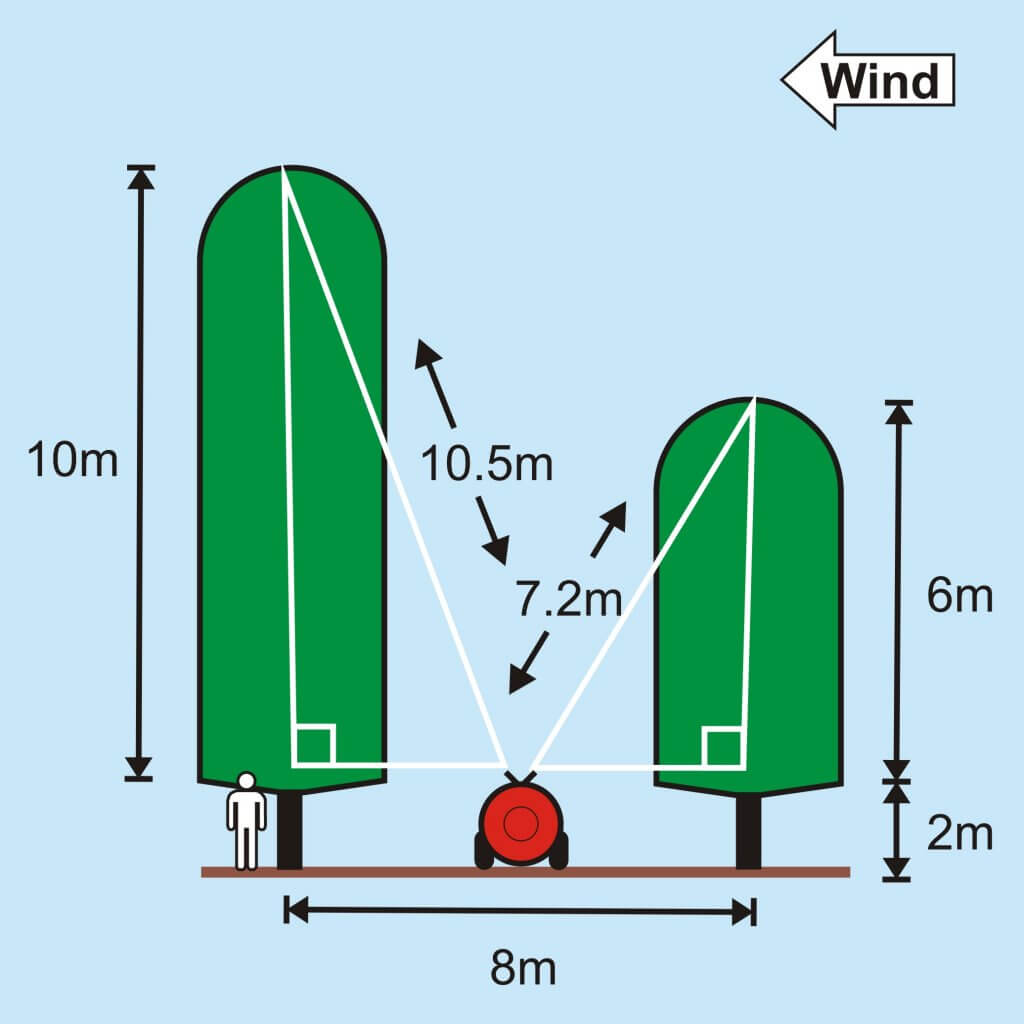

    The observer will have difficulty seeing leaf movement at the top of either the taller or shorter tree, but we can safely assume there will be less movement as a function of height. Since our goal is uniform penetration throughout the canopy, we must somehow compensate for this differential. Consider the following figure which extrapolates the path between the sprayer air outlet and the tree:
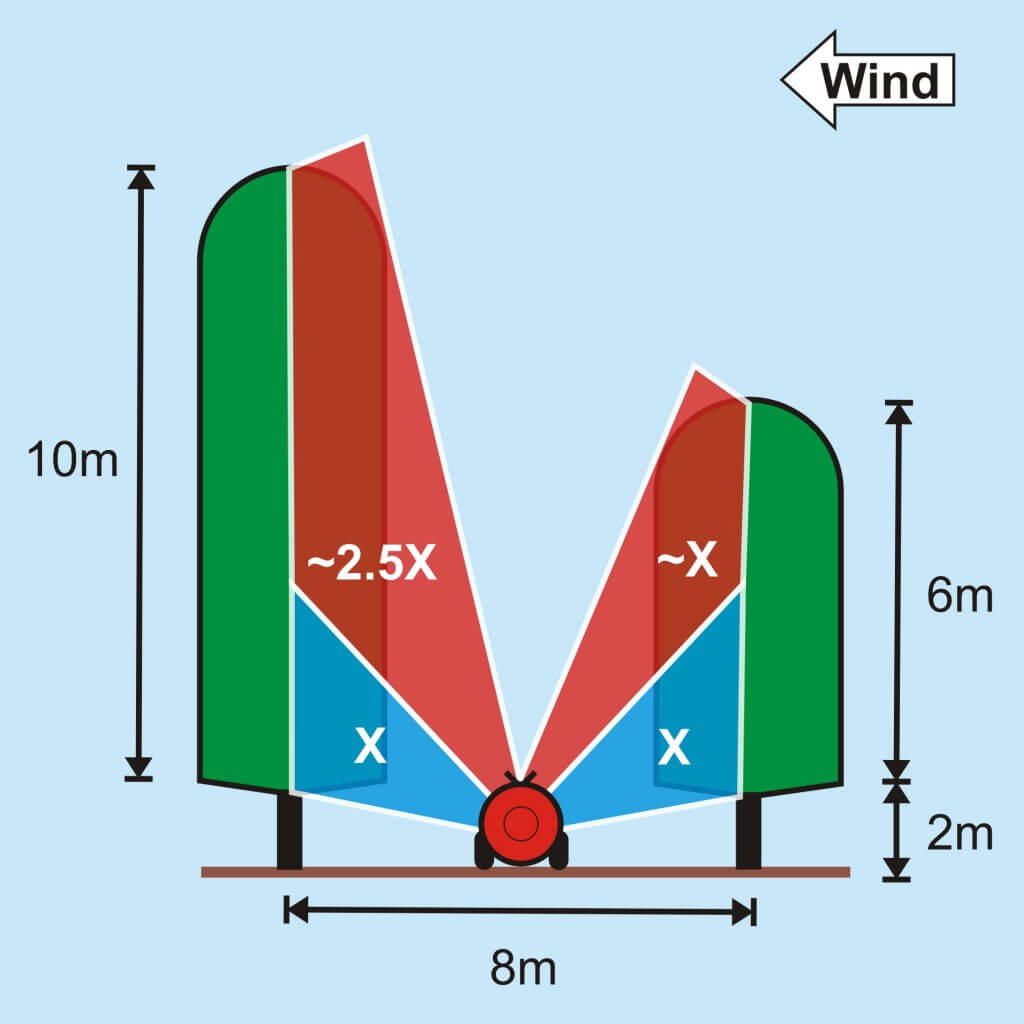
    In this figure we have divided each side of a low-profile axial sprayer into halves. The bottom half of the air outlet must produce enough air volume to displace area X. I realize I’m mixing area and volume, but bear with me. For the taller tree, the upper half of the outlet must produce enough air to displace 2.5 times the area versus the bottom half. Given that it is a single air outlet, this means inconsistent coverage.

    Comparatively, the shorter tree requires a more uniform air distribution. While this improves matters, there are further challenges. Sprayer-generated air slows and disperses proportional to distance, requiring more air to compensate. Also, orchard wind speed increases with elevation, increasing the potential for interference and dispersion. So, the taller the tree, the harder it is to achieve uniform canopy penetration.

    Spraying shorter nut trees with a low-profile axial sprayer is possible. The sprayer would require a large fan (≥1 m diameter), an aggressive fan blade pitch and a high fan speed. Air deflectors and air separation vanes would also be needed to segregate and focus the air. And travel speed would play a significant role.

    Travel Speed

    Travel speed should be considered as function of air penetration. A slower travel speed (~2 km/h) facilitates the displacement of stagnant canopy air with sprayer-generated air. Further, a slower travel speed reduces the wake effect that can suck finer droplets from the swath.

    It may seem counter-intuitive, but slower speeds can result in greater productivity. There is no need to increase the volume sprayed per hectare, so additional refills are not an issue. Further, improving spray coverage at slower speeds may prevent the need for an additional “clean-up” application later on, saving time and reducing environmental impact. Time lost to slower travel speed can also be reclaimed with more efficient loading practices.

    Learn more about travel speed here and productivity here.

    Directed Sprays and Off-Target Deposition

    When the height of the target tree exceeds alley width, or when branches overgrow alleys, many low-profile axial sprayers suffer from line-of-sight issues. Lower branches/leaves block the upper canopy and too many nozzles target the lower canopy. See the figure below.
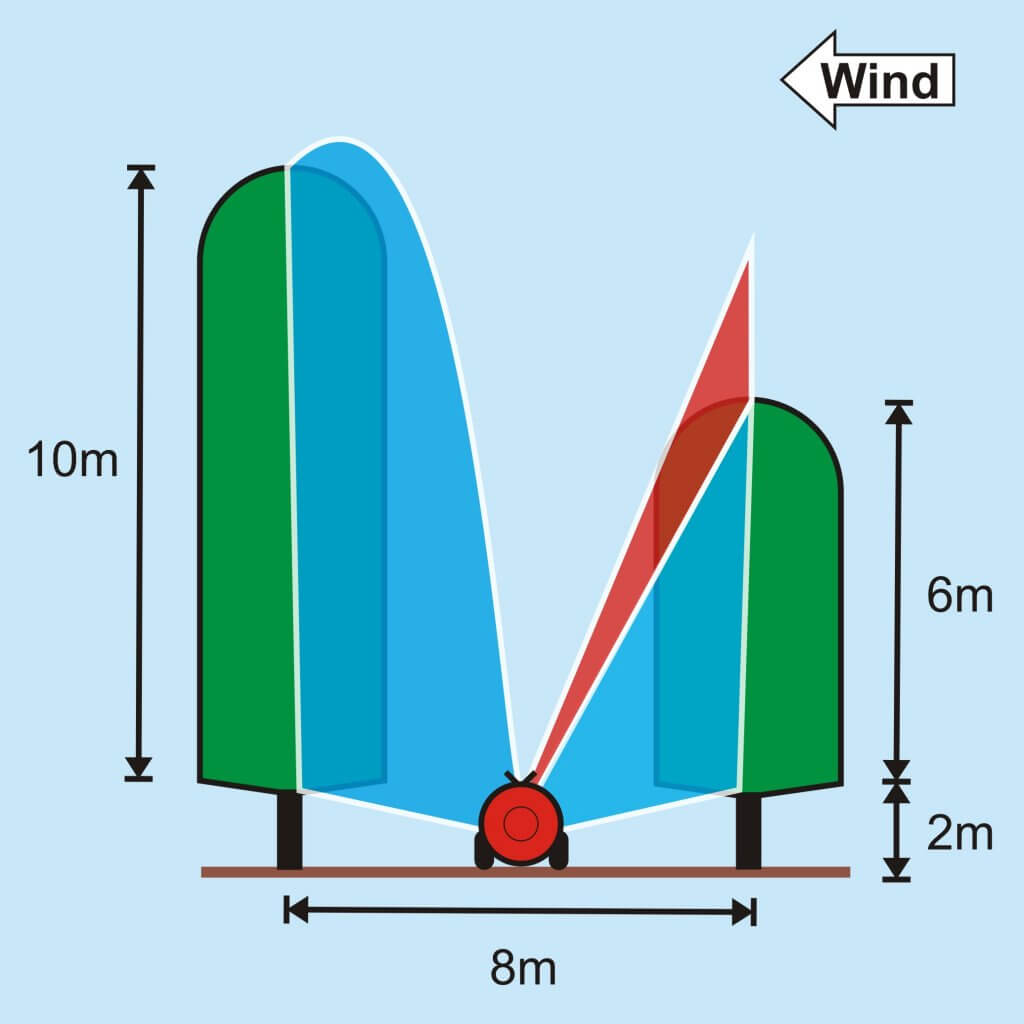
    One option is to direct spray vertically to ensure the swath reaches the top of the canopy. In this case it is hoped that droplets remain Coarse enough to fall from the swath and penetrate the canopy, or blow laterally with prevailing wind (left side of figure). This unadvisable strategy is unlikely to achieve consistent results and greatly increases the potential for drift.

    Alternately, the top of the swath can be vectored directly at the top of the tree, but it must pass through canopy to reach it (right side of figure). This strategy increases the potential for drift, risks missing a portion of the upper canopy and is also unlikely to yield consistent results.

    Ideally, we would use a sprayer design that brings the air (and nozzles) closer to the target. Hypothetically, there are several possible configurations, but in practice their success will be hampered by boom sway and roll (from sloped plantings or uneven alleys) and pressure drop restrictions (from boom height). Here are a few possibilities:
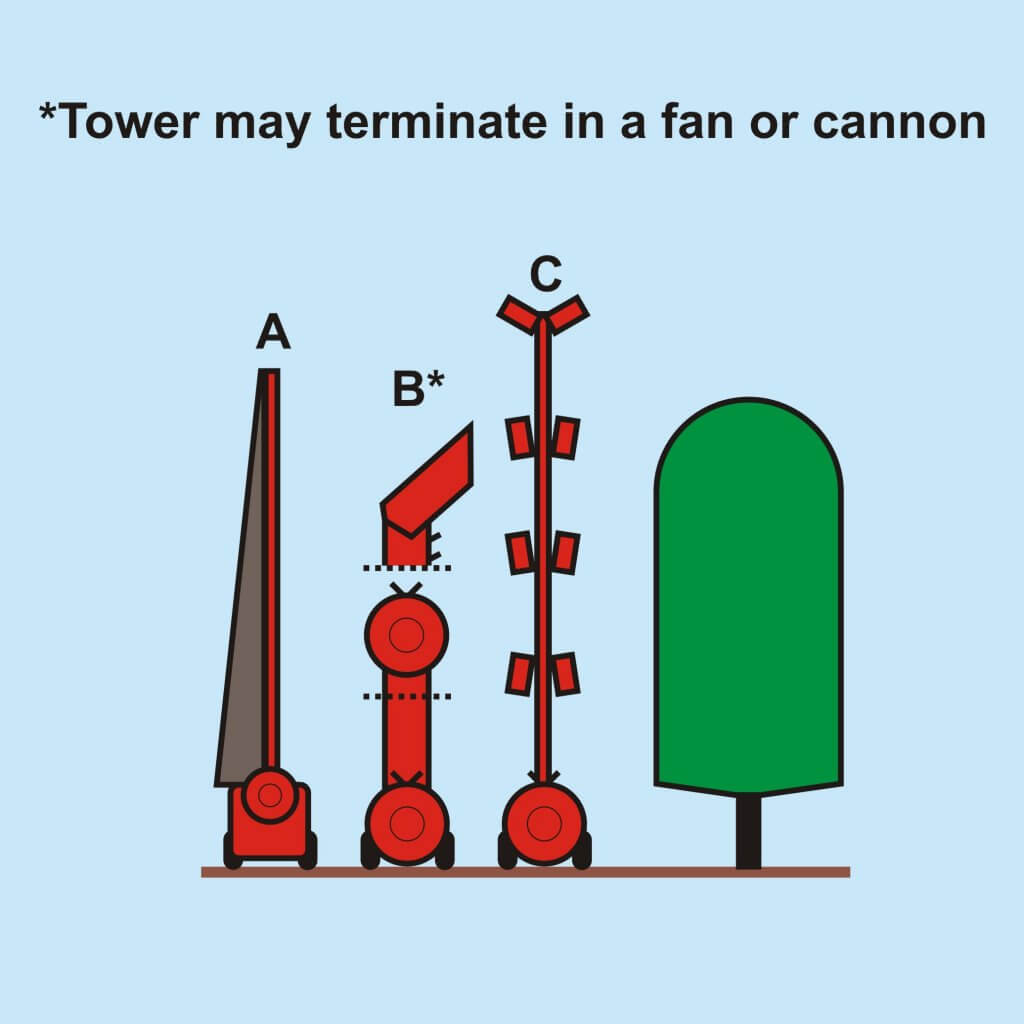
    A. A vertical boom with a tapered inflatable bag to convey and redirect the air laterally (typically one-sided).
    B. An axial sprayer topped with a ducted tower with vertical booms, terminating in either a second axial fan or one-sided cannon.
    C. An axial sprayer with a vertical mast with a series of Sardi-style nozzle/fan assemblies distributed along the height.

    Learn more about towers here.

    In the following figure we see how two possible arrangements might work. On the left is a vertical boom with a tapered air assist system. This provides the shortest distance-to-target for each nozzle and in moving laterally, the air will more easily penetrate horizontal limbs. It also reduces the potential for drift.
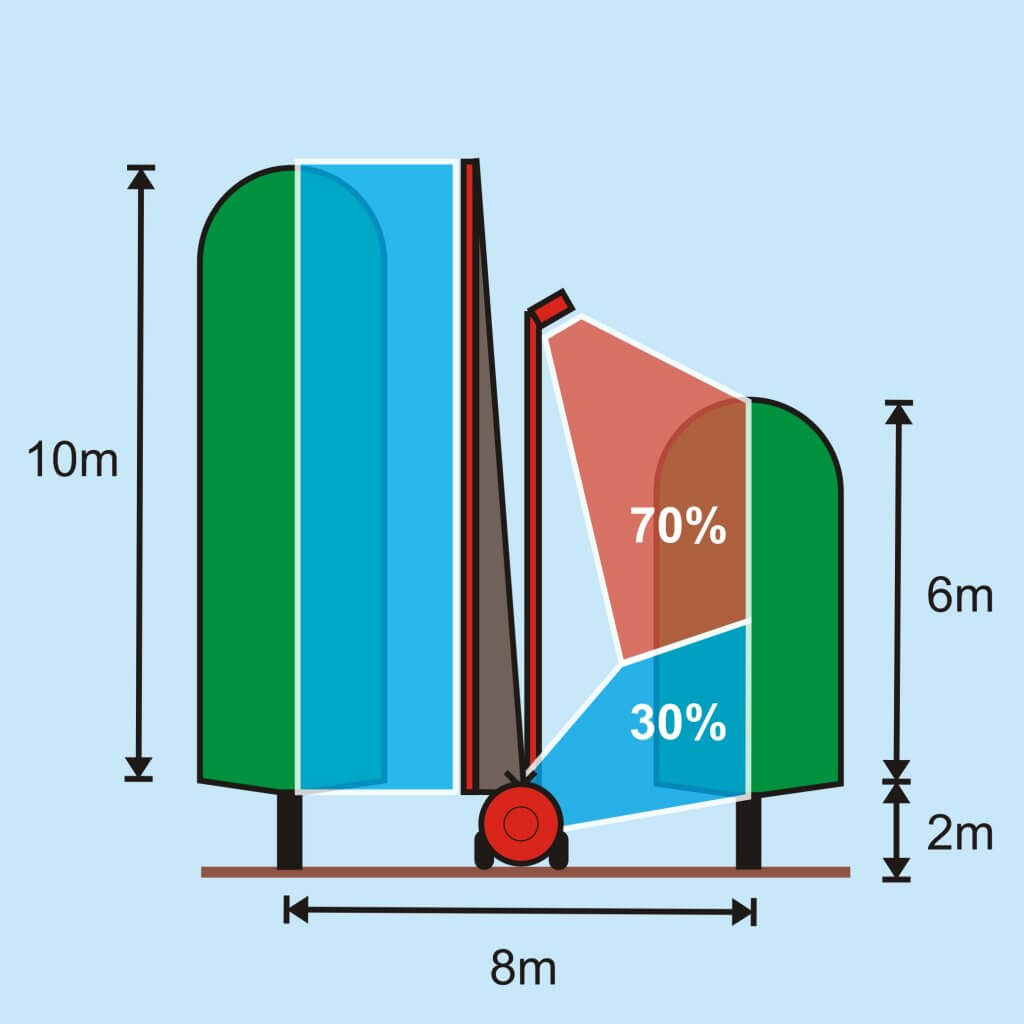
    On the right is a novel arrangement proposed by Dr. Ken Giles (UC Davis, California). A Sardi-style fan and nozzle assembly is elevated above the canopy from an axial sprayer. His intention was to create air and fluid interaction to generate turbulence that could improve uniformity and decrease drift. He proportioned 70% of the overall spray to the top fan, and the remaining 30% from the ground. Working in almond, he saw more even coverage distribution compared to a low-profile axial sprayer and noted it reduced off target drift. For a target as tall as macadamia, additional fans would likely be required.

    In Part 2 we discuss Droplet size, Boom distribution, Spray coverage and diagnostics, California research and Canopy management.

  • Application Recordkeeping: Focus on Environmental Conditions

    Application Recordkeeping: Focus on Environmental Conditions

    Note: This article was written by Bob Wolf of Wolf Consulting and Research, and first appeared as an NDSU Extension Service publication. Bob has agreed to reproduce the article on our website.

    When applying crop protection products, a good steward is one who can identify and record the environmental factors that may negatively impact making an application; particularly, the possibility of spray drift.

    New label language states: “Avoiding spray drift at the application site is the responsibility of the applicator.” A wise sprayer operator must possess the ability to assess the environmental conditions at the field location to determine how best to spray the field, or maybe decide it would be best not to spray that field, or part of that field, at that time. Instruments that assess environmental conditions are available to assist applicators in making good decisions.

    Making the correct measurement is the critical first step. Record the information measured to document the application conditions. Quality records help mitigate against any misapplication allegations, such as a drift complaint. Many of the items listed below are based on past legal experiences with applications involving spray drift litigation.

    The following guidelines should help you measure and accurately record environmental conditions at the application site.

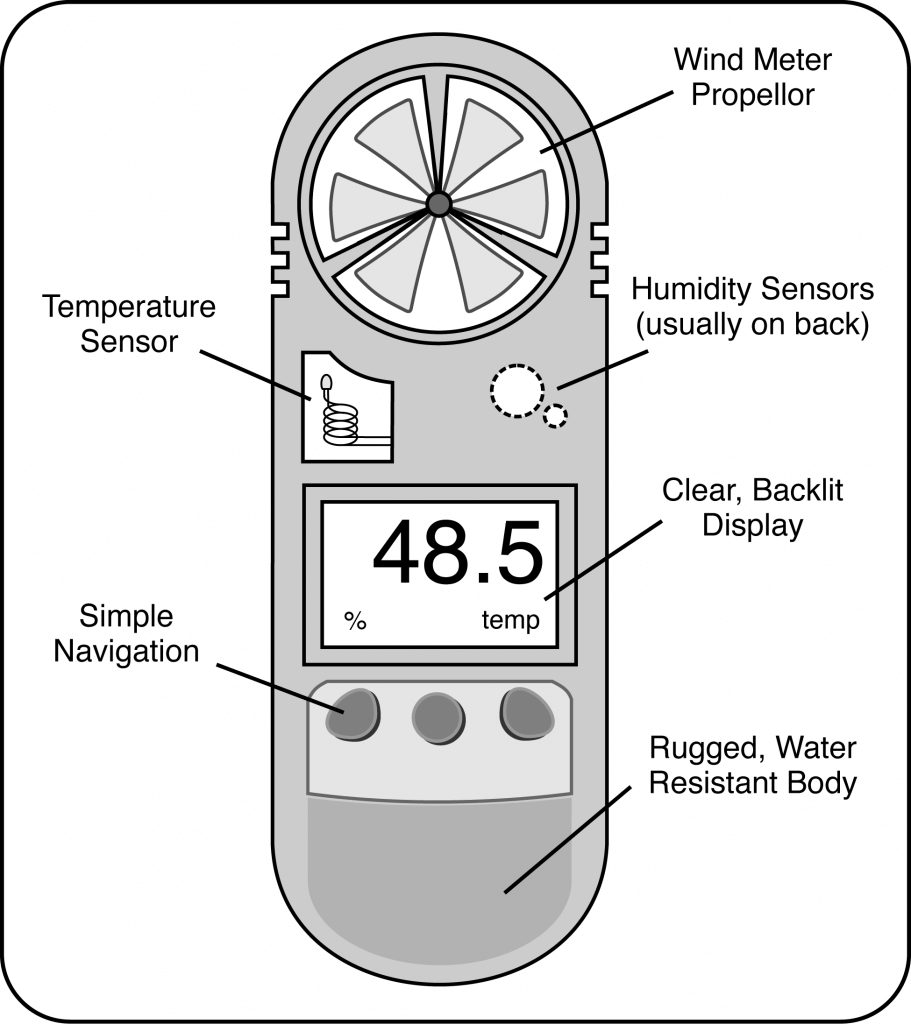
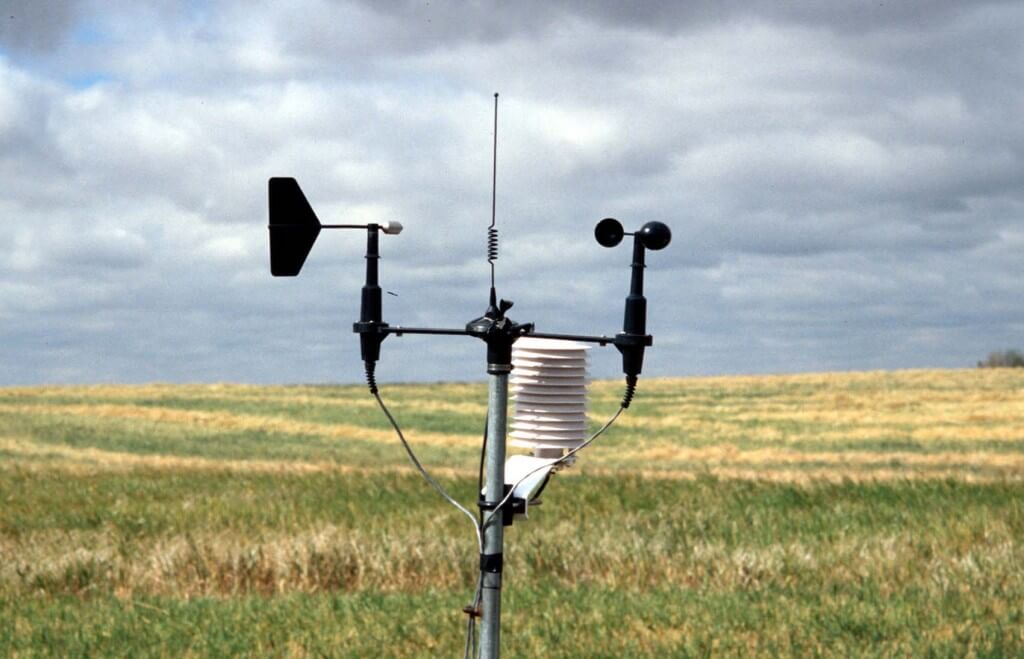
    1- Document any instrument used by recording the manufacturer and model number. Accurate portable weather instruments are recommended. Portable weather instruments are available that log and store data, and aid in auditing and recordkeeping. Some will have Bluetooth/wireless capabilities.

    2- Environmental measurements include wind speed and direction, temperature, and relative humidity.

    3- At a minimum, record data at the start and finish of the job. Consider more often as conditions change or for a job that lasts over a longer period. For example, make observations when tank refilling for larger fields. Time stamp all observations with a.m., p.m., or military time.

    4- Take meteorological readings as close to the application site as possible. Be advised that the weather data received via a smart phone or local weather station may not be accurate for the location being sprayed.

    Note the specific location where the measurement was made, such as GPS coordinates, field entry point, field location, etc. Check the label to see if it requires a specific observation location in relation to the treatment area.

    5- Make all measurements as close as possible to the nozzle release height (boom height) and in an area not protected from the wind by the spray machine or your body. For aerial applications, six feet is suggested when using a hand held instrument.

    6- Record wind speed averaged over a 1 to 2 minute time span. Note the time the observation was recorded. Most instruments give an average over a period of time. Make sure the instrument’s anemometer is facing directly into the wind.

    Do not record winds as variable or with a range i.e. 4 to 8 mph – an average gives a better indication of the transport energy. Light and variable winds, where directions may change several times over a short period, can be more problematic than higher speed winds in a sustained direction. Observe any label restrictions on wind speed.

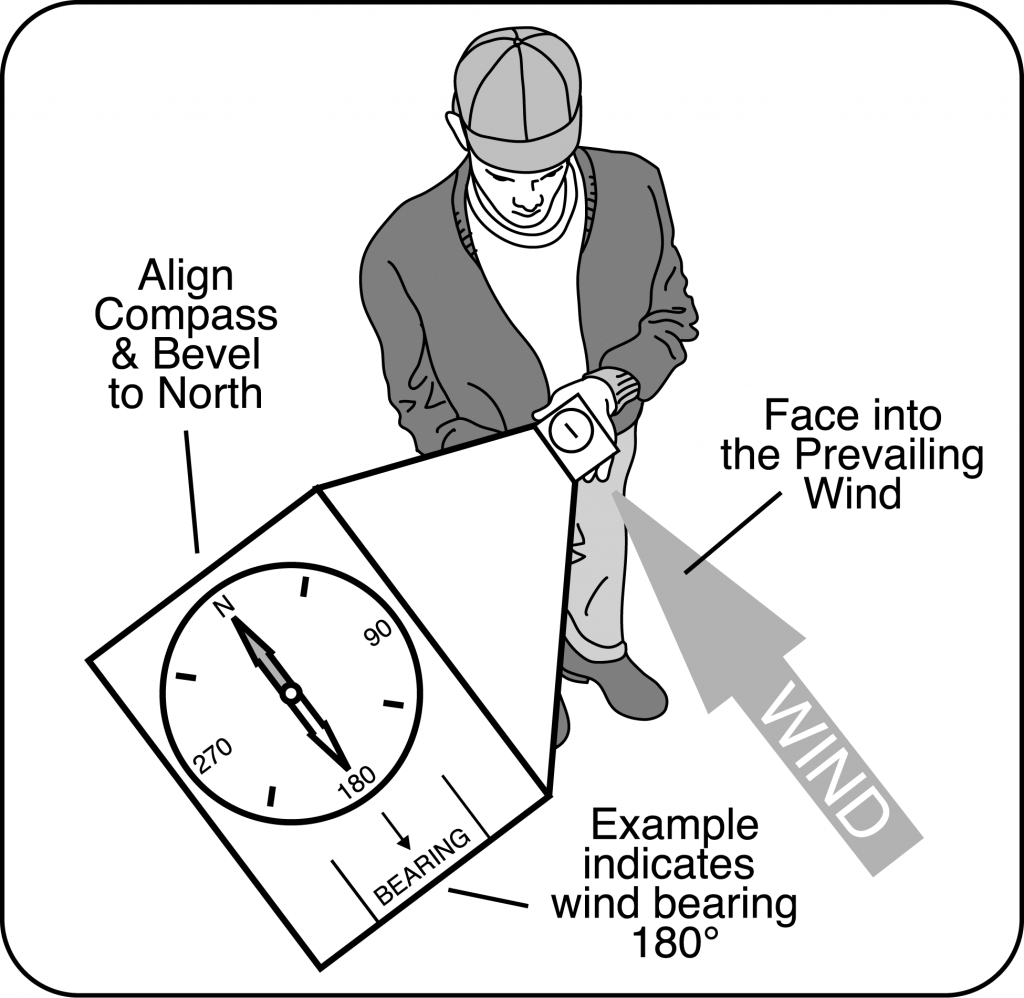
    Wind direction requires a similar averaged measurement. Record direction in degrees magnetic from a compass (0-360°). The use of alphabetic characters, i.e., N, S, NW, to indicate wind direction is discouraged. The key for determining direction is to have an accurate assessment method: trees moving, dust, smoke, a ribbon on a short stake, etc. Face directly into the wind and record the direction from which the wind is coming. A ribbon on a stake with the ribbon blowing directly at your body is a simple fail safe approach. Movement of smoke, particularly from moving aircraft, or dust may help determine direction.

    7- Record temperature and humidity since they can be helpful in determining temperature inversion potential. It may be advisable to record both temperature and humidity well before and after the application for this purpose. In fact, recording a morning low and an afternoon high would be useful regarding determining the potential for an inversion. Take temperature measurements with the instrument out of direct sunlight. Shade the instrument with your body or spray equipment. This is especially critical if you are trying to assess temperature differentials for determining if an inversion is in place.

    8- Be alert to field level temperature inversion conditions which typically occur from late afternoon, can be sustained through the night, and into the next morning. Beware, inversions can start mid-afternoon. Observe conditions such as the presence of ground fog, smoke layers hanging parallel to the ground, dust hanging over the field/gravel road, heavy dew, frost, or intense odors (i.e., smells from manure or stagnant water from ponds are held close to the surface when inversion conditions exist). Inversions commonly occur with low (less than 3 mph) to no wind speeds. Spraying in calm air is not advised. If a mechanical smoker is used note wind direction and smoke dissipation with a time stamp.

    9- Note any variances due to terrain or vegetation differences, tree lines, buildings, etc.

    10- Initial or sign all recordings to indicate who made the observation(s).

  • The Misplay of our Generation

    The Misplay of our Generation

    We tend to overestimate the effect of a technology in the short run and underestimate the effect in the long run.

    –Amara’s Law of Computing

    We tend to overestimate the effect of a stewardship mistake in the short run and underestimate the effect in the long run.

    –Wolf’s Adaptation of Amara’s Law to Agricultural Stewardship

    August 9, 2017

    Since June of 2017, we’ve been hearing reports of widespread dicamba damage symptoms in soybeans throughout the US mid-south and midwest. It appears that millions of acres could ultimately be affected, and yield impacts are unknown at this time.

    For those new to the issue, dicamba is a broadleaf herbicide in the Group 4 mode of action group, a benzoic acid. It’s an important tool for herbicide resistance management for weeds like palmer amaranth (Amaranthus palmeri) and waterhemp (A. tuberculatus), populations of which have become resistant to Group 2 (ALS inhibitors), Group 5 (triazines), Group 9 (glyphosate), Group 14 (PPO inhibitors) and Group 27 (HPPD inhibitors) in some places.

    Dicamba is a volatile herbicide, discovered in 1942 and first registered in the US in 1967. Its primary use was in corn and other cereal crops, lawns, and rights of way, at comparatively low doses, and relatively early in the season.

    Calling a pesticide volatile means it can evaporate after application, either from a liquid or a dry deposit, for hours or sometimes days after application. The resulting vapor cloud can move unpredictably, depending on atmospheric conditions, and affect plants long distances away. Higher temperatures increase vapor loss.

    Starting this year, dicamba-tolerant soybeans and cotton (Xtend varieties) were sprayed with new lower-volatility formulations of dicamba, XtendiMax, Engenia, and FeXapan, to control certain broadleaf weeds (including the Amaranth species above) without harming the soybeans. Problem is, dicamba can harm non-Xtend soybeans and other plants, even at very low doses. And these registrations were for applications that occurred later in the season, at higher doses than before.

    I usually don’t get involved in people’s decision about whether to spray, or what to spray. But I do get involved when it comes down to how to spray. That’s my job. The real question to me is “can this product be used safely in cotton and soybeans?” Right now, the jury’s out on that one.

    In my business, our guiding principles are what some people have called the “Three Es of Application”, Efficacy, Efficiency, & Environment.

    We use sprays to control pests. That’s the only reason. We have to apply them so that they work, or else it’s a wasted effort. That’s the efficacy part. We also need to use our resources, time, money, etc., efficiently so the whole process doesn’t bankrupt us and we have time left for other important tasks.  That’s efficiency. And finally, we need to protect the environment, and that means making sure the product lands where it’s intended.

    None of these three priorities trumps the others. All need to be met to the best degree possible. And due to ever-changing conditions, we will typically change our approach to emphasize one or two of these three over the others, to have a working system.

    Simply put, pesticides belong on target surfaces covered by the swath of the sprayer, and nowhere else. If they do move elsewhere (something we’ve come to view as inevitable), regulators conduct risk assessments to ensure that this movement does not result in harm. If harm is possible, mitigating tools such as application timing, product rate, spray method, and buffer zones may be imposed. If those tools aren’t enough to ensure safety, regulators deny product registration. That’s their job.

    But even if no harm is done by trespass, the products still need to be on-target. That’s stewardship. It’s a principle whose adherence gives license for a technology to be used. It gives others faith in our competence. Practicing this principle when it’s easy prepares us for hard times.

    I respect our regulatory process, and know it to be increasingly conservative with regards to risk the less data there are. I worked for the PMRA (the Canadian pesticide regulatory agency) as an application expert for five years. I know the system isn’t perfect and can make mistakes.  I know the system can be political. Usually it’s by being too careful. With dicamba, it looks like the opposite happened.

    The reason we’re seeing dicamba leaf cupping everywhere isn’t because all applicators suddenly forgot how to spray. They didn’t suddenly get reckless. They didn’t wilfully ignore all the training that the dicamba manufacturers and state and provincial governments developed in preparation for the product launch.

    Instead, dicamba drift reports arose from a combination of extreme sensitivity and easily identified symptoms, as well as an unexpected (by some) amount of vapor drift. Even good applications appeared to create problems. Despite warnings from local experts, regulators and registrants didn’t see it coming.

    Experienced agronomists have suggested that the observed dicamba trespass of 2017 implicates both temperature inversions and vapor drift. And although the new product labels advise against spraying under inversion conditions, they don’t say a word about vapor drift, the conditions that give rise to it, or how to protect against its occurrence. Not one word. I’ve searched the XtendimaxEngenia and FeXapan labels. Nada.

    Seems that the regulators and registrants felt confident enough in the reduced volatility of dicamba, based on their internal empirical data and modeling, that they didn’t need to mention it on the label. Calling that a mistake is an understatement.

    I’d call it the biggest spray application misplay I’ve ever seen.

    A part of the problem may be the enormous scale on which this new use of dicamba was introduced, over 25 million acres of Xtend crops. Scale-up errors are common in many industries. Emergent properties related to scale can’t readily be predicted by empirical data and models. Especially when the underlying data are scant.

    So what to do? The continued success of agriculture depends to continued access to safe crop production tools. Irresponsible use threatens that. And by irresponsible use, I don’t just mean application. I also mean registration, promotion, sale, and support. The whole stewardship package.

    When problems occur, we need to be quick on our feet to acknowledge them, to support those affected, and to try to understand the cause and prevent the situation from continuing or getting worse.

    The current industry response appears to be the exact opposite. What I’ve seen is full of denial, downplaying, innuendo, blaming, and entrenchment.

    Why is such an important issue in pesticide stewardship handled so poorly?

    The immediate victims of this situation are the producers that depend on new technologies. But the long-term victim is agriculture as a whole. The lack of humility and leadership by many of the proponents of this technology, those with no small financial stake in its continued use, hurts not just them, but all of us involved in farming. This is not stewardship. It’s not license. It’s short sighted and reckless.

    Over my career, spray application has generally become safer for the operator and the environment. A big part of our success has been the adoption of low-drift nozzles, the de-facto standard for modern pesticide application. The development of less toxic and less persistent pesticides has also been very important. We can avoid a lot of problems with good chemistry. I’ve been proud to tell this story.

    I want to stay proud of our story. And in this case, that requires admitting to mistakes that were made and taking corrective action that is in the best interest of our entire industry. Agriculture will persist longer than company brands and titles. It takes priority.

    It’s still too early to fully understand all the reasons for the widespread dicamba damage. But it’s not too soon to say that much of this could have been prevented with a smaller rollout, with greater collaboration with government and university experts during registration, and with more honest information on dicamba volatility on product labels. Call it Volatility Humility.

    We’ll all pay for the mistakes that were made. We’ll likely have more stringent and expensive registration protocols. More restrictive application parameters. Strained relationships. More distrust of agriculture.

    And as always, an ounce of sweet prevention would have been much better than the pounds of bitter cure that will surely be required to make this right.

  • Storing Pesticide Mix Overnight

    Storing Pesticide Mix Overnight

    Not being able to finish a tank due to weather or any other reason happens to just about everyone. Is it OK to simply leave the sprayer as is, and resume spraying later after some agitation?

    In many cases, the answer is yes. Most pesticide mixtures are stable in short term storage. On resuming spraying, an agitation could be all that’s needed to get back to where you started a day or so earlier.

    But there are three important exceptions.

    When the active ingredient is formulated as a suspension. Suspensions are typically wettable powders and flowables, and rely on a clay carrier to distribute the active in the tank. Because clay is denser than water, these formulations settle out quickly after agitation stops. Sure, they can be brought back into suspension with vigorous agitation. But in lines and booms, boom ends and screens, dislodging a settled clay carrier is much more difficult. It’s also hard to tell if the cleaning has been successful because the problem spots are hidden.

    The best solution is to flush the spray boom with water before materials can settle and lodge. A visual inspection where access is possible, such as strainer bowls and boom ends, is part of the process to ensure the formulated product has been removed.

    Learn to identify which formulations are suspensions. There’s lots of jargon out there. Look for terms such as DC, DF, DG, DS, F, Gr, SP. Even EC formulations are suspensions (oil in water) and require agitation.

    When the active ingredient is chemically unstable. Some pesticides can degrade in the tank, usually due to alkaline (high pH) hydrolysis. The effect is very pesticide specific, but in general, insecticides (particularly organophosphates and carbamates) are more susceptible than other pesticides. This fact sheet by Michigan State University describes the impact of pH on a the half-life of a large number of pesticides.

    Note that in the examples in the MSU fact sheets, pesticide half lives are typically days and weeks, and only rarely hours. Also note that while high pH is most often problematic, low pH can lead to faster breakdown in a small number of products.

    Ensuring tank mix stability requires a pH meter or paper, and possibly a pH modifier such as citric acid. But do your research first! Here’s an article on pH and water quality.

    When the tank previously contained a product known to harm the current crop. This situation is most common and most difficult to address. Some examples from western Canada are Group 2 modes of action sprayed prior to a canola crop. Why are Group 2 products implicated?  Many are formulated as dry products on a clay base, and these can settle in boom ends, adhere to tank walls, or get stuck on screens. Their solubility is pH dependent, as we explain in this article.

    Canola is particularly sensitive to this mode of action, and the most common canola herbicides, Liberty and glyphosate, are formulated with strong detergents that act as tank cleaners.

    Even when applicators think that their tank is clean, they can’t actually be sure and can’t do much about it at that stage. The stripping of tiny amounts of residue off the tank walls, filter screens, or plumbing, can happen during a mid-day stop or an overnight break.  Applicators eventually find out that this happened, usually about two weeks after spraying.

    Our advice is:

    After spraying a herbicide to which a subsequent crop may be sensitive, with the classic case being a Group 2 and moving to canola, be extra diligent with cleaning and pay attention to the tank walls, all screens, and boom ends.

    The best way to solve issues is to avoid them in the first place. If the weather looks unsettled and may interrupt your spray operation, consider mixing smaller batches that can be sprayed out completely even if conditions change quickly. This allows you to rinse the tank and spray water through the boom, thus avoiding a contamination problem developing overnight.

    If that’s not possible, at least do not let a tank mix sit in the boom overnight. Instead, use your clean water tank to push water through the boom prior to storage and double check the screens. The following day, prime the boom with your tank mix as usual and resume spraying the crop.

    If you’re not sure that your sprayer can draw from the clean water tank and push through the booms (the wash-down nozzles are, after all, the intended destination for that water), decipher your system and add the necessary valves that make this possible.

    A useful design that helps flush and prime a boom quickly is the recirculating boom offered by some aftermarket boom manufacturers. These booms are also more common on European sprayers. A nice feature of such designs is that the tank contents can be pumped through the entire boom assembly without actually spraying. This ensures that the boom is primed without any soil contamination. It also dilutes whatever residue there may be in the boom plumbing with the entire tank, likely reducing its concentration enough to be of little concern.

    An additional feature of recirculating booms is that many offer stainless steel tubing throughout most of their feed and return length, minimizing the black rubber hose products that often adsorb, and later release, herbicide contamination.

    Even if a wholesale boom or sprayer change is impractical, consider switching to steel boom lines and tanks tank to minimize residue carryover.

    As is often the case in the spraying business, prevention is easier and less costly than solving a big problem later. Spray mix storage is one of those examples where a small amount of extra effort at the beginning can pay big dividends later.

  • Does Higher Pressure Increase Spray Penetration?

    Does Higher Pressure Increase Spray Penetration?

    A very common question we hear at sprayer demonstrations is:

    “I want to drive the spray deeper into the canopy – does higher pressure help?”

    Well, here’s the classic government answer:

    “…yes and no.”

    It depends on two things. First, the size of the droplet and second, your tolerance for drift (ours is almost zero, BTW). The following video explains how Fine droplets behave very differently than Coarse droplets. It’s always nice to get outside and toss a few balls around:

    Well, that last statement in the video isn’t strictly correct…

    It’s true that changes in pressure have greater impact on the momentum of coarser droplets, but there is some impact on finer droplets, too. Sufficiently high pressure makes for a finer spray quality and finer sprays have been shown to penetrate dense canopies more effectively. We have seen improved canopy penetration in ginseng, field peppers and matted-row strawberry using finer spray under higher pressure. If pressure is high enough, it will create air-inclusion and impart additional momentum to even Fine spray droplets over a short distance, but it’s a case of diminishing return. That is, it takes a lot of pressure to do it and relatively speaking they only got a bit faster/further. In our work, we used pressures between 90 and 300 psi. Excepting hollow cones, that’s generally on the upper end, or beyond a nozzles rated pressure range and it may even be outside the pumps capacity.

    The reason we downplay pressure as a tool for improving canopy penetration is because finer spray under high pressure causes unbelievable drift. A fraction of the spray does get deeper into canopies when you “fog it in”, but the plume of spray blowing beyond the sprayer is entirely unacceptable. Slowing down the travel speed, spraying on cool, humid, low-wind days and lowering boom height can help, but in every trial where we’ve used high pressure and Fine spray quality, we see the image below… or far worse:

    Staged drift in peppers using water
    Staged drift in peppers using water and high pressure combined with Fine spray quality

    The compromise in canopy penetration is to use a Medium spray quality and higher water volume. Stay within the pressure range the nozzle requires to achieve that Medium spray quality. If canopy penetration is still insufficient, consider canopy management (like planting density and pruning) and explore drop-arms to direct the spray, or booms that offer an air-assist or air-deflection option (a few shown here) to entrain and carry spray into the canopy.

    Don’t use higher pressure to increase canopy penetration.