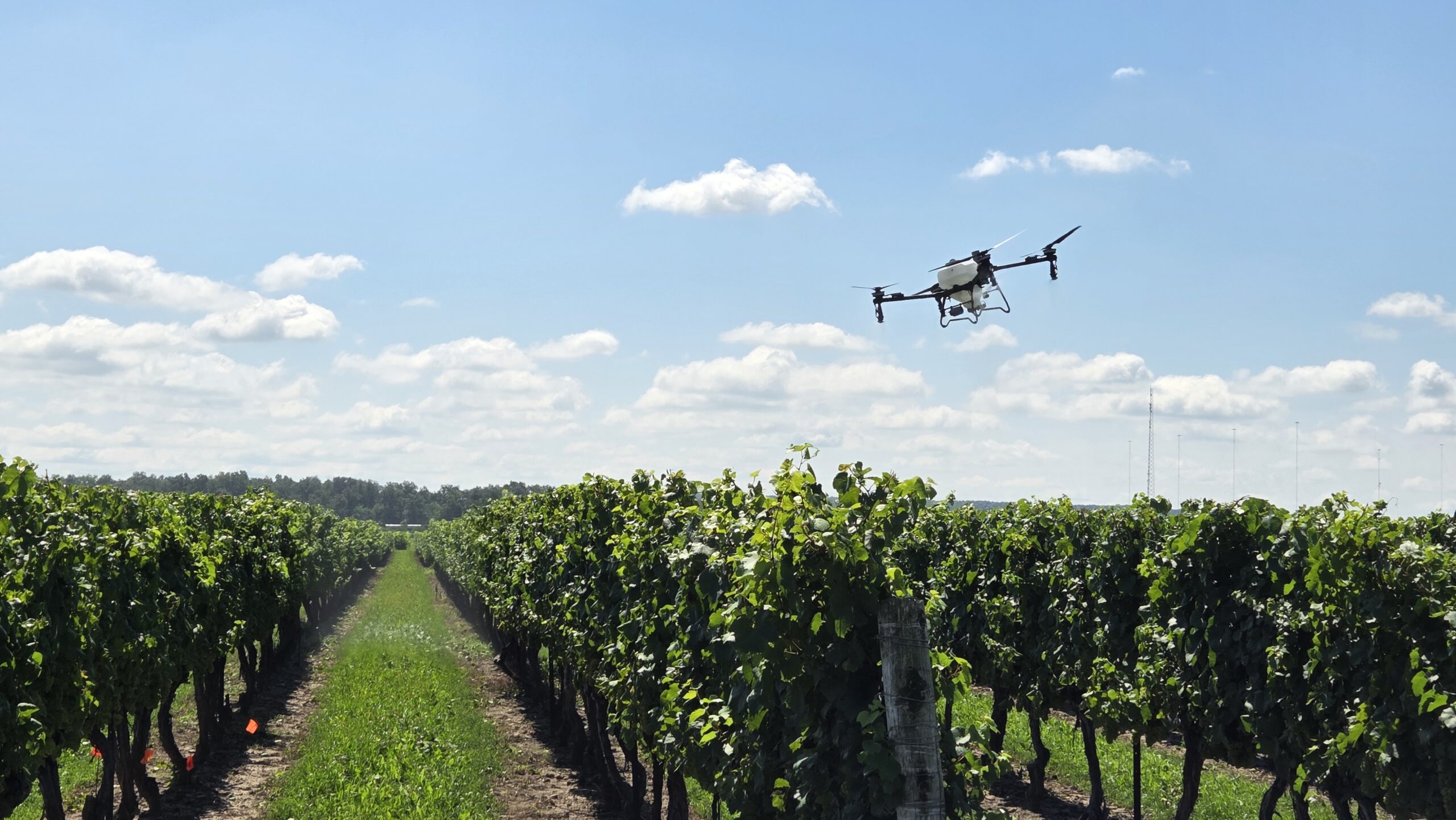
- Measure productivity as a complete application system, not just flight settings.
- Tendering tasks such as water refills, battery swaps, fill times, and ferrying distance affect downtime; small improvements compound into large productivity gains.
- Use the calculator to test variables; swath and speed are limited by agronomics, so tender capacity and staging often determine real output.
This text was generated by OpenAI GPT 5 Mini
Drone operational settings such as capacity, speed, and swath width are useful figures for calculating productivity, but they only describe the airborne portion of the job. A commercial application business must also transport water, mix product, charge batteries, and establish an efficient staging area that is both safe for operators and maintains drone connectivity. If any of these functions fall behind, productivity suffers.
We consulted several mission records to develop a productivity calculator that can model a range of scenarios. We assumed a shuttle (back-and-forth) flight pattern to apply successive spray swaths for uniform coverage of a treatment area. Download our offline version or try it online at the end of this article.
How to use
In this, version 3.0 of our drone productivity calculator, we’ve expanded the functionality to include several tendering options. If you are uncertain what the variables mean, consult this handy instruction manual to walk you through the process.
Use it as a planning tool, or simply as a way to explore the impact of different operational settings on mission productivity. We propose adjusting variables one at a time to determine their effect. You can then compound the effect by changing another, or return to the base value and choose another variable to manipulate. In this way you can explore the relative influence of each variable on the overall job.
Which factors matter most?
The relative impact of each operational setting (or the geometry of the target area) on productivity is situation-specific. Nevertheless, here are some generic observations:
- While swath width and flight speed play a role, both are limited by the agronomic realities of the job. So, while you can change them in the calculator, it does not follow that the results of the application will be successful.
- Water rate (e.g. L/ha) has an impact on productivity, but once again there are agronomic considerations. Too low a volume can compromise product efficacy and contribute to off target drift, and quite often the minimum volume is stipulated on the product label.
- The drone’s tank capacity depends on the model, but maxing it out may not be the best option. Some large drones suffer reduced battery life and slower acceleration when filled completely. Note that when the user forces a refill/battery swap, there will be spray mix left in the drone. It is prudent to minimize this residual by not overfilling the drone in the first place.
- The ferrying distance between where the drone empties and the staging area a critical productivity factor, so minimizing it is a reasonable objective. Doing so can mean additional sorties, which require additional refills and battery swaps. Small improvements here compound into big impacts, but pay close attention to see if the additional sorties are worth the time savings.
- The number of operators have a significant effect on productivity. If a solo operator has to retrieve additional water, or move the tender truck to a new location, the drone isn’t spraying.
Batteries – A potentially limiting factor
The calculator assumes that a sufficiently charged battery is ready whenever the drone returns to the tender, so battery charging does not extend the entered refill and battery-swap time.
In practice, flight endurance can change dramatically with payload. For example, a heavily loaded aircraft may fly for only a few minutes, while the same aircraft may remain airborne much longer with an empty tank. Repeated short, high-load sorties may therefore consume charged batteries faster than they can be recharged.
If the battery inventory, chargers, generator capacity or electrical supply cannot keep pace, the crew may eventually have to wait for batteries, reducing actual productivity below the calculator’s estimate. Additional batteries, higher-capacity charging equipment or improved generator capacity may be required to sustain the projected workflow.
Thanks to Mike Verhoog (Drone Spray Canada) for reviewing and contributing to the design of this model.
