Tag: Swath

  • Exploring the Accuracy of Drone-Applied Herbicide Treatments

    Exploring the Accuracy of Drone-Applied Herbicide Treatments

    Author’s note: Minor edits were made to this article on December 12, 2025. While the results remain unchanged, aspects of the interpretation have been adjusted upon reflection.

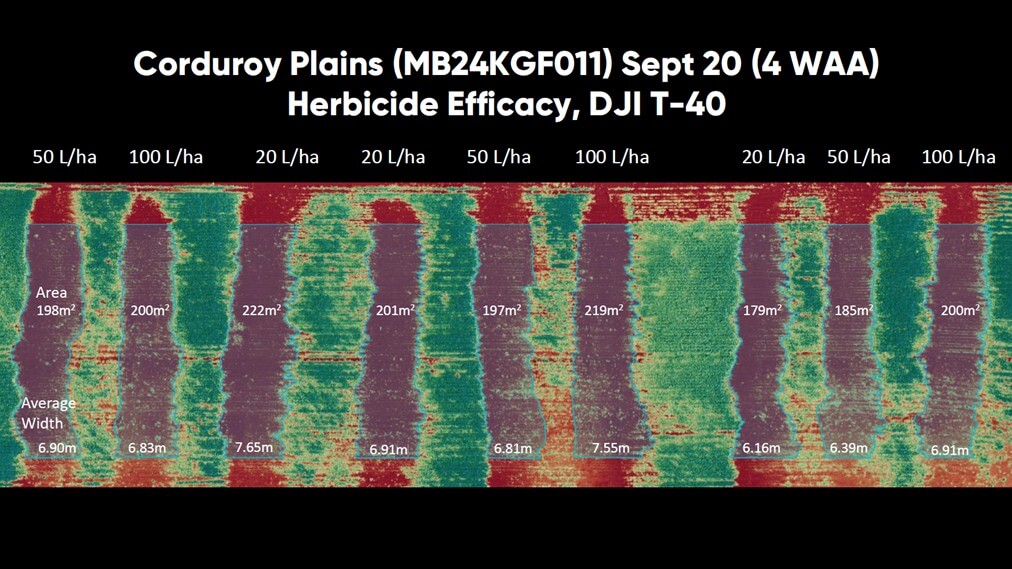
    In 2024, Corteva conducted a study entitled “Drone-Delivered Herbicides: Comparing LontrelTM XC (Clopyralid) Efficacy Across Application Techniques and Water Volumes”. Go read all about it here. Their objective was to compare the relative efficacy of hand booms and drones, and to determine if drone efficacy was affected by low water rates. The researchers evaluated the area treated and the effective swath width by manually tracing the burned areas from an aerial NDVI image.

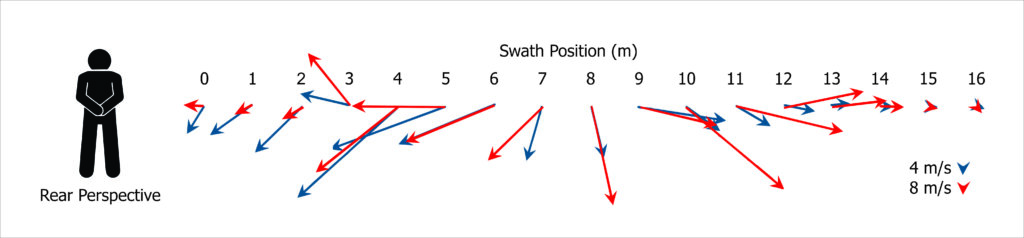
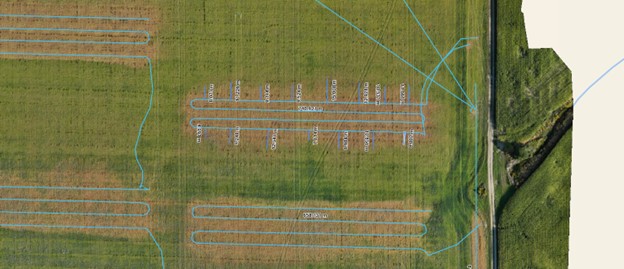
    Interestingly, the study found that water volume had an insignificant impact on herbicide efficacy. But what really caught our attention was the inconsistent and variable shape of the treated area along each flight path (Figure 1).

    Figure 1 – Image from work performed by Kevin Falk, Rory Degenhardt, Angela Fawcett and Neil Spomer, as presented at the 2025 Canadian Weed Science Society annual meeting in Vancouver, BC.

    If the swath width fluctuates and vacillates along the flight path, then there is great potential for overlaps and misses throughout a treated area. Common practice is to rely on displacement (and drift) from upwind passes to deposit a sufficient cumulative dose of herbicide to mask areas of low coverage. This would be facilitated by consistent wind direction, higher altitudes, and a surface with little or no canopy to interfere with secondary deposition.

    On the other hand, if the programmed swath width (i.e. route spacing) is too wide, and/or the the droplet size too large to permit sufficient displacement, then gaps in coverage would appear. And there is always the consideration of restricting the deposit to field boundaries and margins, particularly on the downwind side of the treatment area.

    We explored these considerations by conducting a study that emulated aspects of Corteva’s work. We applied Roundup Transorb HC (a non-selective herbicide) instead of Lontrel (a selective herbicide specifically for broadleaf weeds). We used the DJI Agras T50 and the new T100 with two atomizers and a DJI RTK-2 base station, employing an array of operational settings. And, we flew multiple passes rather than a single pass for each treatment.

    Part one of the study examined three programmed swath widths from both drones to compare their performances directly. Part two of the study evaluated the T100’s performance over a series of flight speeds and spray qualities. Burndown was evaluated using post-application orthomosaic images taken at 200 feet using a DJI M3M drone. Images were analyzed using Pix4D software.

    Materials and Methods

    Field Conditions

    Applications took place in a 160-acre field of wheat stubble in Central Elgin, Ontario (42°45’29.3″N 81°05’58.9″W) on September 13, 2025.

    Treatments

    Each flight was centred on the right boundary of the treatment block, as indicated by a pin flag. Four passes were flown per treatment (i.e. two out-and-backs). There were no repetitions for treatments, so there was no need to randomize them.

    Part One

    The intent of this part of the study was to make a direct comparison of the swaths produced by the T50 and the T100. The T100 is heavier, has a larger volumetric capacity (100 L vs. 40 L) and is capable of faster flight (20 m/s or 64 km/h vs, 10 m/s or 23 km/h). We wrote about our first impressions of the T100, here.

    Drone operational settings were selected to replicate those used in previous corn and wheat fungicide experiments with the T50. These settings are admittedly more restrictive (from the perspective of productivity) than those commonly used for herbicide applications. For example, and anecdotally, we have been told the T100 can spray a full section (~260 hectares or 640 acres) at 2.8 gpa and 20 m/s on one tank and one battery charge. However, we have no information about subsequent coverage, efficacy or off-target deposition.

    Maintaining these operational settings allowed us to make a more direct comparison of herbicide vs. fungicide placement and efficacy. All applications were performed using a 250 µm spray quality (Table 1).

    Treatment CodeRPASProgrammed Swath (m)Speed
    (m/s, km/h)
    Altitude (m)Volume (gpa)
    AUnsprayed
    BT5066, 21.635
    CT5086, 21.635
    DT50106, 21.635
    ET50610, 3635
    FT50810, 3635
    GT50108, 28.8*35
    HT10066, 21.635
    IT10086, 21.635
    JT100106, 21.635
    KT100610, 3635
    LT100810, 3635
    MT1001010, 36*35
    Table 1 – Part one: Drone settings. (*10 m/s was intended, but the T50’s pumps could not produce a 10 m swath at 5 gpa at that speed.)

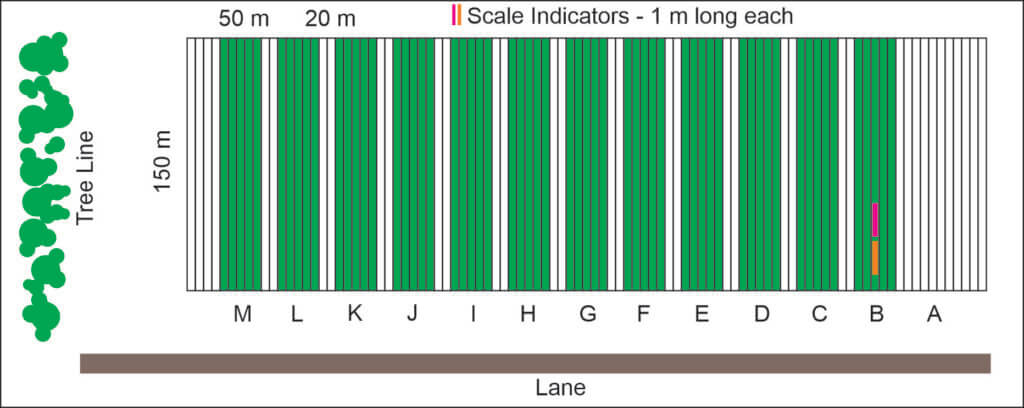
    Each treatment block was 150 m long, 50 m wide and a 20 m buffer was maintained between treatments (Figure 2). Two, 1 m scale indicators were placed in Treatment B to confirm scale during image analysis.

    Figure 2 – Part one treatment layout.

    Part Two

    The intent of this part of the study was to explore the new drone design and its capabilities. Particularly, the impact of high-speed flight on effective swath width, displacement and drift. The DJI controller advises an altitude of 5 m or higher (likely a safety consideration). We felt this was too high for consistent coverage, and compromised by flying at 4 m (Table 2).

    Treatment CodeRPASSpray Quality (µm)Speed
    (m/s, km/h)
    Altitude (m)Volume (gpa)
    NT10050018.3, 65.843
    OT10025018.3, 65.843
    PT10080*12.5, 45*43
    QT10025018.3, 65.843
    RT10025015, 5443
    ST10025010, 7243
    Table 2 – Part two: Drone settings (20 m/s was intended, but the drone only reached a maximum of 18.3 m/s before slowing as it approached the end of the treatment. *50 µm and 20 m/s was intended, but the T100 controller would not permit those settings, so a compromise was made.)

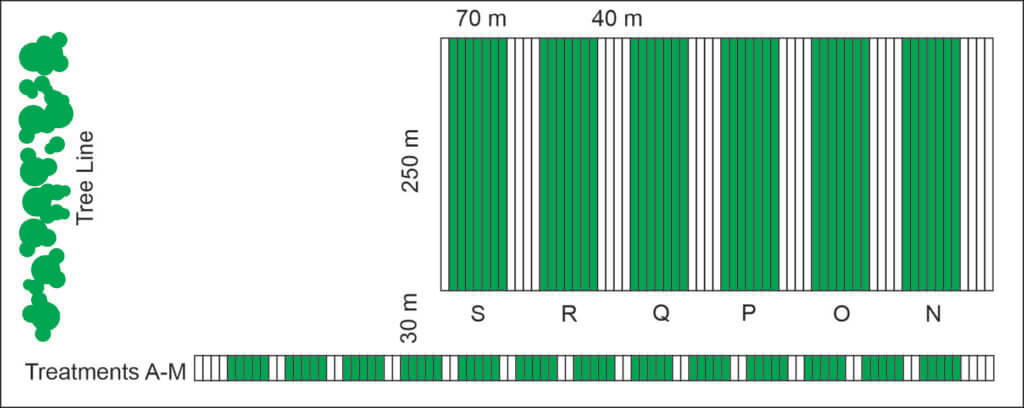
    Given the greater potential for displacement and drift in this part of the study, we established wider and longer treatments blocks, and wider buffers between treatments. Each treatment was 250 m long, 70 m wide and a 40 m buffer was maintained between treatments (Figure 3).

    Figure 3 – Part two treatment layout.

    Chemistry

    The spray solution (PMRA research authorization 0054-RA-25) was premixed in a single batch. For part one, 80 L Roundup Transorb HC in 1,000 L water plus 0.05% Halt (defoamer). For part two, 700 L of the solution remained, so we added an additional 20 L of Roundup to approximately maintain the dose when dropping from 5 gpa to 3 gpa. This is a high dose of Roundup (~1.5 L/ac), selected to ensure that every drop that landed would create an obvious burn for easier analysis. It does, however, also mean that any reduced dose (i.e. striping) between passes would likely be masked. Drones were refilled after each treatment (to 40 L for T50 and to 65 L for T100) to negate any weight effect on the magnitude of the downwash.

    Weather

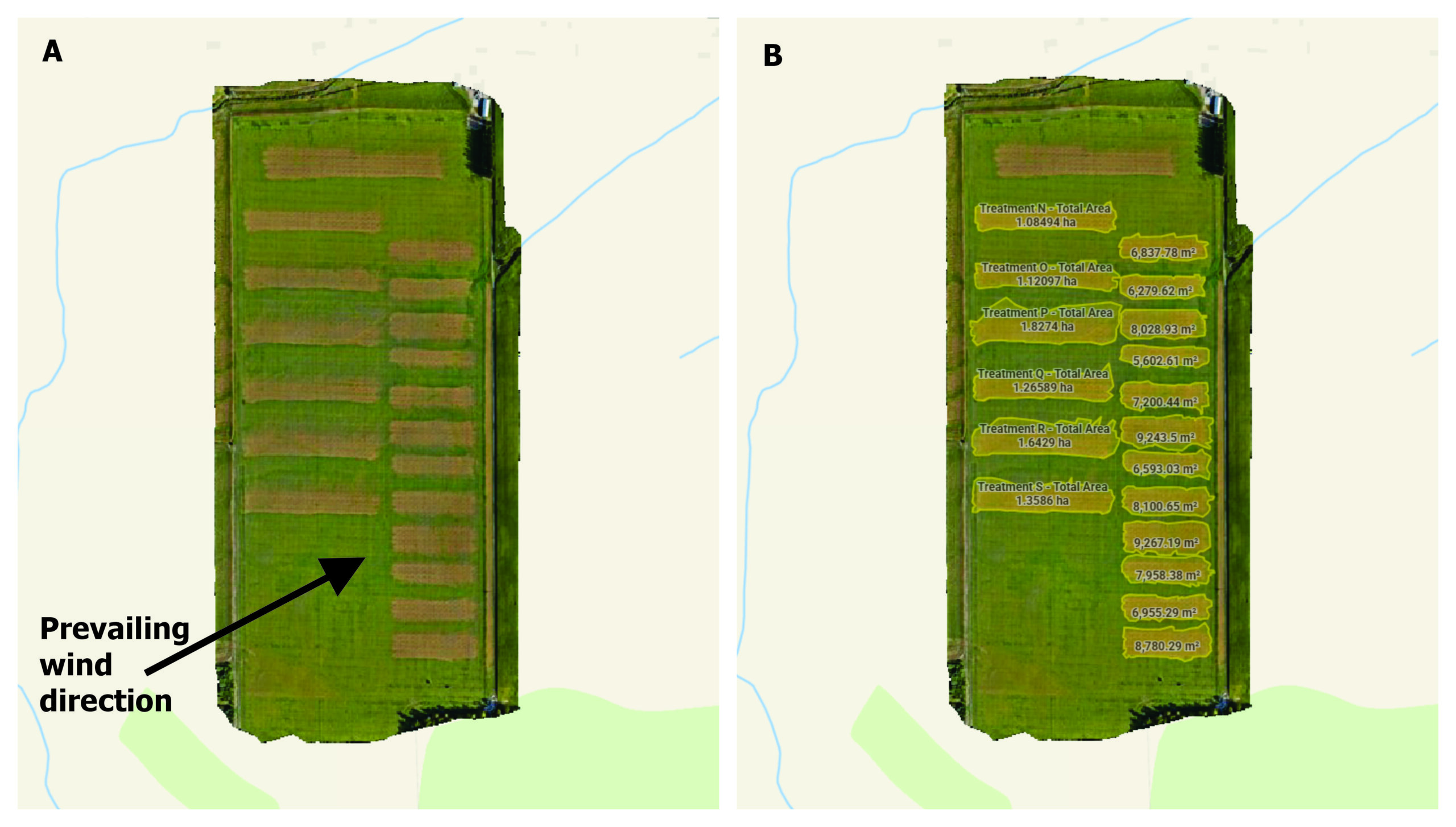
    Weather data was collected using a Kestrel 3550AG weather meter (Kestrel Instruments) in a vane mount positioned 2.5 m above ground (Table 3). For part one, conditions were ideal: humid with a light wind in a consistent direction. For part two, afternoon wind speed increased, but predominant direction remained consistent (Figure 4A).

    TimeExperiment PartTreatmentWeather
    10:05 – 10:581B – G18.6 ̊C, 78% RH, 0.0 km/h wind.
    10:58 – 12:401H – M19.8 ̊C, 72% RH, 2.0 km/h wind.
    12:40 – 1:502N – S22 ̊C, 61.2% RH, 7.0 km/h wind.
    Table 3 – Treatment times and weather conditions
    Figure 4 – Left (a): Prevailing wind direction overlaid on orthoscopic image. Right (b): Polygons representing manual traces of the perimeter of the burned treatment areas. Areas are noted for each treatment.

    Estimating Effective Swath Width

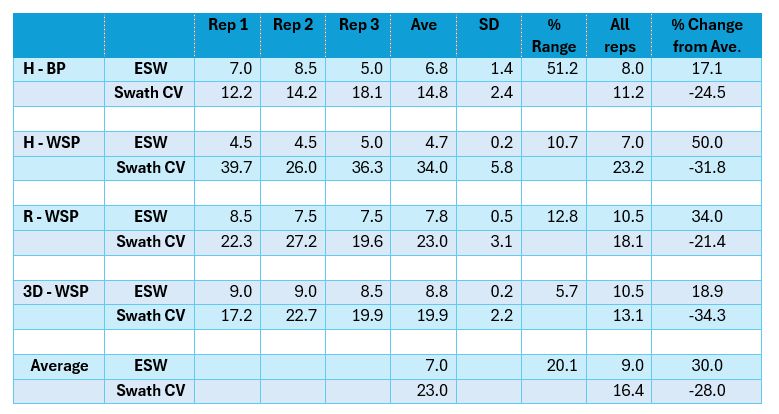
    The burned area indicates that the spray deposited met or exceeded an efficacious dose. This agronomic consideration of real-world efficacy sets the Effective Swath Width (ESW) apart from a swath width measured during calibration. Methods for calculating swath width utilize a sampling system aligned perpendicular to the flight path. Whether continuous or discreet samplers, this approach produces a coefficient of variation and some measure of over- and under-dose based on an assumed target threshold (dose or coverage). By measuring the biological effect (i.e. the burned area), we need not assume a target threshold – it’s indicated by the burn. Work with fungicides has demonstrated that the ESW can be a fraction of the measured swath width.

    ESW was estimated using two methods, and while both approaches have inherent flaws, they still provide valuable information. A more realistic representation of ESW likely falls between the two.

    In the first method, the perimeter of the area burned was traced to create a polygon (above, in Figure 4B). Then, the average width of that area was established from measured spans along the block. Finally, that average was divided by the four passes. Hereafter referred to as the “treatment width ÷ passes” method. This method produces an underestimate of ESW because each upwind drone pass can overlap and hide any displacement (and drift) from the previous. It divides the drift over however many passes are made.

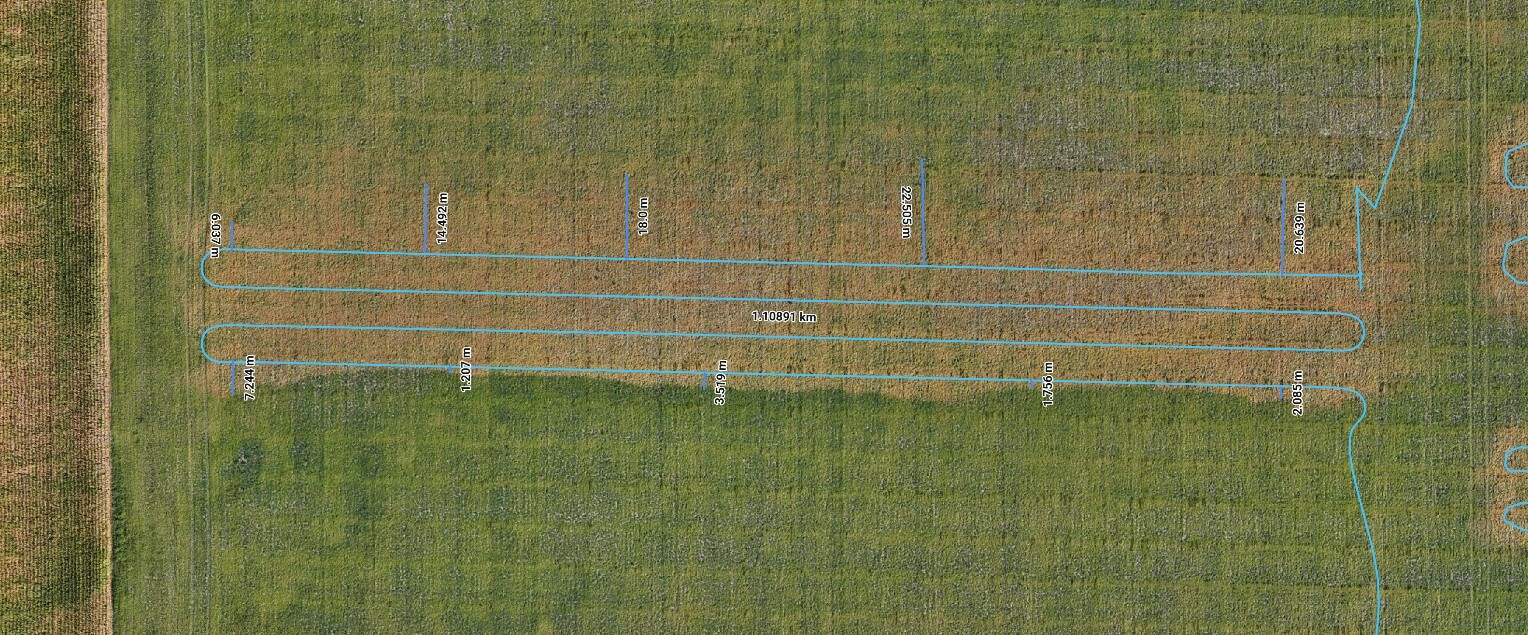
    The second method overlays the flight path onto the area burned. The upwind side of the swath was determined from an average of at least five measurements along the upwind flight path. The downwind side of the swath was calculated the same way (Figure 5). Both the average upwind and downwind distances were added to arrive at the ESW. Hereafter referred to as the “port + starboard extent” method. This approach captures a clear representation of the upwind side of a single pass, but overestimates ESW by including any cumulative increase in drift from multiple passes on the downwind side.

    Figure 5 – Example of port and starboard measurements along the downwind and upwind-most flight paths. The averages were calculated and added to estimate effective swath width.

    Results – Part One

    Planned versus Measured Treatment Area

    The “programmed swath width” is something of a misnomer. More accurately, it is the route spacing and it describes the distance between passes over a target area. However, most drone manufacturers refer to this variable as programmed swath width, so that’s what we’ll do.

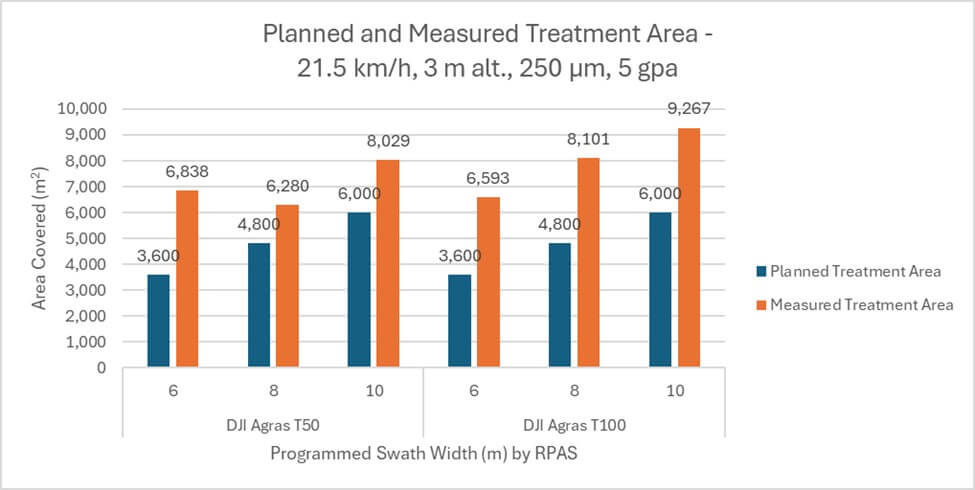
    Planned treatment areas were calculated from distance flown × programmed swath width × number of passes. Measured treatment areas were calculated by tracing a polygon along the perimeter of the area burned. In all cases, actual was larger than planned by an average 36.1%. The T50 treated 32% more area than planned and the T100 treated 40% more area than planned, or 8% more than the T50 (Figure 6).

    Figure 6 – Planned and Measured Swath Widths for T50 and T100.

    Programmed and Effective Swath Widths

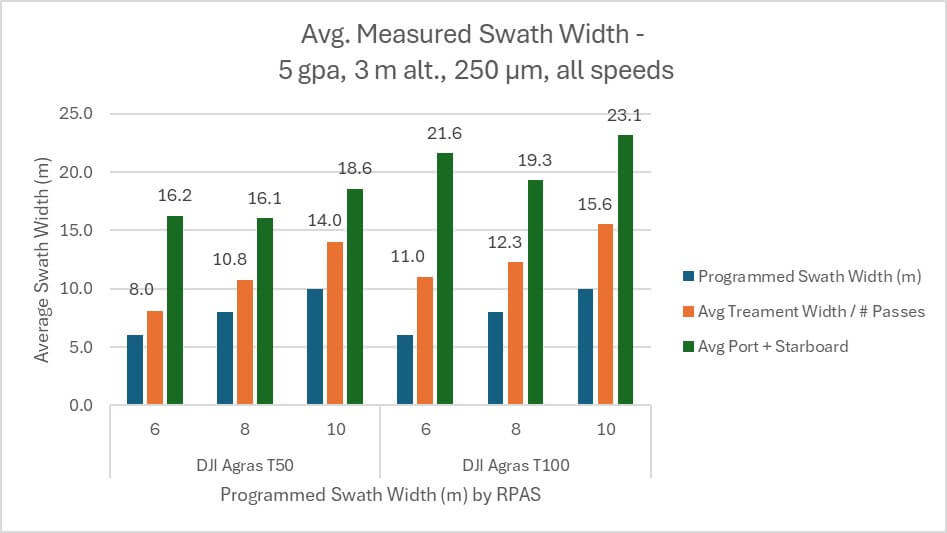
    In all cases, the “treatment width ÷ passes” method produced an estimated ESW that was greater than, and positively correlated with, programmed swath width (Figure 7). For the T50, it was an average 26.8% wider. For the T100, it was an average 38.3% wider. The ESW calculated by the “port + starboard extent” method was larger still, but was not positively correlated with programmed swath width. For the T50, it was an average 52.8% wider. For the T100, it was an average 62.5% wider.

    No matter the method used to estimate ESW, the T100 exceeded the planned swath width by more than the T50. Using the “port + starboard extent” method, the average T100 ESW was 21.3 m, which is an average 15.4% wider than the average 17 m ESW produced by the T50.

    Figure 7 – Average measured swath width (two methods) compared to planned swath width for the T50 and T100 flown at 5 gpa, 3 m altitude, 250 µm spray quality and multiple speeds.

    T50 ESW by Travel Speed

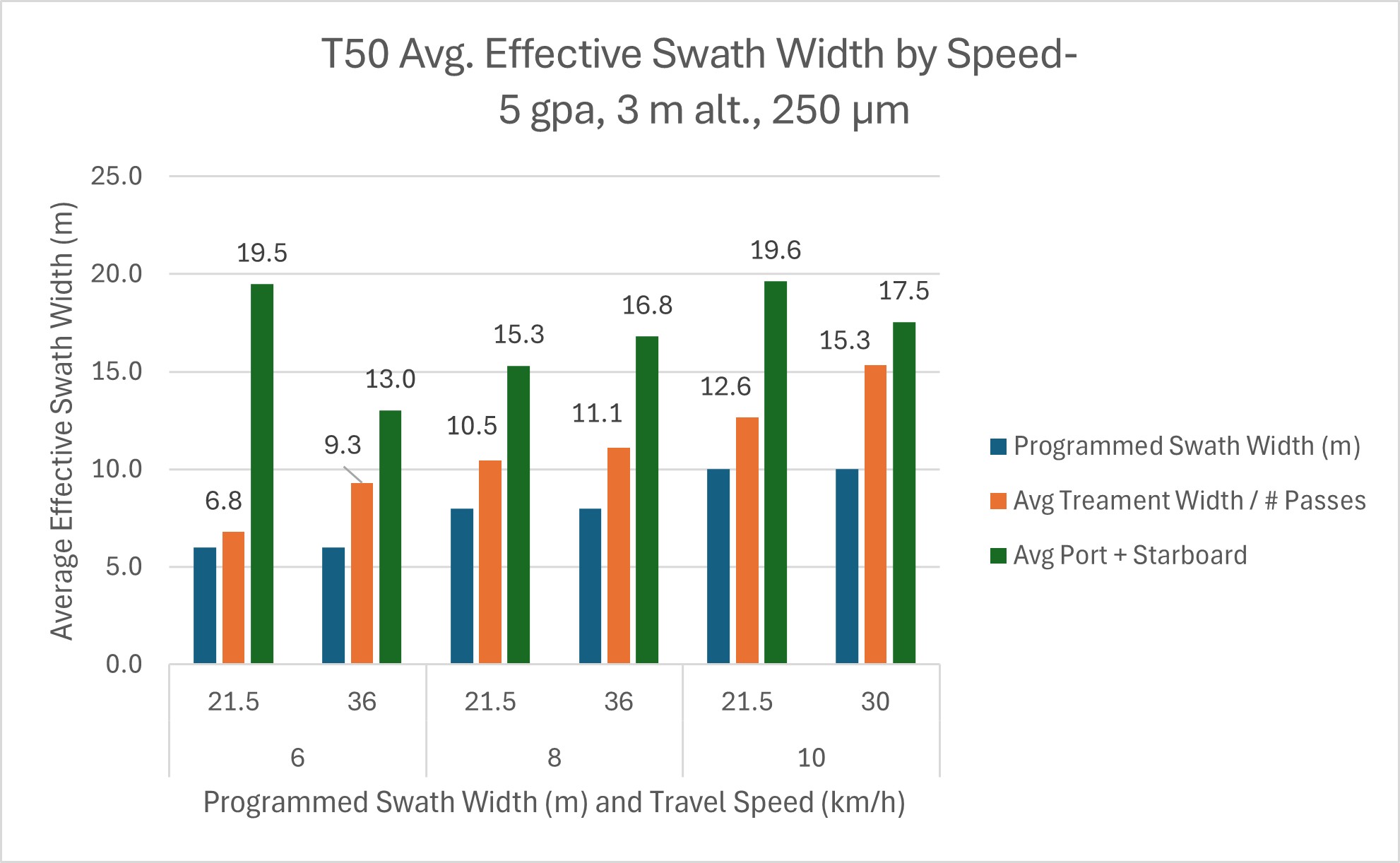
    When travel speed becomes the independent variable for the T50, the “treatment width ÷ passes” method produces an average ESW that positively correlates with flight speed. At 21.5 km/h, the average ESW was 10 m, increasing to 11.9 at 30-36 km/h (Figure 8). This is typical and expected as higher speeds have been shown to produce wider swaths with the T10 and T50.

    However, the relationship between speed and ESW is less clear when estimated using the “port + starboard extent” method. At 21.5 km/h the average swath was 18.2 m, but reduced to 15.8 km/h at 30-36 km/h (Figure 8).

    Figure 8 – Average measured swath width by speed for the T50.

    T100 ESW by Travel Speed

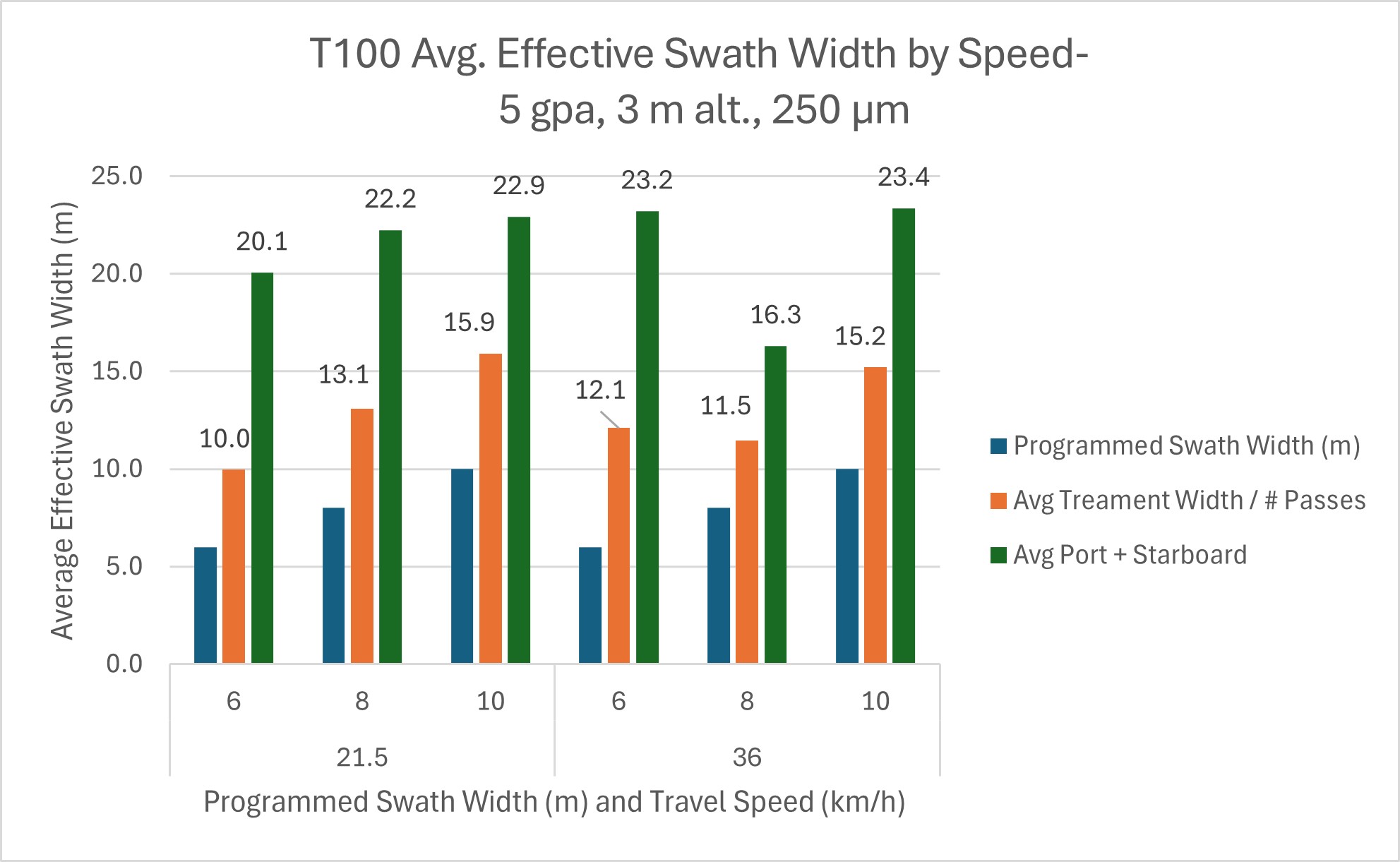
    When travel speed becomes the independent variable for the T100, neither method for estimating ESW show an effect from flight speed. The “treatment width ÷ passes” method produced an average ESW of 13 m at 21.5 km/h and 12.9 at 30-36 km/h (Figure 9). The “port + starboard extent” method produced an average ESW of 21.7 m at 21.5 km/h and 21 at 30-36 km/h.

    Figure 9 – Average measured swath width by speed for the T100.

    Results – Part Two

    T100 ESW by Travel Speed

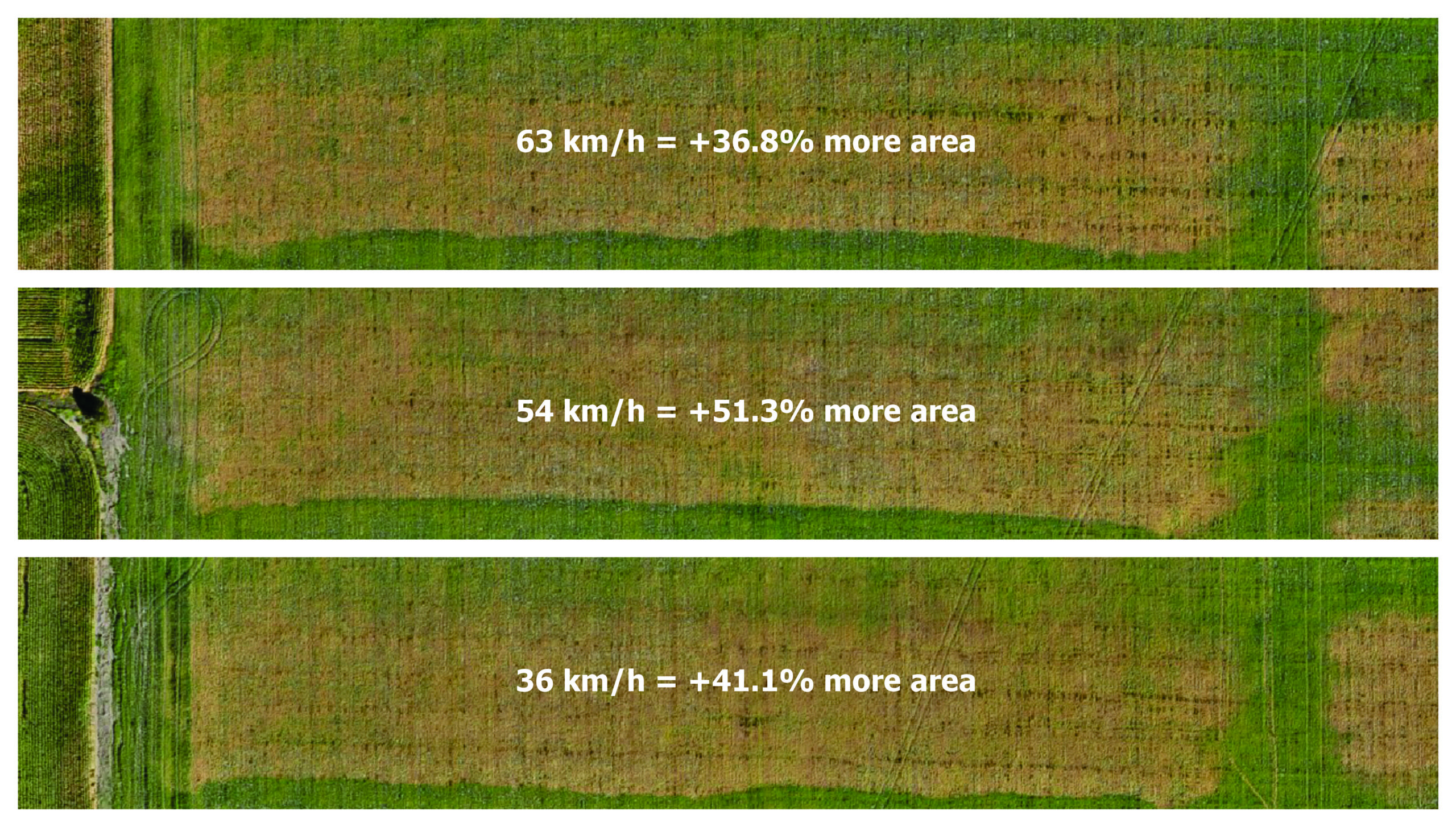
    The effect of flight speed on treated area and ESW was examined. In each case, the treated area was significantly larger than the programmed area (Figure 10).

    Figure 10 – Actual treatment areas compared to expected for the T100; three speeds.

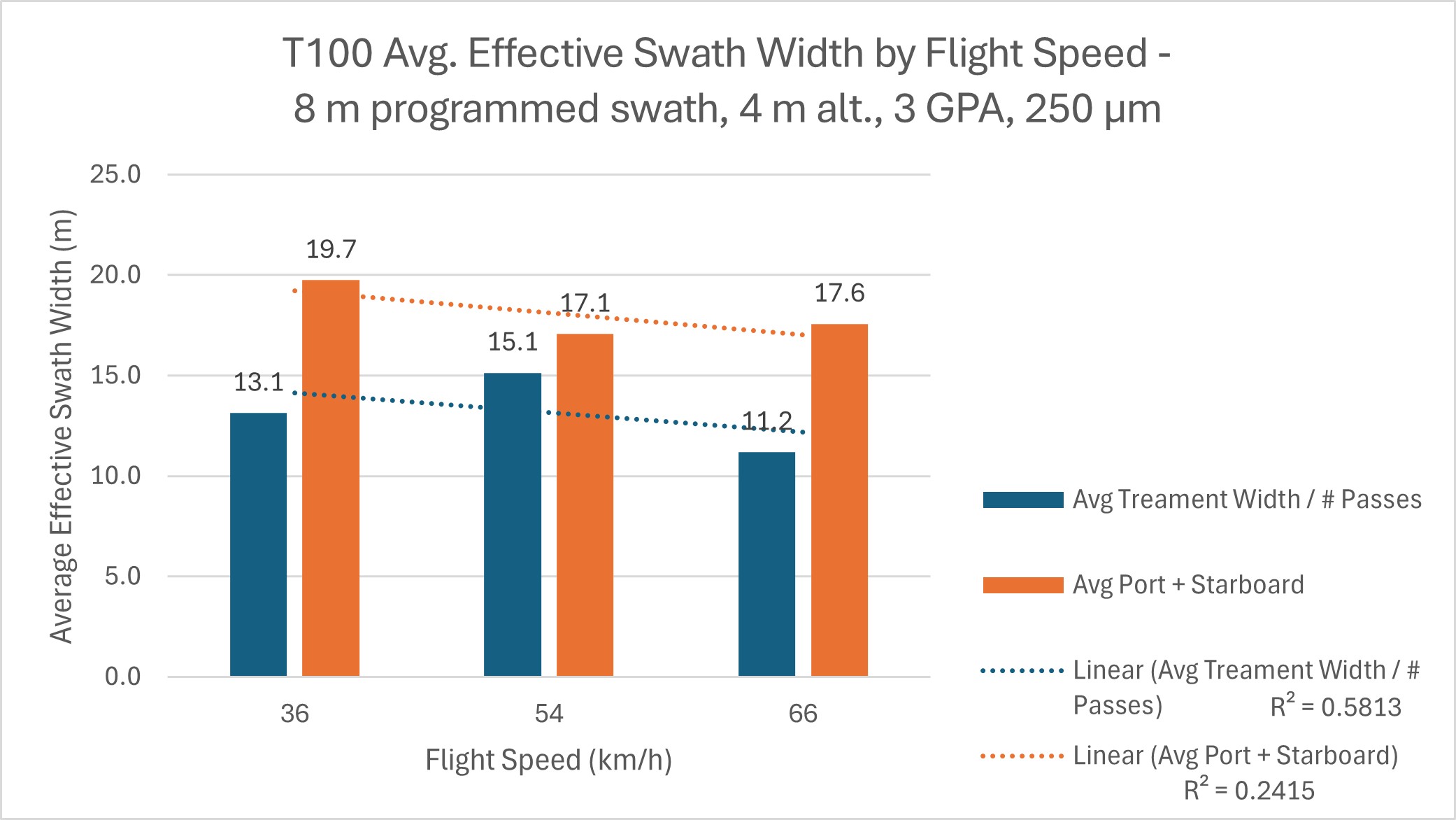
    Similar to Part one, travel speed did not appear to influence ESW in any consistent or significant way (Figure 11).

    Figure 11 – Average swath width for T100 calculated using two methods at three speeds.

    T100 ESW by Spray Quality

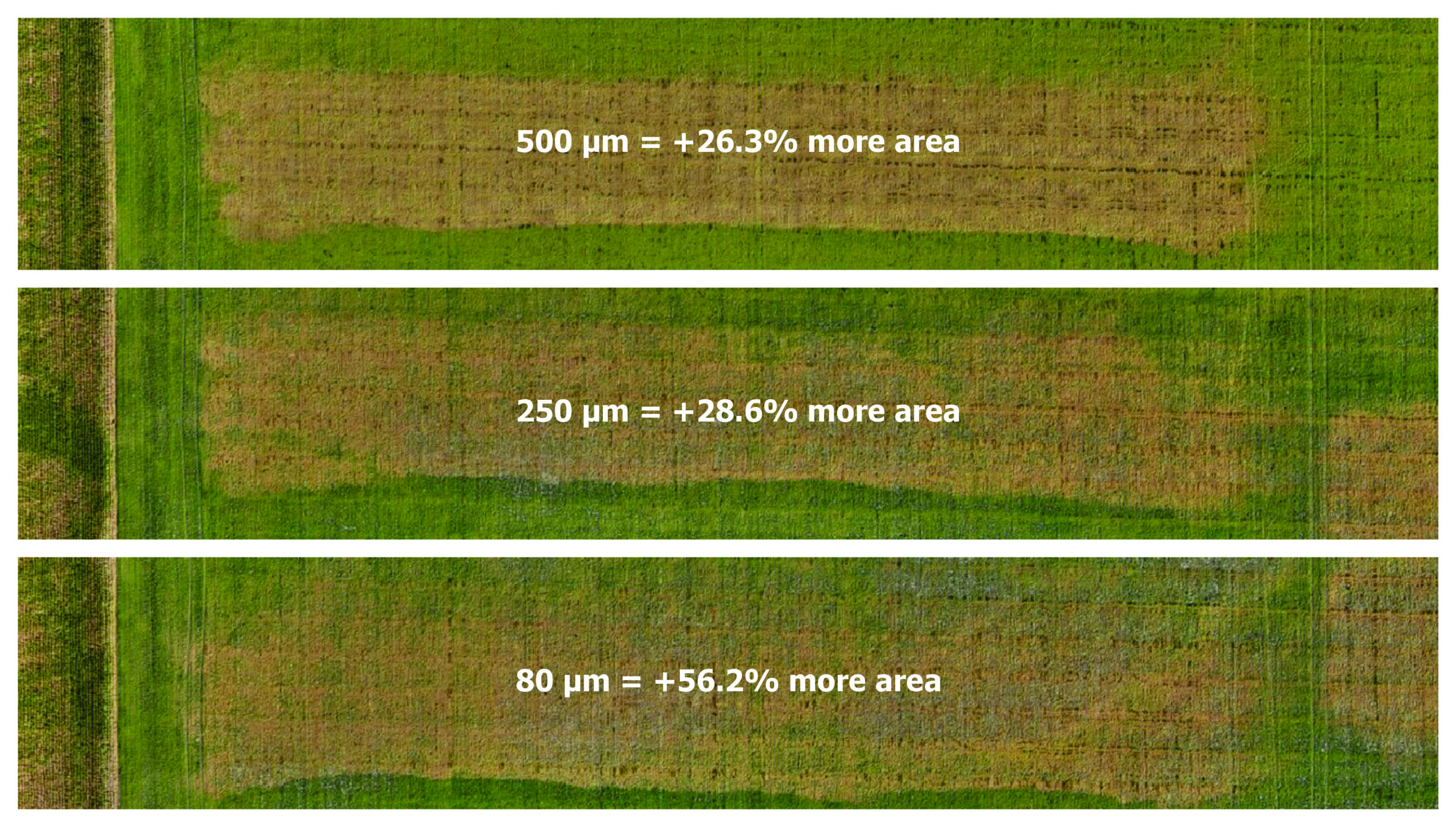
    The effect of spray quality on treated area and ESW was examined. Once again, in each case, the treated area was significantly larger than the programmed area (Figure 12).

    Figure 12 – Actual treatment areas compared to expected for the T100 using three spray qualities.

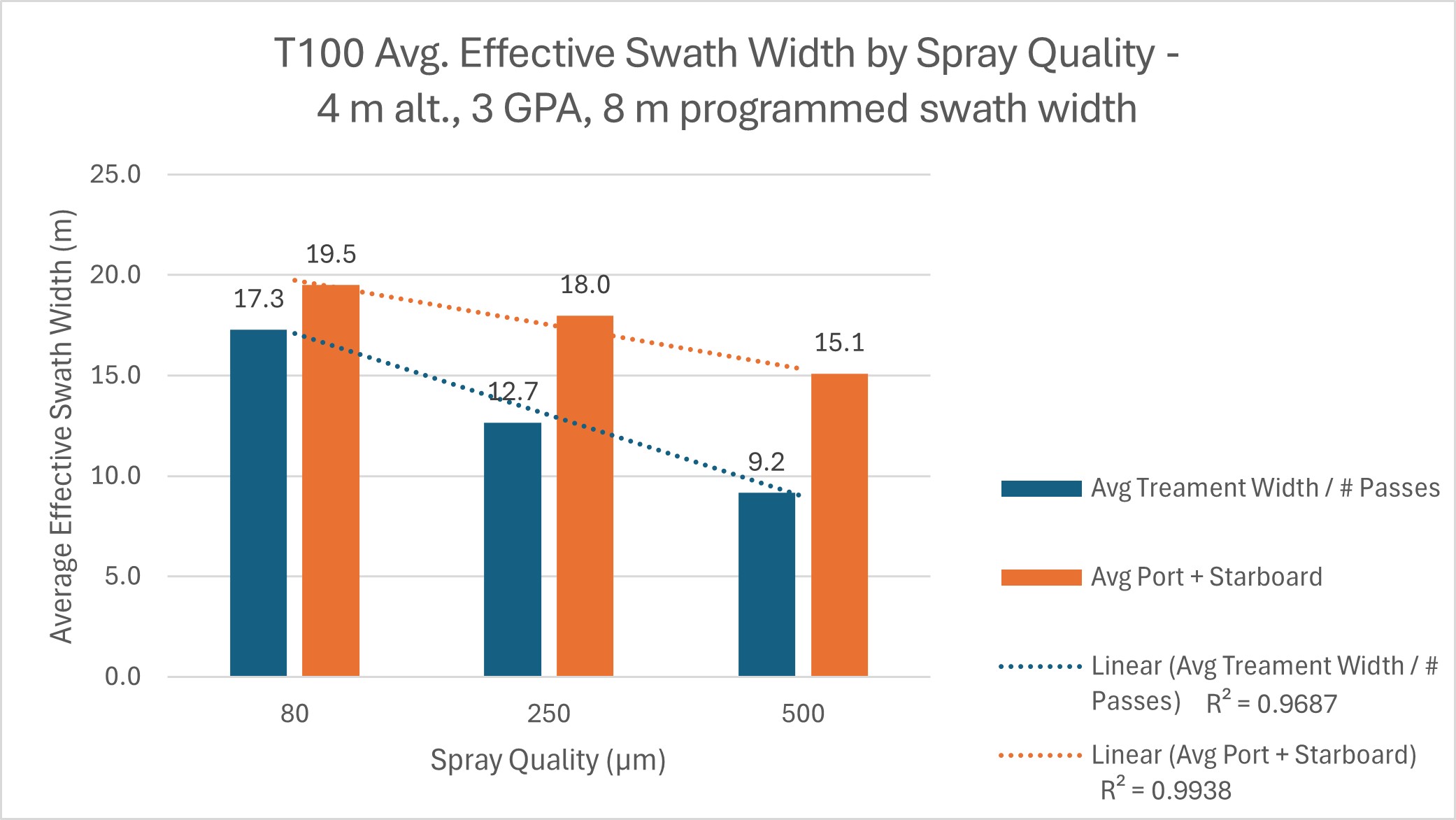
    Effective swath widths estimated from both methods were negatively correlated with spray quality (Figure 13). Coarser droplets have greater mass, making them are less prone to displacement by wind than finer droplets. The “treatment width ÷ passes” saw an 80 µm spray quality produce an ESW 46.8% larger than a 500 µm spray quality. The “port + starboard extent” method saw an 80 µm spray quality produce an ESW 22.6% larger than a 500 µm spray quality.

    Figure 13 – Average swath width for T100 calculated using two methods for three spray qualities.

    Discussion

    In all cases, the area treated (i.e. burned) exceeded the area planned. The T50 covered 32% more area while the T100 (with the same operational use case) covered 40% more. This implies that the T100 created wider swaths and/or drifted more than the T50.

    The ESW estimated from herbicide efficacy appears to be considerably larger than those observed in fungicide efficacy / coverage studies. This is likely the result of the agronomic use case. Consider that herbicides have a relatively lower threshold dose than fungicides. Further, herbicide application on bare earth or into sparse canopies permits the lateral spread of droplets, where spraying fungicides into a dense canopy limits penetration in all directions. Even the sparsest coverage from a systemic herbicide produces a visual effect, and this binary result (i.e. hit or miss) extends the effective swath width. This should raise awareness of the importance of field boundaries and margins, particularly with herbicides.

    When estimating ESW, the method used affected the results. The “port + starboard extent” method resulted in large and low-resolution estimations of ESW, whereas the “treatment width ÷ passes” method seemed to respond in a more predictable way, even if it underestimates the ESW. Ultimately, both methods produce rough estimates; they are not intended to replace traditional, quantifiable assessment methods. The “truth” is likely somewhere in between.

    With that caveat reaffirmed, we assessed ESW using the “treatment width ÷ passes”. It was positively correlated with flight speed for the T50, as observed in previous work. However, this was not the case with the T100. Given that both drones were operated using the same settings, it is unclear why the T100 would produce such erratic results. Future work will evaluate T100 ESW using conventional methods.

    When the T100 was flown using a span of three droplet sizes, there was a strong negative correlation between average droplet size and ESW. Once again, this aligned with previous experience. While rotary atomizers on drones tend to create smaller droplet sizes than reported by the flight controller, coarser droplets have greater mass, making them less prone to displacement by wind.

    However, when the T100 was flown at at three speeds, the relationship with ESW was once again unclear. When flown at 36 km/h (~10 m/s) the T100 was flying at the top speed of the T50. It also flew at 54 km/h and at 66 km/h, which was the highest speed we could achieve at 5 gpa. The ESW (as estimated using the “treatment width ÷ passes” method) was essentially unchanged. While it is possible (and likely) that any increase in effective swath width due to travel speed was obscured by drift, pervious work has shown that drift increases concomitantly with speed. That does not appear to have happened here.

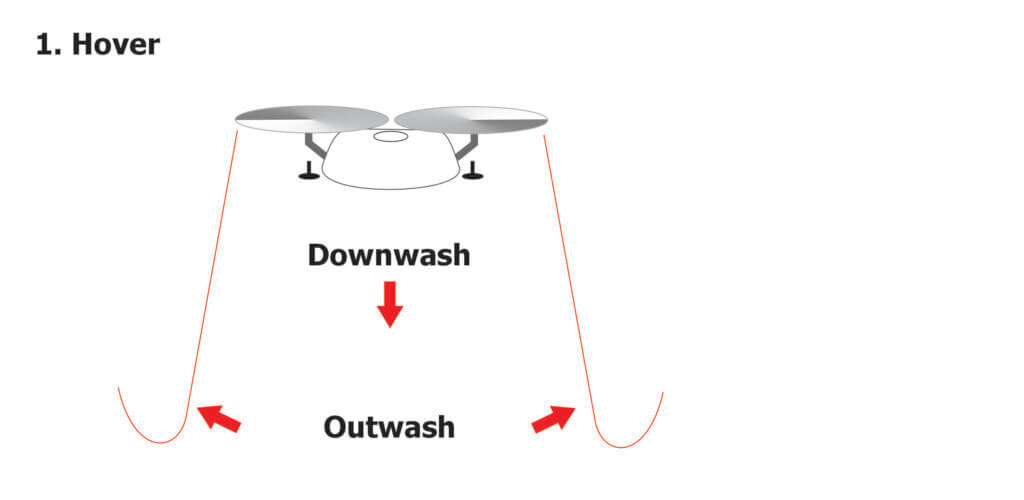
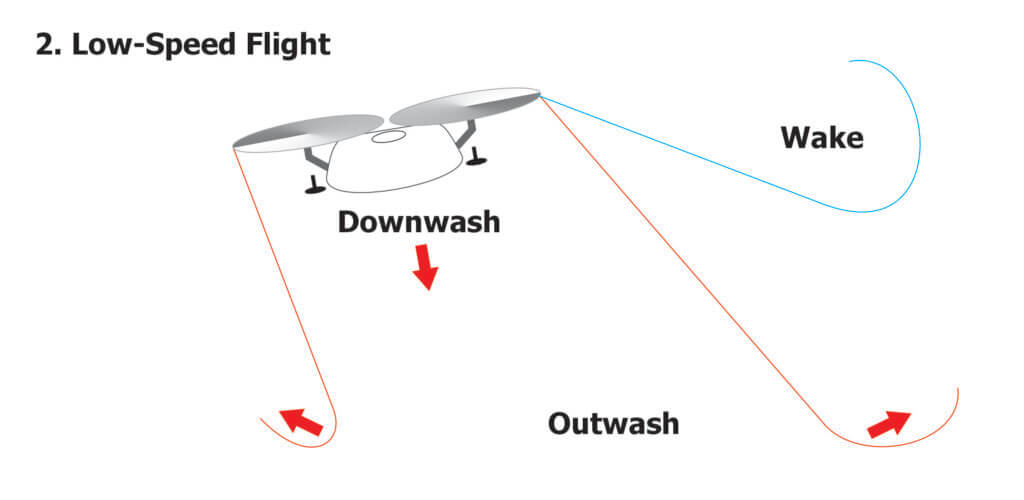
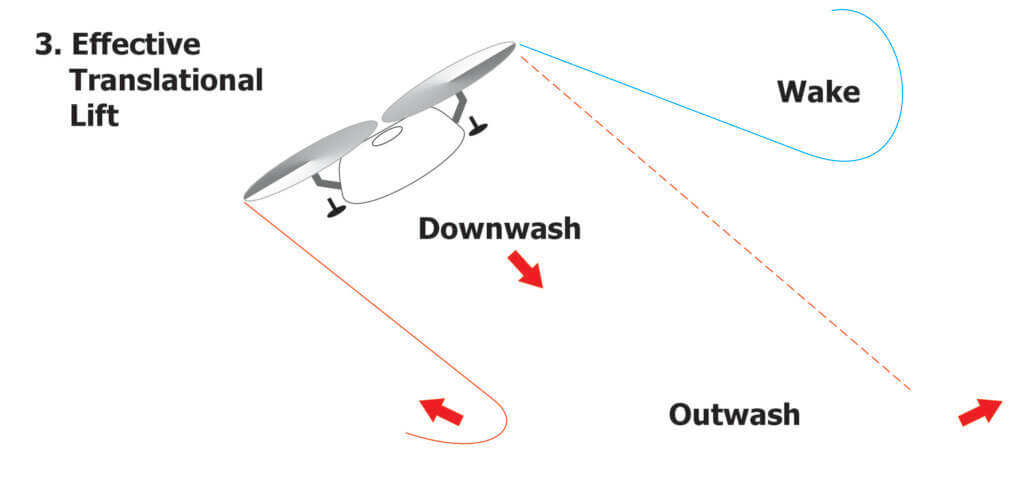
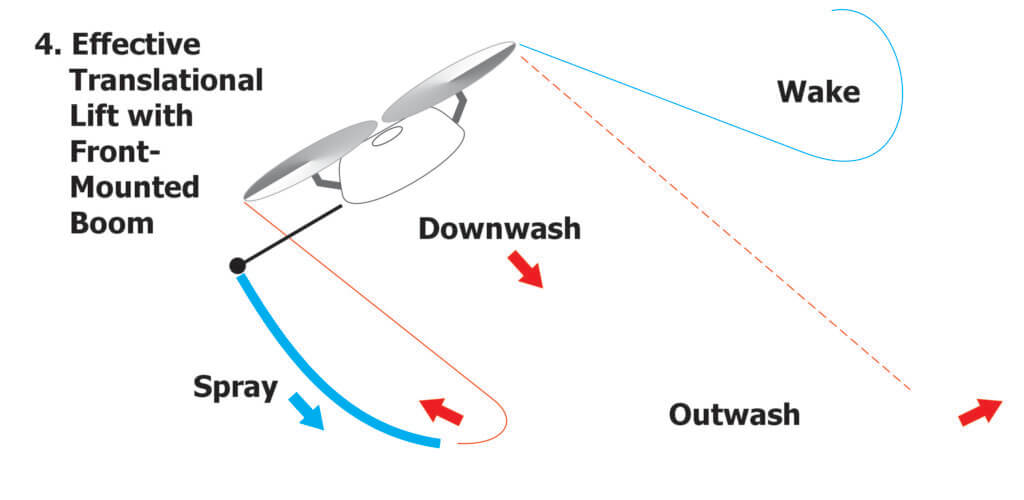
    Perhaps this is a function of a greatly reduced dwell time diminishing the effect of the downwash. Or, perhaps, the T100’s capacity for higher speeds has allowed it to pass beyond translational lift into true forward flight, similar to a helicopter. Translational lift occurs any time there is relative airflow over the rotor disk. As headwind and/or forward speed increase, translational lift increases, resulting in less power required to hover. According to Transport Canada, it is present with any horizontal flow of air across the rotor but most noticeable when the airspeed reaches 16 to 24 knots flight (8.25 to 12.8 m/s or 30 km/h to 46 km/h). This would greatly reduce the effect of the downwash on droplet movement. In our first impressions of the T100, we found that flying slower overheated the battery. This did not occur at higher speeds, and this efficiency supports the premise that it moved past translational lift, perhaps achieving true forward flight.

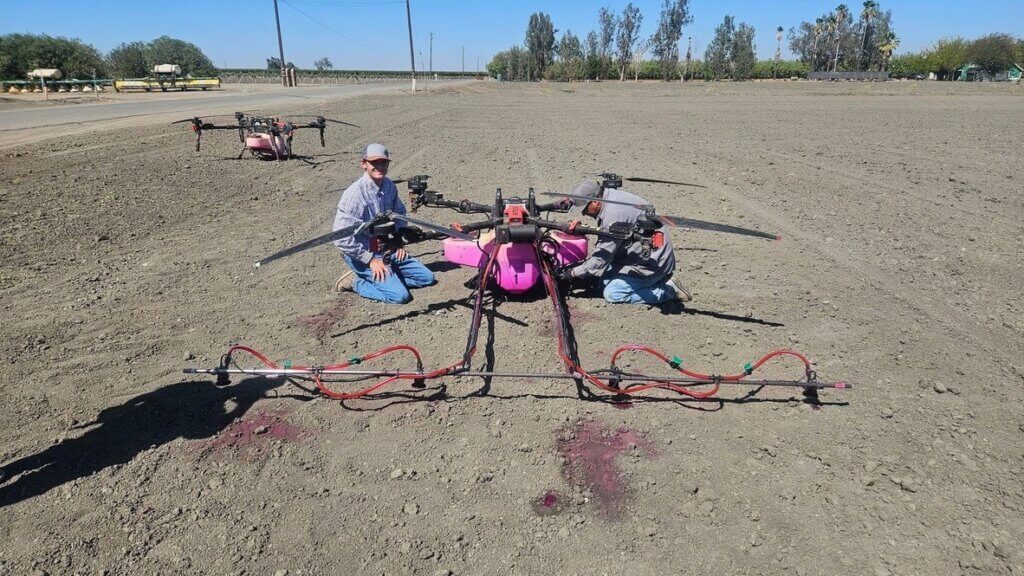
    If this theory is correct, it’s a new development for rotary drones, which were not previously capable of reaching these speeds. Downwash was an unavoidable side effect of the flight, but may now be a tool for the operator to use as the situation warrants – battery temperature notwithstanding. Perhaps it warrants a return to horizontal booms positioned beyond the downwash in order to improve coverage uniformity. On the other hand, we saw that it took the T100 roughly 100 m to reach the target 66 km/h, meaning it moved from hover to translational flight and beyond over that distance. This raises questions about how they spray would respond throughout that transition.

    More work is required.

    Acknowledgements

    Adrian Rivard and Stuart Hunter (Drone Spray Canada), Adam Pfeffer (Bayer Canada) and Mike Cowbrough (Ontario Ministry of Agriculture, Food and Agribusiness) are gratefully acknowledged for their participation, and both in kind and financial support of this study. Thanks also to Mark Ledebuhr and Tom Wolf for discussions surrounding the interpretation of these results.
  • RPAS Swathing in Broad Acre Crop Canopies

    RPAS Swathing in Broad Acre Crop Canopies

    This work was performed with contributions from Adrian Rivard (Drone Spray Canada) and Adam Pfeffer (Bayer Crop Science – funding partner). Dr. Tom Wolf is gratefully acknowledged for his editorial support and assistance interpreting the results.

    Introduction

    This research is part of a continuing effort to identify best practices for broad acre crop protection using remote piloted aerial systems (RPAS). Previous work in wheat, corn and soybean has provided insight into how RPAS operational settings and environmental factors affect drift potential, effective swath width and spray coverage. This information, paired with advancements in RPAS design, has helped operators to improve spray deposit accuracy.
    However, RPAS still produce what has traditionally been considered poor (or at least sporadic) broad acre coverage. Many studies have illustrated these shortcomings using herbicides or fluorescent tracers. Contributing factors include inappropriate operational settings, low application volumes (20-50 L/ha) paired with coarser spray qualities, and inaccurate swath widths. In light of these issues, we struggle to reconcile claims of acceptable disease control, which is arguably the greatest challenge in a spray-based crop protection paradigm.
    Tar Spot

    One real-world example of intermittent disease control from aerial applications (not just RPAS) is the case of tar spot in corn. Tar spot is a fungal disease caused by Phyllachora maydis and it is becoming a significant economic concern in Ontario. Left unchecked the disease causes rapid, premature leaf senescence. This reduces photosynthetic capacity, and ultimately, yield. Depending on spray timing, crop variety, environmental stressors, and the product applied, protection should last for up to three weeks.

    In the last few years there have been several reports (both in Ontario and in corn-producing US states) of tar spot “striping” following aerial sprays. Crops seem well protected directly beneath the flight path (green and healthy), but efficacy tapers to failure towards the edges of the swath (brown and desiccated). Fundamentally, this is likely due to inadequate spray coverage caused by an overestimation of the effective swath width.

    Figure 1 Tar spot striping in Western Illinois following two applications from a fixed wing sprayer (2023).
    Figure 2 Tar spot striping from RPAS volume trials. A brown strip can be seen between two passes in each RPAS treatment of 30 and 50 L/ha. The top is an application by a 100 foot horizontal boom. Each treatment is separated by an unsprayed check. (2023).
    Figure 3 – Tar spot striping in Ontario corn following fungicide application by helicopter (2024).

    Effective Swath Width (ESW)

    The measured swath width presents the lowest variability (as indicated by the coefficient of variability, CV) while minimizing the degree of over- and under-dosing. As a matter of operational productivity, wider swaths mean wider route spacing, which is attractive because it means fewer passes and faster applications. Once the agronomics are considered, the effective swath width is that portion of the swath that gives the desired biological result. It may equal, or only be a fraction of, the measured swath width. It is plausible that inappropriate effective swath widths from aerial applications are common, but have not always been detected, because:

    • Generally, fungicides are weakly systemic and give modest yield increases from disease suppression and their “stay green” properties. Until tar spot, a sub lethal dose of fungicide did not lead to rapid and acute crop failure.
    • Most growers do not intentionally leave unsprayed checks, or the check locations do not coincide with disease presence.
    • The applied product rate is sufficiently high to cover regions of under-application.
    • Taken together, deficiencies are often too subtle for passive detection.

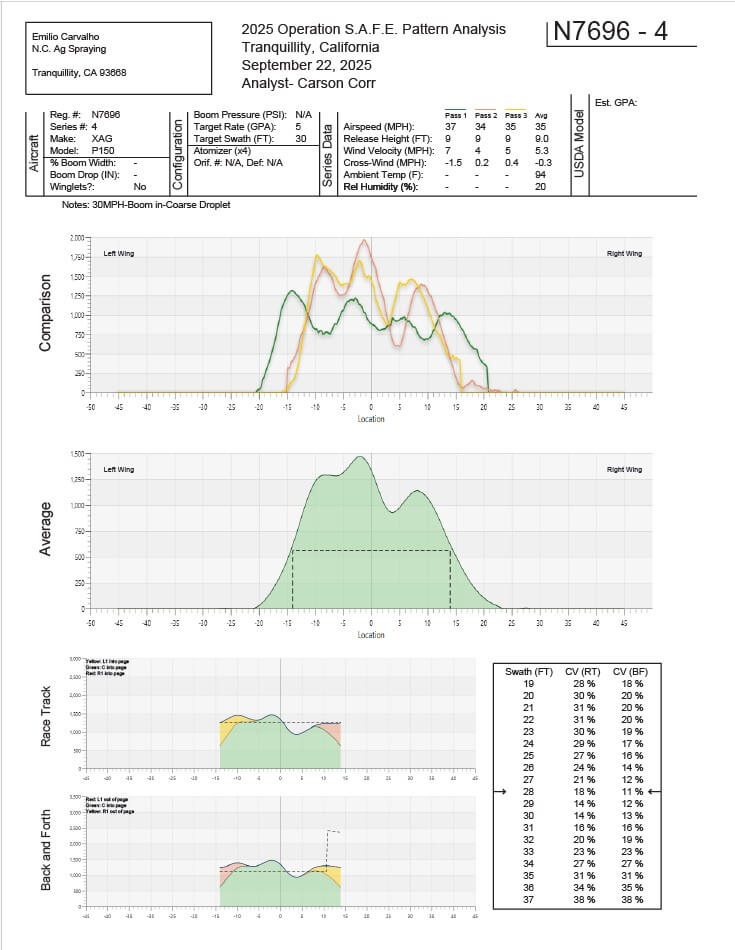
    This is not to suggest that pilots intentionally inflate swath widths. Swaths are evaluated during fly-in calibration sessions using established protocols (e.g., Operation S.A.F.E.), and RPAS swath evaluation has emulated these practices. Calibrations take place on bare ground or stubble/grass using two-dimensional samplers (i.e., continuous samplers like string or bond paper, or discreet samplers like water sensitive paper). However, this protocol does not account for any physical interference from the crop canopy itself. This may have negative implications, particularly given the unique nature of the RPAS swath.

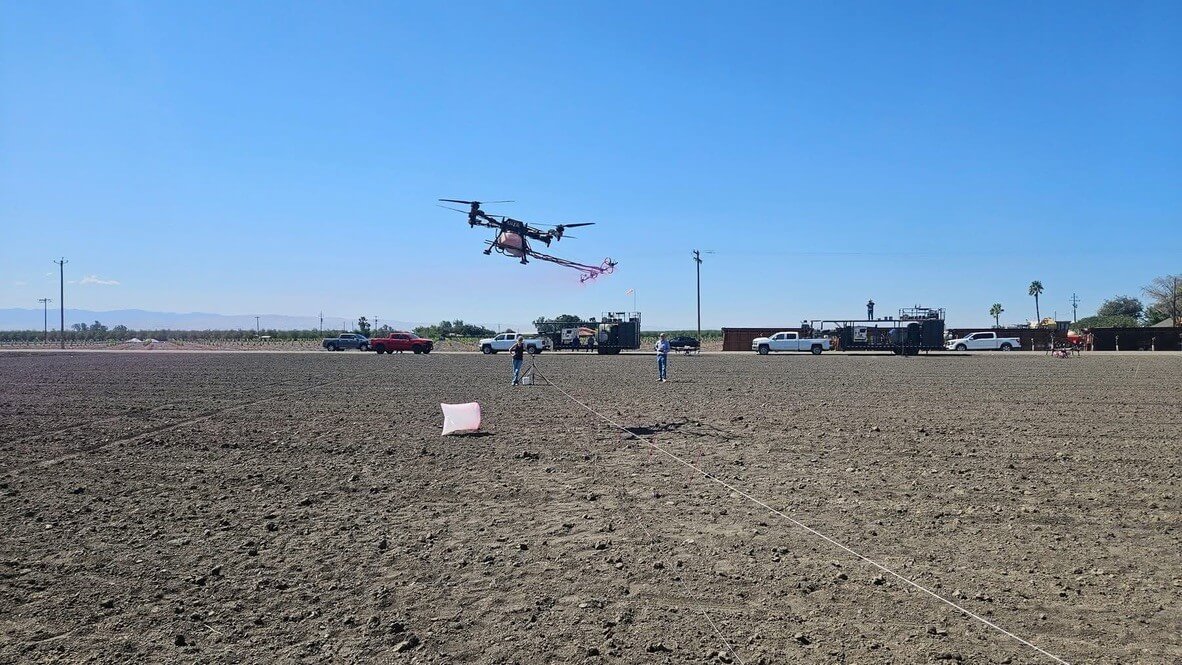
    RPAS tend to produce swaths with a very narrow span and a steep profile. To a certain extent, their swath widths share a direct relationship with altitude and headwind speed, and coarser sprays result in narrower swaths (with Dr. Michael Reinke, MSU). The outer edges of the RPAS swath represent the least amount of spray volume along the width, and this coincides with the turbulent dispersion zone of the downwash. Therefore, those extremes should contain a higher proportion of low-energy droplets moving in multiple directions relative the centre of the swath.

    While crop morphology and planting architecture are contributing factors (i.e. part of the agronomic use case), it is generally accepted that the degree of spray penetration falls off exponentially with canopy depth. It follows that this should also be the case for any lateral movement, resulting in a significantly shorter swath in-canopy versus on bare ground.

    Materials and Methods

    Spray Sampling

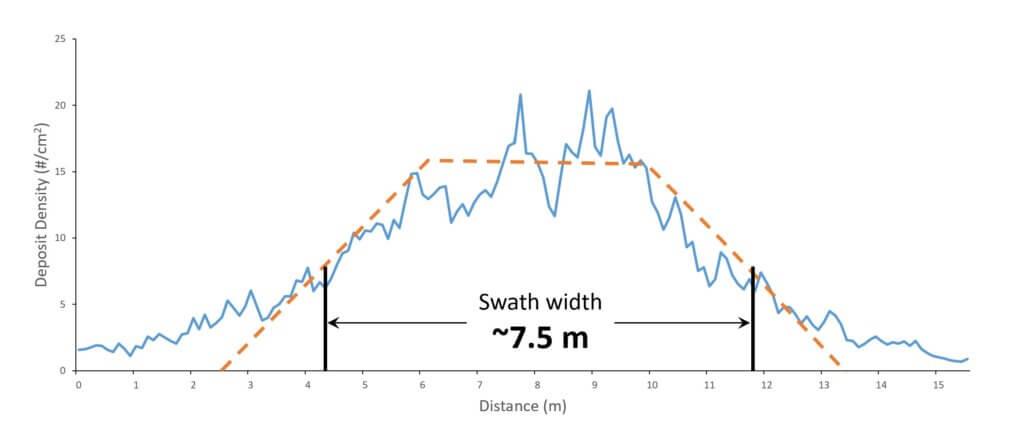
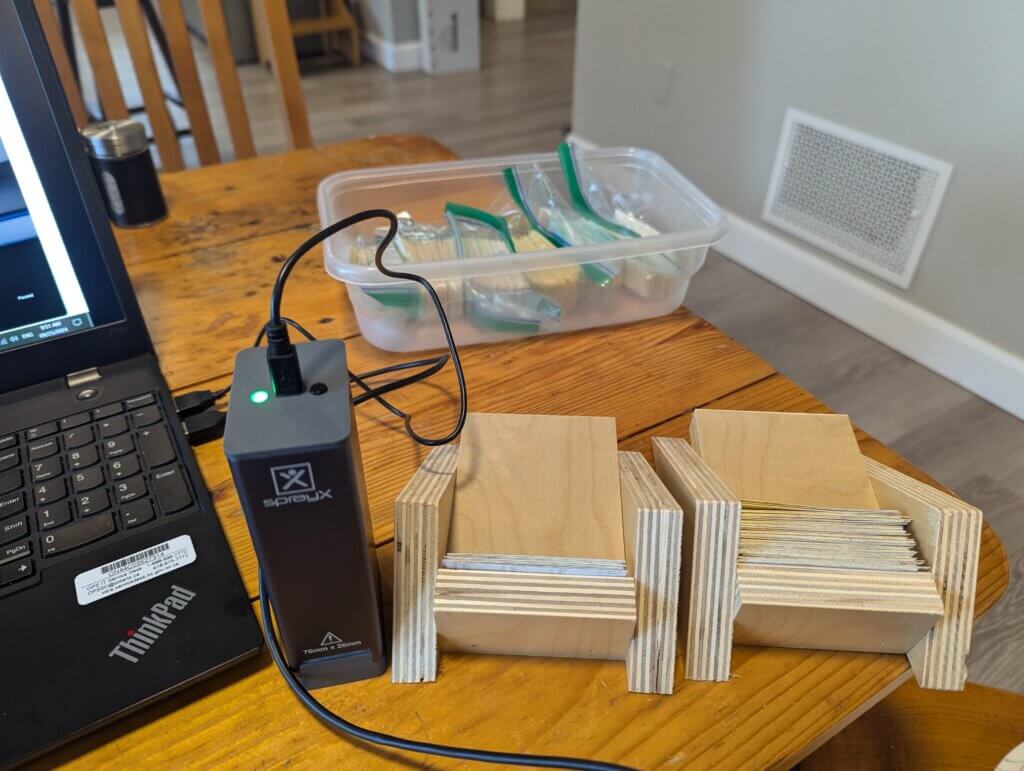
    Spray deposition was sampled using a 15.8 m (52 ft) Speed Track (Application Insight LLC) loaded with 3-inch bond paper (Staples Canada). The spray mix was 0.3% v/v FD&C Blue #1 Liquid. Bond papers were analyzed using a Swath Gobbler (2nd gen software – Application Insight LLC) at 100 mm sampling rate (i.e., ~150 discreet images per sample). Hue: 32-180. Saturation 17-60. Value: 156-255.

    The Swath Gobbler produces a complete, correlated and ordered record of the cross-section of a swath. For each discreet image, it reports the number of individual droplet stains on the sampler per area. It also reports percent area covered by measuring the total number of pixels with dye divided the total number of pixels in the image.

    The device deliberately does not calculate a Droplet Size Distribution (DSD) of the stains. This is because any DSD calculated from paper collectors relies on assumptions that cannot be validated, such as the fact that all droplets are captured and detected, spread factors are known for that application condition and similar for all stain sizes, there are no multiple hits, etc.

    RPAS

    The sprayer was a DJI T40, calibrated according to the pilot’s standard operating procedure (Drone Spray Canada). Certain operational settings varied with treatment and will be detailed later in this section.

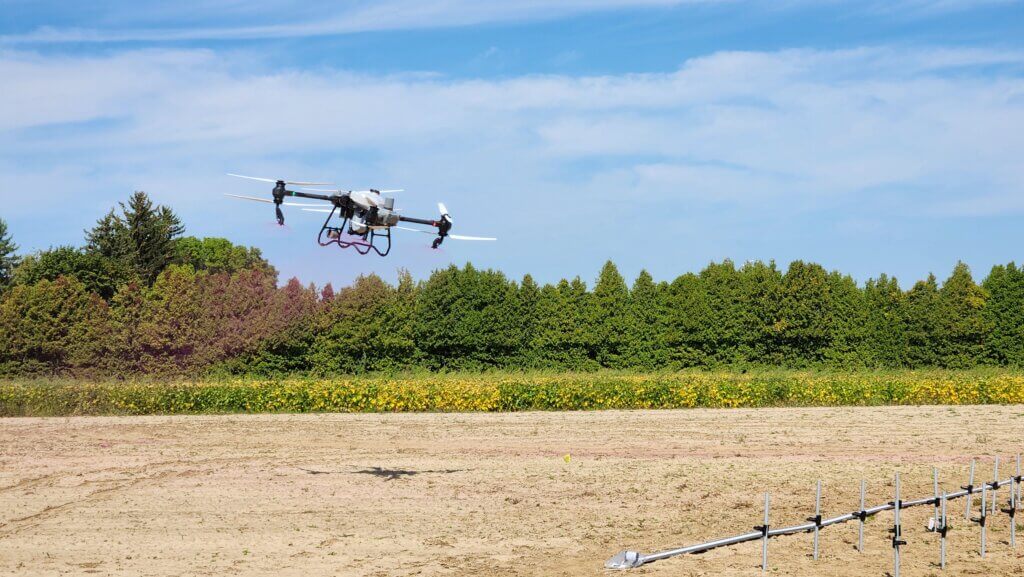
    The flight path was perpendicular to the sampler, aligned with the centre using pin flags as references for the pilot. Spraying began approximately 20 m prior to the sampler to ensure the RPAS was at target speed and continued some 20 m past the sampler.

    Figure 4. DJI T40 approaching sampler on bare ground. Sampler was later moved into the adjacent wheat field (left).

    Defining Coverage

    Swath width will be calculated from two different coverage metrics.

    Percent Area Covered describes the amount of surface area covered by deposit. Given the variable degree of stain diameter (a function of sampler material, spray mix, and droplet velocity) this value can only be used as a relative index (i.e., can only be compared to itself). No conclusions can be drawn about how spray interacts with plant tissue, but generally more coverage correlates to improved crop protection.

    Deposit Density describes the number of individual droplet stains on the sampler per area. Higher densities can imply more uniform distribution over the plant surface, which is particularly important for contact materials.

    Previous studies (with Dr. Tom Wolf, Agrimetrix Research and Training, data not shown) indicate a higher correlation between deposit density and swath width at lower versus higher spray volumes. Lower volumes are typically comprised of finer droplets, which are more accurately resolved using deposit counts. Swath widths determined by deposit density also tend to be longer than those determined using percent coverage, better aligning with real-world observations of efficacy.

    Wheat

    R40 wheat was planted on October 9th, 2023, at 808,000 seeds/ha (2 million seeds/ac). Wheat height at the time of the trial was 60 cm (25 in). The location was 45180 Fruit Ridge Line, St. Thomas, Ontario. Deposition trials took place on May 23rd. Wheat stubble swath testing also took place at this location on May 15th.

    The RPAS was programmed to apply 50 L/ha using a 260 µm droplet diameter according to the DJI software. Air speed was 5 m/s and the flow rate was 11-12 L/min as it passed over the sampler. Swath was programmed at 8 m.

    Coverage was evaluated for water (control) and for a spray mix containing 0.15% v/v Interlock (a drift mitigating adjuvant – Winfield United) and 0.15% v/v Interlock + 0.125% v/v Activate Plus (a spreader adjuvant – Winfield United). For bare ground, each treatment had three passes (n=3) except for water, which had four (n=4).

    The wheat canopy was only sprayed with water three times (n=3). Limited passes were made because it served as a proof of principle. Any indication of relevant differences in the swath width would justify later trials in corn and soybean. These first passes revealed issues with the experimental design that were later corrected:

    • The RPAS spray tank level was not held constant. The RPAS weight affects the intensity of the downwash. The volume dropped from 30 L to ~20 L over the course of the experiment. In future trials, a tank volume of 20 L was maintained from a premixed source.
    • The wind direction occasionally shifted from a direct headwind to a partial cross wind from the RPAS’s right. In future experiments, we waited for an optimal wind direction before starting each pass.
    • The RPAS altitude was set to 3 m above bare ground. We assumed it would climb to account for the height of the wheat, but the canopy did not register with the RPAS sensors. As a result, spray was released ~60 cm closer to the wheat heads than to the ground in bare ground swathing. In future experiments, we confirmed that the RPAS was 3 m from the top of the crop canopy.
    • Despite best efforts, moving the sampler into the wheat parted and distorted the canopy. As a result, the sampler was not as obscured as it should have been. We developed strategies to minimize canopy distortion in corn and soybean that will be described later.
    Figure 5. Top-down view of sampler in wheat canopy. Note that the canopy did not close over the sampler as intended.

    Corn

    Corn was planted on May 15th, 2024, at 13,300 seeds/ha (33,000 seeds/ac). The sampler was erected in the field on July 3 to allow the canopy to grow up and around it. Deposition trials took place on July 26 and every effort was made to leave the canopy undisturbed around the sampler. Corn measured 2.4 m (9 ft) at the tassel and 1.2 m (4 ft) at the silks. The sampler height corresponded to the ears. The location was 42°40’52.1″N 81°04’45.9″W near 5277 Quaker Road, Sparta, Ontario.

    Figure 6 Sampler erected to 4 ft. Crop grew around the sampler to minimize any canopy disturbance.
    Figure 7 Sampler position relative to ears during sampling.
    Figure 8 Installing Speed Track for swath testing in wheat stubble.

    Soybean

    Soybean was planted on June 30th, 2024, at 80,800 seeds/ha (200,000 seeds/ac) on 38 cm (15 in) centres. Deposition trials took place the morning of August 14. While the densest area was selected for the trials, the field was patchy with crop height spanning 20-25 cm (8-14 in). Each section of the Speed Track was inserted under the canopy separately to avoid disturbing or damaging the plants. The track was elevated ~10 cm off the ground. The location was at 42°46’50.4″N 81°08’20.8″W near 43900 Talbot Line, Central Elgin, Ontario.

    Figure 9 Sampler in soybean.

    Corn and Soybean Treatments

    The following treatments were repeated three times in-canopy (n=3) (Table 1). The actual flow rate (recorded as the RPAS passed over the sampler) was always ~1.5 L/min less than programmed.

    Treatment #Droplet Diameter (µm)Programmed Swath (m)Volume (L/ha)Rate (L/min)Flight Speed (m/s)Spray Mix
    1320102010.510water
    232083010.58.3water
    332085010.55water
    43208305.75water
    550085010.55water
    63208505.750.5% Masterlock
    732083010.58.30.5% Masterlock
    Table 1 RPAS operational settings for corn and soybean treatments

    The following treatments were repeated three times on wheat stubble (n=3) (Table 2). Once again, the actual flow rate (recorded as the RPAS passed over the sampler) was always ~1.5 L/min less than programmed.

    Treatment #Droplet Diameter (µm)Programmed Swath (m)Volume (L/ha)Rate (L/min)Flight Speed (m/s)Spray Mix
    1320102010.510water
    232083010.58.3water
    332085010.55water
    43208305.75water
    Table 2 RPAS operational settings for wheat stubble treatments

    Weather Data

    The RPAS flight path was into the prevailing wind, but minor variations occurred throughout sampling. Weather was recorded as the RPAS passed over the sampler using a Kestrel 3550AG weather meter in a vane mount positioned on a tripod 2 m above ground (Table 3).

    TerrainWind Speed (km/h)Direction Relative to Flight PathTemperature (°C)Cloud Cover (%)RH (%)
    Bare Ground3-5Headwind +/- 25° from starboard20-21060
    Wheat Canopy5-7Headwind +/- 25° from starboard21-22060
    Corn Canopy2-4Headwind +/- 15° from starboard23-26<1075
    Wheat Stubble4-7Headwind +/- 15° from starboard26-28<1065
    Soybean3-4Headwind +/- 15° from starboard22055
    Table 3 Average weather conditions during trials.

    Results

    Raw Coverage Expressed as Percent Coverage or Deposit Density

    Coverage can be presented as raw data plotted by swath position. This is a qualitative means for assessing the swath. The bare ground data has been presented (using both coverage metrics) as an example (Figures 10 and 11).

    Figure 10 Swath coverage data for water on bare ground expressed as percent area covered. All four passes are plotted.
    Figure 11 Swath coverage data for water on bare ground expressed as deposit density. All four passes are plotted.

    Repetitions were similar enough to imply that environmental conditions were consistent during sampling. By averaging the repetitions, coverage in-canopy can be more easily compared to that on bare ground Figures 12 and 13).

    Figure 12 Average swath coverage data expressed as percent area covered. Bare ground (n=10). Wheat canopy (n=3).
    Figure 13 Average swath coverage data expressed as deposit density. Bare ground (n=10). Wheat canopy (n=3).

    The magnitude of coverage on bare ground exceeded that in-canopy, tapering to similitude and near-zero at the edges of the pattern. It can therefore be concluded that the entire swath was captured, and that spray was filtered by the canopy before reaching the sampler within.

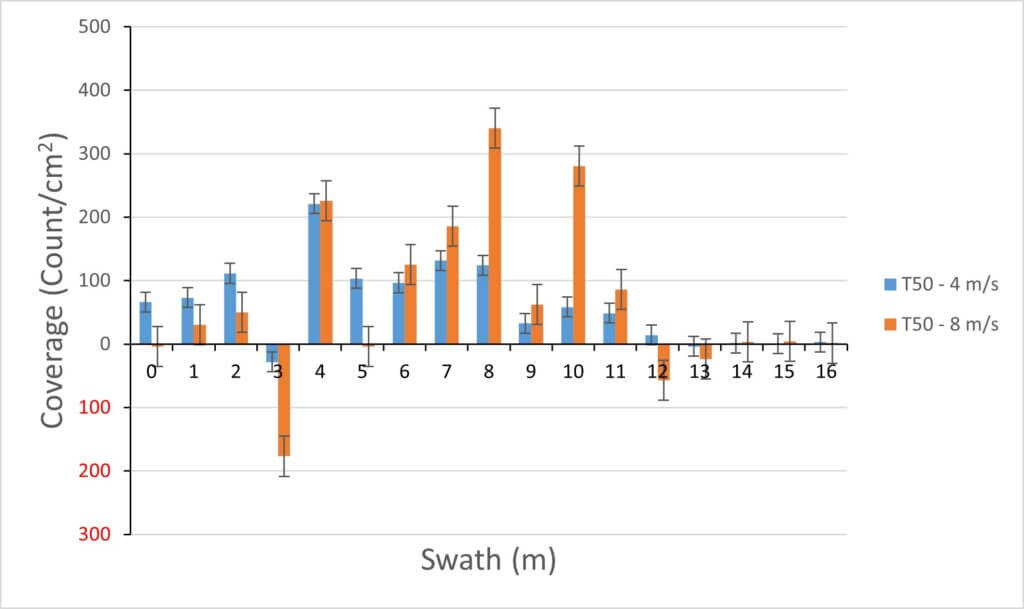
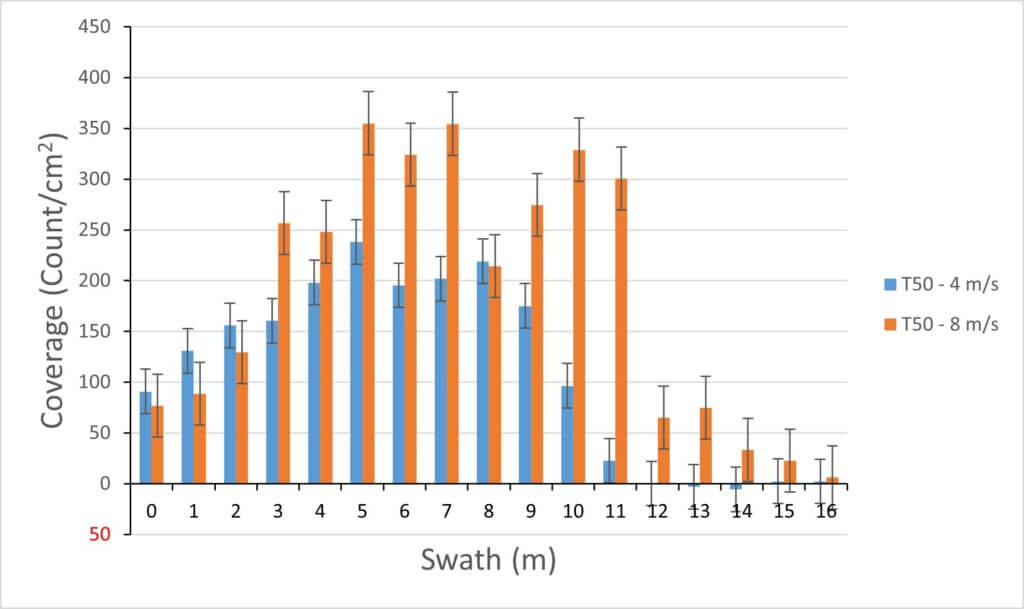
    The difference between bare ground and the wheat canopy was greater when the data were presented as percent area versus deposit density. Differences in the number of deposits from finer sprays were more accurately resolved using deposit density than percent coverage. Since it can be expected that smaller droplets penetrate a canopy better than coarser droplets, it may be more appropriate to use deposit density to document their presence. We also saw indications of wider swaths when data were presented as deposit density, as well as a bimodal distribution that reflected the positions of the two rotary atomizers.

    While informative, this raw coverage format did not allow empirical comparisons. Each pass must be converted to a swath width.

    Converting to Swath Width

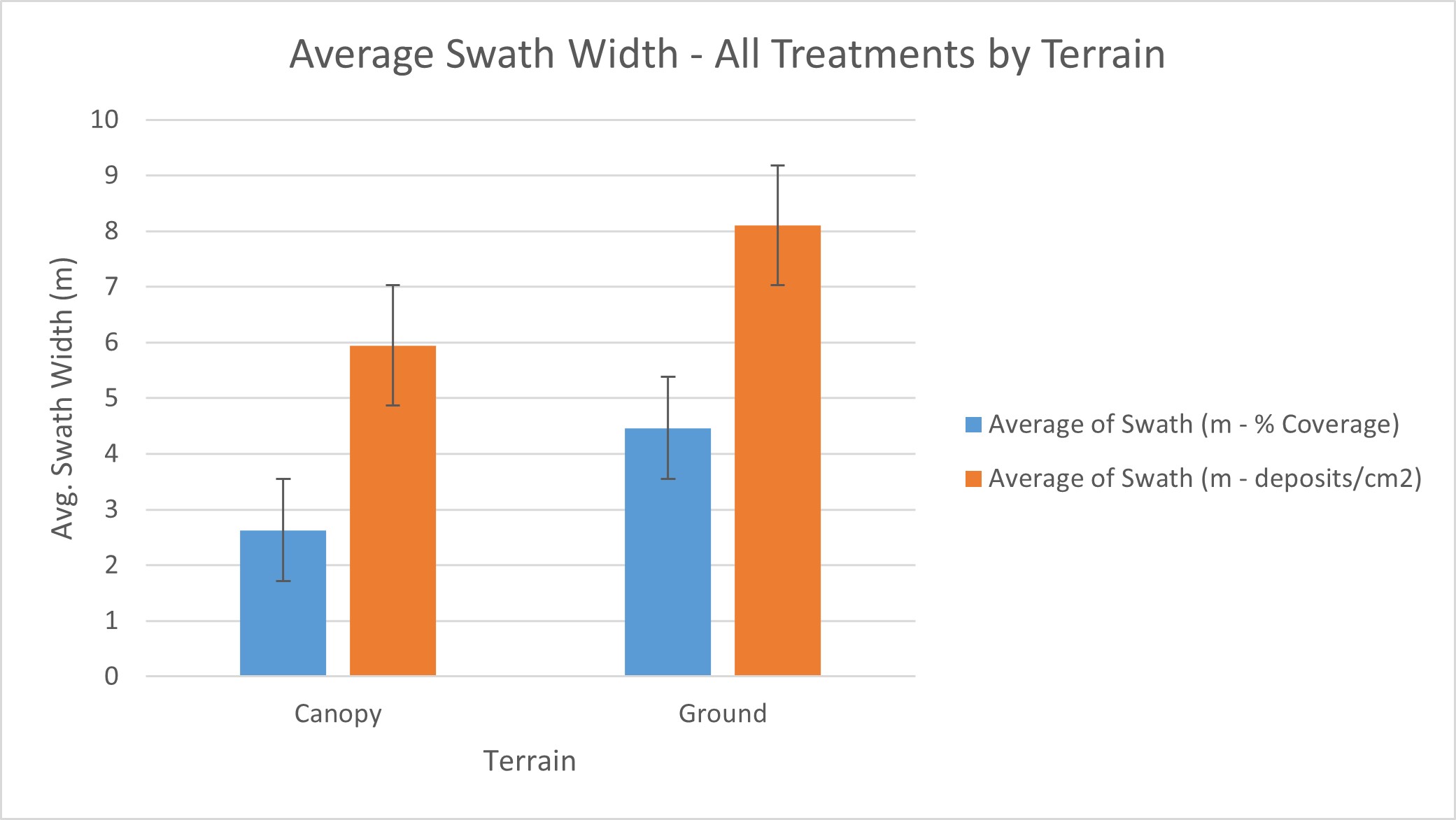
    Each pass was transformed by averaging Swath Gobbler data to a single value every 0.5 m. Data were then entered into the www.sprayers101.com swath width calculator and the SW was manually determined for each pass. Criteria was the lowest overdose, lowest underdose and lowest CV for an idealized threshold coverage of 90% that of the highest value in the swath. In the following histogram, the SW from all treatments have been averaged for ground and canopy terrains (Figure 14).

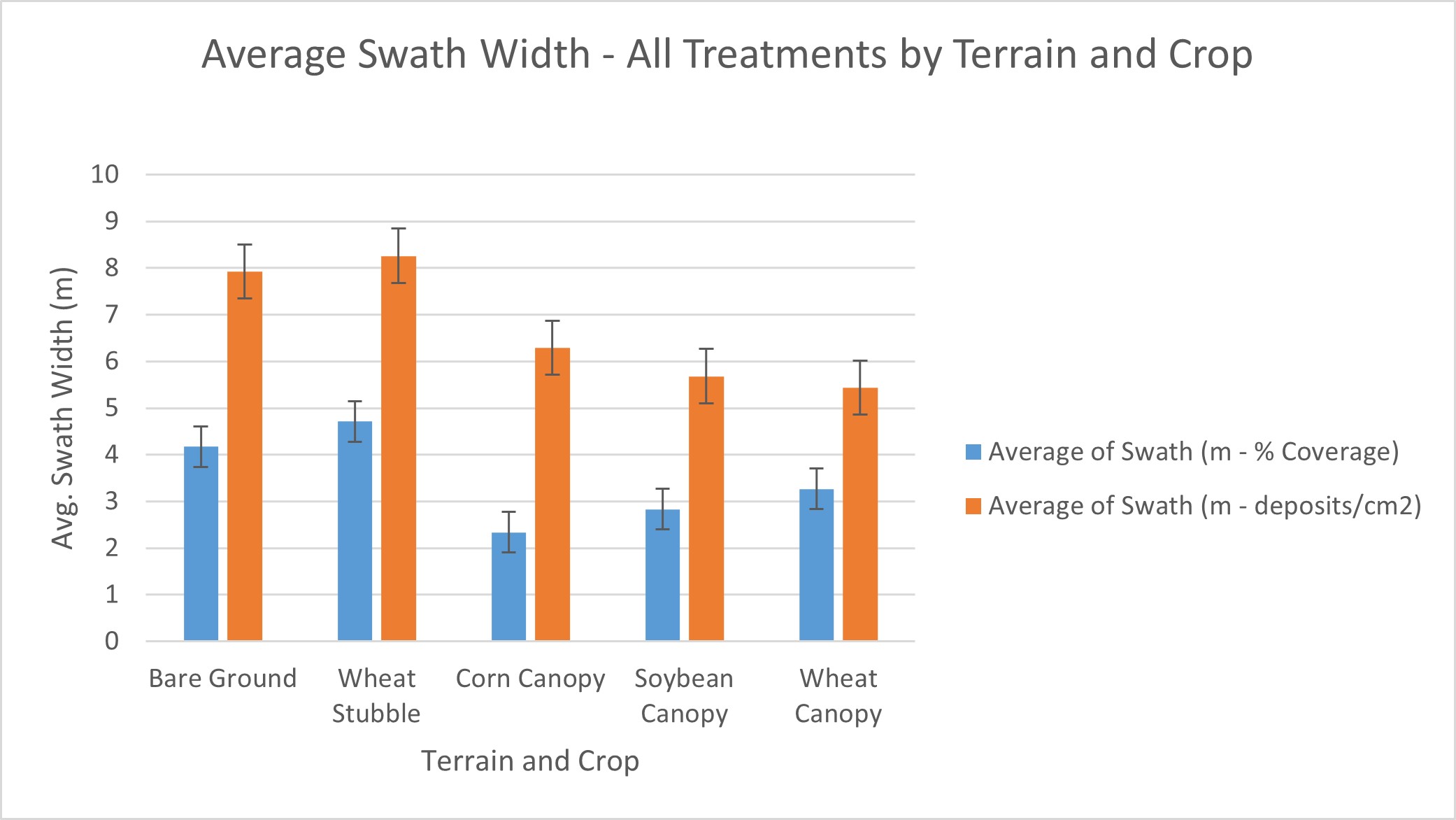
    There was a significant reduction in swath width in a wheat canopy compared to stubble or bare ground. There was a 41.2% reduction in swath width in a canopy when measured as percent area covered and a 26.6% reduction when expressed as deposit density. As previously stated, deposit density better reflects the contribution of finer deposits, which tend to penetrate deepest into crop canopies.

    Figure 14 Average effective swath width for all treatments on all terrains. Swaths expressed from both percent coverage and deposit density metrics. Standard error bars presented. Canopy (n=45). Ground (n=22).

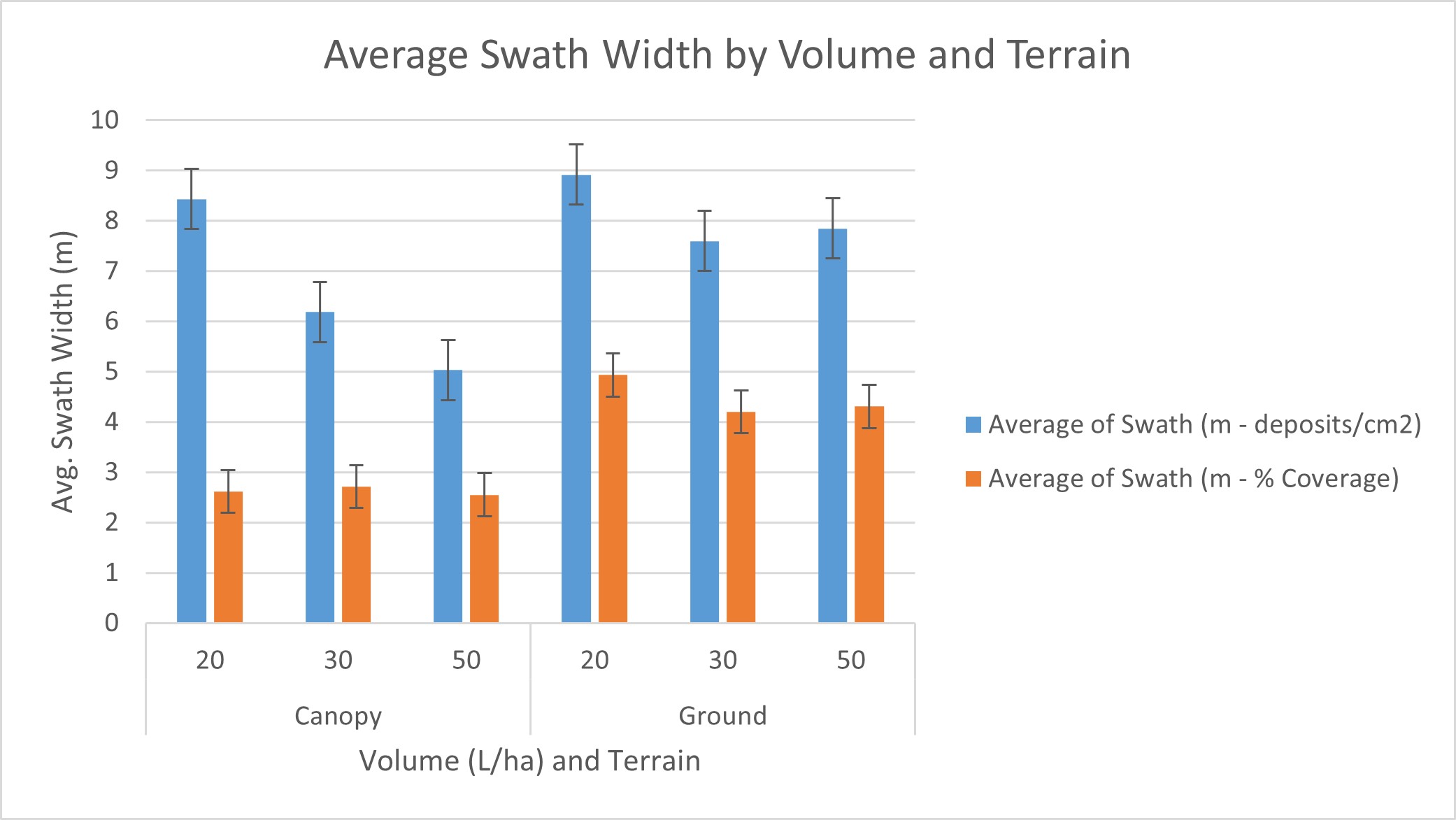
    When the data is considered by terrain and by crop, we see that swathing on bare ground or in wheat stubble doesn’t have a significant impact. This justifies combining those data as “Ground” in subsequent analyses.

    Another observation that supports the use of deposit densities is the difference between the intended (i.e., programmed) swath width and the detected swath width on ground (Figure 15). The SW on ground was closer to the intended 8 or 10 m swath width when expressed as deposit density. It was approximately half the desired width when expressed as percent coverage, which is considerably less than common practice.

    Figure 15 Average effective swath width for each crop and terrain. Swaths expressed from both percent coverage and deposit density metrics. Standard error bars presented. Ground 8 m swath (n=19). Ground 10 m swath (n=3). Canopy 8 m swath (n=39). Canopy 10 m swath (n=6).

    Canopy Effect

    By percent area, corn had the biggest reduction in swath width compared to bare ground, then soybean, then wheat (Table 4 and Figure 16). This suggests the SW shares an inverse relationship with the canopy depth. However, the relationship reversed when SW was expressed as deposit density. The relationship between droplet size, crop physiology, planting architecture and canopy penetration is complicated, and no conclusions can be drawn beyond a reduction in SW in-canopy.

    Crop% Reduction in SW (% area)% Reduction in SW (deposits/cm2)
    Corn44.020.6
    Soybean32.228.3
    Wheat21.731.5
    Table 4 Reduction in average effective swath width in-canopy by crop compared to on ground. Swaths expressed from both percent coverage and deposit density metrics.
    Figure 16 Average effective swath width for each terrain. Swaths expressed from both percent coverage and deposit density metrics. Standard error bars presented. Bare ground (n=10). Wheat Stubble (n=12). Corn Canopy (n=21). Soybean Canopy (n=21). Wheat Canopy (n=3).

    Effect of Volume on SW

    The effect of spray volume on swath width is not immediately clear. When the data were expressed as deposit density, volume shared an inverse relationship with SW in canopy (Figure 17). There appeared to be no effect when expressed as percent coverage. The inverse relationship is weakly expressed, if at all, for both metrics on bare ground.

    Figure 17 Average effective swath width by volume and terrain. Swaths expressed from both percent coverage and deposit density metrics. Standard error bars presented. Canopy 20 L/ha (n=6). Canopy 30 L/ha (n=18). Canopy 50 L/ha (n=21). Ground 20 L/ha (n=6). Ground 30 L/ha (n=3). Ground 50 L/ha (n=13).

    Effect of Speed on SW

    For most RPAS designs, lower volumes are applied at higher flight speed (Table 5). Previous work demonstrated that higher flight speeds tended to result in wider swaths and an increase in drift. Do higher speeds cause wider swaths in-canopy, despite lower volumes?

    Volume Applied (L/ha)5 m/s Flight Speed8.3 m/s Flight Speed10 m/s Flight Speed
    203 treatments9 treatments
    309 treatments12 treatments
    5034 treatments
    Table 5 – Number of treatments for each flight speed by volume applied.

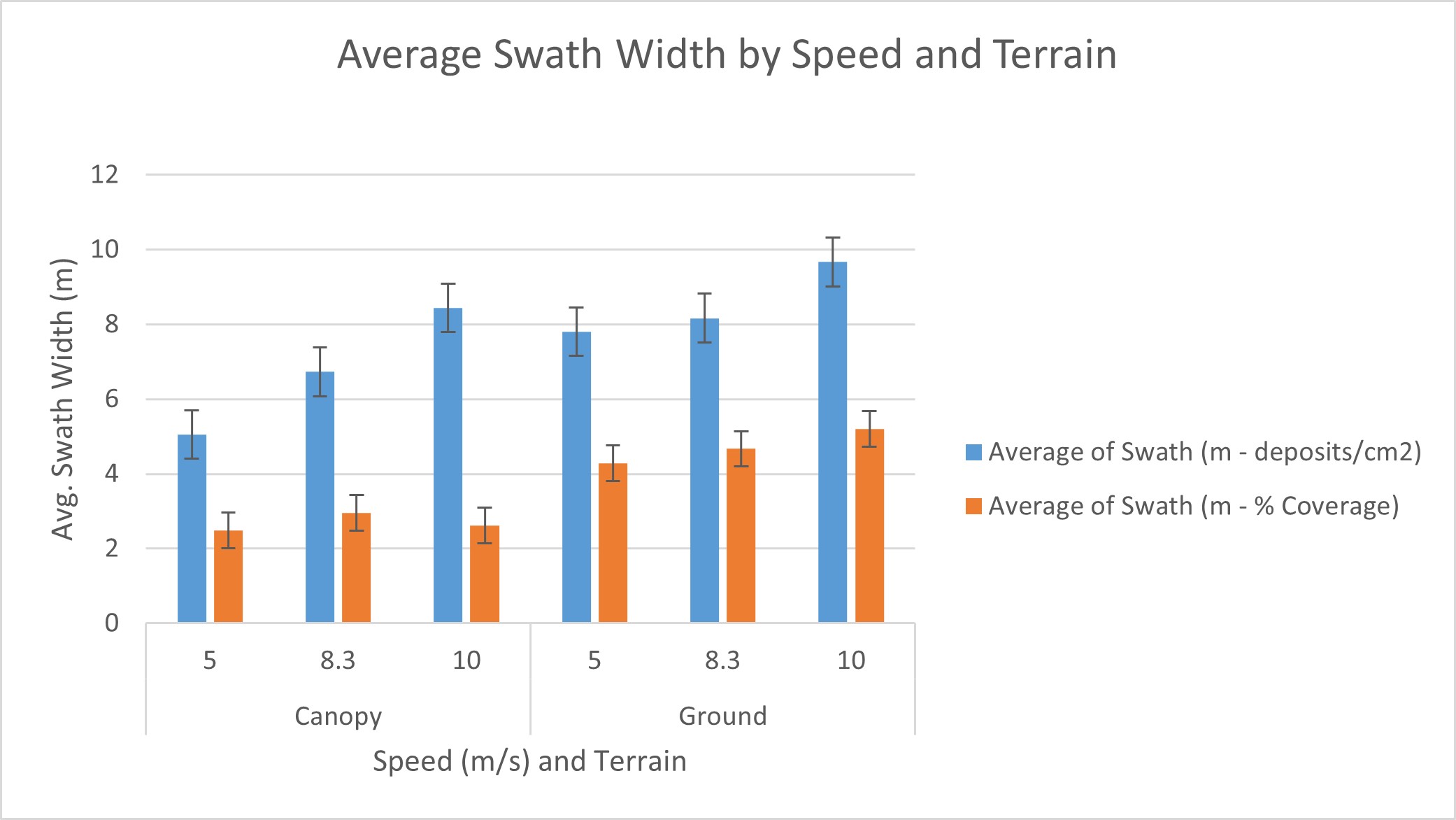
    Flight speed had a clearer impact on swath width than spray volume did (Figure 18). There was a positive relationship between flight speed and swath width as measured by deposit density in canopy and on bare ground.

    Figure 18 Average effective swath width by speed and terrain. Swaths expressed from both percent coverage and deposit density metrics. Standard error bars presented. Canopy 5 m/s (n=27). Canopy 8.3 m/s (n=12). Canopy 10 m/s (n=6). Ground 5 m/s (n=16). Ground 8.3 m/s (n=3). Ground 10 m/s (n=3).

    Just as with volume, there appeared to be no significant effect on swath width in either canopy when expressed using percent coverage. This was likely because finer sprays were better able to penetrate a canopy and deposit density is better able to resolve their presence.

    Conclusions

    There was no difference in SW between stubble and bare ground. The SW on-ground was far closer to the programmed 8 or 10 m swath width when expressed as deposit density.

    There appears to be a significant reduction of SW in-canopy versus on-ground. A crop canopy created a 26.6% reduction when expressed as deposit density. Specifically, corn was -20.6%, soybean was -28.3%, and wheat was -31.5%. Previous work has demonstrated diminishing coverage with canopy depth in corn, but it is difficult to make comparisons between agronomic use cases (e.g. different planting architectures and plant physiologies).

    When the data were expressed as deposit density, spray volume shared an inverse relationship with SW in-canopy, but the effect on SW on-ground was less clear. However, RPAS speed had a clear inverse relationship with SW in-canopy and strong trend on-ground.

    It is understood that finer spray is better able to penetrate canopies. One reason is because finer droplets are able to become entrained the downwash. Another is simply mathematical advantage, given that finer sprays are comprised of exponentially higher numbers of droplets than coarser sprays, increasing the odds of deposition. Conversely, coarser droplets (which have the greatest influence on percent area covered), are more likely to impinge on the canopy structure before reaching the sampler. Deposit density appears to be the more accurate metric for calculating SW both on-ground and in-canopy.

    The reduced SW in-canopy versus on-ground explains, in part, why striping is occurring in aerial corn fungicide applications. The route spacing reflects on-ground swath width, where it should reflect the shorter, ESW.

  • How to Calibrate a Drone

    How to Calibrate a Drone

    Calibration is a fundamental step in any spray application. To apply the correct product rate, we need to know how much liquid per unit land area is deposited under the sprayer.

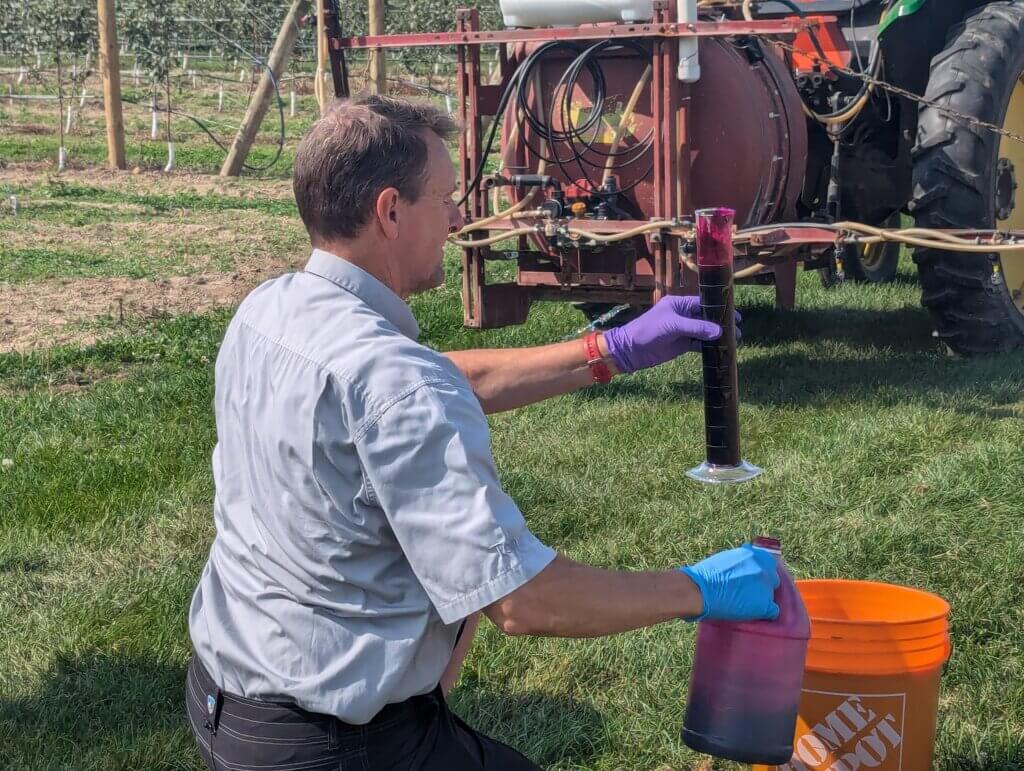
    To conduct the calculations, either manually or through the drone software, we need to know the width of the spray swath. This task requires the operation of the sprayer under typical conditions, some kind of sampler capture the spray deposit, and a means of quantifying that deposit so the spray pattern becomes apparent. Here’s how we do it:

    1. Confirm the accuracy of the flow meter

    Drones don’t typically report the spray pressure of the spray mix. Instead, they report the flow rate using a built-in flow meter. The drone maintains the desired application rate by using the flow rate to adjust pump speed and engage nozzles over a range of travel speeds. Because everything depends on the flow meter, its accuracy needs to be verified.

    • Fill the spray tank with clean water and flush all the lines.
    • Install nozzles required for task, ensuring all nozzles are identical and in good working order.
    Nozzles installed on DJI T20 drone.
    • Select the nozzle size you installed on the spray monitor.
    • Purge the air from the system.
    • Activate the spray and wait for the flow rate to stabilize on the spray monitor. This may take a few moments.
    • With the nozzles flowing, place collectors under each nozzle and collect the spray liquid for a fixed time, say one minute.
    Capturing spray during flow meter calibration.
    • Ensure the collector catches all the spray. Buckets often create turbulence. Rotary atomizers make this more difficult.
    • When the time elapses, remove the collectors and then shut off the spray.
    • Unless the shutoff is very fast and positive, leaving the collectors in place during shutoff can introduce error as the flow diminishes.
    • Confirm that the volume collected from each nozzle was identical, and that the flow rate reported by the drone flow meter is accurate.
    • Repeat to ensure consistency.
    Use of a Spot-On digital calibrating cup ensures that all spray is captured and it also reports the volume instantly.

    2. Measure the swath width

    Spray swath width is variable. For a measurement to be relevant we must evaluate spray deposition under environmental conditions that are similar to the planned spray operation, as well as use the same operational settings such as altitude, travel speed, nozzle choice, and application volume.

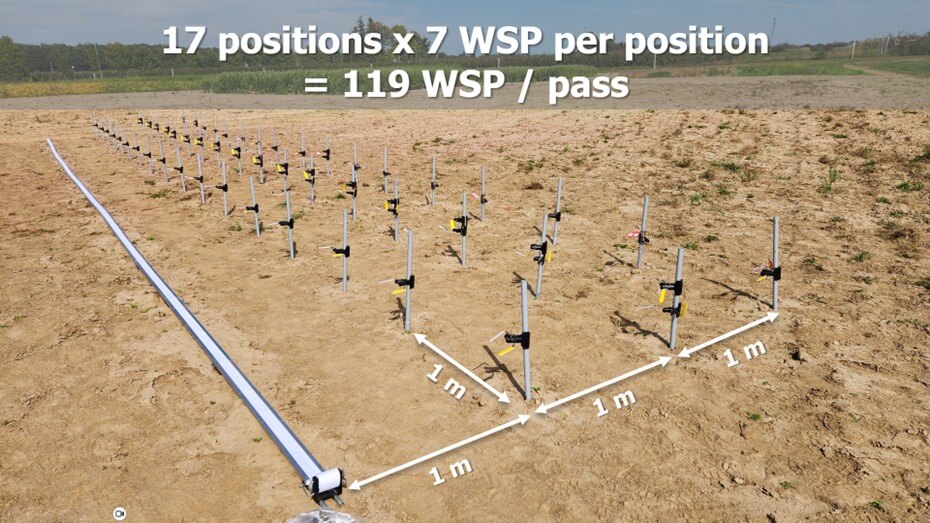
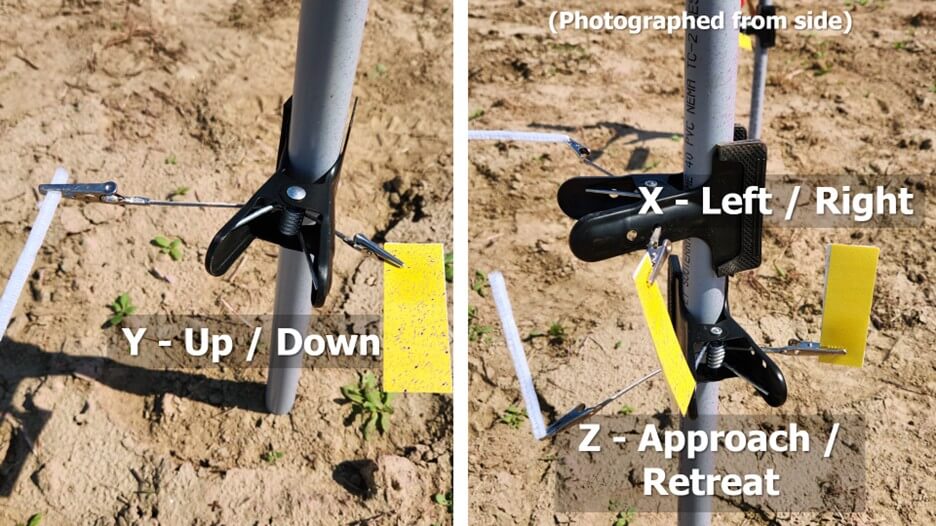
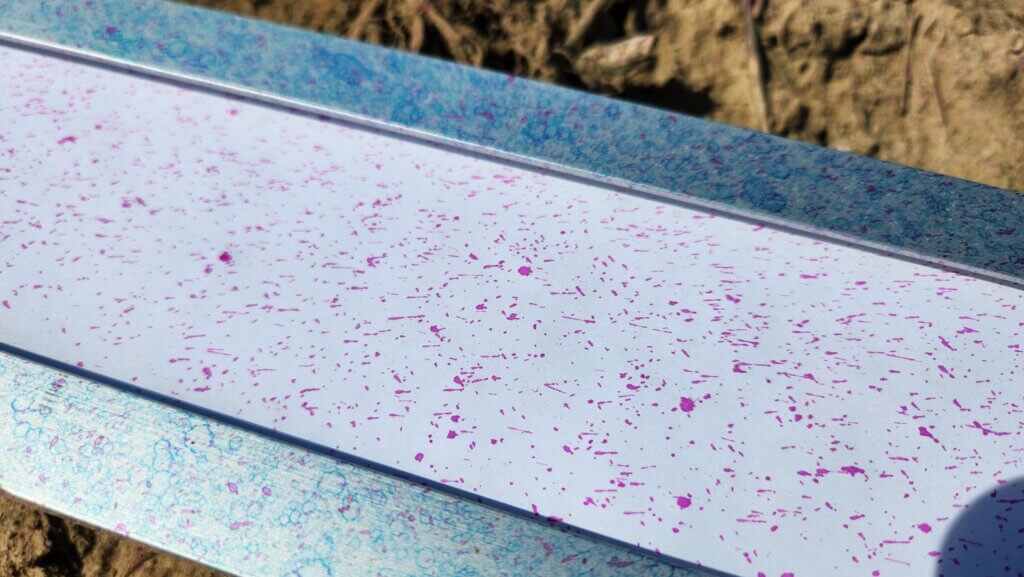
    Spray samplers are positioned along the ground, perpendicular to the flight path. We use water-sensitive paper (WSP) because it’s readily available, fast and easy to use, and the deposits can be analyzed visually or using simple apps that calculate coverage. We create a sampling line of WSP positioned a 1 m intervals (or maybe 0.5 m for narrow swaths). The samplers should extend to twice the expected swath width to account for any swath displacement from sidewinds.

    • Choose a day with light, consistent winds.
    • Find an open space free of obstruction in the direction of the prevailing wind.
    • Install a weather station to document conditions during flight.
    A Kestrel 3550AG or 5550AG wind meter can record weather data and download to a phone via Bluetooth.
    • Mark an approximately 200 m long flight line into the prevailing wind direction by placing wire flags every 50 m.
    • At the 150 m mark, use wire flags to centre a sampler line perpendicular to the flight path. Sampler line length should be about twice the expected swath width.
    Swath sampling line
    • Wooden blocks with paper clips can be used to secure WSP at regular intervals along the sampler line.
    Wooden blocks attached to a 4″ tow strap allows for easy setup and movement of sampling line.
    • Fill the drone 1/2 full.
    • Manually fly the drone along the entire flight line. The spray pressure, flow rate and altitude of the drone should be stable before it reaches the sampler line. This may take 25 meters or more depending on drone model, flight speed and drone weight.
    • Fly 50 m past the sampling line without any drone maneuvering to avoid affecting the deposit.
    • Land the drone and walk along the sampler line.
    • Note the deposits in the central region. Walk along line as the deposits taper off, looking for deposits that are approximately 50% of the average central deposits.
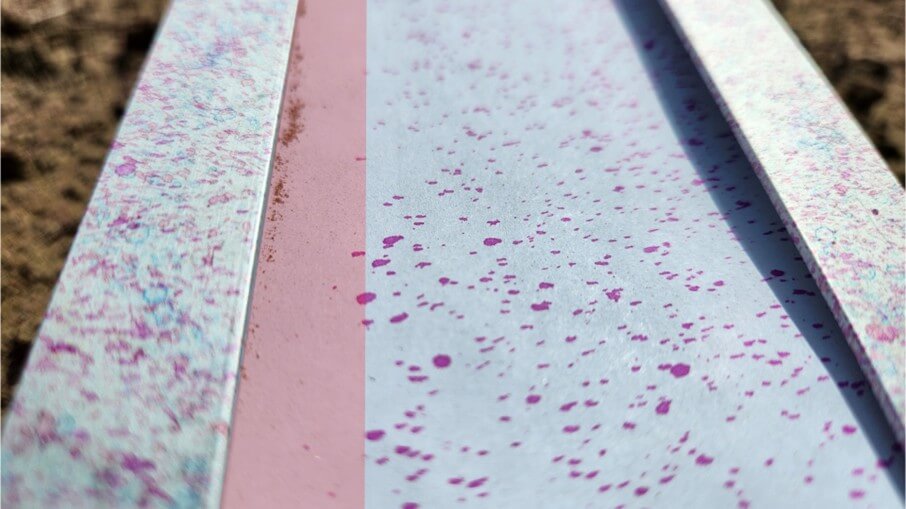
    Water-sensitive paper following a drone application.
    • Estimate the distance between these deposits on both edges of the swath. This is the estimated swath width that can be entered for the second flight.
    • Replace the WSP with a fresh set, refill the drone to 1/2 full, and repeat the flight two more times.

    Other methods perform a more advanced assessment by analyzing the entire swath, and not just intervals. These methods use dyes and dedicated hardware to quantify the deposits along strings or paper samplers.

    The Swath Gobbler documents swaths at high resolution using lengths of 3″ bonded receipt paper, food grade dye, and a digital scanner.
    The Application Insight LLC Swath Gobbler scanner in action.

    3. Analyze the Pattern

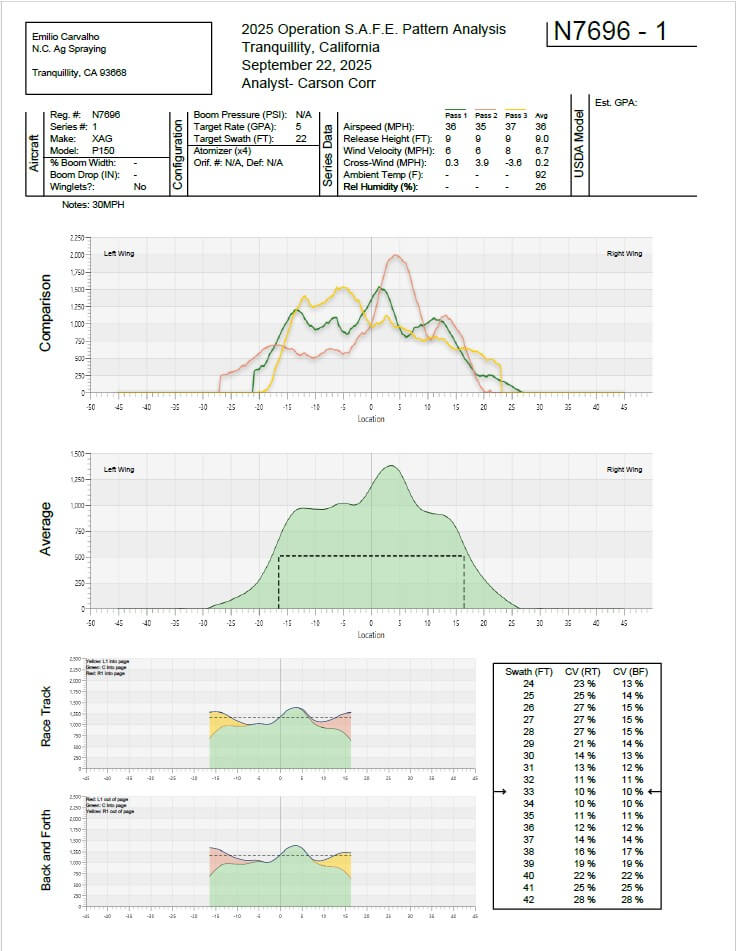
    The nearest approximation for drone swathing is that of a manned aircraft. The spray pattern of an aircraft is tapered, meaning the highest deposition is near the centre of the swath, and the edges of the swath fade to zero deposit. In order to achieve consistent coverage, we need the edges of the spray swath to overlap so the cumulative coverage at the edges is closer to that in the centre. Too little overlap leaves gaps and too much overlap results in excessive deposit.

    Insufficient overlap creates gaps in coverage
    Excessive overlap results in over-dosing and waste
    Correct overlap is necessary for efficient and effective application.

    Deposits from drones can be highly variable. The challenge is to find an overlap distance that minimizes this variability, minimizes both over- and under-application, and maximizes swath width. Download a copy of our Excel spreadsheet to help you with this process.

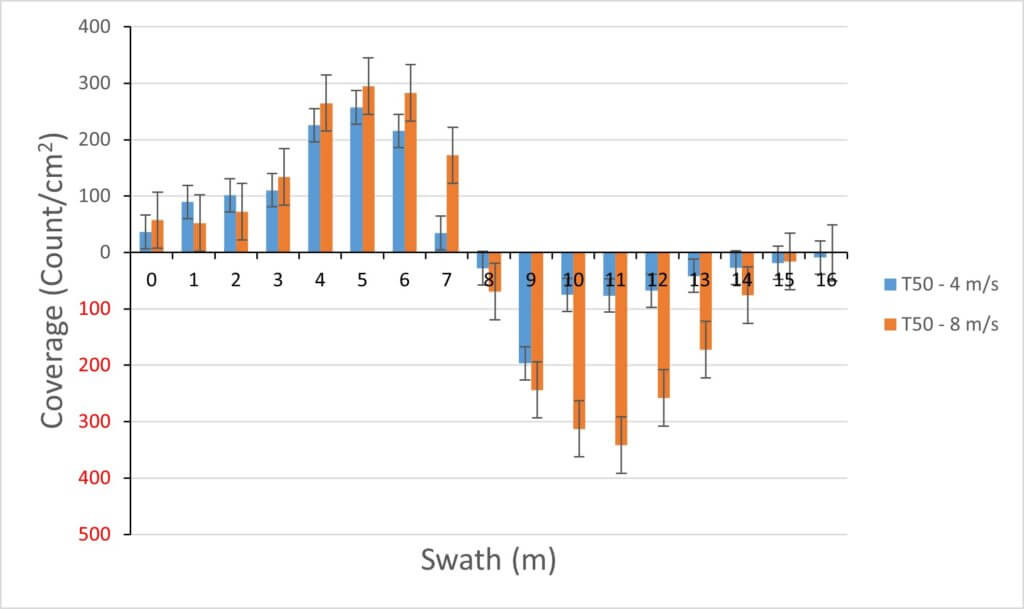
    The first step is to estimate a reasonable average deposit, called “Threshold”. Graph the deposits from each sampler, and estimate a point on the Y axis (Relative Deposition) that represents the average maximum deposit. This could be the maximum value of the plateau, or a midpoint between the maximum and a nearby dip. This is the Threshold. We then take 50% of this estimated average deposit, and find the two distances on the X axis (Sampler Locations) that intersect the curve at these points. The distance between these two points is our first estimate of the swath width. If two adjacent swaths are spaced so the edge of one overlaps 50% with the next, the overall cumulative deposit should be relatively even.

    The coverage information from each sampler location is graphed to create a deposit pattern.

    We can alter the amount of overlap to improve the apparent uniformity, but be cautious. For example, even though we can often improve the uniformity by narrowing the swath width, this can add deposit to the area under the drone and raise the overall deposit amount. Plus, the narrower swath also lowers the productivity of the drone. Use the Excel model to establish a swath width that has the lowest variability (Coefficient of Variability or CV) AND results in a balance between over- and under-dosing.

    The amount of overlap is adjusted to minimize variability (CV) and both equalize and minimize over- and under-dosing.

    4. Recognize the factors that influence swath width

    Operational use case affects swath width

    Swath width is affected by altitude, speed, water volume and spray quality. Generally, higher altitudes, lower volumes, and finer sprays will result in a wider swath. Unfortunately, the same configuration also results in greater drift. It is recommended that swath widths be determined for each spray volume and nozzle arrangement that will be used.

    Drones will be applying low water volumes and this requires a critical assessment of coverage to ensure the deposit density is sufficient to achieve the desired result. A low volume will require a finer spray for minimum coverage to be realized. Coarser sprays that reduce drift and evaporation will need higher water volumes and result in narrower swaths. Significant time may need to be invested to understand the effects of operational settings and environmental conditions on spray deposit uniformity and swath width.

    Effective Swath Width and the Agronomic Use Case

    The relatively sparse coverage at the extremes of the measured swath width may be insufficient to elicit the desired biological result. The Effective Swath Width (ESW) represents the segment of the total swath width that results in pesticide efficacy. In some use cases, the two widths can be similar, but typically the ESW is only a fraction.

    The difference is influenced by the “Agronomic Use Case” which includes factors such as:

    • Spray mix rheology (i.e. the interaction of spray mix viscosity and atomizer design on droplet size)
    • Minimum effective dose: This is a complex relationship between coverage, spray mix concentration and pesticide mode-of-action that results in an effective result while minimizing the environmental impact.
    • Target location (e.g. a pest within a dense canopy or a weed on relatively bare ground)

    Taken collectively, research has shown a 20-30% reduction in ESW for corn, wheat and soybean fungicide applications compared to swaths measured on open ground. Conversely, herbicides sprayed on bare earth or sparse vegetation can produce an efficacious response 20% wider than the measured swath width. The impact of agronomic use case on ESW must be considered during mission planning.

    Additional pointers

    Here are a few tips and tricks to help you be successful when calibrating your drone.

    • Drone patterns will have deposit peaks and valleys in the central region. Repeated runs are needed to confirm that these are real and persistent. If so, then adjustments in flying height, spray quality, or water volume may be needed to eliminate them.
    • The absence of pressure gauges on drones can be corrected by installing an analog gauge in-line with one of the spray nozzles. If may be necessary to mount an auxiliary camera on the drone to record this gauge. We have observed strong fluctuations in spray pressure, particularly on starting a spray swath, that were not reflected in the reported flow rate.
    A pressure gauge can be plumbed into a drone without affecting flight behaviour. A camera is trained on it to read pressure during a flight.
    • Many drones have the option of recording the flight screen during a mission. This will provide a record of the performance of the drone, and can be valuable should performance problems arise.
    • Although swath width calibration is done by flying into a headwind, the actual spray application should be done with a side wind. Start at the downwind edge of the field and turn into the wind. The drone is symmetrical and the tapered spray patterns should equalize the deposits. Alternately, flying into a headwind and returning with a tailwind can alter the aerodynamics of the spray deposition process, alternating between a wider and more narrow swath width, respectively.

    Drone spraying will walk a razor’s edge of sorts – there is little room for error when using scant water and fine droplets. Getting the basics right has never been more important.