- Regulatory and label uncertainty complicates optical applications; labels often lack guidance for concentrated spot spraying and residue limits.
- Tendering, mixing, and scouting limitations require coordinated job planning to minimize leftover product and mismatched water volumes.
- When weed pressure is irregular but significant, see and spray can save money and enable higher value chemistries with precise nozzle setup.
This text was generated by OpenAI GPT 5 Mini
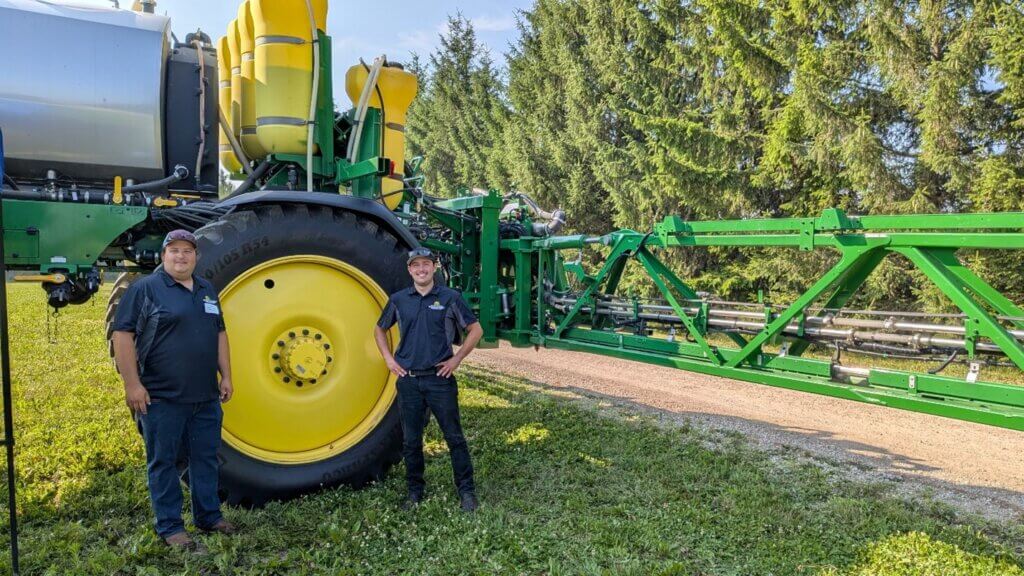
In the summer of 2025, Todd Frey of Clean Field Services (Drayton, Ontario) and I participated in the Elora Weeds Tour. We discussed his new John Deere See & Spray Premium and the practical considerations for implementing green‑on‑green spraying in Ontario (Figure 1). With that first season squarely in the rearview mirror, I reached out to Todd to ask about his experience.
To be clear, we had a lot of questions then and we still have questions now… but we’re optimistic. This article summarizes the original topics from the Weeds Tour, Todd’s 2025 learnings, and considerations for the year ahead.
Challenges Identified in 2025
Label Language and MRL Constraints
Optical spraying introduces uncertainties when interpreting pesticide labels written for broadcast applications. For example, an operator might elect to concentrate a herbicide beyond the common broadacre rate while technically adhering to the label. Depending on the active, this risks excessive residue levels that can cause crop replant issues. A few Canadian labels already address this grey area by specifying water-to-product ratios in addition to per‑hectare limits. Most do not.
Australia’s experience offers a possible way forward: optical systems in Australia are commonly calibrated at 100 L/ha (~10 gal/ac), and labels specify whether they permit higher concentrations for spot and patch spraying. Additionally, most labels state the operator must revert to a conventional broadcast application when fields have more than 30% weed cover.
Tendering and Mixing Logistics
Estimating product and water needs is, perhaps, one of the most difficult operational challenges. Traditional field scouting cannot accurately predict how much spray solution an optical sprayer will apply. This leads to logistics issues, increased risk of unnecessary leftovers, and subsequent disposal/clean out problems.
Nozzle Availability and Performance
Nozzle choice is central to realizing the full benefit of precision application. Ideally, operators require low‑drift, narrow‑angle nozzles with an appropriate dynamic range (i.e. travel speed vs. flow rate) to spray small weeds efficiently. Perhaps it goes without saying that a stable boom is critical in this equation, but we’ll say it anyway. Nozzle options are currently limited and we’ve written about this subject in a previous article.
Cost–Benefit Realities
While herbicide savings are an obvious appeal, the actual economics are more nuanced. The See & Spray Premium model adds a $6/acre CDN fee for unsprayed acres, which can diminish savings in very clean fields. A fall broadcast herbicide application improves the success of spring green‑on‑green passes, but this added cost must be figured in. Of course, there are many other benefits to a fall burndown that shouldn’t be dismissed, and you can read about them here.
On the other hand, perhaps good agronomy should be the motivating factor. Any savings from reduced broadcast spraying may allow operators to upgrade to more effective, higher‑value tank mixes, improving weed control and contributing to long‑term seedbank reduction. Regarding the later point, there have been recent studies that suggest using low sensitivity may adversely affect the seedbank.
New Chemistry Possibilities
It’s a stretch, but there could be a silver lining to increasing herbicide costs and resistance pressures: chemistries once considered too expensive for broadcast use could become economically viable for spot or patch applications. This would expand chemical options.
The 2025 Experience
Cost savings
To evaluate performance under Ontario conditions, Todd conducted a structured trial on his own 125‑acre corn field. In 2024 the field received a fall application targeting annual grasses and broadleaf weeds. Todd’s intention was to leave perennial sow-thistle and Canada thistle for targeted control in the spring.
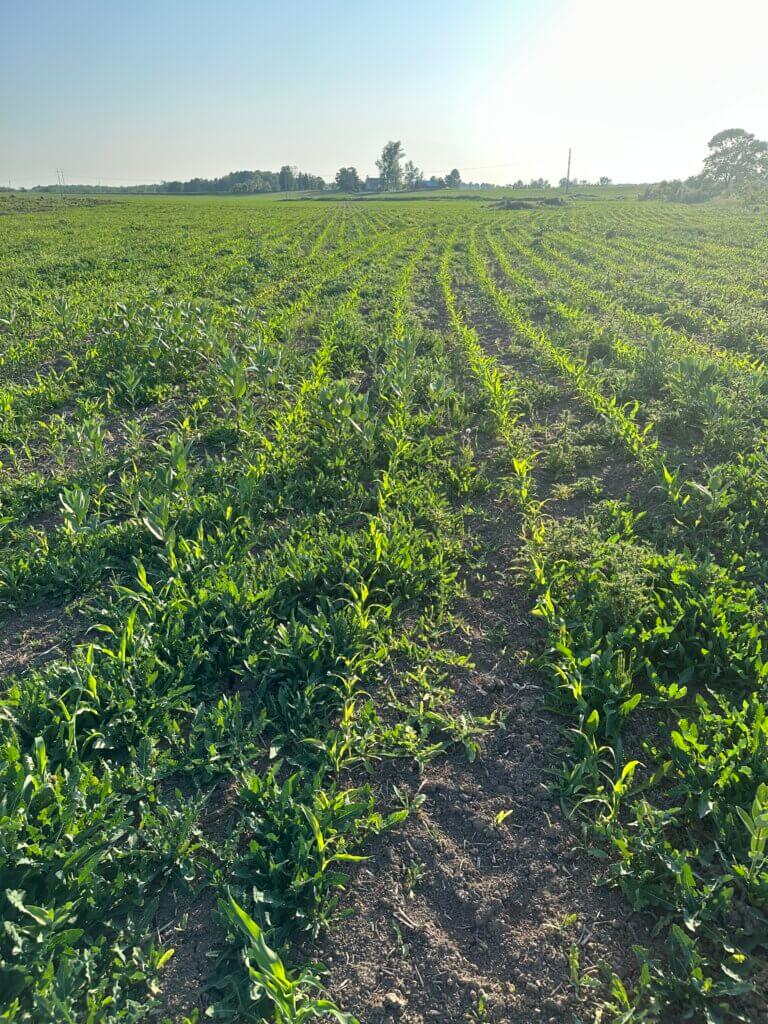
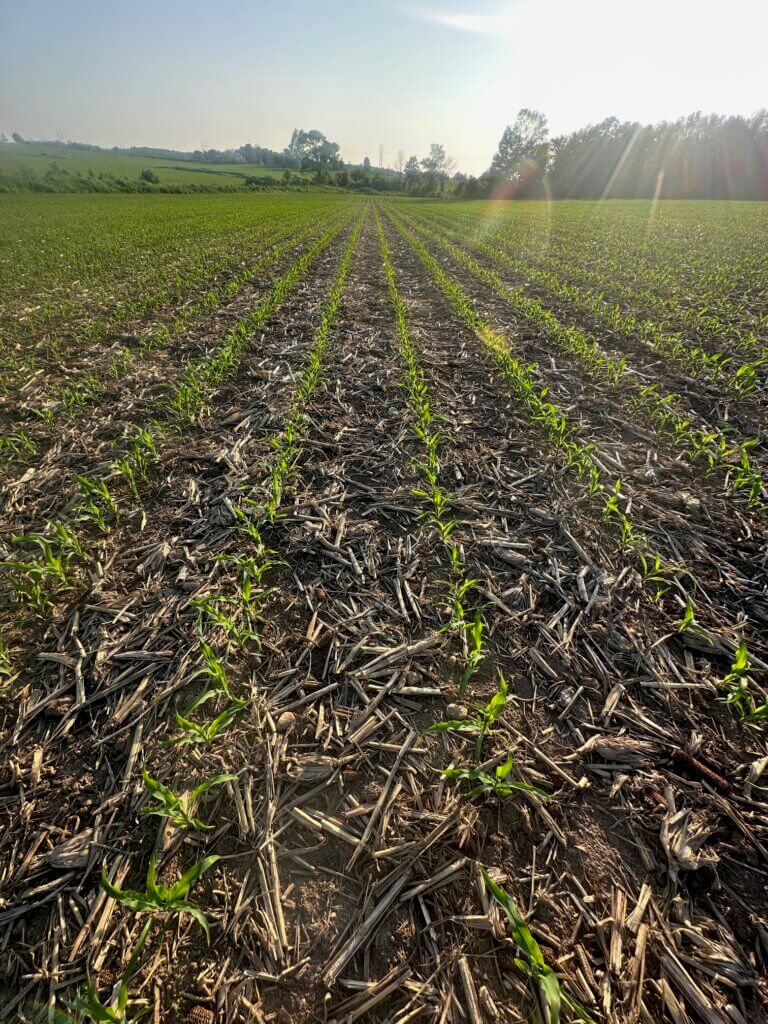
He used the See & Spray Premium to apply Lontrel + glyphosate at 13 GPA. The John Deere Operations Center map (Figure 2) shows a distinct high‑pressure zone in red. This corresponds to 2–3 acres recently reclaimed for production —significantly weedier (Figure 3) than the remaining acreage (Figure 4). This work was performed using the Deere TSL8005 nozzle, with sensitivity set to 3 (medium) and buffers set to medium in both directions.
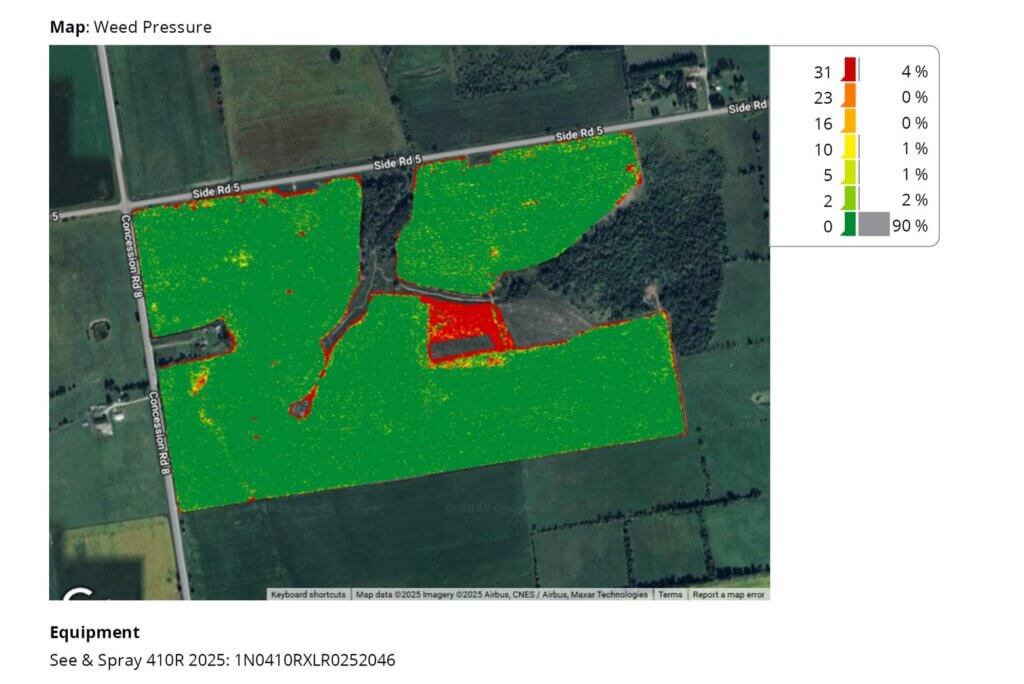
Download a copy of the as‑applied data. You’ll see the See & Spray treated only 25.8% of the field. If Todd had broadcasted Lontrel at 65 mL/ac and charged his typical $14.50/ac it would have cost $4,139.36. However, even with his premium spot-spray rate of $17/ac and passing on the $6/ unsprayed acre, the total cost was $3,507.96. This represents a net savings of $631.40, and the surprise twist: he used the 100 mL rate of Lontrel and still saved money.
So, in fields with moderate but uneven perennial pressure, See & Spray Premium can produce meaningful savings while enabling more robust chemistry.
Scouting Limitations
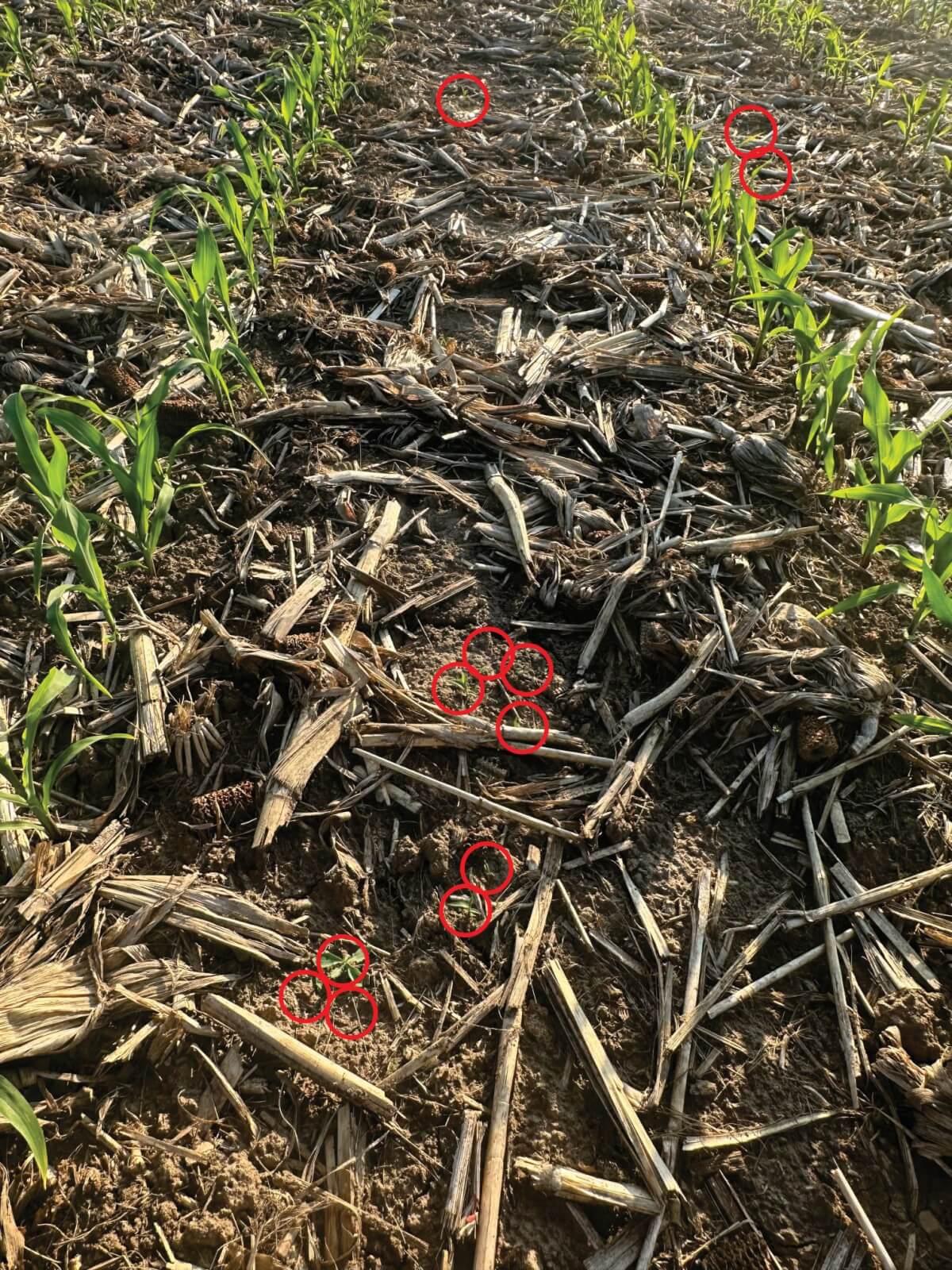
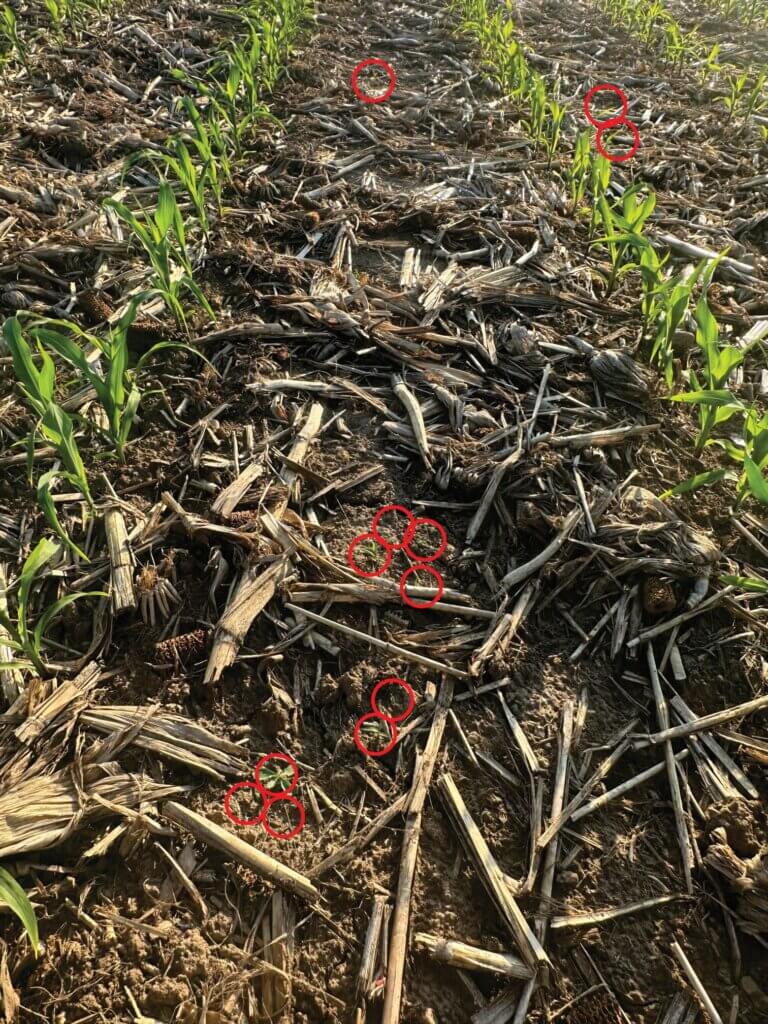
As expected, visual scouting underestimated real weed density. Figure 4 might seem clean at first blush, but the cameras see a different story hidden in the stover (Figure 5). This is why predictive tank‑mix planning is unreliable.
Optimizing Tendering Through Job Planning
Todd found that the best approach to minimizing leftovers was to group farms with similar pre‑emerge programs and weed spectra. He would then book them from the smallest to the largest fields, allowing leftover spray mix from smaller jobs to feed into larger ones. His goal was to finish with <5 acres worth and broadcast it at the end of the last job.
This kind of planning starts with the fall burndown and should be firmly in place by March. It’s already challenging to accommodate last-minute requests during spring spraying, but this approach makes it particularly difficult.
Customer Scheduling Challenges
There was some frustration along the learning curve. A few customers experienced delays waiting on sprayer availability and then paid the premium on a field that ended up requiring a broadcast application. Experience will help refine expectations and scheduling.
Looking Ahead: 2026 and Beyond
In 2025, the See & Spray machines in Ontario sprayed mostly soybean, but in Todd’s region it was predominantly corn. One reason was that most of his soybean customers weren’t quite sold on the fall application. Todd has plans to get into soybeans in 2026, but his strategy involves IP beans.
Traditionally, IP beans get a spring application timed to catch as many weeds as possible, perhaps too late for some and too early for others. Then Todd takes his phone off the hook as customers fret over burned beans while they inevitably grow out of the visual injury. But this time, Todd will make two targeted passes with a more expensive tank mix to do a better job of controlling weeds at the right stage, while avoiding burning the IP beans. If his projections are correct, he believes he can accomplish this more economically than a single broadcast pass.
We’ll update this article with the outcome. Be sure to check back and see if he succeeds 🙂
Conclusion
Ontario’s early experience with green‑on‑green optical spraying suggests that while the technology is promising, it requires substantial logistical planning, label awareness, and nozzle optimization. Under the right conditions—particularly where weed pressure is irregular but significant—operators can achieve both economic savings and precise weed control.
As adoption increases and equipment evolves, we’ll learn more about where spot and patch spraying technology fits in changing weed management programs.
Thanks to Todd for sharing his experience and insights.
