On May 29, 2015, we launched www.sprayers101.com. Actually, that date is practically correct, but not technically correct. To celebrate our anniversary, I thought I’d share the history of how of we got to where we are today.
2013
On December 21, 2013, I launched www.sprayers101.com… sort of. Back then, the website was different. I’d just developed a classroom -based course called “Airblast101” to teach applicators how to calibrate, operate and maintain their airblast sprayers. The website was a virtual and self-directed version for those that couldn’t attend in person.
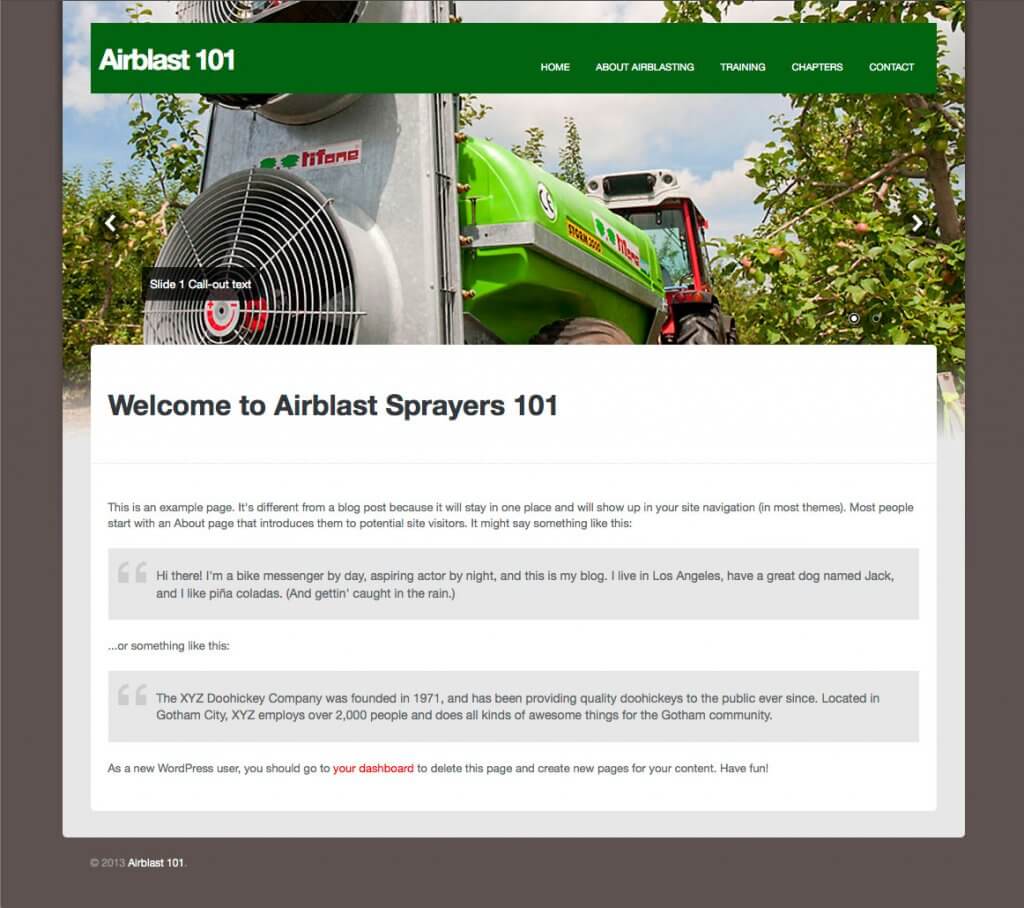
The name “Sprayers101” sounded like a first-year university course, so it seemed an appropriate domain name. I could have called the site “Airblast101” but I had hope that the course might one day expand to include field crop, closed environment and aerial spraying systems. Being generic gave room to grow.
After the launch, I lurked behind the scenes, addicted to Google Analytics (a diagnostic tool that lets us assess how the site was being used). It was a thrill to see a modest number of people around the Great Lakes and in British Columbia use this new resource. But they weren’t using it the way I’d envisioned. It was designed as an online course, so it was assumed the user would start at the first page and read it in order until they reached the end. Instead, they were jumping all over the place.
Users would search for key words to find specific information, and once they had what they wanted, they left. This suggested the audience was more interested in a resource library. They were also interested in bite-sized morsels, not a long-term commitment.
2014
Around this time, I was fortunate to have been in communication with Dr. Tom Wolf. I took a flyer and proposed that we team up to re-create the website from the ground up. I knew it would benefit immensely from his experience as a global authority on application technology. Happily, Tom agreed and he brought an insight and creativity to the project that helped transform it. We worked for the next six months to develop and assemble new content as well as beta test website designs. Then we re-launched.
In the 17 months B.T. (Before Tom) I had a total 31,500 page views. Only six months A.T. (After Tom) we gained 70,000 more. We were on to something good. The numbers continued to climb as we added calculators, opinion pieces, research results and invited content from contributing authors.
2015
In 2014 Tom encouraged me to explore social media. By 2015 we were deeply involved in Twitter, using it to learn from farmers, discuss their issues and draw inspiration for some of our articles. Our handles “Nozzle_Guy” and “Spray_Guy” were entirely coincidental – seriously. There was another bump in website use in 2018 when we created “Exploding Sprayer Myths”, which are parody-based educational videos for our companion YouTube channel. Incidentally, we’re still hoping to one day find a legit educational reason to blow up a sprayer.
2021
In July, 2021 we decided to refresh and relaunch the site. Most of the changes addressed stability, improved smart phone access, and allowed us to cross-reference and re-organize content (an ongoing administrative task). We adopted a cleaner look and lost the drop-down menus to focus on a more powerful search engine to help users access the now 250+ articles.
2025
Today, ten years since we reimagined the site, sprayers101.com has grown beyond what might be considered “101”. It receives >250,000 page views annually from users all over the world. Of the 325+ posted articles, our most popular have been viewed more than 20,000 times. We have more than 2,000 subscribers. We’re often contacted by people who tell us how much it has helped their spraying practice, or how it’s been used to train new industrial, agronomic and regulatory staff.
Our original goal was to provide the best information on agricultural spray application, and that remains true today; from humble backpack sprayers and fundamental skills through to drones and autonomous sprayers with optics, prescription maps and algorithms. The site is, and has always been, entirely impartial to preserve the integrity of the content we offer.
Our heartfelt thanks to our readers, to our sponsors, and to our contributing authors.
Happy Spraying.
2026 ADDENDUM
Just for completeness, and given that this article is something of a historical record, we relaunched the website in March of 2026. New features include:
- All-new look and feel, including an animated logo
- Bulleted, AI-generated summaries
- Far better search engine with predicative text and the ability to search titles and tags
- Referenced and printable articles
- Better layout on mobile devices
And we have lots of ideas to takes us into the next ten years.