- Air-assist is the secret sauce for efficient, uniform spray coverage, reaching both abaxial and adaxial surfaces not achieved by hydraulic systems.
- Micothon M2 used about 20% less water and product, with reduced run-off versus conventional hydraulic tree sprayers.
- Well-engineered but imperfect: self-leveling wheels, drive-assist, break-away boom, powerful centrifugal fan; downsides include diesel exhaust, latency, and battery concerns.
This text was generated by OpenAI GPT 5 Mini
I’ve experienced a few spectacular failures trying to build niche sprayers. Until now, I haven’t had a reason to write much about them. But I decided the contrast, and confession, would be a fun way to set the scene for a discussion about an excellent niche sprayer.
Failed Attempts
First, the ill-fated “Hops Sprayer”. We used an adjustable ladder to position 20 feet of arborist guns between hop rows. The nozzles could be raised and engaged to match the growing crop canopy. While it left decent coverage on the adaxial surfaces, we quickly realized it needed air-assist to get under the leaves and battle high winds at the top of the trellis. It’s since been cannibalized for parts, and the rusted remains haunt me whenever I drive by the outdoor storage area at our ag research station.

Later, encouraged by a minor success ducting a backpack mist blower with PVC and Coroplast, I tried building an air-assisted spray cart for a floriculture operation. It featured commercial, high-volume radial fans paired with hollow cone nozzles positioned in front of the air outlets. With respect to GreenTech and Croplands Equipment in Australia, I tried to build a bargain-basement SARDI-style head.
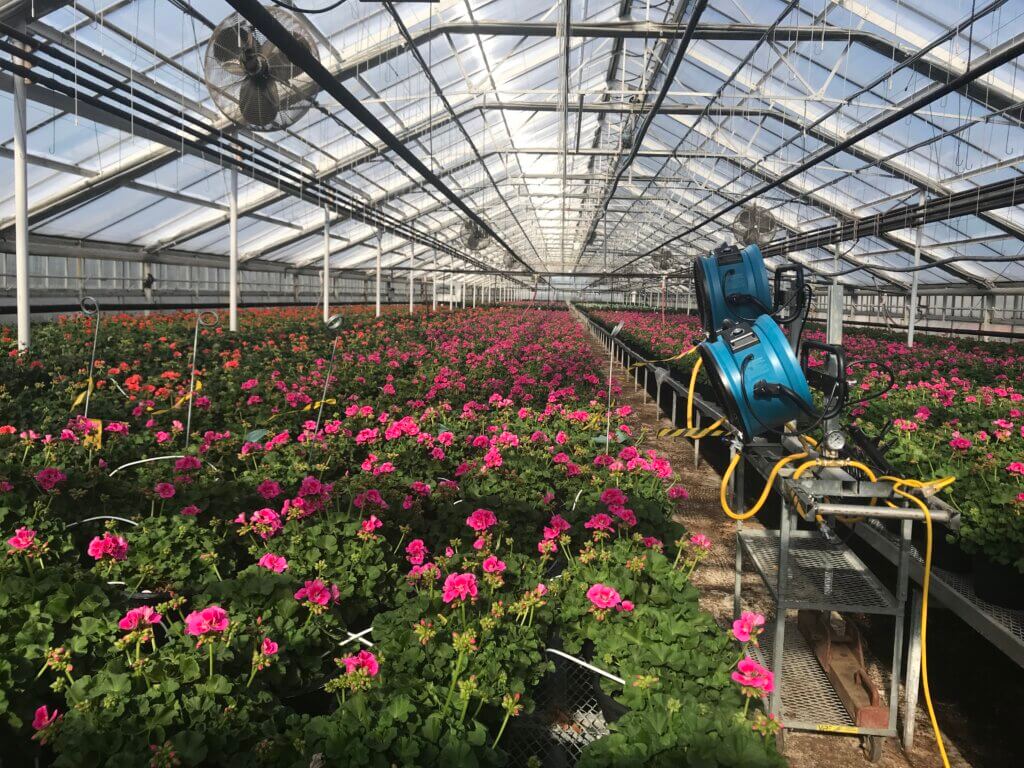
As it turns out there’s a very good reason engineers use computational fluid dynamics to design air-assisted sprayers. We were ultimately beaten by an uneven greenhouse floor crowded with obstacles, a stiff canopy of geraniums, and the inverse square law, which states: “The farther away an object is from an effect, the less change can be observed in the object”. This rig now has a new life circulating hot air in a boiler room.
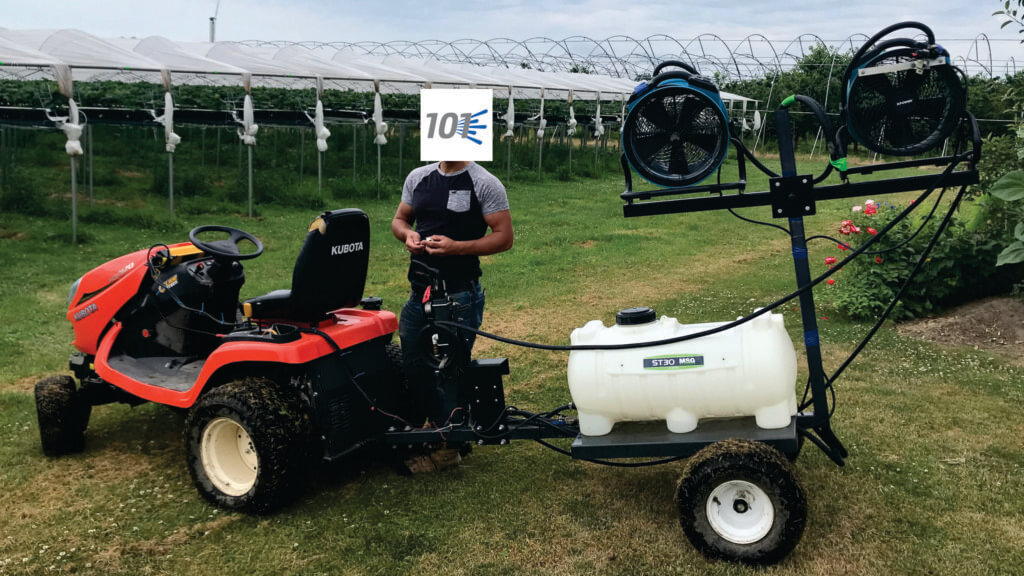
And I once built an air-assisted, tow-behind sprayer to spray troughs of tabletop, hoop house strawberries. That unit laid down an excellent, uniform spray on all foliar surfaces, but it was frustrating to use. There was almost no clearance in the hoop house, which changed height with the topography, and the alternator couldn’t keep the battery sufficiently charged to run the pump and fans. I felt we could overcome these small difficulties, but sadly the operator ended this experiment halfway through the season. I can only assume the sprayer is now an interesting piece of lawn sculpture.
The Micothon M2
Despite my inability to build a decent air-assisted sprayer, I have always maintained that air-assist is the secret sauce for efficient, uniform spray coverage. Lucky for me, Great Lakes Greenhouses (GLG) agreed. No stranger to innovation, the company recently purchased a first generation, air-assisted Micothon M2 greenhouse sprayer and invited me to come see it. This was a proper sprayer designed by engineers, and not a delusional plant physiologist, so I was excited to assess and calibrate it. This article will describe what we learned and perhaps in some small way, validate my failed attempts.
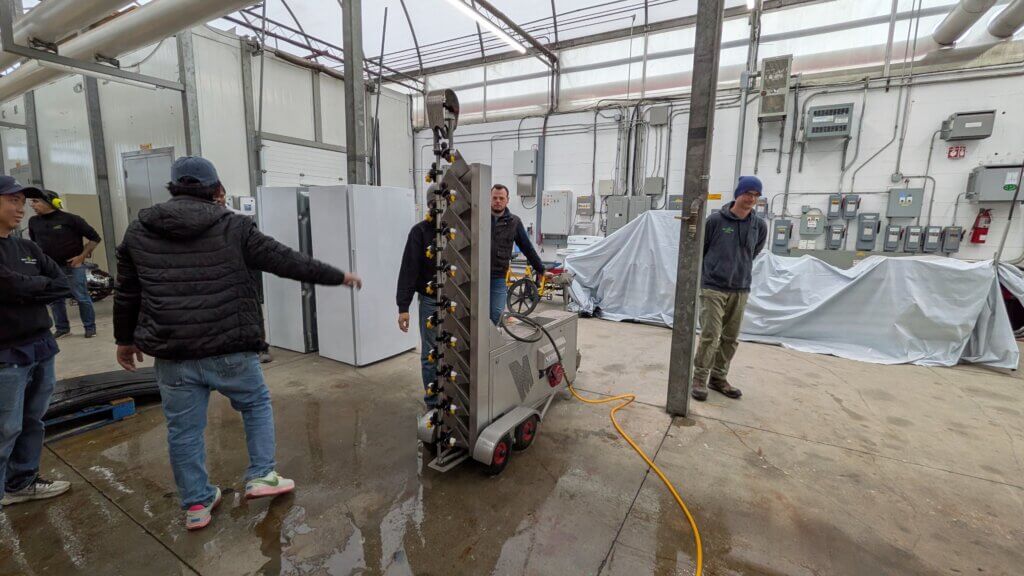
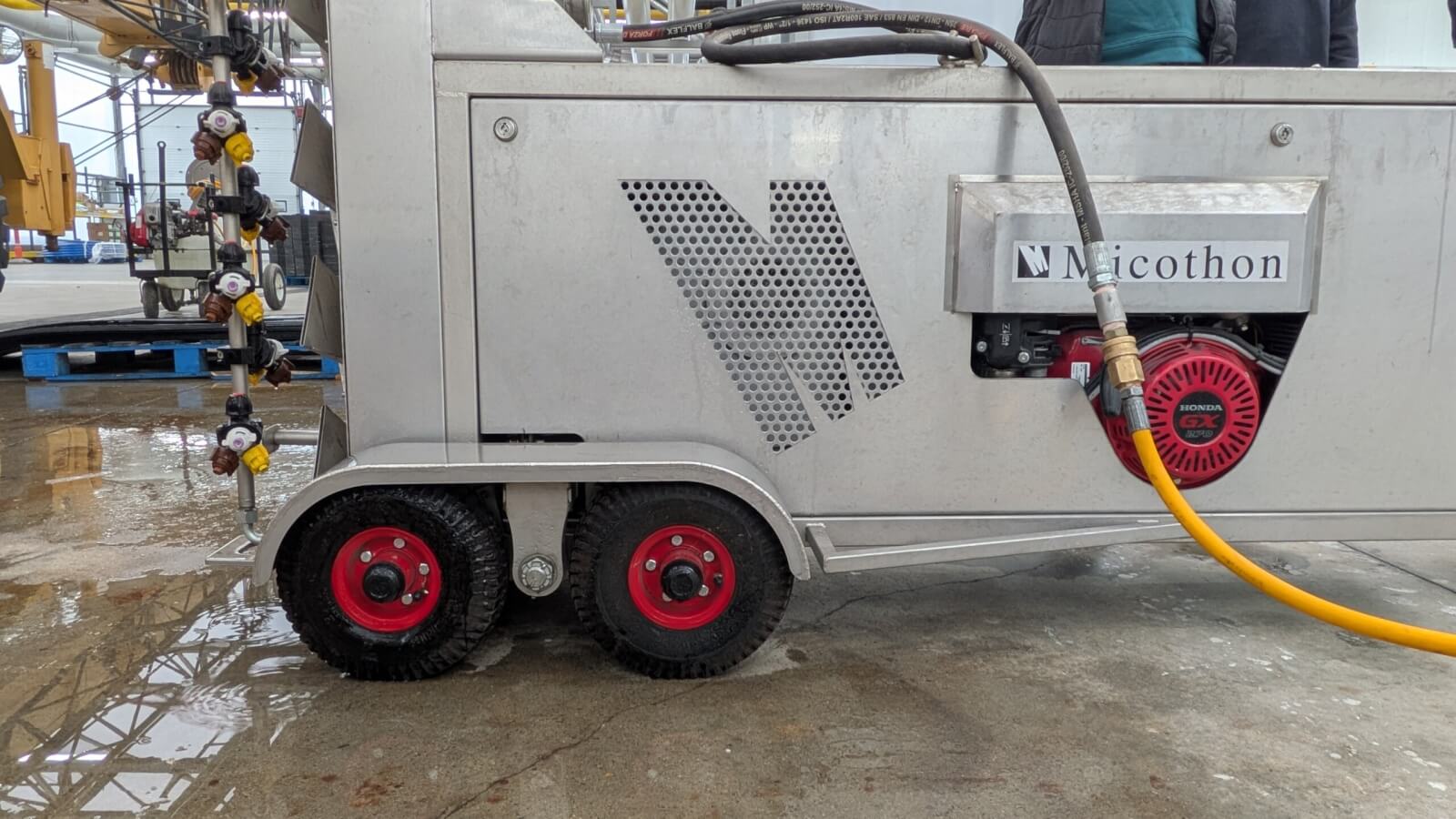
The M2 features a vertical boom design supported by a portable tender unit, but that’s where the similarities to a classic “tree” sprayer end. Rather than riding on the hot water pipes, or tipping onto two wheels like a hand cart, this version rides on self-leveling wheels. It is drive-assisted but still has to be guided by an operator, like a self-propelled walk-behind lawn mower.

The mast features 18, three-position nozzle turrets (nine to a side). GLG requested a bespoke spring-loaded break-away section at the top of the boom. This allowed the top nozzles to “duck” under an annoying section of greenhouse infrastructure that would have otherwise prevented it from being positioned between the rows.
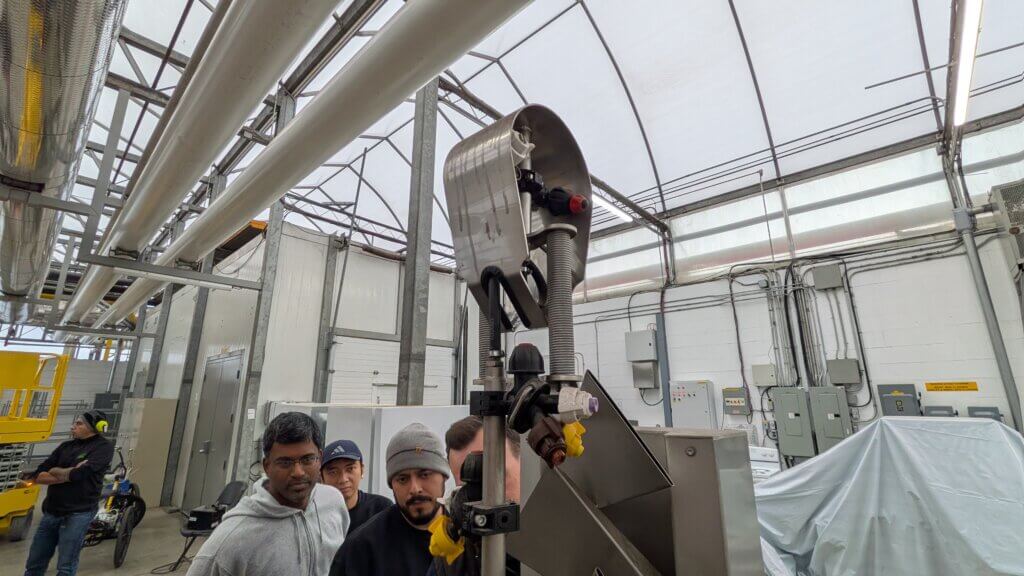
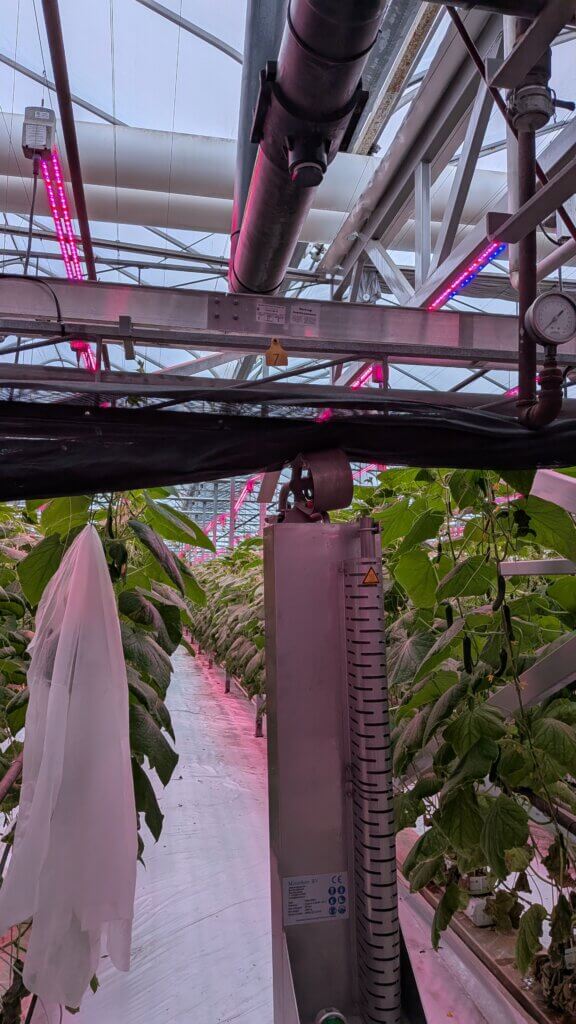
The air is generated by a centrifugal fan powered by a Honda motor. The air travels up the ducted mast to a manifold of narrow air outlets. When the sprayer is moving, the air outlets precede the nozzles, which initially seemed wrong as the spray would be released outside the air stream. But, upon closer inspection, we saw that the air outlets are not only angled up by 45 degrees but are also angled back so the air can transect the spray.
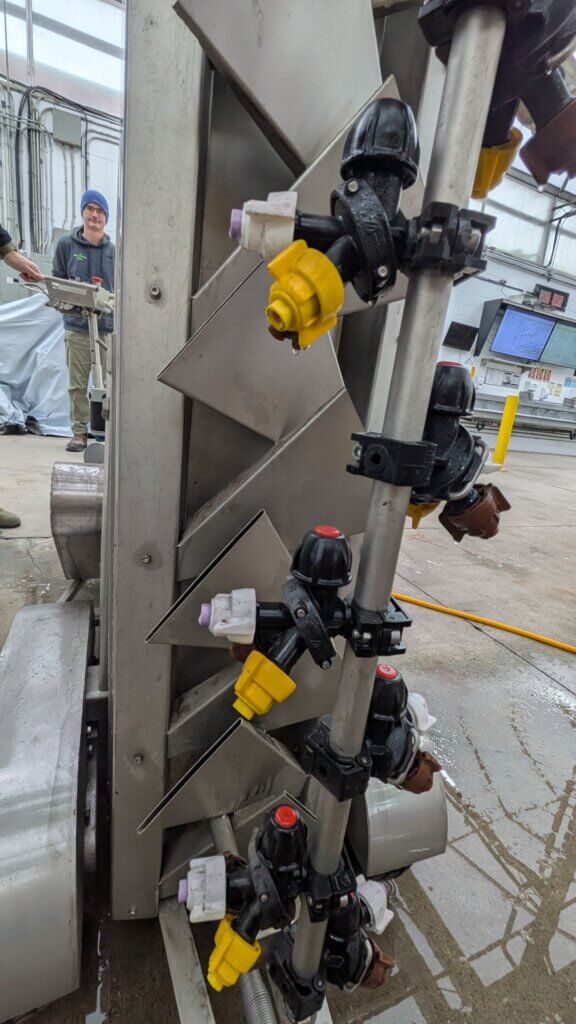
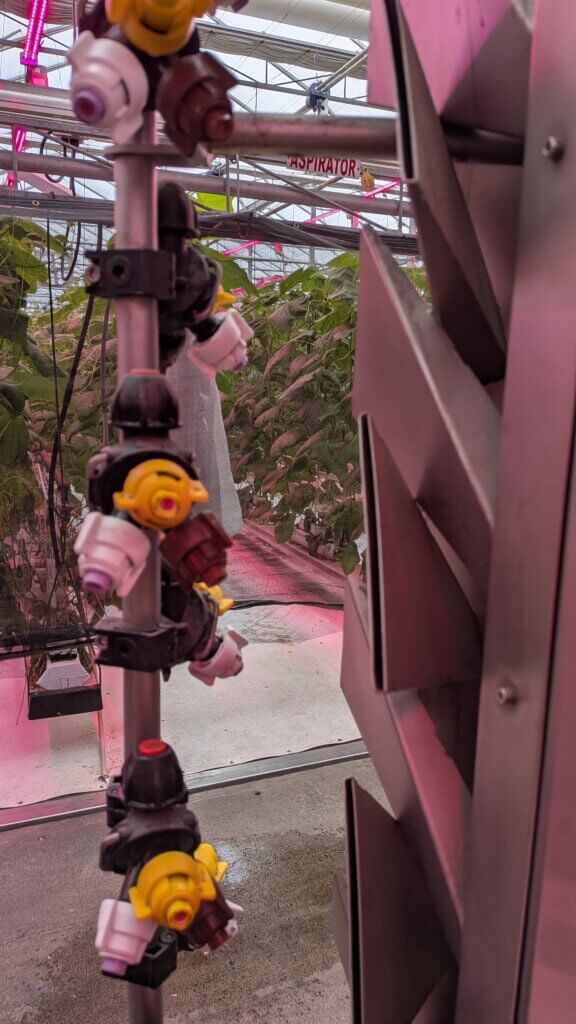
It was suggested that the blade of air acts like an airfoil, creating an area of low pressure and sucking small droplets into the airstream. This is Bernoulli’s principle and it describes how wings create lift. Personally, I think it behaved more like a Venturi. I’m open to debate since, as evidenced by my attempts at building a sprayer, I’m no engineer. What matters is that we didn’t see any droplets hanging in the air as the sprayer passed. It works.
Calibration and Optimization
We followed the same greenhouse sprayer optimization protocol I’ve outlined in this article. Go give it a quick read and come back so I won’t have to reiterate why we took the steps we did.
Travel speed and air settings
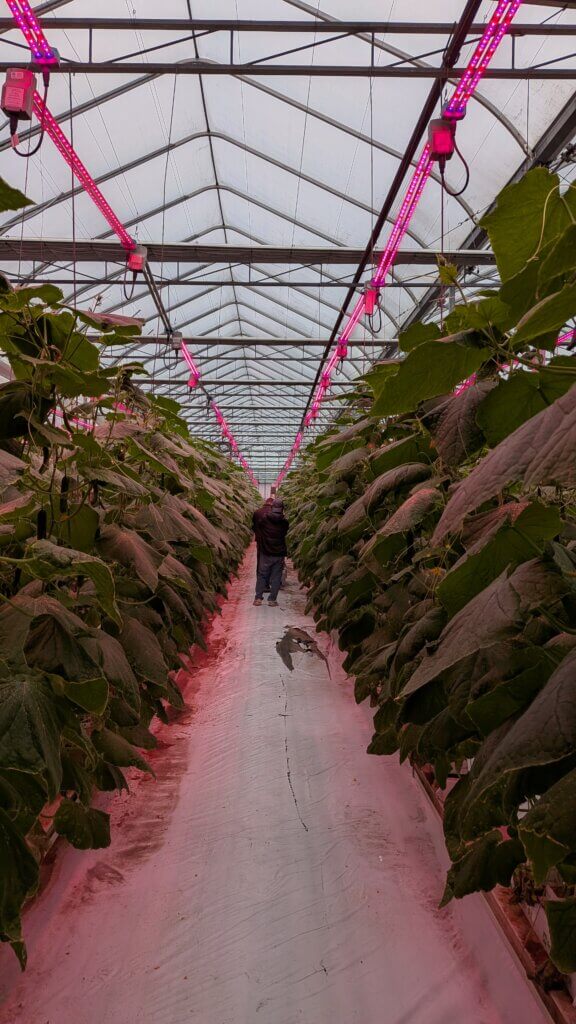
The sprayer was set to speed “3” of a possible “5”, as recommended by Micothon. Travel speed dictates dwell time, which is the duration the air is focused on the target. Observers stood in the drive alley and in the two adjacent alleys to see how the air moved leaves. The upward angle of the outlets combined with the volume produced by the centrifugal fan wafted and twisted leaves on their petioles. This created sufficient movement throughout the canopy, but not so much that it caused the canopy to louver shut. It was a Goldilocks situation so there was no need to alter anything.
Pressure and nozzles
The tender system regulator was set to 41.5 bar (600 psi) and that pressure dropped to 5.5 bar (80 psi) according to the gauge on the sprayer. While we didn’t test it, I’m certain the pressure at the furthest (aka highest) nozzle would have been closer to 5 bar (~70 psi). With observers in place, we started spraying water using the Albuz 025 (lilac) hollow cone tips.
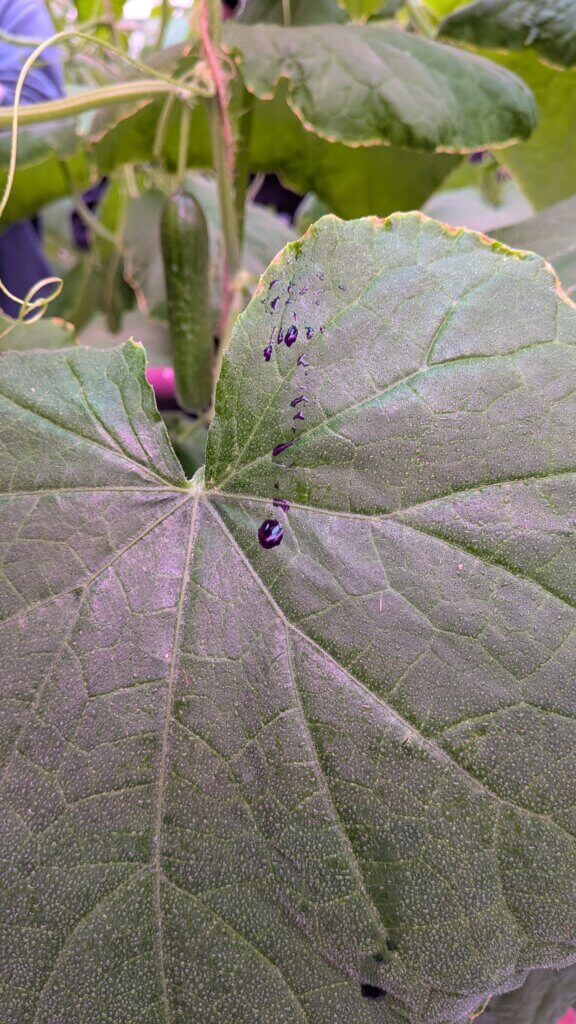
We saw the highest nozzle positions were spraying over the canopies and did not need to be on. We also saw drip points form at the tips of the leaves and the bottom of the cucumbers. There was evidence of yellowed (possibly damaged) tissue at the leaf tips, suggesting they were often sprayed to drip. This is wasteful and tends to redistribute deposits in undesirable ways. While it’s hard to avoid on the waxy, vertical cucumbers, it can be prevented on the leaves.
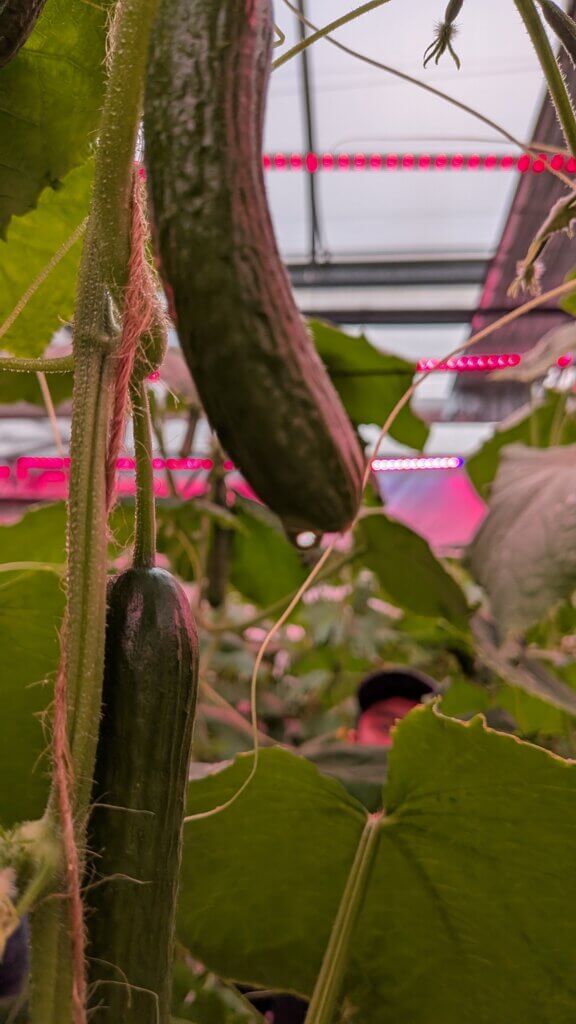
We turned off the top nozzles, swapped to Albuz 02 (yellow) hollow cones, moved to an unsprayed canopy and tried again. Effectively this was a 20% cut in water and product, but there were no more drips on leaves and less evidence of coalescing deposits. The cucumbers still had drip points, but without an adjuvant that was the best we could do. That’s assuming there would be value in spraying the fruit in the first place – these sprays were targeting the foliage.
Coverage
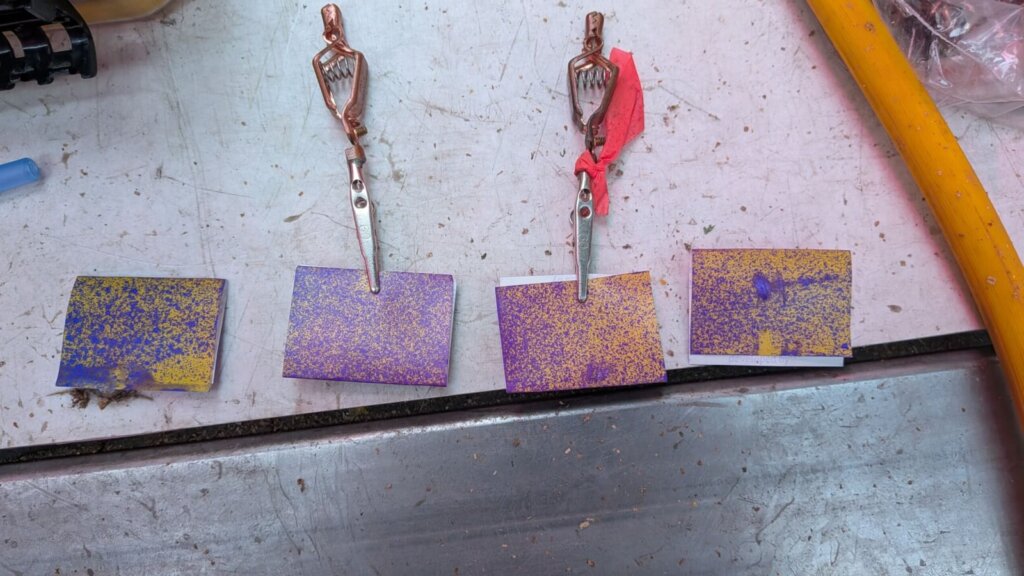
With the subjective part of the assessment complete, it was time to quantify spray coverage. Water sensitive papers were oriented co-planar with the leaves and essentially parallel to the ground. We clipped them 2-3 cm below the leaves by affixing them to the petioles. This way they would move with the leaf and represent a very challenging target (reminiscent of a sucking insect on the abaxial leaf surface).
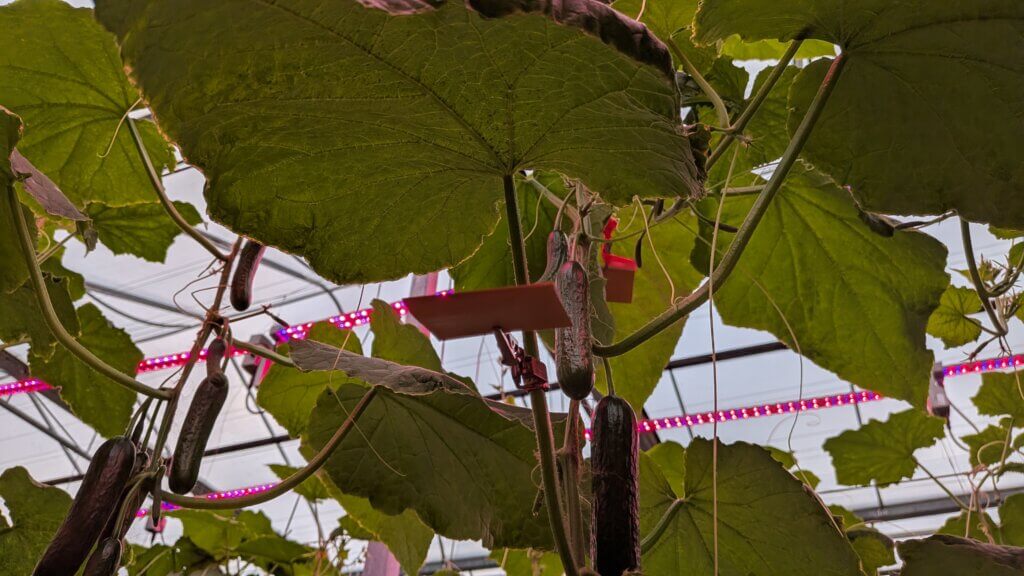
We divided the canopy into quarters, placing one target in each section. This spanned the height of the canopy, but we also positioned them along the canopy depth: One on each of the four plants in the row. This left us with a diagonal cross-section. Read it again – you’ll get it.
Then we sprayed the row from one side and inspected the results. We saw excellent coverage on the abaxial surfaces of the two plants closest to the sprayer. We expected that. But we were pleasantly surprised to see the spray got in under the umbrella-like leaves and deposited on the adaxial surfaces. This was not line-of-sight for the nozzles, and there wasn’t much room between the paper and the underside of the leaves, so this was clearly the result of air-assisted droplets.
There was also respectable coverage on the two plants on the far side of the row. These targets were greatly improved once we travelled down that alley and saw the cumulative coverage. This is why you should (almost) never perform alternate row spraying.

Compared to a tree
Since I was in the neighbourhood, we decided to see what a conventional, hydraulic tree could do by way of comparison. Frankly, there was none.

The tree was nozzled with Albuz 04 (red) hollow cones angled upwards. There were only a few check valves, so it leaked when it was turned off and had to be drained at the end of each row using a quarter turn valve. Coverage was generally excessive (i.e. coalesced droplets and lots of run-off) and non-uniform (we randomly missed both adaxial and abaxial surfaces).
We re-nozzled to my favourite load out: TeeJet TwinJet fans alternating back and forth by 45 degrees from centre. Using 03’s (blue), we observed improved uniformity, but still saw misses and suspected we were still using too much water. When leaves are drenched they get heavy, causing them to hang lower and obscure the other parts of the plant. This is the contradiction that limits a strictly hydraulic system: Pressure motivates droplet movement, so you need slightly larger drops and more volume. However, too much water causes run-off and weighs leaves down, obscuring the rest of the canopy. Catch 22.
I proposed getting a set of 02 (yellow) tips in the hopes there would still be enough spray for better uniformity. I hope they tried it.
A few beefs about the M2
There’s always room for improvement. Before you think I’m selling these sprayers, here are a few observations from the owners and from what we saw that day. No deal breakers, just some nice-to-haves:
- The diesel exhaust from both the sprayer and the tender cart is not ideal. Applicators wear respirators, and the greenhouse fans tend to dilute the exhaust, but a battery system (perhaps like a drone) would be preferable to power the drive electrically.
- There was a latency with the self-leveling wheels and with air build-up in the tower portion of the sprayer. You simply need to be patient before you start down a row.
- The tower section gets hot to the touch, likely because of the position of the exhaust pipe.
- The alternator on board recharges the battery, but if you let it sit the battery is depleted (sounds like the same trouble I had with my sprayer, which is somehow gratifying).
I’m sure you’re asking “How much?”
Well, at the time of writing, it was almost $70,000.00 CDN, but don’t judge it too harshly! Bear in mind that our assessment saw a reduction of 20% water and crop protection product that would otherwise have ended up on the greenhouse floor. Not only is that a big savings in water and inputs, but it’s fewer refills and it produced far better spray coverage that a hydraulic system. While improved coverage is not always linked to improved efficacy, they certainly go hand in hand. And when we’re considering “softer”, biorational greenhouse chemistries, improved coverage is the best bet we have for pest control.
All in all, this was an excellent sprayer that I hope is the first of many to grace Ontario’s greenhouses.
Thanks to Great Lakes Greenhouses for the invitation, and thanks to all the other grower cooperators (names withheld to protect the innocent) that took a risk on building budget, niche sprayers with me. Sometimes, you just have to throw money at it.
