Author: Wendy McFadden-Smith

  • Rainfastness of Insecticides and Fungicides on Fruit

    Rainfastness of Insecticides and Fungicides on Fruit

    This article was co-authored by Kristy Grigg-McGuffin, OMAFA Horticulture IPM Specialist

    In view of the frequent heavy rains in many regions this season, understanding rainfastness, or the ability of a pesticide to withstand rainfall, is important to ensure proper efficacy. All pesticides require a certain amount of drying time between application and a rain event. Typically, residue loss by wash-off is greatest when rain occurs within 24 hours of spraying. After this point, the rainfastness of a product will depend on formulation, adjuvants and length of time since application.

    Rainfastness of Insecticides

    John Wise, Michigan State University has studied rainfastness of common tree fruit insecticide groups and his findings are summarized below. For the complete article, refer here. Note that some products listed in this article may not be registered for use in Canada. Check with your local supplier or in Ontario, refer to OMAFA Publication 360 for a complete list of registered products.

    According to Wise, the impact of rain on an insecticide’s performance can be influenced by the following:

    1- Penetration

    Penetration into plant tissue is generally expected to enhance rainfastness.

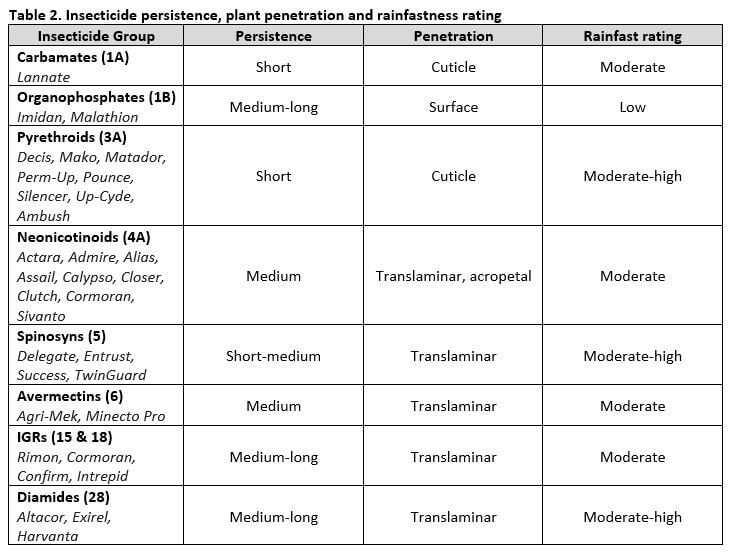
    • Organophosphates have limited penetrative
      potential, and thus considered primarily surface materials.
    • Carbamates and pyrethroids penetrate the cuticle,
      providing some resistance to wash-off.
    • Spinosyns, diamides, avermectins and some insect
      growth regulators (IGR) readily penetrate the cuticle and move translaminar (top
      to bottom) in the leaf tissue.
    • Neonicotinoids are considered systemic or
      locally systemic, moving translaminar as
      well as through the vascular system to the growing tips of leaves (acropetal
      movement).
    • For products that are systemic or translaminar,
      portions of the active ingredient move into and within the plant tissue, but
      there is always a portion remaining on the surface or bound to the waxy cuticle
      that is susceptible to wash-off.

    2- Environmental persistence and inherent toxicity

    Environmental persistence and inherent toxicity to the target pest can compensate for wash-off and delay the need for immediate re-application.

    • Organophosphates are highly susceptible to
      wash-off, but are highly toxic to most target pests, which means re-application
      can be delayed.
    • Carbamates and IGRs are moderately susceptible
      to wash-off, and vary widely in toxicity to target pests.
    • Neonicotinoids are moderately susceptible to
      wash-off, with residues that have moved systemically into tissue being highly
      rainfast, and surface residues less so.
    • Spinosyns, diamides, avermectins and pyrethroids
      are moderate to highly rainfast.

    3- Drying time

    Drying time can significantly influence rainfastness, especially when plant penetration is important. For instance, while 2 to 6 hours is sufficient drying time for many insecticides, neonicotinoids require up to 24 hours for optimal penetration prior to a rain event.

    4- Adjuvants

    Spray adjuvants that aid in the retention, penetration or spread will enhance the performance of an insecticide.

    The following tables can serve as a guide for general rainfastness to compliment a comprehensive pest management decision-making process. They are adapted from “Rainfast characteristics of insecticides on fruit” by John Wise, Michigan State University Extension.

    Based on simulated rainfall studies to combine rainfastness with residual performance after field-aging of various insecticides, including carbamates (Lannate), organophosphates (Imidan, Malathion), pyrethroids (Capture), neonicotinoids (Assail, Actara, Admire), IGRs (Rimon, Intrepid), spinosyns (Delegate) and diamides (Altacor), Wise recommends the following re-application decisions for apples. Additional work was done on grapes and blueberries; see Wise’s article for this information. Among the crops, variation in rainfastness of a specific insecticide occurs since the fruit and leaves of each crop have unique attributes that influence the binding affinity and penetrative potential.

    • ½ inch (1.25
      cm) rainfall:
      All products with 1-day old residues could withstand ½ inch
      of rain. However, if the residues have aged 7 days, immediate re-application
      would be needed for all products but Assail, Rimon, Delegate or Altacor on
      apples.
    • 1-inch (2.5
      cm) rainfall:
      In general, most products would need re-application following
      a 1-inch rainfall with 7-day old residues, whereas Delegate and Altacor could
      withstand this amount of rain on apples and would not need to be immediately
      re-applied. Some products such as Imidan on apples could withstand 1 inch of
      rain with 1-day old residues.
    • 2-inch (5
      cm) rainfall
      : For all products, 2 inches of rain will remove enough
      insecticide to make immediate re-application necessary.

    It is important to note, not all products registered for the selected pests were included in this study. Refer to Publication 360 for a complete list of management options.

    Rainfastness of Fungicides

    There is no comparable research on rainfastness of fungicides and few labels provide this kind of information. A general rule of thumb often used is that 1 inch (2.5 cm) of rain removes approximately 50% of protectant fungicide residue and over 2 inches (5 cm) of rain will remove most of the residue. However, many newer formulations or with the addition of spreader-stickers, some products may be more resistant to wash-off. Avoid putting on fungicides within several hours before a rainstorm as much can be lost to wash-off regardless of formulation. As well, there are exceptions to the general rule in regard to truly systemic fungicides such as Aliette and Phostrol.

    The effectiveness of sticker-spreaders with fungicides is variable and product/crop specific. Penetrating agents don’t help strobilurins; in fact, some fungicide/crop combinations have been associated with minor phytotoxicity due to excessive uptake. Captan, which is intended to stay on the surface, is notorious for causing injury when mixed with oils or some penetrating surfactants that cause them to penetrate the waxy cuticle.  Consult labels for minimum drying times for individual products and recommendations for using surfactants. 

    Annemiek Schilder, Michigan State University suggests the following to improve fungicide efficacy during wet weather:

    • During rainy periods, systemic fungicides tend
      to perform better than protectant (or contact) fungicides since they are less prone
      to wash-off.
    • Applying a higher labelled rate can extend the
      residual period.
    • Apply protectant fungicides such as captan
      (Supra Captan, Maestro), mancozeb (Manzate, Dithane, Penncozeb) and metiram
      (Polyram) during sunny, dry conditions to allow for quick drying on the leaves.
      These types of fungicides are better absorbed and become rainfast over several
      days after application.
    • Apply systemic fungicides such as sterol
      inhibitors (Nova, Fullback, Inspire Super), SDHI (Fontelis, Sercadis, Kenja, Aprovia
      Top, Luna Tranquility) and strobilurins (Flint, Sovran, Pristine) under humid,
      cloudy conditions. The leaf cuticle will be swollen, allowing quicker
      absorption. In dry, hot conditions, the cuticle can become flattened and less
      permeable, so product can breakdown in sunlight, heat or microbial activity or
      be washed off by rain.

    Click here to refer to the complete article.

  • “Bee” Responsible with Pesticide Sprays

    “Bee” Responsible with Pesticide Sprays

    Horticultural crops cannot be produced commercially without the use of pesticides to manage the impacts of insects and pathogens. Growers recognize the importance of pollinators and in some cases, rely on bees for pollination. Growers are practicing due-diligence to try to minimize the effects of necessary pest management activities on bees. There’s a fine balance between managing pests effectively and economically and minimizing the effects of pesticides on pollinators. Impact on pollinators is a major consideration for the registration of pesticides.

    Not all pesticides are toxic to honeybees.

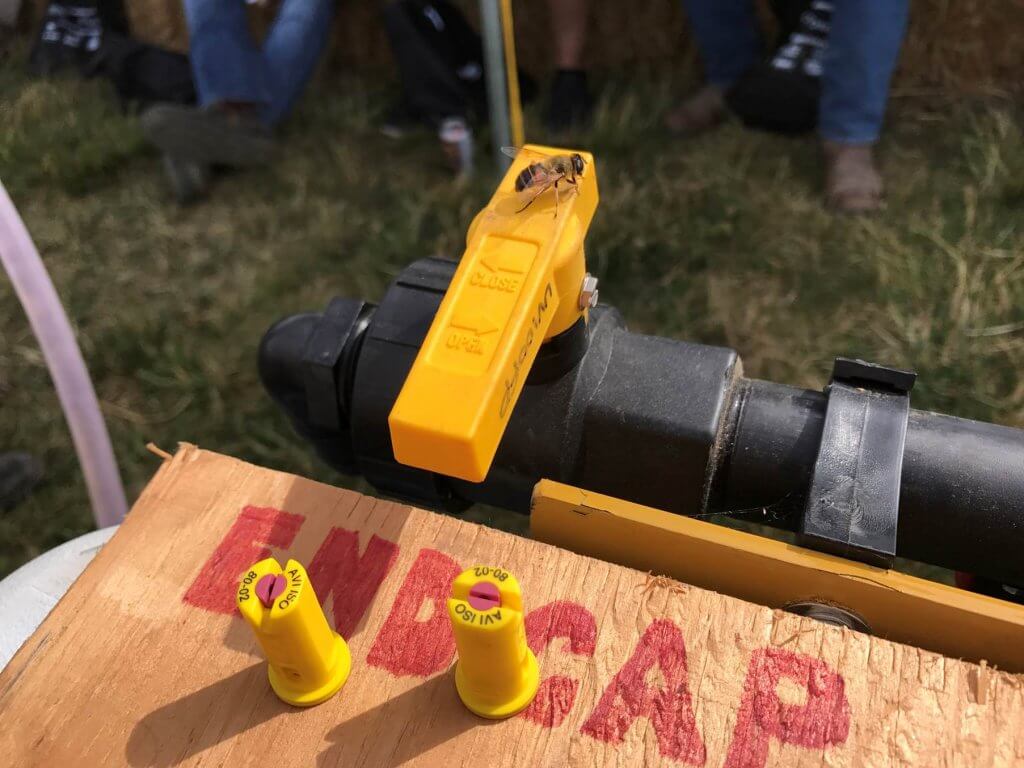
    Not a honeybee, but a great photo of a pollinator on a spray boom near some nozzles. Too good not to use.

    Growers use IPM practices which means that they are spraying only when necessary (monitoring for pest levels) rather than following a calendar-based program. Because each droplet of spray that does not land on the target (the crop) is wasted money, growers are more conscious of drift and are using technology to reduce off-target drift.

    The Ontario Bees Act states “No person shall spray or dust fruit trees during the period within which the trees are in bloom with a mixture containing any poisonous substance injurious to bees unless almost all the blossoms have fallen from the trees.” While some crops, like grapes and peaches, do not rely on insects for pollination, bees may still visit their flowers and they are still present in vineyards and orchards before and after bloom, foraging for nectar and pollen on flowering plants in row middles and surrounding vegetation areas. We have been promoting row middle management with flowering plants to encourage the presence of beneficial insects. Honey bees are also attracted to these plants. For this reason, it’s important to recognize that sprays applied to manage pests may have adverse effects on honey bees as well.

    One of the most important things to do is to maintain communication between growers/custom operators and beekeepers. While it’s common sense to not allow insecticides to drift directly onto bee hives, bees will usually forage up to 3 km from a hive and when food sources are scarce, they are known to fly as far as 12 km (8 miles) (Download reference).

    BeeConnected is an app connecting registered beekeepers with registered farmers and spray contractors, enabling anonymous communication on the location of hives and crop protection product activities. The app is available free of charge through a web browser, the Apple App Store and Google Play.

    Here are a few others things you can do:

    Read the pesticide label:

    Carefully follow listed precautions with regard to bee safety. In some cases a product may not be used while bees are actively foraging.

    Product selection:

    Pesticides (insecticides and fungicides) are not all equally toxic to honey bees. It is also important to be familiar with the relative toxicity of pest control products to bees. In Publication 360, Fruit Crop Protection Guide, the relative honeybee toxicity is now listed in the fungicide and insecticide activity tables of each chapter. The impact of products that are moderately toxic to bees can be can be minimized if dosage, timing and method of application are correct. Highly toxic products may cause severe losses if used when bees are present at treatment time or within a few days thereafter.

    Choose the least hazardous insecticide formulation. Emulsifiable formulations normally have a shorter residual toxicity to bees than wettable powders and flowables which, in addition to having residual characteristics can be more easily picked up from the flowering plant while bees are gathering pollen.

    Spray timing:

    Whenever possible, apply products with toxicity to bees in late evening, night or early morning while bees are not foraging (generally between 8 p.m. and 8 a.m.). Evening applications are less hazardous to bees than early morning applications. Warm days and nights can extend the foraging period; therefore applications may be necessary later in the evening or earlier in the morning under unusually warm conditions. Do not apply insecticides when cool temperatures are expected after treatment. Residues will remain toxic to bees for a much longer time under cool conditions. Do not apply insecticides that are toxic to bees on crops in bloom, including crops containing weeds or cover crops in bloom. Avoid treating during hot evenings if beehives are very close to the target field and honey bees are clustered on the outside of the hives.

    Remove alternate pollen sources:

    Where feasible, eliminate weeds or flowers in row middles by mowing at least 2 days before a pesticide with toxicity to bees is to be applied.

    Minimize off-target drift:

    Drift of spray applications can cause significant bee poisoning problems, particularly when drift reaches colonies or adjacent flowering weeds. In general, sprays should not be applied if wind speed exceeds 10 mph and favors drift towards colonies. Give careful attention to position of bee colonies relative to wind speed and direction. Ensure that there are no colonies directly in the orchard at the time of spray. Select drift-reducing spray nozzle technology, whenever possible. Since fine droplets tend to drift farther, apply spray at lower pressures or choose low-drift nozzles that reduce drift by producing a medium to coarse droplet size.

    Calibrate spray equipment often. Air-blast sprayers can produce finer droplets with greater drift potential. When using an air-blast sprayer, consider redirecting or turning off nozzles, or use technologies that reduce drift (for example, towers, multirow, tunnel and target-sensing sprayers). Shut off sprayer when making turns at field ends or gardens, near large puddles, ponds and other sources of water that may be used by pollinators and other wildlife.

    There is a precaution to nighttime spraying: you must be aware of inversions. When you spray during an inversion, the larger drops fall quickly (per normal), but smaller lighter droplets fall very slowly (a few centimetres per second). They do not disperse. Instead, they move with the air they were released into, evaporating very slowly, over great distances. These small particles, as well as vapours from volatilizing products, are capable of moving for kilometers and are therefore subject to drift.

    The only sure way to know if you are in an inversion is to take two air temperature readings: the first about 10 cm from the ground, and the second about three metres off the ground. If the surface air temperature is cooler, you are in an inversion. The magnitude of the difference indicates how strong the inversion is. Accurate measurements are difficult to manage with conventional thermometers (Although the new Spot-On Inversion Detector makes it possible). It is generally easier for sprayer operators to watch for the following cues:

    • Large temperature swings between daytime and the previous night.
    • Calm (e.g. less than 3 km/h wind) and clear conditions when the sun is low.
    • Intense high pressure systems (usually associated with clear skies) and low humidity where you intend to spray.
    • Dew or frost indicating cooler air near the ground (fog may be too late).
    • Smoke or dust hanging in the air or moving laterally.
    • Odours travelling large distances and seeming more intense.
    • Daytime cumulus clouds collapse toward the evening.
    • Overnight cloud cover is 25% or less.

    If you suspect a strong inversion, don’t spray. Postpone the application if possible.

    Reducing pesticide injury to honey bees requires communication and cooperation between beekeepers and growers and applicators. It is important that beekeepers understand cropping practices and pest management practices used by farmers in the vicinity of their apiaries. Likewise, pesticide applicators should be sensitive to locations of apiaries, obtain a basic understanding of honey bee behavior, and learn which materials and application practices are the most hazardous to bees.

    Furthermore a number of native pollinators such as bumblebees, leaf cutter bees, sweat bees and squash bees are also important pollinators in some crops and they too require consideration. While it is unlikely that all poisonings can be avoided, a balance must be struck between the effective use of insecticides, the preservation of pollinators and the rights of all — the beekeeper, farmer and applicator.