Category: Directed and Air-Assist

  • The Micothon M2 – The Benefit of Air-assist Spraying in a Vegetable Greenhouse

    The Micothon M2 – The Benefit of Air-assist Spraying in a Vegetable Greenhouse

    I’ve experienced a few spectacular failures trying to build niche sprayers. Until now, I haven’t had a reason to write much about them. But I decided the contrast, and confession, would be a fun way to set the scene for a discussion about an excellent niche sprayer.

    Failed Attempts

    First, the ill-fated “Hops Sprayer”. We used an adjustable ladder to position 20 feet of arborist guns between hop rows. The nozzles could be raised and engaged to match the growing crop canopy. While it left decent coverage on the adaxial surfaces, we quickly realized it needed air-assist to get under the leaves and battle high winds at the top of the trellis. It’s since been cannibalized for parts, and the rusted remains haunt me whenever I drive by the outdoor storage area at our ag research station.

    The Hops Sprayer. A 3 point hitch, vertical boom that could adapt to match canopy height.

    Later, encouraged by a minor success ducting a backpack mist blower with PVC and Coroplast, I tried building an air-assisted spray cart for a floriculture operation. It featured commercial, high-volume radial fans paired with hollow cone nozzles positioned in front of the air outlets. With respect to GreenTech and Croplands Equipment in Australia, I tried to build a bargain-basement SARDI-style head.
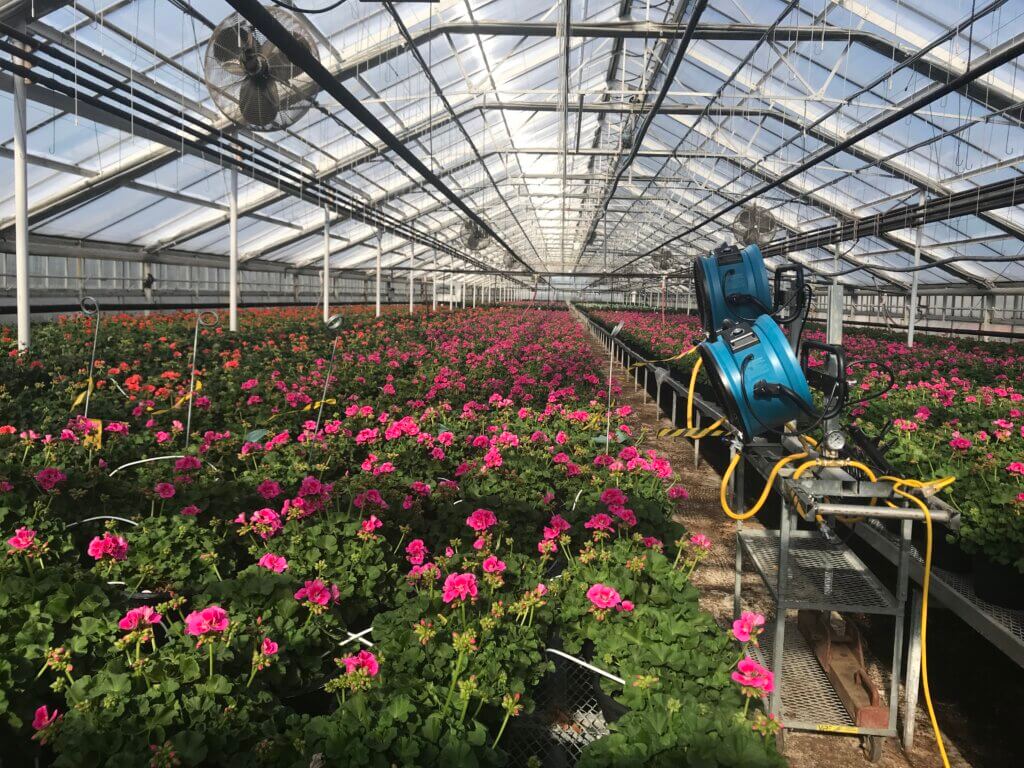
    When it wasn’t threatening to tip over, it managed decent coverage over almost 2 meters. Almost.

    As it turns out there’s a very good reason engineers use computational fluid dynamics to design air-assisted sprayers. We were ultimately beaten by an uneven greenhouse floor crowded with obstacles, a stiff canopy of geraniums, and the inverse square law, which states: “The farther away an object is from an effect, the less change can be observed in the object”. This rig now has a new life circulating hot air in a boiler room.

    And I once built an air-assisted, tow-behind sprayer to spray troughs of tabletop, hoop house strawberries. That unit laid down an excellent, uniform spray on all foliar surfaces, but it was frustrating to use. There was almost no clearance in the hoop house, which changed height with the topography, and the alternator couldn’t keep the battery sufficiently charged to run the pump and fans. I felt we could overcome these small difficulties, but sadly the operator ended this experiment halfway through the season. I can only assume the sprayer is now an interesting piece of lawn sculpture.
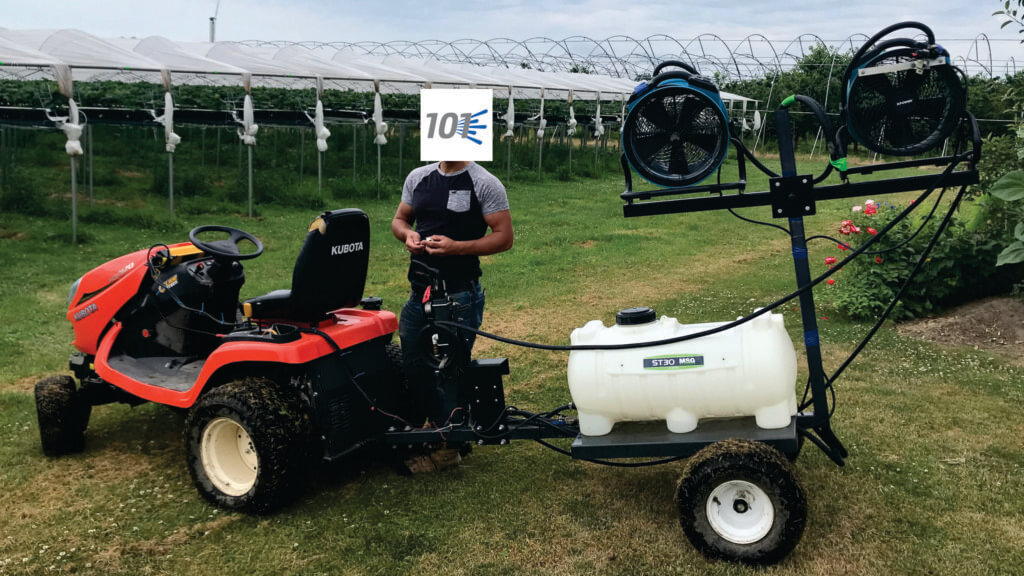
    This sprayer had potential, but limited resources prevented it from getting beyond the beta stage.

    The Micothon M2

    Despite my inability to build a decent air-assisted sprayer, I have always maintained that air-assist is the secret sauce for efficient, uniform spray coverage. Lucky for me, Great Lakes Greenhouses (GLG) agreed. No stranger to innovation, the company recently purchased a first generation, air-assisted Micothon M2 greenhouse sprayer and invited me to come see it. This was a proper sprayer designed by engineers, and not a delusional plant physiologist, so I was excited to assess and calibrate it. This article will describe what we learned and perhaps in some small way, validate my failed attempts.
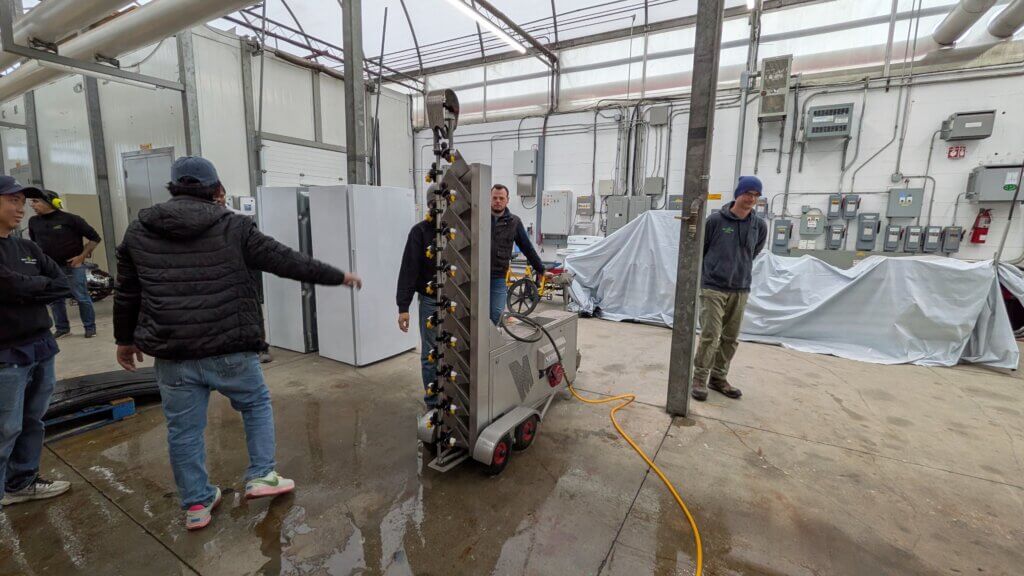
    A quick walk around before we got to spraying.

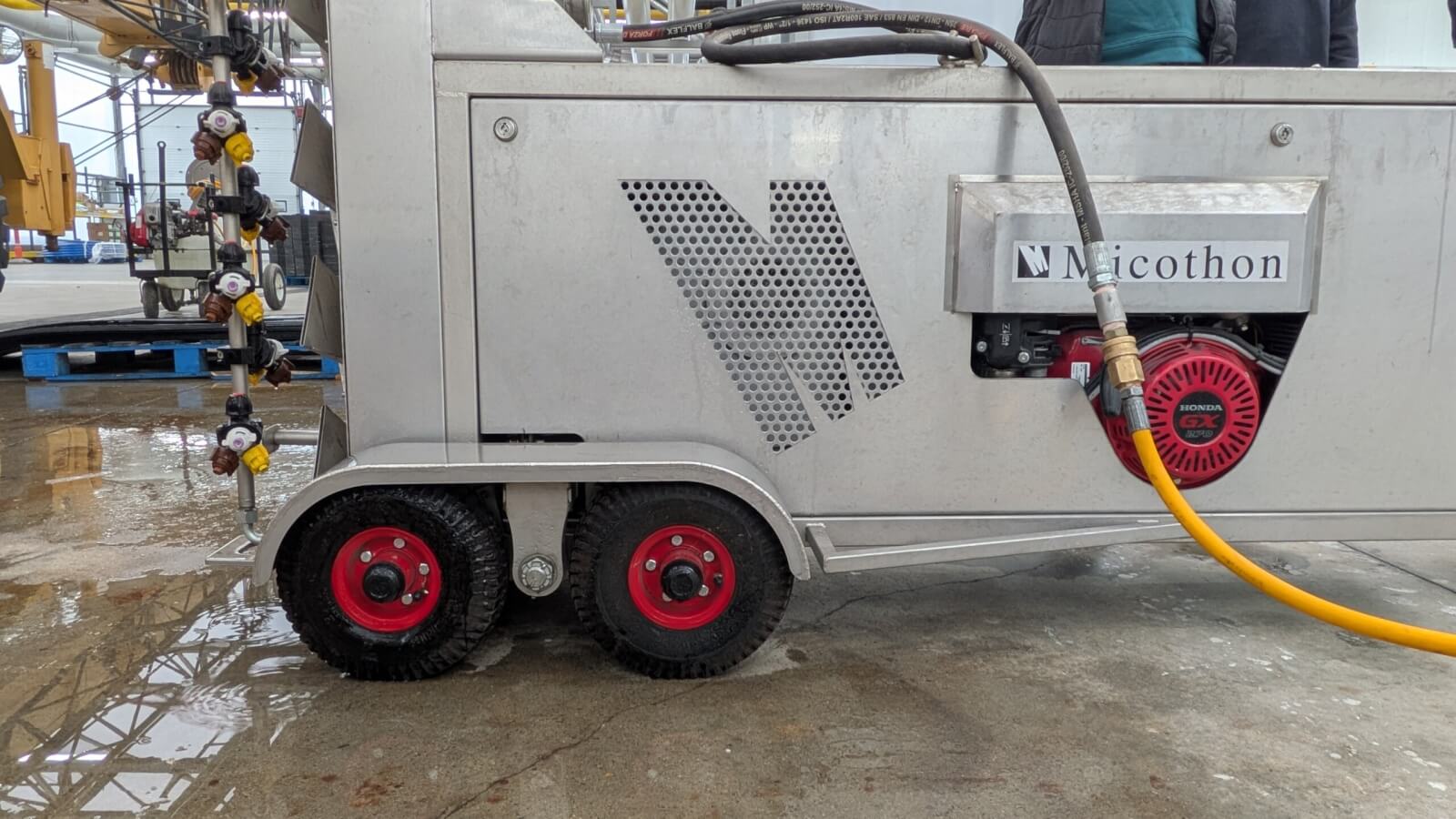
    The M2 features a vertical boom design supported by a portable tender unit, but that’s where the similarities to a classic “tree” sprayer end. Rather than riding on the hot water pipes, or tipping onto two wheels like a hand cart, this version rides on self-leveling wheels. It is drive-assisted but still has to be guided by an operator, like a self-propelled walk-behind lawn mower.

    Drive-assist, self-levelling wheels.

    The mast features 18, three-position nozzle turrets (nine to a side). GLG requested a bespoke spring-loaded break-away section at the top of the boom. This allowed the top nozzles to “duck” under an annoying section of greenhouse infrastructure that would have otherwise prevented it from being positioned between the rows.
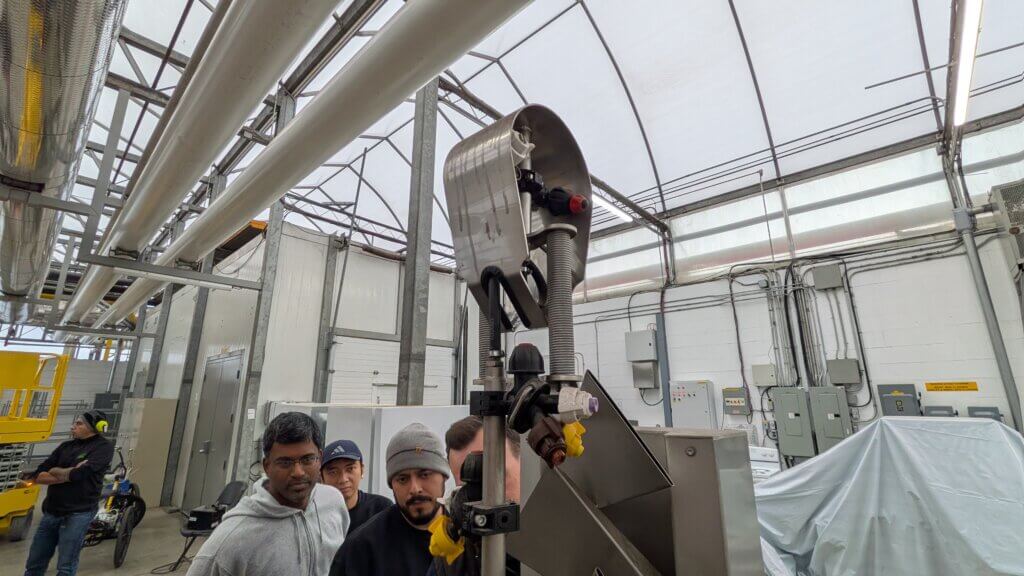
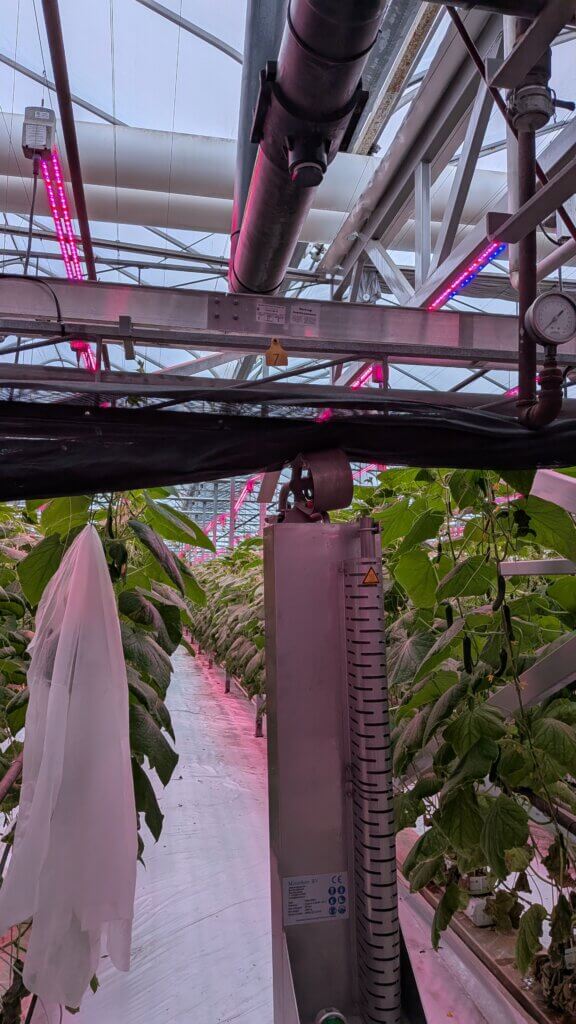
    A spring-loaded, break-away boom section (with guard) to prevent impact damage.
    The break-away section in action.

    The air is generated by a centrifugal fan powered by a Honda motor. The air travels up the ducted mast to a manifold of narrow air outlets. When the sprayer is moving, the air outlets precede the nozzles, which initially seemed wrong as the spray would be released outside the air stream. But, upon closer inspection, we saw that the air outlets are not only angled up by 45 degrees but are also angled back so the air can transect the spray.
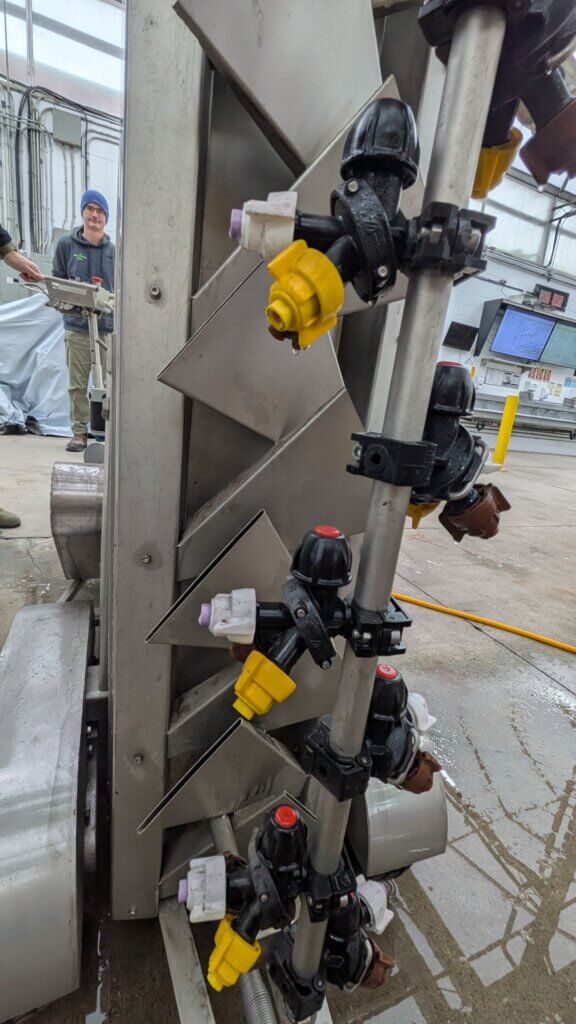
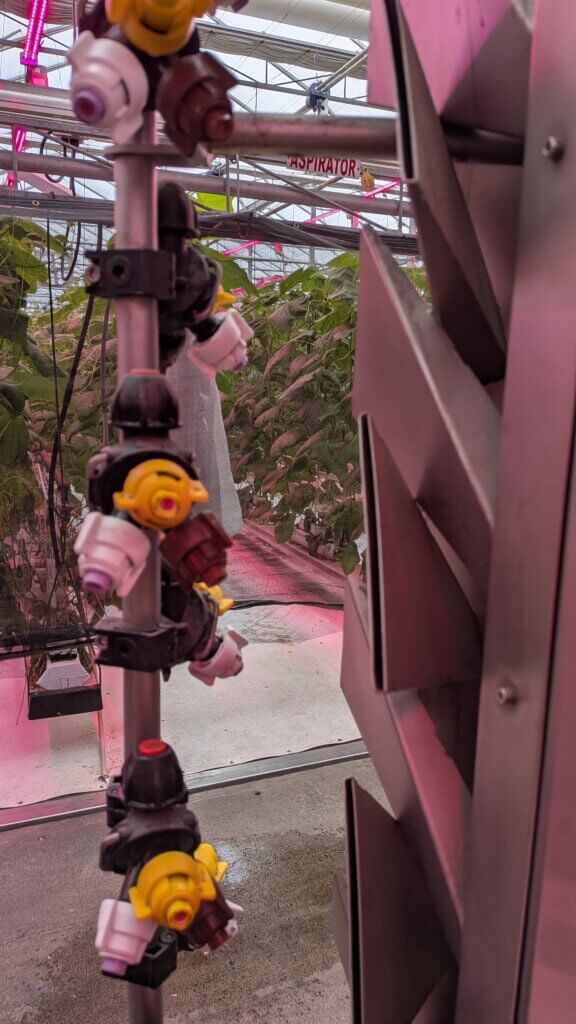
    Air outlets and nozzles – front view.
    Air outlets and nozzles – side view.

    It was suggested that the blade of air acts like an airfoil, creating an area of low pressure and sucking small droplets into the airstream. This is Bernoulli’s principle and it describes how wings create lift. Personally, I think it behaved more like a Venturi. I’m open to debate since, as evidenced by my attempts at building a sprayer, I’m no engineer. What matters is that we didn’t see any droplets hanging in the air as the sprayer passed. It works.

    Calibration and Optimization

    We followed the same greenhouse sprayer optimization protocol I’ve outlined in this article. Go give it a quick read and come back so I won’t have to reiterate why we took the steps we did.

    Travel speed and air settings

    The sprayer was set to speed “3” of a possible “5”, as recommended by Micothon. Travel speed dictates dwell time, which is the duration the air is focused on the target. Observers stood in the drive alley and in the two adjacent alleys to see how the air moved leaves. The upward angle of the outlets combined with the volume produced by the centrifugal fan wafted and twisted leaves on their petioles. This created sufficient movement throughout the canopy, but not so much that it caused the canopy to louver shut. It was a Goldilocks situation so there was no need to alter anything.
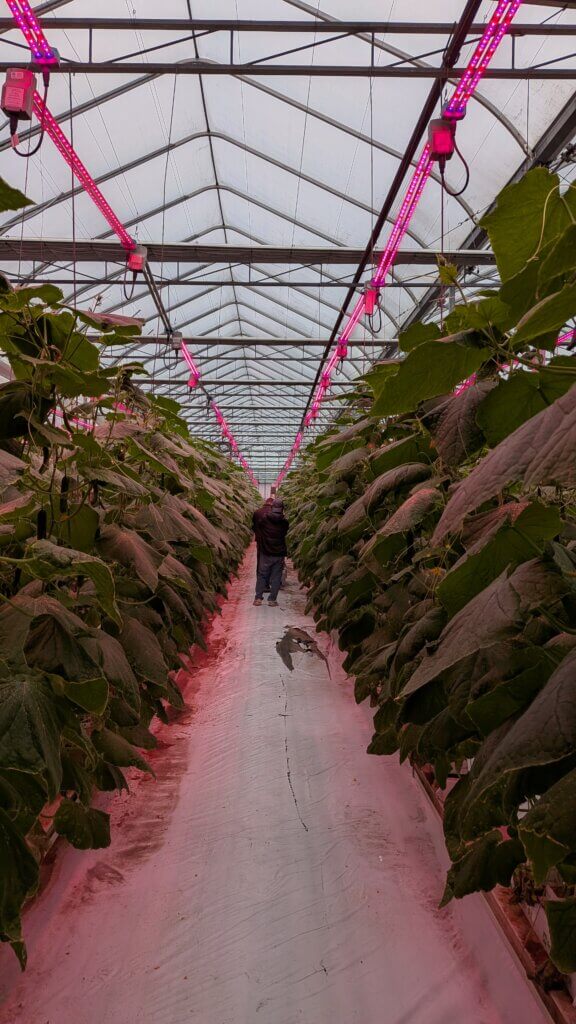
    Preparing to guide the Micothon M2 through the cucumbers under red LED lights. This image gives perspective of canopy height, density and the sprayer clearance.

    Pressure and nozzles

    The tender system regulator was set to 41.5 bar (600 psi) and that pressure dropped to 5.5 bar (80 psi) according to the gauge on the sprayer. While we didn’t test it, I’m certain the pressure at the furthest (aka highest) nozzle would have been closer to 5 bar (~70 psi). With observers in place, we started spraying water using the Albuz 025 (lilac) hollow cone tips.

    We saw the highest nozzle positions were spraying over the canopies and did not need to be on. We also saw drip points form at the tips of the leaves and the bottom of the cucumbers. There was evidence of yellowed (possibly damaged) tissue at the leaf tips, suggesting they were often sprayed to drip. This is wasteful and tends to redistribute deposits in undesirable ways. While it’s hard to avoid on the waxy, vertical cucumbers, it can be prevented on the leaves.
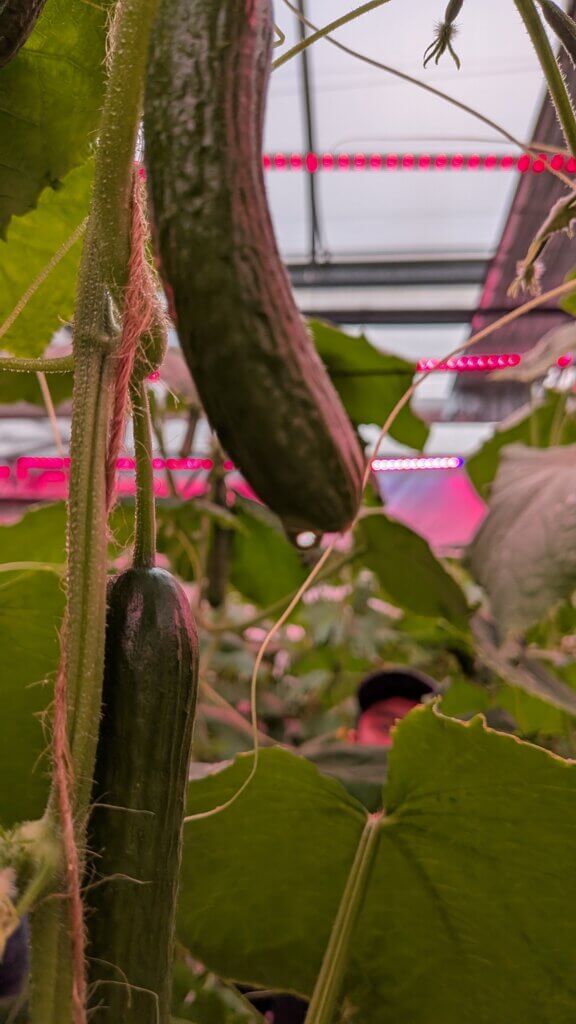
    Note the drip point formed at the bottom of the fruit. This is hard to avoid, but can at least be minimized.

    We turned off the top nozzles, swapped to Albuz 02 (yellow) hollow cones, moved to an unsprayed canopy and tried again. Effectively this was a 20% cut in water and product, but there were no more drips on leaves and less evidence of coalescing deposits. The cucumbers still had drip points, but without an adjuvant that was the best we could do. That’s assuming there would be value in spraying the fruit in the first place – these sprays were targeting the foliage.

    Coverage

    With the subjective part of the assessment complete, it was time to quantify spray coverage. Water sensitive papers were oriented co-planar with the leaves and essentially parallel to the ground. We clipped them 2-3 cm below the leaves by affixing them to the petioles. This way they would move with the leaf and represent a very challenging target (reminiscent of a sucking insect on the abaxial leaf surface).
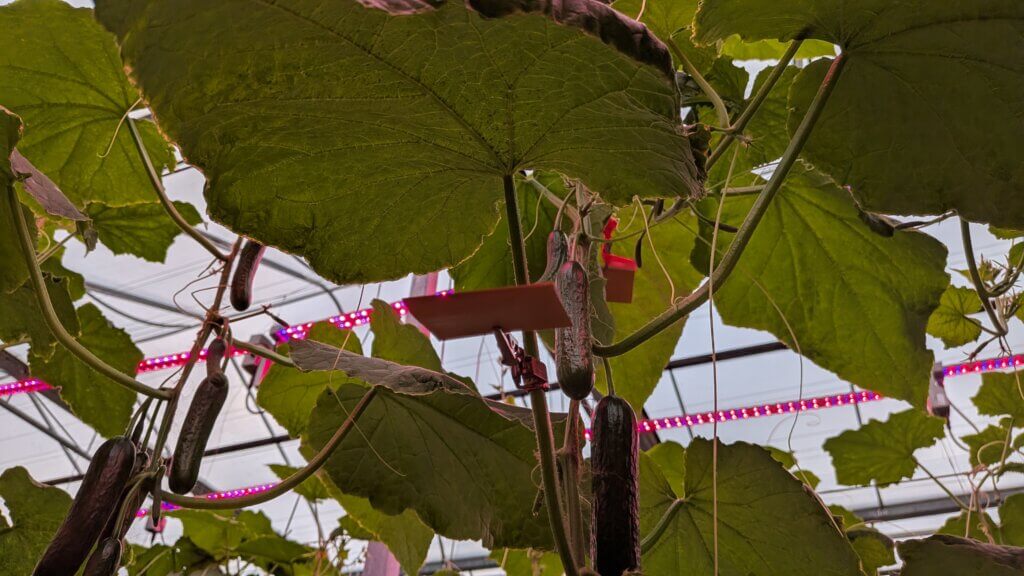
    This is a difficult target to hit. The spray must get up between the leaf and upper side of the water sensitive paper, which is not in line-of-sight of the nozzle.

    We divided the canopy into quarters, placing one target in each section. This spanned the height of the canopy, but we also positioned them along the canopy depth: One on each of the four plants in the row. This left us with a diagonal cross-section. Read it again – you’ll get it.

    Then we sprayed the row from one side and inspected the results. We saw excellent coverage on the abaxial surfaces of the two plants closest to the sprayer. We expected that. But we were pleasantly surprised to see the spray got in under the umbrella-like leaves and deposited on the adaxial surfaces. This was not line-of-sight for the nozzles, and there wasn’t much room between the paper and the underside of the leaves, so this was clearly the result of air-assisted droplets.

    There was also respectable coverage on the two plants on the far side of the row. These targets were greatly improved once we travelled down that alley and saw the cumulative coverage. This is why you should (almost) never perform alternate row spraying.

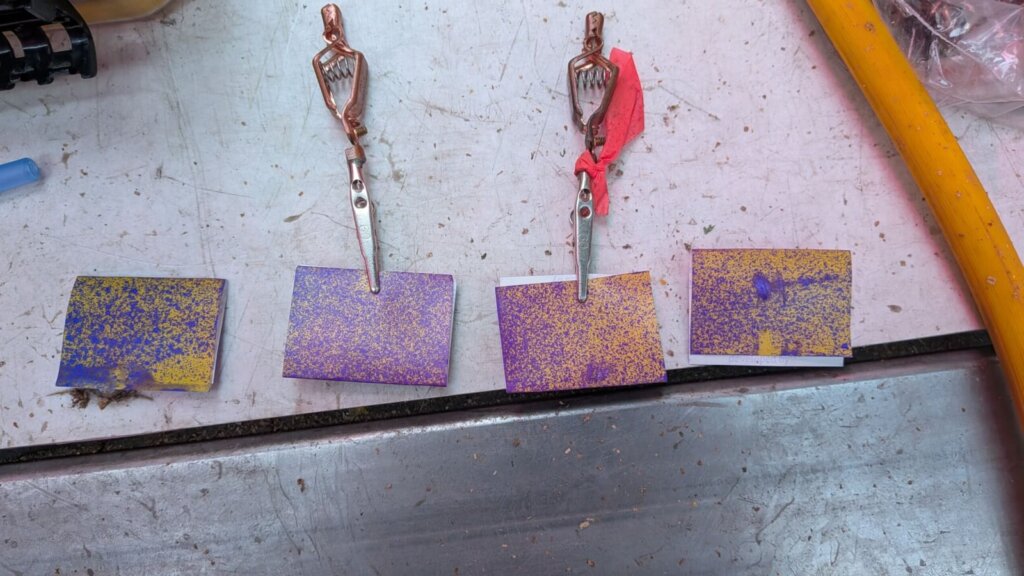
    Abaxial side of the water sensitive papers. From left to right, papers ascended from the lower quarter of the nearest plant to the upper quarter of the farthest plant in the row.
    Adaxial side of the water sensitive papers. From left to right, papers ascended from the lower quarter of the nearest plant to the upper quarter of the farthest plant in the row.

    Compared to a tree

    Since I was in the neighbourhood, we decided to see what a conventional, hydraulic tree could do by way of comparison. Frankly, there was none.

    A typical greenhouse tree. Note the 1/4 turn drain near the pressure gauge, the lack of check valves, and the uneven distribution of the nozzle positions (i.e. more at the top) likely intended to direct more flow higher in the canopy.

    The tree was nozzled with Albuz 04 (red) hollow cones angled upwards. There were only a few check valves, so it leaked when it was turned off and had to be drained at the end of each row using a quarter turn valve. Coverage was generally excessive (i.e. coalesced droplets and lots of run-off) and non-uniform (we randomly missed both adaxial and abaxial surfaces).
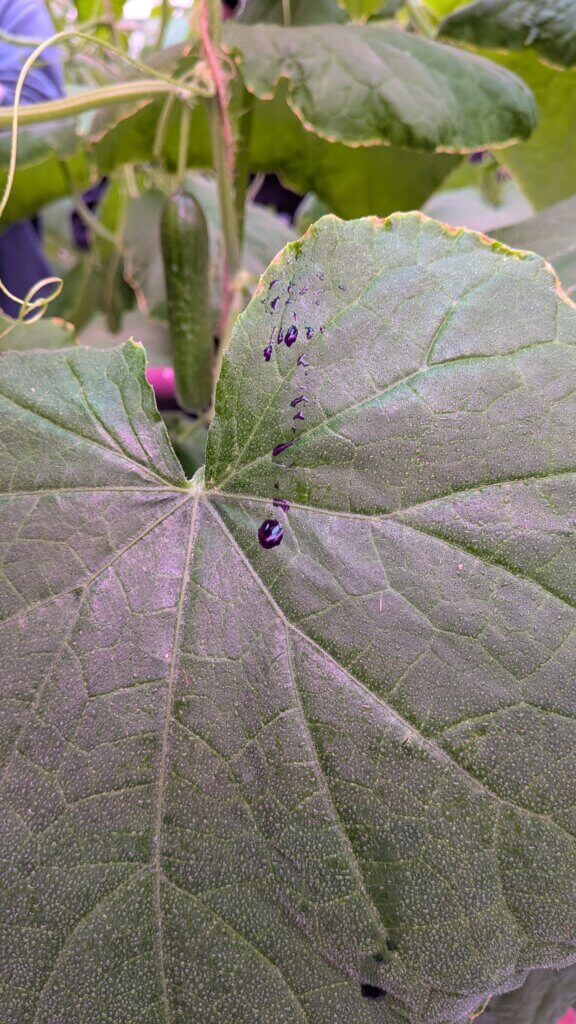
    Run-off was so pronounced that it washed the dye off the water sensitive papers.

    We re-nozzled to my favourite load out: TeeJet TwinJet fans alternating back and forth by 45 degrees from centre. Using 03’s (blue), we observed improved uniformity, but still saw misses and suspected we were still using too much water. When leaves are drenched they get heavy, causing them to hang lower and obscure the other parts of the plant. This is the contradiction that limits a strictly hydraulic system: Pressure motivates droplet movement, so you need slightly larger drops and more volume. However, too much water causes run-off and weighs leaves down, obscuring the rest of the canopy. Catch 22.

    I proposed getting a set of 02 (yellow) tips in the hopes there would still be enough spray for better uniformity. I hope they tried it.

    A few beefs about the M2

    There’s always room for improvement. Before you think I’m selling these sprayers, here are a few observations from the owners and from what we saw that day. No deal breakers, just some nice-to-haves:

    • The diesel exhaust from both the sprayer and the tender cart is not ideal. Applicators wear respirators, and the greenhouse fans tend to dilute the exhaust, but a battery system (perhaps like a drone) would be preferable to power the drive electrically.
    • There was a latency with the self-leveling wheels and with air build-up in the tower portion of the sprayer. You simply need to be patient before you start down a row.
    • The tower section gets hot to the touch, likely because of the position of the exhaust pipe.
    • The alternator on board recharges the battery, but if you let it sit the battery is depleted (sounds like the same trouble I had with my sprayer, which is somehow gratifying).

    I’m sure you’re asking “How much?”

    Well, at the time of writing, it was almost $70,000.00 CDN, but don’t judge it too harshly! Bear in mind that our assessment saw a reduction of 20% water and crop protection product that would otherwise have ended up on the greenhouse floor. Not only is that a big savings in water and inputs, but it’s fewer refills and it produced far better spray coverage that a hydraulic system. While improved coverage is not always linked to improved efficacy, they certainly go hand in hand. And when we’re considering “softer”, biorational greenhouse chemistries, improved coverage is the best bet we have for pest control.

    All in all, this was an excellent sprayer that I hope is the first of many to grace Ontario’s greenhouses.

    Thanks to Great Lakes Greenhouses for the invitation, and thanks to all the other grower cooperators (names withheld to protect the innocent) that took a risk on building budget, niche sprayers with me. Sometimes, you just have to throw money at it.
  • Air-Assisted Spraying in Greenhouse Ornamentals

    Air-Assisted Spraying in Greenhouse Ornamentals

    The aesthetic value of ornamental plants requires a near-zero tolerance for insect pests, which cause up to 10% of crop losses per season. Controlling them with insecticides is a difficult proposition:

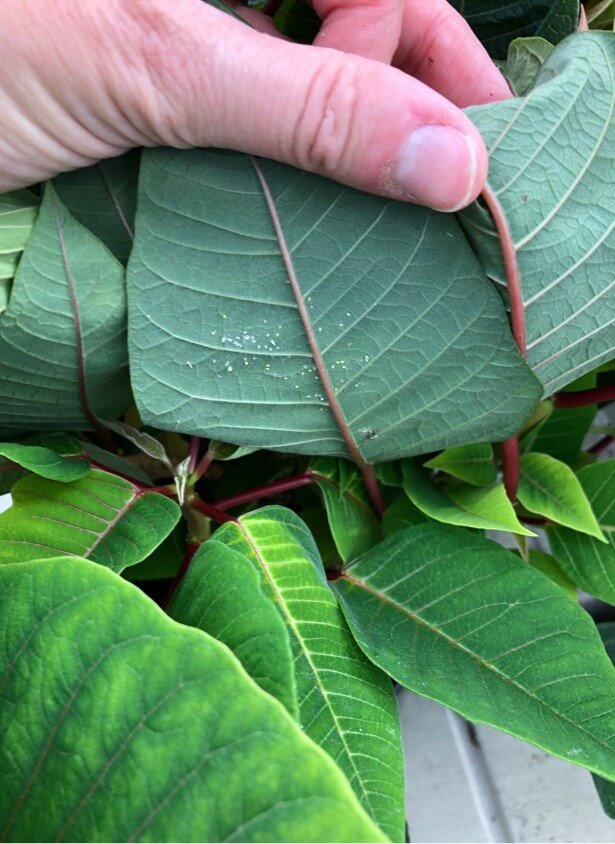
    • Key pests such as thrips, aphids and whiteflies tend to feed on the underside of leaves – a notoriously difficult surface to target because of it’s orientation relative to the spray nozzle (see image below).
    • Other pests, such as mealybugs, are found on stems. Stems are hard-to-wet plant surfaces because spray tends to run off. Further, as the plant canopy grows and densifies, these surfaces are buried deep inside, out of line-of-sight.
    • The insecticides available for closed environment spraying must be compatible with biological controls and are therefore “softer” chemistries. Examples include soaps, oils and entomopathogenic fungi. These products require contact with the pest and are at best translaminar, so coverage becomes critical for performance.
    Whitefly on the abaxial laminar (under-leaf) surfaces of Poinsettia.

    Spraying for Insects

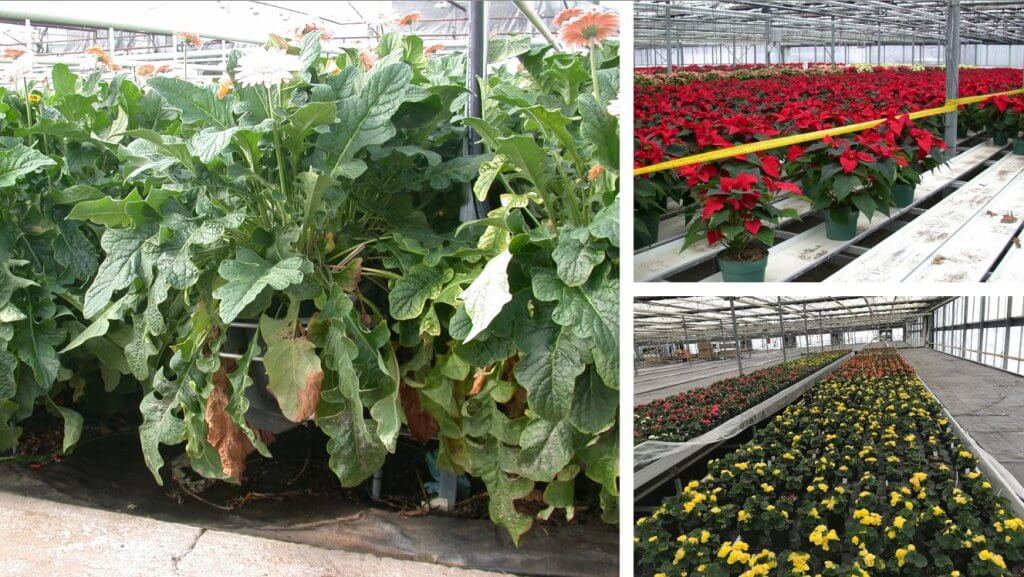
    The planting architectures and canopy morphologies are highly variable in ornamental greenhouses. Perhaps they are young plants with sparse canopies, densely packed in pots on raised tables. Perhaps they are mature, hanging plants with dense canopies. Perhaps they are something in between.

    Crop canopy morphology and planting architecture are highly variable from operation to operation.

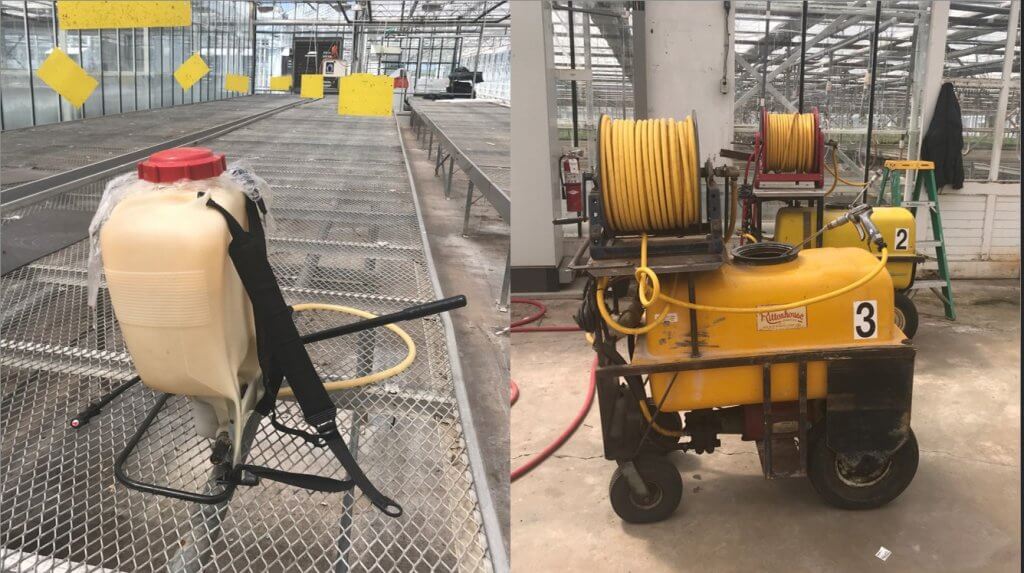
    Ideally, each combination of canopy morphology, planting architecture, pest and chemistry would have a specific sprayer designed to optimize coverage and efficiency. This is economically unrealistic. Instead, many producers utilize technologies that rely on high water volumes and hydraulic pressures to “drench” targets indiscriminately. Others employ highly manual methods that allow the operator to aim the nozzle in relation to the canopy on a case-by-case basis, but still rely solely on water to distribute the insecticide.

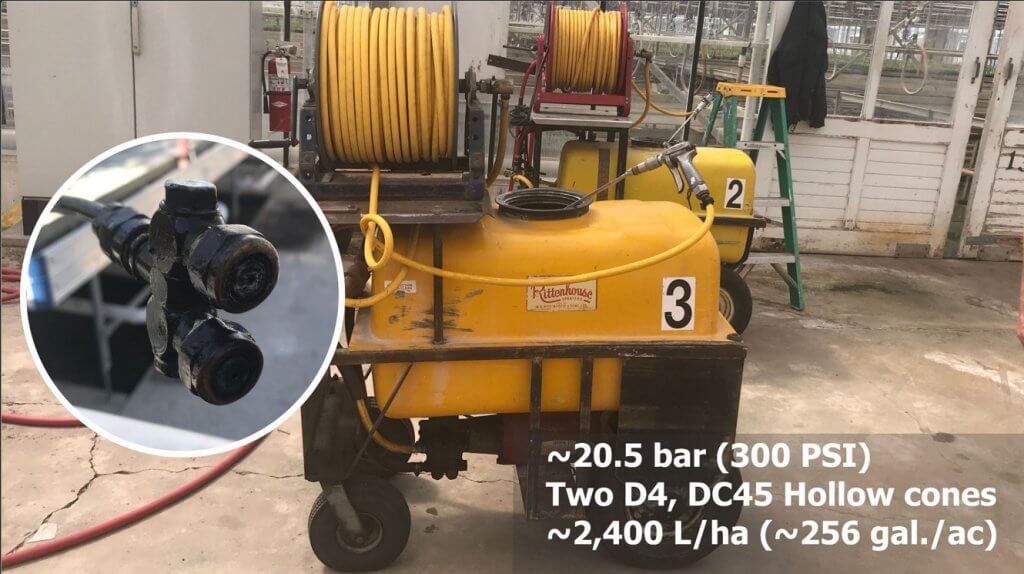
    Typical application technologies in ornamental greenhouses. The backpack sprayer (left) with its manual pump is inexpensive and the operator can aim the nozzle more accurately. The trailed tank-and-handgun (right) utilizes higher hydraulic pressure and water volume in an attempt to improve the work rate. Both rely solely on water and hydraulic pressure to distribute spray.

    These technologies have their place, but the reliance on hydraulic pressure and carrier volume has drawbacks:

    • High water volumes lead to higher humidity in closed environments which may favour disease.
    • The inevitable run-off creates waste water that may require treatment before leaving closed environments.
    • High carrier volumes dilute an already “soft” chemistry and hydraulic pressure doesn’t always improve canopy penetration or coverage uniformity.

    Air-assisted spraying can be a viable alternative (and an improvement) over these approaches. Stationary or mobile, many ultra-low volume sprayers already employ air to capitalize on the mechanical advantage offered by smaller and more numerous droplets. Finer droplets have very little mass, so they must be directed and carried by air currents to get them to the target. Sufficient air energy will also displace the air within the target canopy and physically expose otherwise hidden plant surfaces to the spray.

    The upshot is that air can partially replace water as a carrier and it has the potential to improve coverage uniformity throughout the target canopy.

    Testing Air-Assisted Spraying

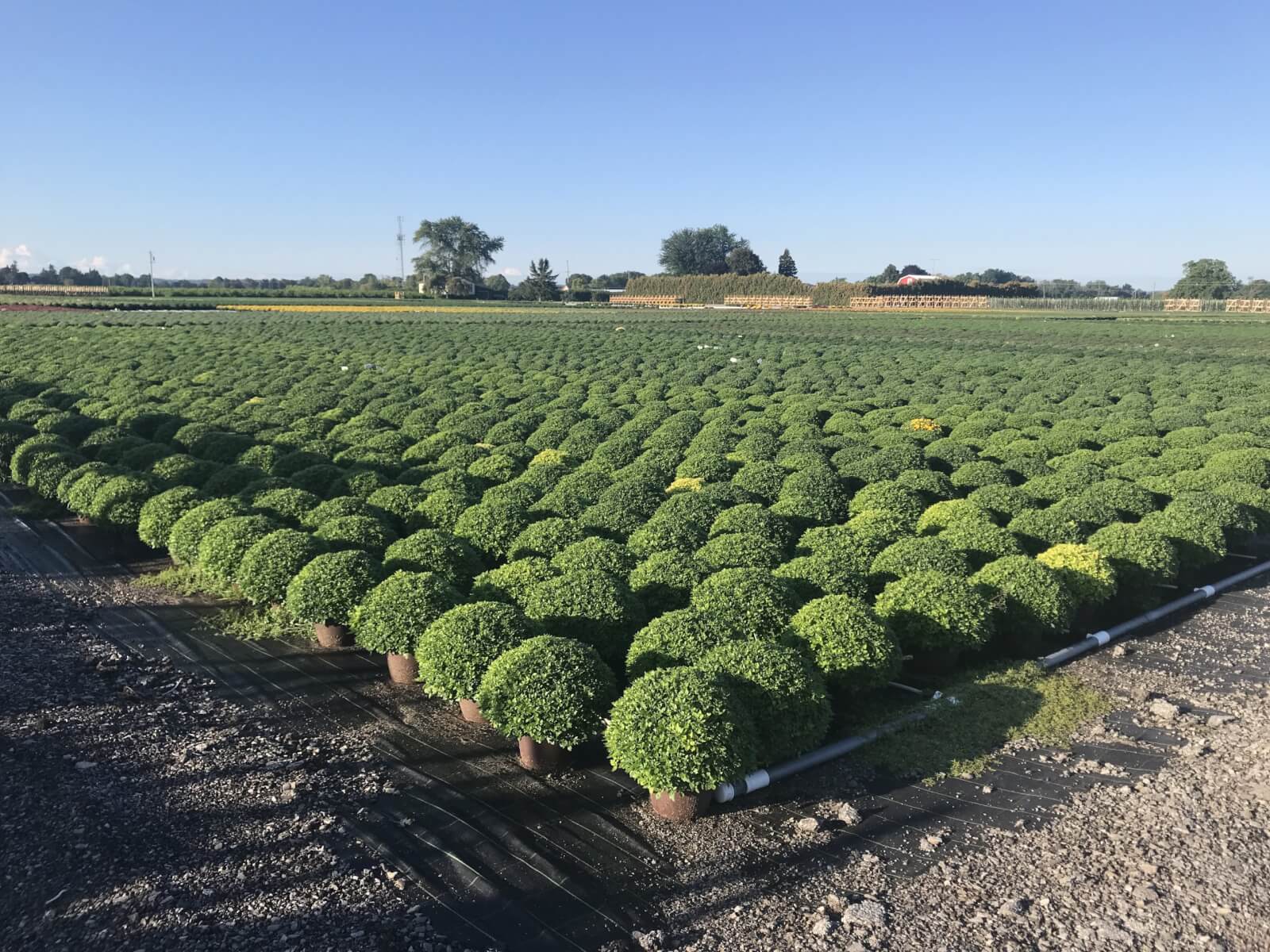
    We chose to test this assertion in a chrysanthemum nursery. Our objective was to compare the coverage from the grower’s conventional hydraulic gun to that of a customized backpack mist blower.

    Crop Canopy and Architecture

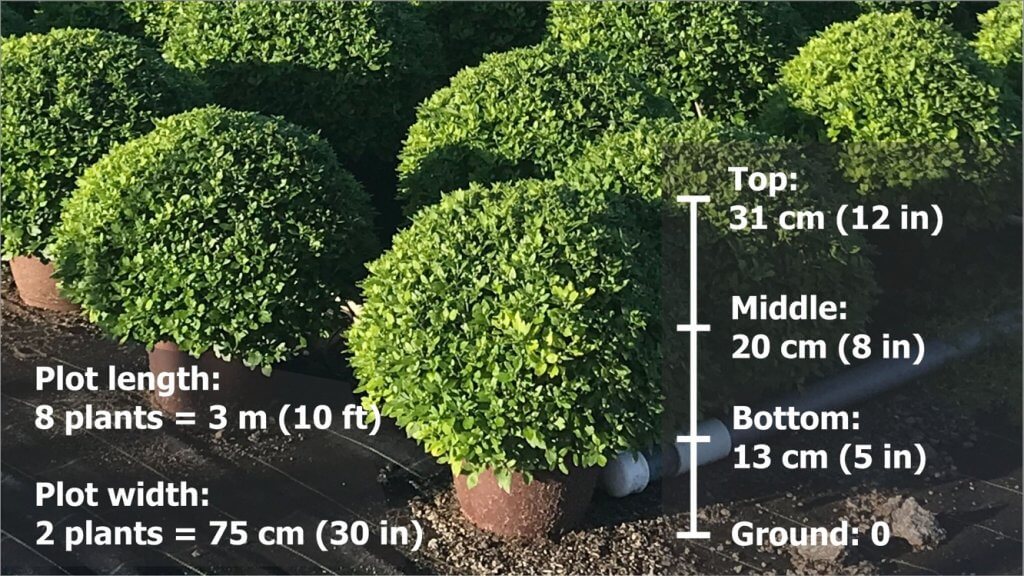
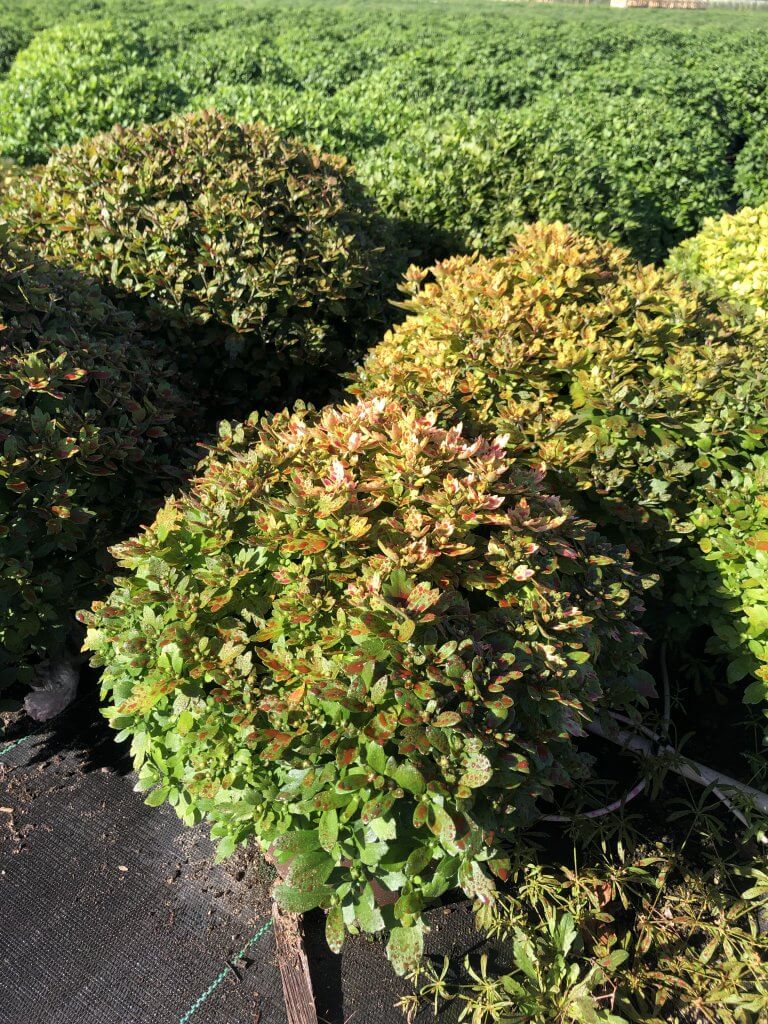
    The crop canopy wasn’t fully mature but still represented a very dense target. In order to compare canopy penetration the canopy was divided into three depths: The Top exterior, the Middle (8″ from ground) and the Bottom (just above the pot soil). Each treatment area contained 8×2 plants and a buffer of three plants was maintained between treatments. We made three sprays (reps) for each condition.

    Sprayers

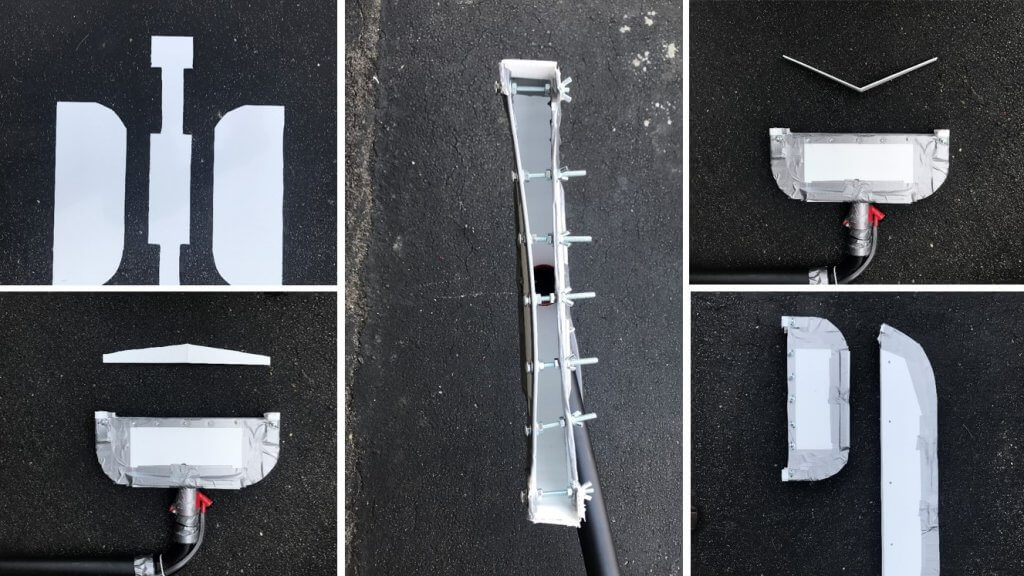
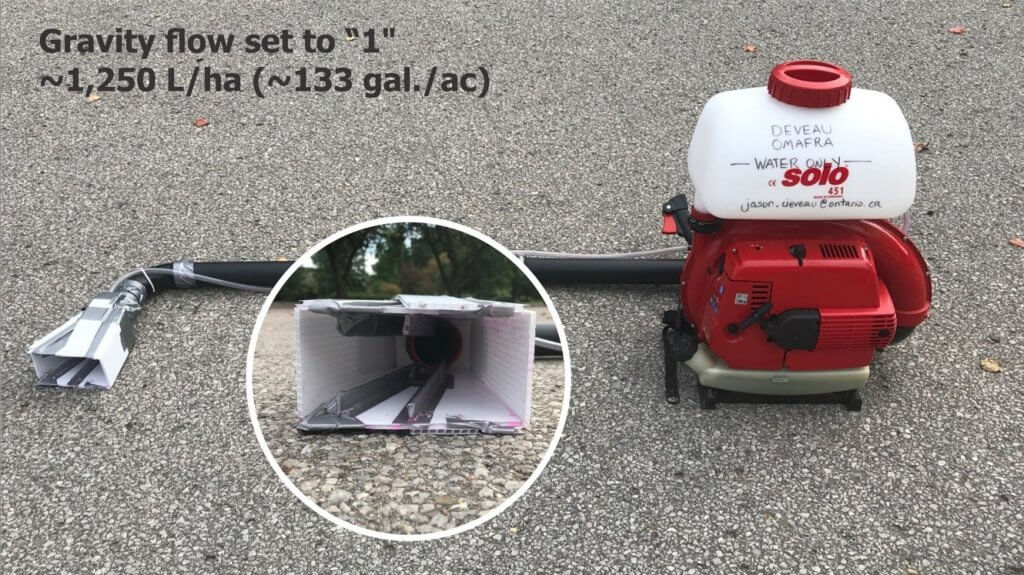
    Several attempts were made to redirect and redistribute air from a commercial backpack mist blower. The goal was to create an air outlet that would distribute the same air speed over a long and narrow swath. Air is highly compressible and early attempts using baffles, straightening vanes and variable outlet sizes were unsuccessful. A compromise was reached by reducing the swath to about plant-width (40 cm). This was confirmed by spraying water on dry pavement and measuring the width of the swath. While not ideal, the operator could span the full 75 cm plot width by shifting the outlet back-and-forth laterally while spraying. There are videos below that show examples of both applications.

    Several iterations of the air outlet design.

    Through trial and error, the outlet was held above the canopy at a height and angle that optimized air penetration. If the outlet was held too far away, there was insufficient air energy to penetrate the canopy. If held too close, too much spray-laden air would escape the canopy. These attempts were performed at a comfortable walking pace to account for dwell time (E.g., the longer the outlet remained stationary over a canopy, the deeper it penetrates).

    With the gravity flow set to “1” and moved as it would be used during spraying, we measured walking pace and timed how long it took to spray a known volume. The application volume was 1,250 L/ha (~133 US gal./ac).

    The grower’s conventional sprayer was used according to their typical practices. Walking pace and flow rate were measured to establish application volume for both sprayers.

    By timing walking pace and performing a timed output test, the application volume was 2,400 L/ha (~256 US gal./ac) for the conventional sprayer.

    Coverage Indicator

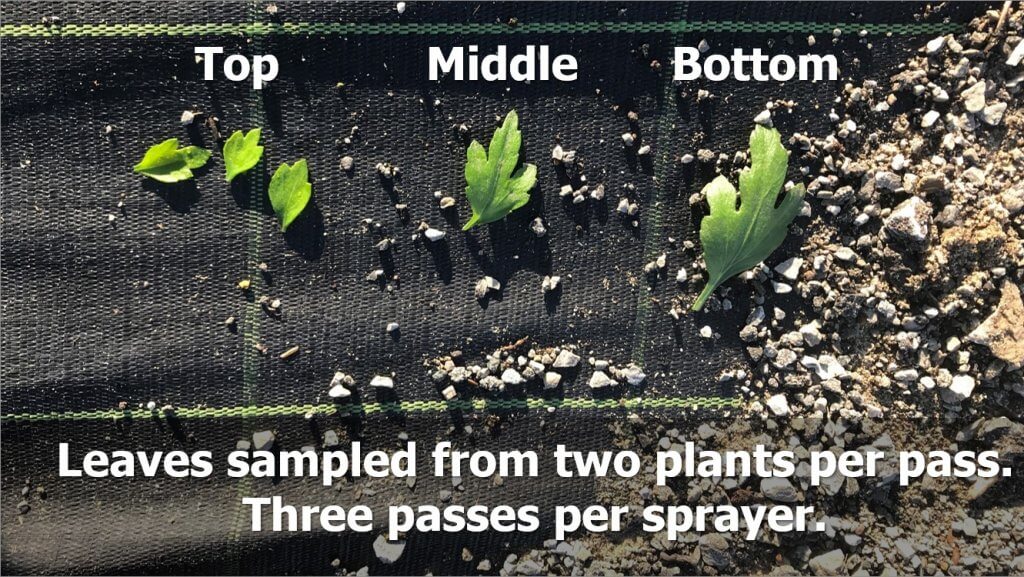
    Coverage was quantified using dye recovery and fluorimetry. The process is described in detail in this article and this article. Basically, a known concentration of Rhodamine WT dye is applied to the plant. Sprayed leaves are collected from key locations in the canopy and placed in labelled containers with a known volume of water. Later, that water is analyzed in a fluorimeter and the data is normalized by leaf weight (or in this case, leaf surface area) to account for the volume used and the size of the leaf sampled.

    Dye pooling on leaf surfaces following an application using conventional methods.
    Relative size and number of leaves sampled from each canopy depth.

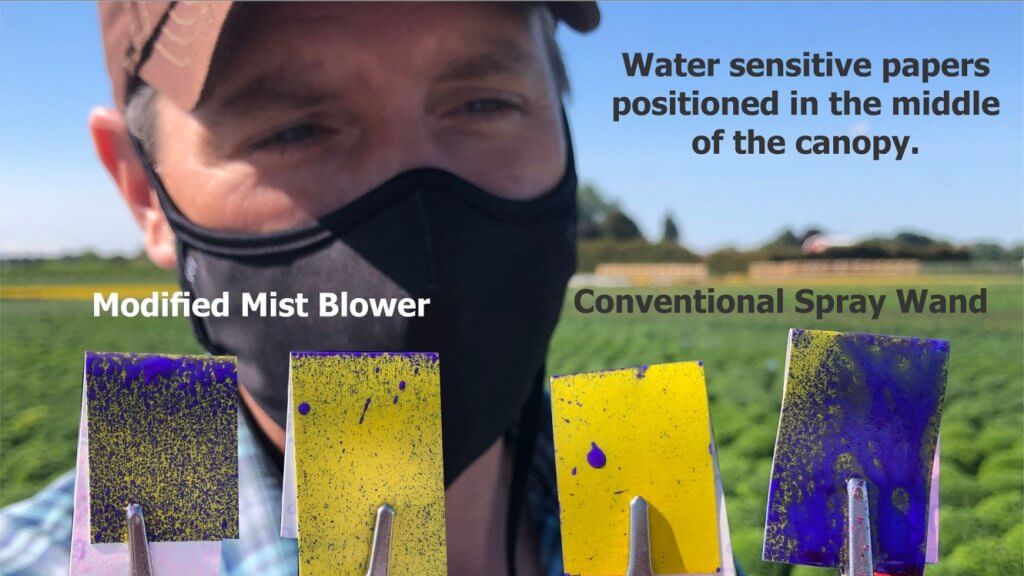
    In addition to dye recovery, we also used water sensitive paper as a qualitative indicator. Papers were placed at the Middle depth facing into and away from the direction of travel and sprayed with both methods. This was used as a visual check to ensure spray went where it was intended, but it also provided insight into how spray might deposit on the leaf surface. As an artificial collector, water sensitive paper does not behave like a leaf surface, but it is helpful for relative comparisons.

    There were obvious visual differences in how spray deposited on water sensitive papers located in the middle of the canopy. The mist blower had far less drenching and an even distribution of finer deposits compared the the conventional method. From left to right: Mistblower, facing sprayer travel direction. Mistblower, facing away from sprayer travel direction. Conventional sprayer, facing away from sprayer travel direction. Conventional sprayer, facing sprayer travel direction. When comparing these papers, remember that the mist blower was using approximately half the volume of the conventional method.

    Results

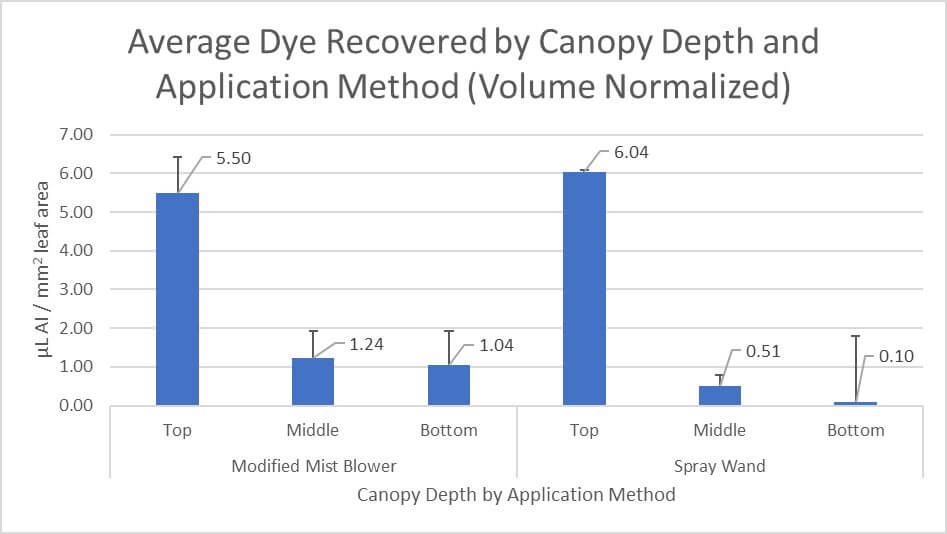
    As mentioned previously, dye recovery was normalized by spray volume and leaf area for each condition. The results align with inferences made in the above image. Spray coverage can be highly variable which often leads to statistically insignificant results, but the mean-dye-recovered does demonstrate clear trends. The top of each canopy received a similar dose of dye for each condition. This comes as no surprise and is typical of any overhead application into a canopy. However, the air-assisted condition resulted in more than 2x the dye in the middle of the canopy and more than 10x the dye at the bottom compared to the conventional method.

    Bars represent standard error.

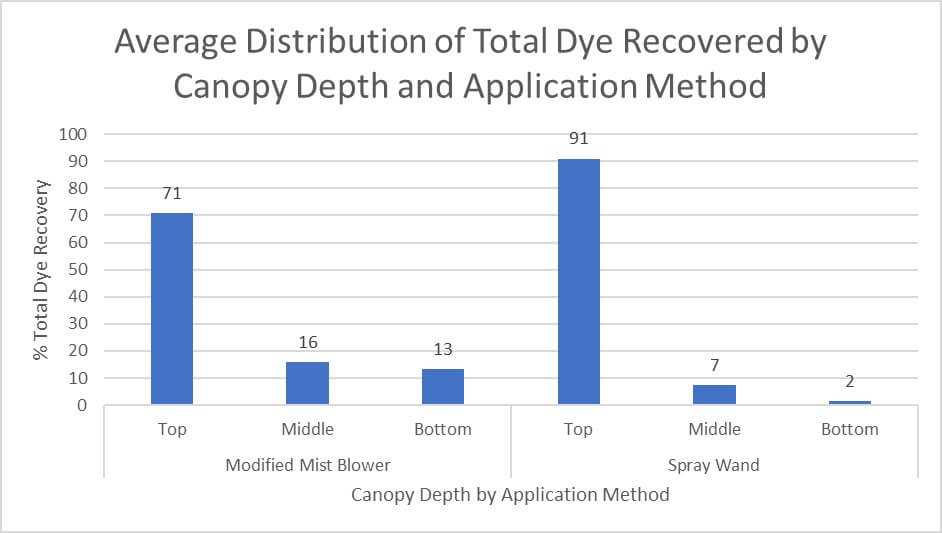
    When considered as a percentage of overall dye recovered, we see that the dye deposited was more uniform in the air-assisted condition. 16% of total dye recovered in mid-canopy in the air-assisted condition canopy versus 7% in the conventional condition. 13% at the bottom on the air-assisted condition versus 2% at the bottom of the conventional condition.

    Conclusions

    Based on this study, there is compelling reason to consider air-assisted applications in closed environments. Canopy penetration and coverage uniformity was improved in the air-assisted condition. In addition, there is potential for reduced water volumes, which mean less contaminated run-off and lower humidity levels in closed environments.

    Future work would require a better-engineered sprayer than the prototype used here. Further, while improved coverage often improves spray efficacy, it is not always a direct correlation. An efficacy study comparing crop damage and pest counts should be performed to confirm that this method of application represents a positive return on investment.

    This research was performed with Dr. Sarah Jandricic, OMAFRA Greenhouse Floriculture IPM Specialist. Thanks to Schenk Farms and Greenhouses Co. for collaborating in the study.

  • Homemade Air-Assist Tower Retrofit

    Homemade Air-Assist Tower Retrofit

    It was Saturday morning in April, 2016 when I received an email from Steven Bierlink, an orchardist in Washington State. He was curious about the impact of air induction nozzles on lime-sulphur applications (intended to thin apple blossoms). Work-life balance notwithstanding, I happily grabbed a hot cup of coffee and we got on the phone. It was a great conversation.

    The top two nozzles are capped in this orchard (targeting 10' and below). It's very evident that the top two nozzles are not in use.
    The top two nozzles are capped in this orchard (targeting 10′ and below). It’s very evident that the top two nozzles are not in use.

    It turned out Steve, like many growers, also had a knack for metal working. Displeased with his Rears sprayer’s performance, he told me he’d replaced his classic radial air outlet and curved boom with a ducted tower assembly, very much like the H.S.S. sprayer had just been introduced to North America.

    I asked if he would share his story and a few photos of how he did it and he didn’t disappoint! What follows is a photo journal of how he designed and built his new sprayer. He wrote:

    Sorry it’s taken me so long to get back to you. Spring is like a tornado and there’s just no time to get things done! Here’s a quick/not so quick rundown of the process:

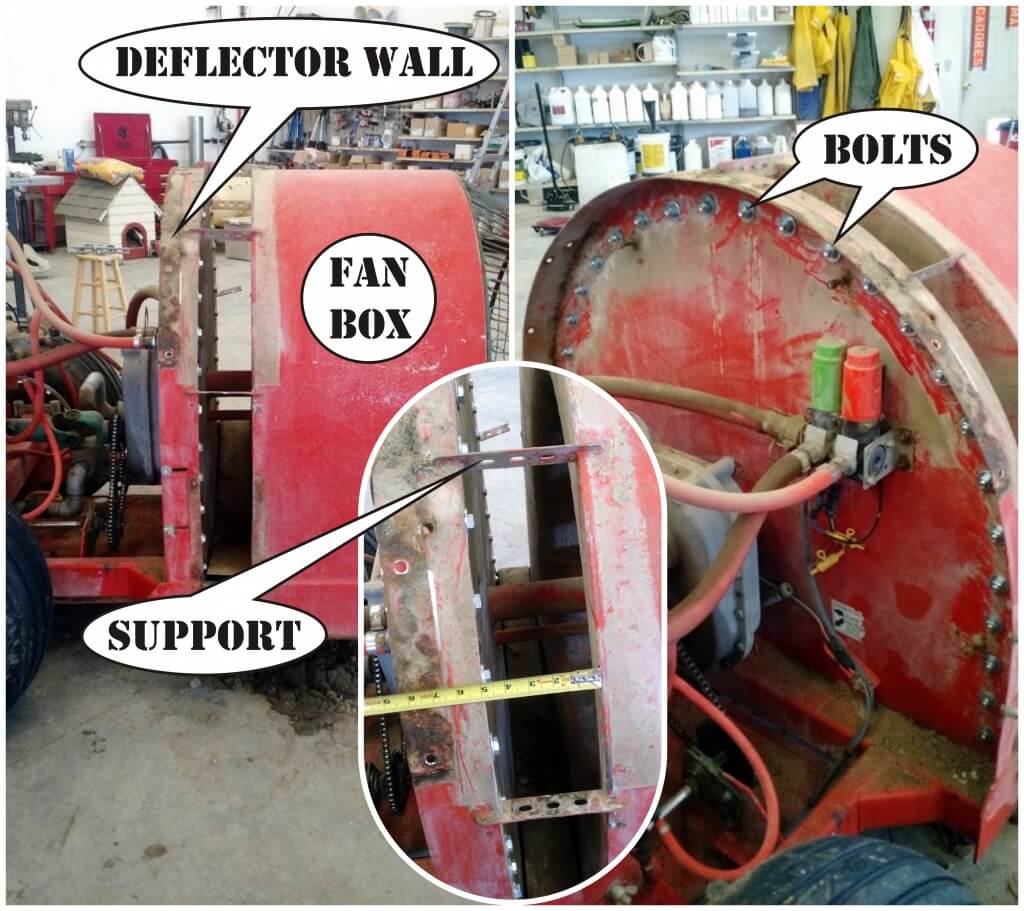
    1 – I started by cutting the horizontal supports that attach the fan box to the front deflector wall. I plugged all the old holes with nuts and bolts to keep the air going where I wanted it.

    1) Fan box cut away from deflector wall. Holes filled with bolts.
    Fan box cut away from deflector wall. Holes filled with bolts.

    2- I then got a 10″ wide sheet of 16 ga cold-rolled steel from a local HVAC guy. I marked out where I wanted to attach it, drilled and tapped the holes, and attached using only stainless hardware. I marked out for a total of 8 holes per side evenly spaced, and drilled them out with a 4” hole saw. I then cut 3″ long sections of 4″ diameter thin-wall pipe (about 0.125” thick) and welded them flush with the inside.

    2) Welded pipe outlets for air.
    Welded pipe outlets for air.

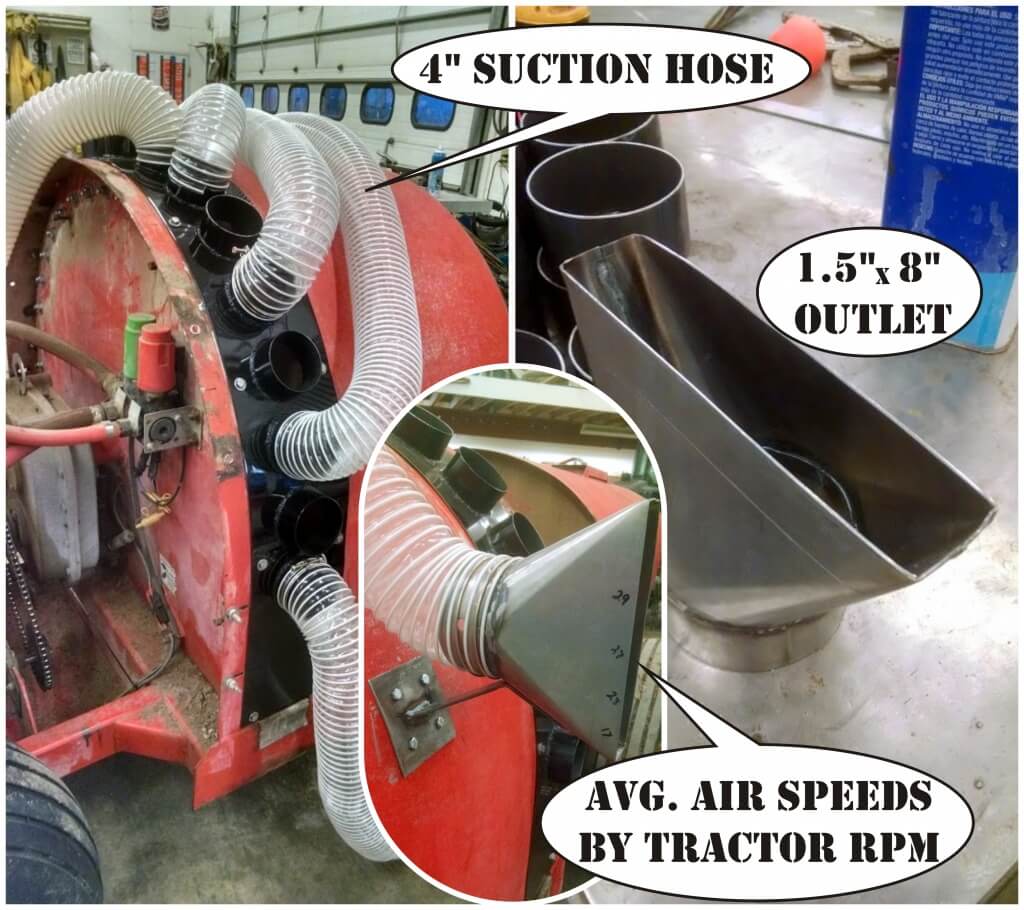
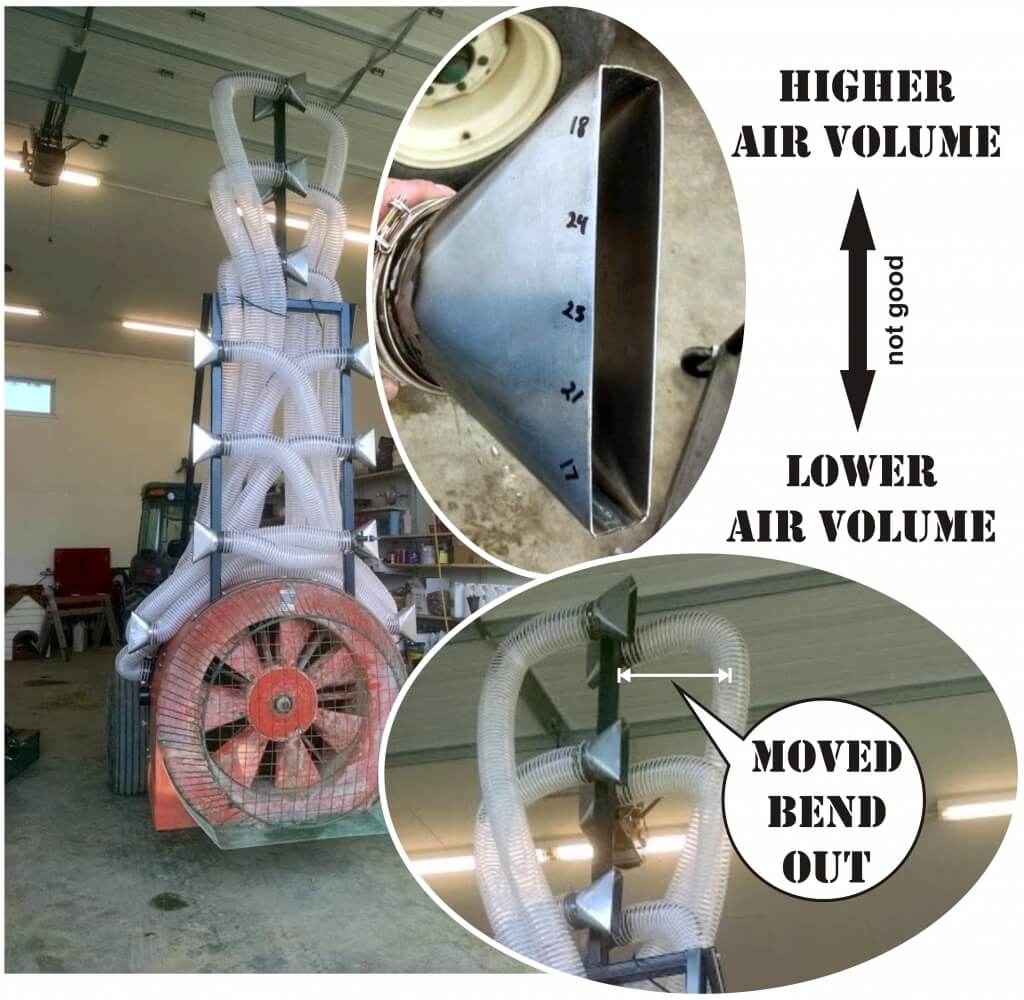
    3 – I had several conversations with the local HVAC guy about turning vanes, nozzles, cubic feet/min. and wind speeds. The reason I decided to use hose after all these conversations is because there are no 90° angle turns. Those turns during testing severely decreased wind speeds because of the turbulence it caused. The hose is standard 4″ suction hose for woodworking chip/dust collection. Together, we came up with a 1.5” x 8” outlet to use. The numbers written on the outlet are average wind speed with 10 feet of hose attached at the desired tractor rpm’s.

    3) Commercial woodshop hose and air outlets.
    Commercial woodshop hose and air outlets.

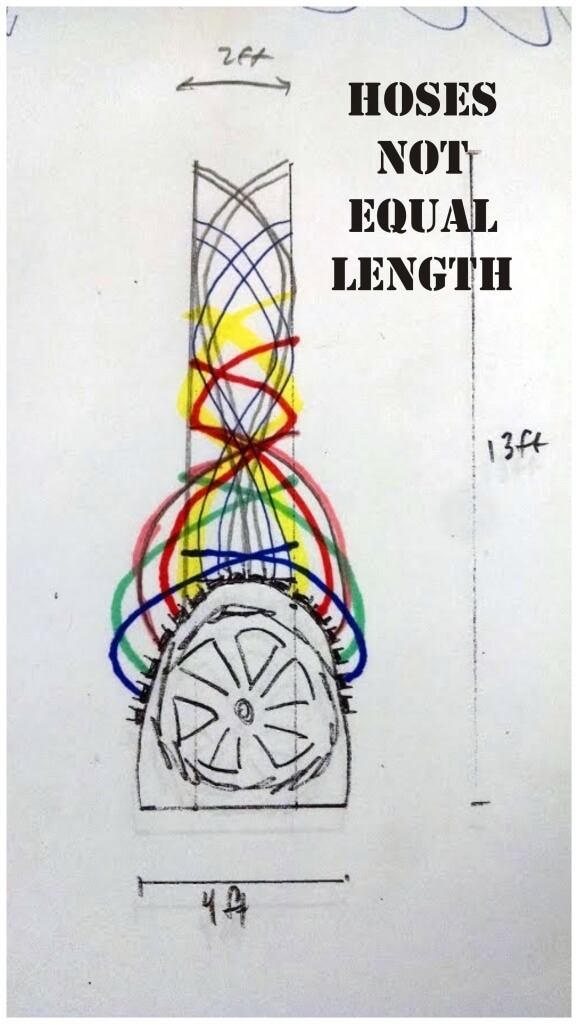
    4 – Initially I was set on having the same distance of hose for each outlet, like headers for an internal combustion engine. I let that go since volume matters so much more in this situation and there is no “real” back pressure pressure to be concerned about. This was the initial drawing:

    4) Early sketch of equal hose lengths and positions.
    Early sketch of equal hose lengths and positions.

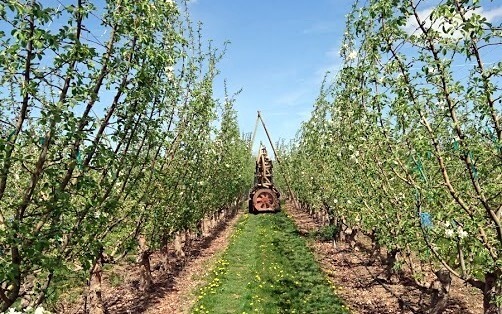
    5 – My measured dimensions showed the rectangular tower frame would fit through my tightest V-trellis, but only if I drove 0.5 mph and who is going to do that!? So, I needed to rethink it, break it down, and redo it. I decided on a partial, center-mast design.

    5a) Original tower frame would not clear the V-trellis. A center-mast solved the issue.
    Original tower frame would not clear the V-trellis. A center-mast solved the issue.
    5b) The top of the mast can be removed and the hoses disconnected and just left to hang. This allows me to hit 12' tall V-trellis easily, as well as 14' vertical trees all the way to the top.
    The top of the mast can be removed and the hoses disconnected and just left to hang. This allows me to hit 12′ tall V-trellis easily, as well as 14′ vertical trees all the way to the top.

    6 – After putting everything together I realized the air volume wasn’t always balanced across the each outlet. This was because the bend in the hose was too sharp and too close to the outlet. This REALLY MATTERS because if the air volume is too “heavy” on one side of the outlet, it doesn’t capture and carry the spray consistently. I corrected it by attaching support rods to increase distance between bends and outlets to about 18”.

    6) Gradual angles on hose prevented uneven air from the outlets.
    Gradual angles on hose prevented uneven air from the outlets.

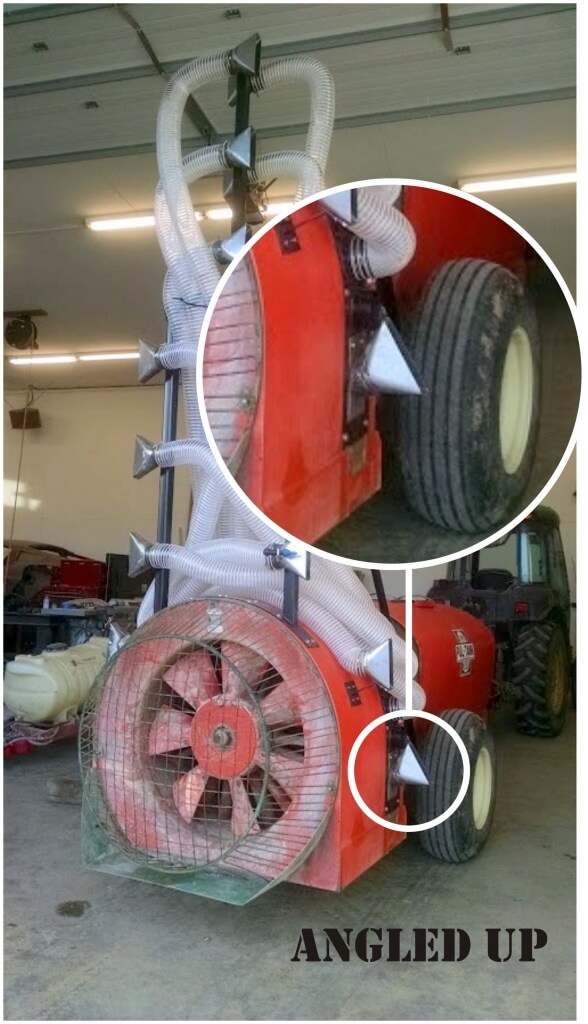
    7 – On the painted, final design, you might notice lowest nozzle is angled. This is because I’ve noticed that foliar applications don’t often hit the lowest branches. I angled one outlet upwards to correct this. I notice in your article on the H.S.S. sprayer that the Woolly Apple Aphid nozzle does the same thing. I feel like I need to meet these people; we have incredibly similar ideas!

    7) Lowest nozzle and air outlet angled up to better hit lowest branches.
    Lowest nozzle and air outlet angled up to better hit lowest branches.

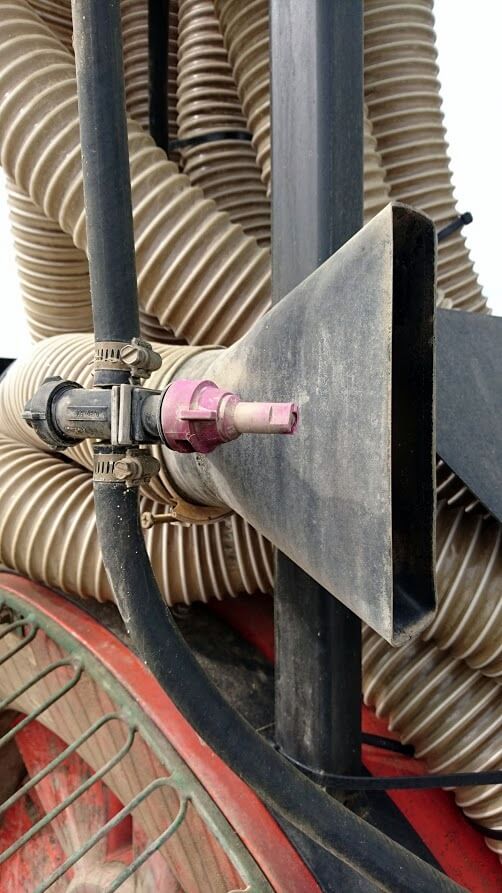
    8 – I used TeeJet’s ¼ turn AIC air-induction flat fan nozzles. They’re molded into the cap, so they are always oriented the right way. I set the nozzle bodies outside the air outlets to reduce turbulence in the airflow. It also makes servicing cleaner and easier. I also ended up adding some shielding around the lower nozzles just in case someone loses focus and runs into something.

    8a) Shields prevent physical impacts to AIC (air induction) nozzles. Coverage map was created for 55 gpa in a 6'x14' vertical planting.Shields prevent physical impacts to AIC (air induction) nozzles. Coverage map was created for 55 gpa in a 6'x14' vertical planting.
    Shields prevent physical impacts to AIC (air induction) nozzles. Coverage map was created for 55 gpa in a 6’x14′ vertical planting.
    8b) Close up of nozzle location versus air outlet.
    Close up of nozzle location versus air outlet.

    I asked Steve to stay in touch and let me know how his spraying season goes with the new sprayer. I’ll add to this article as he checks in and lets us know how the sprayer holds up and what changes, if any, he wants to make in the future.

    July 2016 Update

    As promised, I checked in with Steve to see how the sprayer was holding up. Here’s what he had to say:

    “It’s awesome. Works fantastic. Very effective in windy weather without having to worry about drift. Also, it works perfectly for sunburn protectants because of how directed the application can be. It has held up well considering how many acres its gone through this year.”

    Of course, there are always a few hiccups. I’ll interject here to suggest that what Steve is about to note about thinning is not a reflection of his design. I believe many orchardists experience the same difficulties with their conventional towers, too. Steve continued:

    “A few downsides I’ve noticed throughout the season: For blossom thinning (lime sulfur), gallonage is critical to get the stamen of the flower burned sufficiently to prevent fertilization. Even when spraying ~100 gallons per acre with this sprayer, it wasn’t enough to effectively blossom-thin the fruit. Part of this may be because I’m now distributing the spray evenly through the entire canopy, rather than spraying up through the canopy below. Another downside is the droplets’ tendency to accumulate in the lower portions of the tree (since every droplet doesn’t hit foliage), and over-apply in those areas. My Sevin/NAA application this year definitely prove this theory as my lower branches were over-thinned.”

    So, what’s the final word on this cool sprayer mod?

    “Overall, it’s great, and with a few tweaks this winter will be even better.