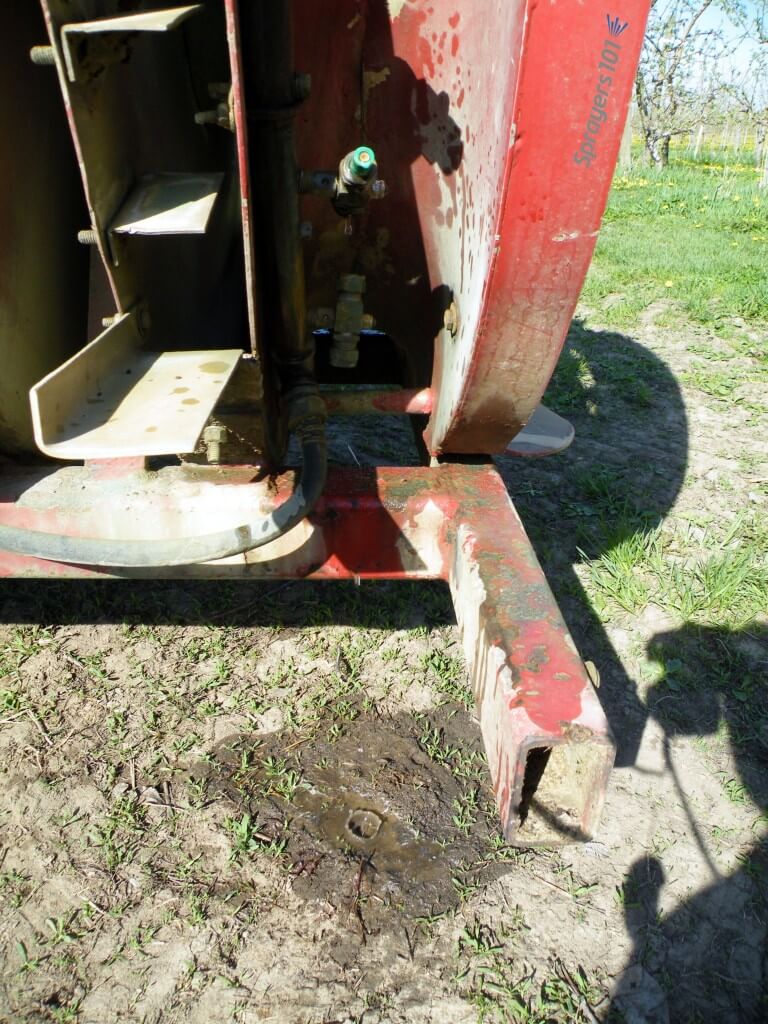
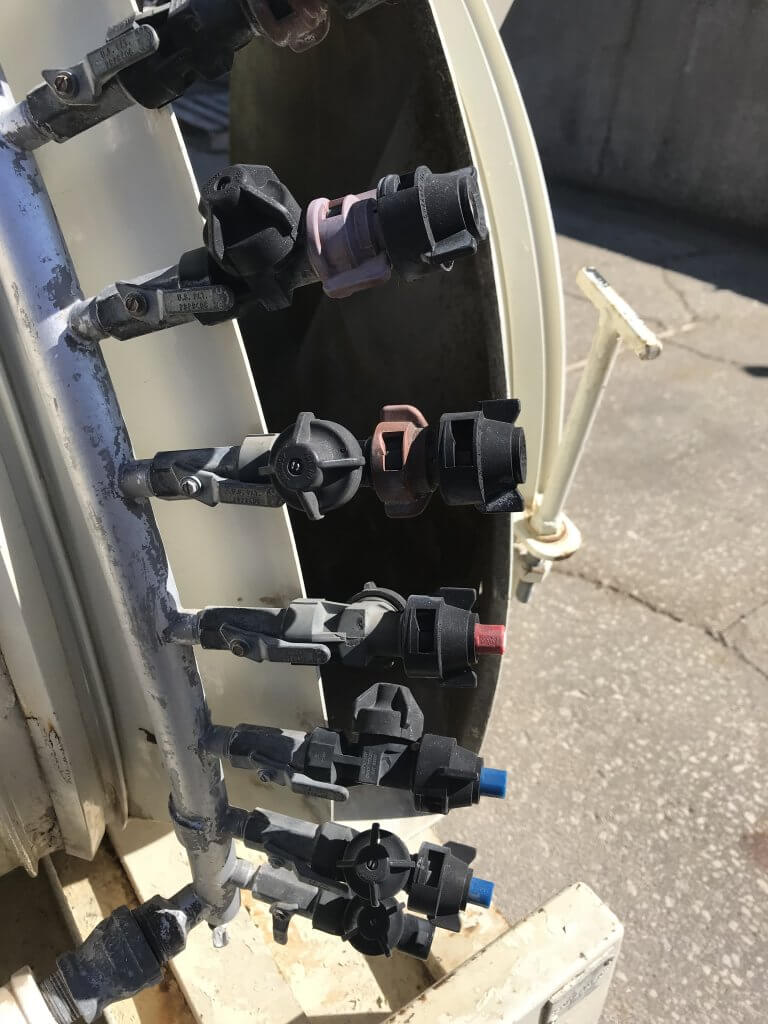
The level of filtration required for any given spray operation depends on the materials sprayed and the nuisance factor: That is, the balance between lost productivity from plugged nozzles and the effort required to address them during rinsing.
There are opportunities to install strainers at the tank opening (usually a basket), the suction-side of the pump, each section line, and behind the nozzles. While we’ve yet to see an operation that uses all four (speciality or field operations), the suction strainer and line strainers are required bare-minimum.
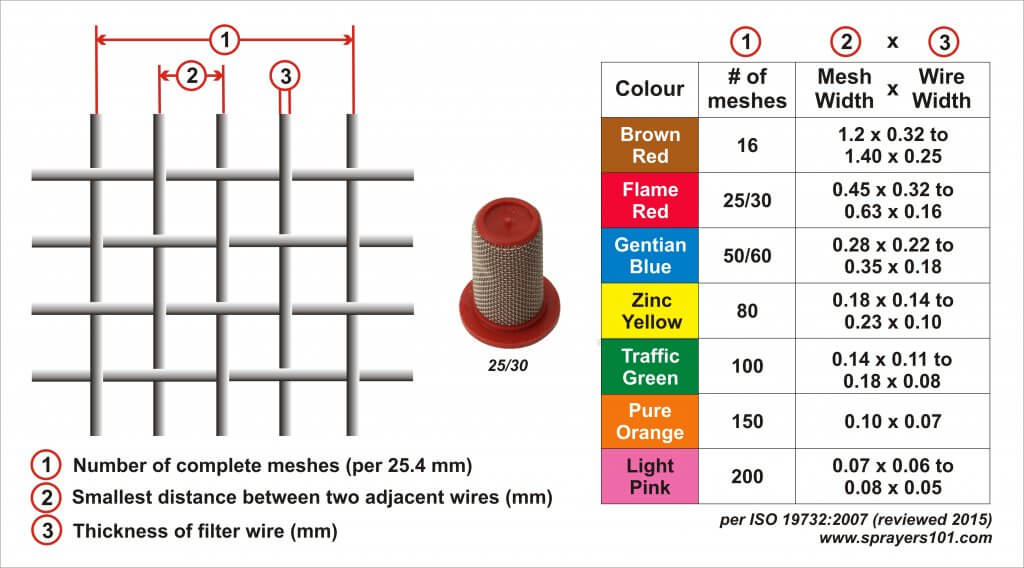
This infographic explains how strainers are classified. Be aware that older strainers may use a different colour code (e.g. 50 mesh used to be red – now it’s blue).
To convert these ratings to actual size exclusion, we look at the Mesh Width (mm). An 80 mesh (yellow) leaves a distance of 0.18 to 0.23 mm between the wires. We can convert Mesh Width from mm to microns by multiplying it by 1,000, giving us 180 – 230 microns.
Each level of filtration should get progressively finer, ending with the nozzle strainers being slightly finer than the nozzle orifice. Nozzle catalogues will often advise you on which strainer is appropriate for the nozzle you are using.
When we ask why operators don’t use nozzle strainers, the response is either “Because they plug” or “It’s one more thing to clean”. Well, if your nozzle strainers are plugging, it’s likely because you have an agitation (see here) or mixing issue (see hereand here) further up the line. They can handle a lot before the spray pattern begins to suffer … but yes, you do have to clean them regularly so they can continue their good work.
Running water through any strainer often fails to remove plugs and debris, which are a source of contamination that can wreak havoc later on. They have to be removed and physically scrubbed during rinsing. We ran a demo to show why this irritating process is still a must-do (here).
If you use an airblast sprayer, you should use slotted (not mesh, which plug too easily) nozzle strainers. Beyond the obvious benefit of preventing plugged nozzles, the strainer shoulder plays a role in keeping the nozzle snug in the nozzle body. Without it, you may need additional gaskets to prevent leaks. Be aware that some nozzle strainer designs can plug a nozzle body. Learn more here.
If you use a field sprayer with clean carrier water, liquid formulations and large nozzles, you may never need nozzle strainers. But, if you’re using a lot of dry formulations, if your agitation is under-powered, or if your fill water is less than pristine (we’ve seen frogs in sprayer tanks) then you might consider them… even if they are a nuisance to clean.
“I’m an organic apple grower with constant nozzle-clogging problems. These problems occur when we use wettable powders such as micronized sulfur and Surround WP. We always premix before adding to the tank through its strainer. Our airblast sprayers have towers and employ mechanical agitation. The nozzle/filter combo is TeeJet TXR8001K Ceramic Conejet Visiflow Hollow Cone spray tips with TeeJet 4514NY10 50-mesh nylon slotted strainers. The nozzle strainers rarely make it through a full tank without having problems. Do I need to add an additional level of filtration or is there something that I’m missing?”
A clogged slotted strainer inside the nozzle body. Note that the inners of the check valve seem clear (a good thing).A clogged slotted strainer.
You can almost feel the frustration. When I receive grower enquiries, I first turn to the library of articles on Sprayers101 as well as the Airblast101 textbook. I was surprised to discover that we didn’t have anything that addressed this issue directly. So, I checked through university extension and industrial resources. Ultimately I couldn’t find what I was looking for, so let’s correct this oversight.
Possible causes
There may not be a single reason for why nozzles plug. It might be a combination of the following factors:
1. Product choice
While any tank mix can create clogs if they prove to be physically incompatible, there are two formulations that have a reputation for clogging nozzles.
Wettable powder (WP) formulations such as micronized sulfur and diatomaceous earth are notorious for clogging nozzles. WPs consist of a finely ground solid active ingredient often combined with wetting and bulking agents to help hold them in a dilute suspension. They tend to be dry products rather than liquids.
In a similar vein, suspension concentrate (SC) formulations also consist of a finely ground solid active ingredient, but this time they are suspended in a liquid and kept dispersed in the sprayer tank by wetting agents, dispersants, and thickeners. These formulations are known as “flowables” or “suspensions”.
By the way, for those thinking he should change products, he already uses Kumulus DF (or Microthiol Disperss), which are reputedly the least troublesome formulations… and smell better than other sulfurs.
2. Mixing practices
Pre-slurries are sometimes prescribed for SCs. I personally feel that pre-slurries create exposure risks and more things to clean, but this opinion is moot in the case of WPs: Micronized sulfur and diatomaceous earth are not soluble. They’re particles that are held in suspension by fluid flow or agitation, so there’s no point in a pre-slurry.
For those readers that cook, consider the corn starch metaphor. You’re making a sauce, and you choose to thicken it with a pre-slurry of corn starch and water. The particles disperse, but do not dissolve, so if you fail to use it immediately they settle to the bottom of the container. They must be forcibly scraped up and resuspended.
3. Agitation
Best practice is to fill the tank at least ½ full of water and engage agitation before you add anything. To extend the cooking metaphor, you want a simmer but not a rolling boil. Once filled, never stop agitating or WPs and SCs will settle and may not resuspend uniformly, if at all.
Your sprayer design may affect matters. Some hydraulic agitation systems flag if they have undersized pumps. If your pump is busy sending flow to the nozzles, it may not have sufficient capacity to run the agitation. When your sprayer is “empty”, is there a thick accumulation at the bottom? You may have insufficient hydraulic agitation. Mechanical (paddle) agitation does not suffer this issue because it is direct-driven off the PTO. Read more here.
4. Clean-out practices
Perhaps plugs are occurring because of the previous tank, not the current tank. WPs can leave a buildup of settled pesticide in the tank, suction strainer and nozzle strainers. If you aren’t diligent about rinsing at the end of each day, products will settle and harden. Micro sulfur particles, for example, are less than 10 µm in diameter and harden into a flakey shell that can break loose and cause plugs.
5. Flow restriction
Several things can restrict flow. Elbows, bends and fittings can increase friction, reducing flow. The greater the distance a fluid needs to travel, the more flow is reduced. The greater the head (a pump’s head is the maximum height that the pump can achieve pumping against gravity), the more flow is reduced. There is an excellent description of this relationship here.
So, if an operator is using nozzles with a particularly small orifice, plus nozzle strainers, on a vertical boom, liquid flow will be reduced. This allows particles to fall out of suspension and settle, forming further restriction to flow and eventually, plugs.
Possible solutions
Now, armed with these potential causes, let’s return to the grower. After some back-and-forth, he clarified that the clogs were a problem, but restricted flow was worse. An operator will stop to clean or replace a plugged nozzle, but may not notice reduced flow. This has the potential to affect several rows as well as leave unsprayed product in the tank.
My first proposal was to increase nozzle size. An ’01 tip is very, very small and even with slotted strainers (as opposed to mesh), that’s a lot of restriction. I suggested recalibrating for larger tip orifices. This is a rather involved process, but options included using every second nozzle (as long as there were no gaps in coverage), and/or dropping pressure, and/or increasing travel speed (as long as the spray still reached the tree top and canopy centre). I shared this Excel outputcalculator to help with the process.
Failing that, we discussed a plumbing project. Section 5.2.1 of Airblast101 describes a way to create a self-cleaning line filter that replaces nozzle strainers. That means instead of climbing a ladder to pull tips off a tower to reach the strainers, all filtration is conveniently located at ground level for easier (and more frequent) cleaning.
The outcome
The grower felt the numbers worked best running orange 02 TXR’s in every second position. He ordered new 50 mesh slotted nozzle strainers. His new operating parameters would be 5 nozzles/side, at 8.2 bar (120 psi) and 5.1 km/h (3.2 mph) for a total 51.5 L/ha (55 gpa). He noted some incompatibility issues running Braglia nozzle bodies (spec on his Rears sprayer), TeeJet TXR’s, TeeJet slotted strainers and TeeJet CP20230 caps. That was an important observation, and you can learn more about it here.
We felt good about this, but while there was an improvement, it didn’t solve the problem. There was still strainer clogging after the first tankload. So, he added inline filters and removed the tip strainers. The result:
“Yesterday I sprayed over 350 pounds (over 1,000 gal) of Surround WP and had no issues. I’m really excited about this new setup – it looks very promising. I’ve attached more pics if you’re interested (I don’t spend a lot of time scrubbing sprayers until after Surround season). Thanks again for all your help in this matter. – Joe Fahey, Peck & Bushel Fruit Company”
A 50 mesh inline filter assembly with a 1/4 turn ball valve for quick flushes.New filter plumbed and secured. Note the anti-rub wrap on the line – always a good idea.The new loadout. 02’s in every second position, with no tip strainers, and a new inline filter on each side of the sprayer.
Fantastic. Thanks to Joe for letting me share this story. Hopefully his experience will help you diagnose and solve any flow or nozzle plugging issues in your own operation.
Happy Spraying.
Epilogue
This article elicited some interesting comments. I’ll share two:
One grower proposed switching from a low profile axial sprayer to an air-shear system (there are a few examples here). In this case, the grower had a European make with hydraulic agitation. The grower re-plumbed theirs by installing a bigger pump and swapping the sparge system with a 3/4″ pipe oriented toward the bottom to sweep it out. When mixing, the agitation valve is left wide open. He says he doesn’t even bother with a tank basket; he dumps the Surround (as much as 2 x 50 pound bags in 1,000 litres) and has no plugging issues.
Another grower with considerable boom-sprayer experience was genuinely surprised this was even an issue. Self-cleaning filters have been commercially available for more than 30 years and most boom sprayers have them. This is a comment on the stagnation of the North American low-profile radial airblast design. Perhaps the long life of these sprayers (sometimes 40 years of service) makes iterative change slow, or perhaps most operators aren’t aware of new features, or perhaps change is a risky proposition in such high-value crops. This is a shame given that the first optic sensors were installed on airblast, not broad acre field sprayers. That comes as a surprise to many. But it seems to have been the exception and not the rule.
Excepting air shear and centrifugal style nozzles, most airblast sprayers employ nozzle bodies designed to except hydraulic nozzles distributed evenly along the booms. Nozzle caps compress the nozzle against the body to force the spray mix through the nozzle orifice. Nozzle bodies are not all created equal.
Double Outlet Roll-Over Nozzle Bodies
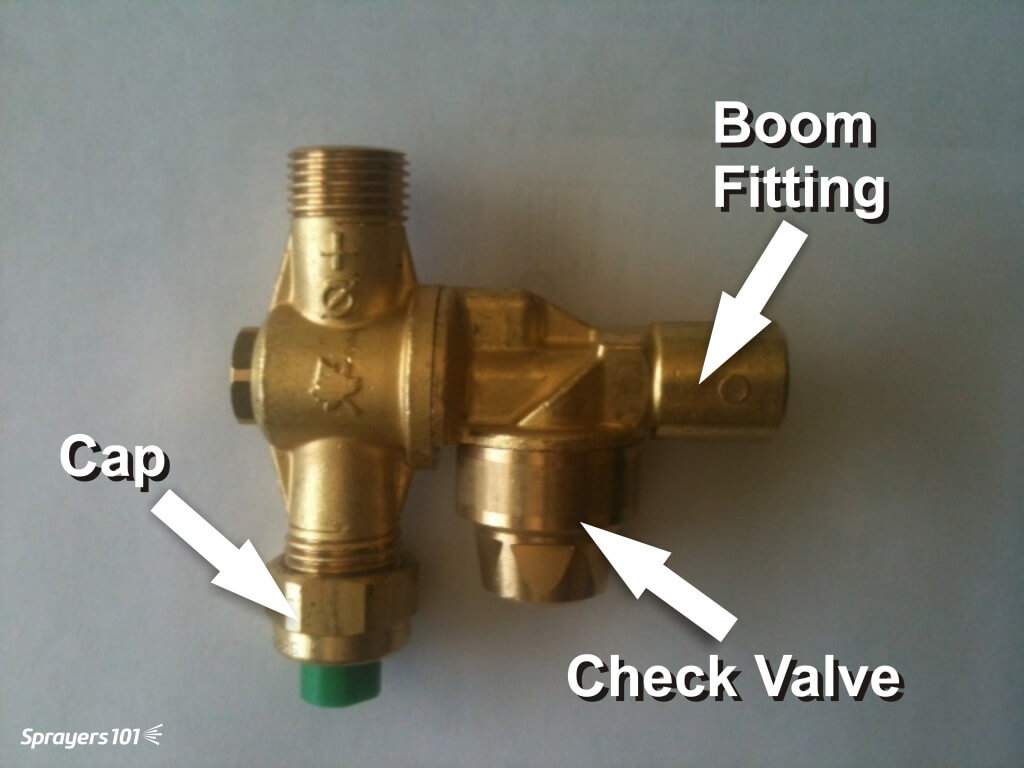
Double outlet roll-over bodies (pictured below) allow the operator to quickly switch between two nozzles mounted in each position. This is convenient when alternating from dilute to concentrated applications, or changing the spray distribution from block to block.
A typical brass roll-over style nozzle body with cap and check valve.
The roll-over feature can act as a shut-off and facilitate fine-tuning the orientation +/- 15° from centre. When roll-overs are new there is an audible ‘click’ when they reach 15° to alert the operator that turning them any further will interfere with flow. This feature fails as bodies wear.
Single Nozzle Bodies
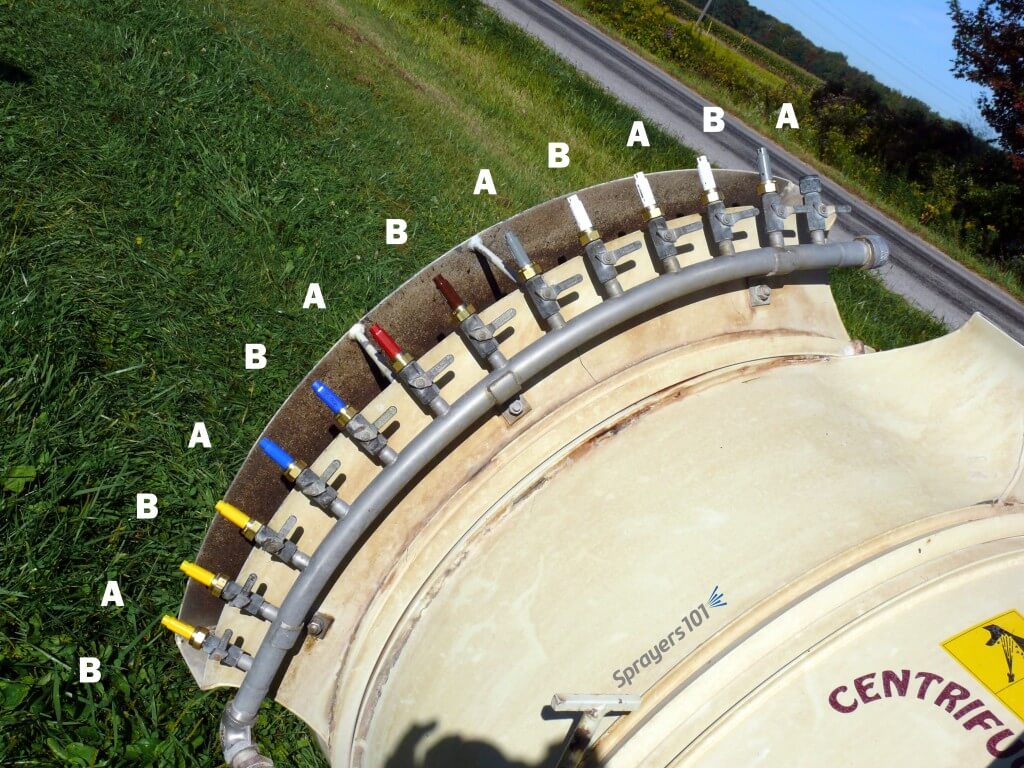
Some sprayers employ single nozzle bodies featuring screw or lever-style quarter-turn shut-offs. Some sprayers, like the Turbomist featured below, double the density of the bodies along the boom, arranged in an alternating A-B pattern. The operator shuts off each alternate nozzle, perhaps using the A’s for dilute and the B’s for concentrate applications. The density gives the operator the ability to “double up” in positions along the boom if more spray is required.
Some sprayers do not use double outlet roll-over nozzle bodies. Instead, they double the density of single bodies along the booms for use in an alternating A-B pattern.
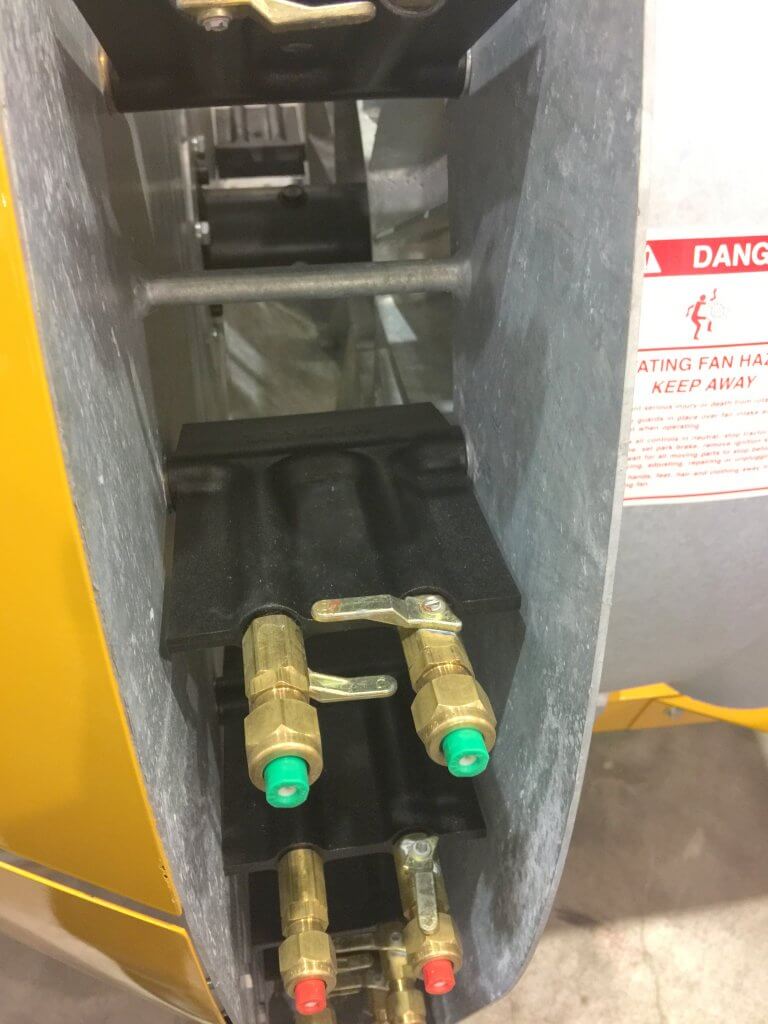
Still others may affix the nozzle bodies to the deflectors (like the Air-O-Fan below), permitting the operator to orient the air and nozzles at the same time.
The Air-O-Fan offers double-density by affixing two single nozzle bodies to each air deflector. The operator aims air and nozzles simultaneously and can select flow combinations using quarter-turn shut-offs.
Check Valves
In my opinion, it should be mandatory for nozzle bodies (or at least booms) to have diaphragm check valves. When pressure drops below ~15 psi the valves shut to prevent the boom from draining (see image below).
An older FMC with nozzles bodies that do not have check valves. Once the pressure is off, the booms drain through the lowest nozzle. This is a waste of pesticide and unnecessary environmental contamination.
Booms don’t just drain in the yard. Operators shut off the outside boom when turning at the end of a row. Without check-valves, the boom drains through the bottom nozzle, wasting pesticide and causing repeated and unnecessary point-source contamination. Further, it takes a moment for the boom to refill, meaning the top nozzles may not be spraying at the beginning of each row.
You may be tempted to purchase mesh nozzle strainers with built-in ball valves. They can work as an alternative to integrated nozzle body check valves, but they plug and fail with irritating regularity. The image below shows a creative method for installing check-valves on single nozzle bodies. The nozzles protrude and the check valve seems too close to the shut-off, but reputedly this works.
An example of retrofitting diaphragm check valves on single nozzle bodies.
Thread Types
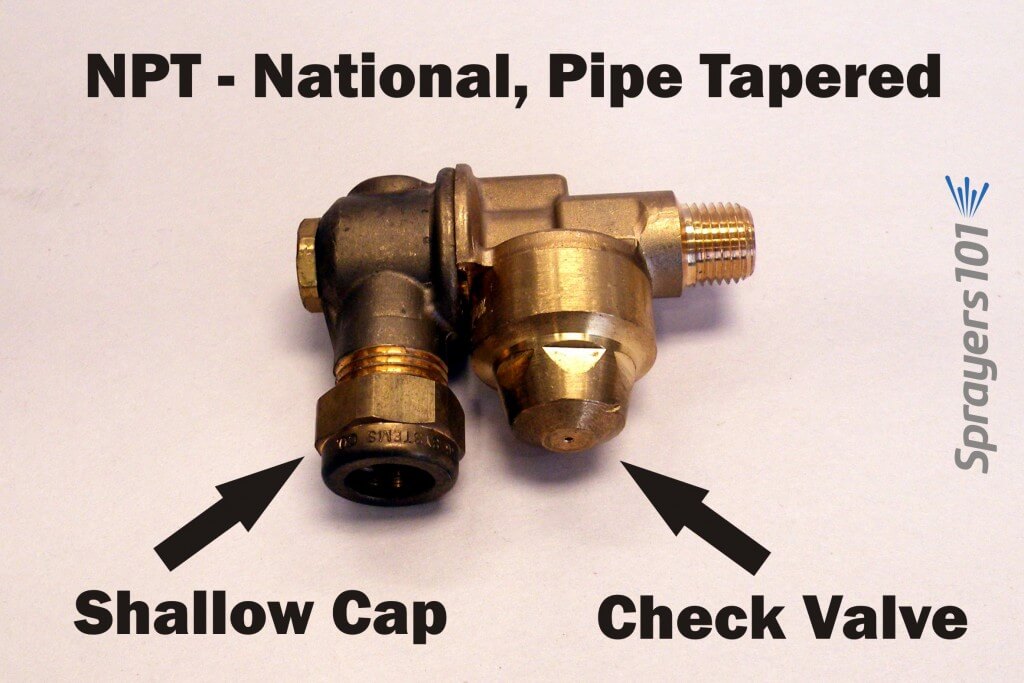
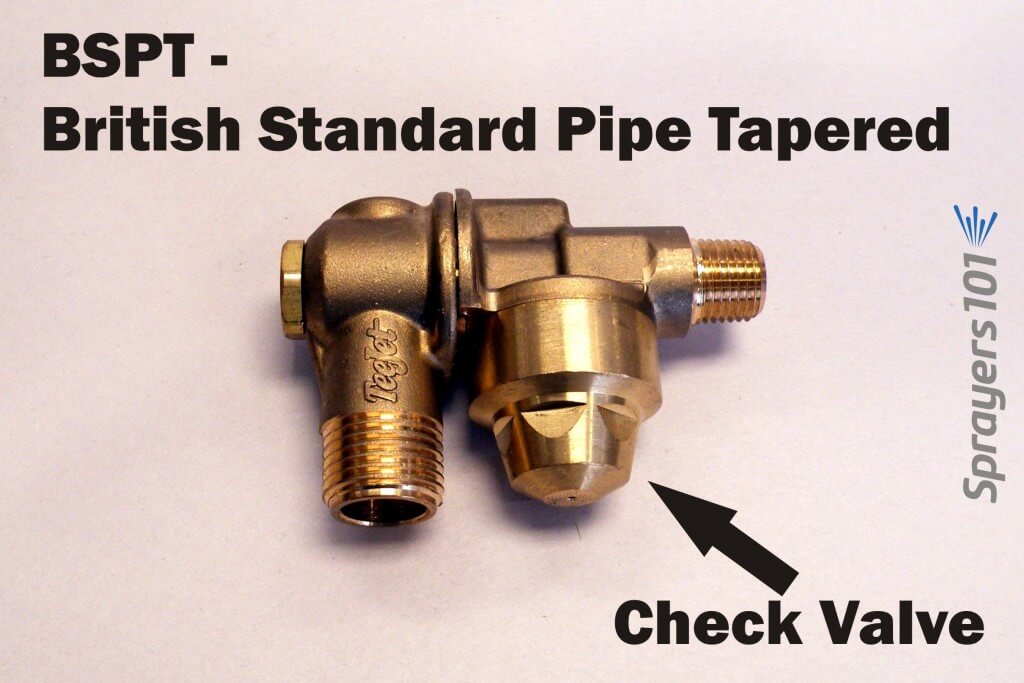
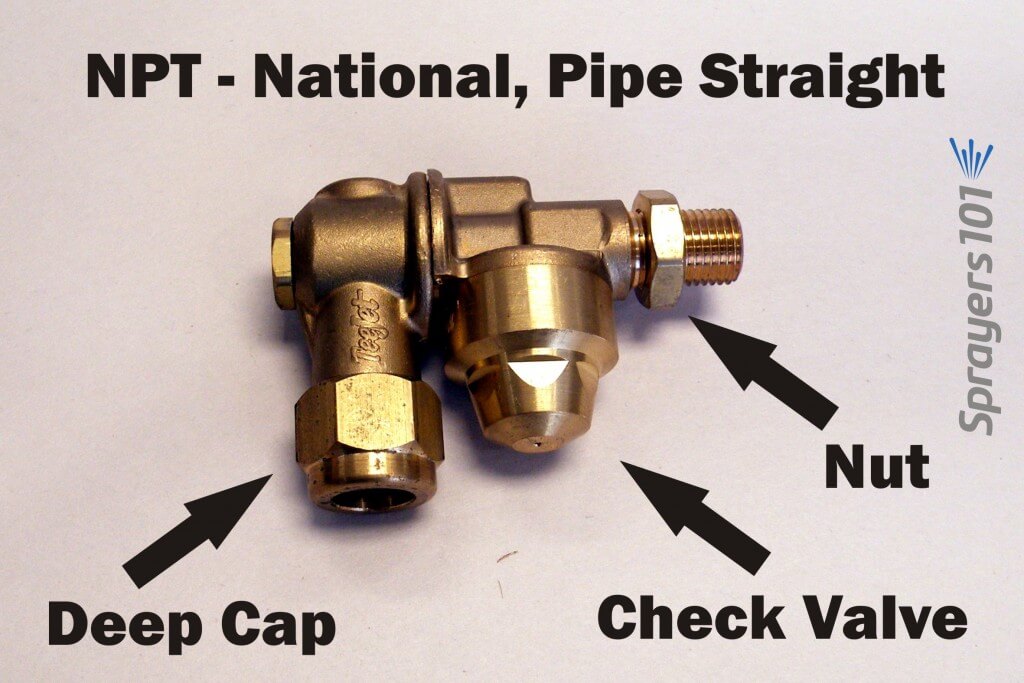
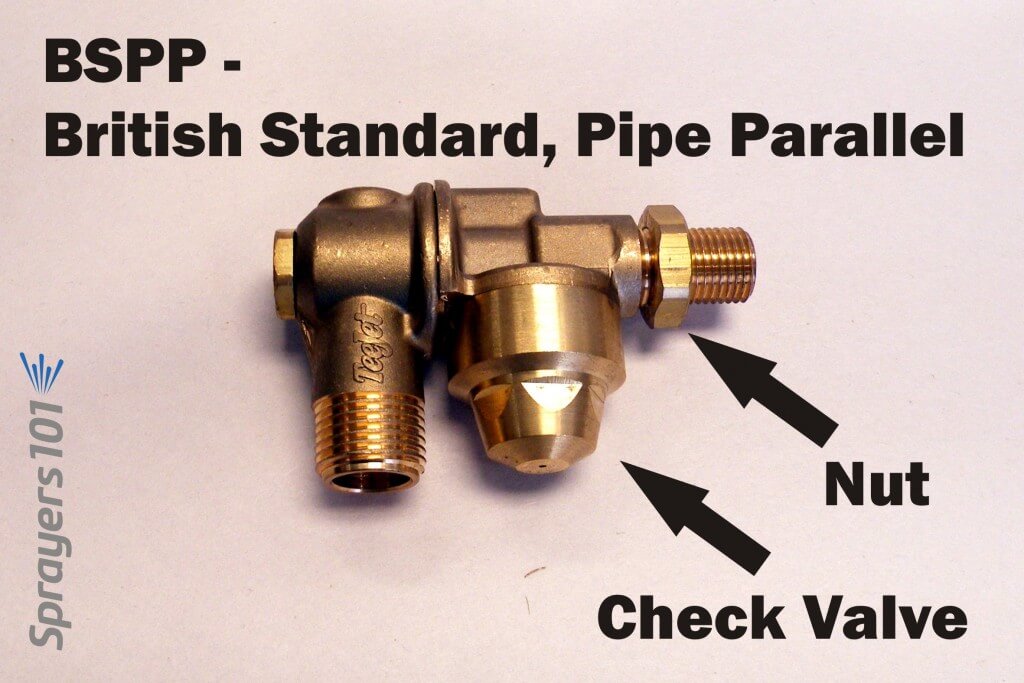
In North America, you will encounter four inlet thread types: NPT, BSPT, NPS and BSPP.
National, Pipe Tapered (NPT) single-sided, brass roll-over nozzle body with check valve. Note the shallow cap pictured here.British Standard, Pipe Tapered (BSPT) single-sided, brass roll-over nozzle body with a check valve.National, Pipe Straight (NPS) single-sided, brass roll-over nozzle body with check valve. Note the deep cap pictured here.British Standard, Pipe Parallel (BSPP) single-sided, brass roll-over nozzle body with a check valve.
The inlet thread sizes available are 1/4” female, 1/4” male and 3/8” male. 1/4” female is not available on the NPS or BSPP inlet thread types. If you are considering installing new roll-over bodies, know your boom’s thread type. The retrofitted Turbomist below, for example, required bodies with female fittings.
A retrofitted Turbomist with check valves and female double outlet roll-over bodies.
Molded Nozzles
Another reason for installing new bodies is to convert from disc & core combination nozzles to single-piece, molded nozzles. They may not fit existing nozzle bodies. Check the diameter of the body outlet (where the nozzle rests) and the outlet cap (which compresses the nozzle against the body outlet). Your sprayer may currently use an unusual-diameter nozzle, like older FMC disc & whirls or European large-diameter pink ceramic disc & cores. Today’s ISO molded nozzles won’t fit in those bodies, so you’ll need to replace them.
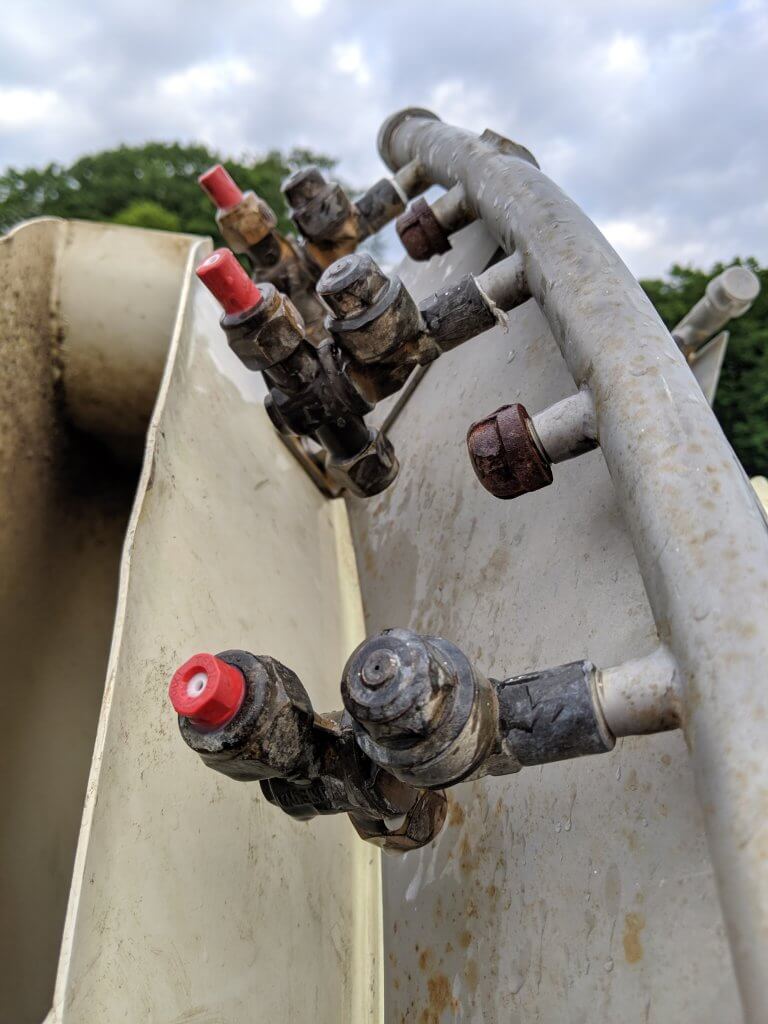
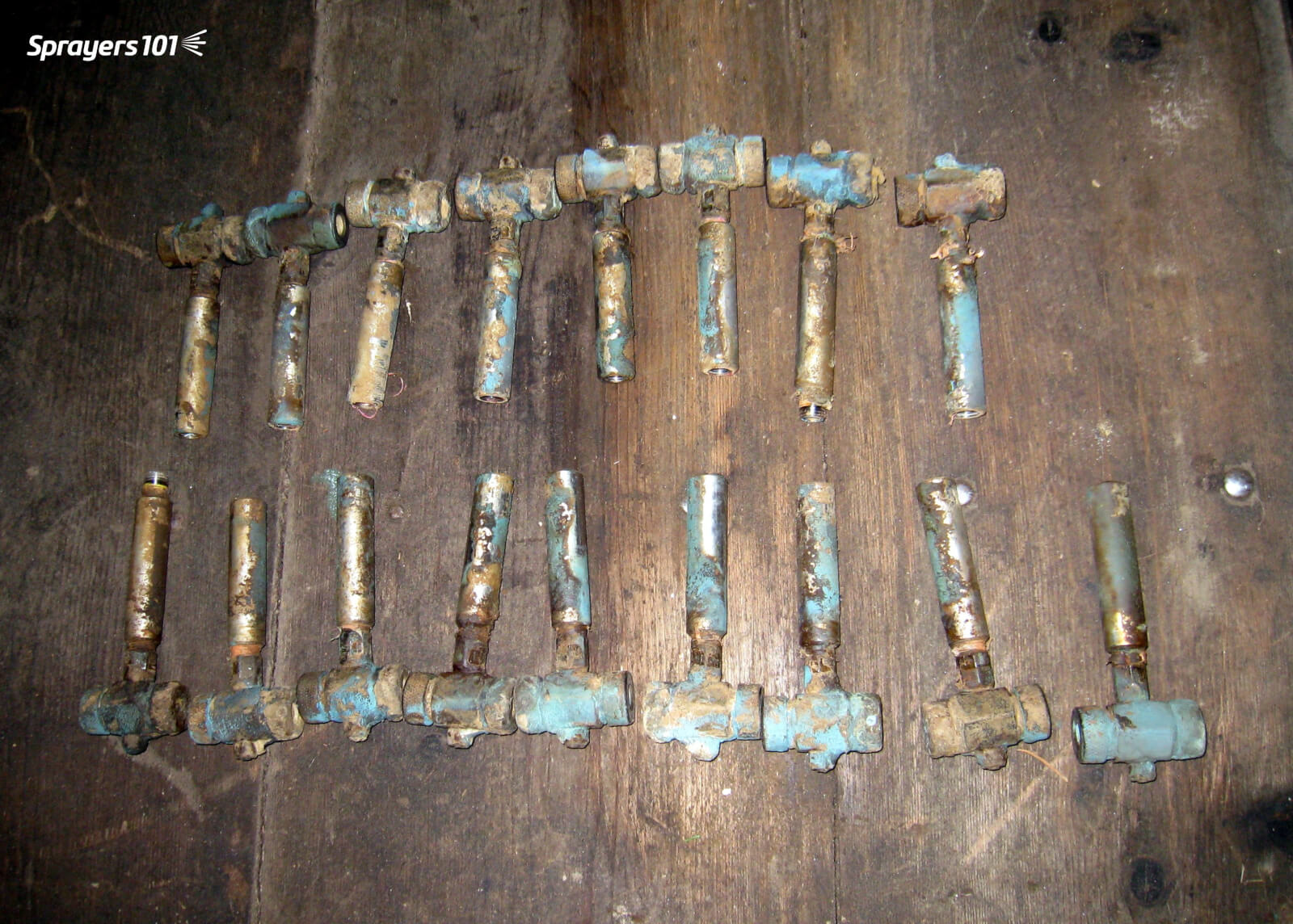
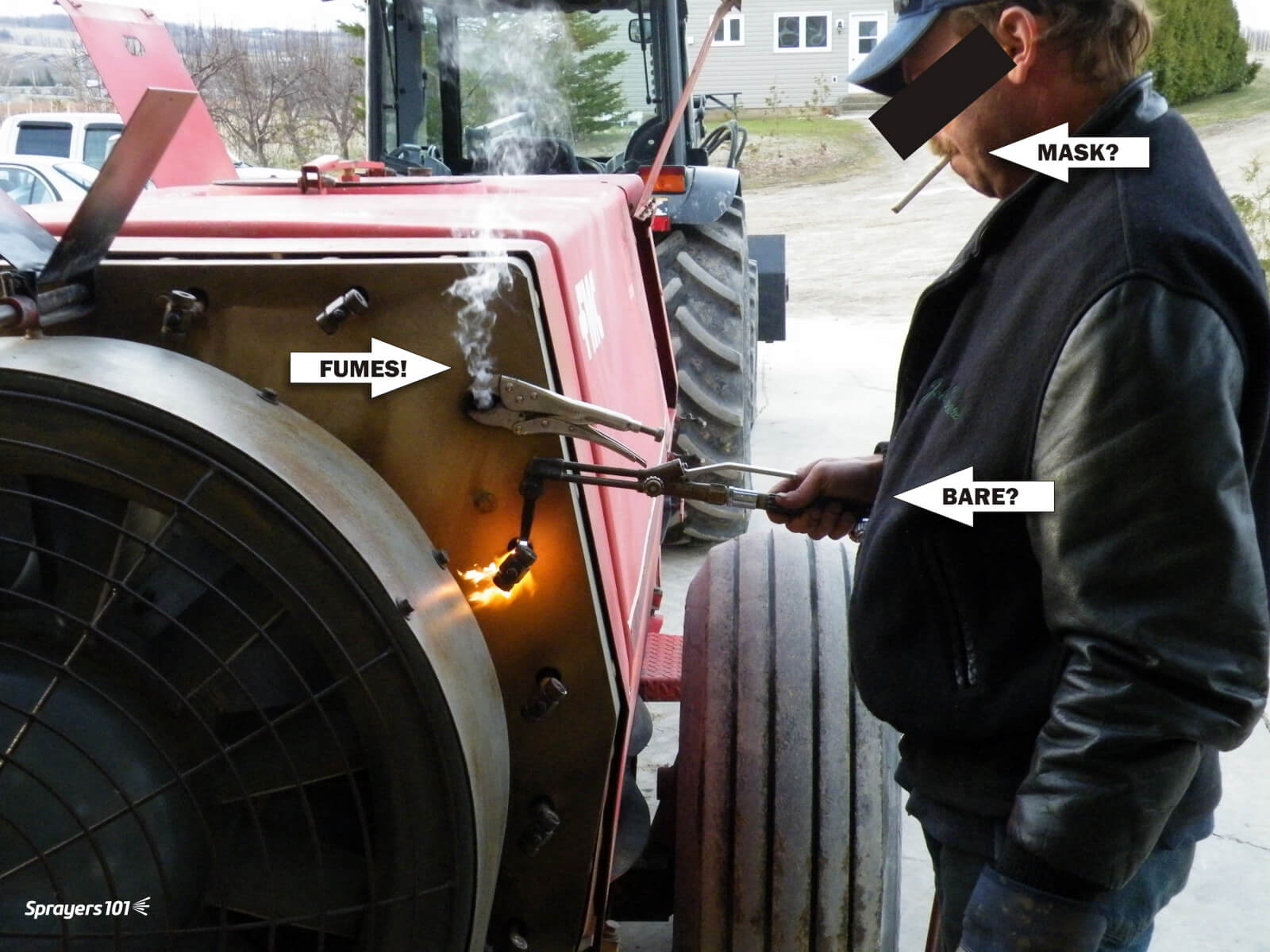
Old roll-over bodies without check-valves. These were removed to make way for better bodies.Older nozzle bodies can seize in the boom, requiring novel approaches to removing them. In this case, the mechanic is heating the fittings using “the blue wrench” to loosen them. If you do this, do not do what this mechanic did. Operate in an open space using gloves and a respirator. Years of residue build-up should be anticipated and respected.
Be aware: that unlike disc and core, molded nozzles protrude and may hit the edge of the sprayer duct when rolled over, preventing them from turning freely
Nozzle Body Caps
Nozzle bodies DO NOT come with the nozzle caps; they are specific to the nozzle type and must be ordered separately. This was an unpleasant surprise the first time I ordered a set of bodies.
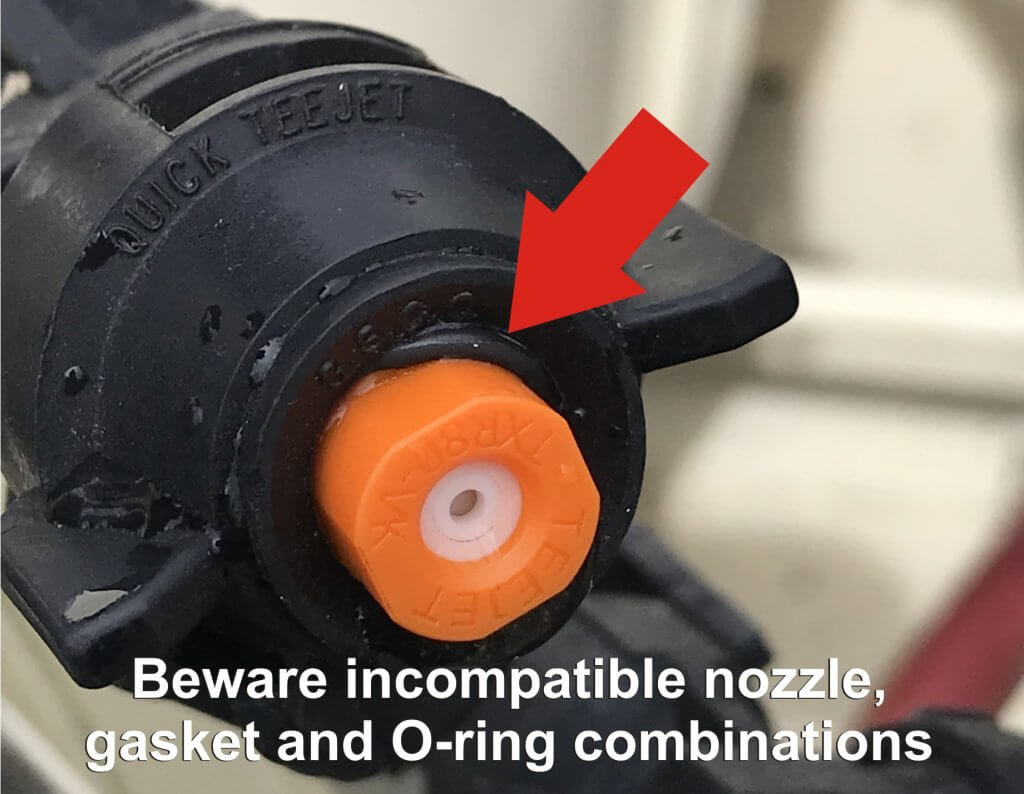
The standard caps are threaded brass hex nut-style but there are also nylon wing-style caps that don’t require a wrench. Beware converting to quarter-turn systems for airblast sprayers. It can work, but nozzles may require additional gaskets and O-rings… and even then are known to leak if the cap diameter is too large (see below):
Airblast pressure often exceeds 100 psi and can force the O-ring off the molded nozzle and cause leaks.
Be aware: North American nozzle caps might not fit imported European bodies, and European nozzles might not fit North American cap diameters. The LipCo sprayer is one such example.
Regarding the cap depths, sprayer operators must consider the how much “stuff” is between the nozzle body and cap. Gaskets, spacers, O-rings and strainers take up room that may warrant a deeper cap. Perhaps most critical is the nozzle itself. For example, brass disc-core are quite thin, but ceramic are much thicker. They require different cap depths.
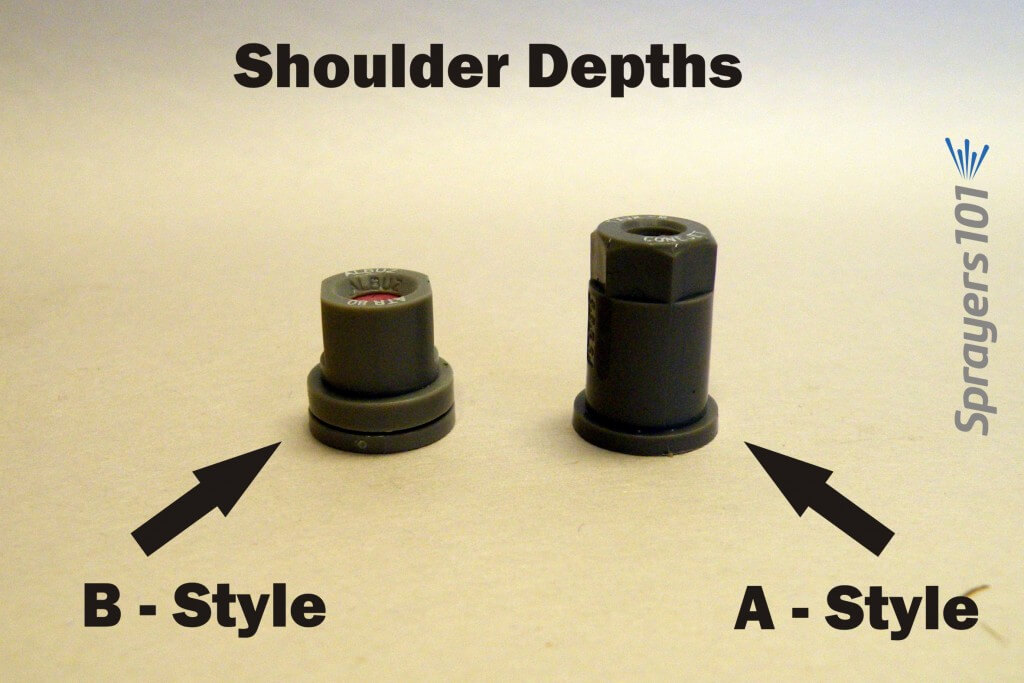
TeeJet’s molded cone nozzles come with an ‘A’ (Thinner) or ‘B’ (Thicker) shoulder. The shoulder is the lip around the nozzle base that is compressed against the nozzle body outlet. The B-shoulder is the ISO standard, and is preferred (see below). Shallow caps may not thread onto a nozzle body using a nozzle with a B-shoulder. Deep caps may bottom-out before compressing a nozzle with an A-shoulder, creating leaks. Be sure to note in the nozzle catalog which caps are recommended for the nozzle.
Molded cone nozzles come in the thin shoulder (A-style) or thick shoulder (B-style) varieties. The B-style is the ISO standard and is preferred.
Nozzle Strainers (aka Filters)
Before we wrap up, here’s one more look-out. As mentioned, the nozzle strainer shoulder takes up some room between nozzle body and cap. It turns out there can be another concern.
A hop grower contacted me. He had installed new nozzle bodies on his sprayer. He’d taken into account the shoulder depth and the cap depth. So why were his nozzles plugged? And why when he loosened the cap to finger-tight did they spray, but leak?
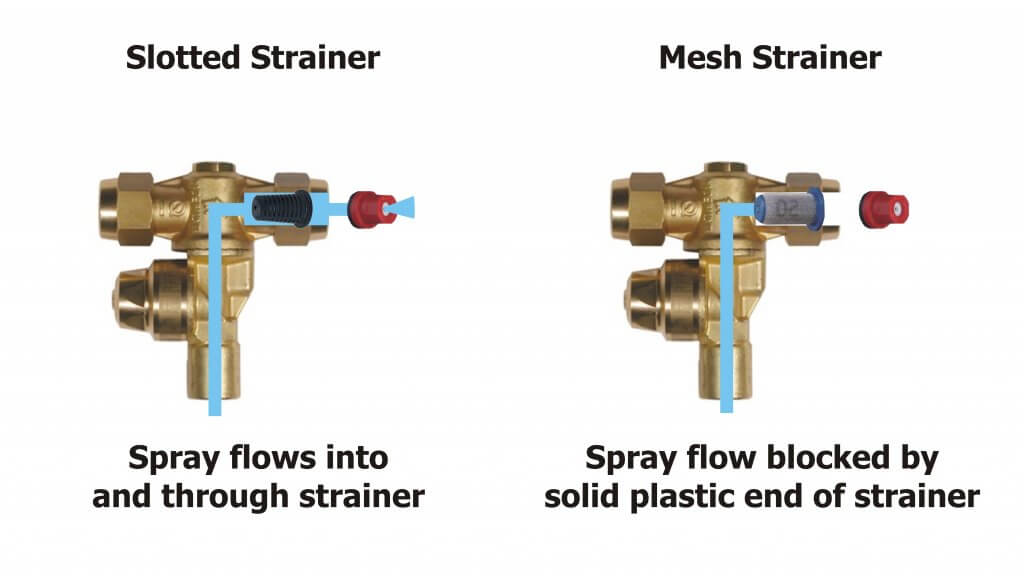
We tried gaskets, O-rings, different cap depths and new nozzles – but no change. That’s when we noticed one side of the roll-over body had a plastic slotted strainer and the other had newer mesh strainer. The mesh strainers were longer and terminated in a disk of solid plastic. When we swapped the two strainers, we had flow! We realized the longer mesh strainers were being compressed against the orifice in the nozzle body, acting like a cork in a wine bottle.
I prefer slotted over mesh because they are a bit more forgiving with dry formulations and hard water residue, but perhaps more critical is that they aren’t long enough to block the flow.
Be aware that some strainers may be long enough to block flow in the nozzle body.
Take Home Tips
If you are considering installing new nozzle bodies:
Confirm the male or female fitting and thread type of your boom
Ensure bodies have check valves
Ensure roll-overs and check valves clear any obstructions with nozzles in place
Know the nozzle type you intend to use, and ensure cap diameter is appropriate
Know whether you will use gaskets, o-rings, spacers and strainers, and confirm the cap depth will accommodate everything.
Be certain the strainer you choose isn’t so long that it interferes with flow.
Consider buying a single nozzle body to install as a trial before buying an entire set of replacements.