Tag: greenhouse

  • The Micothon M2 – The Benefit of Air-assist Spraying in a Vegetable Greenhouse

    The Micothon M2 – The Benefit of Air-assist Spraying in a Vegetable Greenhouse

    I’ve experienced a few spectacular failures trying to build niche sprayers. Until now, I haven’t had a reason to write much about them. But I decided the contrast, and confession, would be a fun way to set the scene for a discussion about an excellent niche sprayer.

    Failed Attempts

    First, the ill-fated “Hops Sprayer”. We used an adjustable ladder to position 20 feet of arborist guns between hop rows. The nozzles could be raised and engaged to match the growing crop canopy. While it left decent coverage on the adaxial surfaces, we quickly realized it needed air-assist to get under the leaves and battle high winds at the top of the trellis. It’s since been cannibalized for parts, and the rusted remains haunt me whenever I drive by the outdoor storage area at our ag research station.

    The Hops Sprayer. A 3 point hitch, vertical boom that could adapt to match canopy height.

    Later, encouraged by a minor success ducting a backpack mist blower with PVC and Coroplast, I tried building an air-assisted spray cart for a floriculture operation. It featured commercial, high-volume radial fans paired with hollow cone nozzles positioned in front of the air outlets. With respect to GreenTech and Croplands Equipment in Australia, I tried to build a bargain-basement SARDI-style head.
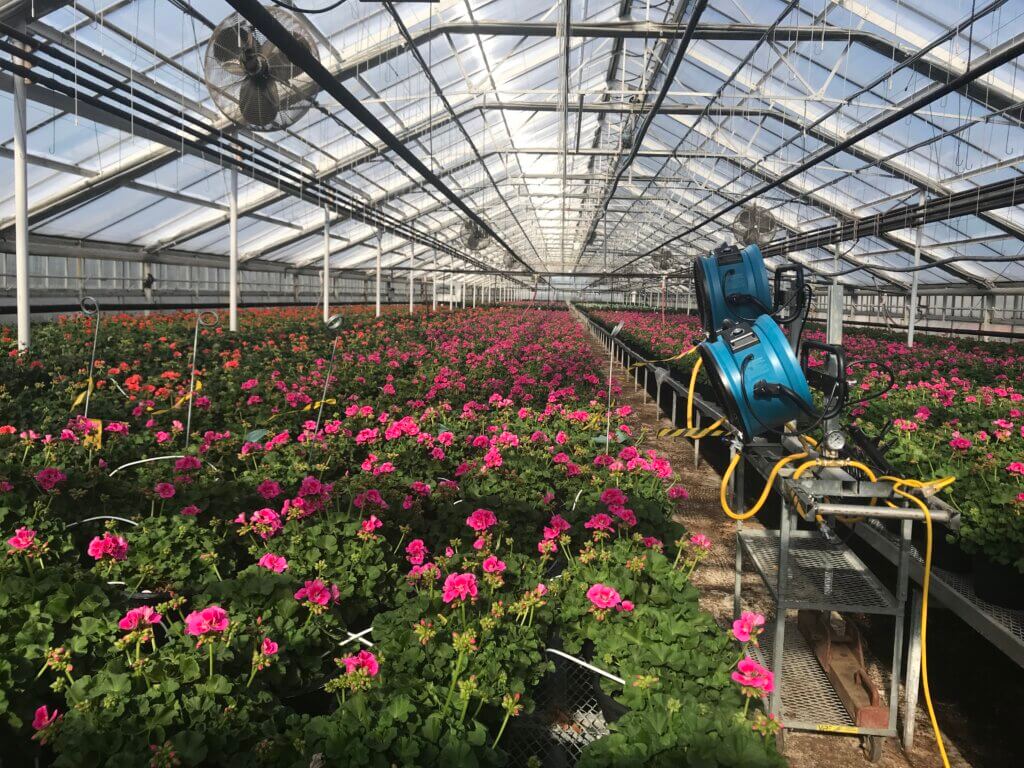
    When it wasn’t threatening to tip over, it managed decent coverage over almost 2 meters. Almost.

    As it turns out there’s a very good reason engineers use computational fluid dynamics to design air-assisted sprayers. We were ultimately beaten by an uneven greenhouse floor crowded with obstacles, a stiff canopy of geraniums, and the inverse square law, which states: “The farther away an object is from an effect, the less change can be observed in the object”. This rig now has a new life circulating hot air in a boiler room.

    And I once built an air-assisted, tow-behind sprayer to spray troughs of tabletop, hoop house strawberries. That unit laid down an excellent, uniform spray on all foliar surfaces, but it was frustrating to use. There was almost no clearance in the hoop house, which changed height with the topography, and the alternator couldn’t keep the battery sufficiently charged to run the pump and fans. I felt we could overcome these small difficulties, but sadly the operator ended this experiment halfway through the season. I can only assume the sprayer is now an interesting piece of lawn sculpture.
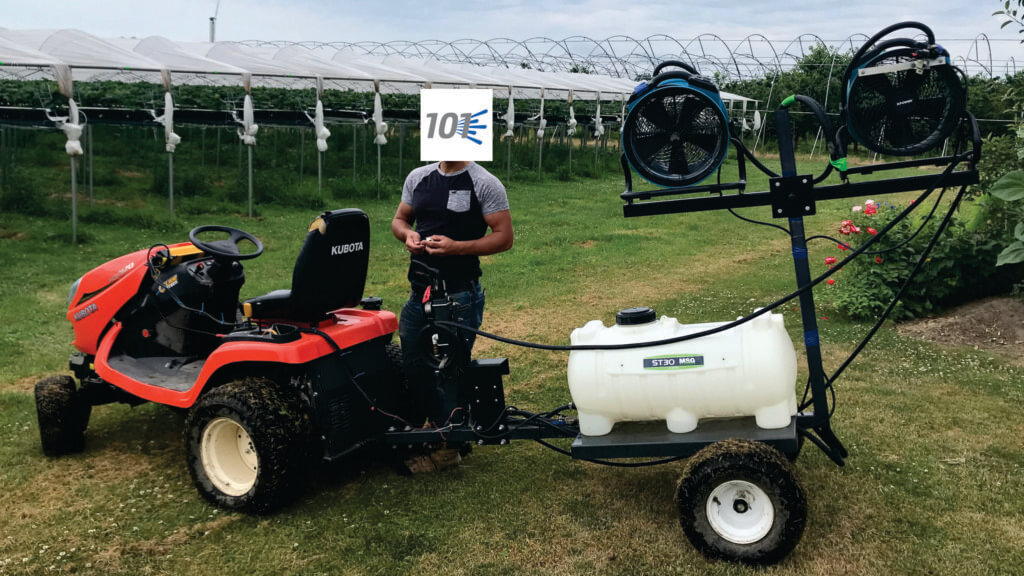
    This sprayer had potential, but limited resources prevented it from getting beyond the beta stage.

    The Micothon M2

    Despite my inability to build a decent air-assisted sprayer, I have always maintained that air-assist is the secret sauce for efficient, uniform spray coverage. Lucky for me, Great Lakes Greenhouses (GLG) agreed. No stranger to innovation, the company recently purchased a first generation, air-assisted Micothon M2 greenhouse sprayer and invited me to come see it. This was a proper sprayer designed by engineers, and not a delusional plant physiologist, so I was excited to assess and calibrate it. This article will describe what we learned and perhaps in some small way, validate my failed attempts.
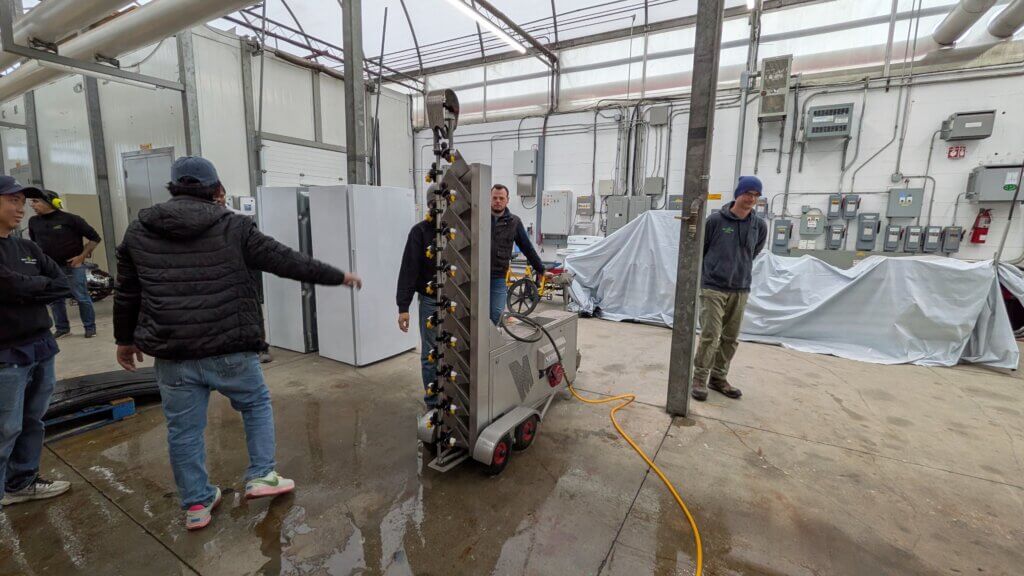
    A quick walk around before we got to spraying.

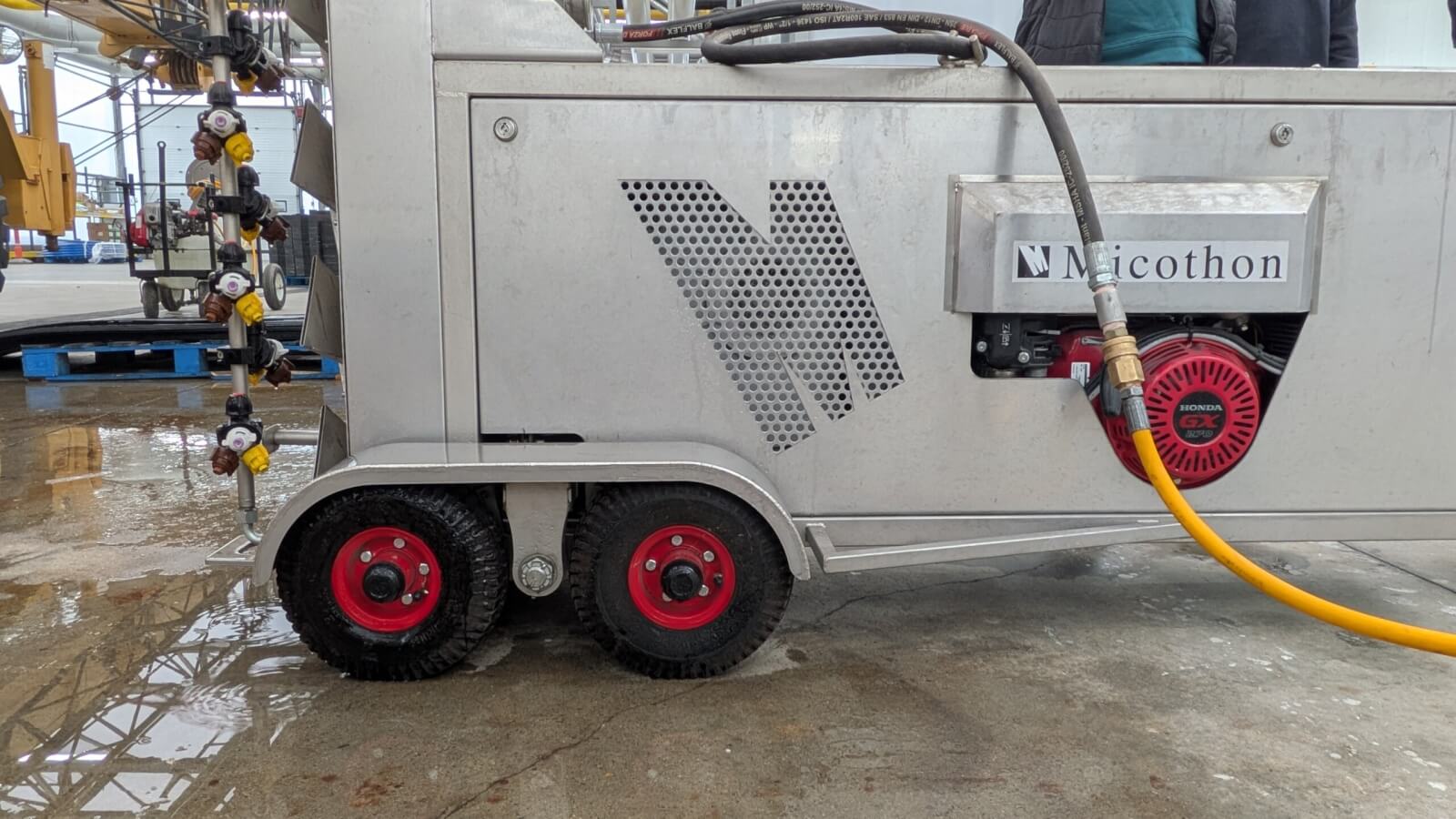
    The M2 features a vertical boom design supported by a portable tender unit, but that’s where the similarities to a classic “tree” sprayer end. Rather than riding on the hot water pipes, or tipping onto two wheels like a hand cart, this version rides on self-leveling wheels. It is drive-assisted but still has to be guided by an operator, like a self-propelled walk-behind lawn mower.

    Drive-assist, self-levelling wheels.

    The mast features 18, three-position nozzle turrets (nine to a side). GLG requested a bespoke spring-loaded break-away section at the top of the boom. This allowed the top nozzles to “duck” under an annoying section of greenhouse infrastructure that would have otherwise prevented it from being positioned between the rows.
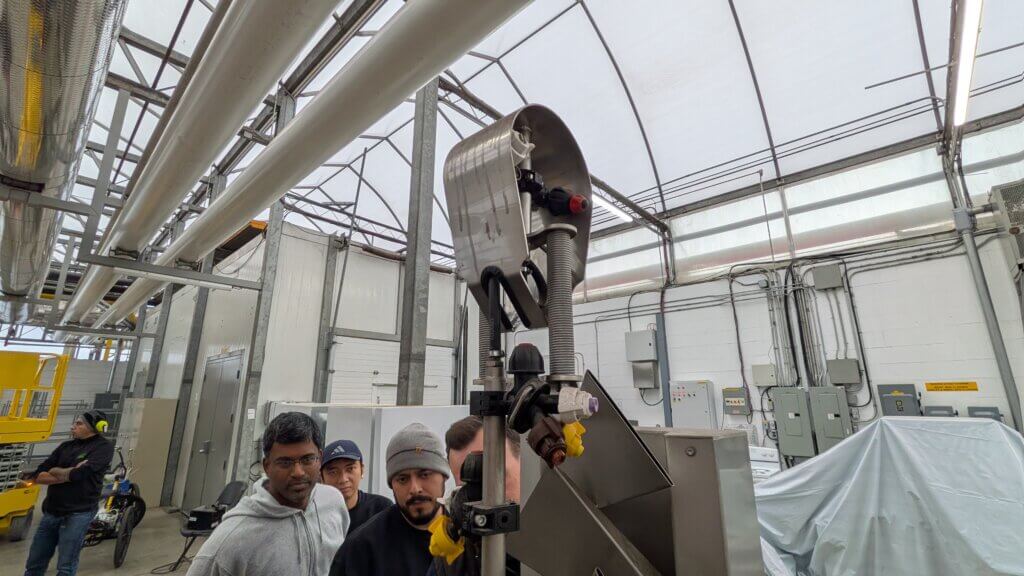
    A spring-loaded, break-away boom section (with guard) to prevent impact damage.
    The break-away section in action.

    The air is generated by a centrifugal fan powered by a Honda motor. The air travels up the ducted mast to a manifold of narrow air outlets. When the sprayer is moving, the air outlets precede the nozzles, which initially seemed wrong as the spray would be released outside the air stream. But, upon closer inspection, we saw that the air outlets are not only angled up by 45 degrees but are also angled back so the air can transect the spray.
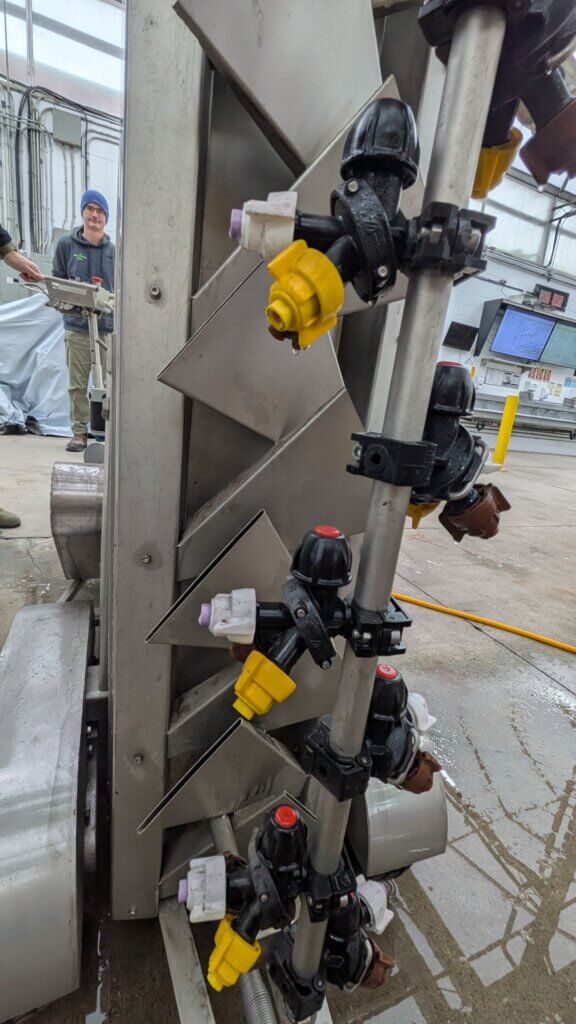
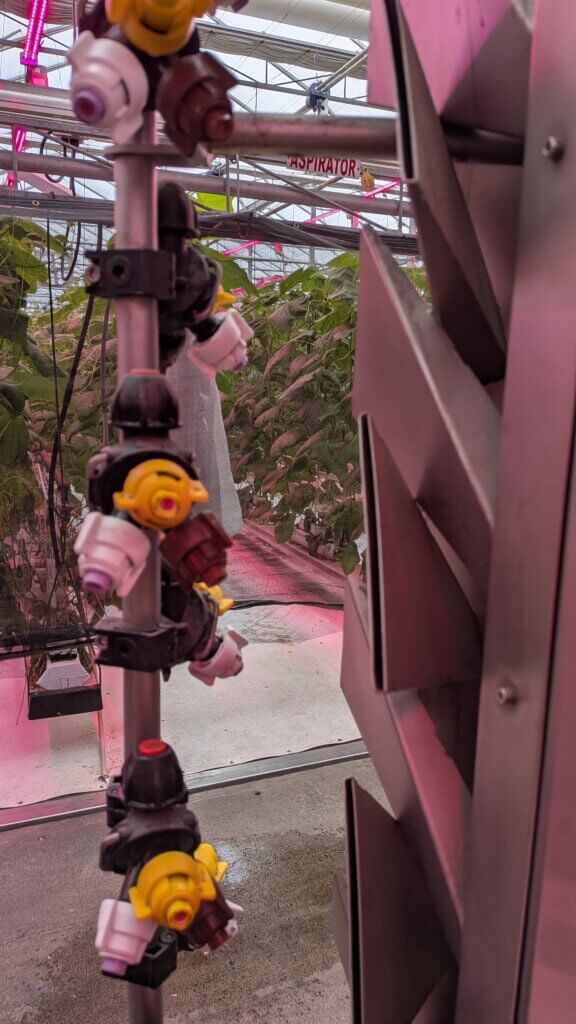
    Air outlets and nozzles – front view.
    Air outlets and nozzles – side view.

    It was suggested that the blade of air acts like an airfoil, creating an area of low pressure and sucking small droplets into the airstream. This is Bernoulli’s principle and it describes how wings create lift. Personally, I think it behaved more like a Venturi. I’m open to debate since, as evidenced by my attempts at building a sprayer, I’m no engineer. What matters is that we didn’t see any droplets hanging in the air as the sprayer passed. It works.

    Calibration and Optimization

    We followed the same greenhouse sprayer optimization protocol I’ve outlined in this article. Go give it a quick read and come back so I won’t have to reiterate why we took the steps we did.

    Travel speed and air settings

    The sprayer was set to speed “3” of a possible “5”, as recommended by Micothon. Travel speed dictates dwell time, which is the duration the air is focused on the target. Observers stood in the drive alley and in the two adjacent alleys to see how the air moved leaves. The upward angle of the outlets combined with the volume produced by the centrifugal fan wafted and twisted leaves on their petioles. This created sufficient movement throughout the canopy, but not so much that it caused the canopy to louver shut. It was a Goldilocks situation so there was no need to alter anything.
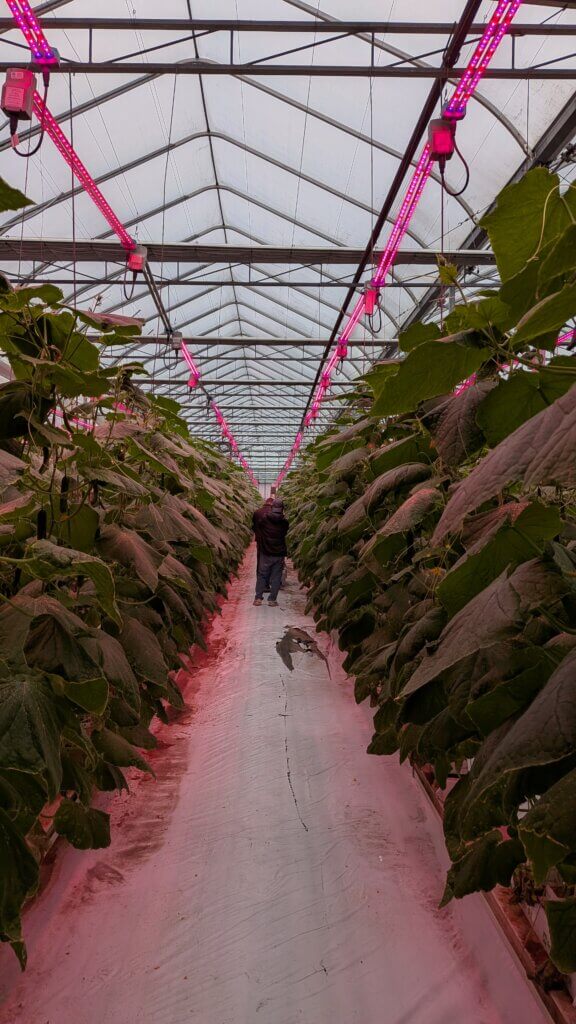
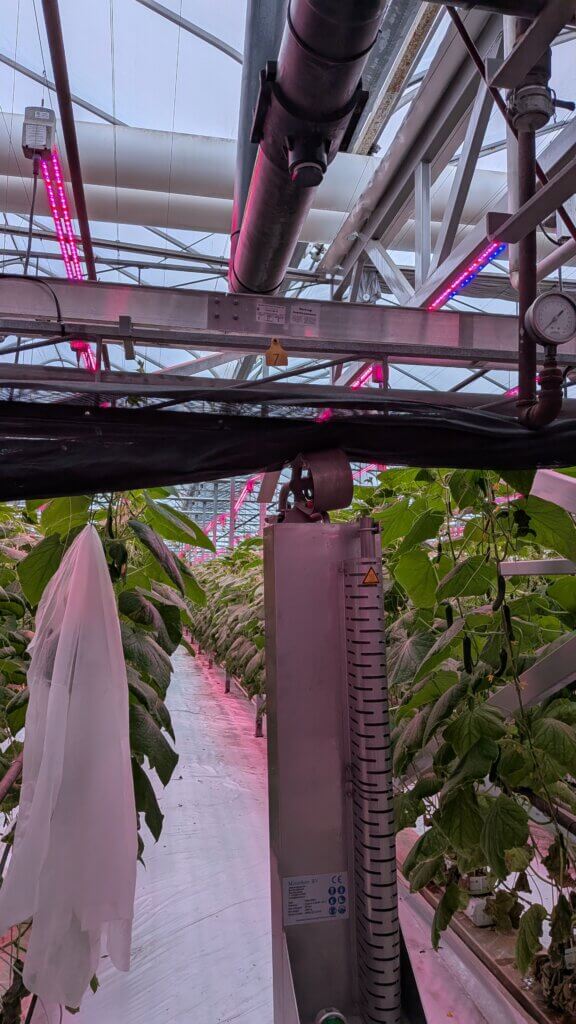
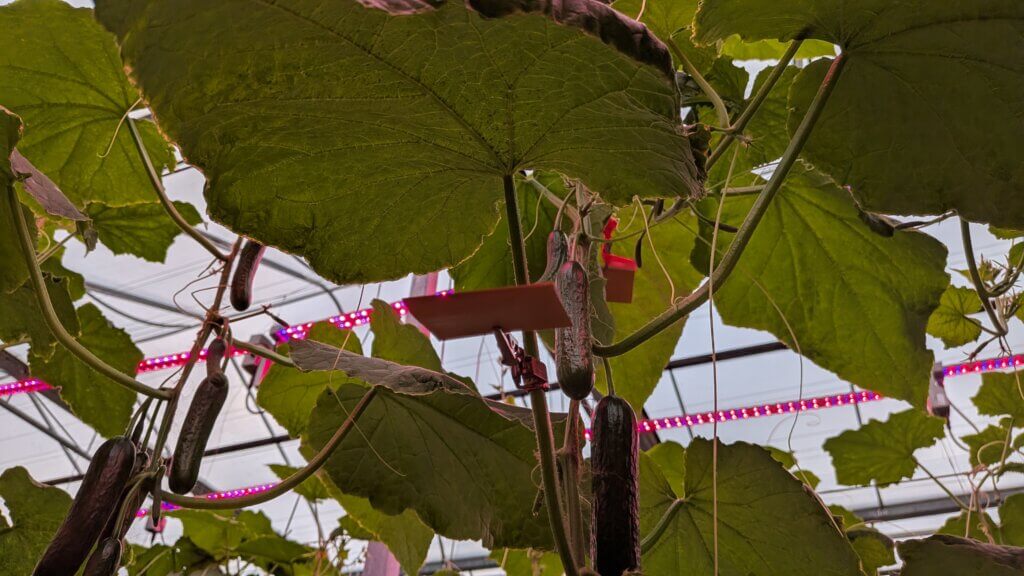
    Preparing to guide the Micothon M2 through the cucumbers under red LED lights. This image gives perspective of canopy height, density and the sprayer clearance.

    Pressure and nozzles

    The tender system regulator was set to 41.5 bar (600 psi) and that pressure dropped to 5.5 bar (80 psi) according to the gauge on the sprayer. While we didn’t test it, I’m certain the pressure at the furthest (aka highest) nozzle would have been closer to 5 bar (~70 psi). With observers in place, we started spraying water using the Albuz 025 (lilac) hollow cone tips.

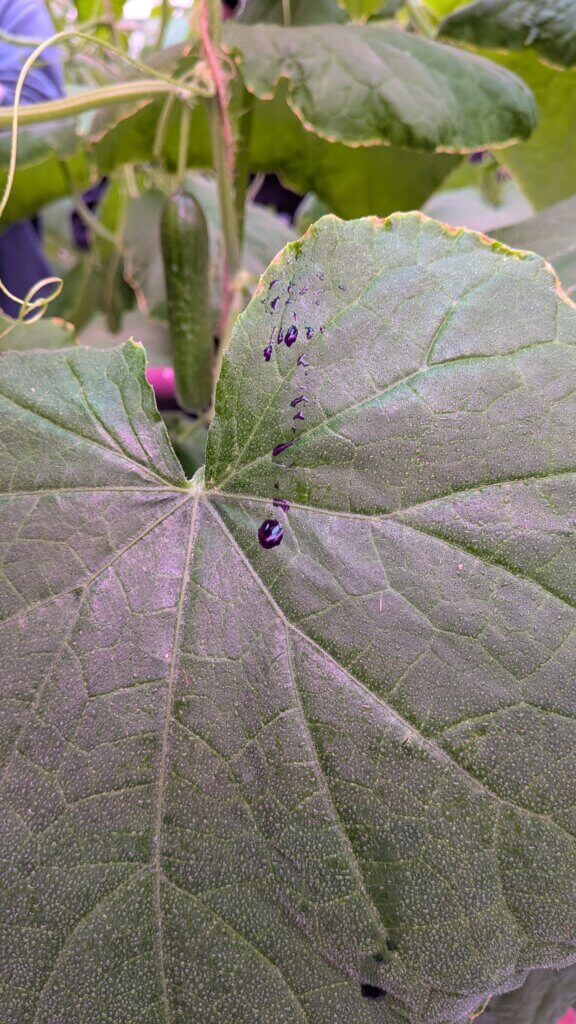
    We saw the highest nozzle positions were spraying over the canopies and did not need to be on. We also saw drip points form at the tips of the leaves and the bottom of the cucumbers. There was evidence of yellowed (possibly damaged) tissue at the leaf tips, suggesting they were often sprayed to drip. This is wasteful and tends to redistribute deposits in undesirable ways. While it’s hard to avoid on the waxy, vertical cucumbers, it can be prevented on the leaves.
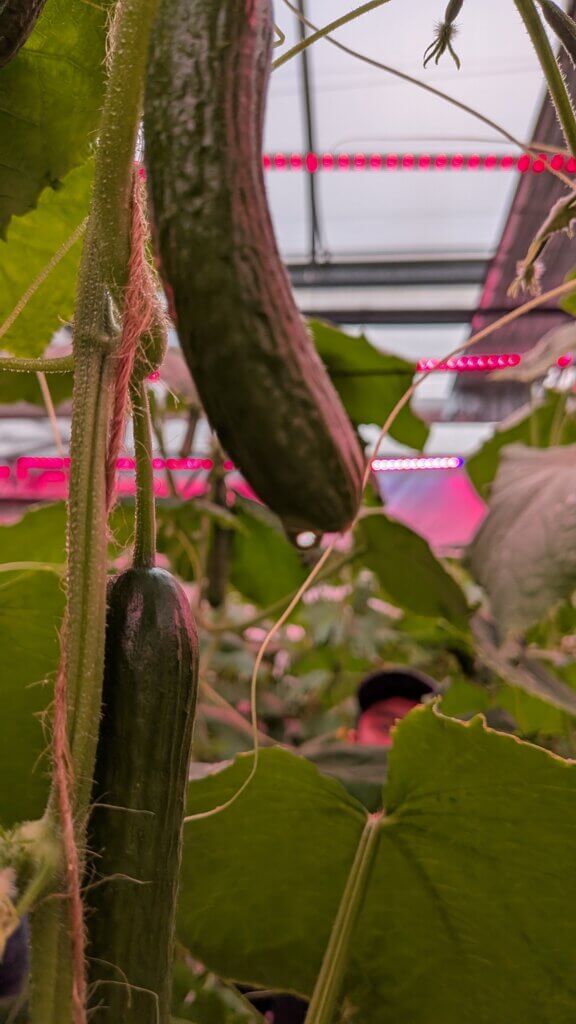
    Note the drip point formed at the bottom of the fruit. This is hard to avoid, but can at least be minimized.

    We turned off the top nozzles, swapped to Albuz 02 (yellow) hollow cones, moved to an unsprayed canopy and tried again. Effectively this was a 20% cut in water and product, but there were no more drips on leaves and less evidence of coalescing deposits. The cucumbers still had drip points, but without an adjuvant that was the best we could do. That’s assuming there would be value in spraying the fruit in the first place – these sprays were targeting the foliage.

    Coverage

    With the subjective part of the assessment complete, it was time to quantify spray coverage. Water sensitive papers were oriented co-planar with the leaves and essentially parallel to the ground. We clipped them 2-3 cm below the leaves by affixing them to the petioles. This way they would move with the leaf and represent a very challenging target (reminiscent of a sucking insect on the abaxial leaf surface).
    This is a difficult target to hit. The spray must get up between the leaf and upper side of the water sensitive paper, which is not in line-of-sight of the nozzle.

    We divided the canopy into quarters, placing one target in each section. This spanned the height of the canopy, but we also positioned them along the canopy depth: One on each of the four plants in the row. This left us with a diagonal cross-section. Read it again – you’ll get it.

    Then we sprayed the row from one side and inspected the results. We saw excellent coverage on the abaxial surfaces of the two plants closest to the sprayer. We expected that. But we were pleasantly surprised to see the spray got in under the umbrella-like leaves and deposited on the adaxial surfaces. This was not line-of-sight for the nozzles, and there wasn’t much room between the paper and the underside of the leaves, so this was clearly the result of air-assisted droplets.

    There was also respectable coverage on the two plants on the far side of the row. These targets were greatly improved once we travelled down that alley and saw the cumulative coverage. This is why you should (almost) never perform alternate row spraying.

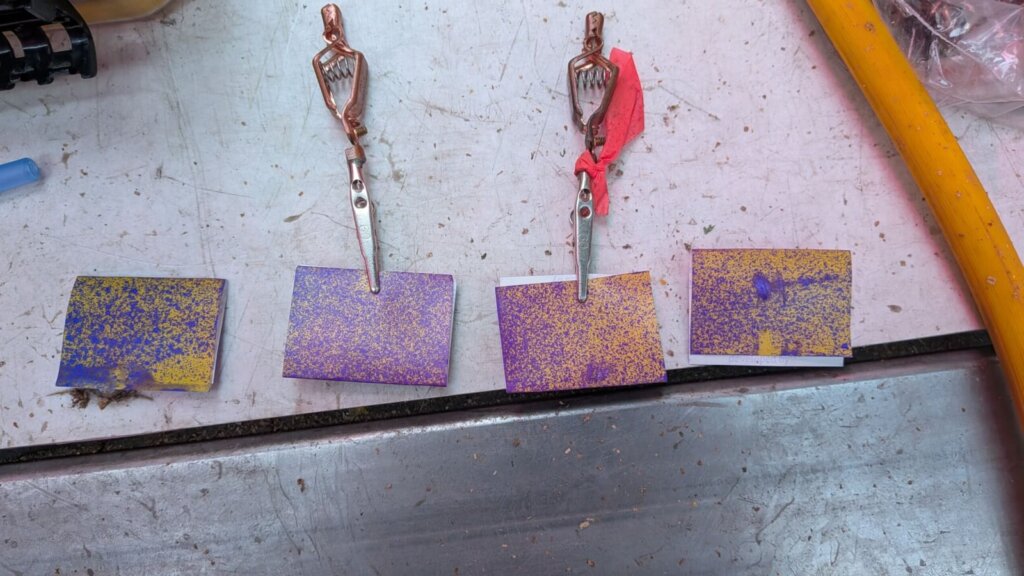
    Abaxial side of the water sensitive papers. From left to right, papers ascended from the lower quarter of the nearest plant to the upper quarter of the farthest plant in the row.
    Adaxial side of the water sensitive papers. From left to right, papers ascended from the lower quarter of the nearest plant to the upper quarter of the farthest plant in the row.

    Compared to a tree

    Since I was in the neighbourhood, we decided to see what a conventional, hydraulic tree could do by way of comparison. Frankly, there was none.

    A typical greenhouse tree. Note the 1/4 turn drain near the pressure gauge, the lack of check valves, and the uneven distribution of the nozzle positions (i.e. more at the top) likely intended to direct more flow higher in the canopy.

    The tree was nozzled with Albuz 04 (red) hollow cones angled upwards. There were only a few check valves, so it leaked when it was turned off and had to be drained at the end of each row using a quarter turn valve. Coverage was generally excessive (i.e. coalesced droplets and lots of run-off) and non-uniform (we randomly missed both adaxial and abaxial surfaces).
    Run-off was so pronounced that it washed the dye off the water sensitive papers.

    We re-nozzled to my favourite load out: TeeJet TwinJet fans alternating back and forth by 45 degrees from centre. Using 03’s (blue), we observed improved uniformity, but still saw misses and suspected we were still using too much water. When leaves are drenched they get heavy, causing them to hang lower and obscure the other parts of the plant. This is the contradiction that limits a strictly hydraulic system: Pressure motivates droplet movement, so you need slightly larger drops and more volume. However, too much water causes run-off and weighs leaves down, obscuring the rest of the canopy. Catch 22.

    I proposed getting a set of 02 (yellow) tips in the hopes there would still be enough spray for better uniformity. I hope they tried it.

    A few beefs about the M2

    There’s always room for improvement. Before you think I’m selling these sprayers, here are a few observations from the owners and from what we saw that day. No deal breakers, just some nice-to-haves:

    • The diesel exhaust from both the sprayer and the tender cart is not ideal. Applicators wear respirators, and the greenhouse fans tend to dilute the exhaust, but a battery system (perhaps like a drone) would be preferable to power the drive electrically.
    • There was a latency with the self-leveling wheels and with air build-up in the tower portion of the sprayer. You simply need to be patient before you start down a row.
    • The tower section gets hot to the touch, likely because of the position of the exhaust pipe.
    • The alternator on board recharges the battery, but if you let it sit the battery is depleted (sounds like the same trouble I had with my sprayer, which is somehow gratifying).

    I’m sure you’re asking “How much?”

    Well, at the time of writing, it was almost $70,000.00 CDN, but don’t judge it too harshly! Bear in mind that our assessment saw a reduction of 20% water and crop protection product that would otherwise have ended up on the greenhouse floor. Not only is that a big savings in water and inputs, but it’s fewer refills and it produced far better spray coverage that a hydraulic system. While improved coverage is not always linked to improved efficacy, they certainly go hand in hand. And when we’re considering “softer”, biorational greenhouse chemistries, improved coverage is the best bet we have for pest control.

    All in all, this was an excellent sprayer that I hope is the first of many to grace Ontario’s greenhouses.

    Thanks to Great Lakes Greenhouses for the invitation, and thanks to all the other grower cooperators (names withheld to protect the innocent) that took a risk on building budget, niche sprayers with me. Sometimes, you just have to throw money at it.
  • Optimizing a Greenhouse Vegetable Sprayer

    Optimizing a Greenhouse Vegetable Sprayer

    In April 2025 we visited Cedarline Greenhouses to assess their spraying methods. Our hosts invited us to examine their practices and then graciously agreed to let us share the process (and the results) so others could learn from the experience. Every greenhouse is different, but with a little imagination the process we used should translate to most operations. I want to be clear that this operation was already doing a good job before we showed up. It’s just easier for someone from the outside to scrutinize and find little things that might need tweaking. Let’s go through the steps we took that day.

    1. Measure the crop canopy and the planting architecture

    The objective of any spray application is to achieve sufficient coverage of the target with as little waste as possible. Achieving this goal means understanding the interaction between the sprayer, the spray droplets, and the crop canopy.

    Start by measuring the the planting architecture. These values allow us to calculate application rates and to calibrate the sprayer. Cedarline is a 16-acre pepper operation. The crops are strung vertically in double rows for a total canopy depth of about 1 m, leaving roughly 0.5 m clearance in the alleys. Spraying takes place while the crop is between 1.5 and 3.5 m high. Each row is 102 m long.

    2. Consider the target from the droplet’s perspective

    Stand between the rows and face the canopy. Where is your spray target relative to the nozzle? Is it in line-of-sight, or are there parts of the canopy in the way? In this case, our primary targets are sucking insects found predominately on the under-side (abaxial) surface of the leaves, and not the waxier, above-side (adaxial) faces.

    As we look through the double row, we see the adaxial sides face out towards the alleys, and the abaxial sides face the canopy interior. Bad luck. But, as we peer through that first row to the second row, we can see the abaxial sides of those leaves. So, perhaps enough of the spray can penetrate past the first row to deposit on the abaxial surfaces of the far row? This is a tricky plan because of the physics of droplet behaviour.

    We know that coarser droplets move ballistically (e.g. like cannon balls), so perhaps they could span the distance from the first row to the next. But they are prone to bouncing and running off surfaces, which means they’d likely drench the waxy adaxial side of the first row before any get to the abaxial side of the far row… and those that do might not stick to the target.

    On the other hand, finer droplets are less prone to run off, so they’re much better at sticking to hard-to-wet surfaces like peppers and waxy leaves. Additionally, thanks to the cubic relationship between droplet size and volume, the smaller the average droplet size, the more droplets we have working for us. However, finer droplets don’t have a lot of mass, so they move erratically, and they are prone to evaporation. Maybe they won’t reach deeply enough into the row.

    Fortunately, greenhouses are humid places, so finer droplets don’t evaporate quickly. Plus, greenhouses tend to spray at relatively high pressure (200 psi or more), which imparts momentum to finer droplets. Also, when enough tiny particles move in a single direction, they create air currents – essentially a light wind. This side-effect is sometimes enough to move leaves, creating holes in the canopy and exposing the abaxial sides of leaves as they twist. So, there’s hope. Now let’s look at the sprayer.

    3. Examine the sprayer and the nozzles

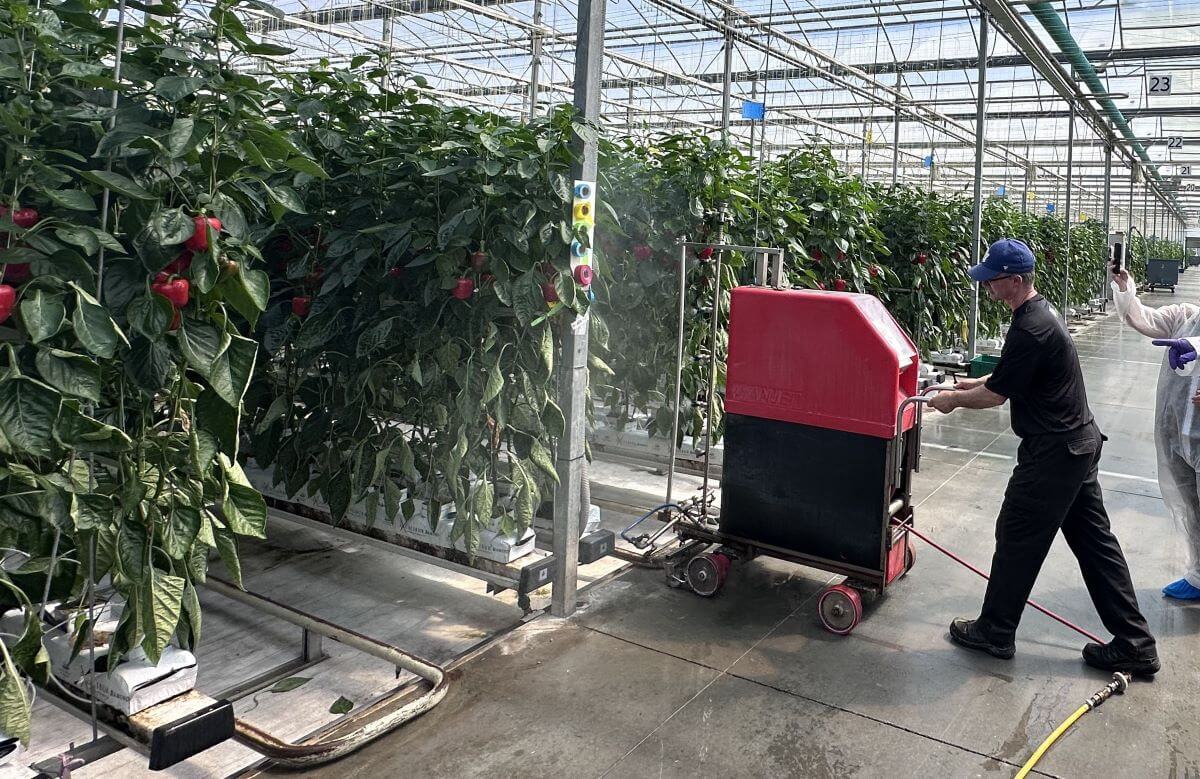
    Cedarline uses semi-automatic “robot trees” (Wanjet model S55). This sprayer has a vertical, 2 m high boom with nozzle bodies spaced every 25 cm. When the crop grows higher than the boom, an extension is added to bring it to 4 m. Flange wheels allow the sprayer to ride the hot water pipes between the rows like a train on rails at a rate of 60 m/min.

    The sprayer is manually placed in the row. Then it trundles along, spraying one side, until it reaches the end of the row. Then the vertical boom turns to spray the other side on the return trip, where it is retrieved and placed in the next row. The sprayer is fed from a portable tender unit via a 180 m auto-reeled hose at 200 psi. The question is, does this all work the way we assume?

    4. Calibrating the sprayer

    4a. Pressure

    We started with pressure. If pressure is the force that causes a specific volume of spray mix to exit the nozzles at a specific rate and produces a specific droplet size and spray geometry (e.g. a cone or a fan), then it’s very important to know that it’s accurate.

    Remove the gauge with a wrench (never turn it by the face) and test it against a known gauge. You can build a test apparatus very easily. Alternately if the gauge is showing wear, such as the needle not sitting on the zero pin, or it’s opaque, or leaking, maybe just replace it without testing.

    In our case, we discovered the gauge was off by 20%. Where the standard gauge read 150 psi, the working gauge read ~120 psi. Plus, the scale of the gauge was far too high. Best practice is to use a gauge rated to about double the operating pressure. This gives better resolution, and a quick glance shows if the needle is pointing straight up.

    I prefer a tender system like this over a central spray tank in a header house. In systems where there is a central tank and the sprayer hoses plug in at intervals, the degree of pressure-drop increases with distance from the source. If this is you, install a regulator on your sprayer and adjust it accordingly to hold the pressure constant. In this case, the distance the spray solution travels is always constant, so the pressure doesn’t change. Best practice in either case is to install a pressure gauge on the sprayer at the end (or top) of the boom so you can confirm the operating pressure is correct.

    4b. Sprayer speed

    We were told the sprayer was set to travel 60 m/minute, but is that true? Certain chemistries will deposit a slick coat on the hot water pipes and the flanged wheels can slip (especially as they wear). There was obvious damage to the rubber surface of two of the flanged wheels that might have affected travel speed. We should have checked, but we didn’t. Use a timer and confirm how long it takes for the sprayer to travel to the end of the row. Don’t include turn time. If it doesn’t match your expectation, then adjust the speed until you get what you want.

    4c. Boom and nozzles

    Next, we explored the boom and the nozzles. The first thing we saw was that their alignment was wrong. Flat fans in ¼ turn nozzle caps will self-align on the lug to ensure each spray fan does not physically impact it’s neighbours. However, the nozzle bodies themselves can sometimes turn on the threaded boom, and they need to be realigned. We did that before removing a few tips for inspection.

    Each nozzle should be oriented 10-15 degrees off vertical and parallel to one another. Here, the top one is correct, but the lower nozzle has twisted and will leave a gap in the swath.

    I asked when the nozzles were last replaced and was told the sprayer arrived pre-nozzled with TeeJet visiflo 8002’s. They had never been inspected, other than when they plugged, and their rates had never been confirmed. Upon inspection we found some were physically damaged. This doesn’t mean the nozzle orifice was compromised, but it instilled doubt. You don’t always see obvious damage but know that the orifice is delicate and very precise. As it wears it gets larger (increasing flow), but more insidiously it also changes shape, altering the size of the spray droplets, which we’ve established are critical to our spray strategy.

    Best practice is to test nozzle outputs at a known pressure and replace them when they are 5% off the expected rate. Unless a nozzle gets physically damaged, replace them as a set so they wear as a set. When do they wear out? It depends on the nozzle material, the nature of what you’re spraying, the pressure and the amount of time they spend spraying. Here’s a link to an article that suggests several methods for testing nozzle output. Some are cheap and slow, others are fast and expensive, but they all work.

    If that’s not appealing, you can mark your tank and see how many rows you should be spraying versus how many you’re actually spraying. Ultimately, given the relatively minor expense of new tips versus the trouble of calibrating them annually, it’s often simpler to replace them at intervals. In this case it’s worth noting that the first 2 m of boom operates all season, while the extension is only added later, so they won’t all wear at the same time.

    We examined and then returned the original tips to the boom for the next part of the calibration. We noticed that the gaskets were stretched (crushed). This made it hard to put the nozzles back on, so they would also need replacing.

    We turned on the boom to ensure we had everything back in the right place, and noticed that when we stopped spraying, the boom slowly emptied through the lowest nozzles. That meant expensive products were left to dribble out every time the boom stopped spraying, which is wasteful. It hinted that the check valves, which are built into the nozzle bodies, were no longer working. Ideally, once the boom pressure drops below ~15 psi, each check valve diaphragm closes to prevent leaks. It also ensures the boom remains primed for the next pass. We advised that they should be replaced and to ensure the new bodies have the correct thread size. European sprayers rarely have the same thread as North American, so compatibility can sometimes be an issue.

    5. Evaluating spray coverage

    This is an iterative process, which means we test, evaluate, make a single corrective change, and repeat until we (hopefully) see what we want. Water sensitive paper (WSP) is a terrific tool for this process, but it has a few caveats:

    • It will react to any moisture, including a humid atmosphere, so handle it with gloves and don’t let it sit for too long.
    • The WSP surface is only a surrogate for a plant surface. Deposits tend to spread more on leaves, vegetables and fruits, but will always be smaller on the papers. So, only compare papers to other papers and infer that the actual crop coverage is better.
    • We really don’t know how much coverage is enough. It depends on pest pressure, product concentration and mode-of-action (e.g. contact or systemic). Generally, we like 10-15% of the surface covered with 85 deposits per cm2 on 80% of the targets. Sometimes it’s easier to imagine the pest on the paper – can it fit between the deposits?

    5a. TeeJet visiflo 8002 at 200 psi

    We started by establishing a baseline using their current nozzles and pressure. WSP was folded and clipped at the petiole so we could assess adaxial and abaxial surfaces. We placed them deep in the canopy so we were looking at the worst-case scenario, and then noted where we left them (use a ribbon or part of the greenhouse as a frame of reference or you’ll never find them again). We sprayed from one side, then examined them in situ, then sprayed from the other side so we could see the impact of cumulative coverage.

    After spraying from both sides, we saw excessive coverage on adaxial surfaces and marginal coverage on abaxial. For those that have tools to digitally scan and assess WSP, it worked out to 31% coverage and 225 deposits/cm2 on the adaxial side, and 2% and 16 deposits/cm2 on the abaxial. In fact, the adaxial side was so saturated (>25% coverage) that I don’t trust the deposit counts because of overlaps, but there it is. This is when we brought out the nozzle manufacturer’s catalogue (which you can also find online). We found their nozzle and looked up the flow table, which shows the relationship between pressure, output rate and droplet size.

    Those in greenhouses might find that their operating pressures are far higher than what is listed, but that’s no problem. Find the highest pressure and output rate listed in the table and call those “Known Output Rate” and “Known Pressure”. Now use the following calculation to extrapolate flow for a new pressure. It’s also worth knowing that higher pressure tends to mean a wider fan angle and finer spray droplets than are listed in the table:

    Unknown Output Rate (gpm) = Known Output Rate (gpm) × (square root of New Pressure (psi) ÷ square root of Known Pressure (psi))

    In this case, at 200 psi this nozzle should produce 0.45 gpm. If we go up one size from the yellow 02 tip to a larger blue 03 tip, we can produce a similar flow but using only 100 psi. This would put less strain on the system, but it would also make droplets larger, fewer and perhaps slower.

    5b. TeeJet visiflo 8003 at 100 psi

    We tried the 8003 at a lower pressure and saw that the deposits were obviously larger on the adaxial side, and not saturating, which is good. However, we saw insufficient deposit density on abaxial, which was a deal breaker.

    5c. TeeJet visiflo 8003 at 200 psi

    We left the blue 8003s and brought the pressure back up to 200 psi. Now the flow was increased to 0.67 gpm, and the droplets were finer, more plentiful and moved a lot faster. The adaxial surface went back to excessive coverage, but perhaps not as bad as with the 02s. The abaxial deposit density was improved, but still not sufficient. You can see the results of the three trials in the photo below. Go counter-clockwise from 1 (at bottom right) to 3 (at top).

    5d. TeeJet twinjet TJ6011003 at 200 psi

    It was time for a radical change. We replaced the single flat fan geometry with twinjet flat spray nozzles (TJ60-8003). We tried this because we’ve tried it in the past and it worked well. We retained a blue 03 rate, so we still produced 0.67 gpm at 200 psi. This nozzle also retained the 80° fan angle, but created two of them at 60° to one an other. This would change the spray trajectory, creating new opportunities for droplets to align with the targets. Perhaps most importantly, the twin fan nozzles would produce finer droplets than their single fan cousins, increasing the odds and perhaps and creating more “wind”.

    We saw far less differential between abaxial and adaxial surfaces, with deposit density greatly improved on both surfaces. While the adaxial face showed larger deposit diameters, they were close enough to require close inspection to determine which side was which; Coverage was more uniform, with no drenches and no misses. By the numbers we saw 34% and 523 deposits/cm2 on the adaxial side (again, hard to trust the counts here because of overlaps arising from >25% coverage) and 19.5% and 400 deposits/cm2 on the abaxial. We had a winner.

    It’s also worth noting that every time we sprayed, we observed the deposit on the fruit and leaves. None of the sprayer configurations caused run-off (e.g. drip points on the bottom of the fruit or tips of the leaves), which would suggest we were not using an excessive volume. Look closely at the following two pictures to see the beads of water and how they deposit. They look great.
    We also watched to see if spray passed through the row into the next alley. A little puff here and there is fine, because it meant the spray was reaching the far side of the row. However, spray that blows through the row excessively is wasted becuase it misses the target row and ends up on the greenhouse floor.

    Epilogue

    We were pleased with the result of half-a-day’s effort. We left our hosts with some homework:

    • Change the pressure gauge to one that is accurate and spans to 400 psi.
    • Replace all nozzles and gaskets and ensure they are properly oriented.
    • Time the sprayer to confirm travel speed is what they assumed.
    • Using the known speed, pressure, and boom output, do the math to account for the fact that they would now be spraying a higher volume than they were. This will change how much product they put in the tank.
    • Watch the crop closely to ensure these changes do not compromise crop protection.

    Everyone learned a lot from our day together. Cedarline said they would calibrate their other sprayers using this process. They are even going to try a set of yellow 02 TwinJets to see if they can achieve sufficient coverage at their current pressure, which would mean they can continue to mix product at the same concentration. Those are pretty small orifices, guys, so watch out for plugged tips and good luck!

    Hopefully this inspired you to look critically at your own operation and to follow these steps to calibrate and optimize your crop protection practices. Happy Spraying.

    Everyone here had helpful ideas during this process. Calibration is a team sport so make sure both your operators and managers are involved. Left to right: Ryan Bezaire – OMAFA Summer Student; Paul Brooks – IPM Specialist, Cedarline Greenhouses; Jason Deveau – Application Technology Specialist, OMAFA; Jimmy La Rosa – Operations Manager, Truly Green Farms / Cedarline Greenhouses; Richard Robbins – Technical Representative, Plant Products; Cara McCreary – Greenhouse Vegetable IPM Specialist, OMAFA
  • Drift is… Good?

    Drift is… Good?

    OK, fine. We confess to the shameful use of click-bait in our title. Nevertheless, it’s absolutely true: Drift can be good. The reason this statement is unsettling is because of the lack of context, which is really what this article is about.

    The majority of sprayer-related information available to ag stakeholders relates to horizontal boom sprayers. Most of it is relevant to broadacre field crops and often pertains to herbicide applications. If you’re unsurprised, or still struggling to grasp our point, it’s likely because you’re part of that world. But consider everyone else.

    Agricultural spraying is diverse and many usage patterns are grossly underrepresented. As a result, those operators struggle to find relevant information. And what information is most readily available? Yes – broadacre herbicide spraying. Even the experts (i.e. agronomists, salespeople and consultants) often make the error of responding to specialty crop questions with field crop answers. Or relatedly, they assume their entire audience is comprised of field croppers and fail to use a disclaimer before making sweeping statements. The problem (and it is a problem) is so pervasive that we often hear about specialty crop operators taking training courses intended for field crop applicators… because that’s all that’s available.

    So how different can spraying be for a given crop? Surely a droplet is a droplet and the laws of physics don’t care what you grow? This is true, but droplet size, spray volume, distance-to-target, environmental conditions, sprayer type and product formulation combine in complicated ways. The result is that the best advice for one operation can be disastrously wrong for another.

    Case in point: Drift is good. If we were persnickety (and we are) we would suggest that moderate drift is the lateral movement of spray with the prevailing wind, and that this helps ground and/or disperse spray in a predictable direction. It’s not a bad thing. But we know that drift quickly becomes bad in high winds and especially when there are sensitive downwind areas. We won’t even talk about dead calm.

    However, in controlled environment applications (e.g. greenhouses) operators use very small droplets in high numbers and absolutely rely on air circulation to expose all crop surfaces to the spray. Without drift, most stationary foggers would only have a limited and localized effect. And in airblast operations, a wind that would never deter a field sprayer operator would derail an airblast operator. Wind is much faster with elevation and airblast sprayers use very small droplets that span considerable distances to the tops of tall targets. In their world, droplet size is not the primary means for drift mitigation – it’s air alignment.

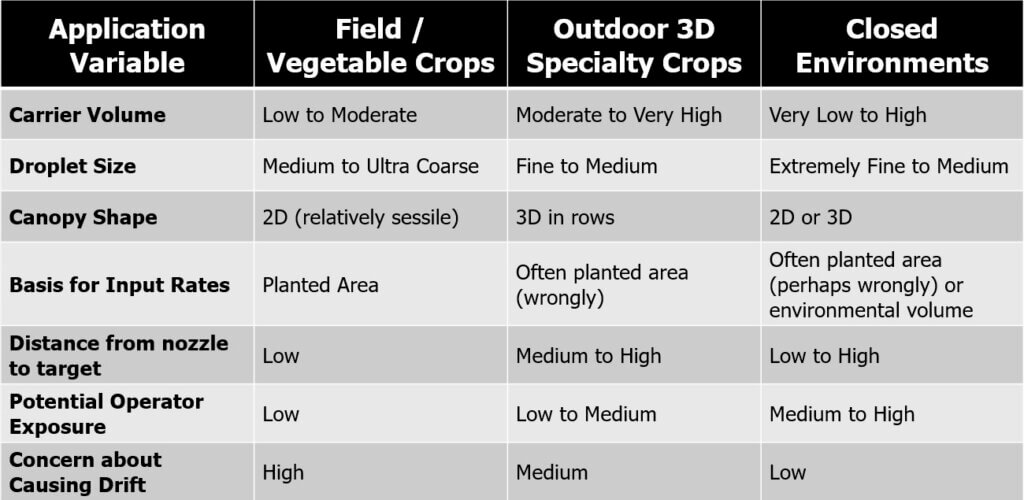
    The following table is a relative comparison of key factors in spraying. Note how different they are depending on the usage pattern. And if this isn’t diverse enough, recognize that we didn’t include a column for vegetative management (e.g. roadsides, industrial and forestry) or aerial application (which might even be split into piloted and remotely-piloted).

    And so where does this leave us? We have two pieces of advice:

    • If you are looking for information on spraying, take the time to find out who your source is and understand the context of the information. More often than not it will have relevance, but in some cases it could be completely wrong for you.
    • If you are providing information on spraying, be clear who the information is intended for. While we don’t propose caveats amending every statement, context is always appreciated. A sentence in an article, or a brief interjection during a presentation, might help someone that doesn’t know what they don’t know.

    This presentation was delivered virtually for the 2021 OMAFRA Controlled Environment Webinar Series. If you’d like to learn more about strategies for spraying in closed environments, settle in and give a watch. It’s 45 minutes plus questions.

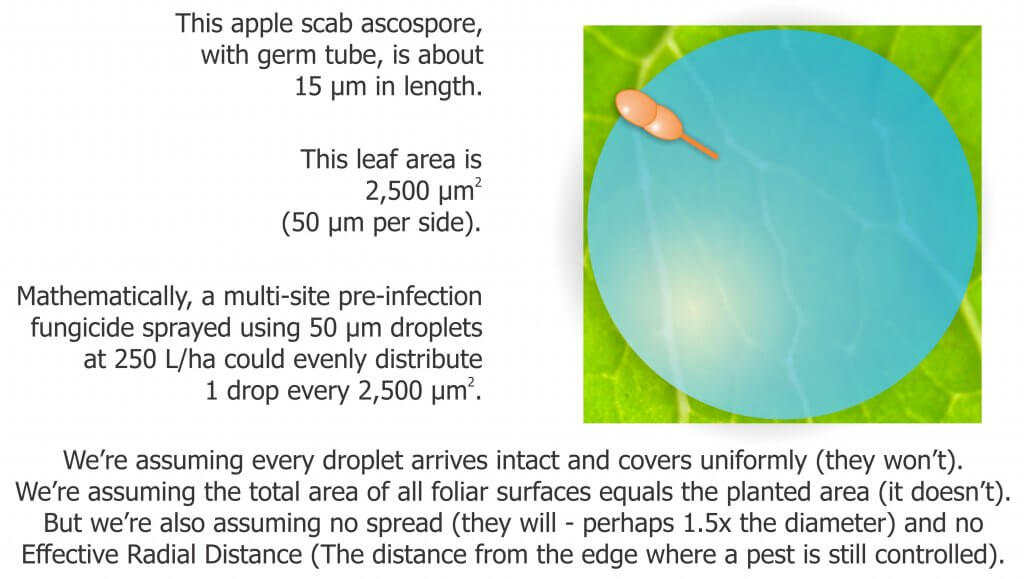
    So, a minor error in the presentation. The image of the ascospore was not quite right. This new version (below) is correct. Perspective can get tricky at the micron-scale of resolution.

  • Greenhouse Foggers

    Greenhouse Foggers

    Greenhouse application equipment spans from the humble squirt bottle, to gas-powered foggers, to robots equipped with hydraulic vertical booms. The variety of spray equipment available reflects a variety of needs, just as a carpenter’s toolbox contains different tools designed to do different things. In order to get the most out of foggers and misters, it’s important to understand how they differ from “conventional” hydraulic spraying.

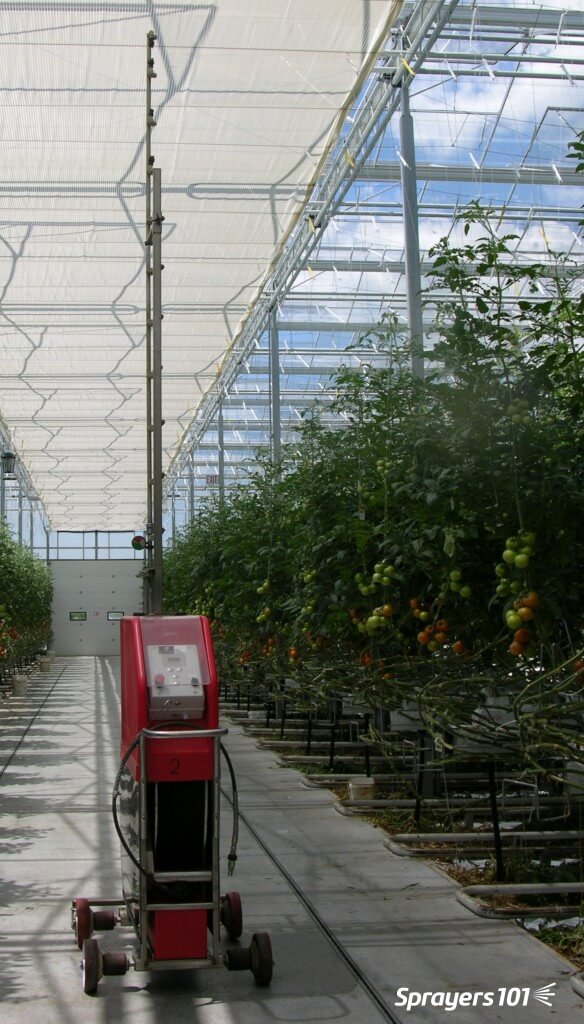
    A greenhouse robotic vertical boom sprayer.
    A greenhouse robotic vertical boom or “tree” sprayer

    Mechanical and Chemical Spread

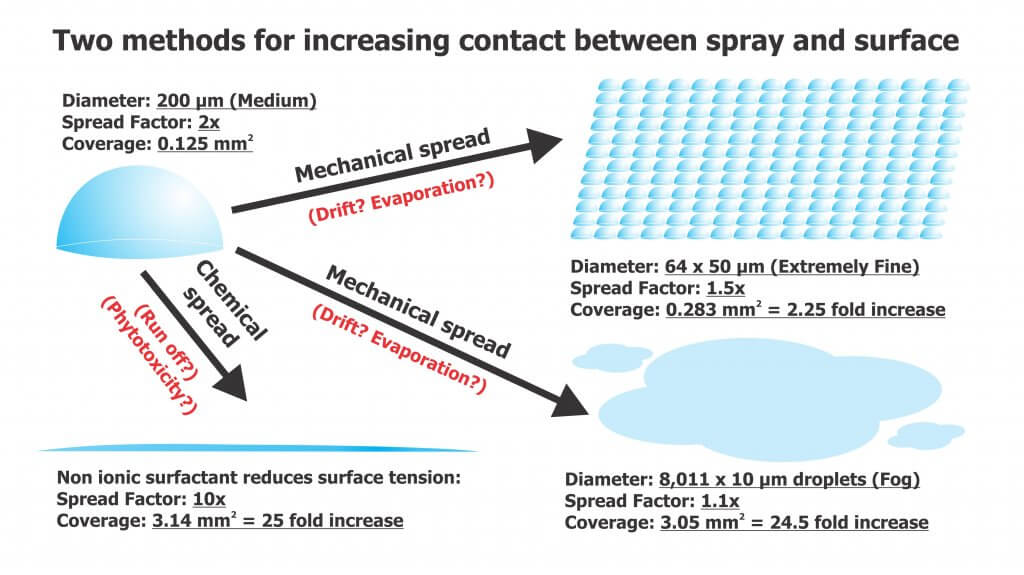
    For many greenhouses, water is the carrier that dilutes and delivers the chemistry to the target. Water has a high surface tension and tends to bead on target surfaces. Dr. Heping Zhu (USDA, Ohio) created some amazing videos using controlled water droplets and both waxy and hairy leaves. In first video we see how water beads up on a waxy leaf, and as it evaporates, the area touching the leaf surface remains small. In the second, we see the droplet get hung up on a trichome (leaf hair) and evaporate while suspended above the leaf surface.

    Neither situation is desirable since the goal of spraying is to maximize the level of contact between droplet and target. Contact can be increased via mechanical spread or chemical spread (see figure below).

    The degree of chemical spread can be increased by adding adjuvants such as non-ionic surfactants to reduce surface tension. In the videos below we see the same controlled droplets with the same volume of liquid, but they now include a non-ionic surfactant. In the first video we see a greater degree of contact with the waxy target surface as the droplet spreads. In the second, the droplet does not get caught by the trichome, but splashes down onto the surface. Some product labels advise the inclusion of adjuvants and others are already formulated with them. In the case of surfactants, be aware of the potential for run-off and phytotoxicity.

    Mechanical spread requires us to break a single, larger droplet into several smaller volumes to increase the degree of contact. This approach usually comes with a caveat about evaporation, but this is rarely a concern in a humid greenhouse. As for the risk of drift, once again, in greenhouses it is a different story than conventional spraying. Spray drift is desirable! Lateral air movement is very important to encourage plant canopy penetration and prevent droplets from merely settling on upward-facing plant surfaces. While some equipment generates its own air, the air currents in the greenhouse are often the primary means for suspended droplets to circulate throughout the space. In either case, air could be considered the carrier instead of water. Too little air flow, or gaps in circulation, will reduce coverage. Too much air flow (specifically, greenhouse air circulation) may cause plants to exhibit stunting.

    Spray Quality (ISO)

    Here’s how ISO/DIS (5681:2019 Equipment for crop protection — Vocabulary 3.2.1) defines the spray quality produced by misters and foggers:

    • (3.2.1.13) MIST: “Spray with volume median diameter between 50 µm and 100 µm.”
    • (3.2.1.14) FOG: “Aerosol spray with volume median diameter under 50 µm where the droplets are effectively suspended in air with little or no settling by gravity.”

    These droplets do not behave like coarser droplets. For more information on droplet movement, survivability, and transfer efficiency, download Purdue Extension’s “Adjuvants and the Power of the Spray Droplet”.

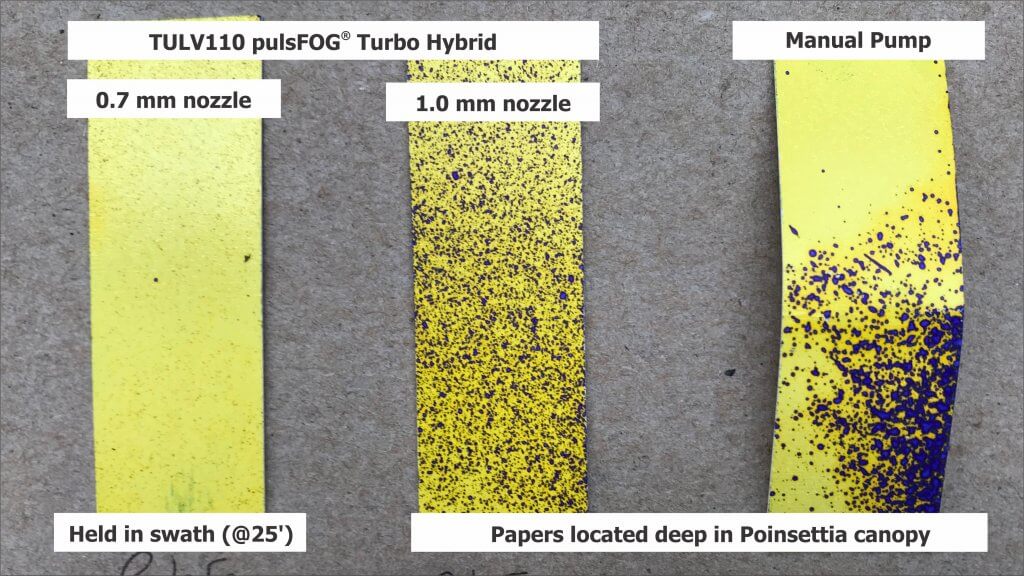
    Water sensitive paper has limited utility when diagnosing coverage from foggers. Sophisticated optical scanners may be able to detect deposits as small as 25 µm, but this is open to debate. Manufacturers do not support the use of papers when quantifying deposits less than 50 µm , and some draw the line at 100 µm.

    In the following image, papers were used to diagnose coverage (from clean water) in a poinsettia greenhouse. The two papers on the right were located in the canopy and sprayed using a thermal pulse fogger and a hardware store style hand pump. The paper on the left was held directly in the path of the fogger while using the smallest nozzle provided with the unit. The spray enveloped the paper (and the person holding it). Close inspection showed tiny deposits, and the SnapCard app detected 4.5% coverage, but this greatly underestimates the actual deposition and does not account for the droplet count.

    UV dyes are the preferred method for analyzing coverage from foggers.

    Fogging and Misting Equipment

    Greenhouse spray equipment can be classified by droplet size, but also by the spray volume they employ.

    High Volume (HV)

    These applications are performed at pressures ranging from 500 to 4,285 kPa (75 to 700 psi) employing flow rates of 3.9 to 5.7 L/min (1 to 1.5 US g/min). They use standard label rates to accomplish a dilute application by broadcasting droplets larger than 100 microns. The goal is to cover all surfaces without incurring run-off. Examples of HV application equipment include backpack sprayers, trailed sprayers and boom sprayers. Practice and self-calibration are necessary to achieve the desired results when using manual HV sprayers.

    Targeted Low Volume (LV)

    These applications are performed at high pressures around 20,685 kPa (3,000 psi) employing flow rates approaching 1 L/min (0.26 US g/min), covering 93 m2 (1,000 ft2). They apply reduced rates over a given area and create droplets between 25 and 100 µm. These are concentrated sprays that do not result in wet foliage. LV applications are particularly good in high-humidity environments, when it is desirable to minimize the moisture on leaves. Examples of LV application equipment include aerosol cans.

    Ultra-Low Volume (ULV)

    These applications employ flow rates approaching 2 L/min (0.52 US g/min), covering 930 m2 (10,000 ft2). They require concentrated solutions, but apply reduced rates per area using droplets less than 25 µm. ULV applications will not raise greenhouse humidity and are a good choice when days are short and nights are long. They are also an excellent way to apply disinfectants for complete space sanitation before starting a new crop. It is important to ensure vents are closed and fans are off during sanitation. Examples of ULV application equipment include total release cans, auto foggers and thermal pulse foggers.

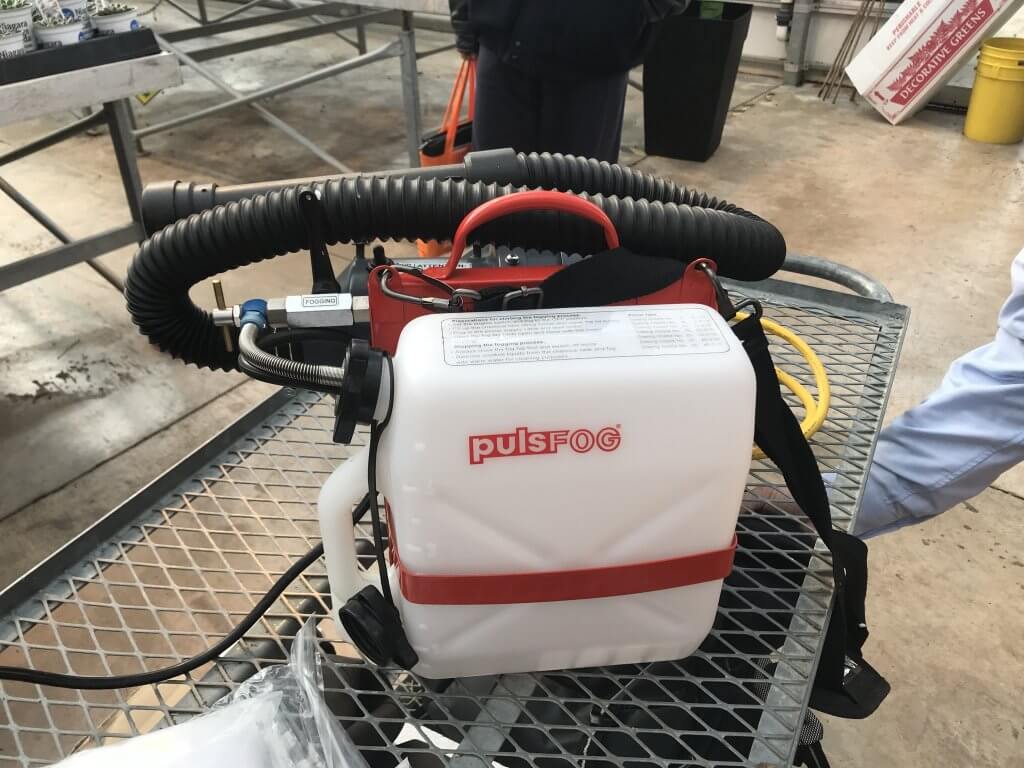
    PulsFOG hand-held ULV cold fogger

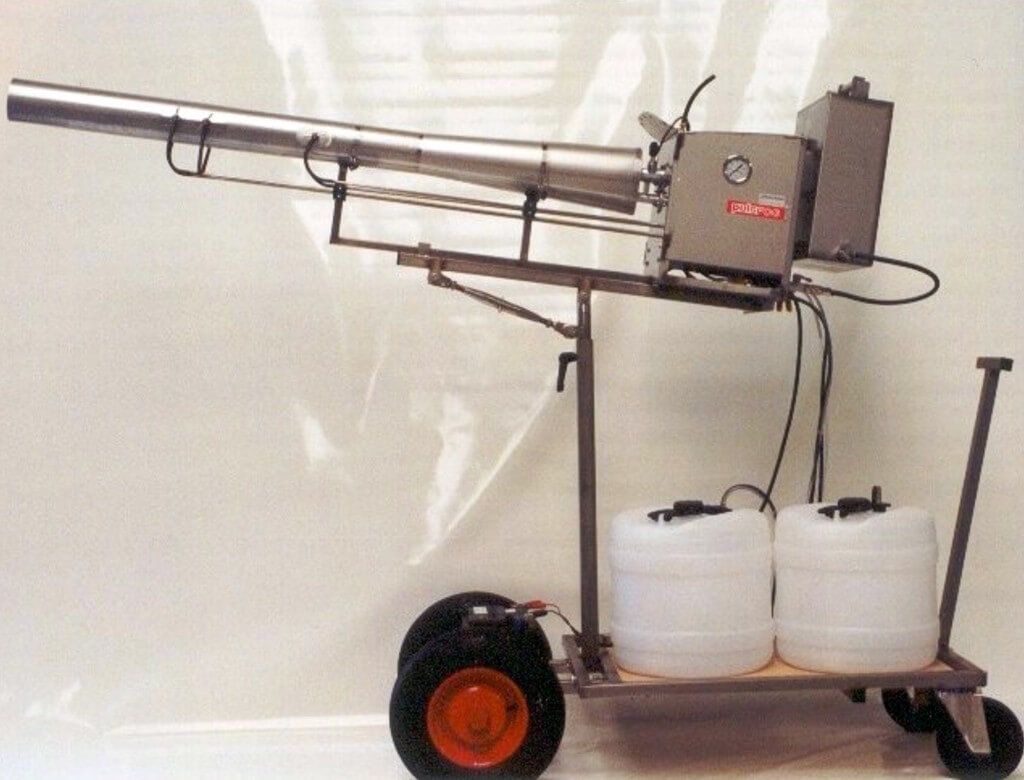
    Thermal pulse foggers are unlike other ULV equipment and warrant special consideration. The design of the pulse fogger has remained virtually unchanged since the 1940’s. Smaller, 24 hp machines are used in smaller operations but range up to large 175 hp machines. Tank size ranges from 10 to 50 L, where 10 L should be enough to cover 4,645 m2 (50,000 ft2) in about 10 minutes, depending on crop density. Their range is about 35 m (115 ft) from the point of release.

    Thermal Pulse foggers do not create aerosol using air shear – they use combustion (80 to 100 explosions per second) to shatter spray into a fog and propel it via positive pressure. Heat is a by-product of the engine, making it an unsuitable method for applying biological products.

    However, water-cooled foggers such as Dramm’s Bio Pulse Fogger reduce the exhaust temperature below 100 °C to make the application bio-rational. This has the added advantage of making droplet sizes more consistent and preventing spray from evaporating too quickly before it diffuses to the target.

    Dramm Bio Pulse Fogger.
    Dramm Bio Pulse Fogger

    Using a Fogger

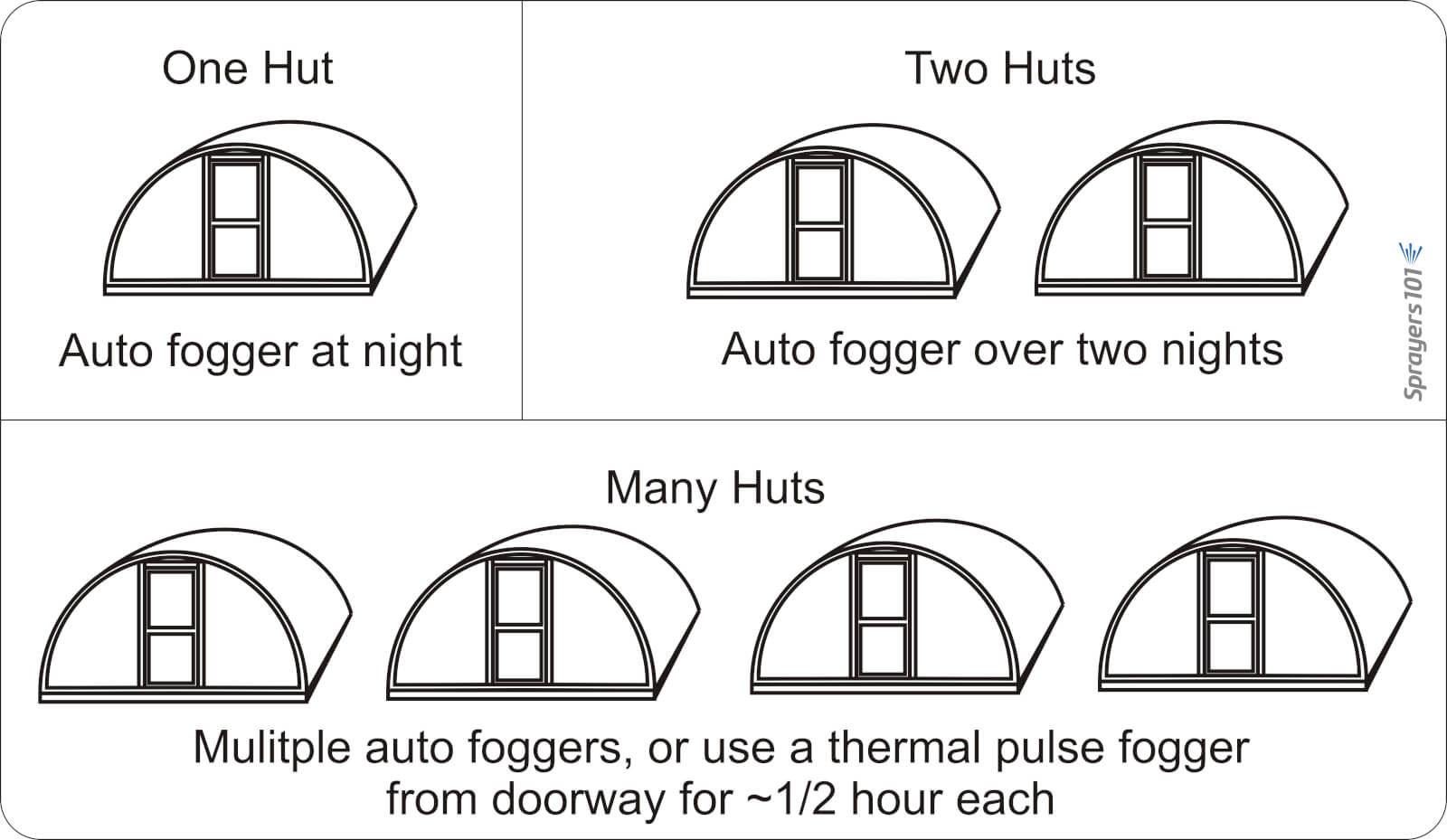
    Dramm recommends that operators use approximately 1 L of carrier in 5 L of spray mix, but a higher proportion of carrier would be required for more viscous products. Start with a full tank of clean, high grade gasoline and once the fogger has been started, run it continuously until the application is complete. Leave it running even when moving between Quonset huts (see below).

    Know when to use a pulse fogger versus an auto fogger. Auto foggers are convenient because the operator can set them and leave. However, in the case of multiple huts, it is more efficient and timely to use a thermal pulse fogger.
    Know when to use a pulse fogger versus an auto fogger. Auto foggers are convenient because the operator can set them and leave. However, in the case of multiple huts, it is more efficient and timely to use a thermal pulse fogger.

    Do not leave the manual fogger running unsupervised as an auto fogger: If they stay stationary, or aim directly at the canopy (as in hydraulic spraying), they could drench and potentially damage nearby plants.

    When fogging, aim between the plants, such as the alleys and between hanging plants. This allows the fog to expand and permeate canopies for the best coverage. When spraying is done, be sure to release the pressure created in the spray tank to prevent accidental back flow into the gasoline tank.

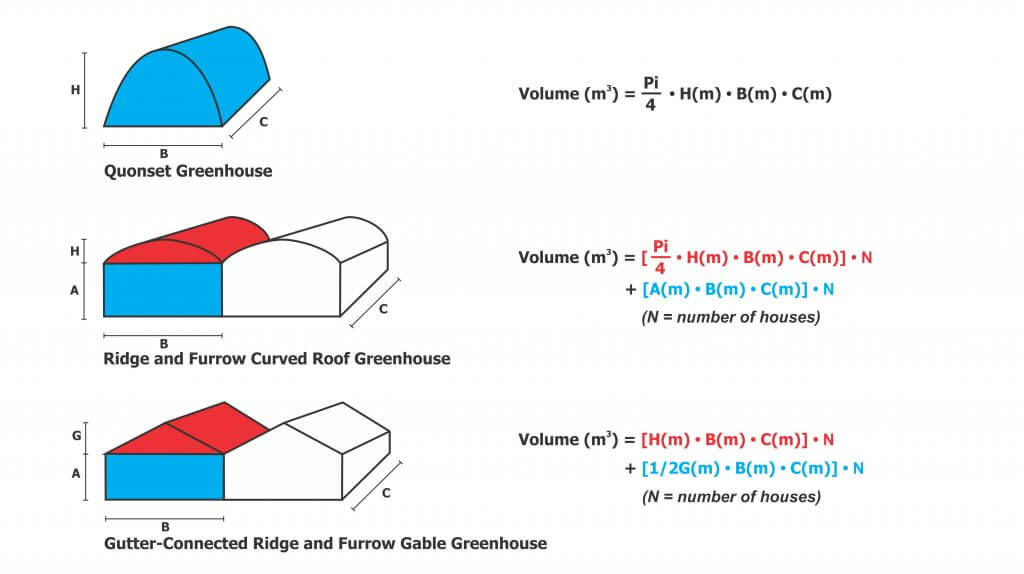
    And, because it’s convenient to include the math in this article, here are the formulae for calculating greenhouse volume to help you determine rates.

    Care and Maintenance

    HV, LV and ULV equipment requires model-specific cleaning and maintenance, according to manufacturer’s instructions. Even when sprayers are kept in prime condition, they are only as good as the operator’s understanding. When the wrong product is applied by the wrong machine using the wrong method, operators risk poor control, crop damage and increased potential for pesticide resistance. For more information, read the instructions that came with your sprayer, or contact the manufacturer.

    Thanks to Louis Damm and Dr. Heping Zhu for their contributions to this article.

  • Spraying in Vegetable Greenhouses

    Spraying in Vegetable Greenhouses

    Back in 2011 we toured a few vegetable greenhouses in Southern Ontario. I wanted to learn more about how greenhouses used hydraulic sprayers (i.e. not misting or fogging systems) to apply pesticides to tomatoes, cucumbers and peppers. It was an eye-opening experience for me, because like every commodity group I’ve encountered, they had their own unique way of doing things.

    Manually-towed sprayers

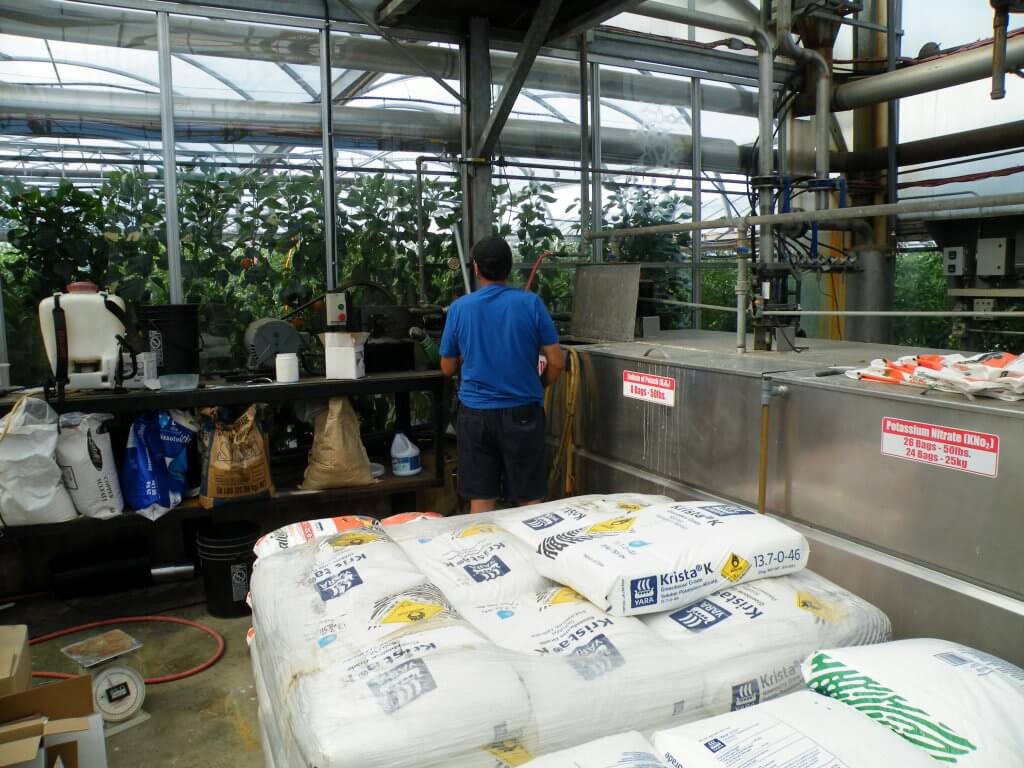
    The first operation employed a system that I’ve come to learn is fairly common in greenhouses. There is a centralized tank and pump, located outside the growing area. Products are mixed and pumped from there.

    Mixing area
    Mixing area

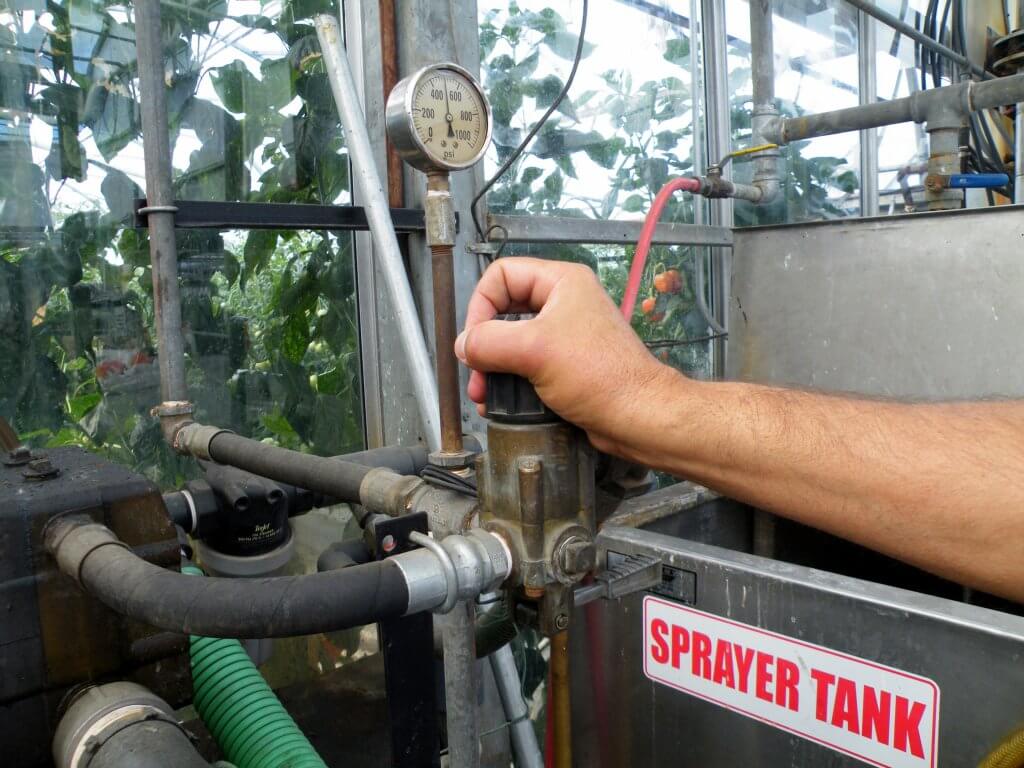
    The pressure is set at the source so the spray mix is pumped to the rest of the greenhouse where the sprayer can be quick-connected to one of a number of outlets along a central line. I’ve been surprised in the past to see airblast sprayers set as high as 300 psi, so it really surprised me to see the pressure set to 500 psi! I was told this was necessary to counter the pressure-drop experienced at the far reaches of the greenhouse (see below).

    Pressure regulator
    Pressure regulator on a clearly-labeled tank.

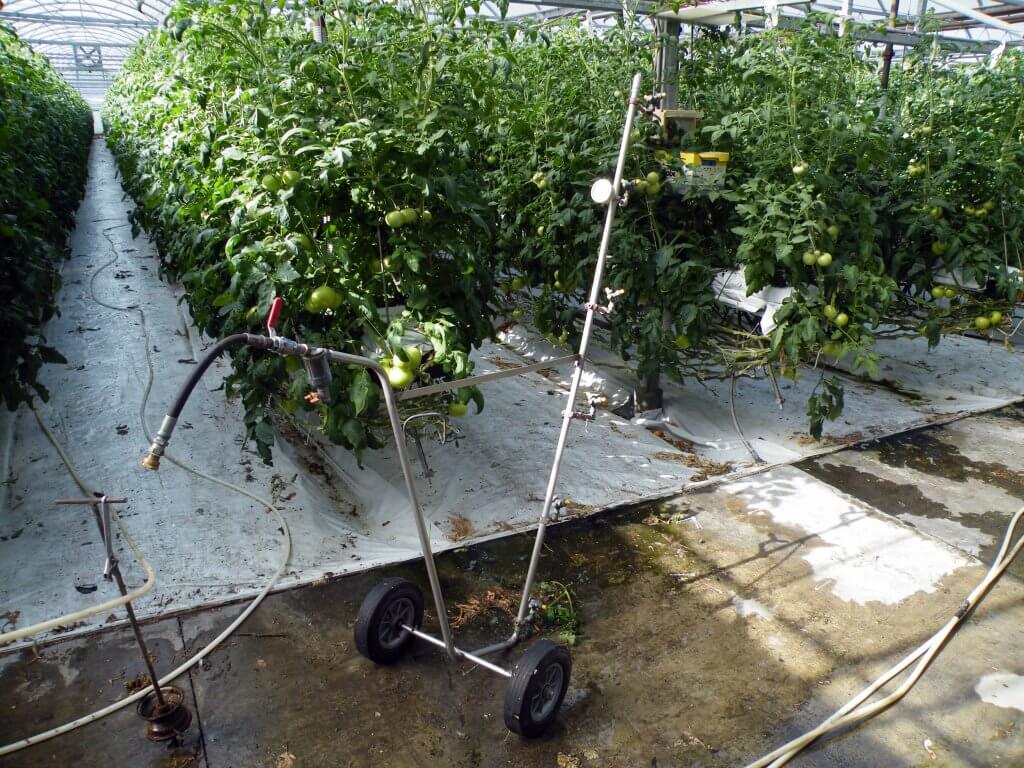
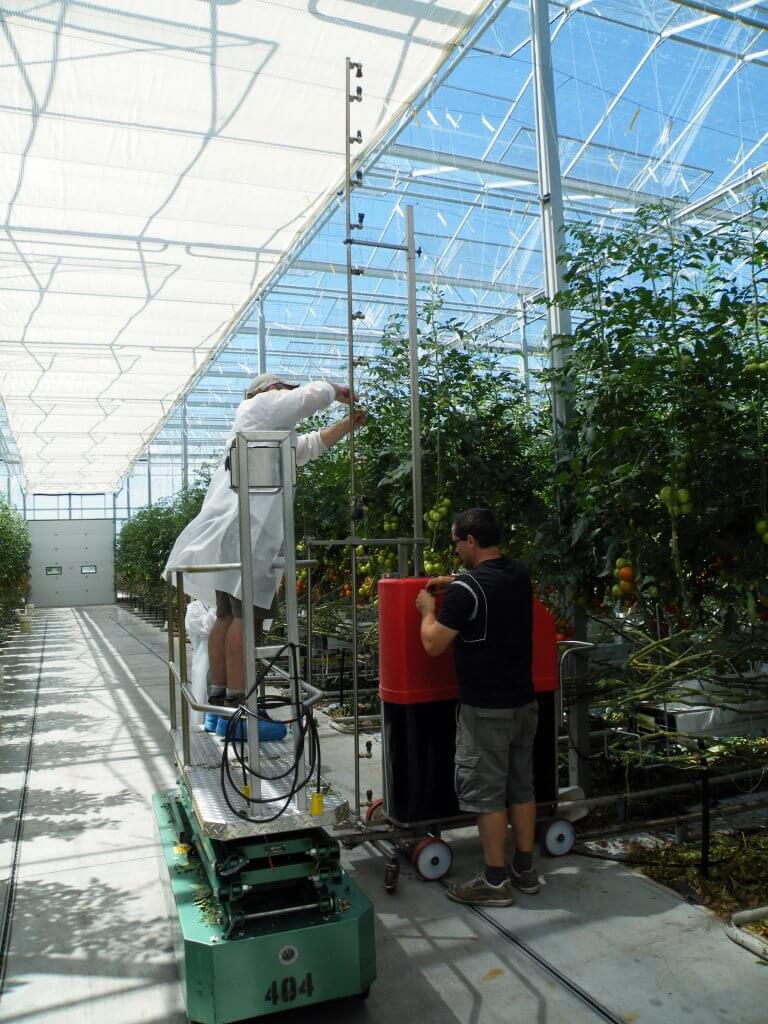
    The sprayer itself was a manually-towed vertical boom and a coil of hose. The operator would wear appropriate personal-protective equipment and tow the sprayer between the rows at a constant speed. They may or may not have the ability to control the pressure with a regulator on the boom – the nozzle selection and travel speed dictate the rate.

    DSCF1156
    Manually-towed vertical boom.
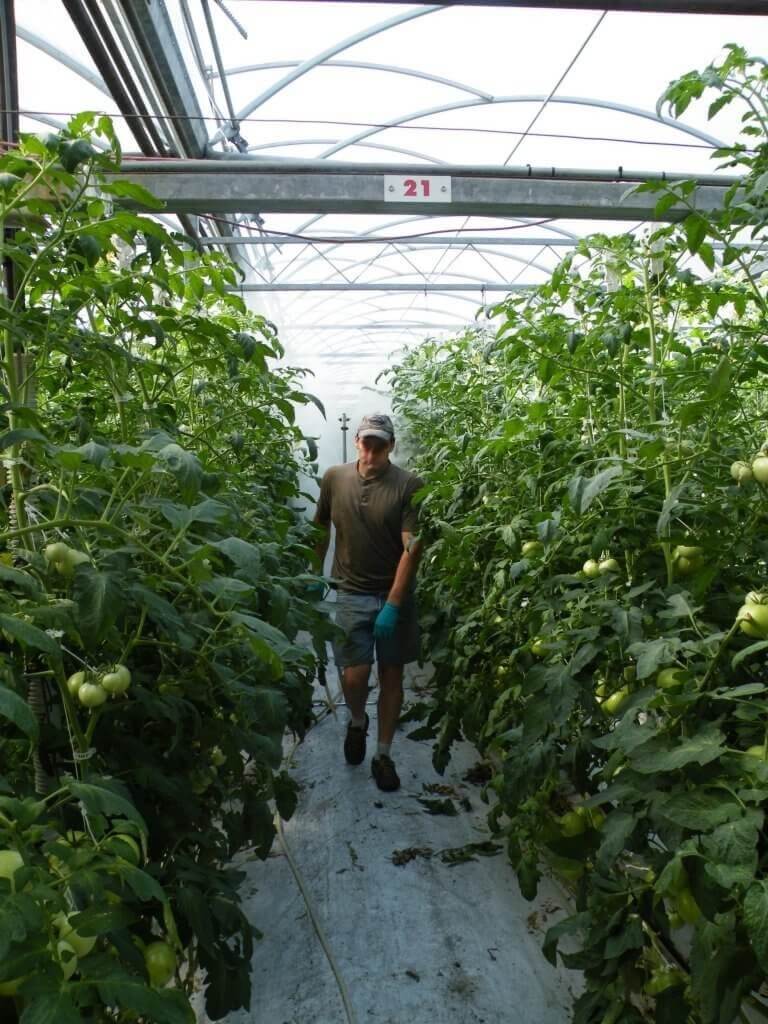
    Demonstrating how an operator spays greenhouse tomatoes with a towed vertical boom. This was just water, so no PPE required.
    Demonstrating how an operator spays greenhouse tomatoes with a towed vertical boom. This was just water, so no PPE required.

    In this demo, the operator was using yellow TeeJet VisiFlo hollow cones (TX-VK3) which, despite the pressure-drop, were still operating at >300 psi and therefore beyond what the manufacturer lists in their rate charts. The resultant spray quality was Very Fine. We’ve said before that increasing the pressure does not increase the speed of tiny droplets appreciably, but that’s when we’re talking about going from, say, 60 to 90 psi. At pressures as high as 300 psi the droplets are moving fast enough to generate some air movement (i.e. making their own light wind) and there was a visible distortion of the outer potion of the crop canopy. The resultant coverage, even on the underside of a leaf (see below), was hard to fault.

    DSCF1160
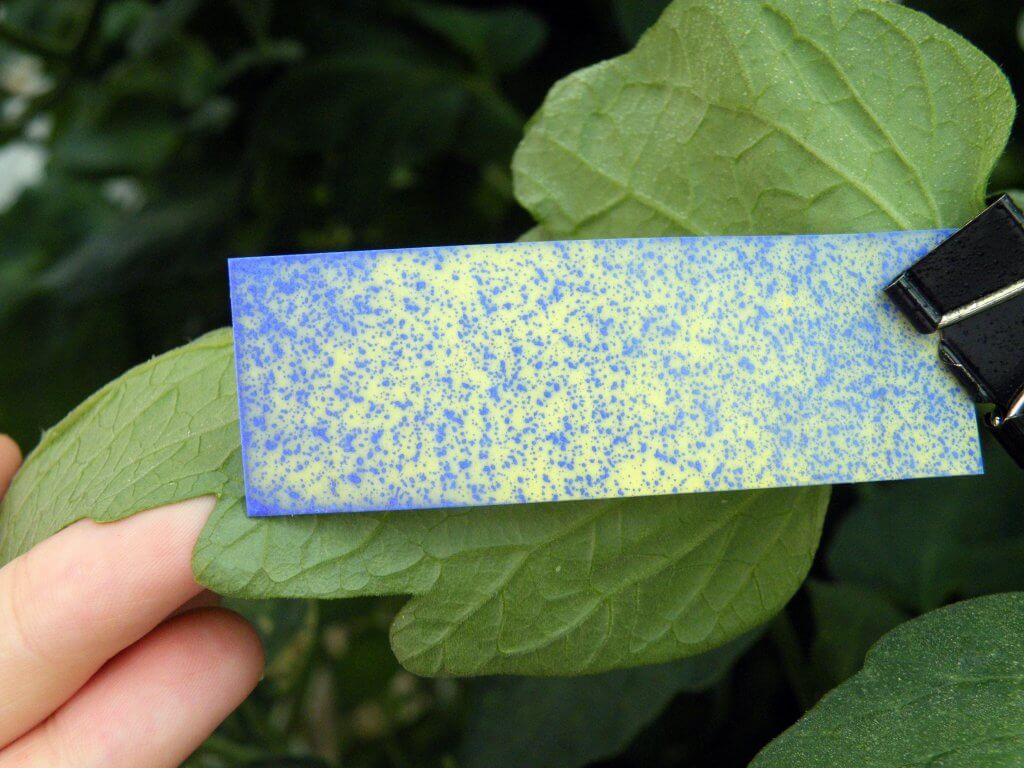
    Under-leaf coverage

    However, as one would expect with Very Fine spray, a lot of the mist didn’t go anywhere. So while the coverage was very good, it was not terribly efficient. I was left thinking there might be an opportunity to find a savings in spray mix and reduce the potential for operator exposure by lowering the pressure. Unfortunately the regulator would not allow us to reduce the source pressure appreciably, so we weren’t able to experiment.

    Automated sprayers

    The next greenhouse we toured used a far more sophisticated method for applying pesticides. While they still used a centralized tank and pump, the sprayers were not hand-pulled trolleys; They were robots! Well, they were automated vertical booms that rode along the hot water pipes in the alleys between the crops. The operator would stand in the corridor and send one sprayer hurdling down the left-hand alley. The sprayer sprayed from only one side of the boom as it went. When it reached the end of the alley, the boom would rotate 180°. Just as it began the return trip, spraying the other side of the alley, the operator would send a second sprayer down the right-hand alley. As the second sprayer reached the end of it’s run, the operator would retrieve the first sprayer, and set it rocketing down the next left-hand alley. In that fashion, alternating back and forth, the greenhouse got sprayed.

    Automated Vertical boom sprayer
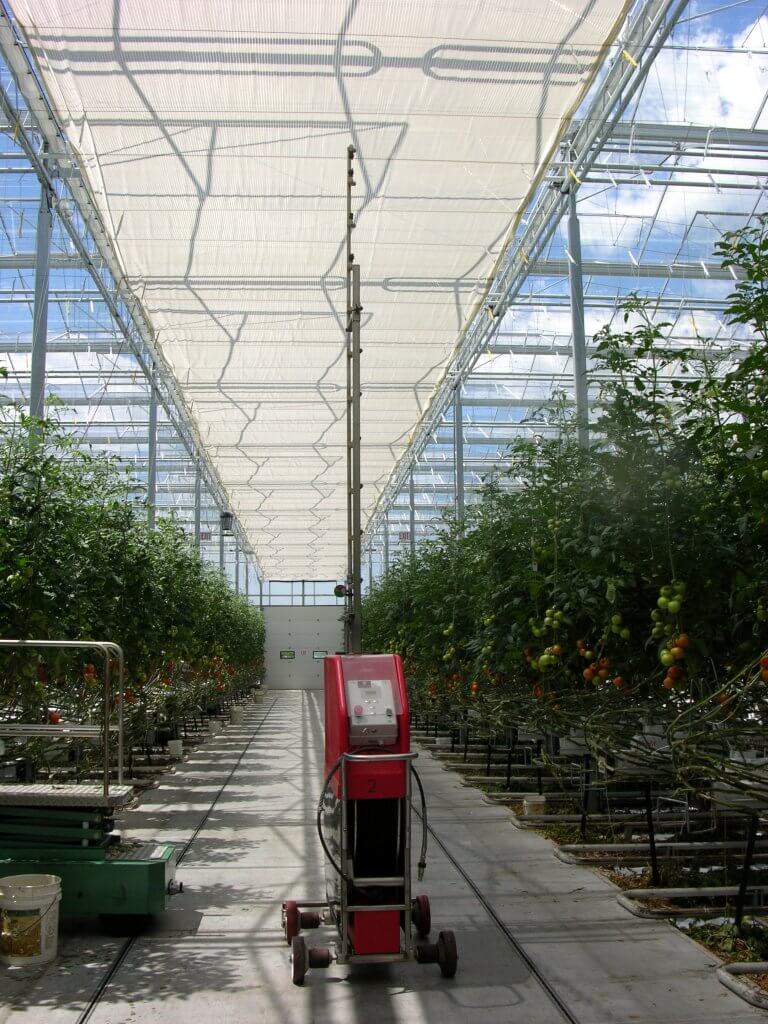
    Automated vertical boom sprayer

    The automated sprayer was set to operate at ~350 psi, traveling at a rate of 75 meters per minute, spraying from a vertical boom equipped with five flat fan nozzles oriented vertically. Water sensitive paper (which has one face that goes from yellow to blue when water contacts it) was placed in three locations in the tomato canopy.

    • One was placed directly behind the fruit with the sensitive face square to the sprayer.
    • One was placed with the sensitive face facing the ground (this upside-down orientation exposed only the edge of the card to the sprayer).
    • The last was oriented with the sensitive face aimed into the direction of the sprayer’s travel, again only exposing the thin edge of the card to the sprayer.
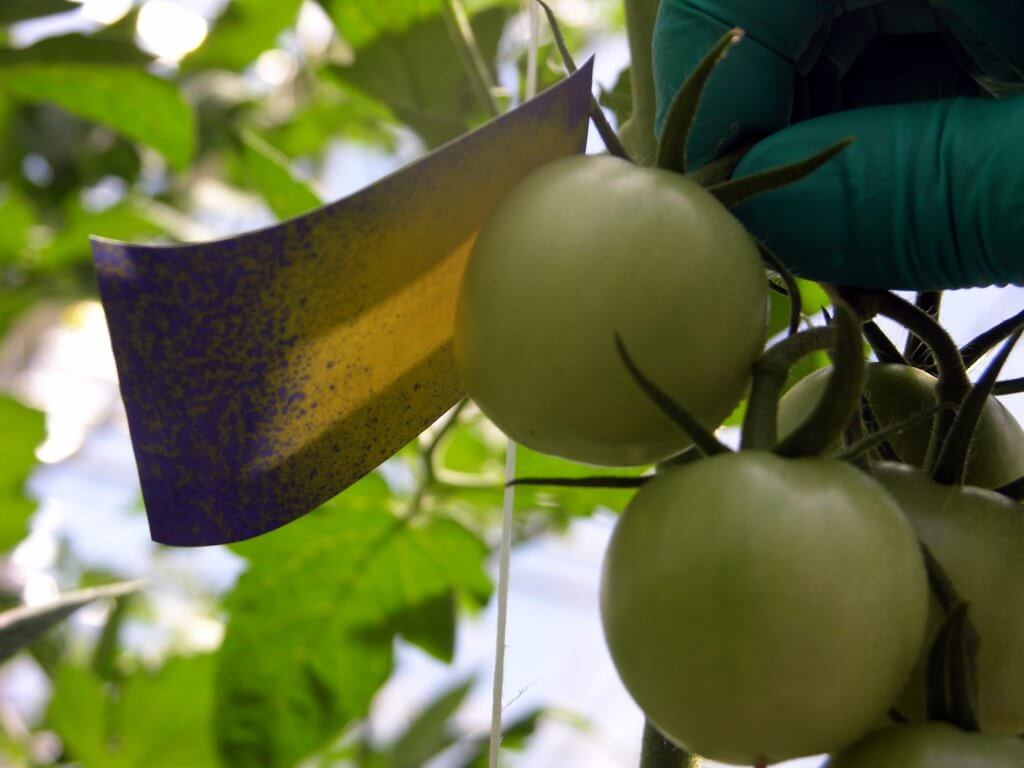
    Water-sensitive paper shielded by a fruit. Sprayed with flat fan nozzles.
    Water-sensitive paper shielded by a fruit. Sprayed with flat fan nozzles.

    Flat fan nozzles

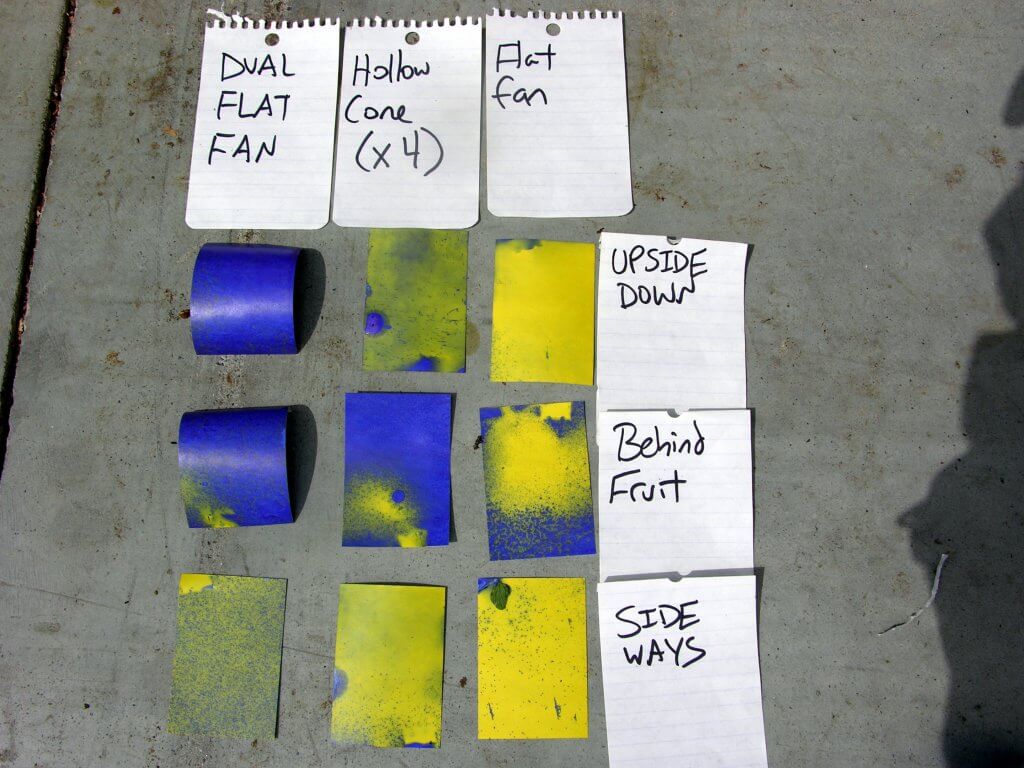
    The sprayer was released to spray the 125 metre row using the flat fans. To the observer, it produced a cloud of spray that appeared to completely envelop the target row. Very little was seen to escape through the tomato canopy into the next row. When the cards were retrieved, however, the coverage was disappointing. See the right-hand column of papers entitled “Flat fan” in the image below. This goes to show that a spray cloud can fool you – always use water-sensitive paper to confirm spray coverage.

    Coverage from three sets of nozzles. Papers oriented in three different ways in a tomato vine.
    Coverage from three sets of nozzles. Papers oriented in three different ways in a tomato vine.

    Hollow cone nozzles

    Now, don’t look at the centre column of papers just yet (you just did, didn’t you?).

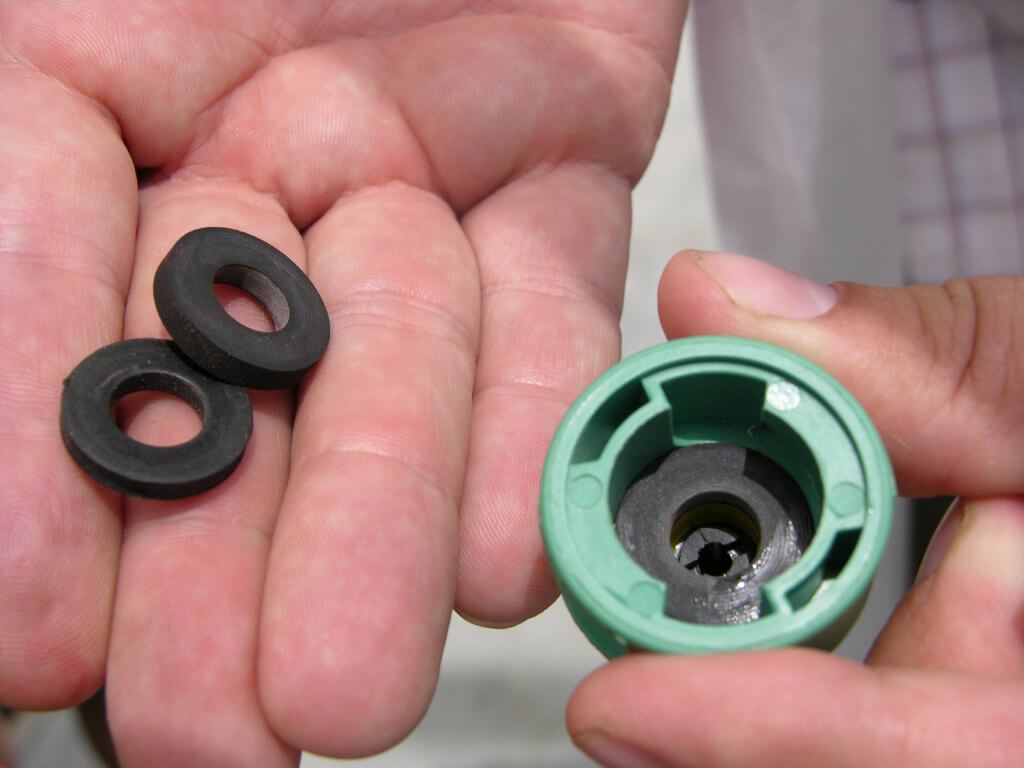
    We chose to switch from the vertically-aligned flat fans to hollow cones. The concept was that the spray would be emitted from so many new angles that it would penetrate the canopy more effectively and hopefully cover more of the targets. I’ll note that we had to use extra gaskets to hold the nozzles firmly in place. The sprayer was re-nozzled, the paper targets replaced, and the sprayer sent back down the alley. Once again, the spray swath looked good to us, but when we retrieved the papers, there was almost no coverage; It was far worse than the flat fans.

    Multiple gaskets were required to hold hollow cone nozzle tightly in place.
    Multiple gaskets were required to hold hollow cone nozzle tightly in place.

    Finer droplets have very little inertia, so perhaps the high pressure made the droplets too fine for them to move very far. To test this, we reduced the pressure to 100 psi and re-sprayed the same cards, which were simply left in place. The resultant coverage was not improved.

    We left the papers in place for a third pass. This time we thought perhaps the spray was still too fine because of the nozzle itself. We replaced the hollow cones with a different set of hollow cones that produced coarser droplets and the same cards were re-sprayed. Still no practicable improvement.

    We were getting desperate, now. Cards were left for a fourth pass. It has been demonstrated that a slower travel speed can improve canopy penetration in orchards, berry crops and and grapes, so perhaps the sprayer was moving too quickly? The sprayer was slowed to 50 metres per minute and the cards sprayed for a fourth time. Now look at the centre column entitled “Hollow Cone (x4)” in the figure below. This coverage is the result of four passes with hollow cones. It was disappointing.

    Note: a greenhouse is a very hot and humid place. Water-sensitive paper begins to discolour quickly, so don’t leave them out for longer than you have to. That’s why the top paper is cloudy-looking.

    Coverage from three sets of nozzles. Papers oriented in three different ways in a tomato vine.
    Coverage from three sets of nozzles. Papers oriented in three different ways in a tomato vine.

    Twin-fan nozzles

    Finally, and only because I had them with me, we decided to try dual flat fans (in this case, TeeJet DG TwinJets). Symmetrical and asymmetrical dual fans are often used to spray vertical targets in field crops (e.g. to control fusarium in wheat heads). We oriented the nozzles so they alternated 45° left, then 45° right. We also turned off every second nozzle. The idea was to prevent the fans from physically intersecting, but still create an overlapping swath. The paper targets were replaced and the sprayer was returned to its original settings (i.e. 350 psi and 75 m/sec). We managed to twist them into that orientation by using a cap with a circular opening and additional gaskets to hold the nozzle snugly. Plus, at 350 psi, we had to get the nozzles extra tight to prevent leaks.

    Nozzling a vertical boom.
    Nozzling a vertical boom.

    The result was spectacular. Here are the results once more (below). See the left-hand column entitled “Dual Flat Fan”. The cards received so much coverage that two became drenched and curled. Even the card with the worst coverage received more than enough. I will point out that this was achieved with about 2/3 the spray volume the operator typically used to spray with flat fans.

    Coverage from three sets of nozzles. Papers oriented in three different ways in a tomato vine.
    Coverage from three sets of nozzles. Papers oriented in three different ways in a tomato vine.

    And, this is where the tour and our trials ended. The operator was happy with the improved coverage and so was I. I was sure to tell them that now that more spray was hitting the target, they should explore reducing the spray volume (either via reduced pressure or lower-rate nozzles) until all the papers looked more like the one in the bottom-left. I suggested a goal of about 85 drops per square centimetre (a benchmark for good coverage) rather than the drench/run-off we were currently getting. The spray mix would continue to be the same ratio of formulated product-to-carrier, but a judicious reduction in overall volume would result in reduced pesticide costs and reduced wastage as long as coverage was never compromised.

    And now, a warning…

    Unfortunately, as I heard two years later from a miffed agrichemical dealer, the operator did not follow through with the volume reduction. I was told the tomatoes began to exhibit symptoms that looked like blossom end-rot but he suspected it might be chemical burn. His hypothesis was that so much spray was getting to the tomatoes that it was accumulating at the bottom of the fruit during run-off, concentrating as the spray dried, and damaging the area. We may never know what really happened.

    And so, it’s important to remember that whenever you adjust or calibrate your sprayer to improve spray coverage, you should reconsider how much spray you need to accomplish your goals. If you were getting poor control before the adjustment, improved coverage might help. If your level of control was already satisfactory, and your adjustments were intended to reduce wastage, consider reducing how much spray volume you use. This is called crop-adapted spraying.

    Note: If you are concerned that changes to your spray practices might cause unwanted side effects, always perform trials on small test-plots and monitor the crop closely to ensure there are no negative impacts.

    Take home

    Greenhouse vegetable producers should consider using water-sensitive paper to test nozzle arrangement on their high volume sprayers. From our preliminary work here, dual flat fans at alternating angles might be worth exploring in hanging tomatoes. And, because it cannot be overstated, consider making changes in small test plots first and monitor the results closely.