This article was co-written with Jennifer Llewellyn, former OMAFA Nursery Crop Specialist
With more and more bio-rational products on the market, crop protection methods may require reassessment. Certain products require exacting water quality, cannot tolerate residues, and have half-lives that are both time- and temperature-critical. We’ve been getting questions about sprayer compatibility with some of these new products, so it seemed like a good opportunity to recycle this article from 2013.
Many horticultural commodities, such as turfgrass and nursery crops, include the application of live nematodes as part of their annual IPM program. We performed preliminary research into the claim that a grower’s nematode applications were becoming less effective. In the course of the investigation it was discovered that the nematode concentration (i.e. dose) sampled from the spray nozzle was diminishing over the course of the application.
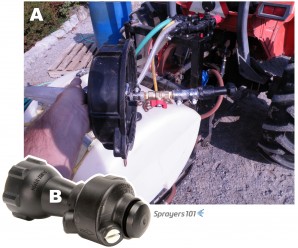
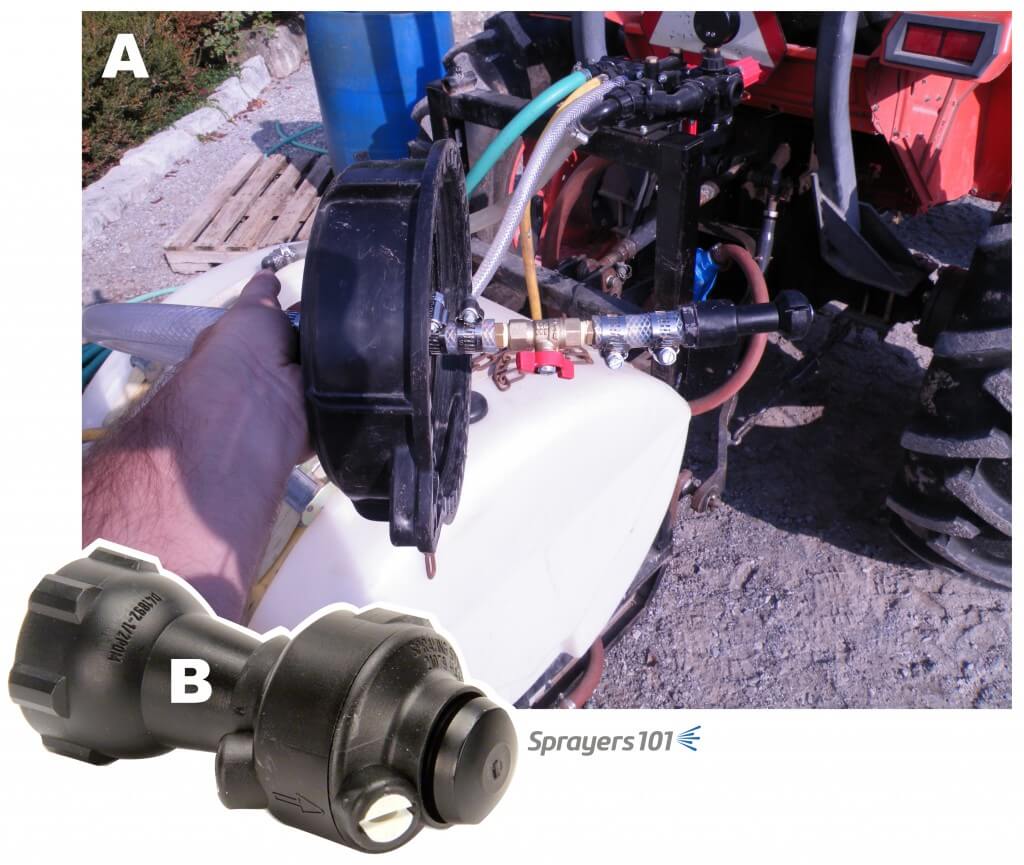
(A) Tank-rinse assembly mounted through tank lid with a flow-regulating valve. (B) Close up of tank-rinse nozzle.
After eliminating potential sinks in the sprayer’s plumbing (e.g. filters, strainers, etc.) it was hypothesized that the nematodes were adhering to the interior of the poly tank. If this was the case, the concentration would drop as the level of spray mix dropped. To test the hypothesis, we installed a tank-rinse nozzle to sparge the inner walls of the tank throughout the application and to re-suspend any stranded nematodes.
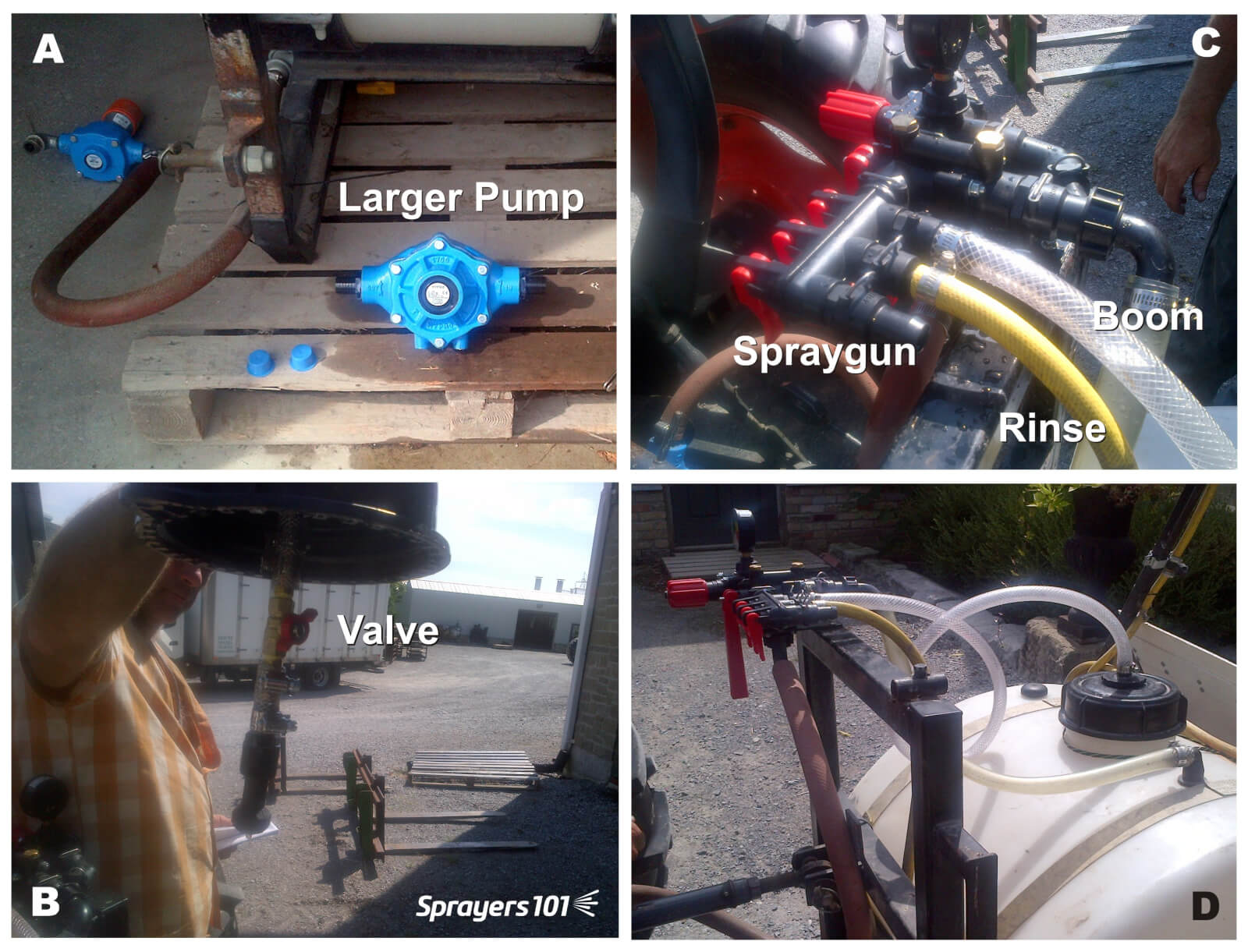
A high capacity roller pump (Pentair series 1700C) was installed to operate the tank-rinse nozzle (Pentair Proclean Tankwash) during spraying. It was installed through a bulkhead fitting in the tank fill lid. During testing it was discovered that the tank-rinse nozzle shunted too much flow and pressure to maintain flow to the spray gun. A valve was installed behind the tank-rinse nozzle to restrict flow to the point where it gently rinsed the inner walls of the tank, restoring flow and pressure to the spray gun.
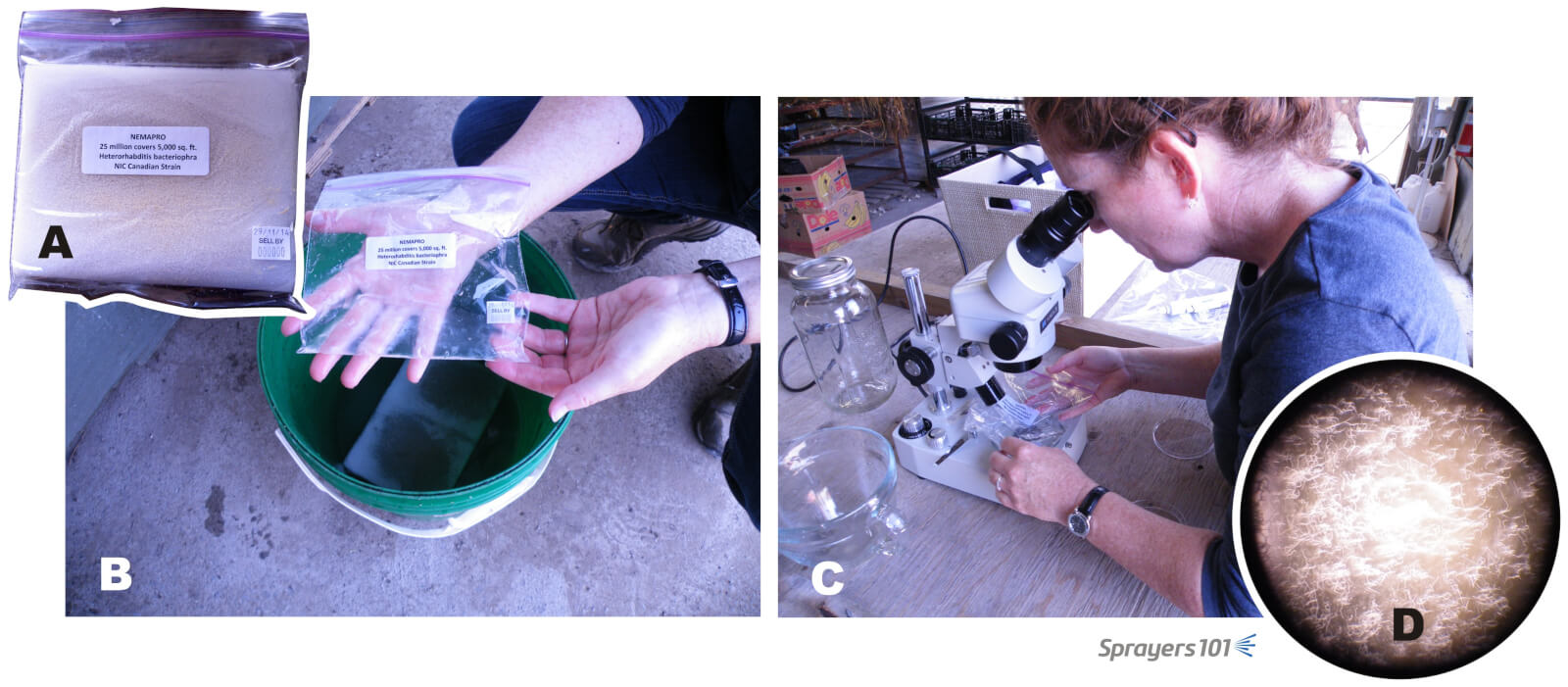
(A) Installing a high-capacity roller pump. (B) Tank-rinse nozzle, with valve, installed through tank lid. (C) Control manifold installed to plumb the return, the tank-rinse nozzle, spray gun and boom. (D) The entire installed system.(A) Nematodes, as-shipped, in a sponge. (B) Suspending nematodes for tank mixing. (C) Counting nematodes. (D) Undiluted, healthy nematodes in a stock solution via microscope ocular.
The 200 L tank was inoculated with a stock solution containing 25 million nematodes (125 nematodes / ml). 20 L of the spray solution was sprayed into a bucket every 10 minutes, whereupon 1 L of spray solution was immediately removed and 1 ml volumes were sub-sampled for counting.
In the first trial, nematode counts continued over a period of 2 hours and viability dropped by ~40%. It was assumed the damage was caused by prolonged circulation through the roller pump. In subsequent trials, the sampling duration reduced to 10 minutes (more realistically reflecting the time it took the grower to apply 200 L in the field). The tank was rinsed and re-inoculated for each trial. 1 ml samples were drawn from the spray gun, which operated continuously, with and without the tank rinse nozzle in operation.
Univariate analysis confirmed data normality and a GLM procedure was conducted for analysis of variance. Results indicate that nematode concentration dropped by ~15% without tank-rinse with minimal nematode damage observed. With the tank-rinse nozzle engaged, the concentration still declined slightly, but significantly less (<5%) (see graph below).
Nematode concentration over time for each condition.
The results suggest that a tank-rinse system that sparges the tank walls preserves nematode concentration throughout an application and may lead to more efficacious applications.
Horticultural Crops Ontario, Ground Covers Unlimited, Pentair (Hypro) and Nemapro are gratefully acknowledged for making this research possible.
The level of filtration required for any given spray operation depends on the materials sprayed and the nuisance factor: That is, the balance between lost productivity from plugged nozzles and the effort required to address them during rinsing.
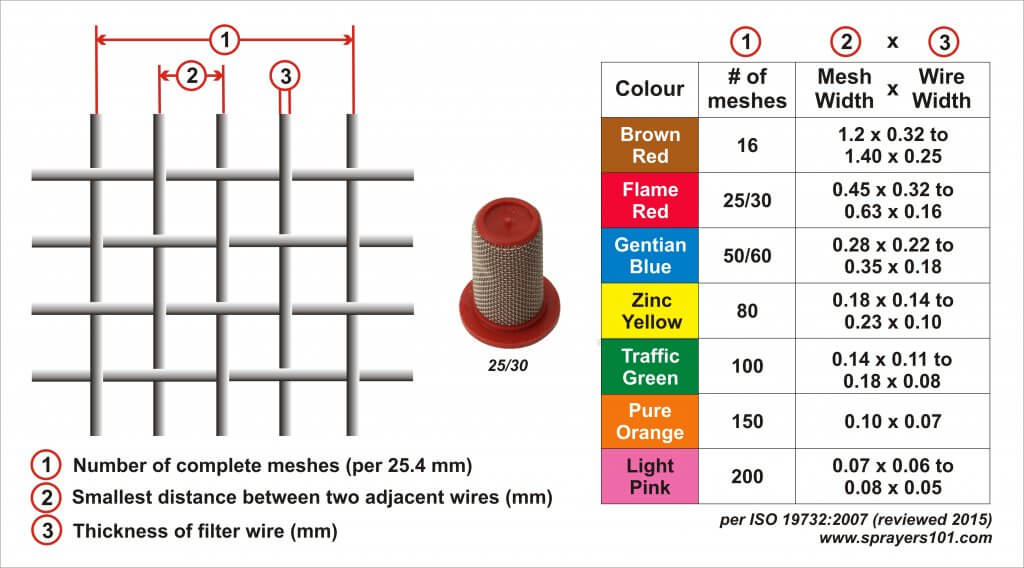
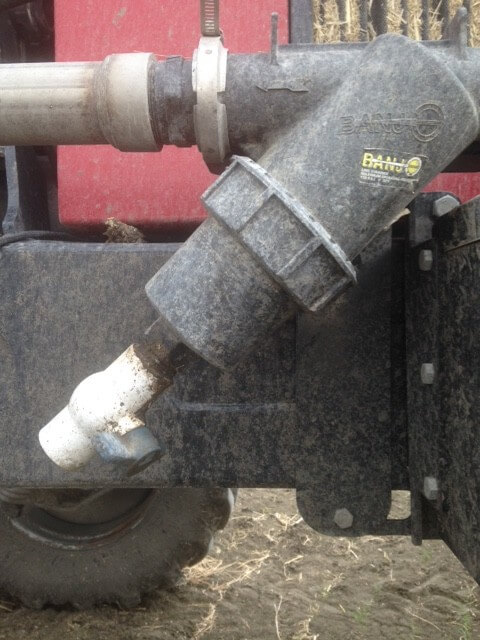
There are opportunities to install strainers at the tank opening (usually a basket), the suction-side of the pump, each section line, and behind the nozzles. While we’ve yet to see an operation that uses all four (speciality or field operations), the suction strainer and line strainers are required bare-minimum.
This infographic explains how strainers are classified. Be aware that older strainers may use a different colour code (e.g. 50 mesh used to be red – now it’s blue).
To convert these ratings to actual size exclusion, we look at the Mesh Width (mm). An 80 mesh (yellow) leaves a distance of 0.18 to 0.23 mm between the wires. We can convert Mesh Width from mm to microns by multiplying it by 1,000, giving us 180 – 230 microns.
Each level of filtration should get progressively finer, ending with the nozzle strainers being slightly finer than the nozzle orifice. Nozzle catalogues will often advise you on which strainer is appropriate for the nozzle you are using.
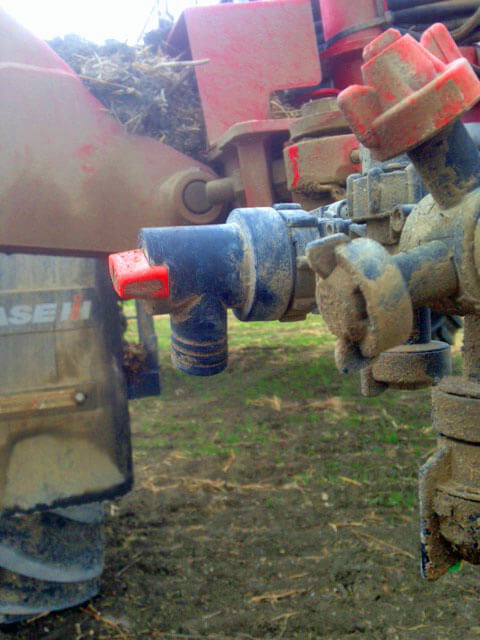
When we ask why operators don’t use nozzle strainers, the response is either “Because they plug” or “It’s one more thing to clean”. Well, if your nozzle strainers are plugging, it’s likely because you have an agitation (see here) or mixing issue (see hereand here) further up the line. They can handle a lot before the spray pattern begins to suffer … but yes, you do have to clean them regularly so they can continue their good work.
Running water through any strainer often fails to remove plugs and debris, which are a source of contamination that can wreak havoc later on. They have to be removed and physically scrubbed during rinsing. We ran a demo to show why this irritating process is still a must-do (here).
If you use an airblast sprayer, you should use slotted (not mesh, which plug too easily) nozzle strainers. Beyond the obvious benefit of preventing plugged nozzles, the strainer shoulder plays a role in keeping the nozzle snug in the nozzle body. Without it, you may need additional gaskets to prevent leaks. Be aware that some nozzle strainer designs can plug a nozzle body. Learn more here.
If you use a field sprayer with clean carrier water, liquid formulations and large nozzles, you may never need nozzle strainers. But, if you’re using a lot of dry formulations, if your agitation is under-powered, or if your fill water is less than pristine (we’ve seen frogs in sprayer tanks) then you might consider them… even if they are a nuisance to clean.
Spot sprays are becoming mainstream. As of 2024, John Deere’s See & Spray Select, their Green-on-Brown technology, is selling well in western Canada but it’s creating some confusion about how to outfit and run the system.
Quick Overview:
See & Spray Select is available on 120’ booms with either 15” or 20” spacing. It can be operated at up to 12 mph with conventional vertically oriented nozzles, or up to 16 mph with backwards oriented nozzles using a 40º adaptor available from John Deere. Optimal boom height is between 26” and 47”
Operating speed for See & Spray Select is measured at the boom. That means if an operator drives at the 12 mph limit and the boom yaws forward under normal driving or in a turn, the boom speed will exceed 12 mph and it will enter “fallback” mode. Fallback mode is intended to provide weed control when camera vision is compromised due to dust, height, or speed, and typically it means that all the nozzles in the affected boom region are turned on. To avoid unnecessary waste, an operator will want to minimize fallback mode and therefore will want to drive slower than the maximum allowed boom speed.
An operator has a choice of selecting a single-nozzle or overlapping-nozzle activation. In single nozzle mode, only the nozzle in the weed’s lane is turned on. In overlapping mode, one adjacent nozzle on each side is also turned on, for security. Overlapping mode is available on most spot spray systems to compensate for spray displacement in a side-wind, for example.
Research at the University of Wisconsin has shown that the overlapping mode resulted in more consistent weed control in a side-wind.
Nozzle Selection
Overlapping mode makes nozzle selection easier because the fan angle is not as critical. Nozzles are allowed to overlap as they’re supposed to on a broadcast boom, and the spray dosage is a function of nozzle size, spacing, and travel speed. It’s also easier because boom height movement doesn’t affect the dose, so long as the required overlap remains. But nozzle fan angles should still not be too wide.
Single nozzle activation can save more product. But in this mode, nozzle fan angle is critical because it determines the band width. Unfortunately, current nozzle selection is poor – most manufacturers aren’t offering any narrow-enough fan angle nozzles yet. For this reason, John Deere’s nozzle recommendations are intended primarily for overlapping mode.
With single nozzle activation, the nozzle pattern (band) width needs to be fairly close to the nozzle spacing, but still have some overlap when adjacent nozzles are activated in a weed patch. The more the pattern width exceeds the nozzle spacing, the greater the underdosing in single nozzle activation compared to overlapping sprays. This conundrum is unavoidable. The closer these two values (pattern width and nozzle spacing) are to each other the better. But for this to work, boom height has to be consistent. Too low a boom creates gaps between adjacent narrow patterns. Too high and the pattern width widens, reducing the single nozzle dose. There is simply not much room for error.
Broadcasting Background Dose
With See & Spray Select, the A solenoid (front nozzle in ExactApply) can be used to apply a PWM broadcast spray simultaneous to the spot spray. This feature is useful with early season application because of just-emerged weeds that may be missed by the sensor. We might choose about 1/3 of the full rate applied this way, a dose which is sufficient to control these small weeds. With a tank mix for 10 gpa, one would spray 3 gpa with the front boom and 7 gpa with the B solenoid, the spot spray. This way the entire field receives the 3 gpa dose, while larger weeds that trigger the spot spray receive the 10 gpa dose.
The problem is again with nozzle availability. For example, 3 gpa with 15” spacing at 11 mph with PWM (broadcast mode) requires a small nozzle such as an 01 (orange) or 015 (green). These are hard to find in a low-drift version. Increasing the broadcast water volume to 5 gpa would allow an 02 (yellow) nozzle to be used. A 20” spacing would allow even larger nozzles to be used, for 3 gpa an 025 (lilac) is a possibility and this greatly improves the available choice. At 5 gpa, an 03 size is suitable, and now the John Deere LDM nozzle is an option (it is not manufactured in sizes smaller than 03).
Let’s assume a user selects 5 gpa for the broadcast based on nozzle availability. The next decision is whether to adjust the total applied volume upwards. If sticking with a 10 gpa tank mix, the spot spray would also be 5 gpa, making the broadcast 50% of the dose.
Alternatively, one could increase the spot spray volume to 10 gpa, mixing the tank for 15 gpa. This returns one to 1/3 of the total dose as broadcast, and 2/3 as a spot spray. A reason for doing this is to make nozzle size selection easier and also improving the product savings of the system.
The spot spray from the B solenoid is not PWM, which allows for a more straightforward nozzle sizing, as well as the use of air-induced tips which are available in a large number of sizes.
A summary of some possible nozzle combinations for two nozzle spacings and travel speeds is listed in Table 1.
Table 1: Possible nozzle sizes for overlapping mode in John Deere See & Spray Select Note that the travel speed is lower than the maximum allowed, to accommodate boom yaw.
If the operator chooses single nozzle activation, the fan angle of the nozzle becomes important. To recap, one would want to have a nozzle that can do two things:
Cover a band that is close to the same width as the nozzle spacing when a single weed activates a single nozzle, and
Provide sufficient overlap when multiple adjacent nozzles are activated in a larger weed patch.
It’s not possible to have a band width as narrow as the nozzle spacing and still get an overlapping pattern when it’s needed. This means the dose for a single nozzle pattern will unavoidably be spread out wider, resulting in a lower dose for any weed it encounters compared to the overlapping activation. But the wider the fan angle, the wider the band and the lower the dose, resulting in possibly reduced control for single nozzle activations.
On the other hand, a narrower band limits the boom height at which an acceptable overlap can be achieved. Let’s say an overlapping nozzle needs to have 30% overlap to get an acceptable spray distribution. At a 20” spacing, the band would need to be 26” wide (a 24% under-dose on a single nozzle compared to an overlapping section). Band width will change with boom height, but it depends on the fan angle. For a 60 degree fan angle, the band changes by about one inch for every inch of boom height. That means even with a modest 10” vertical movement of the boom, the dosage might change by 30%, a fair amount.
Actual changes depend on the nozzle spacing and the fan angle, but the point remains that this is a significant dosage change that could affect weed control. And this change in dose is because of boom sway.
Recommendations
What should a spot spray user do? One thing is clear, compromises will be necessary.
The most consistent application will be achieved with overlapping mode, but at the cost of forfeited savings. These lost savings may be recovered due to fewer weed control failures, or less need to re-spray.
On the other hand, the greatest savings will be achieved with single nozzle activation. But fan angle will need to be carefully selected and boom height consistency will be critical.
Availability of narrow fan angles is limited. Only Wilger (20, 40, and 60 degree DX), Greenleaf (40 degree Spot Fan), Arag (CFLD-CX 40 degree) and Magnojet (30 and 60 degree) offer spot spray-specific low-drift nozzles off the shelf. TeeJet has issued DriftGuard (DG) versions of 65 degree nozzles for the Australian spot spray market, with the DG65055 a special nozzle that conforms to the VC spray quality requirement needed for 2,4-D products.
John Deere has recently (Spring 2025) released an 80 degree spot spray tip called the TSL. It ships with the angled adaptor for faster spray speed. However, 80 degrees is still not narow enough to permit single nozzle activation without some significant rate compromises between single and overlapping mode.
The availability will need to increase, not only in terms of fan angles, but also in flow rates and spray qualities. With spot sprays remaining a relatively small market this will take time. But the success of spot sprays also depends on it.
One question that only experience will answer is the relative frequency of single vs multiple nozzle activation for any given farm. If the majority of the activations are multiple nozzles, then setting up the nozzles for that situation (i.e., opting for wider fan angles that create more overlap) makes most sense.
But regardless of the choice made by the user, the need for stable booms remains paramount. This feature will be the basis on which any progress in spot spray adoption will be built. Call your dealer. Tell them how important boom stability is.
Editor’s Note: Changes have been made to this article since its original publication in 2015.
When in-crop spraying is around the corner, sprayer tank clean out is an important topic to address on your farm. Many farms have done the same clean-out routine for years and not had any issues with contaminating residues in the tank resulting in crop damage. Although the old saying “If it ain’t broke, don’t fix it” definitely has some merit, in this case it is good to question whether your cleanout routine is adequate. When you consider the way chemicals have changed over the years, especially the higher reliance on oily surfactants in modern chemicals, it makes sense why we need to pay attention to spray tank cleanout.
The goal of cleaning the tank is to remove and dilute the previous chemical formulation as much as possible to prevent buildup and carryover of residues which can cause crop damage on non-target crops.
Safety First
Always wear safety gear before working around chemicals. Although it can be a hassle, we all know that it is no fun spilling chemical on your clothes and skin. What’s even worse is smelling it all day in the sprayer cab. I use a long waterproof coat, a plastic face shield to prevent back splash when spiking jugs, and of course rubber gloves (No judgment on me looking like a total dork please:).
Safety First – Are you looking at my headgear? Are you!?
1 – Get the Previous Product Out of the Tank ASAP
In my experiences spraying, I have always tried to get the previous product out of the tank as soon as possible. Spraying the extra product out of the tank is the safest and most environmentally responsible way to rid your tank of left over product. Dr. Tom Wolf of AgriMetrix Research and Training, states that spraying a crop twice is usually safe, as all herbicides must be registered to be sprayed at twice the rate in order to be registered by the Pest Management Regulatory Agency (PMRA). If one lets the product sit in the tank overnight before beginning the cleanout, there is more time for product to congeal and adhere to the tank and plumbing components.
Ball valve on main filters.
I open the valve ends on my filters to empty the buildup in the bottom of the filter canister. There is often chemical residue or green slime from dug-out water in here. Next I like to go along my booms and empty out all the chemical product within the boom plumbing. Our farm runs a Patriot 4420 sprayer, with valves on each boom section to empty out product. Usually I will go to the sprayer and tip the boom ends up so that gravity allows all of the product to drain out. Then I raise the centre rack, and tip end of booms down to force the product to drain out the other way. You would be amazed at how much product comes out by doing this both directions!
Valves on each nozzle.Tipping the boom ends up with the centre rack down.
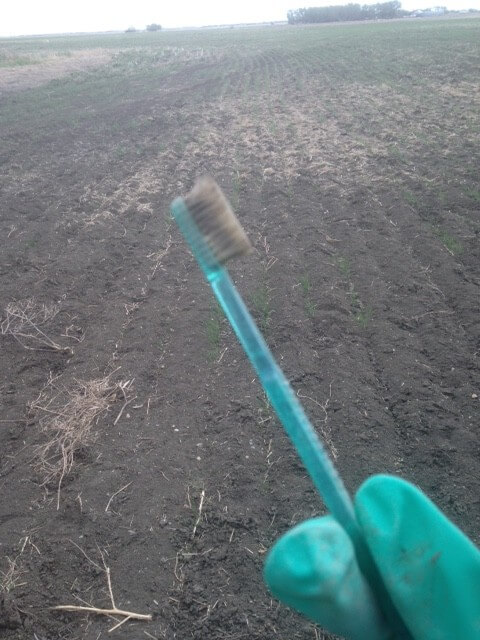
While the tank is empty and no pump is running, I will remove all the filters on the sprayer, and grab the handy dandy toothbrush – this is the most valuable tool in filter cleanout! This brush is just small enough to get it in the centre of the filter and scrub all of the residue and gunk out of the filters. A pail filled with rinsing solution is an easy way to clean filters and nozzles.
Possibly the most important cleaning tool. Don’t put it back in the bathroom afterwards.
2 – Begin Rinsing Process
I used to always put about 1,000 gallons of water to our 1,200 gallon tank, thinking that a larger volume would clean all areas of the tank better, but I’ve since changed my thinking. Research has shown that two or three smaller rinses *aka triple rinsing) is more effective for rinsing the tank than one large volume rinse. I always crank the agitation up to high and allow the cleaning solution to agitate for as long as possible.
Nowadays I try to do three 400 gallon rinses.
1st Rinse
Cleaning product plus 400 gallons water
2nd Rinse
Cleaning product plus 400 gallons water
3rd Rinse
400 gallons of just water to rinse, and run through plumbing system to check nozzles and for leaks
Many labels Recommend leaving the rinsing solution in the tank and lines overnight. This will allow more chemical deposits to loosen up. If an operator is forced to speed up the tank cleaning process due to limited time, they must understand that there are risks involved in doing a less thorough tank cleaning.
Cleaning Products
Detergent or ammonia? Check the label. If the label doesn’t specify, you can consult this table from Winfield United.
Detergent Cleaner
Ammonia
Solution contains an adjuvant
Sulfonylureas (SU’s)
Solution contains a milky looking component (an Emulsion or EC)
Thiencarbazone – methyl
Glufonsinate
Flucarbazone
Imi’s (Group 2)
Dicamba
Simplicity
Detergent (e.g. All Clear)
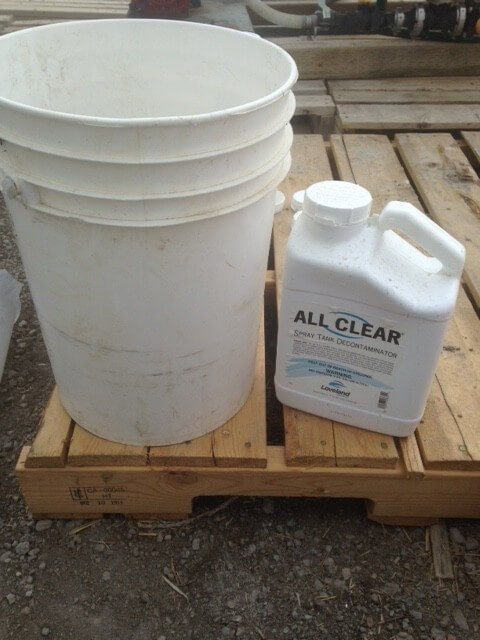
This detergent cleaner is specifically designed to remove pesticide deposits and other debris, including oily substances from booms, filters, and nozzles. Use All Clear (or other detergent cleaner) if the solution is milky-looking (called an emulsion), which means it is oil-based.
Label rate is 0.25 L of All Clear/100 L of water.
If you are adding 400 gal of water, you will only need 3.78 L of cleaning product.
Decontamination rate is double this: 7.57 L of cleaning product. Use this rate if you have had residue issues, or to do a more thorough cleaning.
pH Increaser (aka Ammonia; e.g. Flush)
This is an ammonia based cleaning solution. This product is used to raise the pH to increase solubility of most Group 2 products (from FMC, Bayer, and Corteva but not BASF). Flush contains 7% ammonia. Use Flush (or other ammonia based cleaner) for most cleaning, but especially for Group 2 products listed above, such as Varro, and Velocity M3, Express, Refine, Muster, and Spectrum.
Label Rate is 0.50 L of Flush/100 L of water.
If you are adding 400 gal of water, you will need exactly 7.57 L of cleaning solution.
A pail and detergent are “must-haves” during sprayer cleanup.
Combo Products
Alternately, some solutions raise pH without ammonia. FS Rinseout is sodium hydroxide based, not ammonia based. It is a high alkaline solution that elevates and holds the pH combined with strong surfactants to help clean the tank. Another is CleanOut, which uses potassium hydroxide and disodium metasilicate, a detergent. In both cases they are both pH increases and detergents.
3 – Draining the Rinse Solution
After I have ensured all nozzles are working correctly, and there are no leaks in the system, I drain out all of the rinse water, fold in the booms, and get ready to fill the tank with chemical solution for spraying!
More Information
Learn where residue can hide. This video was filmed for the Environmental Farm Plan with the nice people at Clean Field Services in Drayton, Ontario. Hardly the height of our acting careers, but good messaging nonetheless.
Editor’s Note: Changes and updates have been made to this article since its original publication in 2019.
The quality of water being used in the spray tank to act as the carrier for your pesticides can have significant effects on how well those pesticides will work. So it may be surprising that very few growers have had their water quality tested.
Obviously, water that contains suspended materials such as clay, algae and other debris will block filters and possibly nozzles, making spraying very frustrating. However, there are a range of water quality variables unseen to the naked eye that can also affect pesticide performance. The two that cause the most confusion are water hardness and pH.
Water Testing
Knowing the quality of the water you are using is essential for effective pesticide application. Water should be initially tested by a qualified laboratory to establish an accurate baseline for your water quality. Check with your pesticide dealer or look for accredited laboratories near you.
It is important to remember that water quality can vary over time depending on its source. Scheme or town water quality tends to vary very little, however water from surface sources such as dams, tanks and rivers will vary depending on rainfall and other factors. Groundwater can also vary over time depending on how much is being pumped and the recharge rates of the aquifer.
At minimum, water should be tested for:
total hardness
bicarbonate (HCO–)
salinity (electrical conductivity) or total dissolved salts (TDS)
pH
Test strips can be used to quickly check water quality before and after addition of pesticides and monitor changes in water quality between laboratory tests. High-quality test strips can be purchased online from companies such as Hach. Water testing for swimming pools will not be as accurate as those from a scientific supply company. No mater the course of the paper strips, they may be hard to read when used in solutions already containing product. Alternately, and preferably, hand-held meters can be used as long as they receive regular calibration to maintain accuracy.
Water Hardness
Water that is considered “hard” has high levels of calcium, magnesium or bicarbonate ions. Calcium and magnesium ions have positive electrical charges that enable them to bind with negatively charged products such as weak-acid herbicides, making them less soluble. Extreme cases can lead to the herbicides settling out in the spray tank, or more commonly (and insidiously) reducing the ability of the active ingredient to be absorbed through the plant leaf. Examples of weak acid herbicides include glyphosate and amine formulations of 2,4-D, MCPA, clopyralid and diflufenican.
It can depend on your region, but generally a water hardness above 250 to 350 parts per million (ppm) (calcium carbonate – CaCO3 equivalents) should be treated before adding weak acid herbicides.
The cations that can cause the most trouble for pesticides include:
aluminum (Al3+)
iron (Fe3+, Fe2+)
magnesium (Mg2+)
calcium (Ca2+)
sodium (Na+)
Magnesium and calcium are the most common cationic culprits of water quality problems. Aluminum can sometimes be a problem if alum (potassium or aluminum sulphate) has been used to remove (i.e. flocculate / settle-out) suspended particles such as clay from the spray water.
Bicarbonates
Bicarbonates can also affect herbicides such as Group 1 ‘dims’ (e.g. clethodim) and 2,4-D amine at levels greater than 500 ppm. Bicarbonates are not typically detected by standard water hardness tests and may have to be analyzed in a separate test. Be suspicious if your groundwater comes from an area with lots of limestone.
pH
The pH of a liquid is represented on a scale of 0 to 14, and it describes how acidic or alkaline it is, respectively. A neutral pH is about 7 whereas a pH of 2 is very acidic and a pH of 14 is very alkaline. It is important to remember that the pH scale is logarithmic, not linear. This means that a value of 6 is 10x more acidic than a pH of 7, while a pH of 8 is 10x more alkaline than 7 and 100x more alkaline than 6.
The following table gives the pH of common materials to give a sense of perspective.
pH
Substance
14
Sodium hydroxide (caustic soda)
12.6
Sodium hypochlorite (bleach)
11.5
Ammonia
10.2
Magnesium hydroxide (antacids)
9.3
Sodium borate (borax)
8.4
Sodium bicarbonate (baking soda)
8.1
Sea water
7.4
Human blood
7.0
De-ionised water
6.8
Tea
6.7
Milk
6.0
Rain water
4.5
Tomatoes
4.2
Orange juice
4.0
Wine & Beer
2.8
Vinegar
2.2
Lemon juice
2.0
Stomach acid
1.0
Battery acid
0.0
Hydrochloric acid
Excessive Alkalinity
Most recognize that a pH above 8 will reduce the effective life of certain pesticides, such as organophosphate insecticides (if you’re still allowed to spray them where you are). In certain situations, water above pH 8 can change herbicide solubility (poor mixing), reduce product stability (reduced half-life) and negatively affect droplet interaction with the leaf surface. However, the effect of high pH on herbicides is largely overstated.
Excessive Acidity
Glyphosate has been found to work slightly better in moderately-acidic solutions. This effect is from the precipitation of calcium compounds in the tank, preventing the formation of calcium glyphosate on the leaf surface. Excessively acidic water (pH < 5) can affect the stability of mixes (see the following image) and leads to gelling of salt-based products. It has also been found to increase the volatility of herbicides such as dicamba (this is discussed later in the article).
This grower was told to drop the pH of his spray. He added citric acid and added another three products. Source: R. Buttimor
Do I need to adjust the pH of my water?
There are many half-truths in the marketplace about the effect of pH on pesticides. But generally:
“If the pH of the water in the spray tank is between pH 6 and 8, it’s is suitable for spraying.“
Something that is rarely discussed is that the addition of the pesticide will modify the pH of the solution. Therefore, each pesticide user needs to test the water before the addition of pesticides and then check the pH after the addition of the pesticide. They will be very different.
The addition of glyphosate to the spray solution will drop the pH of the spray mix from 8 to less than 5. In the following figure the test strip on the right is town water which normally has a pH of about 8.5, compared with the test strip to the left which is from a 1% glyphosate (450 g/L) solution using town water, which is below a pH of 4.
Adding glyphosate will drop the pH of the tank mix two or three units, depending on initial pH, the formulation and the rate of glyphosate. The pH following the addition of 1% glyphosate (450 g/L) is less than 4 (the yellow test strip). Town water (the blue test strip) is shown on the right.
Research in the United States has found drift damage from dicamba continued to be a problem despite the mandating of using XC and UC spray quality. They found one cause was the addition of glyphosate to the mix, which reduced the pH of the spray solution (Table 2). Volatilization of dicamba increases with decreasing pH. Different formulations of dicamba were found to drop the spray solution pH from 7.8 to between 6.5 and 6.9, however the addition of different formulations of glyphosate dropped the spray solution to 5 or lower.
Table 2 Effect of different formulations of dicamba and glyphosate on spray solution pH. Source: Larry Steckel
Starting pH (water)
Dicamba added (3 formulations)
Glyphosate added (3 formulations)
7.8
6.9
4.8
7.8
6.5
4.8
7.8
6.7
5.0
Currently, in Australia, the recommendation for dicamba is to not add glyphosate to the mix. This will minimize pH drop and therefore reduce the volatilization of dicamba and potential off-target damage.
There’s even more about adjusting the pH of carrier water here.
Adjusting pH using Ammonium sulphate (AMS), Ammonium thiosulphate (ATS) and adjuvants
The degree of bicarbonate, or alkalinity, depends on the presence of calcium and sodium, which can inhibit herbicide performance. Readings higher than 500 ppm inhibit 2,4-D-amine and MCPA-amine. Adding AMS can be effective at countering bicarb. According to Jim Reiss (former Vice President, Ag Chemistry with Precision Labs in Illinois), the following formula can be used to calculate how many pounds of AMS are required to raise the alkalinity. It involves soil testing levels of sodium, calcium, magnesium and iron, along with potassium:
0.002 x K ppm + 0.005 x Na ppm + 0.009 x Ca ppm + 0.014 x Mg ppm + 0.042 x Fe = lbs of AMS/US gallon.
Generally, AMS has no negative impact on mixing in a water-based carrier when added at any stage, but always follow the label if it specifies a mixing order. Especially if mixing in a fertilizer carrier instead of water. Read more about AMS here, under the “Water Conditioners” heading.
Ammonium thiosulphate (ATS) is another option, but must be used with care. Research from Purdue University (2019) concluded that using ATS with a burndown herbicide program that relies on glyphosate or glyphosate plus 2,4-D could lower the control of weeds (e.g. barnyard grass, velvetleaf or lamb’s quarters), or cover crops.
Adding UAN can also help neutralize the effects of bicarbonates, but be aware that adding UAN (or any sulfur) to a carrier could cause physical incompatibilities – especially when adding to a fertilizer carrier. Follow mixing order directions on the pesticide label and read more, here.
Alternately, you might consider a mixing aid or water conditioning adjuvant to deal with bicarbonate. The following table describes the difference between using AMS and a pH adjuster (based on information from Winfield United). If you’re in doubt, speak to your crop consultant and/or pesticide dealer about the best pH adjustment method for your situation.
AMS
pH Adjuster Adjuvant
How it works
Sulfate binds to cations in water and on leaf surfaces
Lowers pH to prevent glyphosate binding to cations.
pH of solution
Remains neutral (pH 5.5-7.0)
Lowers pH to 5.0 or less
Tank compatibility
Compatible with pesticides and micronutrients
Only compatible with glyphosate and weak acid herbicides
Herbicides
Compatible with wide range (often used with Groups 1, 9, 10 and 27)
Helps glyphosate and weak acids (e.g. 2,4-D amine). Antagonizes many others (e.g. Groups 2, 27)
Fungicides
Generally compatible
Not recommended
Insecticides
Generally compatible
Not recommended
Final Thoughts
While we share some general best practices in this article, the standards defining the suitability of carrier water can often be region-specific. Be sure to have your water tested and interpret it within the context of local best practices before making adjustments. If an adjustment is warranted, be sure to follow the pesticide label and the water treatment product label, exactly.
Additional Resources
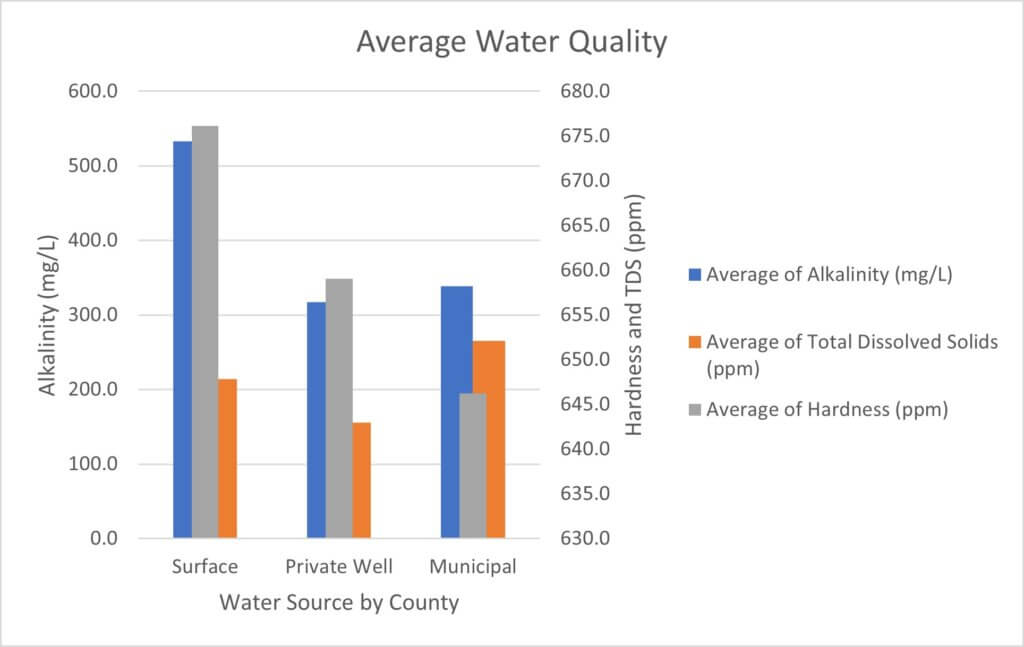
In 2024, Ontario held a sprayer event (Spray Smart) where sprayer operators were asked to bring in their water for testing. This article discusses some of the observations made that day, and a graph of the fill water survey is presented below. Assuming no adjustments are needed for a hardness < 600 ppm, a TDS < 325 ppm and and alkalinity (esp. bicarbonate) <500 mg/L, the averaged results of the sampling indicated no adjustments were required. However, there were a few outliers that are lost in the averaging.