Tag: sectional control

  • Putting a Number on Pesticide Waste

    Putting a Number on Pesticide Waste

    Waste (noun): an act or instance of using or expending something to no purpose.

    In agriculture, environment and economy are intertwined. Producers strive to obtain the maximum return on their inputs. They study incremental returns and avoid applying more inputs than necessary, especially if conditions don’t warrant it.  The financial incentive is powerful, and waste is a four-letter word. This applies to seed, fertilizer, and pesticide. Pesticide labels identify the rate needed to obtain the desired result, and there is no incentive to over-apply. In fact, it’s illegal.

    But there are plenty of other places where applications incur waste. As with time efficiency, it’s a good idea to identify where this waste occurs, and the only tool needed is a sharp pencil.

    When might we incur waste in the spray application process?

    • Mixing more than we need because we don’t trust the flow meter or the tank gauge entirely, or don’t know the exact field size.
    • Priming the boom before the first swath.
    • Overlapping due to curvy terrain and coarse sectional control.
    • Spray drift away from the intended swath.

    How big are the losses?

    Let’s say we have a clean sprayer and need to spray 160 acres before moving to a new crop and product. We plan to apply 10 gallons per acre and have a 1,200 gallon tank with a 120 foot boom. That means we need 1,600 gallons of spray mix in total.

    Once we’re at the field we prime the boom. Each sprayer is different, but depending on operator experience, 30 to 50 gallons are usually needed to push product from the tank to the last nozzle. Only part of that is lost to the ground, as boom sections can be shut off as soon as product has reached every nozzle of that section. We’re assuming 0.2 gallons per foot of boom is lost.

    Spraying itself is relatively straightforward. Swath and sectional control handle the overlaps, but in less ideal terrain, double application is known to account for 4 to 5% of the area to reach non-square parts of the field. This is even more likely when the outer section is 10’ or more. Early turn-on of the boom prior to leaving the headland, to allow boom to reach operating pressure, adds to this.
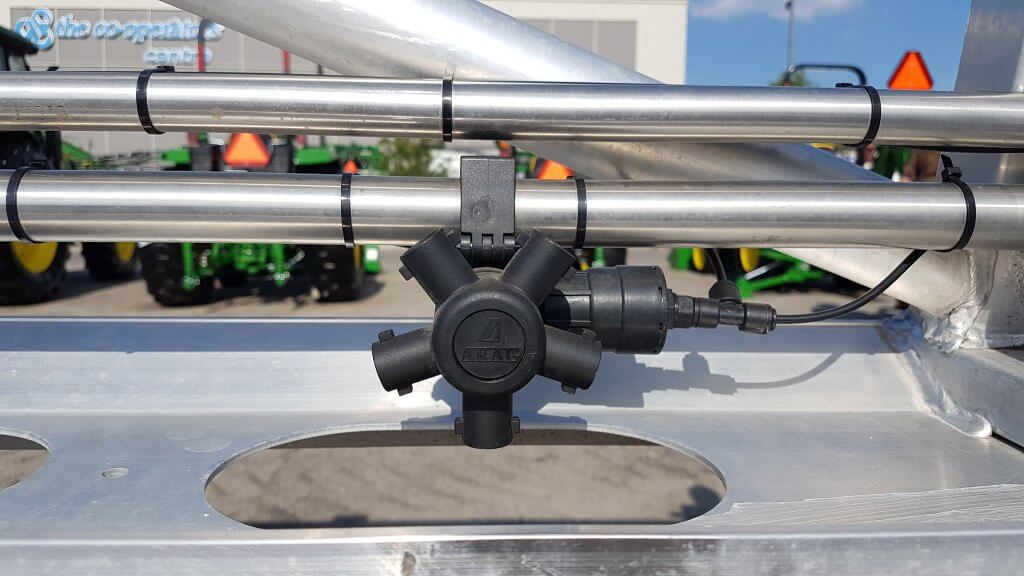
    Air-activated shutoff for individual nozzles reduces section size at a reasonable cost.

    With an average nozzle, we can expect about 2% of the product to airborne drift. Most airborne won’t return to the ground within the field borders, so it’s a complete loss.
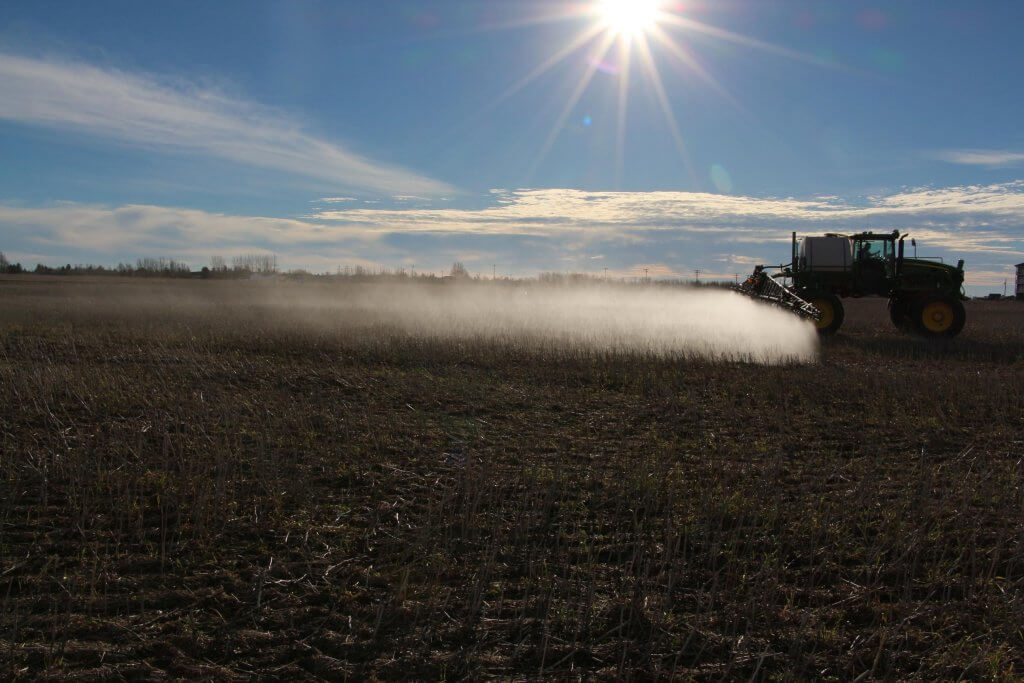
    Most of the spray that travels more than 5 m after leaving boom stays airborne and should be considered a total loss from the field.

    As we finish, the pump will draw air before the tank is empty due to sloshing or foaming, and a 50 to 60 gallon remainder may not be unusual. This simulation has assumed 5% of tank volume remains.

    We also need to purge spray from the boom at cleanout, consuming approximately 0.4 gallons per foot of boom. This occurs after the field is completely sprayed and is therefore considered waste.

    So how does this add up? The following table shows the approximate losses associated with five setups.

    Table 1: Spray mix losses during a sprayer operation. Setup 1 = baseline, Setup 2 = low application volume, Setup 3 = baseline with recirculating boom, tank level monitor, and low-drift nozzles, Setup 4 = large area between cleaning, Setup 5 = large area with recirculating boom, tank level monitor, and low-drift nozzles.
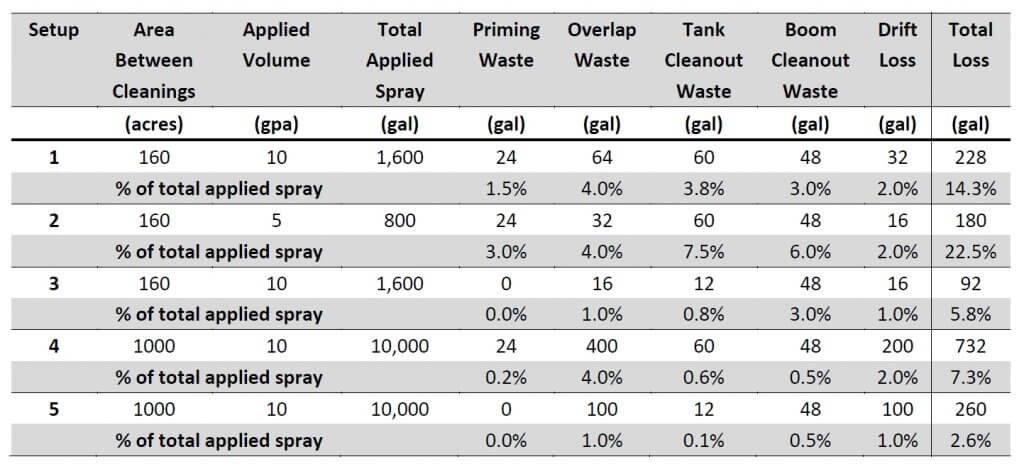
    In the first scenario, we spray just 160 acres at 10 gallons per acre. Priming the boom with 0.4 gallons per foot (allowing for all associated feed lines) consumes 48 gallons, but only wastes half of that, or 1.5% of the total volume needed for the field.

    Four percent overlap consumes another 64 gallons.

    If we have 5% of the tank volume left over, that’s 60 gallons. That amount is so small it doesn’t even register on the sight gauge but nonetheless it represents another 4% of the total sprayed amount.

    Upon cleaning the boom, we need to push the spray mix out of all the  plumbing after the pump, as it has nowhere else to go. At an assumed 0.4 gallons per foot, that’s another 48 gallons or 3%.

    If we add to that a conservative 2% drift loss, it sums to a surprising 14% of the total spray volume. For those that use lower water volumes (the second scenario), the volumetric losses are slightly less, but their proportion is higher, now accounting for 23% (!) of the total spray mix.

    In the third scenario, let’s assume we use a recirculating boom that returns the initial prime volume to the tank, eliminating any waste. We’ll also upgrade to individual nozzle sectional control, reducing overlap to 1%. And, since we want to know exactly what’s left in the tank, let’s invest in an AccuVolume system to precisely monitor tank volume. This allows us to make small rate adjustments up or down to be sure as much of the mixed product goes onto the sprayed swath as possible.
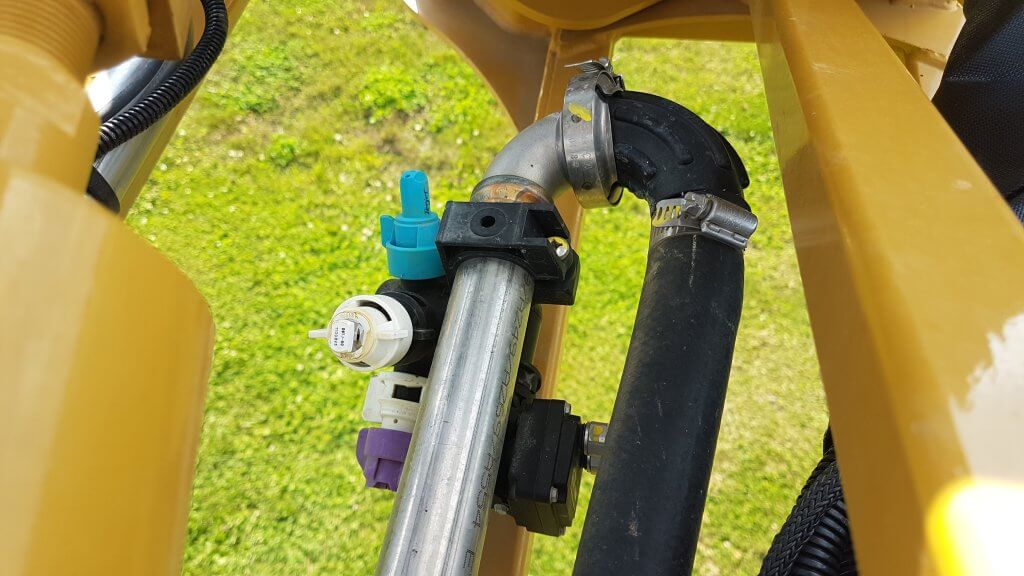
    Recirculating booms allows the spray mix to pass through entire length of boom without being sprayed, saving waste during priming and allowing waste-free boom rinses.

    When the sump begins to empty, we can introduce some water from the clean water tank to push the last of the mix to the boom (a continuous rinse system makes this easy).
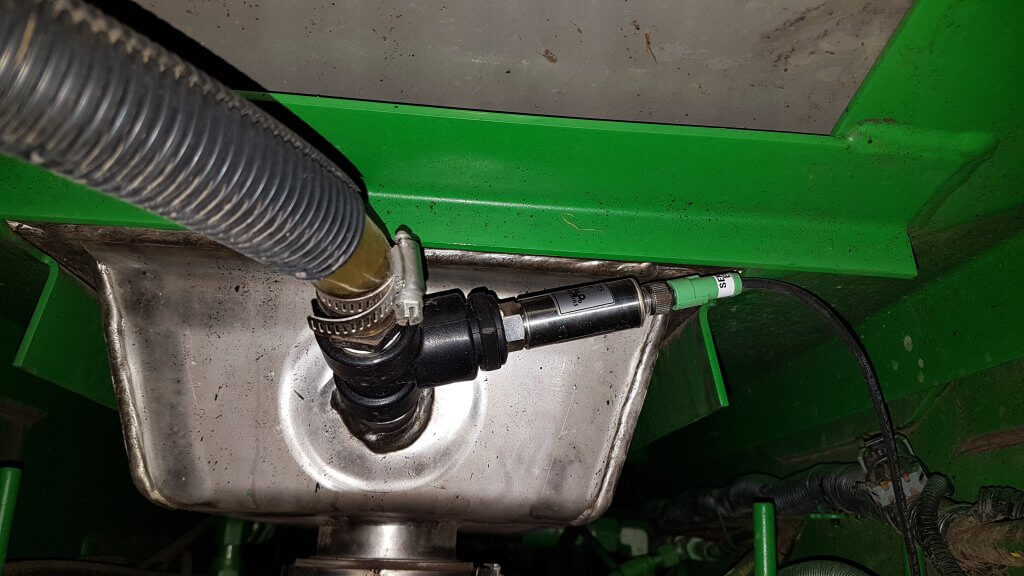
    An AccuVolume sensor shows the exact volume left in the tank at any slope position and with 1 gallon resolution, allowing greater accuracy when filling and emptying.

    We’ll assume our sump waste is now reduced to 12 gallons. We still need to dispose of the content of the boom somehow, so the recirculating boom offers no saving there. But let’s also add better low-drift nozzles to reduce drift by 50% (now 1% total volume). Total loss is now just 6%.
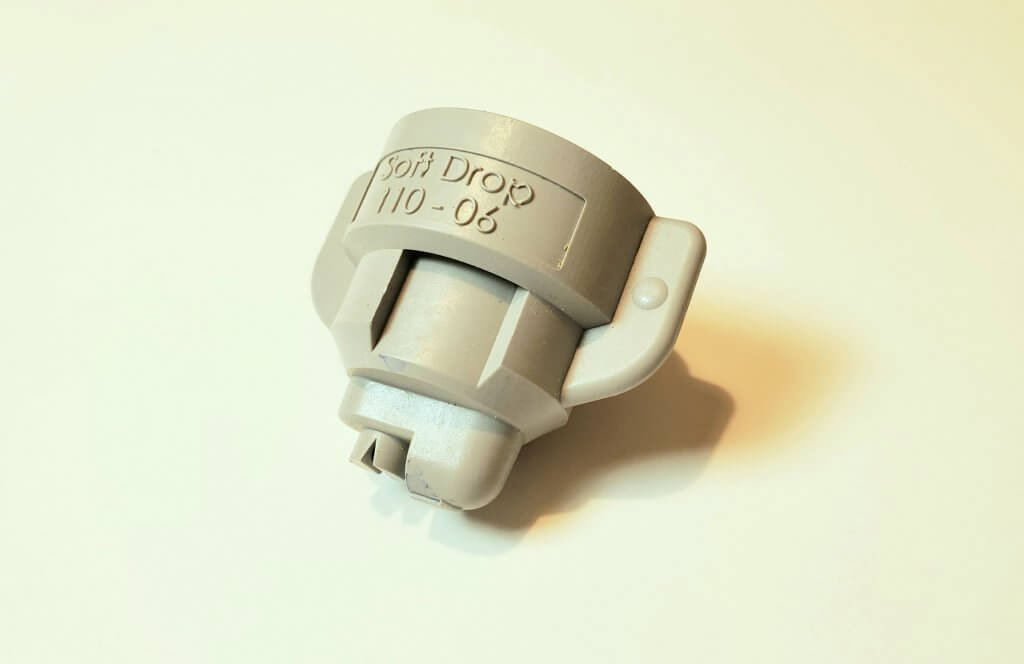
    Low-drift nozzles such as this AirMix (Agrotop) SoftDrop reduce airborne drift by 50 to 90%.

    The last two rows in the table repeat the first and third scenarios for a larger sprayed area (1000 acres) before a tank cleaning is needed. This doesn’t change the magnitude of the volumetric loss, but reduces its proportion. Percent loss is down by a factor of two from the 160 acre interval, to 3 to 7%.

    Experienced operators might cheat the system a bit by mixing the required pesticide with some extra water to make up for the plumbing waste. Doing so prevents extra pesticide from being consumed, but it doesn’t reduce the inherent inefficiency.

    Lessons

    This exercise suggests that waste from spraying is probably higher than we assumed. If we average the scenarios, there is 10 to 15% waste. At, say, $200,000 spent on pesticide for a single spraying season, that’s $20 – $30,000 worth of product and water hauled that ends up where it doesn’t belong. Beyond the time and money, there can also be environmental consequences depending on how that waste is treated.

    There are some things that can be done.

    • Know the exact area of the field to be sprayed.
    • Study your sprayer plumbing and consider improvements such as recirculating booms and continuous cleanout.
    • Improve monitoring of tank content to allow lower remainders.
    • Consider individual nozzle shutoff to improve sectional control. These are part of Pulse Width Modulation (PWM) systems, but can also be achieved with less expensive valves.
    • Plan spray operations to minimize the amount of product changeovers.
    • Consider direct injection.

    The return on investment for plumbing improvements can be high and result in considerable future savings over the life of the sprayer. It’s worth thinking about.

  • The Most Important Developments in Spraying

    The Most Important Developments in Spraying

    Some things have improved a lot. Others have lost ground.

    Some years ago, a few of us weed scientists sat around a table and debated the most important developments in agriculture in our lifetimes. It was a great discussion, and we arrived at a few that included direct seeding (for its soil and moisture conservation as well as improved fertilizer placement), GMO crops (for slowing Group 1 and 2 herbicide resistance), and the abandonment of summer fallow in much of western Canada. Let’s apply this exercise to spray application to see what we come up with.

    What follows are my version of the most important spray technology developments in the last 50 years.

    1. Low-drift Nozzles. Spray drift is the biggest time management challenge and also perhaps the biggest public relations battle. These nozzles reduce drift, making more time available for spraying and doing it safely and effectively.
    2. Rate Controllers. I both love and hate these things. On the one hand, a rate controller matches sprayer output to travel speed. On the other, it has allowed spray pressures to go wherever they need, even beyond the optimum, to match travel speed, and that can lead to nozzle performance issues.
    3. Pulse Width Modulation. The pulsing nozzle fixes the rate controller problem mentioned above. Now, travel speed and pressure are independent. Plus, of course, a whole host of other flow management options, such as turn compensation and rate boosting, become available.
    4. Optical Spot Spraying. Once you see these in action, you can’t go back. Why would you spray a whole field when weeds only cover 10% of it? Products like WEEDit and WeedSeeker are proven green-on-brown performers after years of field success around the world.
    5. GPS Guidance. Some of us grew up with foam or disk markers, others learned to aim for brave family members perched on headlands. Achieving accuracy was stressful, overlap was insurance, and misses were common. The importance of this development is probably under-estimated.
    6. Sectional Control. The ability to adjust the spray width in individual nozzle steps makes sense, and this can come with or without PWM. In fact, that alone can save 5% of an annual chemical bill compared to conventional sections measuring about 10 to 15 feet. And it’s definitely better than the left boom or right boom options from the 70 and 80s.
    7. Operator Comfort and Safety. The refuge of the cab makes longer days bearable for all equipment, but for spraying it dramatically improves safety as well.

    But we’re far from done. We still need work in these areas.

    1. Cleaning and Waste Management. I can’t imagine another industry where managing potentially hazardous leftover materials are left to the discretion and circumstances of the applicator. Let’s make it easy and fast to thoroughly clean the sprayer and safely dispose of leftovers. Step 1 is smarter and simpler plumbing.
    2. Boom Stability. Booms are too high, resulting in more drift and poorer nozzle performance, and adding to operator stress. The sole reason is unsatisfactory levelling. It’s possible to solve this, but it seems to not be a priority.
    3. Weight. The road to productivity seems to be paved with larger, heavier machines. The side effects are fuel consumption, compaction, getting stuck. Let’s get smarter with frame design and logistics and talk acres/h rather than tank capacity and power.
    4. Cost. All farm equipment has seen cost increases that far outstrip inflation or any reasonable accounting of productivity and features. Sprayers lead the way. Yes, it’s possible to spins this as a value proposition. But it shouldn’t be necessary.
    5. Drift Management. Sprayer design continues to ignore drift management. We need sprayers that produce less drift by design, and this requires consideration of tractor unit, wheel, and boom aerodynamics. It’s more than a droplet size issue.
    6. Direct Injection. Although very handy for single product application, the plethora of product formulations and mixes has limited the success of direct injection systems. The complexity of injecting at the nozzle, and the resulting lack of available systems, has stymied some very attractive options, such as site-specific rate or product use.
    7. Ergonomics. If you need training, or to call someone before using your new sprayer for the first time, something’s wrong. Interfaces need to be intuitive and simple. The golden age of spray monitors was the 1980s. Those featured a main power toggle switch, a pump power switch, boom section switches, an agitation switch, and a simple way to enter the important information which was basically desired application volume. The screen can still be pretty, and you can still paint and monitor or tweak all the functions if you like that. But let’s at least have different tiers so beginners can also use the machine. Make interfaces using the philosophy Steve Jobs instilled in his trusted designer Jony Ive with the first iPod: no more than three clicks to achieve any desired outcome.

    A few areas show promise and may suit certain niches.

    1. In-Crop Weed Sensing. The green-on-green sensing that has been made possible by machine learning has shown some encouraging early success. Continuing improvements will eventually bring its reliability to within commercially acceptable standards. There is significant activity below the radar in this area, as all players recognize the enormous upside of a breakthrough.
    2. Autonomy. While dispensing a pesticide adjacent to sensitive areas isn’t exactly the low-hanging fruit of autonomy, such field sprayers will have a fit in the temperate plains of North and South America, Australia, and Asia and may help solve the cost and weight problem.
    3. Drone Application. The rapid pace of advancement in remotely piloted aerial systems, along with a seemingly low barrier to entry of new companies, will put pressure on the industry to make a decision on this alternate application method. If it can be done safely, it will have a dramatic impact.

    If you want to improve your sprayer, don’t ignore the small things you can do in your operation. Although we’re conditioned to look for game-changing technology, the most sustained improvements don’t come from a single innovation, but from a period of persistent evolution. A lot of small improvements add up. Spray application is no different.