Tag: winterize

  • Airblast Spring Start-up and Winterizing

    Airblast Spring Start-up and Winterizing

    Any description of airblast sprayer start-up must, contextually, make assumptions on how it was winterized for long-term storage. This cyclic relationship is why I use a chicken-and-egg title slide when giving this presentation.

    Answer: It was the rooster.

    The inability to describe one process without the other is further complicated by the possibility that the sprayer is brand new and was therefore never winterized. So, what follows is an attempt at a logical sequence of pre-season maintenance activities to restore a winterized sprayer, or initiate a new sprayer.

    New Equipment

    If this is a new sprayer, you have an opportunity to perform some preventative maintenance.
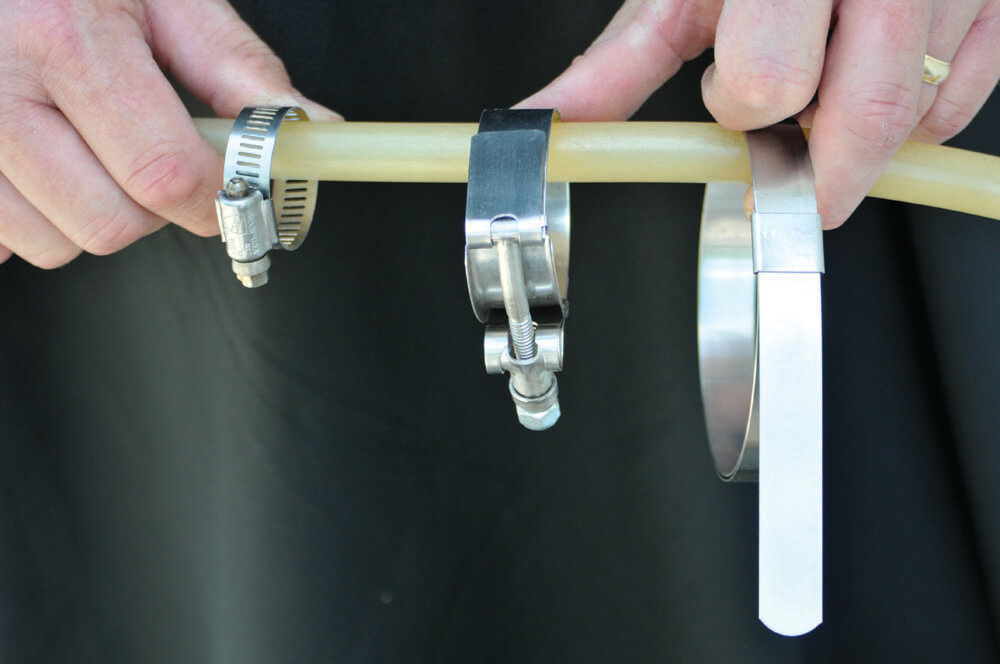
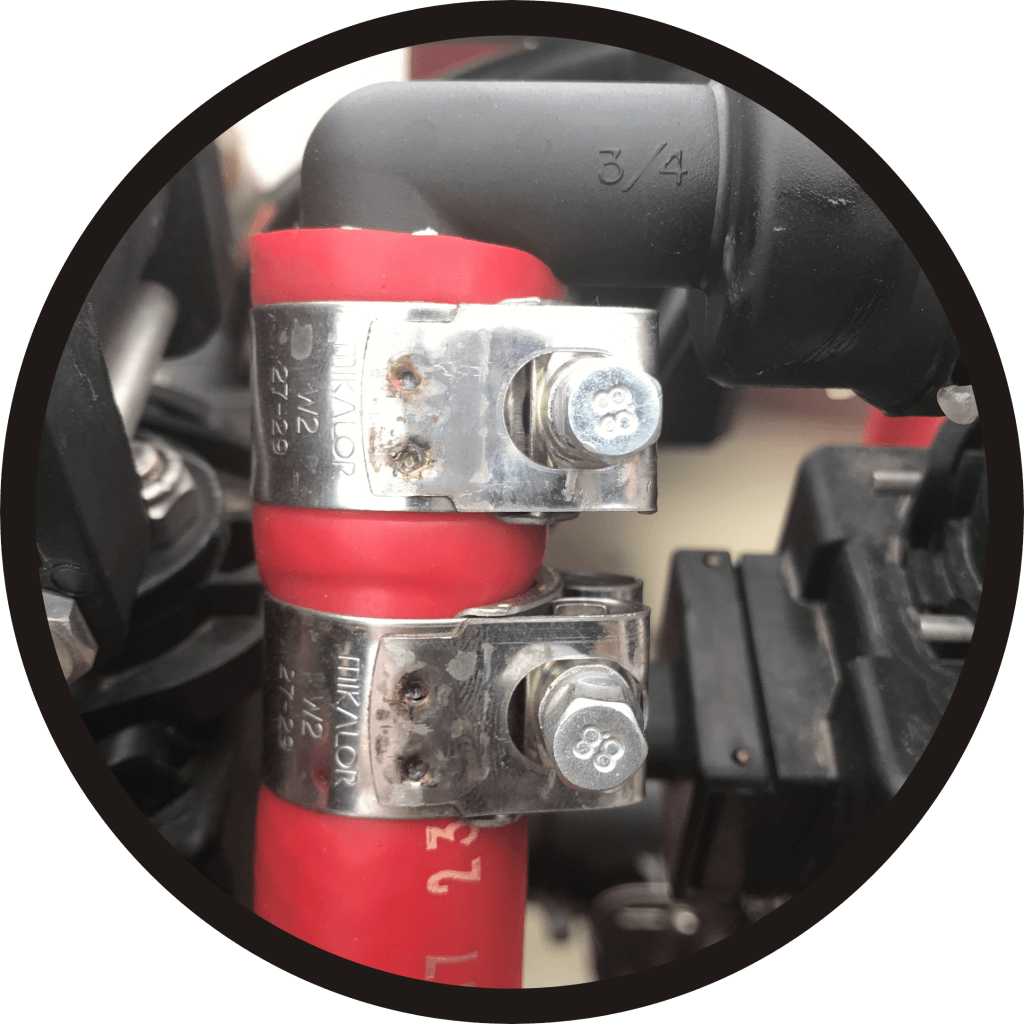
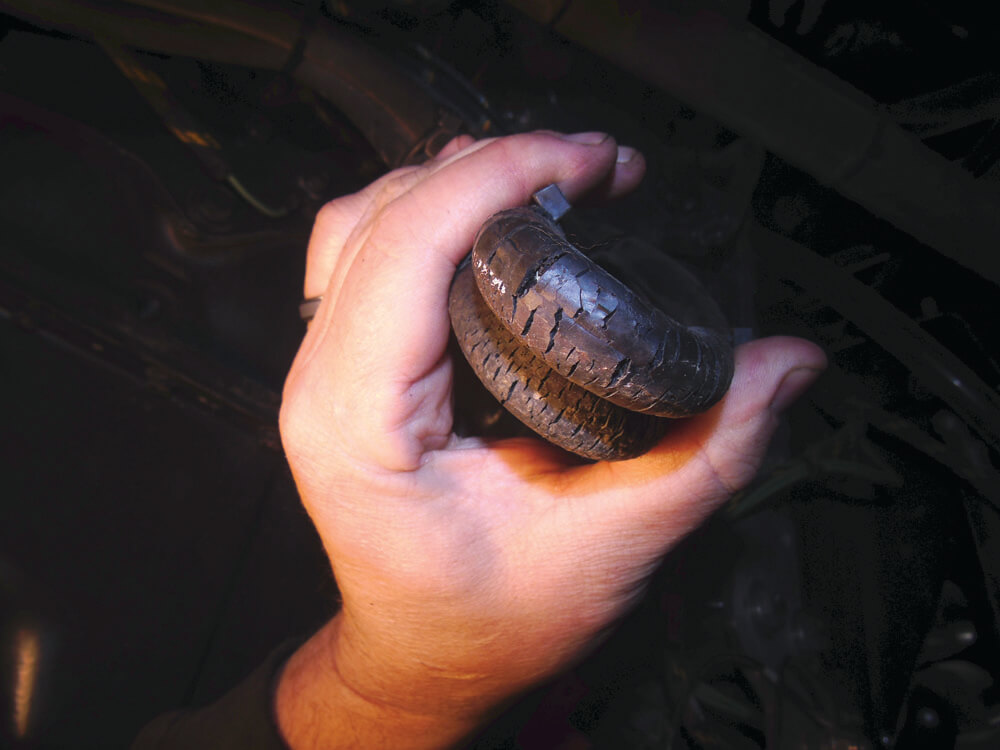
    Loosen, lubricate and re-tighten clamps. Always back gears off before tightening to avoid stretching them. (Image from Purdue Extension publication PPP-121: Preparing Spray Equipment for Winter Storage and Spring Startup)
    Use double clamps on pressurized lines for added safety. Wider clamps are better and T-bolt clamps are better than worm-gear.
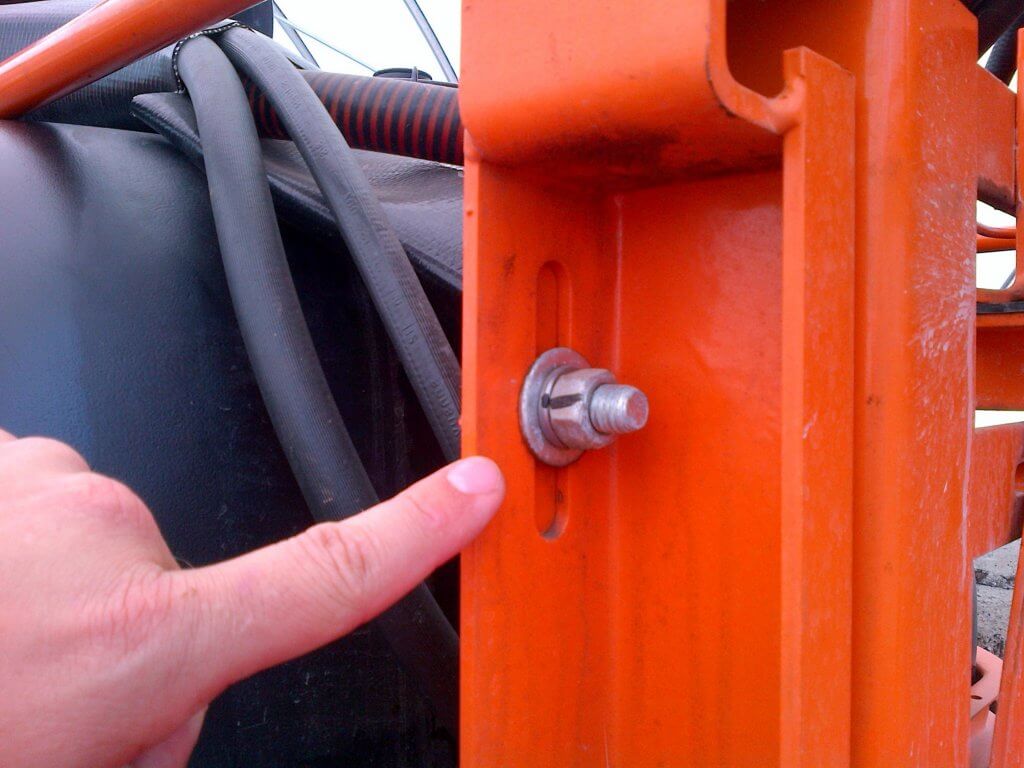
    Put thread release on bolts and re-tighten with a torque wrench (not an impact tool). Use a paint pen to mark nut, washer and bolt for future visual checks. This is called a “Witness Mark”.
    Protect hoses and wires at rub points. Follow hoses and with a paint pen, number the hose-ends and connections for future reference.
    Using a new tractor? You may have to re-calibrate to account for different gear ratios. When hitching a new sprayer, note that the distance from the ball on the drawbar hitch to the tip of the PTO should be ~14″. Don’t exceed maximum working angles for PTO shafts (usually <25 degrees). If your tractor or implement manufacturer says differently, go with that. And get it in writing.

    Winterizing (Long-term storage)

    If you are preparing the sprayer for long-term storage, follow the normal rinsing process, but don’t reinstall strainers and nozzles.
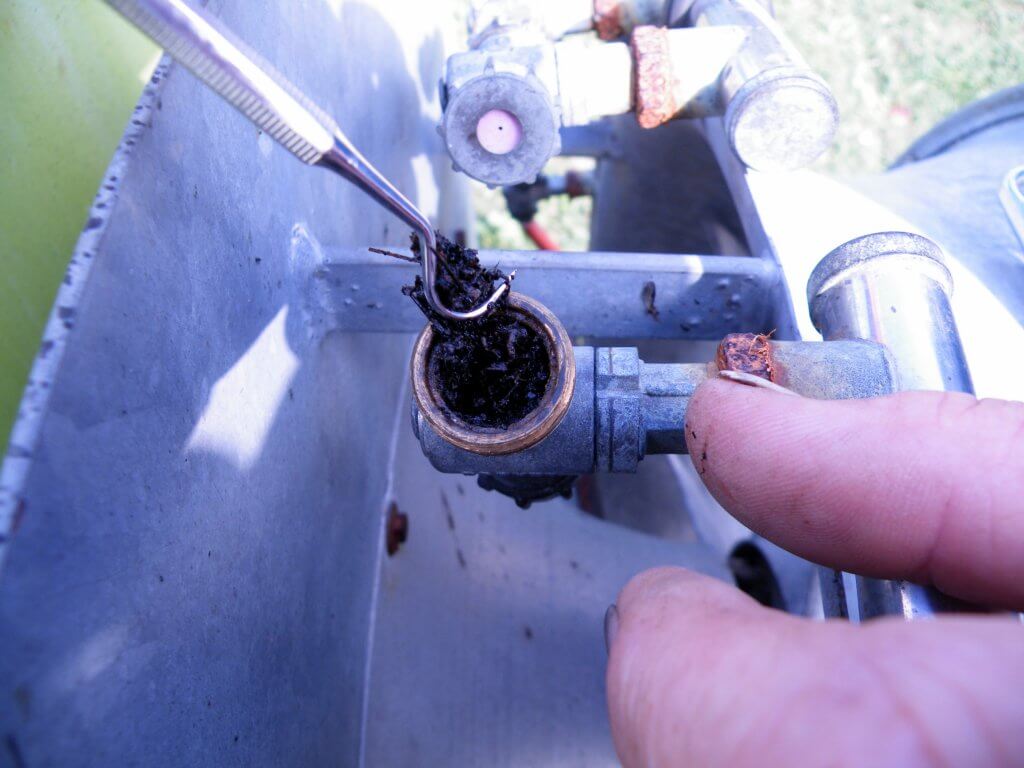
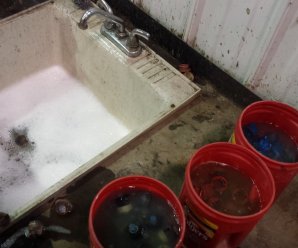
    Look in the nozzle bodies for debris. Discard worn or broken nozzles.
    Soak, scrub, rinse and store nozzles and nozzle strainers. You may replace them once the sprayer is clean, but I prefer to store them separately since they have to come back off during start-up.

    With the agitation on, circulate undiluted plumbing antifreeze (the sprayer already has 5-10 L (1.25-2.5 gallons) of water in the system from the decontamination process) for five minutes and drain it through the plumbing system (not the booms).
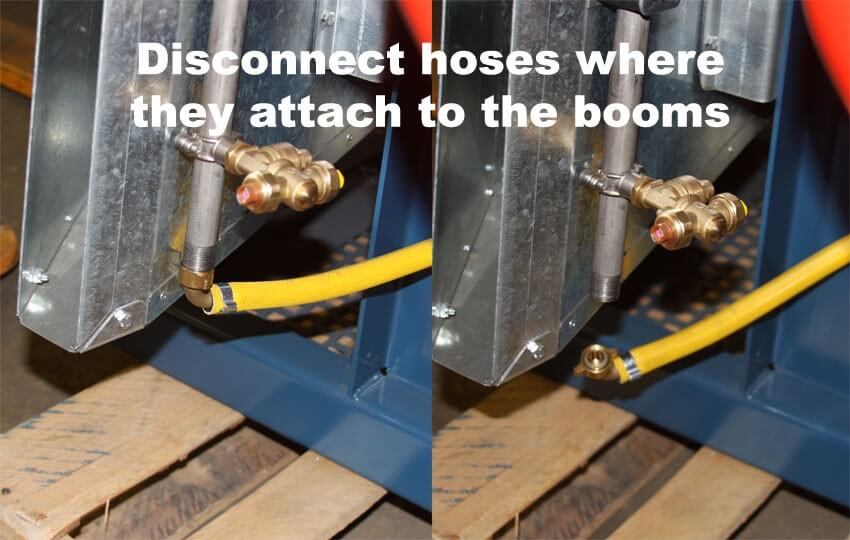
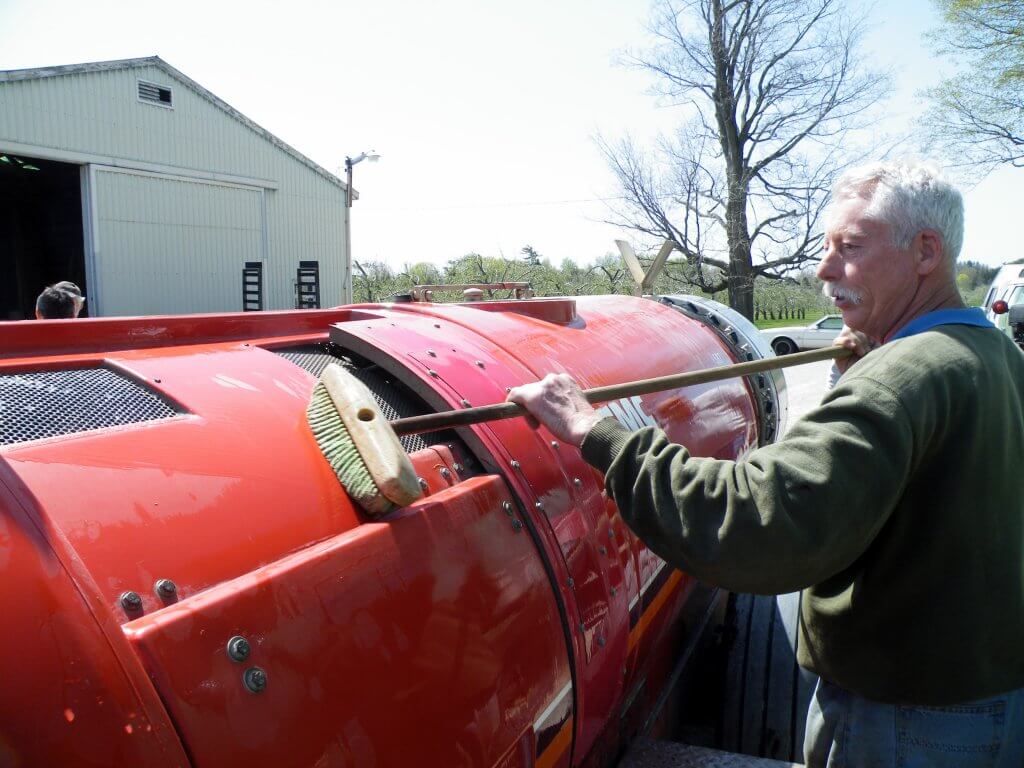
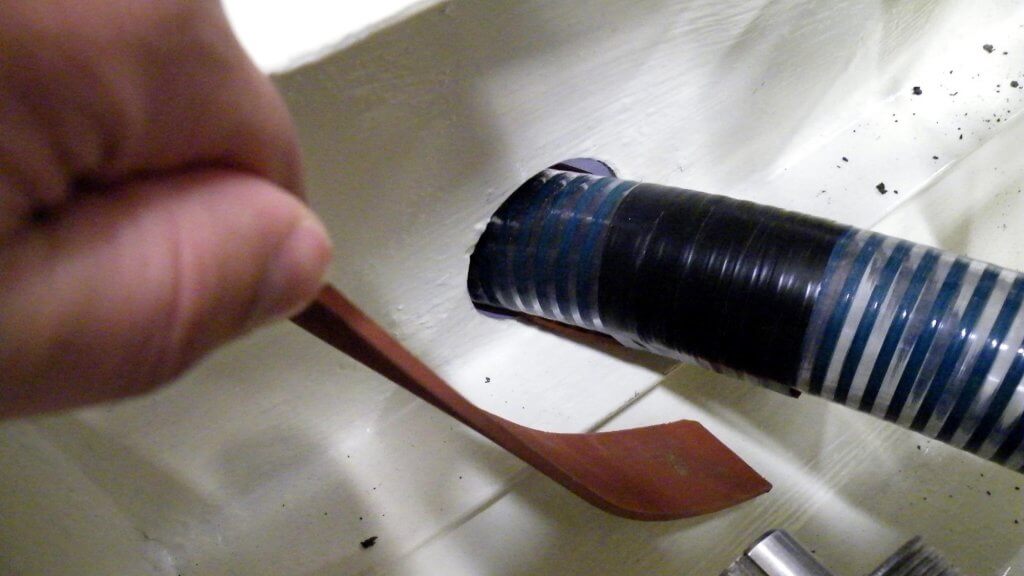
    Disconnect hoses where they attach to the booms and drain as much liquid from the sprayer as possible. (Image from Munckhof Sprayers). Take the time to examine any hose fittings.
    Clean the sprayer (Triple rinse with a detergent) and scrub the exterior. Do not use pressure washers on bearings, fittings, pumps or any lubricated or moving parts.
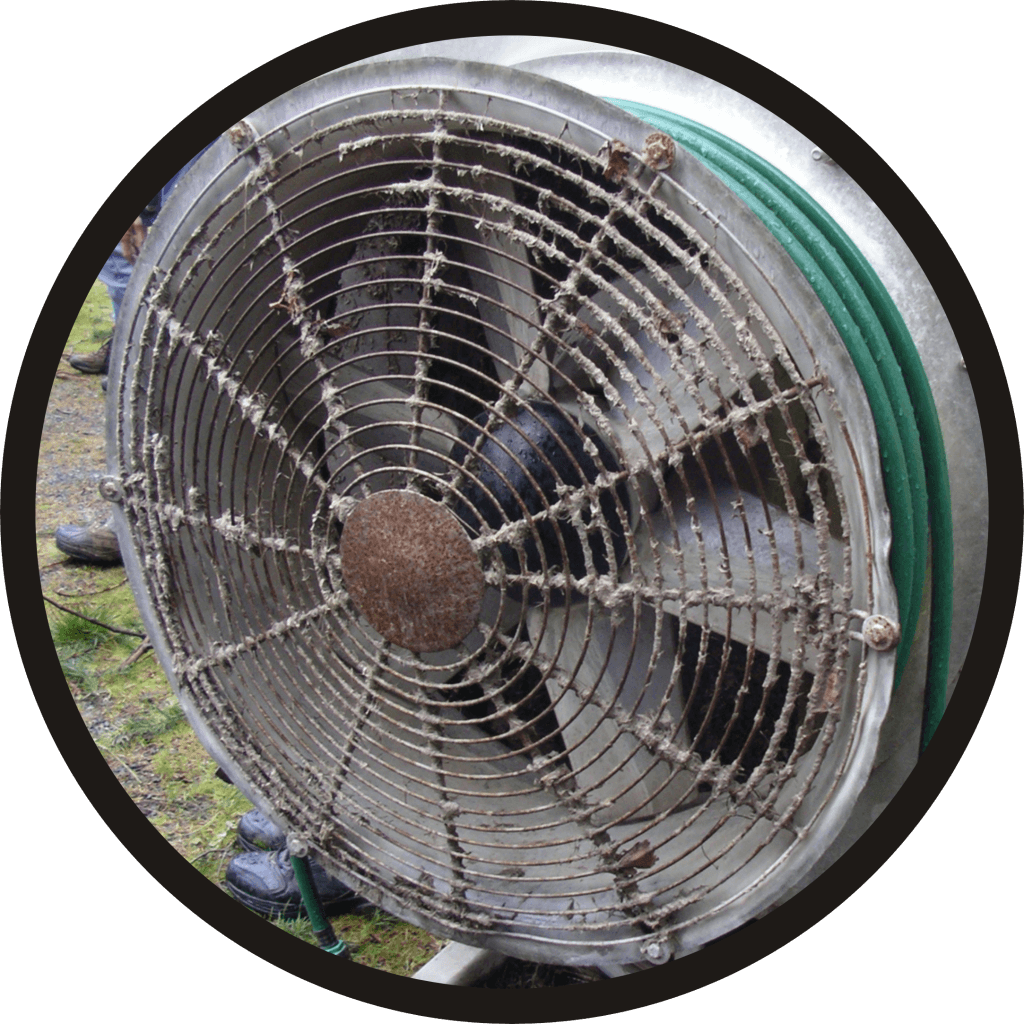
    Examine fan blades for cracks, build-up or nicks that can cause imbalance. Replace (not just repair) punctured entrance grills.
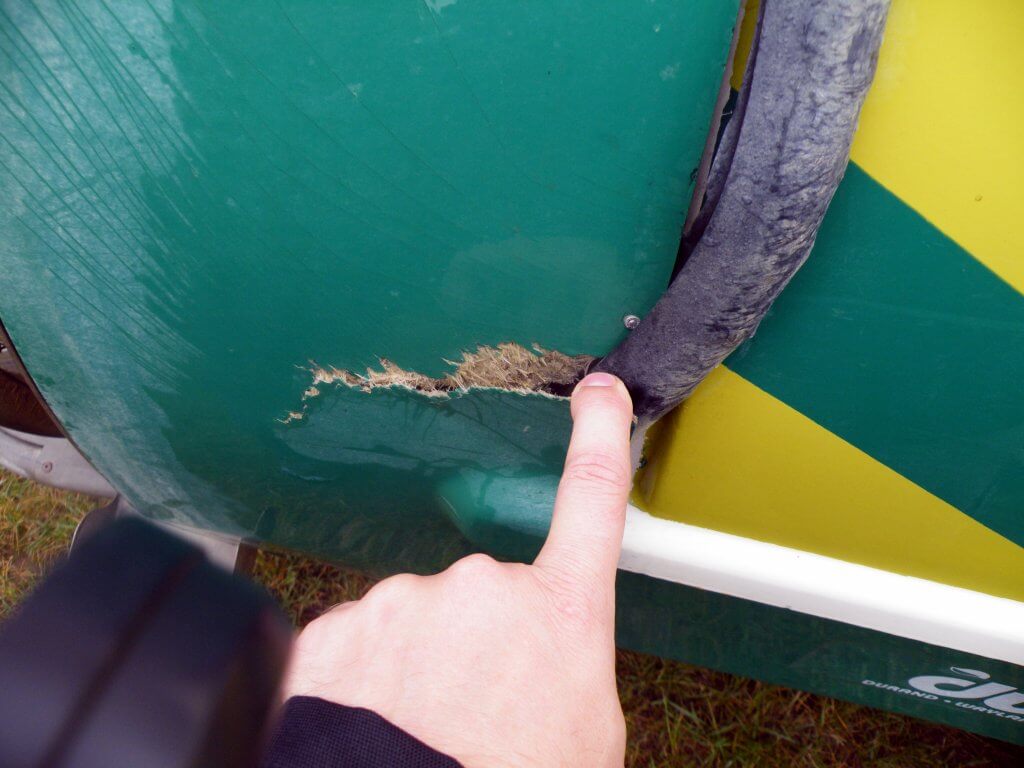
    Don’t ignore tank damage. Poly tanks are prone to sun damage and cracks. Never climb into a tank to repair it. Quite often, replacement is the best option.
    Clean and inspect wheel assemblies. It’s best to do this during winterization to prevent bearing corrosion as the sprayer sits all winter.
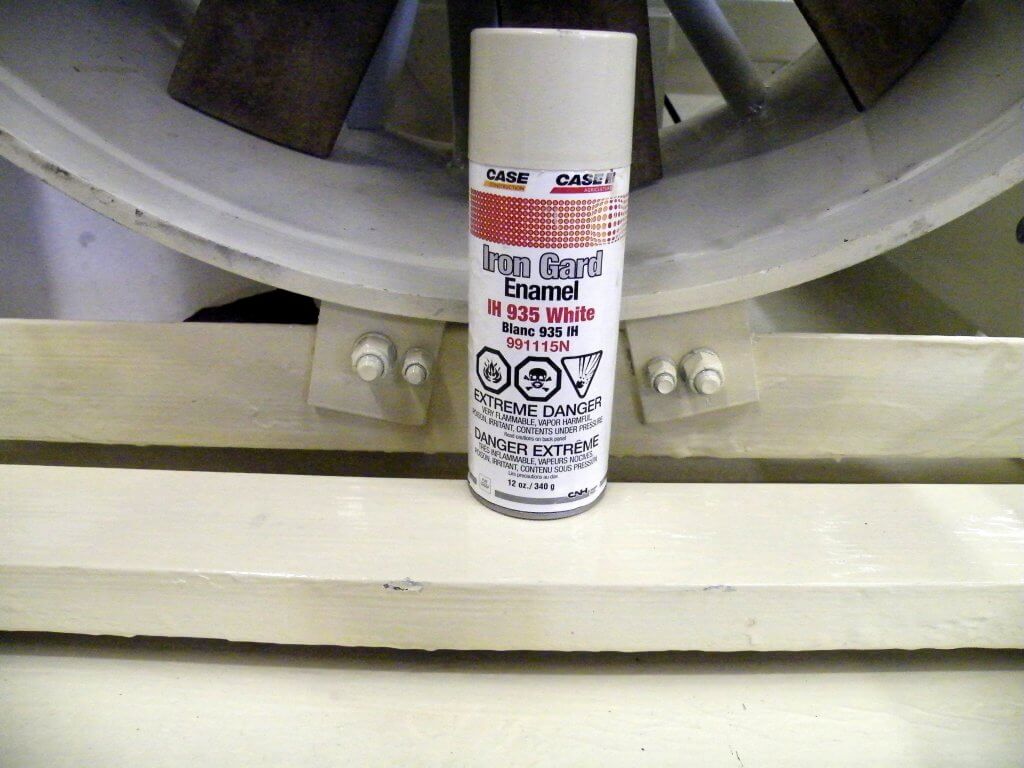
    Remove any rust and repaint (or just touch up). Paint not only looks good, it protects.
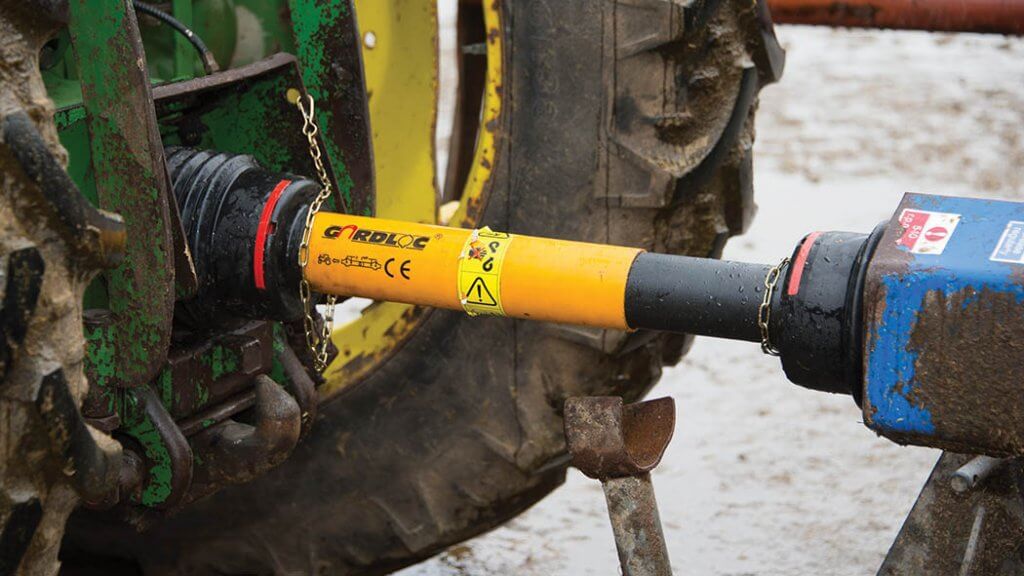
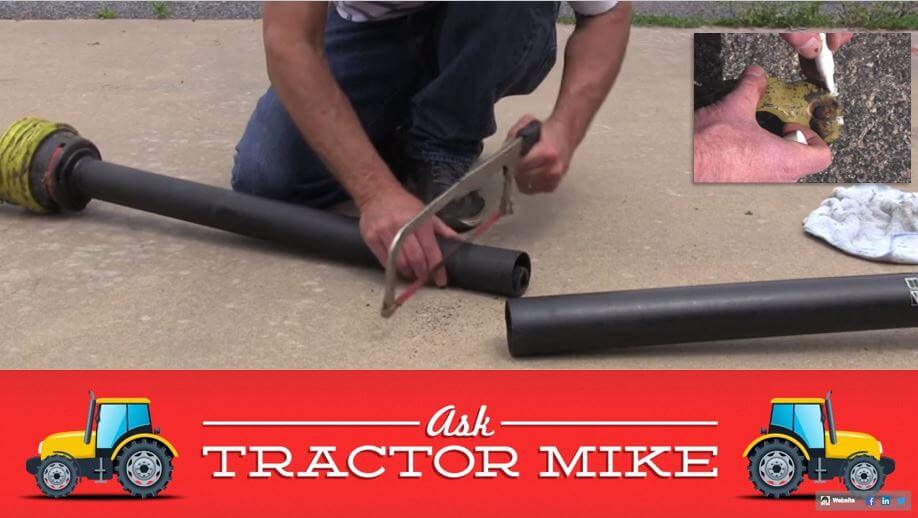
    The excellent YouTube channel Ask Tractor Mike proposed storing the PTO shaft indoors in two pieces, and to cut away a portion of the interior guard to facilitate reassembly later on. Also, use a paint pen to mark the splines on the shaft for easier hook-up (see inset top-right of image).
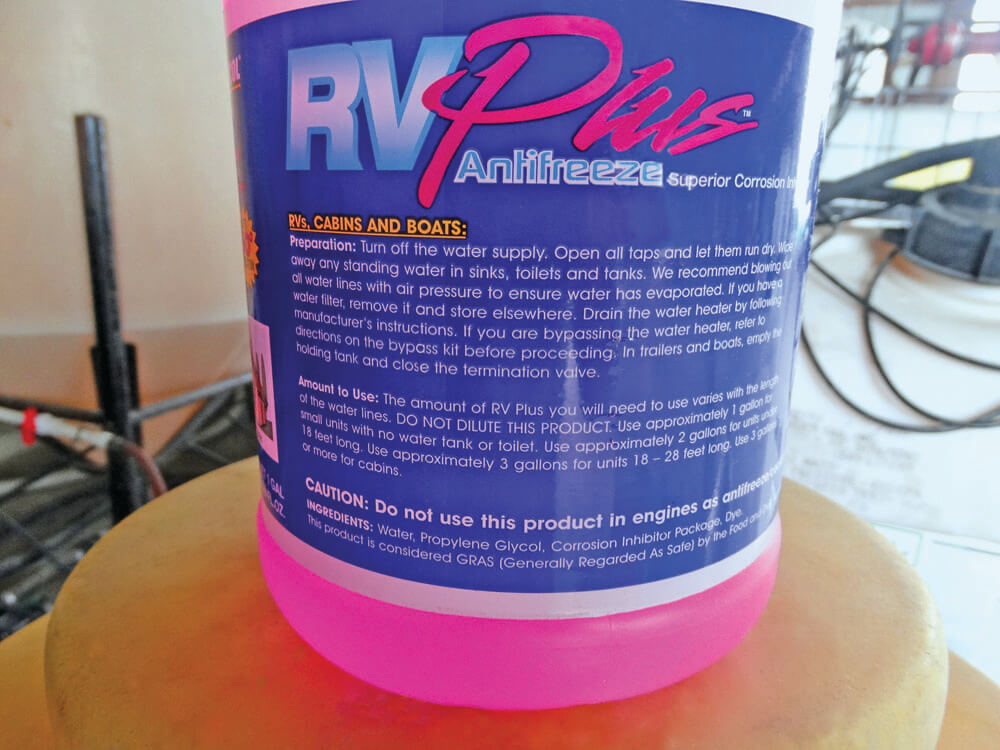
    RV antifreeze is a 50% solution of antifreeze and water with a rust inhibitor. It should not cause phytotoxicity if sprayed or dumped, but be sure to dispose of it away from water sources during start-up. Turn the pump manually to get antifreeze throughout the system. Close the nozzle bodies, loosely fit the tank lid and store indoors. (Image from Purdue Extension publication PPP-121: Preparing Spray Equipment for Winter Storage and Spring Startup).

    Spring Start-up

    Most operators are guilty of neglecting their airblast sprayers and babying their tractors. Sprayers are precision tools that must be kept in good operating order to prevent costly breakdowns, improve their performance, and increase their lifespan.

    Your car is serviced based on distance travelled. Your sprayer should receive regular maintenance based on working hours, per the manufacturer’s recommendations. Daily sprayer inspections are part of regular maintenance since the operator will (hopefully) find small problems before they become big problems.

    Never assume your sprayers is ready to go right out of long-term storage. Parts seize, scale breaks away from surfaces, and small beasties sometimes choose to eat, or make their homes in, cozy sprayers.

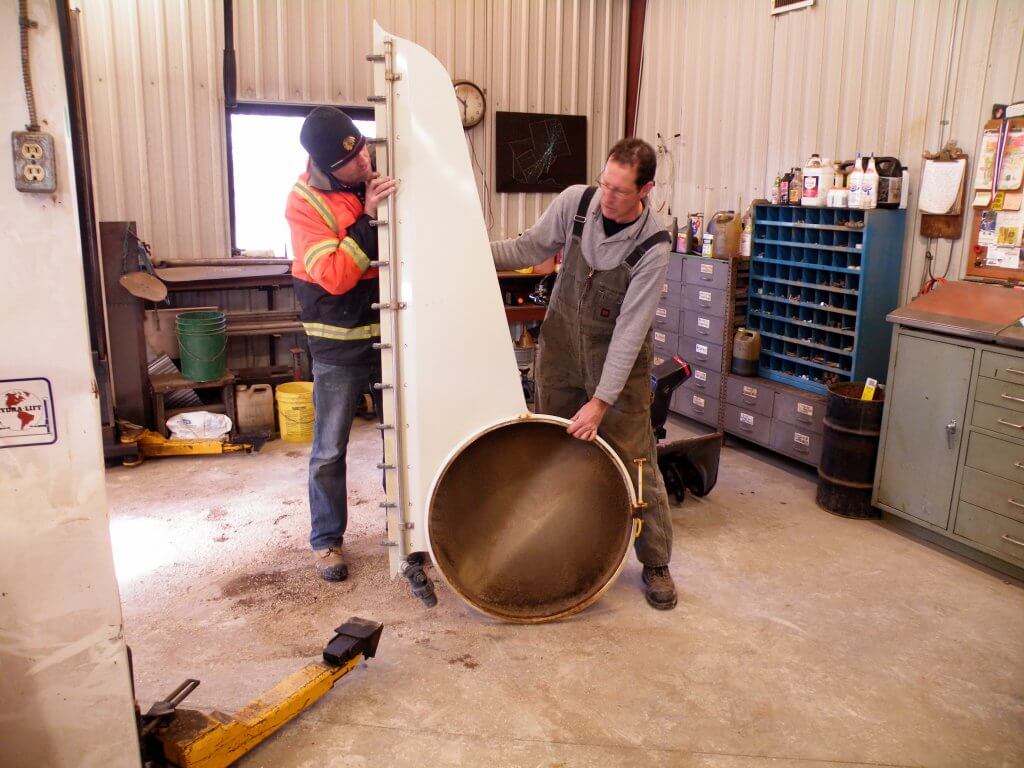
    When planning spring start-up, never assume the winterized sprayer is ready for immediate hook-up. Expect a minimum half day per sprayer.
    Attempting to loosen or shift something that hasn’t moved in several months is risky. Pressure gauges snap off, fittings crack, welds break. Expect the unexpected and either have spare parts on hand, or a plan to get them quickly.
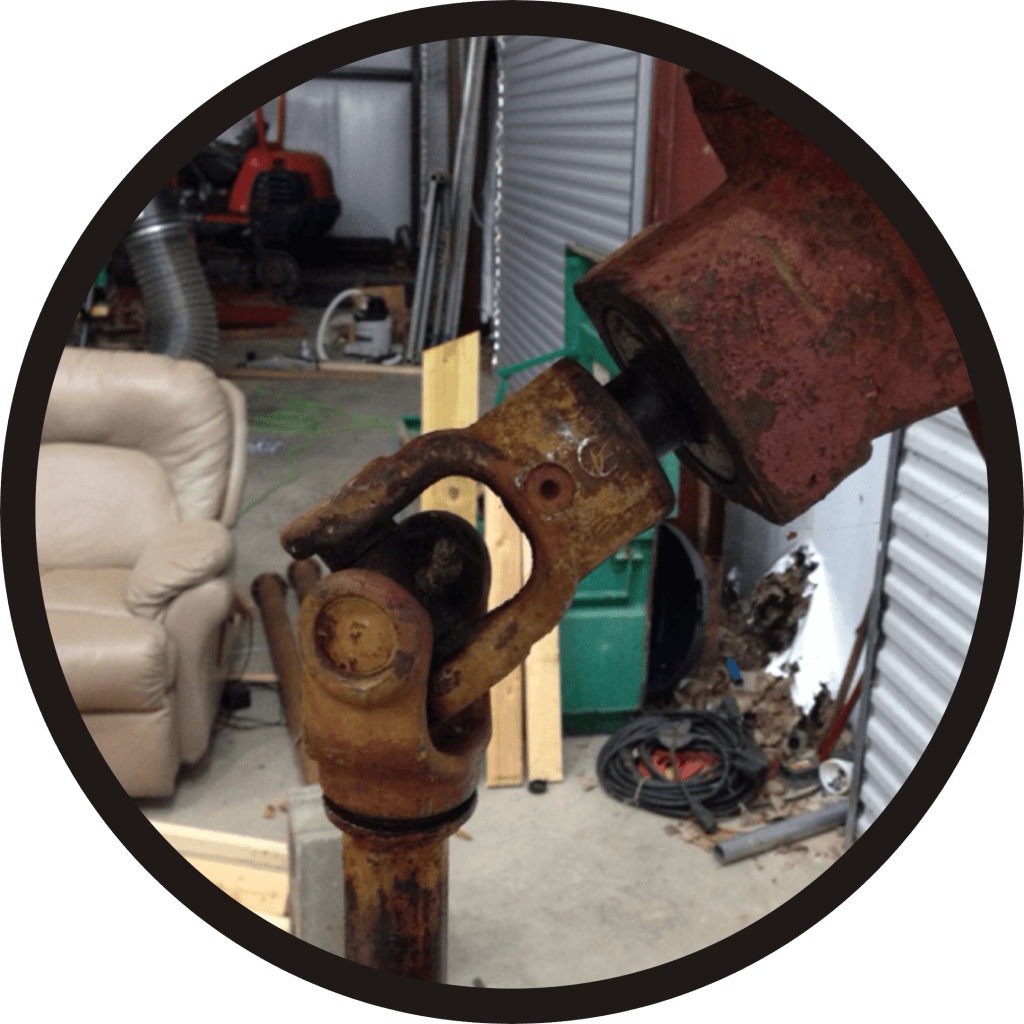
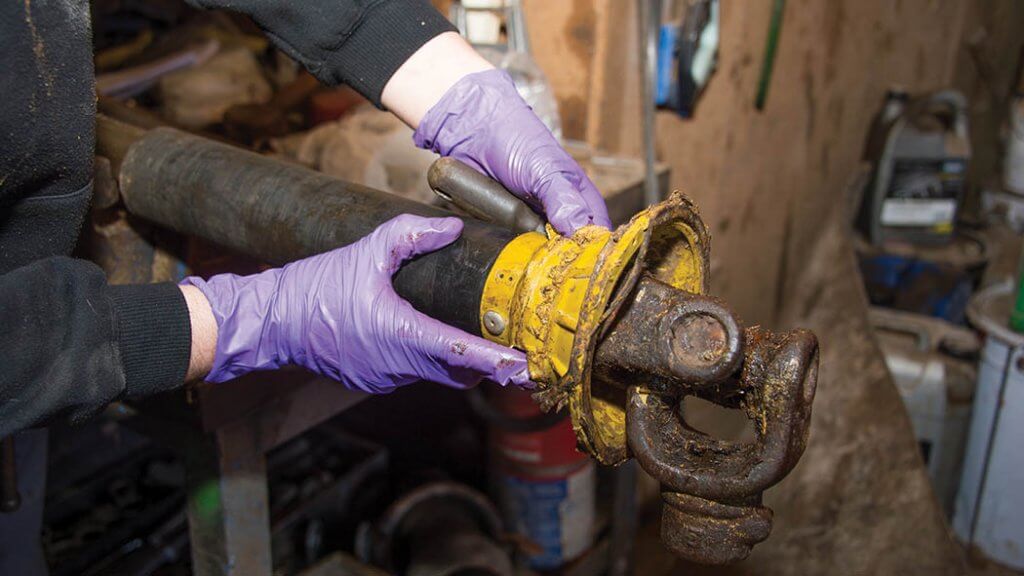
    Parts are most likely to seize during the first spray. Bearings and PTO universal joints, especially.
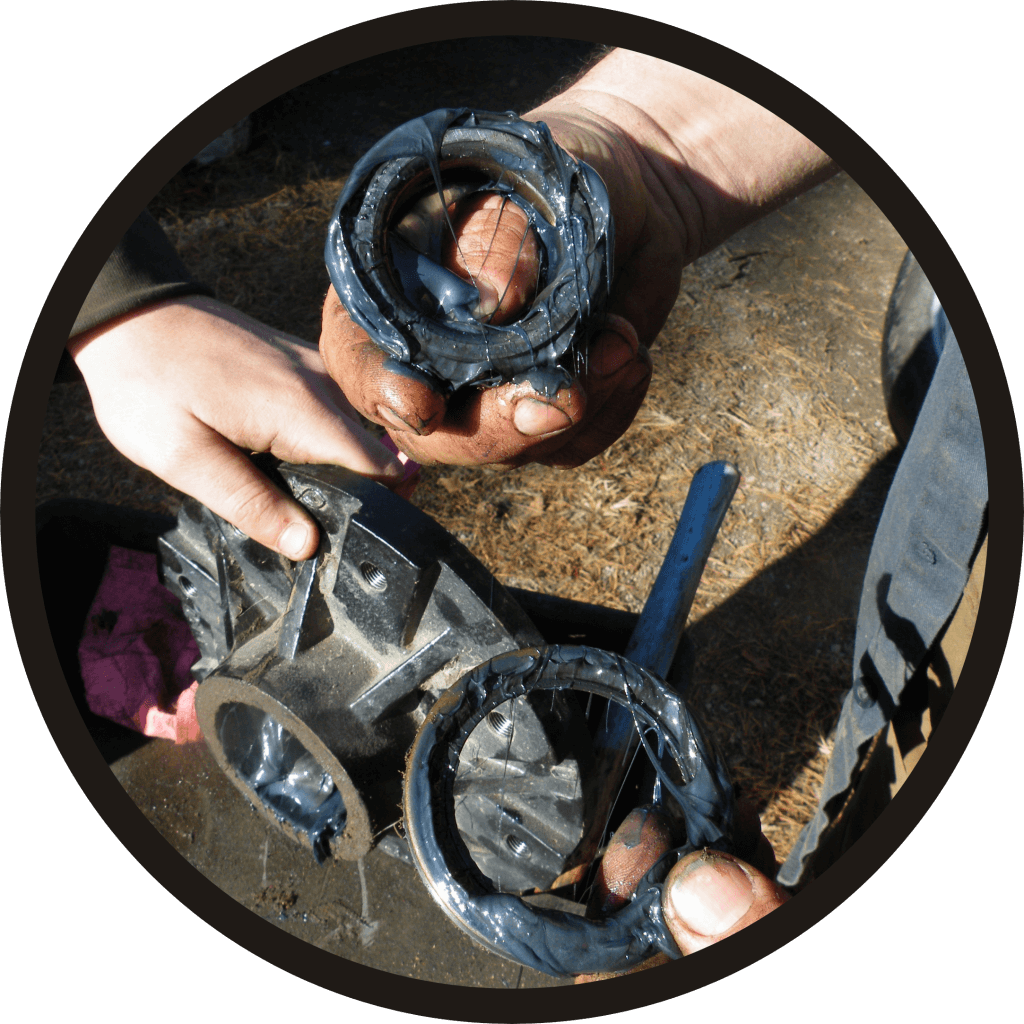
    Start-up is a good time to lubricate parts. Grease the guard ring bearing every 100 hours, the universal joint cross every 25 hours and the shaft and shear bolt regularly.
    Insects, birds and rodents eat, or make homes in, sprayers. Professional rodent bait/traps, steel wool and peppermint oil/gel are possible solutions.
    Check belt tension, alignment and wear. (Image from Purdue Extension publication PPP-121: Preparing Spray Equipment for Winter Storage and Spring Startup).

    Pump specific maintenance is beyond the scope of this article. Hypro recommends changing oil after 40 hours of break-in operation and every 500 hours after that. The diaphragms should be replaced every 1,000 hours. Generally speaking, EPDM (black) diaphragms are a better choice for airblast sprayers, while the Desmopan (amber) diaphragms are really for lawn care sprayers.
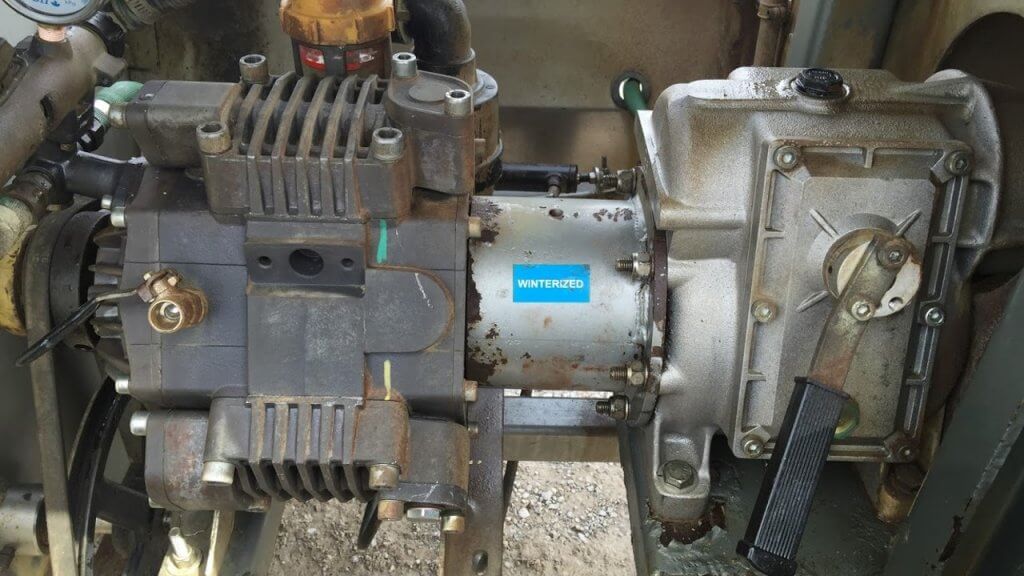
    Pump maintenance is beyond this article, but change the oil every 500 hr or 3 months. Use a paint pen to write on the pump what type of oil it requires, and then date the filters. Note the “winterized” sticker.

    At minimum, check the tire pressure. Hard tires drive faster, but leave compacted ruts. Soft tires drive slower, but disperse weight better. Airblast sprayer wheel assemblies should be cleaned and inspected as part of regular annual maintenance. Wheel bearing maintenance before long-term storage may prevent water from corroding the bearings.
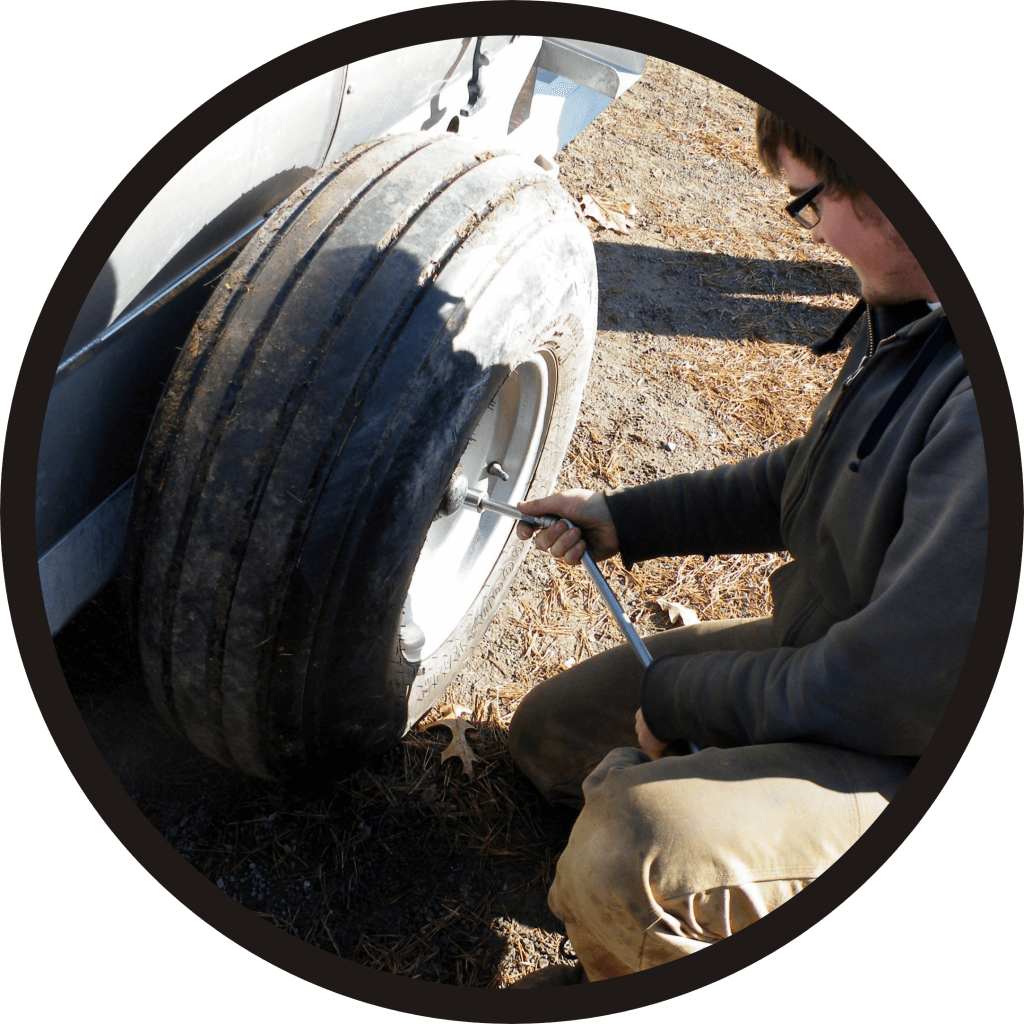
    Ensure tire pressure matches the ideal stamped on the tire. Or, if using less pressure to avoid spring soil compaction, ensure both tires have the same pressure.

    The relief valve on your sprayer should always be in the bypass position during start-up. If your gauge spikes then the gauge may always read high afterwards and should be replaced.
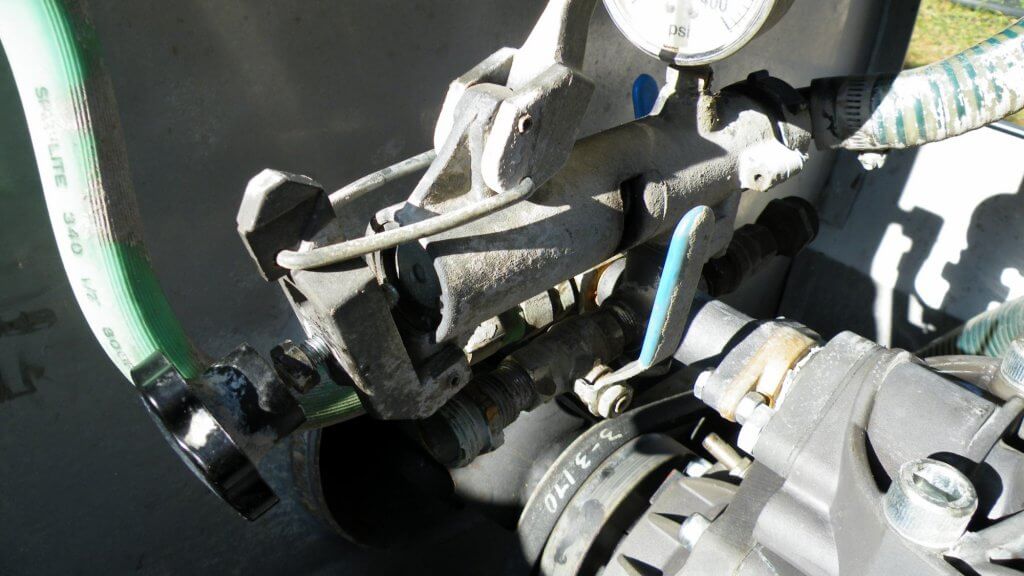
    A reminder to always set the relief valve to the bypass position when starting up the sprayer. This is one reason why pressure gauges spike and can eventually fail.

    Replacing leaking, opaque or inaccurate gauges improves sprayer performance. Be sure to use the oil-filled variety of gauge to eliminate a bouncing needle. You can also get suppressors that fit between the gauge and sprayer to prevent pulsing. Consult the article on testing airblast pressure gauge reliability.
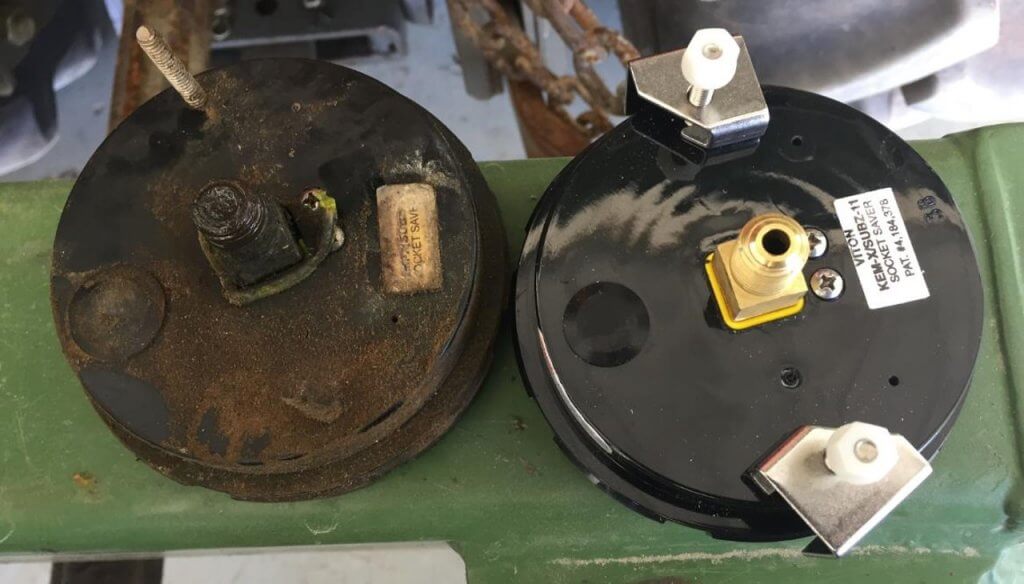
    Use a wrench to turn gauges at the nut. Don’t twist them by hand holding the face. Ensure they are not opaque, leaking, plugged or resting above the zero pin.

    Many spray materials do not mix well and one of the common causes of uneven application is poor agitation. If you find deposits at the sump in the bottom of the sprayer after an application, your agitation is insufficient. For mechanical agitators, check for propeller wear and ensure paddles are secure on the agitator shaft. Learn more about agitation here.

    If the agitator shaft is leaking a little, tighten the packing. The packing gland is a common source of leaks. Keep it properly greased. If a leak occurs you can usually repair it by tightening the bolts on the packing gland by ½ a turn, but if that doesn’t work you may have to remove and repack (or replace) it.
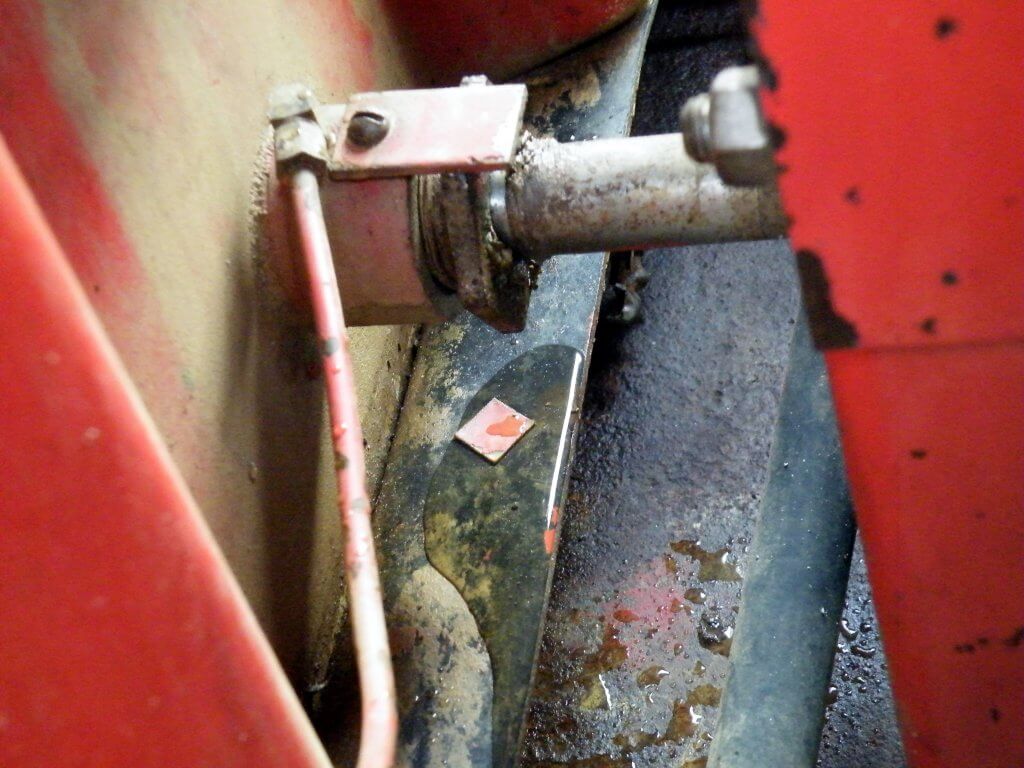
    On sprayers with mechanical agitators, look for prop wear and loose or damaged paddles. Fill the sprayer with water and looks for tank leaks. Tighten the bolts 1/2 turn if the packing gland on the agitator shaft is leaking. You may have to remove and repack the gland if the leak persists.
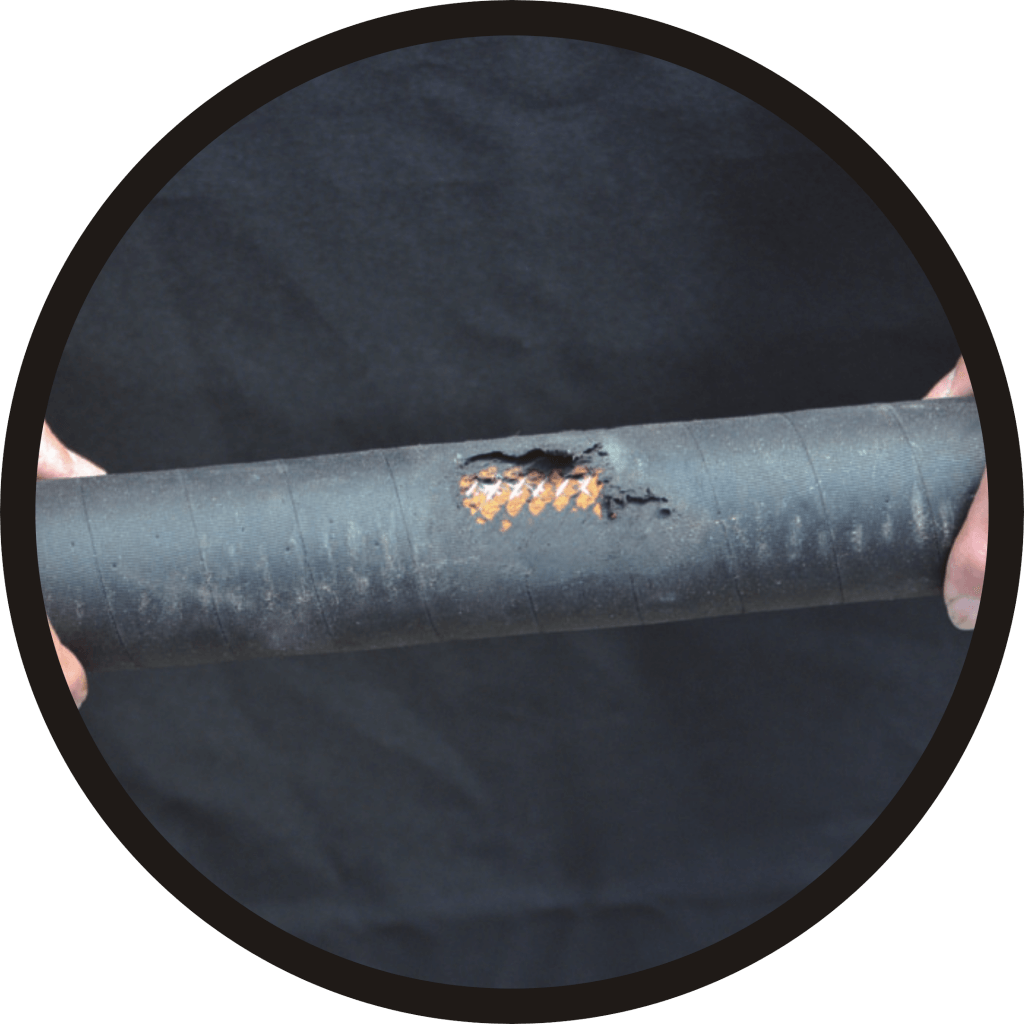
    Look for signs of hose wear and examine the sprayer for leaks while under pressure. Be careful when pressurizing the sprayer for the first time in the spring; this is when lines are likely to come loose or burst. (Image from Purdue Extension publication PPP-121: Preparing Spray Equipment for Winter Storage and Spring Startup).
    Minerals chelate (i.e. scale) more readily on stainless steel than plastic tanks. In either case, the first tank of water and leftover antifreeze should be sprayed from the nozzle bodies with no line or nozzle strainers, and no nozzles. Replace them once the tank is sprayed out.

    The last step is calibrating the sprayer, and that process really depends on your definition. If the preceding steps conflict with those of the manufacturer’s, always follow the manufacturer’s. Do this for reasons of safety and to preserve any warranty.

    Thanks to Fred Whitford (Purdue University), Gail Amos and Mark Ledebuhr (Application Insight LLC) for reviewing the content of this article and for their helpful edits.
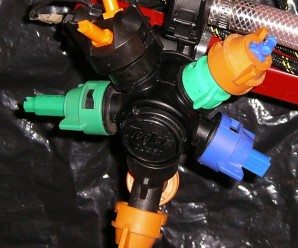
  • Clean Your Nozzles

    Clean Your Nozzles

    When operators winterize their sprayers, they should remove all the tips and store them separately. Many store them in large pails with lids. Calibrating the sprayer just prior to winterizing will indicate if the nozzles should be stored, or replaced. Let’s assume each tip flow rate is within 5% of the average output and no more than 5% more than the manufacturer’s pressure tables. Yes, industry standard is 10%, but I always wonder how the spray quality suffers with that much wear. Nozzles are, comparatively, a cheap replacement and it’s not worth skimping. Learn more how to check nozzle flow rate, here.

    Just like any other part of the sprayer that comes in contact with spray liquid, nozzles (and strainers) should be cleaned regularly. And, just like any other part of the plumbing, the best way to do that is to dilute any residues via a series of rinses. For a more rigorous cleaning, one of the intermediate rinses should include a detergent, and soaking during this step is an excellent practice.

    The orifice of any nozzle is delicate, either machined or molded to exacting standards. Even small changes to the orifice shape results in distorted spray (e.g. spray comes out at undesirable angles), a change to the rate (typically more volume per minute) and a change in the spray quality (typically larger median droplet size). If foreign objects or residues remain in the tips, the subsequent spray job may be less accurate and even damage the tips.

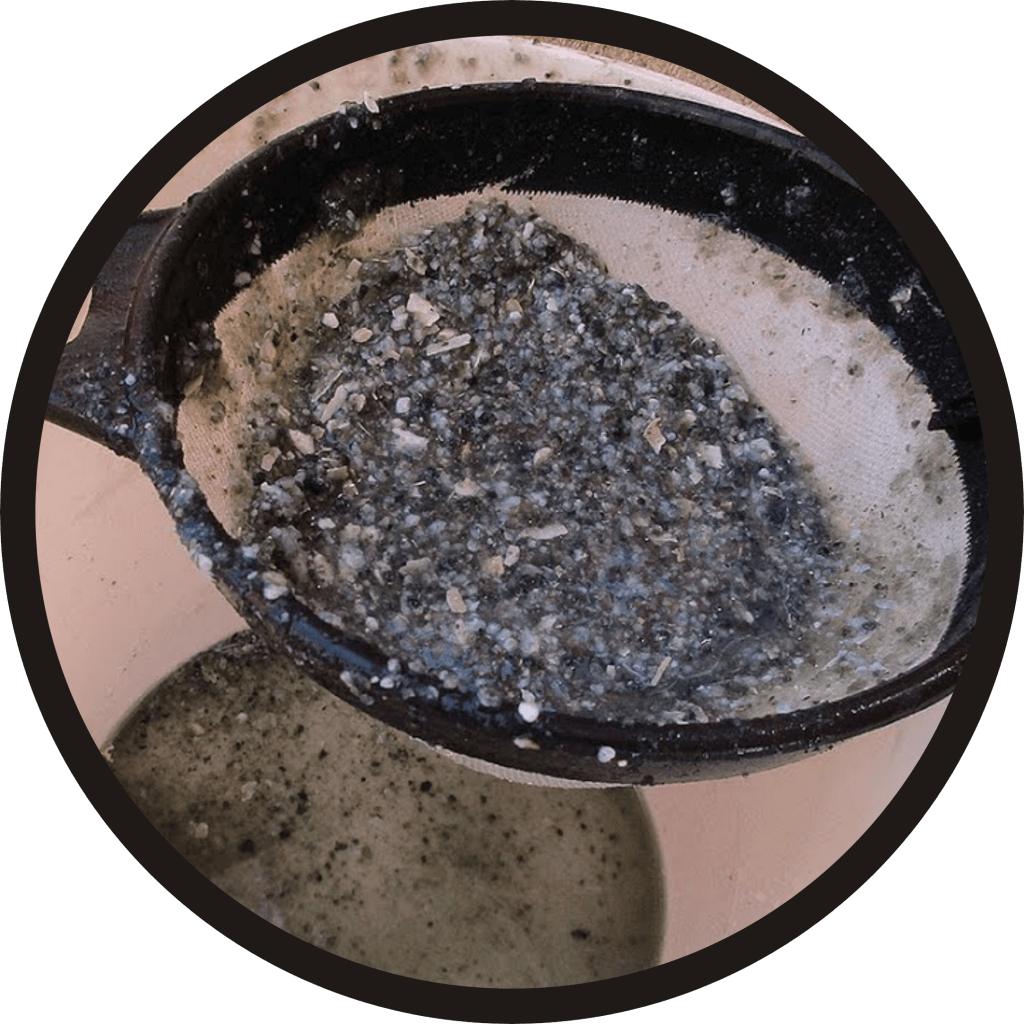
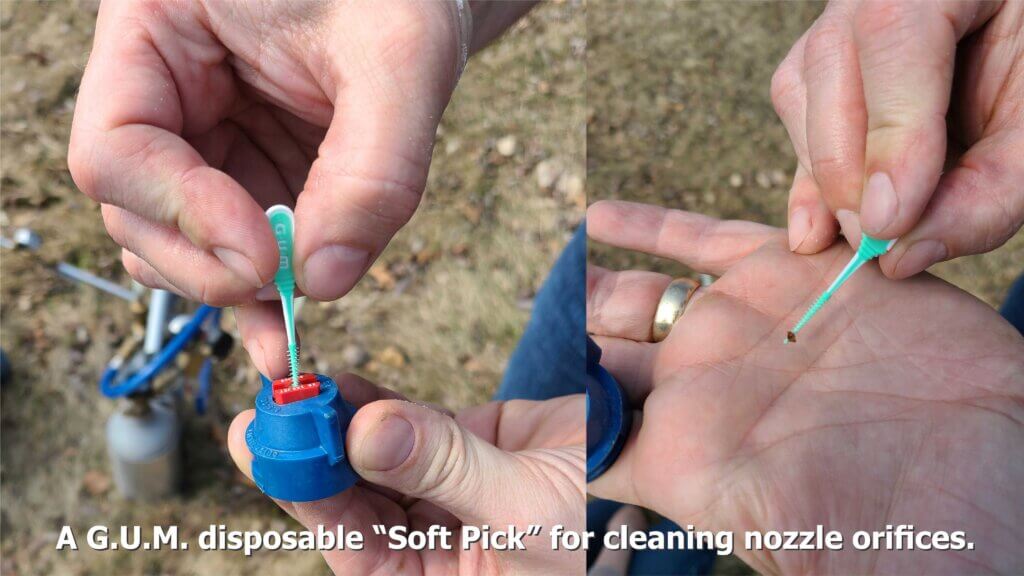
    In the case of air induction nozzles, which are essentially the standard on most boom sprayers, debris and weed seeds can plug the air-intake ports. When that happens, the nozzle will not function as intended. So, while the occasional soaking of nozzles does a great deal of good, they may also have to be scrubbed. Don’t use picks or reamers! There are nozzle cleaning tools out there, but they’re basically toothbrushes so save your old ones (and mark them clearly). Soft bristles are the way to go for removing stubborn residues and cleaning any tip orifices, but we found a nifty new way:

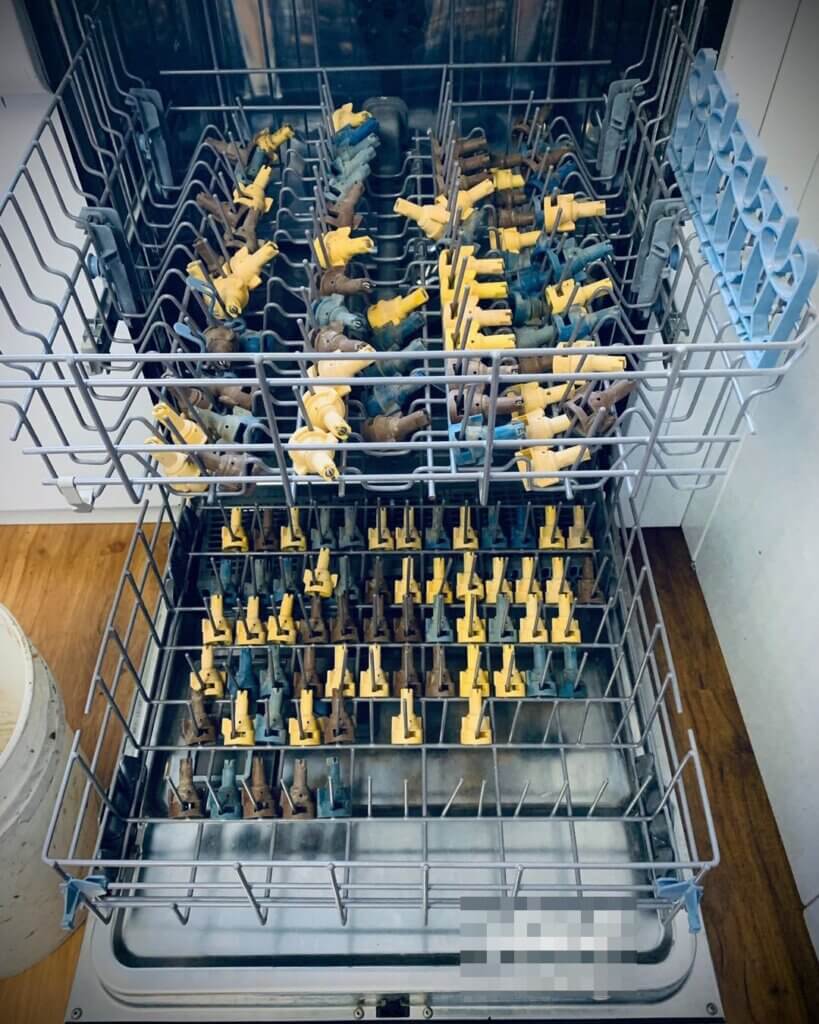
    Occasionally we receive photos like the one below and we’re asked what we think. Well, just the same way we don’t recommend cleaning your sprayer overalls in the family clothes washer, we also don’t recommend the use of dishwashers for nozzles.

    Not a great idea. Certainly not if you intend to ever use this dishwasher for anything else. And where does the rinsate go?

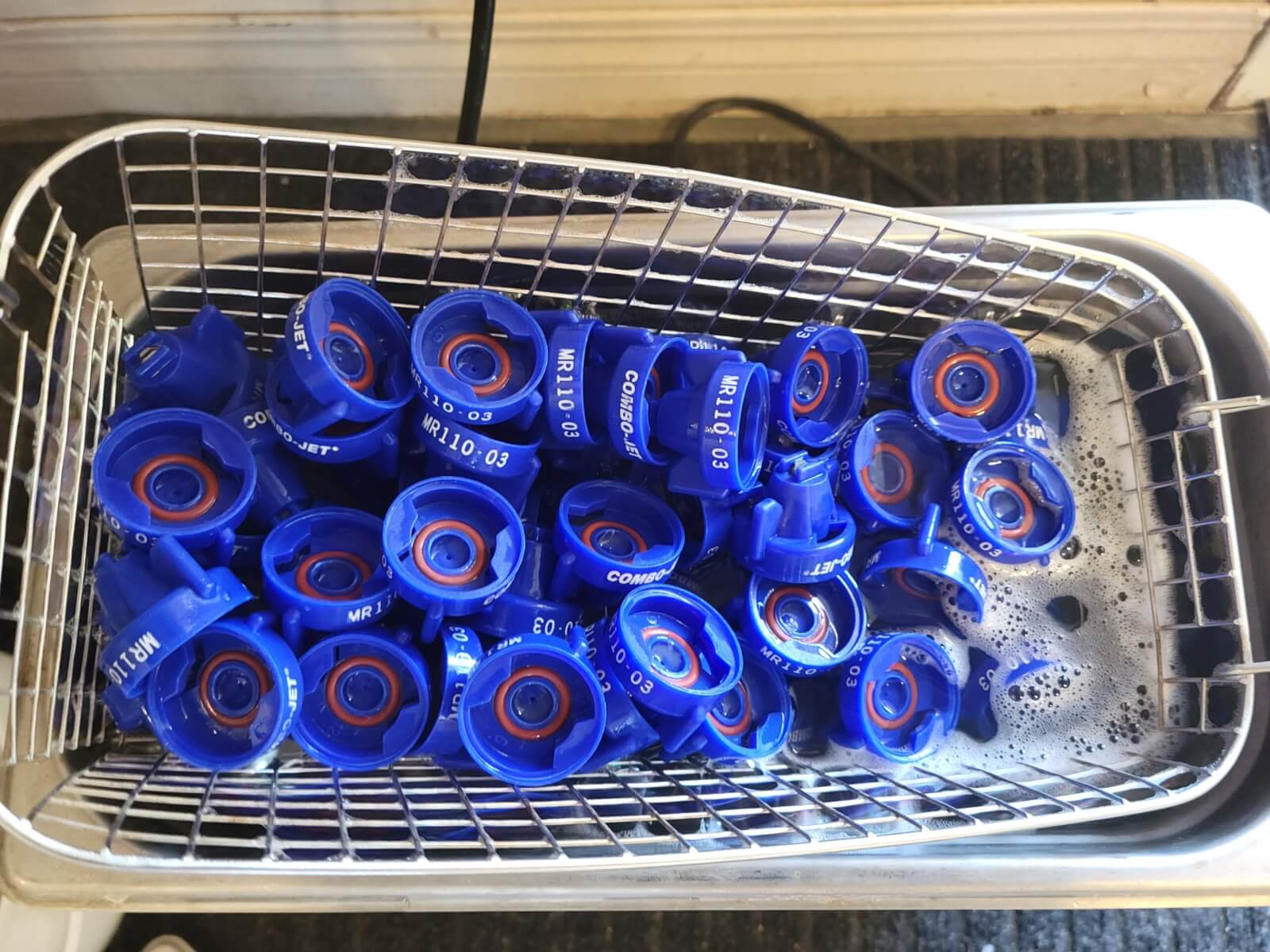
    In an interesting experiment, Lucas Olenick of Wilger tried cleaning tips in a heated ultrasonic cleaner. We haven’t tested this and we don’t know what heat and vibration might do to poly and ceramic components, but surely it’s no more aggressive than hot, soapy water and a bristle brush. Lucas tried several durations with and without detergent and arrived at this recipe:

    “For tough, non-water-soluble pesticides, around 8+ hours in a heated ultra-sonic cleaner with (Dawn) dish soap to come out like brand new. Other solvents may speed this up, but I’d generally suggest against heating solvents at any concentration. For water-soluble pesticides, expect to be within the 3-6+ hours for the first time to be confident enough in not having to flow-test each of the nozzles. With any pesticides, ensure proper care in handling contaminated nozzles and rinsate after cleaning nozzles.”

    The mad genius of Lucas Olenick (@WilgerParts) who used dish detergent and a heated sonic cleaner to unplug tips. Be sure to dispose of rinsate safely. Photo credit: Lucas Olenick.

    Don’t have a heated sonic cleaner? No problem. Here’s a step by step:

    1. Wearing gloves, remove all nozzles, strainers, rubber gaskets and tips from the sprayer.
    2. Put them in a large plastic pail and cover them in warm water. Leave them to soak.
    3. Drain the pail, but be aware that the rinsate will have pesticide residue.
    4. Fill a second pail with a solution of the same commercial detergent used to clean the sprayer.
    5. With a toothbrush, scrub the caps, gaskets, strainers and nozzles to remove any residue. Some nozzles can be pulled apart to expose the mixing chamber and facilitate cleaning.
    6. Once scrubbed, leave all the parts to soak in the detergent solution.
    7. Drain the solution, which will contain trace amounts of pesticide, rinse the parts with water and reassemble the nozzles.

    While you’re at it, drop those filters and scrub them alongside the tips. This may seem extreme, but of all the technology on a sprayer, the nozzle has the biggest impact on the effectiveness and efficiency of the spray job. Take the opportunity over the winter months to clean and inspect the tips for damage so the sprayer is ready for calibration in the spring.

    Soak, scrub, rinse and store nozzles and nozzle strainers. You may replace them once the sprayer is clean, but I prefer to store then separately. Photo credit: Jason Boersma (@RVFBoys), Ridge Valley Farms, Ontario.

    Thanks to Jason Boersma (@RVFBoys), Ridge Valley Farms, Ontario, who sparked this article with his tweet: “Great job for a cold winter day, soak & clean all your tips to be ready for spring also saves on down time!”

  • End of Spraying Season Checklist

    End of Spraying Season Checklist

    It’s finally that time of year to put away the most-used piece of farm equipment, the sprayer. Winterizing is a necessary step, but also an opportunity to do a few extra things.

    Winterizing

    1. Before you do anything, walk around the sprayer and note any telltale signs of liquid leaks. Once washed, the helpful dusty surfaces are gone and slow, chronic leaks may go unnoticed.
    2. Now it’s OK to clean and rinse the sprayer tank and wash the sprayer exterior.
    3. Drain any remaining water from the product and the rinse tanks. These remainders will cause unwanted dilution of the antifreeze. After you drain filter housings, inspect and clean filters.
    4. Choose your anti-freeze. Automotive anti-freeze works, but’s it’s toxic and you can’t spray or drain it on the ground. Liquid fertilizer is sometimes used, but it’s corrosive, crystallizes when cold, and is not recommended. The best product is RV Antifreeze. It’s friendly to rubber and plastic, considered non-toxic, and can protect down to the coldest temperatures. Some dealers carry specific sprayer antifreeze. Don’t use fertilizer (e.g. 28) to winterize – especially with PWM systems.
    5. Add between 25 and 50 gallons of antifreeze to the product tank, or if you have one, to the clean water tank. Most larger sprayers need at least 25 gallons just to prime the plumbing.
    6. If you have a rinse tank, start a normal rinse procedure. Run the product pump, drawing from the rinse tank and pushing the material through the wash down nozzles into the product tank. Once the rinse introduction is complete, an automatic rinse procedure may subsequently open various lines leading to the tank as it swirls the rinse solution through the tank. Familiarize yourself with the specifics of that process.
    7. If rinsing valves are manually controlled, once the antifreeze is in the product tank, run the pump, drawing from the tank and circulating back to the tank via agitation. If you have any other bypass lines, such as sparge, make sure the valve is opened. Run for two to three minutes.
    8. If you have an on-sprayer eductor system, run the antifreeze past it and activate the eductor wash process.
    9. Now, it’s time to push the antifreeze to the boom. Treat this like a boom cleaning, making sure the antifreeze gets to each nozzle body. If you have high- and low-flow options, open them to ensure the bypass gets the antifreeze.
    10. Activate one boom section at a time and ensure all nozzles have received the antifreeze. Open nozzle end caps and allow the antifreeze the push out the water that is trapped there. It helps if you first purge the system with compressed air, then you don’t need to wait for the clear water to gradually change colour as the antifreeze arrives.
    11. For extra points, rotate the nozzles through each position. As with cleaning or servicing, a remote-control boom section controller is invaluable here.
    12. Remember to activate the fence row nozzles if you have any. These usually have their own dedicated feed line coming off the outer boom section.
    13. If you filled your anti-freeze directly into the rinse tank, briefly open the rinse and product tank fill valves to allow anti-freeze to push out any water. Don’t forget the front fill line.
    14. It’s OK to leave any leftover antifreeze in the tank. Next spring, collect it for re-use in the fall. You’ll still need more but this saves you some.
    15. Don’t forget to also winterize your spray tender and any other transfer pumps.
    16. It’s always a good idea to grease fittings after equipment is washed, to displace any water that got in, and to lubricate other moving parts that should be protected from corrosion.

    Inspecting and Reflecting

    You’re going to be looking closely at a clean sprayer, and this is a good time to spend a few extra moments to ponder the big picture. But first:

    1. Inspect the full length of all hoses. Look for kinks, rubbing, small leaks, loose or defective clamps, valves, nozzle bodies. Tighten what’s loose, replace what’s worn.
    2. Check cabin air filter service interval. Most new sprayers have activated carbon filtration that requires regular replacement. Activated carbon starts deteriorating with any air contact, so if you get a new one, leave it wrapped in its plastic until you need it.
    3. Download or record sprayer performance data. How many engine and spraying hours? How many acres? How much water? A typical sprayer may calculate your acres per hour, but uses spraying hours only which paints a rosy picture. Do the calculation using gross engine hours to get a better idea of time lost to idling, transporting. Compare to previous year, perhaps set some goals.
    4. Check with the dealer to make sure you’ve got the latest controller software version. Many systems get an upgrade during the off-season, so check back in the spring.
    5. Remove the flow meter from the system and ensure it runs free. Do not use compressed air to run the impeller, this can ruin it. Simply blow on it and ensure it runs freely. This is an important part of the sprayer, so some people store it separately over winter. Did it provide accurate information?
    6. Top up the fuel tank to prevent condensation.
    7. Don’t forget to mouse-and bird-proof.

    Now:

    1. Think back on the season. What went well? What went poorly? What repairs were needed? Which ones did you put off? Are you happy with your procedures for filling and cleaning? Did you hear or read about improvements that seem interesting? Reminisce by reading the notes you wrote on your cab windows.
    2. Make a list of the improvements that would address the main issues you came up with during your reflection. Is it time for a better filling setup? Do you need a whole tender system, or just an upgraded fill pump or a better inductor? Is it time to add a continuous rinse system?

    Replacements and Improvements

    1. Some sprayer components simply wear out and need regular replacement. A rule of thumb for sprayer nozzles is about 30,000 acres for an average sprayer speed and boom width. But before you buy, make sure you know what you need. Were you happy with the spray performance? Did you have more drift than you wanted, or poor coverage? As our cropping systems change, we may need different nozzles to suit the purpose. Now is the time to think about that very coarse low-drift nozzle that would have allowed you to get the spray on before the rain that delayed you for 3 days. Or the higher volume spray that would have done a better job with desiccating the tall canola crop, speeding up harvest. Or the finer spray that works better with the contact products you need to manage resistance.
    2. Pumps can also wear. An impeller replacement can revitalize a centrifugal pump and give back more pressure and flow. Or a new pump with run-dry seals can avoid downtime from a pump failure in the middle of a good stretch of weather.
    3. We still see plastic boom lines on some sprayers. Replacing them with stainless steel eliminates warped lines and makes spray patterns more accurate, improves cleanout, and adds sparkle.
    4. A wider boom can dramatically increase productivity. After-market booms are available in 135′ and larger widths. Aluminum construction keeps them light, and corrosion-free.
    5. Pulse Width Modulation (PWM) can be retrofitted on any sprayer. This will offer improved sectional control resolution, turn compensation, and better droplet size control.
    6. Spot spraying can be added to any sprayer, and this will save 50 to 75% of pre-seed product use. In the case of WEEDit Quadro, these systems now come with stand-alone PWM that will work for general broadcast spraying in crop, with all the features mentioned above. Trimble offers the WeedSeeker II, it’s also feature rich but doesn’t offer PWM.
    7. Become part of a mesonet. Most crop imaging services and some agronomic service providers offer weather stations, and obtaining one can make you part of a large, high resolution network. Local monitoring of temperature, rainfall, and wind conditions improves spray decisions as well, and may even give you the ability to identify temperature inversions.

    The sprayer will often be the first piece of equipment used in the spring. Preparing it for its next job starts now.

  • Cleaning an airblast sprayer

    Cleaning an airblast sprayer

    Next to sprayer math, cleaning the sprayer is one of the more distasteful aspects of airblast spraying. It’s time-consuming, you never really know when you’re finished, and sprayer manufacturers and pesticide labels offer only limited guidance.

    Clean sprayer rinsate often looks and smells exactly like contaminated sprayer rinsate.

    When airblast sprayers are not cleaned as often or as thoroughly as they should be, it creates problems:

    • Unnecessary operator and environmental exposure.
    • Residue in (or on) the equipment can damage sprayer components.
    • Residue can cause physical or chemical incompatibility issues with future spray mixes.
    • Carry-over can deposit damaging or unlabelled residues on crops.
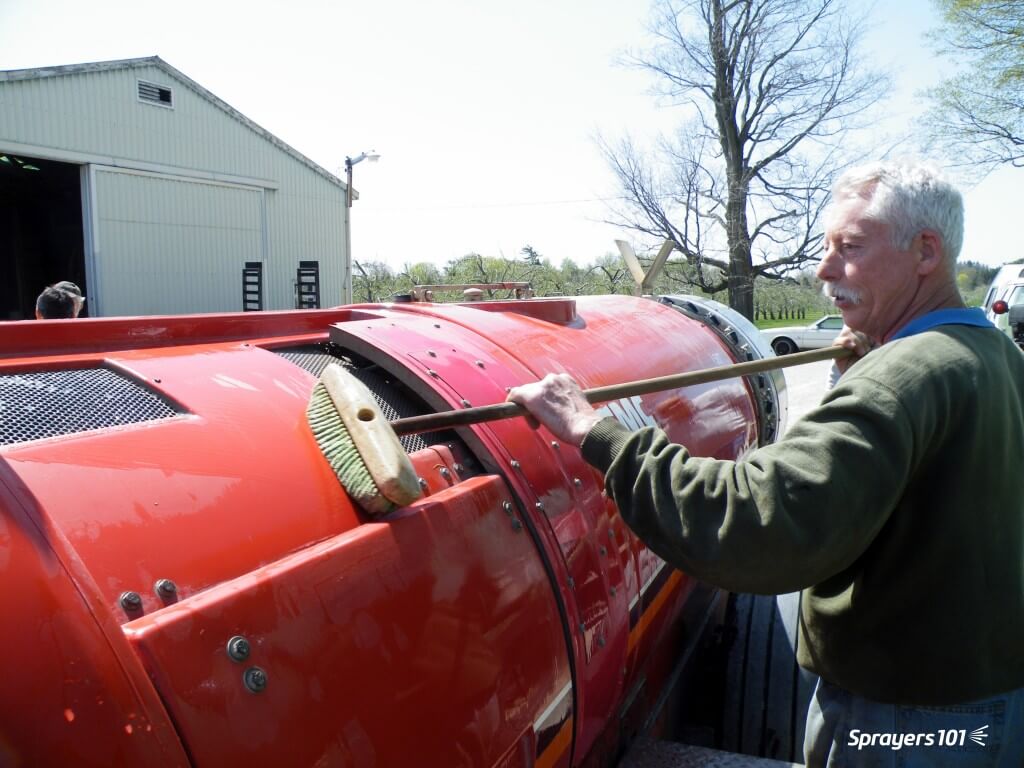
    Keeping the sprayer clean, inside and out, as part of the spray day. K. Bell is pictured giving his FMC a bath. This picture was staged – he normally wears PPE and so should you.
    Keeping the airblast sprayer clean, inside and out, as part of the spray day. Ken Bell is pictured giving his FMC a bath. This picture was staged – he normally wears PPE and so should you.

    Dr. Tom Wolf (Agrimetrix Research and Training), defines cleaning as two processes. Rinsing is the dilution of any remaining spray solution. Cleaning is rinsing with additional steps to decontaminate sprayer components (e.g. filters, nozzles).

    Rinsing

    1. Rinse ASAP

    Don’t let residue sit in (or on) the sprayer, even if you plan to use the same product the next day. Multiple studies have shown that products adsorb onto, and absorb into, plastic and rubber parts. They form hard-to-clean residues when left to dry.

    Think about cleaning oatmeal or egg yolk off dishes – it’s far easier if you clean them before they dry. Rinse right away, while the sprayer is still wet.

    2. Minimize the volume remaining in the sprayer

    Experience, sprayer math, and familiarity with airblast sprayer design helps minimize the volume remaining in the sprayer. Rate controllers and volume-monitoring systems (e.g. Ontario’s Accu-Volume) provide real-time feedback so the operator can speed up or slow down to empty in the right place. Minimizing any remaining volume makes rinsing far more effective.

    Even an “empty” sprayer can still retain several litres of standing volume in the sump and lines. Operators should know this volume. Never Drive-and-Drain to empty standing volume onto the ground.

    Standing volume from the booms allowed to drain to a holding tank via the bottom nozzles.

    3. Dilute the remnant: The Triple Rinse

    Rinsing the system multiple times with low volumes (aka The Triple Rinse) is more effective at reducing pesticide concentration than a single, high-volume rinse. See for yourself using this clever dilution calculator.

    Once the sprayer is “empty”, use clean water to fill the tank to 10% of its capacity (or add 10 parts water to one part standing volume) for the first rinse. The use of such low volumes may not be possible with centrifugal systems where the tank must be filled above the top of the pump for priming. Know your sprayer design.

    Agitate and circulate it through the entire sprayer for a few minutes. Spray out the rinsate and repeat the process two more times. Where do you perform this? Where does the rinsate go? Read on.

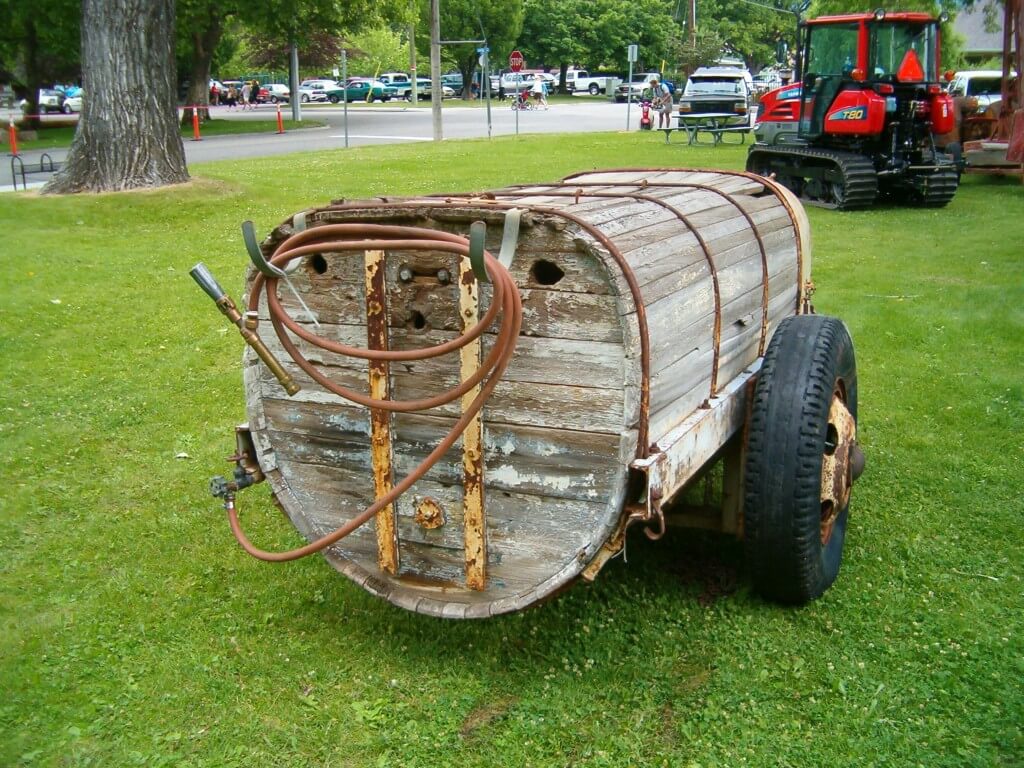
    A wooden sprayer tank. You know that had to be tough to clean thoroughly.
    A wooden sprayer tank. You know that had to be tough to clean.

    Where does the rinse water come from?

    Nowadays, all airblast sprayers should include an onboard tank-rinse system consisting of a clean water tank and tank-rinse nozzles inside the tank. They may even include a pressure wand to rinse the exterior.

    Sadly, most airblast sprayers do not have these features. But, aftermarket rinse kits are available. If you are considering installing a rinse system, check out the continuous rinse system.

    Left- Product-pump-powered water tank, Right- external-pump-powered water tanks. Images from Paolo Balsari’s (DiSAFA) “Sprayer Cleaning: Importance and Phases” at AAB Sprayer Cleaning Workshop, Oberbozen, Italy. October 2019.
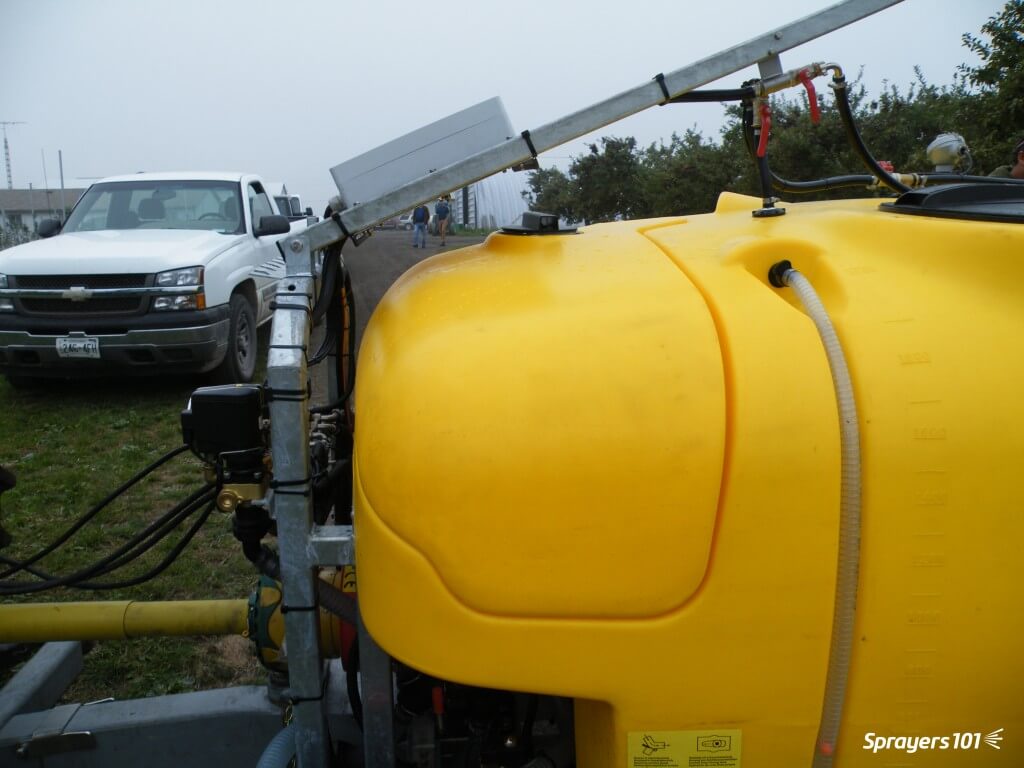
    The Hol features a separate 150 L tank to supply clean water to its automatic tank rinse system.
    The Hol features a separate 150 L tank to supply clean water to its automatic tank rinse system.

    Alternately, the clean water for this process can be carried on a support vehicle or sourced from holding tanks strategically-located near the planting.

    Where to rinse

    Precautions must be taken to ensure rinsing is performed away from wells or open water. It is best to perform the triple rinse in the crop that was just sprayed. The dilute rinsate can be flushed through the lines and sprayed out through the nozzles onto the crop. You can choose to overspray treated areas again at a lower dose (label permitting), or use a hedgerow or target row that has been set aside for this purpose.

    As regulatory agencies concerned with environmental contamination re-evaluate chemistries critical to horticulture, it becomes even more important for airblast operators to manage rinsate responsibly.

    While it is best to rinse the sprayer exterior in the planting as well, most return to the farm. Too often, the entire rinsing procedure takes place on-farm, on crushed gravel. This creates point-source contamination: a leading source of off-target pesticide movement. Washings should be secured (e.g. on an inflatable or permanent loading/mixing pad.

    Cleaning an airblast sprayer on an inflatable pad. Images from Victoria Nelissen’s (pcfruit, Belgium) “On-farm systems to avoid point pollution” at AAB Sprayer Cleaning Workshop, Oberbozen, Italy. October 2019.

    In Europe, operators are encouraged to collect contaminated rinsate for safe disposal. There are four systems in use:

    • Bioremediation – Employs a bio-active matrix (E.g. Biobed).
    • Evaporation / Dehydration – Residue following evaporation is collected and disposed of (E.g. Heliosec).
    • Physico-chemical – A combination of filtration and active carbon.
    • Photocatalytic – Photo degradation (E.g. Phytocat).

    Cleaning

    A complete cleaning is required prior to long-term storage, or when residues from previous applications are known to cause physical or chemical antagonism with scheduled applications. Perform the following steps after a complete triple rinse:

    One. Remove the suction and in-line screens. Remove nozzle strainers and nozzle tips. These will be inspected and cleaned shortly.

    Two. Fill the tank about 1/2 full of water and add an appropriate tank cleaning adjuvant. For example, ammonia at 3%/100L water will raise the pH and helps remove those products whose solubility benefits from this. A detergent at 1.0 kg /150 L water will remove the oily layer formed by EC formulations. Commercial cleaners like All Clear or Cleanout conveniently combine these properties in one jug. Be aware that adding a surfactant or a commercial cleaner can generate a lot of foam, so have de-foamer handy.

    Note: Ammonia cleaner products do not “neutralize” pesticides; they raise the pH, improving the solubility of some products. Do not use chlorine bleach! It is not as effective a cleaner as ammonia and can form chlorine gas when mixed with ammonia-containing liquids.

    Three. Collect a bucket-full of cleaner solution from the tank. Using a brush, clean the suction and in-line screens, and the nozzle strainers and tips.

    Four. Meanwhile, agitate and circulate it the cleaner solution through the entire sprayer for five to 10 minutes. Open and close any lines or valves during this process to ensure everything is exposed to the rinse.

    Five. You might spray a small volume through the booms, but drain the vast majority through the plumbing system. Collect some for cleaning the exterior of the sprayer.

    Six. Clean the exterior of the sprayer. High pressure washers and scrubbing with a push broom works well. Studies in Europe have shown the vast majority of residue is found on the sprayer head (i.e. fan outlet and boom area).

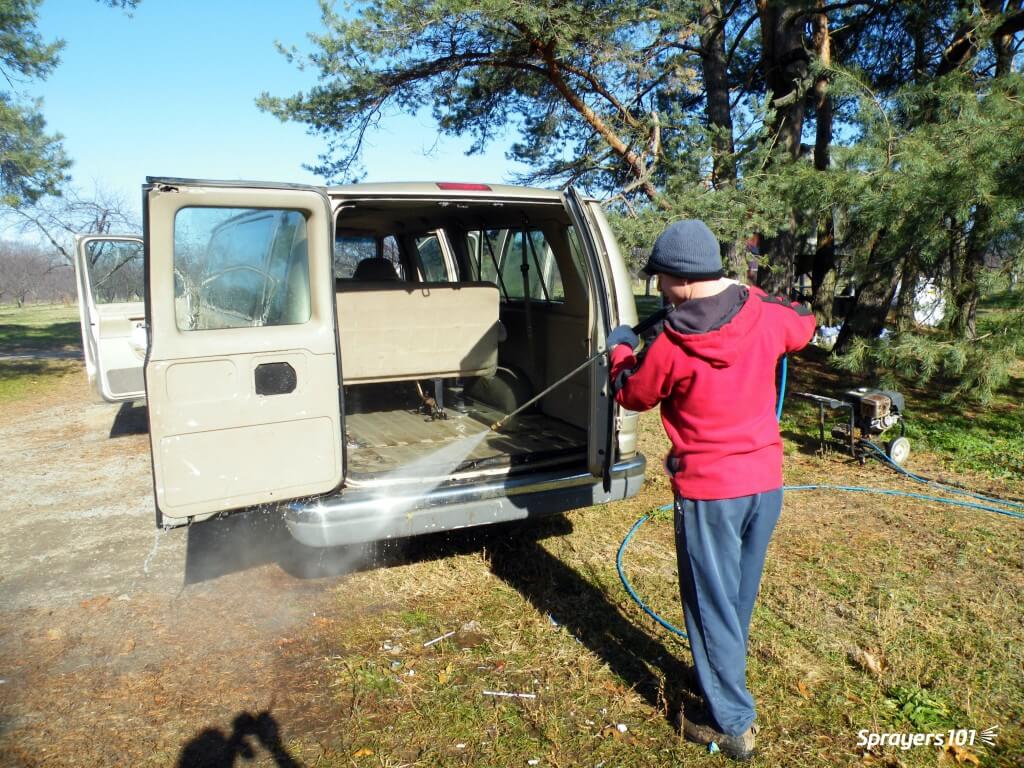
    Pressure washers are handy tools on a farm, and they’re fun to use, too. However, they can cause a great deal of damage if they are used to wash delicate things like engine parts, electronics housings, or sealed bearings. Use caution!
    Pressure washers are handy tools on a farm, and they’re fun to use, too. However, they can cause a great deal of damage if they are used to wash delicate things like engine parts, electronics housings, or sealed bearings. Use caution when power washing an airblast sprayer.
    Relative external contamination on a low profile axial airblast sprayer. Image from Paolo Balsari’s (DiSAFA) “Sprayer Cleaning: Importance and Phases” at AAB Sprayer Cleaning Workshop, Oberbozen, Italy. October 2019.

    Seven. Rinse it all off. Replace all parts unless preparing for long-term storage.