Tag: plumbing

  • Recirculating Boom Options

    Recirculating Boom Options

    If you read this site, you know we’re fans of recirculating booms. We love them for three reasons:

    1. They save money and waste by recovering spray back to the tank during priming and rinsing
    2. They make boom cleaning easier by eliminating boom-ends
    3. Most require individual nozzle shutoff, which makes for better sectional control

    If you’re new to the concept of recirculating booms, read more here.

    Until recently, these booms were only available on sprayers imported from outside North America (Horsch, Amazone, Agrifac to mention three), or via France’s Pommier booms that have been available as retrofits for many years. In 2018, Agco introduced their Liquid Logic system on the Rogator line, becoming the first North American manufacturer to offer a recirculating boom at the factory. Pattison Liquid also offers Recirculating booms as standard equipment on their Connect Sniper pull-type sprayer.

    In the meantime, three boom retrofit kits and one sectional conversion kit have become available.

    Arag Australia‘s BRS (Boom Recirculation System)

    The first was developed by Arag Australia, and is available there via Nozzles Online, and in Canada through Nozzle Ninja. Designed for John Deere R-Series and Case Patriot sprayers, the kit uses the existing line that feeds liquid to the outermost section and simply extend that line to the end where it enters the boom via two installed elbows. The liquid returns to the centre via the installed boom sections which are connected together by removing the boom end cap (or “aspirator” for John Deere) and replacing the gap with a section of hose. Back at the centre rack, the liquid from both booms meet in the middle. At this point, a three-way valve gives the choice to return the spray to the tank, or to receive pressure from the pump. There is also a manual valve that allows the return to be dumped for safe disposal.
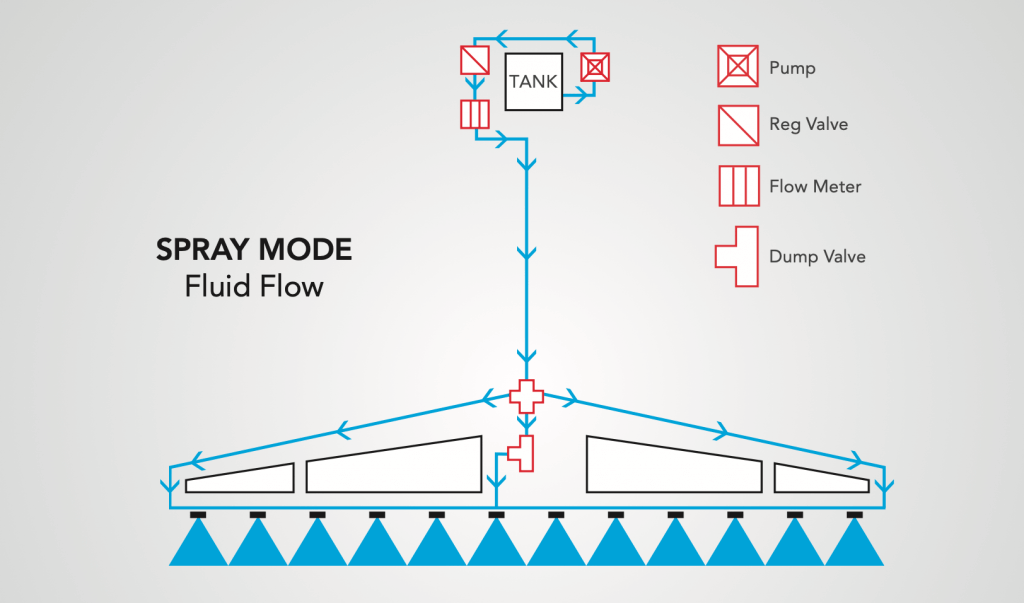
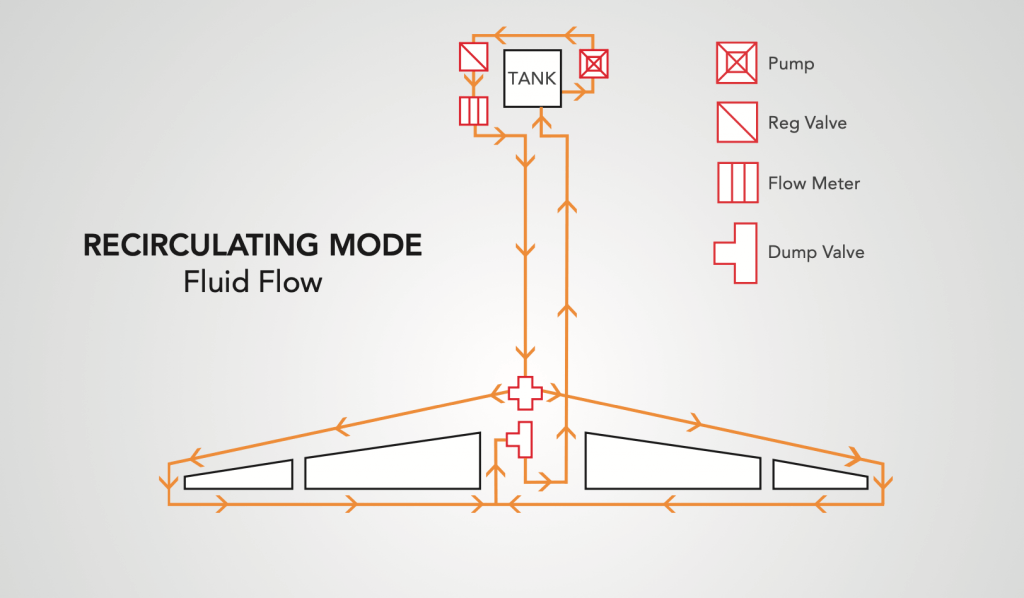
    Arag Boom Recirculation System (Spray Mode)
    Arag Boom Recirculation System (Recirculation Mode)

    The system does not tie into the sprayer’s electronics. instead, it adds a switch in the cab that the operator uses to switch from spray mode to recirculation mode. The switch is not activated at the end of each swath, but instead to prime or flush the boom.
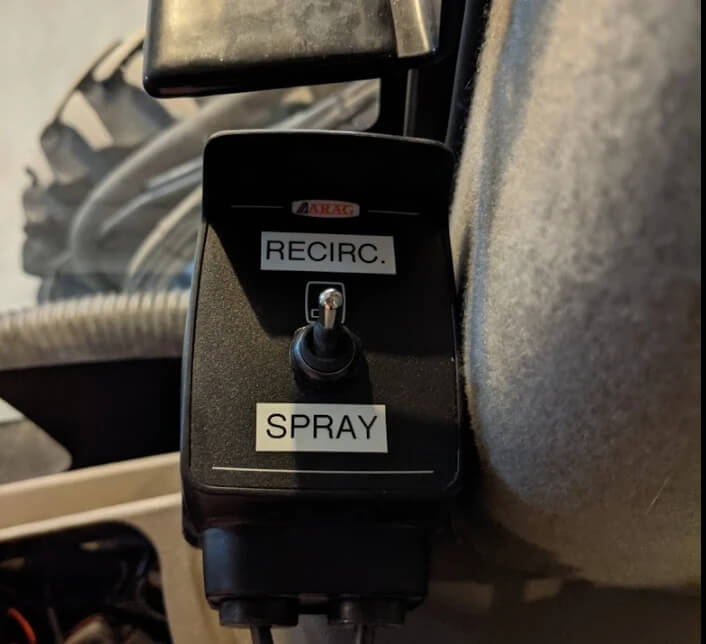
    A switch is added so the user chooses recirculation or spray mode. The boom would recirculate to prime or flush, and remain in spray mode during the spray operation.

    Raven

    Raven offers a recirculation kit for 3000, 4000, and 5000 series Case Patriot sprayers with Aim Command HD and an ISOBUS terminal. The approach is slightly different, as they retain the pressure feed through individual sections but also tie the sections together so the spray is returned to the tank. By including a shutoff valve between each section, the system retains the option to use conventional sectional control for high flow situations, or to isolate a section should a leak occur. The system can be configured and controlled from the sprayer monitor, either a Viper 4+, CR7, or CR12.
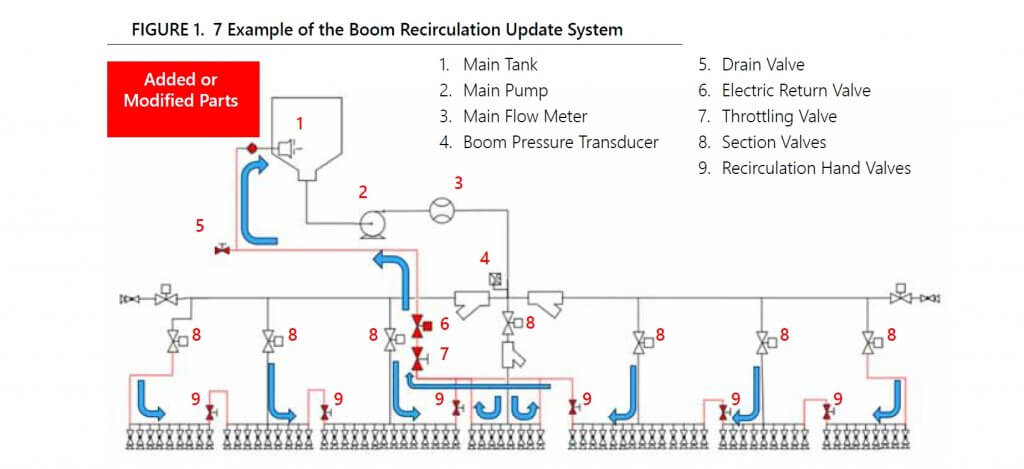
    Raven Boom Recircualtion System schematic (from Raven manual). Note the retention of section valves and the addition of manual valves between sections.

    John Deere

    On March 2, 2021, John Deere announced a 2022 factory option called Pressure Recirculation and Product Reclaim. The system keeps several existing sections and adds two steel lines the flull length of each boom wing. One is for supply, the other return. As these lines approach a section, the supply is fed to one end of the section and the return is connected to the other end. On a 120′ boom, there are five recirculating sections, two on each wing and the centre.

    This approach adds one more line than the other designs, and this line will hold materials that ultimately need to be cleaned, flushed, and possibly dumped or sprayed out for cleanout. A possible reason for the extra line is the ability to deliver 220 gpm to the boom, an advertised feature of John Deere high flow booms that may come in handy for topdressing liquid fertilizer. These levels of volume are not needed for pesticides.
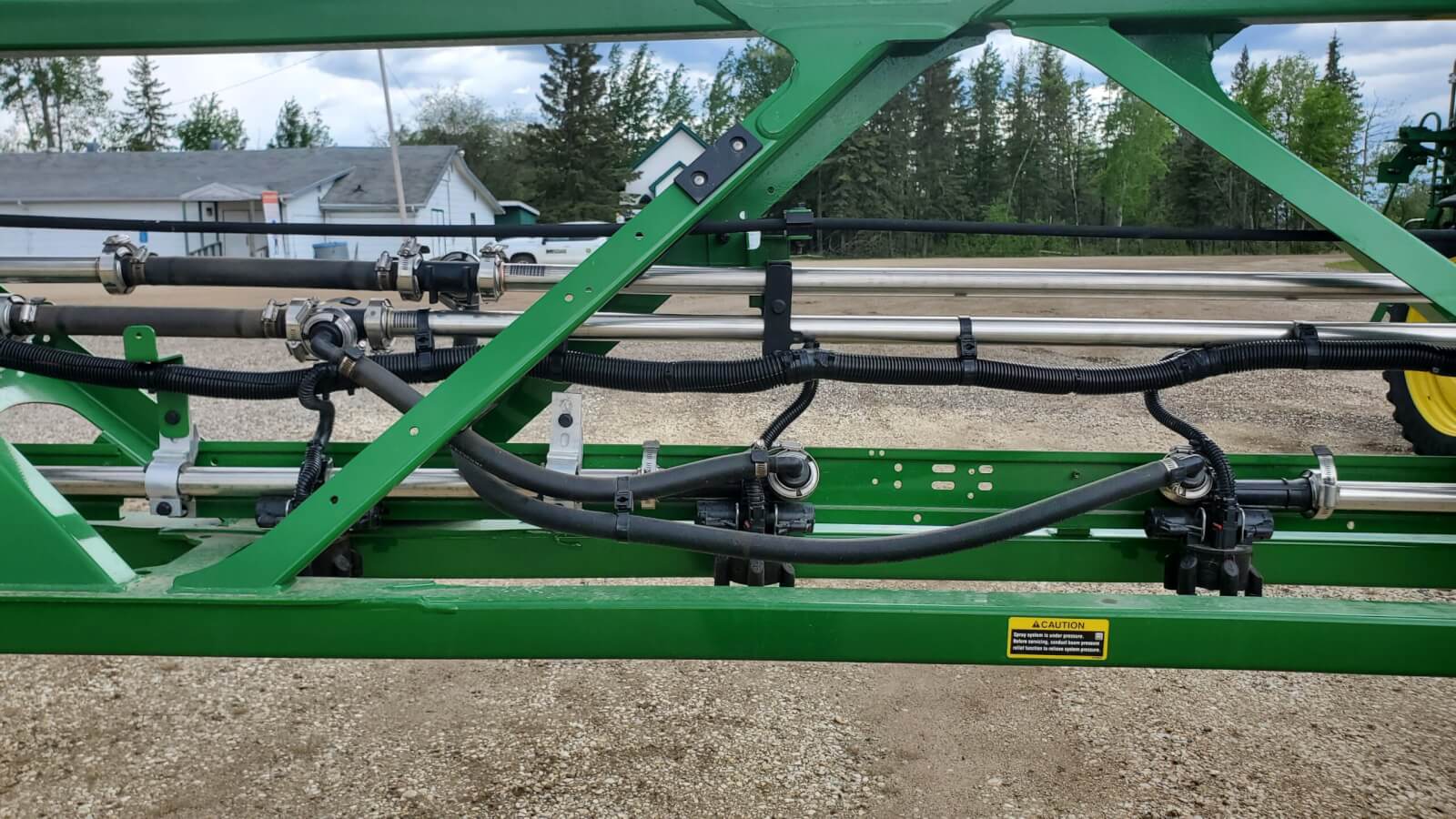
    John Deere Boom Recirculation and Reclaim. Top two lines are supply and return and extend the length of each boom wing. These connect to the existing sections on each wing, creating several smaller recirculating sections.

    Latitude Ag

    This Wisconsin company has developed an innovative product that converts any existing plumbed section that contains boom ends into a recirculating section. It does this by incorporating a boom recirculation valve” (the “Merlin IC System“) into the original section feed line. Boom end caps are removed and replaced with sweeps and hoses that return flow to these boom valves. The flow from the boom ends is incorporated back into the sectional feed thanks to a venturi design in the recirculation valve.
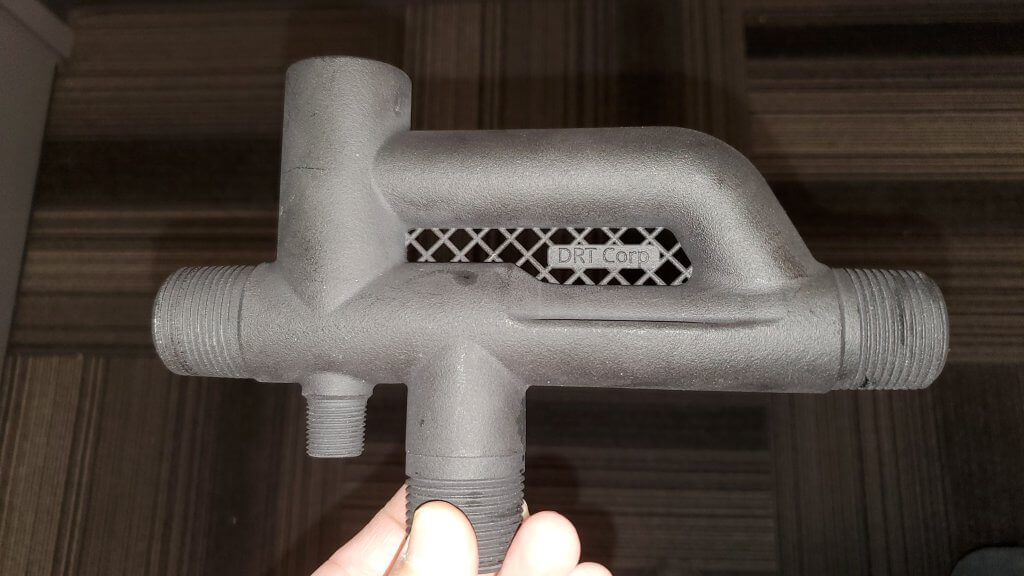
    A prototype of the Merlin IC System valve made by Latitude Ag

    Advantages of this design include simplicity. No moving parts are required, the valve simply recirculates the flow from the boom ends automatically whenever that section operates. Existing sectional control, whether it’s by plumbed section or individual nozzle bodies, is unaffected. Flushing the boom with water is done with normal spraying. It takes some extra time to incorporate and dilute the contents of the boom end return lines but results in a clean boom and no section end residue. We’ve seen the results of testing and agree that it works.

    This product does not allow boom priming without spraying. However, a key advantage is that it can be used with direct injection since no product is returned to the tank. Latitude Ag says it will provide the necessary flow sensor and software to make this possible. As of 2025, this system may no longer be commercially available.

    Precision Planting ReClaim

    ReClaim is capable of operating on a sprayer with or without individual nozzle shutoff. For conventional nozzle bodies containing the original spring-loaded diaphragm check valves, the concept is to drop the liquid pressure below the cracking point of the check valves so flow continues through the sections and back to the tank without engaging the nozzles.

    Recirculation fittings are added to the end of each boom section. These feed into 3/4″ lines are installed on section ends, which in turn feed increasing diameter collector lines that eventually return all flow to the tank. Flow reaches the sections as before. When recirculation is turned on, flow exits the boom section through the new fittings and returns through 3/4″ lines to the centre of each section, where it enters 1” lines that take the flow to the center of each boom wing. There the flow in the 1” lines is combined moves to the center of the sprayer on 1.5” lines where it meets the flow from the other wing.  From there, the flow returns to the tank through an electronic ball valve and 2” line. This system ensures no back-pressure and balanced flow from each section.

    For some sprayer rate control systems such as John Deere, the pump won’t operate below about 20 psi despite operator settings. This means the priming or flushing procedure would trigger nozzles to spray if the bodies were fitted with spring-loaded diaphragm check valves. A pressure reduction kit (a second restrictor valve) is required to reduce the pressure sufficiently for ReClaim to work in these instances. More here.
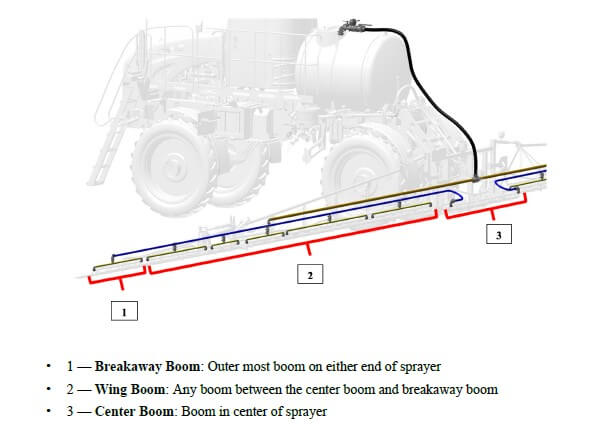
    ReClaim operates independently of any electronic control systems, relying on a toggle switch to initiate recirculation. When flow back to the tank is detected, a light indicates that recirculation is working, and the operator waits approximately 60 sections for a 120’ boom to circulate all volume back to the tank. Download the operator’s guide, here.

    This system requires a lot of additional lines. A 120’ boom would require 120’ of additional 1” line and 60’ of 1.5” line. The manufacturer states that ReClaim adds about 14 gallons of volume that would need to be displaced back to the tank, adding to the standing volume. This volume can be circulated using solution from the main solution tank, or displaced back to the tank using flow from an existing clean water tank, or displaced using compressed air via an optional pneumatic port. It is not clear how spray mix in the ReClaim system can be removed from lines without returning it to the tank and draining it from there. Users should consider the additional surface area and volume that will have to be addressed during cleanout.

    Do It Yourself

    If none of the available options work for your sprayer, consider building your own system. Sprayer plumbing parts are available from the major manufacturers Banjo, Hypro, TeeJet, and Wilger. Wilger, in particular, has developed a nice suite of parts well suited to recirculating booms, including flanged sweeps and thin gauge steel booms, punched for nozzle bodies or unpunched to move product. See their support for DIY projects on this dedicated page: Wilger Retrofit.

    Take Home

    All these recirculation options improve the status quo of plumbed boom sections with boom ends. They should be considered essential equipment on sprayers.

  • Six Spray Technology Skills for Agronomists

    Six Spray Technology Skills for Agronomists

    Press play to listen to an audio version of this article

    Agronomists help farmers manage their crop with advice on everything from crop cultivars to fertilizer rates to marketing. It’s challenging to be an expert on everything, but a few core competencies can go a long way to improving the level of service.

    Agronomists are also responsible for communicating environmental best practices. Along with fertilizer rates come messages of source, time, and place, the 4R principles. The same is true for spraying, with messages of spray drift, resistance management, and economic thresholds part of the consultation. Let’s remember that we should not be indifferent to the potential consequences of our recommendations.

    Here are six skills that an agronomist should know about spray technology.

    1. Recognizing major nozzle models and their spray quality and pressure requirements.

    Application technologists are often asked to identify nozzles and recommend spray pressures for clients. It’s a skill that anyone can develop with just a bit of homework.

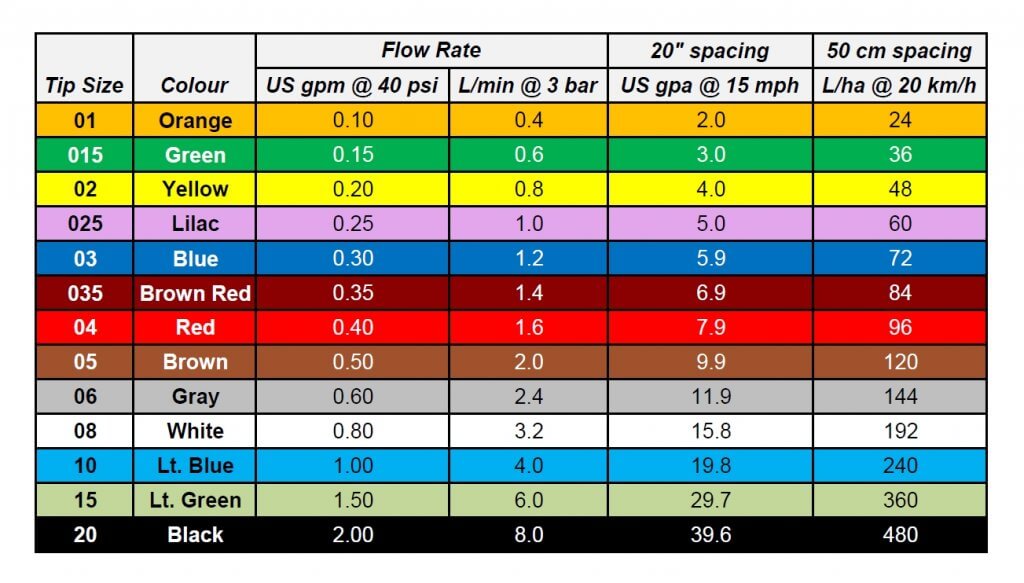
    First, learn the colour-coding of nozzles – colours identify flow rates and follow an international standard that all manufacturers have adopted.

    ISO Colour coding of major nozzle sizes, as well as application volumes at benchmark speeds.

    Next, focus on the common nozzles on the major sprayers. John Deere sprayers will typically have three main air-induced nozzles, made for John Deere by Hypro, the Low-Drift Air (LDA), the Ultra Low-Drift (ULD), and the GuardianAIR Twin (GAT). Those with ExactApply, John Deere’s PWM system, will see the non air-induced 3D, the Guardian (LDX), and the Low-Drift Max (LDM). Recall that PWM flow control should not be used with air-induction tips.

    Almost all Case sprayers have PWM, called AIM Command. Case uses Wilger ComboJet bodies and nozzles, with the ComboJet ER, SR, and MR most common, sometimes the DR or UR for dicamba.

    New Holland/Miller with PWM (called IntelliSpray) are also likely to have these tips, but because these brands have TeeJet bodies on their booms, they require an adaptor for the proprietary ComboJet caps.

    Otherwise, PWM units often use TeeJet’s TurboTeeJet (TT), Turbo TwinJet (TTJ60), and Air-Induced TurboTwinJet (AITTJ60), the only air-induced tip approved for PWM use by TeeJet.

    Conventional spray systems (i.e., no PWM), will commonly have (in alphabetical order) the Air Bubble Jet (ABJ, actually labelled BFS for their manufacturer, Billericay Farm Systems), the Greenleaf AirMix (AM), the Hypro GuardianAIR (GA), and the TeeJet AIXR.

    Many sprayers will have a twin fan for fungicides, primarily for fusarium headblight (FHB) management. The Greenleaf Turbo Asymmetric Dual Fan (TADF), the Hypro GuardianAIR Twin (GAT), and the TeeJet AI3070 dominate, as well as a number of custom configurations using splitters and twincaps.

    Where dicamba is applied on Xtend trait soybeans, some special nozzles may be used to meet label requirements for coarseness. The TeeJet TTI is very common, but Greenleaf developed a special set of tips called the TurboDrop XL-D and the TADF-D. Wilger’s version, mentioned earlier, is the UR. John Deere has just announced their new ULDM.

    That covers 95% of what you’ll encounter in the North American market. In Europe, add some Lechler nozzles (ID3, IDTA, IDK, IDKT) to the mix. In Australia, Arag is gaining ground.

    Identifying the nozzles on sight is the prerequisite to finding out their average droplet size, called spray quality. Often, the inscriptions are worn off, so visual recognition is required to get there.

    We’ve published a visual identification guide with pictures of the major nozzles here.

    Knowing the relative spray qualities produced by these various nozzles will get you bonus points, but you’ll need to do some extra research to get there.

    2. Using a spray calibration chart

    This skill will make you popular on the farm and at the office. A very frequent question is “what size nozzle do I need for this new sprayer?”. The best way to approach the answer is to ask several questions.

    • Does the sprayer have 20” nozzle spacing? (90% of sprayers do).
    • What is the desired water volume?
    • What is the expected average travel speed?

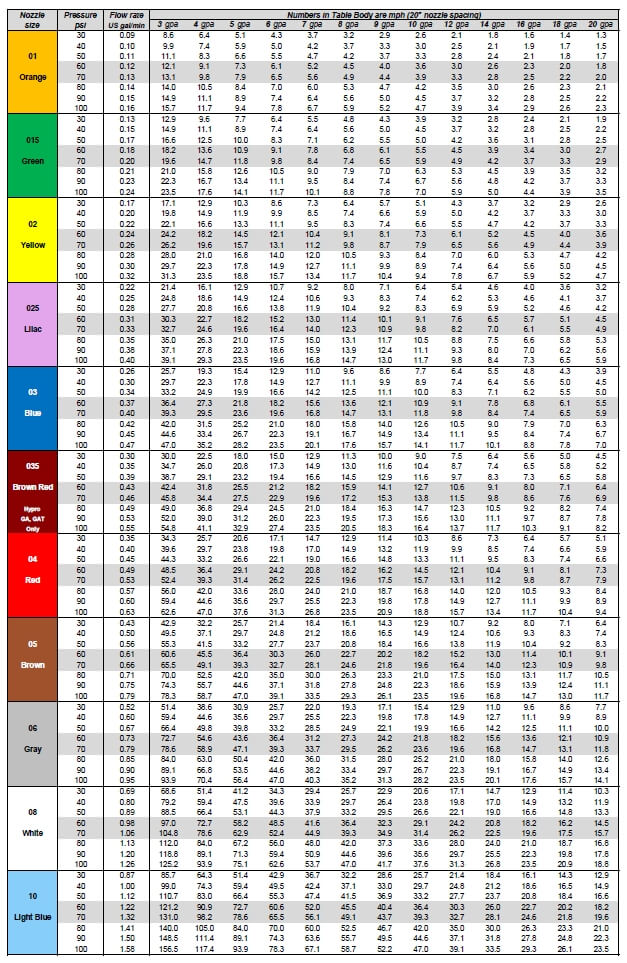
    The first question guides you to the appropriate calibration chart, which can be downloaded here or can also be found in all sprayer catalogues.  We explain how to use these charts here. 

    Calibration chart for 20: spacing, in US units.

    If you don’t have a chart handy, use this shortcut: on a boom with 20” spacing, at 5 mph, every 0.1 US gpm capacity at 40 psi delivers 6 US gpa. So if you need to apply 12 gpa at 15 mph, an 06 size will get you there at 40 psi. That’s ballpark.

    In metric, with 50 cm spacing, at 10 km/h every 400 mL/min (01 size) at 3 bar delivers about 50 L/ha. To deliver 200 L/ha at 20 km/h would require an 08 (white) tip.

    Of course, if the tip is air-induced, make adjustments to speed or size to accommodate the higher pressure requirement of these types of nozzles.

    Remember that spray pressure is key to performance, therefore the operator needs to drive at a speed, or use a volume, that results in the correct spray pressure.

    3. Understanding Pulse Width Modulation

    PWM technology has been on the North American and Australian market for two decades, but it remains poorly understood by those who do not use it. PWM will continue to gain popularity and has implications for nozzle selection and sizing.

    Traditional rate control in the field involves the use of spray pressure to match liquid flow rates to travel speed. The rate controller knows the width of the boom (entered by the user), the travel speed (from gps), and the desired application volume (entered by the user). It does some math to identify the flow rate it needs, and compares that to the sprayer’s current flow meter reading. If the current flow is less than what’s needed, the sprayer increases pressure to increase flow. This happens continuously in the background.

    When an operator speeds up, the pressure increases, and vice versa. As a result, the pressure (and therefore droplet size) will fluctuate with travel speed, and that can result in inconsistent spray patterns, coverage and drift.

    PWM involves the installation of electronic solenoid valves at each nozzle body. These valves pulse on and off at 10, 15, 50, or 100 Hz, depending on the manufacturer. Each pulse contains a brief, complete shutoff of the flow. The proportion of the time the valve is open during a pulse is called the Duty Cycle (DC), and this is proportional to the flow through the nozzle.

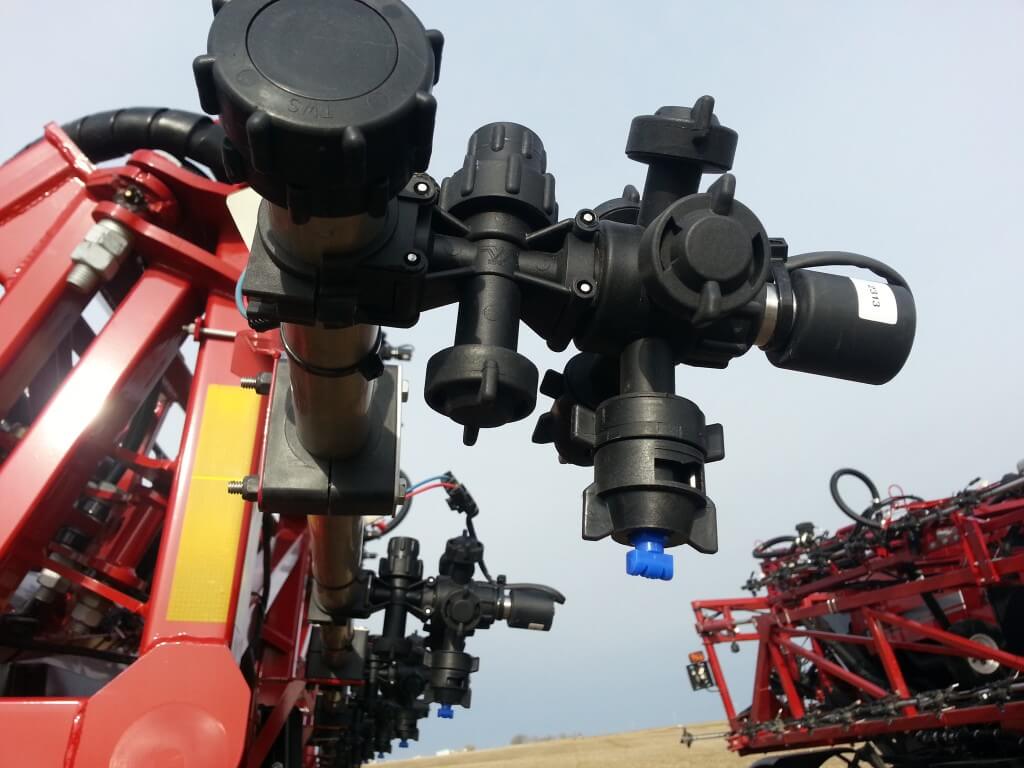
    Capstan PWM solenoid on Case AIM Command

    When the system requires more flow, it no longer increases pressure. Instead, it increases the DC. The advantage of this approach is that nozzle pressure can now stay constant, ensuring consistent coverage and drift.

    There are other advantages of these systems. Each nozzle can be controlled independently, offering high resolution sectional control and turn compensation.

    Nozzle selection and sizing are both affected by this technology. Nozzles need to be sized larger, with about 30 to 40% more flow capacity ideal. The DC will therefore run at 60 to 70%, optimal for speed fluctuations and turn compensation. Air-Induced tips are not usually recommended because their pattern deteriorates with pulsing.

    We’ve written about PWM here, here and here to get you started.

    4. Validating coverage of the target

    A very useful indicator of the success of a spray operation is an assessment of “coverage”. This term refers to a qualitative combination of droplet density and percent area covered, and can be quickly assessed using water sensitive paper. We’ve explained the use of WSP here and here.

    It’s very useful to have some of this paper on hand (available from any retailer that sells TeeJet or Hypro products, or on-line from Sprayer Parts Warehouse in Winnipeg or Nozzle Ninja in Stettler, AB). The coverage can be assessed in four different ways:

    Water-sensitive paper being used to assess spray coverage.
    • using the “SnapCard” app (gives % coverage only);
    • using the “DropScope” scanner (gives a comprehensive assessment of coverage, density, size, plus image editing tools);
    • using a template of coverage examples;
    • using experience built on years of doing this.

    Water-sensitive paper is also useful as a record, for quality assurance. A spray application is conducted and part of the record is an image of the deposit. Should a performance issue arise, this will help settle it.

    5. Understand basic sprayer plumbing

    Often, a sprayer problem can be traced back to an issue with its plumbing. There could be mysterious sources of contamination. The pump might not be building pressure. The agitation isn’t running. Or you need to drain all the remaining liquid from the tank.

    Sprayer plumbing seems intimidating for a number of reasons. It’s become complex on most modern sprayers. It’s hidden under the sprayer belly. All the lines are the same black colour, so they’re hard to tell apart.

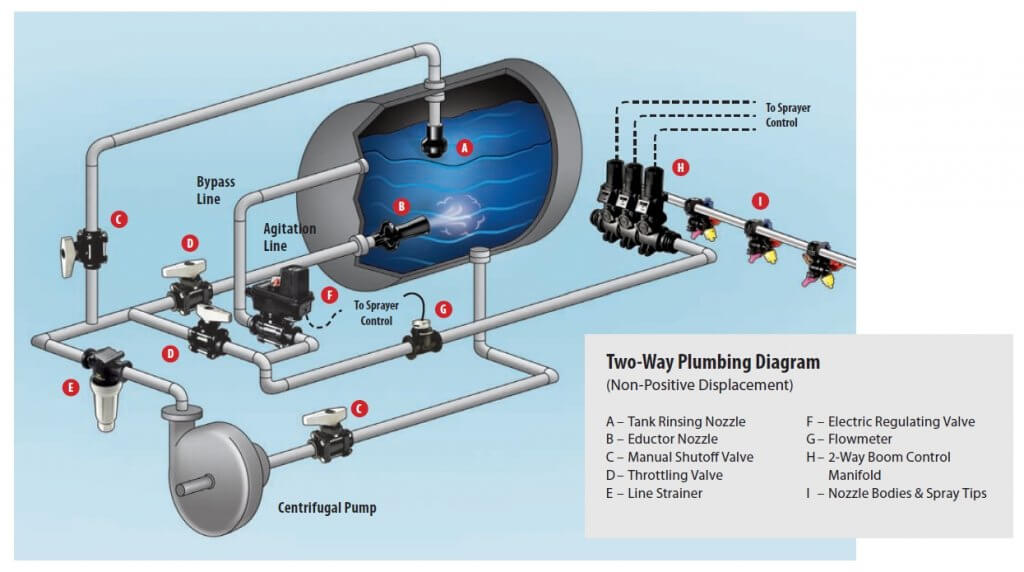
    But it’s not as bad as it seems. Basic plumbing is the same on all sprayers. The pump draws the spray mix from the bottom of the tank, the sump. It may also have options to draw clean water from an external supply, or from the clean water tank for wash-down.

    The pressurized supply goes to three places:

    • to the booms, via sectional valves;
    • back to the tank, via a control valve that can be used to adjust the spray pressure;
    • to the wash-down nozzles.
    Typical sprayer plumbing for a centrifugal pump (Courtesy TeeJet).

    When spraying, the less is returned to the tank, the higher the boom pressure. There may be several ways back to the tank, via agitation, via bypass (sparge), or via wash-down (used only when the pump draws water from the wash-down tank). Usually engineers can’t help themselves and introduce several what-if features that complicate the situation. But with a bit of know-how, and a flashlight, the plumbing system can be deciphered.

    Pro tip: A centrifugal pump’s inlet (suction) is always the centre of the pump, its outlet (pressure) is at the periphery.

    6. Matching a pesticide recommendation with application advice

    It’s commonplace to recommend a specific crop protection product that matches the crop and pest situation. Recommending an ideal crop or pest stage improves the recommendation. But a truly successful outcome requires one additional step, advice on the application method. The customer may need to know if product performance depends on water volume and droplet size. Some products are more sensitive to this than others. Perhaps there is a specific nozzle type that may be helpful.

    The classic example for application method is Fusarium headblight in wheat. The basics are straightforward. An agronomist recommends the fungicide, and guides the tight application window with a field visit to stage the crop, plus a look at the disease risk forecast map. But true application success requires an angled spray, with a coarser spray quality plus relatively low boom height to make it all worthwhile. That’s a full-featured recommendation. 

    Common herbicide applications also benefit from additional information. Some tank mixes and weed spectra allow for coarser sprays than others, and the ability to spray coarser means a wider application window and therefore more accurate timing. Other tank mixes may pose a significant risk to drift damage, requiring special measures to prevent a problem. Identifying those opportunities adds value.

    Water volume and spray quality recommendations for major herbicide mode of action groups.

    Newer labels for dicamba (Xtendimax, Engenia, Fexapan) and 2,4-D (Enlist Duo) have very specific instructions for drift prevention. This information must be shared with customers to ensure that their drift liability is covered.

    Are there other skills that you feel agronomists should have? Please share them with us by contacting us at the bottom of this page.