Tag: spot spray

  • Greeneye makes impressive debut

    Greeneye makes impressive debut

    Green-on-green sprayer competes with Blue River and Bilberry

    One distinguishing feature of the new agriculture is the rapid development of new technologies. Ideas move from concept to implementation at record pace, helped by an influx of talent and capital into this profitable sector.

    Greeneye Technology is an example of this pace. Founded by entrepreneurs who met in the Israeli armed forces, they developed a software platform that identified crops, weeds, and other objects in agricultural fields from drone imagery. They recognized the opportunity to transition their software to a sprayer platform, and in 2017 decided to join the race, most notably competing with Blue River, Bilberry, Carbon Bee, and Xarvio, to create a green-on green spot sprayer.

    Greeneye, in an amazing display of efficiency and speed, has been a commercial product for approximately one year in the US and has sold several units in Nebraska, Minnesota and Oklahoma, and next year will expand to North and South Dakota, Iowa, Illinois, Kansas and Texas. Having consulted for the company in its early years, I paid a visit to Peterson Farms Seed near Fargo, ND in early July 2023 to see the sprayer first hand at a field demo. By the way, kudos to PFS for bringing this technology to their customers to see. Have to love a business so committed to the cutting edge.
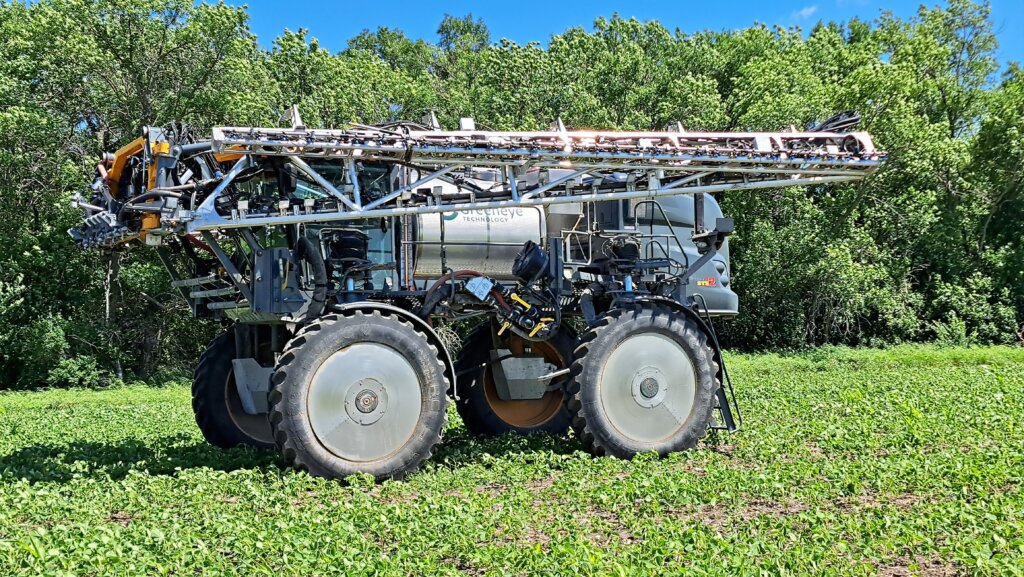
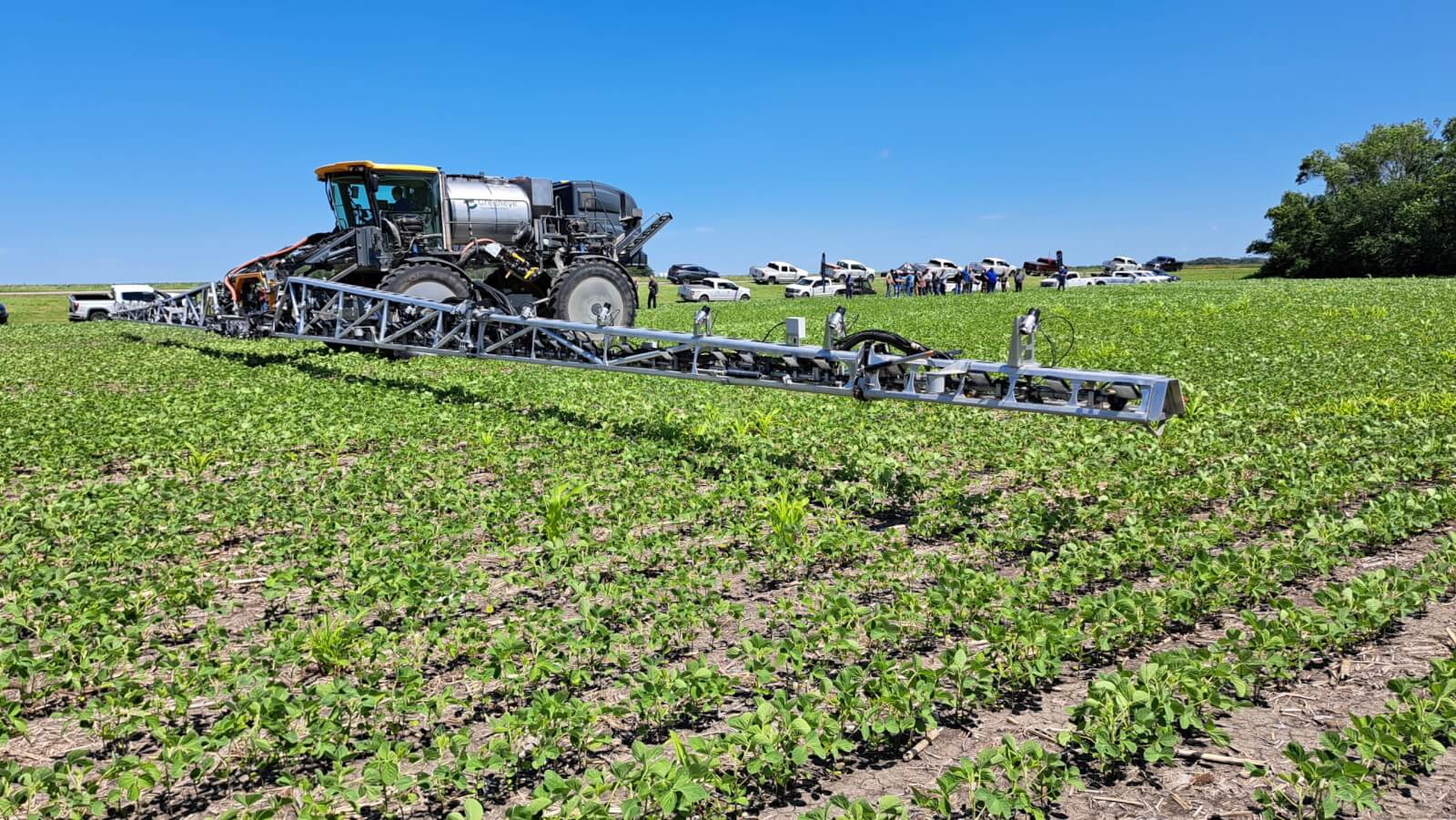
    Figure 1: The Greeneye system was mounted on a Hagie STS 12 sprayer.

    The Greeneye system was mounted on a Hagie STS 12 sprayer (1200 US gallon tank) with a custom 120’ boom manufactured for Greeneye by Millenium. Recognizing the agronomic need to broadcast pre-emergence herbicides along with a post-emergent spray, they company retained the existing plumbing system (tank, pump, wet boom) for this purpose. They added a smaller spot spray tank (240 gallons) with its own pump and wet boom for spot spraying.
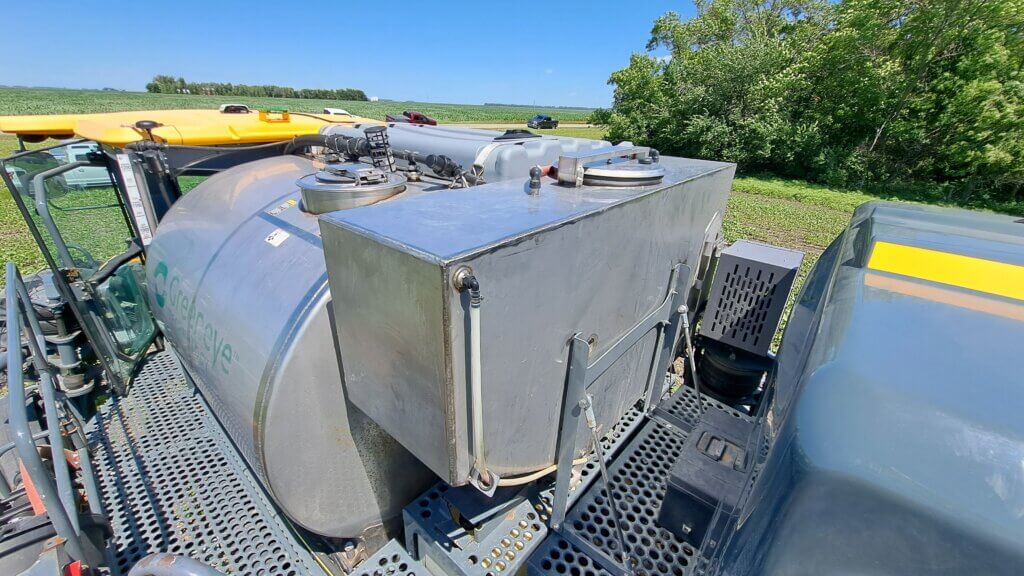
    Figure 2: A smaller spot spray tank was added to the Hagie. If necessary, spray mix can be pumped from the larger tank to this smaller tank.

    This approach permits the flexibility of broadcasting a pre-emergent herbicide during burnoff alongside a post spot spray on emerged weeds. The agronomist in me likes this a lot. Broadcast pre-emergent herbicides are an important part of resistance management, particularly in the US.
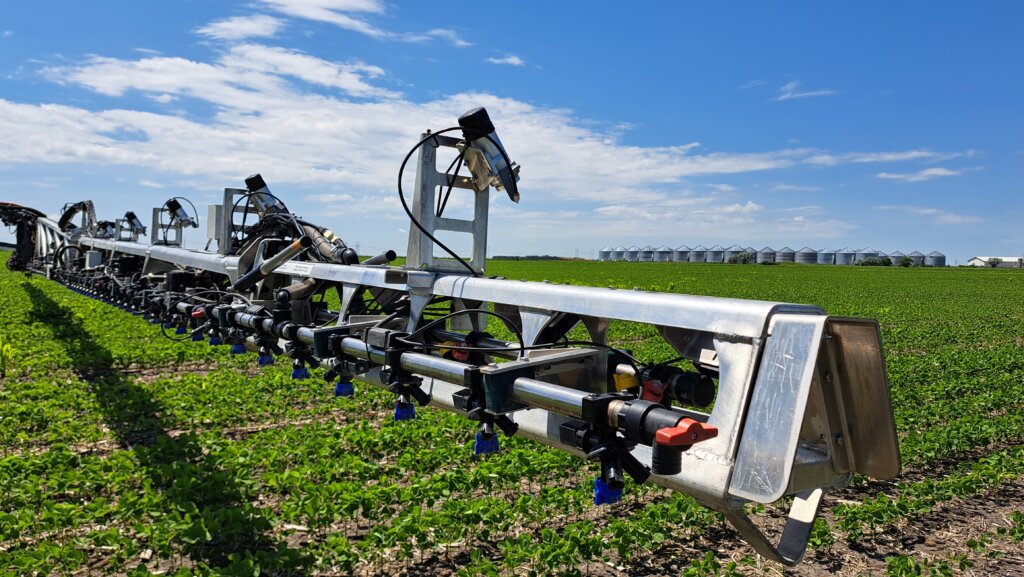
    Figure 3: The second (spot spray) boom is mounted behind the factory wet boom.

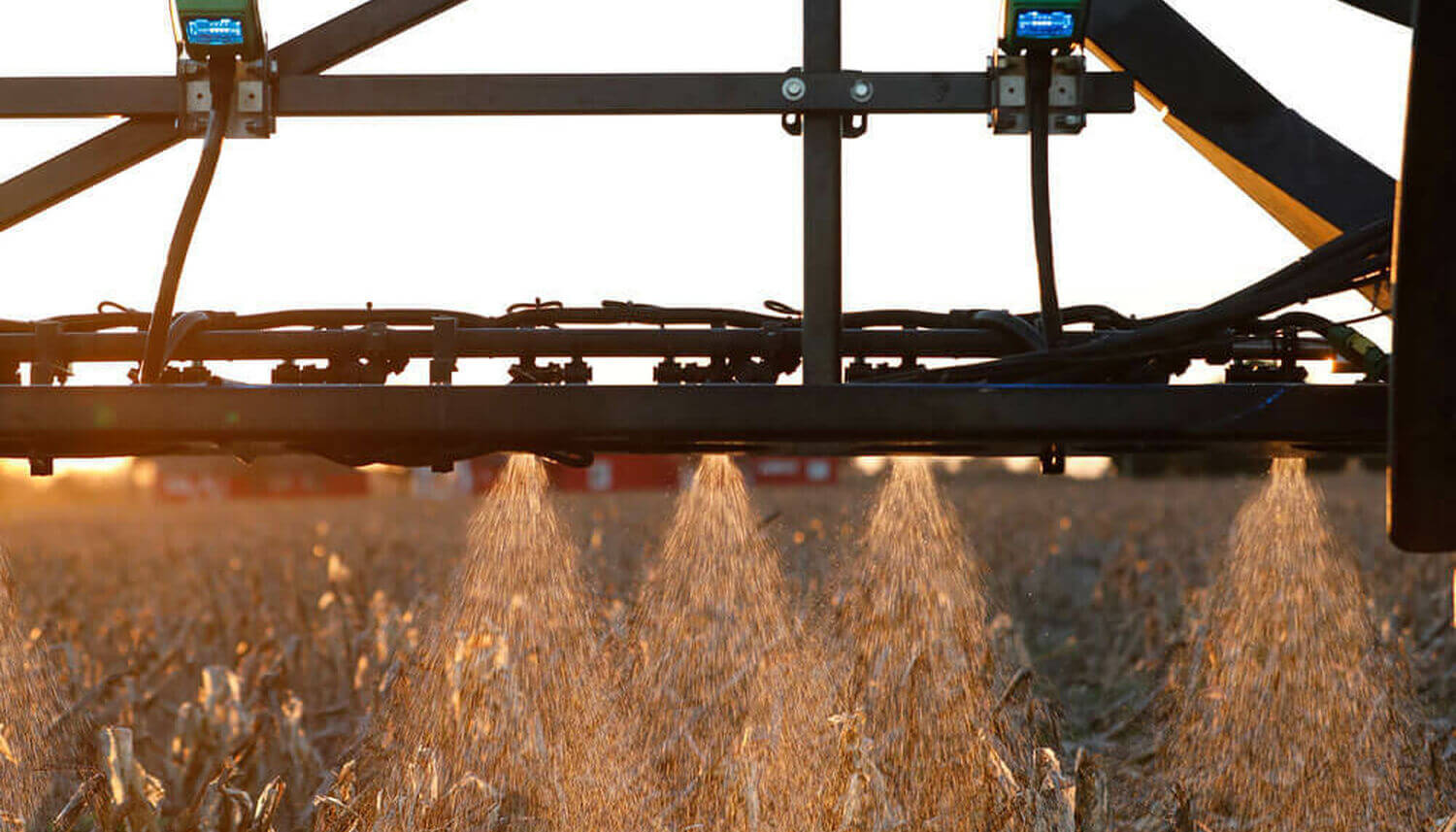
    The new wet boom has a nozzle spacing of 10”, is fitted with three-nozzle-turret TeeJet bodies. The 10″ spacing allows for higher resolution of the spot spray, increasing potential savings compared to a 20″ spacing.
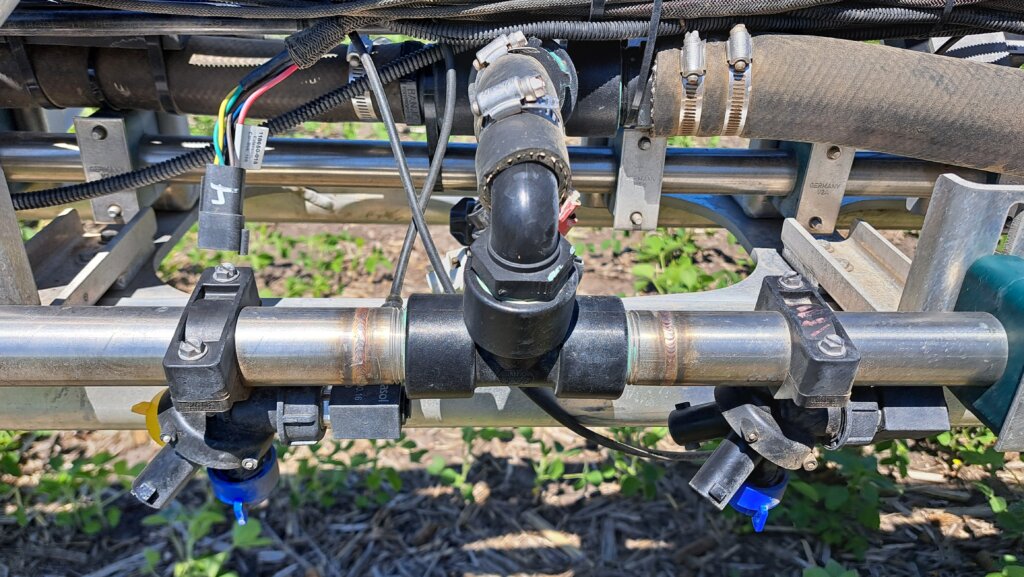
    Figure 4: The spot spray nozzles are mounted at 10″ (25 cm) spacing.

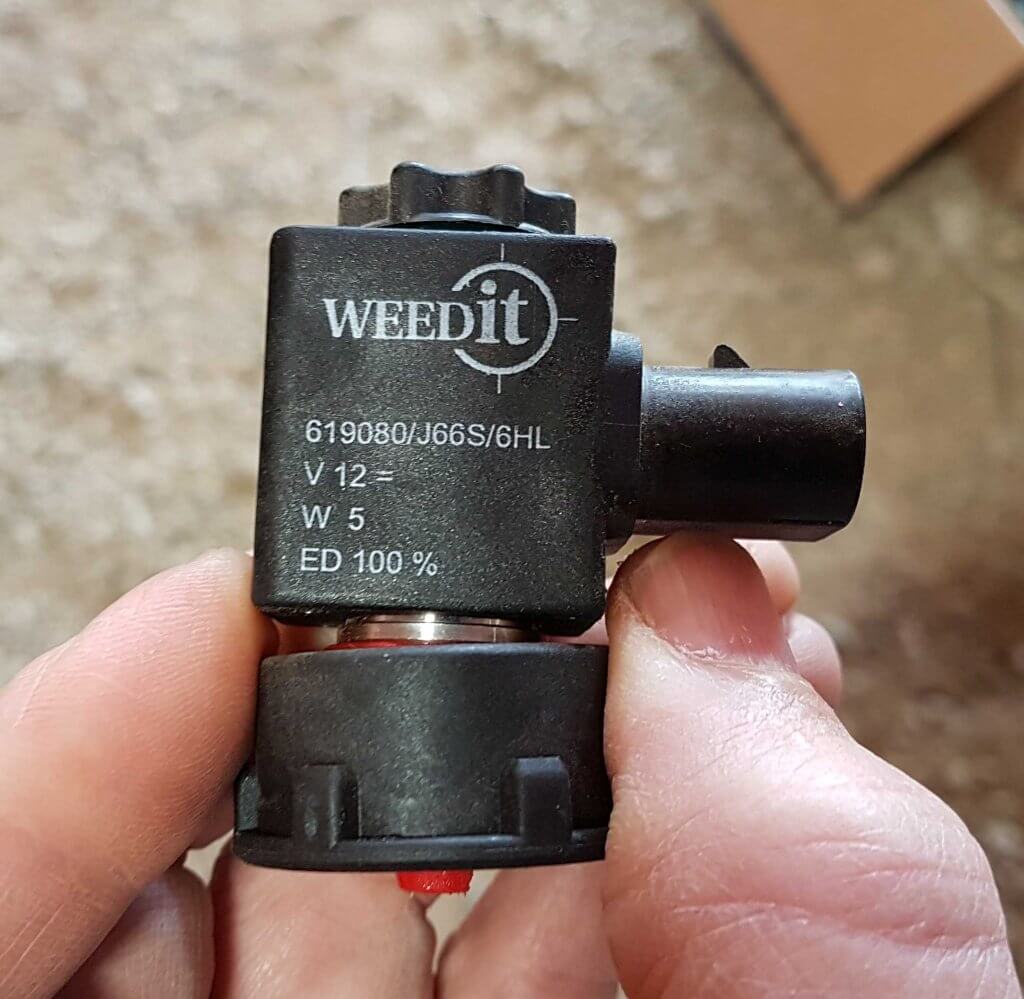
    The spray was metered through custom-made TeeJet DG4003 tips using Gevasol solenoids running at a speed-dependent frequency, maximally 100 Hz, with turn compensation.
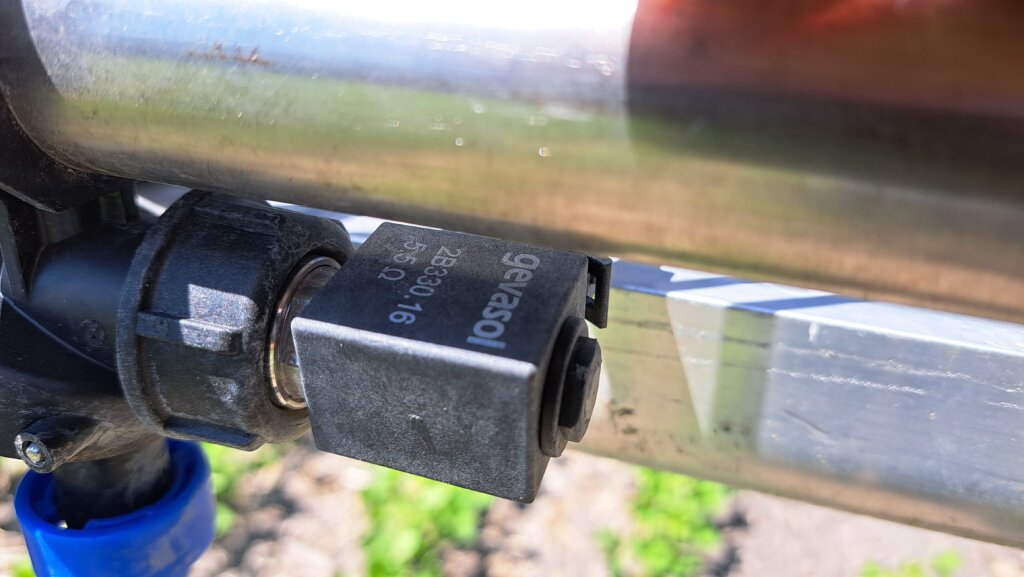
    Figure 5: Solenoids activate the spray when a weed is detected in that nozzle’s lane.

    DG Nozzles use a pre-orifice to meter the flow at the rated amount, with an exit orifice slightly larger. This creates a pressure drop, resulting in a lower drift spray.
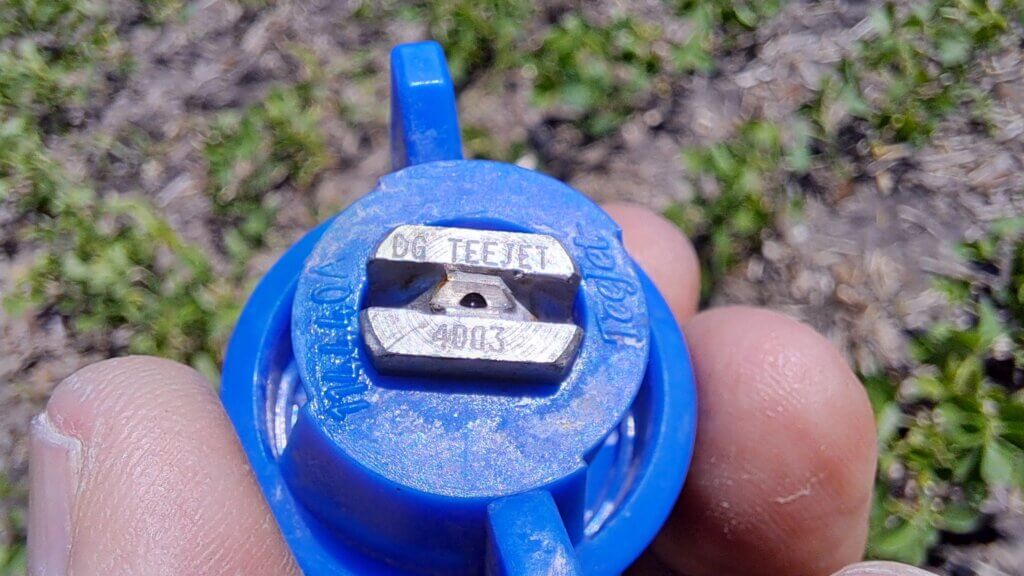
    Figure 6: These Drift Guard nozzles are custom-made for Greeneye by TeeJet.
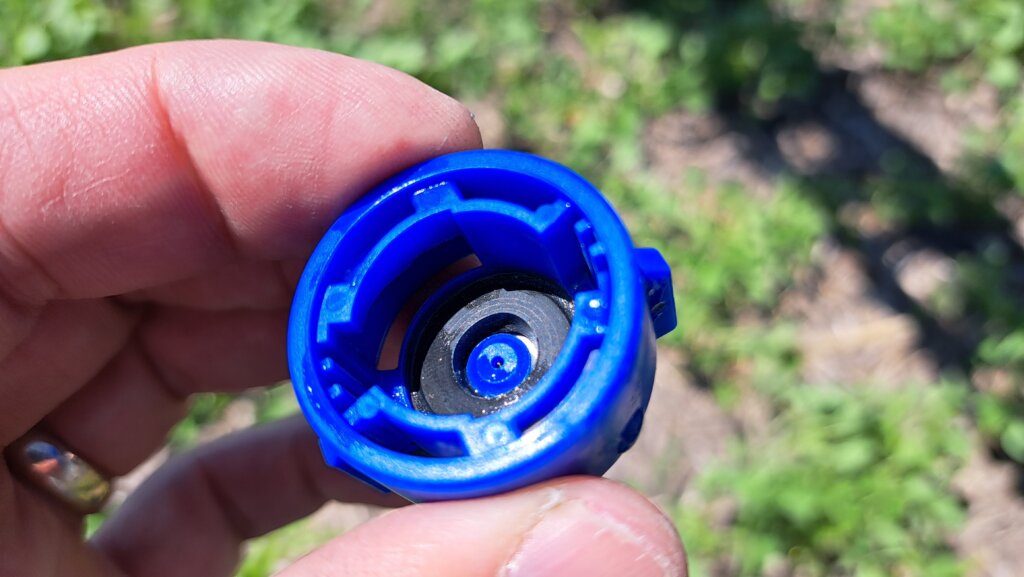
    Figure 7: The blue DG pre-orifice meters the flow at 0.3 US gpm at 40 psi.

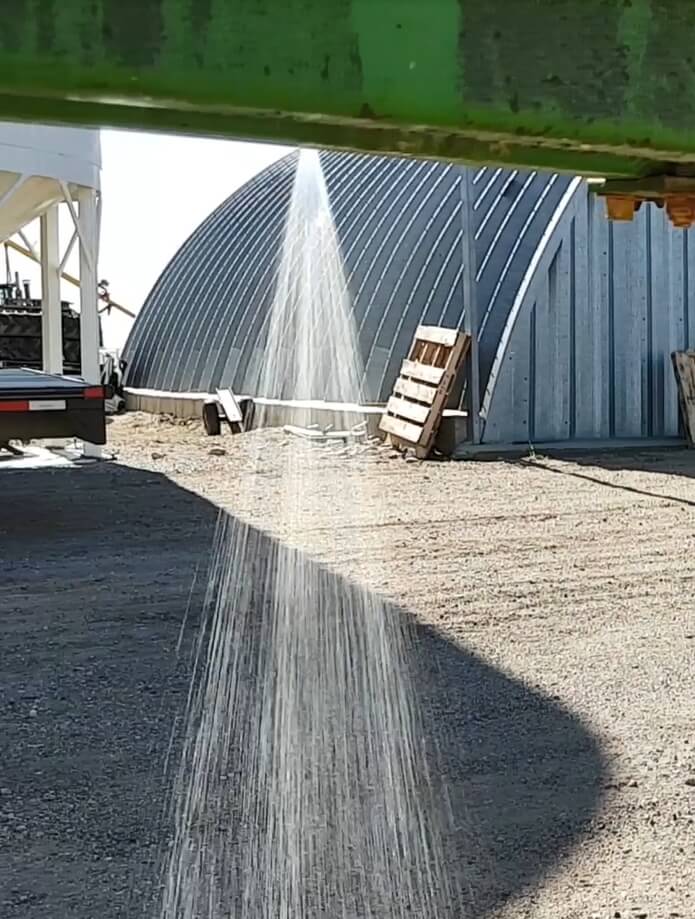
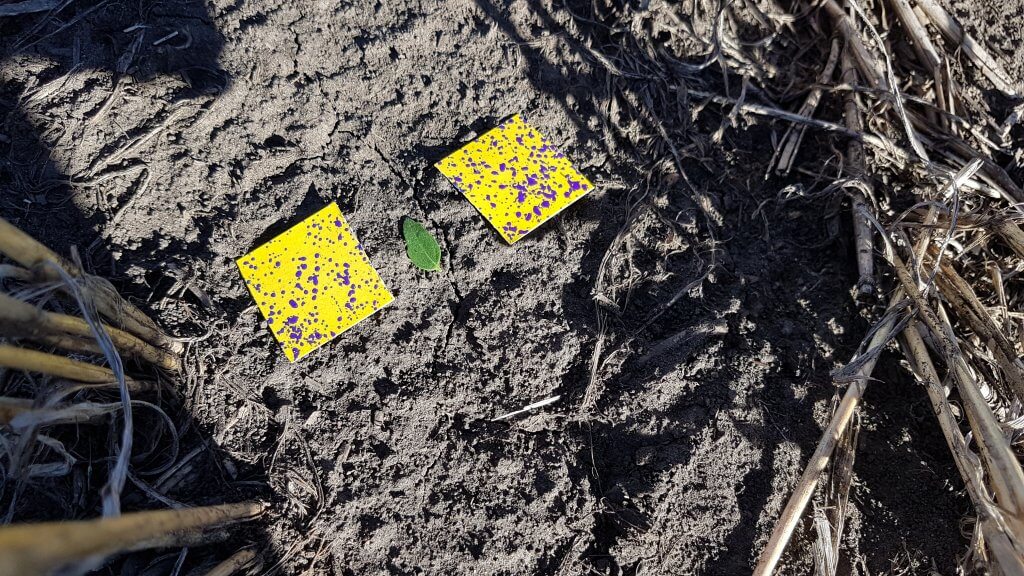
    Looking at the spray quality and coverage on water-sensitive paper I thought the deposit looked just right. Spot sprays shouldn’t be too fine for risk of displacement from their intended band. We’re not seeing bundled nozzles with other spot spray systems, who leave nozzle selection to the operator. That can pose difficulties and possibly forfeit either weed control or savings.
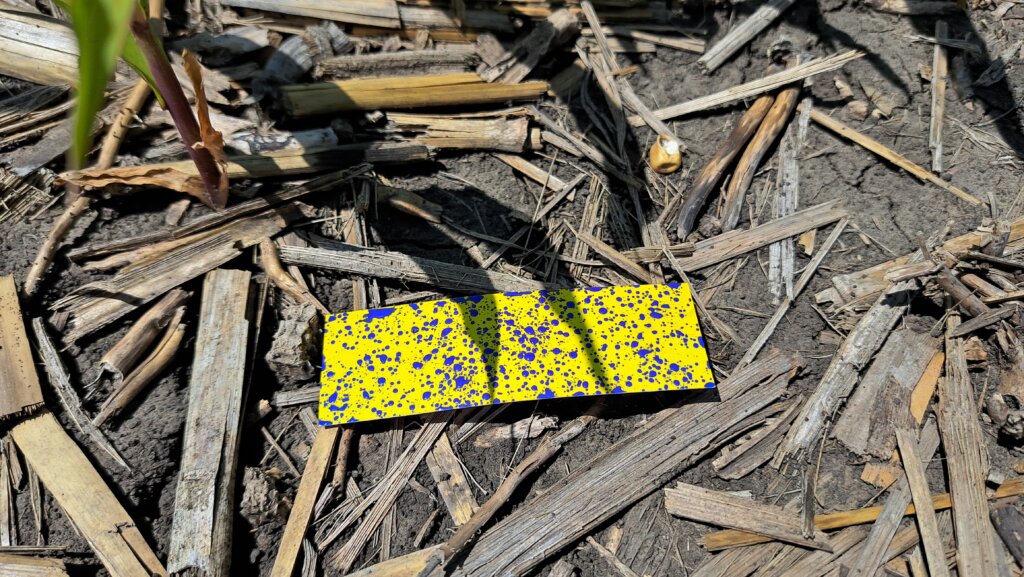
    Figure 8: The spray deposit shows adequate coverage and a good droplet size distribution for good placement accuracy.

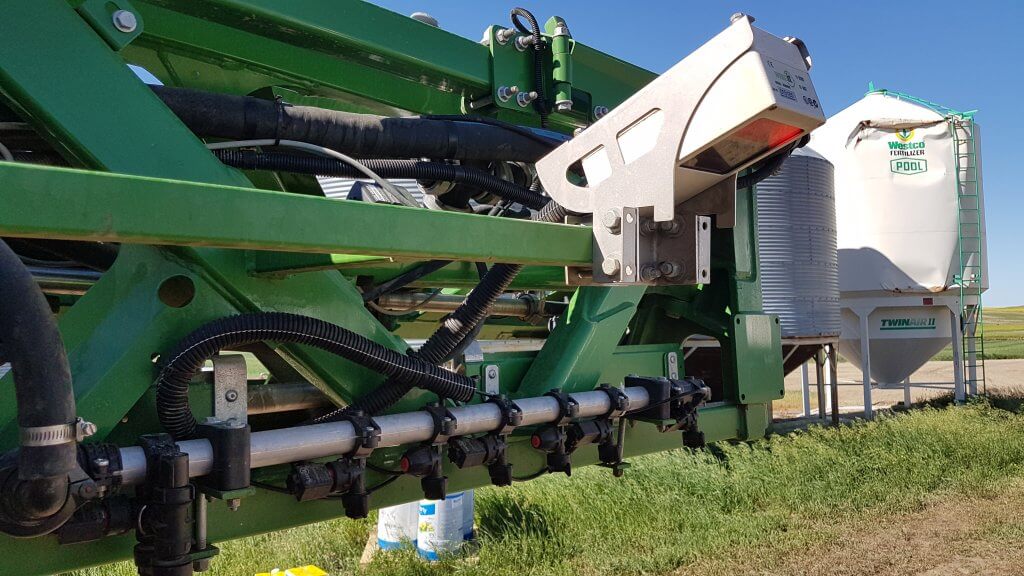
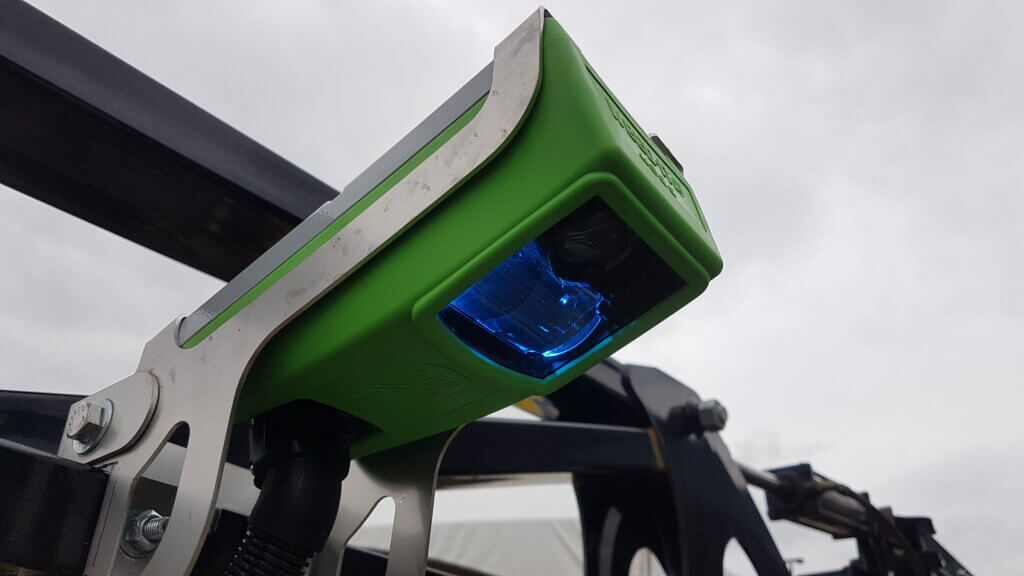
    Sectional control retains the plumbed resolution at this time, although nozzle-by nozzle resolution is in the pipeline. Cameras are mounted at 1.5 m intervals and can run up to 50 fps.  Camera resolution is proprietary, but the company claims that weeds as small as ¼” diameter can be detected. In its current configuration, weed diameters of 1” are detected, leaving smaller weeds for the pre-emergent products. LED lights flash to illuminate the camera field of view, improving image consistency and permitting the system to run at night. The Greeneye system analyzes a captured image just once to make a spray decision, and does not use segmentation in its algorithm.
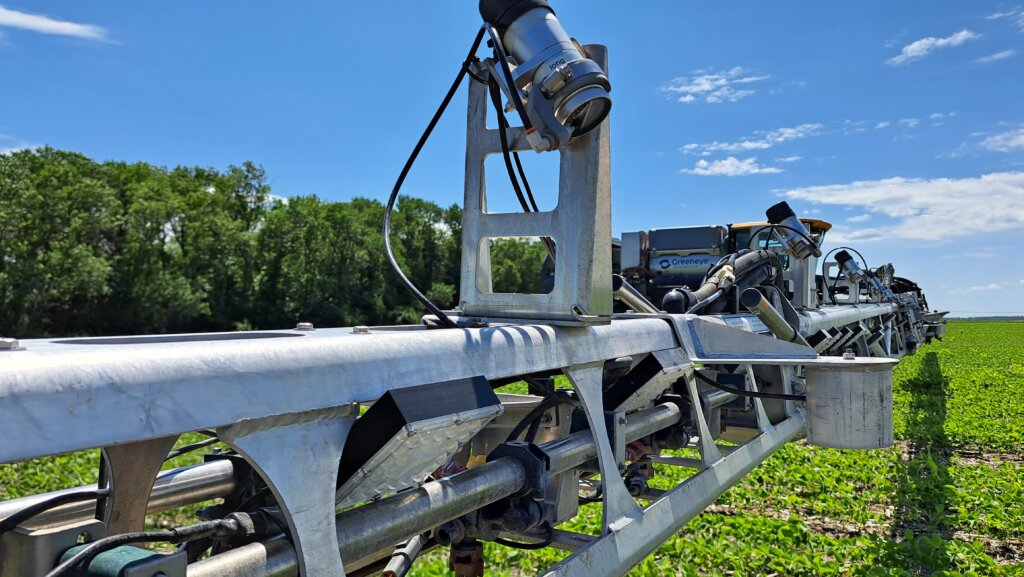
    Figure 9: The camera and lights look ahead to provide the necessary time for the on-board computer to make the required calculations that determines the plant’s identity. Note the aspirated lens cleaner.

    Like its competitors, the user can select from individual nozzle activation or, in “windy mode”, the addition of the adjacent two nozzles to create a three nozzle broadcast. The length of the band is automatically selected by the software, with no user input available. Sensitivity adjustments are currently by request to the factory, but will be available for operator control in 2024.

    Greeneye provides its own cab monitor that works with the sprayer monitor on sectional control. The Greeneye monitor keeps track of the spray volume usage and provides an ongoing report to the operator.

    The software is able to report back whether a detection was a grassy or broadleaf weed, a powerful piece of information for keeping track of weed patches and monitoring for emerging problems. Weed maps are already being produced as a proprietary tool, and will be generally available in 2024.

    New Greeneye customers have their sprayer picked up at the yard and transported to Greeneye facility where the new boom, tank, and digital components are installed. The customer receives the converted sprayer, calibrated and ready to go.

    In my judgement, the install was clean and tidy. Camera mounts are welded on, and an air jet can be used to keep the lenses dust free. Brackets for the GPU and other control boxes are unobtrusive, although the wiring does get a bit crowded in places. Everything is accessible.

    Cost is $239,000 US at time of printing (July 2023). This gets the customer a Greeneye system for a 120 foot boom, a brand new aluminum boom, retrofit of the sprayer to dual tank, installation and warranty. Return on Investment (ROI) for a spot sprayer will depend on farm size and herbicide use. Based on observed savings to date, Greeneye estimates that for a farm larger than 3,000 acres the ROI would typically be less than 2 years.

    Greeneye does not charge subscription fees for its algorithms. This last aspect is interesting as John Deere and Bilberry both charge for use of their algorithms on a per acre basis. John Deere, for example, charges $3/acre US for corn, and $4/acre for soybeans and cotton, each time you make a spot spray pass with See & Spray Ultimate.

    Available Greeneye algorithms are for Green-on-Brown, and Green-on-Green in corn and soybeans as of July 2023. Cotton and milo will be available in 2024, and Greeneye is working on canola and wheat as well. Like Bilberry, they capture images from the cameras for use in algorithm learning, and accuracy and hit rate should be improving with time. Travel speeds of 15 mph are working well according to Greeneye.

    As for performance, the proof will be in the pudding. The company in its wisdom did commission an independent evaluation at the University of Nebraska, Lincoln, and has made a summary of the university report available on its website. According to UNL, broadleaf weed control in corn with the spot sprayer was equivalent to the broadcast treatment, and grassy weed control was slightly less effective. UNL researchers noted herbicide crop injury (“Status”, dicamba + diflufenzopyr) was reduced with the spot spray. Of course, savings will be a function of weed density and the detection threshold chosen by the operator, but the addition of reduced crop injury resulting in greater yields could also be very valuable.

    A recent investor and business partner is Farmers Business Network (FBN). FBN sees the opportunity for a spot sprayer to act as a scouting platform that helps evaluate the success of new pest management strategies.

    Support on the ground is in the form of US staff with backgrounds in the spraying industry. Software development and digital troubleshooting remains in Israel.

    Although I no longer have business links to Greeneye, I was happy to see this sprayer operating as well as it did. I remain convinced that spot sprays will be an essential part of our spraying future, for sustainability and resistance reasons. It is heartening to see these early successes and it will be interesting to see them continue to evolve.
  • Spray Patterns for Spot Sprays

    Spray Patterns for Spot Sprays

    Spot spraying promises to dramatically cut herbicide use. Data from Green-on-Brown (GoB) sprays suggest at least 50% and possibly 90% savings are possible, depending on weed density and the system employed. These savings are significant. But system performance depends on the nozzle selection even more than for broadcast sprays. What are the issues?

    Pattern Width

    Spot sprays represent a unique mix of single nozzle banding and multiple nozzle broadcasting on the same boom at different times and locations, depending on what the weedy spots require. Both need to be optimized to get the best performance and savings out of such a system.

    Even (Banding) Nozzles

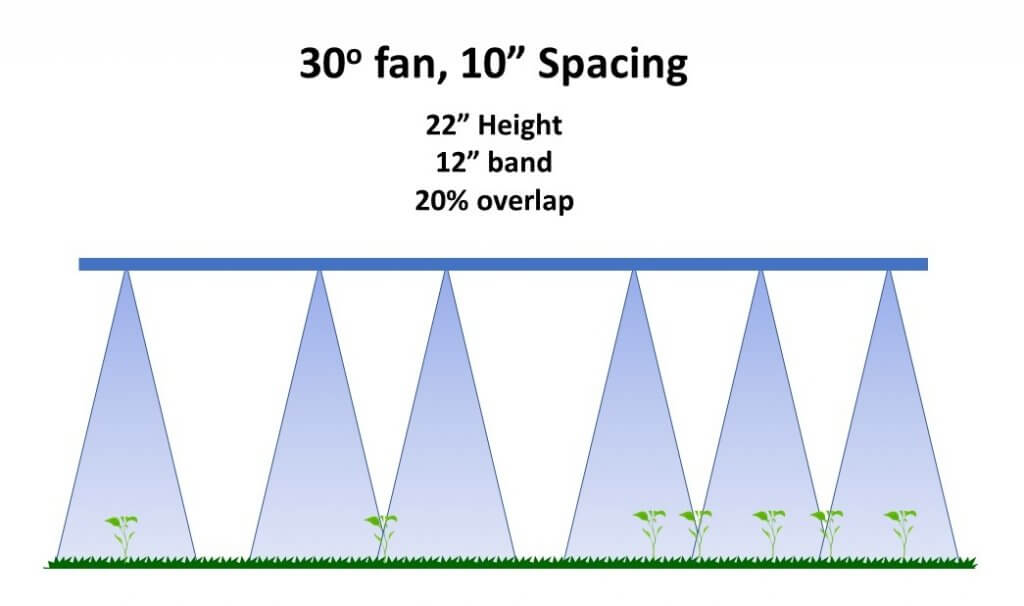
    Let’s say the spot spray boom has a spacing of 10” (25 cm) and is carried by wheels to ensure consistent height. An operator would want the spray pattern to have a very similar width as the nozzle spacing. A 30 degree even fan angle would create a band of about 10” wide at a boom height of 19” (48 cm, download a worksheet that solves this for any fan angle and boom height here). Assuming a travel speed of 12 mph (20 km/h) and a pressure of 40 psi (2.75 bar), an 03 sized nozzle would apply 14.9 US gpa (139 L/ha) in these 10” wide bands.

    But most applicators would be uncomfortable with zero overlap, and would prefer to raise the boom to allow, say, 20% overlap. This would ensure targetting of taller weeds that appear exactly between two sprays, for example. At 22” (56 cm) boom height, the pattern would be about 12” (30 cm) wide and affording 1” overlap on either edge.

    Spot spray booms activate any number of nozzles depending on the weed locations.

    Because the application is diluted by the extra pattern width, the applied volume is now 12.4 US gpa (116 L/ha), about 20% less than before. This change is easily accommodated by mixing the product more concentrated in the tank. The downside is that the overlap in banded sprays receives twice the dose, and this is less than ideal.

    Tapered (Overlapping) Nozzles

    A possible solution is to employ tapered flat fans that are the standard type on broadcast booms. These produce more of their volume in the centre, diminishing at the edges, to allow for overlapped patterns and thus functioning better when more than one nozzle is activated. In addition, the extra coverage from a wider pattern is not as wasteful as it is from an even pattern type since it comprises less volume. A single nozzle spray, however, would have a higher dose in the centre than at the edges, since a single pattern has a bell-shaped volume distribution. (note: a single nozzle moving through air loses some of its volume from the centre and places it at the edges, due to aerodynamics of the fan shape. That levels out the bell shape somewhat.)

    Broadcasting

    When more than one nozzle is triggered by the sensor, the spot spray of that region is just a small section of a broadcast boom. The average dose is now related to the nozzle spacing, not the actual band width as it was for a single nozzle. The wider the section of nozzles that are activated simultaneously, the less inefficiency a wider individual pattern creates because it’s only wasted on the outside edges of the outside nozzles.

    Clearly, a sprayer that sometimes functions as a single nozzle spot spray, and at other times as a broadcast boom requires some compromises. Monitoring the activation of nozzles and learning from the relative frequency of single vs multiple nozzle activations will be useful to optimize the configuration. But when boom height is constant, a good compromise solution is possible.

    Suspended Booms

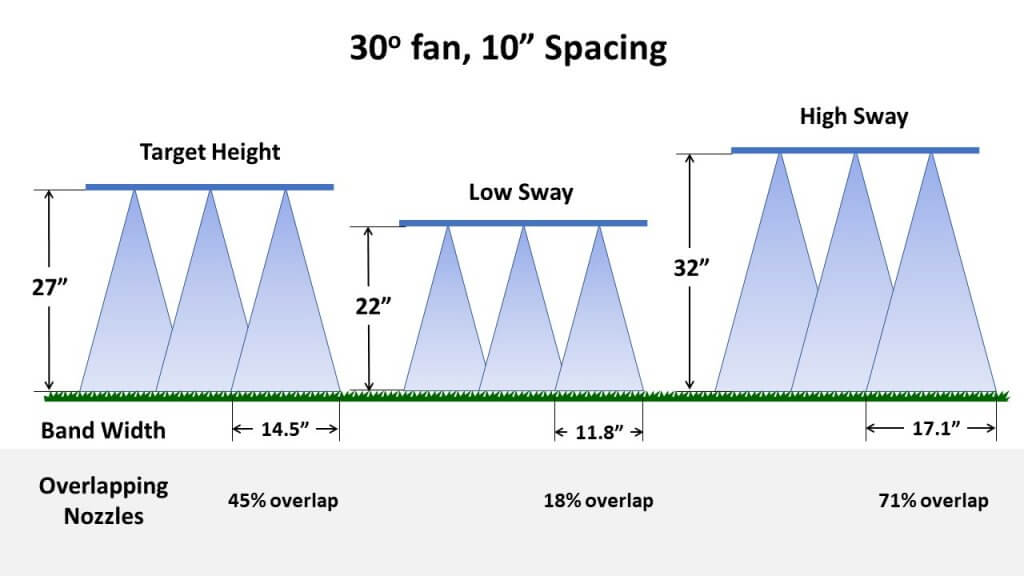
    A more challenging situation arises from suspended booms that do not hold a consistent height. Let’s assume a boom height variance of 10” (5” in either direction), and a wish to retain 20% overlap at the lowest height to avoid misses from a 30 degree nozzle.  The lowest height would have about a 12” pattern width, achieved at 22”. The boom would be set 5” higher, 27” (69 cm). At this height, a 30 degree fan would produce a band width of 14.5” (37 cm), producing a 45% overlap. If the boom sways up to 32” (81 cm), the pattern width would be 17.1” (43 cm).

    For multiple adjacent nozzles, boom height determines overlap, and a minimum overlap must be achieved even when the boom sways low.
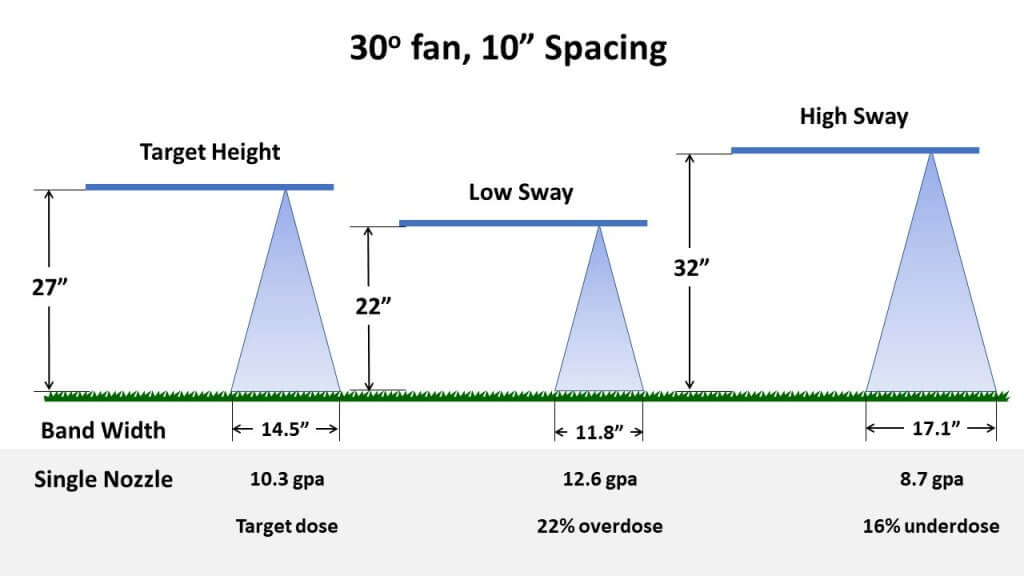
    For single nozzles, boom height determines band width and therefore dose.

    This is where it gets tricky. At suboptimal heights, the difference between a single band and a section of overlapping patterns increases. Do we calculate the tank mix for the rate a single nozzle delivers within its band, or for a set of nozzles activated simultaneously? If we knew that the majority of activations are for a set of two or more nozzles, we could opt to assume an application rate of a boom section with 10” spacing. An 03 nozzle at 40 psi and 10” spacing would apply 14.9 gpa (139 L/ha). But when a single nozzle is activated, the application volume in the 14.5” band is just 10.2 US gpa (95 L/ha), and the plants that triggered just a single nozzle would be under-dosed.

    At the top of the sway (32”), a single nozzle’s wider pattern would deliver about 8.7 gpa (81 L/ha) , another 16% less spray volume than at 27”. At the low end of its sway, the band is 12” wide, applying about 12.4 gpa (116 L/ha) , 23% higher than the 10.2 gpa rate at the 27” boom height.

    It’s clear that to take advantage of the potential savings of spot spraying, and to ensure good success with single nozzle activation, consistent and accurate boom heights are essential.  I’m not sure how much more obvious a development priority can be.

    Band Length

    Spot sprays allow the user to select the length of band that the spray is activated for. Shorter band lengths require more targetting certainty. If booms and travel speeds are both low, an individual detected weed can be targetted accurately with relatively short band lengths because relatively little can happen to displace the spray during its short journey. But as booms and travel speeds are higher, the time that the spray arrives at the target is more difficult to predict and longer band lengths need to be programmed. For example, wind can push the spray off its target. Or the faster speeds impart more of a horizontal vector to the spray, causing it to land further away from the point of release.

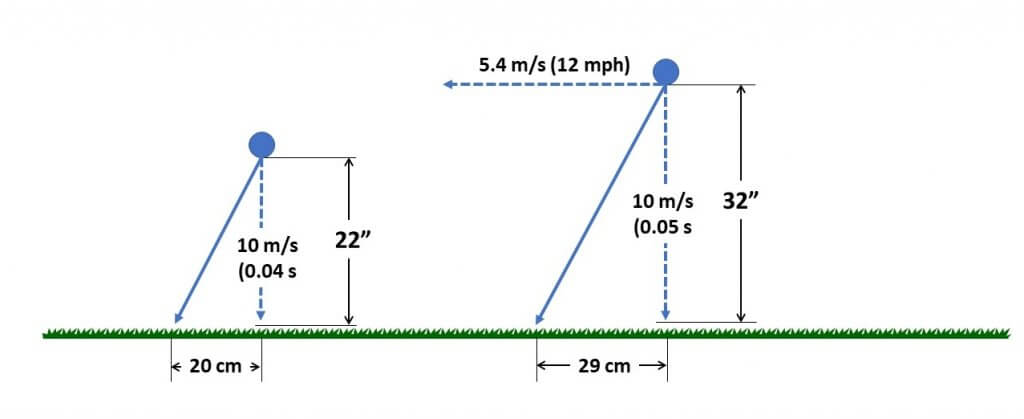
    The variances in where the spray lands along the direction of travel depend on droplet speed and boom height. A conventional flat fan nozzle produces an initial droplet velocity of about 20 m/s. These droplets slow at a rate dependent on their size and whether they’re entrained in the spray plume. At 45 cm below the nozzle, larger droplets are still moving at 10 m/s. Smaller droplets are only moving at 1 to 2 m/s.

    Droplets take time to reach their target, and the spray band length must accommodate variance in this time arising from different from boom heights or droplet speeds.

    Let’s assume an average droplet speed of 10 m/s for the journey. At that speed, the spray takes about 0.05 s to travel the 0.7 m (27”) from nozzle to target. During that time, the sprayer going 12 mph (5.6 m/s) moves about 0.25 m forward, as do the larger droplets from the released spray. If the boom sways down to 22” or up to 32”, the distance travelled by the sprayer is 0.2 and 0.3 m, respectively. In other words, the band length would need a buffer of 10 cm to accommodate the variability of the beginning and end of the band.

    Overall Efficiency

    Are these numbers such a big deal?  You might say that we’re already cashing in on some big savings here, so why sweat the details?

    It’s the principle and the resources. If we’re talking about individual nozzle band width and its change with boom height, accommodating boom sway means applying more than necessary on average to avoid under-dosing when booms sway high. The examples used here show a potential dose variance of 40% with a boom sway of 10”, a modest assumption. That’s a big number to leave on the table. If we had a constant boom height, we could decide what overlap we wanted and minimize these losses.

    One of the features on most spot sprayers is to turn on all nozzles of a section that exceed a certain boom height. While this prevents under-dosing and ensures an area is treated even when the sensor is outside of its optimal range, it is possibly an unnecessary use of product.

    If we’re talking band length, adding 10 cm to a band length of 50 cm is 20% over-application. That can also add up.

    The key to being efficient with spot sprays is accurate and consistent boom height. We know we can do that with a wheeled boom. But show me a suspended boom that can deliver on this, and I see an instant industry leader in spot spray application.

  • Optical Spot Spraying and AI Scouting

    Optical Spot Spraying and AI Scouting

    Listen to the Audio article here

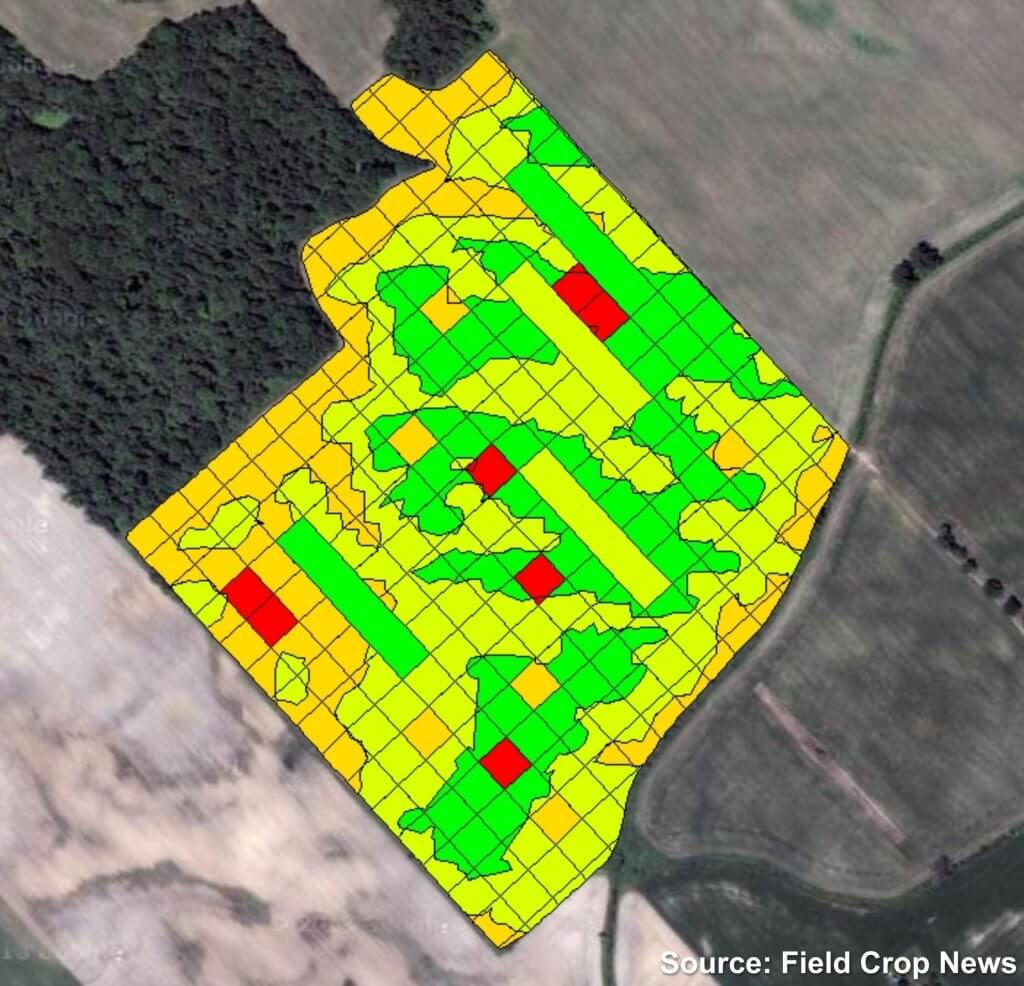
    Site-specific treatments have long been a goal in agriculture. It makes sense to provide inputs or treatments at rates that reflect the local situation. And to a large degree, those capabilities have been available for fertility and seed inputs for some time, with input zones reflecting soil types or topography.

    Typical prescription map for nutrients (Source: Field Crop News)

    But the sprayer world has not seen as much site-specific treatment. One reason is that pest maps are time-consuming to generate and their usefulness may be short-lived. Or perhaps weeds are fairly ubiquitous, and it usually makes sense to treat an entire field. Another reason could be that sprays are relatively inexpensive compared to fertilizer or seed.

    For spraying, we need to re-define site-specific.

    While traditional zone maps (corresponding to, say soil type and/or elevation or slope position) allow unique treatments on a scale of acres, new sensors have allowed sprayers to basically leapfrog this approach and treat each square foot uniquely. These sensors identify plants directly and create an immediate treatment response.

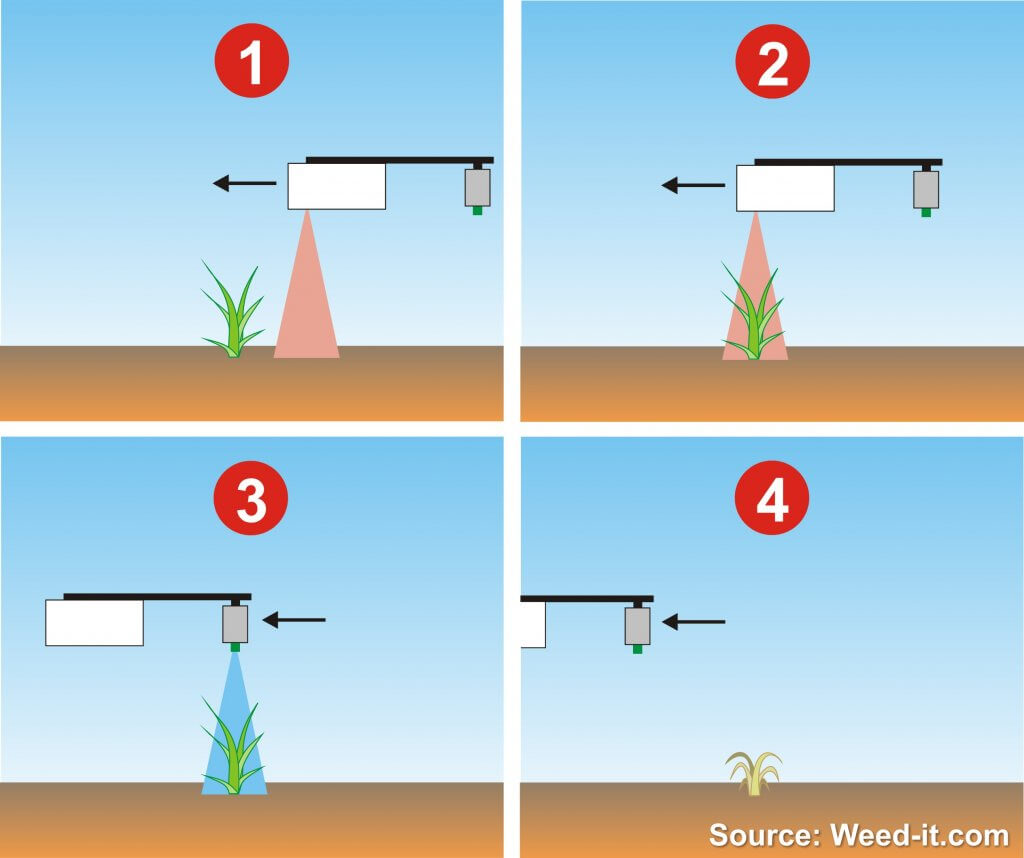
    Optical Spot Spray(OSS) principle (adapted from WEEDit)

    The idea, and technology, has and been around agriculture since the early 1990s, with the Concord DetectSpray and later the Trimble WeedSeeker. For various reasons, these two never became widespread in North America, although a significant market formed in Australia and New Zealand.  New cutting edge technologies are about to change this.

    Green on Brown

    Two main manufacturers have occupied the traditional Green on Brown Optical Spot Spraying (OSS) space, the Trimble WeedSeeker and WEEDit. Both have been available for over 10 years and are well established and proven reliable. WeedSeeker uses the Normalized Difference Vegetation Index (NDVI) principle to detect green on a non-green background. It employs one sensor per nozzle and the nozzle is either on-or off based on what the sensor detects. The WEEDit system is manufactured in the Netherlands by Rometron (https://www.weed-it.com/), and is widely adopted for use in Australia and South America. It is now making inroads into North America. The most recent version is named Quadro.

    WEEDit spray booms contain sensors placed at 1 m intervals. These scan the ground ahead of the boom, identify the presence of plants, and trigger the nozzle in line with the plant. The newest Quadro sensor contains four channels so that its resolution is actually 25 cm (10″) wide. The boom therefore contains a nozzle every 25 cm, and this nozzle has a correspondingly narrow fan angle that treats just this space.

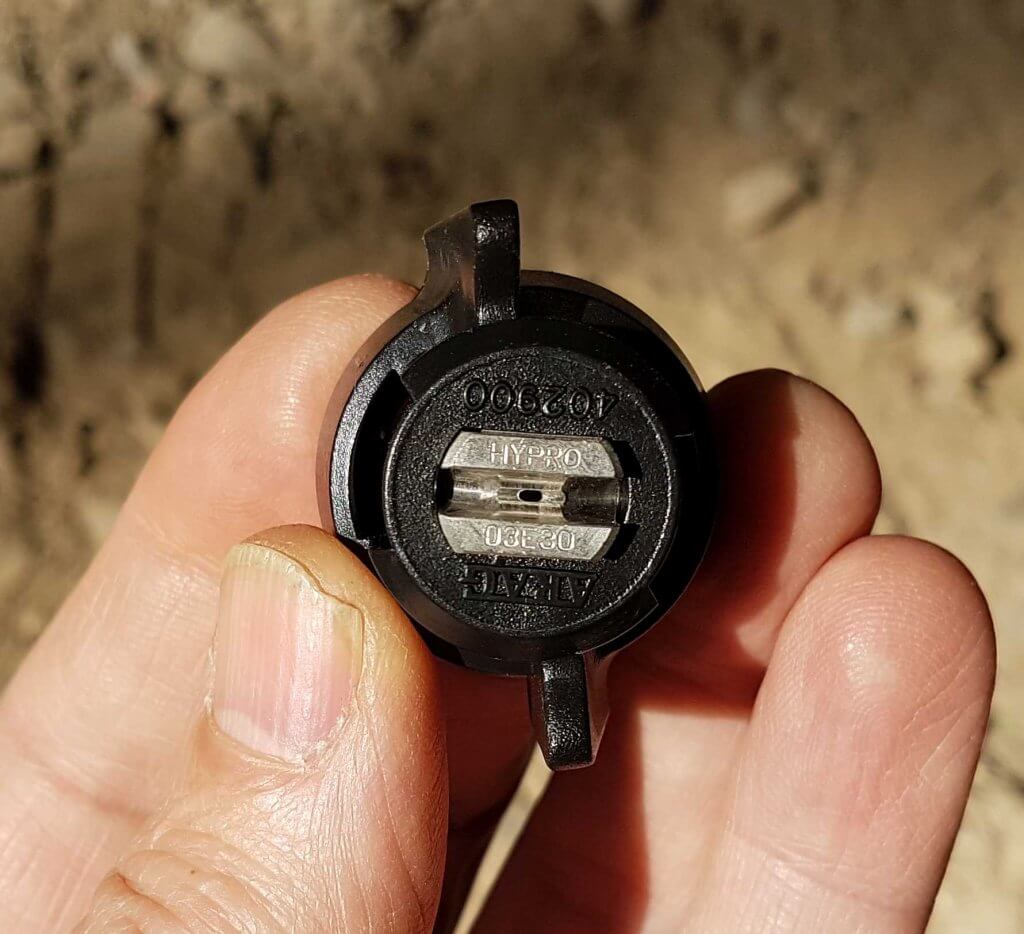
    Hypro even spray (banding) nozzle with 30 degree fan angle. 30 and 40 degree nozzles are currently installed on WEEDit on 10″ spacing.
    30 degree fan achieves approximately 8″ to 10″ band at target height. Boom stability is important

    The detection principle is based on the quality of light that is reflected from living plant tissue compared to everything else. A red (older generation) or blue (newest generation, Quadro) light is emitted, and chlorophyll-containing plants reflect a unique wavelength that differentiates them from ground or dead plant material.

    Older generation WEEDit sensors were placed at 1 m intervals and had five channels, each covering a 20 cm band. There were 180 nozzles on a 36 m (120′) boom.

    The response time of the system is very fast. Triggered by small solenoids, a sprayer travel speed of up to 15 mph is possible when the sensor looks 1 m ahead. Furthermore, the software allows the user two important controls: first, the sprayed distance before and after a detected plant can be buffered between 5 and 20 cm, resulting in a sprayed patch between 10 and 40 cm long. This could be useful when boom heights fluctuate and placement of the sprayed patch shifts accordingly. Second, the user can select from among four sensitivity settings. Higher sensitivity can detect smaller weeds but will also result in more false results.

    WEEDit Quadro sensor

    One reason the system has been successful in the southern hemisphere is the long growing season that may require multiple spray passes outside of the crop each year, and in which the weeds are relatively large at treatment time and therefore easier to detect.

    Water sensitive paper can be used to show whether a target has been detected (and therefore sprayed).

    In North America, the pre-seed spray window is relatively narrow and weeds may be very small or just be emerging. The risk of a miss due to non-detection is therefore greater. Fortunately, the WEEDit system has a feature that addresses this risk.

    PWM valve for WEEDit, capable of instantaneous response at 10 to 50 Hz

    The solenoids that trigger an individual nozzle are pulse-width modulated (PWM). This means that the application rate is adjusted according to travel speed via a duty cycle. And it offers an innovative capability: The entire boom can be programmed to spray a defined fraction of the full dose, to a maximum of 50%, as a background broadcast rate (called “Dual Mode” or “Bias”). The smallest weeds that escape detection are likely to be susceptible to this lower dose. Larger weeds are then detected and sprayed with an individual spot spray at the full dose. Dual Mode is typically set to about 25%; overall savings are less, but control is improved for those very early season situations.

    A WEEDit Quadro boom can also be operated in “Cover Mode” for broadcast spraying where it functions as a full PWM system with turn compensation.

    Currently, several hundred WEEDit sprayers are operating in Australia, and they’ve been available in Canada and the US since 2017. in 2019, Croplands, an Australian sprayer manufacturer owned by Nufarm, started representing WEEDit in Canada. It is available as a retrofit on existing booms, and can be ordered with a WEEDit Millennium aluminum boom that contains mounting brackets and wiring harness channels. Savings compared to broadcast spraying range from 65 to 85%.

    In early 2021, John Deere announced its entry into the Green on Brown space with See & Spray Select™. This system is built around the ExactApply nozzle body and uses RGB cameras to differentiate green plants from non-green background colours. It will be in fields in 2022 according to John Deere. Similar RGB-based systems are in development by other manufacturers. Although their performance has not been compared side by side with WEEDit or WeedSeeker, initial specs suggest that the RGB systems are slower and are less able to detect small plants. Nonetheless, the future looks very promising.

    In 2021, Hardi Australia announced a new product, called GeoSelect. This system does not have boom-mounted sensors, and instead sprays according to a prescription map developed by a drone. The advantage of this system is that the amount of herbicide needed is known in advance of spraying, and the knowledge of weed distribution in the field can allow for a more efficient coverage plan to be used. This system allows for spraying under any light condition, and adjusts for boom sway to ensure accurate placement. Drone map development is the responsibility of the applicator.

    Green on Green

    Green on Green spraying, which detects weeds within a crop and differentiates them from that crop, is advancing and the earliest commercial releases are now available in Australia, offered by a partnership between Bilberry and Agrifac (WeedSmart podcast here), as well as Bilberry and Goldacres with Swarmfarm. Others, notably the SmartSprayer from Amazone in partnership with Xarvio and Bosch and Greeneye Technology are entering field testing with commercial sized units in 2021 and 2022, respectively.

    Opportunities for Optical Spot Spraying

    Taken as a whole, optical spot spraying offers a number of opportunities for weed management.

    Cost Savings: OSS has an appealing rate of return on investment. On a 5000 acre farm, a pre-seed treatment of glyphosate plus tank mix for resistance management may cost $10/acre, or $50,000 per year. At an average savings of 75%, that represents $37,500 per year. Add other non-crop uses, such as post-harvest, and savings increase. With eventual weed recognition in-crop, virtually all herbicide treatments are candidates for such savings.

    Herbicide Resistance Management: Delaying the onset of herbicide resistance requires the use of multiple effective modes of action in a tank mix. Cost is a deterrent to this practice. With OSS, these tank mixes become affordable.

    Efficiency: With 75% product savings, a tank of product will last longer. The time lost to hauling water and product, as well as filling the sprayer, will decrease. For example, WEEDit users are spraying a full day on a single load. Or they may choose to use a much smaller load, decreasing equipment weight.

    Pre- and Post-Harvest: Whether for desiccation or weed control, site-specificity of late season sprays can also be based on living tissue. Only regions in the field requiring the desiccant are treated. Perennial or late-season weeds are selectively controlled pre-harvest. Since herbicide rates in these applications are typically higher, savings are significant.

    High value crops: Row crops requiring multiple fungicide applications per season, such as potatoes, can benefit from OSS. Sprays applied prior to canopy closure can thus avoid gaps between plants, saving product.

    Producer Innovation: One user of the WEEDit system in Saskatchewan developed an innovative use. Having missed a pre-seed spray, the applicator was faced with large weeds in a 1-leaf RoundupReady canola crop. By turning down the sensitivity of the system so the canola crop did not trigger the sensors and turning on Dual Mode, he was able to broadcast spray the field at a low glyphosate dose (sufficient to control the small weeds) and then apply a full dose to the larger weeds, triggered by the sensor.

    Equipment Innovation: Since individual zones or weeds require unique doses or products, technologies like direct injection, remote nozzle switching, multiple smaller tanks and booms, and PWM will make more sense and grow. But the whole concept of detection and treatment can be moved away from pesticides to mechanical control or other techniques such as lasers, as does Carbon Robotics.

    License to Farm: OSS makes intuitive sense not only to applicators, but also to the public at large. Showing and using these technologies demonstrates stewardship practices that are easy to communicate and understand.

    Artificial Intelligence Scouting

    Another approach is pioneered by several companies, for example Dronewerkers in the Netherlands (https://www.dronewerkers.nl/english/) Taranis (http://www.taranis.ag/), and Xarvio (https://www.xarvio.com). These companies have developed plant recognition algorithms that are currently able to identify over 100 different species. Each species can be divided into several growth stages. Taranis has launched a business in North America that scouts fields by high-resolution drone imagery, and then provides customers with maps that highlight potential agronomic issues such as weeds, disease, or insect damage.

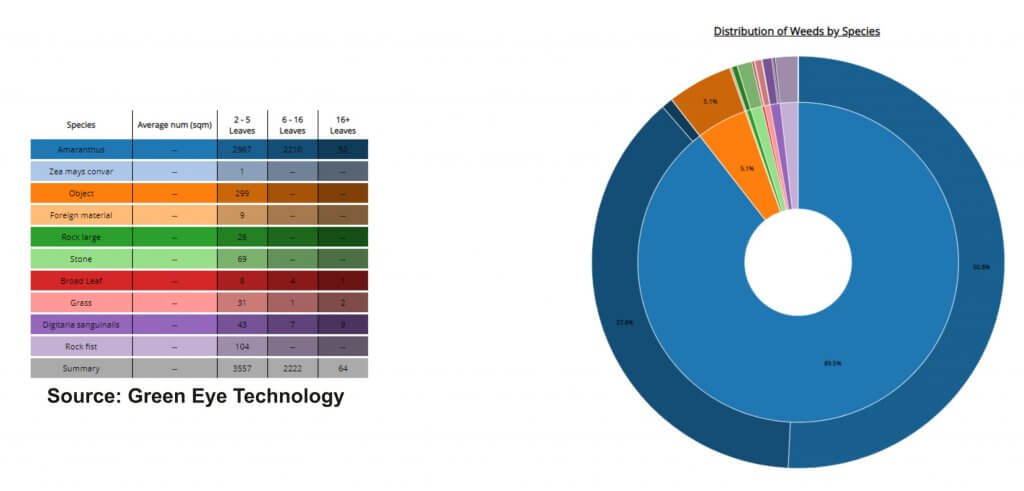
    Example of information available from artificial intelligence scouting. In this case, plant and foreign material information by species, relative abundance, and growth stage.

    Resolution of the output can be species-specific (lambsquarters vs redroot pigweed), or by coarser resolution (broadleaf vs grass). The resulting output then shows the plant density at each location.

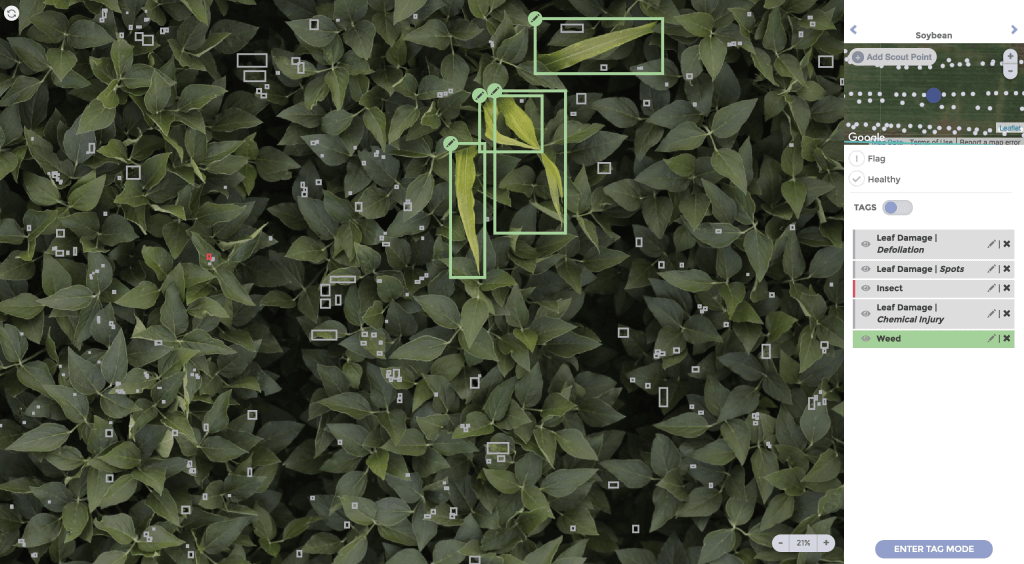
    Weeds in a soybean crop (courtesy of Taranis)

    Xarvio Scouting is a product in their Field Manager line (https://www.xarvio.com/en-CA/Scouting). App-based, the agronomist or producer takes pictures of their crops and the app is able to recognize weeds, diseases, insect feeding damage, as well as nitrogen status. The app is aware of other users in the area and basically crowd-sources emerging agronomic issues as they arise, communicating them back to the user.

    The Xarvio Scouting app can identify certain weeds, diseases, and insect feeding damage from pictures taken while scouting (Screenshot from Xarvio.com).

    The agronomic value of this information is clearly very high. Imagine knowing the distribution of weeds by species before and after treatment. Although we can already assess this when we walk fields, by conducting the task via drone we are measuring on a wide scale, permitting an accurate quantification of the treatment effect so its value can be assessed. This level of measurement intensity was not possible before. Yield loss models for time of removal of certain weeds at certain growth stages can be applied across the entire field, and economic analyses allows follow-up treatments to be tailored to specific portions of the field.

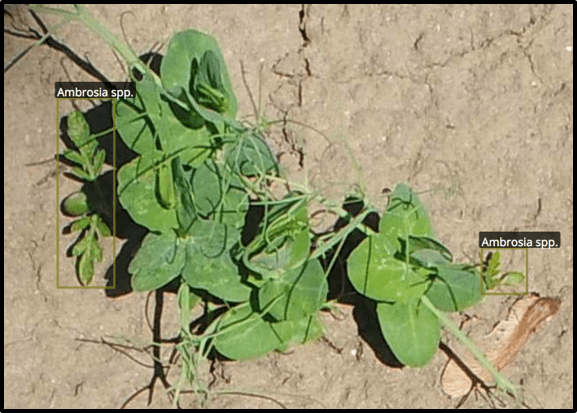
    Green-Eye Technology artificial intelligence can differentiate these ragweed plants from the pea crop. (Courtesy Green Eye Technology).

    Or imagine following specific patches of weeds over time, to monitor the effectiveness of a certain cultural practice, or be alerted to the establishment of a resistant population while it’s still feasible to contain it.

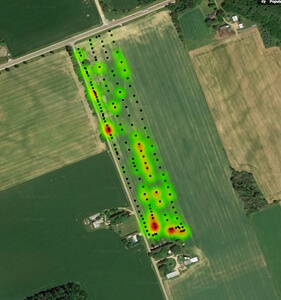
    Heat maps can be generated to document weed patches, and perhaps monitor their size over time. (Courtesy Green Eye Technology).

    When this information is converted to a prescription map, rate and tank mix composition (or cultural controls) could be varied as necessary by zone, or weeds could, in the future, be sprayed individually. Perhaps future autonomous robots could be deployed more efficiently.

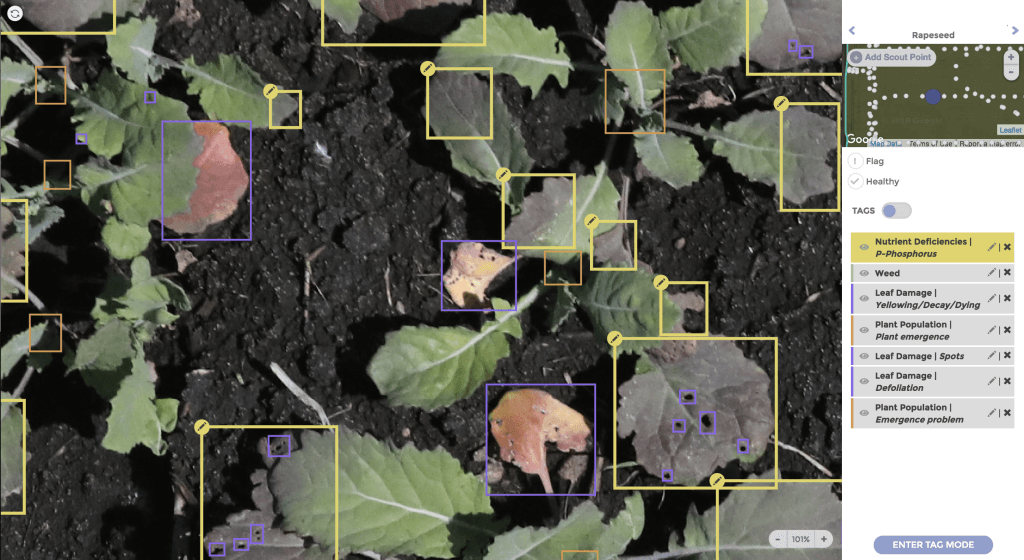
    Identification of plant symptoms in canola (Courtesy of Taranis)

    Development and improvement of these technologies is ongoing rapidly. Finally, we may have all the pieces that can bring site specific weed, disease, and insect management to market.