Tag: volatility

  • Fundamentals of Spray Drift

    Fundamentals of Spray Drift

    The year 1989 marked my first spray drift trial under the watchful eye of Dr. Raj Grover and John Maybank. We evaluated the performance of several spray shrouds, Flexi-Coil, AgShield, Brandt, and Rogers, and wanted to measure just how effective they were. But in my heart I wasn’t interested in drift. I wanted to study herbicide efficacy. Anyway, I thought, we’ll do this trial and I’m pretty sure we won’t have to revisit the topic.

    It’s now thirty-two years later and spray drift has interwoven itself into all my projects, remains one of the most powerful drivers of regulatory activity, is likely the most visible consequence of poor stewardship, and will stay as one of the dominant creators of public opinion around modern agricultural practice.

    Drift has not gone away. And yet our understanding of it is far from complete.

    Spray drift is defined as the wind-induced movement of the spray cloud away from the treated swath. Droplet drift can occur for all sprays, and it happens within minutes of the spray pass. Its cousin, vapour drift, is limited to active ingredients that are volatile, that is, they can evaporate from dry deposits after application. Vapour drift happens after the spray application is complete and can last several days.

    Droplet Drift

    Droplet drift can be divided into two phases that are separated by about 1 second and that are measured differently. “Initial drift” happens first and refers to the product that leaves the treated area immediately after atomization. It is airborne and can be measured by placing air-samplers (any device that can capture droplets in air) close to the downwind edge of the spray swath.
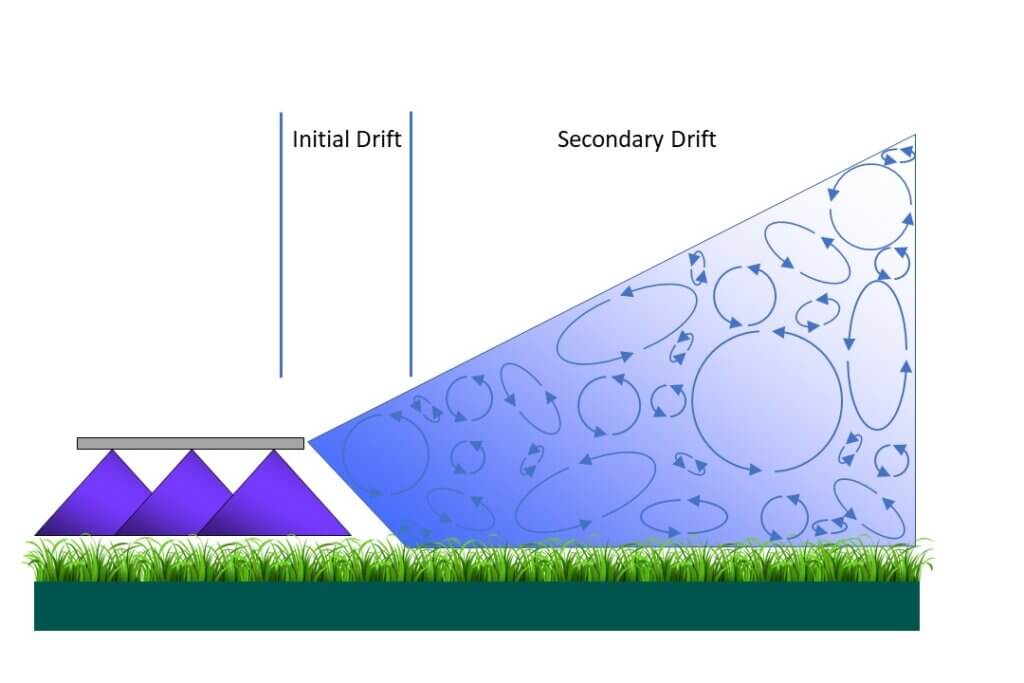
    Figure 1: Initial vs Secondary drift. Once the drift cloud leaves the treated swath, the relative strengths of turbulence and sedimentation determine the amount that remains airborne and the amount that lands downwind.

    Secondary drift describes the airborne spray cloud that continues to move downwind from the swath edge, where it either remains aloft or deposits on the surface below it. It is typically measured using samplers placed on the ground that capture sedimenting spray droplets. The difference in method is important because it goes to the heart of the problem of understanding spray drift.
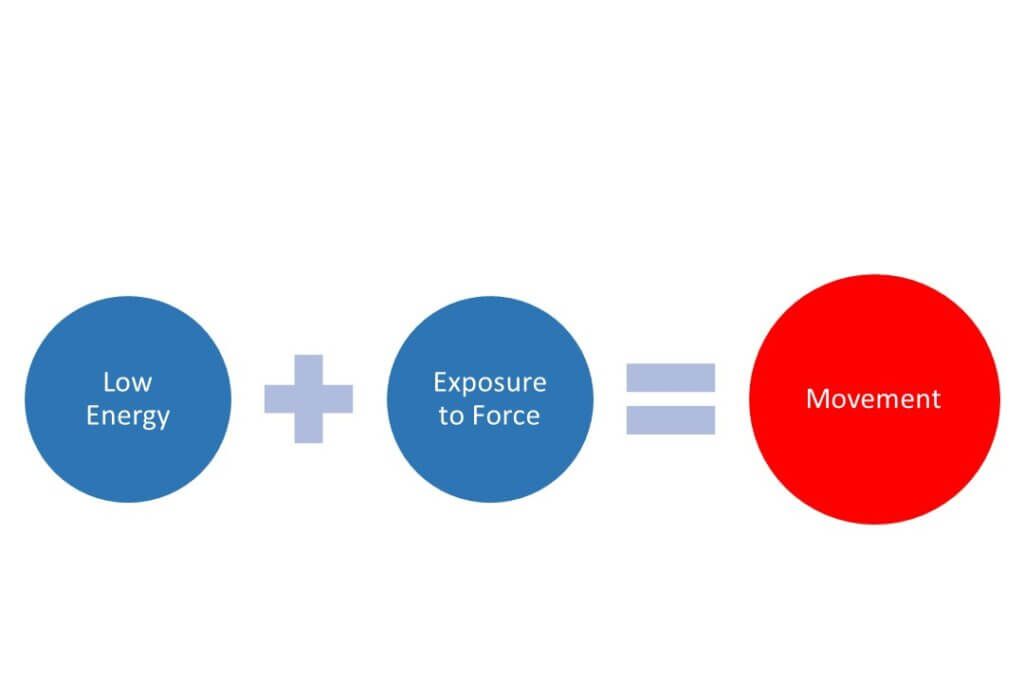
    Figure 2: Droplet drift occurs when displacement energy exceeds droplet energy. The droplet’s combination of mass and velocity cannot withstand the energy presented by moving air.

    Initial drift is actually quite easy to understand because its creation is intuitive. The displacement of droplets from the spray plume is a function of balancing two types of energy. The first, droplet energy, is the product of droplet diameter and velocity. The more energy in the droplets, the more difficult they are to displace, and that’s why larger, heavier droplets or fast-moving air assist are useful drift reducing tools.  The second, displacement energy, comes from relative air movement, either from forward travel speed or wind and the associated turbulence. More wind or turbulence means more power to displace.
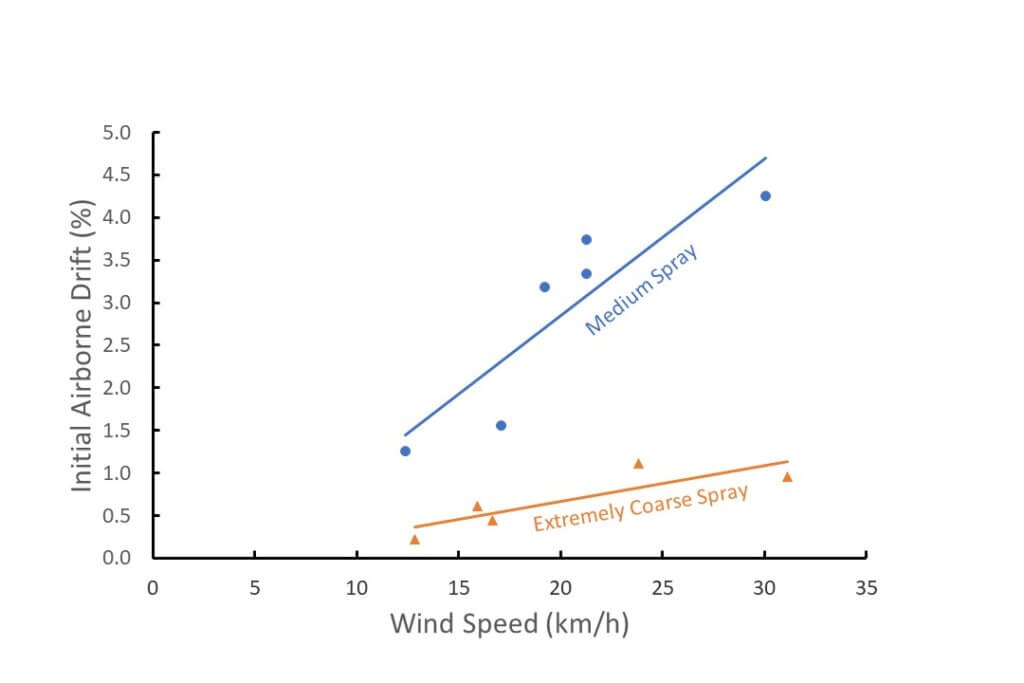
     Figure 3: Initial drift follows an expected response to greater wind speeds and coarser sprays. Data from a pull-type sprayer travelling 13 km/h with 60 cm boom height.

    Because initial drift is easier to understand, our most common advice for reducing drift is based on maximizing droplet energy and minimizing displacement energy. Lower booms, larger droplets, slower travel speeds, shrouds, or properly implemented air assist all help reduce initial drift. It makes sense that creating less initial drift will also reduce downwind deposition arising from secondary drift.
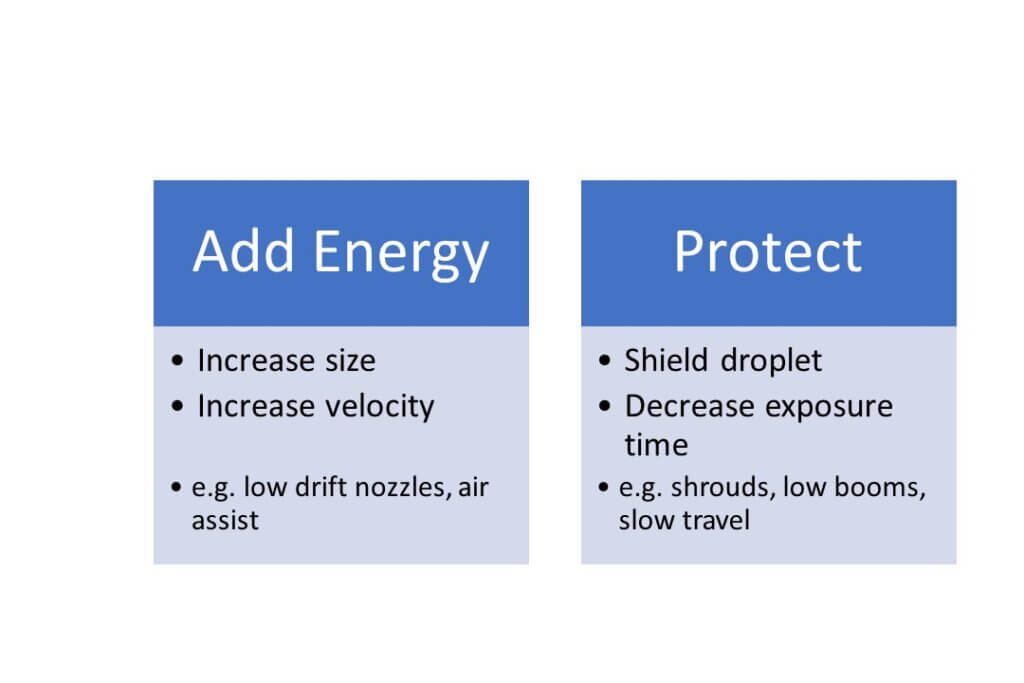
    Figure 4: Management of initial drift is intuitive. We reduce drift by adding energy to the droplet and by protecting the droplet from exposure to moving air.

    Downwind Deposition

    After leaving the spray swath, the moving secondary drift cloud has two main options. It can deposit or it can remain airborne. Basic physics suggest that all objects eventually fall to the ground, and since smaller objects need more time, they drift further. But when atmospheric turbulence and topography are considered, it’s not quite that simple. These two complicating factors control what proportion of the drift cloud remains airborne, and what proportion deposits.

    Drift trials show that about 20% of the initial drift amount returns to the surface within the first 100 m or so of the sprayer. The rest remains and rises in the atmosphere where it evaporates and gets mixed further.
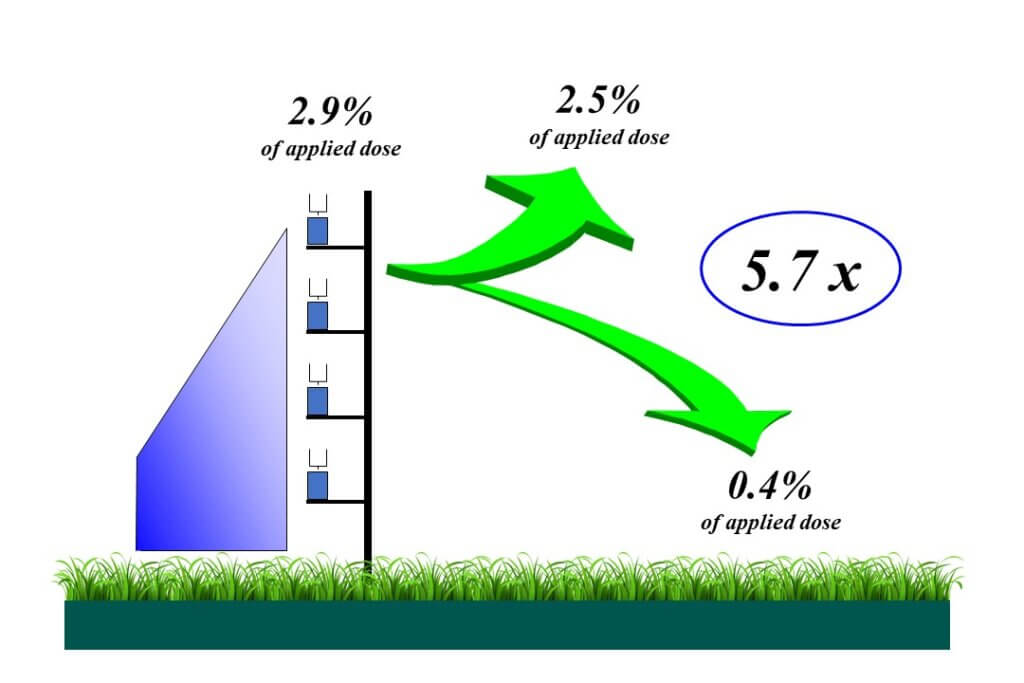
    Figure 5: The majority of secondary drift remains airborne. Data are for Medium spray quality from a pull-type sprayer with 60 cm boom height and 13 km/h travel speed

    It happens quickly. Just 5 m downwind of the spray swath, the cloud is already 4 m tall. At 100 m downwind, we’ve measured its height to be 30 m.

    The proportion of the spray that remains airborne depends on the spray quality and the nature of the atmosphere. If it’s windy and sunny, or if the spray is finer, turbulence sends more into the air. If it’s cloudy and the wind is low, we have little atmospheric mixing. As a result, a smaller proportion will remain airborne and more will sediment, and overall, we may actually have more potential to damage downwind areas.

    When we graph spray drift deposit data from a windy day, the deposit amount decreases exponentially with downwind distance. Usually, drift damage follows the same pattern. The larger droplets that contain the majority of the dose deposit first. The smaller droplets go further and are more likely to mix in the atmosphere and rise with thermals.
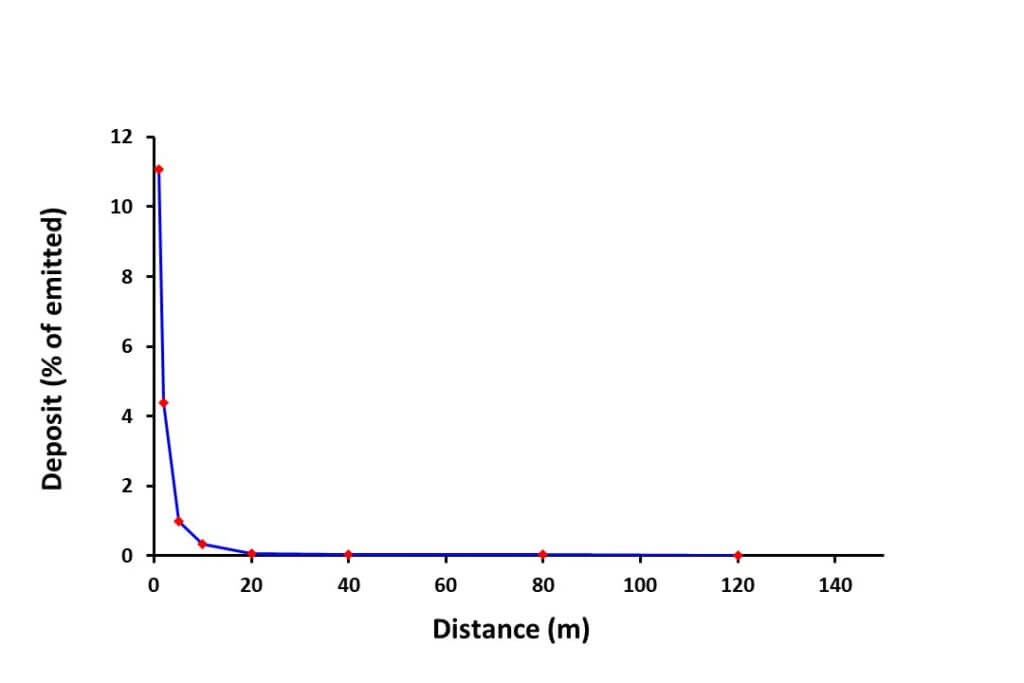
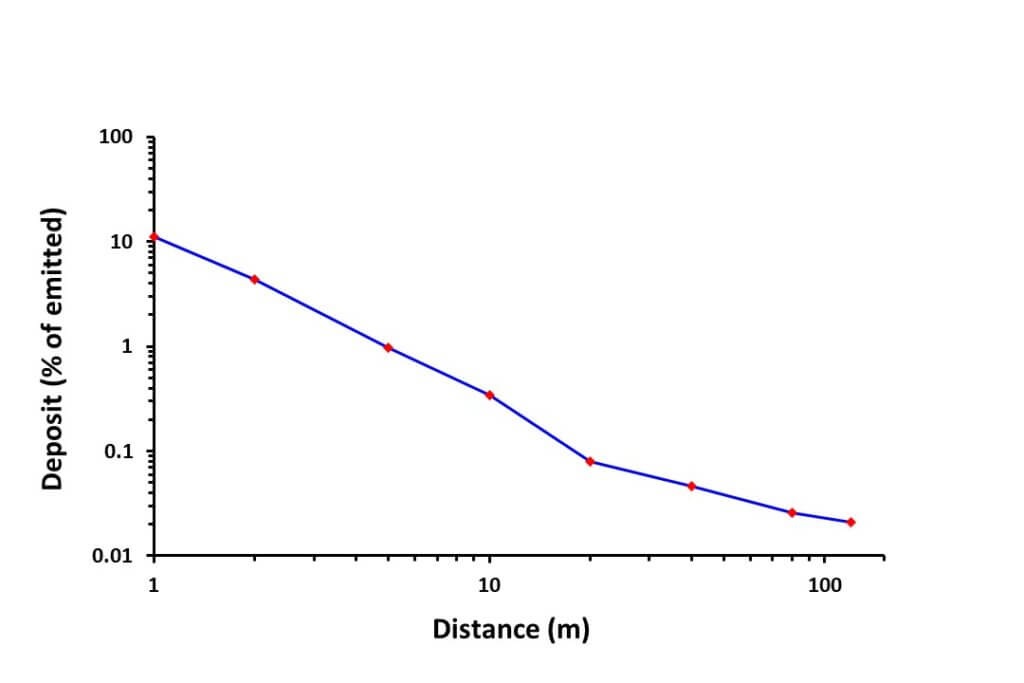
    Figure 6: Deposited drift decreases logarithmically with distance. Top, linear axes. Bottom, log axes.

    Under temperature inversion conditions that are common on calm summer evenings, overnight, and early mornings, the damage from the drift cloud does not decrease the same way. The cloud containing the buoyant mist lingers over a large area. Without atmospheric mixing and its resulting dilution with time and distance, large areas can be damaged.

    The Effect of Turbulence on Deposition

    We’ve established that the more atmospheric mixing we have, the less spray will deposit on the ground, at least in the short term. How does this affect our thinking on the role of wind?

    When we evaluated drift data from a number of trials, we always saw more initial drift with higher wind speeds, as expected. However, the downwind deposit did not usually increase significantly. We attributed this observation to turbulence generated by wind which lifted more of the initial drift higher into the atmosphere. To be clear, deposited drift did not go down with higher wind. It just didn’t rise as fast as initial drift.
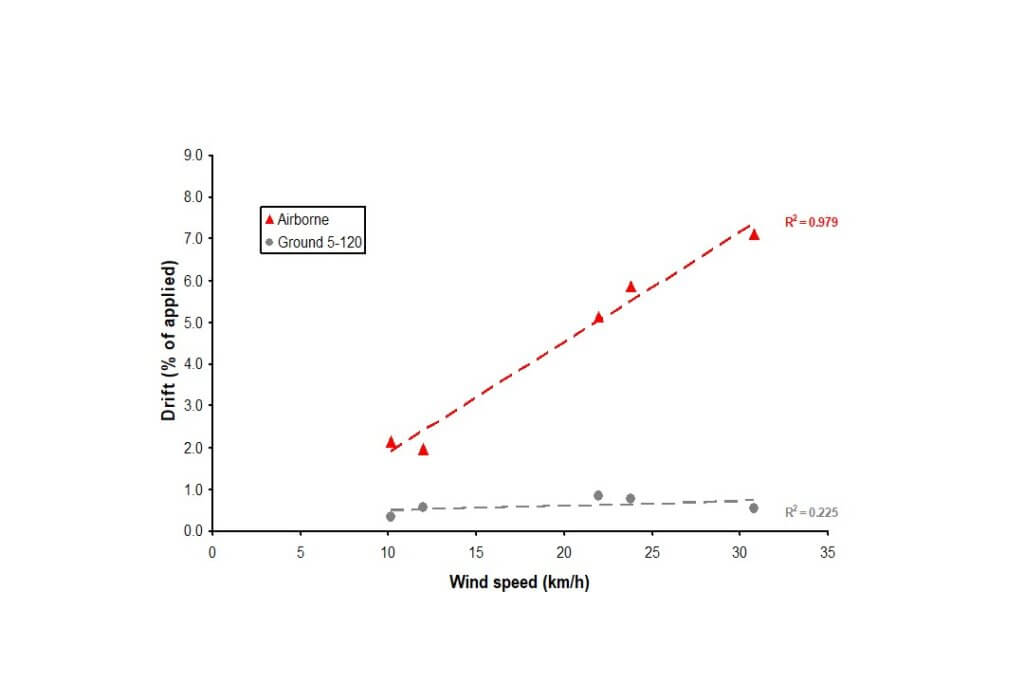
    Figure 7: The effect of wind speed on airborne drift (top line) vs deposited drift (bottom line) from a high clearance sprayer travelling 23 km/h and emitting a Very Coarse spray.

    The effect of turbulence can be viewed as a good thing because it protects downwind objects. Rapid dilution reduces immediate drift damage. We can use turbulence to protect objects on the ground. It’s certainly better than the alternative, emitting sprays when the atmosphere can’t dilute them, such as in an inversion. In that case, downwind areas remain at risk for a long distance, and for a long time.

    But we have to also consider what happens to airborne spray droplets. Some pesticides degrade in sunlight and stop being a problem. But others are more stable and may persist in the atmosphere for days or longer. During that time, they may move significant distances, ultimately returning to the earth’s surface in precipitation or in dust. Even though the atmosphere has diluted them, these deposits are measurable, and will show up in environmental monitoring of air, soil, and water.  We may not be able to find out where they originate, but the public knows who to blame. Agriculture.

    Vapour Drift

    Vapour drift is another issue altogether. It occurs hours and days after application, as long as the volatile product remains on a surface and conditions that allow formation of vapours persist. Vapour pressure is related to surface temperature, and losses increase with warmer surfaces. Some products enter the vapour phase when in contact with water, and release vapour after a rainfall.

    In situations where vapour is released for several days after application, it becomes impossible to control its subsequent movement. For droplet drift, if we know the wind direction at the time of spraying, we know where the impact is likely to be. But vapour movement depends on conditions that may occur between now and three days from now, and these could include high temperatures, various wind directions, and even inversions in which vapours accumulate. Ultimately, the best way to avoid off-target vapour movement is to avoid using volatile products.

    The Public Good

    Spray drift is one of agriculture’s most important stewardship challenges, and our industry needs to continue to improve its track record. Sprayers have a difficult task of converting a relatively small volume of liquid into a spray that offers good target coverage yet doesn’t move off the treated area. Favourable weather combined with droplet size management are at the heart of making this system work, but there isn’t a lot of wiggle room. Once again, an emphasis on sprayer productivity is one of the most fruitful areas to invest in, as this makes the best of the sometimes rare conditions in which spraying conditions are optimal.

  • What’s the Relationship Between Vapour Drift and Inversions?

    What’s the Relationship Between Vapour Drift and Inversions?

    Drift symptoms can take a few weeks to be discovered, and to figure out the cause, people need to reconstruct the conditions during the application in question. Wind direction is the easiest. But when we consider factors like inversions, volatility, calm conditions, and others used to explain the movement of pesticides, it can quickly become quite confusing.

    Let’s review how and why pesticides move.

    There are about six main ways that pesticides can move off-target.

    1. Droplet drift at the time of application;
    2. Vapour drift at or after the time of application;
    3. Pesticide movement in water (precipitation or runoff) after application;
    4. Dislodgeable residues from plant surfaces after application;
    5. Pesticide-containing soil movement after application;
    6. Pesticide residue in sprayers applied to another site.

    Whenever we find pesticides in a place where they do not belong, usually first indicated by plant symptoms specific to that herbicide, we need to find out the possible reasons and take steps to prevent that from happening again. We’ll focus on the first two items from the above list because those two are the most common.

    Droplet Drift: Sprayer nozzles produce droplet sizes ranging from 5 to 1000 µm, some up to 2500 µm. All nozzles, even the venerable low-drift tips recommended for dicamba application, will have a fraction of their volume in driftable droplets, say, less than 150 to 200 µm. For the low-drift sprays, that fraction is indeed very low, only a few percent of the total spray volume. For conventional nozzles, the driftable fraction may be 10 to 20% or more if high pressures are used.

    Tiny droplets have no energy of their own and move with the air mass they’re released into. If it’s windy, they move downwind. If the air is turbulent, they move up and down. If the atmosphere is stable, the buoyant fraction stays aloft and concentrated. So in order to understand their movement, we need to understand the atmosphere.

    Vapour Drift: Some chemicals are inherently volatile. This means they convert from the liquid or solid phase to a vapour phase on their own in accordance with temperature. Water is a great example, it is highly volatile. It is also able to sublimate, which means it can convert from a solid directly to a vapour without going through the liquid phase. An example of that is freezer burn, in which ice cubes shrink due to water escaping as a vapour.

    Volatile pesticides can also sublimate. On landing on a leaf or soil, a significant portion of a droplet is absorbed or adsorbed. Some fraction may dry on the leaf surface. This remaining solid can volatilize (form a vapour) for hours or days after application. The rate of evaporation is driven by two factors, (a) the background vapour pressure of the substance in the atmosphere, and (b) the surface temperature of the object the chemical is resting on. For water, the atmospheric vapour pressure can be expressed as relative humidity. Droplets evaporate slower when the atmosphere is already full of water.

    Pesticide evaporation is driven primarily by surface temperature. The background concentration of pesticide in the air is much lower than saturation, and has no effect. Pesticide evaporation is not directly affected by relative humidity because vapour pressures are independent of each other. In other words, most active ingredients will evaporate at the same rate whether the RH is 30% or 100% (it’s actually a bit more complicated than that. See the Note on Evaporation at the bottom of this article). This will be on the test, kids.

    Vapour losses can be minimized by choosing low-volatile pesticides and also by making the application on cooler days. We also need to watch the forecast and avoid spraying when tomorrow or the day after is forecast to be hot.

    Sometimes a rainfall can affect vapour losses, prompting a release of pesticide into the atmosphere. This behaviour can be predicted by the Henry’s Law Constant of a chemical.

    Inversions:  There are two types of turbulence, mechanical and thermal. Mechanical turbulence results from air encountering friction as it moves across a landscape. Taller objects and stronger winds result in greater mechanical turbulence. This turbulence creates small eddies that allow different layers of the atmosphere to communicate with each other and transfer momentum and contents up and down. More mechanical turbulence means more mixing and more sedimentation and dilution of a contaminant. In other words, the downwind impact of drift particles is reduced with greater mechanical turbulence. Mechanical turbulence happens whenever it’s windy, day or night, and it tends to counteract thermal turbulence.

    Thermal turbulence is more powerful than mechanical turbulence for dispersion of pollutants. Driven by the solar heating of the earth’s surface, that causes the lower atmosphere to be much warmer than the air higher up. The atmosphere normally cools the higher you go (at about 1°C/100 m, called the dry adiabatic lapse rate), but when it’s sunny, the gradient is greater. In other words, it cools faster because the air at the ground is warmer.

    Thermal effects move large parcels of air up and down, and we call this an unstable  or a turbulent atmosphere. When parcels of air rise and fall great distances, we get a powerful diluting effect which is usually associated with a breeze but can also happen under calm conditions. An unstable atmosphere is great at dispersing drift, minimizing its downwind impact. This can only happen during the daytime, is most powerful when it’s sunny, and almost never happens at night.

    By the way, a neutral atmosphere occurs when the rate of air cooling with height equals the adiabatic lapse rate described above. A neutral atmosphere can occur on cloudy days just before a rain, or on windy nights. There are no thermal effects in a neutral atmosphere, and the only dispersion occurs due to mechanical turbulence (windy conditions).

    A stable atmosphere (inversion) happens when there is no solar heating of the soil. In other words, it can only happen when the sun is low in the sky or at night. In this case, soil cools off and the cold soil cools air near it. As a result, the air temperature rises with elevation. Since it’s normal for air to cool with elevation (at the dry adiabatic laps rate mentioned earlier), the temperature profile is now…inverted. Hence the name “inversion”. To be clear (write this down kids, it’s on the test), an inversion describes an atmospheric condition in which (potential) temperature rises with elevation. That’s it. It rarely happens during the day, but is common on clear calm nights. (btw, “potential temperature is the temperature adjusted by its normal rate of cooling with height. To have thermal effects, the rate of cooling needs to be different from this rate.)

    The atmosphere is called stable because there is no thermal mixing. Air parcels stay put. Suspended particles such as tiny droplets stay put. Drift clouds stay concentrated, potent. If you make a fire, smoke hangs around. Cool, dense air is near the ground, and moves laterally very slowly, and might run downhill, like water, in a sloped setting. This situation is dangerous because it can move pesticide particles or vapours great distances without them becoming diluted or dispersed. An additional danger is that relative humidity is higher at night, delaying evaporation of water from the droplets. They stay potent.

    In Summary: Pesticides move in the atmosphere and are rapidly diluted by mechanical, and especially thermal, turbulence. That is why we like to see spray applications on sunny days with a nice breeze, which moves the product in a predictable direction and dilutes any drift rapidly along the way. We minimize particle drift through the usual measures such as the use of low booms, protective shields, slow travel speeds, and coarser sprays. We avoid spray application of volatile pesticides on or preceding hot days to minimize the risk of vapour drift. We do not apply pesticides when the atmosphere is stable (inversion), which usually means from just before sunset to just after dawn on a clear night.

    OK, that’s the basics. Now let’s explore some common questions.

    1. Can all pesticides move as particles and vapours? All pesticides that are atomized through a nozzle can move as particles. Only pesticides that are considered “volatile” can form significant amounts of vapour and move in that form. Dicamba is volatile. New dicamba formulations such as Xtendimax, FeXapan, and Engenia are much less volatile than older formulations, but they’re still capable of moving as vapours. Glyphosate and many other pesticides are not considered volatile and are not known to cause vapour drift.
    2. Are inversions only a problem for dicamba? Inversions affect droplet drift from all pesticides equally. The key difference is the amount of harm that any given droplet or vapour cloud can impart. Dicamba can harm conventional soybeans, many vegetable crops, and many trees and shrubs at extremely low doses. That means that even a weak inversion or a small amount of drift can cause great harm for long distances. In comparison, most other products are not as harmful to most of our crops in such small doses (I’m generalizing, forgive me). Tiny amounts may never be noticed, but they are there. Dicamba lets us notice these tiny amounts.
    3. Does vapour drift move only by inversions? No, although its movement is more damaging under inversions. Vapour drift clouds form above a recently sprayed canopy on hot days when leaf or soil surfaces contain a volatile product. On a sunny day (no inversion), this vapour will likely disperse rapidly downwind, causing diminishing damage with increased distance in relation to the sensitivity of the non-target plant. But towards evening, the dispersion (caused by thermal turbulence) ends as the sun sets and the atmosphere becomes stable. Now, the residual vapour cloud above the crop is no longer diluted, and may move in an unpredictable direction based on the slope of the land or a very gentle evening breeze. This movement may be significant, extending for miles in some cases, and potentially causing harm along the way.
    4. How long after application can vapour drift occur? Under most conditions, vapour losses diminish rapidly and will likely be gone within a few days as the pesticide is taken up by plants, metabolized, converted to a non-volatile form, etc. For some products, a light rainfall event can release a new wave of vapour drift because these products would rather be vapours than be dissolved in water, in accordance with their Henry’s Law Constant.
    5. Do some products drift further than others? Yes and no, but mostly no. Spray drift is a physical process governed by the behaviour of droplets in the atmosphere. Droplet diameter determines its mass and this mass controls the time it takes the droplet to sediment to the ground. The substance dissolved or suspended in that droplet has no bearing on this behaviour. But there are two key exceptions to consider. First, we know that some formulations generate more fine droplets than others even when atomized through the same nozzles. The greater abundance of small droplets will create more drift damage at any given distance, and also extend further downwind. And secondly, some formulations change the rate of water evaporation from the droplets. As a result, droplets moving downwind may shrink faster, in effect making them more drift prone and causing them to move further downwind. The same droplet size drifts the same distance, but droplet size changes. Question for the final: If you spray dicamba and glyphosate on the same day using the same nozzle, and the formulation has no impact on droplet size or evaporation, which one drifts further over a soybean crop? The answer is at the bottom of this article.
    6. Do calm conditions indicate an inversion? Inversions are defined as a temperature profile, not a wind condition. But the two are associated. An inversion is most pronounced and persists the longest under calm conditions, and because it suppresses atmospheric mixing, an inversion does prevent a windier upper atmosphere from reaching the ground. But it can be calm in the middle of the day with an unstable atmosphere. The calm condition eliminates mechanical turbulence, and therefore reduces the dispersion of the spray cloud. Calm conditions are also undesirable because the winds that follow a calm period are often unpredictable in direction, force, or duration. So it’s not a great idea to spray when it’s completely calm, even on a sunny day.
    7. Can inversions occur during the day? Yes, but it’s rare. Sometimes a large cold air mass moves into an area, say from a cool body of water, pushing warm air above it. So technically the air at the ground is cooler than the air above it, suppressing dispersion through that cap. Another situation is an inversion layer that forms at the top of a transpiring plant canopy. The air at ground level is warm, and cools suddenly where the crop evaporates water from its leaves. Air temperature rises with elevation above this transpiring layer, then cools again in accordance with an expected profile. So we have a thin layer in which vertical mixing is suppressed. This is most common in dense, thick canopies with adequate soil moisture on hot days.
    8. Is there an inversion every night? No. Cloud cover suppresses the rapid cooling of the soil, and the air at soil level stays warmer longer. Wind mixes the cold air layer into a warmer air layer, returning a more neutral condition. Inversions are most likely on clear nights with little wind. Recent data in inversion frequency from Missouri and North Dakota shows that inversions occur on the majority of nights, but the frequency depends on the location.
    9. Can drift be eliminated? Yes, we can eliminate spray drift by atomizing the spray in droplets (or, for dry soil-active products on carrier particles) large enough to resist movement in wind. We would need to be sure that absolutely no fine droplets or particles are produced, and that they don’t dislodge after application. That will require different atomizers and significantly more water volume and possibly new adjuvants. Some will argue that drift can also be eliminated by protecting the fine droplets with shields or air assist, but again, the protection would need to be 100%. Drift control has not been a high enough priority for these technologies to be developed and made available to applicators. Vapour drift can be eliminated by not applying volatile products.

    Pesticide movement in the atmosphere is complicated. But pesticides don’t just move as a result of vapour or droplet drift. Consider all the options when investigating an affected field. And let’s all work together to better understand pesticide movement and to prevent it.

    Answer: Both drift equally. But assuming the beans are susceptible to both herbicides, the dicamba damage will appear further downwind due to the greater sensitivity of the beans to this herbicide. This does not mean it drifted further.

    Note on Evaporation: There is some discussion about the role of relative humidity on vapour loss. Although we stated that RH plays no direct role in pesticide volatility, we need to qualify that.

    (a) Many pesticides dissolve in water. More water moves to plant or soil surfaces during periods of low RH, and this can carry dissolved pesticide with it. The supply of pesticide that can evaporate is thereby replenished.

    (b) Evaporation is driven by temperature and the concentration gradient between the source and the atmosphere. In still air, the air layers closest to the evaporating surface are most concentrated with evaporated pesticide, slowing further evaporation. Air movement will remove these layers, increasing the rate of evaporation.

    (c) co-distillation may occur for some pesticides. This means that the pesticide dissolved in water may evaporate with water, liberating it into the atmosphere. When co-distillation occurs, low RH would increase pesticide losses as well.

    We still have much to learn about these phenomena, especially as it affects new formulations.

  • The Misplay of our Generation

    The Misplay of our Generation

    We tend to overestimate the effect of a technology in the short run and underestimate the effect in the long run.

    –Amara’s Law of Computing

    We tend to overestimate the effect of a stewardship mistake in the short run and underestimate the effect in the long run.

    –Wolf’s Adaptation of Amara’s Law to Agricultural Stewardship

    August 9, 2017

    Since June of 2017, we’ve been hearing reports of widespread dicamba damage symptoms in soybeans throughout the US mid-south and midwest. It appears that millions of acres could ultimately be affected, and yield impacts are unknown at this time.

    For those new to the issue, dicamba is a broadleaf herbicide in the Group 4 mode of action group, a benzoic acid. It’s an important tool for herbicide resistance management for weeds like palmer amaranth (Amaranthus palmeri) and waterhemp (A. tuberculatus), populations of which have become resistant to Group 2 (ALS inhibitors), Group 5 (triazines), Group 9 (glyphosate), Group 14 (PPO inhibitors) and Group 27 (HPPD inhibitors) in some places.

    Dicamba is a volatile herbicide, discovered in 1942 and first registered in the US in 1967. Its primary use was in corn and other cereal crops, lawns, and rights of way, at comparatively low doses, and relatively early in the season.

    Calling a pesticide volatile means it can evaporate after application, either from a liquid or a dry deposit, for hours or sometimes days after application. The resulting vapor cloud can move unpredictably, depending on atmospheric conditions, and affect plants long distances away. Higher temperatures increase vapor loss.

    Starting this year, dicamba-tolerant soybeans and cotton (Xtend varieties) were sprayed with new lower-volatility formulations of dicamba, XtendiMax, Engenia, and FeXapan, to control certain broadleaf weeds (including the Amaranth species above) without harming the soybeans. Problem is, dicamba can harm non-Xtend soybeans and other plants, even at very low doses. And these registrations were for applications that occurred later in the season, at higher doses than before.

    I usually don’t get involved in people’s decision about whether to spray, or what to spray. But I do get involved when it comes down to how to spray. That’s my job. The real question to me is “can this product be used safely in cotton and soybeans?” Right now, the jury’s out on that one.

    In my business, our guiding principles are what some people have called the “Three Es of Application”, Efficacy, Efficiency, & Environment.

    We use sprays to control pests. That’s the only reason. We have to apply them so that they work, or else it’s a wasted effort. That’s the efficacy part. We also need to use our resources, time, money, etc., efficiently so the whole process doesn’t bankrupt us and we have time left for other important tasks.  That’s efficiency. And finally, we need to protect the environment, and that means making sure the product lands where it’s intended.

    None of these three priorities trumps the others. All need to be met to the best degree possible. And due to ever-changing conditions, we will typically change our approach to emphasize one or two of these three over the others, to have a working system.

    Simply put, pesticides belong on target surfaces covered by the swath of the sprayer, and nowhere else. If they do move elsewhere (something we’ve come to view as inevitable), regulators conduct risk assessments to ensure that this movement does not result in harm. If harm is possible, mitigating tools such as application timing, product rate, spray method, and buffer zones may be imposed. If those tools aren’t enough to ensure safety, regulators deny product registration. That’s their job.

    But even if no harm is done by trespass, the products still need to be on-target. That’s stewardship. It’s a principle whose adherence gives license for a technology to be used. It gives others faith in our competence. Practicing this principle when it’s easy prepares us for hard times.

    I respect our regulatory process, and know it to be increasingly conservative with regards to risk the less data there are. I worked for the PMRA (the Canadian pesticide regulatory agency) as an application expert for five years. I know the system isn’t perfect and can make mistakes.  I know the system can be political. Usually it’s by being too careful. With dicamba, it looks like the opposite happened.

    The reason we’re seeing dicamba leaf cupping everywhere isn’t because all applicators suddenly forgot how to spray. They didn’t suddenly get reckless. They didn’t wilfully ignore all the training that the dicamba manufacturers and state and provincial governments developed in preparation for the product launch.

    Instead, dicamba drift reports arose from a combination of extreme sensitivity and easily identified symptoms, as well as an unexpected (by some) amount of vapor drift. Even good applications appeared to create problems. Despite warnings from local experts, regulators and registrants didn’t see it coming.

    Experienced agronomists have suggested that the observed dicamba trespass of 2017 implicates both temperature inversions and vapor drift. And although the new product labels advise against spraying under inversion conditions, they don’t say a word about vapor drift, the conditions that give rise to it, or how to protect against its occurrence. Not one word. I’ve searched the XtendimaxEngenia and FeXapan labels. Nada.

    Seems that the regulators and registrants felt confident enough in the reduced volatility of dicamba, based on their internal empirical data and modeling, that they didn’t need to mention it on the label. Calling that a mistake is an understatement.

    I’d call it the biggest spray application misplay I’ve ever seen.

    A part of the problem may be the enormous scale on which this new use of dicamba was introduced, over 25 million acres of Xtend crops. Scale-up errors are common in many industries. Emergent properties related to scale can’t readily be predicted by empirical data and models. Especially when the underlying data are scant.

    So what to do? The continued success of agriculture depends to continued access to safe crop production tools. Irresponsible use threatens that. And by irresponsible use, I don’t just mean application. I also mean registration, promotion, sale, and support. The whole stewardship package.

    When problems occur, we need to be quick on our feet to acknowledge them, to support those affected, and to try to understand the cause and prevent the situation from continuing or getting worse.

    The current industry response appears to be the exact opposite. What I’ve seen is full of denial, downplaying, innuendo, blaming, and entrenchment.

    Why is such an important issue in pesticide stewardship handled so poorly?

    The immediate victims of this situation are the producers that depend on new technologies. But the long-term victim is agriculture as a whole. The lack of humility and leadership by many of the proponents of this technology, those with no small financial stake in its continued use, hurts not just them, but all of us involved in farming. This is not stewardship. It’s not license. It’s short sighted and reckless.

    Over my career, spray application has generally become safer for the operator and the environment. A big part of our success has been the adoption of low-drift nozzles, the de-facto standard for modern pesticide application. The development of less toxic and less persistent pesticides has also been very important. We can avoid a lot of problems with good chemistry. I’ve been proud to tell this story.

    I want to stay proud of our story. And in this case, that requires admitting to mistakes that were made and taking corrective action that is in the best interest of our entire industry. Agriculture will persist longer than company brands and titles. It takes priority.

    It’s still too early to fully understand all the reasons for the widespread dicamba damage. But it’s not too soon to say that much of this could have been prevented with a smaller rollout, with greater collaboration with government and university experts during registration, and with more honest information on dicamba volatility on product labels. Call it Volatility Humility.

    We’ll all pay for the mistakes that were made. We’ll likely have more stringent and expensive registration protocols. More restrictive application parameters. Strained relationships. More distrust of agriculture.

    And as always, an ounce of sweet prevention would have been much better than the pounds of bitter cure that will surely be required to make this right.