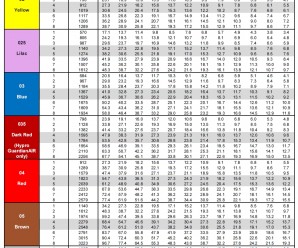
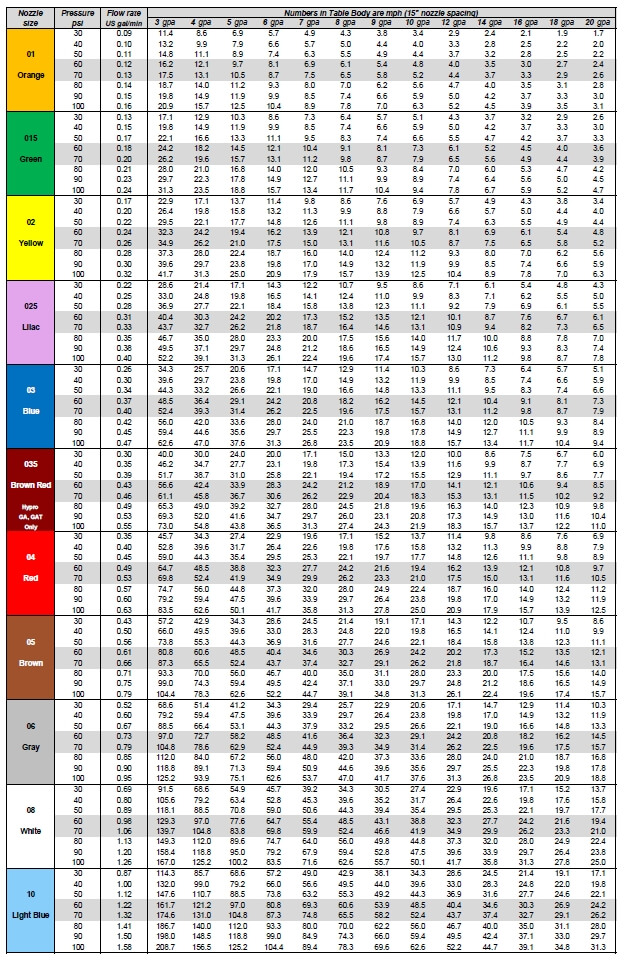
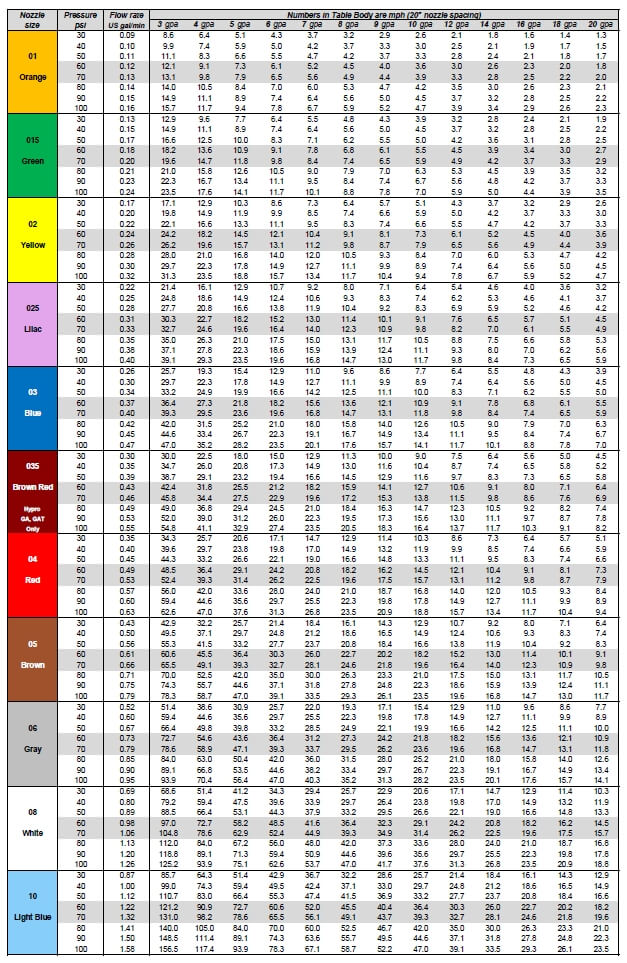
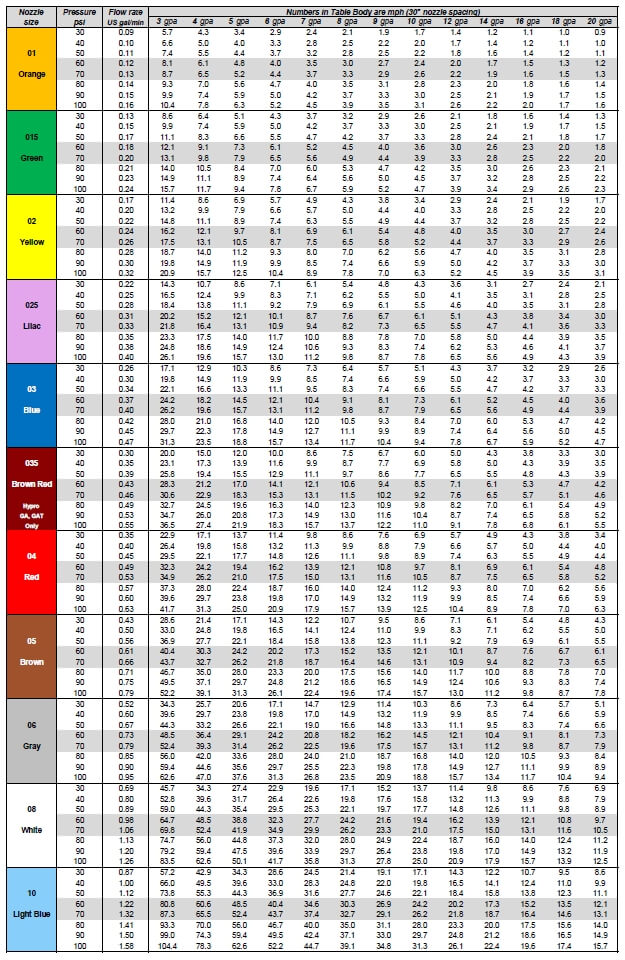
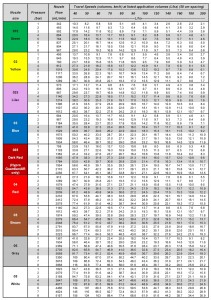
Need to find the right nozzle size for your application? Sometimes a simple chart is the easiest way to figure things out. Print it and place it in your sprayer cab.
In this chart, identify your water volume along the top row, and follow the column until you encounter the travel speeds you’re interested in.
Once you’ve encountered your travel speed, move along the row to the left to identify the nozzle size and spray pressure.
Make sure that your travel speeds are achieved at a pressure that’s right for the nozzle you’re using. For most air-induced nozzles, this will be about 60 to 70 psi (highlighted).
Once you’ve decided on a nozzle size, the travel speed column for that size becomes the travel speed range at various pressures. Avoid operating a low-drift spray below 30 psi – its pattern will be too narrow and likely its spray quality will be too coarse for good results.
Click on the images or text below to download a high quality pdf version of each chart, starting from the top with US, 15″ spacing, then US, 20″, then US 30″, then metric, 50 cm. Print, laminate, and place them in your sprayer cab.
Canada, like most of the world, is officially Metric. Our American friends are US Imperial. It sounds very cut and dried, doesn’t it?
Anyone that’s tried to calibrate a sprayer in Canada quickly discovers that we’re really a horrible amalgam of the two systems. Our sprayers and nozzles often hail from the states, and that means US Imperial. Our pesticide labels hail from Health Canada’s Pest Management Regulatory Agency, and that means Metric
And so, when speaking with applicators about their sprayer practices, we’re often treated to mind-rending sentences like:
Well, I drive 12 mph, spraying about 150 L/ha and my pressure is about 40 psi. How many ml/min should my nozzles emit for a product that wants 6 oz/acre acid equivalent?
Cue the quiet sobbing…
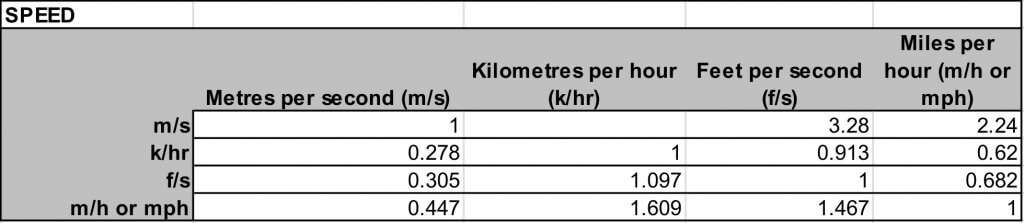
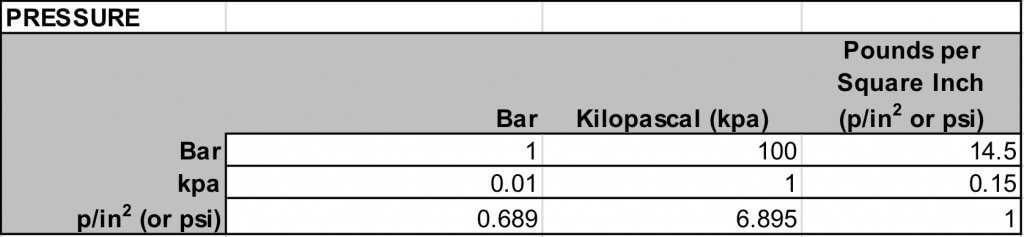
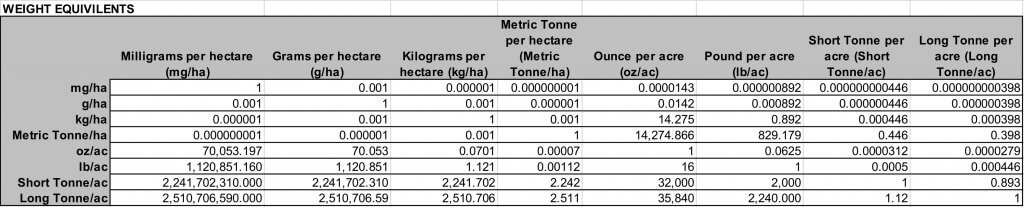
Well, your smoking calculators are in for a treat! In a fit of frustration we created the ultimate set of conversion tables that should set you right for almost any Imperial/Metric emergency! Find one we missed -We DARE you! (update: Tip of the hat to D. Wiens of Saskatchewan, who found one! We added it.)
Simply find your current units in the left-hand column. Then find the units you are converting to in the upper row. Now multiply by the conversion figure where they intersect in the table.
Yes, they’re ugly, but they’re absolutely complete! If the tiny ones are too tiny to read, right click and download the image so you can zoom in. It’s a limitation of this website that we can’t make them larger.
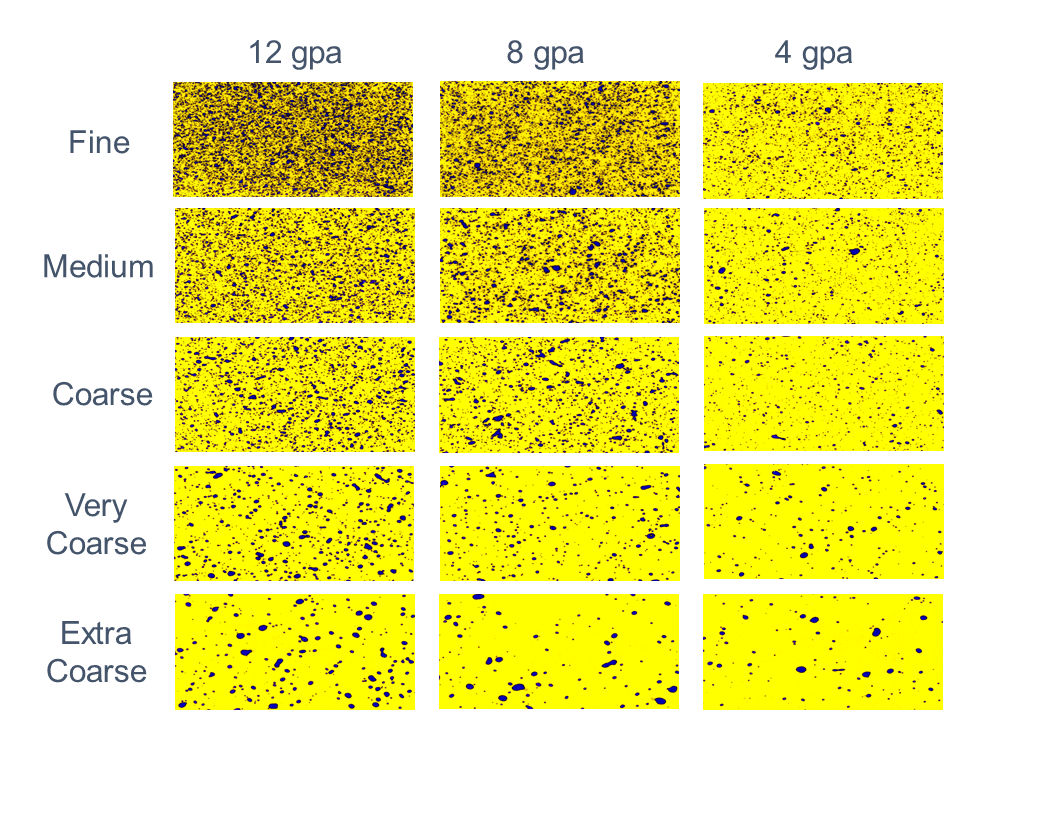
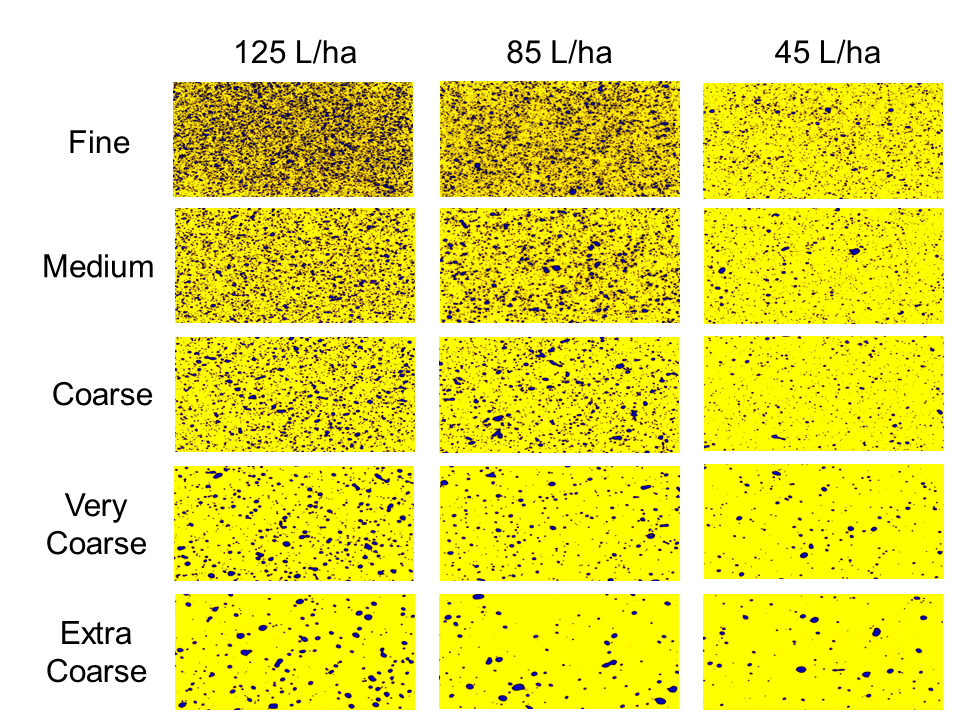
We often write about how valuable water sensitive paper can be to visualize and assess the coverage we’re getting from a specific application method. A handy reference is this matrix that combines both factors. Print it and use it in the field to compare what your application method is doing to these relative standards. On average, you will want to see deposits similar to those in the middle of the matrix.
Pulse-width Modulated flow control allows you to change travel speed by a factor of about five without a change in spray pressure. This chart shows which nozzle flow rates to use. Note the significant pressure drop across the Capstan solenoid. This value must be added to the cab spray pressure, as explained here.
Undoubtedly, the number one question we get from operators is: “Which nozzle should I get”? Luckily there’s no simple answer, or we wouldn’t have jobs! The reason it’s not simple is because selecting the “right” nozzle for a sprayer is a process. It can be broken down into two steps:
identifying the right flow rate (aka nozzle size)
choosing a specific nozzle model (i.e. brand, spray pattern type, spray quality, etc.)
It’s a big question, so let’s tackle just the first bullet: identifying the right flow rate.
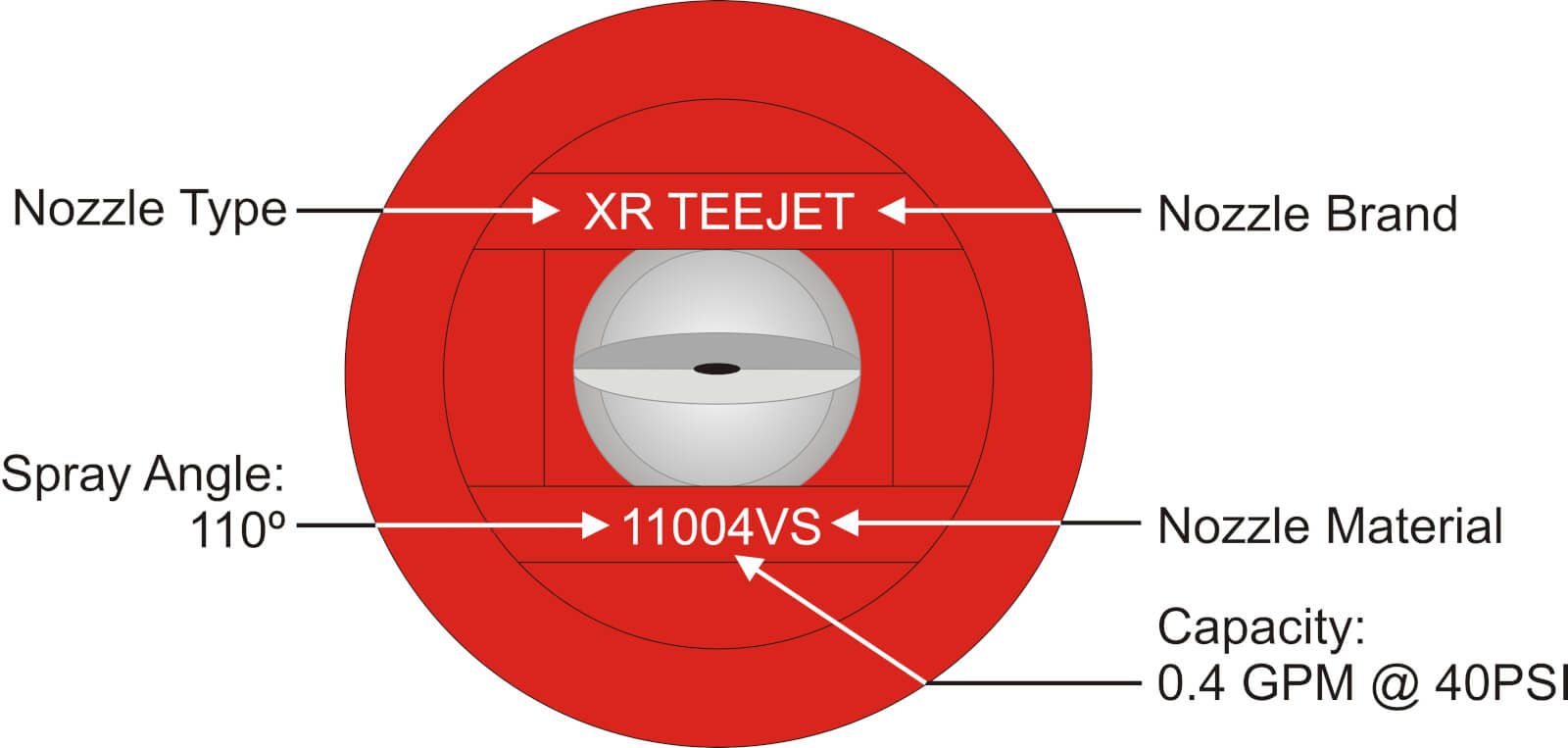
All sprayer nozzles come in standardized (ISO) sizes, and these sizes are usually identified by numbers stamped on the nozzle as well as the colour of the nozzle itself. The nozzle’s key characteristics (i.e. the fan angle and nominal flow rate), are identified in a format that looks like some version of this (Fig. 1):
Fig. 1: Typical information printed on modern nozzles.
The 110 refers to the fan angle (110°) and the 04 refers to the flow rate. 04 means 0.4 US gallons of water per minute (gpm) at 40 psi. Each nozzle brand has a slightly different convention, but no matter how the information is presented it ought to be on the nozzle somewhere.
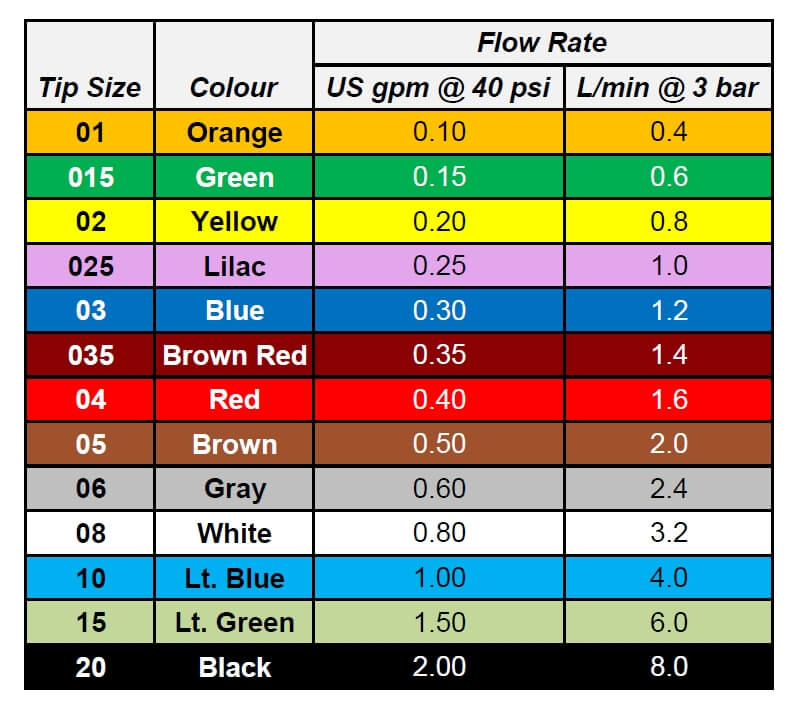
Nozzle colour has an ISO standard across fan-style nozzles, and we have this table to match the nozzle colour to the flow rate:
Fig 3: ISO nozzle colours and flow rates
You’ll note that the nozzle we pictured earlier was “flame red”, matching the 0.4 gpm on the table. So how do we use the table to pick the right size nozzle?
Application rate (i.e. gallons per acre or L/ha) is a function of travel speed, nozzle spacing along the boom, and nozzle flow rate. Traditionally, this has been expressed as the following formula in US units:
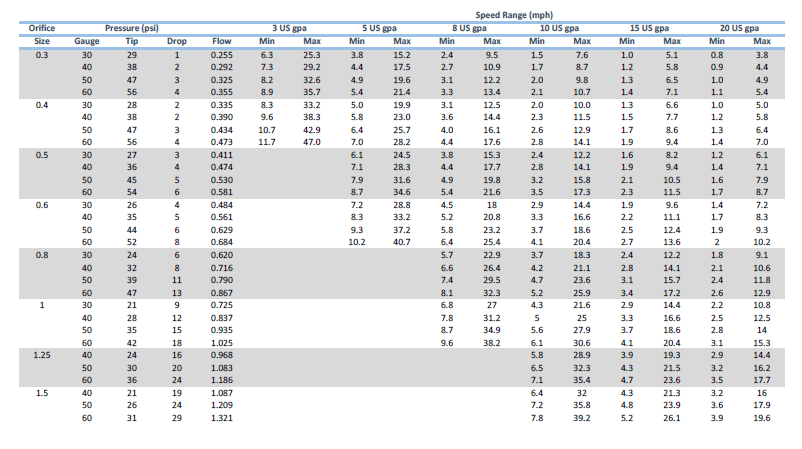
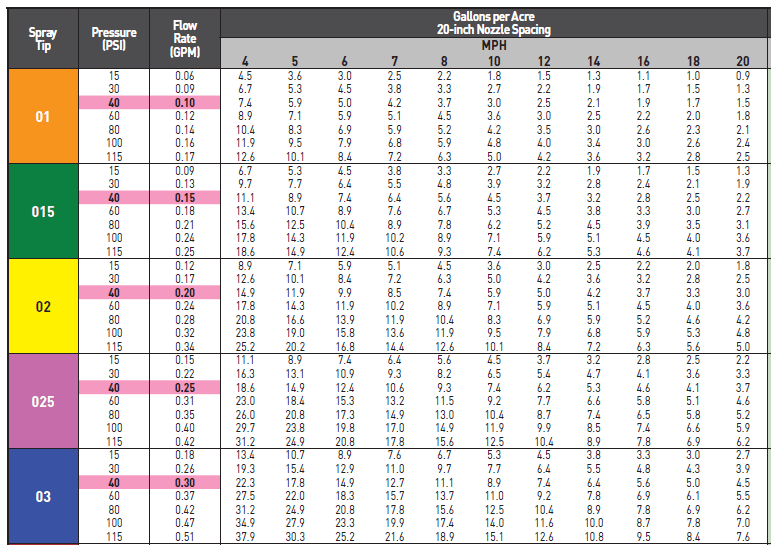
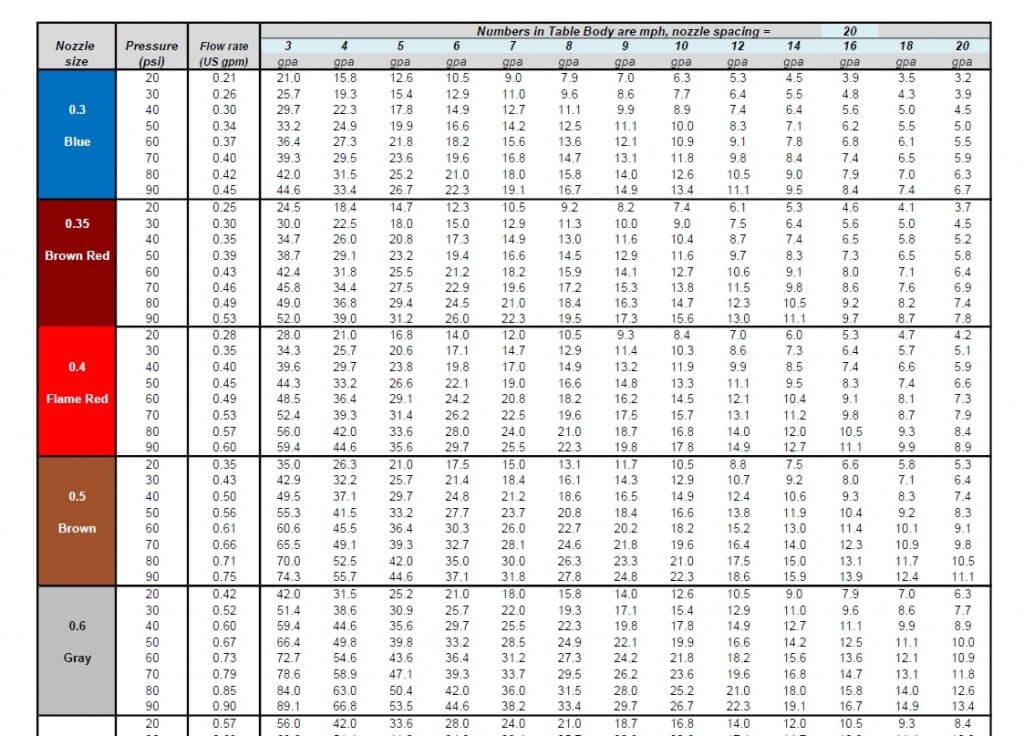
This formula is famously represented in nozzle charts found in all sprayer catalogues (Fig 4). Along the left side are nozzle sizes and pressures. Along the top is sprayer speed. The body of the table contains application volume. Pick your speed, and look for your application volume in the columns. If you want to apply five gpa, you need to look for the number 5 (or as close as you can get to it), among these numbers.
Fig 4: Typical nozzle flow rate chart, with speed at top and volumes in body. Ugh.
The format of the chart can be confusing because it doesn’t follow a modern sprayer operator’s priorities. Usually, an operator decides on an application volume first, and this decision is not very flexible. Travel speed, decided second, has more flexibility.
We’ve therefore re-worked the table to make more sense (Fig. 5). Along the top are common water volumes. The body of the table are travel speeds. Pick a water volume at the top and follow the column underneath this value to find a speed range you’re comfortable with. To the left, the nozzle size and corresponding operating pressures are now visible.
Fig. 5: Nozzle flow rate chart with volumes at top makes it user friendly.
Try to operate at a spray pressure that’s in the middle of the nozzle’s operating range. For an air-induced nozzle, the range is usually from 30 to 90 psi, so the middle is 60 to 70 psi. That should be the target pressure. Look for a nozzle size that delivers this pressure at your expected travel speed.
These columns can be used to work out a nozzle’s travel speed range. If a nozzle can be operated between 30 and 90 psi, for example, the corresponding speeds are listed in the same rows in the volume column.
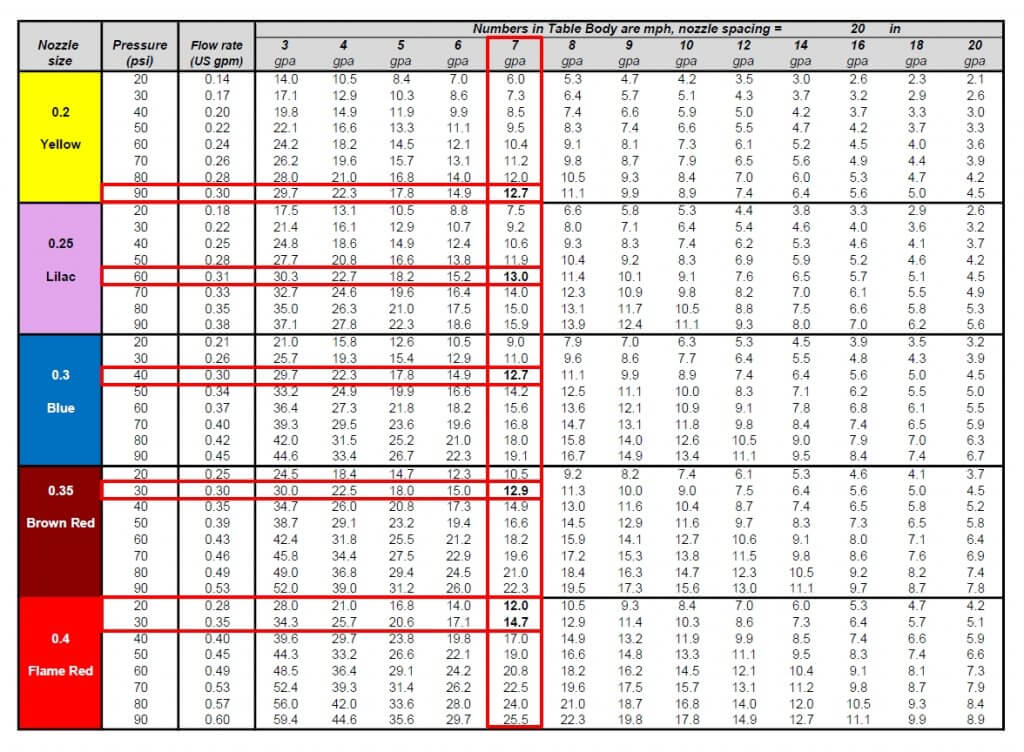
For example, say you want to apply seven gpa and think that 13 mph would be a good average travel speed.
Fig 6: Five solutions for the question, “which nozzle to apply 7 gpa at 13 mph?”
Move down the seven gpa column, and you’ll encounter a value close to 13 mph five times – the yellow nozzle at 90 psi, the lilac nozzle at 60 psi, the blue nozzle at 40 psi, the dark red at 30 psi, and the red at about 25 psi. Now use the columns to see which of these three best matches your expected travel speed range.
The yellow nozzle would allow between seven and 12.5 mph from 30 and 90 psi, the lilac nozzle nine to 16 mph, the blue nozzle 11 to 19 mph, the dark red 13 to 22 mph, and the red 15 to 26 mph.
The best choice for a typical air-induced tip would be the lilac 025 size, since it would meet the target speed of 13 mph at a perfect 60 psi, about right for nozzles of that size, and allowing some travel speed flex on the slower side.
Some operators try to extend that range, but dropping below 30 psi will likely result in too narrow a pattern, or too coarse a spray quality, so it’s not advised.
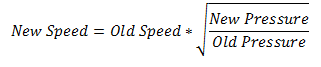
Note that the three-fold change in pressure from 30 to 90 psi translates to only a 1.73-fold change in travel speed. That’s due to the square-root nature of the relationship, as illustrated by this formula:
This exercise applies to sprayers with rate controllers that adjust pressure to regulate flow rates. However, if you use pulse-width modulation (e.g. Case AIM Command, Capstan Sharpshooter, Raven Hawkeye, or TeeJet DynaJet) check out this article describing these systems.
There are a number of apps and websites, usually developed by nozzle manufacturers, which provide similar answers. These are also very useful, and all of them rely on the same formulas used in our new, simplified table. You can go here to download a high resolution version, suitable for framing, in both US and metric units.