Tag: PWM

  • My Sprayer Santa Wish List

    My Sprayer Santa Wish List

    Dear Sprayer Santa,

    “I tried to be good this year.  It was hard, though.  Yes, I know that fast driving causes drift and lots of other problems.  But I couldn’t help it – the 375 horses under the hood needed the exercise.  I honestly didn’t mean it.  I’d have stopped had the air-ride not cushioned all the impacts so well.  I had no idea, really.  The cab was so quiet.  I’m sure that plume of spray and dust behind my sprayer didn’t cause any damage.  I mean, nobody called me, anyways.  I had no choice, after spending 2 hours cleaning out the tank and having to do another three quarters before the forecast rain.  So please, Santa, can I have a bigger sprayer?  Please? I think I need it…to, errr…to…to feed the world.  Yeah, that’s right, Santa Baby.  I need it to grow food for others.  So how about it?”

    I wake up in a cold sweat.  Well, if there was a Sprayer Santa, he’d hear lots of excuses about these sorts of things from applicators afraid of getting a lump of coal on Christmas Day, a black nozzle so to speak.

    So why don’t we stop making excuses and solve the problem by making sprayers that focus on the right things?

    Here’s my “no more excuses” wish list:

    1. Increase transport speeds, reduce field speeds. Let’s establish gear ranges which save time getting to the field, and ensure a better quality job once we get there. Let’s focus on productivity without resorting to the easy, but bad option.  Speed comes at a cost.  More horsepower.  More fuel. More structural stength. More weight.  None of it cheap. Or good.
    2. Increase boom width. This one’s a productivity powerhouse.  It’s every bit as good as travel speed, on a percent gain basis, and much cheaper.  Where else in the world is there a better opportunity for wider booms?  The earth’s temperate plains are almost without exception wide, and more or less flat.  With the help of autosteer and automatic boom height, why should 120 ft be the limit? Many aftermarket manufacturers offer booms at 150 ft.  But why stop there?  Sure, we’ll need some engineering to make it work.  But the fact is that wide booms, coupled to slower speeds that require less horsepower, can have the same productivity.  Not a bad tradeoff.
    3. Explore lighter materials. Sure, Ford was ridiculed by GM for offering aluminim trucks.  But when weight is important, alternate materials can make the impossible possible. Booms that weigh many thousands of pounds require so much strength just to carry their own weight, there are diminishing returns.  And the result is that we are stuck with narrow booms.  Let’s get inventive with alloys and composites.
    4. Focus on time saving features. On any given day, we are given maybe 6 hours of good spraying conditions, some in the morning, some in the evening, and perhaps a few in between. This can be interspersed with several days of bad conditions.  What a waste to spend this precious time not actually spraying, but rather filling, cleaning, transporting, getting un-stuck, figuring. In a business where timing is so important, and where a late application can have serious yield implications, we should be spending a greater proportion of time spraying. We need help to minimize downtime.
    5. Dedicated clean water pumps and small sumps. Want to clean out the tank faster? Rather than relying on batch mode, reducing concentration by serial dilution, consider adding a dedicated pump to your clean water saddle tank.  Introducing clean water through the wash-down nozzles while at the same time spraying out the sump dramatically increases dilution power with less water. And of course, the smaller the sump and recirculating reservoir, the faster the job will get done.
    6. Recirculating booms. I initially wrote these off as a bad idea when they offered a single pressure entry point (on one end) followed by an exit on the other. Over 120 ft, you’d surely see pressure drops of 10 psi – unacceptable. But with modern designs offering up to four pressure entry points (both ends and middle) these issues appear to have been eliminated. And with clever plumbing, the boom can act as an extension of the tank, making priming and cleaning faster and easier.  Sectional control is now governed by individual shutoff valves, offering customizable, fast, positive shutoff.
    7. Better flow and droplet size control. 2016 promises to be one of the most exciting years for new atomizers, with new entries in the twin fluid, pulse-width modulation, and multiple nozzle markets. But there’s still lots of room for improvement. To the young engineers reading this, give us a nozzle that provides a 10-fold range of flow rates, each at the same pattern angle and droplet size.  Let this nozzle offer easy control of droplet size from Medium to Ultra Coarse at each flow rate. How hard can this be? Make it affordable and reliable, with consistent flow rates and a long wear life.  I think we’re ready to pay for this.
    8. Easy cleaning materials. Every year, it’s a guessing game. Are all the Group 2 residues removed from the tank and booms before you spray your LibertyLink canola? How can you be sure?  Well, by checking your canola two weeks later, of course!  In the meantime, all we can do is offer hope with ever more rigorous cleaning protocols, one-upping last year’s efforts to ensure that nothing got left behind.  How about tank, fitting, hose, boom, and nozzle body designs engineered to eliminate these problems?  How about a guarantee to that effect by the sprayer manufacturer?  It’s going to take more than the occasional stainless steel component.  If we have enough knowledge in fluid dynamics to send an F1 sports car into a turn at 250 km/h, then surely we can design a hydraulic system that self-cleans!
    9. Better aerodynamics. Let’s face it, we can’t control drift just by making sprays coarser. Eventually we’ll reduce coverage too much and this will hurt our important contact products the most. Instead, we need sprayer and boom designs that facilitate the transport of droplets towards their target, avoiding drift. Maybe the shape of our tractor units and boom components will play a role here, maybe the nozzle pattern needs a re-evaluation. Maybe shrouds will return. One thing’s for sure – we can’t simply drive faster and expect coarser sprays to solve the problem.

    So that’s my list.  I’m sure it’s just a beginning.

    What’s on your list?
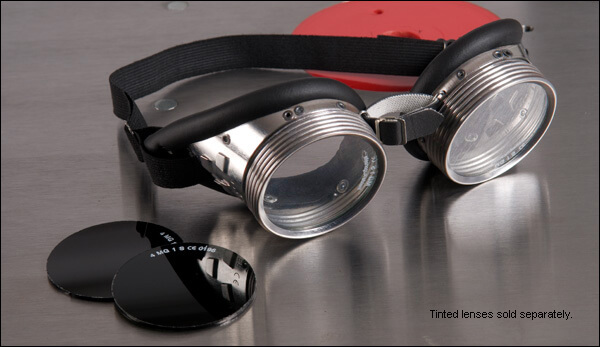
    Lee Valley Safety Goggles

    *I have a confession to make.  I’m secretly hoping for those Lee Valley German Safety Goggles for Christmas.  Protecting your eyes has never been cooler.

  • A New Way to Purchase Sprayers

    A New Way to Purchase Sprayers

    I always await a trade show with excitement. Everyone’s going to be there, showing their latest and greatest. You see old friends. And of course, trade-show food. Every year, I search for the Fiddle Sticks I learned to love in the 80s. They’ve been replaced by the Pocket Dawg, it seems. Not the same.

    Touring around the sprayer and nozzle displays at this year’s Western Canada Farm Progress Show, I couldn’t help but notice that an old contrast got even more striking.

    As expected, sprayers are bigger and heavier than ever. The JD r4045 is an example, weighing in at 36,000 lbs, with a list of $563 k CDN. It’s not the only one, though, I just pick on John Deere because they can take it. They know it’s outrageous.

    Most sprayers are made by multinationals, with large engineering budgets, and they build complicated and sophisticated machines. They’re huge. They crush weeds. Their cost has often increased by double digits annually.

    Then it’s off to the nozzle manufacturers, for the contrast. Small booths nestled among other family businesses, staffed by the owners. Yes, most of the nozzles we use are produced by surprisingly small family-owned companies with just a handful of employees. They make their products on-shore. They have modest research budgets. They collaborate with each other and share components. And their products are priced very low. Not bad, considering the nozzle is the most important part of the sprayer (after the operator, of course).

    One can get a very good low-drift, air-induction nozzle for about $6.00. That’s close to the same price it was 10 years ago. Nozzles, engineered to remove small droplets with a two-stage venturi design offer good spray patterns between about 30 and 100+ psi. This means that a $450,000 sprayer with a 120 foot (36 m) boom requiring 72 nozzles can be outfitted with nozzles for a cost of $450 (0.1% of the sprayer cost) , or $1350 for a set of three.

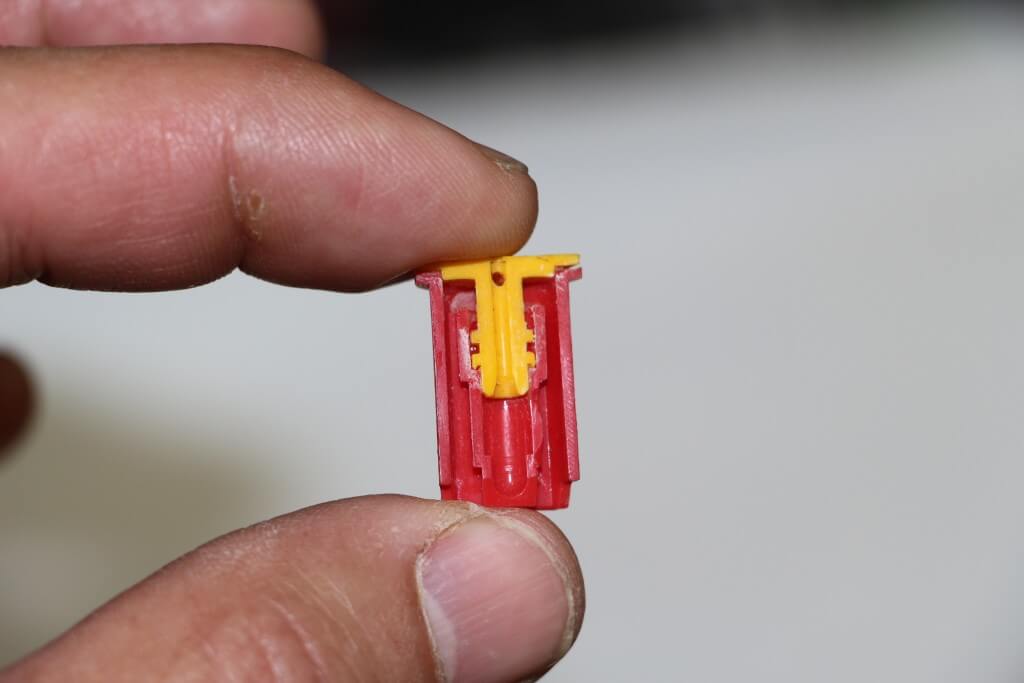
    A very cool cut-away view of an Airmix nozzle.
    A very cool cut-away view of an Airmix nozzle.

    These nozzles have important tasks. They need to:

    • meter the pesticide mixture out accurately (within 5% or less of the target amount);
    • atomize the mixture into droplets that maximize coverage while minimizing drift and other waste
    • distribute the spray uniformly across the width of the boom.

    If nozzles miss on any one of these goals, producers pay with lower control, higher costs, or environmental contamination. So these little devices are important.

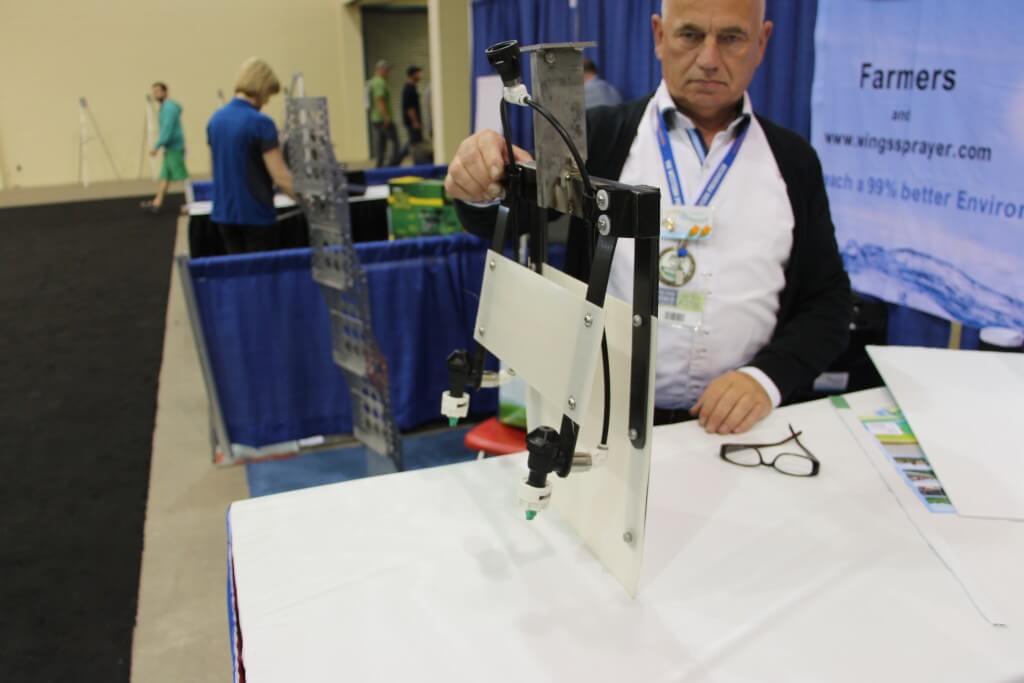
    We do see innovation in this important area, again from small companies. Devices designed to improve rate control (pulse-width modulation or variable rate nozzles), to reduce drift (PatternMaster), or to improve canopy penetration while increasing coverage and reducing drift (Wingssprayer) are appearing. While these aren’t cheap, they cost a fraction of what the sprayer costs, are light, and reliable.

    Harrie Hoeben holding a section of his Wingssprayer system.
    Harrie Hoeben holding a section of his Wingssprayer system.

    And they’re meeting with resistance because of a very peculiar response. Over the past 15 years, when a producer has heard the cost of a new sprayer, the sticker shock has made them walk away. But not far. They’ve returned shortly after to make the purchase. Need a new sprayer, right? Need high clearance, hydrostatics, air-ride, horsepower.

    But when they see the cost of even the most expensive atomization system (some as low as $4000, the most costly typically $20,000 to $40,000), they just shake their heads and walk away. Probably for good.

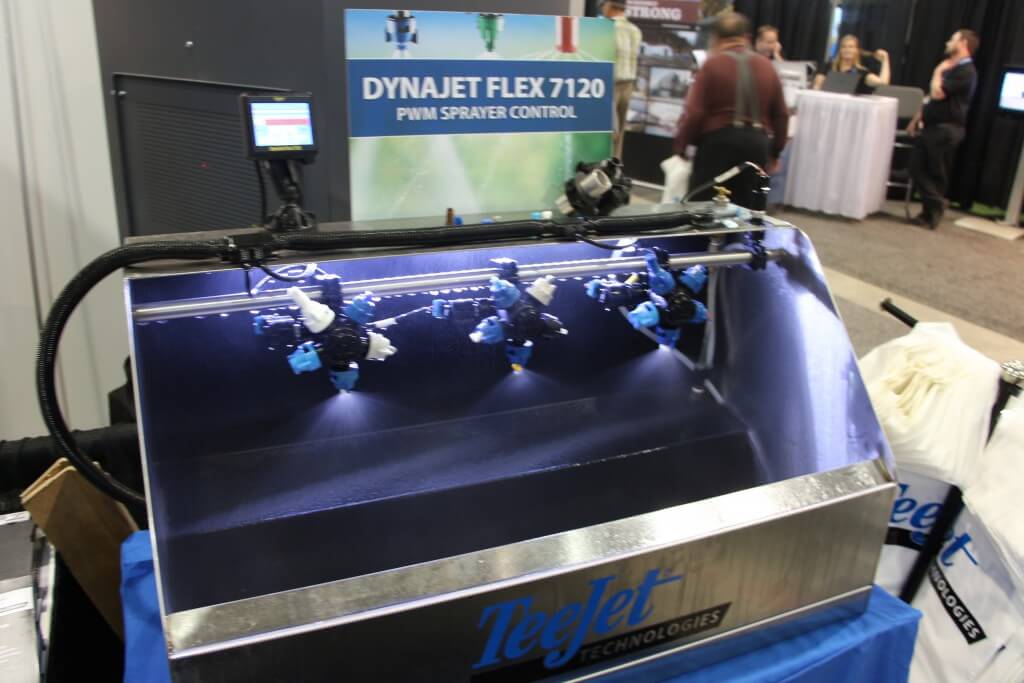
    TeeJet's pulse width modulation system - the DynaJet Flex 7120.
    TeeJet’s pulse width modulation system – the DynaJet Flex 7120.

    And yet it is this purchase that will probably pay the highest dividends. It’s this technology that can answer to the needs presented by heavy, fast tractor units. The $6.00 nozzle is out of its depths here. And the innovators need the sales so they can conduct proper research to give you the best value, and lower their costs.

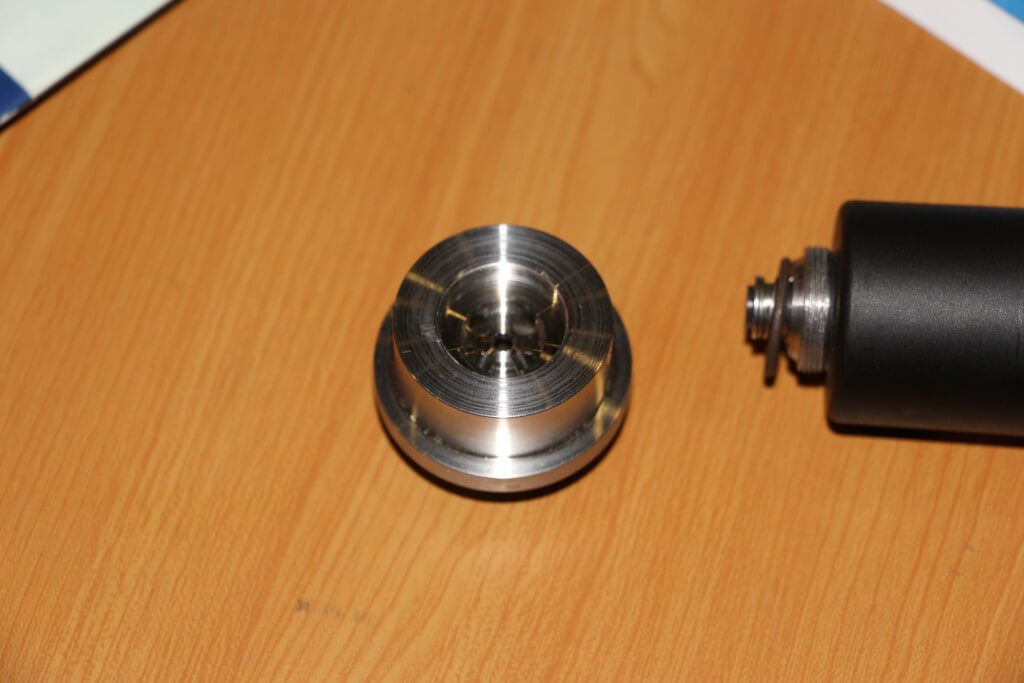
    Capstan's new PWM solenoid for high-flow John Deere bodies.
    Capstan’s new PWM solenoid for high-flow John Deere bodies.

    A New Process

    How about we look at it this way: Budget for a new sprayer. Say you accept that it will cost about $440,000. This is the total amount you will spend. Now budget for a great delivery or atomization system. One that either improves coverage, decreases drift, improves consistency, or makes you more productive. Let’s go for the best one, and budget $40,000.

    Now don’t raise the cost of the investment by that amount, but instead make it inclusive. The sprayer’s tractor unit budget is reduced to $400,000 to accommodate the atomization system, for a total cost of $440 k, still within budget. You may need to re-evaluate the type of sprayer, or features, that you will be able to obtain with a 10% lower cost.

    Or perhaps you can take advantage in the slightly more desperate market situation for big iron and score a better deal. Buy used, or invest in your old sprayer to rehabilitate it.

    Either way, we need to start thinking differently. Within any given budget, let’s purchase the most important components first. Then let’s put wheels on it. And then, let’s get some Fiddle Sticks.

  • Capstan Calibration Chart (with Pressure Drop)

    Capstan Calibration Chart (with Pressure Drop)

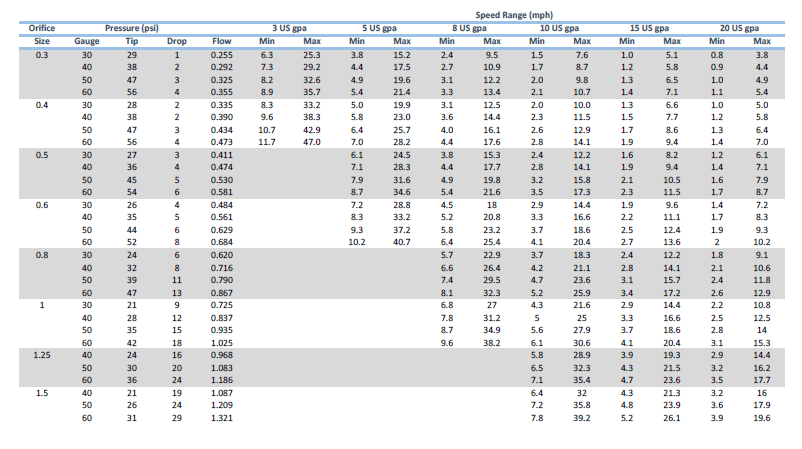
    Pulse-width Modulated flow control allows you to change travel speed by a factor of about five without a change in spray pressure.  This chart shows which nozzle flow rates to use. Note the significant pressure drop across the Capstan solenoid.  This value must be added to the cab spray pressure, as explained here.

    Capstan Tip Chart (with Pressure Drop).pdf

  • Measuring Pressure Drop

    Measuring Pressure Drop

    All sprayers experience a drop in pressure as the solution moves further away from the pump.  Here’s why that’s important, and how to measure it.

    Optimal nozzle operation in terms of spray quality and fan angle is closely tied to spray pressure.  As we try to maximize travel speed range with a modern sprayer, we often push spray pressure to its limits on the low and high side. For many air-induced nozzles, spray quality and fan angle become critical at about 30 psi.  We need to be sure about the exact nozzle spray pressure to prevent problems.

    Pressure drop is caused by the friction that the spray solution experiences as it moves from the pump to the spray nozzles.  It’s caused by a number of factors, including length of tubing, elbows, valves, screens, and other flow obstructions.

    Plumbing components add friction to liquid flow. If the pressure gauge is installed before these components, the nozzle pressure is unknown but will be lower than the gauge reading.

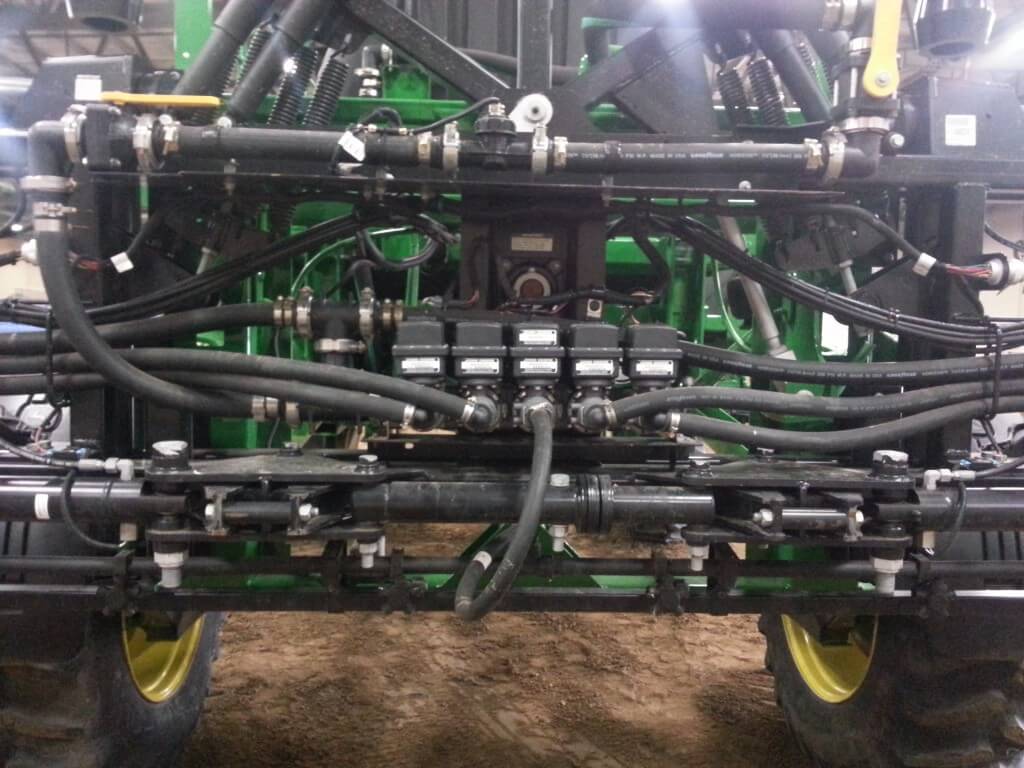
    The pressure transducer that reports pressure to the cab is usually located between the pump and the manifold that divides the spray into the various boom sections.  At this point, the spray liquid hasn’t experienced any significant flow restrictions.  The transducer basically reports pump pressure.

    Once the spray mixture starts moving through boom sections towards the nozzles, it encounters those restrictions, and pressure at the nozzle will therefore be lower than the cab reading indicates.  The higher the liquid flow, the greater the friction, and therefore, pressure loss.

    Even older sprayers with only two boom sections (left and right) and few elbows and reducers, will see pressure losses due to the narrow and long boom pipe that feeds up to 60′ on each side.

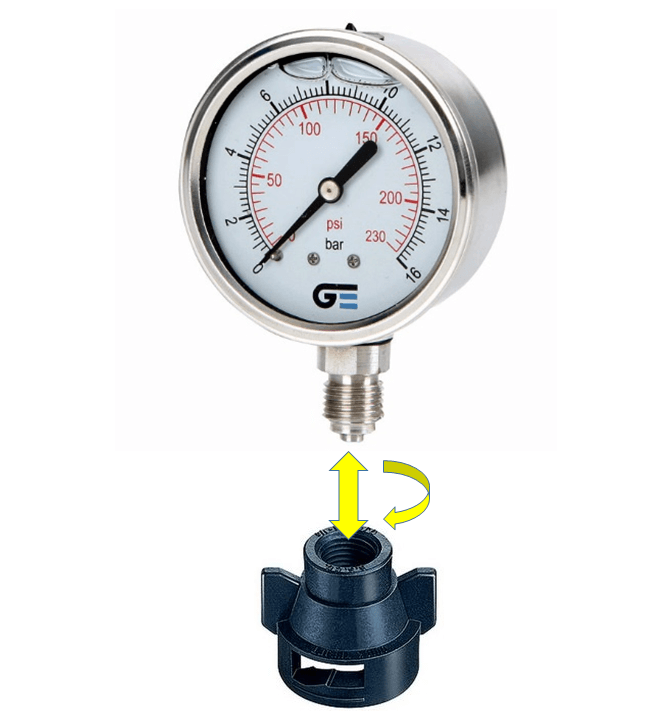
    The nozzle pressure can be measured with a gauge placed on a nozzle body.  Simply purchase a quality gauge and a threaded nozzle cap, combine the two and install in place of a nozzle.

    A pressure gauge threaded into a nozzle cap can measure boom pressure.

    Operate the sprayer at your expected spray pressure (say, 60 psi) with all boom sections on.  Install the portable pressure gauge on an open turret position and turn into place, noting its reading.  If both gauges are accurate, the boom pressure will likely be below 60 psi.

    The difference between the cab gauge pressure and the boom gauge pressure two is the pressure drop.  Repeat the measurement for each boom section.  Also repeat at your lowest, as well as your highest expected flow rates.  Higher flow rates cause greater pressure drops.

    Now, use this information to adjust your interpretation of the cab pressure reading.  For example, if you want to spray at 60 psi and your pressure drop is 10 psi, then the cab pressure should read 70 psi.

    If your boom pressure is higher than your cab pressure, and you’ve checked the accuracy of your new boom gauge, then don’t be too mystified.  Your pressure transducer is malfunctioning.

    This exercise is important if you’re trying to compare your nozzle flow to the expected nominal flow of the nozzle – perhaps you’re trying to determine nozzle wear.  The nominal flow of agricultural nozzles is determined at 40 psi, so it will be important to measure the flow at exactly that pressure.

    By measuring pressure drop on all your boom sections, you also get a good sense of the variability in pressure across your boom.  Your measurements might reveal an obstruction or a hose kink somewhere along the line.

    To see how low pressures can affect coverage, watch this video.

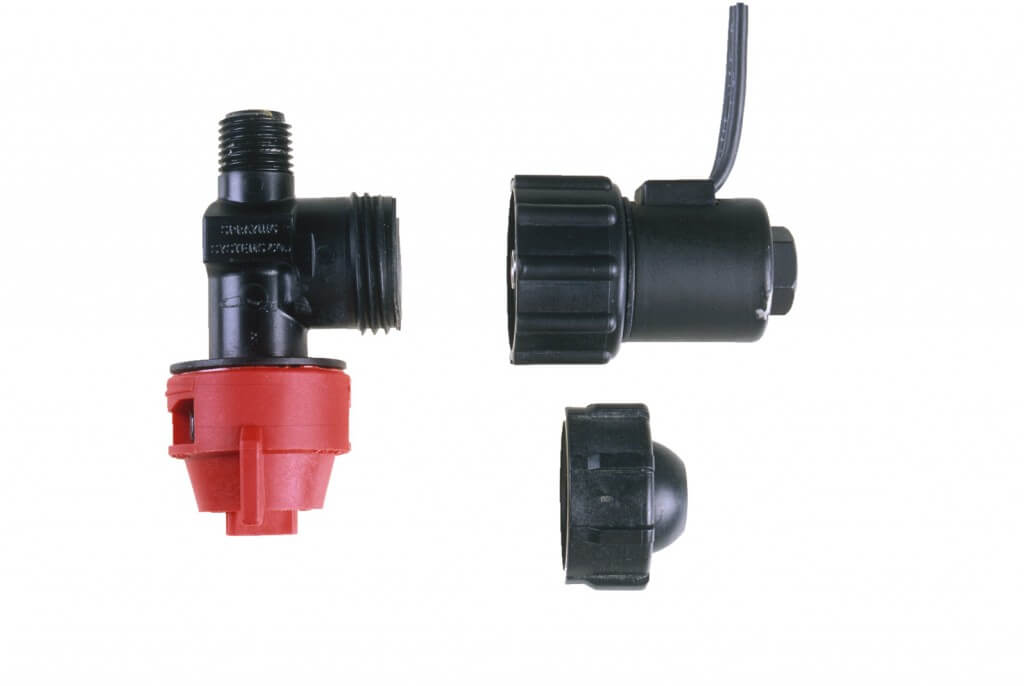
    Note that the pulse-width modulated systems offered by Capstan, Case, and Raven use a solenoid at each valve.  This solenoid adds a known, and significant, pressure drop to the spray system as can be seen here.

    Pulse-Width-Modulation (PWM) solenoids typically have internal flow restrictions that can contribute to pressure drop.

    Here’s a fun video filmed by the Ontario Pest Education Program during a break at Ontario’s Southwest Crop Diagnostic Days:

  • Pulse Width Modulation

    Pulse Width Modulation

    Note:  This article was written before significant changes occurred in the marketplace in 2016. While it still explains how the system works, a more current account can be found here.

    Pulse-Width-Modulation (PWM) refers to a method for controlling the flow rate of fluids.  How does it work?  Does it have a fit on your farm?  We explain in this article.

    Case Aim Command, Capstan PinPoint, Raven Hawkeye, TeeJet DynaJet, John Deere ExactApply, WEEDit Quadro, and Agrifac StrictSprayPlus are Pulse-Width-Modulation (PWM) technologies, where a pulsing solenoid controls flow rate through the nozzles. The solenoid is installed in place of the diaphragm check valve, and shuts off the nozzle flow for a split second exactly 10 times per second.

    How it Works

    All PWM systems employs the duty cycle of a pulsing solenoid instead of spray pressure to control nozzle output. The pulse width, also known as the duty cycle, is the proportion of time that the solenoid is open, and can range from 10% to 100%, although 20% to 100% is more realistic.  Duty cycle is closely related to the nozzle flow. Pressure (and droplet size) stays fairly constant throughout the duty cycle range. This means that a wider range of travel speeds can be used without any change in spray pressure. Pressure can still be changed if necessary, to control droplet size.

    The Tip Wizard

    If using ComboJet nozzles, use the Tip Wizard to identify the best nozzle. Select “Canada”, and “US gal/acre”. Select “Tip Wizard” on the left side of the screen, and choose “Blended Pulse System, Search for Tips”.

    Enter your information in the boxes. For example, 10 (gpa), 350 (µm, VMD), 15 (mph, max speed), 20 (inches nozzle spacing), 110 (degrees, fan angle). Always select 110 for use with Aim Command or Capstan.

    Click “Search for Spray Tips”. The pressure that matches your droplet size criteria will be highlighted for each nozzle. In this example, the SR11006 nozzle is highlighted at 52 psi, giving about 349 µm VMD. If you choose the SR11008, the pressure goes up to 73 psi to get the same droplet size, and your minimum and maximum speeds increase as a result. Note that the numbers are calculated and do not always agree exactly with published nozzle charts. Allow for some leeway, and double check with manufacturer flow charts to be sure you’re in the ballpark.

    If using TeeJet style bodies, use any wide-angle spray tip that is not air-induced. Good candidates are the TurboTeeJet, the TurboTwinJet, and the Hypro Guardian. Other pre-orifice flat fans can also be used.

    Pressure Drop

    Also note that the system should not be used at very high pressures – about 60 psi max. Finally, pay attention to the pressure drop across the solenoids. The manufacturer publishes charts that show the drop at various flow rates. For a 11004 tip, the drop is about 3 psi. For a 11008 tip, it’s between 6 at 30 psi and 13 psi at 60 psi. Add these values to your rate controller pressure reading, i.e., if you want to spray at 40 psi, have the rate controller read 40 & pressure drop.

    Calculating Duty Cycle

    Your expected average speed should be 60 – 80% of the maximum speed that the nozzle is capable of in these charts (100% duty cycle). For example, if you expect to travel 14 mph, select a solution whose maximum speed is 20 mph. This way, the system will be averaging 70% duty cycle at 14 mph (20 mph x 70% = 14 mph), allowing you to increase your application rate (or speed) by 30% where necessary (system moves to 100% duty cycle), or reduce your travel speed to 5 mph (system moves to 25% duty cycle). Slowing down further is an option, but a very coarse spray at low duty cycle may introduce skips under some conditions (low booms, fast speeds). This option also gives you maximum flexibility to change pressure to manage droplet size in both directions. Using a higher average duty cycle (say 80%) increases your flexibility to slow down, but limits your top speed more.

    Picking the Right Droplet Size and Pressure

    The right nozzle pressure depends on the choice of nozzle. For low-drift tips such as the Wilger SR and MR, higher pressures (>40) are recommended to ensure the spray pattern develops fully. Drift remains acceptably low. The %<200 columns in the Tip Wizard is a drift index. It identifies the proportion of the total spray volume in droplets <200 µm. Use the number to compare drift potential of various nozzles and pressures, making sure you also pay attention to the %<600 µm column. When values in that column are subtracted from 100, the result is volume in droplets >600 µm, an indication of the volume in droplets that are possibly too large to contribute much to coverage or efficacy.

    It’s not easy to pick the best droplet size for each application because various pesticides and pests each have their own response. Typically, a Volume Median Diameter (VMD) ranging from 350 to 450 µm is ideal for most pesticides. Choose smaller VMDs for low water volumes, grassy weeds, and contact products, but use these only when drift is manageable. Choose larger VMDs for systemic products, broadleaf weeds, and higher water volumes, or when drift must be avoided. If you aim for 375 µm to start, that will be relatively low-drift and work well for most products.

    If using nozzles other than the Wilger ComboJets, the Tip Wizard is still useful for identifying the flow rate and pressure of nozzle that you need. The Tip Wizard’s droplet size feature will not be usable, and instead, reference to the specific nozzle manufacturers’ spray quality data will be necessary. Choose nozzles that have a “Coarse” spray quality on average, and allow some movement into “Medium” and “Very Coarse” to suit a specific application need. Avoid “Fine” (not necessary for any pesticide, and too drift-prone) and “Extremely Coarse” (possibly insufficient coverage) unless specifically instructed by the pesticide manufacturer. Always select 110 degree nozzles, and do not use air-induced nozzles.

     Advantages:

    • Constant pressure (and droplet size) over a wide range of travel speeds.
    • Ability to change droplet size with pressure adjustments on-the-go, without changing travel speed (depends on where you are in the duty-cycle range).
    • Ability to change application volume on-the-go, without changing travel speed or pressure (again, depends on where you are in the duty cycle range).
    • Instant response to shut-off, turn-on. Sprays at full pressure immediately. Does not drip.
    • The new AIM Command Pro or Sharpshooter PinPoint allows for individual nozzle flow control. This enables nozzle-by-nozzle sectional control as well as turn compensation.

     Considerations:

    • Must keep water clean to avoid malfunctioning of tappet seal.
    • Operator needs to understand system to take advantage. For example, at max travel speed (100% duty cycle), one cannot increase application volume or reduce drift by lowering pressure without first slowing down. Most flexibility is available at 70% duty cycle, and nozzles should be selected so that at average travel speed, system is near 70% duty cycle.
    • Must use wider fan angle nozzles or higher boom height to get 100% overlap.
    • The system’s primary purpose is to increase the consistency and accuracy of spraying by maintaining constant pressure over a wide travel speed range. It does not have a unique ability to reduce drift or water volume over a conventional system.

    A conventional nozzle system can still do a very good job. However, using a conventional system with low-drift nozzles often reduces the available pressure range by raising the effective minimum pressure, usually to about 30 psi depending on the tip. Since many sprayers cannot produce pressures over 100 psi, this limits the travel speed range (max speed:min speed) to about 1.8. The Aim Command system removes this limitation by using duty cycle, not pressure, to control flow.