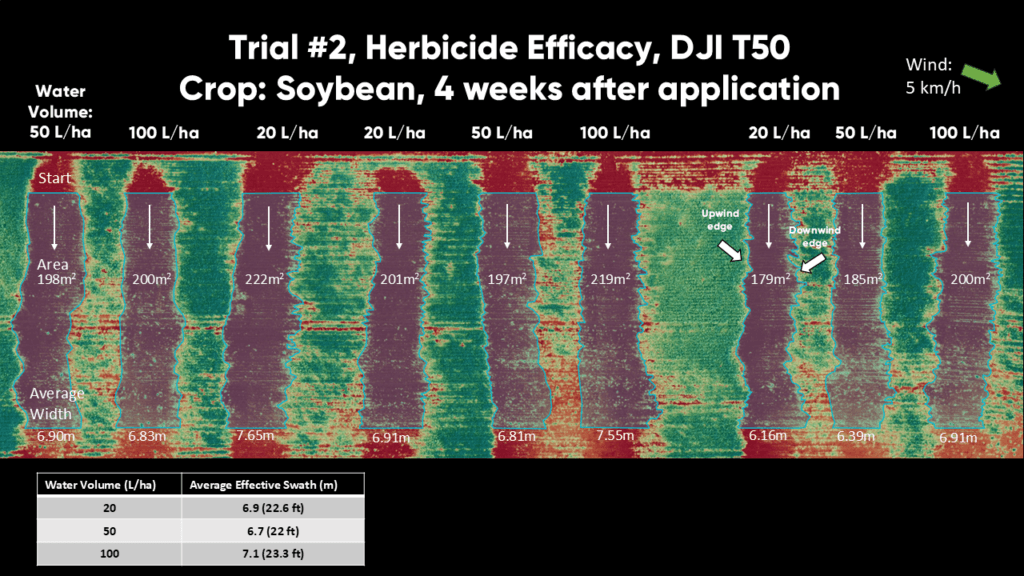
The Hidden Shape of a Drone’s Spray Swath: What 2-D Imagery Reveals

Introduction Most operators assume drone swath widths are wide, stable, and predictable. That confidence generally comes from three places: But drones move through space and time; spray patterns evolve as they fly. What you think is happening in the two seconds you glance up is not what’s happening over a 50 metre pass. The following […]

Read More… from The Hidden Shape of a Drone’s Spray Swath: What 2-D Imagery Reveals
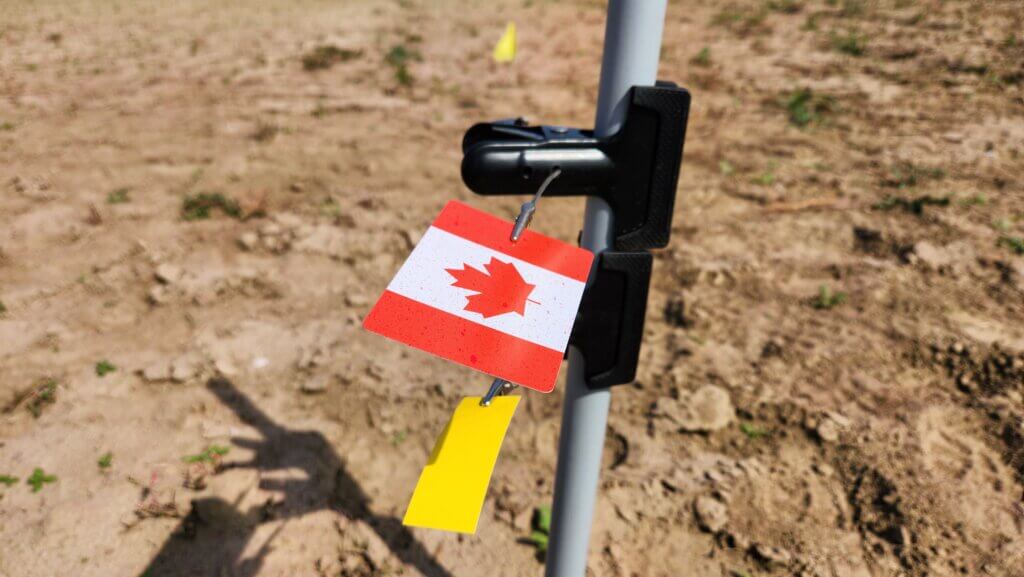
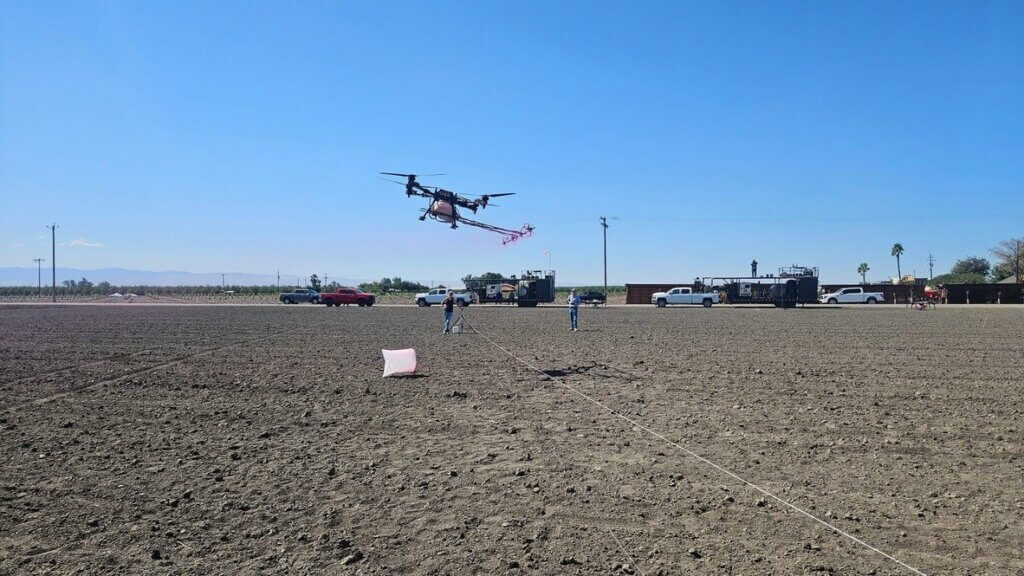
Droplet trajectories from rotary spray drone application: Implications for swath width measurements

Introduction We conducted a series of drone deposition studies with three main objectives: We wanted to: The four swath width measurement methods were: Assuming a trapezoidal-shaped spray swath, the Effective Swath Width (ESW) can be roughly defined as the span between two points that represent 1/2 of the average maximum deposit density. The idea is […]

Read More… from Droplet trajectories from rotary spray drone application: Implications for swath width measurements

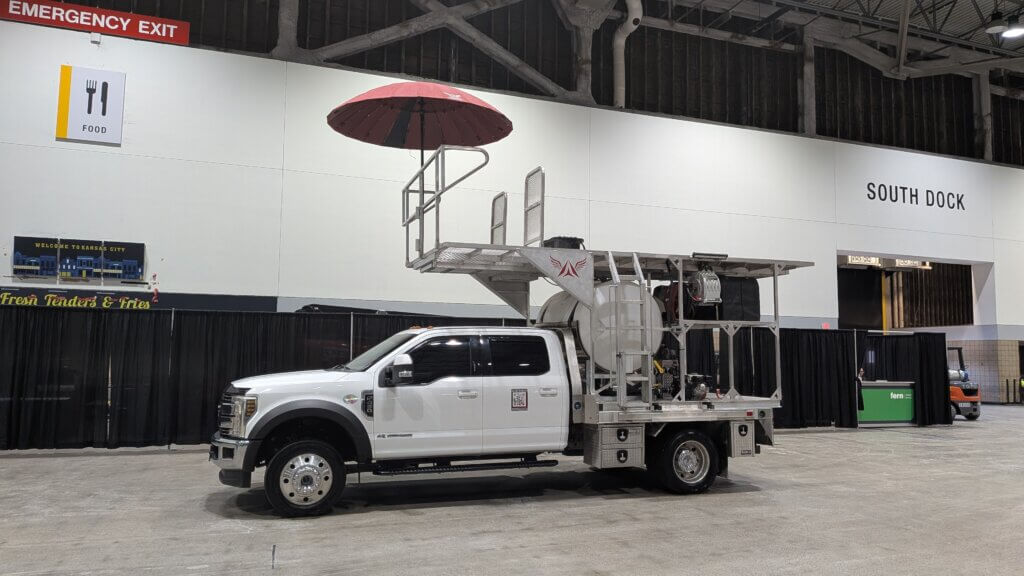
Drone Tendering – Considerations before Buying or Building

Acknowledgments Much of this article is based on a session and tradeshow I attended at the 2026 Drone End-User Conference in Kansas City. I want to acknowledge the insightful information provided by the three session speakers, as well as the ~200 audience members that asked honest questions and shared their experiences. The speakers were Mr. […]

Read More… from Drone Tendering – Considerations before Buying or Building

The Carvalho Boom and the Stages of Quadcopter Flight

The Hypothesis The results of a recent herbicide deposition study performed with the DJI T100 led us to observe that after ~13 m/s, swath width and drift were no longer directly related to travel speed; They appeared unaffected. The result was completely unexpected as it was counter to several years of prior study with smaller […]

Read More… from The Carvalho Boom and the Stages of Quadcopter Flight

Canada Gazette Part II – Recent and upcoming changes to Canadian rules for operating Remote Piloted Aerial Systems

Editor’s Note: This article was posted in June 2025, and as of November 4th all rules have now come into effect. Summary The Government of Canada introduced the first set of Remote Piloted Aerial Systems (RPAS) rules in 2019, which addressed safety concerns and created a flexible and predictable environment for small RPAS flown within […]

Read More… from Canada Gazette Part II – Recent and upcoming changes to Canadian rules for operating Remote Piloted Aerial Systems