Category: General Operation

Articles that discuss general field sprayer operation and productivity factors

  • Debunking Sprayer Myths

    Debunking Sprayer Myths

    Reproduced from an article written by Angela Lovell for Grainews, 2014

    “The fundamental challenge of spraying is that it’s a compromise game,” said Tom Wolf of Agrimetrix Research and Training. “As operators and advisors we need to always balance the opposite needs of coverage, efficacy and drift.”

    Wolf, in a presentation at the recent Manitoba Agronomists Conference in Winnipeg, sees a trend towards more fungicide use on farms across western Canada and technology that purports to make application more efficient. These trends include wider booms, faster speed capability, complex monitors, auto boom heights and bigger tanks.

    As much as technology is a great thing, it’s still the operator that is the single most important part of any spray operation, so it’s important to make sure that he or she isn’t going out to the field with any conventional beliefs that simply aren’t correct.

    The challenge with spraying is to control pests without harming you neighbour’s crops or the environment and over the years Tom Wolf has developed some pretty good ideas about how to do that and has had to dispel more than one popular myth about spraying.

    Myth # 1: More pressure forces the spray into the canopy.

    “There’s an element of truth to this but it’s forcing spray downward is the least thing that pressure does,” says Wolf. Spray pressure is primarily used to change spray flow rate. If you increase the pressure you will need to travel faster to allow the carrier volume to stay constant, and faster travel speed actually works against canopy penetration. Another important change is that spray quality will become finer with higher pressure. Finally, droplet velocity will initially increase, but even at higher pressure, small droplets still move slowly by the time they reach the canopy. “If you want to force a fine spray into the canopy, the best way to do that is to lower your boom, slow down, and increase the carrier volume,” says Wolf.

    Myth # 2: Higher water volumes lead to run off.

    There are two things that govern run off; droplet size and surface morphology of the leaf surface. “Anyone who says that anything more than 3 gallons/acre runs off the leaf surface is not telling you the whole picture,” says Wolf. “We’ve been unable to induce runoff from up to 200 US gpa in our tests, even using hard-to-wet grasses like green foxtail. Don’t be afraid of water. It’s a very good way of covering the canopies. Water gives you flexibility to use coarser sprays and that allows you to spray when it’s windier.”

    Myth # 3: Spray drift is no issue for fungicides and insecticides

    Aquatic organisms are extremely sensitive to most fungicides and insecticides. We might not see this effect, but it has a definite impact on our environment. It’s important to observe the buffer zones shown on product labels, which can vary depending on the product, the application method and the specific environment.

    Myth # 4: Faster travel speeds save time and boost productivity

    Wolf suggests evaluating this on a field by field basis. At faster speeds you lose control of the spray cloud and the finest droplets will go wherever the wind goes. Other problems with higher speeds are canopy penetration, pattern uniformity and pressure management. If you have an 800 gallon tank with an 80 ft boom and you are going 12 mph at 10 gallons/ac and your fill rate is 50 gallons per minute you are going to do about 84 acres/hour not including turns. If you go faster – 18 mph – you can do 110 acres/hour. But if you increase your fill speed, thereby decreasing the time spent filling you can increase productivity just as much. If you also increase your boom width you also increase productivity. “All I am asking is you don’t just look at travel speed to improve your productivity,” says Wolf.

    Myth # 5: Double nozzles produce more droplets and improve coverage

    “It’s the droplet size and water volume that drives the droplet numbers produced. It doesn’t matter how many nozzles produce this size,” says Wolf. Although some double nozzles produce finer droplets and therefore improve coverage, others actually produce coarse sprays which may decrease coverage. Pay attention to droplet size first – nozzle manufacturers publish spray qualities from their products. You can increase coverage from a single nozzle simply by increasing the spray pressure so yo produce a finer spray.

    Myth # 6: Calm early mornings have the lowest drift risk

    This is one of the biggest myths out there, says Wolf, and it’s all because of a condition called an inversion, which usually occur during clear nights, and which linger into the early morning hours. Under normal sunny daytime conditions, air currents rise, fall and disperse spray clouds rapidly but under inversion conditions they don’t. This can lead to severe drift issues, even significant distances away from the treated field.

    Under sunny daytime conditions, air temperature cools with height and that allows for thermal turbulence to disperse the spray cloud. On clear nights, the temperature increases with height (the opposite temperature profile, therefore called an “inversion”), and this prevents air from mixing. As a result, the spray cloud will not disperse.

    Assume that the atmosphere is inverted on clear summer nights, extending into a few hours after sunrise. Producers should never spray when an inversion is present, and a good indication might be if fog or smoke hangs in the air and not dispersing.

    Myth # 7: A rate controller calibrates the sprayer

    “Even with a $400,000 sprayer, the rate controller still relies on a single flow meter that sits at the back of the sprayer and measures the total flow to the boom. The operator has no idea where that total flow is going,” says Wolf. As a result, there is still no substitute for individual nozzle calibration. There are various new tools on the market to assist with that but they still need to be done individually.

    Myth # 8: If I mess up agronomic decisions, I can correct that with a good spray application

    A spray application has to be on time to be truly effective, says Wolf. In efficacy studies where yeield was measured, spraying herbicides “on time” (=early) produced a yield advantage over spraying just one week later, even with a spray quality that was so coarse that it resulted in relatively poor weed control. “If it’s breezy, use a low drift nozzle. This allows you the opportunity to spray on time,” he adds.

    Myth # 9: Ammonia is a good general purpose tank cleaner

    Ammonia raises pH and some chemicals like sulfonylurea products dissolve better at a higher pH. But if you have an oily emulsifiable concentrate (EC) formulation, either as a product or adjuvant, a soapy cleanout product will be needed. “Liberty exposes poor tank cleanout because the adjuvant in Liberty is such an excellent cleaner,” says Wolf. After use of an oily product, the use of a wetting agent such as AgSurf will assist in removing oily residue and many soap-based commercial cleaners are available.

    Myth # 10: There is an optimal nozzle that does it all

    “Right now a sprayer costs approximately 100,000 times more than the nozzle and the nozzle is still the part that makes you happy or sad,” says Wolf. “If we inverted the investment trend and said ‘let’s build a better atomizer’ there would be an optimal nozzle right now. But although we’ve made progress with low-drift nozzles recently, the industry still looks for inexpensive, simple ways to atmozie sprays.”

    Spray quality is the language that is used when selecting nozzles. All manufacturers publish spray quality charts for their nozzles that also give recommended pressures to produce different spray qualities using a particular nozzle type. Spray qualities are colour coded and generally speaking the hotter (redder) the colour code the more drift-prone (finer) the spray. There are many nozzle choices and designs and typically grassy targets and contact products require nozzles that will produce Medium to Coarse spray quality. For broadleaf targets and systemic products a Coarse to Very Coarse spray quality can be used successfully. Selecting the right nozzle to produce the quality of spray required is important, says Wolf who recommends Coarse as a general purpose spray quality.


  • Fungicide Application Basics

    Fungicide Application Basics

    Fungicide use appears to be the fastest growing segment of North American crop protection.  Here is some advice on how to get the best bang for the buck.

    • Timing is the most important part of fungicide application. Diseases can develop and spread quickly.  Most fungicides cannot cure a disease infection, they can only protect against it.  If an application misses the window, yield is lost.  Remember your priorities – become familiar with disease symptoms, the susceptibility of your crop and key growth stages.  Make sure your sprayer is ready – your nozzles are installed, calibrated, and you can achieve the necessary boom height.  Hire an agronomist to help scout and make recommendations. Make the right decision about whether to spray or not.
    • Water volume is the most important application parameter for fungicide application. In years of study, increasing water volume had a greater effect on fungicide performance than changes in droplet size or spray pressure.  More water is needed for fungicides than herbicides because of the greater amount of plant material present.  Getting coverage on leaf areas deeper into the canopy requires more water.  Although finer sprays can also help with coverage, this practice is riskier due to drift potential and higher evaporation rates.
    • Double nozzles, in particular the asymmetric types, are becoming more popular with fungicides. Double nozzles are proven effective and recommended primarily for fusarium head blight, or any other disease where an exposed vertical part of the plant canopy is the primary spray target.  Double nozzles are also useful for preventing the spray quality from getting too coarse as higher flow-rate nozzles (which tend to have larger droplets) are used.
    • Travel speed is important with fungicides. Canopy penetration sometimes improves with slower travel speeds, and this can be used as an advantage by eliminating the need for a special fungicide nozzle.  For example, assume a nozzle was used to apply 8 gpa of herbicide at 15 mph at 70 psi (this pressure assumes air-induced tips).  For fungicides, this same nozzle and pressure will deliver 12 gpa simply by slowing down to 10 mph.

    Boom height and spray quality are both important for single angled sprays or double nozzles. The angle at which a spray leaves a nozzle diminishes quickly as air resistance and gravity exert their influence.  If the boom is too high, the initial forward  angle will be lost and the spray droplets will actually deposit with gravity and wind.  But if the spray is a bit coarser and the boom is low enough, the angle of attack is retained for long enough to make a difference in spray deposition.

    Despite these suggestions for making the spray more effective, there is no substitute for an informed decision regarding fungicide use.  It’s possible that spraying is unnecessary for a number of reasons, and it’s best to have professional advice help make that call.  If you decide to go ahead, ensure that your sprayer is set up to deliver the fungicide to the part of the canopy that needs protection.

  • Water Quality and Spray Application

    Water Quality and Spray Application

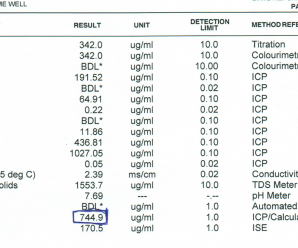
    Water is one of the main inputs into a spray operation. The amount of water applied per acre is closely related to spray coverage and pesticide performance. But water quality – a term encompassing its cleanliness and chemical composition – is also critical to the performance of pesticides. Ensuring good performance means testing water and understanding the results.

    There are four main water quality indicators related to pesticide performance:

    1. Water Hardness. Water hardness is caused by positively charged minerals, primarily calcium and magnesium, but also sodium and iron. These cations can bind to some herbicides (glyphosate is the best-known example, also 2,4-D amine), reducing its performance. Hardness is usually named “Total Hardness (calculated)”, based on the concentration of calcium and magnesium in the sample, and is expressed in ppm or mg/L of CaCO3 equivalent. Some tests refer to the older unit “Grains”, which is ppm divided by 17.  Bayer suggests that total water hardness should be below 350 ppm (20 grains) for the low rate (1/2 L/acre equivalent) of glyphosate, and below 700 ppm for the higher rates.
    2. Bicarbonate.  Sometimes referred to as alkalinity, the bicarbonate ion can inhibit herbicide activity, and also make some herbicides more difficult to mix. The most commonly affected herbicides are members of the Group 1 modes of action, products like clethodim, sethoxydim, and others, as well as MCPA amine and 2,4-D amine. Definite guidelines are hard to find because the antagonistic effect of the bicarbonate ion depends on the presence of other ions such as sodium and calcium.
    3. pH. This is a complex parameter because it is related to pesticide solubility, hard water antagonism, and pesticide degradation. In most cases, pH values between 4 and 7 are considered acceptable. But some herbicides, notably those in the Group 2 modes of action, have specific pH needs to dissolve properly. For example, the sulfonylureas (FMC products such as Refine, Express), triazolopyrimidines (Corteval products such as Frontline, Simplicity), Triazolones (Bayer products such as Varro, Velocity M3) and Sulfonylaminocarbonyltriazolinone (UPL products such as Everest) dissolve better at higher pH, whereas the imidazolinones (Odyssey, Pursuit, Ares) tend to require lower pH. Some Group 14 products such as saflufenacil (BASF products Heat, Eragon) also prefer higher pH values for solubility. Label directions are important, sometimes calling for specific adjuvants to adjust the pH prior to adding the pesticide. Some pesticides, particularly insecticides, can break down rapidly in higher pH water. The rate of breakdown is usually not of importance on a spray day but may matter if a mixed tank needs to be stored for many hours or days.
    4. Cleanliness / turbidity. Water may contain suspended solids such as clay. Glyphosate and diquat (Reglone) are sensitive to this, as these chemicals are readily adsorbed to soil particles, and turbid water can reduce their effectiveness. This is also why dust generated by the sprayer can reduce these herbicides’ performance.

    Ensuring good performance

    Select clean water sources and conduct a water test to identify possible problems. Well water is more likely to be hard than surface water. If a laboratory water test is not available, then some quick home testing can provide the necessary guidance. First, use a conductivity meter to test the electrical conductivity (EC) of the spray water. Although this test does not identify the ions present, it shows if a potential problem exists. EC values less than 500 µS/cm are considered safe. For values above 500, a hardness test is necessary to confirm the presence of antagonizing cations. Paper test strips compared to a colour scale are a quick way to determine hardness.

    If you have done a water test and want to know what all the numbers mean, have a look here.

    If the water is hard, a generally accepted solution is to add ammonium sulphate (AMS) fertilizer at rates between 1 – 3% w/v of 21-0-0-24 to the spray tank, preferably before adding the herbicide. Spray grade liquid concentrate AMS product is available from Bayer CropScience, Winfield United, and some other suppliers.  The sulphate anions tie up the hard water cations, preventing them from antagonizing the herbicide. Liquid urea-ammonium nitrate (UAN, 28-0-0) has also been shown to improve herbicide activity for some products, but because it does not contain the sulphate ion, it is not as effective as AMS.

    Certain weak organic acids can also function as water conditioners. For example, citric acid can chelate hard water ions so long as the pH is not too low, that is, the necessary dissociable groups are ionic. If the pH is very low, these groups will be protonated and the chelating action is suppressed.

    Be careful when lowering pH. It does affect the solubility of many herbicides and possibly the function of some formulations. The outcome may be an unusable tank mix.

    Caution is also advised when adding foliar fertilizer specialty products. Adding a blend of fertilizer salts, combined with associated changes in pH, can result in unpredictable interactions with pesticides and water, resulting in sticky precipitates that may be very difficult to clean out of tanks and plumbing. Ask for compatibility data, and always conduct a jar test to be sure that the planned mixture mixes as expected. A recent study shows the effects of adding herbicides to UAN and ammonium thio-sulphate (ATS) plus nitrate stabilizers, where mixing order is critical.

    Turbidity is a problem with surface waters, especially in areas of clay soils and after surface runoff. If spray water is taken from a pond, its turbidity can be reduced by adding aluminum sulphate at rates between 10 to 60 mg/L of pond water. Thorough agitation is required, and 80 to 95% removal of turbidity is achieved within 24 to 48 h (technical information here).

    Pesticide manufacturers are usually aware of potential problems when their products are used in poor quality water. Consult with your local rep to learn of know issues and solutions before spraying.

    Check out this 2022 Real Agriculture interview with Tom and Greg Dahl of Winfield United. Pan ahead to the 16 minute mark for a discussion on water quality.

  • Top Five Tips for the Spray Season

    Top Five Tips for the Spray Season

    This article was originally written by @nozzle_guy as a guest blog for Farm At Hand, and is reproduced with permission.

    Spray season is here, but are you ready?  Here are 5 tricks to give you a productivity edge.

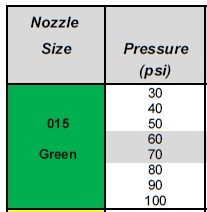
    1. Choose a spray pressure in the middle of your nozzle’s operating range.  All spray nozzles have a range of pressures throughout which the manufacturer believes the spray pattern is acceptable.  We’ve come to assume that the correct spray pressure for a nozzle is about 40 psi, largely because of tradition.  In fact, 40 psi is merely the mid-point of a traditional nozzle’s pressure range, between 20 and 60 psi.  Modern air-induced nozzles have much higher and wider pressure ranges, usually from 30 to 100 psi.  The new middle ground is about 70 psi.
    For this nozzle, the manufacturer recommends pressures from 30 to 100 psi. The middle ground is 60 to 70, allowing travel speed flexibility

    Why so high?  There are two reasons.

    • Air-induced tips perform optimally at higher pressures, and remain lower drift than conventional nozzles even at those pressures.
    • Travel speed range.  As a sprayer changes speed, the spray pressure is automatically adjusted to maintain a constant application volume.  Even a small reduction in speed, due to changes in terrain, for example, can put the spray pressure too low for good nozzle operation.  A nozzle that is sized for a higher average operating pressure will permit a reduction in speed without a nozzle performance penalty at lower speeds.
    1. Measure your boom’s pressure drop and add this value to your target operating pressure. All sprayers experience a drop in pressure as the solution moves further away from the pump.  This is due to friction caused by a number of factors, including length of tubing, elbows, valves, screens, and other flow obstructions.  The pressure transducer that reports pressure to the cab is usually located between the pump and the manifold that divides the spray into the various boom sections.  After this point, the spray liquid experiences those additional restrictions, and pressure at the nozzle will therefore be lower than the cab reading indicates.
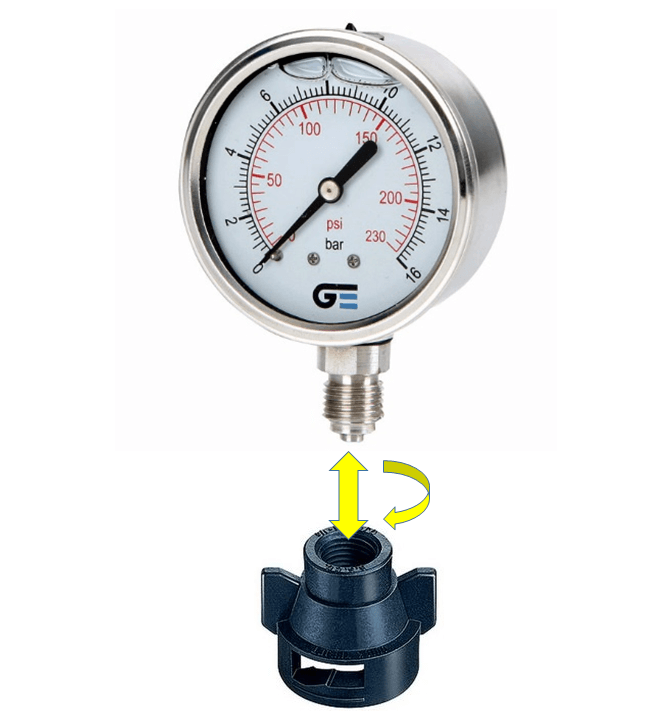
    By adapting a pressure gauge to a nozzle cap, boom pressure can be measured directly

    The nozzle pressure can be measured with a gauge placed on a nozzle body.  Simply purchase a gauge and a threaded nozzle cap, combine the two and install in place of a nozzle.  Operate the sprayer and read this pressure, comparing it to the pressure in the cab.  The difference between the two is the pressure drop.  Do this for your lowest, as well as your highest expected flow rates.  Higher flow rates cause greater pressure drops.  If you want to spray at 60 psi and your pressure drop is 10 psi, then the cab pressure should read 70 psi.

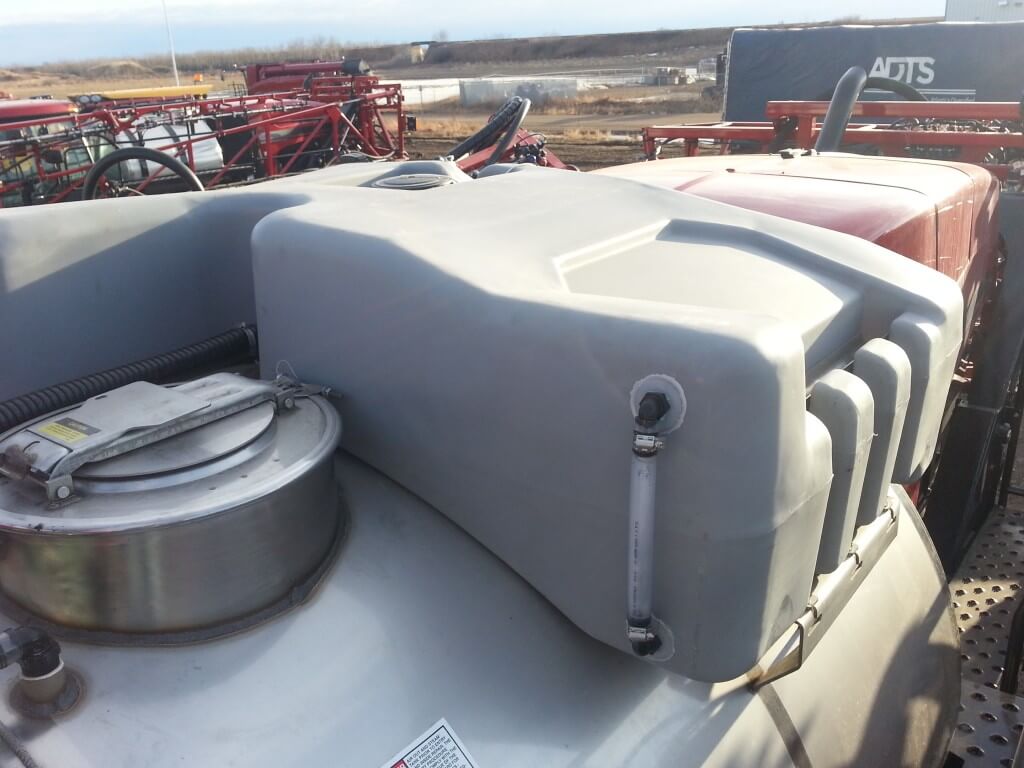
    1. Install a clean water tank and wash-down nozzle on your sprayer. One of the more time-consuming aspects of a spray operation is cleaning the sprayer when you switch products.  The quickest way to clean a sprayer starts with accurately calculating your last tank needs, and spraying any remainder (if you’ve done your math, this will be small) out in the field.  Depending on the product, overspraying the crop a second time can be an option, simply reduce the application rate to prevent doubling the dose.
    On-board clean water tanks save time

    When the spray tank is empty, introduce clean water from your clean water tank through the wash-down nozzle, allow to mix with remaining spray in plumbing (make sure agitation is on) and spray out.  The spray mixture will quickly become increasingly dilute and flush through all sprayer parts that contained the product.  The clean water tank can contain a cleaning adjuvant such as ammonia or a detergent depending on the properties of the product to be removed. After the sprayer is cleaned, stop and inspect all screens to ensure there are no pockets of residue.

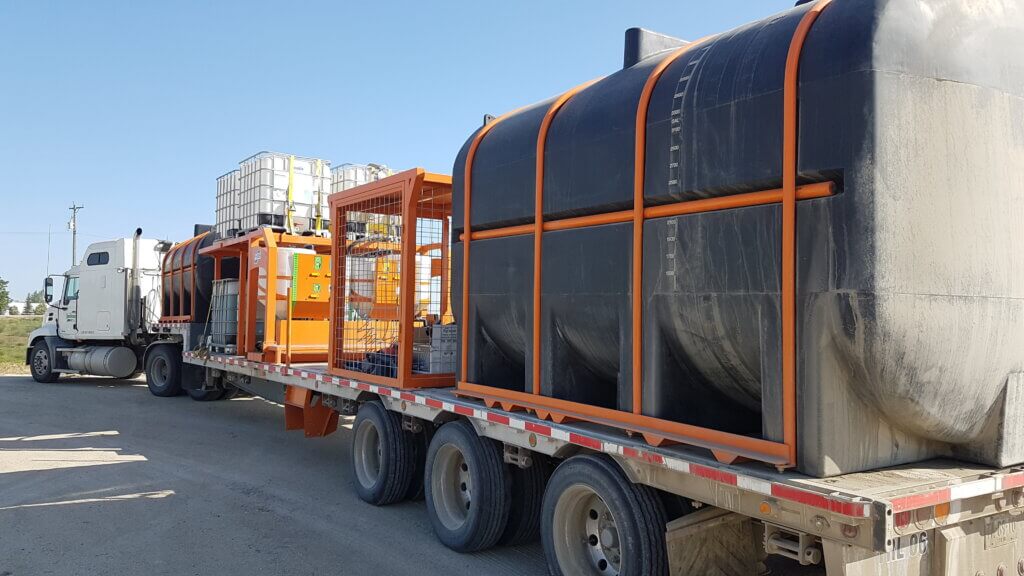
    1. Obtain a faster transfer system and strive to load faster. Most sprayer refills can take longer than planned, and before you know it, 15 or more minutes have passed.  That can be a significant portion of the total spray time, resulting in lost productivity.  By moving to a 3” transfer pump and plumbing, fills in 5 minutes are possible.  Care is required to ensure that products are properly mixed, and dry products may need to be hydrated in advance to prevent screen and nozzle plugging.
    A good tender system may be the most important productivity component in your spray operation

    The fastest operators have a capable person on the tender truck, and have the tender truck move to the sprayer at the field edge, not the other way.  Front fill attachments save further time.  Think of it like a Nascar pit stop, and watch productivity increase.

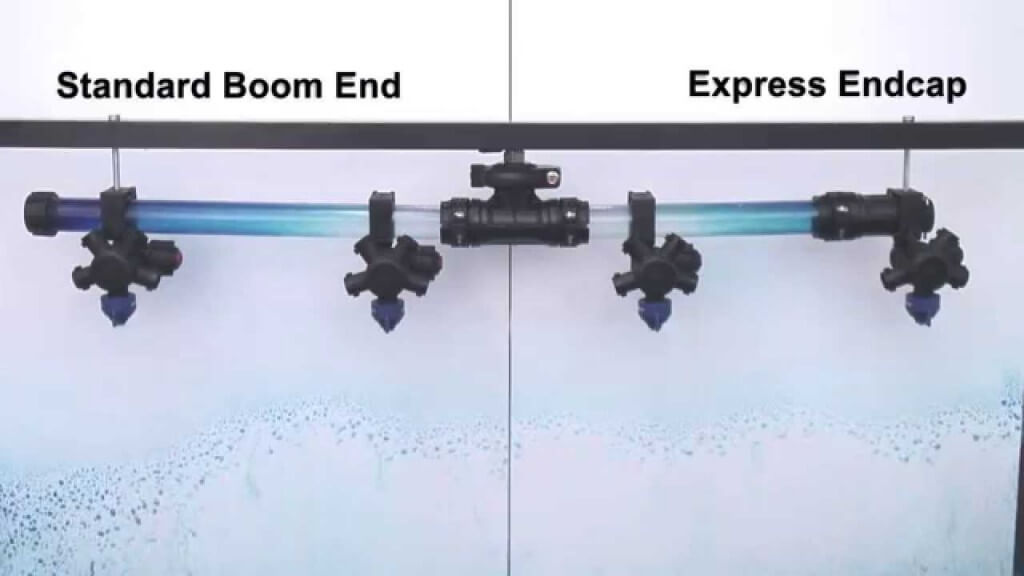
    1. Say goodbye to boom end valves. Traditional 1” wet boom sections have a “boom end” that is capped about 4 to 6” beyond the last nozzle body.  The boom end is a dead end, and any pesticide mixture that ends up there, as well as any air in the boom, is virtually impossible to remove.
    The Hypro Express End Cap system prevents boom ends from retaining spray mix.

    Two problems result:

    • Boom end residues can cause contamination.
    • The air in a boom acts as a bladder, preventing diaphragm check valves from shutting nozzles off until enough liquid has left the boom to reduce the bladder pressure.

    The most common way to remedy this is to install valves at each boom end, flushing the air and contamination out.  But this has to be repeated twice for each boom section, which can number anywhere from 5 to 11 per boom.  A product called the Hypro Express Nozzle Body End Cap automates the process.  The end cap has a novel design that eliminates the dead reservoir and bleeds air from the boom continuously during normal operation.  The result is easier sprayer cleaning and better shutoff responsiveness.

    Spraying is an important operation, and timing is critical.  Small changes in productivity can add up, preventing problems and getting more acres treated each day.

  • Increase Sprayer Productivity Without Driving Faster

    Increase Sprayer Productivity Without Driving Faster

    Timing trumps most things in crop protection. A great spray applied at the wrong time isn’t nearly as valuable as a mediocre spray at the right time. So how do we improve our ability to get things done at the right time?

    Often, we try to win races by driving faster. In our last article, we looked at driving speed and concluded that faster speeds can lead to more drift and less uniform deposition. Driving slower can be viewed as a sort of insurance policy: You may not notice the benefits right away, but on days when that extra bit of performance is required, you’re covered.

    So how do you get the job done quickly if you can’t drive faster?  To answer, we have to look to other opportunities for boosting productivity.

    Recently, we built a model to capture all the elements of a normal spray operation that affect timeliness. These were:

    • travel speed
    • boom width
    • tank size
    • water volume
    • field length
    • number of headlands
    • turning speed
    • fill time

    First, we identified a reasonable base condition. For the sprayer, that was a travel speed of 14 mph, a 90’ boom, an 800 gal tank, a 10 gpa water volume, and a 20 minute fill time. Then, we set up a typical field situation, which was spraying a half-mile run on a quarter with two sprayed headlands and a turning speed of 8 mph. Finally, we changed one factor at a time to determine its relative importance.

    Before we discuss the results, let’s make it clear that just because changing some of these factors improves productivity doesn’t mean we’re recommending them! For example, adequate water volume remains an important input that improves coverage and permits the use of low-drift sprays. Larger tanks increase compaction and take more power, and so forth.

    Here’s what we found:

    All productivity values were expressed as acres per engine hour. For this reason, our numbers will be lower than what a typical sprayer monitor reports, most of which calculate acres per spraying hour.

    For the base condition, the sprayer spent 15% of its driving time turning, and 37% of its on-field time stationary (i.e. filling).  For every hour spent on the field, less than half the time (48%) was spent spraying. This resulted in an average productivity of 82 acres/h.

    Increasing the spray speed to 18 mph increased average productivity to 93 acres/h, but it also increased the proportion of time spent turning and loading, resulting in just 40% of the field time spent spraying.

    Decreasing the loading time from 20 to 10 minutes reduced the proportion of field time spent stationary to 23%, covering 100 acres/h at 14 mph. Surprisingly, this was the productivity-winner, resuling in 62% of on-field time spraying.

    We discovered other powerful productivity factors, and chief among them was boom width. A 33% increase in boom width from 90’ to 120’ gave a productivity boost to 94 acres/h, close to the same result as increasing the travel speed to 18 mph earlier. Similar side effects occurred: more time turning, and a greater proportion of time filling, as we saw with faster travel speeds.

    Boom width seems to have some room for growth.  Many smaller European counties use wider booms than we do in North America, for example.  With gps guidance and large fields, we have excellent conditions for their implementation.

    Two other factors that had similar effects to fill time were water volume and tank size. Less water and larger tanks increased productivity by decreasing the fill frequency, with effects similar in magnitude to speeding up the fill time. Decreasing the water volume from 10 to 5 gpa increased productivity to 100 acres/h by decreasing the proportion of time the sprayer was stopped from 37% to 23%. Increasing from an 800 to a 1,200 gallon tank increased productivity to 94 acres/h, again by decreasing the proportion of time spent filling to 28%.

    Taken together, a sprayer with a 120’ boom, a 1,200 gal tank, applying 10 gpa and filling in 10 min had an average productivity of 132 acres/h. And this was achieved without driving faster than 14 mph. If you can string two quarters together and drive a whole mile before turning, that number rises to 145 acres/h, a surprisingly large 13 acres/h gain.

    The perspective of minimizing downtime extends to other tasks, too:

    • Be more prepared for the job by reviewing the product label in advance, noting the correct mixing order.
    • Keep extra nozzles, clamps, and nozzle bodies in the cab.
    • Don’t clean plugged nozzles, replace them.
    • Use low-drift nozzles so a small increase in wind doesn’t shut you down.
    • Ensure all the products needed are on the tender truck (e.g. pesticide, adjuvant, tank cleaner, anti-foamer, etc.).
    • Consider switching to 3” plumbing (pump rates of 300 – 400 gpm are possible).
    • Make sure your inductor won’t be the limiting factor. For example, product pumps can be awfully slow when the product is cold. It might be worthwhile to explore a venturi system.

    Speeding up the fill process is a good idea, but be careful with certain products. Dry materials such as the sulfonyl ureas (e.g. Refine, Express SG, etc.) and some fungicides (e.g. Astound, etc.) require time to hydrate in water so they mix properly. Some operators pre-hydrate these in a smaller tank, while others get an extra tank to pre-mix whole loads and simply transfer them over.

    Also think about the time spent cleaning the sprayer. Thoroughness is important, but perhaps there are efficiencies to be gained there as well, like never letting a sprayer sit after spraying. We’ve written about continuous rinsing, for example, to improve cleaning speed and effectiveness.

    So, the quicker we can spray, while ensuring a quality job, the more effective our crop protection practices will be. We encourage you to use our to determine your best configuration.

    Got a productivity tips to share? Let us know! And remember: In spraying, the race is won in the pits.

    Factor

    Base

    Drive Faster

    Fill Faster

    Spray Wider

    Less Water

    Bigger Tank

    New Sprayer

    Travel Speed

    14 mph

    18 mph

    14 mph

    14 mph

    14 mph

    14 mph

    14 mph

    Fill time

    20 min

    20 min

    10 min

    20 min

    20 min

    20 min

    10 min

    Boom Width

    90 ft

    90 ft

    90 ft

    120 ft

    90 ft

    90 ft

    120 ft

    Water Volume

    10 gpa

    10 gpa

    10 gpa

    10 gpa

    5 gpa

    10 gpa

    10 gpa

    Tank Size

    800 gal

    800 gal

    800 gal

    800 gal

    800 gal

    1200 gal

    1200 gal

    Field Length

    0.5 mile

    0.5 mile

    0.5 mile

    0.5 mile

    0.5 mile

    0.5 mile

    0.5 mile


    Time Turning

    15%

    19%

    15%

    20%

    15%

    15%

    20%

    Time Loading

    37%

    42%

    23%

    42%

    23%

    28%

    19%

    Time Spraying

    48%

    39%

    62%

    38%

    62%

    57%

    61%

    Acres/h

    82

    93

    100

    94

    100

    94

    132