This is the first of a series of short, educational and irreverent videos made with Real Agriculture to bring a little levity to sprayer education. Let’s face it – ironically, nozzles can be pretty dry.
This first video discusses what a rate controller can be expected to do, and what it cannot do. Plus, we got to blow up a sprayer in the intro… so there’s that.
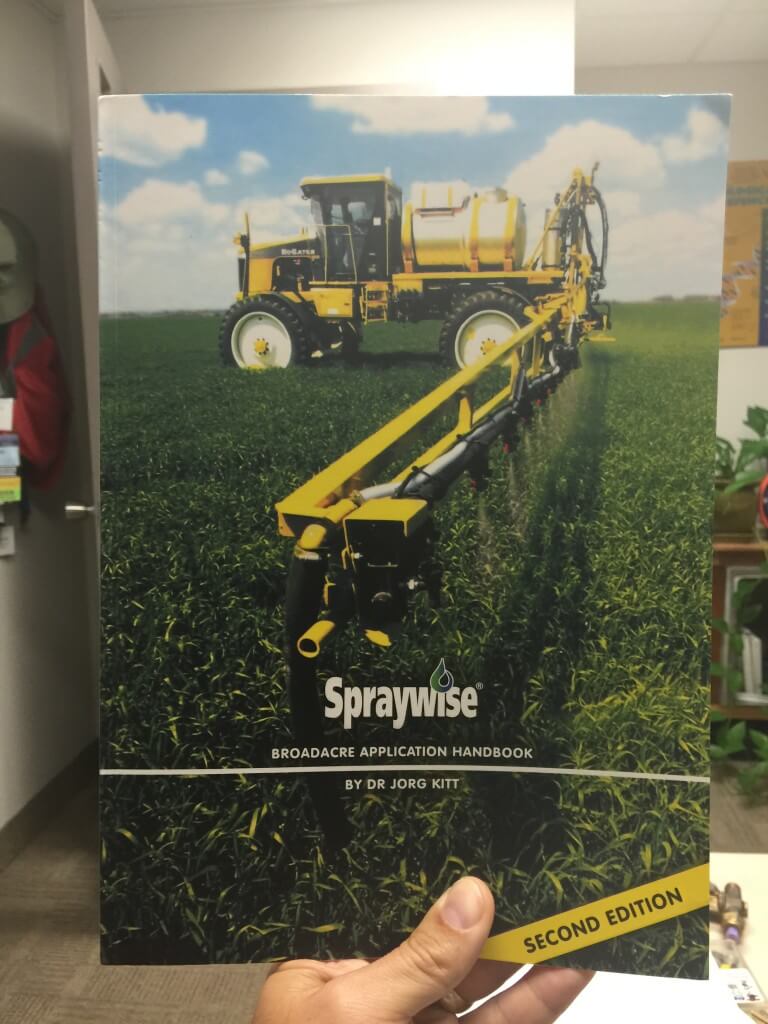
I haven’t written a book-report since high school, but I was recently sent a copy of Dr. Jorg Kitt’s “Spraywise – Broadacre Application Handbook” and I was compelled to share. It’s published by Nufarm and is based out of Australia. What a fantastic, easy-to-read book full of excellent spraying know-how.
Am I overselling this? I am not.
Spraywise – Broadacre Application Handbook by Dr. Jorg Kitt (published by Nufarm, Australia)
The chapters include:
Droplet Size
Chemical Target Interaction
Nozzle Types
Nozzle Selection
Nozzle Spacing & Boom Height
Drift
Weather
Adjuvants
Formulation & Mixing Order
Cleaning Procedure
Calibration
Record Keeping
At risk of copyright infringement, let me share a little of Dr. Kitt’s advice on chemical and target interaction.
“Many chemicals used in agriculture show only limited movement in or on the plant. For surface active fungicides such as mancozeb coverage is critical because the active does not move – it settles where the droplet dries with only limited redistribution properties.”
This is why we suggest coverage is king when applying products that don’t translocate. You can slow down, raise water volume, or as a last resort reduce spray quality (minding the drift and evaporation issues that arise from this choice). But he goes on:
“Many cereal fungicides such as DMIs move only in the xylem (water transport bundles) and therefore can only travel in one direction – upwards towards the tip of the leaf (acropetal).”
So, I admit that as I continue to transition from horticultural spray applications to broadacre work, I have a lot to learn. Something that bothered me when I started looking at fungicide applications in corn was the appalling coverage on water sensitive paper. If any of my vegetable or orchard applicators had such poor coverage, their crops would be riddled with disease… so why was such poor coverage working so well in field crops?
According to this new-to-me information, perhaps the >Coarse droplets were penetrating the canopy, reaching down to impinge on the base of the plant (or splatter up from the soil) where they could re-distribute by moving up through the xylem. It certainly makes more sense to me why such coarse droplets and relatively low volumes can still be efficacious for certain fungicides in field crops. I’ll reiterate – this may be old hat to some readers, but I still have a lot to learn on this topic.
Dr. Kitt shares many digestible, easily-implemented little factoids that make this handbook a must-have for your spray library. Applied herbicide advice, for example:
“…if 50% of the ground is covered with stubble only half the spray volume will hit the soil directly; the other half will strike stubble. To optimise applications in this situation it is important to produce droplets with sufficient velocity to increase bounce and splatter. The applicator should use higher water volumes (70-100 L/ha) and a coarse to very coarse spray quality. In a clean bed spray quality and water volume have little effect. A coarse spray quality and water volumes above 50 L should be sufficient to achieve efficacy.
These volumes are low for North America (Australia uses nerve-rackingly low volumes) but otherwise this is solid gold.
I was fortunate to have someone send me a copy of this handbook. I’ve poked around on-line to try to find a Nufarm-based website where anyone could order a copy, but I was unsuccessful. However, if you Google “Spraywise Broadacre Application Handbook 2nd ed.” you will find a number of dealers that will happily sell and mail you a copy. I won’t share those links here to avoid a bias, but they’re easily found.
So, to summarize, I wanted to make the sprayers101 readership aware of this Handbook. Given the affiliation with an agrichemical company, it’s a bit adjuvant-rich, but it’s chock full of great information and well worth the cost and effort to have a copy mailed to you.
I always await a trade show with excitement. Everyone’s going to be there, showing their latest and greatest. You see old friends. And of course, trade-show food. Every year, I search for the Fiddle Sticks I learned to love in the 80s. They’ve been replaced by the Pocket Dawg, it seems. Not the same.
Touring around the sprayer and nozzle displays at this year’s Western Canada Farm Progress Show, I couldn’t help but notice that an old contrast got even more striking.
As expected, sprayers are bigger and heavier than ever. The JD r4045 is an example, weighing in at 36,000 lbs, with a list of $563 k CDN. It’s not the only one, though, I just pick on John Deere because they can take it. They know it’s outrageous.
Most sprayers are made by multinationals, with large engineering budgets, and they build complicated and sophisticated machines. They’re huge. They crush weeds. Their cost has often increased by double digits annually.
Then it’s off to the nozzle manufacturers, for the contrast. Small booths nestled among other family businesses, staffed by the owners. Yes, most of the nozzles we use are produced by surprisingly small family-owned companies with just a handful of employees. They make their products on-shore. They have modest research budgets. They collaborate with each other and share components. And their products are priced very low. Not bad, considering the nozzle is the most important part of the sprayer (after the operator, of course).
One can get a very good low-drift, air-induction nozzle for about $6.00. That’s close to the same price it was 10 years ago. Nozzles, engineered to remove small droplets with a two-stage venturi design offer good spray patterns between about 30 and 100+ psi. This means that a $450,000 sprayer with a 120 foot (36 m) boom requiring 72 nozzles can be outfitted with nozzles for a cost of $450 (0.1% of the sprayer cost) , or $1350 for a set of three.
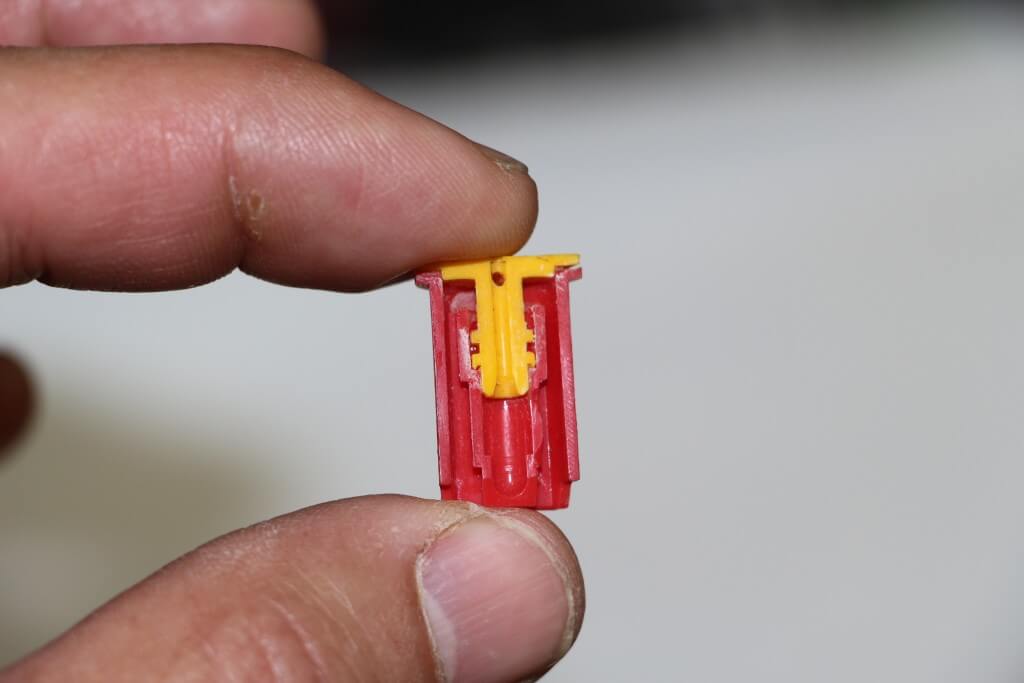
A very cool cut-away view of an Airmix nozzle.
These nozzles have important tasks. They need to:
meter the pesticide mixture out accurately (within 5% or less of the target amount);
atomize the mixture into droplets that maximize coverage while minimizing drift and other waste
distribute the spray uniformly across the width of the boom.
If nozzles miss on any one of these goals, producers pay with lower control, higher costs, or environmental contamination. So these little devices are important.
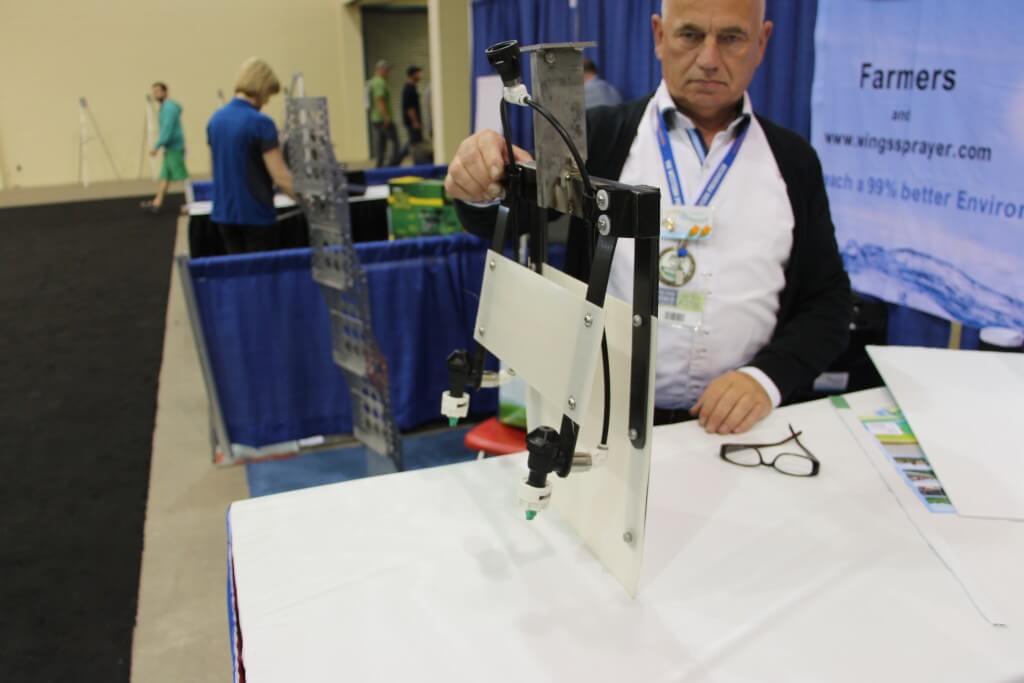
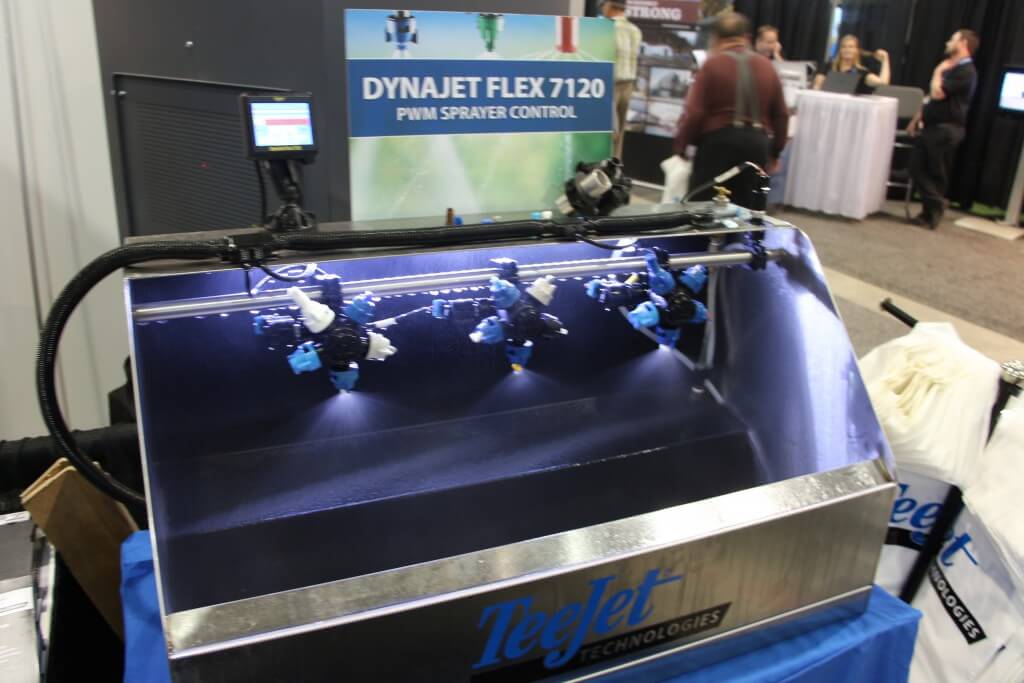
We do see innovation in this important area, again from small companies. Devices designed to improve rate control (pulse-width modulation or variable rate nozzles), to reduce drift (PatternMaster), or to improve canopy penetration while increasing coverage and reducing drift (Wingssprayer) are appearing. While these aren’t cheap, they cost a fraction of what the sprayer costs, are light, and reliable.
Harrie Hoeben holding a section of his Wingssprayer system.
And they’re meeting with resistance because of a very peculiar response. Over the past 15 years, when a producer has heard the cost of a new sprayer, the sticker shock has made them walk away. But not far. They’ve returned shortly after to make the purchase. Need a new sprayer, right? Need high clearance, hydrostatics, air-ride, horsepower.
But when they see the cost of even the most expensive atomization system (some as low as $4000, the most costly typically $20,000 to $40,000), they just shake their heads and walk away. Probably for good.
TeeJet’s pulse width modulation system – the DynaJet Flex 7120.
And yet it is this purchase that will probably pay the highest dividends. It’s this technology that can answer to the needs presented by heavy, fast tractor units. The $6.00 nozzle is out of its depths here. And the innovators need the sales so they can conduct proper research to give you the best value, and lower their costs.
Capstan’s new PWM solenoid for high-flow John Deere bodies.
A New Process
How about we look at it this way: Budget for a new sprayer. Say you accept that it will cost about $440,000. This is the total amount you will spend. Now budget for a great delivery or atomization system. One that either improves coverage, decreases drift, improves consistency, or makes you more productive. Let’s go for the best one, and budget $40,000.
Now don’t raise the cost of the investment by that amount, but instead make it inclusive. The sprayer’s tractor unit budget is reduced to $400,000 to accommodate the atomization system, for a total cost of $440 k, still within budget. You may need to re-evaluate the type of sprayer, or features, that you will be able to obtain with a 10% lower cost.
Or perhaps you can take advantage in the slightly more desperate market situation for big iron and score a better deal. Buy used, or invest in your old sprayer to rehabilitate it.
Either way, we need to start thinking differently. Within any given budget, let’s purchase the most important components first. Then let’s put wheels on it. And then, let’s get some Fiddle Sticks.
During post-harvest down-time, it’s important to take a much needed breather. Then, before you know it’ll be time to start the shop projects and equipment maintenance for next year, if you haven’t started already. Before you get started, though, Tom Wolf has a handy list of things to evaluate, clean up, fix or replace on the sprayer.
In this final installment of Tips with Tom, Wolf runs through key areas of the sprayer that could potentially use upgrading or just maintenance, plus lists some quality parameters that could be improved for next year that may take some footwork through the busy winter season.
How often do you test spray-water quality and what do you do if you’ve got hard water?
If you’re looking to replace your spray tank, is stainless still the way to go?
What about double nozzles — are they really the bee’s knees?
The questions surrounding these aspects of spraying come up very often.
Tom Wolf recaps some key aspects of water volume and water quality you may not have considered, plus we get that answer on when a stainless steel tank might be the right choice.
Moving on to nozzles and overall spray operation tweaks, Wolf summarizes the reasons for moving to double (or twin-fan) nozzles in some scenarios, plus offers some insight into where your time may be best spent on improving your fill transfer set up.