Category: Speciality Sprayers

Main category for all sprayers that are not horizontal booms

  • The Real Story behind pH and Water Hardness

    The Real Story behind pH and Water Hardness

    Editor’s Note: Changes and updates have been made to this article since its original publication in 2019.

    The quality of water being used in the spray tank to act as the carrier for your pesticides can have significant effects on how well those pesticides will work. So it may be surprising that very few growers have had their water quality tested.

    Obviously, water that contains suspended materials such as clay, algae and other debris will block filters and possibly nozzles, making spraying very frustrating. However, there are a range of water quality variables unseen to the naked eye that can also affect pesticide performance. The two that cause the most confusion are water hardness and pH.

    Water Testing

    Knowing the quality of the water you are using is essential for effective pesticide application. Water should be initially tested by a qualified laboratory to establish an accurate baseline for your water quality. Check with your pesticide dealer or look for accredited laboratories near you.

    It is important to remember that water quality can vary over time depending on its source. Scheme or town water quality tends to vary very little, however water from surface sources such as dams, tanks and rivers will vary depending on rainfall and other factors. Groundwater can also vary over time depending on how much is being pumped and the recharge rates of the aquifer.

    At minimum, water should be tested for:

    • total hardness
    • bicarbonate (HCO)
    • salinity (electrical conductivity) or total dissolved salts (TDS)
    • pH

    Test strips can be used to quickly check water quality before and after addition of pesticides and monitor changes in water quality between laboratory tests. High-quality test strips can be purchased online from companies such as Hach. Water testing for swimming pools will not be as accurate as those from a scientific supply company. No mater the course of the paper strips, they may be hard to read when used in solutions already containing product. Alternately, and preferably, hand-held meters can be used as long as they receive regular calibration to maintain accuracy.

    Water Hardness

    Water that is considered “hard” has high levels of calcium, magnesium or bicarbonate ions. Calcium and magnesium ions have positive electrical charges that enable them to bind with negatively charged products such as weak-acid herbicides, making them less soluble. Extreme cases can lead to the herbicides settling out in the spray tank, or more commonly (and insidiously) reducing the ability of the active ingredient to be absorbed through the plant leaf. Examples of weak acid herbicides include glyphosate and amine formulations of 2,4-D, MCPA, clopyralid and diflufenican.

    It can depend on your region, but generally a water hardness above 250 to 350 parts per million (ppm) (calcium carbonate – CaCO3 equivalents) should be treated before adding weak acid herbicides.

    The cations that can cause the most trouble for pesticides include:

    • aluminum (Al3+)
    • iron (Fe3+, Fe2+)
    • magnesium (Mg2+)
    • calcium (Ca2+)
    • sodium (Na+)

    Magnesium and calcium are the most common cationic culprits of water quality problems. Aluminum can sometimes be a problem if alum (potassium or aluminum sulphate) has been used to remove (i.e. flocculate / settle-out) suspended particles such as clay from the spray water.

    Bicarbonates

    Bicarbonates can also affect herbicides such as Group 1 ‘dims’ (e.g. clethodim) and 2,4-D amine at levels greater than 500 ppm. Bicarbonates are not typically detected by standard water hardness tests and may have to be analyzed in a separate test. Be suspicious if your groundwater comes from an area with lots of limestone.

    pH

    The pH of a liquid is represented on a scale of 0 to 14, and it describes how acidic or alkaline it is, respectively. A neutral pH is about 7 whereas a pH of 2 is very acidic and a pH of 14 is very alkaline. It is important to remember that the pH scale is logarithmic, not linear. This means that a value of 6 is 10x more acidic than a pH of 7, while a pH of 8 is 10x more alkaline than 7 and 100x more alkaline than 6.

    The following table gives the pH of common materials to give a sense of perspective.

    pHSubstance
    14Sodium hydroxide (caustic soda)
    12.6Sodium hypochlorite (bleach)
    11.5Ammonia
    10.2Magnesium hydroxide (antacids)
    9.3Sodium borate (borax)
    8.4Sodium bicarbonate (baking soda)
    8.1Sea water
    7.4Human blood
    7.0De-ionised water
    6.8Tea
    6.7Milk
    6.0Rain water
    4.5Tomatoes
    4.2Orange juice
    4.0Wine & Beer
    2.8Vinegar
    2.2Lemon juice
    2.0Stomach acid
    1.0Battery acid
    0.0Hydrochloric acid

    Excessive Alkalinity

    Most recognize that a pH above 8 will reduce the effective life of certain pesticides, such as organophosphate insecticides (if you’re still allowed to spray them where you are). In certain situations, water above pH 8 can change herbicide solubility (poor mixing), reduce product stability (reduced half-life) and negatively affect droplet interaction with the leaf surface. However, the effect of high pH on herbicides is largely overstated.

    Excessive Acidity

    Glyphosate has been found to work slightly better in moderately-acidic solutions. This effect is from the precipitation of calcium compounds in the tank, preventing the formation of calcium glyphosate on the leaf surface. Excessively acidic water (pH < 5) can affect the stability of mixes (see the following image) and leads to gelling of salt-based products. It has also been found to increase the volatility of herbicides such as dicamba (this is discussed later in the article).

    This grower was told to drop the pH of his spray. He added citric acid and added another three products. Source: R. Buttimor

    Do I need to adjust the pH of my water?

    There are many half-truths in the marketplace about the effect of pH on pesticides. But generally:

    If the pH of the water in the spray tank is between pH 6 and 8, it’s is suitable for spraying.

    Something that is rarely discussed is that the addition of the pesticide will modify the pH of the solution. Therefore, each pesticide user needs to test the water before the addition of pesticides and then check the pH after the addition of the pesticide. They will be very different.

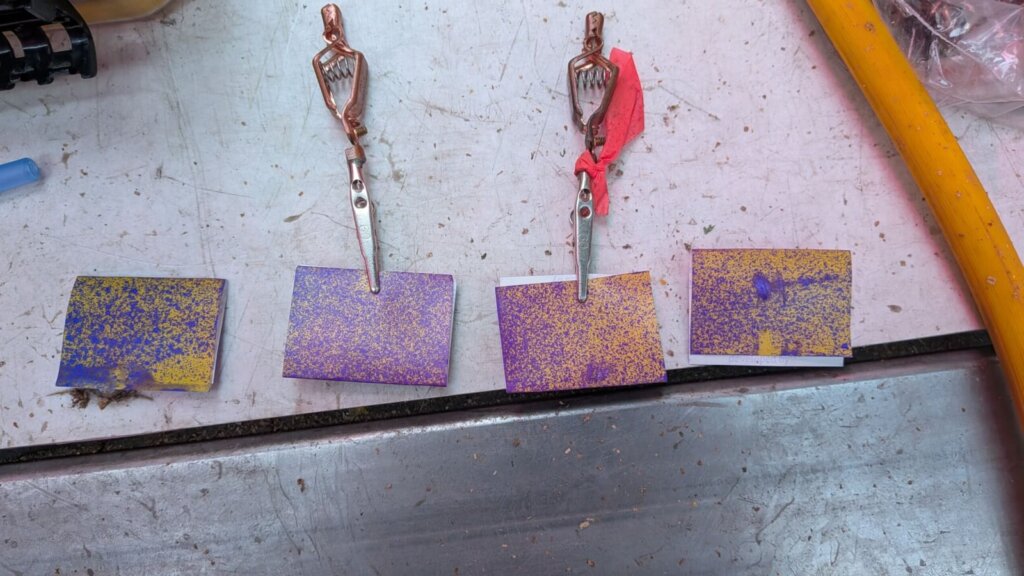
    The addition of glyphosate to the spray solution will drop the pH of the spray mix from 8 to less than 5. In the following figure the test strip on the right is town water which normally has a pH of about 8.5, compared with the test strip to the left which is from a 1% glyphosate (450 g/L) solution using town water, which is below a pH of 4.

    Adding glyphosate will drop the pH of the tank mix two or three units, depending on initial pH, the formulation and the rate of glyphosate. The pH following the addition of 1% glyphosate (450 g/L) is less than 4 (the yellow test strip). Town water (the blue test strip) is shown on the right.

    Research in the United States has found drift damage from dicamba continued to be a problem despite the mandating of using XC and UC spray quality. They found one cause was the addition of glyphosate to the mix, which reduced the pH of the spray solution (Table 2). Volatilization of dicamba increases with decreasing pH. Different formulations of dicamba were found to drop the spray solution pH from 7.8 to between 6.5 and 6.9, however the addition of different formulations of glyphosate dropped the spray solution to 5 or lower.

    Table 2 Effect of different formulations of dicamba and glyphosate on spray solution pH. Source: Larry Steckel

    Starting pH (water)Dicamba added (3 formulations)Glyphosate added (3 formulations)
    7.86.94.8
    7.86.54.8
    7.86.75.0

    Currently, in Australia, the recommendation for dicamba is to not add glyphosate to the mix. This will minimize pH drop and therefore reduce the volatilization of dicamba and potential off-target damage.

    There’s even more about adjusting the pH of carrier water here.

    Adjusting pH using Ammonium sulphate (AMS), Ammonium thiosulphate (ATS) and adjuvants

    The degree of bicarbonate, or alkalinity, depends on the presence of calcium and sodium, which can inhibit herbicide performance. Readings higher than 500 ppm inhibit 2,4-D-amine and MCPA-amine. Adding AMS can be effective at countering bicarb. According to Jim Reiss (former Vice President, Ag Chemistry with Precision Labs in Illinois), the following formula can be used to calculate how many pounds of AMS are required to raise the alkalinity. It involves soil testing levels of sodium, calcium, magnesium and iron, along with potassium:

    0.002 x K ppm + 0.005 x Na ppm + 0.009 x Ca ppm + 0.014 x Mg ppm + 0.042 x Fe = lbs of AMS/US gallon.

    Generally, AMS has no negative impact on mixing in a water-based carrier when added at any stage, but always follow the label if it specifies a mixing order. Especially if mixing in a fertilizer carrier instead of water. Read more about AMS here, under the “Water Conditioners” heading.

    Ammonium thiosulphate (ATS) is another option, but must be used with care. Research from Purdue University (2019) concluded that using ATS with a burndown herbicide program that relies on glyphosate or glyphosate plus 2,4-D could lower the control of weeds (e.g. barnyard grass, velvetleaf or lamb’s quarters), or cover crops.

    Adding UAN can also help neutralize the effects of bicarbonates, but be aware that adding UAN (or any sulfur) to a carrier could cause physical incompatibilities – especially when adding to a fertilizer carrier. Follow mixing order directions on the pesticide label and read more, here.

    Alternately, you might consider a mixing aid or water conditioning adjuvant to deal with bicarbonate. The following table describes the difference between using AMS and a pH adjuster (based on information from Winfield United). If you’re in doubt, speak to your crop consultant and/or pesticide dealer about the best pH adjustment method for your situation.

    AMSpH Adjuster Adjuvant
    How it worksSulfate binds to cations in water and on leaf surfacesLowers pH to prevent glyphosate binding to cations.
    pH of solutionRemains neutral (pH 5.5-7.0)Lowers pH to 5.0 or less
    Tank compatibilityCompatible with pesticides and micronutrientsOnly compatible with glyphosate and weak acid herbicides
    HerbicidesCompatible with wide range (often used with Groups 1, 9, 10 and 27)Helps glyphosate and weak acids (e.g. 2,4-D amine). Antagonizes many others (e.g. Groups 2, 27)
    FungicidesGenerally compatibleNot recommended
    Insecticides
    Generally compatible
    Not recommended

    Final Thoughts

    While we share some general best practices in this article, the standards defining the suitability of carrier water can often be region-specific. Be sure to have your water tested and interpret it within the context of local best practices before making adjustments. If an adjustment is warranted, be sure to follow the pesticide label and the water treatment product label, exactly.

    Additional Resources

    In 2024, Ontario held a sprayer event (Spray Smart) where sprayer operators were asked to bring in their water for testing. This article discusses some of the observations made that day, and a graph of the fill water survey is presented below. Assuming no adjustments are needed for a hardness < 600 ppm, a TDS < 325 ppm and and alkalinity (esp. bicarbonate) <500 mg/L, the averaged results of the sampling indicated no adjustments were required. However, there were a few outliers that are lost in the averaging.

    For more information on how water affects spraying, consult Purdue Extension’s “Adjuvants and the Power of the Spray Droplet – PPP-107”. You can also consult Purdue’s “The Effect of Water Quality on Pesticide Performance – PPP 86”.

  • Drone Spraying in Canadian Agriculture (up to 2024)

    Drone Spraying in Canadian Agriculture (up to 2024)

    Note: There have been updates to Canadian regulations governing drones since this article was written. For updates, please refer to this article.

    Introduction

    In Canada, the use of drones for pesticide application, otherwise known as RPAS, is regulated by two Federal Departments: Transport Canada establishes regulations for safe operation and Health Canada for the registration and conditions of use of pest control products.

    Drones are already used in Canadian agriculture for crop surveillance and livestock management, and they’re being used to apply granular fertilizers, for pollination, for frost protection and greenhouse shade management. The use of drones for general spraying was cleared by Transport Canada in July 2017. In 2018, Health Canada stipulated that the use of RPAS for pesticide application is not allowed under the Pest Control Products Act (PCPA) without sufficient data to characterize the hazards or risks associated with this use. You can read the updated (as of June, 2023) Pest Management Regulatory Agency Information note on the subject of pesticides applied by drone, here.

    At this time this article was written, only three pest control products were registered for application by RPAS in Canada. These were restricted-use microbials (two granular and one liquid) intended for larval mosquito control. Their labels were expanded to include RPAS in the fall of 2022 but as of 2023 no province or territory has yet permitted their application. International RPAS working groups (e.g. the OECD working party on pesticides and drones) comprised of academics, the agrichemical industry, government regulatory agencies, and both drone manufacturers and operators, are working collaboratively to assemble the evidence-based information we need to inform the expansion of other pesticide labels. These studies include:

    • comparative evaluations of efficacy
    • operator and bystander exposure studies
    • drift studies
    • residue studies, and
    • technical evaluations of how environmental, topographical, and operational parameters affect the above

    In parallel, several groups are working to develop pesticide safety certification and training materials. Pesticide training and certification programs across Canada are based on the Standard for Pesticide Education, Training and Certification in Canada. Canadian provinces/territories are responsible for the training and certification of pesticide vendors and applicators based on these standards. A national core manual for RPAS operator is anticipated.

    A candid moment from one of the many Health Canada-authorized RPAS research programs happening in Canada.

    Registration and Certification

    Anticipating future pesticide label expansions, perhaps you’re planning to buy and fly a RPAS. Pilots must register their drone (online for a $5 fee) and display that number on the drone. For more information, the Canadian Aviations Regulations (CARs) covers drones here. It’s a massive document, so jump to the end to find the relevant information under Section IX.

    Transport Canada requires all pilots with RPAS over 250 g to obtain a Pilot Certificate, either for Basic Operations or for Advanced Operations. In some cases, pilots may also have to apply for Special Flight Operations Certification (SFOC), which must be approved before the mission can take place. See below for details.

    Basic Operations Pilot Certificate

    The Basic Operations certificate allows pilots to operate any drone from 250 g up to and including 25 kg. This allows the pilot to fly:

    • Outside controlled airspace
    • No closer than 100 ft laterally from bystanders
    • In VLOS (or in contact with someone in VLOS)
    • Over 1.8 km from heliports
    • Over 5.6 km from airports

    If you’d like to explore the requirements, Transport Canada has an online document called TP15263 which describes required knowledge for Basic Operation pilots of small RPAS. Personally, I took a $100 online course (from a Canada-based drone flight school) to help me prepare for my exam. A good course will supply you with what you need to know about the laws, the environment, the aircraft, and your responsibilities as a pilot.

    The $5 exam has 35 multiple choice questions. You have 90 minutes to complete it and you need a 65% to pass. It was a surprisingly challenging exam, so don’t be discouraged if you don’t pass on your first try. You can take another swing at it after 24 hours, and you’ll encounter new questions randomly drawn from their database.

    Advanced Operations Pilot Certificate

    The Advanced Operations certificate allows pilots to operate any approved RPAS over 25 kg in VLOS. This allows the pilot to fly:

    • Inside controlled airspace
    • No closer than 16.4 ft laterally from bystanders
    • Under 16.4 ft above bystanders (essentially directly overhead)
    • In VLOS (or in contact with someone in VLOS)
    • Within 1.8 km from heliports
    • Within 5.6 km from airports

    There are two parts to this certification. The $10 exam requires an 80% to pass, covers more topics than the Basic Operations exam, and has the same 24h wait to retry. You must also undergo a Flight Review with a certified trainer, who changes about $200 for the service. Once the exam and flight review are successfully completed, there’s a $25 issuing cost. Be aware that flying a drone over 25 kg will also require an SFOC.

    Special Flight Operations Certificate

    In some cases pilots will have to apply for a Special Flight Operations Certificate (SFOC). Based on the CARs part IX regulatory structure, examples include operating a drone over 25 kg, flying at an advertised event, operating with foreign credentials (i.e. not a Canadian pilot) or operating outside the rules for Basic or Advanced operations, such as Beyond Visual Line-Of-Sight (BVLOS). Note, the requirements surrounding SFOC’s are under review as Transport Canada reassesses weight classes and streamlines the process, which can take weeks or months to complete. The new requirements are anticipated in late 2023 or early 2024 in Canada Gazette 2 (the 2019 update to Gazette 1 can be found here).

    Recency

    Once you have your Certificate(s) you must carry a copy with you while flying. Technically, Pilot Certification doesn’t expire, but you still have to maintain it. According to CARs 901.56, pilots cannot operate a drone unless they have successfully completed the following within 24 months preceding the flight:

    • Testing / Issue of their pilot certificate (Basic or Advanced).
    • A Flight Review
    • Any of the recurrent training activities set out in section 921.04 of Standard 921. This is an online questionnaire that has the answers posted right after each question. Don’t ask… just comply. Be sure to print it out after you complete it because it doesn’t save the answers.

    Just like the Certificate, the pilot must have Proof of Recency with them at all times. Unlike certification, it’s free.

    Learning from one another at a 2022 RPAS workshop in Southern Ontario.

    Records

    Every owner of a remotely piloted aircraft has to keep certain records. They need to be with you while flying for a certain period of time and all records must be transferred with the system if you sell or give it to a new owner.

    • The name of the pilot(s) and crew involved with each flight, noting time and date (keep with you while flying for 12 months).
    • Any maintenance, modification or repair of the RPAS, including precisely who did what and when. This should detail the instructions used to complete the work (keep with you while flying for 24 months).

    Fines and Enforcement

    Fines for contravening regulations range from a maximum of $3,000 for an individual to a maximum of $25,000 for a corporation. The RCMP and local police are part of the enforcement team.

    Crop Protection Products Registered in Canada

    This list is subject to change. To date, there are no pest control products registered for use in agriculture in Canada. There is no distinction between personal (i.e. home farm) and custom application. It is currently illegal to spray a registered agricultural product by drone. There are, however, two liquid formulation pesticides registered for non-agricultural use:

    • VectoBac 1200L – A biological larvicide intended for black flies and mosquitoes that must be applied over water sites. Label expanded in 2023.
    • Garlon XRT – A herbicide registered for industrial applications (e.g. controlling woody plants and vegetation in non-crop settings, such as around power lines and other utilities). Label expanded in 2024.

    Final Thoughts

    Get certified before you buy your RPAS, and do your research before you commit to a system. Rotor-based RPAS design is changing rapidly as manufacturers adapt to the demands of North American and European applicators. We once thought a swarm of lightweight, nozzled drones would be the path to success, and now the industry is leaning towards larger solitary drones with payloads over 40L and rotary atomizers instead of conventional nozzles.

    Be sure you understand what they can and what they cannot do. Only buy from a reputable dealer with practical spraying experience, and not someone with slick advertising that over-promises RPAS work rate, swath width, reduced drift or improved coverage potential. Ask to see data and remember, at the time this article was written: In Canada, it is currently illegal to spray pesticides in agriculture from a drone, whether it is on your property or not.

  • Adjusting Orchard Airblast Sprayers for Spring

    Adjusting Orchard Airblast Sprayers for Spring

    For those on the fly, hit play to hear a shortened, narrated version.

    I have far too many photos and videos of airblast sprayers blowing straight up through treetops, or downwind through the last row, during spring applications. I chose not to include any in this article to avoid people recognizing the operations. If you haven’t seen anyone doing it, maybe it’s you!

    I recognize that it can be a tricky balance to adjust a sprayer for spring applications. It’s counterintuitive, but a bare tree can be difficult to spray. Young and/or bare trees represent small targets which have a very low catch efficiency, so a lot of spray will miss. Switching nozzles to adjust rates doesn’t help much in this regard – it’s far better to adjust travel speed and air settings, and we’ll get to that in a moment.

    That lack of foliage also means wind moves through the orchard unabated, so the sprayer may have to blow a little harder into the wind to compensate. In the case of a low-profile axial sprayer, which blows laterally and upward, that means creating greater risk for blowing too high, and blowing through downwind rows.

    That off-target deposition represents a huge loss of materials and potential for drift incidents. To add insult to injury, many of those early season applications often have oil components, which require a drench (higher volume) and are more easily seen by bystanders (opaque droplets). All in all, it’s a bad time of year for crop protection PR. Learn more about drift and drift prevention here: BeDriftAware.

    Air Adjustments

    So, let’s start with air. Air carries spray droplets, so perform a ribbon test to ensure the air outlets are oriented correctly. This is achieved by adjusting deflectors (e.g. low-profile axial), the air outlets on a tower, or the entire head on a wrap-around design with individual fan/nozzle combinations.

    Spray height should always exceed the canopy height by a small degree. This compensates for the increase in wind speed with elevation, the potential loss of spray height with faster travel speeds, and uneven alleys that cause the sprayer to rock, which changes the spray angle.

    It is less critical that spray align with the lower portion of the canopy. As air energy wanes, or as droplets begin to lose momentum, finer droplets will slowly fall, depositing on random surfaces. Coarser droplets will quickly fall towards the bottom of the canopy, settling primarily on upward-facing surfaces. This secondary deposition can also occur from the cumulative impact of blow-through from upwind rows.

    Nozzle Adjustments

    Now pay particular attention to which nozzles are on or off. Park the sprayer in an alley. Stand behind the sprayer and extrapolate a direct line from each nozzle to target canopy. Nozzles that point at the canopy should be left on. Nozzles that point above or below can be blocked, or turned off, via valves or rotating roll-overs.

    Some roll-over nozzle bodies can be swiveled up or down 15 degrees to fine tune the spray angle. An alternative would be to permanently rotate the nozzle body fitting in the boom line. When aiming nozzles using a roll-over nozzle body, be careful not to swivel them too far or the valve will partially close and compromise the spray pattern.

    When extrapolating, remember that the centre of a nozzle only indicates the centre of the spray pattern. Cone and fan angles can span 60 to 110 degrees, depending on the influence of air. Therefore, even though the centre of the lower-most nozzle intersects the bottom of the target canopy, you may still be able to turn it off because the nozzle above has that portion covered.

    Travel Speed, Wind, and Coverage Assessment

    Now let’s consider travel speed. If the wind is blowing hard through the orchard, you can increase the air speed or slow down the sprayer to focus longer. However, in both cases, you run the risk of overblowing the downwind rows by a considerable margin. Easily three rows in a high-density orchard.

    This downwind coverage is cumulative, so when you assess your coverage (preferably using water sensitive paper), don’t do so until you’ve made a few upwind passes. So much of that spray ends up on the orchard floor, and still more evaporates or blows up, but some of it will hit and it adds up.

    Downwind Boundary

    Finally, pay attention to where you are in the block. It may be necessary to turn off the downwind bank of nozzles on the final downwind three (or more) rows. That means you’ll be performing the dreaded alternate row (one-sided) application, and I’ll be the first to say that’s not ideal. However, in this case, the spray will blow back and help cover the unsprayed side. Again, use water sensitive paper to confirm the job you’re doing.

    Final Thoughts

    And, of course, seriously consider when it’s time to wait for better conditions. No one likes to do that, especially when rain is imminent and the ground stays soft, but the alternative is a lot of waste and a poor application. If this always seems to be the fight you’re having, maybe it’s time to consider the return on investment of a tower sprayer, or a shrouded sprayer. Towers improve matters since they more easily reach the treetop without having to blow as hard, and without angling air upward. Shrouded recycling-style sprayers (if they fit the architecture) help even more.

    Plan to do all of this (especially the capital investment number crunching) before the season starts and be prepared to change sprayer settings on the fly, as required. Don’t be the subject of my next spring drift photo.

  • Airblast Spring Start-up and Winterizing

    Airblast Spring Start-up and Winterizing

    Any description of airblast sprayer start-up must, contextually, make assumptions on how it was winterized for long-term storage. This cyclic relationship is why I use a chicken-and-egg title slide when giving this presentation.

    Answer: It was the rooster.

    The inability to describe one process without the other is further complicated by the possibility that the sprayer is brand new and was therefore never winterized. So, what follows is an attempt at a logical sequence of pre-season maintenance activities to restore a winterized sprayer, or initiate a new sprayer.

    New Equipment

    If this is a new sprayer, you have an opportunity to perform some preventative maintenance.

    Loosen, lubricate and re-tighten clamps. Always back gears off before tightening to avoid stretching them. (Image from Purdue Extension publication PPP-121: Preparing Spray Equipment for Winter Storage and Spring Startup)
    Use double clamps on pressurized lines for added safety. Wider clamps are better and T-bolt clamps are better than worm-gear.
    Put thread release on bolts and re-tighten with a torque wrench (not an impact tool). Use a paint pen to mark nut, washer and bolt for future visual checks. This is called a “Witness Mark”.
    Protect hoses and wires at rub points. Follow hoses and with a paint pen, number the hose-ends and connections for future reference.
    Using a new tractor? You may have to re-calibrate to account for different gear ratios. When hitching a new sprayer, note that the distance from the ball on the drawbar hitch to the tip of the PTO should be ~14″. Don’t exceed maximum working angles for PTO shafts (usually <25 degrees). If your tractor or implement manufacturer says differently, go with that. And get it in writing.

    Winterizing (Long-term storage)

    If you are preparing the sprayer for long-term storage, follow the normal rinsing process, but don’t reinstall strainers and nozzles.

    Look in the nozzle bodies for debris. Discard worn or broken nozzles.
    Soak, scrub, rinse and store nozzles and nozzle strainers. You may replace them once the sprayer is clean, but I prefer to store them separately since they have to come back off during start-up.

    With the agitation on, circulate undiluted plumbing antifreeze (the sprayer already has 5-10 L (1.25-2.5 gallons) of water in the system from the decontamination process) for five minutes and drain it through the plumbing system (not the booms).

    Disconnect hoses where they attach to the booms and drain as much liquid from the sprayer as possible. (Image from Munckhof Sprayers). Take the time to examine any hose fittings.
    Clean the sprayer (Triple rinse with a detergent) and scrub the exterior. Do not use pressure washers on bearings, fittings, pumps or any lubricated or moving parts.
    Examine fan blades for cracks, build-up or nicks that can cause imbalance. Replace (not just repair) punctured entrance grills.
    Don’t ignore tank damage. Poly tanks are prone to sun damage and cracks. Never climb into a tank to repair it. Quite often, replacement is the best option.
    Clean and inspect wheel assemblies. It’s best to do this during winterization to prevent bearing corrosion as the sprayer sits all winter.
    Remove any rust and repaint (or just touch up). Paint not only looks good, it protects.
    The excellent YouTube channel Ask Tractor Mike proposed storing the PTO shaft indoors in two pieces, and to cut away a portion of the interior guard to facilitate reassembly later on. Also, use a paint pen to mark the splines on the shaft for easier hook-up (see inset top-right of image).
    RV antifreeze is a 50% solution of antifreeze and water with a rust inhibitor. It should not cause phytotoxicity if sprayed or dumped, but be sure to dispose of it away from water sources during start-up. Turn the pump manually to get antifreeze throughout the system. Close the nozzle bodies, loosely fit the tank lid and store indoors. (Image from Purdue Extension publication PPP-121: Preparing Spray Equipment for Winter Storage and Spring Startup).

    Spring Start-up

    Most operators are guilty of neglecting their airblast sprayers and babying their tractors. Sprayers are precision tools that must be kept in good operating order to prevent costly breakdowns, improve their performance, and increase their lifespan.

    Your car is serviced based on distance travelled. Your sprayer should receive regular maintenance based on working hours, per the manufacturer’s recommendations. Daily sprayer inspections are part of regular maintenance since the operator will (hopefully) find small problems before they become big problems.

    Never assume your sprayers is ready to go right out of long-term storage. Parts seize, scale breaks away from surfaces, and small beasties sometimes choose to eat, or make their homes in, cozy sprayers.

    When planning spring start-up, never assume the winterized sprayer is ready for immediate hook-up. Expect a minimum half day per sprayer.
    Attempting to loosen or shift something that hasn’t moved in several months is risky. Pressure gauges snap off, fittings crack, welds break. Expect the unexpected and either have spare parts on hand, or a plan to get them quickly.
    Parts are most likely to seize during the first spray. Bearings and PTO universal joints, especially.
    Start-up is a good time to lubricate parts. Grease the guard ring bearing every 100 hours, the universal joint cross every 25 hours and the shaft and shear bolt regularly.
    Insects, birds and rodents eat, or make homes in, sprayers. Professional rodent bait/traps, steel wool and peppermint oil/gel are possible solutions.
    Check belt tension, alignment and wear. (Image from Purdue Extension publication PPP-121: Preparing Spray Equipment for Winter Storage and Spring Startup).

    Pump specific maintenance is beyond the scope of this article. Hypro recommends changing oil after 40 hours of break-in operation and every 500 hours after that. The diaphragms should be replaced every 1,000 hours. Generally speaking, EPDM (black) diaphragms are a better choice for airblast sprayers, while the Desmopan (amber) diaphragms are really for lawn care sprayers.

    Pump maintenance is beyond this article, but change the oil every 500 hr or 3 months. Use a paint pen to write on the pump what type of oil it requires, and then date the filters. Note the “winterized” sticker.

    At minimum, check the tire pressure. Hard tires drive faster, but leave compacted ruts. Soft tires drive slower, but disperse weight better. Airblast sprayer wheel assemblies should be cleaned and inspected as part of regular annual maintenance. Wheel bearing maintenance before long-term storage may prevent water from corroding the bearings.

    Ensure tire pressure matches the ideal stamped on the tire. Or, if using less pressure to avoid spring soil compaction, ensure both tires have the same pressure.

    The relief valve on your sprayer should always be in the bypass position during start-up. If your gauge spikes then the gauge may always read high afterwards and should be replaced.

    A reminder to always set the relief valve to the bypass position when starting up the sprayer. This is one reason why pressure gauges spike and can eventually fail.

    Replacing leaking, opaque or inaccurate gauges improves sprayer performance. Be sure to use the oil-filled variety of gauge to eliminate a bouncing needle. You can also get suppressors that fit between the gauge and sprayer to prevent pulsing. Consult the article on testing airblast pressure gauge reliability.

    Use a wrench to turn gauges at the nut. Don’t twist them by hand holding the face. Ensure they are not opaque, leaking, plugged or resting above the zero pin.

    Many spray materials do not mix well and one of the common causes of uneven application is poor agitation. If you find deposits at the sump in the bottom of the sprayer after an application, your agitation is insufficient. For mechanical agitators, check for propeller wear and ensure paddles are secure on the agitator shaft. Learn more about agitation here.

    If the agitator shaft is leaking a little, tighten the packing. The packing gland is a common source of leaks. Keep it properly greased. If a leak occurs you can usually repair it by tightening the bolts on the packing gland by ½ a turn, but if that doesn’t work you may have to remove and repack (or replace) it.

    On sprayers with mechanical agitators, look for prop wear and loose or damaged paddles. Fill the sprayer with water and looks for tank leaks. Tighten the bolts 1/2 turn if the packing gland on the agitator shaft is leaking. You may have to remove and repack the gland if the leak persists.
    Look for signs of hose wear and examine the sprayer for leaks while under pressure. Be careful when pressurizing the sprayer for the first time in the spring; this is when lines are likely to come loose or burst. (Image from Purdue Extension publication PPP-121: Preparing Spray Equipment for Winter Storage and Spring Startup).
    Minerals chelate (i.e. scale) more readily on stainless steel than plastic tanks. In either case, the first tank of water and leftover antifreeze should be sprayed from the nozzle bodies with no line or nozzle strainers, and no nozzles. Replace them once the tank is sprayed out.

    The last step is calibrating the sprayer, and that process really depends on your definition. If the preceding steps conflict with those of the manufacturer’s, always follow the manufacturer’s. Do this for reasons of safety and to preserve any warranty.

    Thanks to Fred Whitford (Purdue University), Gail Amos and Mark Ledebuhr (Application Insight LLC) for reviewing the content of this article and for their helpful edits.

  • A Strange Case of Herbicide Injury in Grape

    A Strange Case of Herbicide Injury in Grape

    In the summer of 2024, six Ontario vineyards participated in an authorized herbicide trial. The objective was to assess efficacy as well as determine if the product fit the timing for seasonal weed and sucker management. If successful, it could replace the expensive and time-consuming manual labour required to remove suckers.

    Each vineyard applied the same rate, at similar times, employing optimal sprayer settings. A few weeks after application, the researchers and registrant toured the vineyards. They were pleased with how quickly and effectively the product worked on both targets at all six locations. However, one vineyard reported visual injury on a sloped region of their operation.

    This raised two questions:

    1. Assuming the cause was drift, and not direct overspray, why did it only happen in a specific region of a single vineyard?
    2. Whether drift or overspray, what is the potential for the applied rate to cause injury?

    The vineyard manager and sprayer operator investigated the application equipment and found no problems with how the sprayer was calibrated or operated. Further, the nearby weather stations recorded reasonable environmental conditions. So, that seemed to discount accidental overspray and wind-borne drift.

    Then we considered the topography. The level portion of the vineyard appeared undamaged, but as it began to slope downhill, we saw damage on leaves and shoots in the bottom half of the canopy. It was almost as if a stratum of herbicide stayed level as the ground fell away. We discussed temperature inversions, volatility, and sprayer wake, but nothing fit.

    Then we stepped back and found ourselves looking up at the Niagara Escarpment. The Escarpment is a long cliff formed by erosion, separating the higher, level ground from where we stood below. And then we had an idea: Could the product have been lifted into contact with the canopy by a Katabatic wind?

    The theory

    On clear nights with calm winds, the ground cools rapidly. Air in contact with the colder ground cools by conducting heat to the ground and by radiating upwards. When this cooling process occurs along mountain slopes, or on top of a plateau, the cooling air becomes colder and denser, causing it flow downslope like water. Perhaps a layer of relatively cool Katabatic wind off the escarpment slid under the warmer layer of air in the downslope portion of the vineyard. And, perhaps, any product still suspended in the air was lifted upwards into contact with the grape canopy.

    Cold air (blue) slides under a warmer layer of air (orange) that carries traces of herbicide in the form of Very Fine, suspended droplets. It is lifted into contact with the lower portions of the grape panels.

    Even the coarsest hydraulic nozzle produces a population of driftable fines. These fines take a long time to fall, and some are essentially buoyant. In the following histograms, we see actual data from a nozzle rated between Medium and Coarse. The operators actually used an air-induction nozzle with a much coarser spray quality, but we’re using this data set as a worst-case scenario example. If we divide the volume produced into its constituent droplet sizes, we see that most of the volume is comprised of droplets between 150 and 250 microns.

    However, droplet diameter shares a cubic relationship with volume. If we plot that same volume by number of droplets, we see the majority are between 18 and 74 microns in diameter. These very small droplets would fall so slowly that any atmospheric disturbance would displace them. Depending on the crop’s sensitivity to the herbicide, they might carry sufficient active ingredient to cause injury, assuming they didn’t evaporate to the point that they were no longer biologically active.

    There are a lot of assumptions in this theory, and perhaps it’s far fetched, but it was the best we could figure. So, if those droplets were lifted into contact with the canopy, were they capable of causing injury? To find out, we conducted a simple, non-replicated bioassay.

    The bioassay

    On the morning of July 12, we filled a spray bottle with 50% of the field-rate (including 1% v/v MSO) and set the nozzle to the finest setting. We applied a single spritz about mid-way up the canopy of the same Riesling grapes on a VSP flat cane training system. We did this on the upwind side on both older (lower canopy) and newer growth (upper canopy). Then we performed a series of serial dilutions, halving the concentration each time, and repeating the application.

    Our hope was to see a subtle response curve when we plotted concentration against tissue damage. Perhaps we’d even see a different curve for older versus newer tissue.

    The vineyard manager photographed and recorded observations on an approximately weekly schedule, with a gap in observations between weeks three and six. The following images show the results of a ½ dose treatment, and a 1/16 dose treatment tracked during that period.

    The results

    We observed the following:

    • Fruit, foliage, and shoots were injured at all doses by three days after application.
    • Initial injury remained stable; no secondary injury was observed.
    • The degree of injury at the lowest dose was significantly more severe than the injury observed following the original May 31st application.
    • Regular vineyard operations, such as mechanical leaf removal in the fruiting zone and hedging, removed some of the damaged leaves and shoots.
    • The study did not include an assessment of harvest quality.

    This was severe injury, even at the lowest rate. When compared to another herbicide commonly used for perennial weed control (e.g. Ignite SN – glufosinate ammonium) the injury we saw manifested very quickly.

    Recently, researchers at Cornell have been exploring the herbicide we used in this study in perennial weed and sucker control in apple orchards. They did not experience any drift issues and found it to be effective between 90-180 ml/ha (0.5-1 oz/ac) (personal communication). That’s ~4x less than the rate proposed for registration in Canada, and it suggests the herbicide in question was certainly capable of causing the damage at very low concentrations.

    Ultimately, we can’t be certain how the initial off-target damage occurred, but we were able to evaluate damage potential using a rough-and-simple bioassay that any grower can try. In unusual cases of drift it’s important to know if the product we suspect is even capable of causing the damage. A simple evaluation using serial dilution and a squirt bottle can tell us if we need to look more closely, or look somewhere else to explain injury.

    Thanks to Kristen Obeid, OMAFA Weed Specialist (Horticulture) and Josh Aitken, Vineyard Manager of Cave Spring Vineyard for their contributions to this work.