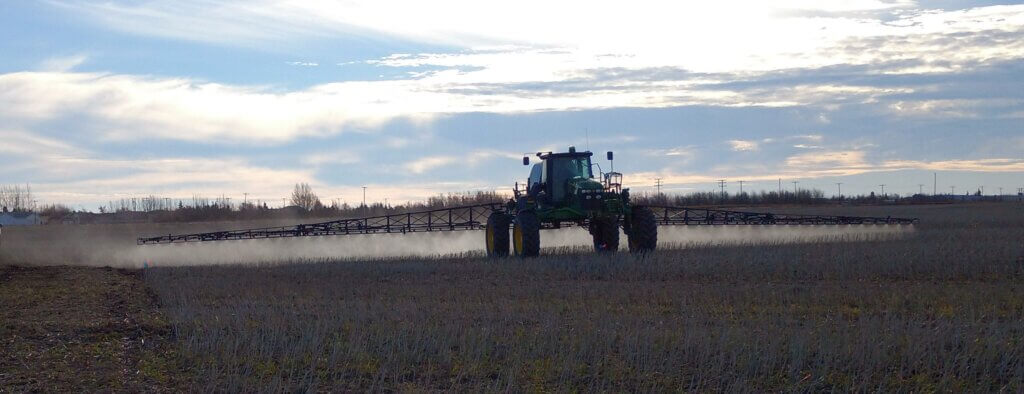
North American built boom sprayers have nozzle spacings of 20” (50 cm in the rest of the world), but other spacings such as 15” (37 cm) and 10” (25 cm) also exist. What are the reasons for these alternative spacings and do they offer any inherent advantages?
Why spacing matters
Nozzles are spaced along a boom to allow their fans (patterns) to overlap sufficiently at the target. In broadcast spraying, a uniform distribution of spray volume gives us the best chance for consistent coverage along the boom. Since flat fan nozzles produce a tapered pattern (i.e. the volume is highest in the centre and diminishes towards the edges), approximately 100% overlap (i.e. 50% from each neighbour) will produce a uniform swath.
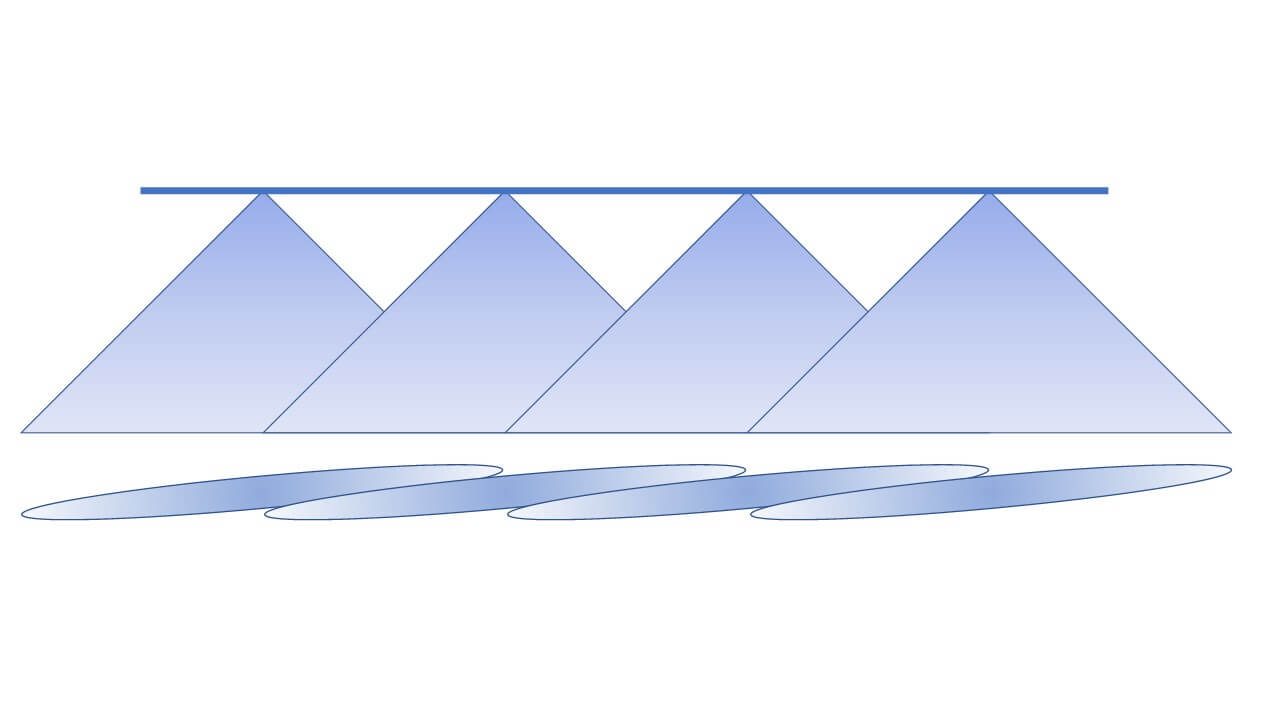
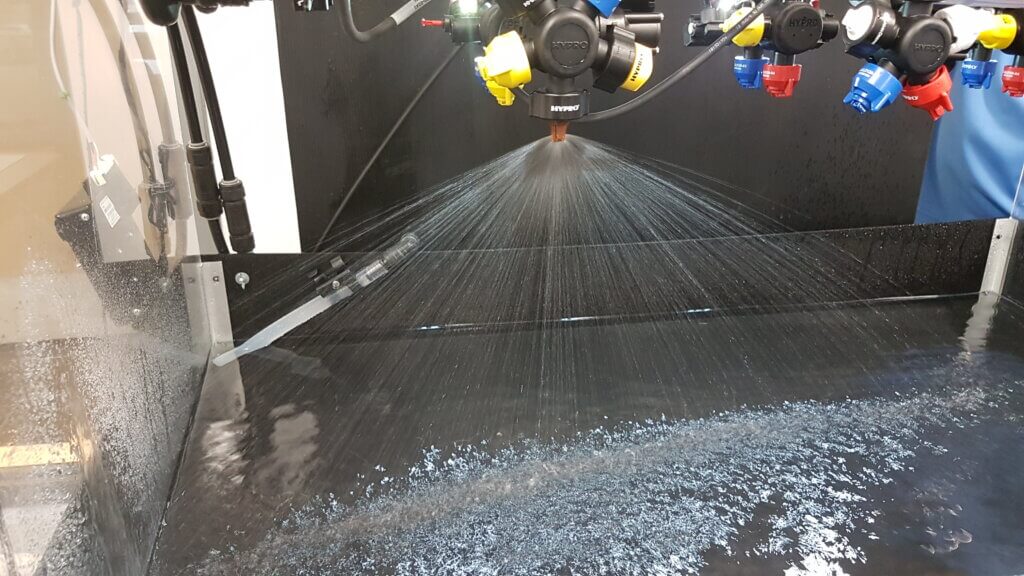
Figure 1: Tapered flat fans that require some overlap are the default pattern type for agricultural boom nozzles. This is true of conventional and low-drift styles. Note that the flat fans are turned 15° to prevent the spray patterns from interfering with one another.
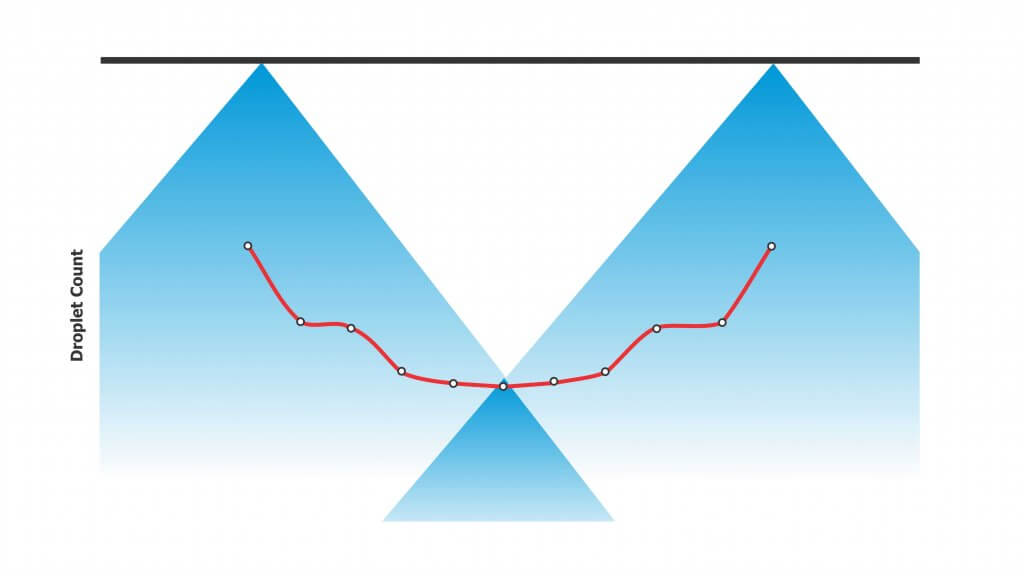
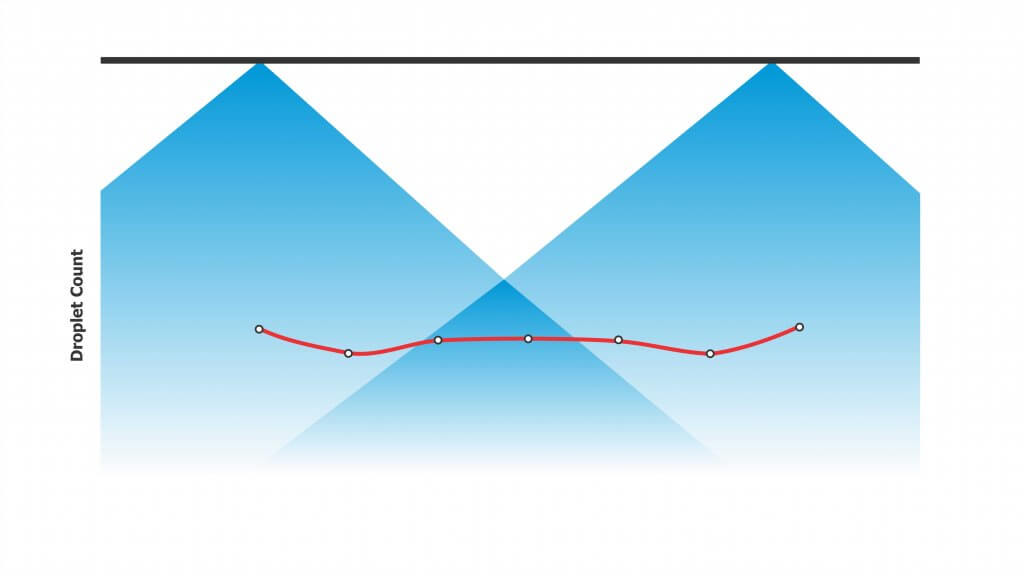
The 100% overlap isn’t just for volumetric distribution. Flat fan spray patterns tend to have more and finer droplets in the centre and fewer and coarser droplets at the edges. All droplet sizes contribute to coverage in different ways, so the overlap ensures both number and sizes are evenly distributed along the entire boom.
Figure 2: 30% overlap may achieve volumetric uniformity. But because the centre of the pattern contains the majority of the smaller droplets, low overlap may result in low coverage in the overlap regions, resulting in striping.Figure 3: Consistent droplet number distribution along the boom requires at minimum 100% overlap (50% from each neighbouring nozzle). This blends those regions of the patterns with high and low droplet densities.
The generic 20” spacing arose from long-held conventions about boom height, fan angle, and travel speed. Specifically, this spacing required a boom height of 20” to obtain good overlap of the once-dominant 80° fan angle. Combined with 0.15 to 0.3 US gallon per minute (gpm) nozzles and travel speeds of 6 to 8 mph, operators were able to apply 5 to 15 US gallons per acre (gpa) volumes. Using nozzles with smaller flow rates would generally result in nozzle blockages.
But what if we want to change any of those variables? How does this affect nozzle spacing? Figuring out the pros and cons of an alternate spacing requires a little math and some contingency management.
Boom Height Math
First the math. If the boom has 20” nozzle spacing and we need 100% overlap, the width of the spray pattern at target height must be two times the nozzle spacing, which is 40″. You must calculate the required fan angle and boom height to achieve this. Most nozzle catalogues have tables to help with this, or you can download a handy spreadsheet to calculate your own scenarios here.
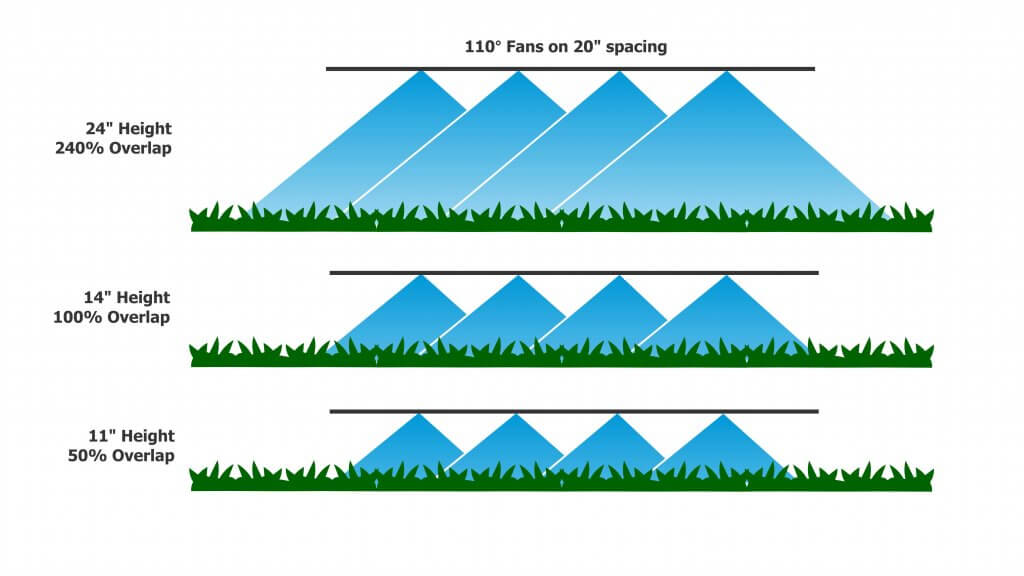
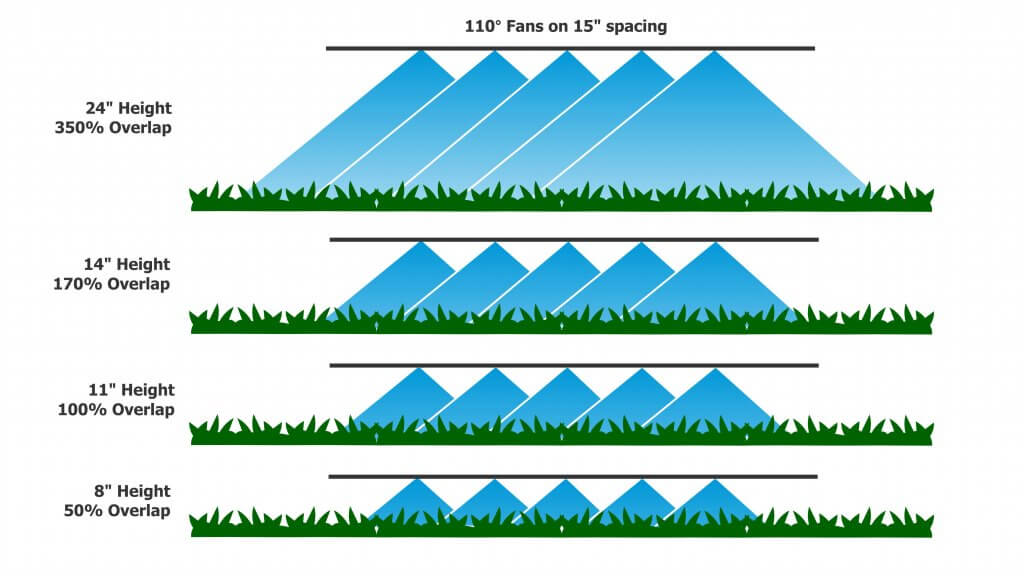
For today’s standard 110° fans, a minimum boom height of 14” is needed to achieve 100% overlap. For 15” spacing, the height is reduced to 11”. For 10” spacing, we drop to a mere 7”. However, consider that most modern suspended booms are not operated at heights less than 24” to allow for sway. At that height, there’s plenty of overlap to go around for 20″ nozzle spacing. For those booms that are able to operate at a consistent height, narrower spacings permit lower heights that will reduce drift potential significantly. Every time we halve boom height, we also halve drift potential.
Figure 4: Using 110° tips with 20″ spacing, the theoretical height at which we achieve 50% overlap is 11″ above target.
By tilting the nozzles forward or backward from the vertical, we can reduce the boom height somewhat further and still get the same overlap. For example, for 20 and 15” spacings, angling nozzles forward or backwards by 30° allows us to drop the boom another 2” closer to the target.
Contingencies
A suspended boom hardly ever stays at a uniform height; It sways up and down with field conditions, topography, etc. This is why many operators set their booms above the minimum height – to prevent striping when the boom sways low. The penalty is that this increases the distance droplets need to travel, increasing drift potential and any turbulent displacement problems arising from the moving boom.
Assuming a 110° flat fan at 24” boom height, each nozzle achieves a theoretical pattern width of about 70”, which is an overlap of 70÷20=3.4-fold or 240% on 20” nozzle spacing. Given a minimally-acceptable overlap of 50% (25% from each neighbouring nozzle), the boom could be as low as 11”. For 15” spacing, the minimum height for 50% overlap is 8”, and for 10” spacing it’s 5”. This means the narrower spray patterns gain 3” to 6” in allowed downward boom movement.
Figure 5: Using 110° tips on 15″ spacing, the height for 50% overlap is 8″ above target.
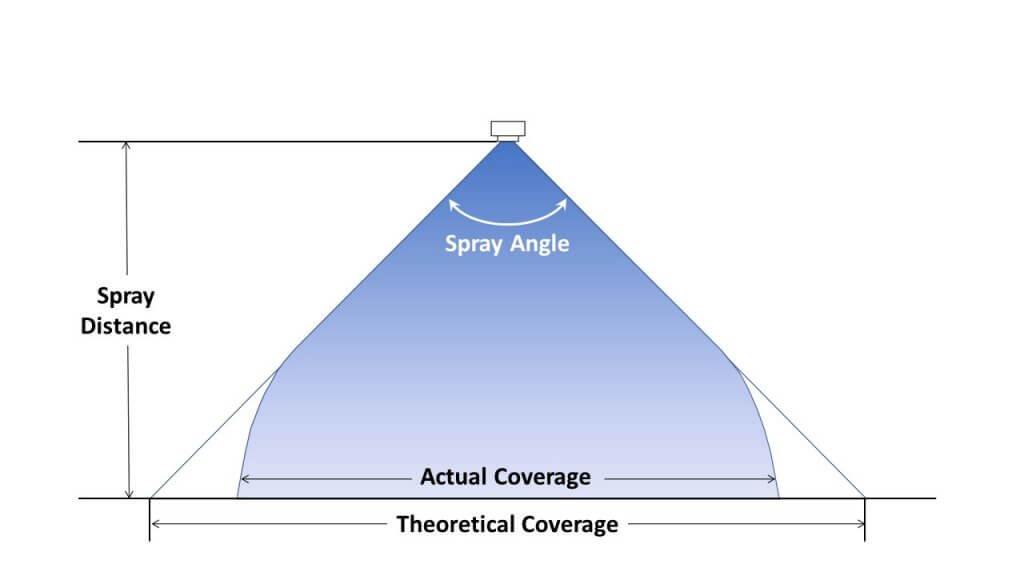
A second contingency is that spray patterns are rarely the exact value that the nozzle catalogues specify. A so-called 110° nozzle may operate at only 90°, or up to 150°, depending on the nozzle model, the spray pressure, and the tank mix. Learn more here and here. Patterns also don’t continue to grow at their rated fan angle, as droplets slow due to air-resistance and fall more vertically due to gravity. For that reason, a visual check is recommended to ensure the expected overlap is achieved.
Figure 6: Fan angles indicate initial trajectories of droplets at the edge. With distance, gravity pulls these droplets downward, narrowing the pattern width from that achieved theoretically (figure adapted from image in TeeJet catalogue).
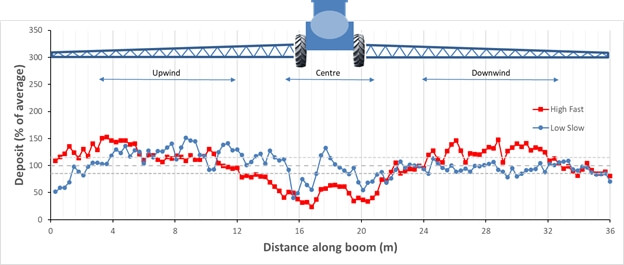
A third issue to consider is less related to boom height but nonetheless affects spray distribution. Small droplets move with air currents, and the turbulence created by large, fast sprayers creates enough turbulence to move these droplets significantly. A perfect pattern under static conditions can look quite different at a fast travel speed with a modest side wind. Low booms may help prevent some of this displacement because droplets spend less time in flight, and their average velocity is faster.
Figure 7: Spray deposition onto a 2 mm string to measure deposit uniformity for a fast travel speed and high boom and a slow speed, low boom configuration.
Flow Rate Math
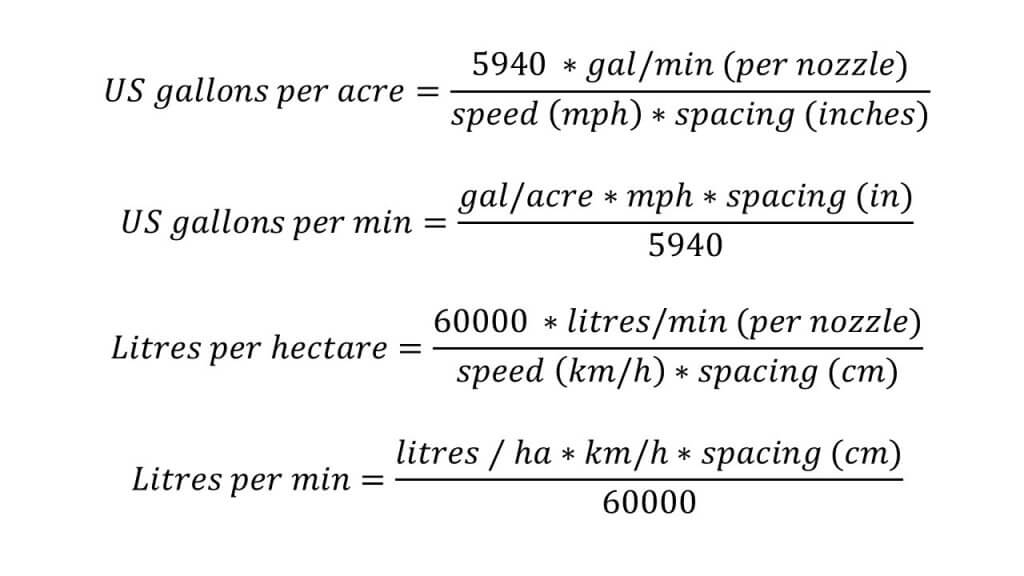
Flow rate requirements per nozzle change whenever we equip a boom at an alternate spacing. The basic formulae are shown below.
Moving from a 20″ to a 15″ spacing would require a nozzle with 0.75 of the flow rate, approximately from a 02 to 015 size, or 03 to a 025 size, or 04 to 03 size, etc.
Pulse Width Modulation
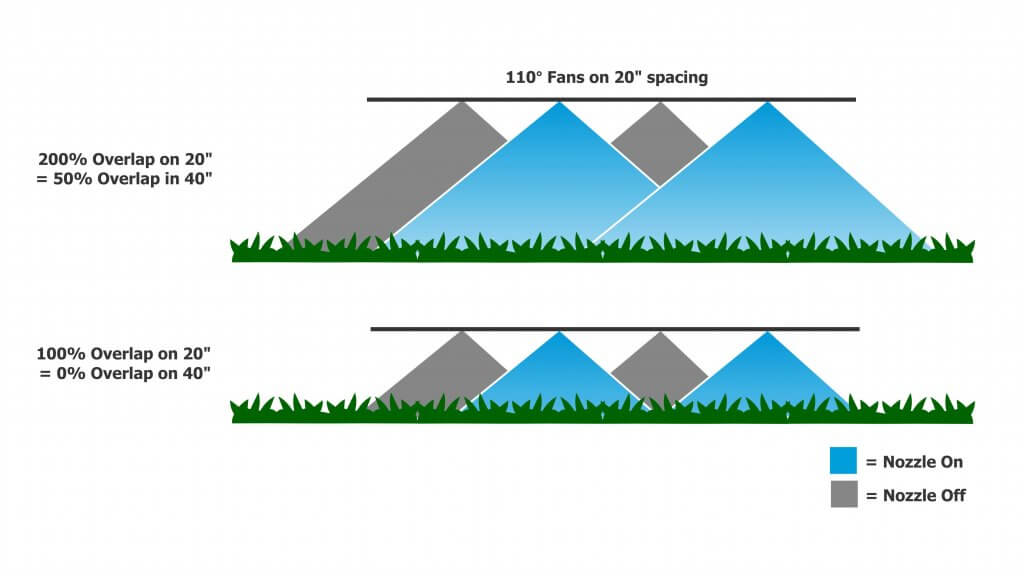
The use of Pulse Width Modulation (PWM) has increased the overlap requirement. With PWM, alternate nozzles are on a 180° timing offset from their neighbours. This means that when running >50% duty cycle, when one nozzle is temporarily off, its neighbours are on. These neighbours’ patterns must now span the gap, and 100% overlap is the absolute minimum to achieve this. PWM users therefore select the wider pattern angles and some opt for >100% overlap.
Figure 8: Pulse Width Modulated booms require 200% overlap so that the entire boom receives proper coverage when the alternate set of nozzles is off. For 110° fans at 20″ spacing, the minimum boom height would be 21″
PWM Considerations
High flows (greater than 1 US gpm at the nozzle) that are common for fertilizer top-dressing may require higher-flow PWM valves.
Narrow spacings reduce the individual nozzle flow rates and can therefore support higher application rates before triggering a larger valve requirement.
PWM valves aren’t cheap and for example 15″ spacing compared to 20″ spacing adds 24 valves on a 120′ boom.
Banding
We noted that 20” nozzle spacing is a standard because it corresponds to what has traditionally been achievable with available boom heights and spray pattern angles. But things can change.
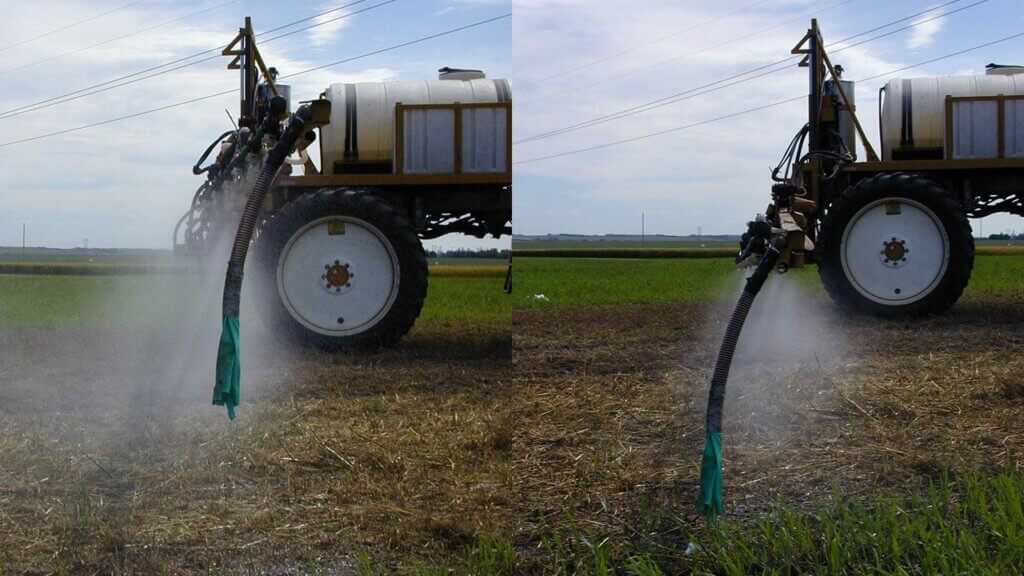
Narrower spacings such as 15” originate with row crops and planter row spacings of 15” or 30”. These spacings exist so the spray pattern can be placed either over the top of a crop row, or in between the rows for banding. Using narrower fan angles and/or lower boom heights, together with “even” (as opposed to “tapered”) fans, banding sprays can be applied over the top of, or between crop rows. Or drop hoses can reach between the rows for top-dressing or directed sprays into the canopy.
Canopy Penetration
With narrower spacing, it can be argued that a greater proportion of the boom length has spray directed directly downward (corresponding to the centre of the pattern). Whether or not this translates into better penetration of a canopy is a fair question. In laboratory trials, use of 10” or 20” spacing did not improve penetration into a broadleaf canopy. But if the lower boom height afforded by the narrower spacing was utilized, some improvements in the deposit of angled sprays onto vertical targets was observed.
Adjusting to Narrower Spacings
As we showed earlier, use of 15” or 10” spacing booms for broadcast sprays requires a smaller nozzle size to achieve the same spray volumes as the 20” spacing. If boom height remains constant, narrower spacings result in greater pattern overlap which provides more latitude for sway. Alternately, lower boom heights can be used.
Using smaller nozzles on narrower spacing presents some challenges. Generally, smaller nozzle size means finer spray quality. If an operator wants to retain the spray quality they had on a 20″ spacing, they may opt to use lower pressure (not advisable for non-PWM systems) or swap to different nozzle design that can produce the desired spray quality at the lower flow rate.
Smaller nozzles are more prone to plugging, so that needs to be managed with filtration, filling practices and water sourcing. Be aware of the the product formulations and their requirements for filter mesh size. Most dry products specify a 50 mesh filter (or coarser). Also, check size options for nozzles. The smallest size for most nozzle models is 015, but certain PWM-specific nozzles are only available in 03 or larger.
The marriage of narrow spacings with individual nozzle shutoff can result in a versatile system capable of producing high resolution banded sprays in narrow seeded crops. For example, consider a boom with a 10” nozzle spacing spacing that matches the seeder row spacing. The operator can shift from 10” to 20” or 30” from the cab if the valve control software allows it. With accurate guidance and good boom levelling, topdressing foliar products (e.g. nutrients, fungicides) can follow the crop row precisely.
Spot Sprays
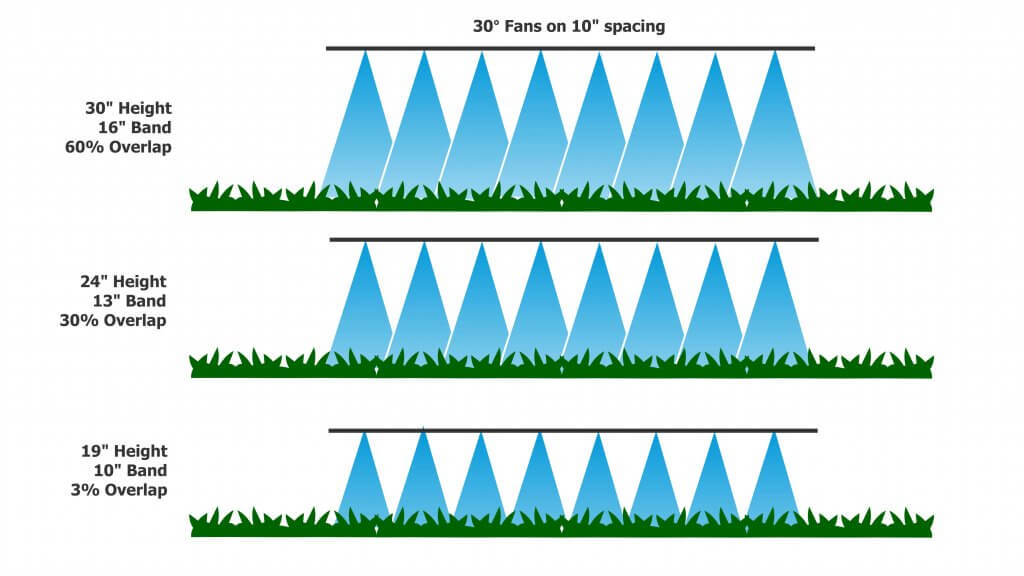
Spot sprays present a situation where compromises are needed. Some, such as WEEDit, utilize narrower nozzle spacings to allow better treatment resolution and increase product savings. Any one nozzle or sets of adjacent nozzles may be triggered by the sensor. For single nozzle activation, to preserve the value of the better resolution a uniform, narrow band of spray needs to be created. This means a 30° or 40° fan angle from a banding nozzle will be necessary. For example, a 24” boom height will result in a 13” band with a 30° fan, and an 18” band with a 40° fan. In the latter case, the dose would be diluted by 80%, wasting much of the potential savings.
Figure 10: Boom height is critical for banded sprays and for spot sprays. Too wide a pattern on a single nozzle reduces dose, too narrow creates misses.
Frequently, a patch of weeds will trigger several adjacent nozzles. Now these individual bands need to work together to create a uniform swath. This will inevitably require some overlap to avoid gaps, but too much overlap will result in bands where twice the dose will be applied. A tapered fan may suit this situation better. As a result of these varying needs, tolerances for spot spray boom height are even more strict than for broadcast spraying. More thoughts on spot spray nozzle selection are here.
Conclusions
Narrower nozzle spacings on a broadcast boom allow somewhat lower boom heights and these can in turn reduce drift and improve deposition of sprays. Lower flow nozzles will be needed with narrower spacings, requiring management of plugging and potentially a more drift-prone spray quality. The value of narrower spacings depends on the availability of booms that control sway, allowing them to operate at uniform, low heights.
There’s been a lot of talk about rate control in spraying, and one key technology is pulse-width modulated spray systems (PWM). Although PWM has been commercially available for a number of years, we are seeing new products enter the market. This article explains what PWM is and how to make it work in a spray operation.
Rate Control Primer
Modern sprayers, be they self-propelled, or tractor- or truck-drawn, experience fluctuations in travel speed. Operators speed up or slow down as conditions demand. In order to maintain a constant application volume per acre, the spray liquid flow must change in direct proportion to travel speed. The sprayer achieves this with a rate controller, a device standard on most sprayers.
The rate controller uses four pieces of information to ensure a constant application rate.
The user enters the width of the boom and the desired water application rate.
The sprayer provides travel speed information (collected from a GPS signal or a radar- or wheel-based speedometer) and liquid flow rate (collected from a flow meter on the main sprayer liquid flow line).
Using a simple mathematical formula, the rate controller calculates what the required liquid flow needs to be for any given travel speed. A typical controller changes the flow by adjusting the pump pressure. The sprayer operator keeps an eye on the spray pressure to ensure it doesn’t exceed the capabilities of either the nozzle, the plumbing, or the pump or that it does not produce an undesirable droplet size or spray pattern.
Rate Control Options
There are currently about five options for rate control on the market, and all but one rely to a degree on spray pressure to manage flow rate.
Pressure-based rate control. The most common system, it changes spray pressure as required by the travel speed. It is limited by the flow rate capacity – both high and low – of the spray nozzles installed on the sprayer and the pressure limitations of the sprayer system.
Variable rate spray nozzles. Commercial systems such as the VariTarget nozzle use a plunger in a nozzle assembly that pushes down on, and deforms a flexible nozzle cap, with spray pressure. Higher pressures result in the cap’s orifice becoming larger, facilitating more flow. This system is capable of a wider range of flows than a conventional nozzle system over the same pressure range.
Dual boom systems. The rate controller still functions as described above, but a second boom fitted with different flow nozzles is activated when the flow rate requirements can no longer be met with a single set of nozzles. For example, if the second boom contains larger nozzles, once the boom with larger flow nozzles is activated, the spray pressure drops significantly and additional speed capacity can be realized.
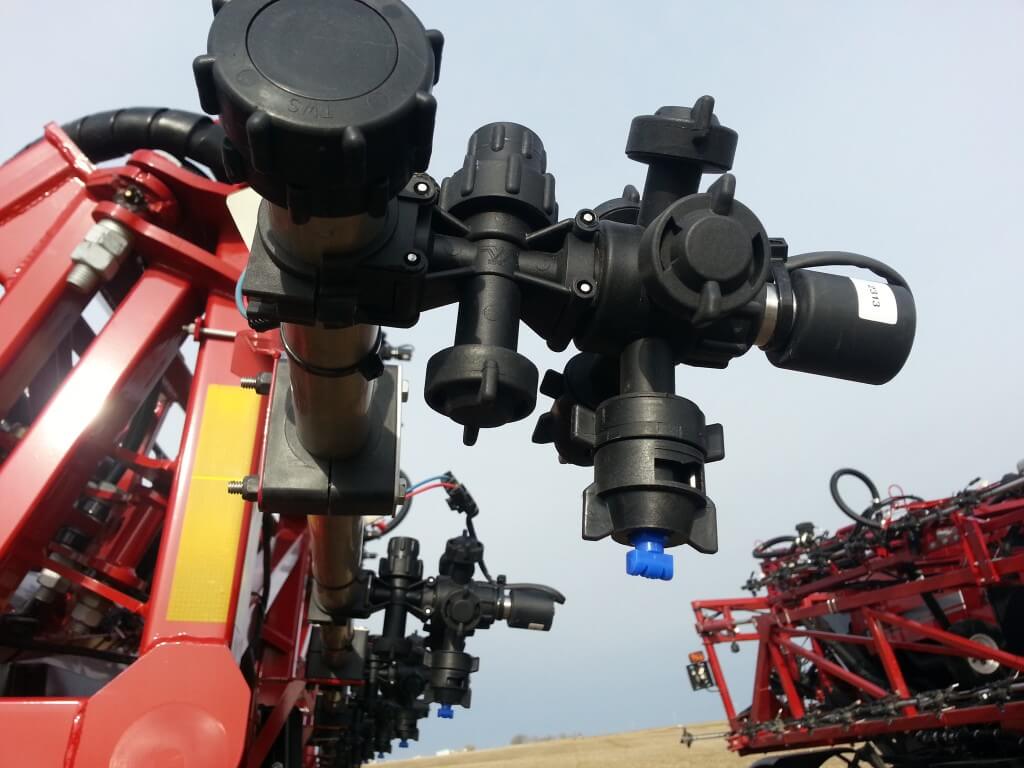
Dual or Quadruple nozzle bodies. A similar approach to the dual boom is available from Arag (Seletron), Hypro (Duo React), and a host of European manufacturers. These systems utilize a single boom (no duplicate boom is required) and direct the flow through one of any two or four (Arag Seletron only) nozzles, or two nozzles simultaneously. Individual nozzle section control is also possible with this approach. Similar pressure fluctuations as with a dual boom would be experienced, requiring careful selection of nozzle flow rates to avoid large pressure jumps. The same system can also be used to manually change from one nozzle to another as conditions require.
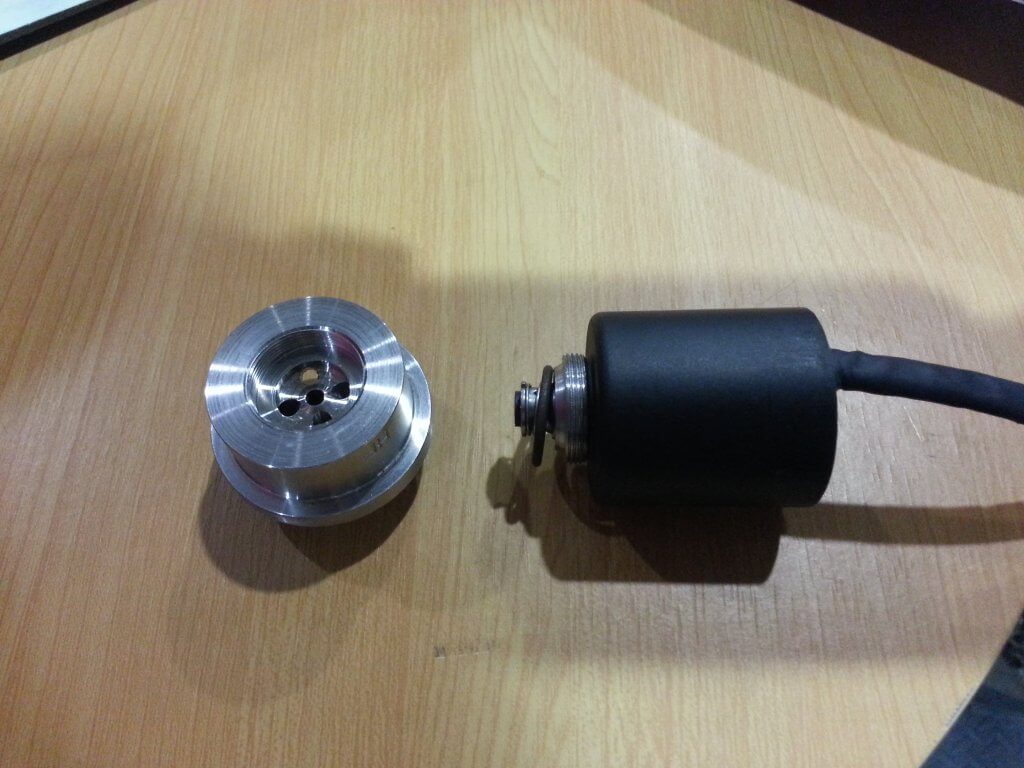
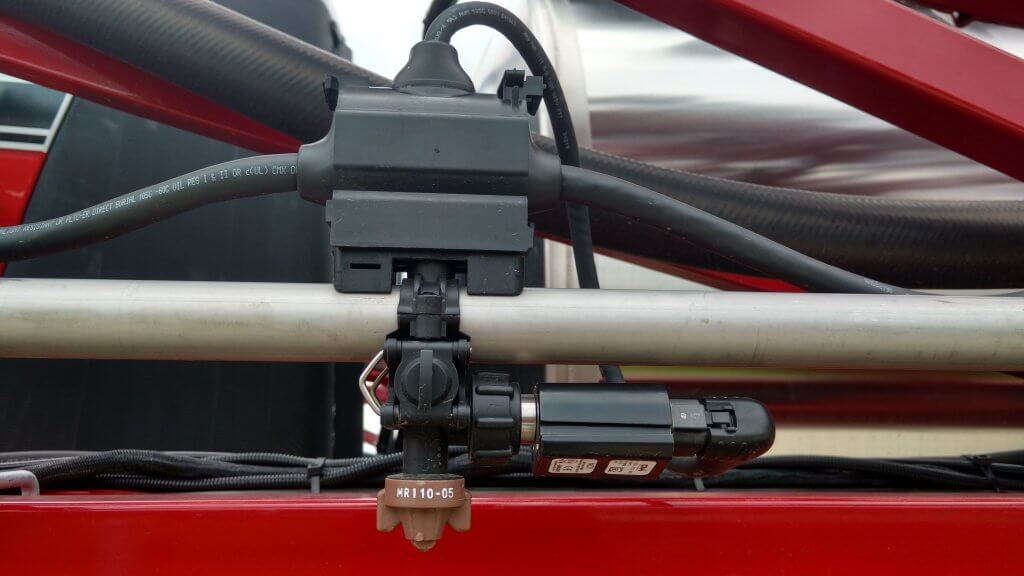
Pulse Width Modulation. PWM utilizes conventional plumbing: a single boom line and a single nozzle at each location. Liquid flow rate through each nozzle is managed via an intermittent, brief shutoff of the nozzle flow activated by an electric solenoid that replaces the spring-loaded check valve. Typical systems pulse at 10 or 15 Hz (the solenoid shuts off the nozzle 10 or 15 times per second), but some pulse at 50 and even 100 Hz. The duration of the nozzle in the “on” position is called the duty cycle (DC) or pulse width. 100% DC means the nozzle is fully on, and 20% DC means the solenoid is open only 20% of the time, resulting in the nozzle flowing at approximately 20% of its capacity. The ability to control the duty cycle is referred to as pulse width modulation.
Pros and Cons
There are two chief features of a pressure-based approach that affect the spray operation.
Pressure affects spray quality and spray patterns. Higher pressures (the result of faster travel speeds) result in finer, more drift-prone sprays, and lower pressures may, in addition to producing a coarser spray, reduce the spray’s fan angle. The resulting narrow patterns can result in less overlap and poor pattern uniformity. When the travel speed drops below a defined point, the spray flow rate is held constant to maintain the pattern; this can result in over application.
Pressure is not a very effective way of changing flow rates. Increasing the travel speed by a factor of 2 requires a pressure change of four-fold, as predicted by the square-root relationship between flow rate and pressure. As a result, a system capable of pressures ranging from a low of 30 psi to a high of 90 psi (a three-fold change in pressure) results in only a 1.73-fold change in flow rate (and travel speed). 1.73 is the square root of 3.
In comparison, PWM systems do not rely on pressure changes to effect new flow rates. Instead, the duty cycle of the system affects nozzle throughput. Boom spray pressure stays constant throughout the duty cycle range, and as a result, so does spray quality and spray fan pattern angle. In practice, the lowest duty cycles increase droplet size, and reduce fan angle, somewhat. These effects are minor and do not impact overall performance, particularly because the time spent at low duty cycles tends to be low. The operator also has the option of adjusting the spray pressure to get a desired droplet size, even “on the fly” and the PWM system will maintain the desired application rate.
A PWM system can therefore change travel speeds by about a factor of five (from 20 to 100% DC). Duty cycles less than 20%, although possible, are not recommended.
Note that the actual measured change in flow rate achieved by a PWM system is not directly related to duty cycle. The actual nozzle flow rate is greater than that predicted by a duty cycle calculation, especially for smaller nozzles and also for higher pulse frequencies.
Commercial PWM Systems
The original inventor of PWM for spraying, Dr. Ken Giles of the University of California at Davis, worked with Capstan Ag Systems to produce the Capstan Synchro, the first PWM system on the market. The Capstan product was later licensed to Case IH sprayers and named AIM Command. It was a factory option on Case sprayers from 1998 to 2016, manufactured by Capstan. The system featured a separate monitor, permitted PWM to range from 100 down to 15%, and featured an alternating pulse in which the every second nozzle pulses identically, and alternating nozzles work in a 180 degree offset. In other words, in a system operating at 50% DC, when any given nozzle is on, adjacent nozzles are off. This results in a “blended pulse” that minimizes the likelihood of skips.
In recent years, Capstan has entered the retrofit market place and the technology has been installed on many brands of sprayers at the dealer level. The hardware is identical to Case products, with some minor differences in how the software interacts with the rate controller.
Since 2012, Case has offered an enhanced version called AIM Command Pro (Capstan calls their version Pinpoint). This system offers individual nozzle sectional control as well as turn compensation. In addition, the enhanced system offers individual nozzle diagnostics that provides operational details to the sprayer operator.
In 2014, Raven introduced a system called the Hawkeye. Initially targeted at the retrofit market, the system uses an ISOBUS approach that works with the Viper 4 monitor. The electric solenoids are similar to those on the Capstan systems. The basic system (Hawkeye) features turn-compensation, but not individual nozzle sectional control. Section resolution is determined by the limits of the monitor, for example, 16 virtual sections on the Raven Viper 4. Hawkeye 2.0 HD, announced December, 2015, allows for individual nozzle on-off control. Hawkeye is available as a factory option on New Holland (called IntelliSpray), Apache, Rogator, Horsch Leeb, and Case (AIM Command HD) sprayers.
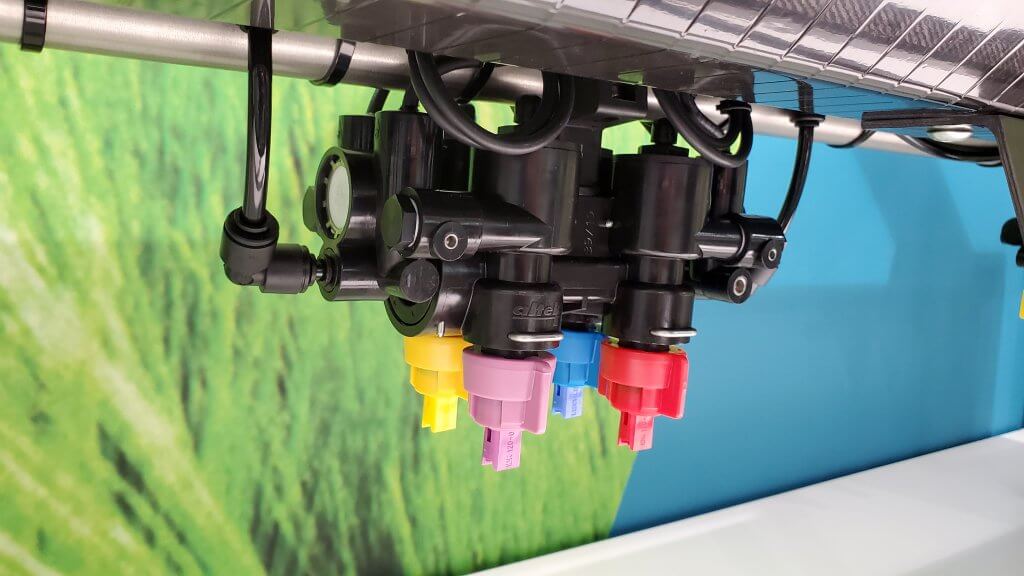
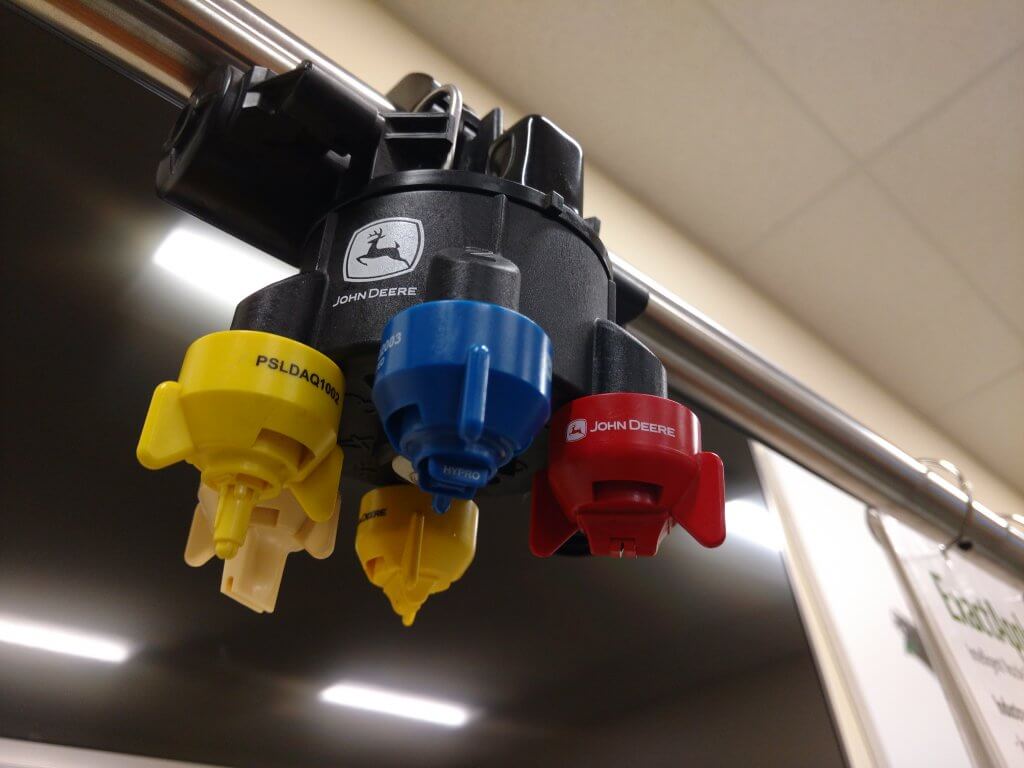
John Deere announced their PWM version in 2016. Called ExactApply, the system splits the liquid flow into two streams, one through each of two solenoids. The solenoids serve to shut off the flow, and also to control liquid flow rate, each running at 15 Hz. The body contains six nozzles on numbered feed housings, and they operate in opposite pairs.
The body is rotated manually to the preferred nozzle pair. With the longer housing in front (#4, 5, and 6) it allows for very high flows from a single nozzle only. When the shorter housing is rotated to the front, the unit will allow just the front, just the back, or both nozzle to operate.
It has three main modes.
High flow (e.g. fertilizer) capacity with the long housing in front. This nozzle can be pulsed at 30 Hz by using both solenoids.
A/B Mode. Cab-switchable nozzles in front, back, or both for rate variation, spray quality variation or other specialty uses. When pulsing is turned off, AB AutoSelect mode is available which automatically switches nozzles based on flow needs. The idea is for a smaller nozzle to be in the front (A) and to respond to travel speed changes with pressure changes (i.e., conventional pressure-based rate control). When increased speed exceeds the pressure limit of the nozzle (set by user), the unit switches to the back nozzle (B), which is slightly larger. Pressure drops immediately and faster speeds are possible. Once the the pressure reaches the user-defined maximum, both nozzles switch on, making additional speed possible.
Pulsing Mode. The front, or back, or both nozzles can be pulsed. The user can switch between these nozzles from the cab. When only one nozzle is pulsed from position #1, 2, or 3, the frequency is 15 Hz. When two are pulsed, the effective frequency would be quasi 30 Hz (15 Hz each at a 180 degree offset).
The system also features individual nozzle shutoff, turn compensation, programmable rates by nozzle, nozzle plug detection, and LED lighting. It offers higher maximum flow rates through its solenoid (up to 50 US gpa at 15 mph).
We’ve provided an in-depth overview of ExactApply here.
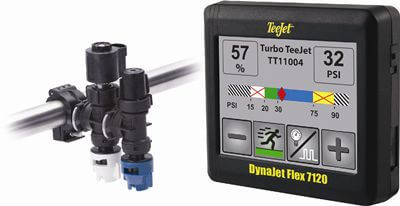
TeeJet has a system called the DynaJet Flex 7120 that uses either a monitor or Android tablet to display pressure, duty cycle, and droplet size. DynaJet is available to OEMs and to the aftermarket. The unique aspect of the TeeJet system is the ability to dynamically select different droplet sizes, and the system will maintain that droplet size across a wide range of speeds or application rates. The TeeJet system is compatible with any flow-based rate control system, and does not require a TeeJet spray control. The product is available from TeeJet dealers.
PWM systems are also available on Agrifac (StrictSprayPlus), WEEDit Quadro, and BBLeap. These systems operate at higher frequencies, up to 50 Hz for WEEDit and up to 100 Hz for Agrifac and BBLeap, as conditions require.
System Capabilities
Spray Quality: Since PWM systems can alter flow rate without affecting spray pressure, the user can select a spray pressure that meets their spray quality goals and expect this spray quality to remain constant throughout the field, regardless of travel speed.
Spray Drift Control: Although PWM does not by itself have any unique capabilities to reduce spray drift, it does make spray drift management easier. For example, the most accessible tool for reducing spray drift is to increase droplet size by reducing spray pressure. In a conventional system, the reduction of spray pressure can only be achieved with a reduction in travel speed because the lower spray pressure also reduces the overall flow rate. With PWM, the loss of flow with a reduction in spray pressure can be compensated by an increase in DC. As a result, lower pressures do not require a reduction in travel speed provided there is sufficient DC capacity in the system. Also, PWM systems use larger orifice nozzles, which naturally produce larger droplets.
Rate Control: A PWM system can be used for variable rate application. The spray volume, as determined by duty cycle, can vary as desired within its operational envelope without a change in travel speed.
Turn Compensation: AIM Command Pro, Capstan Pinpoint, Raven Hawkeye, John Deere ExactApply, Agrifac StrictSprayPlus, TeeJet DynaFlex, and WEEDit Quadro feature turn compensation capabilities. During a turn, the outside boom moves faster than the inside boom, resulting in under- and over-application. A turn-compensated system can deliver additional flow to the outside, reducing the flow towards the boom end on the inside of the turn. In practice, there are limits to this feature. For example, the system’s average DC needs to be about 60 to 70% to offer the maximum flexibility. Second, the diameter of the object being turned around should not be much smaller than the width of the boom, or else the inside boom moves too slowly in relation to the outside boom. The system’s lag must also be minimal to avoid a counteracting effect during turn initiation and completion.
Sectional Control: In a PWM system, sectional configuration is determined by wiring and software, not plumbing. All section valves remain open during operation, and sectional shutoff is effected directly at the nozzle solenoid. Individual nozzle sectional control is offered by most PWM manufacturers. This feature may provide product savings when field margins are not straight, or fields feature obstacles resulting in significant overlaps.
Shutoff response: The traditional nozzle check valve is designed to prevent nozzle dripping on boom shutoff. However, due to the presence of air pockets in most booms as well as the elastic nature of rubber hoses leading to the boom, the shutoff is delayed until the boom pressure reaches about 10 psi or nearly 1 bar. This can take up to 10 seconds, resulting in unintended overspray and other safety concerns. In a PWM system, the solenoid shuts off the flow to the nozzle instantly, and conversely, turn it on instantly as well. The boom remains fully pressurized while the nozzles are shut off, allowing the spray patterns to be fully developed upon flow resumption.
Nozzle Options
A pulsing solenoid creates short durations of low pressure inside the nozzle body, and this can result in poor performance of some air-induced tips. As a result, the PWM manufacturers have recommended that air-induced nozzles be avoided, and pre-orifice nozzles be used instead.
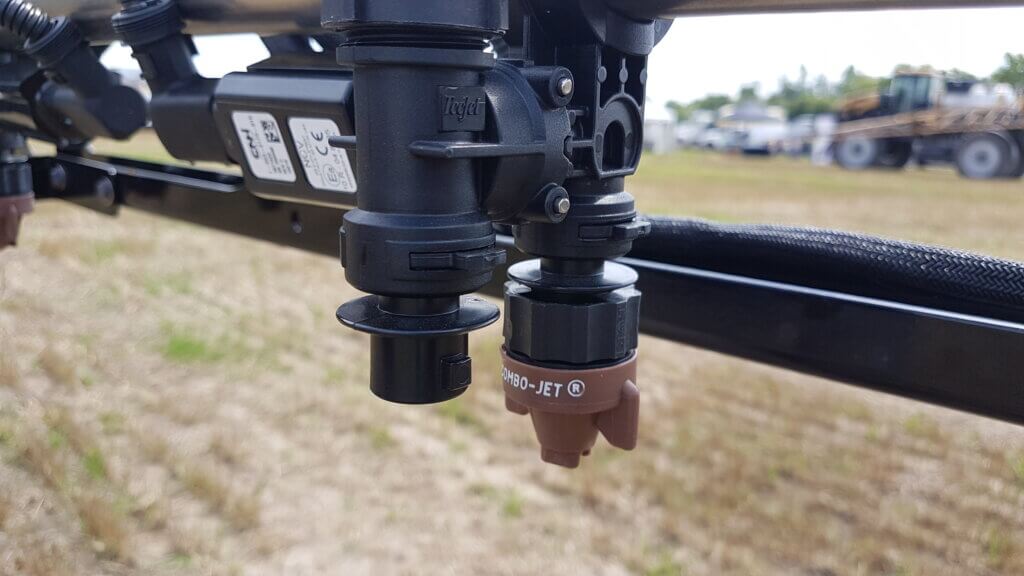
Case sprayers are equipped with a nozzle body manufactured by Wilger Industries that fits the ComboJet nozzle caps. This company offers five nozzles for PWM. In order, from finest to coarsest:
ComboJet ER
ComboJet SR
ComboJet MR
ComboJet DR
ComboJet UR
In practice, the ER and DR are rarely used in PWM systems. The MR is typically suited for lower water volume rates (3 US gpa to 6 US gpa achieved with the MR11003 or MR11004), whereas higher volumes (6 US gpa to 15 US gpa) are typically delivered using the SR tip (SR11005, SR11006, or SR11008, depending on average travel speed). In some cases, the ER nozzle is use when flow rates require 11010 or 110125 sizes. Spray pressures are typically 40 psi at the nozzle. The UR is a dicamba-specific nozzle to meet US label requirements for drift protection.
Wilger’s nozzle body can be purchased as retro fits for other sprayers. The company also offers adaptors that allow Wilger nozzles to be used on TeeJet-style bodies and vice versa, as seen below.
PWM systems operating on TeeJet style bodies are well served by TeeJet Technologies’ Turbo TeeJet nozzles. These wide-angled tips are available in sizes up to 11012 and generate suitable spray qualities at pressures ranging from 15 to 60 psi. Many operators use the Turbo TwinJet, another good option, which is available in a large selection of flow rates to 11010. Recently, TeeJet has tested and approved several air-induced nozzles for PWM, among these are the AITTJ60, the TTI, and the TTI TwinJet.
Hypro’s Guardian and 3D nozzles are well suited for PWM, but are somewhat finer than current air-induced standards. The new ULDM nozzle is Ultra Coarse, and approved for PWM despite being air-induced. Hypro also manufacture the LDM nozzle exclusively for John Deere for ExactApply, producing a spray quality similar to the well-established ULD. Most other manufacturers, including Lechler, Hardi, and others, have traditional pre-orifice flat fan nozzles that may also work. It is important to always select 110 degree fans to ensure that 100% overlap is achieved to maintain the concept of blended pulse. Limitations are in the maximum flow rates available in a specific model, many nozzles are not available in sizes larger than 05 or 06.
Agrotop (Greenleaf in the US) offer two unique PWM nozzles. The BPDF is an asymmetric twin configuration featuring two modified AirMix tips which have eliminated air-induction. The much coarser SoftDrop nozzle is intended for the dicamba market.
Arag has introduced PWM nozzles that produce Coarse or Very Coarse spray qualities, called CFLD-C or CFLD-VC nozzles. These are the a good spray quality for general use. These models are not yet offered in flow rates above 06, however.
Target a duty cycle of 70% ± 10% on average during operation. This permits the best travel speed flexibility. Say you want to apply 10 US gpa at 15 mph. In a conventional system, the 05 nozzle size could meet this flow at 40 psi. For PWM, the 06 size would operate at about 83% duty cycle (0.5/0.6 = 0.83). Assuming a minimum DC of 20%, a minimum travel speed of about 3.6 mph is possible. The 08 size would operate at 63% DC (0.5/0.8=0.63), allowing a minimum speed at 20% DC of 4.8 mph. Either option can work as long as the operator recognizes the travel speed limitations of both. Remember that the actual flow rate change is not directly related to duty cycle. Expect to see higher flows than calculated, especially for the smaller flow rate nozzles.
Calculate the travel speed range. The travel speed range of any nozzle selection and water volume can easily be calculated. The maximum travel speed is limited by the capacity of the selected nozzle and pressure at 100% DC. The minimum travel speed can be assumed to be 20% of that value, at which the system would be operating at 20% DC. Assuming a user selected the 08 nozzle size at 40 psi in the above example, the maximum travel speed can be read from a traditional calibration chart, 24 mph. The minimum would be one fifth of that, 4.8 mph. Capstan has charts that show the theoretical travel speed range (assuming a direct relationship between DC and flow). For Raven and TeeJet, the charts were developed using actual flow measurements. These reveal that actual flows are greater than predicted, especially for smaller nozzles.
Consider the pressure drop across the solenoid. The pressure drop depends on the total flow through the solenoid, it varies from 3 to 5 psi for 04 flow rates to 5 to 13 psi for 08 flow rates for the Case, Capstan, and Raven products. If targeting 40 psi spray pressure, set the pressure to 40 psi plus these values. Traditional spray charts do not account for pressure drop across the PWM solenoids. When using a Capstan Ag system, always refer to the tip charts from Capstan Ag Systems, Inc. at capstanag.com, (or here) and when using a TeeJet system, refer to the charts at www.teejet.com. Both show the pressure drop at various flow rates. Raven’s tip chart is in their operator’s manual.
Common Questions
Will the pulsing of the spray create skips in control? This is very rarely the case, usually only when a mistake in nozzle selection has been made. Skips are more likely with a combination of low duty cycles, fast travel speeds, low booms, narrow fan angles, and extremely coarse sprays. At normal field speeds, the system is usually operating at a high duty cycle unless a nozzle size which is far too large has been selected. At boom heights above 20 inches and Medium to Very Coarse sprays, there is enough blending of the spray cloud from the nozzle to the target to remove any skips in coverage. We can see skips on the outer edge of a boom during a sharp turn, when duty cycle is taken from the tractor unit speed (slow during a turn) and the outer edge of the boom is travelling at two to three times that speed. A conventional system would see similar under-application under these conditions.
Does the droplet size really stay constant throughout the Duty Cycle range? At low duty cycles, we have seen a slight increase in the droplet size, and also a slight decrease in the fan angle. This could be because the longer off-phase reduces the internal pressure in the nozzle body, resulting in an effectively lower pressure. These changes are not significant in their magnitude. It remains important to avoid the lowest duty cycles (travel speeds) for prolonged periods.
Can I do all my spraying with one nozzle? A PWM system offers the advantage of maintaining consistent pressure over a wide range of travel speeds for any given water volume. When moving to a new water volume that is more than 25 to 30% different, a different flow nozzle is recommended. Keeping the same nozzle for two volumes can technically work, but at the cost of limiting the travel speed range for one or both volumes. A typical PWM user has three nozzles, one each for low, intermediate, and high water volume needs assuming similar travel speed ranges. Some choose to use the same nozzle for intermediate and high water volumes, on the assumption that the high volumes is in maturing canopies and travel speeds will be reduced as a result.
Does PWM reduce drift? PWM does not reduce drift in any special way. Drift is related to droplet size, which is controlled by nozzle choice and operating pressure. A conventional system will use low-drift nozzles that maintain reasonably low drift sprays over their pressure range. But at high speeds, high pressures will be used and that can increase drift potential. In a PWM system, high speed does not increase pressure, offering a more consistent amount of drift. However, even at the same pressure, higher speeds increase drift potential because more drift-prone droplets are pulled from the spray plume. Some users of PWM may drive faster than they should simply because they avoid the pressure spike. Fast travel speeds remain a poor practice from a drift perspective.
Is the system prone to breakdowns? PWM has been on the market for about 15 years with Case and Capstan and has proven to be robust. The solenoids themselves have a good wear life, but do require replacement from time to time. Inside the solenoids, a poppet seal can wear over time, requiring fairly inexpensive and easy replacement. As with all electronics, regular inspection of the wiring harness to ensure no abrasion or pinching is required.
Additional Help
One of the more useful websites for PWM users is the Tip Wizard by Wilger (www.wilger.net). It is geared towards selecting the right nozzle for Case AIM Command, which uses the proprietary Wilger nozzle bodies and caps. The website helps users to select nozzles that match their volume, speed, and droplet size requirements.
Once a user understands the basic principles of the system, any conventional calibration chart can be used to identify the needed size nozzle. A user simply needs to choose a nozzle that is about 30 to 40% larger in flow rate, to allow the system to run at approximately 70% DC on average.
Wilger also produces a smartphone app, Tip Wizard, that offers much of the same features as their website for selecting tips.
Capstan (www.capstanag.com) produces a useful calibration table that identifies the pressure drop for various nozzles and pressures, as well as travel speed ranges for these nozzles when applying a range of water volumes.
Raven Industries offers information on the Hawkeye on their website (ravenprecision.com). The company offers useful videos on their youtube channel that illustrate installation procedures.
TeeJet Technologies has DynaJet information on their website (www.teejet.com). The site contains have product information, installation and operator manuals, application rate charts, and drop size information.
Troubleshooting and Maintenance
The main hazard for the PWM solenoids is contaminants. Granules can become lodged on the poppet seal surface, reducing the metering accuracy. Regular inspection of screens, and occasional removal and disassembly of the solenoids to expose the poppet is recommended.
This is the final part of our three-part article discussing methods for digitizing and processing water sensitive paper. You can read part one here and part two here.
Morphological operations
We can now move on to the larger shapes, or “morphology” of the objects in our binary image. Our goal is to quantify deposits by interpreting these shapes. Once again, these operations are powerful processing tools, but we must acknowledge three overriding limitations:
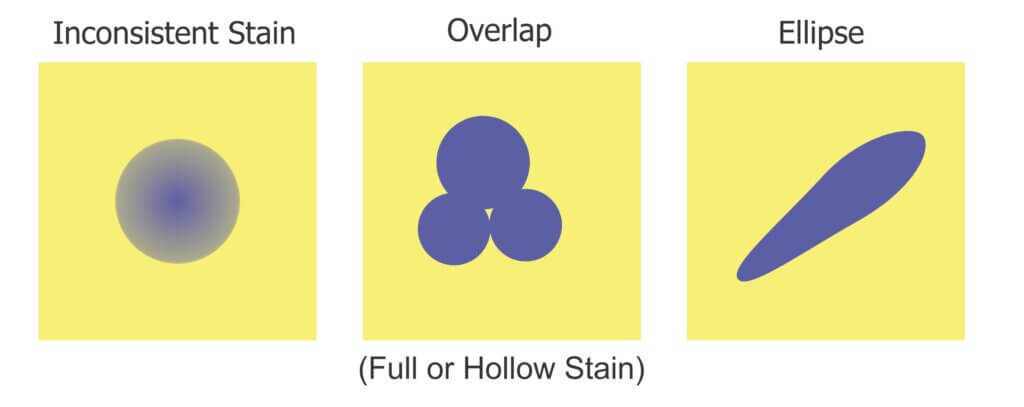
1. Inconsistent stains
Sometimes deposits do not create a consistent blue colour – they can get lighter or take on a greenish-yellow hue towards the perimeter of the stain. During thresholding, the outer edge can be accidently eroded, leaving behind an object with a jagged edge. This may lead us to underestimate the percent area actually covered. In the case of tiny stains, it might eliminate them entirely and lead us to underestimate deposit density.
2. Overlaps
It can be difficult to determine if an object represents a stain from a single droplet or is the result of multiple, overlapping deposits. This becomes significant when the surface of the WSP exceeds ~20% total coverage. The resulting objects may or may not have hollow centres where droplets do not overlap entirely. Misidentifying overlaps leads us to falsely conclude that an object is the result of a single, coarser droplet rather than multiple finer droplets.
3. Ellipses
Non-circular stains are formed when droplets scuff along the surface. Two droplets with the same volume encountering a paper at different angles can create stains with significantly different areas. We may wrongly conclude that the droplets that created them were coarser than they truly were. One approach is to use Feret’s Diameter (aka Caliper Diameter) by measuring the widest spans on the X and Y axes and taking the average. Another approach is to interpret the ellipse as a series of circular stains. Or we can decide to only acknowledge these objects when calculating percent area covered, but omit them when calculating deposit density or predicting original droplet size. Each strategy is a compromise, so it is important to be consistent and transparent when reporting results.
Three common problems when analysing water sensitive paper.
We’ll explore two morphological operations that can help us separate fact from fiction: Granulometry and Dilation-and-Erosion. We’re introducing these operations as part of the processing and detection step, but they may also overlap with the measurement step in our three-step process.
Granulometry
We can estimate the range of object sizes and get a sense of how they are distributed on the paper by filtering or “sieving” the image. Imagine pouring a mixture of sand and rocks through a series of ever-finer sieves. Doing so allows you to separate particles based on size exclusion. A granulometry function compares each object to a series of standardized objects with decreasing diameters. This isolates objects of a similar size and bins them in that size range. This is a powerful operation, but accuracy is lost when stains overlap to form larger objects. In this case, we move on to Dilation and Erosion.
Dilation and Erosion
Think of dilation as adding pixels to the boundary of an object. This makes tiny objects bigger, fills in any interior holes and can cause objects to merge. The number of pixel-wide dilations required to make objects contact one another can be used as a measure of deposit density.
Erosion removes pixels from the outer (and sometimes inner) boundaries of an object. This eliminates tiny artifacts that may not actually represent stains. It can also split non-circular objects into multiple parts before shrinking them into multiple nuclei (aka centroids). These last-remaining points are not necessarily the centre of a stain, but the pixels furthest away from the original boundary.
When a non-circular shape has more than one nucleus, they likely represent individual droplets that combined to form the larger stain. We can then use these nuclei to measure deposit density, such as in a Voronoi partition which triangulates each nucleus in relation to the two closest neighbours.
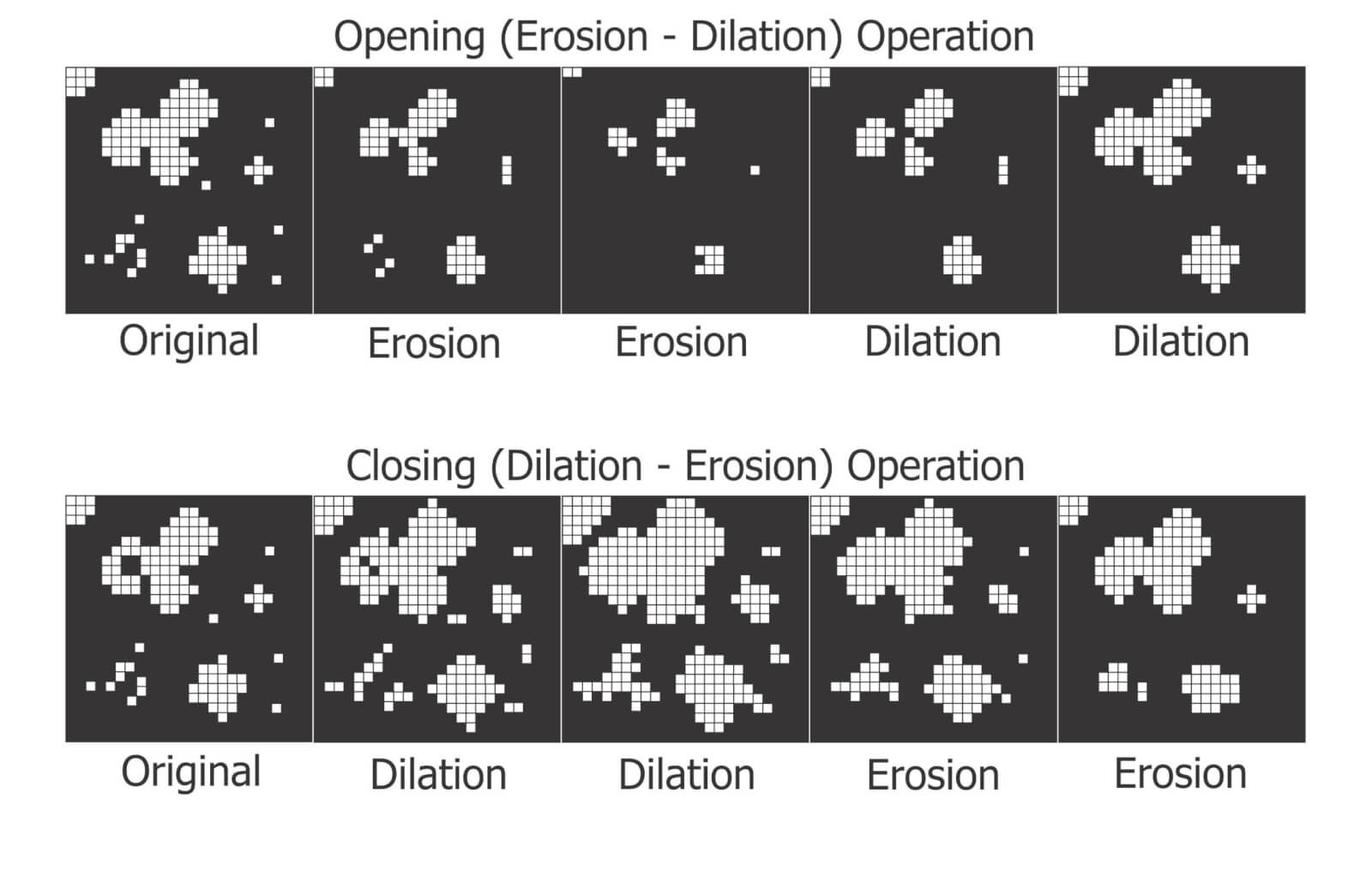
Many image processers use both these operations sequentially. When an image is eroded and then dilated (a process called “Opening”), smaller objects are removed, leaving the area and shape of remaining objects relatively intact. Dilating and then eroding (a process called “Closing”) fills in small holes and merges smaller objects, once again leaving the area and shape of remaining objects relatively intact. We can use both of these functions to help smooth an image prior to measurement.
(Top) Opening operations erode and then dilate the image. Moving left to right, the smaller objects tend to disappear. (Bottom) Closing operations dilate and then erode the image. Moving left to right, smaller objects either disappear or merge and holes are filled in
Distance Transformations
Distance transformations are advanced operations specifically used to separate objects that are densely packed. While not typically used when analyzing WSP, distance transformations are another means of identifying object nuclei. They are another means for teasing apart objects that are likely the result of overlapping deposits and then mapping their relative sizes and positions.
Measurement
The calculation of the area covered by deposits is straightforward. The pixels belonging to objects (the deposits) and those belonging to background are summed and then the fraction is converted to percent area covered. Research has shown that the image resolution does not significantly impact percent coverage assessments and has suggested that all image analysis software tends to produce similar results (+/- 3.5% observed when the same threshold was applied to multiple papers). This is acceptable because it’s within the variability inherent to spraying.
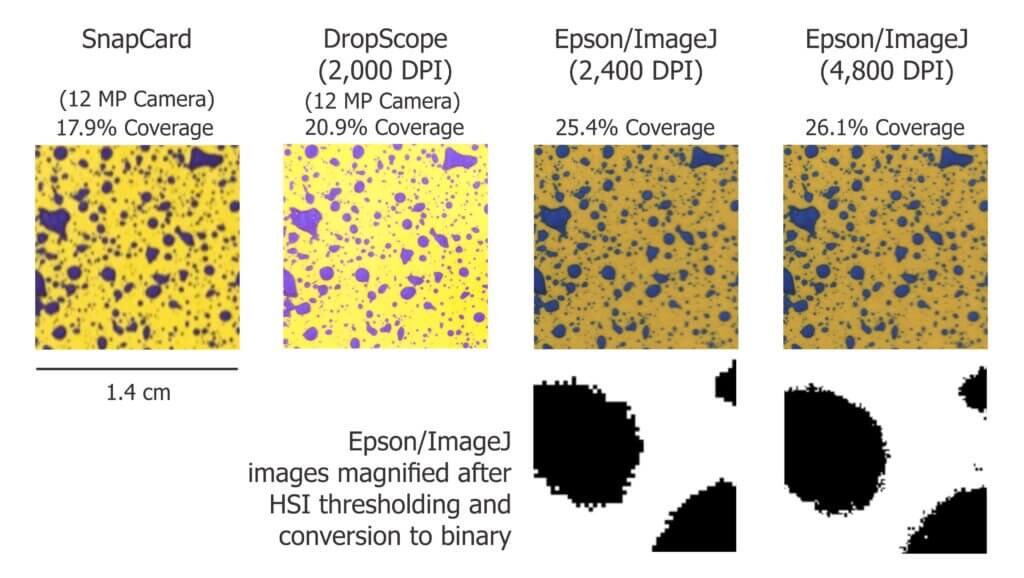
We ran a similar experiment wherein we analyzed the same piece of WSP using four methods. Here are a few facts about the software we used:
DropScope produces images between 2,100 and 2,300 DPI. Currently, it ignores ellipses and doesn’t count anything spanning less than ~35 µm (3 pixels).
We set ImageJ to ignore any object spanning less than 3 pixels, which at 2,400 DPI was 30 µm in diameter.
We are unaware of Snapcard’s processing methods except that the software was benchmarked using ImageJ. Developers note it will underestimate the percent area covered if the image is out of focus. (Note: As of 2026, this app may no longer be supported by the GRDC).
The images shown in the figure below were cropped from screenshots produced by each method. The actual ROI analyzed was ~3 cm2 for SnapCard, 3.68 cm2 for DropScope and 2.0 cm2 for both Epson/ImageJ methods. Our results indicate an +/- 4% difference in percent area coverage. This variability reflects the results of a 2016 journal article that compared SnapCard with ImageJ and other leading analytical software. That study claimed no statistically significant difference in percent coverage detected (standard deviations were about 20%). However, the ImageJ results tended to trend several percent higher than SnapCard. We saw this as well. And so, while resolution may not have a significant impact on percent area covered, there does appear to be some correlation.
Percent area covered as reported by three image analysis systems. Only a minor difference was observed when resolution was doubled using the Epson/ImageJ method.
Resolution definitely affects deposit counts. Particularly in applications that employ finer droplets. Consider the difference between detecting or missing 1,000 30 µm diameter objects. It may only amount to a fraction of a percentage of the surface covered, but +/- 1,000 objects on a 2 cm2 area is significant in terms of deposit density.
Output
Once a WSP image (or set of images) has been scanned, pre-processed, processed and measured, we will receive some manner of output. Some software packages create an attractive report with images, graphs and key values. These reports include percent coverage and many provide droplet density. Deposits may be binned by size, or spread factors are used to calculate the original droplet diameters and even estimate the volume applied by area. Other software packages provide raw data that can be imported into a statistical program or spreadsheet program like Excel for further analysis. Some software packages provide both.
How far can we take this?
Blow-by-blow data analysis is beyond the scope of this document, but how much weight should we give to coverage data obtained using WSP? The answer depends on the metric in question, but in all cases we must first acknowledge the three overriding caveats. Take it as said that they apply to everything that follows:
Different brands (and even different production runs) of WSP can produce significantly different coverage metrics. When conducting experiments, use a single brand of WSP. Better still, use papers from the same production batch whenever possible.
The same of piece of sprayed WSP can produce significantly different results depending on the software and protocol used to analyze it. When conducting experiments, use the same software and assessment protocol and be transparent about the process when communicating results.
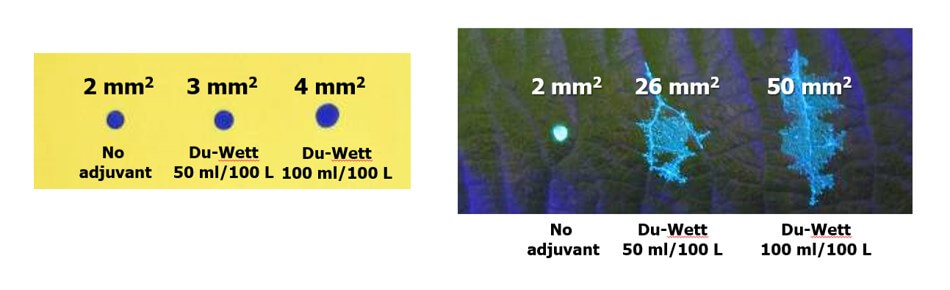
WSP coverage may not reflect the coverage achieved on an actual plant tissue surface. It is suitable as a relative index (I.e. papers can be compared to papers, but not to tissues) but the spread factor changes with surface wettability and the surface tension of the liquid sprayed. Note the differences in percent area covered in the following experiment with an organosilicone super-spreader:
Difference in deposit spread on water sensitive paper versus a leaf surface using an organosilicone super-spreader and UV dye. The same volume was applied in each case and while the area increased two-fold on WSP it increased ~10-fold on an actual leaf. Image reproduced from work by Robyn Gaskin, Plant Protection Products, New Zealand.
Recall that we started this document by listing the four pieces of information commonly sought using WSP. They were listed in order of reliability, and now we can explain why.
The percent surface area covered: We have established that this is the most reliable piece of data. Droplets do not spread on WSP the way they do on plant surfaces, so it will underestimate actual coverage. The results vary by analytical method, but it’s likely not dependent on resolution and still falls within the variability inherent to spraying. This metric gives us valuable and actionable information. We can say whether or not we hit a target, and evaluate whether a sprayer change resulted in more or less deposit.
The density of deposits on the target area: We have established that that there are limits to the reliability of this metric. It is affected by the analytical method used and can be greatly underestimated when resolution is poor or when deposits overlap in high numbers. Also, it will never reliably reflect deposits under 30 µm. Nevertheless, under controlled conditions this information does have value and is of great interest in enquiries about drift and contact fungicides.
The size of the droplets that left the stains: This metric is highly questionable except under controlled conditions. The many assumptions about surface tension, droplet speed, and droplet evaporation make it impossible to make definitive statements about spray quality. Finer droplets are greatly underestimated in this equation. Therefore, while there may be some value in using WSP as a relative index, this metric is a crude indication at best.
The dose applied to the target surface: This metric has not been discussed up to this point, but is quickly and easily dismissed. Let’s assume that a droplet with a high concentration of an active ingredient will leave a stain that is the same area as another droplet with a lower concentration. This will lead some to suggest that as long as the original concentration is known, we can back-calculate the dose (which is the amount of active on a given area). However, one droplet has the same volume as eight droplets that are half it’s diameter. This cubic relationship means that if they all deposit, the larger droplet will cover roughly 1/2 the surface area as the eight smaller droplets. Therefore, the smaller droplets spread the same amount of active over a greater area. Spread factor muddies this a bit, but ultimately it means that dose cannot be estimated from area covered. Dose is better assessed using collectors that permit the residue to be removed, such as Petri dishes, Mylar sheets, pipe cleaners, alpha cellulose cards, or glass slides.
And so, the image analysis process described here is powerful and effective when used with water sensitive paper as long as the limitations are acknowledged. The same process can also be used with dyes and specialized collectors such as Kromekote to permit even greater resolution. But that’s another story.
Marçal, A.R.S., Cunha, M. 2008. Image processing of artificial targets for automatic evaluation of spray targets. Trans. of the ASABE. 51(3): 811-821.
Moor, A., Langenakens, J., Vereecke, E., Jaeken, P., Lootens, P., Vandecasteele, P. 2000. Image analysis of water sensitive paper as a tool for the evaluation of spray distribution of orchard sprayers. Aspects of Applied Biology. 57.
Panneton, B. 2002. Image analysis of water‐sensitive cards for spray coverage experiments. Applied Eng. in Agric. 18(2): 179‐182.
Salyani, M., Zhu, H., Sweeb, R.D., Pai, N. 2013. Assessment of spray distribution with water-sensitive paper. Agric. Eng. Int.: CIGR Journal. 15(2): 101-111.
SnapCard website. University of Western Australia and the Department of Primary Industries and Regional Development, Western Australia. (Note: As of 2026, may no longer exist).
Syngenta. 2002. Water‐sensitive paper for monitoring spray distributions. CH‐4002. Basle, Switzerland: Syngenta Crop Protection.
Turner, C.R., Huntington, K.A. 1970. The use of a water sensitive dye for the detection and assessment of small spray droplets. J. Agric. Eng. Res. 15: 385-387.
Choosing the right time to spray can be tricky. Our gut tells us that spraying when it’s windy is wrong. The experts tell us that spraying when it’s calm is wrong. So when can you actually spray?
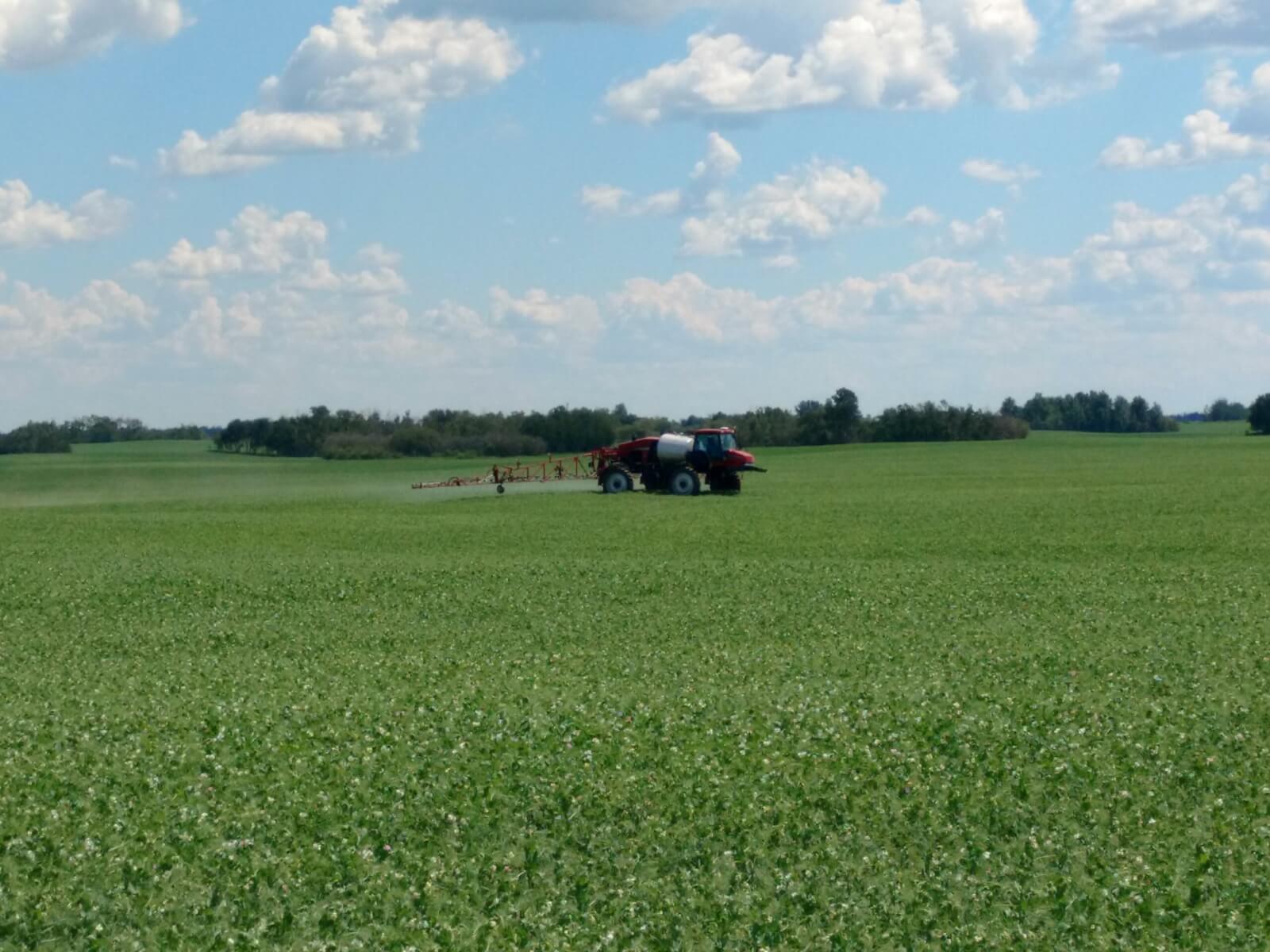
I’ve always advised my clients to spray in some wind, because it has a few advantages. The main one is that wind helps disperse the spray upward and downward, diluting the spray cloud fairly rapidly. Another advantage is that winds tend to be reasonably steady in their direction and velocity (or at least that can be forecast), so downwind areas can be identified and potential impacts are known or predictable. It helps if it’s sunny, because that improves the dispersion of the cloud even more.
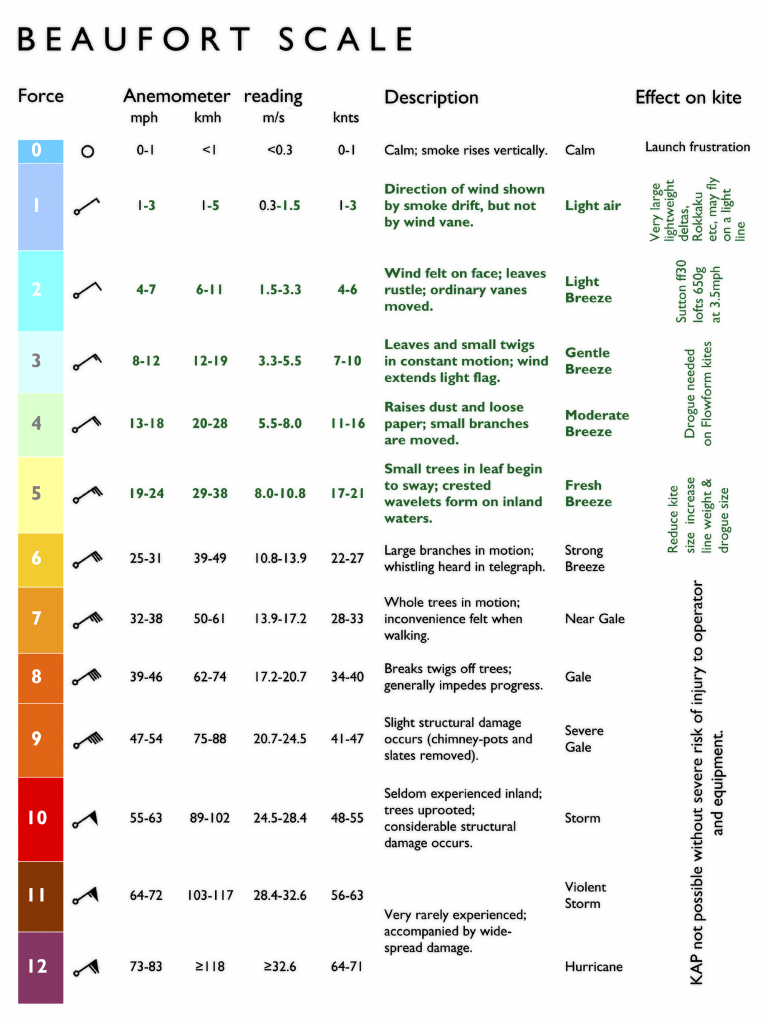
First, let’s define “windy”. The classic wind scale is the Beaufort Scale, intended for the sea, but also used on land. The upper limit for spraying is probably Force 3 or Force 4, with upper limits of 20 – 25 km/h or so. The Beaufort Scale calls these “Gentle or Moderate Breezes” (they had to save the alarming words for hurricanes), and the scale provides good visual clues such as what wind does to flags, leaves, or dust.
Spraying under breezy conditions can be done fairly safely if you follow specific steps. The idea is to understand what the risks are and to manage them.
The cornerstone is to use a low-drift spray and match it to a pesticide that will work well with larger droplets. But there are other important aspects to consider. Below are the top ten to think about:
Choose a herbicide that can handle large droplets. Glyphosate products are well suited to coarse droplets. But glyphosate commonly has contact actives in the mix, members of Group 6, 14, and 15, and these are less likely to perform well with big droplets than those that contain Group 2 and 4 mixes. Actives with soil activity also have more tolerance for larger droplets.
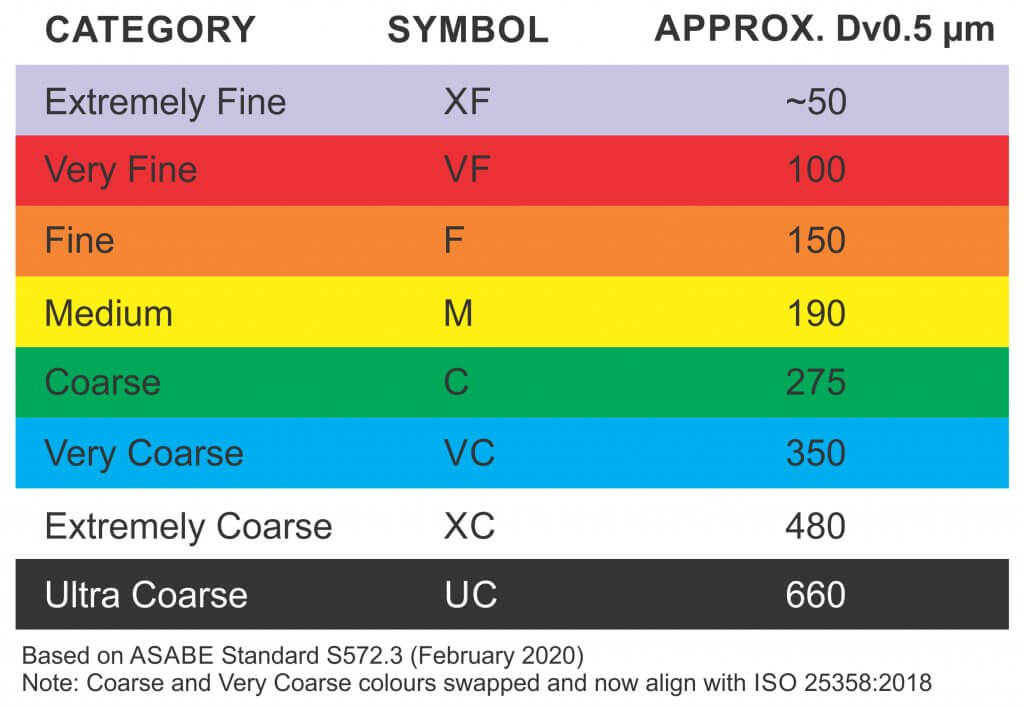
Use a low-drift nozzle and operate it so it produces a Coarse (C) to Very Coarse (VC) spray quality, as described by the manufacturer. Dicamba labels call for Extremely Coarse (XC) to Ultra-Coarse (UC) sprays, and Enlist requires at least Coarse. To achieve these you may need to purchase new nozzles. Low-pressure air-induced nozzles operated at about 50 – 60 psi will generally be very low-drift, but lower drift models are available. If you need a finer spray, produce it either by increasing the pressure or moving to a finer tip. Do this when the weather improves, for contact modes of action.
The name, symbol and range of droplet sizes used to describe the median droplet diameter produced by nozzles according to ASABE S572.3
Keep your boom low. Lowering the boom ranks as the second-most effective way to reduce drift, after coarser sprays. But there’s a limit. For low-drift sprays, you need at least 100% overlap (more for PWM), which is for the edge of one nozzle pattern to spray into the centre of the adjacent pattern. In other words, the spray pattern should be twice as wide as your nozzle spacing at target height. For most nozzles, a boom height of close to 20 inches is enough to achieve this overlap. That’s pretty low by current standards from suspended booms on self-propelled sprayers, so being too low for a good pattern will only happen due to boom sway.
Maintain reasonably slow travel speeds. These reduce the amount of fine droplets that hang behind the spray boom, reduce turbulence from sprayer wheels, and they also make low booms more practical. An added bonus is less dust generation.
Know what’s downwind and what harms it. Survey the fields on all sides of the parcel you’re treating. When you have a choice, avoid spraying fields that have sensitive areas downwind such as water, shelterbelts, pastures, people, etc. If you can’t avoid being upwind of these areas, make sure you check and obey the buffer zone restrictions on the label. These will also give you an idea if the product can cause harm in water or on land, or both.
Let the weather help you.
Take the wind from the side if you can. Going straight into the wind creates a lot of extra drift.
Consider a dicamba tip for special situations, even if you don’t use dicamba. If you’re in a situation where quitting and waiting is a poor option, these tips allow you to finish the job with minimal drift risk and with only slight reductions in product performance due to poor coverage.
Use a low-drift adjuvant. Specific products such as Interlock or Valid have been shown to reduce driftable fines (<150 microns) by between 40 – 60%, without adding significant volume in coarser droplets. The response will depend on the nozzle and the tank mix, but can be very noticeable.
Study drift and how it forms and moves. It’s about more than wind speed and droplet size. Knowledge in this area can help you work out the best strategies.
Invest in productivity. You may not need it every day, but on occasions when you have a small window to avoid bad weather, it pays dividends.
If you feel that drift is unavoidable and someone might be impacted by it, talk to those people first. It’s one of the most important things you can do.
Keeping pesticide sprays on target continues to be one of our top responsibilities.
This research was performed in 2012 and since then there have been considerable advances in application technology for asparagus in fern that should be considered. Be sure to read the epilogue at the end of this article.
Introduction
Diseases such as purple spot can have major economic impacts for asparagus growers, and the best line of defence is spraying the appropriate control products. The good news is that asparagus growers know this. The bad news is that there are few things harder to spray than asparagus in fern.
Asparagus infected with purple spot.
Asparagus in fern can stand 1.5 m (5 ft) high by 1.0 m (3 ft) diameter and is typically planted on 1.2 m (4 ft) centres. Asparagus in fern has a very dense canopy full of needle-shaped leaves. This dense canopy slows air movement, making conditions still, humid and very difficult for a spray droplet to penetrate.
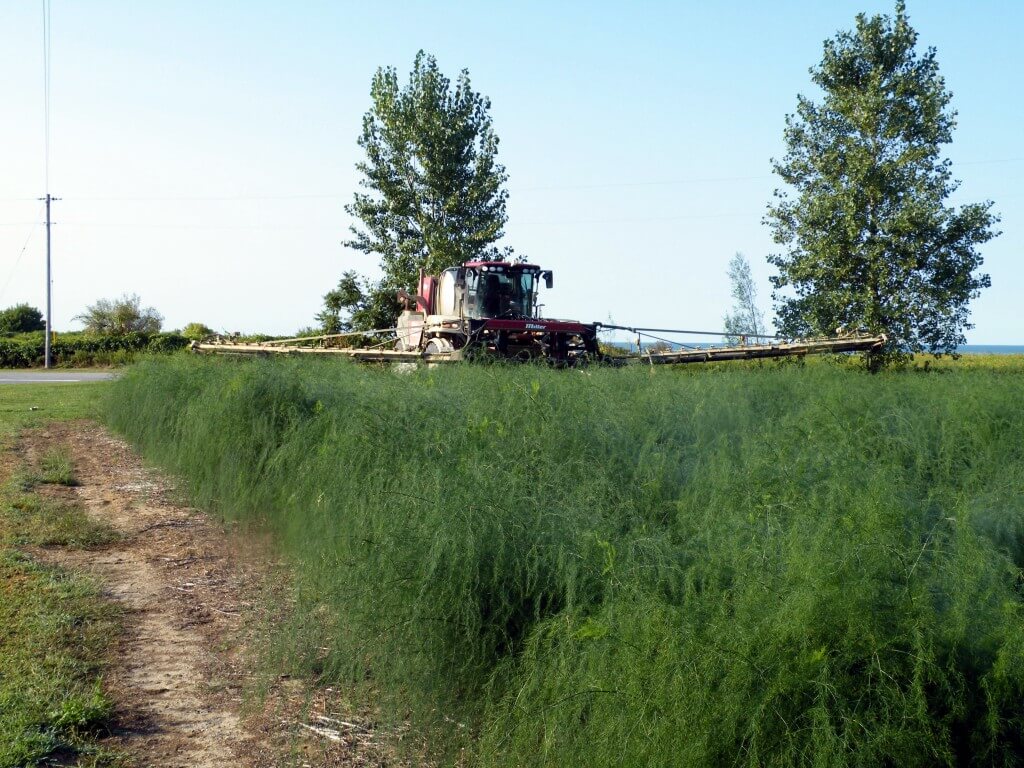
Spraying asparagus in fern.
Spray coverage is a combination of two factors: the area of the target contacted by spray droplets, and the distribution of spray droplets over that target. For most insecticide and fungicide applications, reasonable coverage is reflected by 10-15% surface area covered paired with an even distribution of approximately 85 medium sized droplets per square centimeter. This is not a rule, but a guideline.
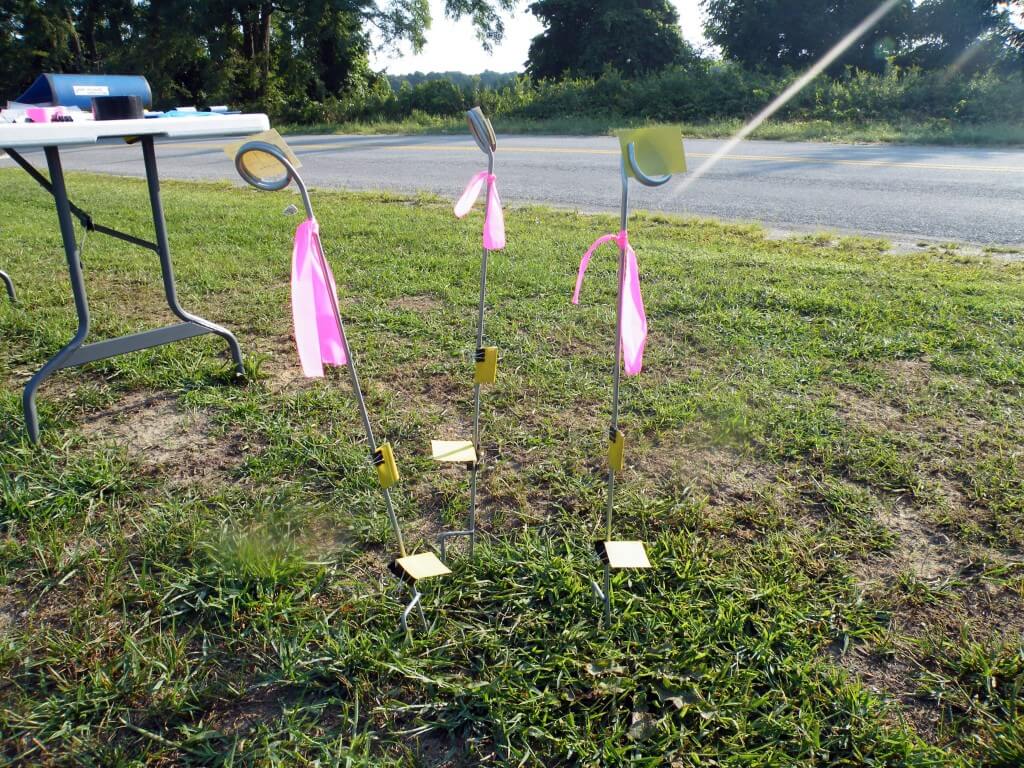
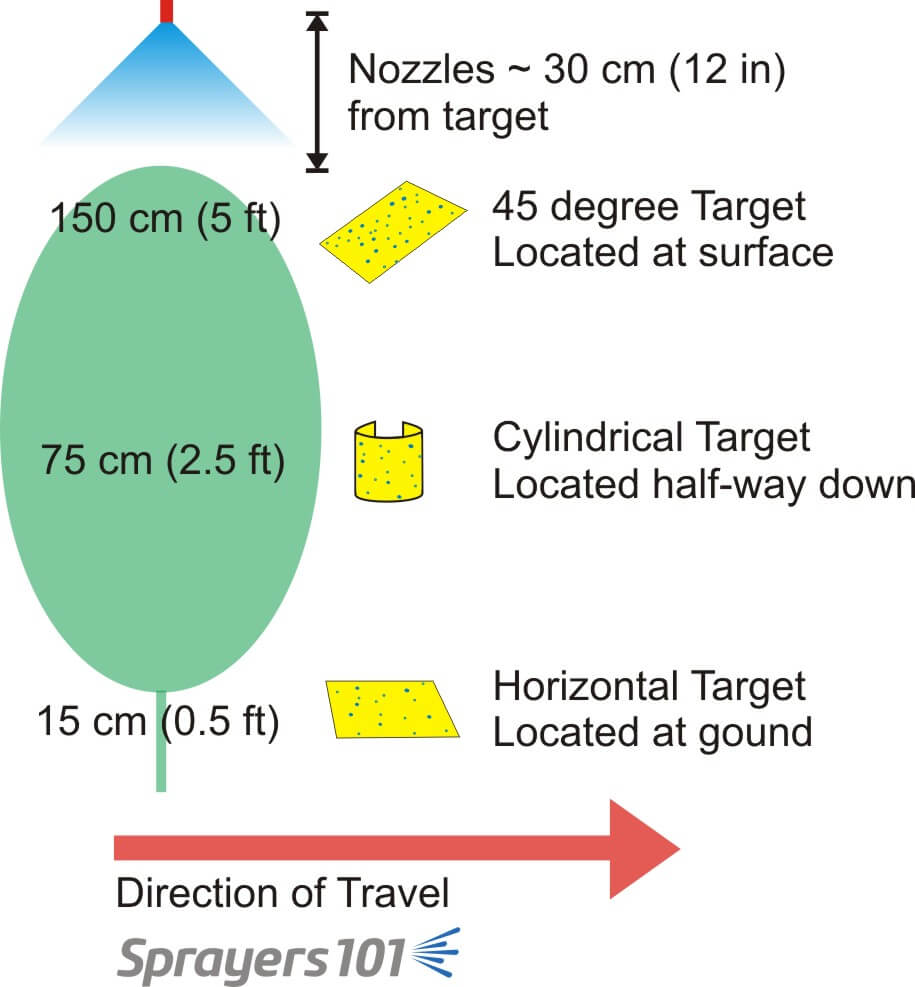
In order to determine the best way to spray, we have to be able to compare the coverage achieved. To do this, we used water sensitive paper, which is yellow until contact with spray turns it blue. Three sets of three targets were placed in approximately the same location for each pass.
Water sensitive paper arranged on stands, ready to be placed in the fern.Water sensitive paper orientation and location in asparagus canopy relative to sprayer direction.
We tested five popular nozzle types, at two ground speeds using three carrier volumes to answer three questions:
Does spray volume impact spray coverage?
Which nozzle style gives the best coverage?
Does travel speed impact spray coverage?
Does spray volume impact spray coverage?
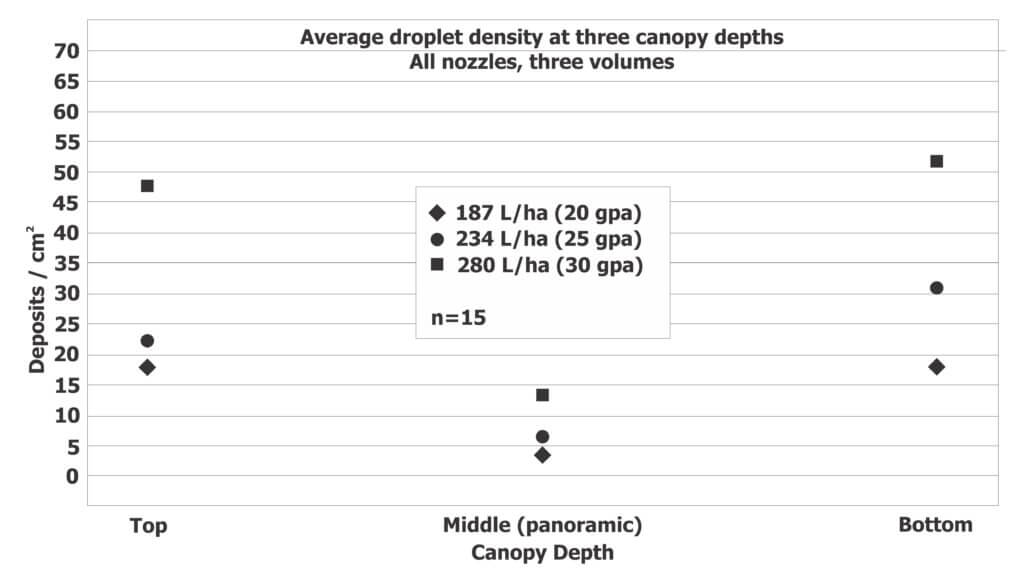
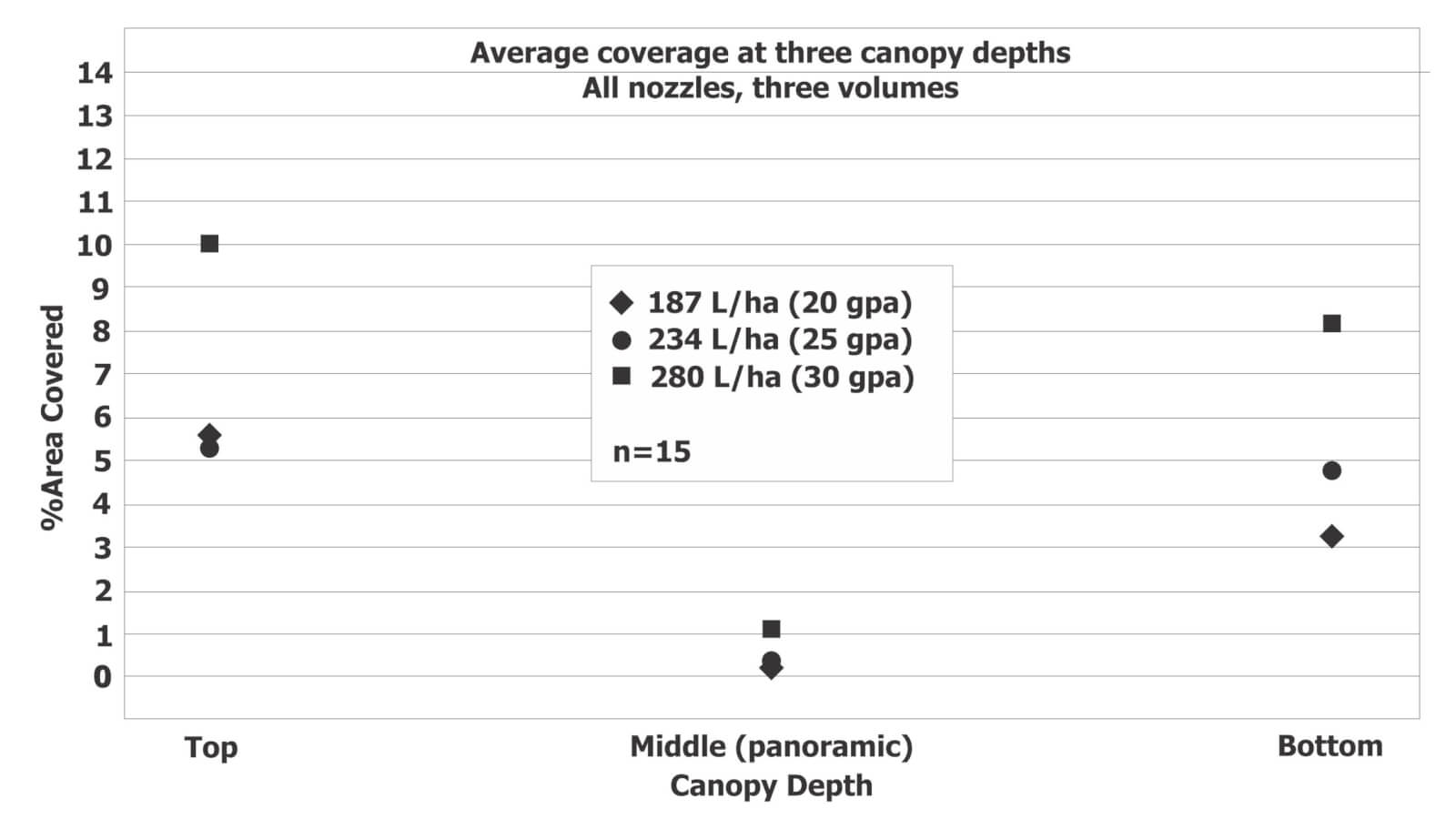
Five different nozzle types were used to spray three volumes onto the targets at 16 kmh (10 mph). This was repeated three times and target coverage was determined both as droplet deposits per cm2 (see Figure 1) and total % covered (see Figure 2).
Figure 1. Average deposits per cm^2 for five different nozzle types at 187 L/ha (20 US gpa), 234 L/ha (25 US gpa) and 280 L/ha (30 US gpa) at a ground speed of 16 kmh (10 mph).Figure 2. Combined average percent coverage for five different nozzle types at 187 L/ha (20 US gpa), 234 L/ha (25 US gpa) and 280 L/ha (30 US gpa) at a ground speed of 16 kmh (10 mph).
Cards in each position consistently received a significantly higher average deposit per cm2 and significantly higher average percent coverage at higher spray volumes. The relatively low coverage in the middle position was anticipated given the orientation of the targets to the sprayer.
Therefore, it would appear higher volumes result in better coverage, at least up to 280 L/ha (30 gpa). Generally, there is a threshold where exceeding a given carrier volume results in a diminishing return.
Which nozzle gives the best coverage?
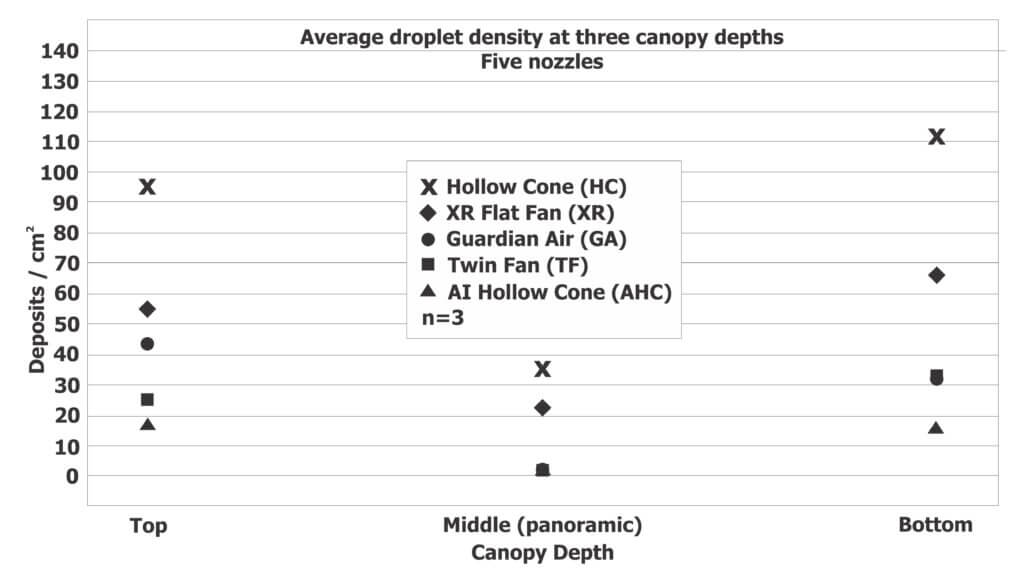
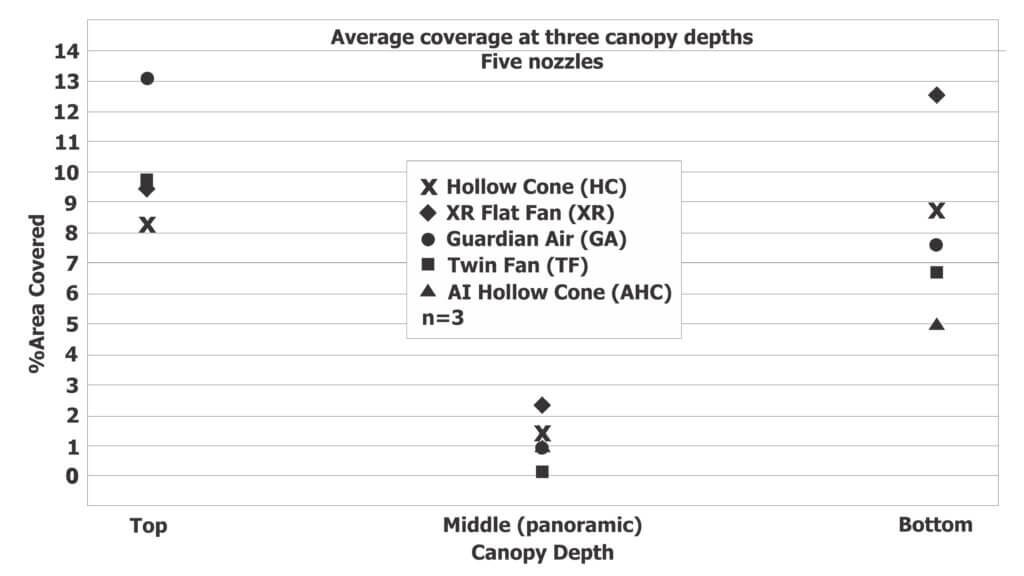
Coverage from five different nozzles was compared: the Hollow cone, Flat fan, Dual flat fan, Guardian Air and Air-induced hollow cone. Given that 280 L/ha (30 gpa) resulted in the best coverage, the following figures illustrate droplet deposits per cm2 (see Figure 3) and total % covered (see Figure 4) at 280 L/ha (30 gpa).
Figure 3. Average deposits per cm^2 for five different nozzle types at 280 L/ha (30 US gpa) and 16 kmh (10 mph).Figure 4. Average percent coverage for five different nozzle types at 280 L/ha (30 US gpa) and 16 kmh (10 mph).
The graphs show that each nozzle followed a similar trend, with more droplets at the top of the canopy, less or par at the bottom of the canopy, and considerably less in the middle of the canopy (which is not surprising given the orientation of the target around the stem).
The trend in droplet density from highest to least coverage is:
Hollow Cone
XR flat Fan
Guardian Air
Dual Flat Fan
Air Induced Hollow Cone
The percent coverage data was less clear. The top two nozzles for each position were:
Top Target:
Guardian Air
All other nozzles approximately the same
Middle Target (around the stem):
XR flat Fan
Hollow Cone
Bottom Target:
XR flat Fan
Hollow Cone
It can be argued that the target at the top of the canopy is easiest to spray, and therefore does not have as much importance as the middle and bottom targets. As such, it would appear that the XR flat fan and Hollow cone nozzles give the best overall coverage. It is debatable whether the higher droplet count from the Hollow cone is more important than the higher percent coverage of the XR flat fan.
Does travel speed impact spray coverage?
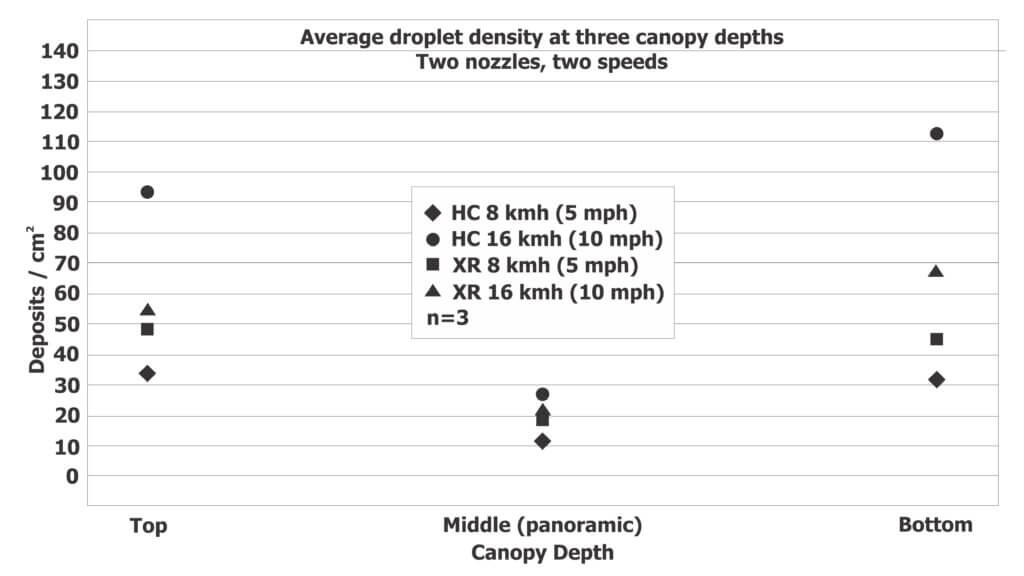
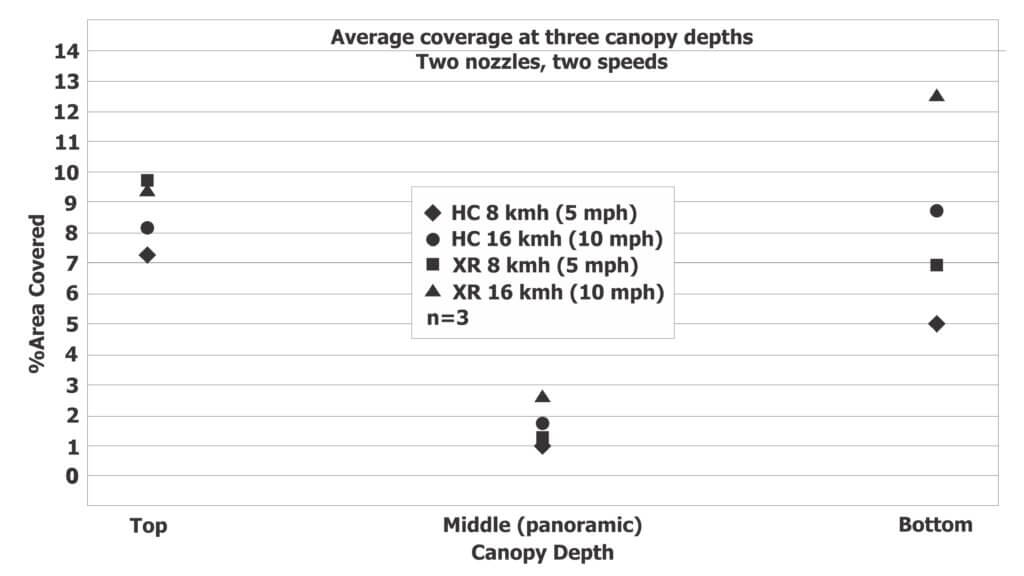
Hollow cone nozzles and XR flat fan nozzles were used to spray targets at two travel speeds and three volumes. Target coverage was determined both as droplet deposits per cm2 (see Figure 5) and total % covered (see Figure 6).
Figure 5. Average deposits per cm^2 for Hollow cone and XR flat fan nozzles at 280 L/ha (30 US gpa) and either 8 kmh (5 mph) or 16 kmh (10 mph).Figure 6. Average percent coverage for Hollow cone and XR Flat fan nozzles at 280 L/ha (30 US gpa) and either 8 kmh (5 mph) or 16 kmh (10 mph).
The variability in deposit density and percent coverage from medium/fine droplets created by the hollow cone nozzles make it difficult to determine statistical significance, but the trend suggests that higher ground speeds improve coverage in the middle and bottom of the canopy. This is likely due to the wake of the sprayer and the vortices created by its passage stirring fine droplets into the canopy.
Overall recommendations
The data suggest that coverage was improved when the sprayer travels at 16 kmh (10 mph) rather than 8 kmh (5 mph). Coverage was also improved at higher spray volumes, where 280 L/ha (30 US g/ac) provided the best overall coverage for all nozzles. As for the best nozzle, this depends on the application; the hollow cone created higher droplet densities than the XR flat fan, but the XR Flat fan created higher percent coverage. Higher droplet densities may be preferred when controlling disease with contact products, but spray drift becomes a significant concern. Higher percent coverage might be preferred with locally systemic products where complete coverage is less of a concern and preventing spray drift is a priority.
Epilogue
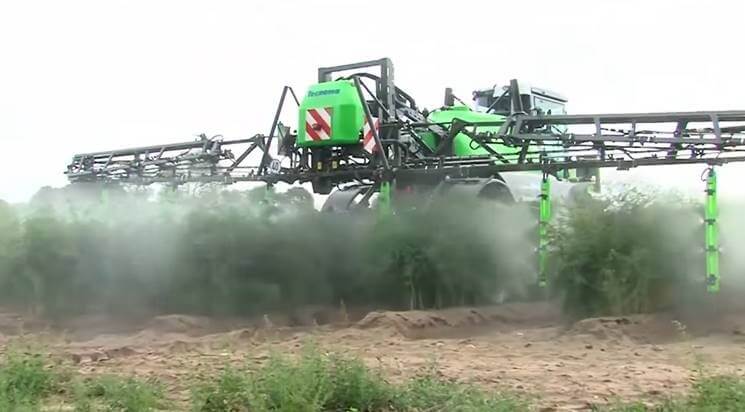
This work was performed in 2012. Since then there have been significant advances in sprayer design for spraying asparagus in fern. Dr. Torsten Balz (Bayer Application Technology Manager) kindly provided an example of such a sprayer (see below) and a video link to watch it in action. Drop arms that bring the nozzles closer to the target at all canopy depths are an ideal solution as long as the row spacing allows clearance without snagging the drops. Further, there have been developments regarding the use of hollow cones in an overhead broadcast application. Over- and under-laps in the hollow cone swath lead to double-dosing and gaps respectively that are referred to as “Technical Strip Disease”. Combined with considerable drift potential, hollow cones are not recommended.
Air-assisted drop arms greatly improve coverage uniformity in asparagus in fern. Photo kindly provided by Dr. Torsten Balz.
Special thanks to Max Underhill Farm Supply (Vienna, Ontario) for use of their sprayer and their assistance both spraying and placing water sensitive papers in the field. Thanks to Mr. Ken Wall of Sandy Shore Farms Ltd. (Port Burwell, Ontario) for providing the site and hosting the associated workshop, and thanks to TeeJet Technologies for their donation of parts and supplies.