Crop-Adapted Spraying (CAS) and an Apple Orchard Case Study

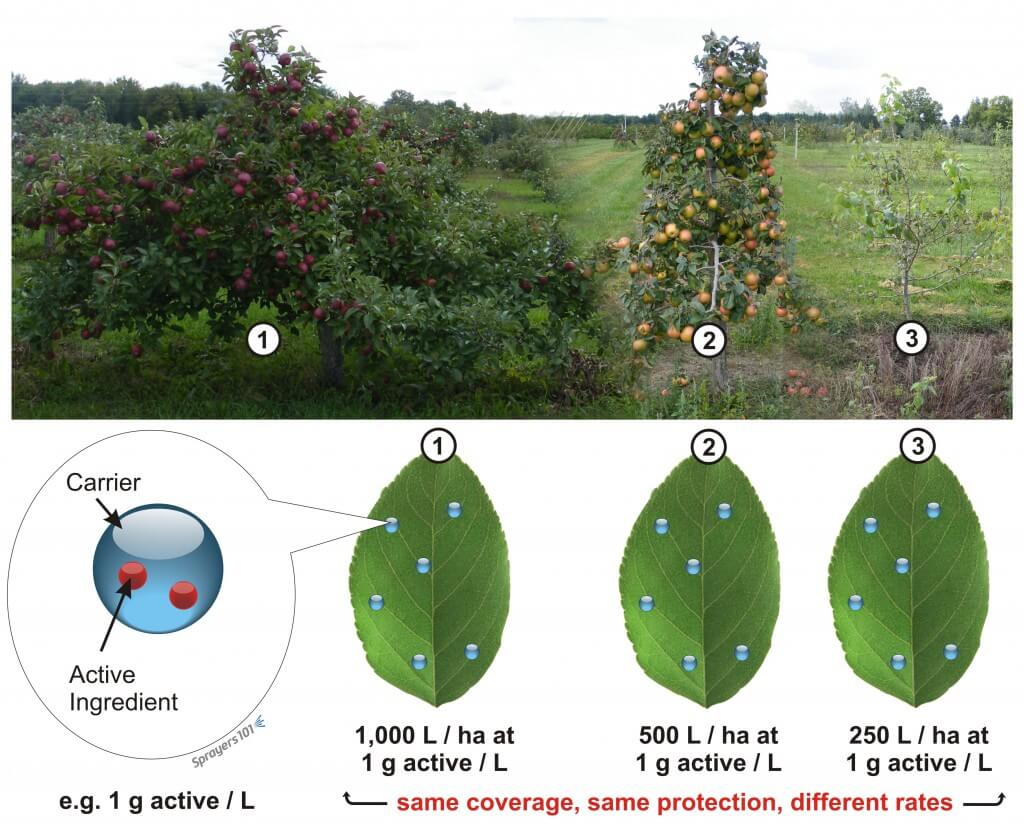
The ultimate goal of CAS is to adapt the amount of active ingredient per unit ground area such that the amount of active ingredient per unit target area (usually the leaf area) remains constant for canopies of varying shape and density. When this is achieved with sufficient accuracy, the pesticide efficacy is maintained. These three plants are all significantly different in size. When calibration is appropriate to each plant, the foliar coverage “experienced” for each plant will be the same, in spite of differences in the amount of solution expelled per ground area.

An orchard spraying scenario Here’s a common situation: An orchardist following IPM identifies a pest that poses an economic threat. It’s an annual pest and spraying is really a matter of when, not if. The operation is 150 acres and runs three airblast sprayers; two have a tower and one does not. Multiple varieties are […]

Read More… from Crop-Adapted Spraying (CAS) and an Apple Orchard Case Study

Optimizing Sprayer Air Settings – Part 2

This is part two of a two part article on how to optimize the match between the sprayer air and the target canopy. You can find the first part here. For a more fulsome description of the process, consult chapters 3, 9, 10, and 11 of Airblast101. Evaluating air energy – Ribbon test part 2 […]

Read More… from Optimizing Sprayer Air Settings – Part 2

Optimizing Sprayer Air Settings – Part 1

This is part one of a two part article on how to optimize the match between the sprayer air and the target canopy. For a more fulsome description of the process, consult chapters 3, 9, 10, and 11 of Airblast101. Why is air so important? Air handling is the most important and least understood mechanical […]

Read More… from Optimizing Sprayer Air Settings – Part 1

Don’t try this tempting shortcut

There’s a call that I’ve been getting for 20 years now. It came again this week. Someone has a twincap with two small air-induced tips, and they’re applying herbicides and fungicides with low water volumes, often 5 gpa, sometimes less. They call because they want to know how much wind they can spray in. Is […]

Read More… from Don’t try this tempting shortcut

Six Spray Technology Skills for Agronomists

Agronomists help farmers manage their crop with advice on everything from crop cultivars to fertilizer rates to marketing. It’s challenging to be an expert on everything, but a few core competencies can go a long way to improving the level of service. Agronomists are also responsible for communicating environmental best practices. Along with fertilizer rates […]

Read More… from Six Spray Technology Skills for Agronomists